
Stoicism: The Ancient Art of Facing Fate and Death
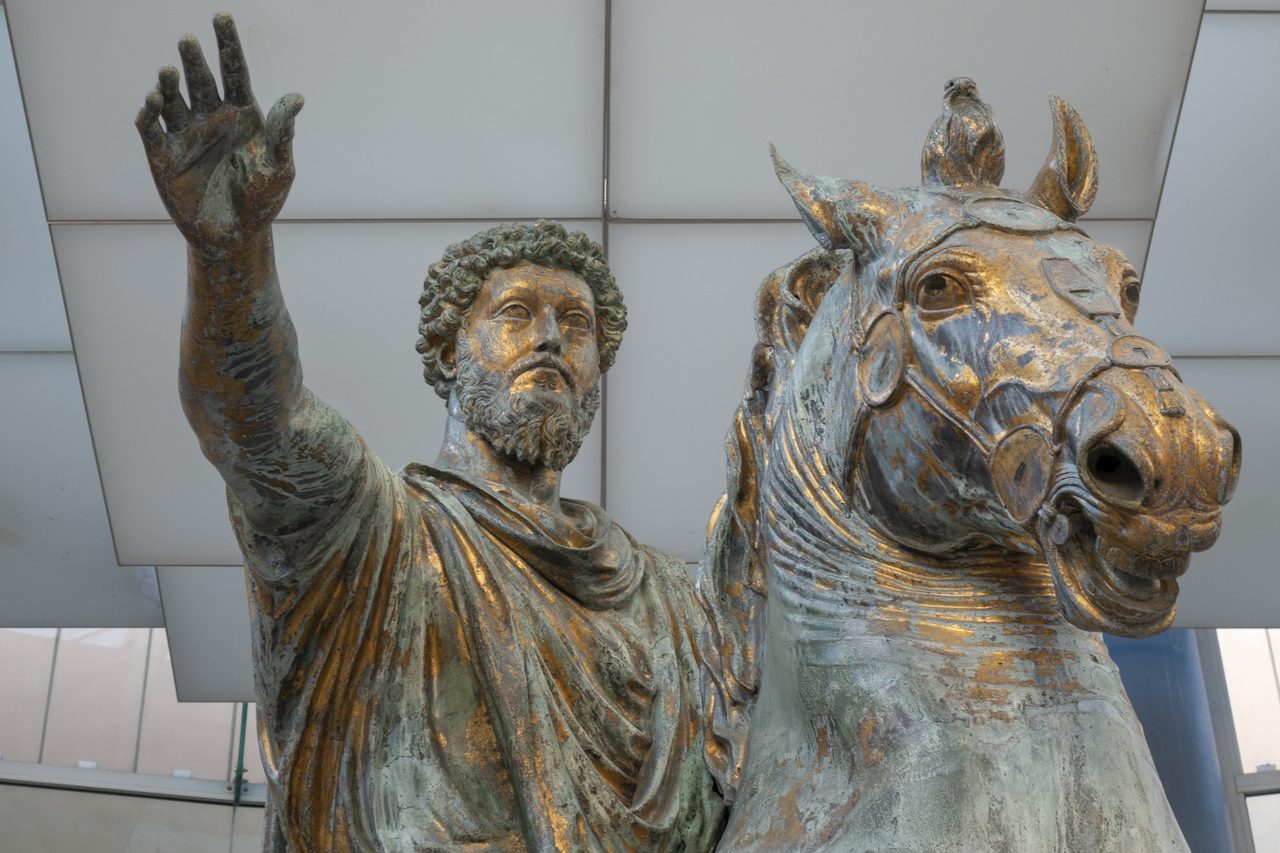
Zeno of Citium began teaching around 300 BCE in a painted public porch in the Athenian agora, and the school took its name from the building. The three Stoics whose work survives came much later and from opposite ends of the Roman world: a man born a slave in Asia Minor, a wealthy senator compelled to kill himself, and an emperor writing privately to himself on a war frontier. All three held that nothing outside a person's own judgment belongs to them. That verdict is not portable advice, because it rests on a physics, a single living rational cosmos in which everything that happens was caused by what came before it, and the standing objection to the modern versions is that they keep the ethics and drop the cosmology. This article carries both halves, and refuses nine widely repeated Stoic quotations and tags, one at a time, with the reason for each.
A public porch in the Athenian agora, decorated with mural paintings and open to anyone walking past, is where this begins. The school that formed around it was not named after its founder, or its doctrine, or its city. It was named after the building. The Greek for that kind of porch is stoa, and the people who gathered there became the people of the porch.
Almost nothing written by those first Stoics survives. What survives, complete and in quantity, is the work of three Romans at the far end of the tradition: a man born into slavery in a Greek city of Asia Minor, a wealthy senator who was ordered to kill himself, and an emperor who kept a private notebook on a war frontier and never meant anyone to read it. Between them they left the sentences that circulate today, which is the first problem this article has to deal with, and it is a large one.
A note on the quotation marks, because on this subject they are the whole game. Seven passages from the ancient texts appear inside quotation marks below, and every one of them names its translator and its standard reference, because a quotation with no translator cannot be checked and misattributed wording is endemic here. Other quotations below come from the Stanford Encyclopedia of Philosophy and from one modern paper's own abstract, and each names its source in the sentence carrying it. Nine widely repeated Stoic lines and tags do not appear at all, and section 07 sets out what was found about each. Two of the nine are printed inside quotation marks in our own research files, with no translator named, in wordings that match no translation verified for this article; the verified wordings are quoted instead, and the correction is made on the page rather than quietly.
Several neighbouring subjects are not this one. Free Will, in this same wing, owns determinism: the experiments, the modern three-position map and the courtroom stakes. Stoic fate is a determinism claim, and it gets exactly one passage here, in section 03, as the ancient ancestor of a position that article carries in full. Death and the Afterlife owns the cross-cultural map of what is said to happen after dying, and it has already filed the Stoics under dissolution; this article gives the Stoic account itself and does not re-run the survey. The Meaning of Life owns the rival answers to meaning and already carries a one-sentence version of the Stoic one, and this article is the long form of that sentence. The modern philosophy that begins from the opposite premise about the cosmos, a universe that refuses to answer, is The Absurd.
The tier marks follow our own two research files where they assign them, and this article's stated principle where they do not. What a surviving text says, and where it says it, is Tier 1. A live scholarly position with named holders on more than one side is Tier 2. A parallel that its own proponents call a parallel is Tier 3. Tier 4 is refusal, and on this subject the refusals run in two opposite directions at once, which section 14 and the verdict both set out.
01The Porch In The Agora
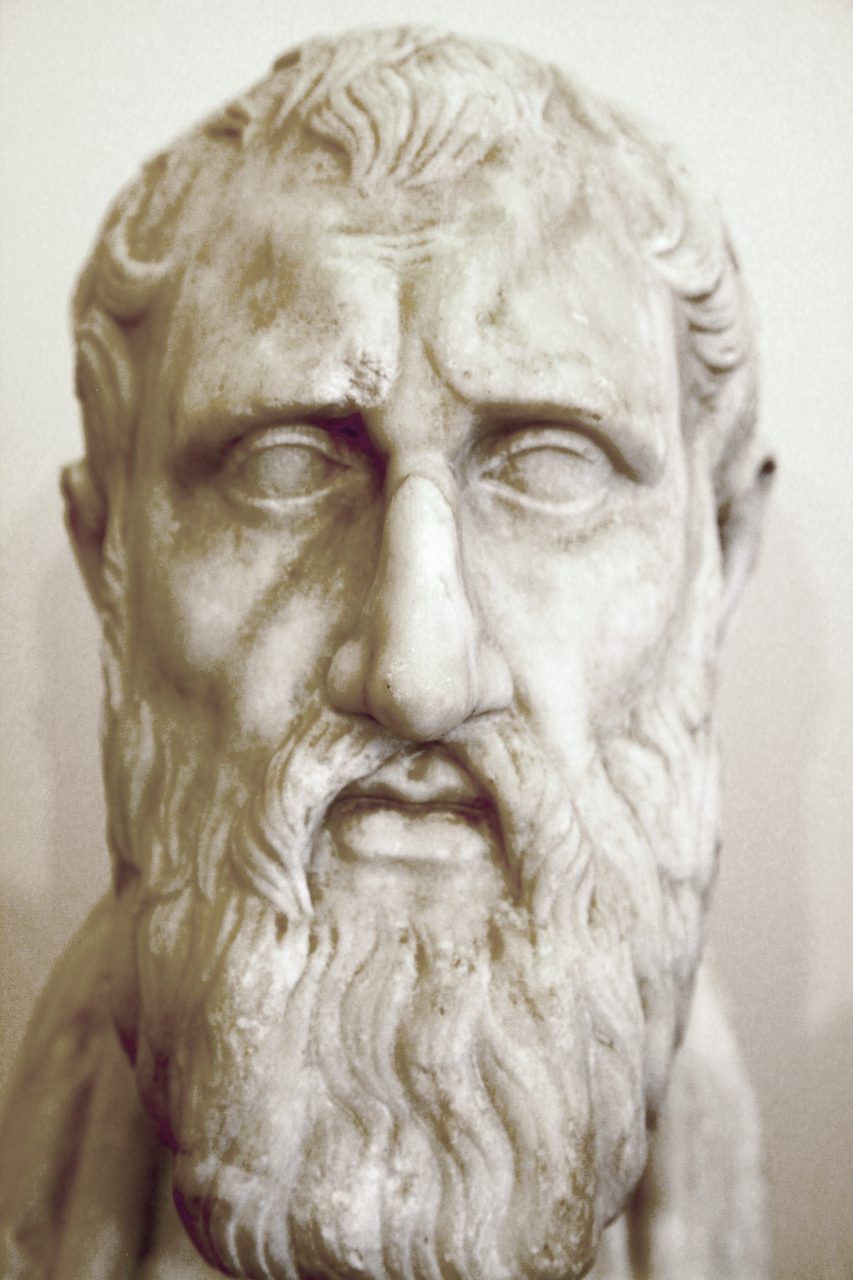
Zeno of Citium, approximately 334 to 262 BCE, founded the school at Athens around 300 BCE. Citium was a city on Cyprus with a large Phoenician population, and both of our research files describe Zeno as a merchant who came to Athens and stayed to study philosophy. Both also report that he arrived there by shipwreck. That detail belongs to the ancient biographical tradition preserved by Diogenes Laertius rather than to anything independently attested, and it is repeated here as what the tradition says and not as an event. Where he taught is not in doubt. The Stanford Encyclopedia of Philosophy's entry on Stoicism traces the school's name to the "porch (stoa poikile) in the Agora at Athens decorated with mural paintings, where the first generation of Stoic philosophers congregated and lectured", and dates the founding to "around 300 BCE".
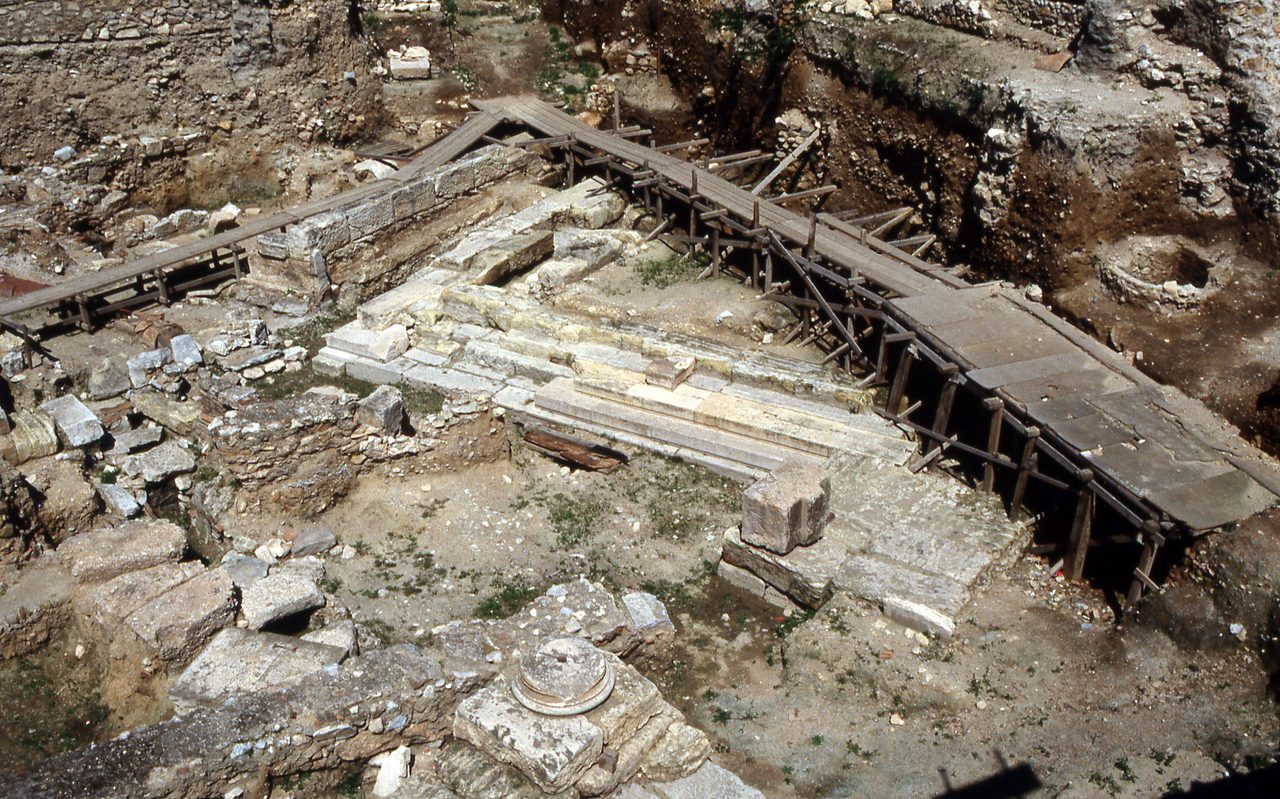
Neither of our files mentions that the Painted Porch has been dug. It has. The American School of Classical Studies at Athens has excavated the Athenian agora since 1931, and a portion of the building was exposed during the 1981 season under T. Leslie Shear Jr., with the excavations of 1980 to 1982 published in Hesperia in 1984 and cited below. The remains lie north of modern Adrianou Street, outside the fence of the main archaeological site. One hedge belongs in the same breath, and it is the site's own. The information panel standing at the excavation, transcribed on the source page of one of the photographs used in this article, describes the remains as tentatively identified as those of the Stoa Poikile and dates the building to about 475 to 465 BCE. The porch has not been found in the sense of proved. It has been dug, and the identification is the excavators' reading, which is how this article states it everywhere it comes up.
The school ran for centuries, and every voice that survives whole belongs to its end. Our files divide it in three. The Early Stoa is Zeno, then Cleanthes, then Chrysippus, at Athens. The Middle Stoa is Panaetius and Posidonius, who brought Stoicism to Rome. The Late Stoa, the Roman one, is Seneca, Epictetus and Marcus Aurelius, whose works are the primary surviving texts. That division is worth holding onto for the rest of this article, because the three men who get quoted belong to the end of the tradition and not to its foundations.
02Logic, Physics, Ethics, And Nothing Complete
Stoicism has three parts: logic, physics and ethics, in Greek logike, phusike and ethike. The school held that they depend on one another rather than standing alone, and the ancient teachers reached for analogies to say how. The Stanford Encyclopedia records three of them, and one is enough here: the parts were compared to a fertile field, in which "the surrounding wall corresponds to logic, its fruit to ethics, and its land or trees to physics". The ethics is the fruit. Everything below about facing fate grows out of a claim about what the universe is, and detaching the one from the other is the standing objection to the modern versions, which section 12 returns to.
Stoic logic worked with propositional forms, if-then, and, or, rather than with the Aristotelian syllogism, and that difference is real. Our primary file goes further and says the Stoics pioneered propositional logic. Its own counter-arguments block then says scholars remain sceptical of claims that Stoic propositional logic anticipated modern formal logic in structure, and that the correspondence between Chrysippean logic and Boolean algebra remains debated. Both of those cannot sit at Tier 1, so only the first does: the Stoics reasoned with propositions where Aristotle reasoned with terms, and whether that anticipated anything modern is contested. The epistemology beside it is not contested and can be carried plainly. Katalepsis is a cognitive grasp, an impression so clear that it compels assent, and it is the Stoic answer to how anyone knows anything at all.
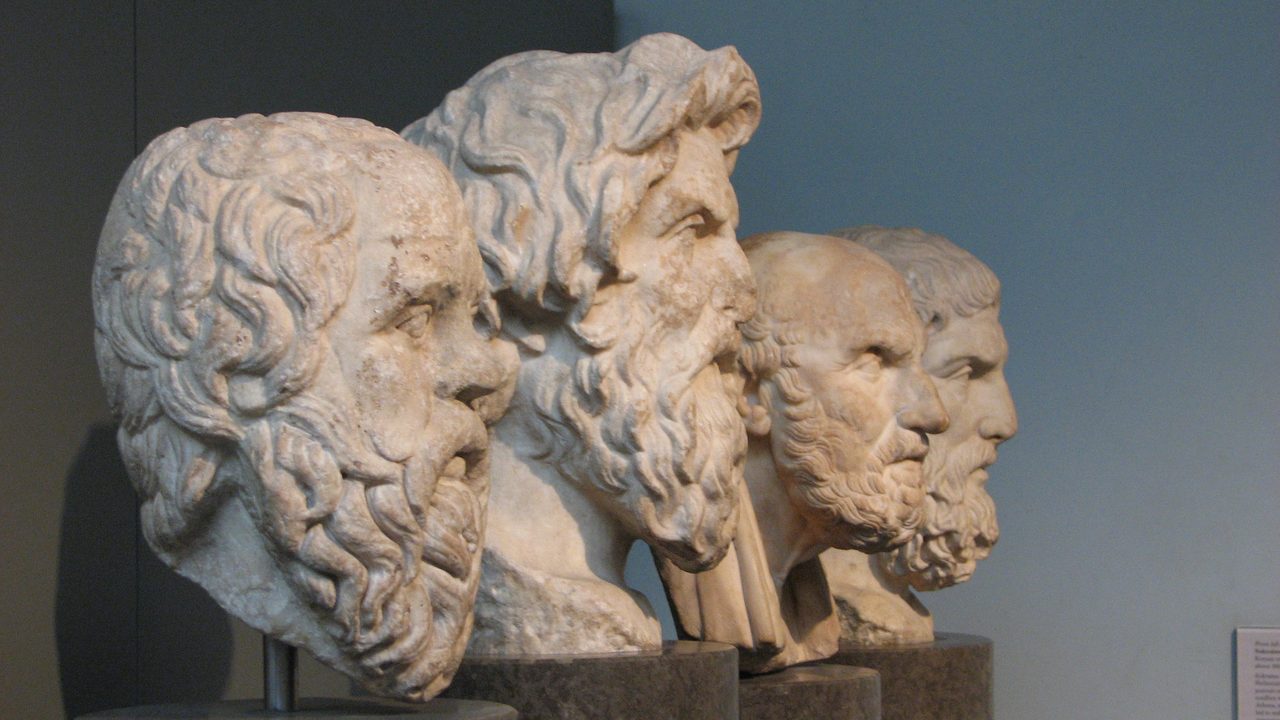
Chrysippus, approximately 279 to 206 BCE, systematised Stoic logic and physics, and the usual thing reported about him is the size of that effort. Our two files report it differently, one saying more than 705 works and the other more than 700, and both print it as though it were a modern bibliographic count. It is not. It is an ancient report, and it can be quoted at its source. Diogenes Laertius, writing much later, says of Chrysippus's treatises, in R. D. Hicks's translation of Lives of the Eminent Philosophers VII.180, that "there are more than 705 of them". Not one of them survives. Nothing complete survives from Zeno, Cleanthes or Chrysippus at all, and what the early school held is reconstructed from fragments and summaries in Diogenes Laertius, Plutarch, Cicero and Sextus Empiricus.
03A Cosmos That Is One Living Thing
The Stoic universe is a single living, rational organism. It is permeated by logos, the rational structuring principle, and shaped by pneuma, a creative fire or breath that acts on passive matter and gives everything its qualities. Everything is material, including the soul, and including God. Our primary file states the identification without softening it: God is logos is Nature is Providence is fate, four names for one thing. From that physics the ethics follows directly. If the cosmos is rational, then the good life is the life lived according to nature, kata phusin, which our secondary file glosses as according to reason. This is the sentence to keep for the rest of the article, because it is what makes facing fate a position rather than a mood.
Everything happens according to an unbroken chain of causes, which the Stoics called heimarmene, and they held this compatible with moral responsibility. The Stanford Encyclopedia gives their fate as "a certain natural everlasting ordering of the whole: one set of things follows on and succeeds another", says everything is "metaphysically determined by preceding causes", and states that the Stoics defend compatibilism. Chrysippus's answer to the obvious objection is a cylinder. A cylinder and a cone are pushed down a slope and roll differently, and the encyclopedia is exact about why: "the push gave it its beginning of motion but not its capacity for rolling". The external impression starts the motion; what the thing is determines what the motion becomes, so, in the same wording, "assent will be in our power". That is ancient compatibilism, and it is the direct ancestor of a position Free Will carries in full, with the experiments, the modern three-way map and the legal stakes. This article names it and moves on.
04The Only Good Is Virtue
Virtue, arete, is the only good, and vice the only evil. Everything else, including health, wealth, reputation and life itself, is indifferent, adiaphora, in the technical sense that it does not make a life good or bad. The Stanford Encyclopedia states it as "only virtue benefits a human being and makes our lives go well, so only virtue is good". The four cardinal virtues are wisdom, courage, justice and temperance: sophia, andreia, dikaiosune and sophrosune.
The caricature stops at the previous paragraph, and the caricature is wrong, because the indifferents are sorted. Preferred indifferents are, in the encyclopedia's phrase, "according to nature", which makes it appropriate to pursue them "even though their possession doesn't affect happiness". Health is preferred over illness and wealth over poverty, and pursuing them is appropriate on the doctrine's own terms. What the doctrine denies is that having them makes a life good. That sorting is the correction the caricature drops, and it is doctrine rather than counsel: the Stoic position is not that nothing matters, but that only one thing counts as good.
Apatheia does not mean what the English word apathy suggests. It is freedom from the destructive passions, the pathe, and it is not apathy and not numbness. The encyclopedia gives the ancient definition of a passion as an "impulse which is excessive and disobedient to the dictates of reason, or a movement of soul which is irrational and contrary to nature", and records that passions were held to involve false cognitive judgements, mistaking indifferents for goods or evils. The virtuous person, in the same entry, is "passion-free" without being emotionless, and experiences what the Stoics called "good feelings", the eupatheiai. Our secondary file names three of them: rational joy, chara; rational caution, eulabeia; and rational wish, boulesis. Our primary file names the failure on the other side, anaisthesia, numbed insensitivity, which the Stoics counted a vice. A school that names a vice for feeling too little is not a school that taught feeling nothing, and section 14 returns to what the English word has done to this.
05Some Things Are In Our Control
Epictetus was born into slavery. The Stanford Encyclopedia's entry on him, by Margaret Graver, puts it as precisely as the evidence allows: "Born sometime in the 50s C.E. in Hierapolis, a Greek city of Asia Minor", he "spent a portion of his life as the slave of Epaphroditus, an important administrator in the court of Nero". Our secondary file adds that he studied under Musonius Rufus. After being freed he was forced out of Rome by Domitian's edict of 89 CE banning philosophers, and then, in the encyclopedia's words, "established his own school at Nicopolis ... in Epirus, on the Adriatic coast of northwest Greece, and remained there teaching and lecturing until his death around 135". Our own files give his dates as approximately 50 to 135 CE; the reference work is both more precise about the place and more careful about the year, and this article follows the careful form.
He wrote nothing himself. The Discourses were written down by his student Arrian. Our secondary file says four books survive of eight; the encyclopedia says the surviving work comprises "four books, or volumes, but the original work comprised eight or more books". The open form is the accurate one and it is the one used here: four books survive of an original of eight or more. The Enchiridion, the handbook quoted twice in this section, is described in the same entry as "a brief abridgment of the Discourses".
The handbook opens with the sentence the whole school gets reduced to. In Elizabeth Carter's translation, Enchiridion 1 begins: "Some things are in our control and others not." What follows in the text is the sorting: judgements, desires and aversions on one side; body, property and reputation on the other. Our files call the faculty of moral choice prohairesis and call it the one thing entirely up to a person, and our secondary file marks the dichotomy of control as the single most influential concept in Stoic practical ethics, which is that file's judgement and is carried here as that file's judgement. The reason to reach the doctrine through Epictetus's own sentence rather than through a gloss is that the sentence contains no instruction at all. It is a claim about what a person owns.
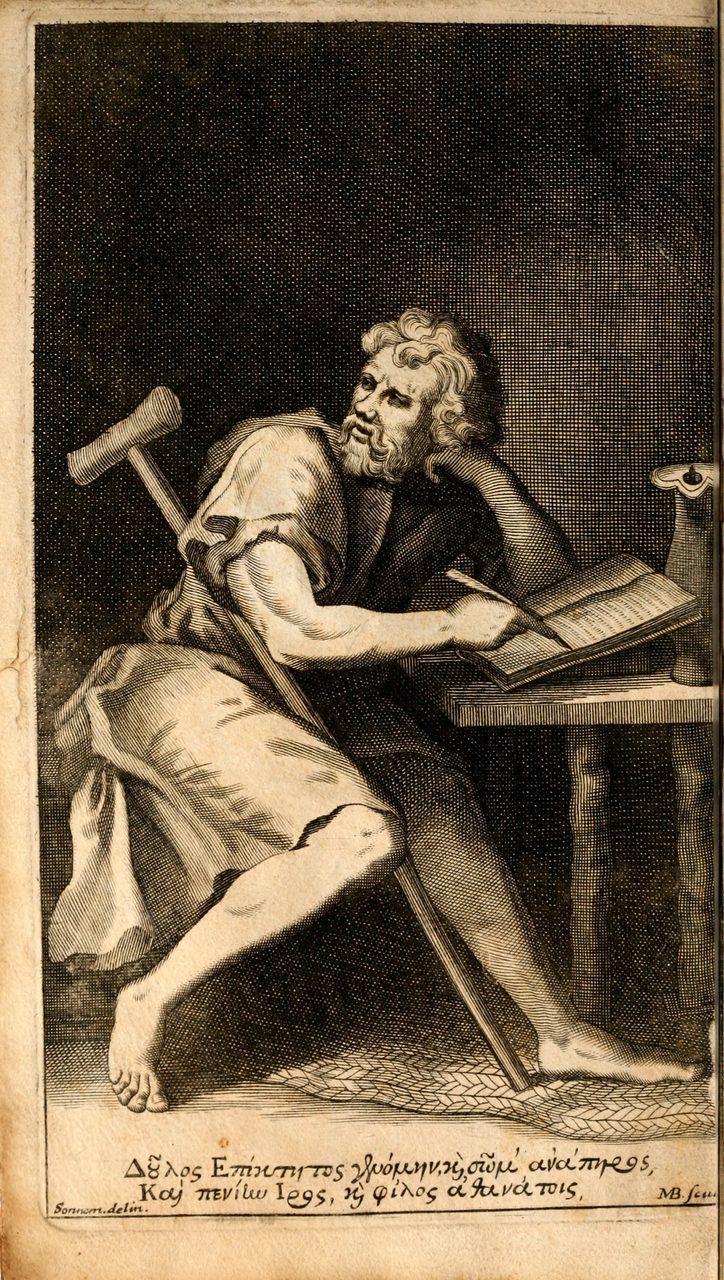
Enchiridion 5 is where that claim meets this article's subject, because the example the text reaches for is death. Carter's translation of the passage runs: "Men are disturbed, not by things, but by the principles and notions which they form concerning things. Death, for instance, is not terrible, else it would have appeared so to Socrates. But the terror consists in our notion of death that it is terrible. When therefore we are hindered, or disturbed, or grieved, let us never attribute it to others, but to ourselves; that is, to our own principles." Note what the passage actually does. It locates the disturbance in a judgement rather than in the event, which is a claim about where the thing is, and the Stoic case for why that judgement is mistaken runs through the physics of section 03 and arrives in section 09.
06The Emperor's Private Notebook
Marcus Aurelius was born in 121 CE and was Roman emperor from 161 CE until his death in 180 CE. The Meditations is a private notebook in twelve books, written in Greek. The Stanford Encyclopedia's entry, by Rachana Kamtekar, says he "wrote for his own moral improvement" and that the work was "written during the last years of his military campaigns"; our secondary file places that composition on the Danube frontier and gives the Greek as Ta eis heauton. The encyclopedia is careful where our own files are not. The work "was not known in antiquity" under a formal title, and Byzantine sources called it ta eis heauton, which the entry renders "the [writings] to himself". The title on the cover of a modern edition is a later label. Our primary file calls the book one of the few extant records of a world leader's inner philosophical life; that is an evaluation rather than a count, and this article does not repeat it as one.
It has been in print continuously since its first edition, which is a stranger fact than it sounds for a document its author never intended anyone to read. Our secondary file gives that first edition as 1558. The editio princeps was Wilhelm Xylander's Greek text with a Latin translation, printed at Zurich, and the sources consulted for this article disagree between 1558 and 1559, with 1559 the commoner date; no bare year is printed anywhere in this article for that reason. A dedicated scholarly treatment of the making of that first edition, Mikhail Sergeev's 2021 study of Conrad Gessner's work on it, is cited below. What is not in dispute is the shape of it: a set of private notes, written by a man to himself on campaign, has been continuously available in print since the late 1550s.
One sentence joins the physics to the ethics in a single line, in George Long's translation of Meditations IV.3: "The universe is transformation: life is opinion." Our primary file prints that passage inside quotation marks in a different wording and names no translator, which is why the version above is the one used here. Section 07 states the general rule and applies it to every line this article had to leave out.
07The Obstacle, And What The Text Actually Says
A four-word slogan circulates widely as a saying of Marcus Aurelius. It is the title of a book published in 2014 by Ryan Holiday, which our primary file itself lists under the modern revival, and the research pass behind this article searched George Long's text of Book Five directly. The phrase is not there. What is there, at Meditations V.20 in Long's translation, is this: "the mind converts and changes every hindrance to its activity into an aid; and so that which is a hindrance is made a furtherance to an act; and that which is an obstacle on the road helps us on this road." Set the two beside each other and the difference is the argument of this whole section. The ancient sentence is longer, stranger and more qualified than the modern one. It says three times over that a mind can turn a hindrance to use, and it never says that the obstacle is the way. A book title may be named as a book title. It may not be presented as a quotation from Marcus Aurelius, and it is not presented as one here.
Here is the discipline the rest of this section runs on. A quotation with no translator cannot be checked, and on a subject where misattributed wording is endemic, an article that quotes four lines it can source is worth more than one that quotes ten it cannot. Nine widely circulated Stoic quotations and tags are refused below. Two are attributed to Marcus Aurelius everywhere and were searched for directly in Long's text without being found. One is genuinely Seneca's but could not be verified in any English wording, because the page hosting the translation returned an error twice. One has no located source in Seneca at all. One is a modern book title. Two are printed inside quotation marks in our own research files with no translator named. And two are Latin tags carried in our primary file as though they were Stoic technical vocabulary. None of them is presented as a Stoic quotation anywhere in this article. Where the words appear below they appear as what they are: a modern book title, or a phrase being corrected.
| The Attribution As It Circulates | What The Research Pass Found | How It Is Handled Here |
|---|---|---|
| A line attributed to Marcus Aurelius about having power over one's own mind rather than over outside events | Searched for directly in George Long's translation of the Meditations and not found there | Not quoted, and not attributed to Marcus Aurelius anywhere in this article |
| A line attributed to Marcus Aurelius about the happiness of a life depending on the quality of one's thoughts | Searched for directly in Long's text and not found there | Not quoted, and not attributed to him anywhere in this article |
| The Obstacle Is the Way, circulating as a sentence of Marcus Aurelius | It is the title of Ryan Holiday's book of 2014. Long's Book Five was searched directly and the phrase is absent from it. Long's actual sentence is quoted in section 07 | Named as a book title, never as a quotation from Marcus Aurelius |
| An aphorism about luck and preparation, widely attributed to Seneca | No locus for it was found in any text of Seneca's during the research pass behind this article | Not quoted and not attributed |
| A widely repeated sentence from On the Shortness of Life | Genuinely Seneca, at De Brevitate Vitae 1.3, but no English wording could be verified: the page hosting the translation returned an error twice | Paraphrased where the point is needed, never quoted. Letter 13.4 is quoted instead, in section 08 |
| A rendering of Meditations IV.3 that our own primary file prints inside quotation marks | It names no translator and matches no translation verified for this article. It is not a fabrication; it is a recognisable rendering of the right passage | Not reproduced. Long's verified wording is quoted in section 06, and the file is corrected on the page |
| A rendering of Enchiridion 5 that both our files print inside quotation marks | It names no translator and matches no translation verified for this article. It too is a recognisable rendering of the right passage | Not reproduced. Carter's verified wording is quoted in section 05 |
| Amor fati, presented in our primary file as Stoic vocabulary at Tier 1 | The attitude is genuinely Stoic. The Latin tag enters philosophy through Nietzsche, first appearing in his published work in Die froehliche Wissenschaft of 1882, book four, section 276, and appearing in no ancient Stoic text | Named as Nietzsche's phrase. Never used as a Stoic term, and never placed in a heading, a chip or a summary line |
| Memento mori, presented as a Stoic term of art | The practice of contemplating death is documented throughout the surviving texts; Enchiridion 5 is an instance of it. No Stoic locus for the Latin tag itself was verified, and that search was not exhaustive | The practice is described and the text cited. The tag is not presented as Stoic, and the refusal is stated as an attribution refusal rather than as a proven negative |
The two Latin tags need a paragraph of their own, because our primary file carries both at Tier 1 under a heading for core concepts documented and defined, beside genuine Stoic technical terms such as apatheia, prohairesis and hegemonikon. Amor fati is Nietzsche's phrase. It first appears in his published work in Die froehliche Wissenschaft, known in English as The Gay Science, published in 1882, in book four, section 276, and it appears in no ancient Stoic text. The attitude our file glosses under it, an active embrace of what happens as necessary and rational, is genuinely Stoic and has primary texts behind it, two of which are quoted in this article. The tag is not Stoic vocabulary and is used as none here. Memento mori is the narrower correction: the practice of contemplating death is documented throughout the texts, and Enchiridion 5 is an instance of it, but no Stoic locus for the tag itself was verified for this article and that search was not exhaustive. Both are stated as attribution refusals, which is the conservative direction, rather than as proven negatives. The same file separates Stoic recurrence from Nietzsche's version correctly, one section later, and section 09 here follows it in that.
08The Wealth Problem
Lucius Annaeus Seneca was a Roman senator, tutor and then advisor to Nero. Both of our files give his birth as 4 BCE; the Stanford Encyclopedia's entry on him gives circa 1 BCE. The year is approximate whichever source is followed, so it is not printed bare anywhere in this article. He died in 65 CE, charged with complicity in the Pisonian conspiracy and compelled to kill himself. The ancient narrative of that death is Tacitus, Annals XV.60 to 64, cited below as a pointer only: the research pass behind this article read the Loeb translation hosted at LacusCurtius and did not pin the chapter number of the passage it saw, so no sentence of Tacitus is quoted here. What survives of Seneca is substantial: 124 Moral Letters to Lucilius, the Dialogues including On Anger, On the Shortness of Life and On the Happy Life, the Natural Questions, and nine tragedies.
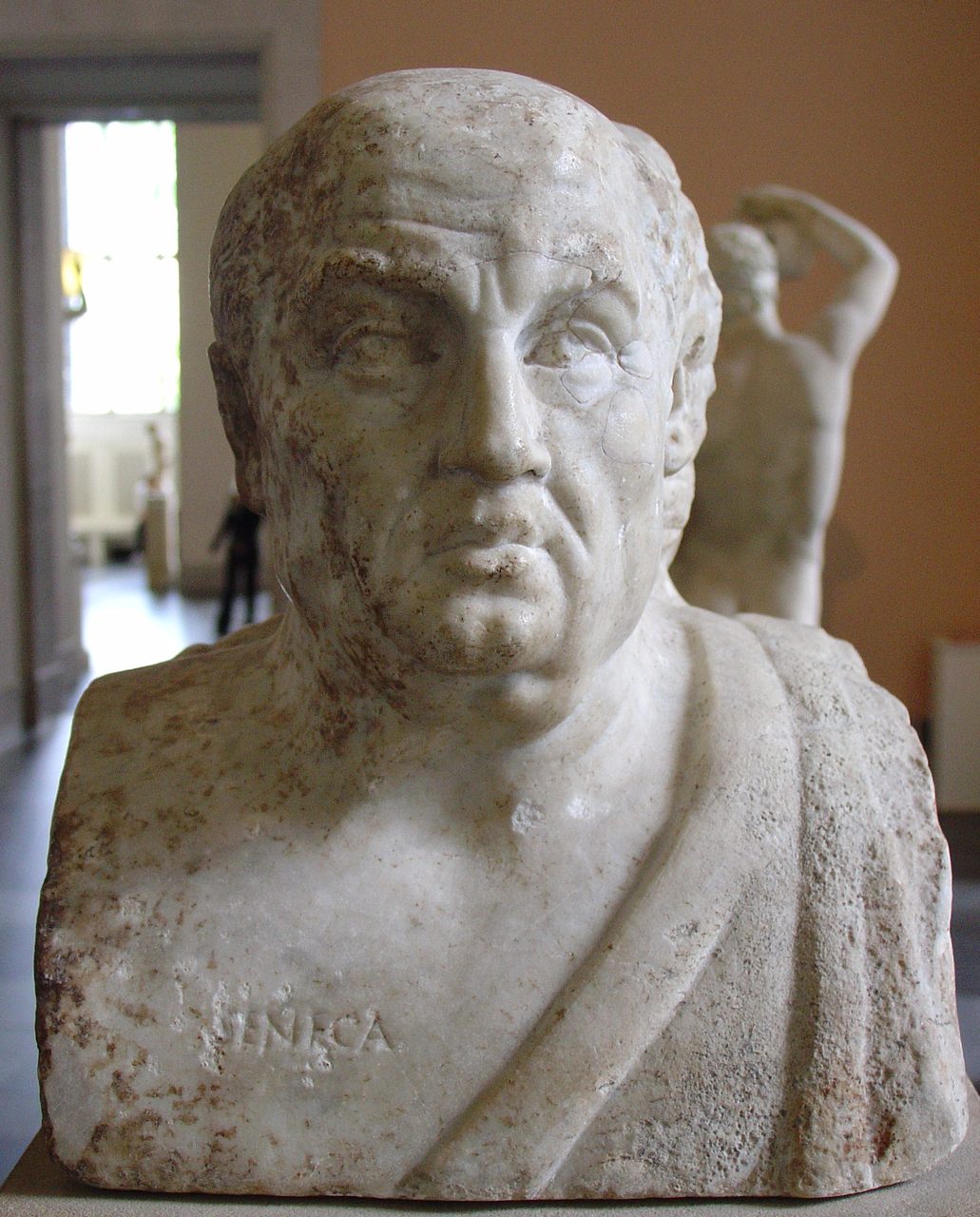
Seneca was immensely wealthy, and our secondary file records that the contradiction between his wealth and his Stoic preaching has been noted since antiquity. That is worth saying carefully, because it is not a modern gotcha. The doctrine has a technical answer available, and section 04 is where it sits: wealth is a preferred indifferent, appropriate to pursue and irrelevant to whether a life is good. Whether the answer holds, in the case of the man who wrote about anger, grief, anxiety, luxury and the fear of death, is an argument about him noted since antiquity. Our secondary file also calls him the most psychologically acute Stoic, which is that file's evaluation and is carried here as that.
One sentence of his is worth quoting whole, precisely because half of it circulates alone. In Richard M. Gummere's Loeb Classical Library translation, Letter 13.4 reads: "There are more things, Lucilius, likely to frighten us than there are to crush us; we suffer more often in imagination than in reality." The second clause is everywhere, usually with no letter number and no translator attached to it. It is genuine, and it is genuine as half of that sentence, addressed by name to the correspondent the letters are written to. Quoting the clause on its own performs the exact operation this article exists to describe.
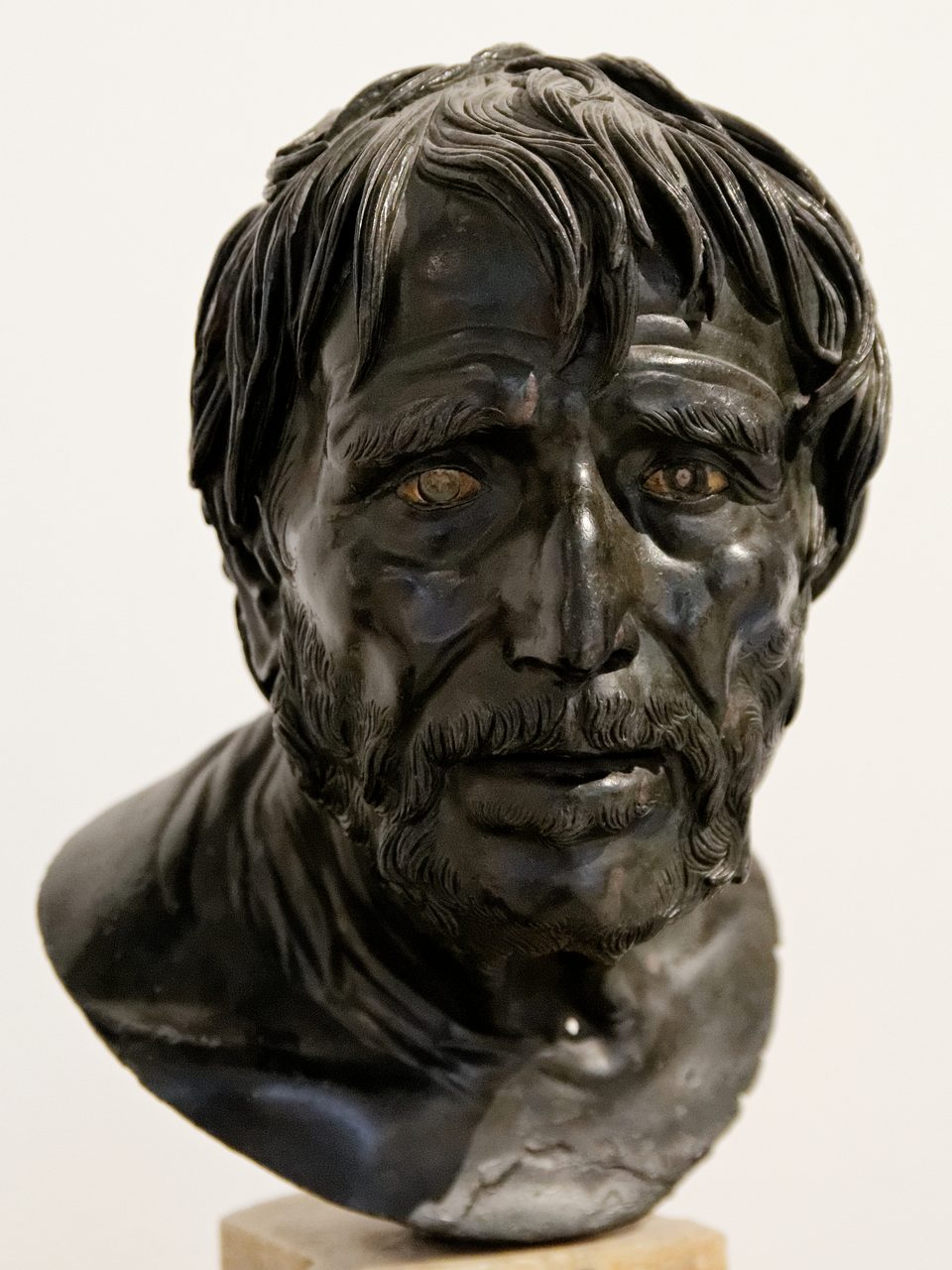
The two pictures in this section carry the same problem in another medium. One head is the portrait the name is attached to on the record. The other is a bronze that was called Seneca for a very long time and is catalogued as a man, probably a poet or a philosopher. Nothing in either face announces which is which, exactly as nothing in a well-turned sentence announces whether Marcus Aurelius wrote it.
| Whose Work | When | What Survives | How It Survives |
|---|---|---|---|
| The Early and Middle Stoa: Zeno, Cleanthes, Chrysippus, then Panaetius and Posidonius | From the founding around 300 BCE | Nothing complete by any of them | Reconstructed from fragments and summaries in Diogenes Laertius, Plutarch, Cicero and Sextus Empiricus |
| Epictetus | Born sometime in the 50s CE, died around 135 CE | Four books of the Discourses, of an original of eight or more, and the Enchiridion | He wrote nothing himself. His student Arrian wrote the Discourses down, and the Enchiridion is described as a brief abridgment of them |
| Seneca | Born circa 1 BCE or 4 BCE depending on the source, died 65 CE | 124 Moral Letters, the Dialogues including On Anger, On the Shortness of Life and On the Happy Life, the Natural Questions, and nine tragedies | Works written for readers: letters addressed to a named correspondent, dialogues, a work of natural science, and tragedies |
| Marcus Aurelius | Born 121 CE, emperor from 161 CE, died 180 CE | Twelve books of private notes, written in Greek | Never intended for publication and known by no formal title in antiquity. Continuously in print since Xylander's Zurich edition of the late 1550s |
09What Follows, On Stoic Terms
The Stoic answer to what happens after death follows from the physics and from nothing else. Everything is material, the soul included, so nobody goes anywhere: the Stoic account dissolves the person back into pneuma and logos, the fire and the reason that were already what the person was made of. Death and the Afterlife, in this same wing, maps how the world's cultures answer the question and files the Stoics under dissolution, and this article does not re-run that survey. What it can add is the part of the Stoic account that is not dissolution at all.
Ekpyrosis is the doctrine that the universe periodically burns. A conflagration returns all matter to pure logos and pneuma, and the cosmos is then reborn, palingenesis, in exactly the same configuration, which makes it a doctrine of eternal recurrence rather than of an ending. The school did not agree about it. Our primary file records that Cleanthes insisted on a literal conflagration while some later Stoics, Panaetius among them, rejected or modified the doctrine. So this is a Stoic position with Stoics on both sides of it, and not a settled article of the school.
The Stanford Encyclopedia states the cycle plainly: "The cosmos goes through a cycle of endless recurrence with periods of conflagration, a state in which all is fire, and periods of cosmic order." It also records a live scholarly question our own files do not: whether the person who exists in the next cycle is identical to the person in this one, or merely indistinguishable from them, and whether Stoic time is therefore linear or circular. That is not a decorative puzzle. It is the persistence question asked of a cosmology, and Personal Identity, in this same wing, is where the modern form of it lives. This article leaves the Stoic version open, because the scholarship does.
Stoic eternal recurrence is not Nietzsche's, and our primary file says so itself. The Stoic version is a cosmological claim about what the universe physically does. Nietzsche transformed the idea into an existential thought experiment applied to a single life, and the two do not carry the same weight or answer to the same evidence. The same file lists structural parallels to ekpyrosis elsewhere, Hindu pralaya, Norse Ragnarok, the Aztec Five Suns, and a modern echo in Big Crunch and Big Bounce cosmologies. It does not claim any of them influenced any other, and neither does this article: they are resemblances, named here in one line for exactly that reason.
10Citizen Of The World, And The Empire He Ruled
Cosmopolitanism is the Stoic doctrine that every human being is a citizen of a single world community, kosmou polites. Both of our files credit the Stoics with originating the idea; that credit is theirs and is carried here as theirs rather than restated as a finding. The primary text is the emperor writing in his own notebook, at Meditations VI.44, in Long's translation: "my city and country, so far as I am Antoninus, is Rome, but so far as I am a man, it is the world." Our secondary file names Hierocles, in the second century CE, and his image of concentric circles of identity: self, then family, then city, then country, then humanity. The Stanford Encyclopedia adds that Stoic justice was held to extend to all human beings, reaching even the remotest stranger; that material is carried in paraphrase, because the research pass did not certify its wording as fetched verbatim.
Downstream of that, our files trace lines of influence and hedge them, and the hedges are the load-bearing part. Our secondary file notes that Paul of Tarsus was a Cilician, from the same region as several Stoic philosophers, and used language resonant with Stoicism: logos, conscience, syneidesis, and the law written on the heart at Romans 2:15. Both files name early Church figures who drew on Stoic ethics and natural law, Clement of Alexandria, Tertullian and Augustine among them, and our secondary file credits Marcia Colish, in 1985, with tracing the transmission in detail. Resonant with and drew on are the files' own words, and they are kept, because a shared vocabulary is not a demonstrated derivation. One later line is worth a sentence on the same terms: Spinoza's substance monism and determinism, and his identification of God with Nature, echo Stoic physics closely, and our primary file lists him among the traditions it traces downstream. Our secondary file also claims influence on Kant's cosmopolitan law and on modern human rights frameworks. That is an influence claim rather than a textual fact, and it stays at this tier.
The standing ethical objection is that acceptance becomes quietism. Our secondary file records the charge directly: Stoic acceptance of external circumstances can become acceptance of injustice, poverty and oppression, and it names Martha Nussbaum, in The Therapy of Desire in 1994, as having argued that Stoic detachment undermines the emotional engagement social justice requires. Our primary file adds the version aimed at the Stoics themselves, and it is the harder one. Whether Marcus Aurelius and the other Roman Stoics actually practised the virtues they preached is debated, given their roles in imperial violence and the maintenance of a slave economy, and that debate challenges idealised presentations of Stoic ethical consistency. The pairing this article opened with is only honest with that sentence attached: the emperor ruled a slaveholding empire, and the freed slave taught inside it.
No, Stoicism is not a proto-fascist philosophy. Our primary file records the claim that Stoic emphasis on duty and self-discipline anticipates authoritarian ideologies, and answers it on the doctrine's own terms: Stoic cosmopolitanism, universal human dignity and an explicit rejection of tyranny, with Seneca writing against cruelty, Marcus Aurelius practising clemency and Cato opposing Caesar's authoritarianism. That answer is correct about the doctrine. It is not an answer about the practitioners, and the two sentences have to travel together or neither of them is honest. The doctrine is cosmopolitan and anti-tyrannical on its own terms, and its most famous practitioners ran an empire.
11The Therapy Question
Aaron Beck founded cognitive therapy in the 1960s, and Albert Ellis founded rational emotive behavior therapy, which our secondary file dates to 1955. Both acknowledged Epictetus as a forerunner, and our secondary file names the Enchiridion specifically. Ellis published the core of his approach as Rational Psychotherapy, in The Journal of General Psychology in 1958, and that paper is cited below because neither of our files carries it. The structural parallel both files draw is exact: the event does not itself produce the emotional response, the judgement about the event does, so changing the judgement changes the response. All of that is what two named therapists said about their own intellectual debts, in print, with dates. It is not evidence that Stoicism works, and the distance between those two statements is the subject of this section.
The evidence claim usually attached to this needs correcting before it can be used at all. Our primary file cites Hofmann and colleagues, 2012, as a meta-analysis of 269 studies. It is not a meta-analysis, and 269 is not a count of studies. The paper is The Efficacy of Cognitive Behavioral Therapy: A Review of Meta-analyses, by Hofmann, Asnaani, Vonk, Sawyer and Fang, in Cognitive Therapy and Research, and its abstract says: "We identified 269 meta-analytic studies and reviewed of those a representative sample of 106 meta-analyses". So it is a review of meta-analyses; the larger figure counts meta-analytic studies rather than primary studies; and the smaller one is the number actually reviewed. Its summary judgement is worth quoting exactly: "In general, the evidence-base of CBT is very strong." Its own stated limits travel with it. The strongest support is stated for anxiety disorders, somatoform disorders, bulimia, anger control problems and general stress, and the authors say additional research is needed. The paper carries a published correction from 2014, which is a correction and not a retraction, and it is cited below beside the paper itself. And all of that is a finding about a modern therapy, not about an ancient philosophy.
The counter belongs here rather than in a later balancing paragraph. Our secondary file records what clinical psychologists say about the comparison: cognitive behavioural therapy is an evidence-based empirical therapy and not a philosophical practice, structural similarity does not make two things identical, and the therapy lacks Stoic metaphysics, teleology and virtue ethics. A therapy that borrows a cognitive move from a philosophy is not that philosophy holding a clinical licence.
Our primary file maps four Stoic exercises onto modern techniques, and they are described here in the past tense, as things Stoics did. Premeditatio malorum, rehearsing misfortune in advance, is matched to cognitive rehearsal. The view from above, imagining events from a cosmic perspective, is matched to cognitive distancing. The evening review, examining the day's judgements, is matched to thought journaling. And the dichotomy of control is matched to distinguishing controllable from uncontrollable stressors. The same file then supplies the sharpest deflationary claim in either of our documents, and it belongs in the same paragraph as the mapping. It is unresolved whether psychological benefits from Stoic-derived practices, and the file names journaling, negative visualization and voluntary discomfort, come from specifically Stoic premises or from generic cognitive reappraisal mechanisms, and it states that consensus is lacking.
One citation in our primary file needs flagging rather than repeating. It attributes measured improvements in well-being from Stoic Week to a named and dated source, Sadler, 2017. No Sadler entry exists in either file's bibliography, and no record for it resolved during the research pass behind this article: a CrossRef search for a Stoic Week or Stoicism-based wellbeing intervention returned nothing matching. Our secondary file independently calls the same measurement effort preliminary. So the honest statement is this: the project that runs Stoic Week reports collecting outcome data, and this article found no peer-reviewed publication of it. No measured improvement is reported here as a finding, and none appears in any summary line below.
12The Revival, Reported
Modern popular Stoicism is a real and dated phenomenon, and it is reported here as one. Stoic Week has been run annually by the University of Exeter since 2012, with participants practising Stoic exercises for a week. Our primary file names three books with their years: Ryan Holiday's The Obstacle Is the Way, named already in section 07; Massimo Pigliucci's How to Be a Stoic, 2017; and William Irvine's A Guide to the Good Life, 2008. Our secondary file adds the Stoicon conferences, and names Tim LeBon and the Modern Stoicism project as having begun measuring effects, calling the results preliminary. Two further claims appear in our files and are deliberately not carried as facts here: a podcast audience figure, and adoption in United States military, police and medical resilience training. Neither is sourced in either file, and neither was verified for this article.
The standing critique of all of it is the one this article has been building toward since section 02. Our secondary file states it: ancient Stoicism rested on a pantheistic, deterministic physics, a universe that is a living rational being, and modern secular Stoicism strips that away. Our primary file asks the same question twice more, whether the universal logos is genuinely compatible with modern secular materialism or is a repackaged theological claim, and whether Stoic physics is proto-scientific naturalism or religious cosmology. It also carries the fidelity critique in its own voice: critics argue that the modern revival movements, the therapy parallels and popular neo-Stoicism among them, selectively appropriate the ancient texts while stripping out the original framework of fate and divine providence. Both files leave the question open, and so does this article, because the answer decides whether what is being revived is Stoicism or a technique that used to belong to it.
One recent voice from outside both our own corpus and the popular revival literature is worth naming for a reader who wants the current argument rather than the ancient one. Nancy Sherman's chapter A Healthy Modern Stoicism, in Stoic Wisdom, published by Oxford University Press in 2021, is where a contemporary philosopher takes up what a defensible modern Stoicism would have to look like. Its record was verified for this article and the chapter itself was not read, so nothing here reports what she concludes. It is listed below as the place the question is currently being argued, which is all this article claims about it.
13Where The Parallels Stay Parallels
Three claims in our primary file sit at Tier 3, and each of them arrives with its own qualifier attached in the file itself. The qualifiers are the reason the claims are worth printing at all.
Our primary file reports that some scholars, naming S. Sambursky's Physics of the Stoics of 1959, argue that Stoic pneuma anticipates modern field concepts as a continuous dynamic medium permeating all matter, and that logos has been paralleled to information-theoretic views of the universe, of which Wheeler's it from bit is the file's example. The file's own qualifier is the point, and it goes in the same sentence: these are analogies, not historical influences, however structurally interesting they are.
The same file reports that Stoic prosoche, attention, has been paralleled to modern mindfulness traditions, that some researchers argue Stoic practices constitute attention training that modifies neural pathways, and that the Stoic hegemonikon, the ruling faculty governing perception and judgement, anticipates executive-function models in cognitive neuroscience. It then states its own gap, and that sentence is the whole of what can be said: neuroimaging studies specifically on Stoic practice, as distinct from mindfulness, are lacking. The parallel does not leave Tier 3 on this evidence.
Zeno came from Citium, modern Larnaca in Cyprus, a city with a significant Phoenician population, and our primary file reports that some scholars suggest Phoenician or Eastern traditions influenced Stoic concepts, offering pneuma from ruach and logos from Near Eastern wisdom traditions. The file then says plainly that the evidence is circumstantial and that direct textual links are absent, and that sentence travels with the claim wherever it goes. It is interesting for what it would change if it were ever established: whether the founding Stoic is best read as a Greek philosopher or as a Phoenician one working in Greek. Nothing this article found settles it either way.
14What The Word Does Not Mean
No, Stoicism is not emotional suppression. The lowercase English word stoic means emotionally numb; the philosophy does not, and both of our files mark the equation debunked. Section 04 is the evidence rather than the assertion. The Stoics distinguished apatheia, freedom from the destructive passions, from anaisthesia, numbed insensitivity, and counted the second a vice. They named and valued the eupatheiai, the good emotional states. And our primary file notes that the Meditations itself shows intense emotional engagement rather than suppression. The English word carries a meaning the doctrine does not, and a Tier 4 block asserting the correction would be weaker than the passage that shows it, which is why the showing happens ten sections earlier.
No, the Stoics did not keep a secret mystical tradition behind a public one. Our primary file states that there is no textual evidence for an esoteric Stoicism behind an exoteric one, that the school was notably transparent about its methods, that Epictetus taught publicly and that Marcus Aurelius wrote privately but not secretively, and it identifies the confusion: the claim conflates Stoicism with Neoplatonism or Hermeticism. Ancient Greece did have a genuine, strictly kept religious secret, and it is not this one; that story belongs to The Eleusinian Mysteries, which also records that Marcus Aurelius was a patron of that sanctuary.
Fast Facts
- The School
- Founded at Athens around 300 BCE by Zeno of Citium, and named after the Stoa Poikile, the Painted Porch in the agora where the first Stoics taught
- The Ground
- Remains north of Adrianou Street in Athens are tentatively identified as the Painted Porch on the site's own information panel. The American School of Classical Studies at Athens has excavated the agora since 1931, and a portion of the building was exposed in the 1981 season
- The Three Parts
- Logic, physics and ethics, held to depend on one another. The ethics is not detachable from the physics, which is the standing objection to any version that drops the cosmology
- The Physics
- A single living rational cosmos permeated by logos and shaped by pneuma, wholly material including the soul and including God, whom the doctrine identifies with nature, providence and fate
- Fate
- Heimarmene, an unbroken chain of causes, held to be compatible with moral responsibility. Chrysippus's cylinder is the ancient ancestor of the modern compatibilist position
- The Only Good
- Virtue. Health, wealth, reputation and life itself are indifferents, sorted into preferred and dispreferred, and that sorting is the distinction the caricature drops
- Apatheia
- Freedom from the destructive passions, not numbness. The Stoics counted numbed insensitivity a vice of its own, and named good emotional states they valued
- What Follows Death
- Dissolution back into pneuma and logos, and on the doctrine of ekpyrosis a periodic conflagration and rebirth. The school did not agree about it: Cleanthes held the fire literal, and Panaetius rejected or modified it
- The Three Voices
- A man born into slavery, a wealthy senator and an emperor, all at the end of the tradition. Nothing complete survives from any of the founders
- The Quotation Problem
- Seven passages here are quoted from primary texts, each naming its translator and its standard reference. Nine circulating lines and tags are refused in section 07, with a stated reason for each
- Not Established
- That the evidence base for cognitive behavioural therapy is evidence for Stoicism; that any Stoic doctrine has been tested as such; or that the well-being measurements attributed to Stoic Week have been published anywhere this article could find
What Can Actually Be Stood Behind
What the surviving texts say, and where they say it, is settled and may be stated flatly. Zeno founded the school at Athens around 300 BCE, and it is named for the Painted Porch in the agora. The three parts are logic, physics and ethics, and the school held them interdependent. The physics is materialist and pantheist; the fate doctrine is heimarmene; the ethics makes virtue the only good and sorts everything else into preferred and dispreferred indifferents; apatheia is freedom from destructive passions rather than numbness; prohairesis is the faculty the dichotomy of control turns on. Epictetus was born into slavery, was owned by an administrator in Nero's court, was forced out of Rome under Domitian's edict of 89 CE and taught at Nicopolis; his Discourses were written down by Arrian and four books survive of an original of eight or more. Seneca was compelled to kill himself in 65 CE. Marcus Aurelius reigned from 161 CE until his death in 180 CE and left twelve books of private notes in Greek. Every quotation from an ancient text in this article was read in a named translation at a named locus, and both are printed beside it; every other quotation names in its own sentence the modern source it was read in.
The disputes are real, serious and unresolved, and each has named holders. Whether Stoic ethics survives the loss of Stoic physics is open in both of our own files and is the closing question here. Whether the modern revival is faithful to the ancient texts is argued both ways, and the fidelity critique is in our primary file's own voice. The therapy lineage is what two named therapists said about their own influences, and the counter, that a therapy is not a philosophy and that structural similarity is not identity, is carried at the same strength in the same section. Stoic influence on early Christian ethics is a live scholarly position stated in our files with hedges this article keeps. The excavated remains north of Adrianou Street are tentatively identified as the Painted Porch on the site's own panel, and nothing here says the porch has been found. Whether the person in the next cosmic cycle is the same person is an open question in the scholarship rather than a settled Stoic doctrine. And the two research files behind this article disagree with each other, or with the reference literature, on four numbers: Chrysippus's output, Seneca's birth year, Epictetus's birth year and the original length of the Discourses. Each is carried in the open form.
Three parallels stay parallels, and the file that carries them says so itself. Pneuma as an anticipation of field concepts, and logos as an anticipation of information-theoretic cosmology, are analogies our primary file calls analogies rather than influences. Stoic practice as measurable attention training is a parallel whose own file states that neuroimaging studies specifically on Stoic practice, as distinct from mindfulness, are lacking. Phoenician influence on Zeno's concepts is circumstantial by the file's own admission, with direct textual links absent. And the well-being measurements attributed to Stoic Week rest on a named and dated citation that has no bibliography entry in either file and no record this article could resolve.
No, twice, in opposite directions, and holding both at the same time is what this whole article is built to make possible. No, the evidence base for cognitive behavioural therapy is not evidence for Stoicism. Hofmann and colleagues reviewed meta-analyses of a modern therapy and reported its own stated scope and its own stated need for further research; Beck and Ellis named an influence. No Stoic doctrine, not the dichotomy of control and not apatheia, has been tested as such, and the Stoic Week measurements this article looked for have no publication it could find. And no, equally, the excesses of the modern revival are not evidence against the ancient philosophy. A book published in 2014 is not evidence about a school founded around 300 BCE. Dropping the first of those refusals is the commonest way this subject is got wrong, and dropping the second is the other way, and dropping them in a summary line is the commonest place it happens.
No, the famous sentences are not all Stoic. Nine widely repeated Stoic quotations and tags are refused in section 07, one at a time and with a reason each: two attributed to Marcus Aurelius and not found in Long's text; one modern book title circulating as his sentence; one attributed to Seneca with no located source; one genuinely Seneca's whose English wording could not be verified because the hosting page failed twice; two printed inside quotation marks in our own research files with no translator named; and two Latin tags, one of which is Nietzsche's phrase and the other of which has no verified Stoic locus. Seven passages are quoted here, each with its translator and its standard reference. That asymmetry is the honest state of this subject rather than an editorial preference, and it is the reason the seven can be trusted.
No, the word is not the doctrine, and no, refusing the caricature is not a defence of the men. Stoicism is not emotional suppression, and there was no secret Stoic mystery school; both refusals come from our own files. Stoic doctrine is cosmopolitan and anti-tyrannical on its own terms, and that is an answer about the doctrine. It is not an answer about the practitioners, whose record our primary file records as contested, given the Roman Stoics' roles in imperial violence and the maintenance of a slave economy. Both sentences stand, and this article crowns neither.
Two men at opposite ends of the Roman world, one who had been someone's property and one who commanded an empire, wrote down the same conclusion about what a person actually controls. That convergence is the fact the modern revival keeps, and it is worth keeping. What the revival mostly leaves behind is why either of them believed it, which was not resilience and not productivity but a cosmology: a single living rational cosmos in which every event was caused by the events before it, and in which a mind is a portion of the same fire that runs the whole thing. Take that away and the dichotomy of control is a technique. Leave it in and it is a claim about the universe, which is either true or it is not, and nothing in this article settles which. The Stoics held that the question of how to face death is answered by the question of what the universe is. Whether the first answer survives without the second is the thing neither of our research files will settle, and neither will this one.
Sources & further reading
Two research files in our own library stand behind this article, P_4_05 and P_5_21. They are where the work was done from; the records below are where it can be checked, and sixteen of the eighteen entries are external. Three limits belong on the record rather than being left to be discovered. First, the quotations. Seven passages from the ancient texts are quoted here and every one names its translator and its standard reference, because on this subject a quotation with no translator cannot be checked at all. Seneca's Letter 13.4 is the single quotation with no link beside it, and deliberately: the transcription read for the research pass behind this article was a Wikisource copy of Richard M. Gummere's translation, which is not a citable edition, so the citation of record is the Loeb Classical Library volume and no substitute link is offered for it. Second, the identifiers. Six of the eight digital object identifiers carried in our own two files resolve to a review of the book they label rather than to the book, one of them to a review of a different translation of the Meditations published in a different decade, and not one of those six is reproduced here. Every identifier below was resolved live against CrossRef on 2026-08-07 and the returned title read against the claim it is attached to. Third, two entries are pointers rather than sources: the Tacitus chapters and the Sherman chapter were verified as records and were not read for this article, so nothing here reports what either of them says.
Image credits
- The original bronze equestrian statue of Marcus Aurelius, Capitoline Museum, Rome Nicholas Hartmann, own work, 2019, via Wikimedia Commons. CC BY-SA 4.0 Source.
- Marble bust catalogued as Zeno of Citium, Farnese Collection, National Archaeological Museum of Naples Jeremy Weate, 2011, via Wikimedia Commons. CC BY 2.0 Source.
- The excavated ground north of Adrianou Street in Athens, labelled by the photographer as the west end of the Stoa Poikile, photographed 1991 Mark Landon, own work, photographed 1991 and digitized 2021, via Wikimedia Commons. CC BY 4.0 Source.
- Marble portrait heads of four philosophers in the British Museum: Socrates, Antisthenes, Chrysippus and Epicurus, all Roman copies after Hellenistic originals Cristian Bortes, 2008, via Wikimedia Commons. CC BY 2.0 Source.
- Imaginary portrait of Epictetus, the engraved frontispiece to Edward Ivie's Latin Enchiridion, Oxford, 1715 William Sonmans (painter) and Michael Burghers (engraver), 1715; scan via the Internet Archive and Wikimedia Commons. Public Domain Source.
- Seneca, one head of a double herm of Socrates and Seneca, Antikensammlung Berlin Calidius, own work, 2004, via Wikimedia Commons. CC BY-SA 3.0 / GFDL 1.2 or later Source.
- Bronze portrait head from the Villa of the Papyri at Herculaneum, Naples inventory 5616, traditionally called the pseudo-Seneca and not identified as Seneca Marie-Lan Nguyen, 2011, via Wikimedia Commons. CC BY 2.5 Source.
- Card crop of the original bronze equestrian statue of Marcus Aurelius Nicholas Hartmann, own work, 2019, via Wikimedia Commons. CC BY-SA 4.0 Source.


.jpg)

_frontispiece.jpg)

