
The Absurd: Camus, Sisyphus, and the Universe That Refuses to Answer
You want your life to mean something. The universe says nothing back. That silence, colliding with your demand, is what Albert Camus called the Absurd, and rather than flee it into religion or end it in despair, he did something stranger: he told you to stare it down and live anyway. This is the philosophy of the absurd, its most famous image (a man condemned to roll a boulder uphill forever, whom Camus insists we must imagine happy), and the careful line the whole thing depends on, because absurdism is not nihilism, it is not despair, and it does not claim to be the one right answer to existence.
There is a particular feeling that tends to arrive without warning, often in the middle of an ordinary week: the sudden sense that the whole routine, rising, commuting, working, eating, sleeping, Monday after Monday, is running on rails toward nothing in particular, and that no one and nothing is going to tell you what the point of it was. Albert Camus took that feeling more seriously than almost any thinker before him. He gave it a name, the Absurd, refused every comfortable way out of it, and then argued, against all expectation, that a person could look straight at it and live a full, even happy, life anyway. What follows is that argument, laid out honestly, including the careful distinctions it stands or falls on.
01What the Absurd Actually Is
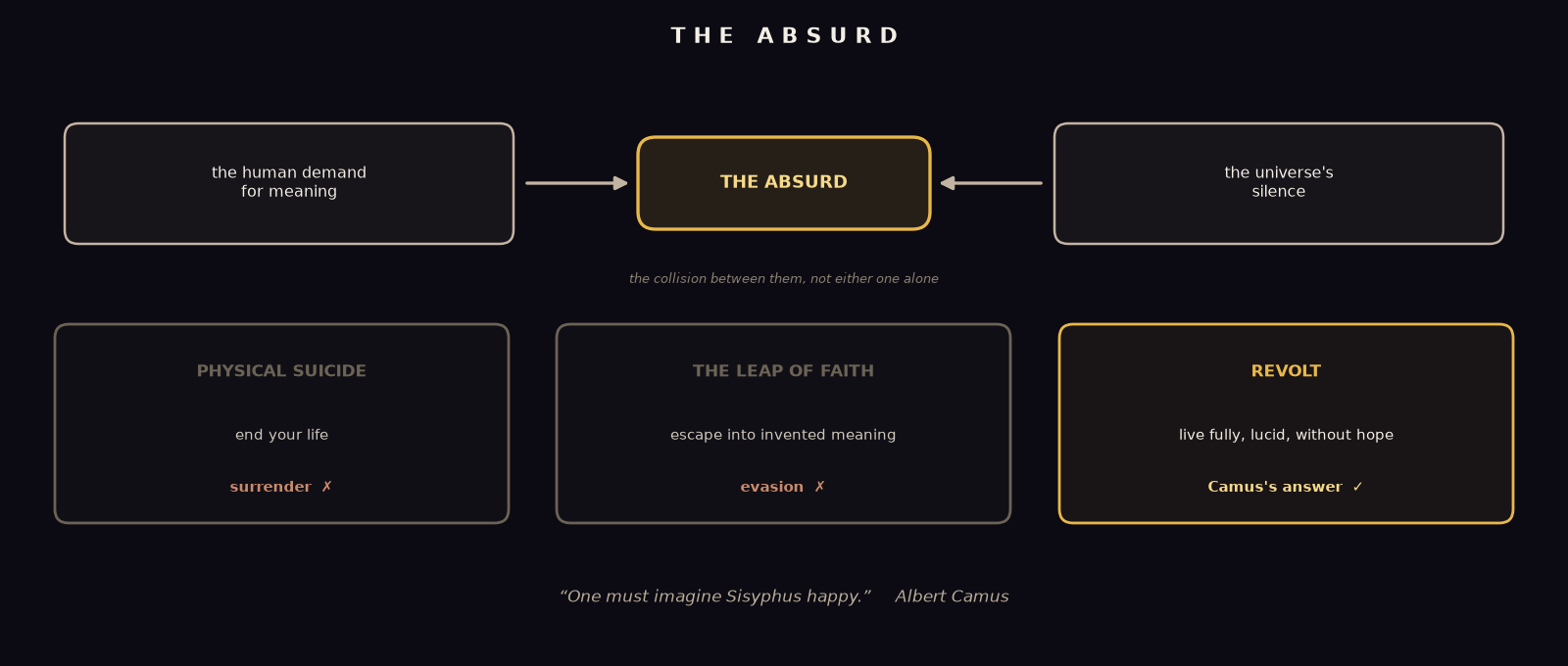
The Algerian-born writer Albert Camus (1913 to 1960), who would win the Nobel Prize in Literature in 1957 and then die in a car accident three years later at the age of forty-six, set out the idea in a 1942 essay, The Myth of Sisyphus, and his definition is more precise than the casual use of the word suggests. The Absurd, for Camus, is not a property of the universe, which is simply indifferent, and not a property of the human mind, whose hunger for meaning is perfectly natural. It is the relationship between them: the collision of a creature that demands meaning with a cosmos that returns only silence. In his own words, 'the absurd is born of this confrontation between the human need and the unreasonable silence of the world.' Crucially, it is not an abstract theory to be argued in a seminar; Camus insists it is a lived experience, the specific vertigo of feeling estranged from your own daily rhythm and realizing the world owes you no explanation for any of it. Remove either side, a universe with a built-in purpose, or a human who stops asking, and the Absurd dissolves. It exists only in the gap.
02Three Ways Out, and the Only One Camus Takes
Once you truly feel the Absurd, Camus says, you face three options, and he spends much of the essay closing two of them. The first is physical suicide, ending your life because it seems not worth living without meaning. Camus rejects it, and his reasoning is subtle: suicide does not solve the Absurd, it abolishes it, by destroying one of the two things whose collision creates it. It is surrender dressed as an answer. The second option is what he memorably calls 'philosophical suicide,' the leap of faith into a religion or metaphysics that supplies the very meaning the universe withholds, an escape he associates with thinkers like Kierkegaard. Camus rejects this too, not because he can disprove God, but because he considers the leap a failure of nerve, an 'eluding' of the Absurd that betrays the one virtue the situation demands, which is lucidity, the refusal to lie to yourself. That leaves only the third path.
The third path is what Camus calls revolt, and it is the heart of the philosophy. To revolt against the Absurd is not to defeat it or resolve it, which cannot be done, but to hold its tension open on purpose: to refuse both the exit of death and the false comfort of faith, and to keep living, fully and consciously, in spite of the silence. From this Camus draws three values that replace the meaning the universe will not give. Revolt, the permanent, clear-eyed refusal to accept meaninglessness passively. Freedom, because if no divine plan scripts your life, you are radically free to live it. And passion, a commitment to the depth and quantity of experience here and now, since here and now is all there demonstrably is. The absurd person does not hope, and does not despair. They live.
03Sisyphus, Happy
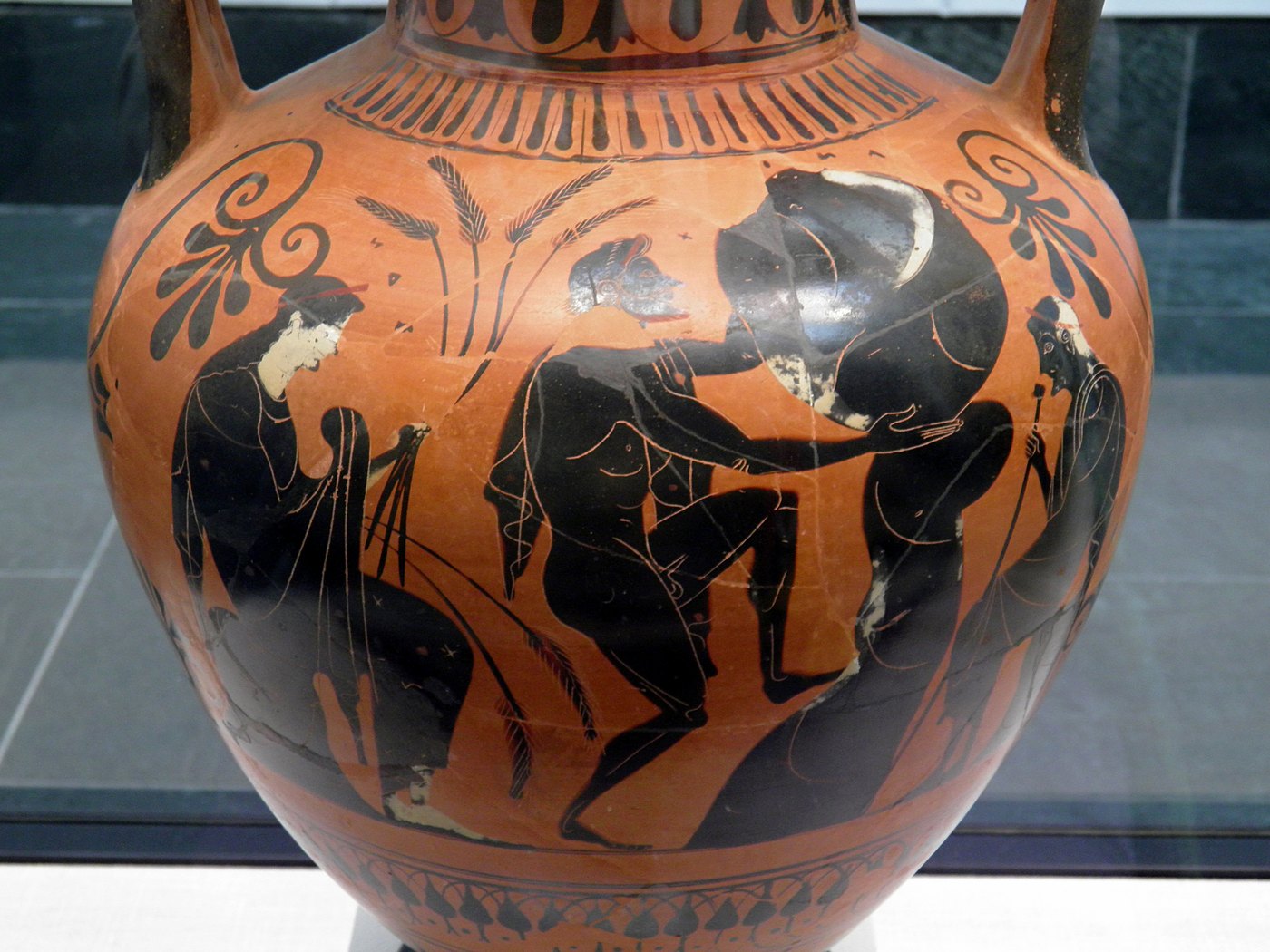
To make the idea concrete, Camus turned to the Greek myth of Sisyphus, condemned by the gods to push a boulder up a mountain for all eternity, watching it roll back down every time he neared the summit. It is the perfect picture of futility, and Camus embraces it as a portrait of every human life. Then comes the famous move. The essay's final sentence is: 'One must imagine Sisyphus happy.' Not happy through hope, because he has none; not happy through illusion, because he sees his fate with total clarity; but happy precisely because he sees it and continues anyway. The moment Camus dwells on is not the struggle up but the walk back down, the pause when Sisyphus, fully conscious, turns to begin again. In that lucid acceptance, Camus argues, Sisyphus becomes superior to his fate. 'The struggle itself toward the heights,' he writes, 'is enough to fill a man's heart.' This is emphatically not optimism. It is, in the corpus's own phrase, a form of heroic defiance.
Sisyphus is not the only figure Camus offers. He sketches a small gallery of 'absurd types,' people who live the revolt-freedom-passion answer without leaning on any transcendent meaning: Don Juan, who chooses the quantity and intensity of many loves over the illusion of one eternal one; the actor, who pours himself fully into life after life knowing each ends at the curtain; the conqueror, who acts decisively while knowing all action is ultimately swallowed by time; and the artist, who creates work fully aware it will not last forever. What unites them is not their pursuits but their stance: each has looked at the silence, refused to lie about it, and chosen to live intensely inside it anyway.
04From the Self to the Street: The Rebel
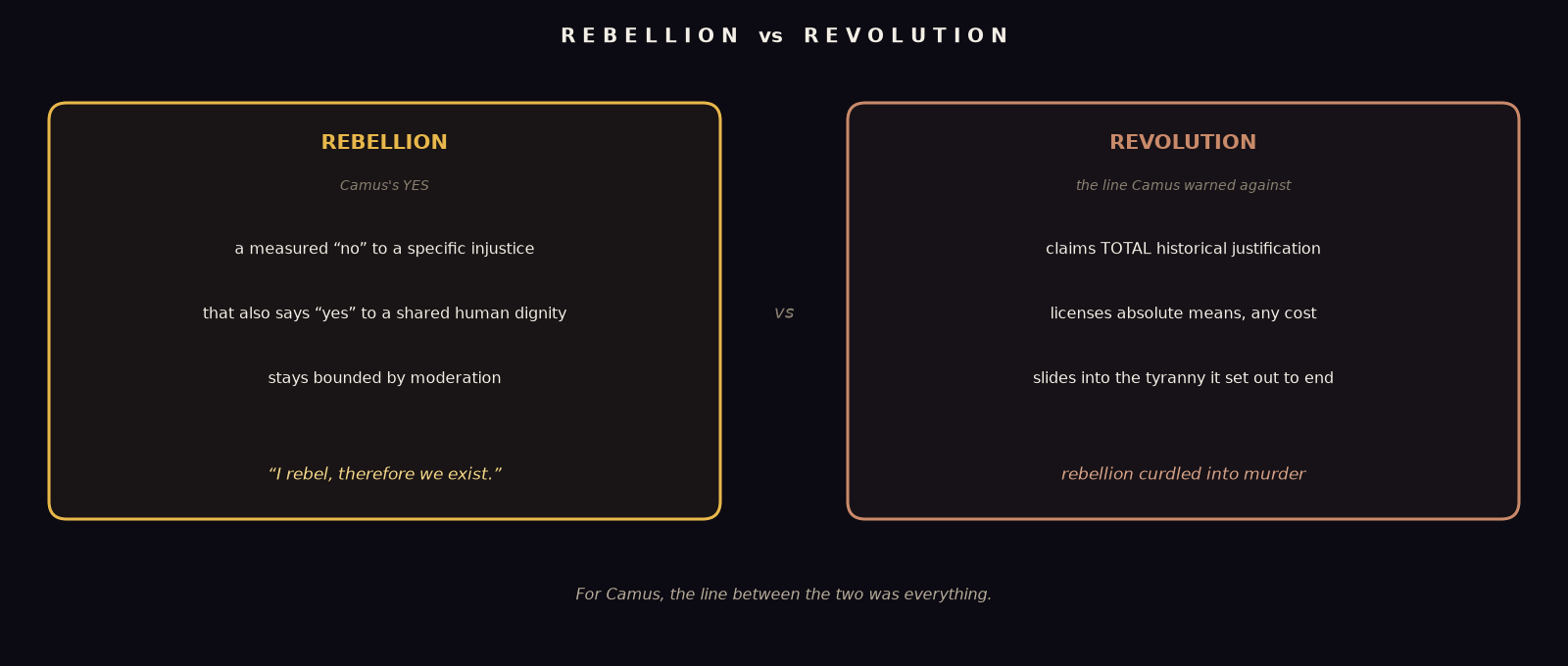
Camus did not stop at the lonely individual facing the void. In his 1951 book The Rebel, he asked what the absurd stance implies for how we treat each other, and reached a famous reformulation of Descartes: 'I rebel, therefore we exist.' The act of rebelling against injustice, he argued, secretly affirms a shared human dignity that the rebel refuses to see violated, so revolt turns out to bind people together rather than isolate them. But Camus then drew a sharp and, for his time, dangerous line between rebellion and revolution. Rebellion is a measured 'no' to a specific injustice that simultaneously says 'yes' to human solidarity, and it must stay limited by moderation. Revolution, by contrast, claims total historical justification, licenses absolute means, and so slides into the very tyranny it began by opposing. On these grounds Camus condemned the Jacobin Terror and, far more controversially in 1951, Soviet communism, as rebellion curdled into nihilistic murder.
That argument detonated the most famous friendship in twentieth-century philosophy. The Rebel was savaged in 1952 in Jean-Paul Sartre's journal, Les Temps modernes, and the ensuing public quarrel ended the Camus-Sartre relationship for good; the two never spoke again. It is important to be precise about what they were fighting over, because it is often softened into a mere personality clash. It was not. The disagreement was substantive and principled: Camus held that no historical or political goal, however noble, could justify revolutionary violence and the crushing of the individual, and he rejected the Soviet Union on that basis; Sartre, at that point, defended revolutionary violence as necessary for liberation. Two brilliant men reached opposite conclusions about whether the ends can justify the means, and their philosophies genuinely diverged. They were not interchangeable existentialists who happened to fall out.
05What Absurdism Is Not
This is the distinction the whole philosophy depends on, and it is the one most often botched. Absurdism is not nihilism. The nihilist and the absurdist start from the same diagnosis, that the universe contains no built-in, objective meaning. But they part ways instantly at the conclusion. The nihilist infers that therefore nothing matters, and slides toward despair or an 'anything goes' amorality. Camus explicitly refused that step; his entire project, from the Myth of Sisyphus through The Rebel, is an argument against sliding from 'the universe is silent' into 'therefore anything is permitted,' which is exactly why he condemned nihilistic revolutionary violence. Nor is absurdism simply existentialism. Camus rejected that label for himself, considering existentialism too much of a grand, systematic philosophy of freedom and being; his absurdism is narrower and more modest, a specific diagnosis paired with a specific way of living, not a total account of reality. Flatten it into either neighbor and you have lost the thing itself.
And absurdism has a real, live weakness worth naming, rather than pretending the position is airtight. The sharpest objection is simple: if life is genuinely meaningless, why should revolt, freedom, and passion matter any more than surrender or despair? What makes Camus's answer better, rather than just his personal preference? Camus's own reply is honest but not knockdown. He does not claim revolt is justified by some higher value, because that would be smuggling meaning back in through the side door. He claims instead that revolt is simply what a lucid human being spontaneously does when they refuse to lie about their situation, more like thirst than like a logical proof. Whether that is a genuine grounding for his values or an elegant way of admitting he has none is a debate philosophers have never closed. There is even a live scholarly question of whether Camus's absurdism is truly its own philosophy or just a vivid corner of existentialism, exactly the label he rejected. We flag these honestly rather than paper over them.
Fast Facts
- The thinker
- Albert Camus (1913 to 1960), Algerian-born writer, Nobel Prize in Literature 1957
- The key work
- The Myth of Sisyphus (1942); the political sequel is The Rebel (1951)
- The Absurd
- The collision between the human demand for meaning and the universe's silence
- Three responses
- Physical suicide (rejected), the leap of faith (rejected), and revolt (embraced)
- The answer
- Revolt, freedom, and passion: live fully and lucidly without appeal to cosmic meaning
- The emblem
- Sisyphus, and the closing line 'One must imagine Sisyphus happy'
- The break
- Camus split with Sartre in 1952 over whether revolution can justify violence
- Not the same as
- Nihilism (Camus rejected it) or existentialism (he found it too systematic)
What We Can Actually Stand Behind
The philosophy and its history are firmly documented. Camus really defined the Absurd as he is described here, really named the three responses and chose revolt, really closed the Myth of Sisyphus with 'one must imagine Sisyphus happy,' and really extended the argument politically in The Rebel with 'I rebel, therefore we exist.' The 1952 break with Sartre really happened and was really about revolutionary violence, not personalities. And absurdism really is distinct from both nihilism and existentialism, a distinction Camus himself insisted on. None of that is in dispute.
Absurdism sits inside a broader family of responses to a meaningless cosmos, and it is one member, not the whole. The pessimist tradition of Schopenhauer and, more recently, thinkers like Ligotti and the antinatalist David Benatar, draw darker conclusions from the same starting point; the religious traditions draw the opposite one; the Stoics and the existentialists chart still other courses. Camus's revolt is a powerful and influential answer, standing alongside these, not above them.
The deepest questions about absurdism are open. Is revolt actually a grounded response, or just Camus's temperament raised to a principle? Can you affirm revolt, freedom, and passion as worth having without quietly reintroducing the meaning you claimed the universe lacks? And is absurdism a distinct philosophy or a branch of the existentialism Camus disowned? These are live, unresolved debates, and we present them as such.
No, absurdism is not the proven, objectively correct response to existence; Camus himself did not claim it was, and this wing does not crown a winner among the rival answers to the meaning of life. No, Camus was not a nihilist, and absurdism is not just nihilism with better prose; conflating them is the single most common error about him, and it gets his whole project backwards. And no, his split with Sartre was not a mere falling-out between friends who basically agreed. Those three flattenings are the ones to refuse. What remains is genuinely bracing: a way of facing a silent universe with open eyes and an unbowed head.
Camus offers something rare among philosophers: not consolation, and not a system, but a posture. He does not promise that your life means anything in the cosmic ledger, and he refuses to lie to you that it does. What he offers instead is the possibility that meaning was never the prerequisite for living well, that a person can shoulder the boulder, walk it up the hill, watch it roll back down, and, in the clear-eyed walk to the bottom to begin again, be somehow undefeated. You do not have to accept his answer; plenty of serious people don't, and this page has tried to show you exactly where it is vulnerable. But it is worth sitting with the strange thing he saw, which is that the silence of the universe, once you stop begging it to speak, might not be a prison after all. It might be the empty, open space in which a free life finally becomes possible. One must imagine Sisyphus happy.
Sources & further reading
Everything above is drawn from our research library on Theories of Anything. Open the full file to check the sourcing and go deeper.
Image credits
- Original diagram of Camus's Absurd: the collision of the human demand for meaning with the universe's silence, and the three responses Original diagram by Theories of Anything. CC BY-SA 4.0 Source.
- Ancient Attic black-figure amphora depicting the punishment of Sisyphus in Hades, Staatliche Antikensammlungen, Munich Photograph by Carole Raddato, 2013, via Wikimedia Commons. CC BY-SA 2.0 Source.
- Original diagram contrasting Camus's rebellion and revolution from The Rebel Original diagram by Theories of Anything. CC BY-SA 4.0 Source.
- Card crop of the original Absurd collision diagram Original diagram by Theories of Anything. CC BY-SA 4.0
.jpg)