
Existentialism: Condemned to Be Free
The name was popularised by a lecture Sartre gave in Paris in 1945, and most of the thinkers it collects either refused it or took it on reluctantly. What the tradition holds in common is smaller and harder than the slogans suggest: that a person arrives with no given nature, and that the freedom this leaves is a sentence rather than a privilege, because what it removes is the excuse. That is a thesis defended by argument, not a result anybody demonstrated, and it was contested from inside the movement itself. Simone de Beauvoir argued that a freedom with no material conditions for its exercise is not yet freedom, her answer and Sartre's are not the same answer, and this article crowns neither. Four of the movement's most quoted lines are handled below, each with its translator named where one exists, and one of them is refused outright, because the famous sentences of this subject circulate in several translations and in forms nobody wrote.
A room asked what existentialism says will answer in slogans: that existence precedes essence, that we are condemned to be free, that hell is other people. All three are famous. Not one of them is doing what the room thinks it is doing. The first is a thesis defended by argument and demonstrated by nothing. The second is not a celebration. And the third cannot be reproduced anywhere in this article, which is the first thing that has to be explained.
Our own research file on existentialism states the subject plainly: the philosophical movement that places individual existence, freedom and choice at the centre of philosophical inquiry. It names three linked commitments as the movement's unifying thread. That existence precedes essence. That humans are condemned to be free. That living authentically requires confronting mortality, groundlessness and responsibility. The same file records that the movement never held together, and names the two axes it split along: theistic against atheistic, and phenomenological against literary. It also records the reach, into modern literature, psychology, theology and political thought.
A note on the quotation marks, because on this subject they carry the whole risk. The famous lines here reach English through translators who do not agree with one another, and some of the most repeated forms are not any translator's wording at all. So every quotation below names whose words it is: a philosopher's, a named translator's, or a reference work's. Where the research behind this article could not read a passage off a primary text, a published translation or a named reference work, the wording is loosened until it cannot be mistaken for a transcription, and no quotation marks appear at all. An unverified quotation is a fabrication with punctuation on it.
Three refusals belong on the record before anything else. The most quoted line from Sartre's play Huis clos is not reproduced here in any form, because no published English translation of it could be read for this article and the renderings differ between translators. The longer and more familiar English of de Beauvoir's most famous sentence is not quoted either, because the two standard translations differ over a single word and only the shorter forms were verified. And one sentence that our own file on existentialism prints inside quotation marks and attributes to Kierkegaard, with no work, translation, edition or page named anywhere, appears nowhere below in any form, quoted or paraphrased. It could not be verified as a sentence of his from any edition, translation or scholarly citation, and what the record does carry from his journals is a different sentence on a related theme. That refusal costs this article a good line. It is the right price.
The tier marks follow our own research files where they assign them, with one correction stated in the open. Our file on existentialism puts Kierkegaard and Heidegger inside its Tier 1 section and Sartre and de Beauvoir inside its Tier 2 section, and gives no criterion for the difference, although the claims are the same kind of claim on both sides of the line: what a named person published in a named year, and what the text says. A second file in our library, the one whose entire subject is de Beauvoir, places the same de Beauvoir material at Tier 1. Where the two disagree, this article carries the tier from the file whose declared subject the claim is, and names which file that is. Nothing below should be read as holding that the Sartre and de Beauvoir material is less well established than the Kierkegaard material. It is not, and neither file says it is.
Several neighbouring subjects are not this one. The Meaning of Life, in this same wing, owns the four-answers map of the larger question and carries existentialism as one of those four, together with Viktor Frankl's account of meaning in suffering; this article is the inside of that answer rather than a second statement of it. Free Will, also in this wing, owns freedom in the other sense entirely: determinism, the neuroscience of decision timing, and the argument over whether the causal order permits alternative possibilities. The two articles use one word for two different things, and the difference is worth stating exactly. Existentialist freedom is not a claim that the physics leaves room. It is the claim that a person cannot hand the choosing back and cannot stop answering for it. The Absurd owns Albert Camus entire, including his rejection of this label. Death and the Afterlife, in this same wing, owns death as a cultural question, so the mortality material below stays philosophical. And Personal Identity asks whether a person at one time is the same person later, which is a different question from what a person makes of themselves.
01The Name Almost Nobody Wanted
Our file on existentialism states that the term was popularised by Sartre in a lecture of 1945, published as Existentialism Is a Humanism, and that most of the thinkers associated with the movement either rejected the label, naming Heidegger and Camus, or accepted it reluctantly. The Stanford Encyclopedia of Philosophy's entry on existentialism, fetched independently for this article on 7 August 2026, names Kierkegaard, Nietzsche, Husserl, Heidegger, Jaspers, Sartre and Beauvoir as the core figures, and then supplies the correction this article opens on: "of these, only Sartre and Beauvoir explicitly self-identified as 'existentialists.'" Those are the encyclopedia's words and nobody else's. The movement is named after a lecture given by one of the two people willing to answer to the name.
The lecture was delivered in Paris on 29 October 1945, at the Club Maintenant, and published the following year by Nagel as L'existentialisme est un humanisme. Our own file gives both years without reconciling them: its summary calls this the 1945 lecture and its Sartre section cites the work as 1946. Both are right, for the lecture and for the publication respectively. Two English translations matter for everything below. Philip Mairet's appeared in Britain in 1948 as Existentialism and Humanism and was reprinted in Walter Kaufmann's anthology Existentialism from Dostoyevsky to Sartre. Carol Macomber's was published by Yale University Press in 2007, and that identifier was resolved live for this article and returns exactly the work it names, which makes it one of only two identifiers in our file's bibliography that do. One limit belongs on the record: the 29 October date and the Club Maintenant venue rest on independent secondary sources consulted for this article rather than on a primary record, and are carried here as the standard account rather than as something checked at the source.
Our file records that the German name for the philosophy of existence, Existenzphilosophie, was coined by Karl Jaspers, a German psychiatrist and philosopher who lived from 1883 to 1969 and who is not the figure the English word calls to mind. The name has been unsettled in both languages from the beginning: coined by one man, popularised by another in a lecture, and refused by most of the people it collects.
The atheistic wing of the tradition begins from a diagnosis Friedrich Nietzsche published in 1882, and that diagnosis is another article's subject rather than this one's. Our file carries a full account of it. This article carries one clause, because the material belongs to Eternal Recurrence, which now exists and where the rest of him is.
And the most famous refusal of the label came from the man most often filed under it. Albert Camus rejected the name, and The Absurd carries him entire: the definition of the Absurd, the three responses, the break with Sartre in 1952, and the boundary between absurdism and existentialism argued from his own side. None of it is retold here.
02The Dizziness Of Freedom
The tradition's oldest layer is a Danish writer who was largely ignored while he lived, died in 1855, and had no idea he was founding anything.
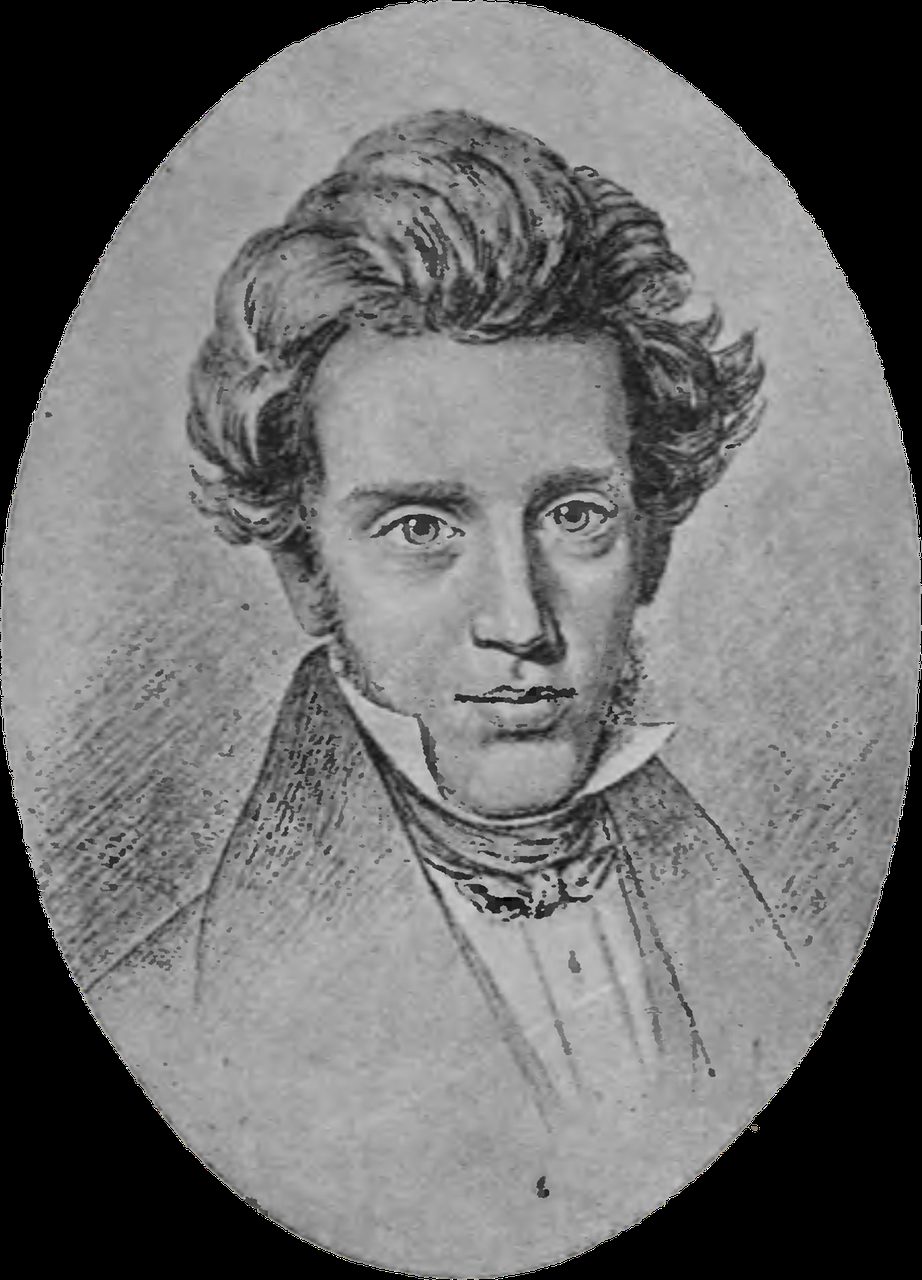
Soren Kierkegaard lived from 1813 to 1855, wrote in Danish, and published much of his work under invented names. Our file records that the pseudonyms were not concealment but a way of presenting different existential perspectives. The Stanford Encyclopedia's entry on Kierkegaard, read for this article, supplies the reason our file leaves out: each invented author embodies a different way of understanding a human life, and the indirect method was meant to move a reader toward self-understanding rather than to instruct.
That method is why the paragraphs below describe positions rather than doctrines. A philosopher who publishes rival views under invented names, each argued at full strength, is not standing behind all of them at once.
Our file gives Kierkegaard three stages, or spheres, of existence. The aesthetic: living for immediate pleasure and sensation, which the file says ends in boredom and despair, and which Either/Or of 1843 represents. The ethical: living by duty, commitment and universal moral law, represented by married life and social responsibility. The religious: a relationship to God through the leap of faith, transcending rational ethics, whose case is Abraham's willingness to sacrifice Isaac in Fear and Trembling, also of 1843. One hedge belongs here that our file does not carry. The Stanford Encyclopedia's entry describes the spheres as different views of what gives a human life value, and reports that the hierarchy between them remains debated among scholars. So the three are set out here and are not presented as a ladder anybody was instructed to climb. The leap of faith is named here as Kierkegaard's own category; read instead as philosophical suicide it belongs to The Absurd, which already carries that reading and names him while making it.
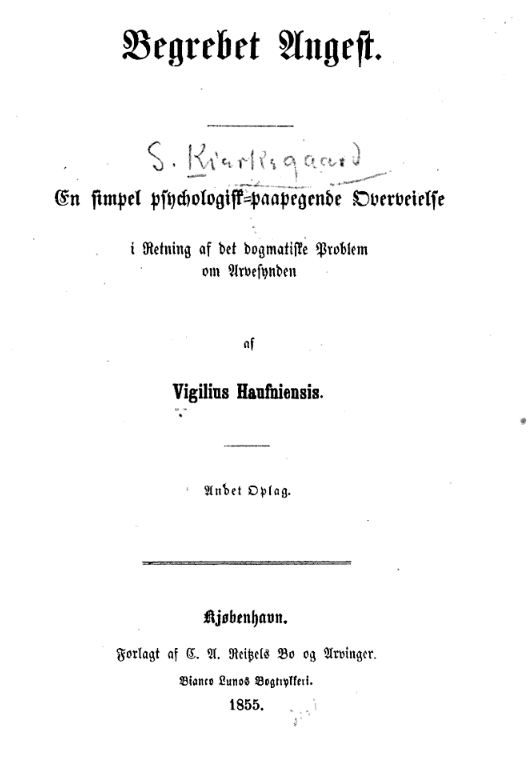
Anxiety, in Danish Angest, is not fear of anything in particular. Our file states that Kierkegaard's anxiety is a fundamental dizziness of freedom, from The Concept of Anxiety of 1844, and prints a compressed line to that effect. That line is a fragment of a longer sentence in the standard English translation, and the research behind this article did not read that sentence off a printed page, so neither wording appears here inside quotation marks. What survives without them is the idea, and it is the hinge of everything that follows. The vertigo is not caused by the height. It is caused by noticing that nothing prevents the step. The Stanford Encyclopedia's entry glosses anxiety as "an awareness of freedom", which is the encyclopedia's phrasing rather than his.
That is why anxiety and freedom are one subject in this tradition rather than two, and it is the thread that runs from 1844 to a Paris lecture hall a century later.
Despair, on this account, is not what the word usually means. Our file states that not getting what one wants is not true despair, and that true despair is the sickness unto death, which it glosses as failing to be oneself, or not knowing that one has a self, from The Sickness Unto Death of 1849. The Stanford Encyclopedia's entry states the same thing in its own words, as "the state in which the self fails to become a self in truth". Two independent sources agreeing matters here, because this is the least intuitive of his claims and the one most likely to be softened in a summary. The counterintuitive half is load-bearing: on this account a contented person who has never faced the question is in despair and does not know it. One sourcing note belongs with it. Our file dates that book to 1849 and lists no edition of it anywhere in its bibliography, although it lists two other Kierkegaard works; the claim is uncontroversial and the gap is our own.
Kierkegaard's claim about subjectivity is the one most easily turned into its opposite, and our file guards it in the same breath as it states it. The claim is not that truth is whatever anybody feels. It is that the truths most essential to human existence, the ethical, the religious and the existential ones, are appropriated through passionate personal commitment rather than through detached theoretical observation. This is not relativism, and our file says so in its own voice. The Stanford Encyclopedia's entry makes the same point about faith, saying that genuine religious faith "requires 'inwardness' or 'subjectivity' as its presupposition". The bare slogan that circulates in two different word orders is not quoted anywhere here, because neither order was read off a printed page for this article, and because the slogan without its qualifier says the opposite of what it meant.
Kierkegaard rejected the attempt to build a complete rational system of reality, and that much is not in doubt. Our file makes the point with a sentence in quotation marks, attributed to him, with no work, translation, edition or page named. That sentence could not be verified as his from any edition, translation or scholarly citation, so it does not appear in this article in any form. The position stands without it: a system that claims to contain everything has to contain the person building it, and it does not. The second correction is the more interesting one. The flat picture of Kierkegaard as a man writing against Hegel is contested by the scholarship. The Stanford Encyclopedia's entry reports that Jon Stewart's work showed the relation to be considerably more complex and nuanced than had been assumed, and that the polemics were aimed primarily at the Danish Hegelians of his own Copenhagen rather than at Hegel himself. Stewart's book is cited below and its identifier resolves exactly. The caricature belongs to popular retelling rather than to the record.
Our file gives Kierkegaard the title father of existentialism in its own section heading, and records the reception history behind it: he published prolifically between 1843 and 1855, was largely ignored in his lifetime, and was rediscovered in the twentieth century through the work of Karl Barth, Martin Heidegger and Jean-Paul Sartre. The Stanford Encyclopedia's entry records the same title and then qualifies it, saying that he is "often dubbed the 'father of existentialism'" and that the designation "obscures at least as much as it reveals". Both halves belong on the page. The honest shape of the fact is that a Danish Christian writing against the philosophy of his own century was made the founder of a twentieth-century French movement by readers ninety years later, one of whom, Heidegger, refused the movement's name. Father of existentialism is an attributed designation everywhere in this article and is never restated as a plain fact.
03The Method They Inherited
Between the Danish writer and the Paris lecture there is a technical step, and skipping it is what makes existentialism look like a mood rather than an argument.
Phenomenology was founded by Edmund Husserl, 1859 to 1938, at the turn of the twentieth century, as the systematic study of the structures of consciousness and of the phenomena that appear within it. Two of its ideas are all this article needs. Intentionality, which Husserl took from Franz Brentano: every act of consciousness is directed toward an object, so consciousness is always consciousness of something. And the epoche, or bracketing: suspending the default assumption that the world simply exists out there ready-made, and attending instead to how things actually appear to a consciousness. Our file on phenomenology is careful to say that this is neither scepticism nor idealism but methodological restraint. The tradition's motto is usually rendered as an instruction to go to the things themselves; neither the German nor the English of it was verified against a primary text for this article, so neither is printed here inside quotation marks.
Heidegger was Husserl's student and his successor at Freiburg, and the move that made existentialism possible was a move against his own teacher. Our file on phenomenology records it and our file on existentialism does not. Heidegger argued that Husserl's transcendental reduction was still trapped inside Cartesian subject and object: a consciousness on one side, a world on the other. His counter-claim is the one everything below runs on. Dasein is not a consciousness contemplating objects but being-in-the-world, always already engaged in practical dealings with equipment, with others and with meaning. Our file adds the hermeneutic turn, that phenomenology is not presuppositionless description but interpretation, because understanding always happens inside a horizon of prior understanding. And it adds mood, Stimmung: that a person is always in some mood, that moods disclose the world in particular ways, and that anxiety discloses the groundlessness of existence. That last item is why Kierkegaard's anxiety and Heidegger's anxiety are the same subject rather than a coincidence of vocabulary.
One more inheritance, here for a single reason. Maurice Merleau-Ponty, 1908 to 1961, published Phenomenology of Perception in 1945 and argued that perception is an active bodily achievement rather than passive sensation or judgement, and that the lived body is not a physical object among objects but the medium through which anybody has a world at all. That is the direct methodological ancestor of de Beauvoir's situated, embodied freedom, and of her argument that biological facts acquire meaning only inside a situation. Everything else in his work stays where it belongs, in an article on phenomenology that this library has not built.
04Thrown Into A World Already Running
Martin Heidegger, 1889 to 1976, published Being and Time, in German Sein und Zeit, in 1927. Our own file calls it arguably the most important philosophical work of the twentieth century, and that hedge is the file's own word: this is our file's estimate rather than a finding, and the judgement is not repeated anywhere else in this article. The book's animating question is what our file calls the Seinsfrage, that philosophy has forgotten to ask what it means to be at all. This article compresses him hard and on purpose. His ontology, his analysis of equipment, his later turn and the full existential analytic belong to an article on the question of being that this library has not yet built. He is here because Sartre and de Beauvoir argue inside vocabulary he made.
Three of his terms are the ones this article actually needs. Dasein, literally being-there, is his word for human existence: we are the beings for whom being is an issue. Being-in-the-world, In-der-Welt-sein: humans are never isolated subjects facing an external world, but are always already embedded in a meaningful context of practices, relationships and equipment. And thrownness, Geworfenheit: a person finds themselves already in a situation, a particular body, a culture and a historical moment, without having chosen any of it. Thrownness is the exact counterweight to the radical freedom argued for in section 05, and the exact ancestor of the situation argued for in section 07. A reader who has met it here needs no further machinery to see what de Beauvoir's objection to Sartre is.
Authenticity, in German Eigentlichkeit, is set against inauthenticity, and our file gives the mechanism: das Man, usually rendered the They or the anyone. We typically exist inauthentically, doing what one does and thinking what one thinks. Anxiety shatters that comfortable conformity and reveals a person's own freedom and finitude. The Stanford Encyclopedia's entry on Heidegger glosses das Man as the anyone and social norms, and glosses authenticity as "an existence that is owned, or taken hold of". Two warnings go with the word. Eigentlichkeit is built on the German for own, so owned is closer to it than genuine or sincere, and an article that translated authenticity as being true to oneself would have imported a self-help meaning the word does not carry here. And this is not a moral instruction. Inauthenticity on this account is the default condition of everyone, the author of the book included, and not a failing attributed to other people.
Mortality enters as a structure rather than as a subject. Our file gives being-toward-death, Sein-zum-Tode, with four stated characters: death is non-relational, certain, indefinite as to when, and not to be outstripped, and it is a person's ownmost possibility. Authentic existence on this account requires confronting death as one's own rather than abstractly, as a thing that happens to people. That is the whole of it here, because the full analytic belongs to the unbuilt article on the question of being, and death as a cultural question belongs to Death and the Afterlife. What it does in this article is narrow and load-bearing: it is why the tradition treats mortality as a structural feature of freedom rather than as a sad topic.
The political record is documented and dated and belongs in plain sight. Our file records that Heidegger was Rector of Freiburg University in 1933 and 1934 under National Socialism, that he joined the NSDAP, that the extent of his complicity is debated but documented, and that the Black Notebooks, published in 2014, contain antisemitic passages which intensified an existing scholarly controversy. The Stanford Encyclopedia's entry on Heidegger is more precise on four points our file leaves vague: he "was elected Rector of Freiburg University in April 1933", he "joined the Nazi Party on May 1st", he resigned the rectorship in April 1934, and he "remained a member of the Nazi party until the end of the Nazi regime", which our file does not say at all. The first three volumes of the Notebooks appeared in March 2014, edited by Peter Trawny, and the reason they intensified the controversy rather than merely continuing it is that they show antisemitic tropes entering the philosophical thinking rather than sitting beside it as private prejudice; the scholarship making that case is cited below. The record is stated here and stopped there. This article does not psychologise it, does not adjudicate what the philosophy owes to the politics, and does not use the biography to win or lose the argument about thrownness.
05The Paper-Knife
Jean-Paul Sartre, 1905 to 1980, French philosopher, writer and political activist, published Being and Nothingness, in French L'Etre et le Neant, in 1943. The Stanford Encyclopedia's entry on him gives the same life dates. The tier on this block is our file's own placement rather than a measure of doubt: it puts Sartre in its Tier 2 section and Heidegger in its Tier 1 section while making the same kind of claim about each, and nothing about Sartre's authorship or dates is disputed by anybody.
The claim itself, in our file's words: there is no pre-given human nature and no divine plan; a person exists first and then creates themselves through their choices. That is the thesis the movement is named for, and the two standard English versions of the lecture do not state it in the same words. Philip Mairet's English, read in full for this article, renders the key passage as "existence comes before essence, or, if you will, that we must begin from the subjective". The form everyone quotes, "existence precedes essence", is the formula as it settled in philosophical English, and it is quoted here from the Stanford Encyclopedia's entry on existentialism, which prints it in that form. The French that both render is one sentence, l'existence precede l'essence. The English is two. A subject this misquoted earns one visible demonstration that translations differ, and this is the first of the two this article carries.
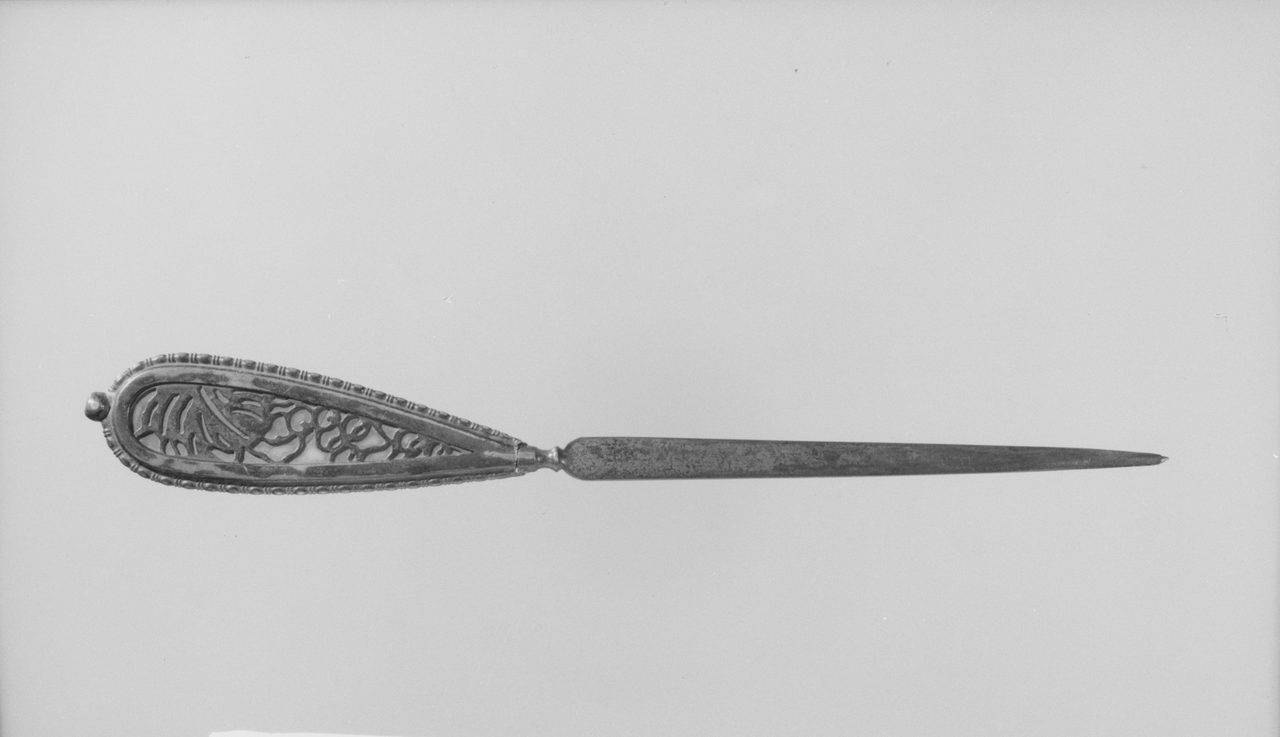
Sartre explains the formula himself, with an example our file does not carry at all. He asks his audience to consider an article of manufacture, and his own examples are a book and a paper-knife. Of such a thing, Mairet's English says that "it has been made by an artisan who had a conception of it", and that it is "at the same time an article producible in a certain manner and one which, on the other hand, serves a definite purpose". The concept and the production technique come first; the object follows. So for a manufactured thing, essence precedes existence. His claim is that when God is subtracted there is no artisan anywhere holding the concept of a human being, and the order simply reverses. This is the one place in the whole subject where the central abstraction is made concrete by its own author, which is why the object at the top of this article is a letter opener rather than a fifth portrait. Mairet writes paper-knife, rendering the French coupe-papier; other translations give letter-opener or paper cutter.
Being and Nothingness sets two modes of being against each other, and the distinction is needed here for exactly one thing. Being-for-itself, pour-soi, is human consciousness, characterised by nothingness, by freedom, and by the ability to negate and to imagine what is not. Being-in-itself, en-soi, is non-conscious reality, a rock or a tree, solid, self-identical, without freedom. The Stanford Encyclopedia's entry on Sartre describes the pair as that which negates and transcends set against pure plenitude. The one thing it is needed for is the next paragraph, because bad faith is the attempt of a for-itself to be an in-itself.
Bad faith, mauvaise foi, is the self-deceptive attempt to deny one's own freedom, and the example this article uses is a waiter who becomes nothing but a waiter. What the performance denies is that being a waiter is something he keeps choosing. The Stanford Encyclopedia's entry describes the manoeuvre as trying to institutionalise oneself as an object while inhabiting the role in the mode of being what one is not. Our file gives a second example, and it is stated here with its context rather than dropped in as an illustration: a woman leaves her hand inert while a man takes it, and Sartre analyses her as deceiving herself about her own freedom by treating her own hand as an object. The example is his and so is the analysis. The objection, that a woman in that situation is being read as a case of self-deception rather than as a person inside a structure, is one this article reaches later, from inside the tradition, in de Beauvoir's argument.
06A Sentence Passed, Not A Privilege Granted
Our file states the claim in three clauses: humans are condemned to be free, even choosing not to choose is a choice, and a person is fully responsible for what they make of themselves. The verified wording supplies the part that turns it from a slogan into an argument. In Philip Mairet's English, rendering the French l'homme est condamne a etre libre, Sartre says that "man is condemned to be free. Condemned, because he did not create himself, yet is nevertheless at liberty", and, further on in the same lecture, "We are left alone, without excuse. That is what I mean when I say that man is condemned to be free." The second clause is the whole point. Freedom here is not a privilege being celebrated. It is a sentence being passed, and the thing it takes away is the excuse. Every compression of this claim, into a summary, a subtitle or a poster, tends to turn a sentence about inescapable responsibility into a line about liberation, which reverses it.
The Look, le regard, is the other half of that account, and it produced the one line this article will not print. Our file states that the Other's gaze objectifies me, cites the line from the play Huis clos, first performed in 1944, and then supplies the corrective that has to travel with it: this is not misanthropy, but the recognition that others constitute part of my being as an object. The Stanford Encyclopedia's entry on Sartre describes the encounter with another's gaze as turning one into a transcendence transcended, and treats it as his refutation of solipsism by way of shame. The line itself is not quoted here in any form. No published English translation of it could be read for this article, the published renderings differ between translators, and the best known of them carries punctuation this house does not reproduce. What can honestly be said is that the play's most famous line is usually given in English as hell is other people, and that this is a rendering of a French sentence rather than a transcription of anything.
There is a direct answer to that inside the same tradition, and it is worth setting down briefly. Emmanuel Levinas, 1906 to 1995, a Lithuanian-French philosopher who studied with Husserl and Heidegger, survived a Nazi labour camp and lost most of his family in the Holocaust, argued that the encounter with the Other's face is the primordial ethical event, and that ethics, meaning responsibility for the Other, is more fundamental than ontology. Sartre says the Other's gaze turns a person into an object. Levinas says the Other's face is the origin of obligation. Two philosophers in one tradition, looking at the same encounter, reaching opposite conclusions.
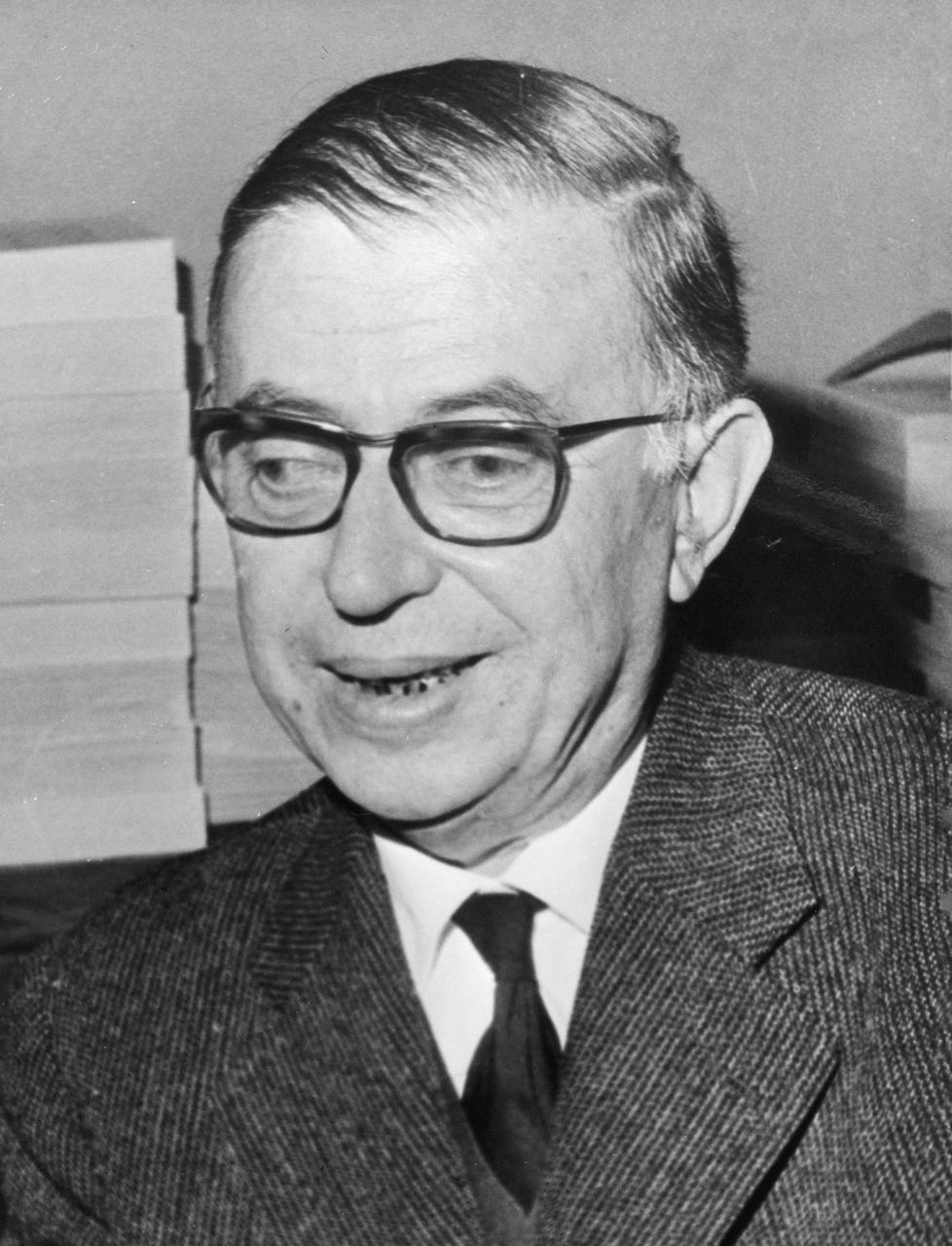
Sartre refused the Nobel Prize for Literature in 1964. One sourcing limit belongs on the record, because this is exactly the sort of tidy fact that gets restated bare: the official Nobel Foundation pages for the 1964 prize returned an access error on both attempts made for this article and could not be fetched, so no primary or official confirmation was obtained. The Stanford Encyclopedia's entry on Sartre corroborates the refusal in cautious form, and our own file states it flatly. No Nobel citation, motivation or Foundation wording is quoted or paraphrased anywhere in this article, because none of it was verified. What the act is doing here is one line's worth. A philosopher whose central claim is that a person is nothing but what they make of themselves, declining a prize whose whole function is to say what a person is, is the argument acted out in public.
Nothing else about anybody's private life appears in this article. A public act with a date belongs. The rest does not.
07The Ethics Of Ambiguity
Every reader arrives with the same objection, and it is the right one. If existence has no predetermined meaning and no given values, how is an ethics possible at all? The answer this tradition gives has an author and a title, and it was published two years before the book she is famous for.
The Ethics of Ambiguity, in French Pour une morale de l'ambiguite, appeared in 1947, and our file on de Beauvoir frames it as a direct answer to that standing challenge. Her answer is that ethics arises precisely from the ambiguity of the human condition, because a person is at once free consciousness and a situated, embodied, mortal being: both a subject who projects meaning and an object subject to the world's constraints and to other people's judgements. She catalogues five ways of fleeing that ambiguity. The sub-man, who refuses to engage and drifts. The serious man, who treats values as given, objective and unchosen, which our file says is analogous to Sartre's bad faith. The nihilist, who sees that values are not given and retreats into cynical indifference. The adventurer, who embraces freedom for himself alone and is indifferent to the freedom of others. And the passionate man, who pursues a single project obsessively and reduces the world to an instrument. Her positive claim is what answers the objection: willing one's own freedom necessarily implies willing the freedom of everyone else, because a person's projects require a world of free beings. That is why oppression is an ethical wrong on this account rather than a misfortune.
Our file on existentialism compresses the same argument into a sentence worth keeping whole. Oppression fails not because it makes people unhappy but because it reduces them to things, denying their transcendence. That is a test which does not depend on how anybody feels about their situation, and a test that does not run on feeling is exactly what an existentialist ethics needs if it is to answer the charge that it collapses into preference.
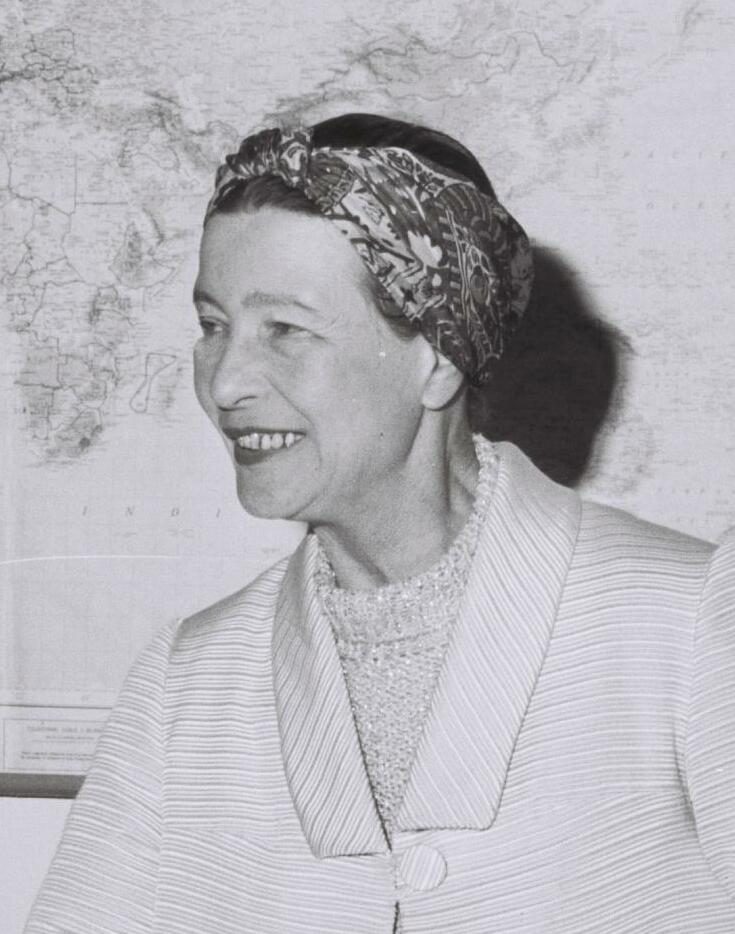
Simone de Beauvoir was born in Paris on 9 January 1908 and died on 14 April 1986. Our file on her records a bourgeois Catholic family, philosophy at the Sorbonne, and the agregation in philosophy passed in 1929, in which she placed second and Sartre placed first. The work runs across four kinds. Novels: She Came to Stay in 1943 and The Mandarins in 1954, which won the Prix Goncourt. Philosophical essays: Pyrrhus and Cineas in 1944 and The Ethics of Ambiguity in 1947. The Second Sex in 1949. And memoirs in four volumes between 1958 and 1972, alongside The Coming of Age in 1970 on old age and A Very Easy Death in 1964 on her mother's death. The file also records the political activity: anti-colonial work during the Algerian War, abortion rights, and the women's liberation movement.
That examination result is the one biographical fact in this article that touches the relationship the popular account puts at the centre of her life, and it is a fact about an examination. Her arguments are the subject here, and they are made on their own terms.
Situated freedom is where she parts from Sartre, and our file on existentialism states it in two moves. First, the ambiguity of the human condition: a person is simultaneously a free subject and a situated being, so freedom is always embedded in concrete circumstances. Second, the objection itself: she criticised Sartre's absolute freedom as insufficiently attentive to structural oppression, on the ground that freedom requires material conditions for its exercise. This is where existentialism is criticised from inside by a first-rank existentialist, and it lands exactly on the title of this article. If a person is condemned to be free, what is true of a person whose situation forecloses almost every option? Sartre's answer and hers are not the same answer. Both are carried here at strength and neither is crowned. It also connects straight back to thrownness in section 04, which is why that material is in this article at all.
08A Situation, Not A Nature
The Second Sex, in French Le Deuxieme Sexe, was published in 1949 in two volumes. Volume I, Facts and Myths, examines the biological, psychoanalytic, historical-materialist and mythological construction of woman. Biology provides no justification for subordination, because biological facts acquire meaning only inside specific social and cultural contexts. Freud is criticised, on the ground that penis envy is a social rather than a biological phenomenon. Engels is criticised as necessary but insufficient. And the myths of the Eternal Feminine, the Mother, the Virgin and the Whore are analysed as the machinery by which a patriarchal culture constructs woman as Other. Volume II, Lived Experience, traces a woman's life from childhood to old age: a childhood socialisation teaching passivity and immanence, then adolescence, marriage, motherhood and ageing, each analysed as a socially structured constraint on freedom. Two structural terms carry the argument. Immanence against transcendence: patriarchal society confines women to immanence, meaning repetitive domestic labour, biological reproduction and passivity, while reserving transcendence, meaning creative projects, public achievement and historical agency, for men. And woman as Other: drawing on Hegel's master and slave, man constitutes himself as the Subject, the essential, by constructing woman as the inessential Other. The sharpest step is the one summaries drop. Unlike Hegel's slave, women have historically failed to assert themselves as subjects because their dispersion among men prevents collective solidarity.
The book's most famous sentence exists in English in two forms that do not say the same thing, and the difference is a live scholarly matter rather than a matter of taste. The thesis behind it, in our file's words: femininity is not a natural essence but a social construction, a situation produced by institutions, customs, education and expectations, and the biological category is distinguished from the socially constructed one. The 1953 translation by H. M. Parshley gives "One is not born but becomes a woman". The 2010 translation by Constance Borde and Sheila Malovany-Chevallier gives "One is not born but becomes woman", with no indefinite article. Both forms are quoted here as the Stanford Encyclopedia's entry on de Beauvoir prints them. The French that both render is On ne nait pas femme: on le devient. The difference is not cosmetic. With the article, the sentence describes an individual acquiring a role. Without it, the sentence describes a category being constructed. The longer and more familiar reprint wording, which adds one word to the 1953 form, was not read off a printed page for this article and is not reproduced anywhere in it.
There is a reason that sentence has a translation history, and no file in our library records it. For fifty-seven years the only English Second Sex was the 1953 translation, made by a zoologist with no philosophical training and commissioned by a publisher who wanted the book shortened. The Stanford Encyclopedia's entry on de Beauvoir states that the translator was "a zoologist with no background in philosophy" and that the translation "omits around fifteen percent of the original text, inaccurately translating the central philosophical concepts, and depoliticizing Beauvoir's feminism". Three external sources carry the episode and all three are cited below, with identifiers resolved live for this article and the returned titles read against the claim. Margaret A. Simons documented the cuts in 1983, twenty-seven years before a replacement translation existed. Toril Moi made the sustained scholarly case for a retranslation in 2002. And Constance Borde and Sheila Malovany-Chevallier published their own account of the work in 2009, the year before their translation appeared. One hygiene note belongs with them. The identifier P_3_03 attaches to The Second Sex is in fact that third article's identifier, so a reader following our file's bibliography would arrive at an essay about translating the book rather than at the book. It is carried below correctly labelled and never as the book.
One qualifier keeps the next sentence accurate. Our file on de Beauvoir states that she did not use the term gender in the technical sense feminist theory later developed, and that her distinction between biological sex and the social construction of femininity laid the conceptual groundwork for the sex and gender distinction that became central to that theory, naming Money, Rubin and Butler as its later developers. So the accurate statement is that she supplied the groundwork and the vocabulary came later. An article saying she invented the distinction would be making a claim our own file explicitly does not support.
| The Line | The French It Renders | What This Article Does With It |
|---|---|---|
| Existence precedes essence | l'existence precede l'essence, from the lecture of 1945, published 1946 | Quoted in both standard forms, each attributed to the rendering it is. Philip Mairet's English has existence coming before essence, and the settled formula is quoted from the Stanford Encyclopedia's entry, which prints it in that form |
| Man is condemned to be free | l'homme est condamne a etre libre, from the same lecture | Quoted, in Philip Mairet's English only, and set as this article's pull quote with the clause that makes it an argument rather than a slogan. The article's own title carries the phrase as a title and not as a quotation, which is why it wears no quotation marks and names no translator |
| Hell is other people | L'enfer, c'est les autres, from the play Huis clos, first performed 1944 | Refused. No published English translation could be read for this article, the renderings differ between translators, and the best known of them carries punctuation this house does not reproduce. The line is named as a rendering and is never printed as a quotation |
| One is not born but becomes a woman | On ne nait pas femme: on le devient, from the opening of volume II of Le Deuxieme Sexe, 1949 | Quoted only in the two shorter forms the Stanford Encyclopedia prints, each attributed to its translation and dated: the 1953 wording in the left column, and the 2010 wording, which drops the indefinite article. The longer reprint wording that circulates most widely was not read off a printed page and is not reproduced in this article at all |
09Her Own Philosopher
For decades she was read primarily as Sartre's disciple, and our file on de Beauvoir records that recent scholarship, naming Simons, Bauer, Bergoffen and Le Doeuff, has argued convincingly that she was an independent and original philosopher. It gives three grounds. The first is the strongest and it is a matter of dates: She Came to Stay developed the themes of intersubjectivity and the Other before Sartre's Being and Nothingness did, and both books appeared in 1943. The second: her ethics, with its emphasis on embodiment, situation and the obligations of freedom, differs significantly from his more individualistic account. The third: her analysis of oppression and of the social constitution of identity was more politically concrete and more sociologically grounded than his early philosophy. Then the twist, from the Stanford Encyclopedia's entry on her. "Her philosophical voice, she insisted, was merely an elaboration of Sartre's", and scholars have since demonstrated her "original contributions to existentialism and phenomenology". She is the source of the misreading, and the scholarship holds that she was wrong about her own work.
No: the claim that de Beauvoir simply repeated Sartre's philosophy does not hold, and our own file on her marks it incorrect, in its own brackets, in its own Tier 4 section. Its ground is the record above. She developed original philosophical positions, particularly on ethics, embodiment, oppression and the social construction of gender, that diverge from his work, extend it, and in the case of She Came to Stay precede it. This article states that refusal outright rather than merely avoiding the error, because a Tier 4 refusal left unsaid is a refusal weakened.
Our file carries the criticism as well as the extension, and both belong here, because a thinker taken seriously is a thinker whose critics are named. The extension: Judith Butler's Gender Trouble, in 1990, argued that not only gender but biological sex itself is socially constructed and performed, which challenges the very distinction de Beauvoir's work grounded. The criticism: her analysis has been challenged for overemphasising Western, white and heterosexual experience; for insufficient attention to race and colonialism, although our file notes that she was politically engaged on those issues; and for ambivalence about motherhood and the female body.
One question about her work is unsettled and our file marks it so. Scholars argue that her later work, particularly The Coming of Age in 1970 and the memoirs, represents a significant evolution in her existentialism toward a greater emphasis on dependency, vulnerability and the limits of freedom in the face of ageing and death. Whether that is a revision of her earlier position or a deepening of it remains debated. It is carried here as the open question it is, and it earns its paragraph for a specific reason. An article built on the claim that a person is nothing but what they make of themselves owes a reader some account of what that claim looks like from the far end of a life.
10The Wing That Was Not Atheist
Our file's own summary names theistic against atheistic as one of the movement's two internal fault lines, and the atheistic half is the half that got famous. Two figures hold the other side, and one of them is the man who coined the German name.
Karl Jaspers gives two ideas this article can use. Limit situations, Grenzsituationen: death, suffering, guilt and struggle, which shatter everyday security and force a confrontation with Transcendence. And the Encompassing, das Umgreifende: the claim that reality always exceeds what can be objectified, and that we exist inside horizons which recede as we approach them. No free-licence portrait of him was found for this article, so he appears in text only, which is the honest outcome rather than a gap.
Gabriel Marcel, 1889 to 1973, a French Catholic existentialist, draws a distinction that does real work. A problem is objective and solvable by technique. A mystery is participatory, because the inquirer is part of what is being questioned. Being, love, hope and fidelity are mysteries and not problems, so detached analysis cannot address them. His figure for human existence is homo viator, man the wayfarer, existence as pilgrimage, defined by hope rather than by anxiety. That last clause answers this article's own subject directly, which is why a single paragraph on Marcel is worth more here than a survey would be. Kierkegaard and Marcel bracket Sartre from the religious side, and no free-licence image of Marcel was found for this article either.
11A Philosophy That Came Out As Novels
Our file states that the movement was unique among philosophical movements in finding its primary expression through literature as much as through systematic philosophy, and that judgement is the file's rather than this article's. It names Sartre's own literary work: Nausea in 1938, in which the character Roquentin discovers sheer contingency; No Exit in 1944; and The Roads to Freedom trilogy between 1945 and 1949. Whatever the comparison with other movements is worth, the fact behind it is why this subject reached a general public at all, and it is why a play and a treatise can be discussed here in the same register without a change of gear.
Our file names Fyodor Dostoevsky, 1821 to 1881, as a figure widely considered a proto-existentialist, points to Notes from Underground of 1864 as an exploration of radical freedom and irrationality, and gives a line from The Brothers Karamazov of 1880 inside quotation marks, immediately hedging it in its own parenthesis by attributing it to the character Ivan Karamazov. That parenthesis is our file being honest and it is kept here. The sentence in the compressed form everyone knows circulates far more widely than any passage of the novel, and it was not verified against Dostoevsky's text in any translation for this article. What is on the record is more interesting anyway. Sartre quotes the line in the 1945 lecture as Dostoevsky's, and treats the idea that if God does not exist then everything is permitted as existentialism's starting point. It is attributed here to Sartre's use of it rather than to the novel, and it is printed as a quotation from neither.
Our file names Franz Kafka, 1883 to 1924, and The Trial, The Castle and The Metamorphosis as works of existential alienation, absurdity and bureaucratic dehumanisation, and then adds the clause that makes the entry worth keeping: without systematic philosophical argument. Kafka is not doing philosophy, and the tradition claimed him anyway. That is a fact about how the movement assembled its own ancestors rather than a fact about Kafka. The word absurdity is used here in its ordinary literary sense; as Camus's technical term it belongs to The Absurd, and the two senses should not be allowed to blur.
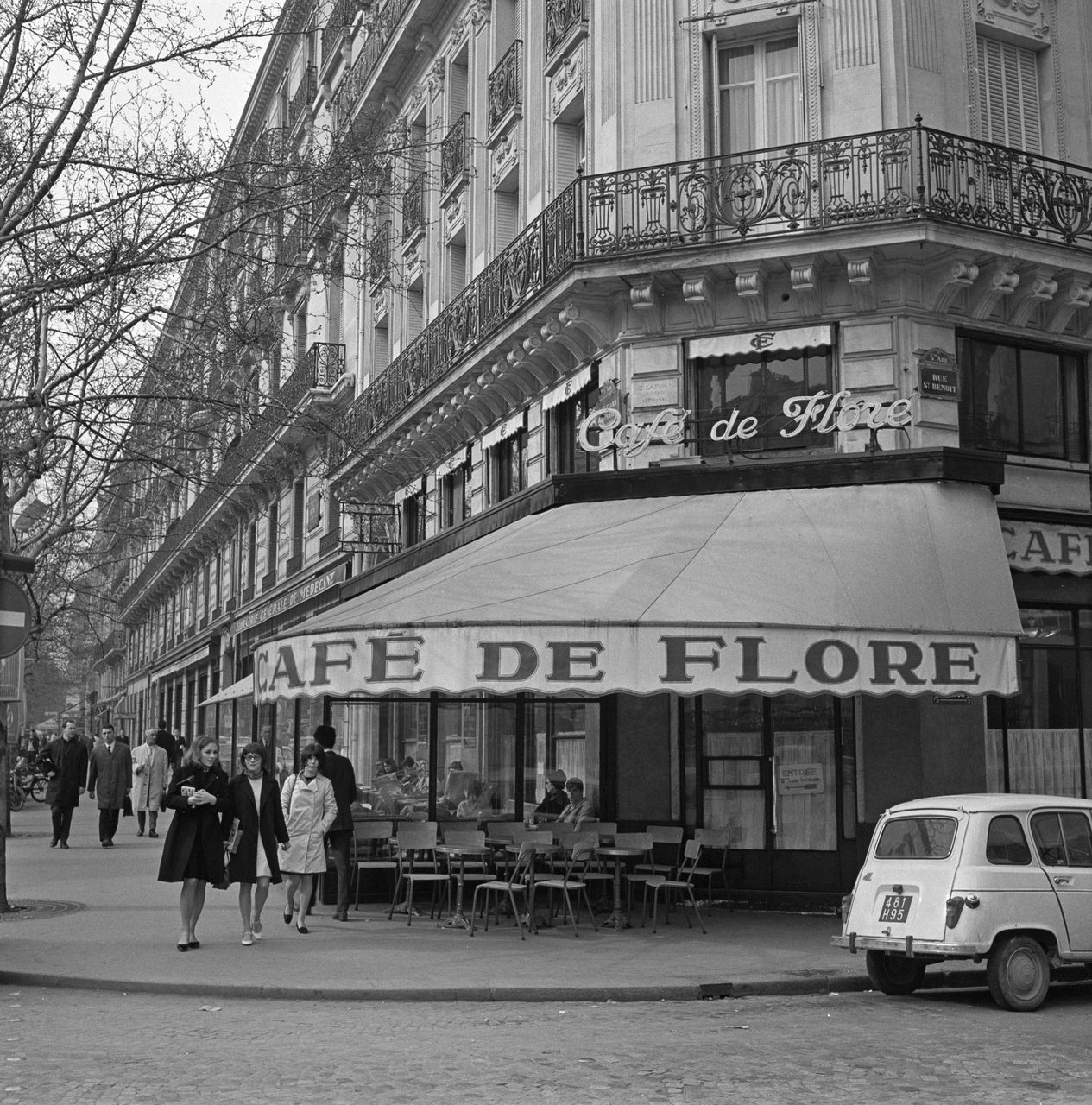
Our file dates the movement's cultural peak to postwar Paris between 1945 and 1960, centred on the cafes of Saint-Germain-des-Pres, and records that existentialism became a lifestyle and a fashion as well as a philosophy, a popularisation that Sartre both encouraged and lamented. It separately records the reach: into twentieth-century art; into theatre through the Theatre of the Absurd, naming Beckett and Ionesco; into cinema, naming Bergman and Godard; and into theology, naming Tillich, Bultmann and Buber. The last clause of that first sentence is the one that should not be lost in any summary. The philosopher who said a person is nothing but what they make of themselves watched the argument turn into a way of dressing, and had mixed feelings about it.
A fashion passing is not a philosophy ending, and the two are easily confused. The next two sections are where the tradition went after the cafes emptied, and where it is still being argued over.
12The Clinic, And A Comparison Left Open
Both of the blocks below carry Tier 3, which is our file's own label on each of them individually rather than a judgement about the whole territory. Each also carries our file's own hedge, and the hedges are the useful part.
Existential psychology draws heavily on Kierkegaard, Heidegger and Sartre, and our file names Rollo May, Irvin Yalom and Viktor Frankl. Frankl's logotherapy, the finding of meaning in suffering, from Man's Search for Meaning of 1946, is a therapeutic application of existentialist principles, and it is carried at length by The Meaning of Life rather than here. Yalom's four existential givens are death, freedom, isolation and meaninglessness. Ludwig Binswanger, 1881 to 1966, and Medard Boss, 1903 to 1990, developed Daseinsanalysis, replacing Freud's metapsychological apparatus with phenomenological description of a patient's being-in-the-world. And R. D. Laing, 1927 to 1989, argued in The Divided Self of 1960 that schizophrenia is an intelligible response to an unlivable interpersonal situation rather than merely a brain disease. Our file states that this emphasis has found empirical support in palliative care, addiction recovery and post-traumatic growth research, and then hedges itself in the same breath: the degree to which clinical outcomes validate existentialist philosophical claims remains an open question. That hedge is not optional. A clinical result cannot confirm a philosophical thesis, and our own file says so. Nothing here is clinical advice and no therapy is named as effective.
Our file also records a comparison and refuses to settle it. Parallels between Heideggerian nothingness and the Buddhist sunyata have been extensively discussed. Heidegger himself engaged with East Asian thought, including a dialogue with the Japanese scholar Tezuka and an interest in Daoist texts. And Kierkegaard's anxiety before the infinite has been said to resonate with the dark night of the soul in mystical traditions. Whether any of that indicates genuine philosophical convergence or superficial typological similarity remains debated, in our file's own words. This article carries the question and does not answer it, partly because it cannot and partly because two articles this library has not yet built own convergence arguments of their own.
13Two Refusals, Running Opposite Ways
A subject can be defended into falsehood as easily as it can be attacked into it, and this one is usually got wrong in both directions at once.
No: existentialism is not despairing nihilism. Our own file places that characterisation in its Tier 4 section and says it fundamentally misreads the tradition, on two grounds. Sartre, Camus and de Beauvoir all insist on the possibility of creating meaning through freedom, engagement and solidarity. And Heidegger distinguished nihilism, which he characterised as the domination of beings at the expense of Being, from his own project of fundamental ontology. That is this article's refusal and its subject is existentialism. The neighbouring refusal, absurdism against nihilism, is argued at length and from Camus's own side by The Absurd, and is not re-argued here.
No, and in the opposite direction: existentialism did not prove that there is no human nature, and existence precedes essence does not settle anything by being said. It is a thesis defended by argument rather than a result demonstrated by evidence, and no file behind this article offers a test that could settle it either way, because it is not the kind of claim a test settles. This refusal appears in none of the three files; it was written for this article precisely because none of them supplies this direction, and an article that let the thesis harden into a fact would have failed in the opposite way to the one our file warns about. The material above shows how contested the neighbourhood is. Most of the thinkers the movement claims refused the label. Its founding figure was recruited to the role posthumously, under a title the reference literature says obscures as much as it reveals. Its most famous internal argument, de Beauvoir's charge that this account of freedom does not survive contact with structural oppression, is unresolved. Her own later work is read by some scholars as a retreat from the strong position, and her analysis carries named criticism of its own. Two further refusals of the same shape belong here. Existentialism is not over: the fashion passed and the philosophical work continued in ethics, in feminist philosophy, in psychiatry and in theology. And there is no such thing as what the existentialists believed, because the movement holds a Danish Christian, a French Catholic, an atheist, a phenomenologist who refused the name and a novelist who refused it too, so any sentence beginning with existentialists believe is almost certainly false. One last item belongs on this list. All three of the research files behind this article carry a footer asserting that no significant counter-arguments exist in the scholarly literature and that the topic has no active scholarly dispute. That is false on each file's own evidence, in each case a few paragraphs above the footer itself, and nothing in this article cites it or leans on it.
14Where It Actually Stands
Laid out at once, this is not a doctrine with adherents. It is a set of arguments made by people who agreed on very little, several of whom denied belonging to anything.
| Whose Argument | What It Puts At the Centre | What Is Pressed Against It | Where It Stands In This Article |
|---|---|---|---|
| Kierkegaard, 1813 to 1855 | Anxiety as the dizziness of freedom, despair as the failure to become a self, and the claim that the essential truths are appropriated through personal commitment rather than through detached observation | Father of existentialism is an attributed designation that the reference literature itself says obscures at least as much as it reveals, and the flat picture of him as writing against Hegel is contested by the scholarship | Tier 1 on the texts. One sentence our own file attributes to him is refused outright, because it could not be sourced from any edition, translation or scholarly citation |
| Heidegger, 1889 to 1976 | Dasein, being-in-the-world, thrownness, das Man, authenticity as an existence that is owned, and being-toward-death | His political record is documented and dated: Rector of Freiburg from April 1933, a party member until the end of the regime, and antisemitic passages in notebooks published in 2014 | Tier 1 on the texts and on the record. Compressed on purpose; the ontology belongs to an article this library has not built |
| Sartre, 1905 to 1980 | Existence precedes essence, the paper-knife that makes it concrete, bad faith, the Look, and freedom as a sentence that removes the excuse rather than a privilege that confers anything | De Beauvoir's charge that a freedom with no material conditions for its exercise is not yet freedom; and the plain fact that the central thesis is defended by argument and demonstrated by nothing | Tier 2 by our own file's placement, which is a placement and not a doubt. The famous lines are quoted only in named translations, and one of them is not quoted at all |
| De Beauvoir, 1908 to 1986 | Ethics grounded in the ambiguity of the human condition, the claim that willing one's own freedom implies willing everyone else's, and woman analysed as a situation rather than as a nature | Criticism for overemphasising Western, white and heterosexual experience and for insufficient attention to race and colonialism; and Butler's argument against the very distinction her work grounded | Tier 1, from the file whose whole subject she is. The claim that she repeated Sartre is Tier 4 and is refused here in the article's own voice |
| Jaspers, 1883 to 1969, and Marcel, 1889 to 1973 | Limit situations and the Encompassing; and the distinction between a problem and a mystery, with existence as pilgrimage defined by hope rather than by anxiety | Neither is a rival to the others so much as a demonstration that the atheistic half is a half. Our file names theistic against atheistic as one of the movement's two internal fault lines | Tier 2. Both are text-only here, because no free-licence image of either was found for this article |
| The literary wing: Dostoevsky, Kafka, and Sartre's own novels and plays | Alienation, contingency and radical freedom worked out in fiction rather than in argument, which is how the subject reached a general public at all | Kafka wrote without systematic philosophical argument and was claimed anyway, which is a fact about the movement rather than about him; and the Paris fashion of 1945 to 1960 is not the philosophy | Tier 2. The line our file gives from The Brothers Karamazov is attributed here to Sartre's use of it and never to the novel |
Fast Facts
- The Name
- Popularised by a lecture Sartre gave in Paris in 1945 and published in 1946. Of the figures the reference literature lists as core, only Sartre and de Beauvoir explicitly answered to the label, and the German name for the philosophy of existence was coined by a third person, Karl Jaspers
- The Thesis, Which Is a Thesis and Not a Result
- That a person arrives with no given nature and makes themselves through their choices. Sartre's own illustration is a manufactured object, whose maker held the concept of it before the thing existed, and whose order he says is exactly reversed for a person
- What Freedom Means Here
- Not a licence and not a benefit. In Philip Mairet's English a person is condemned to be free because he did not create himself and is at liberty nonetheless, and is left alone without excuse. The thing this freedom removes is the excuse
- Where It Started
- Kierkegaard, writing in Danish under invented names, largely ignored in his lifetime, rediscovered in the twentieth century by readers including Heidegger and Sartre. Our own file's subheading calls him the father of existentialism; the reference literature calls that designation one that obscures at least as much as it reveals
- The Vocabulary
- Heidegger's, and this article compresses him deliberately: Dasein, being-in-the-world, thrownness, das Man, authenticity as an existence that is owned, and being-toward-death. His political record is documented and dated and is stated here rather than hinted at
- The Objection From Inside
- De Beauvoir's. Freedom requires material conditions for its exercise, so an account inattentive to structural oppression is incomplete. Her Ethics of Ambiguity of 1947 answers the standing charge that existentialism cannot ground an ethics, two years before the book she is famous for
- The Translation Problem
- The most famous sentence of The Second Sex reached English readers for fifty-seven years through a 1953 translation by a zoologist with no philosophical training, which the reference literature says omits around fifteen percent of the original and depoliticises the argument. A replacement appeared in 2010
- What Is Refused Here
- Two claims running in opposite directions. That existentialism is despairing nihilism, which our own file marks Tier 4. And that its central thesis is a settled result, which it is not. A third refusal is about a person: that de Beauvoir repeated Sartre, which our file on her marks incorrect
- What Is Not Quoted
- The famous line from the play Huis clos, in any form. The longer reprint English of de Beauvoir's most famous sentence. And a sentence our own file prints in quotation marks and attributes to Kierkegaard with no source, which could not be verified as his
- What Is Not Settled
- Whether the central thesis holds. Whether Sartre's freedom or de Beauvoir's situated freedom is the better account. Whether her later work revises or deepens her position. And whether the parallels between this tradition and Buddhist thought are convergence or resemblance
What Can Actually Be Stood Behind
What was published, and when, and what it argued, is settled and can be stated flatly. Kierkegaard published prolifically between 1843 and 1855, Either/Or and Fear and Trembling in 1843, The Concept of Anxiety in 1844 and The Sickness Unto Death in 1849. Heidegger published Being and Time in 1927. Sartre published Being and Nothingness in 1943, delivered the lecture in Paris in 1945, on 29 October by the standard account, and saw it published in 1946. De Beauvoir published She Came to Stay in 1943, Pyrrhus and Cineas in 1944, The Ethics of Ambiguity in 1947, The Second Sex in 1949 and The Coming of Age in 1970. Merleau-Ponty published Phenomenology of Perception in 1945. Heidegger was elected Rector of Freiburg in April 1933, joined the party on 1 May 1933, resigned the rectorship in April 1934 and remained a member until the end of the regime; the first three volumes of the Black Notebooks appeared in March 2014. Sartre refused the Nobel Prize for Literature in 1964, on our file's statement and the reference literature's cautious corroboration, since the official record could not be fetched for this article. Every one of those is a fact about a text or a dated public act, which is the level at which this article states them.
The arguments are live and none of them is closed. Whether Sartre's account of freedom survives de Beauvoir's objection that freedom requires material conditions for its exercise is argued rather than settled, and both answers are carried above at strength. Whether the sex and gender distinction her work grounded holds at all is argued against her by Judith Butler. Her analysis carries named criticism as well as named extension. And the tier numbers themselves are contested inside our own library: one file places the Sartre and de Beauvoir material below the Kierkegaard and Heidegger material with no stated criterion, and another file places the same de Beauvoir claims at Tier 1. This article carries the higher-confidence file's tier and names which file it is, and nothing above should be read as the Sartre or de Beauvoir material being less well established than anything else here.
Three things carry our files' speculative label and keep it. Whether clinical outcomes in existential therapy validate any existentialist philosophical claim is an open question, and our own file says so in the same breath as it reports the empirical support, because a clinical result cannot confirm a philosophical thesis. Whether the parallels between Heideggerian nothingness and Buddhist sunyata, or between Kierkegaard's anxiety and the mystical traditions, indicate genuine convergence or superficial resemblance remains debated, again in our file's own words. And whether de Beauvoir's later work revises her position or deepens it carries the same label and the same status. Nothing in this article turns on any of the three.
No: existentialism is not despairing nihilism. Our own file places that characterisation in its Tier 4 section and says it fundamentally misreads the tradition, because the figures it names all insist on the possibility of creating meaning through freedom, engagement and solidarity. No: de Beauvoir did not simply repeat Sartre's philosophy, which our file on her marks incorrect in its own brackets, the dated evidence being that She Came to Stay developed intersubjectivity and the Other before Being and Nothingness did, both books appearing in 1943. And no: none of the three research files behind this article is right to carry a footer saying that no significant counter-arguments exist in the scholarly literature and that there is no active scholarly dispute. That footer is false on each file's own evidence, it appears in all three, and nothing in this article rests on it.
No, running the other way, and this refusal matters as much as the last one. Nothing above shows that there is no human nature, that existence precedes essence is a demonstrated result, or that the question is closed. It is a philosophical thesis defended by argument, the objection it received from inside the movement was never resolved, most of the thinkers it collects refused the label, and no file behind this article offers a test that could settle it, because it is not the kind of claim a test settles. Nor is existentialism over: the Paris fashion of 1945 to 1960 passed, and the philosophical work continued in ethics, in feminist philosophy, in psychiatry and in theology. And there is no set of things the existentialists believed, because they did not agree about that either. If a reader finishes this article able to say correctly that this site holds there is no human nature, or that this was a postwar fashion that ended, the article has failed in one direction or the other.
One thing here is not a matter of opinion, and it is the shape of the disagreement rather than its content. Nobody in this article agrees with anybody else about what follows from the starting point. A Danish Christian and a French Catholic arrive at it through faith. An atheist arrives at it by subtracting the maker from a workshop bench and watching the order of concept and object reverse. A phenomenologist who refused the name arrives at it by asking what it means to be at all. And the person who argued hardest against the most famous version of it was the only other one who agreed to be called an existentialist. What they share is not a doctrine. It is a refusal to let a person be explained by anything settled before they arrived, together with a willingness to say out loud what that refusal costs. Which returns the room at the top of this article to its slogans, with one of them now doing something different. Condemned to be free promises nothing. It takes something away, and what it takes is the sentence that begins because I had no choice.
Sources & further reading
Three research files in our own library stand behind this article: P_3_03 on existentialism, P_3_04 on phenomenology for the method in section 03, and P_5_15 on Simone de Beauvoir, which is where the de Beauvoir claims in sections 07, 08 and 09 come from. Those files are where the work was done from. The records below are where the work can be checked, and they are listed for that purpose rather than as a reading list. Thirteen of the sixteen entries are external. Seven of those are digital object identifiers resolved live against CrossRef for this article on 2026-08-07, with the returned title read against the claim it is attached to. Five are Stanford Encyclopedia of Philosophy entries fetched the same day and cited by title, URL and their own stated dates rather than by an author name, because only one of the five printed an author on the page. And one is a full English translation of Sartre's lecture hosted online, which is a transcription of a published translation rather than a publisher's edition, and every quotation resting on it is attributed to that translator on that basis. Two limits belong on the record rather than being left to be discovered. Six identifiers carried in our own files' bibliographies are deliberately not reproduced here, because not one of them resolves to the work it is attached to: four resolve to reviews rather than to the reviewed books, and one of those four is a review of an unrelated book by a different author; one resolves to an article about translating a book rather than to the book, and is carried below correctly relabelled; and one resolves to a later chapter by one of the named authors, from a different publisher in a different decade. And the official record of the 1964 Nobel Prize for Literature returned an access error on both attempts and could not be fetched, which is why the refusal is reported with a hedge and why no Nobel wording is quoted anywhere in this article.
Image credits
- Letter opener made by Tiffany Studios, about 1910 to 1920, Metropolitan Museum of Art Object by Louis Comfort Tiffany and Tiffany Studios; museum photograph donated by the Metropolitan Museum of Art, via Wikimedia Commons. CC0 1.0 Public Domain Dedication Source.
- Soren Kierkegaard, the standard portrait as reproduced in a 1923 English volume The Royal Library, Denmark; reproduced in Selections From the Writings of Kierkegaard, translated by Lee Milton Hollander, 1923, via Wikimedia Commons. Public Domain Source.
- Title page of an 1855 issue of Kierkegaard's The Concept of Anxiety Scan uncredited on the file record; digitisation source given there as Google Books, via Wikimedia Commons. Public Domain Source.
- Jean-Paul Sartre, 12 July 1965 Photographer unknown; Dutch National Archives, The Hague, Fotocollectie Algemeen Nederlands Persbureau (ANEFO), via Wikimedia Commons. CC BY-SA 3.0 nl Source.
- Simone de Beauvoir, 29 March 1967 Fritz Cohen; National Photo Collection of Israel, Government Press Office, digital identifier D804-102, via Wikimedia Commons. Public Domain Source.
- The Cafe de Flore in Saint-Germain-des-Pres, Paris, 1965 Willem van de Poll; Dutch National Archives, Fotocollectie Van de Poll, via Wikimedia Commons. CC0 1.0 Public Domain Dedication Source.
- Card crop of the Tiffany Studios letter opener photograph Object by Louis Comfort Tiffany and Tiffany Studios; museum photograph donated by the Metropolitan Museum of Art, via Wikimedia Commons. CC0 1.0 Public Domain Dedication Source.


.jpg)
