
Eternal Recurrence: Nietzsche's Test for a Life Worth Living
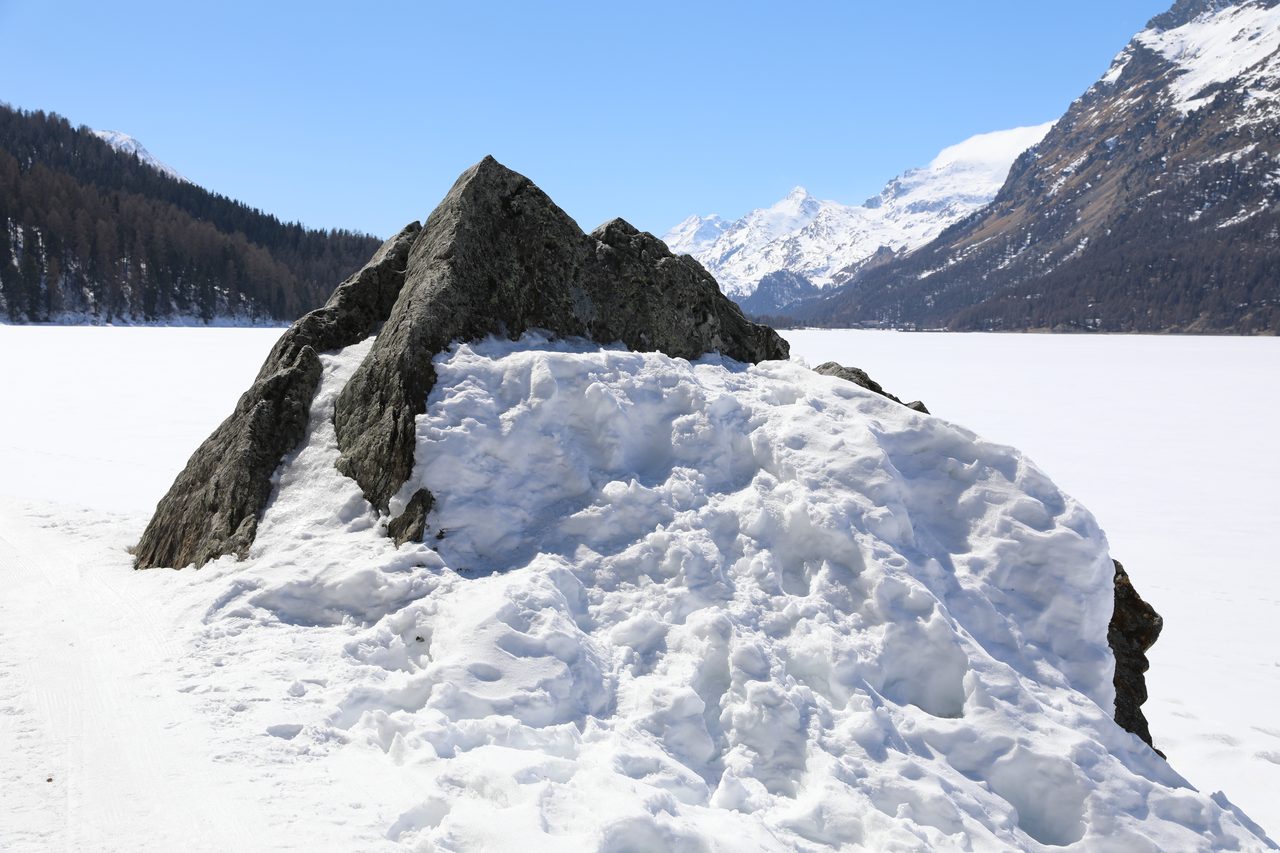
Nietzsche puts the thought to a reader as a question asked by a demon: this life, exactly as it has been lived, to be lived again an unlimited number of times, with nothing new in it. The passage is section 341 of The Gay Science, it offers two answers, cursing the demon and calling it a god, and it crowns neither. Whether he meant a claim about what the universe physically does or a test applied to a single life is debated among scholars, and nothing here settles it. Nine passages from Nietzsche's own books are quoted below with their translator and their standard reference beside them, because on this subject a quotation with no translator cannot be checked, and the gym-poster sentence about what does not kill a person is set beside the wording Anthony M. Ludovici's 1911 English actually prints.
A book published in 1882 carries a short section in which a demon steals into a person's solitude and says that the life they have lived will be lived again, an unlimited number of times, with nothing new in it. The section does not tell anyone what to do about that. It asks what the answer would be, offers two, and crowns neither. That question is this article's subject, and the man who wrote it is the reason the article has to be careful about almost every sentence it prints.
A note on the quotation marks, because on this subject they are the whole game. Nine passages from Nietzsche's own books appear inside quotation marks below, and every one of them names its translator and its standard reference. Three translators of Nietzsche are involved and they are not interchangeable: Walter Kaufmann for The Gay Science, Anthony M. Ludovici for Twilight of the Idols and Ecce Homo, and Thomas Common for Thus Spake Zarathustra. Five of those quoted strings carry an ellipsis, and the ellipsis is not decoration. It marks the point where the printed sentence continues past what the research pass behind this article actually read, or past a dash this house does not print, and no gap marked that way is closed anywhere below. One further ellipsis, inside a quotation from the Stanford Encyclopedia of Philosophy, is the encyclopedia's own. Other quotations come from that encyclopedia and each names it in the sentence carrying it. Seven things are not quoted here at all, and section 11 states what each of them is and why.
Several neighbouring subjects are not this one. Existentialism, in this same wing, owns Kierkegaard, Sartre, de Beauvoir, the Heidegger vocabulary, phenomenology and the lecture of 1945 that gave the movement its label; it carries Nietzsche in a single clause and leaves the rest of him to this article. The Absurd owns Camus entire, including Sisyphus, and neither is developed here. Is Time Real owns the philosophy of time, which matters here because eternal recurrence has a reading on which it is a claim about what time does; that article carries eternal return in a single pointer, and what belongs here is Nietzsche's version and the dispute over it, not the block universe and not the cross-tradition survey of cyclical time. The Meaning of Life already carries Nietzsche as nihilism's diagnostician, so section 03 compresses that to a clause and points there. Stoicism carries the correction about amor fati from the Stoic side, and section 04 carries the same fact from Nietzsche's. Free Will owns determinism and nothing is imported from it.
The tier marks follow our own research file where it assigns them, and this article's stated principle where it does not. What a named translation says at a named locus, and who published what when, is Tier 1. A live scholarly position, held and contested seriously, is Tier 2. A claim resting on a provenance chain this work could not close is Tier 3. Tier 4 is refusal, and on this subject the refusals run in two opposite directions at once, which sections 06, 10 and 12 and the verdict all set out.
One more thing belongs at the front, because it is unusual. No photograph of Nietzsche taken from life appears in this article. A studio portrait of 1882 already illustrates another article in this library; one candidate found during the research pass wore a free licence over a description that credited a commercial picture agency, and was dropped for exactly that reason; and the photographs made of him during his final illness are refused here as a class, because this is an article about a thought and not about a man's collapse. The one likeness below is a work made five or six years after he died, and its caption says so.
01The Philologist Who Left The Chair
Friedrich Wilhelm Nietzsche was born on 15 October 1844 at Roecken in Saxony, the son of a Lutheran pastor who died when Nietzsche was four. Our own research file and the Stanford Encyclopedia of Philosophy's entry on his life and works agree on the date, and the encyclopedia gives the birthplace as Roecken bei Luetzen. The parsonage is not decoration here: the man who wrote that God is dead grew up inside the framework whose failure is this article's opening subject. He was appointed professor of classical philology at the University of Basel at the age of twenty-four, in 1869, which our file calls an extraordinarily young appointment and attributes largely to the recommendation of his teacher Friedrich Ritschl; the encyclopedia dates the appointment to May 1869 and agrees on the age. He was trained as a philologist and not as a philosopher, which is why so many of his arguments are made about texts, words and their histories.
The Birth of Tragedy was published in 1872, combining philology with philosophy and arguing that Greek tragedy emerged from the tension between the Apollonian, which our file glosses as rational and ordered, and the Dionysian, which it glosses as ecstatic and chaotic. It is here for two reasons and no more: it dates the beginning of the published work, and the Dionysian is the vocabulary Nietzsche later uses for affirmation, which is precisely what the demon's question is built to measure.

Nietzsche resigned the Basel professorship in 1879 because of chronic illness. The encyclopedia dates the resignation to June 1879 and gives his age as thirty-four. He then spent roughly a decade as a peripatetic writer, living in boarding houses across Switzerland, Italy and southern France, and produced in that decade the books this article quotes: The Gay Science, Thus Spoke Zarathustra, Beyond Good and Evil, On the Genealogy of Morals, Twilight of the Idols and Ecce Homo. The Engadine summers at Sils-Maria belong to that decade, and so does everything that follows here.
02Two Places The Sentence Appears, And Two Speakers
The Gay Science exists in two editions and this article prints no bare 1882 for any section of it without saying which. Our own file dates the work 1882; the Stanford Encyclopedia dates it 1882 and 1887, because a second edition added material. Sections 108 and 125, the two places this section needs, both sit in Book Three and both are in the text of 1882, and the German Historical Institute's source note for its own excerpt gives the range as Book Three, sections 108 to 126. Section 341 is in Book Four, and so is section 276. Section 343 is a deliberate exception and is flagged here so nobody dates it carelessly: this article did not establish which edition first carried it, so it is cited by section number and carries no year anywhere below.
Section 108 is titled New struggles, and it is where the sentence first appears in a book Nietzsche published. It is stated by the book's own narrating voice, not by any character, and it arrives inside an analogy. In Walter Kaufmann's translation, read at German History in Documents and Images, the analogy opens: "After Buddha was dead, his shadow was still shown for centuries in a cave ..." The ellipsis is not tidying. The printed sentence continues past that point, and this article does not complete it. The sentence the section is remembered for follows immediately: "God is dead; but given the way of men, there may still be caves for thousands of years in which his shadow will be shown." Note what that is and is not. It is not a celebration and it is not an announcement of atheism. It is a claim about how long a shadow outlasts a body, which is a claim about culture.
Section 125 is a parable with a character in it, and the character is not Nietzsche. In Kaufmann's translation, read at Fordham University's Internet Modern History Sourcebook and with its opening sentence independently corroborated at the German Historical Institute, it begins: "Have you not heard of that madman who lit a lantern in the bright morning hours, ran to the market place, and cried incessantly: I seek God! I seek God!" The source sets the madman's cry inside quotation marks of its own within that sentence. He runs in looking for God. What he says afterwards, to a crowd who laugh at him, is the line everyone knows: "God is dead. God remains dead. And we have killed him." Three sentences, each ending in a full stop. He asks them, in the same speech, "What were we doing when we unchained this earth from its sun?" and later, of the buildings around him, "What after all are these churches now if they are not the tombs and sepulchers of God?", which is the American spelling the source prints and is left as it stands. Then, in the source's own structure of quotation and reporting, "I have come too early," he said then; "my time is not yet."
The difference between those two places is checkable rather than interpretive, and it is where this article can be genuinely useful. At 108 the sentence is the book's own voice, stated flatly, inside an analogy about a shadow in a cave, with the weight falling on how long the shadow lasts. At 125 the same words are put in the mouth of a madman, addressed to a crowd who do not understand him, with the weight falling on the size of what has been done and on the fact that nobody has noticed. The sentence is usually quoted as a triumphant announcement by an author. In its most famous appearance it is a lament by a lunatic that nobody is listening to. Our own research file gets the parable wrong in a specific way, and the correction belongs on the page: it prints the madman running into the marketplace already crying that God is dead and that we have killed him, as one sentence with exclamation marks. The verified text has him running in crying that he is seeking God, and the death comes afterwards, in three sentences, addressed to the crowd. The punctuation, the compression and the order are all wrong, and none of it is quoted here.
03What Collapses When That Collapses
The Stanford Encyclopedia of Philosophy's entry on Nietzsche, by R. Lanier Anderson, cites the pronouncement at three places, sections 108, 125 and 343, and adds a detail our own file misses entirely. The point, the entry says, is not so much that atheism is true, because "in GS 125, he depicts this pronouncement arriving as fresh news to a group of atheists". The crowd the madman shouts at do not believe in God either, and they still do not understand him. The entry then draws the consequence from section 343, where "the belief in the Christian God has become unbelievable" and everything "built upon this faith ... including the whole of our European morality" is destined for collapse. That ellipsis is the encyclopedia's own and is reproduced as it prints it.
That is the bridge to this article's subject. If what fails is not a belief in a deity but the framework of value built on it, then the question of what could make a life worth affirming stops being rhetorical. Our own file calls the consequence nihilism and divides it in two: passive nihilism, the last man who seeks comfort and avoids suffering, which it calls the worst outcome, and active nihilism, a destructive transitional stage that clears the ground for new values. The Meaning of Life already carries that distinction in full, so it is one clause here. Our file also traces Nietzsche's influence across existentialism, postmodernism, psychoanalysis, literature and music, item by item and without a source for any single item, and this article does the same thing it does with the nihilism material: names it and points at Existentialism and The Absurd, which carry those figures properly. What this article owns is what comes after the diagnosis, which is the test.
04Amor Fati, And Whose Phrase It Is
Section 276 is titled For the new year, it stands in Book Four of The Gay Science, and it is where the Latin tag enters Nietzsche's published work. It is a New Year resolution, written in the first person about himself. In Kaufmann's translation, read at a Georgetown University faculty page maintained by William Blattner, it says: "I want to learn more and more to see as beautiful what is necessary in things; then I shall be one of those who make things beautiful." It goes on: "I do not want to wage war against what is ugly. I do not want to accuse; I do not even want to accuse those who accuse." And it ends with a wish: "some day I wish to be only a Yes-sayer." The tag itself is quoted here in the form the Stanford Encyclopedia prints, and attributed to the encyclopedia rather than to the page above, for a reason worth stating: the two hosts differ by one word, the Georgetown transcription reading by where the encyclopedia reads be, and this article does not adjudicate which page carries the typographical error. In the encyclopedia's form the line is "Amor fati: let that be my love henceforth!" And the order matters for what follows: the love of what is necessary is stated at 276, and the test that measures it arrives at 341, in the same book.
Nietzsche restates the phrase as his own formula in Ecce Homo, written in 1888 and published after his collapse. In Anthony M. Ludovici's English of 1911, in the chapter Why I Am So Clever, section 10, the definition reads: "amor fati: the fact that a man wishes nothing to be different, either in front of him or behind him, or for all eternity." Two things travel with that sentence. Ludovici is not Kaufmann, and this article verified only Ludovici for it, so the rendering is his and is labelled his. And the publication situation is not the one section 10 of this article describes: Ecce Homo was written and completed by Nietzsche himself and then published by other people, which is a different thing from a book assembled out of notebooks by somebody else, and the two are kept apart here.
So the Latin tag is Nietzsche's, and it enters philosophy through him. It appears in his published work at The Gay Science, book four, section 276, of 1882, and he restates it as his own formula in Ecce Homo. It appears in no ancient Stoic text. Stoicism, in this same wing, already carries the other half of that correction, because one of our own research files lists amor fati as documented Stoic vocabulary and that is wrong; the attitude is genuinely Stoic and the tag is not Stoic vocabulary. This article states the same fact from the other side, with the same date and the same section number, so that the two pages agree. One limit belongs on it: this is a claim about philosophical vocabulary and not about the history of the Latin language. Nothing here says Nietzsche invented the two words.
05The Greatest Weight
Section 341 of The Gay Science carries a title that Kaufmann's English prints in italics, "The greatest weight", and it is where the thought is put as a question. Kaufmann's text, read at the Georgetown faculty page, opens: "What, if some day or night a demon were to steal after you into your loneliest loneliness and say to you:" What the demon then says is quoted here only as far as it was actually read: "This life as you now live it and have lived it, you will have to live it once more and innumerable times more: and there will be nothing new in it ..." That ellipsis marks a real gap and it is left open on purpose. The transcription available to the research pass behind this article stopped partway through the demon's speech, so the famous catalogue that follows, of every pain and every joy returning in the same order, was not read and is not completed anywhere in this article, however familiar it looks. What was read to its end is the image the speech closes on: "The eternal hourglass of existence is turned upside down again and again, and you with it, speck of dust!"
Still in Kaufmann's English, still at section 341, the passage offers two answers to the demon and prefers neither in what it says next. One: "Would you not throw yourself down and gnash your teeth and curse the demon ...", where the ellipsis again marks a sentence that continues past what was read. The other is the line above. Then the passage turns the whole thing into a weight rather than a doctrine: "The question in each and every thing, Do you desire this once more and innumerable times more? would lie upon your actions as the greatest weight." The source sets that inner question inside quotation marks of its own. And the closing question is not about the universe at all, but about a relation: "Or how well disposed would you have to become to yourself and to life to crave nothing more reverently than this ultimate eternal confirmation and seal?" Note what the text does not do, because this is where popular versions go wrong. It does not say the recurrence is true. It does not say the second answer is available to anybody. It does not tell anyone what to do. It asks how well disposed a person would have to become.
Our own research file states the doctrine at its own Tier 1 and this article carries the statement in paraphrase, because the file prints its quotation of the passage with no translator named and that quotation is not reproduced anywhere here. The file says the thought is presented in The Gay Science 341 and in Thus Spoke Zarathustra; that the experiment asks what a person would do if told this life would have to be lived once more and innumerable times more with nothing new in it, and whether the answer would be rejoicing or despair; and that it functions as an existential test in which the ability to affirm eternal recurrence is the measure of life-affirmation, which the file ties to amor fati. The file's own closing sentence in that section is the one this article will not drop: whether Nietzsche intended a literal cosmological claim or purely a psychological and ethical test is debated among scholars. Section 06 is that sentence taken seriously.
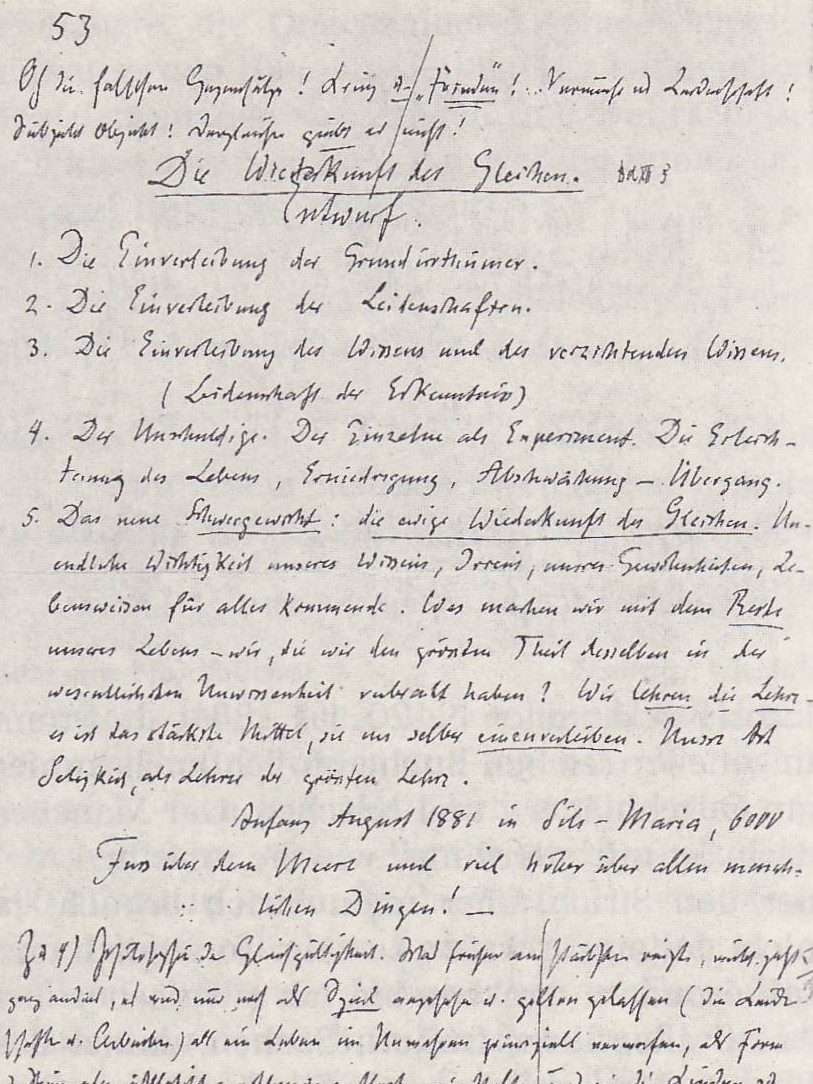
There is a place and a piece of paper attached to this thought, and neither of them survived verification intact. A Wikimedia Commons file page states that the image beside this paragraph reproduces Nietzsche's first note on the eternal recurrence, dates it to August 1881 at Sils-Maria, and gives a notebook page, a fragment number and an archive signature in Weimar. This article corroborated none of that and prints none of the numbers. Separately, a boulder above Lake Silvaplana near Surlej is called the Nietzsche Stein, and one file page for it calls it the stone of eternal recurrence. That is an uploader's naming and a local naming, not an institutional record. The traditional primary anchor for the whole story is a passage in the chapter of Ecce Homo on Zarathustra, The fetch made for this article's research pass returned that text cut off before the chapter, so the anchor was not read then. A later check reached the same URL complete, which means the fault was in our retrieval and not in the hosted text, and a reader following the link in the sources will find the chapter there. The tier below does not rest on that and does not move: what is uncorroborated here is the file page's notebook, fragment and archive numbers, and the naming of the rock. What that leaves is exactly this: the place carries the name, the association is reported here as an association, and nothing in this article says the thought came to Nietzsche at that rock. Our own research file does not mention the note or the place at all.
06Cosmology Or Test, And Why It Stays Open
That the interpretation is disputed is itself a Tier 1 fact in our own file, which says plainly that scholars debate whether Nietzsche meant eternal recurrence as a literal cosmological claim about what the universe physically does, or purely as a psychological and ethical test applied to a life. This article does not settle it. It is worth naming one asymmetry in how the question is usually received, because it decides what neutrality looks like here: the cosmological reading is the half the modern popular reception has quietly dropped. An article that carries only the test reading is therefore not standing outside the argument. It is agreeing with one side of it while appearing not to.
Our own file cites no scholarship on eternal recurrence at all, which on a document whose own title carries the phrase is a gap worth naming. Three works exist, were resolved against CrossRef for this article, and are listed below. Alexander Nehamas published The Eternal Recurrence in The Philosophical Review in 1980, and it carries a published erratum in the same volume, which is a correction and not a retraction and is cited here beside it. Paul S. Loeb published Nietzsche's Heraclitean Doctrine of the Eternal Recurrence of the Same in Nietzsche-Studien in 2021. Bevis E. McNeil's chapter Nietzsche's Cosmology of Eternal Recurrence appeared in a Springer volume, online in 2020 and in print in 2021, and no bare year is printed for it here because the record carries two. None of the three was read for this article, so nothing here reports what any of them argues. Their titles alone support one claim and only one: the cosmological reading is the subject of named, dated, peer-reviewed scholarship rather than a curiosity, since one chapter title is literally about a cosmology of eternal recurrence and one journal article calls the thing a doctrine.
So: no, twice, and the two refusals point opposite ways. No, Nietzsche did not demonstrate eternal recurrence as a fact about the universe. Nothing read for this article argues any such demonstration, and the published passages put the return in a demon's mouth as a question rather than in an argument as a conclusion. And no, equally, eternal recurrence is not merely a motivational device, a mood, or a way of feeling better about a life, with no cosmological content at all. That is the commoner modern error and it is the one this article was most likely to commit, because the test reading is the comfortable half. Our own file records the question as debated, and named scholarship exists on the cosmological side. The physics of time is not this article's subject and belongs to Is Time Real; what belongs here is the refusal to decide, in either direction, a question our own source says is open.
07A Rope, And A Word With No Settled English
Zarathustra's Prologue is where the Uebermensch is announced, and Thomas Common's English calls him the Superman. Three sentences were read for this article and are quoted as Common's. The announcement, with the capitals as the source prints them: "I TEACH YOU THE SUPERMAN. Man is something that is to be surpassed." The claim attached to it: "The Superman is the meaning of the earth." And the image the passage is remembered for: "Man is a rope stretched between the animal and the Superman ..." That ellipsis costs the sentence most of its force, and this article would rather lose the force than print what it did not read: the printed sentence continues past that point across a dash this house does not reproduce. The figure is here for one reason. He is the one who could give the demon the second answer.
The German word has no settled English name, and this article says so rather than choosing one quietly. Common's translation, which is the one verified here, renders it Superman throughout. Our own file glosses the term as Overman and Superman together. What was verified for this article is Common's rendering and nothing else: how Kaufmann, Hollingdale, Del Caro or Large render the word was not checked, and no rendering is attributed to a translator this article did not read. That is not pedantry. The English word Superman acquired a comic-book meaning in 1938 that the German word does not carry, and printing it without saying whose translation it is hands a reader a false association for free.
08Two Movements This Article Only Names
On the Genealogy of Morals, of 1887, which our file calls his most systematic work, traces the historical origins of moral concepts across three essays. The first draws the distinction between master morality, originating among nobles and valuing strength, pride, excellence and the affirmation of life as good, and slave morality, originating among the powerless, which revalues weakness as virtue, labels the strong as evil, and valorises humility, pity and suffering through ressentiment. The second locates guilt and bad conscience in the internalisation of aggressive instincts by humans constrained by society. The third takes up the ascetic ideal and asks why humanity has preferred to will nothingness, in religious self-denial and in scholarly objectivity alike, rather than not will at all. All of that is a claim about where moral concepts came from, and it is carried here as one. It is not a recommendation, and normative ethics is another wing's subject entirely.
Perspectivism, as our file states it: there are no facts, only interpretations, and all knowledge is perspectival, shaped by the interests, drives and position of the knower. The file immediately adds that this is not a straightforward relativism, because Nietzsche valued intellectual honesty, rigour and the multiplication of perspectives as a path to fuller understanding. The doctrine is described here and the famous formula is not quoted, and the reason is the file's own. It prints two of its key words inside quotation marks with no work, no section, no translator, and no indication of whether the source is a book Nietzsche published or the notebooks. On this document of all documents that distinction is not cosmetic, since its own next section warns that the notebook material must be treated with caution.
The will to power, the German Wille zur Macht, is the drive our file proposes as fundamental: not political domination but the impulse to growth, self-overcoming, creative expression and the imposition of form on chaos, intended as a replacement for Schopenhauer's will to live and for Darwin's survival-centred natural selection. Our file places this at Tier 2 and not at Tier 1, and this article keeps it there. That tiering is not caution for its own sake. The doctrine's textual base is unusually entangled with the notebook material, which is what the next section is about, and it is why the will to power appears in an article on eternal recurrence at all.
09The Collapse, And Who Held The Papers
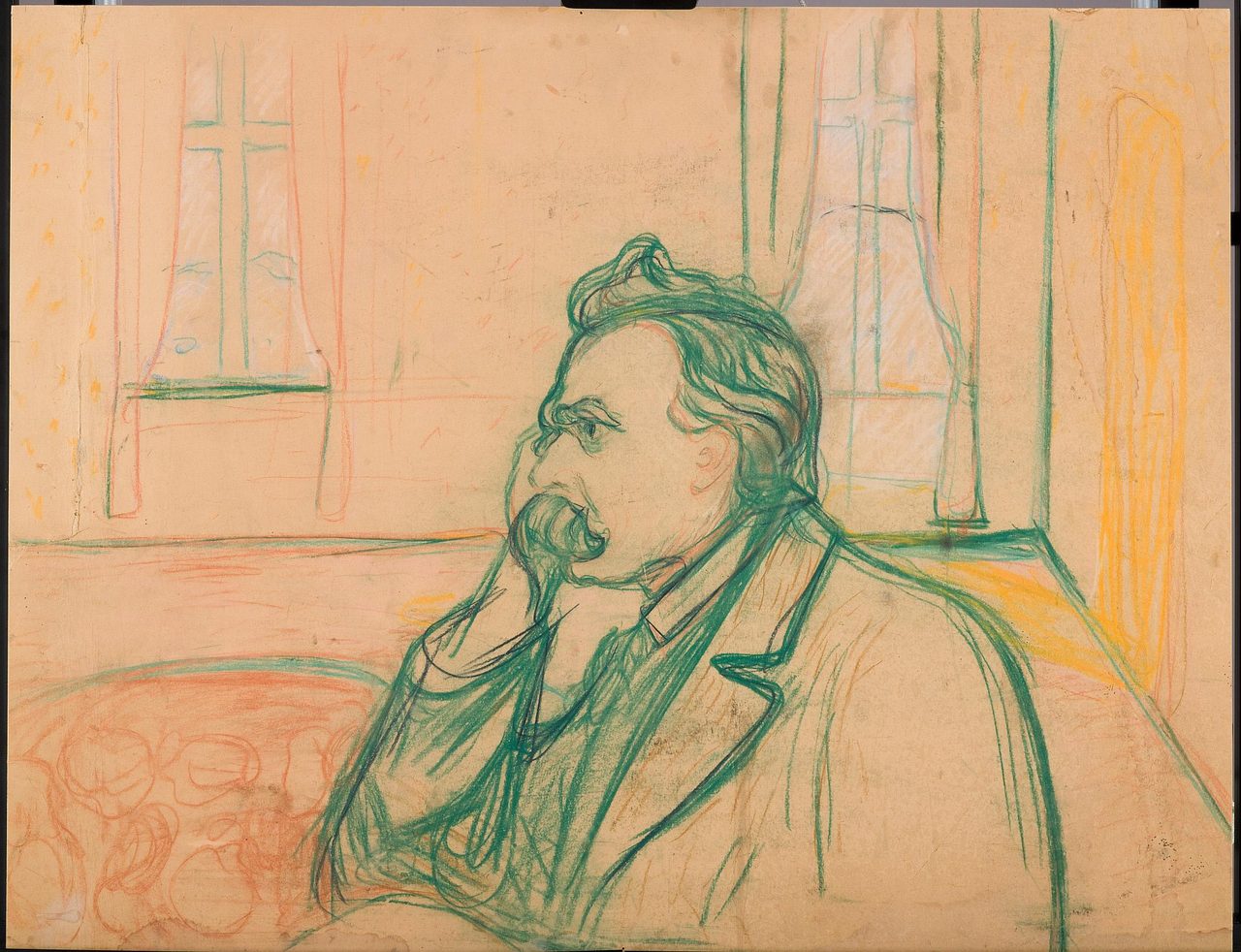
Nietzsche collapsed in Turin on 3 January 1889. Both our own file and the Stanford Encyclopedia give that date. He spent the last eleven years of his life unable to work, in the care of his mother and then his sister, and died on 25 August 1900; the encyclopedia adds a cause, quoted here as the encyclopedia's own words and not as a medical finding, "apparently of pneumonia in combination with a stroke". Two consequences follow and both matter for the rest of this article. Everything published under Nietzsche's name after January 1889 was published by other people. And any portrait, drawing or painting of him dated later than 25 August 1900 is posthumous by simple arithmetic.
The cause of the breakdown remains debated. Our file records the traditional attribution to tertiary syphilis and lists alternatives that include a brain tumour, specifically a meningioma, CADASIL, which it glosses as a hereditary vascular condition, and frontotemporal dementia, and then states its own limit, which is the part that survives into this article: definitive diagnosis is impossible given the available evidence. That is one sentence and it is all this article has to say about it. The collapse is not used here to explain, discredit or account for any part of the philosophy.
Elisabeth Foerster-Nietzsche took control of the literary estate while her brother was alive and incapable. Our file says she edited and distorted his posthumous writings. The Stanford Encyclopedia supplies the dated mechanics our file lacks: after their mother's death in 1897 she "assumed responsibility for Nietzsche's welfare", she "rented the Villa Silberblick", and she "moved both Nietzsche and his collected manuscripts" there, establishing the Nietzsche Archives; the unpublished manuscripts were collected under the title "The Will to Power: Attempt at a Revaluation of all Values". The physical fact is the one worth writing down. The philosopher and the papers were moved into the same house, and whoever controlled the house controlled both.
10The Book He Did Not Write
Our file's caution about The Will to Power has two halves and they have to travel together. The published notebook fragments compiled by Elisabeth Foerster-Nietzsche as The Will to Power are not a book Nietzsche wrote, and must be treated with caution; and many of the individual notes are genuine. Carry only the first half and the book becomes a fabrication, which it is not. Carry only the second and it becomes a work of Nietzsche's, which it also is not. The year our file gives for the compilation is 1901, and this article attributes that year to our own file rather than asserting it, because it was not independently verified for this piece.
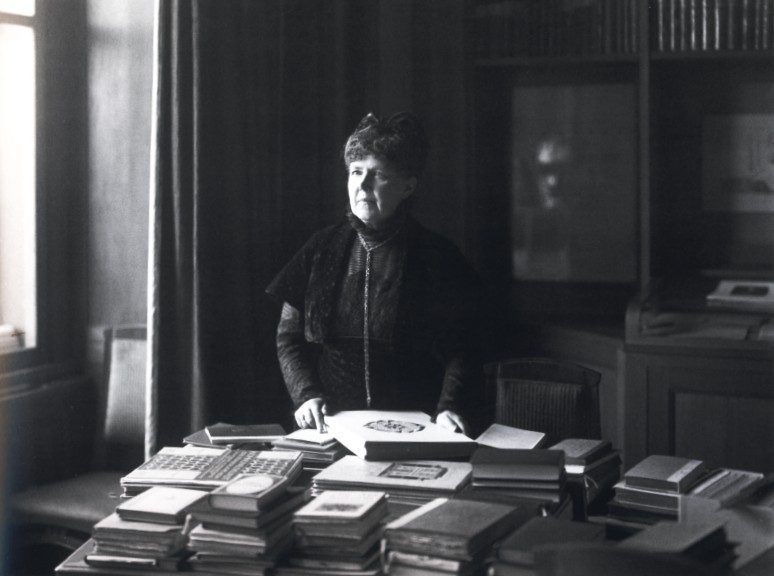
The Stanford Encyclopedia's account is more precise, and it supplies the detail that makes the story intelligible. During Nietzsche's illness his sister took charge of his literary legacy and eventually published The Antichrist and Ecce Homo, together with "a selection of writing from his notebooks for which she used the title The Will to Power, following Nietzsche's remark in the Genealogy (GM III, 27) that he planned a major work under that title". The title was his; the book was not. The entry then states both defects in a single sentence: "The editorial work was not well founded in Nietzsche's surviving plans for the book and was also marred by Elisabeth's strong anti-Semitic commitments, which had been extremely distressing to Nietzsche himself."
There is a live scholarly counter-current, and our own file does not know about it. A chapter in a Princeton University Press volume on the uses and abuses of Nietzsche's philosophy is titled, in its own words, "The Elisabeth Legend: The Cleansing Of Nietzsche And The Sullying Of His Sister", by Robert C. Holub. That is carried here as a pointer and an identifier and nothing more. Its record was resolved for this article and the chapter itself was not read, so nothing here reports what Holub argues beyond what his title says on its face. Its value is that it gives a current, named, citable voice to the possibility that the standard story about the sister has been doing exculpatory work for the brother.
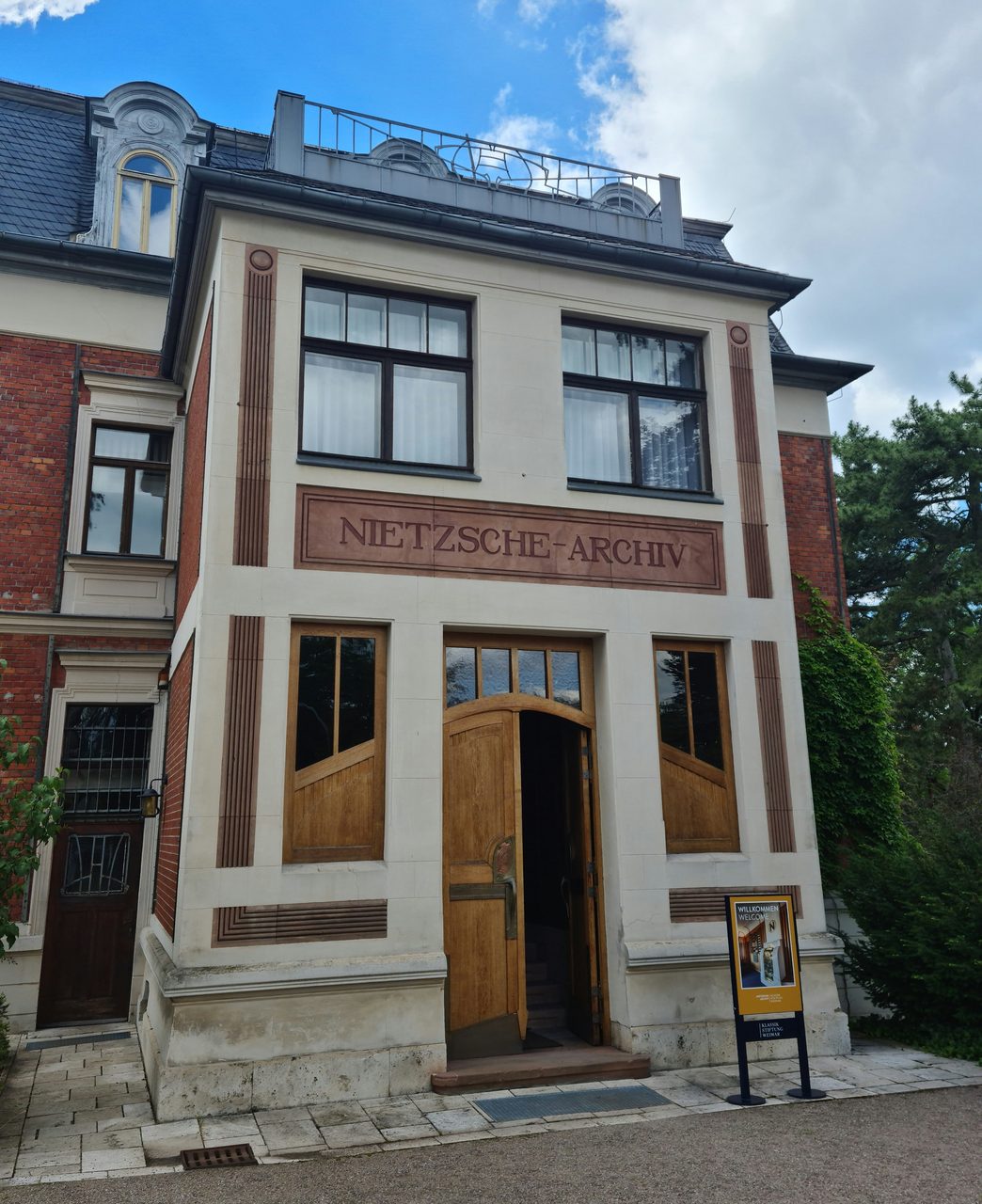
Two opposite overclaims about the sister, both refused. No, The Will to Power is not a forgery, Elisabeth did not write it, and its contents are not somebody else's. What is established is that the selection, arrangement and framing were editorial, that the editorial work was not well founded in Nietzsche's surviving plans, that it was marred by her antisemitic commitments, and that many of the individual notes are genuine. And no, equally, the whole problem does not reduce to one wicked sister, leaving the text clean and no further question standing. A university press chapter exists whose title is precisely about the cleansing of Nietzsche and the sullying of his sister, so that reading is not the settled view of the field. Three sentences are required and all three are here: the book is a compilation he did not make; the compiler had a political commitment that distorted it; and how much of what came later that compilation actually explains is an open scholarly question. Any one of the three alone produces a false article.
11The Lines Everyone Knows
The sentence about what does not kill a person has a real locus and this article found it, so it is traced rather than refused. It is the eighth numbered aphorism of the series that opens Twilight of the Idols. In Ludovici's English of 1911 the aphorism opens "From the military school of life ...", with the ellipsis marking a dash this house does not print, and then reads: "That which does not kill me, makes me stronger." Set that beside the gym-poster version. The popular wording begins with a different word and drops the comma, and it is nobody's verified translation, so it is described here and not quoted. Even the heading of the series differs by translator: Ludovici's 1911 English heads it MAXIMS AND MISSILES, the form Maxims and Arrows belongs to other translators, and only Ludovici's was verified here, so no heading is asserted as the heading. The difference between the two sentences is small, real and entirely checkable, which is the point. It is what happens to a sentence with no translator attached to it.
| The Passage | The Work And Locus | The Translator | Where It Was Read |
|---|---|---|---|
| The Buddha's shadow in the cave, and the sentence about the caves to come | The Gay Science, section 108, Book Three | Walter Kaufmann | German History in Documents and Images, German Historical Institute Washington DC |
| The madman with the lantern, the death, the churches and the sun | The Gay Science, section 125, Book Three | Walter Kaufmann | Fordham University's Internet Modern History Sourcebook, with the opening sentence corroborated at the German Historical Institute |
| The New Year resolution, and the Latin tag | The Gay Science, section 276, Book Four | Walter Kaufmann, with the tag itself quoted in the Stanford Encyclopedia's form and attributed there | A Georgetown University faculty page maintained by William Blattner, and the Stanford Encyclopedia of Philosophy |
| The demon, the hourglass, the two answers and the weight | The Gay Science, section 341, Book Four | Walter Kaufmann | The same Georgetown faculty page. The demon's speech was read only partway and is quoted only that far |
| The military school of life, and the sentence about what does not kill | Twilight of the Idols, the eighth aphorism of the opening series | Anthony M. Ludovici, 1911 | Project Gutenberg's text of the 1911 Complete Works volume edited by Oscar Levy |
| The formula for greatness, defining amor fati | Ecce Homo, Why I Am So Clever, section 10 | Anthony M. Ludovici, 1911 | Project Gutenberg's text of the 1911 Complete Works volume edited by Oscar Levy |
| The announcement of the Superman | Thus Spake Zarathustra, Zarathustra's Prologue | Thomas Common | Project Gutenberg. The header names Common; no title page confirming a volume number was seen, so no volume number is cited |
| The Superman as the meaning of the earth | Thus Spake Zarathustra, Zarathustra's Prologue | Thomas Common | Project Gutenberg, same text |
| The rope between the animal and the Superman | Thus Spake Zarathustra, Zarathustra's Prologue | Thomas Common | Project Gutenberg, same text. The printed sentence continues past what is quoted |
Here is the discipline the table below runs on. On this subject a quotation with no translator cannot be checked at all, five English translations circulate, and one Victorian rendering still travels as though it were canonical. An article that quotes nine passages it can source is worth more than one that quotes twenty it cannot. Seven things are refused below, and two of the seven are printed inside quotation marks in our own research file as quotations, and a third pair of key words is quoted there without being a quoted passage. Neither of those is a fabrication. Both are unquotable for the same reason, which is that nobody can check a quotation whose translator is not named, and one of them also gets the order of events wrong. One further refusal is a whole language: no German original was read from a critical edition during the research pass, because the digital critical edition refused the connection twice, so no German appears in quotation marks anywhere in this article.
| What Is Not Quoted | What The Research Pass Found | How It Is Handled Here |
|---|---|---|
| The rest of the demon's speech at The Gay Science 341 | The transcription read for this article stopped partway through the speech, so the catalogue of every pain and every joy returning in the same order was never read | Quoted only as far as it was read, with the ellipsis left open in section 05. The remainder is not completed anywhere |
| Our own research file's rendering of that same speech | It names no translator, and it diverges from Kaufmann's text as transcribed at Georgetown in two places: a missing pronoun, and a semicolon where Kaufmann has a colon. It is not a fabrication and it is recognisably the same translation | Not reproduced. Kaufmann's verified wording is quoted in section 05 instead |
| Our own file's compressed cry from the parable of the madman | It runs three sentences into one, prints exclamation marks where the verified text prints full stops, and reverses the order of the madman's two cries | Not reproduced. The verified sentences and the actual sequence are given in section 02, and the correction is made on the page |
| The formula about facts and interpretations | Our own file prints its key words inside quotation marks with no work, no section, no translator, and no indication of whether the source is a published book or the notebooks | Perspectivism is described in section 08 and the formula is not quoted |
| Any German original, including the heading transcribed on the notebook file page | The digital critical edition of the German text refused the connection twice during the research pass, so no German was read from a critical edition | No German appears inside quotation marks anywhere in this article |
| Thomas Common's English of The Gay Science | Two fetches made for the research pass returned this text cut off at Book First; it was re-fetched complete on 8 August 2026, so the fault was in our retrieval, not the host. His Victorian English is the version that circulates free online, which is why it is named here rather than passed over | Nothing is attributed to Common except the three passages from Zarathustra's Prologue quoted in section 07 |
| The popular wording of the sentence about what does not kill a person | It differs from Ludovici's verified sentence in its opening word and in a comma, and it corresponds to no translation verified for this article | Ludovici's sentence is quoted in section 11 and the popular wording is described rather than quoted |
12What This Article Refuses
No, Nietzsche was not a Nazi philosopher. Our own file marks the claim refuted and gives its evidence, which is good evidence: he explicitly condemned German nationalism, antisemitism and racism in numerous passages, he broke personal relations with Richard Wagner over Wagner's antisemitism, and he broke with his sister's husband Bernhard Foerster, a prominent antisemite. Our file also says the appropriation was based on Elisabeth's editorial distortions and selective quotation, and calls it utterly false. The refusal is right. The finality is not, and this article does not reproduce it. A volume from Princeton University Press is devoted to the uses and abuses of this philosophy, and one of its chapters asks in its title how to de-Nazify Nietzsche's philosophical anthropology. A question with a university press volume attached to it is an open field rather than a closed case. Both sentences stand together: Nietzsche was not a proto-fascist and said so himself in print, and how his work was turned into one is a live scholarly subject.
No, this subject is not settled, and our own research file says it is. Its counter-arguments block asserts that no significant counter-arguments exist in the scholarly literature for the core claims in the document, and that the subject represents established philosophical consensus with no active scholarly dispute. The same document contradicts that three times over: its own first section says the interpretation of eternal recurrence is debated among scholars, its own second section says the Will to Power material must be treated with caution, and its own third section says the cause of the collapse remains debated. The line is a template artefact and it appears verbatim in other documents of this library. It is not cited here, not leaned on, and not reproduced in any form, including the softened form that the core material is settled.
Fast Facts
- The Passage
- The Gay Science, section 341, in Book Four. A demon puts the return of this same life, an unlimited number of times with nothing new in it, and the passage offers two answers, cursing the demon and calling it a god, and crowns neither
- The Open Question
- Whether Nietzsche meant a literal cosmological claim about what the universe physically does, or purely a psychological and ethical test applied to a life, is debated among scholars. Our own research file says so at its own Tier 1, and this article settles it in neither direction
- The Book, And Its Two Editions
- The Gay Science was first published in 1882 and expanded in 1887. Sections 108 and 125 sit in Book Three, and 276 and 341 in Book Four. Section 343 is cited here by section number only, because this article did not establish which edition first carried it
- Two Speakers, One Sentence
- At section 108 the sentence about the death of God is stated by the book's own narrating voice, inside an analogy about the Buddha's shadow. At section 125 the same words are spoken by a character, a madman, to a crowd who laugh at him
- Amor Fati
- Enters Nietzsche's published work at The Gay Science, book four, section 276, of 1882, and is restated as his own formula in Ecce Homo. It appears in no ancient Stoic text, which is the correction this article shares with Stoicism in this same wing
- The Compilation
- The Will to Power is a selection from the notebooks, assembled by Elisabeth Foerster-Nietzsche after her brother was incapable of writing, under a title he had once mentioned planning in On the Genealogy of Morals. Many of the individual notes are genuine. The Stanford Encyclopedia records that the editorial work was not well founded in his surviving plans and was marred by her antisemitic commitments, and section 10 carries the open scholarly question of how much of what followed that actually explains
- The Quotations
- Nine passages from Nietzsche's books are quoted here, each with its translator and its standard reference. Three translators are involved and they are not interchangeable. Five of the quoted strings carry an ellipsis marking a gap that is not closed anywhere below
- Not Established
- That Nietzsche demonstrated eternal recurrence as a fact about the universe; that the thought came to him at the boulder near Surlej; that the notebook page reproduced above is what its file record says it is; or that the cause of the January 1889 collapse can be determined from the available evidence
What Can Actually Be Stood Behind
What the texts say, and where they say it, is settled and may be stated flatly. Nietzsche was born on 15 October 1844 at Roecken in Saxony to a Lutheran pastor who died when he was four; he took the chair of classical philology at Basel in 1869 at the age of twenty-four; he resigned it in 1879 because of chronic illness; he collapsed in Turin on 3 January 1889 and died on 25 August 1900. The Gay Science was first published in 1882 and expanded in 1887. Section 108 states the death of God in the book's own narrating voice, inside an analogy about the Buddha's shadow. Section 125 puts the same words in a madman's mouth, addressed to a crowd who laugh at him, and he runs in seeking God rather than announcing the death. Section 276 is where amor fati enters the published work, and section 341 is where the demon asks the question and the passage declines to crown either answer. Twilight of the Idols carries the sentence about what does not kill a person as the eighth aphorism of its opening series, and Ludovici's English of 1911 prints it with a comma. Zarathustra's Prologue announces the Uebermensch, which Common's English calls the Superman. Every passage quoted from Nietzsche in this article was read in a named translation at a named locus, and both are printed beside it, with one exception this page marks where it occurs: the amor fati tag in section 04 is quoted in the form the Stanford Encyclopedia prints and attributed to the encyclopedia rather than to a translator, because the divergence between two published wordings is not one this page adjudicates.
The disputes are real, and each has named holders. Whether eternal recurrence is a cosmological claim or purely a test is argued in print on both sides: one chapter title is about a cosmology of eternal recurrence and one journal article calls the thing a doctrine, and neither was read here beyond its record. The will to power sits at Tier 2 in our own file rather than Tier 1, and that tiering is doing real work, because the doctrine's textual base is entangled with notebook material the same file says must be treated with caution. The account of The Will to Power's making rests on the Stanford Encyclopedia rather than on our own file, which is less precise about it. And the standard story about the sister is not the settled view of the field: a chapter in a Princeton University Press volume is titled, on its face, about the cleansing of Nietzsche and the sullying of his sister, and this article cites it as a pointer and reports nothing about what it argues.
Three things stay here. The notebook page reproduced in section 05 is identified by its file record as Nietzsche's first written draft of the thought, dated to early August 1881 at Sils-Maria, with a notebook number, a fragment number and an archive signature attached; none of that was corroborated for this article, so none of the numbers is printed and the identification is attributed rather than asserted. The boulder above Lake Silvaplana carries his name locally and is locally associated with the idea, and nothing checked here joins the rock to the note; the traditional primary anchor for that story is a chapter of Ecce Homo that the research pass's own fetch returned cut off and that a later check reached in full. And our own file places the cause of the January 1889 collapse at its own Tier 3 and states that definitive diagnosis is impossible on the available evidence, which is exactly where it stays.
No, twice, in opposite directions, and holding both at the same time is what this article is built to make possible. No, Nietzsche did not demonstrate eternal recurrence as a fact about the universe: nothing read for this article argues any such demonstration, and the published passages put the return in a demon's mouth as a question. And no, equally, eternal recurrence is not merely a motivational device or a mood with no cosmological content, which is the commoner modern error and the comfortable half of the argument. Our own file records the question as debated and named scholarship exists on the cosmological side. An article that quietly adopts the test reading has taken a side in an open dispute while appearing not to, and this one does not take it.
No, Nietzsche was not a Nazi philosopher, and no, refusing that is not the end of the matter. Our own file's evidence for the refusal is sound: he condemned German nationalism, antisemitism and racism in print, and he broke with Richard Wagner and with Bernhard Foerster over antisemitism. Our file then calls the appropriation utterly false, and that word is what this article declines, because a Princeton University Press volume is devoted to the uses and abuses of this philosophy and one of its chapters asks how to de-Nazify his philosophical anthropology. Both sentences stand together or neither is honest, and this article crowns neither the refusal nor the question it leaves standing.
No, the circulating sentences are not all what they appear to be. Seven things are refused in section 11 with a reason for each, among them two quotations printed inside quotation marks in our own research file with no translator named, a whole language this article could not read from a critical edition, and the popular wording of the line about what does not kill a person, which differs from Ludovici's verified English in its opening word and in a comma. Nine passages are quoted here and every one carries its translator and its locus. And no, none of this is advice. Section 341 is written in the second person because its author wrote it that way, and it is reported here as something a book asks, never as an exercise, a lesson or a principle to adopt. Our own file's assertion that this subject is settled consensus with no active scholarly dispute is contradicted three times by the same document and is not carried here in any form.
A demon asks a question in a book of 1882, and in January 1889 the man who wrote it collapsed in Turin and never worked again. Everything published under his name after that was published by other people, one of whom assembled a book out of his notebooks and gave it a title he had once mentioned planning. That is the route by which this thought reached the twentieth century: through an archive somebody else controlled, in a house somebody else rented, and the only likeness of him in this article was made after he was dead. The passage itself has not moved. It still asks what a person would have to have become for the exact return of their own life to be craved rather than cursed, it still offers two answers and crowns neither, and it still does not say whether the return is anything more than the question. Our own research file says that scholars debate that, and they do, and nothing here settles it.
Sources & further reading
One research file in our own library stands behind this article, P_3_15. It is where the work was done from; the records below are where the work can be checked, and fifteen of the sixteen entries are external to this site. Four limits belong on the record rather than being left to be discovered. First, the quotations. Nine passages from Nietzsche's books are quoted here and every one names its translator and its standard reference, because on this subject a quotation with no translator cannot be checked at all; five of them carry an ellipsis marking where the printed sentence continues past what was read or past a dash this house does not print, and no gap marked that way is closed anywhere in the article. Second, what could not be read. The digital critical edition of the German text refused the connection twice during the research pass, so no German original was read and none is quoted; two fetches of Thomas Common's English of The Gay Science came back cut off at Book First, so nothing is attributed to Common except three passages from Zarathustra's Prologue; and the fetch of the chapter of Ecce Homo that is the traditional anchor for the August 1881 story stopped before reaching it. A verification pass on 8 August 2026 re-fetched all three of those hosted texts and found every one complete to its own end marker. The truncation was in this project's retrieval and not in the hosts. An earlier draft of this page said otherwise, in five places, and the sentences are corrected here rather than quietly removed, because each of them was printed beside the very link that disproves it. Nothing was ever quoted from what was not read, so no quotation on this page changes; what changes is the reason given. The August 1881 story stays at Tier 3 for the reason section 05 gives, which is that the file page's notebook, fragment and archive numbers are uncorroborated. Third, the identifiers. Six identifiers appear in our own file's bibliography; four of them resolve to a different work and one to a publisher's series list bound inside the right book, and not one of the six is reproduced here. Every identifier below was resolved live against CrossRef on 7 August 2026 and the returned title read against the claim it is attached to. Fourth, seven of the entries below are pointers rather than sources: the Nehamas article and its erratum, the Loeb article, the McNeil chapter, the Golomb and Wistrich volume record and the two chapters from the Princeton volume were verified as records and were not read for this article, so nothing here reports what any of them concludes.
Image credits
- The boulder known as the Nietzsche Stein at Silvaplana-Surlej, Switzerland, with the view oriented toward Sils Maria, photographed 3 April 2026 Fyrtaarn, own work, 2026, via Wikimedia Commons. CC BY-SA 4.0 Source.
- The building known as the Nietzsche Haus at Sils Maria, Graubuenden, Switzerland Paebi, own work, 2014, via Wikimedia Commons. CC BY-SA 4.0 Source.
- A hand-written notebook page identified on its file record as Nietzsche's first draft of the eternal recurrence of the same Friedrich Nietzsche; scan of a facsimile in Benders and Oettermann (eds), Friedrich Nietzsche, Chronik in Bildern und Texten, Hanser and dtv, 2000, page 492, via Wikimedia Commons. Public Domain Mark 1.0 Source.
- Edvard Munch's Friedrich Nietzsche, Munch Museum, Oslo, accession MM.M.00254, dated by the museum between 1905 and 1906 Edvard Munch (1863 to 1944), via the Munch Museum and Wikimedia Commons. Public Domain Source.
- Elisabeth Foerster-Nietzsche photographed in 1910 Louis Held (1851 to 1927), via Wikimedia Commons. Public Domain Source.
- The building known as the Nietzsche-Archiv in Weimar, photographed in summer 2024 JensKunstfreund, own work, 2024, via Wikimedia Commons. CC BY-SA 4.0 Source.
- Card crop of The boulder known as the Nietzsche Stein at Silvaplana-Surlej, Switzerland, with the view oriented toward Sils Maria, photographed 3 April 2026 Fyrtaarn, own work, 2026, via Wikimedia Commons. CC BY-SA 4.0 Source.
,_Surlej,_Silvaplana_TR259773_2026-04-03_yj.jpg)


