
Is Time Real: The Block Universe and the Vanishing Now

Augustine said he knew what time was until somebody asked him to explain it. McTaggart argued in 1908 that time is unreal, and philosophy has spent more than a century disagreeing about which of his two premises to reject. Special relativity removes absolute simultaneity, and Rietdijk and Putnam turned that into an argument that past, present and future are all equally real. Stein published a reply in the same journal one year after Putnam, and our own file names it in the body while leaving it out of the bibliography. Three positions are live, each with named defenders and named problems, and this article crowns none of them.
Augustine wrote Book XI of the Confessions around the year 400. Partway through it he stops to ask what time is. Our own research file on the philosophy of time opens with his answer, and so does this article.
At Confessions XI.14.17 the Latin runs, with one sentence of the original omitted here and marked as omitted: "quid autem familiarius et notius in loquendo commemoramus quam tempus? ... quid est ergo tempus? si nemo ex me quaerat, scio; si quaerenti explicare velim, nescio." Nothing is spoken of more familiarly than time; so what is time? If nobody asks, he knows; if he has to explain it to somebody who asks, he does not. The sentence left out says that we understand time perfectly well both when we speak of it and when we hear somebody else speak of it, which sharpens the puzzle rather than softening it. A few lines earlier in the same chapter he had already asked it in different words: "quid est enim tempus? quis hoc facile breviterque explicaverit?" The English above is a paraphrase and carries no quotation marks, deliberately. The Latin was fetched from an online archive of the text and read for this article, and it is quoted. Our own research file renders the first of those sentences in an English that matches no translation this article could identify, and that English is not reproduced here.
That same file frames the field around three questions, and they are the three this article works through. Is time real, or is it an illusion? Does the present moment have a special ontological status, or are past, present and future equally real? And does time genuinely flow, or is passage a subjective experience projected onto a static reality?
A note on the quotation marks, because they are scarce here. Two passages in this article sit inside them, both Latin, both fetched and read for this article. The two questions set as the pull quote in section 10 are also verbatim, taken from the survey organiser's own published discussion document, and they carry no quotation marks because a pull quote is already a quotation. Everything else in this article is paraphrase, including every sentence drawn from our own research file, and it carries no quotation marks anywhere.
The tier marks follow our own research file where it assigns them. One placement in that file has to be explained before section 03, because it is easy to misread. The file puts the entire dispute between presentism, eternalism and the growing block inside its Tier 1 section, and that is correct as the file means it: what is verified there is the content of each position and the identity of its defenders, never which of them is true. A Tier 1 mark on a position in this article is a mark on a text, not a verdict on the world.
Several neighbouring subjects are not this one. The geometry of spacetime, its causal structure and its light cones belong to Black Holes, which carries them in the physical register; relativity appears below only as the premise of a philosophical argument, stated once and not taught. What follows for a chooser if the future is already there belongs to Free Will, in this same wing. What makes a person at one time the same person as somebody at another belongs to Personal Identity. The physics of the arrow of time, and the cosmologies that run time in circles rather than in a line, are separate subjects with their own research files in this library, and neither is developed here.
01Two Ways To Put Events In Order
J. M. E. McTaggart, writing in 1908, distinguished two ways of ordering events in time. In the first, which he called the A-series, events are ordered as past, present or future. Those positions change. Yesterday was future, then it was present, and it is now past. The A-series is the ordering that builds passage into time itself.
In the second, the B-series, events are ordered by the permanent relations earlier than and later than. Those relations never change. The battle is earlier than the treaty, and it stays earlier than the treaty from whichever moment the ordering is read. The B-series is the ordering that describes time without passage.
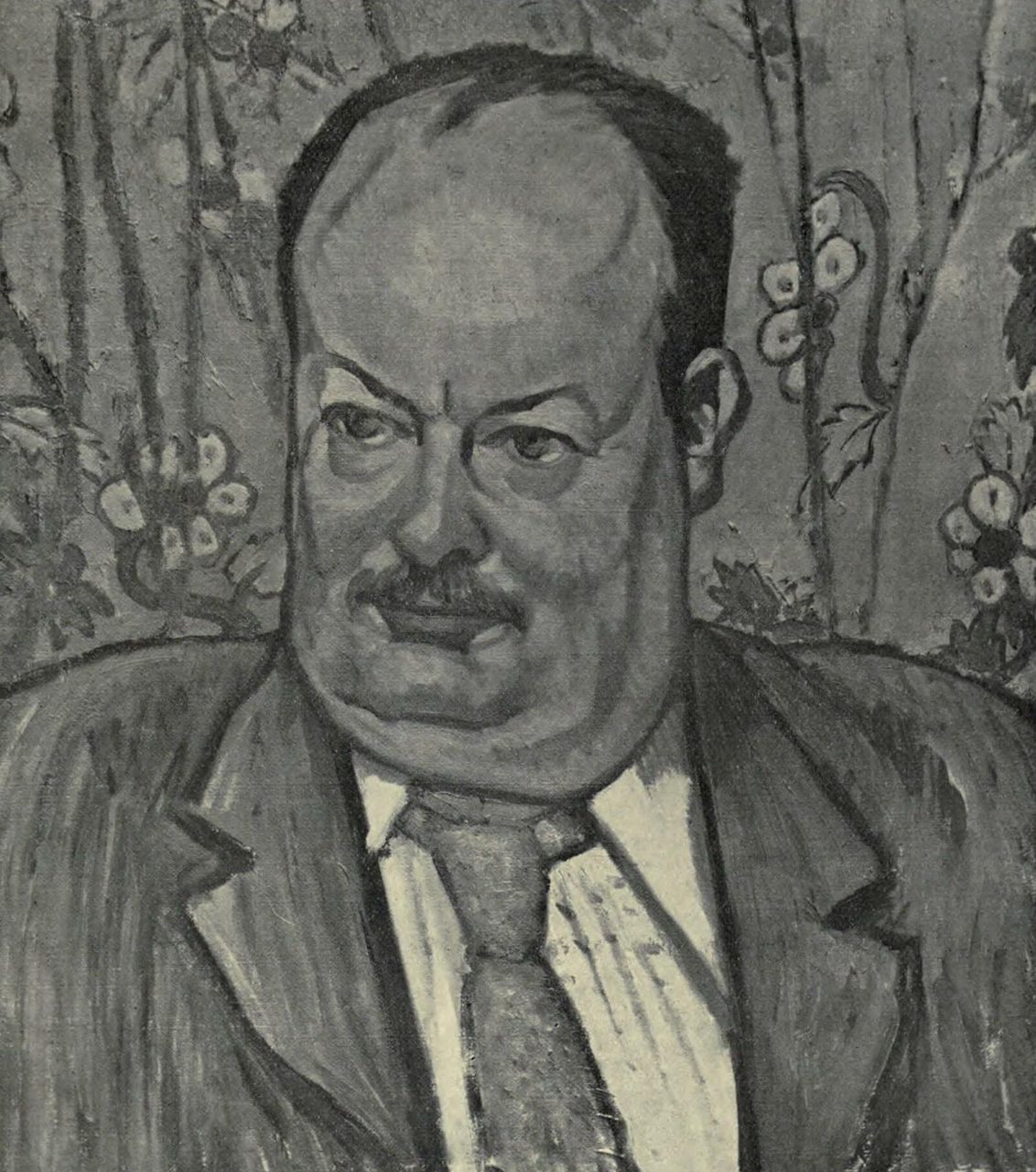
The argument runs in three steps, as our own file states them. First, genuine time requires the A-series, because the B-series alone is insufficient: it contains no change. Second, the A-series is contradictory, because every event has all three A-properties, past and present and future, and those are incompatible. Third, therefore time is unreal.
Our own file states that argument in four bullets and stops. It does not record what an A-theorist says back, and the reply is standard: the three properties are held successively rather than all at once, so the regress the argument turns on is benign. No source is cited for that reply here, because our file carries none and the research pass behind this article did not resolve one. It is named as the shape of the disagreement rather than as anybody's argument in particular, and it is named because presenting an argument from 1908 as though nobody had answered it would be false.
Our file records that the argument has generated over a century of debate, and that most philosophers reject McTaggart's conclusion while disagreeing about which premise to deny. That clause is what organises the rest of this article, because it makes the live positions two ways of refusing the same argument. Deny the first premise and the result is the B-theory and the block universe. Deny the second and the A-series survives, which gives presentism or the growing block. One caution travels with it. The quantifier is our own file's and is unmeasured: most philosophers is what the file says, and it is not a percentage anywhere in that file and is not converted into one anywhere in this article.
02The Physics That Removed The Universal Now
Einstein's special relativity, published in 1905, and Minkowski's spacetime formulation of it, delivered as an address at Cologne on 21 September 1908 and published in 1909, remove absolute simultaneity. Whether two events happen at the same time is not a fact about the events alone. It depends on the state of motion of the observer asking, and two events simultaneous for one observer occur at different times for another. That is the whole of the physics this article needs, and it is not in dispute. It is stated here as the premise of an argument and nothing else.
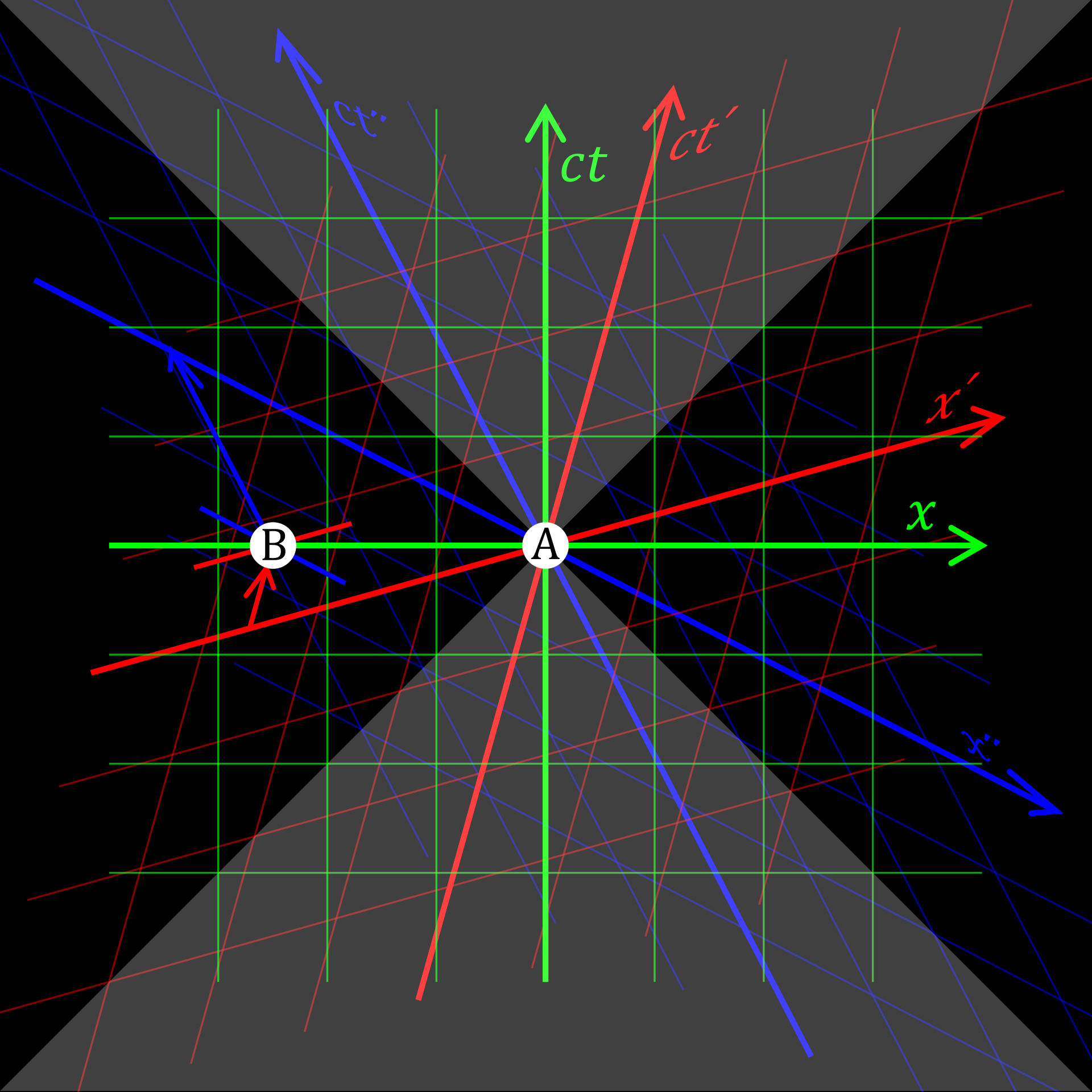
The inference our file calls the Rietdijk-Putnam argument, after papers of 1966 and 1967, runs like this. If simultaneity is relative, then events in one observer's future are already present for some other observer. If that other observer's present is real, those events are real. Therefore all events are equally real, which is eternalism and the block universe. This is the step on which everything dramatic about the subject depends, because it is where a result in physics is made to bear on a question in metaphysics. It is an argument. It is not a finding of physics, it is not presented as one here, and our own file supplies its rebuttal in the very next lines.
Relativity does not compel eternalism, and our own file says so under a heading of its own. It names Stein, in the Journal of Philosophy in 1968, and Maudlin, in 2002. The point is precise rather than sweeping: relativity shows that now cannot be defined as a global hyperplane cutting across the whole universe, while local temporal relations and the causal structure of spacetime still preserve a meaningful distinction between past and future. Stein's reply appeared in the same journal as Putnam's argument, one year later, and it appears nowhere in our own file's bibliography. It is cited below, because an article that presents the argument without the reply is presenting one side of a live dispute. Our file gives Maudlin's year and no title, and Maudlin published more than one relevant item that year, so the paper cited below is this article's identification of what the file meant and not the file's own.
Nothing about the three positions below is settled by that exchange, which is the reason for putting it first. The physics is not in dispute. What the physics licenses is.
03Three Answers, Each With Defenders And Problems
Presentism: only the present exists. Past events have happened and no longer exist; future events have not happened and do not yet exist. Our file records one strength and three challenges. The strength is that it aligns with common-sense temporal experience, which is not a small thing, because that experience is what the whole subject is trying to account for. The challenges are special relativity, which leaves no absolute present to privilege; truthmaker theory, which asks what makes past-tensed statements true if the past does not exist; and cross-temporal relations. The defenders our file names are Prior, in Past, Present, and Future of 1967, Zimmerman in 2008, and Bourne in 2006. Of those three, only Bourne's book resolved to a verified identifier for this article, and it is cited below.
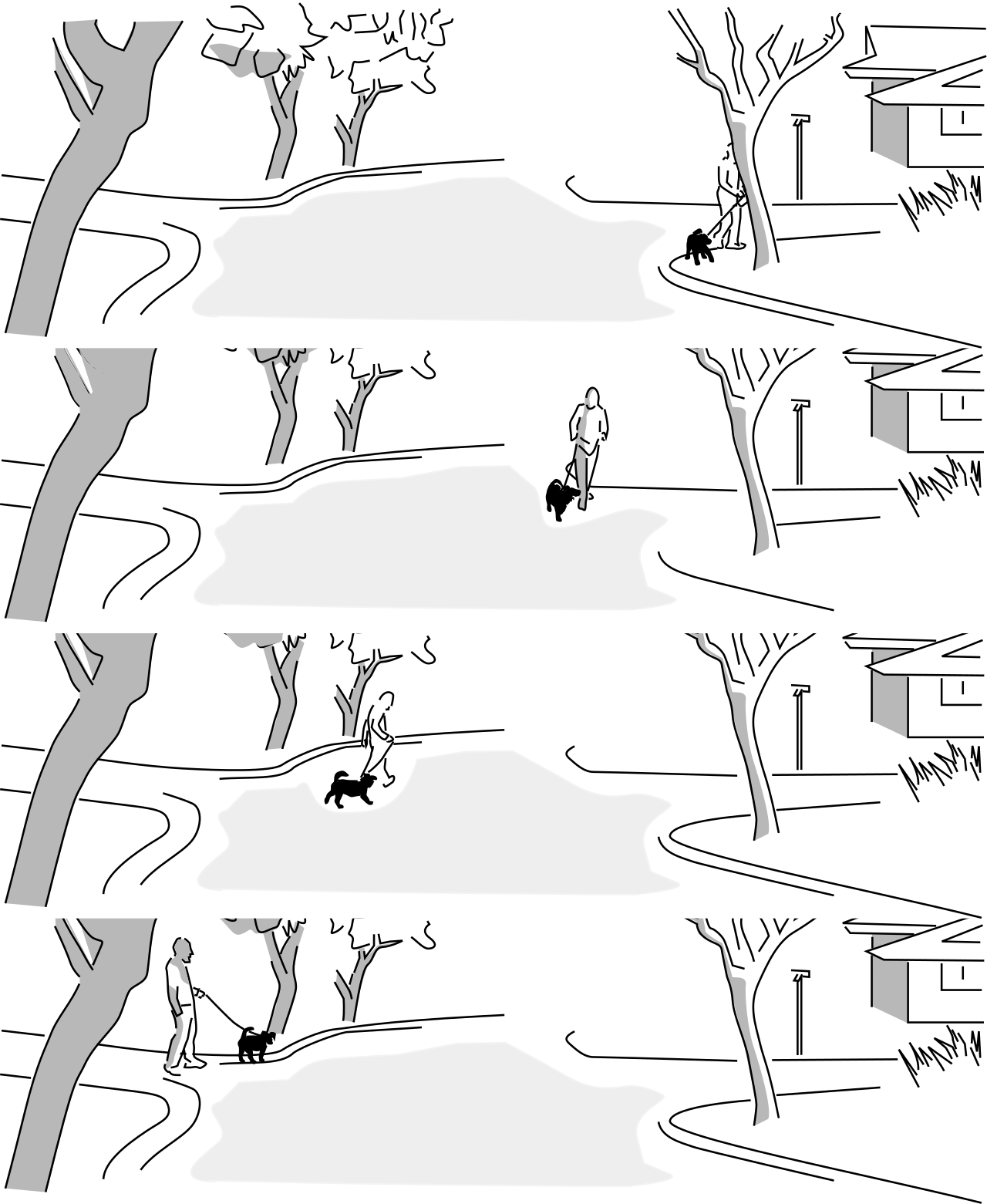
Eternalism, the block universe: past, present and future events all exist equally, the universe is a four-dimensional block of spacetime, and temporal passage is a subjective illusion. Our file records one support and one challenge. The support is that this is the natural interpretation of Minkowski spacetime. The challenge is the manifest image, which is to say the pervasive human experience of flow and becoming. That challenge is doing real work and this article does not walk past it, because it is why the dispute is not closed by physics: an argument from relativity can remove the universal now without touching the experience of one. The defenders our file names are Sider, in Four-Dimensionalism of 2001, Mellor, in Real Time II of 1998, and Quine, who is named with no work and no date.
The growing block: past and present events exist and the future does not, so the block of reality grows as time passes. Our file attributes it to Broad, in 1923, and Tooley, in 1997, and supplies its challenge in a single parenthesis: why does the present edge feel special? The growing block is the position that tries to keep both the reality of passage and the reality of the past, which is what makes it the third real option here rather than a compromise between the other two.
04If The Future Is Already There
Rietdijk's half of that hyphenated attribution is missing from our own file's bibliography, and its title is the story. The earlier of the two papers, in Philosophy of Science in 1966, is called A Rigorous Proof of Determinism Derived from the Special Theory of Relativity. Whatever is thought of the proof, the framing in the title is explicit. The argument was put in print as a derivation of determinism from relativity, not as a description of a block.
Our file lists free will as one of three places where the philosophy of time reaches outside itself: if the future already exists, is agency an illusion? That question is not answered here. It belongs to Free Will, in this same wing, which already carries the block universe in its own tier list and gives the compatibilist answer its space. What this article owns is the block universe itself, and whether anything actually establishes it.
05The Arrow The Laws Do Not Have
Entropy increases toward the future, and our file calls the second law the physical basis for the asymmetry between past and future. The philosophically sharp part is the sentence underneath it. The fundamental laws of physics are mostly time-symmetric, meaning that they work equally well run forward or backward. The word mostly is our file's own and it is kept here, because dropping it would state something stronger than the file does. The asymmetry everybody lives inside is not written into the laws.
The asymmetry is traced instead to boundary conditions: the universe began in a state of extraordinarily low entropy, a framing our file attributes to Albert in 2000 and Carroll in 2010. And then the file says, in its own voice, that why the Big Bang had low entropy remains unexplained, naming inflationary cosmology and anthropic reasoning as proposals rather than answers. That is the honest gap in the whole account, and it is worth stating plainly rather than at the end of a paragraph. The explanation of why time seems to run one way bottoms out in an initial condition nobody has explained.
The psychological arrow is the last link and the softest. Memories are of the past and not of the future, and time feels as though it flows from one toward the other. Our file says this is hypothesized to be a consequence of the thermodynamic arrow, on the ground that memory formation requires entropy increase. Hypothesized is the file's own word and it is kept, because an article that upgraded it to because would have invented a result. This is also where the physics hands the question back, since the experience the psychological arrow describes is exactly what presentism appeals to and exactly what eternalism has to explain away.
06The Third Voice
Henri Bergson, in Time and Free Will of 1889 and Creative Evolution of 1907, drew a line that neither the A-theory nor the B-theory draws. On one side, scientific time: spatialized, measured by clocks, represented as a line of discrete instants. On the other, duree, lived temporal experience, which he held to be continuous, indivisible and irreducible to spatial representation. This is a third position rather than a variant of the other two, because it denies that either ordering captures what time is as it is lived.
Bergson argued that the intellect spatializes time for practical purposes and thereby distorts its true nature, and that only intuition grasps real duration. Our file's note on his reception has three parts and all three belong here. He was influential on Proust, on Deleuze and on process philosophy. He was largely dismissed by analytic philosophers. And he is experiencing a revival. Dropping the dismissal would make him a settled authority he is not. Dropping the revival would make him sound finished when he is not.
On 6 April 1922, at a meeting of the Societe francaise de philosophie in Paris, the two registers met in one room. Einstein argued that Bergson's philosopher's time has no physical reality. Bergson argued that Einstein's physics presupposes lived temporal experience. Our file gives only the year, and adds that the debate echoes today in consciousness studies. The date, the venue and the standing book-length treatment of the episode, Canales's The Physicist and the Philosopher of 2015, were resolved for this article and the book is cited below. What Canales concludes about the exchange is not reported here, because the record was read and the book was not.
07One Frame Among Others
One paragraph, because the linear frame this article has been arguing inside is not the only frame human beings have used. Our file names Hindu and Buddhist cosmology, with its kalpas and yugas and samsara and its vast cycles of creation, destruction and recreation; the Maya long count; the Aztec Five Suns; and eternal return, in Nietzsche and in Stoic ekpyrosis. Against those it sets the Judeo-Christian-Islamic frame, in which time is a unique narrative with a beginning and an end: creation, history, eschaton. Our file's own conclusion from the comparison is the part worth keeping. These diverse frameworks challenge the assumption that any single philosophical account of time is universal, including the account this article has been conducting entirely inside one tradition. Cyclical time is a subject in its own right, with its own research file in this library, and it is not developed here.
08Whether Time Is Fundamental At All
Our file labels this territory Tier 3, speculative, and most of what follows carries that label. Two blocks in this section deliberately do not. Whether a 1967 paper exists and what formalism is written in it is checkable, and so is whether a journal published a study of a particular book at a particular length. A checkable fact inside a speculative territory is carried at the tier the fact deserves rather than the tier the topic has.
The formalism at the centre of this is real and datable. DeWitt's Quantum Theory of Gravity. I. The Canonical Theory appeared in Physical Review in 1967, and it is the source of what is now called the Wheeler-DeWitt equation. Our file names the equation and cites nothing for it; the paper is cited below. What is carried at Tier 2 here is that the 1967 formalism exists and says what it says. What it means for the reality of time is the next block, and that is Tier 3.
In that equation the wave function of the universe satisfies an equation with no time variable in it at all, which is what our file calls the problem of time in quantum gravity. Its Tier 3 claim is that time may not be fundamental but emergent from a more basic timeless structure. That is a live research problem rather than a discovery that time is unreal, and a resolved identifier under the formalism does not launder the claim above it into a verified one.
Loop quantum gravity and some string-theory approaches suggest that time emerges from more fundamental relational structures. Our file states this at exactly that level of generality and names no specific result, so no specific result is named here either, and the hedge belongs in the sentence rather than in a note underneath it.
Julian Barbour, in The End of Time of 1999, proposed that the universe is a collection of Nows, that is, configurations with no intrinsic temporal ordering, and that time is an illusion generated by the correlations between those configurations. It is a striking proposal and it is the natural place for an article like this one to stop. It does not stand unchallenged, which is why the next block sits directly underneath it rather than at the end of the section.
The British Journal for the Philosophy of Science published a study of Barbour's book by Butterfield in 2002, running from page 289 to page 330 of volume 53. That a leading journal in the field devoted a review essay of that length to the proposal is a checkable fact, and it shows two things at once: that the proposal is taken seriously, and that it is contested. What Butterfield concluded is not reported here. The record was resolved for this article and the essay itself was not read, and the entry below is labelled as a review rather than as Barbour's book.
09What Does Not Hold
Goedel published an exact solution of Einstein's field equations in Reviews of Modern Physics in 1949, under the title An Example of a New Type of Cosmological Solutions of Einstein's Field Equations of Gravitation. That solution contains closed timelike curves. Our file's Tier 4 section names the Goedel universe and cites nothing for it, and this is the paper. What is carried at Tier 2 here is the existence and the content of the 1949 solution, and nothing beyond it.
Time travel to the past has not been physically realized, and popular claims that it has lack any scientific basis. Our file's wording is careful and this article keeps it. General relativity permits closed timelike curves in certain exotic spacetimes, the Goedel universe, the interior of a Kerr black hole and the Tipler cylinder among them. There is no evidence that any of those configurations exists in the actual universe. And the chronology protection conjecture, proposed by Hawking in 1992, holds that quantum effects prevent their formation. Two distinctions have to survive the compression. What the mathematics permits is not what the universe contains. And a conjecture is a conjecture, which is why this article does not say that physics has ruled time travel out.
10Where It Actually Stands
The field was polled on exactly this. The 2020 PhilPapers Survey, published by Bourget and Chalmers in 2023, put the question to philosophers, and the wording of two of its questions was confirmed for this article from the survey organiser's own published discussion document. The options offered are the three positions section 03 describes and the two orderings section 01 describes, which is itself a checkable fact about how the discipline frames its own disagreement. The results are a different matter. No percentage from that survey appears anywhere in this article, because the research pass behind it could not reach the survey's own results: four independent routes to them refused, and a figure taken from a search summary is corroboration rather than verification. What can be said is that the field was asked, and that these were the options.
| The Position | What It Says Exists | The Challenge Our File Records | The Defenders Our File Names |
|---|---|---|---|
| Presentism | Only the present. Past events have happened and no longer exist; future events have not happened and do not yet exist | Special relativity leaves no absolute present to privilege; truthmaker theory asks what makes past-tensed statements true if the past does not exist; and cross-temporal relations | Prior, 1967; Zimmerman, 2008; Bourne, 2006, whose book is the only one of the three carrying a resolved identifier below |
| Eternalism, the block universe | Past, present and future alike, as a four-dimensional block of spacetime, with temporal passage a subjective illusion | The manifest image: the pervasive experience of flow and becoming, which an argument from relativity does not touch | Sider, 2001; Mellor, 1998; Quine, named in our file with no work and no date |
| The growing block | Past and present, but not the future. The block of reality grows as time passes | Why does the present edge feel special? Our file states the objection in a single parenthesis and does not answer it | Broad, 1923; Tooley, 1997, neither of whom appears in our file's own bibliography |
The same material laid out by date shows something the position-by-position view hides. The argument and its rebuttal are two years apart in the same journal, and the physics that both of them lean on is older than either.
| Year | What Appeared | What It Put On The Record |
|---|---|---|
| 1889 and 1907 | Bergson, Time and Free Will and Creative Evolution | The distinction between scientific time and duree, lived time held to be continuous and irreducible to a spatial line |
| 1905 | Einstein, Zur Elektrodynamik bewegter Koerper, in Annalen der Physik | Special relativity, and with it the removal of absolute simultaneity |
| 1908 | McTaggart, The Unreality of Time, in Mind | The A-series and the B-series, and the three-step argument that time is unreal |
| 1908 and 1909 | Minkowski, Raum und Zeit | The spacetime formulation, delivered at Cologne on 21 September 1908 and published in 1909 |
| 1922 | The exchange in Paris | Einstein and Bergson at the Societe francaise de philosophie on 6 April, on whether the philosopher's time has any physical reality |
| 1923 and 1997 | Broad, Scientific Thought; Tooley, Time, Tense, and Causation | The growing block, stated and then defended again |
| 1949 | Goedel, in Reviews of Modern Physics | An exact solution of the field equations containing closed timelike curves |
| 1966 and 1967 | Rietdijk, in Philosophy of Science; Putnam, in the Journal of Philosophy | The inference from relative simultaneity to the conclusion that all events are equally real |
| 1967 | DeWitt, in Physical Review | The canonical quantum theory of gravity behind the Wheeler-DeWitt equation |
| 1968 | Stein, in the Journal of Philosophy | The published reply to Putnam, in the same journal one year later, which our own file omits from its bibliography |
| 1992 | Hawking, in Physical Review D | The chronology protection conjecture, that quantum effects prevent closed timelike curves from forming |
| 1999 and 2002 | Barbour, The End of Time; Butterfield's review essay in The British Journal for the Philosophy of Science | The proposal that time is an illusion generated by correlations between configurations, and a study of it running from page 289 to page 330 |
| 2020 and 2023 | The PhilPapers Survey and its published report | The discipline asked itself, in the two wordings quoted above, |
11The Question Augustine Asked
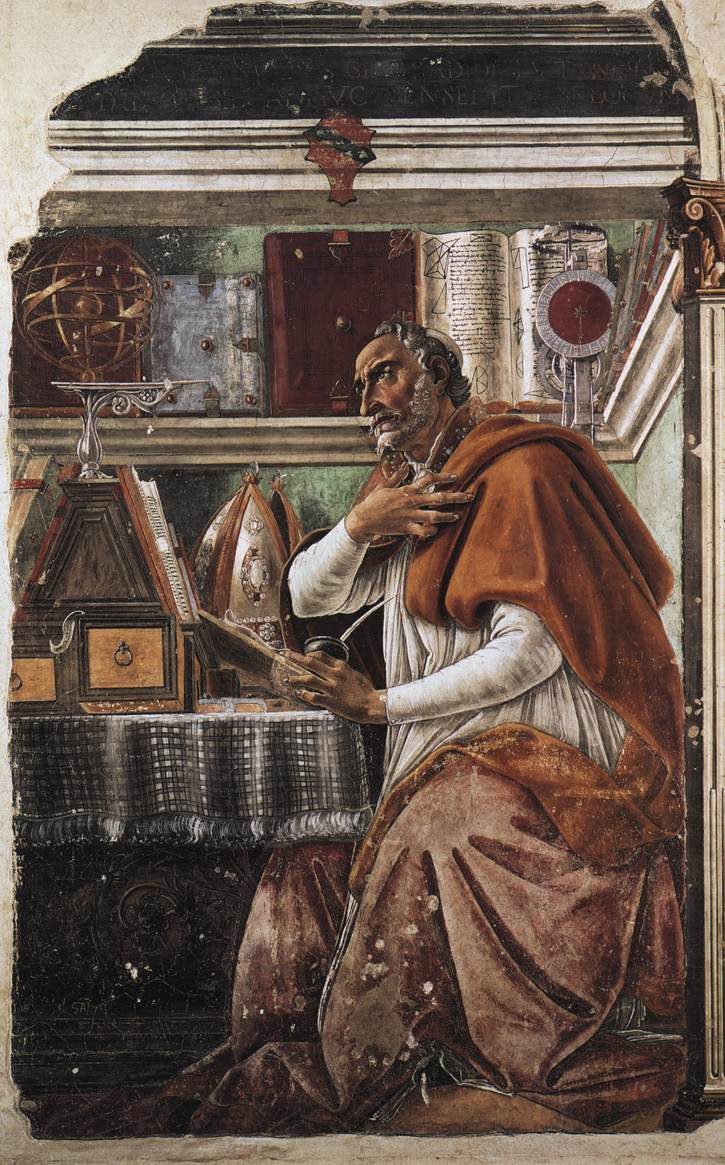
Augustine's difficulty was not that he lacked a theory. It was the difficulty his own sentence names: that the familiarity and the account come apart. Everything above is an attempt to close that distance. Two orderings of events, the loss of a universal now, three accounts of what exists, an arrow that the fundamental laws do not carry, duree, and an equation with no time variable in it: each of those is a way of saying what the difficulty is about, and none of them has dissolved it.
The reason for not crowning a winner is not caution. It is that the two strongest cases are strong in different places, and our own file's own entries say so. The eternalist case is strongest where it is about physics, and it has to work hardest against the manifest image, which our file records as its standing challenge. The presentist case is strongest where it is about experience, and it has to work hardest against relativity, which our file records as its first challenge. Those are the file's own entries and not this article's scoring.
Fast Facts
- The Question
- Is time real, or an illusion? Does the present have a special ontological status, or are past, present and future equally real? Does time genuinely flow, or is passage a subjective experience projected onto a static reality? Those three framings are our own research file's
- The A-Series And The B-Series
- McTaggart's two orderings, from 1908. The A-series orders events as past, present and future, positions that change. The B-series orders them by earlier than and later than, relations that never change
- McTaggart's Argument
- Genuine time requires the A-series; the A-series is contradictory; therefore time is unreal. Our own file records that most philosophers reject the conclusion while disagreeing about which premise to deny, and it does not record what an A-theorist says back
- The Physics Premise
- Special relativity removes absolute simultaneity: whether two events happen at the same time depends on the observer's state of motion. This is not in dispute, and in this article it is the premise of an argument rather than its conclusion
- The Rietdijk-Putnam Argument
- From relative simultaneity to the conclusion that all events are equally real, in papers of 1966 and 1967. It is an argument and not a finding, and Stein published a reply in the same journal as Putnam one year later
- The Three Positions
- Presentism: only the present exists. Eternalism, the block universe: past, present and future exist equally. The growing block: past and present exist and the future does not. Each has named defenders and a named challenge in our own file, and none of them is settled here
- The Arrow
- Entropy increases toward the future while the fundamental laws are mostly time-symmetric. Our file traces the asymmetry to a beginning of extraordinarily low entropy, and says in its own voice that why the beginning had low entropy remains unexplained
- The Speculative Edge
- Our file's Tier 3: that time may be emergent rather than fundamental. The Wheeler-DeWitt equation carries no time variable, and Barbour proposed that the universe is a collection of configurations with no intrinsic order. A review essay on Barbour's book ran in a leading journal from page 289 to page 330
- What Does Not Hold
- Time travel to the past has not been physically realized. General relativity permits closed timelike curves in exotic spacetimes, nothing observed suggests the universe contains one, and Hawking's chronology protection conjecture of 1992 proposes that quantum effects prevent their formation
- What Is Not Settled
- Which of the three positions is true. Whether the argument from relativity licenses eternalism, which Stein denied in print. Whether passage is a feature of reality or of experience. The field was surveyed in 2020 and the results were not reachable for this article, and this article supplies no winner
What Can Actually Be Stood Behind
What was published, and when, and what it argued, is settled and may be stated flatly. McTaggart published The Unreality of Time in Mind in 1908, and its argument runs in the three steps set out in section 01. Einstein published special relativity in 1905, and Minkowski delivered the spacetime formulation at Cologne on 21 September 1908 and published it in 1909. Rietdijk published in 1966 and Putnam in 1967; Stein replied in the Journal of Philosophy in 1968 and Maudlin argued in the same direction in 2002. Prior published Past, Present, and Future in 1967 and Bourne A Future for Presentism in 2006; Mellor published Real Time II in 1998 and Sider Four-Dimensionalism in 2001; Broad published Scientific Thought in 1923 and Tooley Time, Tense, and Causation in 1997. Bergson published Time and Free Will in 1889 and Creative Evolution in 1907, and met Einstein in Paris on 6 April 1922. Goedel published his solution in 1949, DeWitt his canonical theory in 1967, Hawking the chronology protection conjecture in 1992 and Barbour The End of Time in 1999. Each of those is a fact about a text, and that is the level at which this article states them. The one piece of physics carried at the same level is that relativity removes absolute simultaneity, which nobody in this dispute denies.
The disputes are real, serious and unresolved, and every side has named holders. The thermodynamic account of the arrow is academic material with an unexplained boundary condition at the bottom of it, and our own file says so in its own voice. The psychological arrow is hypothesized rather than shown, on our file's own word, and this article does not upgrade it. Bergson's standing is genuinely mixed in all three directions at once: influential on Proust and Deleuze and process philosophy, largely dismissed by analytic philosophers, and currently reviving. Whether the paper cited below is the Maudlin item our file meant is this article's identification and not our file's, because the file gives a year and no title. And the 2020 survey is used here for its question wordings and for the qualitative finding only; its percentages appear nowhere in this article, and section 10 says why.
One claim in this article carries our file's Tier 3 label, and it is carried visibly rather than quietly dropped: that time may not be fundamental but emergent from a more basic timeless structure. Two facts inside that territory are not speculative, and section 08 marks each of them where it stands. DeWitt's 1967 paper exists and contains the formalism named after him and Wheeler; what its missing time variable means for the reality of time does not follow from that and stays Tier 3. Loop quantum gravity and some string-theory approaches are carried at exactly the generality our file states and no further, with no specific result named. Barbour's Nows are a proposal, and a review essay of them ran in a leading journal from page 289 to page 330, which this article reports as a fact about the literature and not as a verdict, since the essay itself was not read.
No: time travel to the past has not been physically realized, and popular claims that it has lack any scientific basis. That is our own file's own assessment and this article carries it whole, including both of its qualifications. General relativity does permit closed timelike curves in certain exotic spacetimes, which is a real mathematical result and not a fringe one, and nothing observed suggests that the actual universe contains such a configuration. Hawking's chronology protection conjecture proposes that quantum effects prevent their formation, and a conjecture is a conjecture. Nothing here says that physics has ruled time travel out.
No: nothing in this article shows that physics has proved time does not flow, that relativity establishes the block universe, or that science has settled that passage is an illusion. The Rietdijk-Putnam step is an argument, and it has a published rebuttal in the same journal one year later. Stein's point is precise: relativity removes a global now, not the local distinction between past and future. Eternalism's own recorded challenge in our file is the manifest image, which physics does not touch. The thermodynamic story explains the asymmetry and bottoms out in an unexplained low-entropy boundary condition. The psychological arrow is hypothesized rather than shown. The quantum-gravity material is our file's own Tier 3, and Barbour's version of it has a review essay standing beside it in a leading journal. And the field, when it was asked, did not converge. This is the more dramatic story of the two and therefore the likelier failure: if a reader finishes this article able to say correctly that this library holds the block universe to be a result physics delivered, the article has failed.
No, and this refusal matters as much as the last one: McTaggart was not simply wrong, the puzzle is not solved, presentism has not been vindicated, the block universe is not dead, and this is not merely a dispute about words. Our own file's statement of the state of play is that most philosophers reject McTaggart's conclusion while disagreeing about which premise to deny, which describes a live disagreement rather than a closed question. The physics premise is not in dispute by anyone: relativity really does remove absolute simultaneity, and presentism really does have to answer for that. Presentism's other two recorded challenges, truthmakers and cross-temporal relations, go unanswered in our own file. And a discipline-wide survey put exactly these options to philosophers, which is not what happens to a settled question or to a merely verbal one. If a reader finishes this article able to say correctly that this library holds the question to be empty, the article has failed that way instead.
Which leaves the sentence this article opened with where Augustine left it. He was not confessing ignorance about a difficult topic. He was reporting that the competence and the account come apart: that time is handled perfectly well until somebody asks for an account of it, and stops being handled at all the moment the question is put. Every position above is an attempt to close that gap, and none of them has closed it. If the account keeps failing while the competence never does, which of the two is telling the truth about time?
Sources & further reading
Everything above is drawn from one research file in our own library, P_1_09, together with sources checked directly for this article. That file is where the work was done from; the records below are where the work can be checked, and they are listed for that purpose rather than as a reading list. Twenty of the twenty-one entries are external, and eighteen of those carry a digital object identifier that was resolved live against CrossRef for this article with the returned title read against the claim it is attached to. Four notes belong on the record rather than being left to be discovered. Our own file cites Sider's Four-Dimensionalism with an identifier that resolves to a chapter of that book collecting the arguments against four-dimensionalism, while citing Sider as a defender of eternalism, so a reader checking it lands on the objections; the book identifier is carried below instead and the chapter one is not reproduced anywhere. Our file's row for Minkowski's Raum und Zeit pairs one journal's name with another journal's volume and pages, so the reference does not resolve: the address was delivered at Cologne on 21 September 1908 and published in 1909 both in the Jahresbericht der Deutschen Mathematiker-Vereinigung, volume 18, pages 75 to 88, and in Physikalische Zeitschrift, volume 10, pages 104 to 111, and since no identifier exists for it, it is not listed below. Nine things our file names in its body appear nowhere in its own bibliography, Rietdijk and Stein among them, and not all nine carry a date or even a work, which is why six of the entries below were resolved for this article rather than lifted from it. And two identifiers below point at editions later than the works the prose dates, both of which say so in their own entries. The books and papers listed here were verified as records, by identifier, title, journal, volume, pages and year, and were not read for this article, so nothing here reports what any of them argues beyond what our own file already claimed.
Image credits
- Star trails above Kitt Peak National Observatory, long exposure KPNO/NOIRLab/NSF/AURA, via Wikimedia Commons. CC BY 4.0 Source.
- J. M. E. McTaggart, a painted portrait reproduced from Cambridge Magazine, 10 February 1912 Cambridge Magazine, via Wikimedia Commons. Public Domain Source.
- Relativity of simultaneity, three observers in relative motion Original by User:Army1987, converted to SVG by Acdx, via Wikimedia Commons. CC BY-SA 3.0 or GFDL 1.2 or later Source.
- Illustration of the block universe, a man walking a dog through a stack of four instants Benjamin Crowell, own work, via Wikimedia Commons. CC BY-SA 4.0 Source.
- Saint Augustine, painted by Sandro Botticelli in 1480 Sandro Botticelli; reproduction from the Web Gallery of Art, via Wikimedia Commons. Public Domain Source.
- Card crop of the star trails above Kitt Peak National Observatory KPNO/NOIRLab/NSF/AURA, via Wikimedia Commons. CC BY 4.0 Source.
.jpg)


