
Radical Doubt: From Pyrrho to the Brain in a Vat
Pyrrho of Elis wrote nothing, and a tradition took his name anyway. Almost everything we have of ancient scepticism comes through one later author whose own dates are a guess spanning about a hundred and fifty years, and his definition makes scepticism an ability rather than a doctrine: set the arguments against each other, find them equal in weight, and stop. Rene Descartes was doing something else entirely. He doubted in order to rebuild, and the sentence he is remembered for are not in the book they are usually attributed to. This article keeps the two projects apart, gives every quotation its translator and locus, or else names the reference work that printed it, refuses three sentences our own research file prints without a source, and states where its tier marks came from, because the file it is built on assigns none.
Start with the word, because in ordinary use it now carries close to the opposite of what it meant. A sceptic, in the ancient sense, is not someone who has concluded that knowledge is impossible. That conclusion would itself be a positive claim, and it would need justifying like any other. The Greek skepsis means investigation. A sceptic, on the original terms, is someone who is still looking.
Two projects run through what follows and they are not the same project. Sextus Empiricus suspends judgement in order to stop, and what arrives after the stopping is tranquillity. Rene Descartes doubts in order to start, and what he wants is a foundation solid enough to rebuild the sciences on. Sextus doubts in order to stop; Descartes doubts in order to start. The popular telling of this subject runs the two together, and an article that does that is wrong in its shape rather than in a footnote, so section 01 settles it before anything else happens.
A note on the quotation marks, because on this subject they decide whether a sentence can be checked. Every passage below that sits inside quotation marks names the work, the locus and the translator, or else names the reference work that printed it. Three sentences that our own research file prints inside quotation marks do not appear here at all: one attributed to Arcesilaus, one attributed to Sextus, and one that is our file's own paraphrase wearing its own emphasis capitals. Section 16 sets out what was found about each. And no Latin edition was read for this article and no Latin is quoted from a Latin text; the only Latin inside quotation marks on this page is the parenthesis Veitch himself prints inside his English sentence, because no Latin edition was read for it; the Latin is reported as a formulation and never printed as text.
Several neighbouring subjects are not this one. Stoicism, in this same wing, owns katalepsis from the Stoic side, the cognitive grasp so clear that it compels assent; this article carries the attack on it and does not re-explain the doctrine. Personal Identity owns Hume's bundle theory of the self, so Hume appears here for induction and for mitigated scepticism and nowhere else. Plato's Cave is the ancestor of the appearance-and-reality distinction the whole article runs on. Are We Living in a Simulation?, on another wing, owns Bostrom's simulation argument outright, which is a probabilistic argument about ancestor simulations and is not the brain in a vat; section 12 names the difference and stops there. And Is Time Real? carries a different paper by Hilary Putnam, from 1967, about the geometry of time; that is the same philosopher on an unrelated question, and the two arguments have nothing to do with each other. Four more articles in this wing are named below without links, because they have not been built yet and a link to a page that does not exist is a dead link.
One thing about the tier marks has to be said plainly, because it is unusual. Our research file P_3_10 assigns no tier to anything: not to a section, not to a subsection, not to a table row, not to a bullet. Its header declares the document Tier 1 and its own Source Tier Classification block declares Tier 3, and the two are never reconciled. So the tiers on this page are not inherited from that file, and they are not presented as its. They were assigned for this article under one stated rule, and the rule is printed here so a reader can audit it rather than trust it. Tier 1 is an attributional or textual fact, meaning what a named person wrote in a named work, or what a text says, where an independent external source was resolved and agrees. Tier 2 is that same kind of fact where no external corroboration was obtained, or a live mainstream scholarly position, or a reading of a text that the literature debates. Tier 3 is genuinely speculative, contested or unsettled. Tier 4 is refusal, and on this subject the refusals run in two opposite directions, which the verdict sets out.
01What The Word Does Not Mean
Scepticism is not denial, and that is the first correction this article has to make. Our research file states the position directly: the sceptic does not claim that knowledge is impossible, because that would itself be a positive claim requiring justification. The Pyrrhonist suspends judgement, neither affirming nor denying, and the resulting condition is one of inquiry rather than of settled conviction. The file makes the etymological point in the same breath, and it is the point to hold onto for the next sixteen sections: skepsis means investigation. Everything the tradition is accused of, paralysis, nihilism, a shrug dressed as a philosophy, follows from reading it as an answer instead of as a refusal to give one.
| Kind | Scope | The Claim |
|---|---|---|
| Global | All knowledge | No knowledge of any kind is possible |
| Local | Specific domains | Knowledge of the external world, or of other minds, or of morality, or of the future, is impossible |
| Methodological | Heuristic | Doubt used as a tool for discovering what can withstand scrutiny. Our file attributes this one to Descartes |
| Academic | Theoretical | Nothing can be known with certainty, and probability is the best that can be achieved |
| Pyrrhonian | Therapeutic | Suspension of judgement on all theoretical matters leads to tranquillity |
Two of those five are the ones this article argues, and they pull in opposite directions. Our own file's table already separates them: Pyrrhonian scepticism is listed as therapeutic, its scope all theoretical matters, its claim that suspension of judgement leads to tranquillity; methodological scepticism is listed as heuristic, doubt as a tool for discovering what can withstand scrutiny. The same file states flatly that Descartes is not a sceptic. The Stanford Encyclopedia of Philosophy's entry on Descartes' Epistemology, consulted independently for this article, says the same thing from the other side: it describes his aim as being "to reach certainty", and it quotes him, in its own sentence, distinguishing himself from "the sceptics, who doubt only for the sake of doubting". The entry continues that phrase about certainty with an image of clearing ground, "to cast aside the loose earth and sand so as to come upon rock or clay"; the two fragments are joined in the source by a dash, which house style does not reproduce, so they are quoted here as two fragments and not silently run together. Hold the difference in one line: Sextus doubts in order to stop, and Descartes doubts in order to start.
02Pyrrho, Who Wrote Nothing
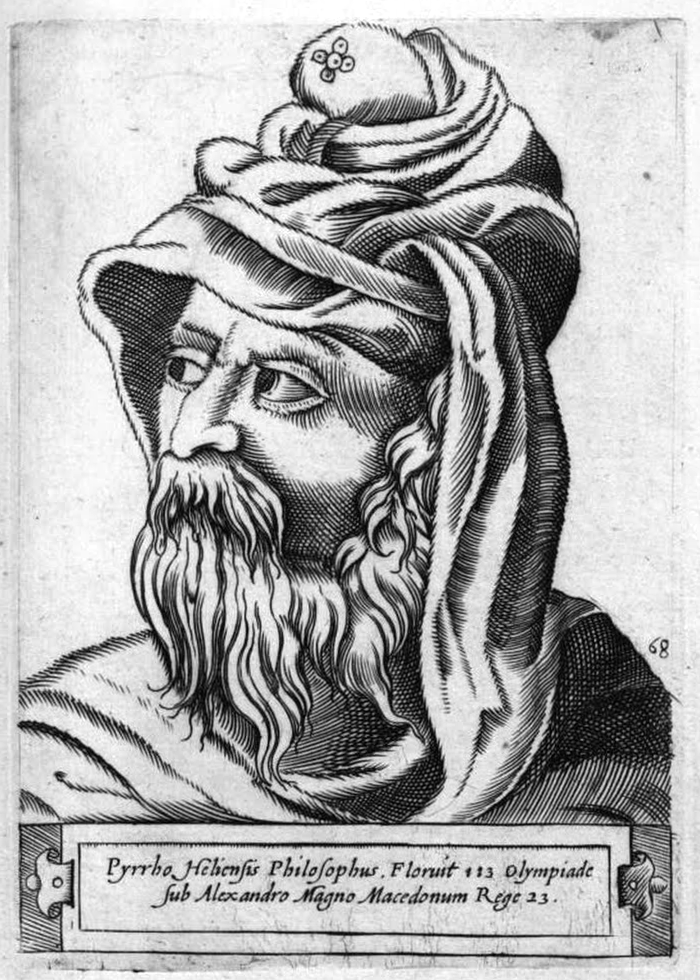
Pyrrho wrote nothing, and that is the first fact about him. Our file states that he left no writings and that his thought reaches us through his student Timon of Phlius and, much later, the systematic exposition by Sextus Empiricus. The Stanford Encyclopedia's entry on Pyrrho, whose author it returns as Richard Bett, sharpens this: apart from poetry allegedly written on Alexander's expedition, which as far as we can tell did not survive that expedition, he wrote nothing; Timon wrote a great deal, of which only fragments and second-hand reports survive; and of Timon the entry says plainly, "Timon is clearly the most important and the most trustworthy source of information about Pyrrho." On the dates the two sources differ, and the wider one is printed here. Our file gives about 360 to 270 BCE. The encyclopedia gives a life running from around 365 or 360 BCE until around 275 or 270 BCE, and every figure in it is approximate. The narrower version is not so much wrong as unsupported by anything either source cites.
What Pyrrho is reported to have said comes to us at third hand, through a summary by Aristocles, and our file gives it in three parts: that things are equally indifferent, unmeasurable and undecidable; that our sensations and opinions are therefore neither true nor false; and that we should be without opinion, uncommitted and unwavering, which will produce ataraxia. The three Greek epithets are adiaphora, astathmeta and anepikrita, transliterated here without the circumflexes the encyclopedia prints on the e in the second and third. Now the hedge, which is absent from our file and which changes what the passage can be used for. The Stanford Encyclopedia's entry on Pyrrho records that those three epithets are subject to competing interpretations, a metaphysical reading on which things really are indeterminate and an epistemological reading on which we simply cannot determine how things are, and it treats the choice between them as open. That is not a footnote. If the claim is metaphysical, then the founder of the tradition is making exactly the kind of positive assertion the tradition exists to refuse, and the disagreement is about him. No full English translation of the Aristocles passage is quoted here, because none was read for this article off a primary source.
The most repeated story about Pyrrho is also the least secure, and it is told here once with its hedges intact. Our file files it under the word Legend: that Pyrrho travelled with Alexander's army to India, that he was influenced by Indian ascetics, the gymnosophists, and that a connection to Buddhist or Jain scepticism has been debated but remains speculative. The Stanford Encyclopedia's entry is more guarded again. It hedges the expedition as something he allegedly joined, hedges the encounter with the naked wise men, the gumnosophistai, as something we are told, and says in terms: "Diogenes Laertius (9.61) claims that his philosophy developed as a result of this meeting, but it is not clear what basis, if any, he has for this assertion." It does allow that the Indians may have influenced his physical impassivity. The story may be told. It may not be used to explain where Pyrrhonism came from, and it is not used that way here.
03One Surviving Author, And Nobody Knows When He Lived
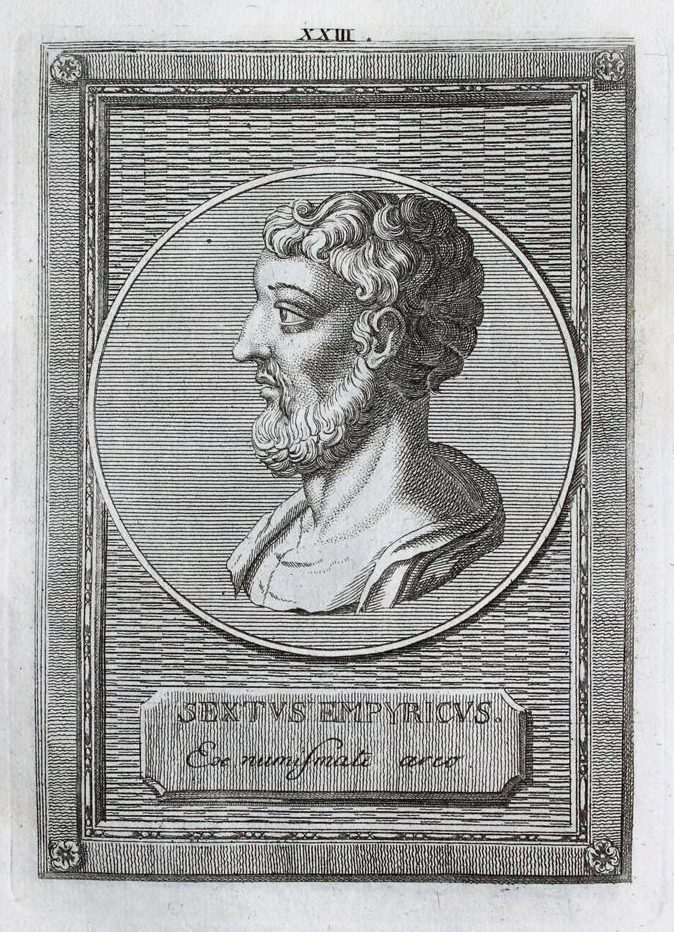
We do not know when Sextus Empiricus lived, and our own file implies that we do. It gives about 160 to 210 CE in its summary and repeats the same fifty-year window once more. The Stanford Encyclopedia's entry on Sextus Empiricus opens instead with a range: "Sextus Empiricus was a Pyrrhonian Skeptic living probably in the second or third century CE." On the tighter question it is tighter still about how little is known, placing him "anywhere between 100 CE and the first half of the third century CE". That is a window of roughly a hundred and fifty years, and nothing in our file's own bibliography supports the narrower figure. The wide range is the one this article prints, and the fact underneath it is worth stopping on: almost nothing is known about the man who wrote the only complete surviving account of ancient scepticism. The scholarly anchor is Pierre Pellegrin's chapter on Sextus in The Cambridge Companion to Ancient Scepticism.
What survives is less than a reader might assume. Our file names two works of Sextus, Outlines of Pyrrhonism and Against the Professors, and describes the first as the most complete surviving account of ancient scepticism. Both identifiers in its bibliography resolve exactly to the R. G. Bury translations in the Loeb Classical Library, published by Harvard University Press in 1933 and 1949, and both are cited below. One naming note, because the literature is inconsistent and this article has to pick: the Loeb English title is Outlines of Pyrrhonism, the Julia Annas and Jonathan Barnes translation calls the same work Outlines of Scepticism, and the standard abbreviation in the scholarship is PH. This article uses Outlines of Pyrrhonism throughout and quotes from Annas and Barnes, naming them each time. So here is the shape of the evidence base for a movement that ran for roughly five centuries: one author whose dates are a guess, plus scattered testimony.
04Scepticism Is An Ability, Not A Doctrine
The whole machine is in that one sentence, and the word to build on is the noun in it. Scepticism is an ability, a capacity to do something, not a set of beliefs about what can be known. The sentence then runs the ability through four stages in order: oppositions are set out, the opposed accounts turn out to be equal in weight, equipollence, which our file names in Greek as isostheneia; that equality produces suspension of judgement, epoche; and tranquillity follows. Our file gives the same chain in its own words and names both Greek terms. Its own opening section makes the corresponding point, that scepticism is an activity rather than a settled conviction, which is the same claim the definition makes and the same claim that answers the self-refutation objection in section 16. The spelling above is the source's, with two l's in tranquillity and no e in judgment, and the next paragraph spells the same word with one l, also as the source has it.
The strangest claim in the tradition is in the last stage of that sentence, and it needs the simile that our file quotes without a citation. Tranquillity follows suspension of judgement "as a shadow follows a body", six words which the Stanford Encyclopedia's entry on Sextus locates at Outlines of Pyrrhonism I 29, in the Annas and Barnes translation, noting the same image at Diogenes Laertius IX 107. Our file prints the phrase with no locus and no translator, which is why both are supplied here. The entry explains what the simile is doing: the tranquillity arrives unexpectedly, not through deliberate pursuit. Hold what that costs. On this account judgement cannot be suspended in order to become tranquil, because pursuing an end is itself a commitment. The peace is a side effect of giving up the search for a verdict, and it does not arrive for anyone who gives up the search in order to get it. The encyclopedia's own sentence carrying those six words spells tranquility with one l, where the passage at I 8 spells it with two. That inconsistency is in the source, not introduced here, and it is exactly why the two passages are quoted separately rather than merged.
05How A Sceptic Gets Through The Day
The obvious objection arrives immediately: if judgement is suspended about everything, how does anyone get out of bed. Sextus has an answer and it is a specific passage, which our file summarises accurately without citing. It says the sceptic lives by appearances, phainomena, following custom, natural inclination, bodily needs and craft expertise, without committing to theoretical beliefs about the underlying nature of things. The passage behind that is Outlines of Pyrrhonism I 24, where four guides are named, and it is worth quoting rather than summarising, because the summary sounds like an evasion and the passage sounds like a life. In the Annas and Barnes translation, as the Stanford Encyclopedia prints it: "By nature's guidance we are naturally capable of perceiving and thinking. By the necessitation of feelings, hunger conducts us to food and thirst to drink. By the handing down of customs and laws, we accept, from an everyday point of view, that piety is good and impiety bad. By teaching of kinds of expertise we are not inactive in those expertises which we accept." Nothing there is a belief about how things really are. All four are reports about how things appear and what a body does about them.
Our file has one worked example of the method and it is the cleanest illustration in the subject, so the idea is used here and the wording is not. Take honey. The sceptic does not assert that the honey is sweet, which would be a claim about what honey is; the sceptic reports that it appears sweet, which is a claim about an appearance and cannot be wrong in the same way. That distinction, between reporting an appearance and asserting a fact about the world, is what makes the whole position livable, and it is what the fourfold observance above is built on. Our file prints a sentence to that effect inside quotation marks, with capital letters for emphasis, as though Sextus had said it. He is not recorded as having said it in those words, the emphasis capitals are our file's own house style, and the underlying passage, at Outlines of Pyrrhonism I 20, was not read off a primary text for this article. So the point is made here in this article's own words and no version of that sentence is presented as a quotation.
06The Academy Took A Different Road
While the Pyrrhonists were suspending judgement, Plato's own Academy was doing something related and different. Arcesilaus, head of the Academy, whose dates our file gives as about 316 to 241 BCE and the Stanford Encyclopedia's entry on Ancient Skepticism gives more precisely as 316/5 to 241/0 BCE, attacked the Stoic criterion of truth. The Stoics held that some impressions are cataleptic: so clear and distinct that they compel assent and cannot be false. Arcesilaus argued that for any such impression an indistinguishable false one is possible. The encyclopedia supplies the case our file leaves out, and it is what turns an abstract claim into an argument a reader can hold: eggs. No impression of one egg could be distinguished from impressions of other eggs. The Stoic side of this belongs to Stoicism, which carries katalepsis in its own words as the Stoic answer to how anyone knows anything at all; this article carries the attack and does not re-run the doctrine. Our file also prints a sentence inside quotation marks, attributed to Arcesilaus, to the effect that nothing can be known, not even that. It could not be verified as his sentence from any edition, translation or scholarly citation for this article, and it does not appear here. The scholarly anchor for this section is Harald Thorsrud's chapter on Arcesilaus and Carneades in The Cambridge Companion to Ancient Scepticism.
Carneades, about 214 to 129 BCE in our file and 214 to 129/8 BCE in the encyclopedia, is where the Academic road gets practical, because he answers the question the Pyrrhonists answer with appearances: how does anyone act without knowing. His answer is to pithanon, the persuasive, and our file lists three grades of it: probable; probable and uncontradicted; probable, uncontradicted and thoroughly examined. The Stanford Encyclopedia gives the same three grades with a component our file drops, and the component is the whole point. Each grade is indexed to how much is at stake. In its words: "a three-stage criterion: (1) In matters of importance, skeptics adhere to the persuasive. (2) In matters of greater importance, they adhere to the persuasive and undiverted. (3) In matters that contribute to happiness, skeptics adhere to persuasive, undiverted, and thoroughly explored impressions." Without the stakes index the three grades read as an arbitrary ladder. With it they are a rule about how much checking a decision deserves, which is both what Carneades meant and something a modern reader already does.
Now the difference between the two schools, and one honest gap in what could be established for this article. Our file draws the line like this: the Academics made a positive claim, that nothing can be known, and offered probability as a guide, while the Pyrrhonists refused even that claim and suspended judgement about whether knowledge is possible. That is the standard textbook framing and it is worth having. What has to travel with it is that the Stanford Encyclopedia's entry on Ancient Skepticism, asked directly for a sentence drawing that comparison, does not draw it there. What it says is: "When comparing Pyrrhonian and Academic skepticism, two topics stand out: Pyrrhonism aims at tranquility; and it assigns pride of place to appearances." So the reference literature this article consulted puts the line somewhere else, and better evidenced. Both are carried here, and whether the Academics were really dogmatists about the impossibility of knowledge is itself a live scholarly question rather than a settled fact. Note in passing that the second of those two topics is what section 05 was about.
07Ten Modes, Then Five
Ancient scepticism has a toolkit, and it comes in two lists. The older one is the ten modes of Aenesidemus, first century BCE, which the Stanford Encyclopedia's entry on Sextus records as ascribed to older sceptics and identified with Aenesidemus. Our file enumerates all ten, and the useful thing is not the enumeration but the fact that they are one argument repeated. Different animals perceive the same thing differently. So do different people. So do different senses in the same person. So does the same person healthy or ill, waking or asleep, young or old. Position, distance and place change how a thing appears; nothing is ever perceived in isolation but always mixed with other things; quantity and composition alter properties; frequency alters judgement, which is why a comet arrests attention and the sun does not; and customs, laws and beliefs conflict. Underneath all ten is a single move: every appearance is an appearance to someone, from somewhere, under conditions. Three of the modes point straight at the bent oar and the optical illusion. Those belong to a philosophy of perception article that has not been built yet, so they are named here as modes and not developed as illusions.
The second list is shorter, later and much harder to answer. Agrippa's five modes, as our file gives them, are disagreement, infinite regress, relativity, hypothesis and circularity. Stefan Sienkiewicz's Oxford monograph, devoted to exactly these five as they appear in Sextus, names the same set in slightly different words, as the modes of disagreement, hypothesis, infinite regression, reciprocity and relativity. About the man himself almost nothing is settled, and our file's question mark understates the problem. It writes Agrippa with a bracketed first century CE and a question mark. Two entries of the Stanford Encyclopedia disagree with each other. The entry on Sextus Empiricus gives "Agrippa (fl. first century BCE; see Schofield 2007; Hankinson 2010; Polito 2014), who probably lived at the end of the first century BCE." The entry on Ancient Skepticism dates him instead to the "1st to 2nd century CE". Those are two different centuries and two different eras, printed by the same reference work. This article carries both and picks neither.
| The Mode | What It Says | What It Leaves |
|---|---|---|
| Disagreement | On any question there is unresolved disagreement among philosophers and among ordinary people | No agreed starting point to reason from |
| Infinite regress | Every justification offered requires a further justification, without end | A chain that never reaches ground |
| Relativity | Things appear differently in different relations and contexts | No view of the thing apart from some relation to an observer |
| Hypothesis | The dogmatist stops the regress by assuming something without justification | A stopping point that was chosen rather than earned |
| Circularity | The argument offered to establish a point already presupposes that point | A proof that works only for someone who already accepts the conclusion |
One loose end, named so that it does not get tidied wrongly. Our file writes the Agrippan trilemma and a second name for it side by side, as though the two names were interchangeable and equally old. They are not. The Agrippan modes are ancient; the other name is a twentieth-century coinage, and our file gives no source for it. No source was resolved for this article either, and neither who coined it nor when could be established. So the ancient name is used throughout this page, and all that is said about the other is that the same argument circulates under a second and much later name. Nobody is credited with inventing it here and no year is attached to it, because this article cannot support either.
08The Trilemma
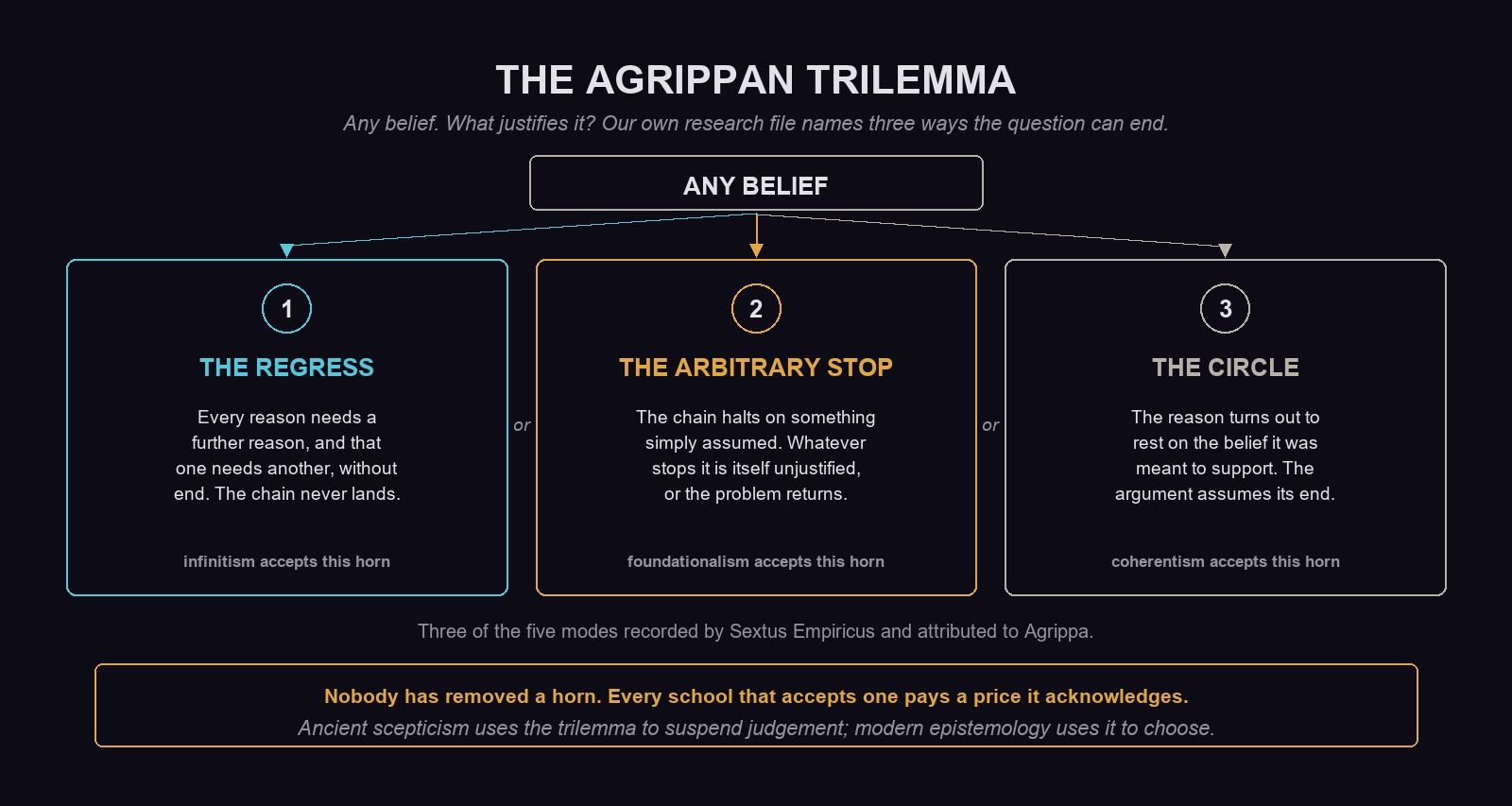
Three of Agrippa's five modes combine into the hardest argument in this article, and it is the reason ancient scepticism is not a historical curiosity. Take any belief and ask what justifies it. Whatever the answer, the same question can be asked of that. Our file states the result: the attempt leads to infinite regress, or to an arbitrary stopping point, or to circularity, none of which is satisfactory, therefore justification fails, therefore suspend judgement. The file also makes a point worth crediting, because the popular versions lose it: the famous trilemma is drawn out of a pentad, three horns extracted from five modes. Sienkiewicz's monograph is devoted to the five as Sextus presents them and names them in the same terms. Here is why this is a live argument rather than an antique one. Modern epistemology has not disposed of the trilemma; it has distributed itself across the horns. Foundationalism accepts the second horn and argues that some beliefs are basic and need no further justification. Coherentism accepts the third and argues that circles of the right size and shape are not vicious. Infinitism accepts the first and argues that an endless chain of reasons is exactly what justification is. Each is a school with holders, each pays a price it acknowledges, and the argument they are all answering is about two thousand years old. What justified true belief does with this, and where the analysis of knowledge breaks, belongs to an article on knowledge that has not been built yet, so it is not run here.
09Descartes Doubts In Order To Start
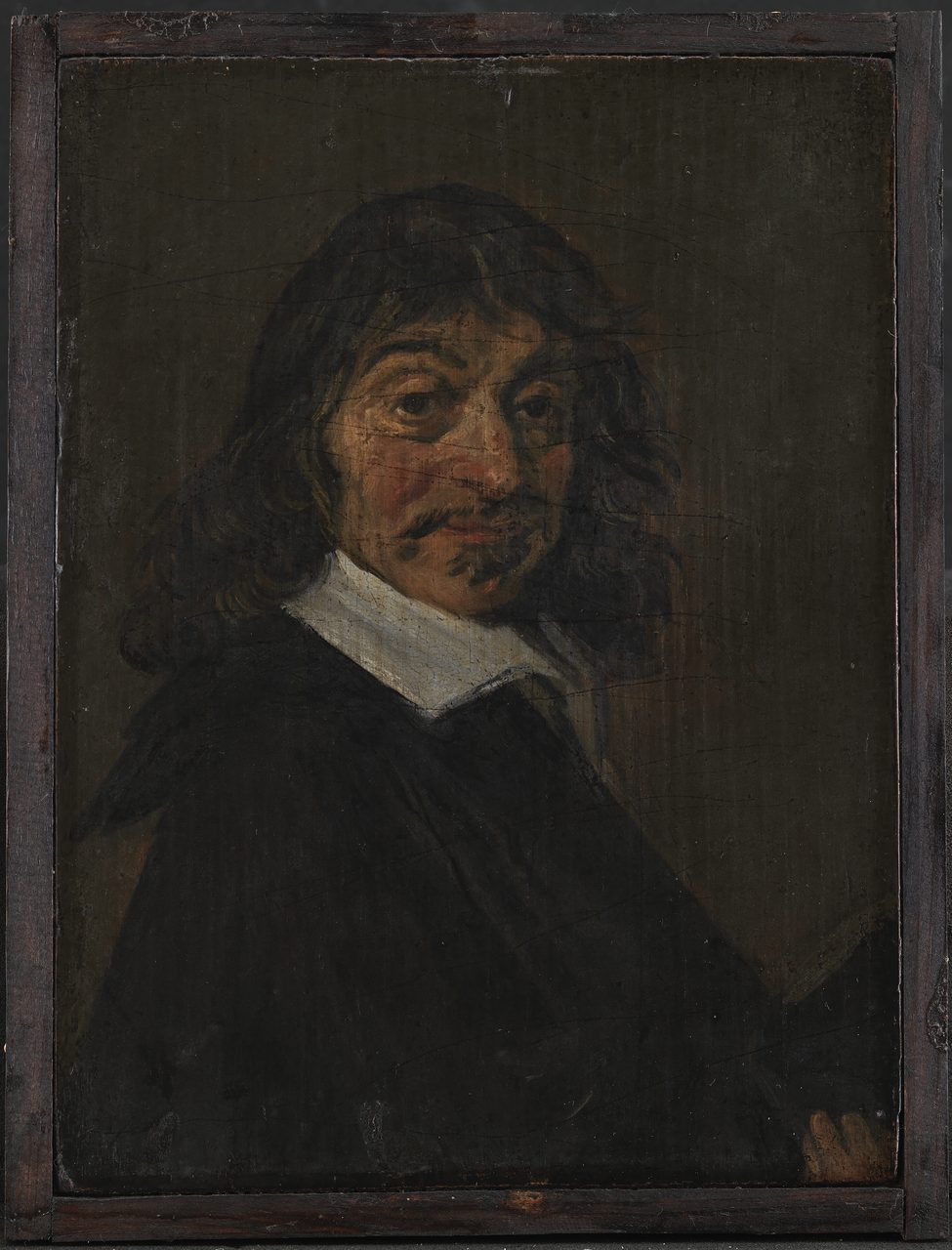
Three books, in order, because the correction in the next section depends on telling them apart. Rene Descartes, 1596 to 1650, published the Discourse on the Method in French, then the Meditations on First Philosophy in Latin, then the Principles of Philosophy. The Stanford Encyclopedia's entry on Descartes' Life and Works, whose author it returns as Kurt Smith, gives the dates independently: the Discourse was "published in 1637", the Meditations was "published in 1641", and of the Principles it says that "in 1644 it was published". The middle one is the book our own file's section on Descartes is about, and it is the book that carries the three waves of doubt and the evil demon. The Cambridge edition of it that our file's bibliography names, translated by John Cottingham with an introductory essay by Bernard Williams, is cited below; its identifier resolves exactly to that edition.
The doubt in the First Meditation is built as a ladder, and each rung takes back something the rung below left standing. Our file gives three waves: the senses sometimes deceive; I cannot tell dreaming from waking; and an all-powerful deceiver could make even my beliefs about mathematics and logic false. The Stanford Encyclopedia's entry on Descartes' Epistemology splits the middle wave into two, which is sharper and is what this article uses. The now dreaming doubt undermines the judgement that I am presently awake. The always dreaming doubt undermines the claim that waking experience comes from external objects at all. Then comes the last rung, in the Cottingham translation as that entry prints it: "I will suppose therefore that not God, who is supremely good and the source of truth, but rather some malicious demon [mauvais genie] of the utmost power and cunning has employed all his energies in order to deceive me." The bracketed French is the source's own interpolation and is reproduced rather than quietly removed. The escalation is the argument. The demon comes last because it reaches the truths that survive dreaming, which is to say arithmetic, and nothing in the First Meditation reaches further than that.
Descartes is not a sceptic, and our file says so plainly, which is the one place it is sharper than the popular literature. It states that he uses scepticism as a tool to overcome scepticism by establishing certain foundations, and that the cogito is the Archimedean point from which knowledge gets rebuilt. Section 01 has the external side of the same point, the encyclopedia quoting him against sceptics who doubt only for the sake of doubting and describing his aim as reaching certainty. The corollary is the thing not to skip. Descartes matters to a history of scepticism not because he was one, but because he built the strongest sceptical hypothesis anyone had built in order to knock it down, and the hypothesis outlived the knocking down. Section 12 is what happened to it.
10The Sentence That Is Not In That Book
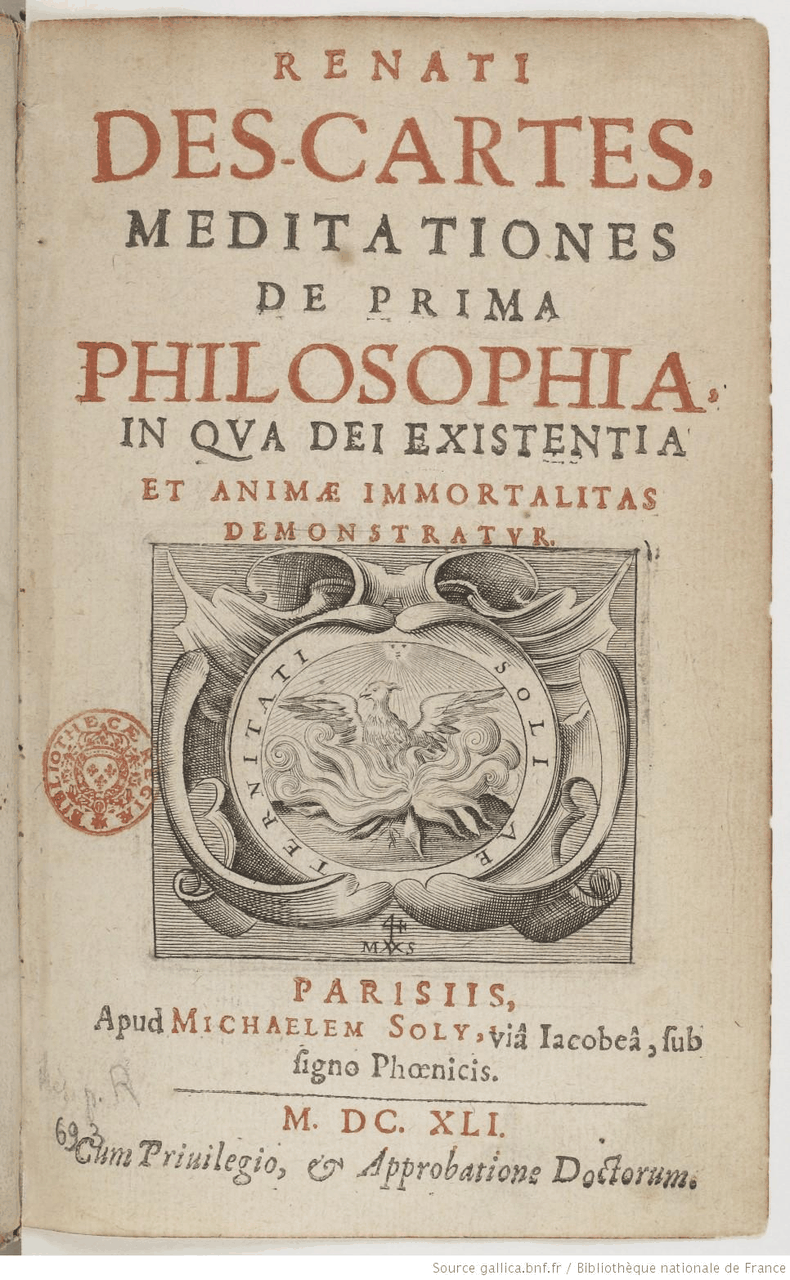
Our own research file attaches the formulation I think, therefore I am to the Meditations of 1641. It does this twice, once in its summary and once under a heading about that book, and it is a document whose header declares itself Tier 1. The Stanford Encyclopedia's entry on Descartes' Epistemology states in terms that the canonical formulation is "a formulation that does not expressly appear in the Meditations". What is in the Meditations, in the Second Meditation, is a different and stranger sentence, which that entry prints in Cottingham's translation: "I am, I exist, is necessarily true whenever it is put forward by me or conceived in my mind." Read what that actually claims. It is not a standing truth that sits there being true; it is true whenever it is put forward, which makes it a claim about an event. The famous form lives in two other books, and both were read for this article in John Veitch's translations at Project Gutenberg. In the Discourse on the Method, Part IV: "as I observed that this truth, I think, therefore I am (COGITO ERGO SUM), was so certain and of such evidence that no ground of doubt, however extravagant, could be alleged by the sceptics capable of shaking it, I concluded that I might, without scruple, accept it as the first principle of the philosophy of which I was in search." And in the Principles of Philosophy, Part I article VII: "Accordingly, the knowledge, I THINK, THEREFORE I AM, is the first and most certain that occurs to one who philosophizes orderly." The capitals in both are Veitch's typography and are reproduced rather than normalised. Two honest limits belong on this page. Veitch's are nineteenth-century English translations hosted by a primary-source archive, not publisher editions and not facsimiles of the French of 1637 or the Latin of 1644, and the quotations are offered on that basis with his name attached each time. And no Latin text was read for this article, so the Latin formulations are reported as formulations here and never printed as quotations.
| Work | Published | What It Carries | Read Here In |
|---|---|---|---|
| Discourse on the Method, Part IV | 1637, in French | The formulation in its familiar form, offered as the first principle of the philosophy being sought | John Veitch's translation, Project Gutenberg |
| Meditations on First Philosophy, Second Meditation | 1641, in Latin | Not the formulation. A different sentence: that I am, I exist is necessarily true whenever it is put forward or conceived | John Cottingham's translation, as quoted by the Stanford Encyclopedia of Philosophy |
| Principles of Philosophy, Part I article VII | 1644 | The formulation again, called the first and most certain knowledge for anyone who philosophizes in order | John Veitch's translation, Project Gutenberg |
It is tempting to file that as a pedantic catch, so here is why it is not. The argument and the slogan are in different books four years apart, and they do different work. The Discourse offers the formulation as a first principle to build on, which is the form that circulates. The Meditations offers something with a time index in it, true whenever it is put forward, which is a claim about the act of thinking rather than about a standing fact, and which is the version that actually survives the demon of section 09. A reader who only knows the slogan has the conclusion without the strange part. Our file's own error is the ordinary one, and it is repeated in a great deal of published writing about Descartes; the reason to correct it on the page rather than quietly is that this article's whole subject is what happens to a claim nobody checks.
11Hume, And The Circle Again
The next argument is not about deception at all. It is about tomorrow. David Hume's problem of induction, as our file states it, is that the inference from what has been observed to what has not cannot be rationally justified: the sun has risen every morning, which does not prove it will rise again, and the assumption that nature is uniform cannot itself be justified without circularity, because the only evidence for it is past experience. The Stanford Encyclopedia's entry on The Problem of Induction locates the argument in A Treatise of Human Nature of 1739, Book 1 part iii section 6, and in An Enquiry concerning Human Understanding of 1748, Section iv, and quotes Hume's own statement of the circle. Such reasoning, he says, must "proceed upon the supposition, that the future will be conformable to the past", and any probable argument for that supposition would involve "taking that for granted, which is the very point in question". At Treatise 1.3.6.4 the entry prints the principle in his own eighteenth-century spelling: "if Reason determin'd us, it would proceed upon that principle that instances, of which we have had no experience, must resemble those, of which we have had experience". Our file names only the Enquiry, and the Treatise passage is the one the literature cites, so both are given here. Notice what has just happened structurally. That is the Agrippan circularity mode, arriving again seventeen centuries later, in a form nobody has answered.
Hume's account of what we do instead is not a justification and he does not offer it as one. Our file puts it as custom and habit: inductive reasoning rests on those rather than on rational demonstration, we cannot help believing the future will resemble the past, and that is a psychological fact about human beings rather than a reason. The encyclopedia supplies his own passage at Enquiry 5.1.8, where the mechanism is named with two examples: "having found, in many instances, that any two kinds of objects, flame and heat, snow and cold, have always been conjoined together; if flame or snow be presented anew to the senses, the mind is carried by custom to expect heat or cold, and to believe". The source emphasises the words custom and believe with bolding and italics; the words are reproduced here and the emphasis is not. Hold the distinction, because it is the shape of this whole article in miniature. Hume is not saying induction is fine because we are built to do it. He is saying the question of whether it is rational was answered no, and that we go on doing it anyway.
That leaves the only livable position this article is going to reach, and our file names it. It distinguishes destructive or excessive scepticism, which paralyses belief and action, from mitigated scepticism: a modesty about the limits of reason, and a willingness to proportion belief to evidence. The file adds that Hume is a practical person who thinks and acts, but does so recognising that certainty is unavailable. One phrase in the file's framing is not carried here. It glosses mitigated scepticism as including an awareness of cognitive biases, which is a modern category and not Hume's, and it is not attributed to him on this page. What can be said is that mitigated scepticism is the position this article can honestly recommend, and also that it is not an answer to the trilemma in section 08 and does not pretend to be. It is a way of living with the trilemma unanswered. The obvious next move after Hume, that the world in itself is permanently sealed off behind the mind's own machinery, is Kant's, and it belongs to an article in this wing that has not been built. This article stops here.
Hume's other scepticisms belong to other articles and one of them is already live. Our file notes his scepticism about causation, that we never perceive a necessary connection between cause and effect but only constant conjunction and habitual expectation, which is the induction argument wearing a different hat and gets no more than this clause here. It also notes his scepticism about personal identity, and that is Personal Identity's subject in this same wing, where the bundle theory of the self is argued properly. Our file prints a short phrase from Hume inside quotation marks in that passage with no source attached; it was not verified for this article and it is therefore not quoted here, even though the neighbouring article may carry it on its own evidence. A quotation licence is not transferable between articles, which is a small rule doing a lot of work on a subject like this one.
12The Demon's Afterlife, And The Vat
Our file makes a claim about what happened to Descartes's demon after Descartes, and it is the bridge from the seventeenth century to the twentieth: the evil demon hypothesis became the template for modern sceptical scenarios. That is a claim about influence, no independent corroboration of it was obtained for this article, and it is carried here as our file's assessment rather than as established intellectual history. What can be stated flatly is narrower and checkable. On another wing of this Athenaeum, Are We Living in a Simulation? reaches for exactly that comparison in its own words, calling the simulation hypothesis effectively unfalsifiable in the way that Descartes's demon is. So the template claim is at least visibly true of one adjacent argument, which is less than our file asserts and more than nothing.
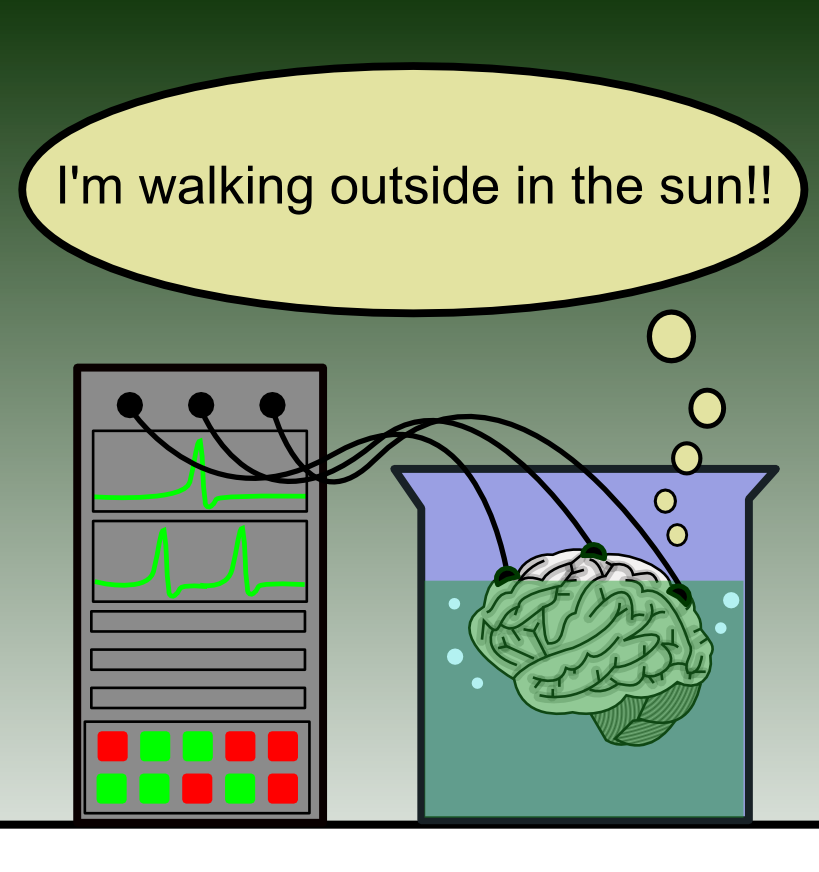
Here is the scenario, and this paragraph does nothing except state it. Imagine a brain in a vat, kept alive and fed artificial sensory input by a computer. Every experience it has is exactly as it would be if it had a body moving through a world. None of those experiences corresponds to anything outside the vat. How could such a brain tell? Our file calls this the modern evil demon and gives it in those terms. The primary locus, which no research file of ours supplies and which was resolved for this article, is Hilary Putnam's chapter Brains in a vat, pages 1 to 21 of Reason, Truth and History, Cambridge University Press, 1981; both the book and the chapter are cited below. Sit with the scenario before reading on, because the next section is about what Putnam actually did with it, and the order matters.
| Descartes's Evil Demon | The Brain In A Vat | |
|---|---|---|
| Where it appears | Meditations on First Philosophy, 1641 | Reason, Truth and History, 1981 |
| Who or what is doing it | An agent, of the utmost power and cunning, who intends to deceive | A mechanism, with no stated intention and possibly no designer at all |
| What is threatened | The truth of my beliefs, mathematics included | The content of my beliefs, meaning what my words are about |
| What its author wanted | Descartes built it in order to defeat it, and believed he had | Putnam attacked it, and philosophers still disagree about whether the attack works |
| Why the difference matters | A theory of reference cannot touch it, because the demon does not depend on what words mean | A theory of reference is exactly what Putnam attacks it with, which is only possible because the threat is semantic |
That table is reasoning rather than a claim from any research file, and it is marked as such. Our file's phrase, the modern evil demon, is a good headline and a slightly misleading equation: three hundred and forty years separate the two, and they do not claim the same thing. One further neighbour has to be named and then left alone. Nick Bostrom's simulation argument is a probabilistic argument concluding a disjunction about ancestor simulations, which is a different kind of argument again from either of these, and it belongs to Are We Living in a Simulation? on another wing, where it is carried in full. Nothing from it is imported here.
13Putnam Was Arguing Against It
Putnam's brain-in-a-vat argument is an attempt to refute the scenario, not a statement of it, and a great deal of retelling has this exactly backwards. Our own file gets it right, which deserves crediting: it labels the passage Putnam's refutation and explains the mechanism correctly. The mechanism runs on a theory about what words refer to. If a speaker has always been a brain in a vat, then that speaker's words brain and vat do not refer to real brains and real vats, because those are not the things the speaker has ever been in contact with; they refer to simulated brains and simulated vats. So when a vat-dweller thinks the thought I am a brain in a vat, the thought is not about brains and vats at all, and on Putnam's account it comes out false. The Stanford Encyclopedia's entry on Content Externalism and Skepticism, whose author it returns as Gary Ebbs, prints his own words at page 15 of the book. In its rendering, with the ellipsis the source itself carries and with the inner quotation marks set as single here so that the nesting reads, where the source has them double: "But part of the hypothesis that we are brains in a vat is that we aren't brains in a vat in the image ... So, if we are brains in a vat, then the sentence, 'We are brains in a vat' says something false". The encyclopedia's own word for the conclusion is self-refuting. Never write that Putnam proposed or invented the scenario, and never write that he argued we might be brains in vats. He argued the reverse, from a theory of reference, and part of the argument's fame is how many people remember it the wrong way round.
Whether the argument works is another matter, and here this article says less than our file does. Our file writes that the refutation is controversial and that many philosophers find it unconvincing. The evidence gathered for this article supports the first half and not the second. The Stanford Encyclopedia entry on Content Externalism and Skepticism, asked directly whether the argument is widely rejected, does not say so; what it records is substantial ongoing philosophical work on how to reconstruct and evaluate it, which is engagement rather than dismissal. Independently, an entire Cambridge volume exists on the question, and Tony Brueckner's chapter Putnam on brains in a vat is cited below. So the honest statement is that the argument is contested and that philosophers continue to disagree about how to reconstruct it. No headcount is offered here, because none was taken. The difference between debated and refuted is the difference this whole article is trying to keep visible.
14Closure, And Whether Anyone Knows They Have Hands
On its own the vat is a curiosity. Bolted to one plausible principle it becomes the central sceptical argument of the last fifty years, and the principle is closure. Our file gives the argument in its knowledge form: if a person knows P, and knows that P implies Q, then that person knows Q. Apply it: a person claims to know they have hands; having hands implies they are not a handless brain in a vat; they do not know they are not a brain in a vat; therefore, by contraposition, they do not know they have hands. The Stanford Encyclopedia's entry on Skepticism gives the same shape formally, but about justification rather than knowledge, writing the principle as "For all propositions p and q, if p entails q, and Jp, then Jq" and the argument as "CP1. If I am justified in believing that h, then I am justified in believing that ~SH. CP2. I am not justified in believing that ~SH. Therefore, I am not justified in believing that h." Knowledge and justification are not interchangeable, and sliding between them mid-argument is the commonest way this gets mangled, so this article runs the knowledge version and names the other rather than blending them.
Our file names three standard responses, and each costs something. Robert Nozick's tracking theory denies closure: knowledge is a matter of a belief tracking the truth, and tracking does not automatically pass along entailment, so a person can know they have hands without knowing they are not a vat-brain. The cost is closure itself, which is about as intuitive as principles get. Contextualism says the standards for the word know shift with context, so in an ordinary conversation a person knows they have hands and in a philosophy seminar they do not, and both are true; Keith DeRose's Solving the Skeptical Problem, in The Philosophical Review in 1995, is cited below as the anchor for it. The cost is a stable meaning for the word know. The third response our file names is pragmatic rejection of the scenario, for which it names no source and none was sought here. One citation note, kept in the open: DeRose's paper resolved exactly and is linked below, and no usable identifier for Nozick's Philosophical Explanations, Harvard University Press, 1981, was obtained, so it is cited by author, title, publisher and year with no link beside it. None of the three has settled the matter, and none of them is presented here as having done so.
One further contemporary line has to be named and then left, and the reason for leaving it is worth stating. Our file's summary lists three contemporary sceptical arguments: the brain in a vat, closure, and the underdetermination of theory by evidence. The first two get their own sections in it. The third gets nothing at all: no section, no explanation, no source. Its own cross-reference index points at a philosophy of science document for that material, and the article built from that document does not exist yet. So underdetermination is named here as a third line of sceptical argument, is placed where it belongs, in the philosophy of science, and is not developed, because this article has nothing to develop it from.
15Doubt About Right And Wrong
The same argument shape reappears in twenty-first-century meta-ethics, and one detail of how it reappears is worth stopping on. Our file defines moral scepticism as doubt about the existence of moral knowledge, moral facts or moral truth, distinguishes it from amoralism, which is simply not caring about morality, and lists three varieties: error theory, non-cognitivism, and moral epistemic scepticism. The Stanford Encyclopedia's entry on Moral Skepticism, by Walter Sinnott-Armstrong, confirms the characterisation of error theory, on which all substantive moral assertions and beliefs are false, or neither true nor false, "if they claim (or semantically presuppose) that moral facts or properties exist". It cites the book behind that position as Mackie, J. L., 1977, Ethics: Inventing Right and Wrong, New York: Penguin; no usable identifier for it was obtained for this article, so it is cited exactly as that entry cites it and the entry is named as the source of the citation. Now the structural point. The entry splits each variety in two: "Dogmatic skepticism about moral knowledge = nobody ever knows that any substantive moral belief is true. Dogmatic skepticism about justified moral belief = nobody is ever justified in holding any substantive moral belief. Pyrrhonian skepticism about moral knowledge withholds assent from both dogmatic skepticism about moral knowledge and its denial. Pyrrhonian skepticism about justified moral belief withholds assent from both dogmatic skepticism about justified moral belief and its denial." That is the distinction from section 01 and section 06, the one between denying and suspending, arriving in contemporary ethics with the ancient names still attached. What follows from any of this for how anyone should actually behave is a different subject and is not argued here.
16Can Anyone Live This Way
The first objection is that the position eats itself. Our file states it fairly: scepticism looks self-refuting, because to say I know that I know nothing is a knowledge claim, and to say no belief is justified is itself a belief requiring justification. And it gives the Pyrrhonist reply, which is sound and which the article has already assembled the parts for. The Pyrrhonist does not assert that nothing can be known. He reports his own state of mind, that he has been unable to decide, and his scepticism is an activity, investigating and suspending, rather than a doctrine. That is the same point as the definition at Outlines of Pyrrhonism I 8: an ability, not a thesis. Our file closes that section by printing a sentence inside quotation marks, attributed to Sextus, to the effect that the sceptic does not dogmatise, not even about the impossibility of dogmatism. No locus is given for it, and it could not be located in any translation consulted for this article, so it is not quoted here and it is not paraphrased as his wording either. The licensed passage at I 8 makes the same point better and comes with its locus attached.
The harder objection is practical and it has a name, the apraxia charge. If judgement is suspended about everything, our file states, action becomes impossible: there is no deciding to eat, and no deciding to step back from a cliff. The standard reply is the fourfold observance of section 05: the Pyrrhonist follows appearances, custom, natural drives and craft expertise, living practically while suspending judgement on theoretical matters, so the charge confuses theoretical commitment with practical engagement. Our file leaves it there, as though the reply closed the question. It does not. This is one of the liveliest questions in the field and it has a canonical title: the chapter Can the sceptic live his scepticism?, in the Cambridge volume Explorations in Ancient and Modern Philosophy of 2012, is cited below, and so is Casey Perin's chapter Scepticism and belief. The chapter record carries no author of its own; the containing volume resolves to M. F. Burnyeat, so it is described here as a chapter in his volume rather than credited to him as a byline this article did not read. Whether the reply works is exactly what the literature is still arguing about, and this page does not settle it.
| As Our Own File Prints It | What Was Found | How It Is Handled Here |
|---|---|---|
| A sentence inside quotation marks attributed to Arcesilaus, to the effect that nothing can be known, not even that | Could not be verified as an Arcesilaus sentence from any edition, translation or scholarly citation consulted for this article. It circulates as a compression of a report in Cicero | The position is stated in section 06. The words are not printed and are not attributed to him |
| A sentence inside quotation marks attributed to Sextus, to the effect that the sceptic does not dogmatise, not even about the impossibility of dogmatism | No locus is given in our file and the sentence could not be located in any translation consulted for this article | Not quoted and not paraphrased as his wording. The definition at Outlines of Pyrrhonism I 8, which carries its locus, is used instead |
| A sentence inside quotation marks about honey appearing sweet rather than being sweet, presented as the sceptic speaking, with capital letters for emphasis | The emphasis capitals are our own file's house style, which is the tell: this is a modern paraphrase in the file's own voice, formatted as a quotation. The underlying passage is at Outlines of Pyrrhonism I 20 and was not read off a primary text for this article | The point is made in this article's own words in section 05, and no version of the sentence appears inside quotation marks |
17What The Arguments Have Been For
Our file makes a case for scepticism's productive role, and the case is good even where the wording needs handling. It says scepticism forced the development of better epistemological theories, naming foundationalism, coherentism, reliabilism and contextualism; that it motivated the scientific method, as empirical testing in response to theoretical uncertainty; and that it remains, in the file's own words, the most powerful tool for testing the foundations of knowledge. That last phrase is our file's superlative, no external source was found for it, and it is attributed here rather than adopted. The stronger version of the same point does not need a superlative at all, and section 08 already built it. Three of the four theories our file names are the three horns of the Agrippan trilemma with modern arguments attached: foundationalism takes the arbitrary stop and defends it, coherentism takes the circle and defends it, contextualism changes what the word know is asking for. The theories exist in the shape they do because of the argument they are answering.
The most honest sentence in our file sits right beside that one, and it pulls the other way. Scepticism, it says, has never been a popular position, and few philosophers are consistent sceptics. Independent support for the substance, though not for any count, comes from the Stanford Encyclopedia's entry on Skepticism, which notes that contemporary philosophers find Pyrrhonian scepticism interesting "not because they take seriously the possibility of its truth, but rather because there are interesting arguments in its favor". That adds a reason to the observation: the arguments are studied by people who do not hold the position. What is not said here, in either direction, is a number. Nobody in the research behind this article counted philosophers, so this page says that scepticism has few adherents and that its arguments are worked on by people who reject its conclusion, and it does not say almost none, or nobody today, or give a figure.
No, this is not a settled field with no active dispute, and our own research file says that it is. Its closing block asserts that no significant counter-arguments exist in the scholarly literature for the core claims in the document, and that the material represents established philosophical consensus with no active scholarly dispute over the fundamental claims presented. Section 8 of that same document is titled Counter-Arguments and Critical Assessment and runs three of them. Beyond its own internal contradiction, this article has documented live disputes on five separate points: whether Pyrrho's position was metaphysical or epistemological, when Sextus lived, when Agrippa lived, on which two entries of the same encyclopedia disagree with each other, whether Putnam's argument works, and whether the sceptic can live his scepticism. That closing block is boilerplate, it is false on the document's own evidence, and nothing in this article's verdict rests on it.
Fast Facts
- The Word
- Skepsis means investigation. On the ancient terms a sceptic is not someone who has concluded that knowledge is impossible, because that conclusion would itself be a claim needing justification
- The Two Projects
- Pyrrhonian suspension aims at tranquillity and is a settled condition reached by exhausting the arguments. Cartesian doubt is a deliberate temporary instrument aimed at certainty. Sextus doubts in order to stop; Descartes doubts in order to start
- Pyrrho
- Wrote nothing. What is attributed to him comes through his student Timon and, much later, through Sextus. His dates are approximate in every source, and whether his central claim was metaphysical or epistemological is an open interpretive question
- Sextus Empiricus
- The only complete surviving account of ancient scepticism runs through one author whose century is not settled: the reference literature places him probably in the second or third century CE, with best estimates spanning roughly a hundred and fifty years
- The Definition
- Scepticism as an ability rather than a doctrine, at Outlines of Pyrrhonism I 8: set out oppositions, find them equal in weight, suspend judgement, and tranquillity follows. It follows as a shadow follows a body, which means it cannot be pursued directly
- Agrippa
- Five modes, of which three combine into the trilemma. The date of the man is genuinely disputed: two entries of the same reference work place him in different centuries and different eras, and this article carries both
- The Trilemma
- Any justification runs into infinite regress, an arbitrary stopping point, or a circle. Foundationalism, coherentism and infinitism each accept one of the three horns and pay for it. That is a distribution across the argument, not a solution to it
- The Cogito
- The formulation I think, therefore I am does not expressly appear in the Meditations. It is in the Discourse Part IV of 1637 and the Principles Part I article VII of 1644, both read here in John Veitch's translations. The Second Meditation carries a different sentence
- Hume
- Induction cannot be justified without using induction, which is the Agrippan circle arriving seventeen centuries later. Custom and habit explain what we do; they do not justify it
- The Vat
- Putnam's brain-in-a-vat argument is an attempt to refute the scenario, not a statement of it. It is contested, and philosophers continue to disagree about how to reconstruct it
- The Quotation Problem
- Every passage quoted here names its work and its locus and its translator, or else names the reference work that printed it. Three sentences our own research file prints inside quotation marks are refused in section 16, with the reason for each. No Latin is quoted anywhere, because no Latin edition was read for this article
- Where The Tiers Came From
- Our own research file assigns no tier to anything, and its header and its source-tier block contradict each other. Every tier on this page was assigned for this article under the rule stated at the top, and none is presented as the file's
- Not Established
- That radical scepticism has been refuted; that it has been shown livable or true; that suspension of judgement in fact produces tranquillity; or that anyone has actually lived this way
What Can Actually Be Stood Behind
What the texts say, and where they say it, is checkable and is stated flatly here. Sextus defines scepticism at Outlines of Pyrrhonism I 8 as an ability to set out oppositions, producing equipollence, then suspension of judgement, then tranquillity; the shadow simile is at I 29 and the fourfold observance at I 24; all three are quoted in the Annas and Barnes translation and all three carry their loci. Pyrrho wrote nothing and reaches us through Timon and Sextus. Descartes published the Discourse in 1637, the Meditations in 1641 and the Principles in 1644, and the First Meditation escalates through the deceiving senses, the now dreaming doubt, the always dreaming doubt and the evil demon. The formulation I think, therefore I am does not expressly appear in the Meditations; it is in the Discourse Part IV and the Principles Part I article VII, both read here in John Veitch's translations, and the Second Meditation carries instead a sentence about a truth that holds whenever it is put forward. Hume's problem of induction sits at Treatise 1.3.6.4 and at Enquiry Section iv, with custom and habit at Enquiry 5.1.8. Putnam's argument is at pages 1 to 21 of Reason, Truth and History, and it argues against the scenario. Every quotation on this page names its translator or its reference work, and no Latin is quoted anywhere, because none was read.
The disputes here are real and unresolved, and several of them are about the most basic facts. Sextus's dates are not known: the reference literature places him probably in the second or third century CE with best estimates spanning about a hundred and fifty years, and our own file's much narrower window is not supported by its own bibliography. Agrippa's date is worse, because two entries of the same encyclopedia disagree with each other about his century and his era, and this article prints both rather than choosing. Whether the Academics really were dogmatists about the impossibility of knowledge is a live question, and the reference entry consulted for this article draws the Academic and Pyrrhonian line somewhere other than where our file draws it. Whether Putnam's argument succeeds is contested, with continuing work on how to reconstruct it and a Cambridge volume on the question; no headcount of philosophers appears here, in either direction, because none was taken. Whether a sceptic can live his scepticism is one of the liveliest questions in the field and carries a canonical literature. And our file's claim that the evil demon became the template for modern sceptical scenarios is an influence claim carried as its assessment, not as established history.
Three things on this page stay where they are. The story that Pyrrho travelled to India with Alexander's army and was shaped by the gymnosophists is told once, with the source's own hedges kept: allegedly, we are told, and it is not clear what basis, if any, the ancient report rests on. It is a good story and it does not explain where Pyrrhonism came from. The second name for the Agrippan trilemma is a twentieth-century coinage whose author and date could not be established for this article, so nobody is credited with it and no year is attached. And the underdetermination of theory by evidence is named as a third contemporary line of sceptical argument and deliberately not developed, because our own file names it once in its summary and then supplies nothing at all to develop it from.
No, the sceptic has not been answered, and this article does not end with a win. Putnam's argument against the vat is contested and philosophers still disagree about how to reconstruct it. The Agrippan trilemma is answered only by accepting one of its three horns, and every school that accepts one acknowledges what it costs: foundationalism takes the arbitrary stop, coherentism takes the circle, infinitism takes the regress. Contextualism dissolves the closure argument by making the word know context-sensitive, which is a price rather than a refutation. Nozick's tracking theory buys the same result by giving up closure. The reference entry on Skepticism consulted for this article does not claim the position has been refuted, and neither does this page. The honest statement is that the strongest sceptical arguments are about two thousand years old, that every response to them costs something, and that the disagreement about which cost to pay is a large part of the field.
No, and equally: radical scepticism has not been shown to be livable or true, and an article that admires its subject is exactly the article that forgets to say so. Four things in particular this page cannot support and does not assert. That the Pyrrhonist reply to the apraxia charge succeeds; it is an open scholarly question with a canonical literature and is carried here as one. That Pyrrho's own position was epistemological rather than metaphysical, which the tradition would need in order to be consistent from its founder onward, and which the reference literature treats as unresolved. That suspension of judgement in fact produces tranquillity; that is an empirical claim about human psychology, made in antiquity, reported by one surviving author, and nothing here tests it. And that anyone has lived this way; nobody in the research behind this article is recorded as having done so, and our own file says few philosophers are consistent sceptics. The shape of the honest ending is both halves at once: an argument nobody has refuted, and a way of life nobody has demonstrated.
No, there is no consensus here with no active dispute, and the sentence claiming otherwise is in our own research file. Its closing boilerplate asserts that no significant counter-arguments exist in the scholarly literature for the document's core claims, in a document whose own section 8 is titled Counter-Arguments and Critical Assessment and runs three of them. Nothing in this verdict rests on that block, nothing on this page cites it, and the five live disputes listed at Tier 2 above are the reason. A file that declares its own subject closed is the one claim on this page that its own contents refute.
The oldest arguments in this article were made by people who wanted to stop arguing. Suspension of judgement, on Sextus's account, is not a conclusion but the condition left over when the arguments come out even, and the peace that follows cannot be aimed at, because aiming is already a commitment. Two thousand years later the same structure turns up in a seminar about whether anyone knows they have hands, and the responses on offer are not refutations so much as decisions about which price to pay: give up closure, or give up a stable meaning for the word know, or plant a foot somewhere and admit the spot was chosen. Descartes thought he had found the one place where the ground was not sand. He found it in a book that does not contain the sentence he is remembered for, and the demon he built to be defeated is still walking around in other people's arguments. What would settle any of this is not obvious, and that is not a rhetorical flourish; nobody in the literature consulted for this article claims to have settled it, and several of them say plainly that they have not. What is left is a question worth carrying rather than closing: if every justification anyone can offer ends in a regress, a circle or a stopping point somebody chose, what exactly is a person doing when they say they know something?
Sources & further reading
One research file in our own library stands behind this article, P_3_10. It is where the work started; the records below are where the work can be checked, and twenty-four of the twenty-five entries are external. Four limits belong on the record rather than being left to be discovered. First, the tiers. That file assigns no tier to any section, subsection, table row or bullet, and its header and its source-tier block contradict each other, so every tier on this page was assigned for this article under the rule printed at the top and none is presented as the file's. Second, the quotations. Every passage inside quotation marks above names its work, its locus and its translator, or else names the reference work that printed it; three sentences the file prints inside quotation marks with no source are refused in section 16 with a reason each; and no Latin appears in quotation marks anywhere, because no Latin edition was read for this article. Julia Annas and Jonathan Barnes's translation of Sextus, Cambridge University Press, 2000, stands behind three quotations and has no entry below because no identifier for it could be obtained; it is named in full at every quotation instead. The same applies to Robert Nozick's Philosophical Explanations, Harvard University Press, 1981, and to J. L. Mackie's Ethics: Inventing Right and Wrong, Penguin, 1977, which is cited exactly as the Stanford Encyclopedia entry on Moral Skepticism cites it. Third, the identifiers. One identifier printed in our own file's bibliography, attached to Putnam's Reason, Truth and History, resolves to a 1984 review of that book rather than to the book, and it is not reproduced here; the correct identifier for the book was found separately and is below. Every identifier below was resolved live against CrossRef on 2026-08-07 and the returned title read against the claim it is attached to. Fourth, the encyclopedia entries are cited by title, URL and their own stated dates, and an author is named only where the entry itself returned one, which was true of four of the nine.
Image credits
- The Agrippan Trilemma, an original diagram Original diagram by Theories of Anything. CC BY-SA 4.0 Source.
- Card crop of the Agrippan Trilemma diagram Original diagram by Theories of Anything. CC BY-SA 4.0 Source.
- Title page of Descartes, Meditationes de prima philosophia, dated 1641, scanned from Gallica Bibliotheque nationale de France (Gallica), via Wikimedia Commons. Public Domain Source.
- Imaginary engraved portrait of Pyrrho of Elis, from Olgiati's volume of philosopher effigies, 1580 Girolamo Olgiati, from Illustrium philosophorum et sapientum effigies ab eorum numistatibus extractae, 1580, via Wikimedia Commons. Public Domain Source.
- Engraving of a coin or medal that depicts Sextus Empiricus, plate published 1801 Gottlieb Friedrich Riedel, from Georg Wilhelm Zapf, Gallerie der alten Griechen und Roemer, Stuttgart 1781 to 1783, reissued Augsburg 1801 by Christoph Friedrich Buerglen, via Wikimedia Commons. Public Domain Source.
- Painted portrait of Rene Descartes, Statens Museum for Kunst, Copenhagen, accession DEP7 Frans Hals, Statens Museum for Kunst, Copenhagen, DEP7, via Wikimedia Commons. Public Domain Source.
- Schematic diagram of the brain-in-a-vat thought experiment Wikimedia Commons user was a bee, incorporating brain vector data by Wikimedia Commons user grm_wnr, via Wikimedia Commons. Public Domain Source.


.png)