
The Singularity: The Day the Curve Goes Vertical
The claim in the title is not this page's. It belongs to an argument that runs from one sentence written by I. J. Good in 1965, through Vernor Vinge, who named it and gave it thirty years from 1993, a clock that ran out in 2023 while the window he attached to it in the same paper runs to 2030, to Ray Kurzweil, who put two dates on it and restated them in 2024. The argument has a genuine structure and serious defenders with published, falsifiable claims. It also has a peer-reviewed critical literature that our own research file says does not exist, and it runs on a mechanism, recursive self-improvement, that our own framework file grades Speculative and records as never demonstrated, even in limited form. Both halves are here at full strength, and this page crowns nobody.
The title of this page is somebody else's claim, and this page does not make it. The argument behind it fits in a paragraph. Machines have been improving at a rate that has held for decades. Designing machines is itself an intellectual task. So a machine that beats us at intellectual tasks would beat us at designing machines, and the machine it designed would be better still, and the interval between improvements would shrink toward nothing. That is the intelligence explosion, and everything else in this subject is that sentence plus assumptions. It is not a measurement. It is an inference, and every link in it can be doubted separately. What follows sorts the parts of the subject that have been measured from the parts that have been argued, keeps a tier on both, and leaves the argument where it honestly stands, which is open.
This page also departs from its own research file repeatedly, and every departure is disclosed on the claim it belongs to. Two of them are structural rather than factual. Our file never states the mechanism the whole argument runs on, and our file says that no significant counter-arguments to it exist in the scholarly literature, which is untrue and which our own cross-referenced framework file refutes by naming four critics. Both gaps are filled below rather than repeated.
01One Sentence, In 1965
The subject has a clean origin, which is rare. It begins with one man, one paper, and a line of reasoning short enough to quote whole.
The intelligence explosion was first stated formally by the British mathematician and Bletchley Park cryptanalyst I. J. Good in 1965, in a paper called Speculations Concerning the First Ultraintelligent Machine. The founding passage is short enough to carry whole, and it is carried whole here because it is almost never quoted that way: 'Let an ultraintelligent machine be defined as a machine that can far surpass all the intellectual activities of any man however clever. Since the design of machines is one of these intellectual activities, an ultraintelligent machine could design even better machines; there would then unquestionably be an "intelligence explosion", and the intelligence of man would be left far behind. Thus the first ultraintelligent machine is the last invention that man need ever make, provided that the machine is docile enough to tell us how to keep it under control.' The inner quotation marks around intelligence explosion are Good's own: he was naming the thing as he wrote it. Two parts of that passage are routinely dropped and our own framework file drops one of them, quoting Good as stopping at the explosion and losing the clause about the intelligence of man being left far behind. The other is the proviso at the end, which matters here more than it looks, because the worry usually told as Good's later change of heart is already written into the founding sentence as a condition on it. A note on the tier, because our own library is not of one mind. Our framework file grades this claim at its highest confidence level and our file on artificial general intelligence grades the same claim one step lower. Neither notes that the other exists. This page carries the more conservative of the two.
Good did not hold the position he is famous for. The 1965 paper, which hyphenates the word in that sentence, says that 'the survival of man depends on the early construction of an ultra-intelligent machine'. In an unpublished statement written around 1998, most widely reproduced in the preface to James Barrat's book Our Final Invention, he revised it: he suspected that survival should be replaced by extinction, reasoning that international competition would make it impossible to prevent the machines from taking over. This appears in none of our research files. It was verified here through reporting of Barrat's reproduction rather than against Barrat's own text, so it should be read as a statement quoted by Barrat and not as a published paper by Good. It is still worth the paragraph, and it is not quite the conversion it is usually told as. The man who wrote the founding sentence spent his last years thinking he had got its sign wrong, and the founding sentence itself had already made its optimism conditional on keeping the machine under control.
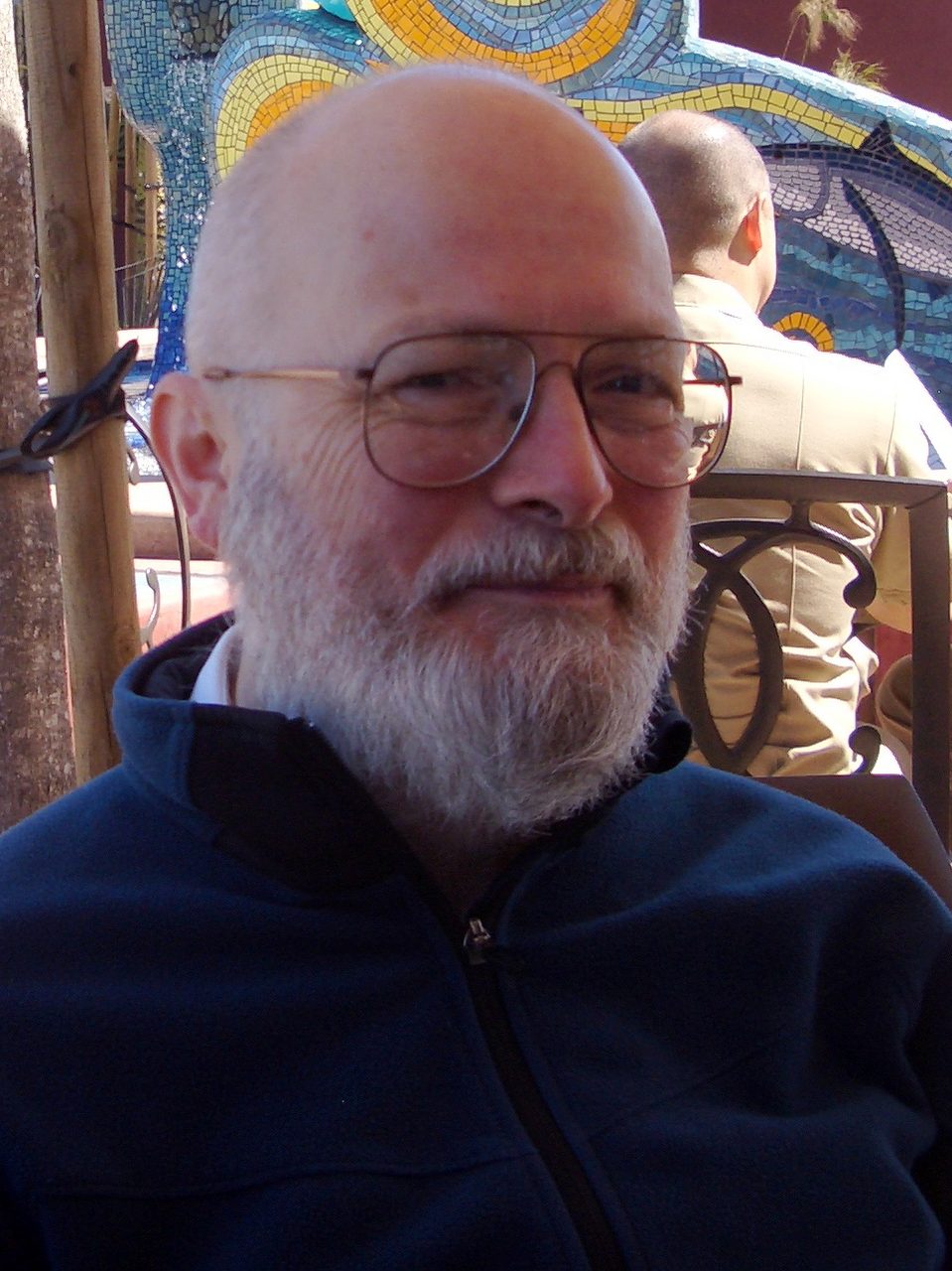
Vernor Vinge, a mathematician and science fiction writer, gave the idea its modern name and its first hard deadline, in a paper written for the VISION-21 Symposium sponsored by NASA Lewis Research Center and the Ohio Aerospace Institute on 30 and 31 March 1993. He wrote: 'Within thirty years, we will have the technological means to create superhuman intelligence. Shortly after, the human era will be ended.' Our file stops there. His own text does not. In the same paper he gives the claim a window and attaches a falsifier to it: 'I'll be surprised if this event occurs before 2005 or after 2030.' That sentence does not narrow the thirty years, it stretches the far end of them by seven, and it is absent from our file. It makes him a more careful forecaster than his reputation allows, and it means the fair way to judge the prediction is against the tolerance he stated rather than against the round number.
Vinge also did not argue only for machine intelligence. He listed four routes to a superhuman mind, in his own words: 'The development of computers that are awake and superhumanly intelligent'; 'Large computer networks (and their associated users) may wake up as a superhumanly intelligent entity'; 'Computer/human interfaces may become so intimate that users may reasonably be considered superhumanly intelligent'; and 'Biological science may find ways to improve upon the natural human intellect.' The quotation marks around awake and wake up are his own. The third route is the human-machine merger, which is the band this page sits in. Vinge treated the merger and the machine as alternative roads to the same event. Kurzweil later fused them into a single story.
Thirty years from 1993 is 2023. No superhuman intelligence existed then and none exists now. That is true and this page says it, but the round number is not the whole of what he claimed, and it would be having it both ways to credit him for attaching a falsifier and then judge him by the figure he attached it to. The window in the same paper runs to 2030, so by the falsifier Vinge set himself the prediction has not failed yet. Our own framework file is not consistent about this. It gives the deadline as about 2023 in one section and as before 2030 in two others, and it lists Vinge among predictions that have passed without realization while printing 2030 as his date. Vinge himself died on 20 March 2024, aged 79, at a care facility in La Jolla, California, of complications of Parkinson's disease, and his death was announced by the writer David Brin. The death and its date are external to our corpus. The first hard deadline in this subject's history came and went inside living memory, and the man who set it did not live to see whether his own wider window would hold.
Ray Kurzweil is the reason the subject has a date attached to it. In his own words he set 'the date for the Singularity', which he describes as 'representing a profound and disruptive transformation in human capability', 'as 2045.' And: 'The nonbiological intelligence created in that year will be one billion times more powerful than all human intelligence today.' The first sentence is given in three fragments rather than whole because his punctuation uses dashes, which this site's style does not carry; every fragment is his. Our file paraphrases the second sentence, so his own wording is used instead. The date is his. It is not this page's.
He gives two dates, not one, and they are constantly conflated. 2029 is his date for human-level machine intelligence. 2045 is his date for the Singularity, which he defines as the merger of human and machine intelligence rather than as the arrival of a smarter machine. Our framework file records a third milestone, full brain emulation by the 2040s. Our primary file does not distinguish 2029 from 2045 at all, and the distinction is load-bearing for anybody trying to be fair to him: a reader who thinks 2045 is his date for artificial general intelligence is judging him by the wrong clock. His date for that is 2029, which is inside this decade and close enough to check.
He has not gone quiet, and our file does not know it. Kurzweil published a sequel, The Singularity Is Nearer: When We Merge with AI, on 25 June 2024, restating both dates: human-level artificial intelligence by 2029 and the merger in 2045. In the sequel he defines the Singularity as the human neocortex extending into the cloud, and he has said that 2029 now looks pessimistic to him, a remark carried here from secondary reporting rather than from the book itself. Our primary research file's own last-updated stamp is 27 February 2026, twenty months after that book, and it discusses his argument entirely through the 2005 edition.
02The Step Our Own File Leaves Out
Everything above is history. The argument itself is a mechanism, and it is worth stating plainly before anybody argues about it, because our primary research file never states it. That file is titled and keyworded for the intelligence explosion. Its own cross-reference index says the intelligence explosion is the Singularity. It then runs from exponential hardware trends straight to Kurzweil's date without ever naming the step in between.
The mechanism is recursive self-improvement: a system rewrites its own design to become more capable, and the more capable version does it again, faster. Our framework file records that Yudkowsky formalised this in 2008 as seed artificial intelligence theory, files it at Tier 3, Speculative, and states flatly that no current system, large language models included, has demonstrated the ability to meaningfully improve its own architecture. Nothing has done it, even in limited form. That is the honest grade and this page carries it exactly as our framework file assigns it.
The formal restatement most readers meet is Nick Bostrom's, in Superintelligence in 2014, and it is four steps: build human-level artificial intelligence; the system improves its own design, being better at that than its designers were; the improved system is better still at improving itself; repeat. Our framework file records that the book catalysed the AI safety field and influenced OpenAI, DeepMind's safety team and MIRI. It is used here only for the shape of the curve. What such a system would want, and whether it could be controlled, belong to The Alignment Problem, which carries that whole question at length.
The most careful version is David Chalmers's, published in the Journal of Consciousness Studies in 2010, and it is the version worth arguing against because it names its own weak joint. He sets it out as a numbered argument, in his own words: '1. There will be AI (before long, absent defeaters). 2. If there is AI, there will be AI+ (soon after, absent defeaters). 3. If there is AI+, there will be AI++ (soon after, absent defeaters). 4. There will be AI++ (before too long, absent defeaters).' The first three lines are the premises and the fourth is the conclusion, set off in the original by an inference bar this page does not reproduce. AI here means human-level artificial intelligence, AI+ means greater than human level, AI++ means far greater. Notice the shape, because it decides where an objection has to land. The first premise is a flat assertion with no antecedent; only the second and third are conditionals. All three carry the same explicit escape clause, absent defeaters, but the first is the one an objector can simply deny, and it is the one most of the objections below go for. The step from AI+ to AI++ rests on what he names the proportionality thesis, again in his own words: 'it holds that increases in intelligence (or increases of a certain sort) always lead to proportionate increases in the capacity to design intelligent systems.' The word always is his. So is the doubt: he writes in the same passage that 'Perhaps the most promising way for an opponent to resist is to suggest that this thesis may fail', and that 'One might reasonably doubt that the proportionality thesis will hold across all possible systems and all the way to infinity.' The most careful formal statement of the argument arrives with its own falsifier attached by the person making it. None of this appears in any of our research files.
Put the two together and the structure of the subject becomes visible. Kurzweil's 2045 sits at Tier 2 in our own file, Credible. The mechanism that date depends on sits at Tier 3 in our framework file, Speculative, with the note that nothing has ever performed it. A Tier 2 date resting on a Tier 3 mechanism is not incoherent and it is not a scandal. It is the shape of the thing, and a reader is entitled to see it before deciding what to make of the number.
03The Curve Underneath
The argument's empirical floor is the growth record: the observation that one class of technology has improved at a compounding rate for a long time. That record is real, it is measured rather than argued, and five of the numbers our own file uses to state it are wrong or out of date. The errors do not all run the same way: some make the argument look better and some make it look worse, which suggests carelessness rather than a thumb on the scale.
Our file says that Moore's Law of 1965 predicted a doubling of transistor density roughly every two years. The 1965 paper did not say that. In Cramming more components onto integrated circuits, published in Electronics, Gordon Moore projected a doubling of components per chip roughly every twelve months, forecasting about 65,000 components per chip by 1975. He revised the rate to a doubling every two years at the IEEE International Electron Devices Meeting in 1975. The familiar two-year figure is the revision, not the prediction. The correction is small and it matters here, because attaching the revised rate to the original paper quietly makes the law look more prescient than it was, inside an article about whether extrapolations hold.
The counts themselves have moved a long way past our file, which gives Apple's M3 at 25 billion transistors as the modern figure. That is correct for that chip and three product generations old. Apple's own newsroom announcement of 5 March 2025 states that the M3 Ultra integrates 184 billion transistors. NVIDIA's own newsroom announcement of its Blackwell architecture in March 2024 states that Blackwell graphics processors are packed with 208 billion transistors, on a custom TSMC 4NP process, with two reticle-limit dies joined by a link running at 10 terabytes per second. The interesting part is not the size of the number. It is that the number is now bought by joining two dies together, which is a packaging trick rather than a lithography one. That is what a curve held up by other means looks like.
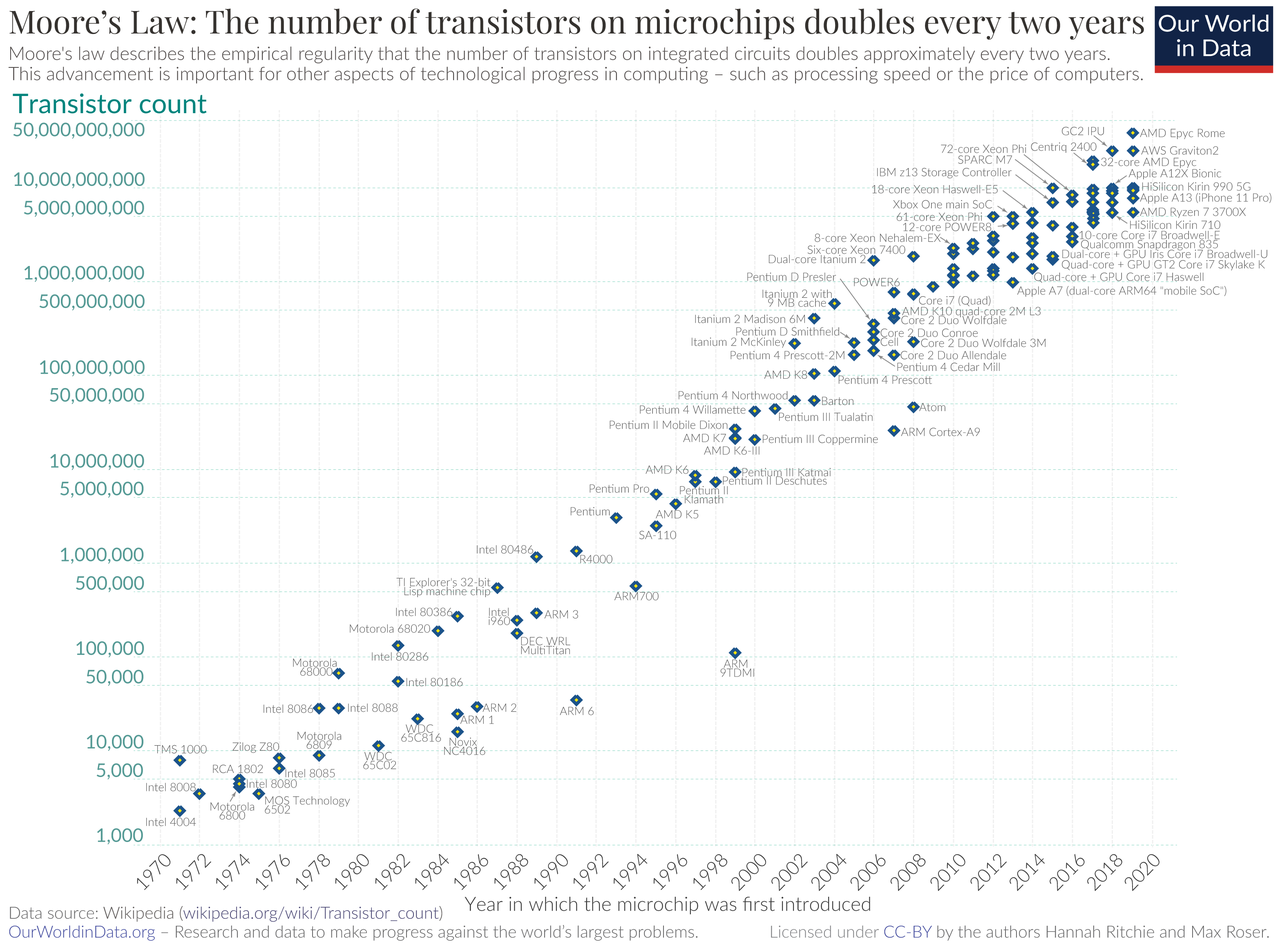
Our file says so itself, in a caveat it labels empirically important. Moore's Law is slowing at the transistor level because of quantum tunnelling limits, with gates approaching roughly 2 nanometres. The file then adds, hedged, that new paradigms, three-dimensional stacking, chiplets, neuromorphic designs, optical computing and quantum computing, may continue the broader trend. May is the operative word and it stays. Whether the paradigm shifts arrive on schedule is the entire question, and nothing in the record establishes that they will.
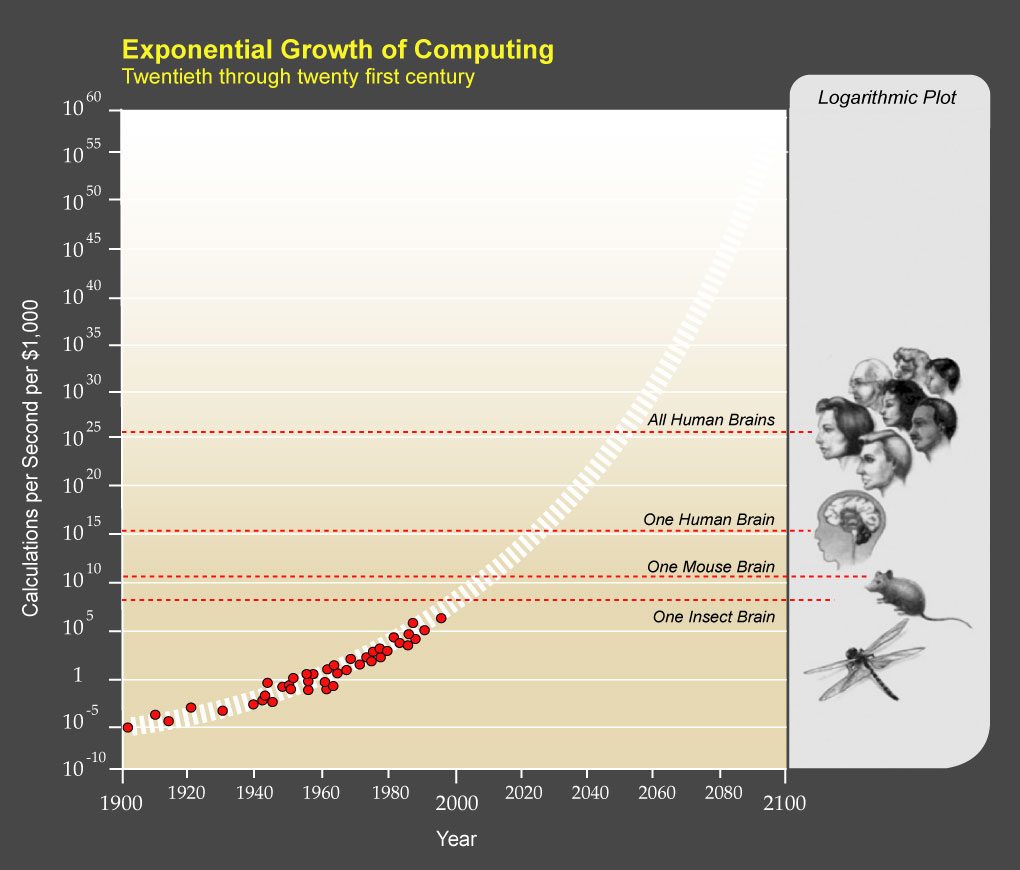
Kurzweil's generalisation from that record is the Law of Accelerating Returns: that exponential improvement is not confined to transistors but is a property of information technology as a class, that the rate of exponential growth itself increases, a double exponential, and that the trend runs backwards through pre-transistor computing paradigms and will run forwards through post-silicon ones. Our primary file files this alongside the raw measurements, at its highest confidence grade. Our framework file files it one grade lower and draws the line explicitly: the raw computational observation is verified, the extrapolation to intelligence is debated. This page uses the framework file's split, because it is the honest one. The measured price-performance trend is the verified half. The law generalising it is the credible and contested half. It is also worth knowing that the strongest independent long-run measurement of that trend was not made by anybody arguing about the singularity: the economist Nordhaus reconstructed two centuries of computing price-performance in the Journal of Economic History in 2007.
Our file's sequencing figure is a clear case of a real curve inflated by a comparison that should not be drawn. It gives the cost of sequencing a human genome as falling from $3 billion for the Human Genome Project in 2003 to $200 in 2024, a 15-million-fold decrease. The arithmetic is consistent and the comparison is invalid. The National Human Genome Research Institute's own fact sheet gives the US contribution to the project as approximately $2.7 billion over about thirteen years, and states in its own words that the figure 'represents the total U.S. funding for a wide range of scientific activities under the HGP's umbrella beyond human genome sequencing, including technology development, physical and genetic mapping, model organism genome mapping and sequencing, bioethics research, and program management.' Its separate cost-per-genome page adds that even its own per-genome figures exclude quality control, bioinformatics, project management and downstream analysis. Our file divides a whole research programme's budget by one commercial price point. The institute also supplies the number our file should have used, on the same fact sheet. Its estimate for what the project's actual human genome sequencing cost is, in its own words, 'at least $500 million' at the lower bound and 'as high as $1 billion' at the upper, with its own note on the range: 'The truth is likely somewhere in between.' It breaks that into about $300 million worldwide to generate the initial draft sequence, of which NIH provided roughly 50 to 60 percent, and about $150 million worldwide to carry the draft to a finished sequence. Those are worldwide figures, which is exactly why a total of US funding was never the right numerator, and they are between three and six times smaller than the $2.7 billion our file's ratio starts from, which makes the true ratio smaller again. The sequencing curve is genuinely one of the most spectacular of the last twenty years and it does not need the help. No current per-genome dollar figure is printed here, because the institute's live pages carry the current numbers only inside a downloadable spreadsheet.
The ImageNet correction runs the other way. Our file dates human-level performance on the ImageNet Large Scale Visual Recognition Challenge to 2021. The human benchmark on that challenge, established by Russakovsky and colleagues, is roughly 5 percent top-5 error, and it was passed in 2015: the winning entry that year reached about 3.6 percent, and a result in February 2015 had already claimed to cross the human figure. The 2011 winner was around 26 percent, and the 2012 entry that started the deep learning era was around 15 to 16 percent depending on the evaluation used. The shape is a fall from the mid-twenties to the low single digits inside four years. No precise figure for 2021 is given here, because none could be sourced for this page and the year-by-year percentages vary by a point or so between compilations depending on the protocol. Our file's error is six years late, which means it understates the very pace it is arguing for.
Under the dates sits an arithmetic worth seeing in full, because it is where the quantitative edifice touches the ground. Kurzweil's estimate of the brain's raw capacity, in his own published wording from his 2001 essay The Law of Accelerating Returns: 'Human Brain = 100 Billion (10^11) neurons * 1000 (10^3) Connections/Neuron * 200 (2 * 10^2) Calculations Per Second Per Connection = 2 * 10^16 Calculations Per Second.' That is three numbers multiplied together, all three of them round, and the fourth is what they come to. It is not a measurement, and he does not present it as one. Order-of-magnitude estimates are a legitimate instrument and this is a legitimate use of one. It is worth knowing how much weight this particular envelope carries.
Our file states that by 2045, one thousand dollars of computing will equal 10^26 calculations per second. The figure is real and it is his, and his own text attaches it to a different year. In The Law of Accelerating Returns he writes: 'We achieve one Human Brain capability (2 * 10^16 cps) for $1,000 around the year 2023' and 'We achieve one Human Race capability (2 * 10^26 cps) for $1,000 around the year 2049.' In the singularity question-and-answer on his own site he writes that by 2020, ten quadrillion calculations per second will be available for around a thousand dollars. So the human-race figure belongs to about 2049 in his 2001 essay rather than to 2045, and his own brain-equivalent date moves between 2023 and 2020 across two of his own documents. Part of that movement is not drift at all: ten quadrillion is 10^16, half of the 2 x 10^16 he elsewhere calls one brain, so the earlier date is attached to a smaller target. The rest of it is drift. Neither is offered as a gotcha. It is how forecasts of this kind are maintained, and a reader weighing a date is entitled to know that the dates move. One thing should be said here rather than left for the section that scores Vinge: both of those Kurzweil dates, 2020 and 2023, have now come due, and this page does not score them in either direction, because it carries no verified figure for what a thousand dollars of computing buys today.
One trend gets exactly one sentence here, on purpose. Training compute for the largest AI systems has been doubling on a timescale of months rather than years, far faster than Moore's Law, and the measurements behind that claim, together with the warning that two separate measurements are routinely quoted as though they were one, belong to The Alignment Problem.
| The Claim, As Our Research File States It | What The Sources Give |
|---|---|
| Moore's Law (1965): transistor density doubles roughly every 2 years | The 1965 paper projected roughly annual doubling, and about 65,000 components per chip by 1975. The two-year rate is Moore's own 1975 revision. |
| Modern chips: 10 billion-plus transistors, Apple M3 at 25 billion | Correct for the M3, and three product generations old. Apple's own newsroom gives the M3 Ultra at 184 billion (March 2025); NVIDIA's gives Blackwell at 208 billion (March 2024), across two joined dies. |
| DNA sequencing: $3 billion in 2003 to $200 in 2024, a 15-million-fold fall | NHGRI gives the US contribution to the Human Genome Project as approximately $2.7 billion and states in its own words that the figure covers far more than sequencing. The comparison divides a programme's whole budget by one commercial price point. The curve is real; the ratio is not a measurement. |
| ImageNet error rate: human level surpassed in 2021 | The roughly 5 percent human top-5 benchmark was passed in 2015; that year's winning entry reached about 3.6 percent. The 2011 winner was around 26 percent. |
| By 2045, $1,000 of computing equals 10^26 calculations per second | Kurzweil's own 2001 essay attaches 2 * 10^26 cps for $1,000 to around 2049. His brain-equivalent-for-$1,000 date is 2023 in that essay and 2020 in the question-and-answer on his own site. |
04What The Curve Cost
There is a question the growth record cannot answer on its own, and it decides whether the record means what the argument needs it to mean. A curve is an output. What went in?
Bloom, Jones, Van Reenen and Webb measured it directly, in the American Economic Review in 2020, and the paper's title is its finding: ideas are getting harder to find. Their headline case is semiconductors. The number of researchers required to sustain Moore's Law rose by roughly eighteenfold between the early 1970s and the 2010s. The constant doubling was held constant by pouring exponentially more effort into it. That figure is the paper's own widely quoted semiconductor result and is hedged here rather than printed exactly, because it was not read out of the paper's text for this page. This is the strongest single external source on the sceptical side that this page carries, and it is not a philosophical objection. It is a measurement, and it concedes that the output curve is real. What it reframes is what the output curve is evidence for. A smooth exponential sitting on top of a steeply rising input curve is not evidence of accelerating returns. It is closer to evidence of the opposite. None of this appears in any of our research files.
05The Ceilings
An argument whose conclusion is unbounded growth owes the reader an account of the limits. Our file offers none. Two real ceilings follow, one in the shape that growth takes and one in physics, both of them published, and both calculated by people who were not arguing about this at all. Then comes a third thing that is often recruited as a ceiling and is not one: the electricity bill.
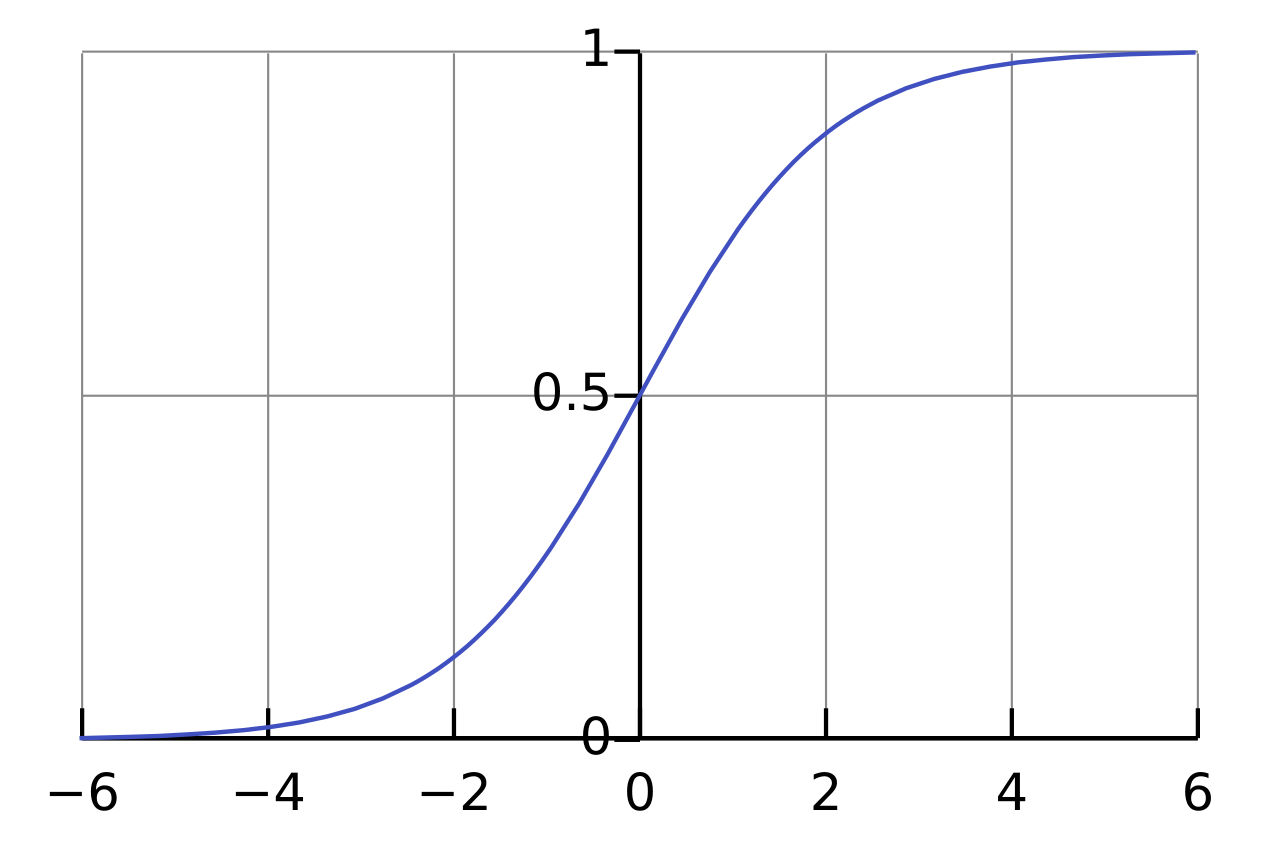
The first limit is the shape of growth itself. Our file states the objection in one line: exponential curves in nature always hit limits, S-curves. The word always is doing more work than the evidence supports, because it asserts a law about the future. The defensible version is that every natural growth process we have watched to completion has turned out to be logistic, the early portion of an S-shaped curve rather than a true exponential. On that reading a runaway is excluded in principle, and the only remaining question is where the inflection sits. Theodore Modis set the general case out in Technological Forecasting and Social Change in 2002.
The second limit is physical and it is not soft. Landauer showed in 1961, in the IBM Journal of Research and Development, that logically irreversible operations carry an unavoidable minimum energy cost, tying the erasure of information to heat. Lloyd computed the ultimate physical limits to computation in Nature in 2000, deriving hard bounds on what any physically realisable computer can do from the speed of light, the quantum limits on how fast a state can change, and gravitational constraints. Neither paper's numbers are printed here, because neither was read out of its own text for this page. The point does not need the arithmetic. A ceiling provably exists, it was calculated by physicists with no stake in this debate, and an argument whose conclusion is unbounded growth has to say something about it. Our file says nothing about it.
The third thing is already arriving as a line on somebody's budget, and this page had better not call it a ceiling, because the body that measured it does not. The International Energy Agency's Energy and AI special report states, in its own words, that 'Data centres accounted for around 1.5% of the world's electricity consumption in 2024, or 415 terawatt-hours (TWh)'. It projects that 'Data centre electricity consumption is set to more than double to around 945 TWh by 2030', and in its base case gives 'global data centre electricity consumption rising to around 1 200 TWh by 2035'. The 2024 figure is a measurement. The 2030 and 2035 figures are the agency's projections rather than observations, and they are the agency's every time they appear on this page. The base case is also one line inside a spread the agency prints beside it: 'By 2035, the range of data centre electricity demand across our cases spans from 700 to 1 700 TWh.' And the same report answers its own number instead of treating it as a wall. Under a heading reading 'A diverse range of sources will be needed to meet demand', it says that 'Half of the global growth in data centre demand is met by renewables, supported by storage and the broader electricity grid', and that 'Renewables generation is projected to grow by over 450 TWh to meet data centre demand to 2035'. It heads another section 'Data centres account for a small share of global electricity consumption today, but their local impacts are far more pronounced', and puts the load in proportion: 'Data centres account for around one-tenth of global electricity demand growth to 2030, less than the share from industrial motors, air conditioning in homes and offices, or electric vehicles', while noting that 'In advanced economies, data centres account for more than 20% of demand growth to 2030'. So the honest reading is a load that is locally severe, globally modest, and expected by the agency to be met. That is more interesting than a wall, and it points somewhere specific: the near-term constraint on compute is capital and grid connection rather than physics. The physics is the paragraph above, and it is a different kind of limit.
06The Objections Our File Says Do Not Exist
Our primary research file's counter-arguments section reads, in full, that no significant counter-arguments exist in the scholarly literature for the core claims presented, and that the topic represents established knowledge within future technology and innovation with no active scholarly dispute over the fundamental claims. That is false. Our own framework file, which the primary file cross-references by name, carries a full counter-arguments section naming Dreyfus, Marcus, Chollet and Modis, and summarising each. The two files contradict each other directly. What follows is the opposition at its strength, from peer-reviewed venues, and none of it appears in our primary file.
The sharpest current statement is David Thorstad's, in Philosophical Studies, published online in 2024 and in the print volume for 2025, under the title Against the singularity hypothesis. Thorstad argues that the hypothesis rests on undersupported growth assumptions, and that the leading philosophical defences of it fail to overcome the case for scepticism. Against Chalmers specifically the objection lands on the proportionality thesis, and it lands exactly where Chalmers himself said the weight sits: the examples that support the thesis show that a small difference in design ability once produced a large difference in what got designed, which is evidence that the thesis holds at particular moments. The argument needs it to hold always, which is the quantifier Chalmers himself wrote into the thesis and the one he had already named as the most promising thing for an opponent to attack. That formulation is attributed to Thorstad's argument rather than quoted, because it was read in summaries rather than in the paper. What makes the exchange unusual is that both parties agree on which premise is load-bearing and disagree only about whether it holds.
The objection also comes from inside AI research, which closes off the reply that only outsiders doubt this. Toby Walsh published The Singularity May Never Be Near in AI Magazine in 2017, arguing that the case for a rapid intelligence explosion rests on assumptions that can each be separately doubted, among them that faster thinking is the same as better thinking, that intelligence has no natural ceiling, and that the ability to improve intelligence is itself unbounded. Only the title, the venue and that thesis were verified for this page. The individual objections above are named as the paper's argument rather than enumerated from its text.
Theodore Modis makes the most specific charge on the table. He argues that the law of accelerating returns selectively picks the technologies and the metrics that fit an exponential narrative while ignoring the areas that have stagnated, naming energy production, transportation speed and materials science. Transportation speed is the awkward one, because it genuinely peaked and then reversed. In a 2012 chapter titled Why the Singularity Cannot Happen, in the Springer volume Singularity Hypotheses, he argues that all natural growth processes following exponential patterns eventually reveal themselves as S-curves, which excludes runaways, and that the growth remaining beyond Kurzweil's own knee is only about one order of magnitude more than the growth already achieved. That last figure comes from secondary reporting of the chapter rather than from the chapter itself, and is carried loosely here. One thing should travel with the charge: Kurzweil published a reply in the same book. This is a live exchange, not an unanswered accusation.
The objection that bites hardest on that third premise is that the argument's central noun may not name a single thing. Marcus and Chollet argue that intelligence is not one scalable dimension, and that recursive self-improvement faces diminishing returns because each increment of capability demands disproportionately more computational resource. Chollet's case rests on separating genuine generalisation from memorised skill, and on the argument that scaling existing architectures is not sufficient for human-level reasoning; the benchmark he built to draw that separation is run at length in The Alignment Problem and is not retold here. Dreyfus argued a related point from phenomenology decades earlier: that intelligent behaviour requires embodied engagement with the world which formal rules and statistical correlation cannot capture. If intelligence is a bundle of loosely related competences rather than a quantity, then twice as intelligent has no referent, and the proportionality thesis has nothing to be proportional to. The grade here is our framework file's, which files these objections inside its Tier 3 block on recursive self-improvement; the positions themselves are published work and are named in that file's own counter-arguments section.
| The Objection | Who Makes It, And Where | What It Attacks |
|---|---|---|
| The growth assumptions are undersupported, and the leading philosophical defences do not overcome scepticism | Thorstad, Philosophical Studies, print volume 2025 | The proportionality thesis, which the objection says is supported locally and needed globally |
| The case rests on assumptions that can each be separately doubted, among them that faster thinking is better thinking | Walsh, AI Magazine, 2017 | The premises generally, argued from inside AI research |
| Every natural growth process watched to completion turns out to be logistic | Modis, Technological Forecasting and Social Change 2002, and Why the Singularity Cannot Happen, Springer 2012 | The growth curve under the premises, which on this reading excludes a runaway in principle |
| The law of accelerating returns picks the metrics that fit and ignores the fields that stagnated | Modis, 2012, naming energy production, transportation speed and materials science | The empirical floor, by disputing which measurements are allowed to count |
| Ideas are getting harder to find: the researchers needed to sustain Moore's Law rose roughly eighteenfold | Bloom, Jones, Van Reenen and Webb, American Economic Review, 2020 | The empirical floor, by measuring the input curve instead of the output curve |
| Intelligence may not be a single scalable quantity at all | Marcus and Chollet, and Dreyfus from phenomenology decades earlier | The proportionality thesis, by denying that there is one axis to run up |
| A physical ceiling on computation provably exists | Landauer 1961 and Lloyd 2000, neither of them arguing about this subject | The conclusion, by bounding what any physically realisable computer can do |
| No system has ever performed recursive self-improvement, even in limited form | Our own framework file, in its own voice, at Tier 3 | The mechanism itself, which no premise in the argument supplies |
07The Scorecard
There is one more thing an argument like this gets judged on: whether the people making it have been right before. That evidence exists. It is weak, and it is weak in both directions.
Our file says that 86 percent of Kurzweil's 147 predictions from 1999 were 'essentially correct' by 2019, self-scored but mostly fair. Three things are wrong with that sentence. The predictions were made for the year 2009, not 2019, and the self-assessment, titled How My Predictions Are Faring, was published in October 2010. The 86 percent is the entirely-correct plus essentially-correct total, 127 of 147 by his own count, while his essentially correct category holds 12 predictions rather than 127. And mostly fair is a verdict delivered in our file's own voice with no source attached anywhere in the block, which is our file endorsing a self-assessment rather than reporting one. His own scoring was 115 entirely correct, 12 essentially correct, 17 partially correct and 3 wrong. He graded his own work, and independent scorers have reached lower figures. That is weak evidence. It is not worthless evidence, and this page will not invert our file's endorsement into a sneer.
The neutral frame exists too, and our file does not carry it. Armstrong, Sotala and O hEigeartaigh assembled and assessed the record of famous AI predictions in the Journal of Experimental and Theoretical Artificial Intelligence in 2014, drawing out the errors and the recurring patterns in how such predictions are made and how they fail. It is cited here for existing. Without a systematic assessment of prediction accuracy, all anybody has is one self-graded scorecard weighed against one commentator's scoring, and neither of those is a method. No specific verdict on Kurzweil is attributed to the paper here, because its findings were not read for this page.
Our file's own refusal on this is the best sentence in it, and it stands unaltered. All specific date predictions are speculative. Kurzweil's 2045 is an educated extrapolation, not a proof. Fundamental breakthroughs cannot be reliably scheduled, whether in alignment, in the science of consciousness, or in scanning resolution. And the record supports the label rather than the dates. Our framework file counts Good's date and Vinge's among those that have passed, though Vinge's own window runs to 2030 and has not. Two of Kurzweil's dollar-per-computation dates, 2020 and 2023, have come due and are not scored here for want of a figure to score them with. His 2029 is now close enough to check. Every date on this page belongs to whoever said it. None of them is ours.
08Copying A Mind
The second half of this subject is not about machines getting cleverer. It is about people becoming software. It rests on the same reasoning and has the same advocates, and unlike the intelligence explosion it has a measurable distance attached to it, which makes it far easier to check.
The proposal is specific: scan a brain at sufficient resolution, emulate its neural connectivity and dynamics in software, and the person's consciousness moves to the digital substrate. It assumes the computational theory of mind, that consciousness is substrate-independent and can be reproduced in any sufficiently complex information-processing system. Whether that is true is, in our framework file's own words, 'a deep open question in philosophy of mind', and it is the subject of The Hard Problem rather than of this page. Everything below is a measurement of how far away the engineering is.
One nervous system has been mapped completely. The nematode Caenorhabditis elegans has 302 neurons, and its full connectome was published in 1986 by White, Southgate, Thomson and Brenner as a single issue of the Philosophical Transactions of the Royal Society running to 340 pages. Pages 1 to 340, one paper, for 302 neurons.
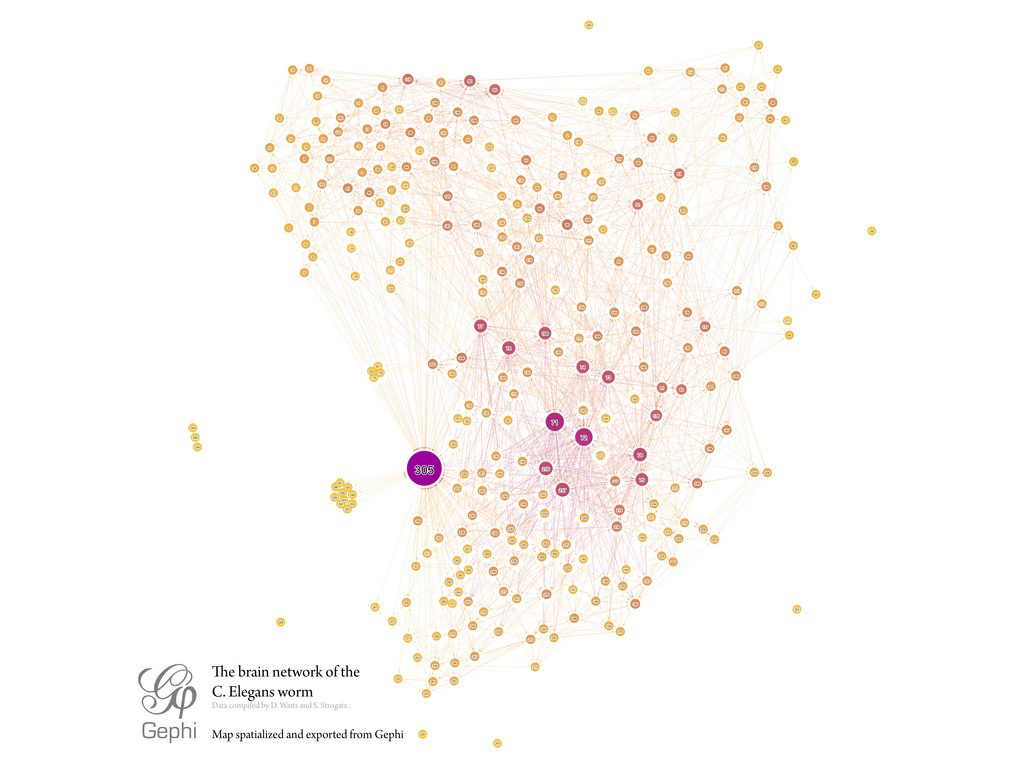
Our file then says that the OpenWorm project simulated that worm, that the simulated worm exhibits basic behavioural patterns similar to the real one without being programmed to, and that 'This is the proof of concept.' The project's own peer-reviewed status report says something different. In the OpenWorm team's overview in Philosophical Transactions of the Royal Society B in 2018, the connectome model can drive body movement inside the project's fluid-dynamics platform, and the level of detail incorporated to date is described as inadequate for biological research. A key remaining component is curating and extracting parameters for Hodgkin-Huxley ion-channel models, and electrophysiological data exists for only a small subset of ion channels, so the parameters have to be inferred by homology from other organisms. That is a fair, non-hostile statement of where the field is, written by the people doing the work. What it is not is a proof of concept for uploading a person, and our file's closing assertion that it is does not survive contact with the project's own paper.
The frontier has moved enormously since our file's account was written, and our file does not know. In October 2024 Dorkenwald and colleagues published a wiring diagram of a whole adult brain in Nature: in the paper's own abstract, 'a neuronal wiring diagram of a whole brain containing 5x10^7 chemical synapses between 139,255 neurons reconstructed from an adult female Drosophila melanogaster', with cell class and type annotations and neurotransmitter predictions. In April 2025 the MICrONS Consortium published a functional connectomics dataset of mouse visual cortex, also in Nature: 'dense calcium imaging of around 75,000 neurons' co-registered with 'an electron microscopy reconstruction containing more than 200,000 cells and 0.5 billion synapses'. That abstract gives counts rather than a volume; the reconstruction covers about a cubic millimetre of cortex, and the cubic millimetre is this page's own statement of the scale rather than a figure quoted from the paper. Neither result appears in any of our research files. Neither of them makes uploading close. A cubic millimetre of cortex is about a millionth of a human brain, and 139,255 neurons is nearly six orders of magnitude short of 86 billion. What they do is turn a flat impossibility into a trajectory with a measurable distance still on it.
The number to hold all of that against: the human brain contains approximately 86 billion neurons, the figure established by Azevedo and colleagues in 2009 using isotropic fractionation. Our file adds, and these are widely repeated round numbers rather than figures traced to a primary measurement for this page, on the order of 100 trillion synapses and roughly 7,000 synapses per neuron. It then makes the point that decides everything downstream: each synapse has distinct weights, receptor types and neuromodulatory states, so sub-synaptic and possibly molecular precision may be required. A wiring diagram may not be enough.
| The Nervous System | What Has Been Mapped | Published |
|---|---|---|
| Caenorhabditis elegans | The complete connectome, all 302 neurons | 1986, as a single 340-page issue of Philosophical Transactions of the Royal Society |
| Adult female Drosophila melanogaster | A whole-brain wiring diagram: 5x10^7 chemical synapses between 139,255 neurons, with cell class and type annotations and neurotransmitter predictions | Nature, October 2024 |
| Mouse visual cortex, a volume of about a cubic millimetre | Dense calcium imaging of around 75,000 neurons, co-registered with an electron microscopy reconstruction of more than 200,000 cells and 0.5 billion synapses | Nature, April 2025 |
| Human brain | Approximately 86 billion neurons. Our file adds, as widely repeated round numbers, on the order of 100 trillion synapses and roughly 7,000 per neuron, each with distinct weights, receptor types and neuromodulatory states | Neuron count: Azevedo et al., 2009 |
Our file cites Sandberg and Bostrom's 2008 report Whole Brain Emulation: A Roadmap for the requirement: a scanning resolution of about 5 nanometres and computing power of about 10^18 FLOPS, which it glosses as about 10 petaFLOPS, achievable with 2030s technology if scanning resolution advances. Three things need correcting. First, 10^18 FLOPS is one exaFLOPS, which is 1,000 petaFLOPS; 10 petaFLOPS is 10^16. The gloss is wrong by a factor of a hundred, in the direction that makes the target look easier. Second, our file's citation of the report reads Technical Report #-3, and the report, which supplies its own citation string on its own cover page, is Technical Report #2008-3. Third, and this is the one that changes the argument, 10^18 is not the roadmap's requirement. It is one row of the roadmap's Table 9, which tabulates eleven levels of biological detail and puts a price on eight of them, from 10^15 FLOPS for an analog network population model up to 10^43 for the stochastic behaviour of single molecules. That is twenty-eight orders of magnitude, for the same brain, in the same table, because the answer depends entirely on how much biology turns out to matter. The scanning figure is the roadmap's too, and it is not the flat 5 nanometres our file prints. The report says that resolving the thinnest axons and synaptic spine necks needs 'imaging on the order of the 5 nanometer scale', and that its workshop's consensus was that '5x5x50 nm scanning resolution would be needed', which is a section thickness ten times coarser than the resolution within the section. In its own accounting of what that costs: 'A 5x5x50 nm resolution brain scan requires 1.4 * 10^21 voxels, a large amount of raw data'.
| Level Of Emulation Detail | Processing Demand, Emulation Only, Human Brain | Earliest Year At $1 Million, The Roadmap's Supercomputer Estimate |
|---|---|---|
| 1. Computational module | Not priced, marked with a question mark | Not given |
| 2. Brain region connectivity | Not priced, marked with a question mark | Not given |
| 3. Analog network population model | 10^15 FLOPS | 2008, which the report footnotes to Roadrunner at Los Alamos |
| 4. Spiking neural network | 10^18 FLOPS, which is one exaFLOPS | 2019 |
| 5. Electrophysiology | 10^22 FLOPS | 2033 |
| 6. Metabolome | 10^25 FLOPS | 2044 |
| 7. Proteome | 10^26 FLOPS | 2048 |
| 8. States of protein complexes | 10^27 FLOPS | 2052 |
| 9. Distribution of complexes | 10^30 FLOPS | 2063 |
| 10. Stochastic behavior of single molecules | 10^43 FLOPS | 2111 |
| 11. Quantum | Not priced, marked with a question mark | Not given |
The roadmap does single out three of those eleven levels, and the reason it gives is the most revealing sentence in the report. Levels 4 to 6, the spiking neural network, electrophysiology and metabolome rows, are the band it builds itself around, and it says why: 'An informal poll among workshop attendees' produced a range of estimates of the resolution whole brain emulation would need, and 'The consensus appeared to be level 4-6.' Two participants were more optimistic about high-level models, two thought elements of levels 8 or 9 might be necessary at least to begin with, and the report then states that it will focus on levels 4 to 6 while remaining open to deeper levels turning out to be needed. The 5 by 5 by 50 nanometre scanning figure comes from the same poll, as what that band would require. This is where the three numbers everybody quotes come from, and it is worth being exact about what they are. The most-cited compute requirement in whole brain emulation is not a measurement and not a derivation. It is the middle of a range that a room of people voted on, printed by authors who said so on the page. That is a candid thing for advocates of a project to write down, and it is the reason the single figure our file prints cannot carry the weight our file puts on it.
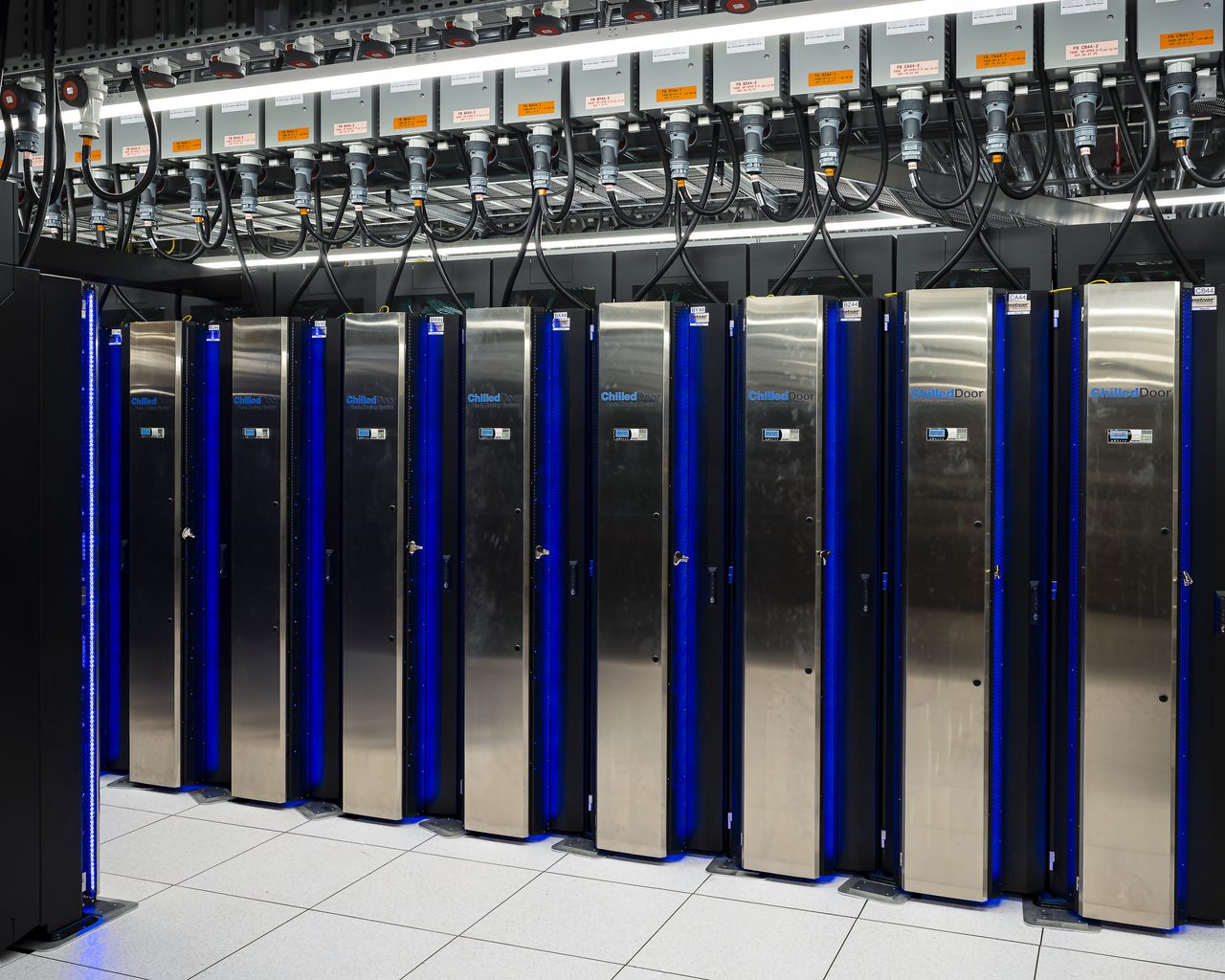
The compute for the fourth of those eleven rungs now exists, and for the third it existed before the report was printed. Oak Ridge National Laboratory's Frontier supercomputer took the top ranking on the 59th TOP500 list on 30 May 2022 at 1.1 exaflops, the first system to reach exascale, and both figures come from the laboratory's own published description of the machine. The roadmap's own supercomputer column dates the spiking neural network level, at 10^18 FLOPS, to 2019, so the real machine landed within three years of the report's own schedule. The level below it, the analog network population model at 10^15 FLOPS, the roadmap dates to 2008, footnoting Roadrunner at Los Alamos reaching 1.7 petaflops on 25 May 2008: that rung had already been climbed while the report was being written. Both comparisons are looser than they look, because those year columns are indexed to a million dollars of computer and Frontier is a national laboratory installation, and the report itself notes that a Manhattan project budget of $10^9 would subtract 19.1 years from its commodity estimates and 11.1 from its supercomputer ones. The shape survives the looseness. The compute arrived, twice, on or near the report's own timetable. Emulation did not. What has not arrived is the scan, the answer to which of the eleven rungs is the right one, and any account at all of whether the emulation would be a person. The bottleneck moved off the axis everybody was extrapolating along.
The institution that wrote the roadmap no longer exists. The Future of Humanity Institute, founded at Oxford in 2005 by Nick Bostrom, closed on 16 April 2024 after nineteen years. Three accounts of why exist, and they are kept apart here because they are three registers of one event. The institute's own closure statement says that 'Over time FHI faced increasing administrative headwinds within the Faculty of Philosophy', that 'Starting in 2020, the Faculty imposed a freeze on fundraising and hiring', that 'In late 2023, the Faculty of Philosophy decided that the contracts of the remaining FHI staff would not be renewed', and that 'On 16 April 2024, the Institute was closed down.' The institute's final report, written by Anders Sandberg, who had co-written the emulation roadmap sixteen years earlier, is sharper: it says the final years 'were affected by a gradual suffocation by Faculty bureaucracy'. Bostrom, in an emailed statement to The Guardian published on 19 April 2024, is blunter still: 'there was a death by bureaucracy'. That last phrase is his, said to a newspaper. It is in neither of the institution's own documents. And the closure is verifiable in an unusually direct way: the roadmap's own cover page prints its address as www.fhi.ox.ac.uk/reports/2008-3.pdf, and that host no longer resolves at all. The document tells the reader where to find itself and the address has ceased to exist. The surviving institutional record for the roadmap is the Oxford University Research Archive, which is where this page reads it from and links to it.
A large and well-funded attempt to build in this direction is a worked example of an extrapolation flattening, and it is recent enough that many readers will remember the launch publicity. The EU's Human Brain Project ran as a Future and Emerging Technologies Flagship and formally completed its ten-year run on 30 September 2023. Our framework file gives it as a one-billion-euro project that fell far short of whole-brain emulation, managing to simulate only small cortical columns. The billion is the pledge rather than the funding: a Nature news feature of 22 August 2023 reports that the project received 607 million euros in total, of which about 406 million was EU funding, and the project's own closing announcement of September 2023 agrees on the end date and the outcome. It did not achieve whole-brain emulation. It did leave behind the EBRAINS research infrastructure, more than 3,000 academic publications and more than 160 digital tools, which is a great deal. It simply is not the thing it was famous for promising.
And then the engineering question stops being an engineering question. Our file puts it plainly: 'Is the upload you or a copy? (Ship of Theseus / teleportation problem). If copy, this is reproduction, not immortality.' The workaround it records, at Tier 3, is gradual replacement: neurons swapped one at a time for artificial equivalents so that continuity of consciousness is preserved, with our file's own question attached to it, at what point are you a machine? Reading the Mind hands this question to this page by name, and states the reason hardware cannot settle it: whether progressive migration preserves a person depends on substrate independence, which is a philosophical claim rather than a technical one. The honest answer is that nobody knows, and that this may not be the kind of question that resolves.
So the flat refusal our file files at its lowest tier is correct, and this page carries it unaltered. No, a human consciousness cannot be uploaded now. Current brain scanning, fMRI, EEG and MEG, operates at vastly insufficient resolution. We cannot fully simulate a single human neuron in all its molecular detail, let alone 86 billion of them simultaneously. Our file adds that uploading remains decades away at minimum, and that clause is itself a schedule, so its own refusal of schedules applies to it. The capability gap is the finding. The date of its closing is not available.
09What Is Promised, If It Works
Everything in this section is speculative and our own file says so. It is here because the promises are the reason anybody cares about the argument at all, and because a page carrying only the objections would be as unbalanced as one carrying only the case.
Kurzweil's central prediction, as our file states it: by 2045 humans will be primarily non-biological, with the biological portion a minor component, enhanced and eventually replaced by silicon or quantum substrates. Our file files this at Tier 3, Speculative, and the grade is preserved here without adjustment. Notice the structure that creates. The date is graded Credible. The thing predicted for the date is graded Speculative.
The rest of the promise, all of it at our file's Tier 3: multiple simultaneous backups of a mind on different substrates; subjective time dilation, thousands of subjective years lived inside physical milliseconds; virtual environments of arbitrary fidelity. Our file puts the risks in the same block, and they are the strongest material in it, because they follow from exactly the same reasoning as the promise. Malicious deletion. Hacking. Modification of subjective experience. And what our file calls hell scenarios: being locked inside a negative simulation with no death available as an exit. If death becomes optional, so does escape. The grade does the work here and the sentence does not need dramatising.
The oldest version of the promise is theological and it has a physics edition. Teilhard de Chardin argued in Le Phenomene humain, published in 1955 and translated into English in 1959, that evolution has a direction, toward increasing complexity and consciousness, culminating in an Omega Point where consciousness merges with the divine. Frank Tipler formalised it cosmologically in The Physics of Immortality in 1994: at the end of the universe infinite computing capacity becomes available, permitting the resurrection of every being who ever lived as a perfect simulation. Our file files this at Tier 3 and then refutes it in the same block, which is our file at its best. Tipler's scenario requires a Big Crunch, and the universe appears to be in accelerating expansion, which rules that specific scenario out. Our file's own verdict is beautiful speculation with questionable physics. It is also the cleanest example on this page of a futurist argument closed by an observation nobody made with it in mind.
One more idea belongs here for its shape rather than for its medicine. Aubrey de Grey's longevity escape velocity is the point at which life-extension technology extends remaining lifespan by more than one year per year, at which point ageing is effectively solved; he estimated in 2004 that the first person to live to 1,000 years might already be alive. That is the same move as the intelligence explosion: a rate-of-change argument that converts a finite improvement into an unbounded one by outrunning the thing it is racing. Our file's assessment of him, stated in its own voice, is that his individual claims are often overly optimistic but that the framework is scientifically sensible and has influenced mainstream gerontology. The second half of that is a soundness verdict with no citation attached anywhere in the block, so it is reported here as our file's opinion and not as a finding. The medicine itself belongs to a different wing here and is deliberately absent from this page.
The observed anchor to hold that against: the longest verified human life on record is Jeanne Calment's, at 122 years and 164 days. It is the record rather than a biological ceiling, and the validation of it has itself been publicly disputed.
The bet placed by people unwilling to wait sits at our file's lowest tier, which the file itself labels misleading. Cryonics organisations preserve bodies and heads at liquid nitrogen temperature. Current vitrification causes severe cellular damage. No organism larger than a small nematode has been revived after cryopreservation to long-term storage temperature. The bet is that future technology will repair the damage, which is faith in a future capability rather than a current one, and the refusal of the claim that cryonics works today stands. Two corrections travel with it. Our file's figure of about 500 people currently cryopreserved is stale in the direction of understatement, and no worldwide total is printed here, because the only figure that came from an organisation actually holding patients is the Cryonics Institute's own register, which lists 268 patients with its most recent entry dated 27 February 2025. That 268 is one provider's register and not a world total, and it is not a fall from 500. And the organ-level state of the art has moved without our file noticing: Han, Rao and colleagues published in Nature Communications in 2023 a method combining vitrification and nanowarming that enabled long-term cryopreservation of rat kidneys and life-sustaining transplantation afterwards. A rat kidney was frozen, rewarmed, and kept an animal alive. That is a real result, and it is a very long way from a person, and both halves of that sentence are the honest report.
10Where The Words Came From
The vocabulary has its own history, and our file gets several details of it wrong in a way worth correcting, because the errors are nearly all of one type: a claim about who was first.
Our file says modern transhumanism emerged from Julian Huxley, who coined the term in 1957. The coinage claim does not survive scrutiny. Peter Harrison and Joseph Wolyniak traced the word's history in Notes and Queries in 2015 and found usages earlier than Huxley's 1957 essay, including Huxley's own use in a 1951 lecture published as Knowledge, Morality and Destiny, and antecedents reaching back to Dante's coinage trasumanar in the Paradiso. The Dante and 1951 details are attributed to their argument rather than asserted flatly here, because the paper's bibliographic record was verified for this page while its contents were read in academic summaries. The safe formulation is that Huxley popularised the term in its modern sense in his 1957 essay Transhumanism, in New Bottles for New Wine. A movement built on transcending the past turns out to have a thirteenth-century word for it.
Our file says Max More and the Extropy Institute, 1988. 1988 is the year More began publishing Extropy: The Journal of Transhumanist Thought, and that date is consistent across every account consulted. The Institute was founded later, and the sources genuinely disagree about when: accounts give 1990, 1991 and 1992, with Tom Bell and Tom Morrow variously named as co-founder. The mailing list dates to 1991 and the first transhumanism conferences to 1992. No founding year for the Institute is printed here as settled, because nothing consulted settles it. Note also that the standard scholarly collection of the movement's self-description, The Transhumanist Reader, records More and Vita-More as its editors, where our file's bibliography lists them as authors.
Our file also reaches back for deep roots, and two of its dates need a note. It cites Gilgamesh at about 2100 BCE, which is a defensible date for the Sumerian Gilgamesh poems of the Third Dynasty of Ur but not for the Epic: the Old Babylonian version is around 1800 BCE, and the Standard Babylonian text, the one carrying the immortality quest as most readers know it, is roughly 1300 to 1000 BCE and survives chiefly through seventh-century BCE tablets from the Library of Ashurbanipal. The Epic of Gilgamesh has its own page here and is not retold. Our file cites Condorcet's prediction of human perfectibility as 1794, which is the writing date: the Esquisse was written across 1793 and 1794 and published posthumously in 1795. And it calls the quest for immortality humanity's oldest story, which is an unhedged superlative that cannot be checked, so this page does not repeat it.
The sharpest line against the movement usually arrives anonymously, as critics saying the singularity is the rapture of the nerds. It has a provenance. The phrase entered wide use through Ken MacLeod's 1998 novel The Cassini Division, where a character calls the singularity the Rapture for nerds. MacLeod has said he did not coin it and took it from a self-satirical article in an early-1990s issue of Extropy, the transhumanist journal itself; that antecedent is MacLeod's own account and was not traced to an issue for this page. Charles Stross and Cory Doctorow later used it as the title of a 2012 novel, which is where most readers now meet it. Attribution matters here for a reason beyond credit. Unattributed, the jibe reads as this page's own sneer, and it is not one. It appears to have been coined inside the movement, laughing at itself, in its own journal.
A standing ethical objection appears in one clause of our file's summary and is never returned to: that transhumanism reflects privilege, promising immortality to the rich while billions lack clean water; that its promises accrue to whoever can pay; and that a technology of indefinite life would be distributed as unequally as every other expensive technology. The position is real and it is held by named people. This page could not verify a citation for it. The nearest named sources, Fukuyama's 2004 piece in Foreign Policy calling transhumanism the world's most dangerous idea, and the US President's Council on Bioethics report Beyond Therapy of 2003, were neither resolved nor read for this page. So the objection is carried at the size its sourcing supports, which is a paragraph, and the gap is named rather than papered over.
One category of objection is refused here for a reason that is not dismissive. Some religious communities frame transhumanism as forbidden knowledge or as a Tower of Babel. Our file's handling is exactly right and is reproduced: these are ethically important perspectives, and they are faith claims rather than scientific arguments. So they are refused as evidence about whether the thing will happen, while remaining perspectives worth hearing on whether it should. There is a neighbouring criticism that is not theological and is fair game: our framework file carries, in its own voice, the charge that the singularity functions as a secular eschatology serving psychological rather than analytical needs. That one is an argument, and it belongs with the objections in section 06.
Fast Facts
- The Argument
- Designing machines is an intellectual task, so a machine that beats humans at intellectual tasks beats them at designing machines, and the loop tightens. Stated by I. J. Good in 1965.
- The Mechanism
- Recursive self-improvement. Our framework file grades it Tier 3, Speculative, and records that no system, large language models included, has demonstrated it, even in limited form.
- The Lineage
- Good 1965; Vinge 1993, who named it and set the first deadline; Chalmers 2010, who stated it as three premises, the first categorical and the other two conditional, each carrying an explicit escape clause; Bostrom 2014, who set it out as a four-step loop
- Kurzweil's Two Dates
- 2029 for human-level machine intelligence and 2045 for the merger, both his, and both restated by him in The Singularity Is Nearer in June 2024. Neither is this page's forecast.
- Vinge's Deadline
- Thirty years from 1993, with a window of 2005 to 2030 attached to it in the same paper. The thirty years ran out in 2023 with no superhuman intelligence; the window has not, so by his own falsifier the prediction has not yet failed. Vinge died in March 2024.
- The Measured Floor
- Two centuries of computing price-performance (Nordhaus 2007); 184 and 208 billion transistors on two manufacturers' own 2024 and 2025 figures; the ImageNet human benchmark passed in 2015
- The Objections, By Name
- Thorstad (Philosophical Studies 2025), Walsh (AI Magazine 2017), Modis (Springer 2012 and Technological Forecasting and Social Change 2002), Marcus, Chollet and Dreyfus, plus the measurement in Bloom et al. (American Economic Review 2020)
- What Our Own File Says About Them
- That no significant counter-arguments exist in the scholarly literature. That is untrue, and our own framework file refutes it by naming four critics.
- The Ceilings
- Landauer 1961 and Lloyd 2000 on the physical limits of computation. Kept separate because it is not a ceiling: the IEA's measured 415 TWh of data-centre electricity in 2024, with 945 TWh by 2030 and around 1,200 TWh by 2035 its projections rather than measurements, inside a 2035 range of 700 to 1,700 TWh the agency expects to be met
- The Uploading Distance
- 302 neurons fully mapped in 1986; 139,255 in a whole fly brain in 2024; about 0.5 billion synapses reconstructed in a cubic-millimetre-scale volume of mouse cortex in 2025; approximately 86 billion neurons in a human
- The Compute Target
- The 2008 roadmap tabulates eleven levels of emulation detail and prices eight of them, its own estimated demands running from about 10^15 to 10^43 FLOPS, and it narrows to three of them on an informal poll of its own workshop. The spiking-neuron level it builds around asks about 10^18 FLOPS, one exaFLOPS; machines reached that in 2022, and the 10^15 level had been reached by 2008 on the roadmap's own reckoning. Emulation followed neither.
- What Is Not Supported
- That the singularity is scheduled, that recursive self-improvement has been demonstrated, that the OpenWorm simulation is a proof of concept for uploading a person, or that a consciousness can be uploaded now
What We Can Actually Stand Behind
The growth record is real, it is measured rather than argued, and that is what puts it here. Computing price-performance has been reconstructed across two centuries by an economist with no stake in the argument. Two manufacturers state 184 billion transistors on a chip announced in March 2025 and 208 billion on an architecture announced in March 2024. The ImageNet human benchmark of roughly 5 percent top-5 error was passed in 2015. One complete connectome exists, 302 neurons published across 340 pages in 1986, and the frontier has since reached a whole adult fly brain in 2024 and a cubic-millimetre-scale volume of mouse cortex in 2025. Exascale computing arrived in 2022. These are measurements, and they are the part of this page a reader can most easily go and check.
The input side is measured too, and our own research file carries none of it. Bloom, Jones, Van Reenen and Webb found that the researchers needed to sustain Moore's Law rose by roughly eighteenfold between the early 1970s and the 2010s, which means the constant doubling was bought with exponentially rising effort. Landauer in 1961 and Lloyd in 2000 established that a physical ceiling on computation provably exists. The International Energy Agency measured data centres at 415 terawatt-hours in 2024, about 1.5 percent of world electricity; its figures beyond that year are projections rather than observations, and the agency pairs them with a supply plan rather than with a wall, which makes that number a cost the argument has to account for and not a limit on it.
The intelligence explosion argument is credible and contested, and this page does not settle it. On one side: Good's 1965 reasoning, that designing machines is an intellectual activity, so a machine better than us at intellectual activities is better than us at designing machines; Bostrom's four-step loop, which restates that as a process rather than a moment; Chalmers's three premises, the first of them categorical and all three carrying an escape clause written in by the person making the argument; and Kurzweil, who unlike most futurists attaches published dates, a falsifiable claim and a scored record to his, which is more than most futurism offers. On the other: Thorstad in Philosophical Studies attacking the proportionality thesis at the exact joint Chalmers identified, Walsh arguing from inside AI research that the premises can each be separately doubted, Modis charging that the metrics are selected and answered by Kurzweil in the same volume, and Marcus, Chollet and Dreyfus denying that intelligence is the kind of thing with a single axis to run up. Both sides are working from the same published record. This page reports the disagreement rather than resolving it.
Every date on this page belongs to whoever said it. Good set none explicitly and later suspected he had the sign wrong. Vinge gave thirty years from 1993 with a window of 2005 to 2030 attached in the same paper, so the thirty years ran out in 2023 while the window has not. Kurzweil gives 2029 for human-level machine intelligence and 2045 for the merger, restated by him in June 2024, and two older dollar-per-computation dates of his, 2020 and 2023, have already come due without this page carrying a figure to score them by. None of these is this page's forecast.
Recursive self-improvement, the mechanism that makes an explosion an explosion rather than a trend, is graded Speculative in our own framework file, which records that nothing has demonstrated it even in limited form. Our primary research file never states the mechanism at all, which means its Tier 2 date rests on a Tier 3 step it does not mention. Kurzweil's merger in 2045, mind uploading, digital backups and subjective time dilation, the Omega Point and the hell scenarios are all Speculative in our own file, and are carried here at exactly that grade.
No, the OpenWorm simulation is not a proof of concept for uploading a person, whatever our own file says. The project's own 2018 paper in Philosophical Transactions of the Royal Society B describes the level of detail incorporated to date as inadequate for biological research, with ion-channel parameters still inferred by homology from other organisms. And no, there is no absence of scholarly counter-arguments here: our file's claim that none exist is refuted by our own framework file, which names Dreyfus, Marcus, Chollet and Modis, and by a peer-reviewed literature running at least to Thorstad 2025, Walsh 2017 and Modis 2012.
No, a human consciousness cannot be uploaded today. Current scanning, fMRI, EEG and MEG, operates at vastly insufficient resolution, and a single human neuron cannot be simulated in full molecular detail, let alone 86 billion at once. And no, cryonics does not work today: vitrification causes severe cellular damage and no organism larger than a small nematode has been revived from long-term storage temperature, although a rat kidney was cryopreserved, rewarmed and kept an animal alive in a 2023 result. This page also declines to date any of those closings, because our own file's refusal of schedules applies to its own decades-away-at-minimum clause as much as to anybody else's.
No, the singularity is not scheduled, and no, this page does not claim that it will not happen. Both of those would be forecasts and the evidence supports neither. What the evidence supports is narrower and more useful: the growth record is real, the input cost of holding it up is rising and has been measured, the ceilings are real, the mechanism has never been observed, and every date on the table belongs to a person rather than to a finding.
Sources & further reading
WHERE THIS PAGE WORKED FROM, AND WHERE IT CAN BE CHECKED. It was written from three files in our own research library: S_1_02 on the singularity and transhumanism, which is the primary file; G_4_23 on technological singularity theories, which supplies the intellectual history, the recursive self-improvement mechanism and the critical literature; and S_1_01 on artificial general intelligence, which supplies Bostrom's four-step loop and nothing else. Those files are where the work started. They are our own claims and they cannot corroborate themselves, which is why the external entries below are here: each one names the section it supports, and none is listed as general reading. THIS PAGE CORRECTS OR NARROWS ITS OWN PRIMARY FILE IN MORE THAN A DOZEN PLACES, EVERY ONE DISCLOSED ON THE CLAIM IT BELONGS TO. The load-bearing ones: Moore's 1965 paper predicted roughly annual doubling and the two-year rate is his own 1975 revision; 10^18 FLOPS is one exaFLOPS and not the 10 petaFLOPS our file states, an error of a factor of a hundred in the direction that makes brain emulation look easier; that same figure is one row of the emulation roadmap's Table 9 rather than the requirement, and the table tabulates eleven levels of biological detail, prices eight of them from 10^15 to 10^43 FLOPS, and narrows to three of them on an informal poll of the report's own workshop; the ImageNet human benchmark was passed in 2015 and not in 2021; the sequencing comparison divides a whole research programme's budget by one commercial price point, which the source institution warns against in its own words while supplying its own replacement estimate of $500 million to $1 billion worldwide; Kurzweil's self-assessment covered predictions made for 2009 and was published in October 2010, and its 86 percent is his entirely-plus-essentially-correct total rather than his essentially-correct category; the 10^26 calculations per second figure is attached in his own 2001 text to around 2049 rather than to 2045; the OpenWorm simulation is described by the project's own 2018 Royal Society paper as incorporating detail inadequate for biological research, which is not the proof of concept our file calls it; and Julian Huxley popularised the word transhumanism rather than coining it. THE TWO MOST IMPORTANT DEPARTURES ARE STRUCTURAL RATHER THAN FACTUAL. Our primary file never states recursive self-improvement, the mechanism the whole argument depends on, so this page states it and carries our framework file's Speculative grade for it. And our primary file says that no significant counter-arguments exist in the scholarly literature, which is untrue and which our own framework file refutes by naming Dreyfus, Marcus, Chollet and Modis, so this page carries the objections at full strength in section 06. WHAT THIS PAGE DELIBERATELY DOES NOT PRINT: a current per-genome sequencing price, because the source institution's live pages carry it only inside a downloadable spreadsheet; the numerical values of Landauer's and Lloyd's limits, because neither was read out of its own paper; a worldwide cryonics patient total, because the only figure that came from an organisation actually holding patients is one provider's own register; a founding year for the Extropy Institute, because the accounts disagree; and a precise 2021 ImageNet error figure, because none could be sourced. THREE IDENTIFIERS CARRIED IN OUR OWN FILES ARE NOT REPRODUCED BELOW. Two are book reviews standing in for the books they review, one for Kurzweil's The Singularity Is Near, which is carried that way in two separate files, and one for Bostrom's Superintelligence. The third resolves to a 2017 anthology reprint rather than to Vinge's 1993 conference paper, which is linked below to the author's own hosted copy instead. FOUR WORKS ARE NAMED IN THE PROSE WITH NO LINK BELOW, because their identifiers were not independently resolved for this page: Chollet's On the Measure of Intelligence, Marcus and Davis's Rebooting AI, Dreyfus's What Computers Still Can't Do, and Kurzweil's The Singularity Is Nearer. The same applies to the Apple, NVIDIA and Oak Ridge figures, which are named in the prose as the manufacturers' and the laboratory's own published claims about their own machines, and to the three documents quoted on the closure of the Future of Humanity Institute: the institute's own closure statement, its final report written by Anders Sandberg, and the emailed statement Nick Bostrom gave The Guardian for its report of 19 April 2024, which is where the phrase death by bureaucracy comes from and which is the only one of the three that carries it.
Image credits
- The Frontier supercomputer at Oak Ridge National Laboratory Oak Ridge National Laboratory, via Wikimedia Commons (CC BY 2.0). CC BY 2.0 Source.
- Vernor Vinge, portrait (2008) David Orban from New York, United States, via Wikimedia Commons (CC BY 2.0). CC BY 2.0 Source.
- Transistor counts in microchips, 1970 to 2020 Max Roser and Hannah Ritchie / Our World in Data, via Wikimedia Commons (CC BY 4.0). CC BY 4.0 Source.
- Exponential growth of computing, 20th to 21st centuries Courtesy of Ray Kurzweil and Kurzweil Technologies, Inc., via Wikimedia Commons (CC BY 1.0). CC BY 1.0 Source.
- The logistic sigmoid function, plotted Qef, via Wikimedia Commons (public domain). Public domain Source.
- Network graph of the C. elegans nervous system Mentatseb, via Wikimedia Commons (CC BY-SA 3.0). CC BY-SA 3.0 Source.
- Card crop of The Frontier supercomputer at Oak Ridge National Laboratory Oak Ridge National Laboratory, via Wikimedia Commons (CC BY 2.0). CC BY 2.0 Source.
.jpg)
.jpg)


