
The Quantum Computer: Computing With the Impossible
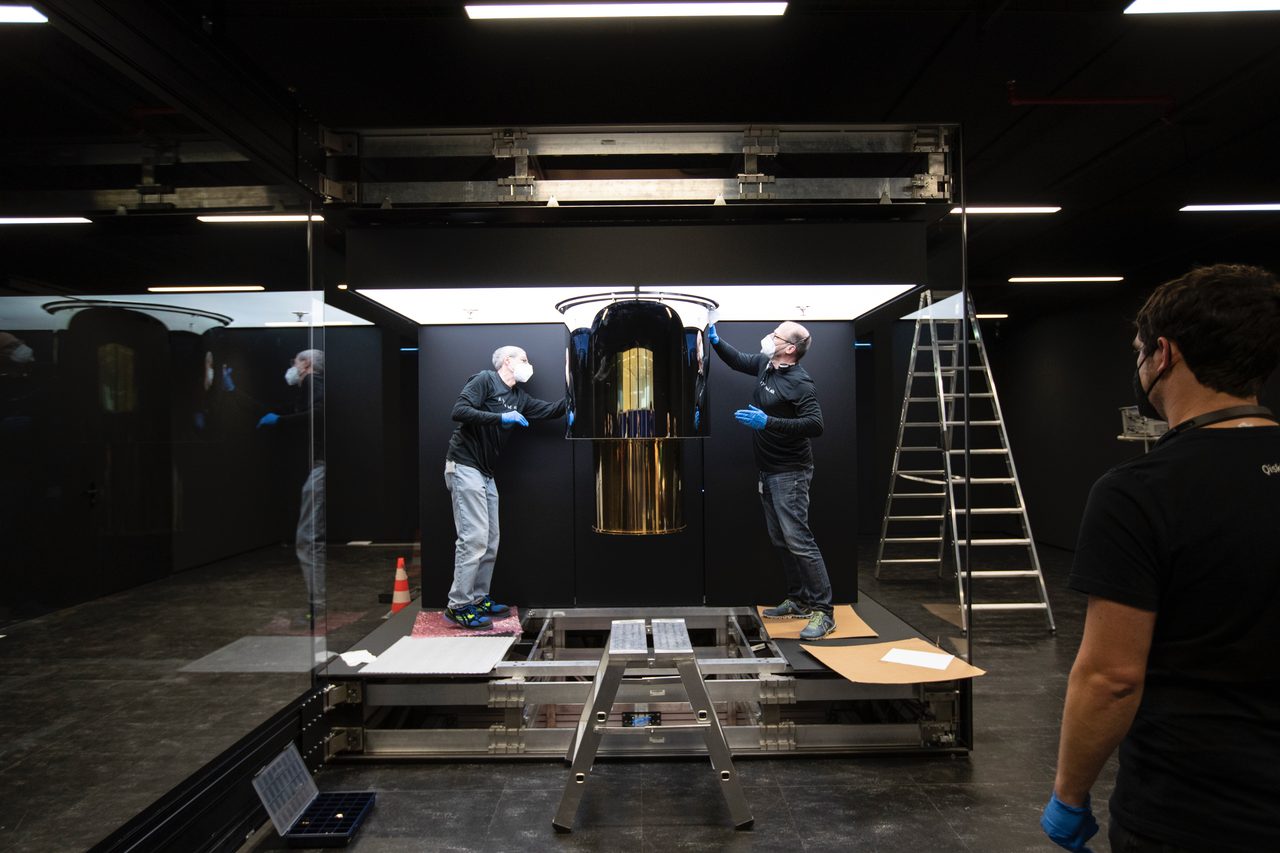
In 2019 a 53-qubit chip called Sycamore finished a specially designed sampling task in about 200 seconds, and Google said a classical supercomputer would need roughly 10,000 years to match it. IBM replied that a better algorithm with more storage would do the same job in about 2.5 days, and a group at USTC later narrowed the gap further still. Every part of that exchange is on the record, and the argument inside it is this whole subject. Real quantum processors exist, they carry names and dates, and in December 2024 one of them did something genuinely new. A general-purpose, fault-tolerant quantum computer that reliably outperforms classical computers on broadly useful problems does not exist. Here is the file, opened claim by claim, each one wearing its evidence, with the field's own skeptics carried at full strength.
Every computer ever built, from the abacus to the machine you are reading this on, does the same three things: it puts a physical system into a definite state, it changes that state by rules, and it reads the answer out. A quantum computer breaks the first step. It puts its physical system into a state that is not definite at all, and then arranges the rules so that the wrong answers cancel each other before anybody looks. That is not a metaphor, and it is not a faster version of what a laptop does. It is a different kind of machine. The honest question about it has never been whether the physics is real, because the physics has a Nobel Prize attached. The question is whether the machine can be built large enough, and quiet enough, to do something a classical computer could not already do more cheaply. Let's open the file.
01The Thing a Bit Cannot Do
The whole subject rests on four properties of quantum systems. None of them is speculative, all of them are a century old or close to it, and each gives the machine something a classical computer does not have.
A classical bit is 0 or 1. A qubit exists as a superposition, written in the standard notation as |psi> = alpha|0> + beta|1>: a linear combination of the two basis states, weighted by complex-number amplitudes. Because those weights are complex numbers rather than plain probabilities, they can interfere, adding constructively or cancelling destructively. That is the entire difference, and it is fundamental rather than practical. A qubit is not a classical bit whose single definite value merely happens to be unknown to us. It is a different mathematical object, and the interference is the part that does the work.
There is a hard limit built in from the beginning, and it has no classical counterpart at all. The no-cloning theorem states that an unknown quantum state cannot be copied. A classical bit can always be copied, freely and endlessly, which is why every file anybody owns can have a backup. An unknown qubit cannot be copied at all. This is a fundamental prohibition in the physics, not an engineering shortfall waiting on better hardware.
Two or more qubits can share a joint state that cannot be described as separate individual states at all. The textbook case is the Bell state |Phi+> = (1/sqrt2)(|00> + |11>), in which neither qubit has a state of its own and only the pair does. That this is a real feature of the world rather than a bookkeeping convenience is settled experimentally. Bell's 1964 theorem made the difference testable, and the experiments delivered: Clauser in 1972, Aspect in 1982, and Zeilinger and colleagues in 2015 all found violations of Bell inequalities. Local hidden variables, the idea that the particles were carrying ordinary predetermined values all along, does not survive those results.
That work was recognized formally in 2022, when Alain Aspect, John F. Clauser, and Anton Zeilinger shared the Nobel Prize in Physics "for experiments with entangled photons, establishing the violation of Bell inequalities and pioneering quantum information science." Zeilinger's group also produced the first demonstration of quantum teleportation, in 1997. That prize is worth carrying through the rest of this article. Whatever remains unproven about quantum computers, and a great deal does, the physics they are built on is not in the speculative column.
One thing entanglement does not do, and the correction belongs here rather than buried later. Entanglement cannot transmit information faster than light. The correlations between entangled particles only become apparent when the two sets of measurement results are brought together and compared, and that comparison travels down an ordinary classical channel at ordinary light-limited speed. Nothing is signalled by the measurement itself. The strangeness is real. The loophole is not.
The fourth property is the one that turns the other three into a computer. A quantum algorithm is an arrangement of operations designed so that the paths leading to wrong answers interfere destructively and cancel, while the paths leading to the right answer interfere constructively and amplify. The machine does not try every possibility at once and pick the best one. It arranges for the useless possibilities to erase each other. That distinction is lost in almost every popular account of the subject, and losing it is where most of the exaggeration in this territory begins.
02The Enemy Is Noise
If those four properties were all there was to it, the machines would already exist and this would be a shorter and duller document. They do not exist, and the reason has a name.
Decoherence is quantum information leaking out of the machine into everything around it: thermal noise, electromagnetic fluctuations, even cosmic rays. It is the central practical obstacle to quantum computing, and it sets the clock every quantum processor runs against. As order-of-magnitude physics rather than any single laboratory's current benchmark, superconducting qubits hold coherence for roughly 100 microseconds, trapped ions for seconds to minutes, and some nuclear-spin systems for hours. Whatever a machine is going to do, it has to finish inside that window.
The answer the field settled on is quantum error correction, and its price is the most under-reported number in the subject. The scheme spreads the information of one logical qubit across many physical qubits; for the surface code, the leading approach, the estimate runs from roughly 1,000 to 10,000 physical qubits for a single logical one. The threshold theorem sets the condition that makes it worth doing: if the error rate per operation can be pushed below roughly 0.1 to 1 percent, error correction can in principle succeed rather than adding more noise than it removes. That was demonstrated in principle long before anyone demonstrated it at scale, and at scale is exactly where this article's argument lives.
Those two numbers, the coherence window and the correction overhead, are the whole engineering problem stated twice. Every hardware platform in the next section is a different bet about which of them to attack first.
03Four Platforms, and One in Dispute
There is no single design for a quantum computer. There are four working approaches built on genuinely different physics, plus a fifth that has been announced and is being publicly disputed. Saying clearly which is which is most of the honesty available in this section.
Superconducting qubits are circuits rather than particles: loops of superconducting metal interrupted by Josephson junctions, held at about 15 millikelvin, roughly a hundredth of a degree above absolute zero, and controlled with microwave pulses. This is the most advanced platform by qubit count, having passed 1,000, and the fastest by gate time, at around 20 nanoseconds per operation. IBM, Google, and Rigetti are the leading builders. Almost every dated milestone later in this file was set on this platform.
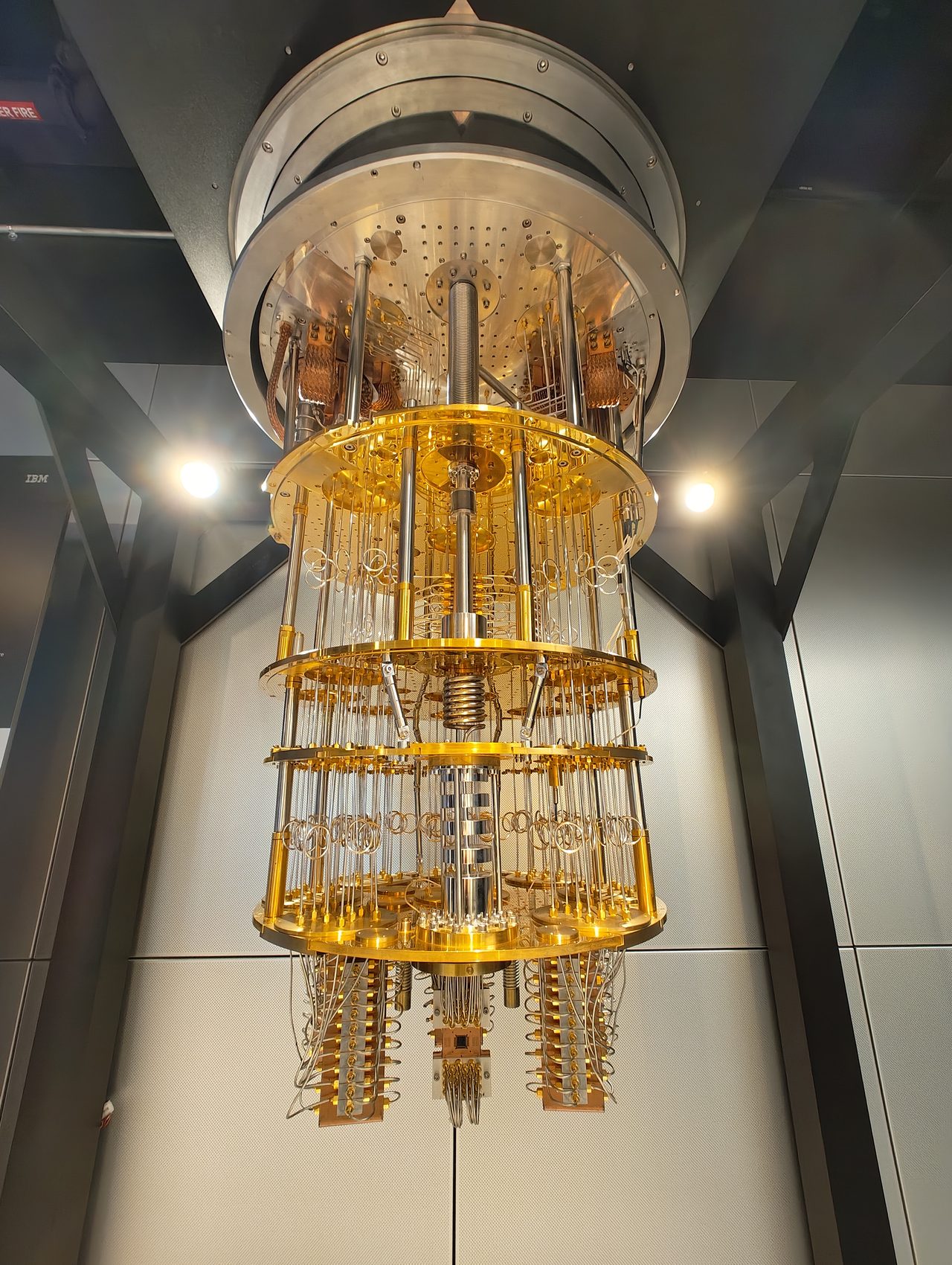
This is the hardware inside the 15-millikelvin figure above: a real machine, not a metaphor for cold.
Trapped-ion qubits are individual electrically charged atoms held in electromagnetic traps and manipulated with laser pulses. The platform's historic advantage is accuracy: its gate operations have been the most faithful of any approach, at around 99.9 percent, bought at the cost of speed, with gates measured in microseconds rather than nanoseconds. IonQ and Quantinuum, formerly Honeywell, are the leading builders.
Our own research document's trapped-ion figures have aged, and this article states the newer ones because they were independently checked, not because the file says so. In October 2025 IonQ, working with the Oxford Ionics team it had acquired, demonstrated better than 99.99 percent two-qubit gate fidelity, and did it without needing ground-state cooling. In November 2025 Quantinuum launched Helios, an all-to-all-connected ytterbium-ion processor reporting 99.921 percent two-qubit fidelity across all 98 qubit pairs, with coherence times measured in seconds to minutes. Those are the kind of numbers the threshold theorem cares about.
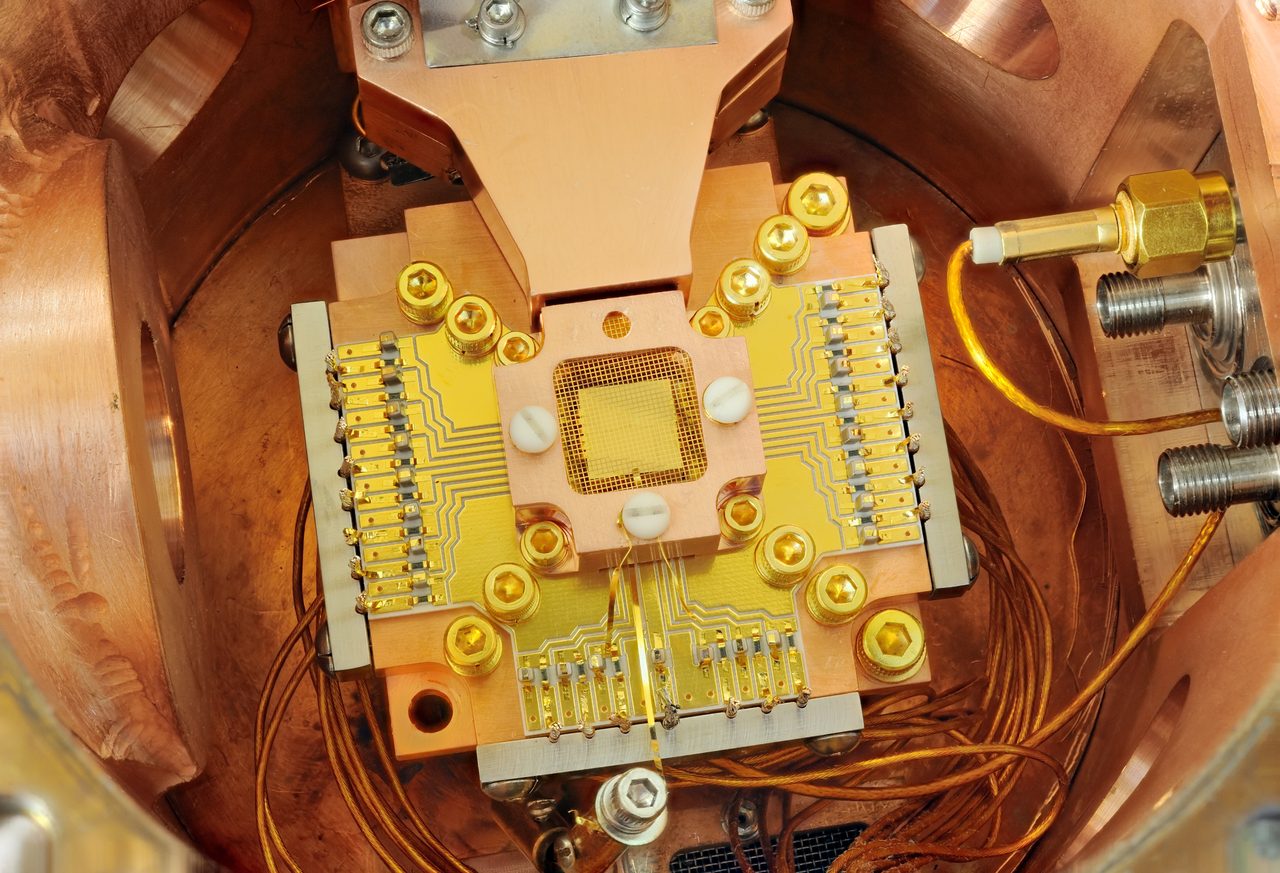
The apparatus predates the 2025 fidelity records above; the physics it demonstrates is unchanged.
Photonic qubits encode information in the polarization or the path of individual photons. The platform runs at room temperature, which removes the cryogenics problem entirely, is naturally suited to carrying quantum information over a distance, and computes through a measurement-based approach rather than a sequence of gates on a static register. PsiQuantum and Xanadu are the leading builders.
Neutral-atom qubits are individual uncharged atoms held in optical tweezers or optical lattices, made to interact by exciting them into high-energy Rydberg states. The platform is fast-scaling and highly reconfigurable, and it has passed 1,000 qubits. QuEra, Pasqal, and Atom Computing are the leading builders. Two named systems make the scale checkable: QuEra's Aquila operates up to 256 qubits in analog mode using Rydberg interactions and optical-tweezer arrays, and Pasqal's platform has demonstrated more than 100 qubits in analog mode.
Those last two sentences are deliberately kept apart. A platform ceiling and a particular machine's published operating figure are different claims, and the gap between them is where a great deal of quantum-computing reporting quietly goes wrong. The platform has passed a thousand qubits. The named systems our sources can point at run at 256 and at more than 100, in analog mode. Both statements are true, and neither one substitutes for the other.
The fifth approach would be the most elegant of all if it worked. Topological qubits would store information not in the state of any single particle but in the braiding pattern of exotic quasiparticles, non-abelian anyons, of which Majorana zero modes are the sought-after example. Because the information would live in the topology rather than in a local property, it is theoretically the most error-resistant qubit encoding possible. On February 19, 2025, Microsoft announced Majorana 1, described as the first quantum processor built on eight such topological qubits, with a companion paper in Nature. That claim is under serious, named, published dispute. The physicist Henry Legg and others argue that Microsoft's own topological gap protocol can be fooled by non-topological doppelganger signatures that look the same in the data. Winfried Hensinger of the University of Sussex states that the peer-reviewed paper itself contains no proof for topological qubits. And Microsoft made, and later retracted, a similar claim in 2018. This file records the announcement, records the dispute, and crowns neither. What it will not do is list Majorana 1 as a fifth working platform beside the four above, because the field has not agreed that it is one.
| Platform | How the Qubit Is Made | The Trade-Off | Leading Builders |
|---|---|---|---|
| Superconducting | Josephson-junction circuits at about 15 millikelvin, driven by microwave pulses | Most advanced by qubit count, past 1,000, and fastest gates at around 20 nanoseconds | IBM, Google, Rigetti |
| Trapped Ion | Individual ions held in electromagnetic traps, driven by laser pulses | Historically the highest gate fidelity at about 99.9 percent, at microsecond gate speeds. 2025 results reached better than 99.99 percent | IonQ, Quantinuum (formerly Honeywell) |
| Photonic | Information carried in the polarization or path of single photons | Room temperature, no cryogenics, suited to distance; computes by measurement rather than gate sequences | PsiQuantum, Xanadu |
| Neutral Atom | Individual atoms in optical tweezers or lattices, interacting through Rydberg states | Fast-scaling and highly reconfigurable, past 1,000 qubits. Named systems: Aquila up to 256 qubits in analog mode | QuEra, Pasqal, Atom Computing |
| Topological (Announced, Disputed) | Braiding of non-abelian anyons, with information stored in the topology rather than in a particle | Theoretically the most error-resistant encoding possible. Microsoft's Majorana 1, February 19, 2025, is disputed by named physicists, and Microsoft retracted a similar 2018 claim | Microsoft (claim contested) |
04What the Machines Have Actually Done
Four results define the public record of quantum computing. Every one of them is more interesting after the argument about it than before, which is why this section states the argument as carefully as the result.
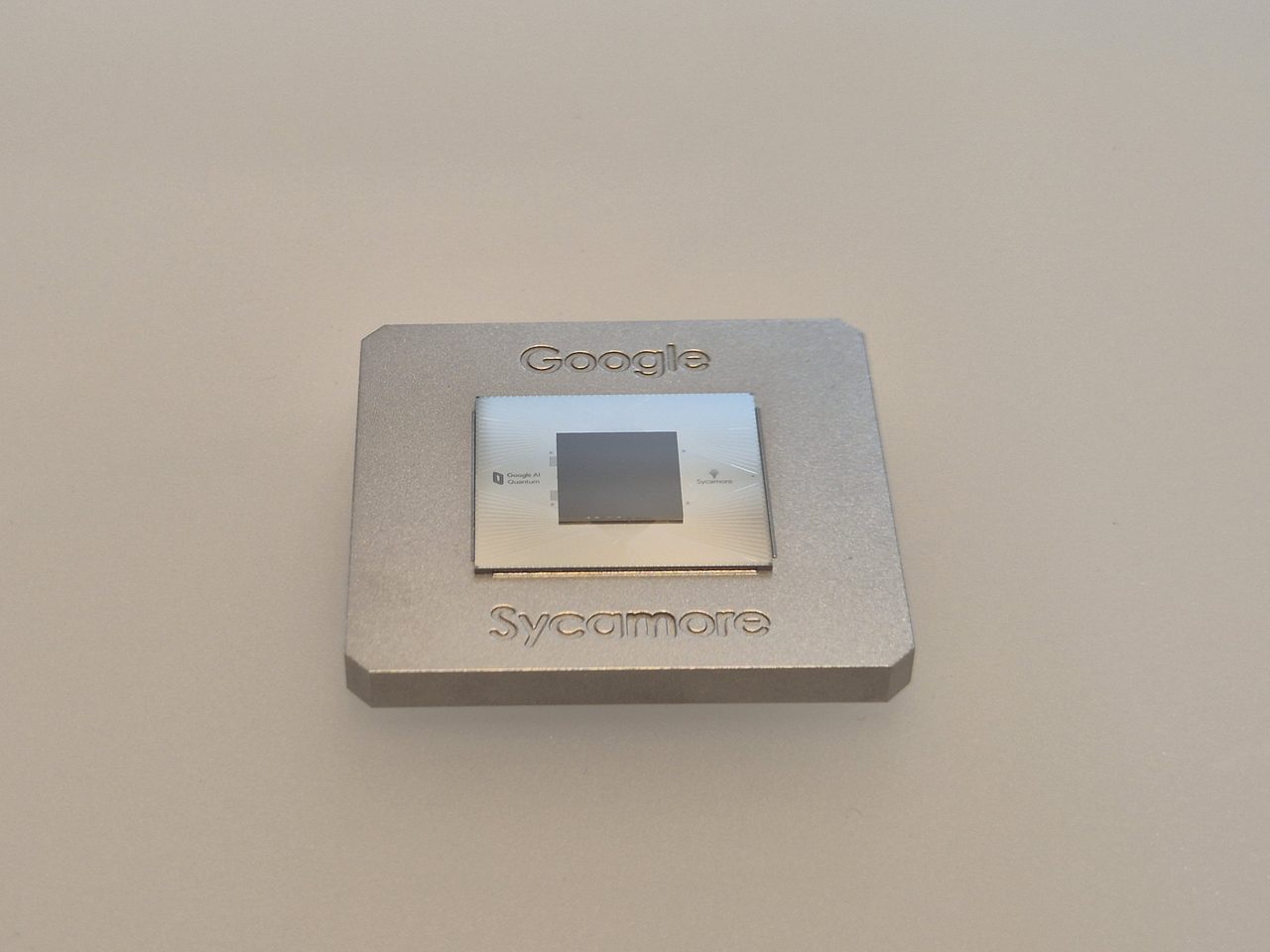
In 2019 Google's 53-qubit Sycamore processor performed a specific sampling task in about 200 seconds. Google's team, publishing in Nature, claimed that a classical supercomputer would need roughly 10,000 years to reproduce it, and called the result quantum supremacy. That estimate did not survive contact with IBM, which publicly disputed it and argued that the same task could be simulated classically in about 2.5 days with a better algorithm and more storage. A group led by Pan Jianwei at USTC later demonstrated further improvements in classical simulation, narrowing the gap again. What is verified here is the run: 53 qubits, about 200 seconds, published as Arute and colleagues in Nature, volume 574, pages 505 to 510, in 2019. The 10,000-year figure is a contested estimate, not a measurement, and this file does not repeat it as fact. One footnote on that citation, because the point of this file is that sourcing is checkable: our own research document lists a DOI for that paper which resolves to Nature's news story about the result rather than to the research paper itself. The link in the sources below points at the paper.
In December 2020 a team at USTC led by Pan Jianwei answered with entirely different hardware. Jiuzhang, a 76-photon photonic quantum computer, performed Gaussian boson sampling in about 200 seconds, a task estimated at the time to take the Sunway TaihuLight supercomputer about 2.5 billion years. Photons rather than superconducting circuits, and no refrigerator. Two things belong in the same breath as that number. The first is that this was published in Science and stands as an independent demonstration on a second physical platform, which matters more than the size of the speedup. The second is that Gaussian boson sampling has no known practical application. It is a problem chosen because it is hard for classical computers, not because anybody needed the answer.
On December 4, 2023, at the IBM Quantum Summit, IBM unveiled Condor: 1,121 superconducting qubits on a single chip, built on the company's heavy-hexagonal architecture, and the first quantum chip to exceed 1,000 qubits. IBM said in the same announcement that it would now prioritize error resistance over further growth in raw qubit count, which is the most informative sentence in the whole release. The company that had just won the qubit-count race said the qubit-count race was not the one that mattered.
Put Condor's 1,121 physical qubits beside the surface code's requirement of roughly 1,000 to 10,000 physical qubits per logical qubit, and the shape of the problem is visible without any interpretation at all. The largest chip our sources can point at lands at the very bottom of the range estimated for a single error-corrected qubit. And the comparison is generous to the hardware, because those physical qubits also have to be good enough to clear the error threshold before the code helps rather than hurts. Which is precisely what the next result was about.
On December 9, 2024, Google announced Willow, a 105-qubit superconducting processor, and the part of the announcement that matters is not the part that got quoted. Willow demonstrated below-threshold quantum error correction for the first time: as the array scaled from a 3x3 to a 5x5 to a 7x7 grid, the logical error rate fell exponentially rather than rising. Adding more physical qubits made the encoded qubit better instead of worse, which is the behaviour the threshold theorem predicts and which nobody had shown across scaling before. Google also reported that Willow completed a standard benchmark computation in under five minutes that the company estimated a classical supercomputer would take roughly 1025 years to match. That second figure is Google's own estimate, of exactly the kind that was contested in 2019, and this file states it as an estimate and leaves it there. The error-correction result is the one that changes anything.
| Result | Date | What Was Achieved | Where the Claim Stands |
|---|---|---|---|
| Sycamore, Google, 53 superconducting qubits | 2019 | A specific sampling task in about 200 seconds | Google claimed roughly 10,000 classical years. IBM argued about 2.5 days with a better algorithm and more storage, and a USTC group narrowed the gap further. The run is verified, the estimate is contested |
| Jiuzhang, USTC, 76 photons | December 2020 | Gaussian boson sampling in about 200 seconds | Estimated at the time at about 2.5 billion years for Sunway TaihuLight. An independent second platform, and a task with no known practical application |
| Condor, IBM, 1,121 superconducting qubits | December 4, 2023 | First quantum chip past 1,000 qubits, on a heavy-hexagonal architecture | IBM stated it would prioritize error resistance over raw qubit count from there on |
| Willow, Google, 105 superconducting qubits | December 9, 2024 | Below-threshold error correction for the first time: logical error rate falling exponentially as the array scaled from 3x3 to 5x5 to 7x7 | The error-correction result is the substantive one. The accompanying 10^25-year benchmark figure is Google's own estimate |
| A commercially relevant problem | Not yet | Nothing to report | No quantum computer has outperformed a classical computer on a commercially relevant problem |
One sentence carries more weight than the entire milestone list above it, and our own research file states it without softening. Quantum supremacy, or quantum advantage, has so far been demonstrated only for artificial, specially designed sampling problems with no known practical use. No quantum computer has outperformed a classical computer on a commercially relevant problem. Not one, on any platform, anywhere. That is not a hedge and it is not pessimism. It is the mainstream position of the field, and every genuine achievement above sits underneath it.
The field has a precise name for where it is, and it was not coined by a marketing department. In 2018 the physicist John Preskill published "Quantum Computing in the NISQ Era and Beyond" in the journal Quantum, introducing NISQ: Noisy Intermediate-Scale Quantum. It describes processors in the range of fifty to a few hundred qubits, large enough to show genuine quantum behaviour and noisy enough that imperfect qubit control limits what they can reliably compute. Raw qubit counts have since passed the top of that band, as Condor shows. The constraint the term actually names, noise limiting what a machine can be trusted to compute, is the one still standing. The physicist who coined it was not lowering expectations. He was naming the era accurately, so the next one could be recognized when it arrived.
05The Algorithms, and What They Are For
A quantum computer is not useful because it is quantum. It is useful only where somebody has worked out an algorithm that exploits interference for a specific problem, and the list of such algorithms is short, old, and famous.
The founding idea came from Richard Feynman in 1982, in a paper called "Simulating Physics with Computers" in the International Journal of Theoretical Physics. His observation was not about speed. It was that a classical computer cannot efficiently represent a quantum system at all once that system passes roughly fifty particles, and that the natural instrument for simulating a quantum system is therefore another quantum system. Molecules and materials are quantum systems. Quantum simulation, rather than anything to do with codes, is the application that follows most directly from the physics.
The result that turned quantum computing from a curiosity into a funded field came from Peter Shor in 1994. Shor's algorithm factors large integers into their primes with an exponential speedup over the best classical methods known. It was published as "Algorithms for Quantum Computation: Discrete Logarithms and Factoring" in the proceedings of the 35th Annual IEEE Symposium on Foundations of Computer Science, pages 124 to 134, and expanded into a full paper in the SIAM Journal on Computing in 1997. Factoring became the textbook case for quantum advantage for a straightforward reason: it is a problem where no classical method is known that does the job efficiently, and the quantum route is exponentially shorter.
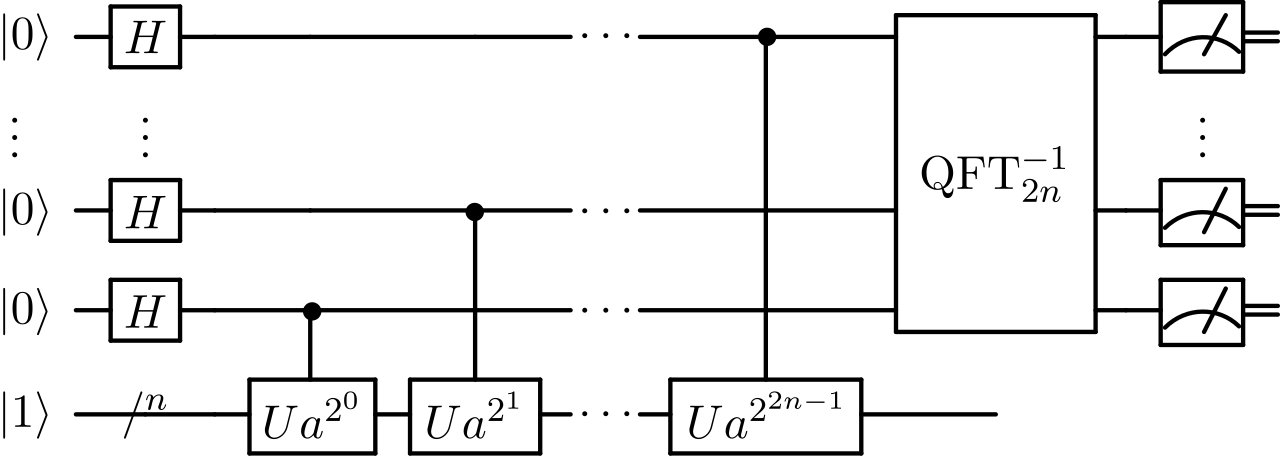
This is what the algorithm looks like as a program, not as a claim about what it threatens.
Factoring is not an academic exercise, which is why this is the algorithm everybody has heard of. RSA public-key encryption, which a large enough fault-tolerant quantum computer running Shor's algorithm would break, underlies a very large share of ordinary internet security: banking, e-commerce, and the TLS connections behind everyday web traffic. Our own research file puts a figure on that, roughly three trillion dollars of daily commerce, and this article states it as the file's own order-of-magnitude estimate rather than a sourced number, because independent checking confirmed RSA's foundational role and did not turn up a primary source for that precise figure. Trillions of dollars a day is the honest form of the claim. The response is already in motion: NIST finalized its first three post-quantum cryptography standards on August 13, 2024, after an eight-year evaluation, as FIPS 203, FIPS 204, and FIPS 205. What that migration involves, and how urgent it is, is a different subject and belongs to its own file. Here, Shor's algorithm is what it was in 1994: proof that a quantum computer could do something no classical computer is known to do efficiently.
The second famous algorithm is quieter and far more general. Grover's algorithm, published by Lov Grover in 1996, searches an unsorted database of N items in roughly the square root of N steps instead of N. That is a quadratic speedup, not an exponential one. Both are real, and they are not the same size of claim, which is worth stating plainly because the two are routinely reported under the same word.
The two algorithms designed for the machines that actually exist are less famous and more honest about their constraints. The variational quantum eigenvalue solver, VQE, from Peruzzo and colleagues in 2014, estimates the ground-state energy of a molecule. The Quantum Approximate Optimization Algorithm, QAOA, from Farhi and colleagues in the same year, produces approximate solutions to combinatorial optimization problems. Both are hybrids: a noisy quantum processor does one part of the work and a classical computer does the rest, and the division of labour is chosen specifically so that NISQ-era hardware can contribute at all. Whether QAOA delivers a genuine quantum advantage is still debated, and this file leaves that open because the field has.
| Algorithm | Who and When | What It Does | The Size of the Claim |
|---|---|---|---|
| Quantum Simulation | Richard Feynman, 1982 | Simulates quantum systems such as molecules and materials, which classical computers cannot efficiently represent past roughly 50 particles | The application that follows most directly from the physics |
| Shor's Algorithm | Peter Shor, 1994 | Factors large integers into their primes | Exponential speedup over the best known classical methods |
| Grover's Algorithm | Lov Grover, 1996 | Searches an unsorted database of N items in roughly the square root of N steps | Quadratic speedup, not exponential |
| VQE | Peruzzo et al., 2014 | Estimates a molecule's ground-state energy, hybrid quantum and classical | Built for today's noisy hardware |
| QAOA | Farhi et al., 2014 | Approximates solutions to combinatorial optimization problems, hybrid quantum and classical | Built for today's noisy hardware, and its real quantum advantage is still debated |
06What a Quantum Computer Is Not
Almost every popular claim about these machines that turns out to be wrong is a version of one mistake: treating a quantum computer as a fast computer.
Quantum computers are not universally faster than classical computers. They offer an advantage only for specific problem classes where somebody has engineered an algorithm to exploit interference; for everything else, which is nearly everything, a classical machine remains better and cheaper. The parallelism is not brute force. A quantum computer does not check every possibility simultaneously and report the winner, it arranges for the wrong possibilities to cancel, and an algorithm has to be deliberately built to make that happen. The expectation in the field is that these machines will work as specialized co-processors, the way a GPU does, sitting alongside classical computers rather than replacing them. And there is no proof that a quantum computer can solve NP-complete problems in polynomial time: BQP, the complexity class quantum computers work in, is not believed to be equal to NP.
None of that reduces the achievement. It relocates it. What is being built is not a better version of the computer anybody already owns. It is a narrow instrument for a small set of problems that happen to be extremely valuable, and the narrowness is a fact about the physics rather than a stage the technology is going to grow out of.
07Is Any of This Going to Work
Which leaves the question the field is genuinely arguing about, and it is not a fringe argument. It is being had in mathematics journals, in public debate, and between people who are in no sense outsiders.
Gil Kalai, of the Hebrew University, has argued for years that fault-tolerant quantum computing will not work at useful scale. His case is not that quantum mechanics is wrong. It is that noise in physical qubit systems may scale with the complexity of the computation in a way that prevents error correction from ever succeeding in a machine large enough to matter, so that the threshold is never actually reachable in practice. He set it out in "The Quantum Computer Puzzle" in the Notices of the American Mathematical Society, volume 63, pages 508 to 516, in 2016, and has pressed it in public debate with Scott Aaronson of the University of Texas at Austin. This is a serious, named, ongoing academic position, and filing it as a fringe claim would be a failure of this file's own standard.
Aaronson's counter-position is the one most of the field holds: no known physical principle rules out fault-tolerant quantum computing. That sentence deserves to be read as carefully as it was written. It does not say the machine will be built. It says nothing in the physics forbids it, which leaves the question sitting in engineering rather than in principle, and engineering questions get answered by hardware rather than by argument.
Mikhail Dyakonov has made a blunter version of the same objection, calling useful-scale quantum computing a mirage. His argument is that the state space of a quantum machine is exponentially large, and that the number of ways it can go wrong grows with it, so errors grow uncontrollably as systems scale. This file carries that at Tier 2 rather than Tier 1 for a specific reason: the sourcing pass could confirm the physicist and the position, but could not pin this exact claim to a particular citable paper and venue the way it could for Kalai. The argument deserves stating. The citation deserves the caveat.
The mainstream response has three parts, and only the first of them is new. Google's Willow result of December 2024 is the first real evidence against a fundamental noise-scaling barrier: the logical error rate went down exponentially as the code got larger, which is the behaviour the skeptical argument says should not survive scaling. Second, four independent hardware platforms are making simultaneous progress on genuinely different physics, so the enterprise does not depend on any single fragile technology turning out to be the right one. Third, even if universal fault-tolerant quantum computing takes twenty years or more, other near-term quantum technologies outside computing already have real value today, and this file leaves those to the articles that own them.
That first point is the strongest card the optimists hold, and it should be read at its actual size. Willow is one chip, in one laboratory, running one error-correcting code, at a scale far below what a useful machine would need, and the skeptical claim is specifically a claim about what happens at scale. Below-threshold scaling on a 7x7 grid is evidence against the barrier. It is not the absence of the barrier. Both of those sentences have to be held at the same time, and the disagreement between them is not going to be settled by anybody's argument. It will be settled by the next few orders of magnitude of hardware, or by their failure to arrive.
Fast Facts
- The Qubit
- A superposition |psi> = alpha|0> + beta|1>, with complex amplitudes that interfere. Not a bit whose definite value merely happens to be unknown
- The Hard Limit
- The no-cloning theorem: an unknown quantum state cannot be copied. No classical analogue exists
- The Nobel
- Physics, 2022: Aspect, Clauser, and Zeilinger, for entangled-photon experiments establishing the violation of Bell inequalities
- The Enemy
- Decoherence. Coherence runs about 100 microseconds for superconducting qubits, seconds to minutes for trapped ions, hours for some nuclear spins
- The Overhead
- Roughly 1,000 to 10,000 physical qubits per logical qubit under the surface code, and per-operation error below about 0.1 to 1 percent to clear the threshold
- The Platforms
- Superconducting, trapped ion, photonic, and neutral atom, all working. Topological announced by Microsoft on February 19, 2025, and disputed
- The Milestones
- Sycamore 2019, Jiuzhang December 2020, Condor December 2023, Willow December 2024
- The Disputed Number
- Google's roughly 10,000 classical years for Sycamore, against IBM's about 2.5 days with a better algorithm and more storage
- The Result That Mattered Most
- Willow, December 9, 2024: below-threshold error correction, the logical error rate falling exponentially as the array scaled from 3x3 to 5x5 to 7x7
- The Era
- NISQ, Noisy Intermediate-Scale Quantum, named by John Preskill in 2018
- The Algorithms
- Feynman's simulation (1982), Shor's factoring (1994), Grover's search (1996), and the hybrids built for noisy hardware, VQE and QAOA (both 2014)
- The Named Skeptics
- Gil Kalai, in the Notices of the American Mathematical Society in 2016, and Mikhail Dyakonov, carried here at Tier 2
- What No Quantum Computer Has Done
- Outperformed a classical computer on a commercially relevant problem
- What Is Not Supported
- That quantum computers are universally faster, that they solve NP-complete problems in polynomial time, or that entanglement sends information faster than light
What We Can Actually Stand Behind
The physics is settled and it is not in the speculative column. Superposition, the no-cloning theorem, entanglement, and interference are standard quantum mechanics, and entanglement in particular has been tested to the point of a Nobel Prize: Aspect, Clauser, and Zeilinger shared the 2022 Physics prize for entangled-photon experiments establishing the violation of Bell inequalities, following Bell's 1964 theorem and experiments in 1972, 1982, and 2015. Nothing in this article's uncertainty is uncertainty about whether quantum mechanics works.
The hardware is real and its record carries dates. Sycamore ran a sampling task in about 200 seconds in 2019. Jiuzhang did Gaussian boson sampling on 76 photons in about 200 seconds in December 2020. IBM's Condor passed a thousand qubits at 1,121 on December 4, 2023. Google's Willow demonstrated below-threshold error correction for the first time on December 9, 2024, the logical error rate falling exponentially as the array scaled from 3x3 to 5x5 to 7x7. In 2025 trapped-ion fidelities went past 99.99 percent at IonQ and reached 99.921 percent across all 98 qubit pairs on Quantinuum's Helios. These are measurements, not projections.
The supremacy milestones were achieved on artificial, specially designed sampling problems with no known practical use, and the classical-time comparisons attached to them are contested. Google's 10,000 years for Sycamore was answered by IBM with about 2.5 days given a better algorithm and more storage, and narrowed again by a USTC group. Willow's 1025-year benchmark figure is Google's own estimate, of the same kind. The runs are verified. The comparisons are claims, and this file states them as claims.
The size of the remaining gap is in our own sources. The surface code is estimated to need roughly 1,000 to 10,000 physical qubits for one logical qubit, and per-operation error below about 0.1 to 1 percent before correction helps at all. The largest chip our sources can point at holds 1,121 physical qubits. Superconducting coherence runs about 100 microseconds. The accurate name for this era is still the one John Preskill gave it in 2018: NISQ, Noisy Intermediate-Scale Quantum.
Gil Kalai has argued, in the Notices of the American Mathematical Society in 2016 and in public debate with Scott Aaronson, that noise may scale with complexity in a way that prevents fault-tolerant error correction from ever working at useful scale. That is a serious academic position and this file does not dismiss it. Aaronson's counter is equally precise: no known physical principle rules out fault-tolerant quantum computing, which is a statement about permission rather than about delivery. Willow's below-threshold result is the first real evidence against a fundamental barrier, and it is one chip at a scale far below the regime the argument is actually about.
Mikhail Dyakonov's version of the objection, that useful-scale quantum computing is a mirage because errors grow uncontrollably with an exponentially large state space, is carried here at Tier 2 rather than Tier 1. The physicist and the position were confirmed. A specific citable paper and venue for this exact claim was not, the way it was for Kalai. The argument stands, with its sourcing stated honestly.
Microsoft's Majorana 1, announced on February 19, 2025 as the first processor built on eight topological qubits with a companion paper in Nature, is not treated in this file as a fifth working platform. Henry Legg and others argue the topological gap protocol can be fooled by non-topological doppelganger signatures. Winfried Hensinger of the University of Sussex states the peer-reviewed paper contains no proof for topological qubits. And Microsoft made and retracted a similar claim in 2018. Claimed, disputed, unresolved, and recorded as all three.
No, a general-purpose, fault-tolerant quantum computer that reliably outperforms classical computers on broadly useful, commercially relevant problems does not exist. Not at IBM, not at Google, not at any of the trapped-ion, photonic, or neutral-atom companies, not anywhere. Quantum advantage has been demonstrated only on artificial sampling problems with no known practical use, and no quantum computer has beaten a classical one on a commercially relevant problem. That is our own research file's plain statement, it is the mainstream position of the field, and everything real in this article sits underneath it.
No, a quantum computer is not a faster computer. It offers an advantage only for specific problem classes with algorithms engineered to exploit interference, and it is expected to work as a specialized co-processor alongside classical machines rather than as a replacement for them. Its parallelism is interference, not brute-force checking of every possibility at once. And there is no proof that quantum computers can solve NP-complete problems in polynomial time, since BQP is not believed to be equal to NP.
And no, entanglement does not transmit information faster than light. The correlations only become apparent once the two sets of measurement results are compared, and that comparison travels down an ordinary classical channel at ordinary light-limited speed. Everything genuinely strange in this article is strange without breaking that limit.
So the file closes on a machine that half exists. The physics behind it is finished work, tested to Nobel standard and disputed by nobody. The hardware is real: four platforms built on different physics, thousands of physical qubits, named chips with announcement dates, and in December 2024 the first demonstration that error correction can be made to improve as it grows instead of collapsing under its own overhead. And the thing all of it is for has not happened. No quantum computer has beaten a classical computer at a problem anybody needed solved, and the accurate name for where the field stands is still the one it was given in 2018: noisy, intermediate-scale, and not yet the machine. Between here and that machine sit two things. One is a number, the thousand to ten thousand physical qubits it may take to build a single reliable logical one, against the largest chip our sources can point at, 1,121. The other is a live disagreement, argued by named people in real journals, about whether the noise gets worse faster than the correction gets better. Willow is one result on the optimists' side of that disagreement. It is genuine, and it is small. Which leaves the question this wing keeps arriving at from every direction. If nothing in the physics forbids a machine and the engineering has not yet produced one, at what point does "not yet" stop being a status report and start being an answer?
Sources & further reading
Everything above is drawn from our research library on Theories of Anything, cross-checked against the primary sources named in the text, with the 2025 hardware figures and the Majorana 1 dispute re-verified against original reporting. Full bibliographic details for every source appear in the article itself; the links below are the ones carrying stable public identifiers. Open the full file to check the sourcing and go deeper.
Image credits
- Engineers working on an IBM Quantum System One installation, Ehningen, Germany IBM Research / Holger Muench, via Wikimedia Commons (CC BY 2.0). CC BY 2.0 Source.
- IBM Quantum System One dilution refrigerator Onri Jay Benally, via Wikimedia Commons (CC BY 4.0). CC BY 4.0 Source.
- NIST trapped-ion quantum computing apparatus National Institute of Standards and Technology, via Wikimedia Commons (Public Domain). Public Domain (17 U.S.C. 105) Source.
- Google's Sycamore quantum processor chip, Deutsches Museum Coldupnorth, via Wikimedia Commons (CC BY-SA 4.0). CC BY-SA 4.0 Source.
- Quantum circuit diagram, Shor's algorithm order-finding subroutine Bender2k14, via Wikimedia Commons (CC BY-SA 4.0). CC BY-SA 4.0 Source.
- Card crop of the IBM Quantum System One installation IBM Research / Holger Muench, via Wikimedia Commons (CC BY 2.0). CC BY 2.0
_installation.jpg)

.jpg)

