
The Hard Problem: Why Does Any of This Feel Like Anything?
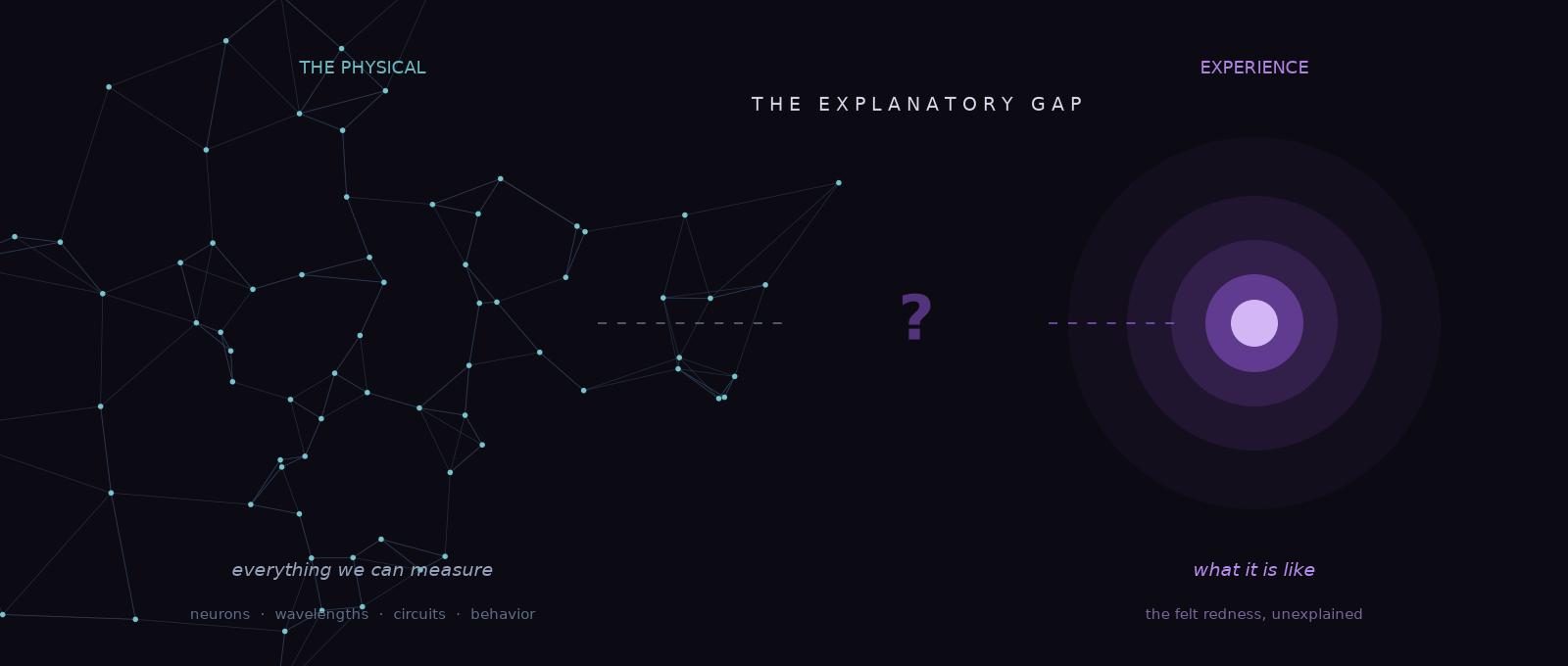
Something is reading these words right now, and there is something it is like to be you doing it. That plain fact, that your brain does not process light and language in the dark but actually experiences them, is the single hardest problem in all of science. We can map every neuron and still not say why any of it is felt. This is the file on the Hard Problem of consciousness, opened argument by argument, each one wearing its evidence, and it ends where the honest science ends: we do not know.
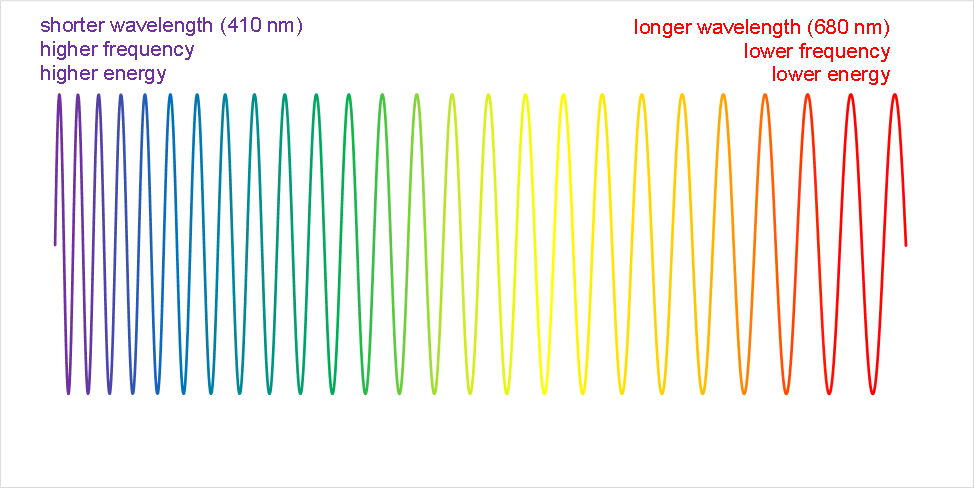
Look at something red. A stop sign, an apple, the inside of your own closed eyelid in bright sun. Now notice that seeing it is not just your eyes registering a wavelength and your mouth being able to say the word. There is a redness to it, a felt quality, something it is like to be you having that experience. Science can trace the light to your retina, the signal to your visual cortex, the word to your lips. What it cannot yet do is say why any of that machinery is accompanied by an experience at all, rather than running along in the dark like a very good camera that feels nothing. That gap, between everything we can explain about the brain and the one thing we cannot, is what the philosopher David Chalmers named the Hard Problem. Let's open the file.
01The Easy Problems and the Hard One
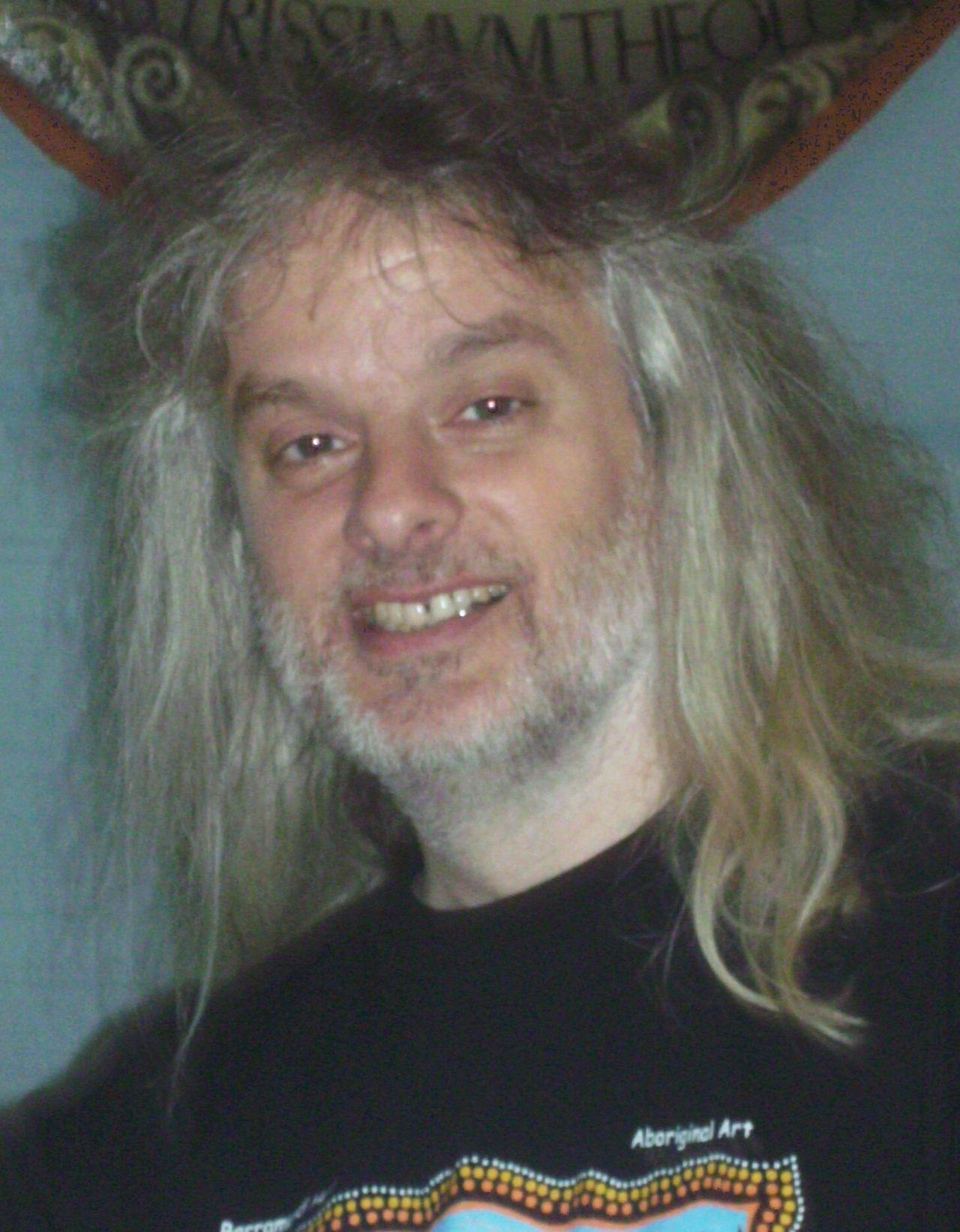
In a 1995 paper with the deceptively calm title Facing Up to the Problem of Consciousness, Chalmers drew a line that has organized the field ever since. On one side sit the easy problems: how the brain discriminates one stimulus from another, how it integrates information, how it produces speech, focuses attention, controls behavior. These are called easy not because they are simple, some will take another century, but because we already know what a solution would look like. It looks like a mechanism: a circuit, a computation, a process you could in principle build.
On the other side sits the Hard Problem, and it is a single question: why is there subjective experience at all? Why does any of that neural processing feel like something from the inside? You could give a complete, flawless, neuron-by-neuron account of everything the brain does when a person sees red, and still not have answered why that person has an experience of red rather than processing the wavelength with no inner life whatsoever. The easy problems ask how the brain works. The Hard Problem asks why the working is accompanied by a felt point of view.
The philosopher Joseph Levine gave the difficulty its sharpest name in 1983: the explanatory gap. Suppose we one day pin down the exact neural correlate of seeing red, say, a particular pattern of firing in a visual area. We would still be left staring at a brute fact. Why is that physical pattern accompanied by that particular quality, the specific redness, rather than some other quality, or none? Compare a real scientific identity like water being H2O. Once you understand the chemistry, there is nothing left over to explain: being H2O is just what water is, all the way down. The identity of a brain state and an experience does not feel like that. The correlation can be perfect and the explanation still seems to be missing.
That missing piece is the whole subject of this article. Everything below is either an attempt to prove the gap is real and unbridgeable, an attempt to argue it away as an illusion, or an attempt to build a bridge across it. On the deepest version of the question there is, honestly, no winner yet.
02The Zombie Argument
The single most famous weapon in this fight is a thought experiment about a being that does not exist and, on most views, never could. It is worth following carefully, because its whole force is in the logic, not the monster.
A philosophical zombie, a p-zombie, is a being physically and functionally identical to a conscious human. Atom for atom the same, the same neural signals firing, the same behavior, the same words. If you asked it about its feelings it would answer exactly as you would. The only difference is that there is nothing it is like to be it. No inner experience, no qualia, no felt redness. The lights are off and yet the whole house runs. The argument's first premise is simply that such a being is conceivable: we can imagine it coherently, and there is no hidden contradiction in the idea the way there is in a four-sided triangle.
The second premise is the load-bearing one, and the most contested. It says that if something is ideally conceivable, coherent after full and careful reflection rather than just a quick intuition, then it is metaphysically possible: it could exist in some possible world, even if not in ours. Chalmers backs this step with a technical apparatus called two-dimensional semantics, the claim that our concepts of experience pick out the same property across every possible world, so that if a zombie is genuinely conceivable, a zombie is genuinely possible.
The third premise is what physicalism, the view that reality is at bottom entirely physical, actually commits you to: that all the facts, consciousness included, are fixed by the physical facts. Any world that is physically identical to ours must therefore be identical in every other way too, experience included. Put the three together and the trap closes. If a zombie world, physically just like ours but with no experience anywhere in it, is even possible, then the physical facts do not fix the facts about experience, and physicalism is false. Consciousness would have to be something over and above the physical.
| Premise | What It Claims |
|---|---|
| 1. Conceivability | A being physically identical to you but with no inner experience is coherently imaginable |
| 2. Conceivability to possibility | What is ideally conceivable is metaphysically possible (could exist in some world) |
| 3. Physicalism needs necessitation | If reality is physical, the physical facts must fix all facts, experience included |
| Conclusion | If a zombie world is possible, the physical does not fix experience, so physicalism is false |
One thing the argument never claims is that zombies are real, or that any actually walk around. Nobody is saying your neighbor might be one. The claim is only about possibility, and about what that bare possibility would reveal about the relationship between physical stuff and felt experience. It is a knife aimed at a theory, not a monster aimed at a town.
03Mary, the Bat, and the Colors Only You Can See
The zombie argument has two close cousins, both older, both pointing at the same suspected gap from different angles. This article touches each briefly; the deep version of the color case belongs to its own file, on qualia, still to come in this wing.
Frank Jackson's knowledge argument, from 1982, asks you to imagine Mary, a brilliant scientist who has lived her whole life in a black-and-white room and learned every physical fact there is about color vision: the wavelengths, the cone cells, the neural pathways, the cortical processing, all of it. Then one day she walks outside and sees red for the first time. The question is whether she learns anything new. The strong intuition is that she does: she finally learns what it is like to see red. And if her physical knowledge was already complete, yet she still learned something, then not all the facts are physical facts. Jackson himself later changed his mind and became a physicalist, arguing that Mary gains a new ability rather than a new fact. The thought experiment outlived its own author's belief in it.
Thomas Nagel made the same point from the outside in 1974, in an essay whose title became a slogan: What Is It Like to Be a Bat? A bat navigates by echolocation, a sense we do not have. Nagel's argument is that no amount of physical knowledge about bat brains, every synapse mapped, every firing traced, would ever tell you what echolocation is like from the bat's own point of view. There is a fact there, the subjective character of the bat's experience, that objective physical description seems structurally unable to reach. Nagel drew a cautious conclusion: not that physicalism is false, but that our current physical concepts are not yet up to the job.
Then there is the oldest worry of all, the inverted spectrum. Could your experience of red be what I would call the experience of green, and mine the reverse, with neither of us ever able to tell? If we behave identically, name the same things red, stop at the same lights, and yet the inner quality is flipped, then the quality is not fixed by the function. That possibility, if it holds, is a direct argument that experience floats free of the physical and behavioral facts that are supposed to pin it down.
04The Pushback: Maybe There Is No Hard Problem
It would be dishonest to present the Hard Problem as a settled discovery with only a few holdouts. It is not. Some of the sharpest philosophers alive think the whole thing is a confusion, and their case is serious. This is the part of the story the field argues about most, and the part any honest account has to give real weight.
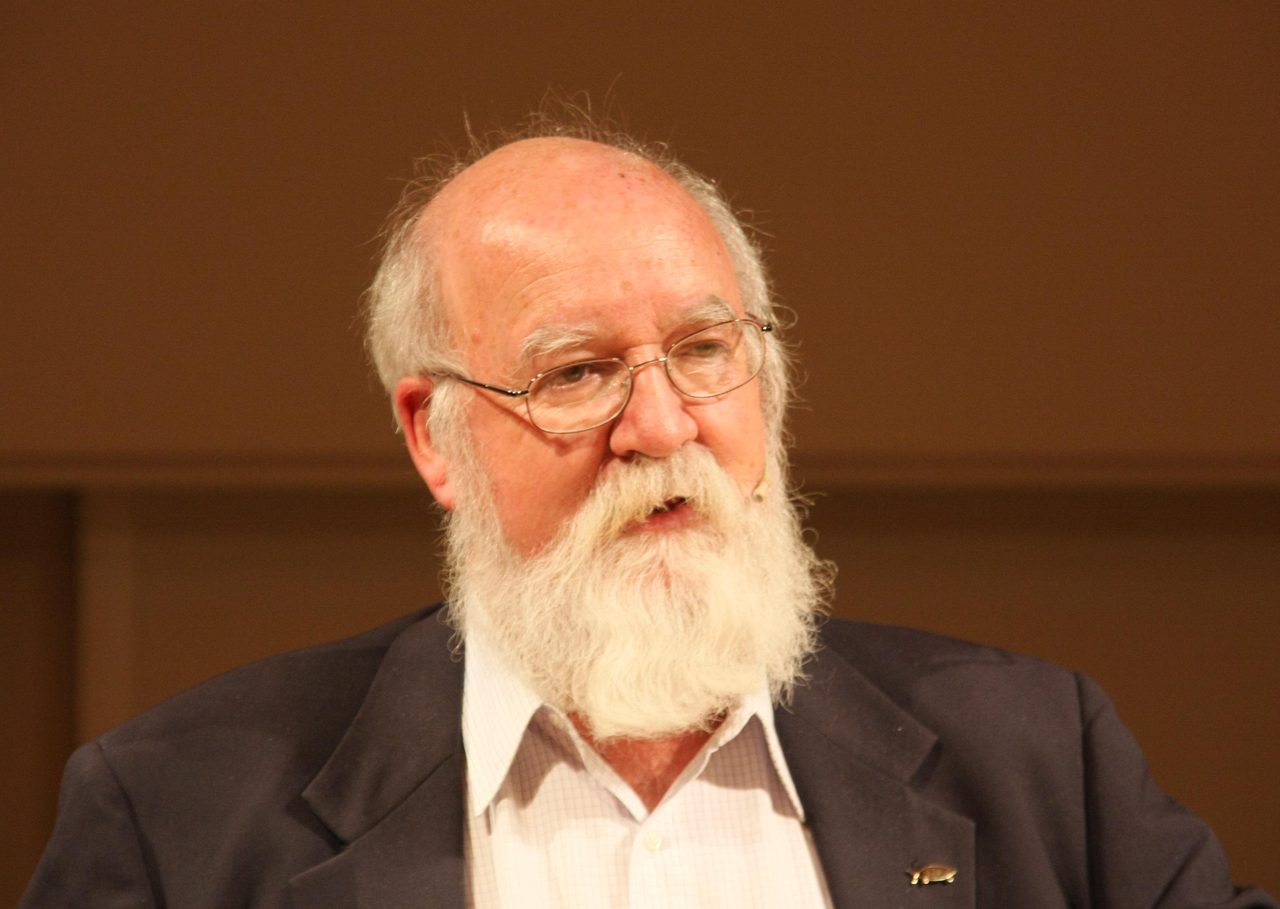
The boldest response is illusionism, associated with Daniel Dennett and Keith Frankish. It denies the zombie argument's very first premise: p-zombies are not actually conceivable, once you are honest about what you are imagining. Dennett's line is that there is no inner theater, no Cartesian stage where experiences are privately screened. Consciousness just is a set of cognitive processes, and once you have explained all of them, the discrimination, the memory, the reports, the reactions, there is nothing left over that you have failed to explain. The sense that something remains, the felt residue, is on this view a kind of user illusion the brain runs on itself. Frankish puts it precisely: experience is real, but it does not have the intrinsic, private, ineffable properties we take it to have. We have quasi-phenomenal states that are fully physical and that merely seem otherwise.
A second response, type-B physicalism, grants that zombies are conceivable but denies that conceivability proves possibility. The classic parallel is water and H2O. Before anyone knew any chemistry, you could easily conceive of water not being H2O; the two ideas came apart in the imagination. But it turned out that water is H2O, necessarily, in every possible world. Conceiving otherwise was a failure of knowledge, not a window onto real possibility. Type-B physicalists say mind and brain may be like that: an identity that is necessary even though we can imagine it failing. Chalmers's counter is that the water case only works because the everyday concept of water was pointing at H2O all along, whereas our concept of an experience points straight at the felt quality itself, so here conceiving really does track possibility.
A third response, the phenomenal concept strategy, tries to have it both ways. It concedes the explanatory gap but says the gap is in our heads, not in the world. The concepts we use to think about our own experiences are special, more like pointing than like describing, this feeling, this quality, and that special way of thinking creates the powerful sense of an unbridgeable divide even though experience is entirely physical. Critics, including Chalmers and Jackson, argue the move is unstable: if those concepts are themselves fully physical, then the zombie, having the same concepts with nothing to point at, would run them empty, which is its own problem.
So the lay of the land is genuinely contested. The Hard Problem is not a fact everyone accepts and then tries to solve. Whether there is a Hard Problem at all is itself one of the live questions.
| Position | Its Move | The Standard Objection |
|---|---|---|
| Illusionism (Dennett, Frankish) | There is no felt residue beyond function; the extra something is an illusion | Denying the datum many find most certain: that experience is happening at all |
| Type-B physicalism | Zombies are conceivable but not possible; mind-brain identity is necessary | Chalmers: for experience, conceivability really does track possibility |
| Phenomenal concept strategy | The gap is in how we think about experience, not in the world | If the concepts are physical, the zombie's versions run empty |
| Property dualism (Chalmers) | Experience is a fundamental feature, tied to the physical by new laws | It has to add something basic to the world's inventory |
05Chalmers's Own Answer
The man who named the Hard Problem does not think it is unanswerable. He thinks the answer requires giving up one comfortable assumption, and he is careful about which one.
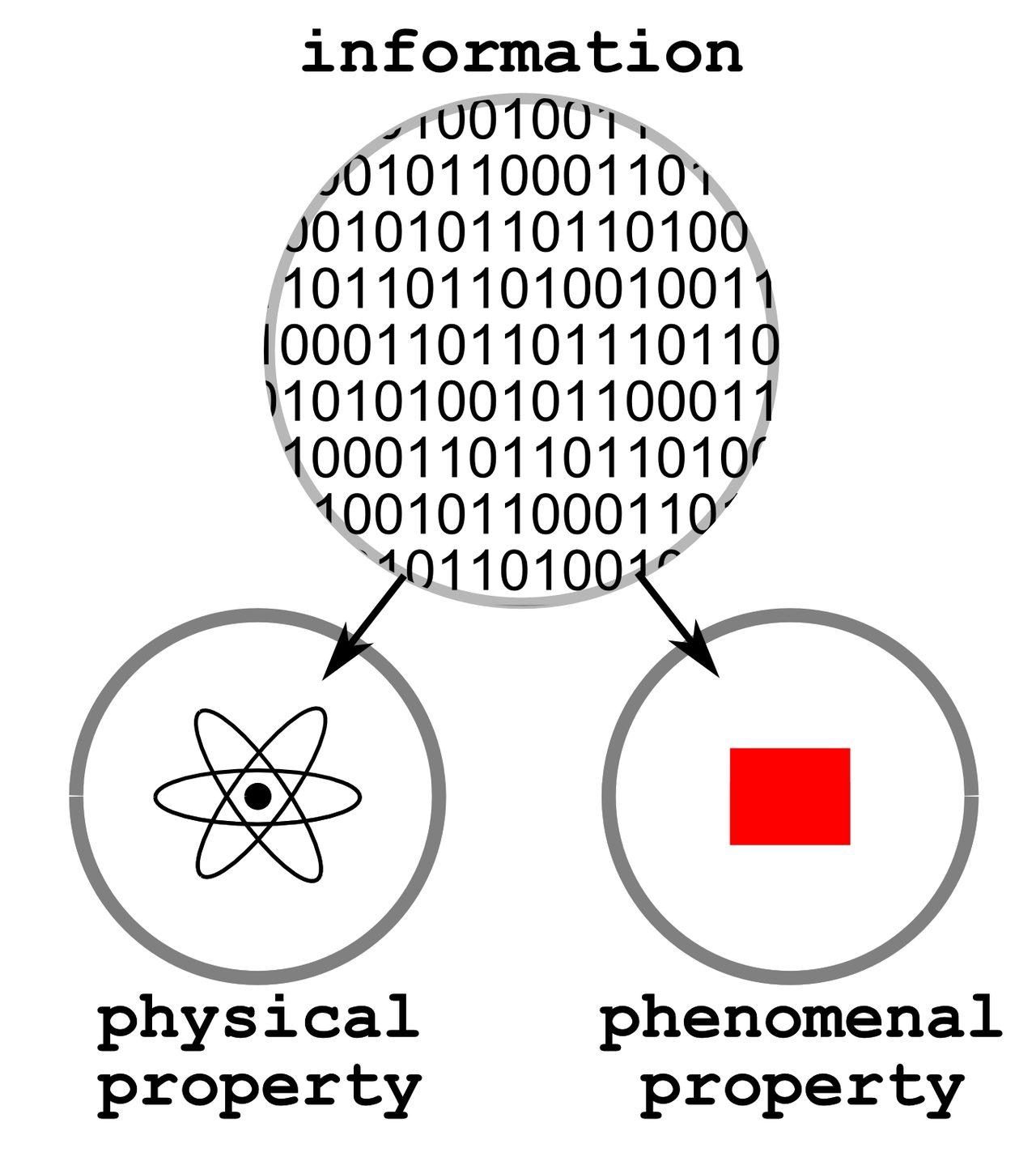
Chalmers's positive view is a form of property dualism. Consciousness, he argues, is a fundamental feature of reality, not reducible to physics but lawfully tied to it. Just as physics posits basic laws relating mass, charge, and space, there would be new fundamental psychophysical laws relating physical processes to experiences. On this picture experience is not spooky and not supernatural; it is basic, an extra thread in the fabric of nature that the physical laws alone do not spell out.
He pairs this with a principle of structural coherence: the structure of a conscious experience mirrors the structure of the information processing underneath it, systematically, as a matter of law rather than lucky accident. And in his more speculative moods he explores panprotopsychism, the idea that the basic constituents of matter carry proto-phenomenal properties, not themselves conscious but capable of combining into consciousness. That would let experience be built up from the ground rather than switched on by magic at some threshold, though how the combining works is a deep unsolved problem in its own right.
06Not a Soul: Why This Is Not Descartes
It is easy to hear all this and conclude that the Hard Problem is just the old religious idea of the soul in new clothes. That is a real misreading, and worth clearing up plainly, because the distinction is the whole point.
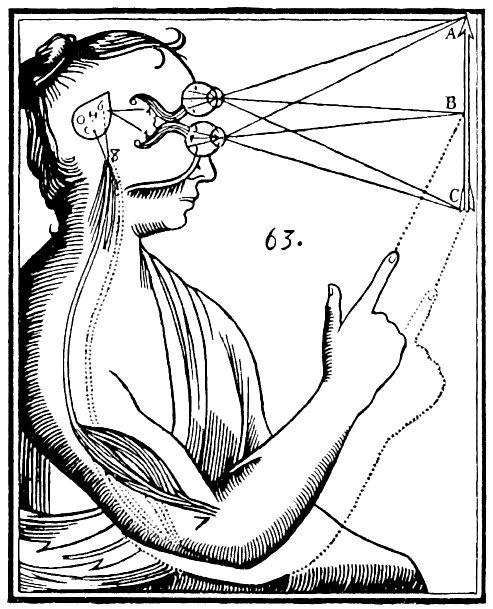
It is a mistake to say the zombie argument, if it works, proves substance dualism, the Descartes picture of a separate immaterial soul that could float free of the body. It does not. At most it establishes property dualism: that phenomenal properties are not physical properties. That is a claim about there being two kinds of property in one world, physical and experiential, tied together by law. There is no ghost, no ectoplasm, no soul that survives the body. Chalmers explicitly rejects substance dualism. Conflating the two is the single most common misunderstanding of the whole debate, and it makes a careful metaphysical position sound like a seance.
07Two Attempts to Dissolve the Problem
Beyond arguing about premises, some thinkers try to make the Hard Problem disappear by rebuilding the furniture of reality so the gap never opens. Two such attempts are worth naming, both genuinely speculative, both taken seriously by real philosophers.
Integrated Information Theory, associated with the neuroscientist Giulio Tononi, comes at the problem backwards. Instead of starting from physics and trying to reach experience, it starts from experience and asks what physical structure it requires. Its answer is a quantity it calls phi, a measure of how much a system's information is integrated, and it makes the striking claim that consciousness simply is integrated information. If that identity held, the zombie argument would collapse: a being with your exact physical structure would have your exact phi, and therefore your exact consciousness, so a zombie would be flatly impossible. The theory is bold and genuinely testable in places, but it has been criticized as unfalsifiable in others, and its implication that even very simple systems carry a flicker of experience strikes many as a reason to doubt it. This wing has a full file on it.
Russellian monism, named for Bertrand Russell, takes a subtler route. Physics, it points out, only ever tells us what matter does, its relations and structure, mass, charge, spin. It is completely silent on what matter intrinsically is, in itself. Perhaps, the monist suggests, that hidden intrinsic nature is itself experiential or proto-experiential. Then consciousness would not be something added to the physical world; it would be what the physical world has been made of all along. Zombies would be impossible because you cannot strip the experience out of the very stuff. It is an elegant middle path between physicalism and dualism, and it runs straight into the same combination problem panpsychism faces: how do the tiny experiential bits add up to a single unified mind?
08Why It Matters for Machines, Animals, and the Clinic
This can sound like a game played only in seminar rooms. It is not. The Hard Problem sits underneath some of the most practical questions we are about to face.
Take artificial intelligence. If the zombie argument is sound, then a machine could reproduce every outward sign of a mind, hold a conversation, claim to feel, pass any behavioral test, and still be a zombie inside, with no experience at all. And we could never tell from the outside, because behavior is exactly what a zombie gets right. If instead physicalism and functionalism are correct, then any system that runs the right organization, silicon included, would be conscious, and consciousness would be substrate-independent. The two possibilities look identical from the outside and could not be more different from the inside. There is no agreed test that tells them apart.
The same unsolved question shadows the harder cases much closer to home. How do we attribute experience to an animal that cannot report it, or to a newborn, or to a patient who is unresponsive after brain injury? The problem of other minds was always difficult; the Hard Problem is why it stays difficult even in principle. We infer experience in others from behavior and biology, but the whole force of this debate is that behavior and biology may not settle the matter. Every one of these questions, the machine, the animal, the patient at the edge of consciousness, is a place where this abstract puzzle turns concrete and ethical.
09Won't Neuroscience Just Solve It?
The most natural objection is that this is all a temporary ignorance, that a mature brain science will simply close the gap the way chemistry closed the mystery of fire. It is worth taking seriously, and worth seeing exactly why the leading philosophers think it misses the target.
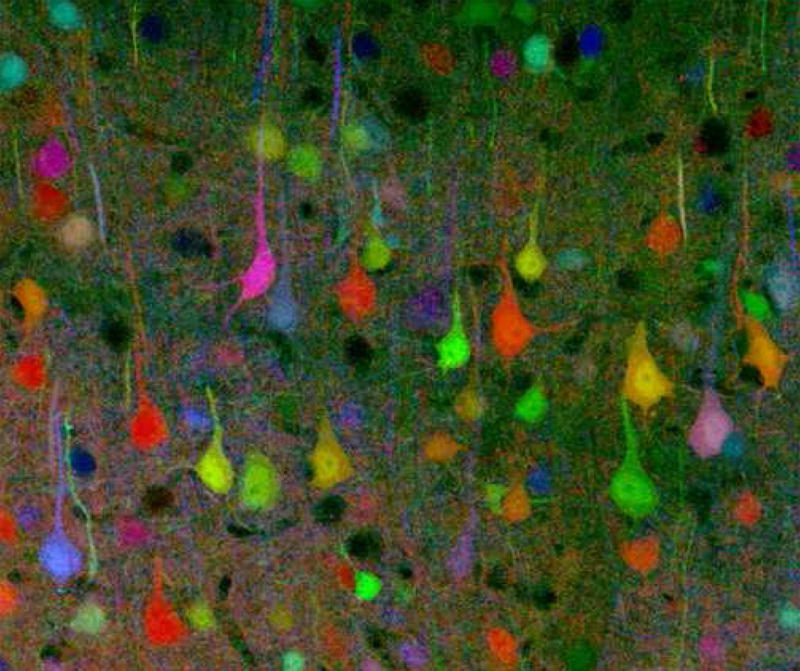
It is a mistake to think the Hard Problem is trivially solved, or even much dented, by finding the neural correlates of consciousness. Suppose we establish that a given experience always goes with activity in some specific network. That is real, valuable science, and it answers a question. But it is not this question. Knowing which brain areas light up when you see red tells you where and when, not why: why that physical activity is accompanied by an experience at all, rather than proceeding in the dark. Neuroscience is answering the easy problems, brilliantly. The Hard Problem is conceptual, and a map of correlations, however complete, does not by itself explain the thing the map is a map of. That does not mean the problem is unsolvable. It means it will not be solved by better imaging alone.
10Where the Field Actually Stands
One more honest correction before the verdict. It is sometimes said that consciousness studies has quietly reached a consensus and the Hard Problem is a fringe worry. The best evidence we have says the opposite: the field is genuinely, roughly evenly split.
| Position on the Mind | Share of Philosophers |
|---|---|
| Physicalism (the mind is entirely physical) | About 52 percent |
| Non-physicalism (it is not) | About 32 percent |
| Other, undecided, or the question is unclear | About 16 percent |
In the 2020 PhilPapers survey of 1,785 professional philosophers, physicalism about the mind was the most common view, but it held only a slim majority, about 52 percent, with roughly a third accepting non-physicalism and the rest undecided or answering some other way. Among specialists in philosophy of mind the physicalist share is a little higher, not lower. Read it either way and the headline is the same: on the question of whether the mind is entirely physical, the people who study it hardest have not reached agreement. Anyone who tells you the matter is closed, in either direction, is ahead of the evidence.
Fast Facts
- The Term
- The Hard Problem of consciousness, named by David Chalmers in 1995
- The Easy Problems
- How the brain discriminates, integrates, reports, attends; solvable in principle by mechanism
- The Hard Problem
- Why any of that processing is accompanied by subjective experience at all
- The Explanatory Gap
- Named by Joseph Levine, 1983: a perfect neural correlate still does not explain why it is felt
- The Zombie Argument
- If a being physically identical to you but with no experience is possible, physicalism is false
- Key Thought Experiments
- Chalmers's zombie, Jackson's Mary, Nagel's bat, the inverted spectrum
- Leading Skeptics
- Illusionists (Dennett, Frankish): the felt residue beyond function is itself an illusion
- Chalmers's Own View
- Property dualism: experience is fundamental, tied to the physical by new laws, not a soul
- State of the Debate
- No consensus; philosophers split roughly 52 to 32 on whether the mind is physical
What We Can Actually Stand Behind
The Hard Problem is real as a problem, and it is precisely stated. There is a genuine, well-defined question, why physical processing is accompanied by subjective experience, that is not answered by explaining the brain's mechanisms, and that is distinct from the tractable easy problems. The explanatory gap between a neural correlate and the experience it correlates with is a real feature of where the science currently stands, acknowledged even by many who expect it to close.
Whether the gap is fundamental or temporary is open, and the responses are live science, not settled winners. Illusionism (Dennett, Frankish) holds that there is no felt residue beyond function and is a serious, well-defended minority position, not a footnote. Type-B physicalism and the phenomenal concept strategy are active physicalist defenses. Chalmers's own property dualism is one respectable option among several. No single answer commands the field.
The attempts to dissolve the problem by rebuilding reality, Integrated Information Theory's claim that consciousness just is integrated information, and Russellian monism's claim that experience is the hidden intrinsic nature of matter, are creative and taken seriously, but neither is established. Both face serious objections (unfalsifiability and counterintuitive consequences for IIT, the combination problem for monism) and neither should be read as a solution in hand.
No, the argument does not prove there is a soul: at most it supports property dualism, not Descartes's separate immaterial substance. And no, the Hard Problem has not been trivially solved by neuroscience: finding the neural correlates of consciousness answers where and when experience happens, not why physical activity is felt at all. Both of these overreaches are common, and both are contradicted by what the careful arguments actually say.
So the file stays open, and it is honest to say why. We have a question we can state with real precision, a battery of arguments sharp enough that professional philosophers have argued them for thirty years without either side conceding, and no experiment on the horizon that would settle it, because the whole difficulty is that the thing in question, felt experience, is exactly what no outside measurement seems able to reach. It is worth sitting with how strange that is. The one fact each of us is most certain of, that there is something it is like to be us, is the fact our science is least able to explain. You are, right now, the evidence and the mystery at once. What would it even look like to finally close the gap, and would we recognize the answer if we found it?
Sources & further reading
Everything above is drawn from our research library on Theories of Anything. Open the full file to check the sourcing and go deeper.
Image credits
- Original diagram of the explanatory gap between the physical, everything about the mind that can be measured, and experience, the felt quality that resists physical explanation Original diagram by Theories of Anything. CC BY-SA 4.0 Source.
- Scientific diagram of the visible spectrum showing wavelength increasing from violet to red DrSciComm (own work), January 23 2020, via Wikimedia Commons. CC BY-SA 4.0 Source.
- Diagram of David Chalmers's double-aspect theory of information, an information space carrying both a physical and a phenomenal aspect Diagram by Wikimedia Commons user Altundra, illustrating the theory proposed by David Chalmers (1995), via Wikimedia Commons. CC BY-SA 3.0 / GNU Free Documentation License 1.2+ Source.
- Rene Descartes's historical illustration of the pineal gland receiving sensory signals and acting upon an immaterial spirit, from his Treatise of Man Rene Descartes (1596-1650), Treatise of Man, via Wikimedia Commons. Public Domain Source.
- Mouse brain neurons individually labeled with different fluorescent color tags by the Brainbow technique, allowing single neurons and their processes to be traced Stephen J. Smith, 2007, via Wikimedia Commons. CC BY 3.0 Source.
- Portrait photograph of the philosopher David Chalmers, 2011 HerbertErwin (own work), June 20 2011, via Wikimedia Commons. CC BY-SA 3.0 Source.
- Portrait photograph of the philosopher Daniel Dennett, 2008 Mathias Schindler (own work), October 19 2008, via Wikimedia Commons. CC BY-SA 3.0 Source.
- Card crop of the original explanatory-gap diagram Original diagram by Theories of Anything. CC BY-SA 4.0


.jpg)
.jpg)
