
Paradoxes: What Is Settled, What Is Open, and What Is Neither
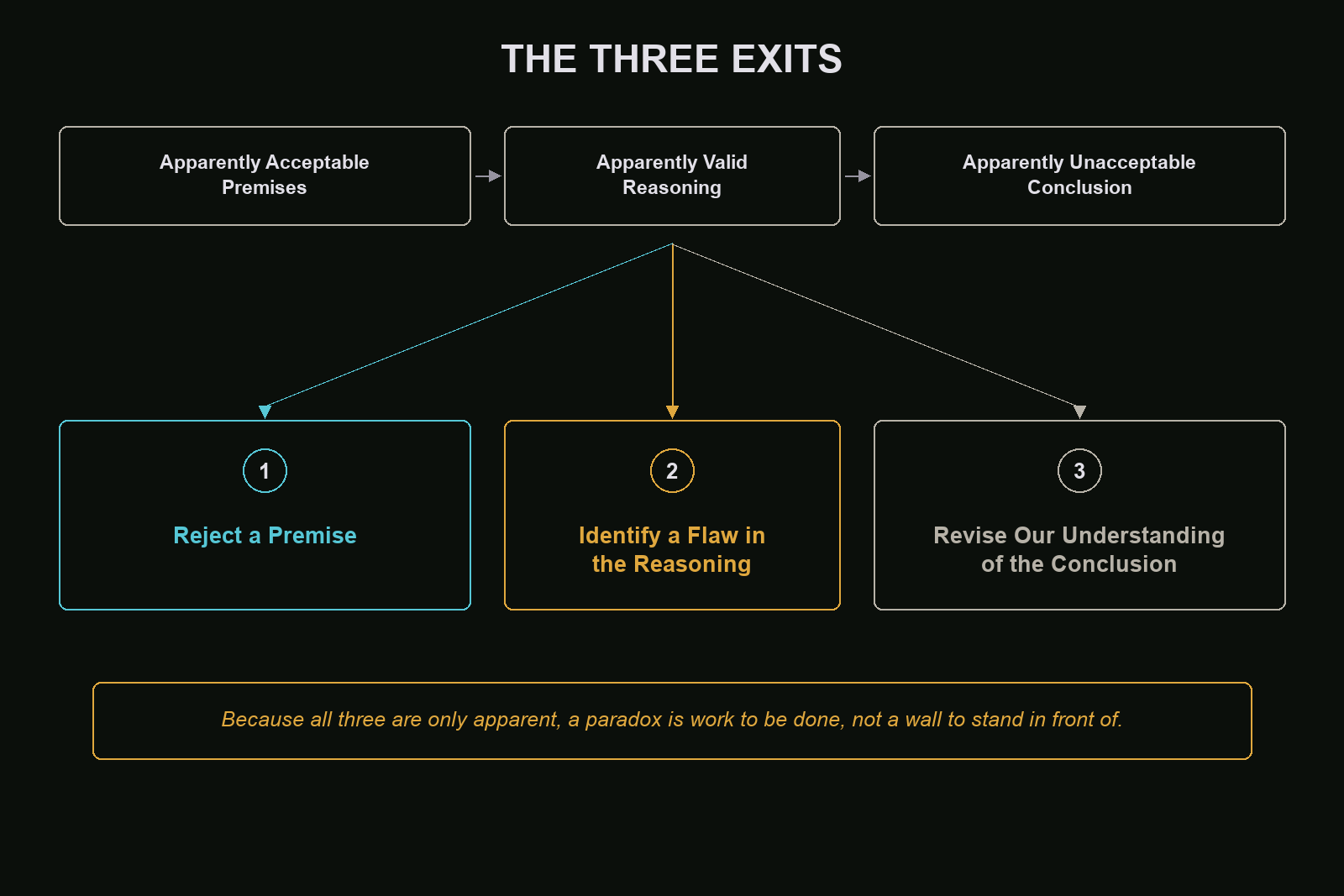
Seven arguments sit in this cabinet and they did not all come out the same way. Two have accepted technical resolutions, four are genuinely open with rival families of response and no winner among them, and one derives no contradiction at all, which makes solved against open the wrong axis for it. The popular telling flattens all seven into nobody knows, and a debunking telling flattens them into all solved. Both are wrong here, and this article says which is which case by case instead of announcing one verdict for the lot. Zeno of Elea's two summation arguments are mathematically closed and philosophically live at the same time. Russell's contradiction is blocked, and the philosophy behind the block is still discussed. The liar, the sorites, the surprise examination and Newcomb's problem have no agreed answer, and the discipline was formally polled on three of them, which is not what happens to a settled question.
Seven arguments sit in this article and they did not all come out the same way. That is the whole reason for writing it. The usual treatment of paradoxes runs them together into one mood, ancient puzzles nobody has ever cracked, and the effect of that is to make a solved problem and an open one sound identical. They are not identical. Two of these seven have accepted technical resolutions. Four are genuinely open, with rival families of response and no winner among them. One derives no contradiction at all, so asking whether it has been solved is asking the wrong question about it.
The mirror failure is just as easy to make and this article refuses it too. A debunking voice says that calculus disposed of Zeno of Elea, that modern logic has cleaned all of this up, and that what is left is a set of word games which dissolve the moment terms are defined. That is also false. Four of the seven have no agreed answer at all, the discipline was formally polled on three of them as multi-option questions, and papers arguing over the adequacy of the mathematical answer to Zeno were still appearing in leading journals in 1954 and in 1962. The verdict at the foot of the page refuses both stories by name.
Some of this material belongs to neighbours and is left with them. Personal Identity, in this same wing, owns the Ship of Theseus outright: it is that article's title concept and its opening move, and it carries a Plutarch passage fetched from a published translation. This page gives the ship a short section rather than a chapter, adds the one thing about it its owner does not need to say, and sends you there. Is Time Real? owns McTaggart, the block universe and the philosophy of time, so when Zeno's arrow turns on whether time is composed of instants, that question is the sibling's and gets a link rather than an argument here. Godel's incompleteness theorems are proved theorems rather than paradoxes and have been ceded to the article that owns them, and this clause is all they get.
One naming point before anything else, because this estate already carries the other man. Zeno of Elea, the subject here, is not Zeno of Citium, who founded the school Stoicism is about and who lived three generations later. Every Zeno below is Zeno of Elea.
A word about the tier marks, because on this subject they behave unusually. Our research file P_1_13 assigns its own tiers and this page keeps them, but what they mark is attributional and textual. Tier 1 here means that this is what the argument says, this is who framed it, and these are the named responses to it. It never means that one of those responses is correct. The sharpest instance is the Ship of Theseus, which sits in the file under verified claims and whose content is three mutually exclusive metaphysical positions: what is verified is that those are the positions, never that any one of them is right. Where a resolution status appears below, its tier comes from the source that establishes the status, and for most of them that source is not our own file.
01What A Paradox Is
Start with the definition, because it decides everything that follows. Our research file defines a paradox as an argument that proceeds from apparently acceptable premises, by apparently valid reasoning, to a conclusion that is apparently unacceptable. The three apparentlys are the definition and they are the part that does the work. Each one names a place where something may have gone wrong, which is why the file's next move is to give three exits rather than none: reject a premise, identify a flaw in the reasoning, or revise your understanding of the conclusion. A paradox on those terms is a piece of work to be done rather than a wall to stand in front of, which is this article's compression of the file's point rather than a sentence taken from it. The file adds that paradoxes have been central to philosophy since the Greeks and that they act as engines of conceptual progress, exposing hidden assumptions and the limits of our concepts. The rest of this article asks one question of each of the seven: which exit does this one take, and has anybody actually walked through it.
02The Cabinet, Row By Row
Here is the whole article in one table, and every row in it is argued in its own section below. Counted off those rows: of the seven paradoxes our file carries, two have accepted technical resolutions, four are genuinely open, and one is not a contradiction at all. Zeno's arrow and his stadium are parts of the Zeno entry and are listed separately in the table rather than counted again, because the answer that settles two of his four arguments does not touch the arrow, and because the surviving text of the stadium is too compressed to grade. No sentence anywhere below contradicts a row of this table. Where a row says settled it also says in what sense, and where it says open it says what the open question is.
| The Paradox | Where It Stands | In What Sense |
|---|---|---|
| Zeno of Elea, the Dichotomy and the Achilles | Mathematically settled, philosophically live | An infinite series of intervals can have a finite sum, and that is the received view. Whether that mathematics describes real motion is a separate question and is still argued |
| Zeno of Elea, the Arrow | Not answered by the series argument | No sum appears in it. Its target is the structure of time and what it means for a thing to be in motion at an instant |
| Zeno of Elea, the Stadium | Not graded here | The surviving text is too compressed for this article to state fully, so it says so rather than guessing at the rest |
| The Liar | Open | At least seven rival families of response, and a standing revenge phenomenon that explains why proposed solutions keep failing |
| The Ship of Theseus | Not a contradiction at all | It derives no absurd conclusion, so solved against open is the wrong axis for it. Ceded to Personal Identity in this same wing |
| The Sorites | Open | At least seven rival families. Its own reference entry says only that most theorists suppose it solvable, which is not the same as solved |
| Russell's Paradox | The contradiction is blocked | Naive unrestricted comprehension was abandoned and the standard replacements do not permit the argument. Which repair is philosophically right is still discussed |
| The Surprise Examination | No agreed analysis | Quine published a deflation of it in 1953, and replies to that deflation were still appearing twelve years later and again fifty-five years later |
| Newcomb's Problem | Open | Our own file's closing line for it is no consensus resolution, and the discipline was polled on it as a two-option question |
03Zeno Of Elea, And What He Was Defending
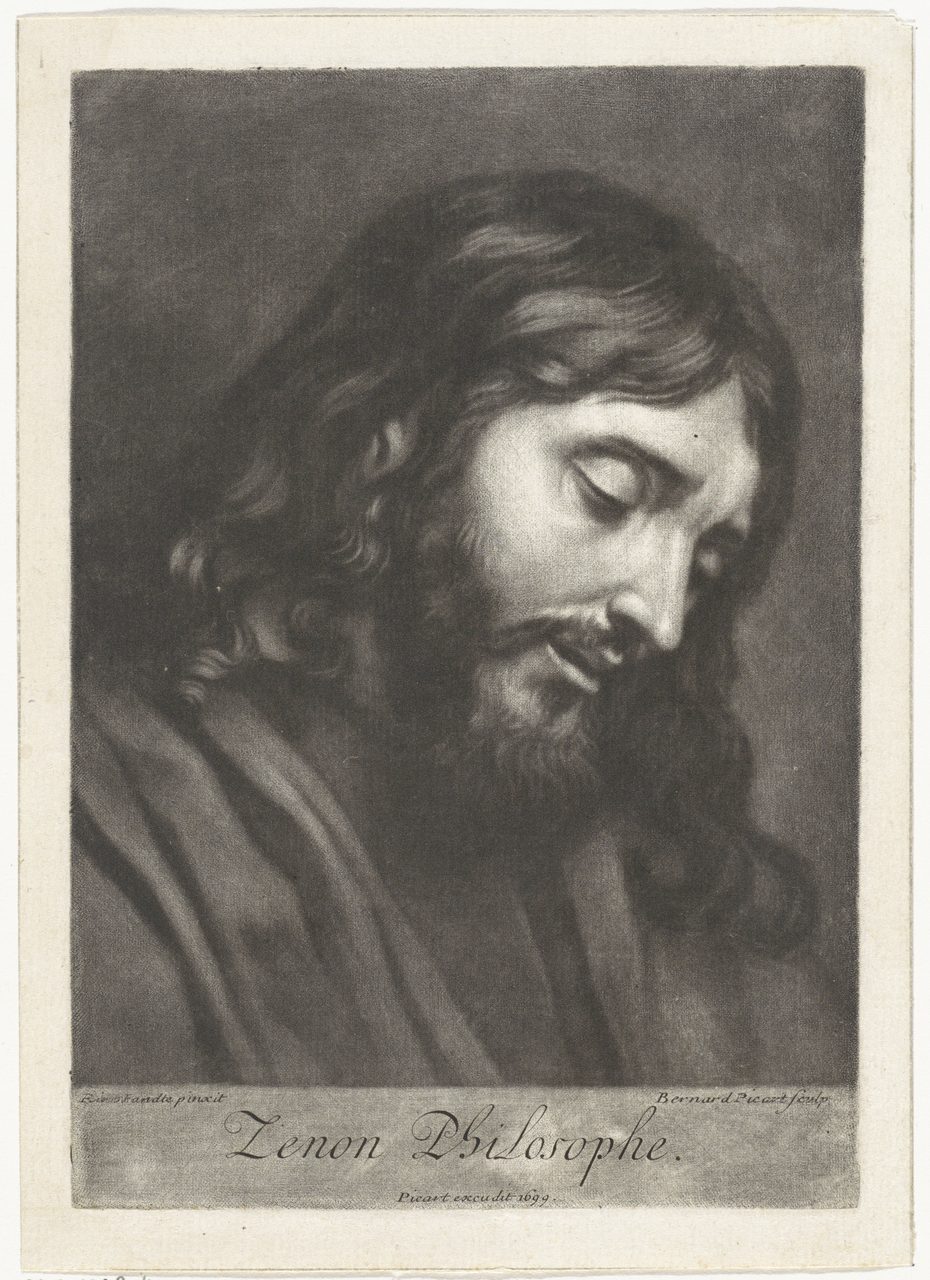
Zeno of Elea was a student of Parmenides, and our file dates his paradoxes to about 460 BCE. The motive is the part retellings drop, and without it the arguments look like riddles told for their own sake. They are not riddles. Zeno was defending his teacher's metaphysics, on which change and motion are illusory, by showing that the common-sense alternative generates absurdities of its own. That is why they are built the way they are: each one takes an ordinary assumption about motion, space or time and runs it until something absurd falls out of the end.
None of it reaches us from Zeno. No work of his survives complete, and the four arguments come down at second hand, chiefly through Aristotle and through the sixth-century commentator Simplicius. That is worth stopping on in a band about the limits of knowing. The canonical formulations here are themselves reconstructions from hostile or explanatory summaries, which is one reason garbled versions spread so easily: there is no original to check a version against.
04The Four Arguments
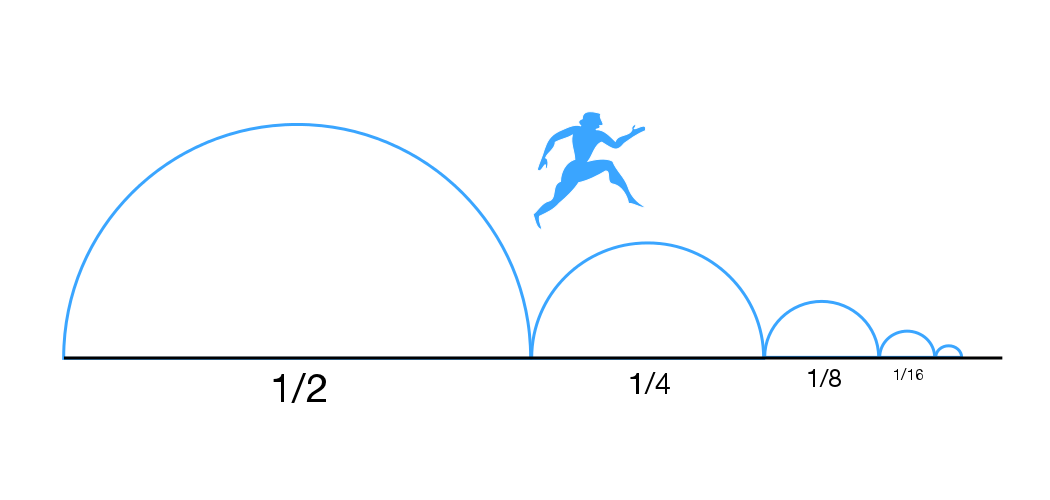
That is the Dichotomy, also called the Racetrack, and the halving is not where the trouble lies. To reach any point you must first cross half the distance, then half of what remains, and so on without end. The load is in what that requires: the completion of an infinite number of tasks in a finite time. A version that stops at how small the steps get has dropped the argument on the floor. The steps getting small is not the problem. Finishing infinitely many of them is.
The Achilles is the same shape with a runner in it, and it has two setup details a careless version drops. Achilles, who is faster, gives the tortoise a head start, and the tortoise keeps moving. By the time Achilles reaches the point where the tortoise started, the tortoise has moved on; by the time he reaches that point, it has moved again; and so without end. Take away the head start, or let the tortoise stop, or have Achilles simply run to a fixed line, and you have a different and far easier problem whose solution will look trivial. One note about the sources belongs here, because it is unusual. The reference entry consulted for this article does not print a block quotation from Aristotle for the Achilles at all. It quotes Simplicius instead.
The Arrow is a different animal, and this is where popular accounts most often go wrong. At any single instant an arrow in flight occupies a definite position and is therefore at rest at that instant. Time is composed of instants. So the arrow is never in motion. Notice that nothing here is a sum. There is no series to converge, so the answer that handles the Dichotomy and the Achilles has nothing to grip. What the Arrow attacks is the premise it states out loud, that time is composed of instants, and with it the question of what motion at an instant could even mean. Whether time really is built that way is Is Time Real?'s question, argued there at length, and this article leaves it there.
The fourth argument, the Stadium or the Moving Rows, is where honesty costs something. Our file gives it in a single clause: it involves the relative motion of rows passing each other, and it challenges the concept of indivisible units of space and time. The reference entry prints a fuller version, in which equal bodies move alongside equal bodies in a stadium from opposite directions at equal speeds, and Zeno takes it to follow that half the time is equal to its double. That conclusion is the part worth carrying, because it is what makes the argument recognisable as an attack on indivisible units rather than on infinite divisibility. It is also as far as this page goes. The ancient text is terse, the entry's own printing of it ends in an ellipsis, and reconstructing a worked example of three rows of bodies from memory is precisely how garbled versions get made. The Stadium's row in the table above records that rather than grading it, and that is deliberate.
05What The Series Answers, And What It Does Not
Our file already contains the sentence this article needs, and it is split in two exactly as it should be. The sum of an infinite geometric series can converge to a finite value: 1/2 plus 1/4 plus 1/8 and onward without end adds to 1. That, the file says, resolves the mathematical puzzle. And then, in the same breath, it says that philosophers debate whether it addresses Zeno's deeper metaphysical point about the nature of infinity and continuous motion. Both halves or neither. Drop the first and the article claims nobody has an answer, which is false. Drop the second and it claims the matter is closed, which is also false.
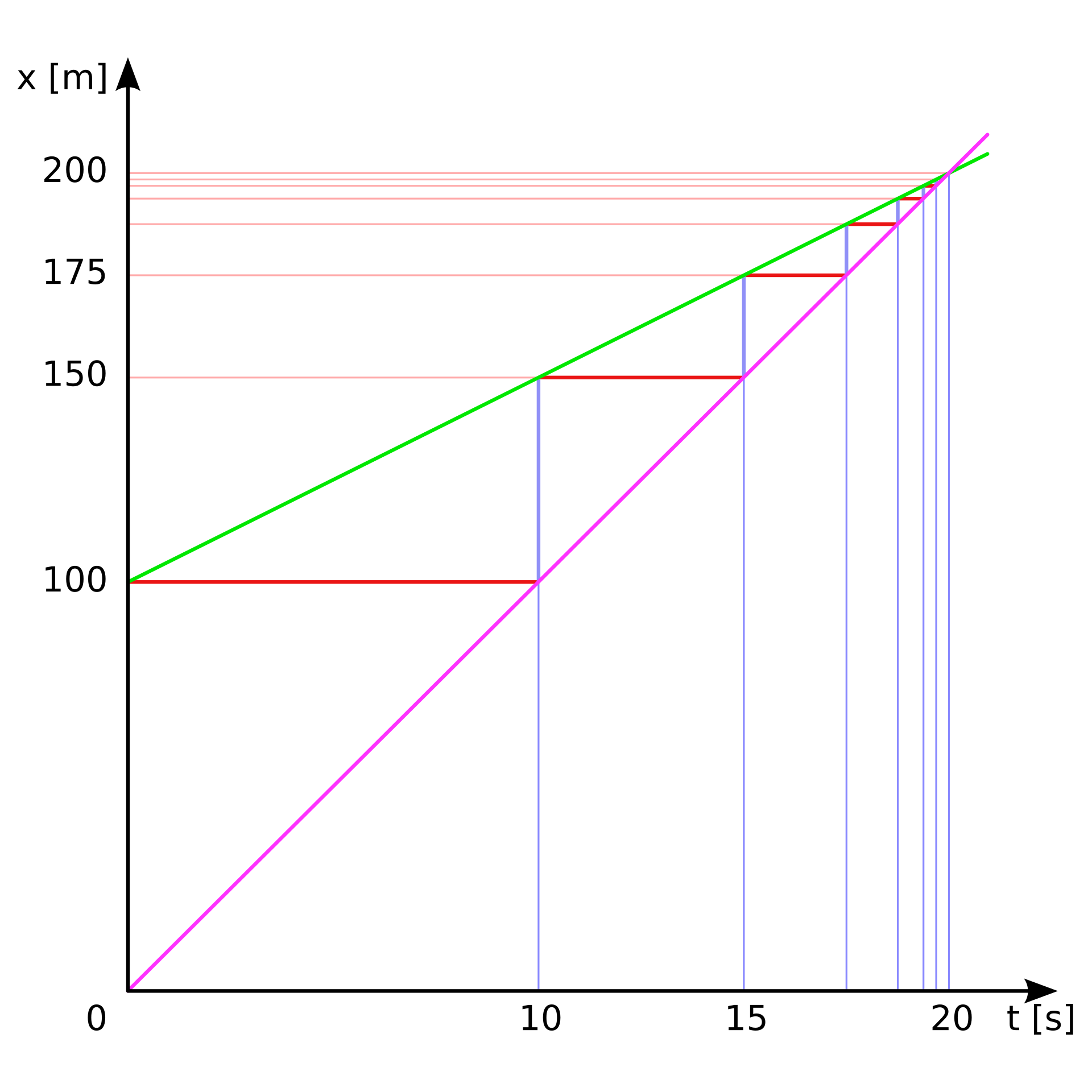
Two independent sources agree, and they agree on both halves, which is why this is the clearest verdict on the page. The reference entry on Zeno describes the modern mathematical treatment as the received view and says it shows how modern mathematics could solve all of Zeno's paradoxes. It then states the standing condition on that answer in its own voice: it would not answer Zeno's paradoxes if the mathematical framework invoked were not a good description of actual space, time and motion. So the honest verdict has two parts. As mathematics, the Dichotomy and the Achilles are not open problems and have not been for a very long time; a reader who has met a convergent series has met the answer. What stays open is whether that mathematics describes real motion, and whether completing infinitely many tasks is a coherent notion at all.
That second question has a literature and it has a name, supertasks. Two papers mark it. J. F. Thomson published Tasks and Super-Tasks in Analysis in 1954, and Benacerraf published Tasks, Super-Tasks, and the Modern Eleatics in the Journal of Philosophy in 1962, replying to Thomson eight years later in a leading journal and naming the modern Eleatics in his title. This article read the bibliographic records for both and not the papers themselves, so it says what their existence supports and no more: the adequacy of the convergent-series answer remained a live question in analytic philosophy long after the mathematics itself was uncontested. What either paper concluded is not stated here, because it was not read here.
One thing Zeno did not do, and our file marks it incorrect in its own Tier 4 section. He did not prove that motion is impossible. The paradoxes were built to support Parmenides's metaphysics, motion obviously occurs, and what the four arguments challenge is our understanding of motion, infinity and continuity rather than the fact of motion itself. That distinction generalises to everything else on this page, and it is the definition this article opened with doing its work: an argument that ends somewhere absurd shows that something in the argument is wrong. It does not show that the absurd thing is true. Note which way that refusal runs, though. Our file refuses the overclaim on Zeno's side only, which is why the verdict below refuses it on both sides.
06The Liar, And Why It Will Not Go Away
This sentence is false. If it is true then, by what it says, it is false; if it is false then, since that is exactly what it says, it is true. That is the liar in the form our file gives it, and it is the simple version. The formulation is the fragile part of this one. The canonical liar has to be self-referential and self-contained, and the folk versions are neither. Everything I say is a lie is not the liar: it has an easy consistent reading, namely that the speaker sometimes tells the truth. This sentence is not true is a genuinely different and stronger variant, used precisely because it survives responses that the false version does not, and it comes back a few paragraphs below.
On where it comes from, our file is careful, and the care is worth copying. It calls the liar one of the oldest paradoxes, attributes it to Eubulides of Miletus in the fourth century BCE, and says it is related to Epimenides the Cretan. Related to is not stated by, and the difference matters. The Epimenides story, in which a Cretan says that all Cretans are liars, is the ancestor of the liar and is not logically the same sentence. If any other Cretan ever told the truth, then all Cretans are liars is simply false in a Cretan's mouth, and a false statement is not a paradox. Neither Eubulides nor Epimenides has a bibliography row in our file, and this article did not independently check the attribution, so it is carried here as the standard attribution rather than as a checked fact.
A sentence on a blackboard became a problem for logic because of what it does to the most obvious principle anyone has about truth. Our file names that principle and attributes it to Tarski: the schema on which snow is white is true if and only if snow is white. Apply the schema to the liar sentence and the contradiction falls straight out. Skip this step and the liar is a party trick. Take it, and the liar is an argument that our plainest principle about truth cannot be held in full generality alongside a language able to talk about its own sentences. That is a real cost, and it is why the twentieth century spent so much on it.
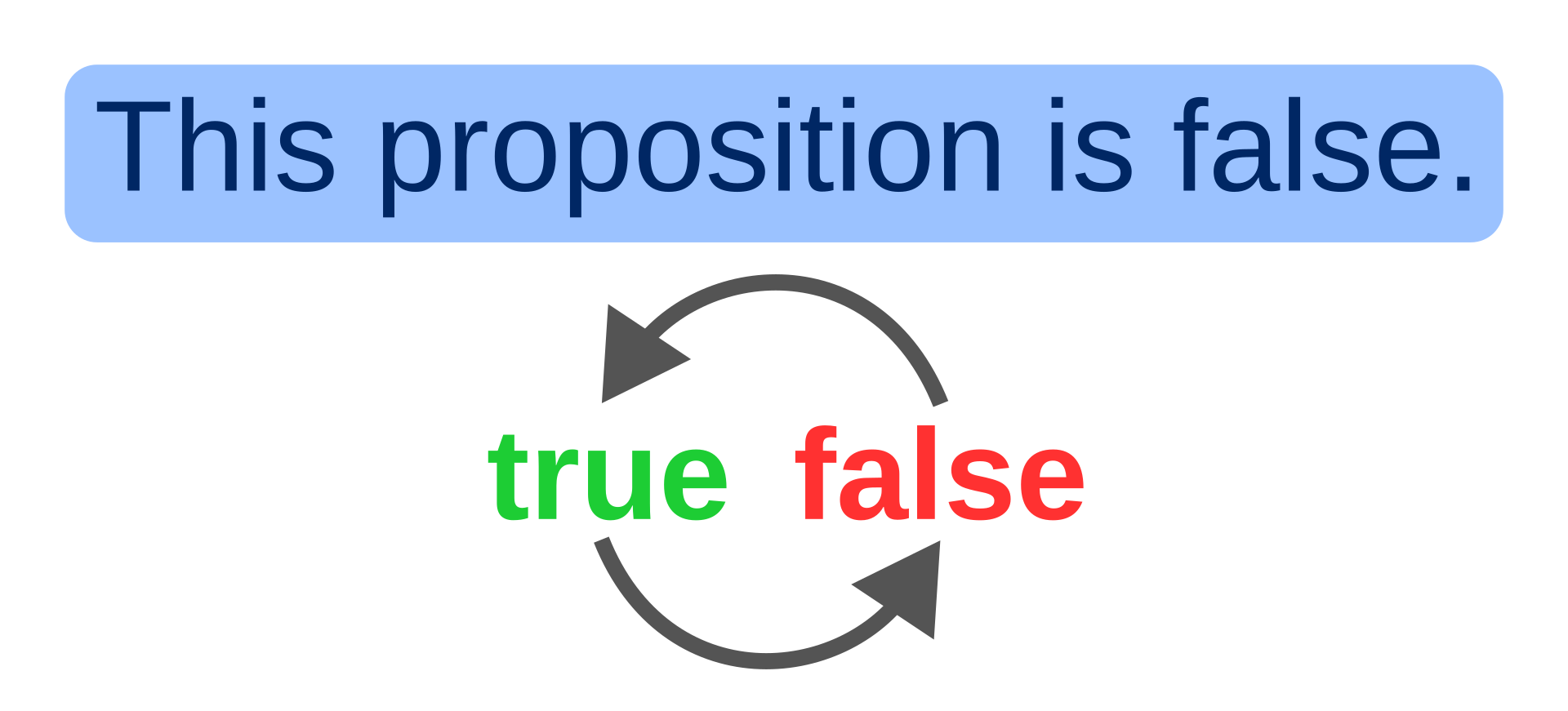
Now the variant, because it shows in miniature why this one stays open. The reference entry on the liar does not work with the false version at all. It uses what it calls the simple-untruth liar, a sentence which says of itself that it is not true, and the contradiction runs the same way: if it is true then it is not true, and if it is not true then it is true. The difference from the false version is not cosmetic. This sentence is false can be answered by saying the sentence is neither true nor false, that is, by allowing a gap between the truth values. That answer does nothing at all to the other form, because a sentence with no truth value is not true, which is exactly what this one says of itself, so it comes out true after all. The repair patches one sentence and the same problem walks back in wearing the next one.
07Four Rivals, No Winner
Our file names four responses to the liar and crowns none of them, which is correct. Tarski's hierarchy of languages: no language can contain its own truth predicate. Kripke's fixed-point theory of truth, from 1975, which the file says allows truth-value gaps. Dialetheism, attributed to Graham Priest: some contradictions are true. And revision theory, attributed to Gupta and Belnap. These are not four versions of one idea. They are four different things to give up. Tarski gives up a single universal language. Kripke gives up bivalence. Priest gives up non-contradiction. Gupta and Belnap give up truth as a fixed property in favour of a process that revises it. Saying that plainly is the most useful thing this section can do, because it shows what kind of problem the liar is: not a puzzle with a missing piece, but a bill that has to be paid out of one account or another.
The reference entry on the liar goes further and says why the question stays open. It states that the past few thousand years have yielded a great number of proposals and that it will not be able to examine all of them, and it lays out at least seven distinct families: paracomplete approaches, paraconsistent approaches and dialetheism, substructural logics, classical approaches including the Tarskian hierarchy and the Kripke fixed-point construction and compositional theories, contextualist approaches, revision theory, and inconsistency views. Then it names the thing that keeps happening, and this is the strongest single fact this article can carry about the liar. It calls it revenge: a proposed solution is rejected on the basis of what might be taken to be a slightly modified form of the paradox. The move above, where the truth-value gap defeats one sentence and fails against the next, is that phenomenon in miniature. The liar is open, and revenge is why it stays that way.
08The Ship Of Theseus Is Somebody Else's
One of the seven is not this article's to tell. Our file reports the Ship of Theseus from Plutarch's Life of Theseus: if the ship is maintained by replacing old planks with new ones, is it the same ship once every plank has been replaced. It adds Hobbes's extension, which this page names and leaves to the article that owns it. That is the whole of it here. Personal Identity, in this same wing, owns the ship outright: it is that article's title concept and its opening move, it carries a Plutarch passage fetched from a published translation, and it runs the rival criteria of identity properly. Go there for it.
There is one thing worth adding that the sibling article does not need to say, and it is a characterization rather than a finding, which is why it is marked Tier 2. Apply the definition this page opened with. A paradox derives an apparently unacceptable conclusion from apparently acceptable premises. The Ship of Theseus derives no conclusion at all. It poses a question, is this the same ship, and rival criteria of identity answer it differently; our own file presents it in exactly that shape, as competing accounts rather than as a derived absurdity. So it is the odd one out in this cabinet, and solved against open is the wrong axis to hang it on. That is why the table above grades it as neither.
09The Heap

The sorites is the argument that a heap cannot be built one grain at a time. From the Greek soros, heap: one grain of sand is not a heap; if n grains are not a heap then n plus one grains are not a heap either, which our file names the tolerance principle; therefore no number of grains is ever a heap, which is plainly absurd. Naming the tolerance principle out loud is what separates a real statement of the sorites from the vague gesture at fuzziness that usually stands in for it. And here is what makes it hard rather than cute: the argument is valid. It is a chain of modus ponens. There are only three ways out, and each costs something. Deny the base case. Deny the tolerance principle. Or accept the conclusion.
The reference entry on the sorites states it with wheat rather than sand, and it spells out the chain instead of the general conditional, which is what puts the validity of the argument where a reader can see it. One grain of wheat does not make a heap. If one does not, two do not. If two do not, three do not. And so on up to a million, from which it follows that a million grains of wheat do not make a heap. Its tolerance premise is stated as the claim that no single grain of wheat can make the difference between a number of grains that does make a heap and a number that does not.
It is not a puzzle about sand. Our file states what the sorites actually exposes, which is vagueness, and it adds that many, perhaps most, natural language predicates lack sharp boundaries. Keep the perhaps; it is doing real work. The file's own examples are tall, bald, red and rich. If the argument runs, it runs for every vague predicate in the language, and that is why this one belongs in a band about the limits of knowing. It is not a fact about heaps. It is a fact about how our words meet the world.

10Solvable Is Not Solved
Our file names four responses. Epistemicism, attributed to Williamson in 1994: there is a sharp boundary, and we cannot know where it is. Supervaluationism, attributed to Fine in 1975: a sentence involving a vague predicate can be true on every admissible way of setting the boundary even when no particular setting is the correct one. Degree theory: truth comes in degrees. And contextualism: the extension of a vague predicate shifts with conversational context. The first two carry names and dates in our file and the last two do not, and this article does not invent attributions for them. Epistemicism is the startling one and it is worth saying plainly, because readers do not expect it. On that view there is an exact grain at which a non-heap becomes a heap, and our failure to find it is ignorance rather than indeterminacy.
The reference entry on the sorites says something precise that is easy to misread. Most theorists of vagueness suppose the paradox is solvable, that is, that the paradoxical argument is defective and that we can discover the defect. Solvable is not solved, and running the two together would be a real error rather than a loose one. The same entry then lists the rival families with their named defenders: ideal-language approaches, the epistemic theory, supervaluationism, three-valued logic, contextualism, multiple range theory, and embracing the paradox, which is to say denying that it has a solution at all. Seven families and no consensus. And it is one of the questions the discipline was formally polled on, which is not what happens to a settled matter.
11The One That Changed A Discipline
Consider the set of all sets that are not members of themselves. Does it contain itself? If it does, then by its own definition it should not; if it does not, then by its own definition it should. That is Russell's paradox as our file states it, dated 1901, and the file records what it did: it led to the reconstruction of set theory, naming the Zermelo and Fraenkel axiomatisation and Russell's own theory of types. One tier note, carried exactly as the file assigns it. Our file files this under Tier 2 rather than Tier 1, even though it is arguably the most securely established item in the whole document, and this page does not silently promote it. Where the article says below that the mathematics is settled, that verdict rests on the external sources named there and not on this mark.
The reference entry states the same argument in symbols, and it corrects one date that our file gives bare. It places Russell's discovery in the late spring of 1901 and notes explicitly that the reports conflict, listing June 1901, the spring of 1901, and May of that year. So the year is safe and a confident month is not. The dated, documented event is the letter. Russell wrote to Frege on 16 June 1902, while the second volume of Frege's work was at the printer, which is also the better scene of the two.
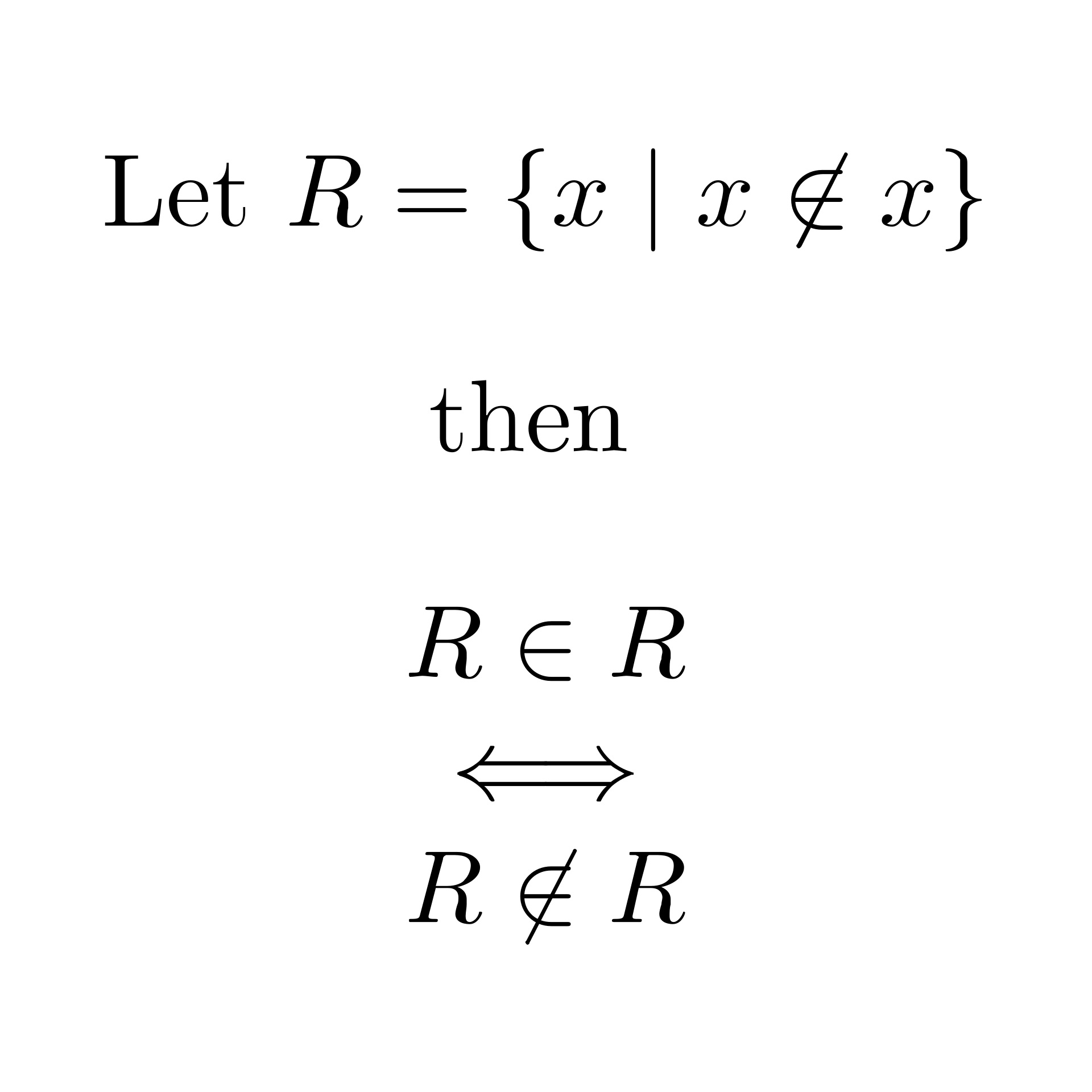
Here is the part the popular framing gets wrong, and it gets it wrong in both directions at once. Nobody is waiting for a solution to Russell's paradox. Naive unrestricted comprehension was abandoned, and the standard replacements do not permit the argument to be run. On Zermelo's approach, as the entry puts it, all the contradiction shows is that V is not a set, that V is an empty name. On von Neumann's method the Russell class cannot be a member of any class and is therefore a proper class rather than a set. Type theory blocks it a third way, by making the sentence x is a member of x ill-formed rather than false. Two of those three were published in the same year by the men who made them, Russell's type theory and Zermelo's axiomatisation, and both are cited below. Von Neumann's method is named here from the entry and is not separately cited. What is not settled is which repair is philosophically right. The entry presents them as various ingenious and mathematically and philosophically significant ways of dealing with the paradox, and this article read no sentence in it declaring the matter finally resolved. Mathematics moved on. The philosophy of why it moved that way is still discussed.
12The Examination Nobody Could Predict
A teacher announces that there will be a surprise test next week. The students reason backwards from the last day. If the test has not happened by Thursday evening it must fall on Friday, and then it would not be a surprise, so it cannot be Friday. With Friday removed the same reasoning removes Thursday, and then Wednesday, and so on back to the start of the week. They conclude that a surprise test is impossible. Then the test happens on Wednesday and they are surprised. Our file's ending is the point and it must not be cut, because it is a different shape of failure from everything else in this cabinet: the argument looks airtight and the world simply ignores it. The direction matters too. The elimination has to start at the last possible day; a retelling that starts on Monday is a different and much weaker thing.
One reply announces itself in its own title. In 1953 Quine published a short deflation of it in Mind under the heading On a So-Called Paradox. This article read the bibliographic record and not the paper, so the only thing it attributes to Quine is what the title announces: that on his view this is a so-called paradox rather than a paradox.
Whether Quine settled it is a different question, and the honest answer is that this article does not know and says so. What it can show is that the argument did not stop there. A search of the bibliographic records returns replies to Quine's deflation published in a philosophy journal twelve years later, and again fifty-five years later under a title announcing a rejection of it. Neither was read beyond its record and neither is cited here, so what those replies concluded is not stated. What their existence supports is narrow and real: this is not a closed question. That is why the table above grades it as no agreed analysis rather than as open or settled, and why this row sits at Tier 2 rather than Tier 1.
13Two Boxes
A predictor has already placed money in two boxes. Box A contains 1,000 dollars, always. Box B contains 1,000,000 dollars if the predictor predicted that you would take only Box B, and nothing if the predictor predicted that you would take both. The predictor has been highly accurate. Do you take both boxes, or only Box B? Three details hold the problem up and a careless retelling drops them. The prediction is already made and the boxes are already filled before you choose. The contents of Box A are not in doubt. And the predictor's accuracy is stipulated as high, not as perfect.
Two decision theories give opposite answers and both have a case. Evidential decision theory says take only Box B: taking one box is evidence that you were predicted to take one box, and the expected value of doing so is 1,000,000 dollars. Causal decision theory says take both: the prediction has already been made and nothing you do now can change it, so taking both dominates, because whatever is in Box B you get 1,000 dollars more by also taking Box A. Our file's closing line for that section, in its own voice, is this: no consensus resolution. That sentence matters beyond Newcomb's problem, because it shows that our own file does distinguish the open cases from the closed ones even though it never says so systematically.
The field was asked. David Chalmers's own discussion document for the 2020 PhilPapers Survey carries the question in his wording: "Newcomb's problem: one box or two boxes?" A discipline does not put a settled question to its own members as a two-option choice. Two more of this article's paradoxes are on the same list. "Vagueness: epistemic, metaphysical, or semantic?" is the sorites. "Liar sentence: neither true nor false, but true and false, not truth-apt ...?" is the liar, and the trailing dots are printed in the source, where the option list runs on past what was read here. One hard limit belongs on the page rather than in a footnote. This article did not retrieve the survey's results and prints no percentage from it. The published paper is cited below. The numbers are not here, because they were not read here.
14Or Maybe It Is Logic That Bends
There is one more position, and our file files it at Tier 3, which is where it stays here. Some philosophers, and the file names Priest's 2006 book, argue that certain paradoxes reveal genuine limits of classical logic, and that reality itself may be inconsistent in ways that require a paraconsistent or dialethic logic. If that is right then the liar is not a sentence to be repaired but a true contradiction to be accepted, and the revenge phenomenon is what you would expect from trying to repair it. Our file adds, in its own voice, that this remains highly controversial, and that hedge belongs inside the sentence rather than in a note at the bottom. It is a tempting closing line, and it is exactly the wrong one, because a Tier 3 claim used as a peroration reads as a conclusion.
15What Was Checked, And What Was Corrected
Aristotle reaches this page at second hand and the page says so rather than implying otherwise. Both primary-text routes tried for this article refused the connection, so the four arguments arrive through the Stanford Encyclopedia's own block quotations of him. The one sentence quoted above was fetched twice and came back character for character identical both times, which is why this page carries it as a quotation at all rather than as a summary. The passage on the Arrow was fetched twice and came back at two different lengths, one of them silently abridged, so its content is stated above and none of it is quoted. The passage on the Stadium contains dashes this house does not print even inside quotations, so it is paraphrased and never quoted. No translator is named anywhere on this page, because the page these were read from names none. And one image was audited the same way. The liar-paradox diagram was uploaded in 2025, and a recent diagram is the hardest class in which to spot a generated picture, so it was checked twice before it was kept: the raster was inventoried element by element, and the vector source was fetched and read. It is hand-drawn in Inkscape. Two of its three paths carry that editor's own node-editing marks, the third path is an arrowhead marker inside the definitions block, the panel behind the sentence is a rectangle rather than a path, and its three pieces of text are still live text rather than converted to outlines. That is the signature of a person moving points, not of a model producing a picture.
Two identifiers in our own file's bibliography point at the wrong things, and neither is reproduced here. The row for Sainsbury's Paradoxes carries an ISBN that resolves at Open Library to Time Paradox by Eoin Colfer, a children's novel published in the same year. Its check digit computes correctly, its year matches, and the word paradox appears in both titles, which is almost certainly how it was matched, so no structural test catches it and only resolving the number and reading what comes back does. The Cambridge monograph is cited below in its place. The row for Priest's In Contradiction carries a DOI that resolves to a four-page chapter of that book rather than to the book itself, and no book-level identifier exists at all, so the book is cited below by name without one and Priest's 1979 paper is cited with one. A third row, Salmon's collection on Zeno, has no record of its own, and the record that comes back under its title is a 1972 review of it; that review is not attached to the book here. The contrast worth naming is inside the same bibliography: one of its two ISBNs was checked and repaired at some earlier point, and that repair is confirmed correct by two independent routes. The other was never checked.
Fast Facts
- What A Paradox Is
- An argument that runs from apparently acceptable premises, by apparently valid reasoning, to an apparently unacceptable conclusion. The three apparentlys are the definition: they name three places where something may have gone wrong, and so three exits. Reject a premise, identify a flaw in the reasoning, or revise our understanding of the conclusion
- The Count
- Of the seven our research file carries, two have accepted technical resolutions, four are genuinely open, and one derives no contradiction at all
- Zeno Of Elea
- A student of Parmenides, with paradoxes our file dates to about 460 BCE, and not the Zeno who founded Stoicism. No work of his survives complete; the four arguments come down chiefly through Aristotle and Simplicius
- The Convergent Series
- It resolves the mathematical puzzle in the Dichotomy and the Achilles, and our file and an external reference entry both say in the same breath that whether it addresses the deeper metaphysical point is still debated. The Arrow contains no sum and is not touched by it
- The Liar
- Open. At least seven rival families of response, and a revenge phenomenon in which a proposed solution is rejected on the basis of a slightly modified form of the paradox
- The Sorites
- Open. Its own reference entry says most theorists suppose the paradox solvable, meaning the argument is defective and the defect can be discovered, which is not the same as saying it has been
- Russell's Paradox
- The contradiction is blocked and nobody is waiting for a solution. Which of the published repairs is philosophically right is still discussed, which is a different question and is not closed
- The Ship Of Theseus
- The odd one out. It derives no absurd conclusion, so it is not graded here as solved or open, and it belongs to Personal Identity in this same wing
- Newcomb's Problem
- Open. Evidential and causal decision theory give opposite answers, our own file's closing line for it is no consensus resolution, and the discipline was polled on it as a two-option question
- What This Page Refuses
- That these puzzles break logic or that nobody has ever solved any of them, and equally that calculus disposed of Zeno or that modern logic cleaned all of this up. Both are refused by name in the verdict
What Can Actually Be Stood Behind
What each argument says, who framed it, and what the named responses to it are is checkable, and it is stated flatly on this page. Zeno of Elea, a student of Parmenides, framed his arguments in defence of the Eleatic thesis that change and motion are illusory, and they survive at second hand chiefly through Aristotle and Simplicius. An infinite geometric series can converge to a finite sum, which the reference entry on Zeno calls the received view, and the same entry states the condition on that answer: it would not answer Zeno if the mathematics invoked were not a good description of actual space, time and motion. The Arrow contains no sum and is not addressed by that answer. Our file names four responses to the liar and four to the sorites and crowns none of them, correctly; the reference entries name at least seven families for each, and the liar entry names revenge as the reason proposals keep failing. Russell's contradiction is blocked, by repairs published in 1908 by Russell and by Zermelo. Our file's own closing line for Newcomb's problem is no consensus resolution, and the field was formally polled on Newcomb, on vagueness and on the liar.
Five things here are credible rather than verified, and the limit sits beside each. Russell's paradox is filed at Tier 2 by our own research file, and this page keeps that mark rather than promoting it, resting the settled half of its verdict on external sources instead. That the Ship of Theseus is not a contradiction at all is this article's own characterization, applied from the definition it opened with, and not a finding from anywhere. That the surprise examination has no agreed analysis rests on bibliographic evidence, replies published twelve and fifty-five years after Quine's deflation, rather than on any survey of that literature. That the adequacy of the convergent-series answer stayed a live philosophical question after the mathematics closed is an inference from two papers' titles and dates, Thomson in 1954 and Benacerraf in 1962, neither of which was read here beyond its record. And Newcomb's setup, including its figures, is carried at our file's own Tier 2.
One position on this page is genuinely speculative, and it is our file's own Tier 3 entry: that certain paradoxes reveal real limits of classical logic and that reality itself may be inconsistent in ways requiring a paraconsistent or dialethic logic. Our file calls it highly controversial in its own voice. It is named here, given its strongest one-line statement, and deliberately not used as the article's conclusion, because a Tier 3 claim placed last reads as a verdict.
No. The claim that these little puzzles break logic, or that nobody has ever solved them, or that we still cannot say why Achilles catches the tortoise, is not supported, and for several of them it is simply false. Our own research file says the convergent-series answer resolves the mathematical puzzle, and an independent external source calls the modern mathematical treatment the received view. Russell's contradiction is blocked by two different published repairs, each resolvable to its own paper, and by a third route the entry describes but this page does not separately cite; no mathematician is waiting for another. The Ship of Theseus derives no contradiction at all. This is the likelier of the two failures, because it is the better story and because it is how this subject is almost always told.
No, equally. Calculus did not dispose of Zeno of Elea, these are not all word games that dissolve once terms are defined, and modern logic has not tidied them away. Four of the seven are genuinely open, with rival named families and no consensus. The liar has at least seven such families and a standing revenge phenomenon that explains why proposed solutions keep failing. The sorites has at least seven, and its own reference entry says only that most theorists suppose it solvable. The surprise examination drew published replies to Quine's deflation twelve and fifty-five years later. Newcomb's problem has no consensus resolution in our own file's words. The discipline put three of them to a formal survey as multi-option questions, which is not what happens to settled matters. Zeno's Arrow is not touched by the series argument at all, and the adequacy of that argument for the other two was still being argued in leading journals in 1954 and in 1962.
No, and the sentence claiming otherwise is in our own research file. Its closing boilerplate states that no significant counter-arguments exist in the scholarly literature for its core claims, and that the document represents established philosophical consensus with no active scholarly dispute over the fundamental claims. The same document carries four rival responses to the liar with no winner, four rival responses to the sorites with no winner, three mutually exclusive theories of identity, a section that ends in the words no consensus resolution, a claim it calls highly controversial in its own voice, and an entire section marked incorrect. The block is false on the document's own evidence. Nothing on this page cites it or rests on it.
Seven arguments, and no single verdict that covers them. Two were answered as mathematics and stayed open as philosophy. One was answered so thoroughly that the answer rebuilt a discipline around it, and the argument about which answer was right has not stopped. One is not a contradiction and never was. And four are still live options to professional philosophers, which is why three of them were put to a survey of the field as multi-option questions rather than as settled matters. That is not a failure of the discipline. On our own file's account it is what these arguments are for: engines of conceptual progress, devices that expose a hidden assumption by driving it until something cracks. Zeno of Elea's assumptions were about infinity and continuity, and answering even two of his four arguments took a mathematics he did not have. The liar's assumption is that a language can safely talk about its own sentences. The sorites's is that our words have edges. Nobody has found the exit on those two. So the question worth leaving with is not whether anyone eventually will, but what it will cost when they do, because every response on the table so far has been paid for out of something its author did not want to give up.
Sources & further reading
One research file in our own library stands behind this article, P_1_13. It is where the work started; the twenty entries above it are where the work can be checked, and every one of them is external. Five limits belong on the record rather than being left for a reader to discover. First, Aristotle. The two primary-text routes tried for this article both refused the connection, so his arguments arrive here through the Stanford Encyclopedia of Philosophy's own block quotations; the single sentence quoted on this page was fetched twice and returned identical both times, the Arrow passage came back at two different lengths and is therefore stated rather than quoted, and the Stadium passage carries dashes this house does not print and is paraphrased. No translator is named because the page these were read from names none. Second, the identifiers. Every DOI below was resolved live against CrossRef on 2026-08-07 and the returned title read against the claim it is attached to. Three identifiers our own file carries are deliberately absent: the ISBN on its Sainsbury row, which resolves at Open Library to a children's novel of the same year; the DOI on its Priest row, which resolves to a four-page chapter rather than to the book; and the only record that comes back for its Salmon row, which is a 1972 review wearing the book's own title. Third, an edition note. The record for Williamson's Vagueness carries the year of the Routledge electronic edition; 1994 is the print first edition and is the year printed here. Fourth, the survey. No percentage from the 2020 PhilPapers Survey appears anywhere on this page, because none was retrieved; what is quoted is the question wording from the survey author's own document. Fifth, the encyclopedia entries are cited by title, URL and their own stated dates, and an author is named only where the entry itself returned one, which was true of three of the four.
Image credits
- The Three Exits, an original diagram Original diagram by Theories of Anything. CC BY-SA 4.0 Source.
- Card rendering of The Three Exits, an original diagram Original diagram by Theories of Anything. CC BY-SA 4.0 Source.
- Portrait print of Zeno of Elea, mezzotint, 1699, Rijksmuseum object RP-P-1908-401 Bernard Picart, possibly after Rembrandt; Rijksmuseum, object RP-P-1908-401, via Wikimedia Commons. CC0 Source.
- Diagram of Zeno's Dichotomy paradox Martin Grandjean, 2014, via Wikimedia Commons. CC BY-SA 4.0 Source.
- Diagram of distance against time for the race between Achilles and the tortoise Wikimedia Commons user Mrmw, 2020, based on an earlier animated file, via Wikimedia Commons. CC0 Source.
- Diagram of the liar paradox Wikimedia Commons user Phlsph7, 2025, via Wikimedia Commons. CC0 Source.
- Photograph of durum wheat grains, described by its photographer as on a porcelain plate, whose edge is not in the delivered frame Wikimedia Commons user Zerohund, 2009, via Wikimedia Commons. CC BY-SA 3.0 and GFDL Source.
- Colour gradient from green to red illustrating a sorites paradox Jochen Burghardt, 2013, via Wikimedia Commons. Public Domain Source.
- Diagram stating Russell's paradox in set-theory notation Wikimedia Commons user Psiĥedelisto, 2021, via Wikimedia Commons. CC0 Source.
,_RP-P-1908-401.jpg)


