
False Memory: How the Mind Rewrites Its Own Past
Remembering is not replay. Every retrieval is a rebuild, and the rebuild uses whatever material is to hand, including material that arrived after the event. This article follows that one fact from Ebbinghaus counting nonsense syllables in 1885 to the DNA exoneration figure that turned it into a legal problem, keeping apart the separate findings that popular writing collapses into one. It carries the numbers with their denominators, the disputes without a winner, and the limit that matters most: nothing available reliably tells a true memory from a false one in a single person.
Try to bring back a specific afternoon from when you were six. Something arrives: a room, a colour, somebody's voice. It arrives whole, and it arrives with the feeling of having been retrieved rather than made. That feeling is what this article is about, because the best evidence in psychology says the arriving thing was assembled a moment ago out of whatever material was to hand, and that some of that material may have reached you long after the afternoon itself. Remembering is a reconstruction, not a replay. And a reconstruction can be steered from outside, by degrees that run from one changed word in a question to an entire childhood event that never happened.
Four boundaries before we start, because this subject touches three others this library already covers and one it will. Cognitive bias belongs to the wing's article on the mind's blind spots, and nothing below explains anything by anchoring or availability. Visual illusion belongs to the illusion of seeing; this article takes it as inherited that perception is constructive, and then asks what happens after encoding. Sleep-dependent consolidation belongs to sleep and dreams. And the method of loci, the memory palace, which shares a research file with everything below, is reserved for an article still to come in this wing, so it appears here not at all.
01The Machine, And What It Loses
The load-bearing claim of this whole article is one sentence, and it is settled. Memory is reconstructive rather than reproductive. Information is encoded, stored, consolidated and retrieved, and every one of those stages can fail, distort or be manipulated. Retrieval is not the playing back of a stored record. It is a rebuild, and the rebuild uses whatever material is to hand, including material that arrived after the event it is rebuilding.
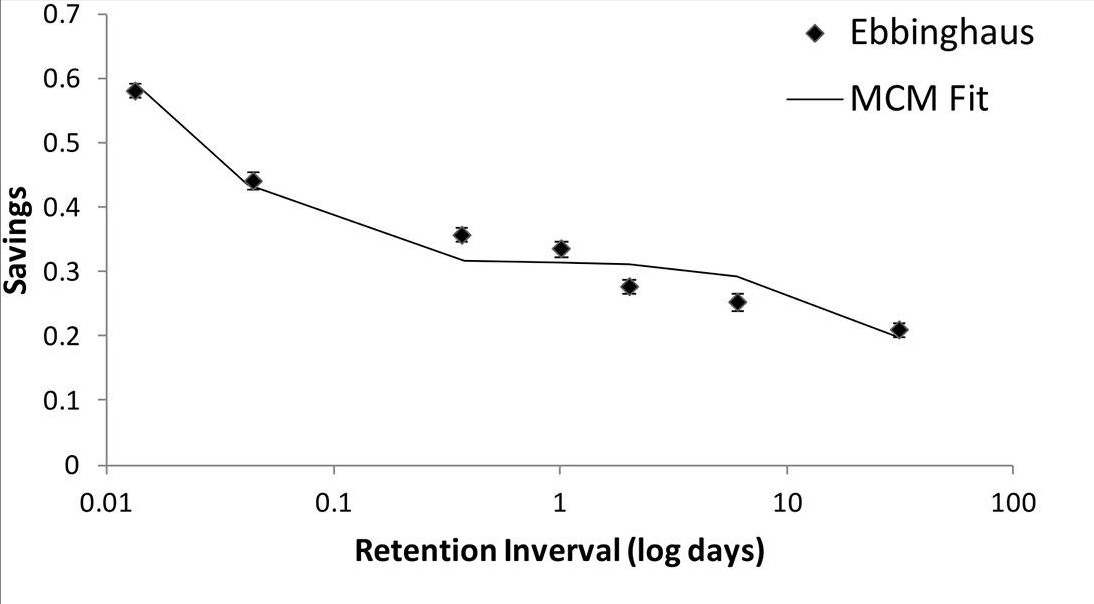
Hermann Ebbinghaus, working in 1885, produced the forgetting curve, and the design is the most interesting thing about it: he used himself as the only subject, memorising lists of nonsense syllables. The curve is steep at the start and shallow afterwards. Our own research file gives the shape in round figures, approximately 50 percent of newly learned material gone within 1 hour and approximately 70 percent within 24 hours, after which the rate of loss slows dramatically. Those percentages are our file's own summary reading of a continuous curve rather than published percentages of Ebbinghaus's, and different textbooks give different round numbers off the same curve depending on which retention interval they read at. Our file also says the finding has been replicated thousands of times, which is a head count with no reachable distribution behind it, so this article does not repeat it. What it can point at instead is one specific replication: Jaap Murre and Joeri Dros re-ran the 1885 procedure and published the result in PLOS ONE in 2015.
Ebbinghaus also gave the field the savings method, and it carries more weight than the curve does. Relearning material you can no longer recall takes less time than the original learning took, which shows that a trace persists below the level of conscious recall. Forgetting is therefore not the same thing as erasure. Hold on to that, because it is what makes both of the arguments at the end of this article possible.
The curve is also not the whole story, and the correction is as old as most of the textbooks that print it. Harry Bahrick published a study in 1984 whose title states what it found: semantic memory content in permastore, fifty years of memory for Spanish learned in school. Material learned in a classroom was still retained half a century later, and permastore is Bahrick's own coinage for the store it sat in. This article states no retention percentage for that study, because the figure was not read for it.
The exact mathematical form of forgetting is its own hundred-year literature and it is not settled. David Rubin and Amy Wenzel published One hundred years of forgetting: A quantitative description of retention in Psychological Review in 1996; John Wixted and Ebbe Ebbesen published On the Form of Forgetting in Psychological Science in 1991. Both sit in the reference list of the 2015 replication, alongside a cluster of further papers arguing about what the shape actually is. This article names the dispute and does not enter it, because entering it would need a reading of those papers that was not done here.
One paragraph of machinery, because the rest of this article breaks it. The standard architecture is Richard Atkinson and Richard Shiffrin's 1968 multi-store model: a sensory register, a short-term store, and a long-term store of potentially unlimited capacity and duration. Our own file attaches to that short-term store the most over-cited number in psychology, a capacity of about 7 plus or minus 2 items. That number is George Miller's, from a 1956 paper in Psychological Review about the span of absolute judgment and immediate memory across several tasks, and it is worth carrying with his name attached rather than as a certified constant, because a figure detached from the paper it came from is exactly the kind of thing this article is about.
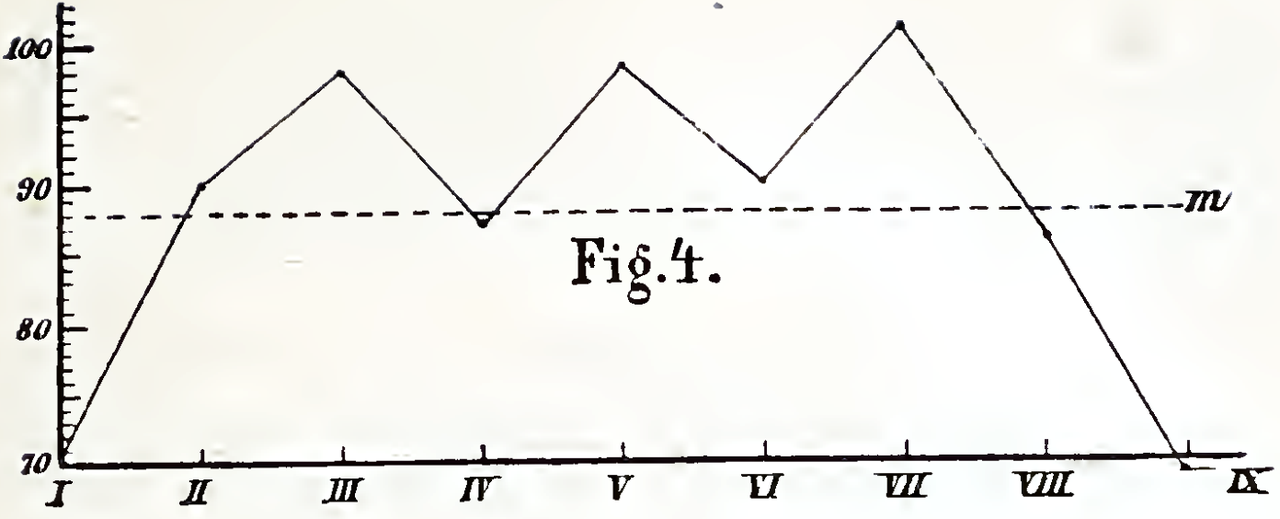
One more thing about that curve, because it is the class of detail this article exists to notice. The graph that gets reproduced everywhere is a modern redrawing. The figures reproduced from the 1885 monograph itself, at least the ones the research pass behind this article could find, plot acquisition rather than retention: the seconds required to memorise each successive block of syllables, or the number of readings a list of a given length needed. The single most reproduced graph in the psychology of memory is not a graph its namesake published.
02The Shape Of What Survives
Frederic Bartlett did the experiment that changed the question. In 1932 he had British participants read an unfamiliar Native American folk tale, The War of the Ghosts, and then recall it repeatedly over time. What came back was not a faithful reproduction that had simply lost detail. It was systematically reshaped to fit Western cultural schemas: the supernatural elements were omitted, the gaps were rationalised, the unfamiliar details were conventionalised into familiar ones. Bartlett's conclusion was that existing knowledge structures, which he called schemas, guide encoding, storage and retrieval, and that the distortions they produce are systematic rather than random. Our own file's word for what this did to the recording model of memory is challenged, not refuted, and this article keeps that word.
A note on how we know that, because it is a small instance of a large problem. Our own research file's bibliography carries a digital object identifier for Bartlett's 1932 book. It resolves to a review of the book, published in the journal Philosophy in 1933. The entry for Ebbinghaus's 1885 monograph has the same fault: its identifier resolves to a contemporaneous review in Science. Both reviews are real, useful, checkable sources, and both are linked at the foot of this page labelled as reviews rather than as the books they discuss. Neither line was copied from our own file.
Our own file grades one belief about memory at its lowest tier, and it is the belief this article runs against: that memory is a faithful recording device. Decades of research contradict it. Memory is reconstructive, selective, and subject to systematic distortion at encoding, at storage and at retrieval, and our file attributes the point to Daniel Schacter, whose peer-reviewed statement of it is The seven sins of memory, in American Psychologist in 1999. One housekeeping note, because our own file is inconsistent about this: its section 1.3 calls the folk model a tape recorder and its section 4.1 calls it a video recorder. Those are the same claim in two costumes. This article uses one form of the metaphor only, the one the survey below actually measured.
That folk belief is not an assumption psychologists make about the public. It has been measured. Daniel Simons and Christopher Chabris ran a large representative telephone survey of the United States population on what people believe about how memory works, published in PLoS ONE in 2011. Of the propositions they put to respondents, which the authors state conflict with expert consensus, 83 percent agreed that amnesia results in the inability to remember one's own identity, 63 percent that memory works like a video camera, 55 percent that memory can be enhanced through hypnosis, 48 percent that memory is permanent, and 37 percent that the testimony of a single confident eyewitness should be enough to convict a criminal defendant. Each figure belongs to its exact proposition and to nothing wider. The 83 percent is the highest agreement on the list, and it is a belief about amnesia rather than about everyday remembering, and section 13 is where that belief meets an actual case: the most documented case in neuroscience is a man who could not form new long-term declarative memories and kept the ones he had formed before his surgery. The 63 percent is not a measure of how many people think memory is generally accurate, and the 37 percent is a belief about what the law should do rather than a belief about what memory is. This article read the published abstract and not the paper, so it states no sample size, no sampling method beyond the authors' own phrase, and no subgroup breakdown. One further item on the same list belongs to the subject of the illusion of seeing and is left there.
03Four Things That Are Not One Thing
Popular writing about false memory collapses several different findings into one, and keeping them apart is the structural job of everything below. They are not the same phenomenon, they are not equally strong, and they do not license the same conclusions. Here they are, in roughly increasing order of strength of claim and decreasing certainty.
| The Finding | What Actually Changes | Where It Sits Below |
|---|---|---|
| The misinformation effect | A detail inside a real remembered event is altered by information that arrived after the event | Section 04. Enormous literature, extremely robust |
| Source monitoring error | The content is remembered correctly and its origin is not, so a suggested detail is recalled as a seen one | Section 05. A mechanism rather than a phenomenon |
| Imagination inflation | Confidence that a childhood event occurred rises after merely imagining it, with no misinformation supplied from outside at all | Section 06 |
| Full implanted-event studies | An entire event that never occurred is reported as a remembered autobiographical experience | Sections 07 and 08. Smallest samples, most methodological dispute, most ethical scrutiny |
| The DRM word list | A word that was never presented is remembered as having been presented, in a laboratory list task | Section 09. Not the same kind of event as any of the four above |
The order matters. A changed detail inside a real event is not the same species of thing as a whole invented childhood, and the literature behind the first is very much larger than the literature behind the last.
04One Word
Start with the smallest version, because it is the whole thesis in one move. In 1974 Elizabeth Loftus and John Palmer showed participants a filmed car accident and then asked how fast the cars were going. Changing a single verb in the question, from contacted to smashed, altered the speed estimates. The smashed wording also increased false reports of broken glass at a later test, and there was no broken glass in the film. Our own file attaches a percentage to the size of the speed change. This article leaves it out, because the paper reports mean speed estimates per verb condition rather than a single percentage, and a number rounded on its way through a summary is precisely what the rest of this page is about.
The effect was not a one-off. Loftus's own thirty-year review of this literature, published in Learning and Memory in 2005 and open access, lists what misleading post-event information has done: led people to recall nonexistent objects such as broken glass, to remember a yield sign as a stop sign, to remember hammers as screwdrivers, and to remember a barn that was not present in the landscape a filmed car was driving through. The stop sign and the yield sign come from Loftus, Miller and Burns in 1978, and they are the clearest single image in the whole literature. The review also reports the effect in subjects including three-month-old infants, a gorilla, pigeons and rats, and its reason for mentioning them is specific rather than decorative: an effect in a nonverbal creature cannot be produced by a participant trying to please the experimenter. Susceptibility rises when time has been allowed to pass between the event and the misinformation, which the review explains through the discrepancy detection principle: a recollection is more likely to change if the person does not immediately notice the discrepancy between the misinformation and their memory of the original event.
Read that principle carefully, because the intuitive version of it is wrong and the review says so outright. Noticing the discrepancy does not protect the memory. The review's own example is a person who thinks, in effect, that they thought they saw a stop sign but the new information mentions a yield sign, and concludes that they must be wrong. False memories can still occur even when the discrepancy is noticed. All the principle predicts is that recollections are more likely to change when the discrepancy goes unnoticed. Pay attention and you will not be fooled is not a finding, and this article will not print it as one. What is doing the work in that example is deference, not inattention, which is a more uncomfortable thing to say.
There is also a genuine and unresolved argument about what the effect does to the original memory, and it changes what a false memory even is. Michael McCloskey and Maria Zaragoza argued in 1985 that misinformation does not impair the original memory at all: it may simply influence the reports of subjects who never encoded the original detail, or of subjects who remember both sources and conclude, after deliberation, that the misleading one must be right. They devised a modified test in which the misinformation option is removed from the answer choices, so a subject who saw a hammer and was told screwdriver must choose between hammer and a novel item, wrench. On that test subjects were good at picking the original item. Later analyses of collections of studies using the modified test found small misinformation effects even there. Two honesty notes. This article takes its account of McCloskey and Zaragoza's argument from Loftus's own summary of it rather than from their paper, which is a partisan route to a critic's position and is disclosed here for exactly that reason. And whether the original trace is damaged or merely outcompeted at retrieval is genuinely unsettled, so this article does not settle it.
05Why A Suggestion Feels Like Seeing
Why does a suggested detail feel like something you saw? Because on the leading account the content is genuinely remembered and only its origin is lost. Marcia Johnson, Shahin Hashtroudi and D. Stephen Lindsay set out the source-monitoring framework in Psychological Bulletin in 1993: remembering involves deciding where a piece of remembered content came from, and that decision can go wrong independently of whether the content itself is accurate. Maria Zaragoza and Sean Lane tested this directly in 1994 and, as Loftus's 2005 review reports, concluded that misled subjects do sometimes come to remember seeing things that were merely suggested to them, which they named the source misattribution effect. The same review is explicit about the limit, and the limit is the original authors' own: the size of the effect varies, and source misattributions are not inevitable after exposure to suggestive misinformation. That is the answer to the reader's obvious question. It feels real because the content is real. It simply came from somewhere else, and the tag recording where does not survive.
06No Suggestion Required
Now remove the misinformation entirely. Maryanne Garry, Charles Manning, Elizabeth Loftus and Steven Sherman published a paper in Psychonomic Bulletin and Review in 1996 whose title states its own finding: imagination inflation, imagining a childhood event inflates confidence that it occurred. Nobody supplied a false detail. Participants imagined something, and afterwards were more confident that it had happened to them. Two limits, and together they are the difference between a finding and a slogan. This article did not read the effect size and states none. And the measured outcome is confidence that the event occurred, which is a weaker and different thing from a recollection of it. On this evidence, imagining does not manufacture a memory. It moves a dial.
07A Whole Event That Never Happened
The most famous demonstration in this field is small, old, and worth stating precisely, because almost every popular account of it prints a number that no reachable source supports. In 1995 Elizabeth Loftus and Jacqueline Pickrell gave participants short written accounts of childhood events supplied by their own relatives. Three were true. The fourth, being lost for an extended period in a shopping mall at around age five or six and eventually rescued by an elderly stranger, had been confirmed by those same relatives never to have happened. About a quarter of the participants went on to develop detailed false memories of it, and the count behind that quarter is six people. Here is the sentence in the words of a 2019 open-access review of this literature, one of whose seven authors is Loftus herself: "After three suggestive interviews, 25% (n = 6) of the participants claimed that the false event in fact had occurred." This article does not tell you how many people were in that study. No source reachable for it states the total: the publisher would not serve the paper, and it is indexed in neither PubMed nor Europe PMC, which was checked rather than assumed. Dividing six by a rounded quarter produces a figure that is in wide popular circulation and is still not a sourced fact, because several different totals all round to about a quarter, so the derived number is not printed here. A reconstruction wearing a citation is the exact failure this article is about.
The field knew the study was small, which is why somebody did it again. A preregistered direct replication and extension was published in Memory in 2023 by Gillian Murphy, Ciara Greene and colleagues, on a much larger sample than the original: with 123 participants, they coded 35 percent as reporting a false memory of getting lost in a mall in childhood, against 25 percent in the original study. Six false-memory reports in the original, and 123 participants in the replication. Those two numbers count different things and must not be read against each other, but the pairing is the honest shape of this literature, and it is a better story than either number alone: a famous small study, and a field that went back and checked it.
So what is the rate? The strongest single figure is a pooled one, and it comes from Loftus herself. In her 2005 review she states that across the many studies that have since used the lost-in-the-mall procedure, an average of about 30 percent of subjects have gone on to produce either a partial or a complete false memory, and she attributes that figure to Lindsay and colleagues in 2004. Partial or complete. Those are not the same thing, the review does not merge them, and neither does this article: about 30 percent developed a full false memory is not the claim, and it would be an overstatement of it.
Then the field did something better than quote its own headline rate. Alan Scoboria, Kimberley Wade, D. Stephen Lindsay, Tanjeem Azad, Deryn Strange, James Ost and Ira Hyman pooled the participant-level memory reports from eight peer-reviewed false-memory implantation studies, 423 participants in total, and recoded every one of them against a single system, publishing in Memory in 2017. Their stated reason for doing it is the interesting part: estimates varied across studies partly because false memory had been operationalised differently in each. Independent raters coded transcripts against seven criteria, which the authors list as accepting the suggestion, elaboration beyond the suggestion, imagery, coherence, emotion, memory statements, and not rejecting the suggestion. Under that scheme 30.4 percent of cases were classified as false memories, and a further 23 percent were classified as having accepted the event to some degree. Where the suggestion included self-relevant information and an imagination procedure and was not accompanied by a photograph of the event, the rate was 46.1 percent, and that figure is conditional on all three of those method features and means nothing without them. A separate published estimate runs lower. Chris Brewin and Bernice Andrews, in a systematic review in Applied Cognitive Psychology, report that implantation studies induce some recollective experience for the suggested event in an average of 47 percent of participants, but that only in 15 percent are those experiences likely to be rated as full memories. Several percentages are now on the table for the same phenomenon and they measure different things. They may not be averaged, combined, or presented as agreeing. That is not a caveat on the finding. It is the finding: a false memory is a thing you have to define before you can count it, and the definition is doing much of the work.
That recount was part of a public argument, and the argument is worth more than either side's number. Brewin and Andrews' systematic review was a criticism of how the prevalence of false memories had been reported. In the same volume of the same journal, Robert Nash, Kimberley Wade, Maryanne Garry, Elizabeth Loftus and James Ost published a direct reply, titled Misrepresentations and Flawed Logic About the Prevalence of False Memories. This article has to declare an asymmetry here, because otherwise it would decide the argument by accident. The research behind this page read Brewin and Andrews' open-access full text and took their figures from it. It did not read the reply. So the paragraph above carries their numbers, and this one carries only the reply's existence and its title, with no characterisation of what it argues or what it showed. The reply is linked at the foot of this page so that a reader can do what this article did not. That a field fought in public over whether its own headline number was inflated is a point in the field's favour, and the honest position from outside it is that the dispute is live.
There is a real constraint on all of this, and it answers the reader who has got this far and concluded that anyone can be made to remember anything. Kathy Pezdek, Kimberly Finger and Danelle Hodge tested and confirmed the hypothesis that an event will be planted in memory to the degree that it is plausible and that script-relevant knowledge for it already exists in memory, publishing in Psychological Science in 1997. In their first experiment, 22 Jewish and 29 Catholic high school students were read descriptions of three true events and two false events said to have happened when they were 8 years old, one false event describing a Jewish ritual and one a Catholic ritual. The result fell exactly where the hypothesis predicted: 7 Catholic students but none of the Jewish students remembered only the Catholic false event, 3 Jewish students but only 1 Catholic student remembered only the Jewish false event, and 2 subjects recalled both. In their second experiment, 20 confederates read a younger sibling or close relative descriptions of one true event and two false ones, the more plausible being that the relative had been lost in a mall while shopping and the less plausible that the relative had been given an enema. Three events were falsely remembered. Three, in total. That is the whole result, and it is not a population estimate of anything; it is decisive for the plausibility hypothesis precisely because all three fell on the same side.
And plausibility can itself be moved. Giuliana Mazzoni, Elizabeth Loftus and Irving Kirsch published a paper in the Journal of Experimental Psychology: Applied in 2001 whose title is its own finding: changing beliefs about implausible autobiographical events, a little plausibility goes a long way. This article carries the title's claim and no result beyond it, because the paper was not read for it. Plausibility constrains what can be planted, and plausibility can be manufactured.
The mall is also not the only invented event, which matters, because otherwise the reader is entitled to think the whole field rests on one shopping centre. Loftus's 2005 review names the others. Ira Hyman, Troy Husband and F. James Billings planted a false memory of an accident at a family wedding, in Applied Cognitive Psychology in 1995. Stephen Porter, John Yuille and Darrin Lehman planted a false memory of a vicious animal attack, in Law and Human Behavior in 1999; that identifier was not resolved for this article, so the study is named here and not linked. Ira Hyman and Joel Pentland examined the role of mental imagery in creating these memories, in 1996. The review calls the general method the familial informant false narrative procedure, crediting the term to Lindsay and colleagues in 2004, and notes that others prefer to call it the lost-in-the-mall technique after the study that introduced it. Every one of those planted events would have been distressing had it happened. That is the design, it is the point, and it is also why the ethics of this literature are argued about.
Photographs work as well, and the second study is the one to pause on. Kimberley Wade, Maryanne Garry, J. Don Read and D. Stephen Lindsay used doctored photographs to create false childhood memories, in a 2002 paper titled A picture is worth a thousand lies. Two years later D. Stephen Lindsay, Lisa Hagen, J. Don Read, Kimberley Wade and Maryanne Garry published True Photographs and False Memories, which is the study Loftus's review credits with both the pooled figure above and the name of the procedure. The titles carry the point between them: a genuine photograph of a real childhood can help build a memory of something that did not happen in it. This article states no success rate for either paper, because neither one's results were read for it. In 2026 that pair of titles has an edge it did not have in 2004, and one sentence is all it gets here, because this is an article about memory and not about image generation.
Outside the clinic and the courtroom, the same machinery sells things. Kathryn Braun, Rhiannon Ellis and Elizabeth Loftus showed participants a fake advertisement placing Bugs Bunny at a Disney resort, and Loftus's 2005 review states that the single fake advertisement led 16 percent of subjects to later claim they had met him, which could not have happened, because Bugs Bunny is a Warner Brothers character who would not appear at a Disney resort. That study's own identifier could not be checked for this article, so the finding is carried as the review reports it and the study is not linked below. Daniel Bernstein, Cara Laney, Erin Morris and Elizabeth Loftus reported in Social Cognition in 2005 that false memories about food can lead to food avoidance. And Henry Roediger, Michelle Meade and Erik Bergman documented social contagion of memory in 2001: a false detail can pass from one rememberer to another. The Bugs Bunny result is the best evidence here that the event does not have to be plausible because it is familiar, only plausible because it is scripted. Everyone has a script for meeting a costumed character at a theme park.
08Remembering A Crime You Did Not Commit
Now the study that carries all this into a police interview room, and the reason to read it is not the result but what happened to the result. Julia Shaw and Stephen Porter published Constructing Rich False Memories of Committing Crime in Psychological Science in 2015. The invented event was not a childhood accident. It was a crime the participant had supposedly committed. Their own abstract reports that after three interviews 70 percent of participants were classified as having false memories of committing a crime, specifically theft, assault, or assault with a weapon, that had led to police contact in early adolescence, and that those participants volunteered a detailed false account. Then the number was contested in the same journal. Kimberley Wade, Maryanne Garry and Kathy Pezdek published Deconstructing Rich False Memories of Committing Crime in 2018, recoding the original data with a different scoring method. On the account of a 2019 open-access review that cites that commentary, the recoding found that only 26 to 30 percent of Shaw and Porter's subjects formed false memories. That range is second-hand here and is flagged as such: the commentary itself has no abstract in any index, the publisher would not serve its text, and so this article takes the figure from a peer-reviewed review whose full text was read rather than from the reanalysis itself. Julia Shaw replied in print in the same 2018 issue, in a paper whose title states the underlying question exactly: how can researchers tell whether someone has a false memory. And a corrigendum to the 2015 paper was published in Psychological Science in 2018. This article states that the corrigendum exists and does not say what it corrected, because that was not obtained. It is not a retraction, and nothing here should be read as implying that it corrected the headline figure.
The one thing not to do with that exchange is to treat the recoded range as the corrected answer. It is a different scoring method, not a discovered error, and Shaw's reply is precisely an argument about which scoring method is right. A reader who is told only the first figure has been misled. A reader who is told only that the critics won has also been misled. A reader who is shown a striking result, a recount by other researchers that roughly halves it, a reply from the original author and a correction notice, all in the same journal inside three years, has been told the truth, and has also been shown what a field looks like when it is working. One further note on what this study does not show: the framing that travelled with it in popular coverage, that it proves most people can be talked into confessing to a crime they did not commit, is not supported by the record read here.
09A Word That Was Never There
There is one demonstration in this article a reader can perform on themselves, and it is the most reproducible false-memory demonstration in existence. Henry Roediger and Kathleen McDermott published Creating false memories: Remembering words not presented in lists in 1995, reviving a 1959 finding by James Deese. The design is a word list whose items all converge on one word that is never presented. The result named in the title is the result: people remember the absent word. It can be run on a lecture hall in about ninety seconds.
It is also the most over-extended finding in this field, which is why the limit has to travel with it. David Gallo reviewed the paradigm at its fifteen-year mark in Memory and Cognition in 2010, under a title that names the inferential leap exactly: False memories and fantastic beliefs, 15 years of the DRM illusion. Remembering an unpresented word from a converging list is not the same kind of event as remembering a childhood that did not happen, and the literature has spent fifteen years saying so. The leading theoretical account of why the illusion happens is Charles Brainerd and Valerie Reyna's fuzzy-trace theory, set out in Current Directions in Psychological Science in 2002: a gist trace and a verbatim trace are stored separately, and the gist survives. That single clause is the standard account of the theory rather than a quotation from the paper, which was not read for this article.
One note about our own file. It lists Roediger and McDermott in its bibliography and then never mentions the paradigm anywhere in its body: not in its summary, not in any of its four tier sections, not in its counter-arguments table, not in its keywords. The most reproducible demonstration in the field it is a file about is cited there and never used. Filling that gap is one of the things this article is for.
10The Courtroom
Everything so far has been laboratory work. This is where it stopped being laboratory work, and it is also where this article has to be most careful, because the single sharpest fact available is also the most misquoted statistic in the field.
Here it is with everything attached. Of the 375 DNA exonerations the Innocence Project tracked nationwide in the United States between 1989 and 2020, 69 percent involved eyewitness misidentification. The denominator is 375. The jurisdiction is the United States. The window closes in 2020, and it closes because the organisation stopped tracking all nationwide DNA exonerations after reaching 375 that year and now tracks only its own cases, so this is a closed historical tally rather than a running figure. Our own research file gets the same sentence wrong in three separate ways at once. It rounds the figure up to 70 percent. It drops the denominator and the window entirely. And it attributes the number to Wells and Olson's 2003 review in the Annual Review of Psychology, which is a real and excellent review of eyewitness testimony and is not the source of the tally. The tally is the Innocence Project's own count, from its own published page, which is linked at the foot of this article.
| The Reported Figure | What It Is A Percentage Of |
|---|---|
| 69 percent involved eyewitness misidentification | The 375 DNA exonerations tracked nationwide in the United States between 1989 and 2020. The organisation closed that nationwide tally at 375 in 2020 |
| 52 percent involved a misidentification from a photo array | Those misidentification cases, not the 375 |
| 34 percent an in-person lineup | Those misidentification cases, not the 375 |
| 54 percent an in-court misidentification | Those misidentification cases, not the 375 |
| 42 percent a cross-racial misidentification | Those misidentification cases, not the 375 |
| 32 percent multiple misidentifications of the same person by different witnesses | Those misidentification cases, not the 375 |
| More than 60 percent of the Innocence Project's own clients were wrongfully convicted on the basis of eyewitness misidentification | A separate figure on the organisation's eyewitness page. Its denominator is Innocence Project clients, and it must never be blended with the tally above |
And now the part that most writing using that number leaves out. The step from the tally to the sentence eyewitness memory is unreliable has been challenged in print, by serious people, in a major journal. John Wixted, Laura Mickes and Ronald Fisher published Rethinking the Reliability of Eyewitness Memory in Perspectives on Psychological Science in 2018. They accept that memory is malleable and that eyewitness misidentification played a role in most of the DNA exonerations. What they deny is that this licenses a blanket verdict of unreliability. Their argument is that eyewitness memory behaves like DNA evidence and other scientifically validated forensic evidence: it is reliable when it has not been contaminated and when proper testing procedures are used, and it is ruined by contamination and bad procedure in exactly the way a physical sample is. Their load-bearing empirical claim is that eyewitnesses typically provide reliable evidence on an initial, uncontaminated memory test, and that this holds even for most of the wrongful convictions later reversed by DNA evidence. The reframing that follows from it is the sentence below.
One further claim of theirs can be stated qualitatively and not numerically. On their reading of those exoneration cases, the same eyewitnesses who were highly confident in their misidentifications at trial had not been confident at the first identification. This article prints no figure for how many cases that covers, because the only retrieval that produced one could not be repeated, and an unrepeatable number is not a source. Then the reply, which is the third corner of this dispute rather than the other side of a two-sided one. In the same issue, Kimberley Wade, Robert Nash and D. Stephen Lindsay published Reasons to Doubt the Reliability of Eyewitness Memory: Commentary on Wixted, Mickes, and Fisher (2018). They open by agreeing with the thrust of the argument, and this article does not stage them as opponents of the whole of it. Then they say the opposite risk is real: the reasoning implies that near-pristine conditions and uncontaminated memories are normative, and there are two reasons to doubt that. First, psychological science does not yet have a good understanding of how often, or when, real eyewitness interviews deviate from best practice in ways that damage accuracy. Second, witnesses may frequently meet preinterview influences that corrupt even a report gathered in a best-practice interview. Both papers were read here at the level of their published abstracts, so this article states what each side argues and describes no method, no analysis and no effect size from either.
That challenge has a companion synthesis, and its conditions are the whole of it. John Wixted and Gary Wells published The Relationship Between Eyewitness Confidence and Identification Accuracy: A New Synthesis in Psychological Science in the Public Interest in 2017. They begin by granting that the pessimistic view was once entirely reasonable, because of the questionable identification procedures police commonly used. Then they ask what confidence tells you under what they call pristine testing conditions, and they define the term rather than gesturing at it: an initial and uncontaminated memory test, a fair lineup, no influence from the person administering it, and a confidence statement taken immediately. Under those conditions, they report, mock-crime studies and police field studies have consistently shown that for adults confidence and accuracy are strongly related and that high-confidence suspect identifications are remarkably accurate. Their own abstract supplies both limits in the same breath. When certain non-pristine conditions prevail, an unfair lineup being their own example, the accuracy of even a high-confidence identification is seriously compromised. And some jurisdictions have not yet made the reforms that would create pristine conditions, so the authors state that their conclusions about the reliability of high-confidence identifications cannot yet be applied to those jurisdictions. Confident witnesses are usually right is a misquotation of this paper. The claim is conditional, all the way down, and what it makes the question about is not the witness but what the system did before the witness ever spoke.
Confidence has a literature of its own, and it does not behave the way a courtroom assumes. Roger Brown and James Kulik proposed in 1977 that highly emotional and surprising events, of the kind a whole population shares, create vivid and detailed flashbulb memories by way of a special neural mechanism. The special mechanism is the part that did not survive. Jennifer Talarico and David Rubin found in 2003 that flashbulb memories are not more accurate than ordinary memories, only more vivid and held with more confidence, and their title says it: Confidence, Not Consistency, Characterizes Flashbulb Memories. Our own file names the September 11 attacks as a flashbulb example, which is fair to the phenomenon and unfair to Brown and Kulik, whose paper is from 1977 and cannot have been about an event in 2001; the ten-year longitudinal study of memory for that day, by Hirst and colleagues in 2015, is the work our file gestures at and never cites. Our file's framing of the consequence is that people are highly confident in flashbulb memories despite significant distortions, which creates a dissociation between subjective certainty and objective accuracy, and it calls that dissociation dangerous. Dangerous is our file's editorial word, not a result. Talarico and Rubin found a dissociation; the danger is what a courtroom does with one. A last note on our own file: its counter-arguments table answers the unreliability of flashbulb memories by citing Brown and Kulik's idea that their emotional significance may serve adaptive social functions. That is the original proposers' framing rather than an independent rebuttal of the people who refuted them, and this article carries the idea while saying whose it is.
A word about one number, because this section has been an argument about denominators and the argument applies to this page too. This paragraph aside, where it is only being named, the figure 70 percent does four separate jobs in this article and counts something different in each: the share of a nonsense-syllable list our own file says is gone within a day, in section 01; the share of participants a 2015 study classified as having false memories of committing a crime, in section 08; the rounded and misattributed version of the exoneration statistic that our own file prints and this article corrects, above; and the share of surveyed clinical psychologists reported to believe in the existence of repressed memories, in section 12. Four different denominators, four different definitions, one number. A percentage without both of those is not information, and that is not a rhetorical flourish. It is the finding of section 07 applied to this page.
Something was done about all this, which is the answer an article of this shape owes its reader. The United States National Research Council published a consensus report on the assessment of eyewitness identification in 2014, titled Identifying the Culprit. Gary Wells and colleagues published the American Psychology-Law Society's policy and procedure recommendations for the collection and preservation of eyewitness identification evidence, in Law and Human Behavior in 2020. This article states not one recommendation from either document, because neither was read for it. What it can state is the institutional fact, and it is not a small one: a national academy and a professional body took this science up formally, which means it changed practice rather than merely being published. Set beside that the survey figure from section 02. When Simons and Chabris asked, 37 percent of a representative sample of the American public agreed that the testimony of a single confident eyewitness should be enough to convict a criminal defendant.
11What Helps, And How Little
Every article about false memory owes its reader something other than despair, so here is what the literature offers, at the strength it offers it. Loftus's 2005 review reports that warning people before they are exposed to misinformation sometimes helps them resist it, which it attributes to Greene, Flynn and Loftus in 1982, and that a warning given after the misinformation had already been processed did not improve resistance. More recent work, which the review attributes to Eakin and colleagues in 2003, suggests that post-misinformation warnings can succeed in limited circumstances, specifically when the misinformation is in a relatively low state of accessibility, and did not work at all when the misinformation was highly accessible. Hartmut Blank and Celine Launay published a meta-analysis of post-warning studies in the Journal of Applied Research in Memory and Cognition in 2014; it is cited here for its existence and not for its result, which was not read. The two identifiers behind Greene 1982 and Eakin 2003 were not resolved, so those studies are named as the review names them and are not linked.
Susceptibility is also not uniform, and the qualification on that sentence is the part that matters. Loftus's 2005 review reports that young children are in general more susceptible to misinformation than older children and adults, that the elderly are more susceptible than younger adults, that misinformation effects are stronger when attentional resources are limited, and that several personality variables including empathy, absorption and self-monitoring are associated with greater susceptibility. Then the review is careful on the point that a reader most wants to duck: suggestion-induced distortion occurs in people of all ages, even though it is more pronounced in some. This is not a finding that some people are suggestible and some are not. An article that leaves a reader believing they personally are the resistant kind has failed at its one job.
12The Memory Wars
This section is about real harm done to real people, so a word first about what this article will not do. It names researchers, who are public figures acting in public professional roles, and it names one published court decision. It names no patient, no therapist, no child, and no private individual, in either direction: nobody here is named as an abuser and nobody is named as a fabricator. It makes no claim about any living person's mental state. The restraint is not legal caution. It follows from the finding at the end of this section: if nothing available distinguishes a true memory from a false one in an individual case, then this article is not in a position to say who was remembering.
Our own research file grades this material at Tier 3, speculative, and its account is the model this article follows rather than improves on. In the memory wars of the 1990s, some therapists claimed that traumatic memories could be repressed and later recovered through suggestive therapeutic techniques. Laboratory research demonstrated that suggestive techniques can create entirely false memories, which raised serious concerns about recovered-memory therapy. Our file's statement of the current consensus has three parts and every one of them is load-bearing. Traumatic events can sometimes be forgotten and later recalled. Suggestive therapeutic techniques carry a high risk of creating false memories. And the distinction between a genuine recovered memory and a therapist-implanted false one is extremely difficult to determine in individual cases. That third clause is the honest end of the road, and this article does not walk past it. The two peer-reviewed anchors our file cites are Loftus's 1993 paper in American Psychologist, The reality of repressed memories, and Loftus and Davis's 2006 review in the Annual Review of Clinical Psychology.
Our own file also supplies the counter that keeps this honest in the other direction, and it matters more than anything else in this section. Richard McNally's 2003 book Remembering Trauma is cited there for the position that some genuinely forgotten traumatic events are later recalled. McNally is a critic of recovered-memory therapy and he holds that. Both halves are true at once, and an article that drops the second half has said something false about the record and something damaging about real people. That book's identifier was not independently resolved for this article, so it is named here and not linked.
The argument is not over, and that is a measurement rather than an impression. Lawrence Patihis, Lavina Ho, Ian Tingen, Scott Lilienfeld and Elizabeth Loftus published a paper in Psychological Science whose title asks the question outright: Are the Memory Wars Over? A Scientist-Practitioner Gap in Beliefs About Repressed Memory. Two studies. The first found high rates of belief in repressed memory among undergraduates, and that greater critical-thinking ability was associated with more scepticism about repressed memories. The second found less belief in repressed memory among mainstream clinicians today than in the 1990s, and that groups containing research-oriented psychologists and memory experts were more sceptical than other groups. Their own summary of the two together is that a substantial gap between the memory beliefs of clinical-psychology researchers and those of practitioners persists today. This article states the direction of that gap and not its size, because the abstract carries no group percentages and the results were not read here. Note which way the direction runs, because it cuts against the lazy version of this story: the clinicians in that study believed less than clinicians in the 1990s. The honest sentence is that the gap persists, not that nothing has changed. The paper appeared online in December 2013 in the 2014 volume, and is dated 2014 throughout this page.
Figures for the belief itself come from somewhere else, and the difference matters. Henry Otgaar, Mark Howe, Lawrence Patihis, Harald Merckelbach, Steven Jay Lynn, Scott Lilienfeld and Elizabeth Loftus published The Return of the Repressed: The Persistent and Problematic Claims of Long-Forgotten Trauma in Perspectives on Psychological Science in 2019. Aggregating across the surveys they review, they report that on average 58 percent of those surveyed indicated some degree of belief in the existence of repressed memories; that among clinical psychologists 70 percent believed in their existence; that 75 percent of other professionals expressed a strong belief in repressed memories; and that 46 percent of laypersons did. Read those thresholds, because they are not one measurement: some degree of belief and a strong belief are different questions, and the four figures are not a single ranked list. Three constraints ride with them. They are that review's aggregation across surveys rather than a single survey, and in particular they are not the figures of the paper above, even though two of that paper's authors are also authors here. They measure belief about repression, which is not the same thing as the practice of memory recovery, and this article does not slide from one to the other. And the authors of that review are sceptical of repression, so this is a sceptical literature's own count and not a neutral reading of the field, which is why McNally's position is carried above at full strength rather than as a footnote.
The question a reader will actually have at this point is how often recovered-memory reports occur in therapy now. Lawrence Patihis and Mark Pendergrast published exactly that study, on a large age-representative United States national sample, comparing therapy types and decades, in Clinical Psychological Science. It is linked at the foot of this page, and this article carries no figure from it, because it was not read here. That is a gap. Naming it is better than filling it with something weaker.
The scientific footing under the legal side of this is Stephen Ceci and Maggie Bruck's work on the suggestibility of child witnesses: a historical review and synthesis in Psychological Bulletin in 1993, and a further review in the Annual Review of Psychology in 1999. This article states no finding from either, and names them because the order matters. Science first, then cases. A case named before its science is a story. A case named after its science is evidence.
One case is named on this page, and it is a civil action about the ethics of research rather than a criminal prosecution. In Taus v. Loftus, decided by the Supreme Court of California in February 2007, the plaintiff was the unnamed subject of a case study set out in a prominent scholarly article describing her apparent recovery of a long-repressed memory of childhood abuse, in which she was referred to as Jane Doe. The defendants were the authors and publishers of two subsequent articles which, in questioning the basic premise advanced by the initial article, disclosed various aspects of the plaintiff's family background and personal life. Justice Moreno wrote separately, concurring and dissenting, disagreeing on one point only: whether the plaintiff had an action for the tort of intrusion into private matters based on alleged misrepresentations made to a member of her family in order to obtain private information about her. This article does not name her, although the opinion does, because her name is in the public record only because she brought an action about the disclosure of her private life, and repeating it here would extend the exact harm the litigation concerned. It does not name the family member. It does not say whether her recovered memory was true or false, because the court did not decide that and neither may we. Later California opinions cite the decision as good law on some points, and at least one records it as overruled on another ground, so this article calls it neither simply standing nor simply overruled and stops at what the 2007 decision itself said. It is here because an article that presented Elizabeth Loftus solely as the scientist who exposed a problem, without noting that her methods were themselves litigated, would be doing the flattering thing rather than the true one.
And now the finding this whole article has been walking toward, which is a negative one. Daniel Bernstein and Elizabeth Loftus published a paper in Perspectives on Psychological Science in 2009 titled How to Tell If a Particular Memory Is True or False. Differences between true and false memories have genuinely been measured. An earlier study by Schooler, Gerhard and Loftus compared real memories of a yield sign that had actually been seen against memories of a sign that had only been suggested, and found that descriptions of the suggested ones were longer, contained more verbal hedges, contained more references to cognitive operations, and contained fewer sensory details. Then the limit, in the words of Loftus's own review: many of the unreal memory descriptions contained verbal hedges and sensory detail too, which makes it extremely difficult to take a single memory report and reliably classify it as real or unreal. The review says the same of the neuroimaging work, that we are still a long way from a reliable assessment when all we have is a single memory report to judge. Those are statistical differences between groups. They do not classify an individual memory. There is no tell, no verbal signature, no set of cues and no scan that identifies a false memory in one person, and any article on this subject that leaves a reader believing otherwise has told them something false.
13The Machinery Underneath
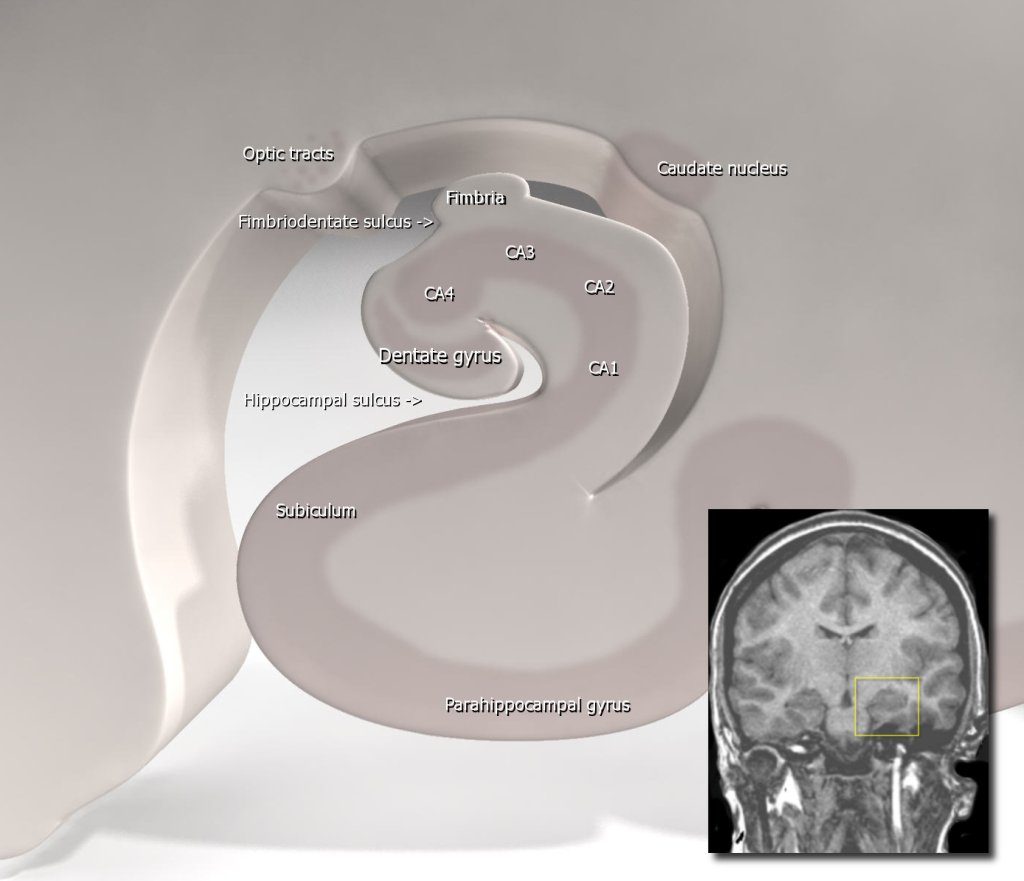
None of this is metaphorical, and the case that proves it is the most documented in neuroscience. Henry Molaison, known in the literature for decades as H.M., lived from 1926 to 2008. In 1953 he received a bilateral medial temporal lobe resection as a treatment for epilepsy. Afterwards he could not form new long-term declarative memories, a condition called anterograde amnesia, but he retained his pre-surgical memories and could still learn new procedural skills. William Scoville and Brenda Milner published the case in 1957. What it established is that the hippocampus is essential for forming new declarative memories, episodic and semantic, and that declarative memory, which is hippocampus-dependent, dissociates from procedural memory, which our file attributes to the basal ganglia and cerebellum. Sixty years later the physical record was examined directly. A 2014 study reconstructed his brain from histological sectioning and digital 3D reconstruction, and reports that the extent of the 1953 operation could not be assessed definitively during his life, that a significant amount of hippocampal tissue survived the surgery, and that there was diffuse pathology in the deep white matter along with a small circumscribed lesion in the left orbitofrontal cortex, which is outside the medial temporal lobe entirely. The tempting overclaim is that the textbook was wrong, and this article refuses it, because the authors themselves do not make it: their own framing is that the findings are new evidence that may help elucidate the consequences of the operation in the context of the brain's overall pathology. This article quantifies neither the surviving tissue nor the damage, because those figures were not read for it. The honest shape here is that the most famous case in the field was re-examined against the physical brain sixty years on, which is what a field looks like when it is working.
There is also a mechanism that would make the rest of this article physical rather than merely psychological. Karim Nader, Glenn Schafe and Joseph LeDoux demonstrated in 2000 that a reactivated memory becomes temporarily labile and must be reconsolidated, which opens a window during which it can be modified or weakened. That challenges the older picture of consolidation as a single one-time event, and if retrieval rewrites, then every act of remembering is an occasion for the record to change. Three limits, and our own file states all three itself. The 2000 result is in rats, it is about fear memory in the amygdala, and the boundary conditions and the reliability of reconsolidation effects in humans remain debated. On the clinical side, our file's own words are that reconsolidation-based therapies for post-traumatic stress disorder, in which propranolol is administered during memory reactivation, show promise but remain experimental. Nothing in this article should be read as saying that a treatment for erasing traumatic memories exists or is available, because it does not and it is not. The human-subject counterpart our file's claim needs and never names is Chan and LaPaglia's 2013 paper in the Proceedings of the National Academy of Sciences on impairing existing declarative memory in humans by disrupting reconsolidation; this article cites it as the human study that exists and states no result from it, because its findings were not read here.
And a false memory has been created directly in the hippocampus, in a mouse. Steve Ramirez and colleagues published Creating a False Memory in the Hippocampus in Science in 2013. The boundary has to be stated in the same breath rather than left for the reader to infer: this is a mouse, and nothing in it licenses any claim about implanting a memory in a human being by any physical means. This article resolved the paper's record and title and did not read its methods, so it describes no technique. It is here because it is the one place where the machinery becomes physically reachable, and therefore the one place where overclaiming would do the most damage.
14What A System Like This Is For
There is a serious answer to the question of why a memory system would be built this way, and it is a position in the literature rather than a settled fact. Daniel Schacter, Scott Guerin and Peggy St. Jacques published Memory distortion: an adaptive perspective in Trends in Cognitive Sciences in 2011. The title's own framing is the argument: distortion may be the cost of a system built for something other than accurate playback. Loftus's 2005 review offers the same idea in a single line, that the updating seen in misinformation studies is the same updating that allows an incorrect memory to be corrected, and that correction is a good thing. This article states the adaptive account as a position held in the literature and cites it. It does not state that memory distortion is adaptive as established fact, because that is a hypothesis about function and it is carried at Tier 2 for that reason.
Which brings us to the two conclusions this article refuses, and the first is where an article on this subject wants to end. Memory is fiction. Nothing you remember actually happened that way. Your past is a story you tell yourself. That is not supported. What the evidence shows is that memory is reconstructive, that the reconstruction can be steered under specific conditions, and that the resulting error is systematic rather than random. It does not show that memory is generally wrong. Plausibility constrains what can be planted, and that constraint was measured. Material learned in a classroom has been found still present half a century later. Relearning something you cannot recall is faster than learning it was, so a trace persists where recall fails. And the same updating that produces the misinformation effect is what allows a wrong memory to be corrected. A memory system this reliable is why anybody can cross a road. The distortions are the interesting edge, not the rule.
The second refusal is the one with consequences outside this page, and it is the more dangerous of the two. Recovered memories of abuse are false. Therapists implant them. Reports of childhood abuse that surface in adulthood should be disbelieved. Nothing in this literature supports that, our own file explicitly does not say it, and the critic our own file cites as its counter-argument holds the opposite half of it: that traumatic events can sometimes be forgotten and later recalled. What the science establishes is narrower and harder. Suggestive technique carries a high risk of producing a false memory, and in any individual case there is no test that distinguishes the two. Both halves have to be carried at once. And the second half of the refusal is worth stating in its own right, because the aggregate version does the same damage as the individual one: writing that therapists implant memories, unattributed and in the plural, defames a profession as surely as naming one person would. Every claim of that kind on this page is attributed to the researcher who made it and to the paper it is in. A reader who leaves this article more confident about disbelieving a particular person has been done real harm by it, and has also got the science wrong.
Fast Facts
- The Load-Bearing Finding
- Remembering is a rebuild, not a replay. Encoding, storage, consolidation and retrieval can each fail, distort or be manipulated, and the rebuild uses whatever material is to hand, including material that arrived after the event
- The Smallest Demonstration
- One changed verb in a question, from contacted to smashed, altered what participants said they had seen, and the smashed wording also increased false reports of broken glass that was not in the film. Loftus and Palmer, 1974
- The Famous Study, Stated Precisely
- Lost in the mall, Loftus and Pickrell 1995. About a quarter of the participants developed detailed false memories of the invented event, and the count behind that quarter is six people. This page prints no participant total, because no reachable source states one
- The Replication
- A preregistered replication and extension published in Memory in 2023 used 123 participants and coded 35 percent of them as reporting a false memory of getting lost in a mall in childhood, against 25 percent in the original
- Why The Published Rates Disagree
- About 30 percent produced a partial or a complete false memory across the pooled literature; a 2017 recoding of 423 participant reports from eight studies classified 30.4 percent as false memories, with a further 23 percent counted as having accepted the event to some degree; a systematic review reports 47 percent with some recollective experience, of which only 15 percent are likely to be rated full memories. They measure different things and may not be averaged
- The Constraint
- Plausibility. An event is planted in memory to the degree that it is plausible and that script-relevant knowledge for it already exists. Pezdek, Finger and Hodge, 1997, on very small samples
- The Courtroom Figure, With Its Denominator
- 69 percent of the 375 DNA exonerations the Innocence Project tracked nationwide in the United States between 1989 and 2020 involved eyewitness misidentification. The organisation closed that nationwide tally at 375 in 2020, so it is historical rather than running
- What Our Own File Got Wrong
- That same sentence in our research file rounds the figure up, drops the denominator and the window, and attributes the tally to a 2003 review that is not its source. The corrected version is in section 10
- The Dispute That Figure Sits In
- Three-cornered and unresolved: the tally; the published argument that it indicts procedure and the legal system rather than the witness, because eyewitnesses typically provide reliable evidence on an initial uncontaminated test; and the published reply, in the same issue, that near-pristine conditions may not be what real cases look like
- The Limit That Matters Most
- Differences between true and false memories have been measured between groups. Nothing available reliably classifies a single memory report as real or unreal, and there is no tell, no verbal signature and no scan that identifies a false memory in one person
- Refused Here, In Both Directions
- That memory is fiction and nothing you remember happened that way; and that recovered reports of childhood abuse are false and should be disbelieved. Neither is supported by this literature, and the second does harm
- Named And Not Named
- Researchers are named, and one civil decision. No patient, therapist, child or private individual is named in either direction, and the plaintiff in Taus v. Loftus is not named here although the opinion names her
- Deliberately Not Covered
- Cognitive bias, which belongs to the wing's article on the mind's blind spots; visual illusion, which belongs to the illusion of seeing; sleep-dependent consolidation, which belongs to sleep and dreams; and the memory palace, which is still to come in this wing
- One Number We Could Not Get
- How many people took part in Loftus and Pickrell 1995. Every open route was exhausted for this article; a library copy of the 1995 issue would settle it
What We Can Actually Stand Behind
Memory is reconstructive, and the reconstruction can be steered. One changed verb in a question altered what people reported seeing, in 1974. Post-event information has made people recall broken glass that was never there and a yield sign where a stop sign stood. Merely imagining a childhood event raises confidence that it occurred, with nothing suggested from outside at all, though confidence is what was measured and not a recollection. A word that was never on the list is remembered as having been on it, in a demonstration anyone can run in about ninety seconds. Whole events that never occurred are reported as remembered experiences by a substantial minority of participants across the pooled implantation literature. And the machinery is physical: the case of Henry Molaison established that the hippocampus is essential to forming new declarative memories, and a false memory has been created directly in the hippocampus of a mouse, which licenses nothing whatever about human beings.
69 percent of the 375 DNA exonerations the Innocence Project tracked nationwide in the United States between 1989 and 2020 involved eyewitness misidentification. That is the organisation's own published tally, closed at 375 in 2020, and not a finding of the 2003 review our own research file attributes it to. Every use of that figure on this page carries the denominator and the window, because without them it is not information.
What that tally licenses is disputed in print by serious people, and this article crowns no winner. Wixted, Mickes and Fisher argue that eyewitness memory, like other scientifically validated forensic evidence, is reliable when uncontaminated and properly tested, that eyewitnesses typically provide reliable evidence on an initial uncontaminated memory test, and that the errors are better construed as belonging to other actors in the legal system. In the same issue, Wade, Nash and Lindsay agree with the thrust and then reply that near-pristine conditions may not be normative, and that psychological science does not yet understand how often real interviews deviate from best practice in ways that damage accuracy. Wixted and Wells' synthesis of confidence and accuracy holds only under conditions they define, and they state themselves that their conclusions cannot yet be applied to jurisdictions that have not reformed. All three papers were read here at abstract level, so no method, analysis or effect size from any of them appears on this page.
The field's own argument about how often implantation succeeds is live, and this article read one side of it. Brewin and Andrews criticised how the prevalence had been reported and put the full-memory rate low; Nash, Wade, Garry, Loftus and Ost published a direct reply in the same volume. This page read the criticism and not the reply, says so where the numbers appear, and does not let the side it read win by default. The 2015 study of false memories of committing a crime went through the same machinery: a striking rate, a recoding by other researchers that roughly halves it, a published reply from the original author, and a corrigendum, all in the same journal inside three years. The recoded range is not a corrected answer. It is a different scoring method, and which method is right is exactly what the reply argues about.
Recovered memories of childhood abuse sit at our research file's Tier 3, and its three-part position is the one this article carries whole. Traumatic events can sometimes be forgotten and later recalled. Suggestive therapeutic techniques carry a high risk of creating false memories. And in an individual case the two are extremely difficult to tell apart. Belief in repressed memory remains widespread among surveyed clinicians and laypeople, on a sceptical 2019 review's aggregation across surveys rather than on a neutral count of the field, and a measured gap between clinical researchers and practitioners persists, though the clinicians surveyed believed less than clinicians in the 1990s. None of that resolves the question, and this article does not pretend otherwise.
There is no test. Differences between true and false memory reports have been measured between groups: descriptions of suggested memories ran longer, with more verbal hedges, more references to cognitive operations and fewer sensory details. Many unreal descriptions carried hedges and sensory detail too, which is why the same review that reports the differences says it is extremely difficult to take a single memory report and reliably classify it as real or unreal, and says the same of the neuroimaging work. If you are reading this page hoping to work out whether one particular memory, yours or somebody else's, is real, the literature's own answer is that it cannot tell you.
No, this does not mean memory is fiction. Plausibility constrains what can be planted, and the constraint was measured. Material learned in school has been found still present half a century later. Relearning something you cannot recall is faster than the original learning was, so a trace persists below recall. And the updating that produces the misinformation effect is the same updating that lets a wrong memory be corrected. The distortions are the interesting edge of a system reliable enough to live by, not the rule.
No, this literature does not license disbelieving a person who reports childhood abuse remembered later in life. Our own research file does not say it, and the critic our file cites for the counter-argument, Richard McNally, holds that genuinely forgotten traumatic events are sometimes later recalled. What the science establishes is narrower and harder: suggestive technique carries a high risk of producing a false memory, and in any individual case there is no test that distinguishes the two. Both halves have to be carried at once, and an article that leaves a reader more confident about disbelieving a particular person has done real harm and has also got the science wrong.
No, memory does not work like a video camera. That is our own file's lowest-tier entry, and it is the proposition 63 percent of a representative sample of the American public agreed with when Simons and Chabris asked them. Everything above contradicts it. Here the popular picture and the research literature are not in a dispute; they are not describing the same thing.
So the shape of this is neither the thrilling version nor the reassuring one. Memory is reliable enough that you can cross a road, recognise your own house, and hold a conversation that rests on retrievals you never notice. It is also reconstructive, which means it updates, and updating is the same property that lets a wrong memory be corrected and lets a suggested one be installed. The distortions are the edge of the system, not its character. What has no answer, on the evidence gathered here, is the question a reader arrives with and leaves with: which of mine are which? Nothing in this literature can tell you, and the people who built the literature say so in print. Which leaves the question this wing keeps running into, and which the article on personal identity takes up from the other side. If the past you carry is rebuilt every time you reach for it, what exactly is the thing that has been continuous?
Sources & further reading
This article was written from one file in our own research library, T_3_03, and that file is where it worked FROM. It is not where the article can be checked. The sources below are: 62 digital object identifiers, one primary archive, one published court record and two published data pages, each named with the section it supports and the claim it carries there. Several things are worth stating plainly here rather than leaving a reader to find them. This article corrects and declines parts of our own file in the open, above: the exoneration statistic's figure, denominator, window and attribution, in section 10; two identifiers in our file's bibliography that resolve to book REVIEWS rather than to the books they are attached to, carried below labelled as reviews; a head-count claim that the forgetting curve has been replicated thousands of times, which has no reachable distribution behind it and is not repeated; a percentage our file attaches to the Loftus and Palmer speed change, which that paper does not report in that form; and our file's use of two different metaphors for the same folk belief. Most of the external literature here was read at the level of its published abstract, or through an open-access review, rather than in full, and where a paper's results were not read this page states no result from it: that applies to the eyewitness synthesis and to both sides of the reliability exchange in section 10, to the photograph studies and the wedding and animal-attack studies in section 07, to the child-suggestibility reviews and the national-sample therapy study in section 12, to the post-warning meta-analysis in section 11, and to others named in place. Several specific things are missing, and each is named where it is missing rather than filled with something weaker. Among them: the participant total of Loftus and Pickrell 1995, which no reachable source states; what the 2018 corrigendum in section 08 actually corrected; the substance of the published reply to Brewin and Andrews in section 07, which was not read, so that dispute is carried with its asymmetry declared; the size of the scientist-practitioner gap in section 12; and a figure from the reliability exchange in section 10 that a single unrepeatable retrieval produced and which is therefore printed nowhere on this page. Two works are named in the text and deliberately not linked, because their identifiers could not be independently resolved for this article: McNally's book Remembering Trauma, and the fake-advertisement study behind the Bugs Bunny figure, whose result is carried as the 2005 review reports it. Four more are named as Loftus's 2005 review names them, with no identifier attached: the Porter, Yuille and Lehman animal-attack study in section 07, the two warning studies in section 11, and the Schooler, Gerhard and Loftus comparison of real and suggested memories in section 12, whose own record was not separately resolved for this article and which is carried only as the review carries it. One caution about a date: the systematic review in section 07 was issued online in 2016 in the 2017 volume, and the scientist-practitioner paper online in 2013 in the 2014 volume; each is given one form here and held to it.
Image credits
- The Ebbinghaus forgetting curve as redrawn for the 2015 replication, savings plotted against a logarithmic retention interval Jaap M. J. Murre, 2015, via Wikimedia Commons; the file names the open-access copy of the 2015 replication paper (PMC4492928) as its source. CC BY 4.0 Source.
- Figure 4 from Hermann Ebbinghaus's 1885 monograph on memory, a zig-zag of nine plotted points over an axis ruled I to IX Hermann Ebbinghaus, 1885; scanned from the Internet Archive copy of the monograph, via Wikimedia Commons. Public Domain Source.
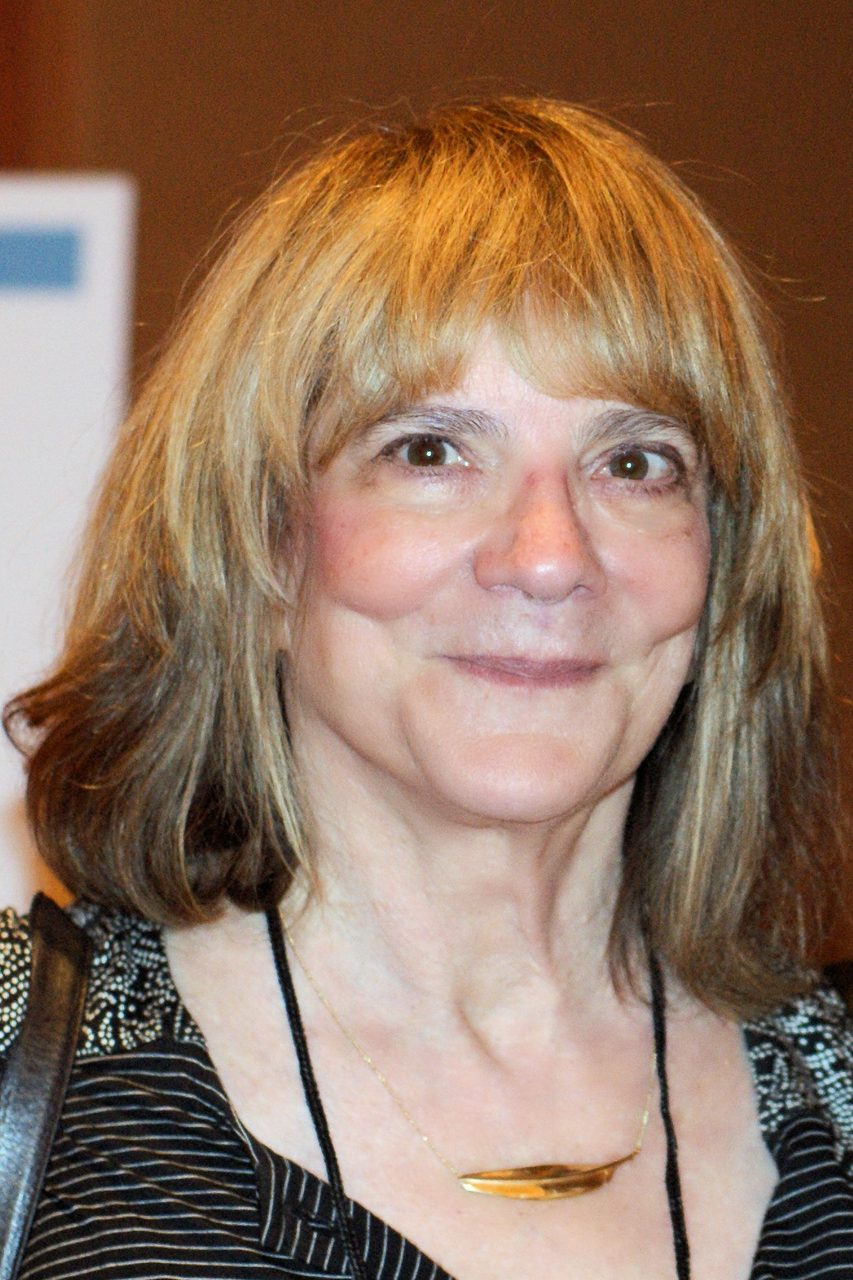
- Elizabeth Loftus photographed at The Amaz!ng Meeting 9, Las Vegas, July 2011 BDEngler, 2011 (own work), via Wikimedia Commons. CC BY-SA 3.0 Source.
- A stylised diagram of the hippocampus in cross-section with its subfields labelled, an inset MRI slice marking where it sits Fg (Frank Gaillard), 2006; original donated by Frank Gaillard Designs, first uploaded to the English Wikipedia, via Wikimedia Commons. CC BY-SA 3.0 / GFDL Source.
- Card crop of The Ebbinghaus forgetting curve as redrawn for the 2015 replication, savings plotted against a logarithmic retention interval Jaap M. J. Murre, 2015, via Wikimedia Commons; the file names the open-access copy of the 2015 replication paper (PMC4492928) as its source. CC BY 4.0 Source.


.jpg)