
The Mind's Blind Spots: The Biases Hidden in Every Judgment
A healthy, intelligent, wide-awake brain makes the same mistakes over and over, in ways so predictable they can be produced on demand in a lab. That discovery, made by two psychologists in the 1970s, was strong enough to win a Nobel Prize in economics and to overturn the assumption that people are basically rational. This is the map of those blind spots: the handful of findings that are rock solid, the crisis that recently forced the field to audit its own weaker claims, and the honest answer to the two questions everyone asks next, whether this means we are hopelessly irrational, and whether simply knowing about a bias is enough to escape it.
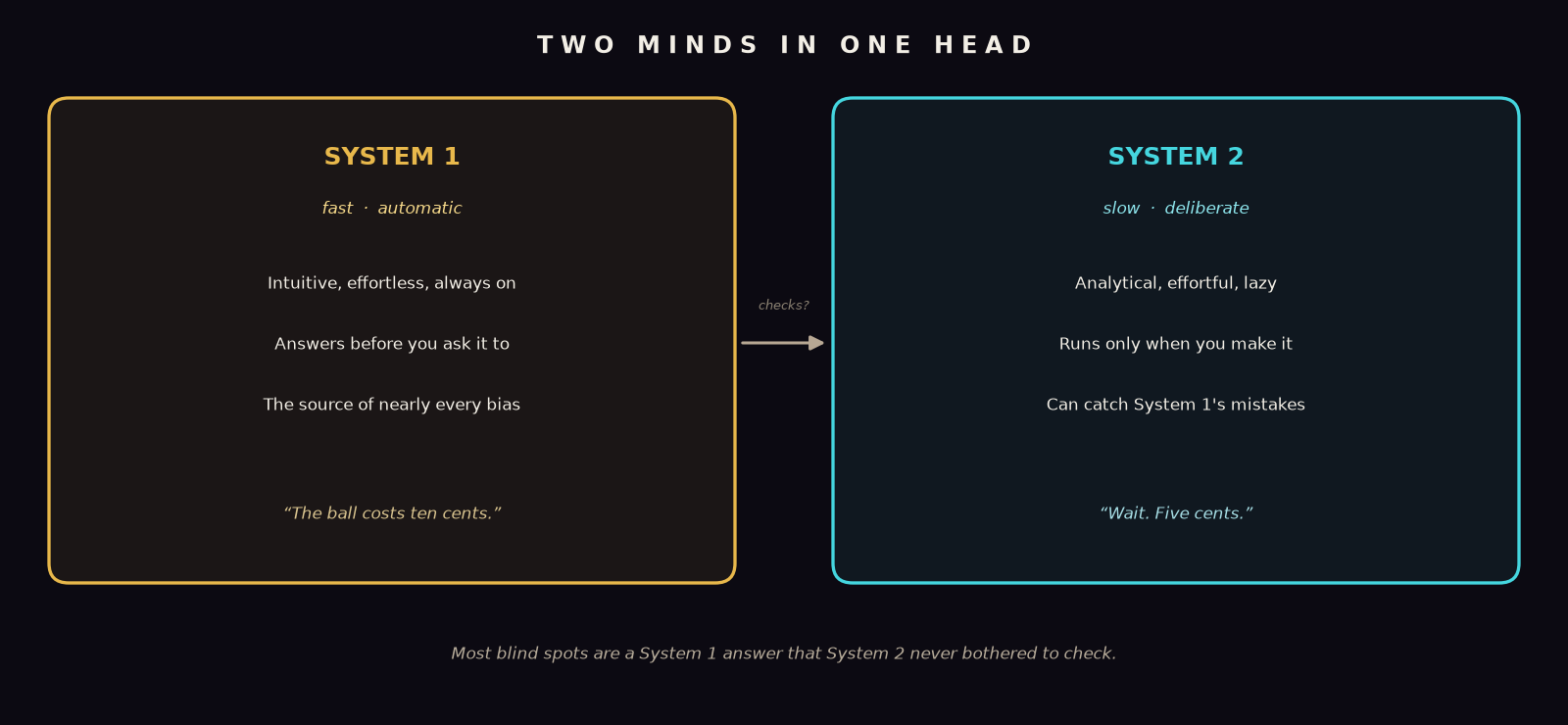
Here is something you can test on yourself and still fall for. A bat and a ball cost one dollar and ten cents together; the bat costs a dollar more than the ball; how much is the ball? The answer that leaps to mind, ten cents, is wrong, and most people, including students at elite universities, give it anyway. The ball costs five cents. That gap, between the fast answer your mind offers and the correct one it could reach if it stopped to check, is the subject of this article, and of an entire science. Beginning in the 1970s, researchers showed that the human mind is not a flawed calculator making random errors; it is a machine that makes specific, predictable, repeatable mistakes, the same ones, in the same situations, in almost everyone. This is the map of those mistakes: the ones that are beyond doubt, the ones the field itself recently had to walk back, and the honest limits of what knowing about them can do for you.
01The Two Economists of the Mind
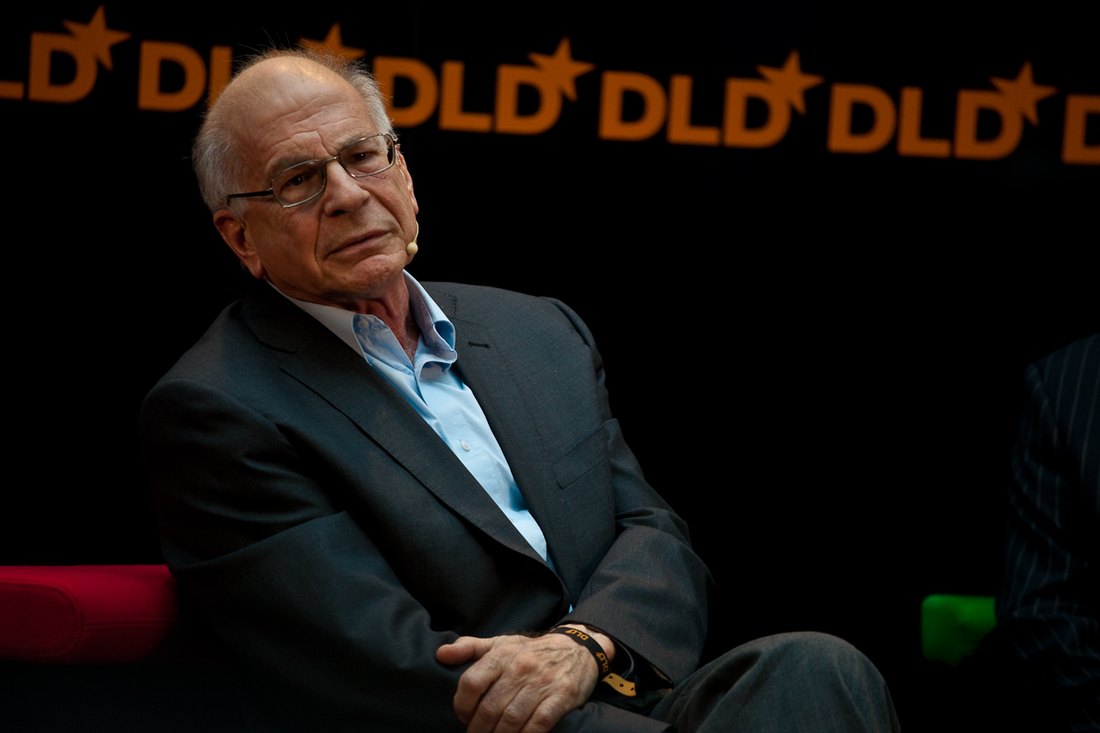
The field was built by two Israeli psychologists, Daniel Kahneman and Amos Tversky, whose collaboration beginning in the early 1970s is one of the most productive in the history of social science. Their insight was that people faced with uncertainty do not compute probabilities; they reach for mental shortcuts, or heuristics, that usually work well but fail in systematic, predictable ways. Their 1974 paper in Science laid out three of these, representativeness, availability, and anchoring, and the errors each reliably produces. The work was radical because economics at the time assumed a rational actor who weighs costs and benefits correctly; Kahneman and Tversky showed, experiment after experiment, that real humans do no such thing. It was for this that Kahneman won the 2002 Nobel Memorial Prize in Economic Sciences, a psychologist honored in economics for demonstrating that the discipline's model of human choice was wrong. Kahneman later popularized the framework the rest of this article uses, in his 2011 book Thinking, Fast and Slow: two modes of thought, a fast, automatic System 1 that generates the snap judgments, and a slow, effortful System 2 that can override them but frequently does not bother. (The exact boundary between the two is still debated by researchers; the metaphor is a teaching tool, not a map of two literal brain regions.)
02The Core Six
A handful of these effects are as solid as anything in psychology, replicated across cultures and decades. Representativeness makes us judge by resemblance and ignore the base rate: told that 'Steve' is shy and orderly, people guess he is more likely a librarian than a farmer, forgetting that there are vastly more farmers, so even a slightly librarian-ish farmer is the safer bet. A famous variant is the conjunction fallacy, or 'Linda problem': given a description of an activist named Linda, people rate 'Linda is a bank teller and a feminist' as more probable than 'Linda is a bank teller,' which is impossible, since a pair of conditions can never be likelier than one of them alone. Availability makes us judge frequency by how easily examples come to mind, so vivid, recent, heavily reported dangers (shark attacks, plane crashes) feel far more common than the quiet ones that kill far more people (diabetes, asthma). And anchoring lets an arbitrary number contaminate a judgment: Tversky and Kahneman spun a rigged wheel to land on a random number, then asked people what percentage of United Nations countries are in Africa, and the meaningless wheel number visibly dragged their estimates toward it. Anchoring is not a novice's mistake; it measurably sways expert real-estate agents and even criminal-sentencing judges, and it works even when people are warned about it in advance.
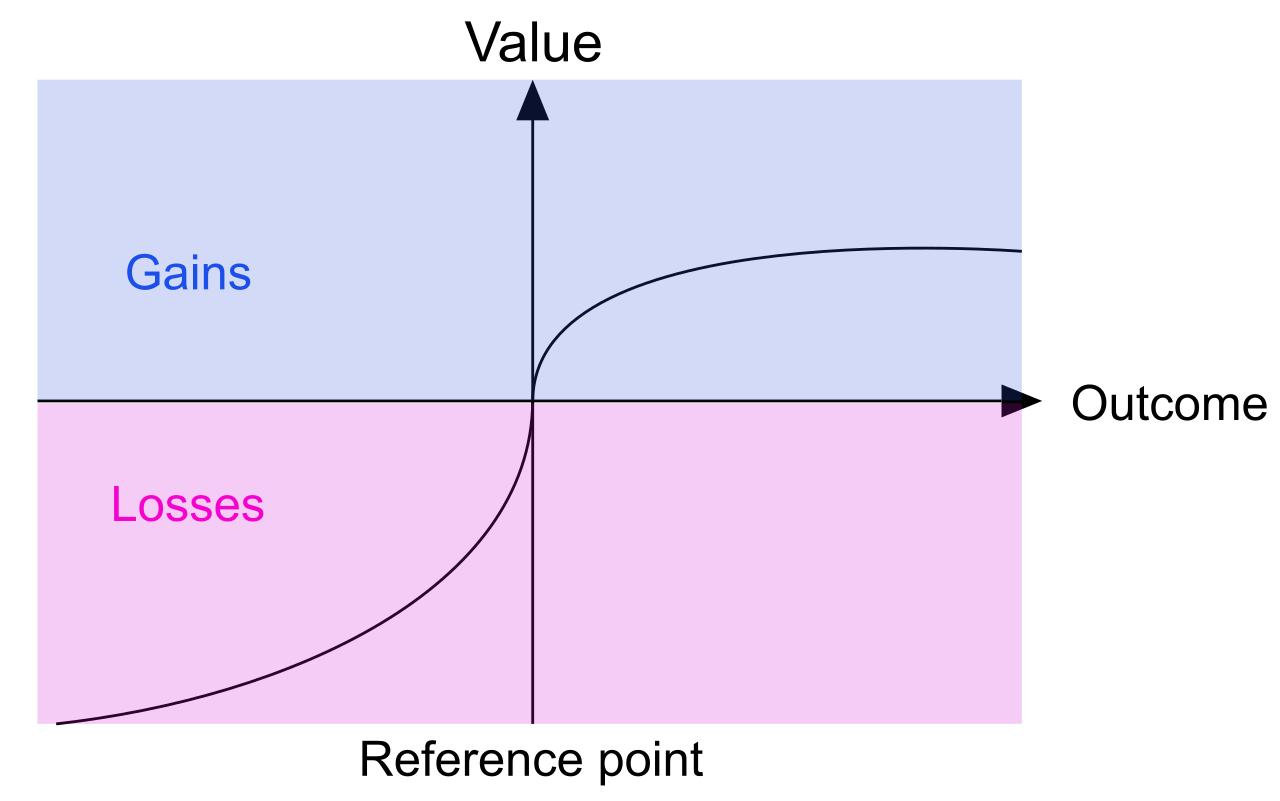
The remaining two of the core six are the deepest. Confirmation bias is the pull to seek, notice, and remember what fits what we already believe, and to skip the test that could prove us wrong; on Peter Wason's classic card-turning logic puzzle, people reliably fail to look for the disconfirming evidence, and the same habit distorts science, medicine, forensics, and every heated argument you have ever had. And prospect theory, Kahneman and Tversky's crowning result, showed that we judge outcomes not against our total wealth but against a reference point, as gains or losses, and that losses loom about twice as large as equal gains. From that single fact, loss aversion, a great deal follows: we take risks to avoid a sure loss but play safe to lock in a sure gain, and we can be swung between the two by pure wording. The same medical treatment is chosen far more often when described as offering '90 percent survival' than as carrying '10 percent mortality,' though the two are identical. That is the framing effect, and it means the packaging of a choice, not just its substance, moves the decision. These findings have held up robustly, which, as the later sections show, cannot be said of everything that later flew under the same banner.
03More Blind Spots, and an Honest One
Beyond the founding effects sit several more that are well established. Hindsight bias, the 'I knew it all along' effect, makes an outcome seem far more predictable after it happens than it ever was before; once you know who won, you misremember having expected it, which is a robust finding backed by well over a hundred studies. The sunk cost fallacy keeps us pouring resources into a failing project because of what we already spent rather than what we will gain: in one real experiment, people who paid full price for theater season tickets attended more plays than those handed the identical tickets at a discount, the extra attendance bought by nothing but the wish not to 'waste' the money. And overconfidence is measurable and large: when people give a range they are 'sure' contains some true number, and mean sure enough that they expect to be right half the time, the true answer falls inside that range only about a third of the time.
Then there is the Dunning-Kruger effect, and it deserves special care, because it is the perfect illustration of this whole wing's discipline. The popular version says the least competent people are the most overconfident. The original 1999 finding is real, but later analysts (notably Gignac and Zajenkowski, 2020) showed that much of the famous chart's shape can be reproduced from random data plus two ordinary statistical artifacts, regression to the mean and the fact that most people rate themselves above average. A smaller real signal survives, poor performers do overestimate themselves somewhat, but the dramatic popular version substantially overstates a partly statistical mirage. The honest move is to state the famous finding and its serious challenge in the same breath, which is exactly what a mature science does.
04The Two-Hundred-Bias Catalogue, Honestly
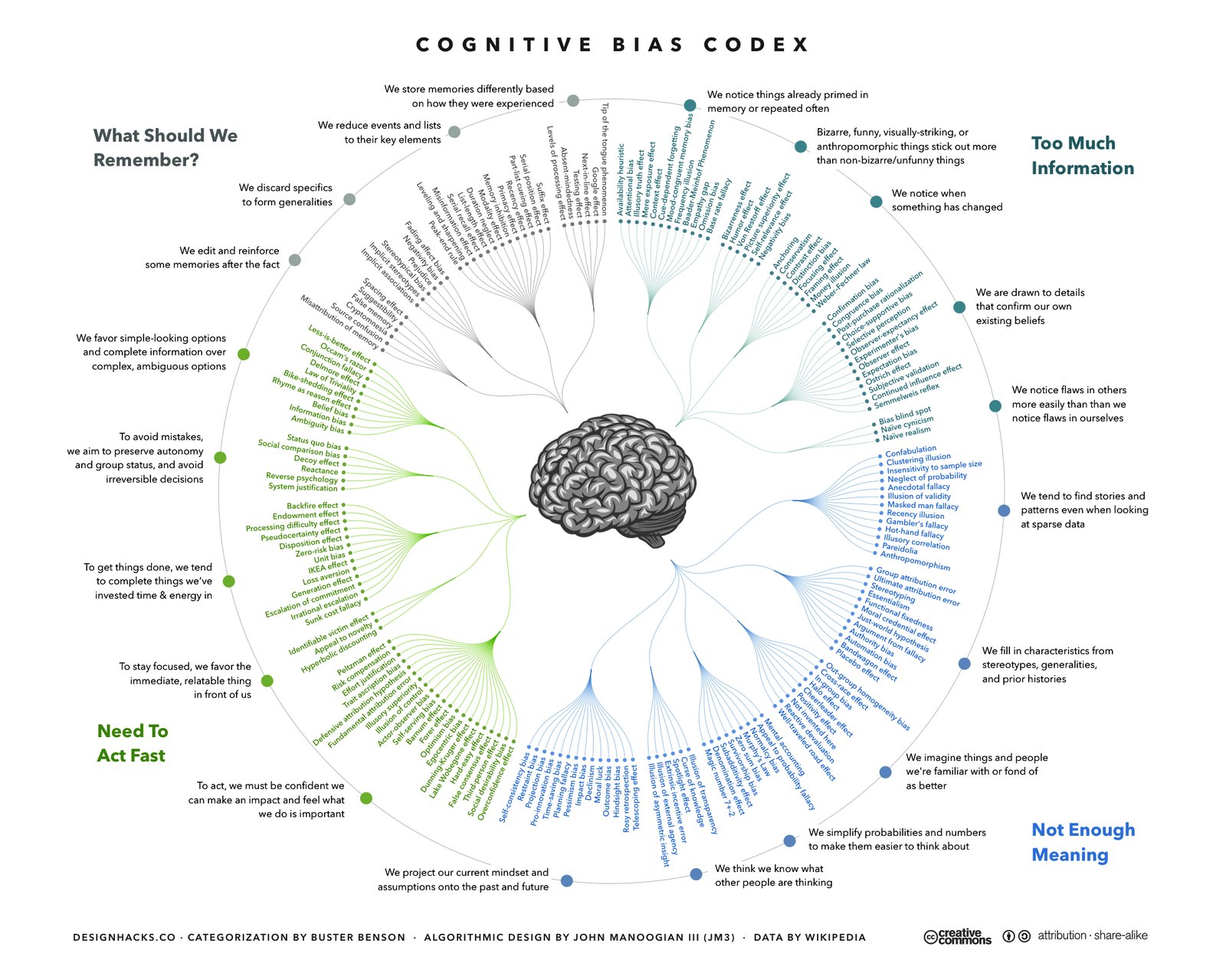
You will often read that psychologists have catalogued 'over 200 cognitive biases,' and the number is real in the sense that a list that long exists. But it needs an honest asterisk. That figure traces to a popular 2016 infographic, the Cognitive Bias Codex, which is simply a nicely organized picture of Wikipedia's crowd-maintained List of Cognitive Biases. Some entries on it are among the most solid findings in all of psychology; others are single studies, contested effects, or near-duplicates of each other under different names. The big number is a real count of a real list, not a roster of 200 equally proven facts, and treating every 'bias' as though it carried the weight of anchoring or loss aversion is its own kind of error. It also matters that most of this research was run on 'WEIRD' subjects (Western, Educated, Industrialized, Rich, and Democratic), a sampling problem named by the anthropologist Joseph Henrich and colleagues in 2010. Some biases, like anchoring, appear genuinely universal; others vary by culture, and the field is still mapping which is which. The catalogue is a beginning, not a settled encyclopedia.
05The Crisis in the Mirror
The most important thing this field did in the last fifteen years was turn its own methods on itself, and not everything survived. Psychology's 'replication crisis' began when large collaborations tried to repeat famous published experiments and often could not: one landmark 2015 effort re-ran 100 studies and reproduced clear results in only about a third of them, at roughly half the original effect sizes. Several celebrated results in and around this literature fell, including power posing (the claim that standing in a confident pose changes your hormones and behavior) and ego depletion (that willpower is a limited fuel that runs down), both of which shrank toward nothing under careful pre-registered testing. Even Kahneman was caught in it: in 2017 he publicly acknowledged that a chapter of Thinking, Fast and Slow, the one on 'social priming,' had leaned on studies too small to trust, writing, 'I placed too much faith in underpowered studies.' The crucial distinction, and the reason this article can still be confident, is that the wreckage was concentrated in a different, later branch of research, social priming and its cousins, not in the founding heuristics. Anchoring, framing, loss aversion, and the conjunction fallacy have replicated robustly across the very same period. That a field can name its own failures this precisely is not a weakness. It is what separates a science from a set of just-so stories.
06The Two Overclaims
Two conclusions people rush to from all this are both wrong, in opposite directions. The first is that humans are, at bottom, irrational, hopeless reasoners tripping over their own minds. This overstates the case badly. The same species that falls for the Linda problem also invented probability theory, built the instruments that catch it out, and reasons superbly under the right conditions. The psychologist Gerd Gigerenzer presses the point further: many so-called biases are not errors at all but 'ecologically rational' shortcuts that perform well, sometimes better than elaborate models, in the messy real environments we actually evolved to handle. Whether every heuristic is adaptive is debated, but the blanket verdict of 'irrational' does not survive contact with the evidence. The opposite overclaim is subtler and more tempting: that simply learning about a bias lets you rise above it. It does not, or not much. Training in statistical thinking and deliberately 'considering the opposite' produce real but modest improvements that fade quickly and collapse under time pressure and cognitive load, exactly the conditions where biases bite hardest. Knowing you are prone to anchoring does not stop the number from tugging at you. The honest verdict is the uncomfortable middle: the blind spots are real and mostly not fixable by willpower alone, which is why the most effective corrections are structural, designing institutions, checklists, and decisions so that System 1's errors are caught by something other than a busy, overconfident mind hoping to catch itself.
Fast Facts
- The founders
- Daniel Kahneman and Amos Tversky, from the early 1970s; Kahneman's Nobel in Economics, 2002
- The framework
- System 1 (fast, automatic, bias-prone) and System 2 (slow, effortful, correcting), popularized 2011
- The robust core
- Representativeness, availability, anchoring, the conjunction fallacy (Linda), confirmation bias, and loss aversion with framing
- Loss aversion
- A loss hurts about twice as much as an equal gain feels good
- The honest example
- Dunning-Kruger is real but partly a statistical artifact; state the finding and its challenge together
- The replication crisis
- Power posing and ego depletion failed; the founding heuristics held up robustly
- The double refusal
- Humans are not 'fundamentally irrational,' and knowing a bias does not simply defeat it
What We Can Actually Stand Behind
The founding science is as solid as psychology gets. Kahneman and Tversky really did found the field; the core effects (representativeness and base-rate neglect, the conjunction fallacy, availability, anchoring, confirmation bias, prospect theory and loss aversion, framing) are real, well-attributed, and replicated across cultures and decades; and System 1 / System 2 is a genuine, if debated, organizing framework. Hindsight bias, the sunk cost fallacy, and overconfidence are likewise well established.
The honest complications are themselves well documented: the '200-plus biases' figure is a real but evidentially uneven catalogue, not a validated taxonomy; much of the research is WEIRD-sampled and some effects vary by culture; and the replication crisis genuinely felled several famous adjacent results (power posing, ego depletion, social priming) even as the founding heuristics survived. Kahneman's own 2017 acknowledgment about underpowered priming studies is part of that honest record.
The framing of biases-as-flaws is itself contested. Gigerenzer's 'ecological rationality' argues many heuristics are adaptive strategies well matched to real environments rather than errors, and the Dunning-Kruger effect's popular form is substantially a statistical artifact. These are live debates carried honestly, not settled verdicts.
Both easy conclusions fail. No, humans are not fundamentally irrational; the biases coexist with extraordinary reasoning power and many shortcuts are genuinely useful. And no, simply knowing about a bias does not reliably defeat it; debiasing is real but weak and collapses under load. What survives is the sober middle: the blind spots are real, mostly resistant to willpower, and best countered by structure rather than by trusting a busy mind to catch itself. That is not a counsel of despair. It is the beginning of designing around the mind we actually have.
The reason this is the right door into a whole wing about the mind is that everything after it depends on it. If your judgment can be swung by a number on a rigged wheel, by whether a risk is phrased as survival or death, by nothing more than what came easily to mind, then every later subject here, the archetypes we project, the crowds we join, the propaganda we absorb, the very act of seeing, is happening inside a machine that does not report its own workings honestly. The mind's most dangerous illusion is not any single bias. It is the conviction, which System 1 supplies for free and System 2 rarely questions, that we are seeing clearly right now, that other people are biased but we are simply correct. The one genuinely reliable defense that the science offers is also the humblest: to hold that conviction a little more loosely, and to build the checks we cannot be, into the world around us instead. The heart is on the scale here too. It is just that the scale is inside our own heads, and it has a thumb on it that we can never fully lift.
Sources & further reading
Everything above is drawn from our research library on Theories of Anything. Open the full file to check the sourcing and go deeper.
Image credits
- System 1 and System 2 (original diagram) Original diagram by Theories of Anything. CC BY-SA 4.0 Source.
- Daniel Kahneman at a public event, 2009 Photograph by nrkbeta (Eirik Solheim), 2009, via Wikimedia Commons. CC BY-SA 2.0 Source.
- Prospect theory value function (illustration of the concept) Diagram by Pharexia, via Wikimedia Commons. CC BY-SA 4.0 Source.
- The Cognitive Bias Codex John Manoogian III, with framework by Buster Benson, 2016, via Wikimedia Commons. CC BY-SA 4.0 Source.
- Card crop of the System 1 / System 2 diagram Original diagram by Theories of Anything. CC BY-SA 4.0
.jpg)

.png)