
The Illusion of Seeing: How the Brain Invents What You See
Sight feels like the most honest of the senses: you open your eyes and the world is simply there, delivered whole. It is not. What you see is a model your brain builds, a best guess assembled from patchy, ambiguous signals and a lifetime of expectation, and it is so convincing that you never notice the construction happening. About half of people watching a video fail to see a person in a gorilla suit walk right through the middle of it. This is the science of that gap: the illusions that expose how vision is really made, the leading theory of the brain as a prediction machine, and the honest boundary between two tempting overclaims, that we see reality exactly as it is, and that we never really see it at all.
You are not, right now, receiving the world through your eyes. You are receiving a small, blurry, upside-down, gap-riddled stream of signals from two patches of light-sensitive tissue, and your brain is using that meager input to construct, at astonishing speed, a stable, colorful, three-dimensional model of a world, which it then presents to you as if it were the world itself. The construction is seamless, which is exactly why it is so hard to believe it is happening. This article is about the moments when the seams show: the illusions and blind spots that psychologists have used, for over a century, to catch the brain in the act of inventing what you see. The point is not that your senses are lying to you. It is stranger and more important than that. Seeing was never a recording in the first place.
01Seeing Is Not Recording
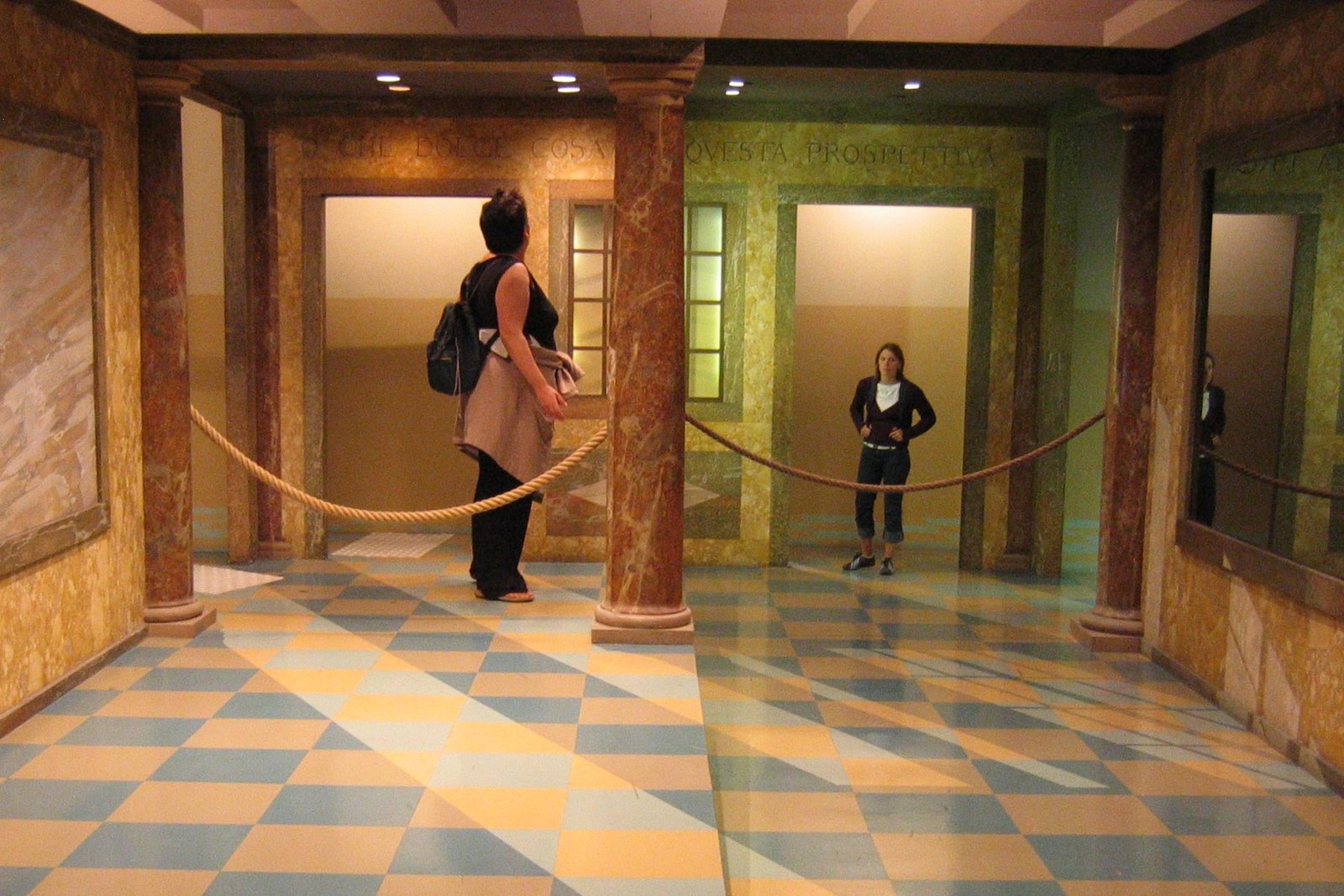
The founding fact of perception science, established over more than a century, is that perception is an active, constructive process, not a passive recording. The eye does not send a picture to the brain; it sends a noisy, incomplete stream of data, and the brain infers the most probable scene that could have produced it. Modern models formalize this as Bayesian inference: the brain combines the incoming sensory signal (which is ambiguous) with its prior expectations about how the world usually is, and settles on the single most likely interpretation. Vision therefore runs in two directions at once, bottom-up from the raw data and top-down from expectation, and when the two conflict, expectation often wins. This is not a fringe idea; it descends from 19th-century psychophysics and from the Gestalt psychologists of around 1912, who catalogued the rules by which the mind groups scattered fragments into whole objects (proximity, similarity, continuity, closure). The hero image above is the principle made physical: an Ames room looks rectangular, so the brain, refusing to doubt the room, concludes that the people inside it must be different sizes. The illusion is not in the eye. It is in the inference.
02The Gorilla You Didn't See
If vision were a recording, you would see whatever fell on your eyes. You do not; you see what you attend to, and startlingly little else. In the most famous demonstration in modern psychology, Daniel Simons and Christopher Chabris (1999) asked people to watch a video of players passing basketballs and to count the passes made by one team. Midway through, a person in a full gorilla suit strolls into the middle of the scene, faces the camera, thumps their chest, and walks off, taking about nine seconds. Roughly half of all viewers, absorbed in counting, simply do not see the gorilla at all, and refuse to believe it was there until the video is replayed. This is inattentional blindness, and it has been replicated many times across cultures. Its cousin, change blindness, is just as unsettling: when a brief flicker interrupts a scene, people fail to notice large changes, a whole building vanishing, a person's clothes changing color, and in one study people conversing with a stranger failed to notice when that stranger was swapped for a different person entirely during a staged interruption. Attention is not a spotlight that brightens what you already see; it is closer to the price of admission for seeing at all. (The gorilla footage itself is copyrighted and cannot be shown here, but the study is easy to find, and worth trying on someone before you tell them what to look for.)
03The Illusions That Give It Away
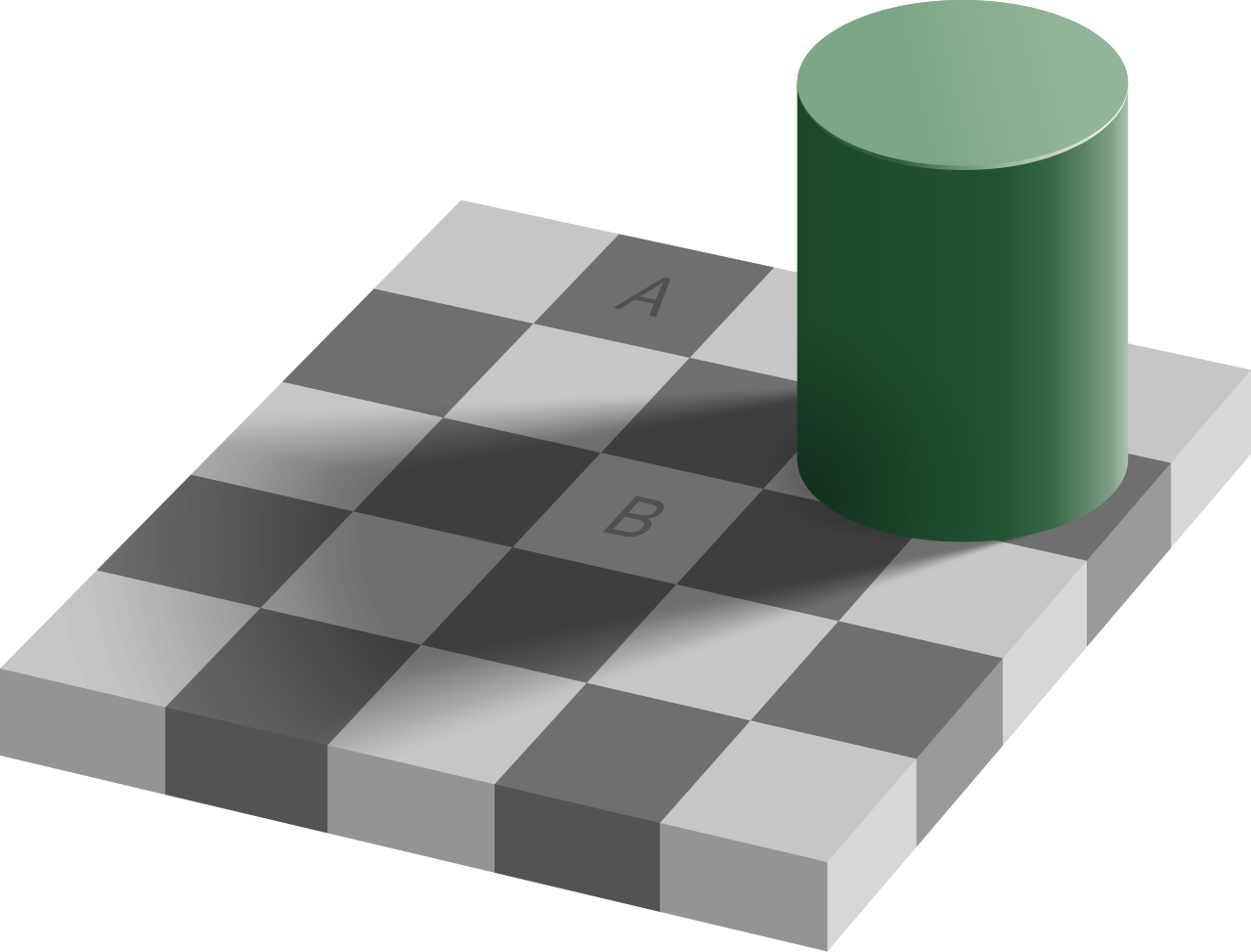
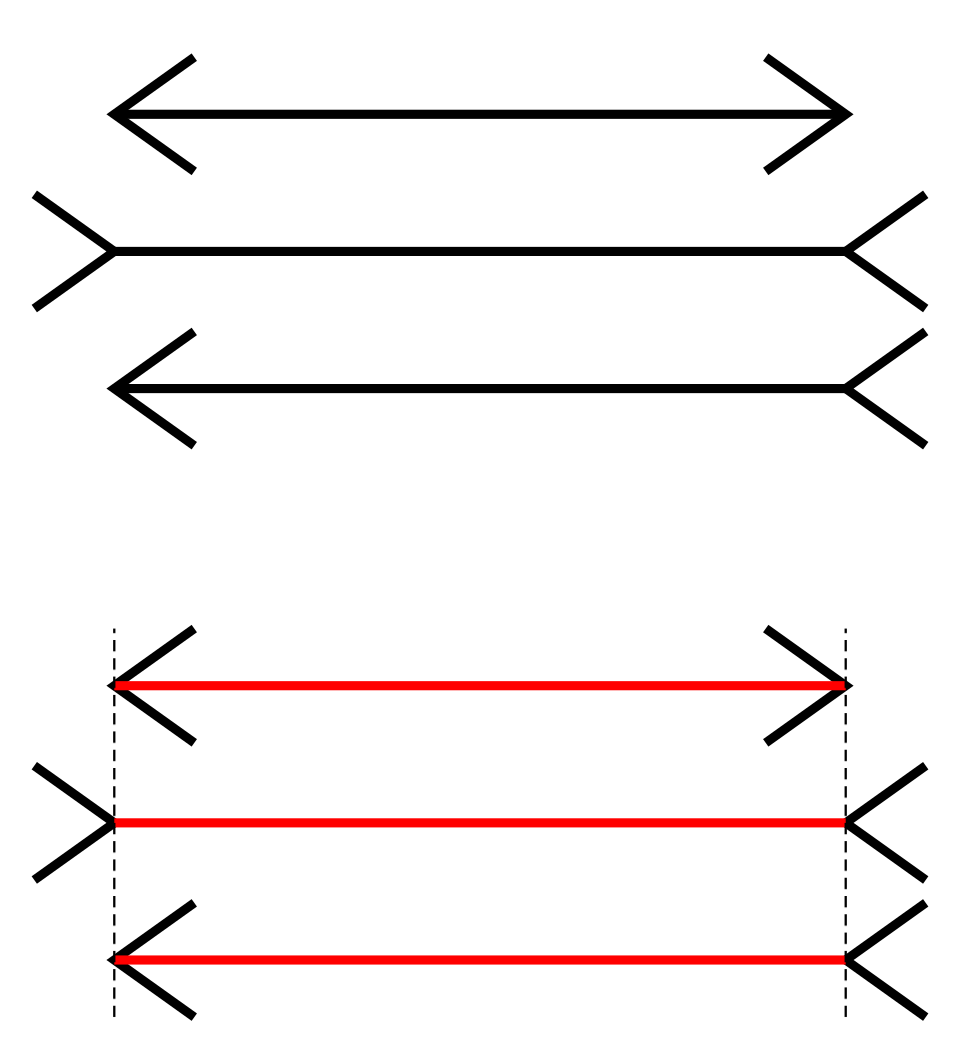
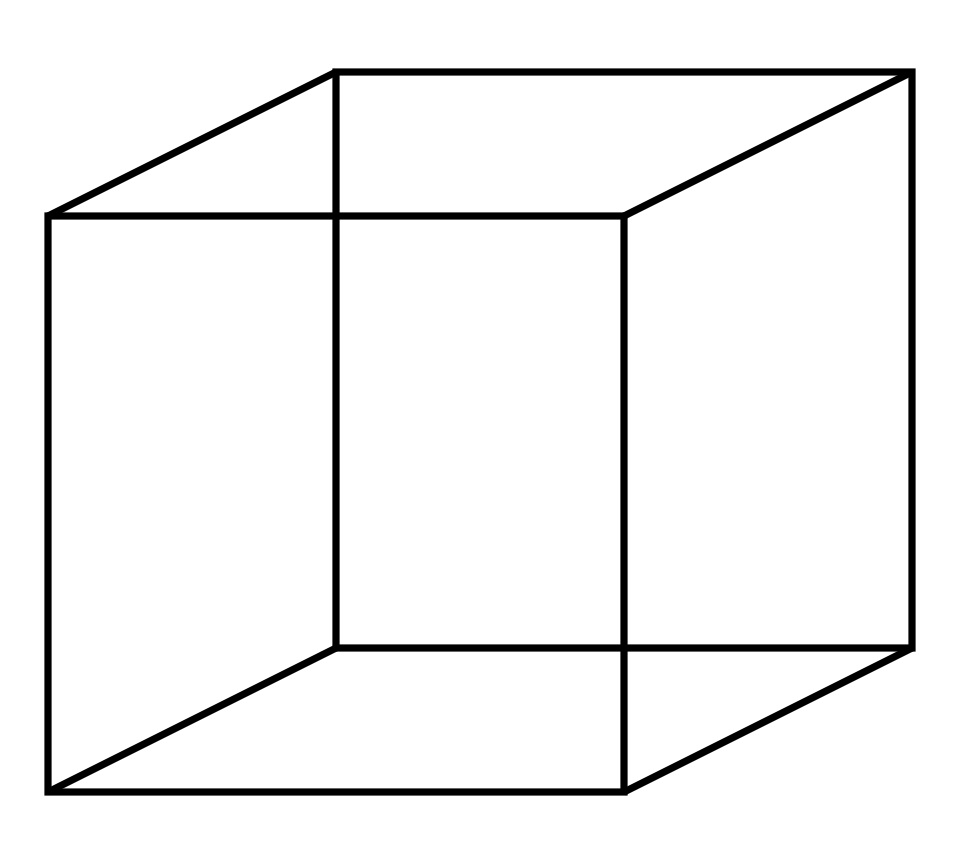
Illusions are not failures of the visual system; they are the visual system's rules, made visible by feeding it a case its shortcuts get wrong. Each classic illusion exposes a different shortcut. The Muller-Lyer illusion (Franz Muller-Lyer, 1889) makes two identical lines look unequal by capping them with inward or outward fins, so the brain reads them as near and far edges. The Ponzo illusion (Mario Ponzo, 1911) enlarges a bar simply by placing it higher between converging 'railway' lines the brain reads as depth. The Necker cube (Louis Necker, 1832) is a flat wireframe with no depth information at all, yet it flips between two solid 3D readings as you watch, because the depth was never in the drawing; it was always your brain's addition. The Ebbinghaus illusion changes a circle's apparent size by the company it keeps (its exact origin, credited variously to Ebbinghaus in the 1890s and popularized by Titchener in 1901, is genuinely unresolved). Adelson's checker-shadow, shown here, is the starkest of all. And the McGurk effect (1976) proves the same construction runs across the senses: watch lips say 'ga' while hearing 'ba,' and you will hear 'da,' a sound present in neither channel, invented by a brain fusing sight and sound. You cannot unhear it even when you know the trick.
There is an even more basic proof that the brain fills in what is not there, and you carry it in your own head. Every eye has a blind spot, a small patch of the retina, the optic disc, where the optic nerve exits and there are no light-sensitive cells at all. There is a literal hole in the data your eyes send. You never see it, because the brain seamlessly paints over the gap using the surrounding pattern and the other eye's view, and you can prove this to yourself in seconds by closing one eye and letting a mark slide into the gap, where it simply vanishes and the background closes over it. The lesson of all of this is consistent: from the illusions built in laboratories to the anatomy of your own retina, what reaches your awareness has already been edited, inferred, and completed. The raw feed is never what you get.
04The Brain as Prediction Machine
If perception is inference, what exactly is the brain doing? The leading modern answer, though not the only one, is the 'predictive processing' framework, developed by thinkers such as Andy Clark and Karl Friston. On this view the brain is fundamentally a prediction machine: at every level it is constantly generating expectations about what its senses should be receiving, and what actually flows up from the eyes and ears is largely just the error, the difference between prediction and input, used to correct the next guess. Perception, in this picture, is a controlled hallucination that the world keeps in check, a running best-guess about reality that incoming data is always nudging back toward accuracy. It is a powerful and currently ascendant idea, and it makes sense of much of the evidence here, but honesty requires flagging that it is a leading framework, not settled fact; whether prediction-error minimization is really the brain's single master principle, or one useful lens among several, is still actively debated among neuroscientists. Related work makes the same constructive point about the body itself: in the rubber hand illusion (Botvinick and Cohen, 1998), watching a fake hand being stroked in time with your own hidden hand makes your brain adopt the rubber one as yours, showing that even the felt boundary of your body is an inference the brain assembles from correlated senses, not a fixed fact.
05The Two Overclaims
A subject this vertiginous invites two opposite overstatements, and both should be resisted. The first, and the more seductive after reading this far, is that if perception is all construction, then the senses cannot be trusted at all and reality is essentially a shared hallucination, that we never really see the world. This overshoots the evidence badly. Perception is constructed, but it is constructed to be useful, and it is astonishingly good at its job: it lets you catch a ball, judge a gap in traffic, recognize a face in a crowd, and cross a street alive, millions of times, because the model it builds usually tracks the world closely enough to keep you safe. The illusions in this article are revealing precisely because they are exceptions, edge cases engineered by researchers to expose the brain's shortcuts; they are not proof that ordinary seeing is false. (A genuinely provocative minority view, the cognitive scientist Donald Hoffman's 'interface theory,' argues that evolution tuned perception purely for survival rather than truth, so we see a useful 'desktop' rather than reality itself; it is a real, published position, but it is also directly rebutted in the peer-reviewed literature, and belongs in the 'interesting, unproven, contested' column, not the settled one.) The opposite overclaim is the naive one this whole article dismantles: that we see the world exactly as it is, like a camera passing light straight through. No serious scientist holds this; every illusion and blind spot here refutes it. The honest position is the one the evidence actually supports: seeing is an inference, usually a good one, occasionally a catchable mistake, and never a recording. (It is worth adding that not every 'perception' claim is real: the famous 1957 story that subliminal 'Drink Coca-Cola' messages spiked cinema sales was simply fabricated by its author, and subliminal images have only weak, fleeting effects. Constructed perception is real; mind control through it is not.)
Fast Facts
- The core claim
- Vision is an active construction (inference from noisy data plus expectation), not a passive recording
- The invisible gorilla
- About half of viewers counting passes miss a person in a gorilla suit (Simons & Chabris, 1999)
- The starkest proof
- In Adelson's checker-shadow illusion, two squares that look clearly different are the identical shade of grey
- Your own blind spot
- Every eye has a hole in its data (the optic disc); the brain paints over it seamlessly
- The leading theory
- Predictive processing: the brain as a prediction machine, ascendant but still debated
- A debunked myth
- Subliminal advertising 'mind control' (the 1957 Coca-Cola story) was fabricated
- The double refusal
- Perception is neither a pure hallucination nor a camera; it is useful, usually-accurate inference
What We Can Actually Stand Behind
The core science is rock solid. Perception is a constructive, inferential process, not a recording; inattentional and change blindness are real and heavily replicated (the invisible gorilla, roughly half of viewers); and the classic illusions (Muller-Lyer, Ponzo, the Necker cube, the Ames room, Adelson's checker-shadow), the McGurk effect, and the retinal blind spot are all genuine, demonstrable, and correctly attributed. These are among the most reproducible findings in all of psychology.
The best current explanation, that the brain is a 'prediction machine' minimizing the error between expectation and input (predictive processing, Bayesian perception), is powerful and ascendant, and the rubber hand illusion extends the same constructive logic to body ownership. But this is the leading framework, not proven neuroscience: whether prediction-error minimization is the brain's single organizing principle remains genuinely debated. Carry it as the strong front-runner, not the final word.
The strongest interpretive claim, Donald Hoffman's interface theory, that evolution tuned us to see a useful interface rather than reality at all, is a real, peer-reviewed position and a genuine, unresolved argument, but it is explicitly rebutted in the same literature. It belongs in the article as a clearly labeled provocative minority view, never as a demonstrated fact that 'we never see reality.'
Both easy conclusions fail. No, perception is not a pure hallucination and the senses are not untrustworthy; vision is constructed precisely in order to be useful, and it tracks the world accurately enough to keep us alive at almost every moment, with illusions the revealing exception rather than the rule. And no, we do not see the world exactly as it is, like a camera; every illusion and the blind spot in your own eye disproves it. What survives is the honest and stranger truth: seeing is inference, usually reliable, sometimes catchably wrong, and never the raw feed. The window was always a painting, done from life, at speed, and mostly right.
It can be unsettling to learn that the most immediate, obvious thing in your life, the sight of the world in front of you, is a construction you have never once caught in the act. But there is something clarifying in it too, and it is the reason this belongs in a wing about the mind examining itself. If the brain builds the very colors and edges and distances you take to be simply out there, delivered raw, then it should be no surprise at all that it also builds the subtler things, the certainty that your memory is accurate, that your group is right, that your judgment is unbiased, that the persuasive message you just absorbed was your own idea. Every later subject in this wing is a version of the lesson the invisible gorilla teaches first and hardest: that the feeling of obvious, effortless, direct access to reality is itself produced by the machine, and is the one feeling the machine is least willing to let you question. To see the world clearly, it turns out, the first thing you have to see through is the impression that you already do.
Sources & further reading
Everything above is drawn from our research library on Theories of Anything. Open the full file to check the sourcing and go deeper.
Image credits
- Ames room ('salle a double perspective') exhibit, Cite des sciences et de l'industrie, Paris Photograph by Wikimedia Commons user mosso, 2006, via Wikimedia Commons. CC BY 2.0 Source.
- Adelson's checker-shadow illusion (squares A and B are the identical shade of grey) Illusion by Edward H. Adelson (MIT), vectorized by Pbroks13, via Wikimedia Commons. CC BY-SA 4.0 Source.
- The Muller-Lyer illusion (three lines of identical length) Diagram by Wikimedia Commons user Fibonacci, via Wikimedia Commons. CC BY-SA 3.0 Source.
- The Necker cube (an ambiguous wireframe figure) Diagram by Wikimedia Commons user BenFrantzDale, via Wikimedia Commons. CC BY-SA 3.0 Source.
- Card crop of the Ames room exhibit Photograph by Wikimedia Commons user mosso, 2006, via Wikimedia Commons. CC BY 2.0


