
Black Holes: The Places Where Physics Breaks
For most of the twentieth century, black holes were a rumor in the equations, a place where Einstein's own theory of gravity predicted something so extreme that even he doubted nature would allow it. Then we found them: heard two of them collide as a ripple in spacetime, and photographed the shadow of one at the heart of another galaxy. Black holes are now among the best-confirmed objects in the universe. They are also the one place where the physics that predicts them points straight at its own limits, where 'infinite density' is less a description than a confession that the theory has run out. This is what we actually know, what we have genuinely seen, and where our knowledge honestly ends.
A black hole is the closest thing physics has to a genuine edge of the map, a region where the theory that predicts it also warns that it can no longer be trusted. For decades they were only that: a disturbing feature of Einstein's equations that Einstein himself suspected nature would find a way to avoid. Nature did not. We have now heard two black holes slam together as a tremor in the shape of space, and we have taken an actual photograph of the glowing ring around one, fifty-five million light-years away. They are among the most thoroughly confirmed objects in the universe. And they remain the single place where our best theory of gravity points straight at its own failure, where the word 'singularity' names not something we understand but the exact spot our understanding stops. This is what black holes really are, what we have genuinely observed, and where, with as much honesty as the subject demands, our knowledge ends.
01What a Black Hole Actually Is
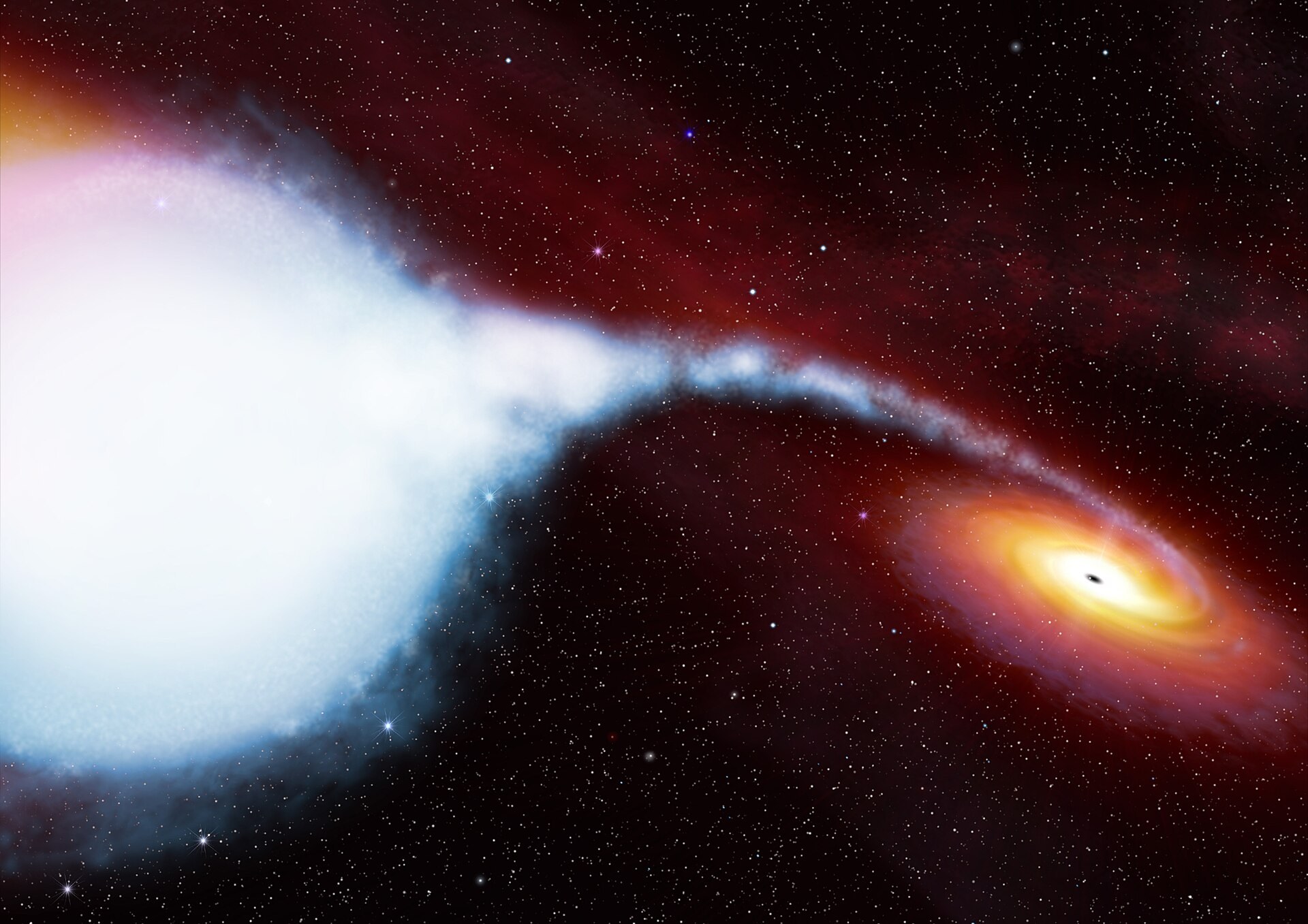
Begin with what a black hole is not. It is not a hole, a tear or a drain in space that things fall through and cease to exist. It is the opposite: an extraordinary amount of ordinary mass, packed so tightly that at a certain radius the escape velocity reaches the speed of light. That radius is the event horizon, and it is not a wall or a surface; an astronaut falling through it would, at that instant, feel nothing unusual at all, the so-called no-drama principle. Cross it, though, and no signal you send, not even light, can ever climb back out. And a black hole's gravity is not some special cosmic suction. At any given distance it pulls exactly as hard as the same mass in any other shape would: if the Sun were swapped for a black hole of identical mass, Earth's orbit would not budge, the sky would just go dark. Black holes come in sizes. Stellar-mass ones, a few to a few dozen times the Sun, form when a massive star collapses; the first widely accepted case, Cygnus X-1, was pinned down in 1971 by the X-rays screaming off gas it was tearing from a companion star, and a 2021 remeasurement put its mass at about 21 times the Sun's, well above older textbook figures. Supermassive ones, millions to billions of solar masses, sit at the centers of essentially every galaxy, including our own. How the largest grew so big so early is still, genuinely, not understood.
02The Theorem
That black holes should exist at all is not a guess bolted onto physics; it falls straight out of general relativity, Einstein's 1915 theory in which mass and energy bend the geometry of spacetime and objects simply follow the straightest available paths through the bend. In 1965 Roger Penrose proved a remarkable theorem: that once a collapse passes a certain point, the formation of a singularity, a place where the curvature of spacetime runs to infinity, becomes unavoidable, not a fluke of perfect symmetry but a robust prediction of the theory itself. That proof earned Penrose half of the 2020 Nobel Prize in Physics, 'for the discovery that black hole formation is a robust prediction of the general theory of relativity.' The other half went to Reinhard Genzel and Andrea Ghez, who spent decades tracking stars whipping around an invisible four-million-solar-mass object at the center of our galaxy. And the reason to trust a theory when it predicts something as strange as a black hole is its record. General relativity has passed every test thrown at it for over a century: from atomic clocks flown around the world, to the frame-dragging of spacetime measured by the Gravity Probe B satellite, to the plain fact that GPS satellites must correct for it, by about 38 millionths of a second a day, or your phone's map would drift miles off within hours.
03Hearing the Dark
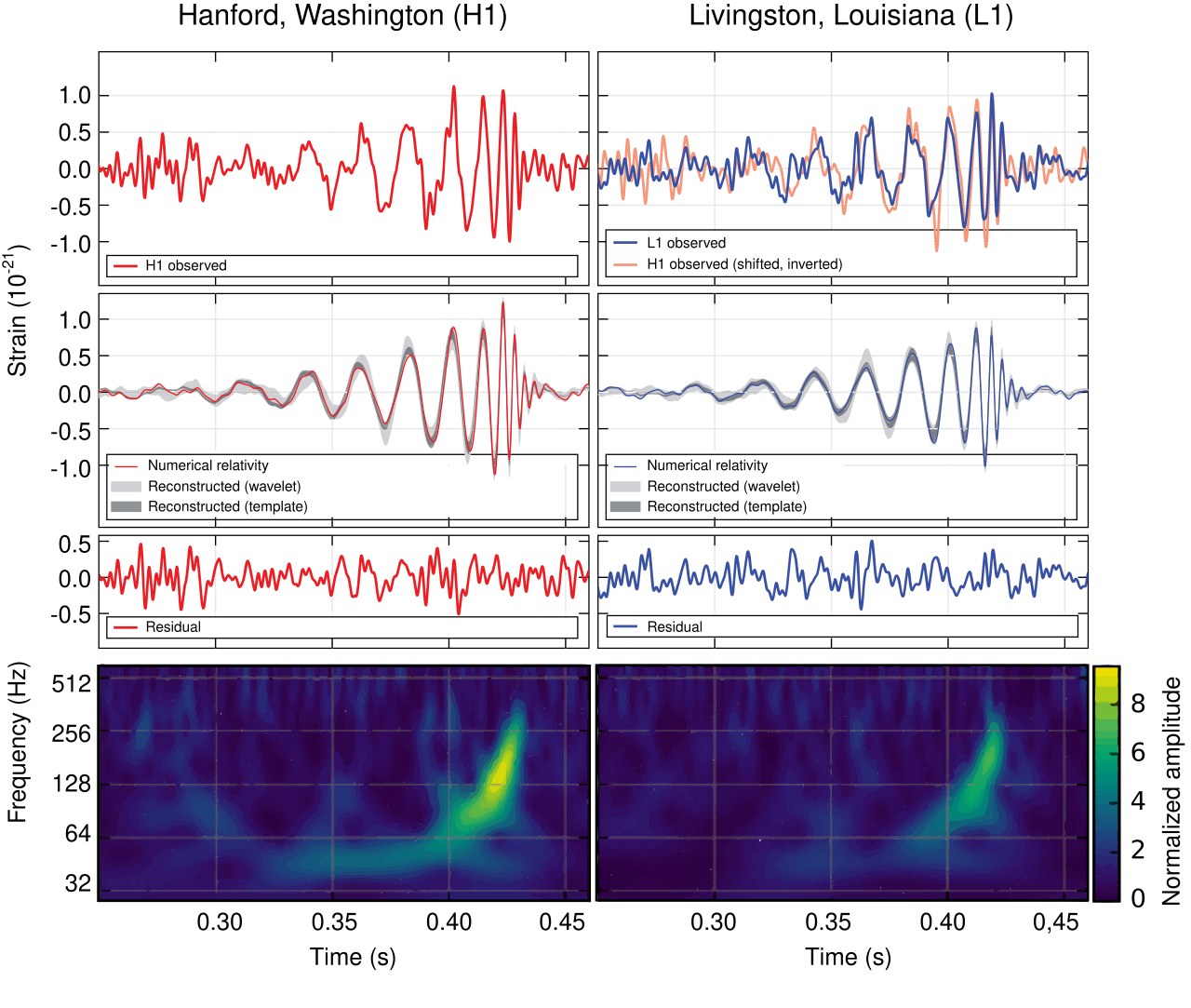
For most of history, the only way to find a black hole was to watch what it did to visible matter nearby. That changed on 14 September 2015, when the two LIGO detectors, L-shaped instruments with four-kilometer arms, registered an identical tremor a few thousandths of a second apart: the first direct detection of gravitational waves, ripples in spacetime itself, from two black holes of about 36 and 29 solar masses spiraling together and merging 1.3 billion light-years away. In the final fifth of a second the collision briefly radiated more power, as warped space, than every star in the observable universe combined. It won the 2017 Nobel Prize, and it opened an ear on the dark: by the catalog released in 2026, gravitational-wave observatories had recorded around 390 such signals. Some are staggering. The 2023 event GW231123 merged two black holes into a remnant of roughly 225 solar masses, in a mass range that ordinary stellar collapse is not supposed to produce. And one, GW250114 in 2025, was clean enough to deliver the most precise test yet of a theorem of Hawking's, that a black hole's event-horizon area can never decrease over time. It held.
04Seeing the Shadow
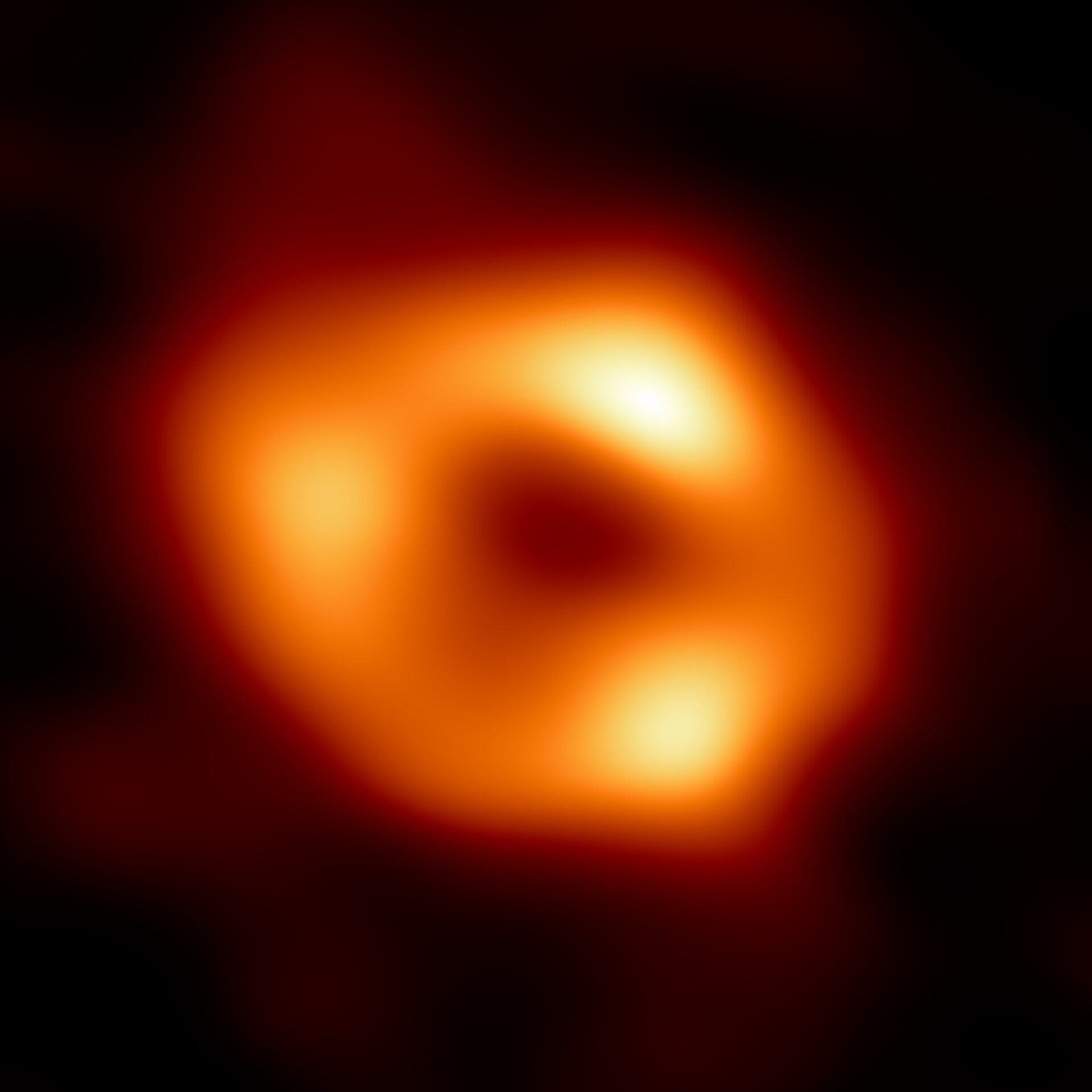
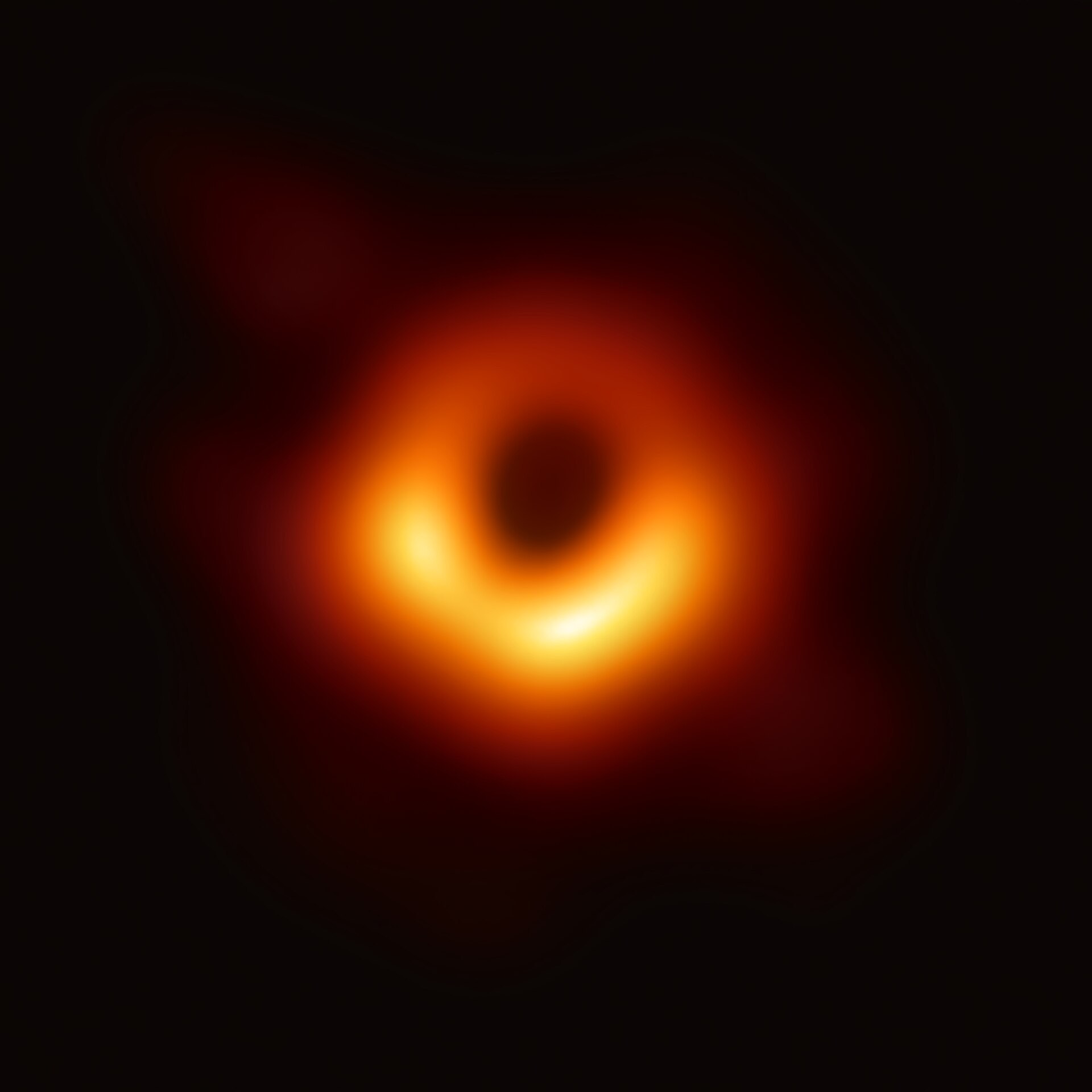
Then, on 10 April 2019, physics did something it had never done before: it produced a photograph of a black hole. The Event Horizon Telescope, a virtual instrument effectively the size of the Earth, assembled from radio dishes on four continents and synchronized by atomic clocks, released an image of M87*, the six-and-a-half-billion-solar-mass black hole at the heart of the galaxy Messier 87. It is a ring of light, bent by gravity around a dark central shadow, brighter on one side because the gas there is racing toward us at nearly light-speed, and its size and shape matched general relativity's prediction almost exactly. Three years later, on 12 May 2022, the same collaboration imaged Sagittarius A*, our own galaxy's central black hole, the very object Genzel and Ghez had tracked by starlight; despite being over a thousand times smaller, its shadow looked like a sibling of M87*'s. In March 2024 they went further and mapped Sagittarius A* in polarized light, revealing strong, ordered magnetic fields threading its edge, much like those already seen at M87*. These pictures are not artist's impressions or simulations. They are the shadows themselves.
05Where Physics Breaks
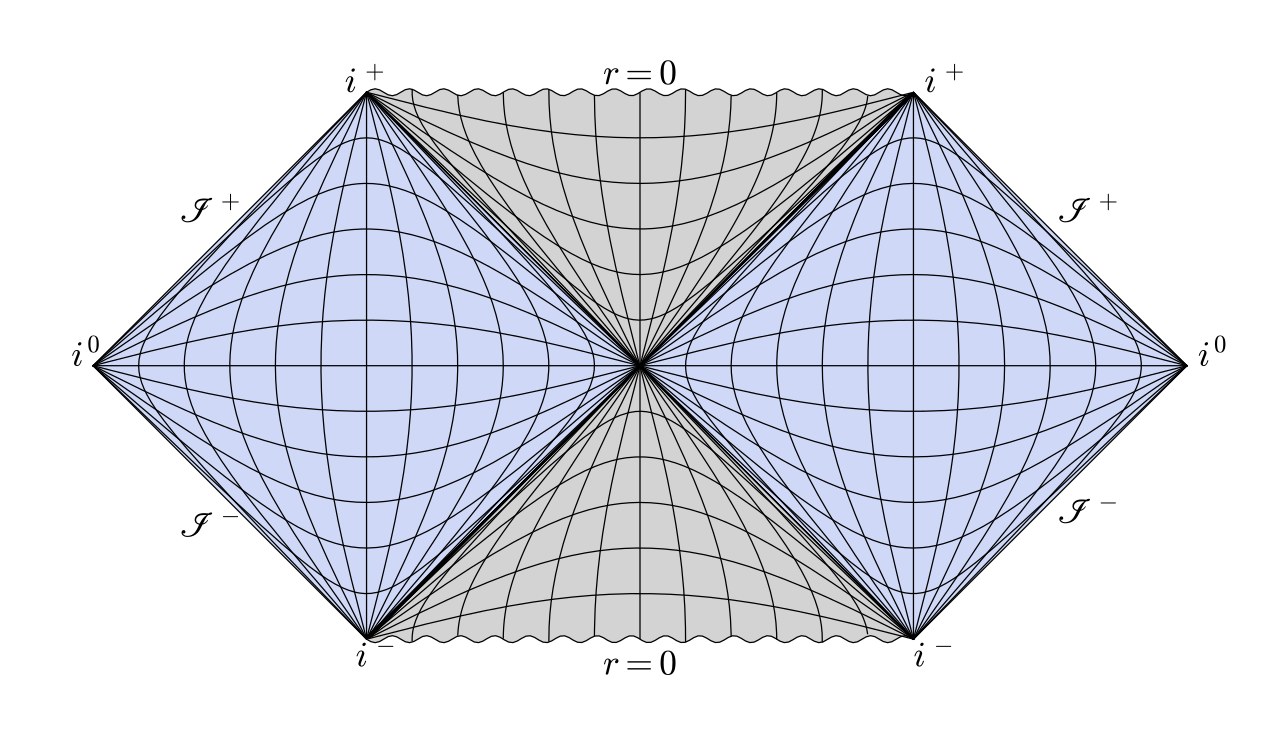
And now the edge. Everything above is solid, observed, Nobel-decorated physics. What happens inside a black hole is none of those things. Penrose's theorem guarantees that general relativity predicts a singularity at the center, a point of infinite density, and the geometry is such that once you cross the horizon, the singularity is not a place off to one side you might steer around; it lies in your future the way tomorrow does, unavoidable. But 'infinite density' is precisely the value at which the theory's own mathematics stops describing anything physical. Most physicists read a singularity not as a real object nature contains but as a flare sent up by the theory: here is where general relativity fails and a deeper theory, a quantum theory of gravity, must take over. No such theory yet exists in tested form, so the honest answer to 'what is inside a black hole?' is that nobody knows. Two related mysteries sit at this same edge. Stephen Hawking showed in 1974 that black holes should very slowly glow and evaporate, emitting a faint thermal radiation; this is solid theory, but it has never been observed from a real black hole, and for any real one it never could be, the evaporation would take vastly longer than the present age of the universe. And because that radiation appears to carry no information about whatever fell in, while quantum mechanics insists information cannot be destroyed, we get the black hole information paradox, which the field itself calls the most important unsolved problem in theoretical physics. Recent work on the mathematics of entanglement has made real progress toward showing the information does escape after all, but, in honesty, it is progress, not a finished proof. The paradox is not solved.
06What They Are Not
A few tempting pictures have to be let go. A black hole is not a portal or a wormhole you could travel through to somewhere else: the rotating-black-hole solution does contain, on paper, passages to other regions, but reaching them means going through the singularity, where unknown physics rules and the structure is thought to be unstable, and nothing about a real, observed black hole suggests you could survive the trip or that it would lead anywhere. The singularity itself is not, as we have seen, confirmed to be a real point of infinite density; treating it as an established object rather than a sign of the theory's breakdown gets the situation backwards. Hawking radiation, real and important as a prediction, has not been detected coming off any actual black hole; the laboratory 'analog' black holes made of sound waves in ultracold fluids are fascinating, but they are not gravity. And the theory behind all of this is not, as a certain kind of skeptic likes to claim, secretly wrong: general relativity is among the most exhaustively tested ideas in all of science, which is exactly why we take its wildest prediction seriously. The wonder here is entirely real. It needs no exaggeration, and it survives being told the truth.
Fast Facts
- What it is
- Not a 'hole' but mass packed so densely that escape velocity reaches light-speed; the event horizon is a boundary, not a surface (crossing it feels like nothing)
- Sizes
- Stellar-mass (a few to dozens of suns, from collapsed stars) and supermassive (millions to billions, at galaxy centers); our own Sgr A* is ~4 million suns
- Predicted
- By general relativity; Penrose's 1965 theorem showed singularity formation is unavoidable (half the 2020 Nobel; the other half for finding Sgr A*)
- Heard
- LIGO's GW150914 (14 Sept 2015), the first gravitational-wave detection; ~390 signals recorded to date
- Seen
- The Event Horizon Telescope photographed M87* (10 Apr 2019) and Sgr A* (12 May 2022), rings of light around a shadow
- The edge
- What is inside is unknown; 'singularity' marks where general relativity breaks down and a quantum theory of gravity, which we lack, must take over
- Hawking radiation
- Solid theory, but NEVER observed from a real black hole (evaporation would take ~10^67 years or far longer)
- Refused
- Black holes as portals; the singularity as confirmed reality; a 'solved' information paradox; observed Hawking radiation; relativity being secretly wrong
What We Can Actually Stand Behind
The physics and the observations are established. General relativity predicts black holes; Penrose's 1965 theorem proved singularity formation is a robust consequence of it (half the 2020 Nobel Prize), and the theory has passed a century of precision tests. LIGO's GW150914 (14 Sept 2015) was the first direct gravitational-wave detection; around 390 signals have now been recorded, and GW250114 confirmed Hawking's area theorem. The Event Horizon Telescope photographed M87* (2019) and Sagittarius A* (2022). The event horizon, the mass classes, and Cygnus X-1 (~21 solar masses, 2021) are all solid.
Several active areas are strong but unfinished. How supermassive black holes grew so large so early is a real, unsolved puzzle, with concrete cases like the quasar J0313-1806 (a ~1.6-billion-solar-mass black hole seen ~670 million years after the Big Bang). Ideas like ER=EPR (entanglement as micro-wormholes) and the firewall paradox are serious, mathematically motivated theoretical work, not established fact, and current thinking leans against a literal firewall while leaving the underlying tension open.
The deepest questions are open. What is inside a black hole is genuinely unknown: general relativity predicts a singularity but that prediction is exactly where the theory breaks down, and the quantum theory of gravity needed to say more does not yet exist. The information paradox is not resolved, though the Page-curve and entanglement-island calculations are real, active progress toward showing information escapes. White holes and the earliest-black-hole candidates (like the disputed GHZ2) remain speculative.
The overclaims get a flat no. Black holes are not traversable portals or wormholes to other places. The singularity is not a confirmed point of infinite density; it is a signal that the theory has failed there. The information paradox has not been solved in either direction. Hawking radiation, though solid as theory, has never been observed from a real black hole (lab 'analogs' in sound waves are not gravity). And relativity is not secretly wrong; it is among the most tested theories in science. The honest position keeps the wonder and refuses the exaggeration.
Black holes earn their place at the opening of a wing about the fabric of reality because they are where that fabric is stretched to the point of tearing, and where physics, for once, is forced to be honest about the limits of what it knows. It is tempting to treat them as the ultimate mystery, and tempting, in the other direction, to wave the mystery away now that we have photographs. Neither serves the truth. What we have is genuinely astonishing: a century-old theory that predicted, from pure geometry, objects so extreme that light cannot escape them, and then the instruments, built by thousands of people over decades, that heard two of them collide and photographed the silhouette of a third. And what we do not have is just as real: no idea what lies past the horizon, no observed evaporation, no answer to where the information goes. A black hole is the rare place where the most confident science we possess and a frank admission of ignorance sit inside the same object, at the same time. That is not a failure. It is what the edge of knowledge actually looks like, and it is worth looking at clearly.
Sources & further reading
Everything above is drawn from our research library on Theories of Anything. Open the full file to check the sourcing and go deeper.
Image credits
- First Event Horizon Telescope image of M87* (2019) Event Horizon Telescope Collaboration / ESO, via Wikimedia Commons. CC BY 4.0 Source.
- Artist's impression of Cygnus X-1 NASA, ESA, Martin Kornmesser (ESA/Hubble), via Wikimedia Commons. CC BY 4.0 Source.
- GW150914 gravitational-wave signal at LIGO Hanford and Livingston LIGO Scientific Collaboration and Virgo Collaboration (Abbott et al. 2016), via Wikimedia Commons. CC BY 3.0 Source.
- First Event Horizon Telescope image of Sagittarius A* (2022) Event Horizon Telescope Collaboration / ESO, via Wikimedia Commons. CC BY 4.0 Source.
- Penrose diagram of the maximally extended Schwarzschild spacetime Diagram by Wikimedia Commons user Osanshouo, via Wikimedia Commons. CC BY 4.0 Source.
- Card crop of the EHT M87* image Event Horizon Telescope Collaboration / ESO, via Wikimedia Commons. CC BY 4.0


