
The Drowning Child: What the Rich Owe the Poor
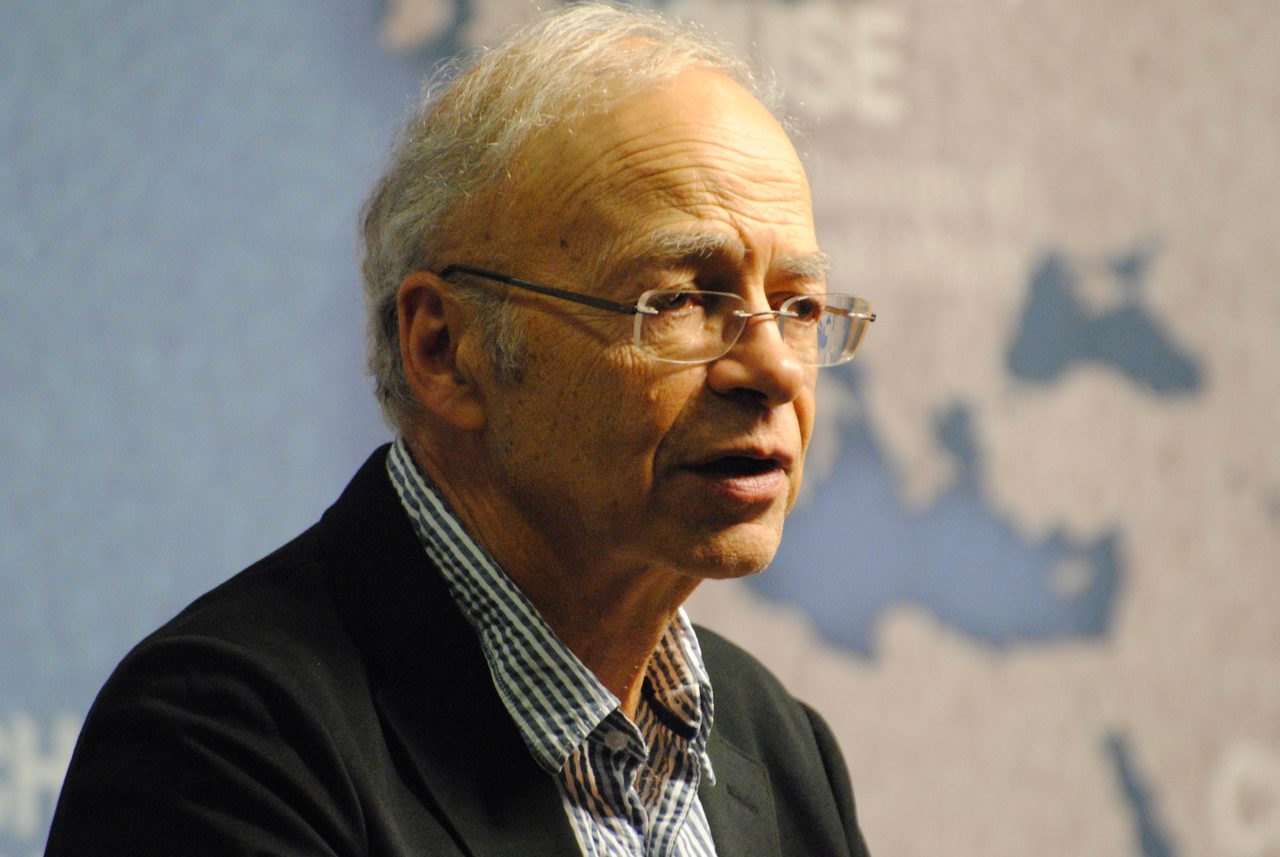
In 1972 Peter Singer asked why a child drowning in a shallow pond a few steps away should count for more than a child dying of poverty ten thousand miles off, and answered that distance changes nothing. What he wrote, and when, is settled. Whether the argument holds is not. Nozick denies that any such duty exists, Wenar denies that poverty is a pond at all, Pogge says the debt is repair rather than charity, and the empirical question underneath every version of the case, whether aid works, is itself disputed by the people who study it. This article reports the argument and its opponents at full strength, crowns nobody, and tells no reader what to do with their money.
A child is drowning in a shallow pond. Someone is walking past. Nobody else is there, the water is not deep, and the only cost of wading in is a set of ruined clothes. Almost nobody thinks the clothes decide the case.
That scene is not a parable and it is not folklore. It is a paragraph in a philosophy journal, written in November 1971 while a specific catastrophe was under way, and its author used it to argue something the comfortable reader is not meant to enjoy: that the reason for wading in survives translation to a distance of ten thousand miles, and that if it does, a great deal of ordinary comfortable life stops being permissible.
A word about the tier marks, because this subject is comparative and normative and the tiers mark something different here than they would in a laboratory article. Tier 1 is textual or attributional fact, checkable against a document or a public record: exactly what Singer wrote in 1972, exactly what Nozick wrote in 1974, a dated legal record, a resolved bibliographic record, an empirical result reported with the scope its own authors gave it. Tier 2 is a live mainstream scholarly position, held seriously and contested seriously, with named holders on more than one side. Tier 3 is genuinely unsettled or minority. Tier 4 is a claim this article refuses, and it refuses in four directions of its own, plus the two our own research file already refuses, because on this subject the overclaims arrive from every side, including from the side that agrees with the argument.
Four things are not this article. Utilitarian theory, the tradition Singer's argument descends from, belongs to this wing's The Greatest Good, which carries the utilitarian tradition itself, the trolley problem, and the theory-side account of effective altruism; it is pointed at here and not developed. Rawls's original position and the machinery of the veil of ignorance belong to this wing's The Veil of Ignorance, and Rawls appears below only as the frame Singer's argument sits inside. Reparations and the ledger of colonialism belong to an article this wing has planned and not yet built, The Empire's Ledger. And the fourth thing this article is not is advice. It reports an argument, the arguments against it, and a dated institutional record. It does not tell anyone what to do with their money, and no sentence in it should be read as though it did.
01The Pond And The Emergency
Start with the date, because an argument that reads as pure abstraction was written about one named catastrophe, and our own research file leaves that out entirely.
The essay opens on a dated emergency rather than on a thought experiment. Its first sentence reads: "As I write this, in November 1971, people are dying in East Bengal from lack of food, shelter, and medical care." He also writes: "Constant poverty, a cyclone, and a civil war have turned at least nine million people into destitute refugees." The essay was written in November 1971 about the East Bengal refugee crisis of the Bangladesh Liberation War, and published the following year.
Peter Singer, "Famine, Affluence, and Morality," Philosophy & Public Affairs, volume 1, number 3, Spring 1972, pages 229 to 243. Our own research file's bibliography gives the same volume, issue and page range, and the citation was corroborated independently against the scanned original and two further reference records. No digital object identifier exists for the article: a query restricted to the journal's own ISSN returns no 1972 Singer record, and the identifiers that do exist belong to reprints of the essay in later anthologies, which are different objects. None of those reprint identifiers is attached to the 1972 citation anywhere in this article.
The analogy, in Singer's own 1972 words: "if I am walking past a shallow pond and see a child drowning in it, I ought to wade in and pull the child out." And immediately following: "This will mean getting my clothes muddy, but this is insignificant, while the death of the child would presumably be a very bad thing."
The popular version of the scene has the rescuer ruining an expensive pair of shoes. The 1972 text does not say that. It says muddy clothes, and the difference is not pedantry, because the shoes belong to a later popular restatement. The website of Singer's own organisation, The Life You Can Save, publishes that restatement in the wording "Wading in is easy and safe, but you will ruin the new shoes you bought only a few days ago, and get your suit wet and muddy", and itself attributes that version to the 1972 essay. The 1972 text does not support the attribution. Singer restated the pond in popular form more than once, in a New Internationalist piece in April 1997 and in The Life You Can Save in 2009, and the ruined shoes and the missed appointment enter there rather than in the journal. Both of our own research files carry the shoes as 1972 wording, and so did an image caption on a published page of this Athenaeum until it was corrected. Section 12 collects that and the rest.

The pond is not the argument. It is the device that isolates one variable, and the sentence that does the isolating reads: "It makes no moral difference whether the person I can help is a neighbor's child ten yards from me or a Bengali whose name I shall never know, ten thousand miles away." Everything the essay concludes runs through that claim.
Which is why the scene is built the way it is. One child, one passer-by, no uncertainty about what will happen, no other rescuer to defer to, and a cost so small that nobody would defend refusing. Strip away every difference between the pond and the famine except distance and anonymity, and the question becomes whether those two things carry moral weight on their own. Singer says they do not. Whether the stripping was fair is what section 06 is about.
02Two Principles In One Paper
Most readers know one principle from this essay. The paper contains two, the second is weaker on purpose, and the second is the reason the argument has survived fifty years of attack aimed at the first.
The strong principle, in Singer's words: "if it is in our power to prevent something bad from happening, without thereby sacrificing anything of comparable moral importance, we ought, morally, to do it." Our own research file quotes this principle correctly and labels it the strong version.
The moderate principle is offered in the same paper, in Singer's own words: "I could even, as far as the application of my argument to the Bengal emergency is concerned, qualify the point so as to make it: if it is in our power to prevent something very bad from happening, without thereby sacrificing anything morally significant, we ought, morally, to do it." Two things change, both deliberately. Bad becomes very bad, and anything of comparable moral importance becomes anything morally significant. Singer offers the weaker version as one he does not need but is willing to accept, because the conclusion he wants about Bengal follows from it anyway.
| The Version | The Wording | What It Changes |
|---|---|---|
| The strong principle, the one most readers know | "if it is in our power to prevent something bad from happening, without thereby sacrificing anything of comparable moral importance, we ought, morally, to do it" | Nothing yet. This is the premise the essay runs on, and it is the version the demandingness objections in section 04 are aimed at |
| The moderate principle, offered in the same paper | "if it is in our power to prevent something very bad from happening, without thereby sacrificing anything morally significant, we ought, morally, to do it" | Two deliberate weakenings. Bad becomes very bad, and comparable moral importance becomes morally significant. Singer says he does not need this version and is willing to accept it, because the Bengal conclusion follows even from the weaker one |
| What our own research file prints | "Weak version: we should give until we sacrifice something morally significant" | Loose in two ways. It drops the change from bad to very bad, which is one of the two weakenings, and it converts a conditional principle into an instruction about giving. The verbatim principle is in the row above |
The strong principle has a stopping point, and Singer names it: marginal utility, the level at which, in his words, "by giving more, I would cause as much suffering to myself or my dependents as I would relieve." He acknowledges in the same passage that the strong principle would on its face require a person to "reduce oneself to very near the material circumstances of a Bengali refugee". Those are quoted here as fragments inside sentences of our own, because they were confirmed as separately returned fragments rather than as one continuous sentence of his. Our own research file states the same stopping point in its own words, as giving until further giving would cause as much suffering to the giver as it relieves in others.
Notice what the second principle does to an objector's position. An argument that only ever demanded everything down to marginal utility could be answered by showing that morality cannot demand that much. An argument that also offers a version demanding only that nothing morally significant be sacrificed has to be answered twice, and the weaker version is much harder to call monstrous. That structural fact is why section 04's objections do not close the case, and it is also why our own file's loose paraphrase of the moderate principle matters more than a paraphrase usually would.
03Duty, Not Charity
The sentence that makes this a wealth-obligation argument rather than a charity argument is not about the pond at all. It is about what category the act belongs to.
Singer's conclusion about the category of the act, in his words: "The traditional distinction between duty and charity cannot be drawn, or at least, not in the place we normally draw it." Of giving to famine relief he writes "To do so is not charitable, or generous." and "On the contrary, we ought to give the money away, and it is wrong not to do so." He explicitly denies that such giving is supererogatory in the philosophers' and theologians' sense of an act it would be good to do but not wrong to omit. Our own research file does not carry this passage.
Everything downstream depends on that move. If the act is charity, it is praiseworthy when done and blameless when not, and the whole question becomes one of generosity. If the act is duty, failing to do it is a wrong, and the question becomes one of justice. Section 06 shows Pogge pushing on the same hinge from the opposite side, arguing that the affluent owe repair rather than aid, which is a third answer again.
The essay does not stay hypothetical. Singer works the comparison on real 1971 numbers: the British government had at that point given "£14,750,000" to Bengal relief, while "Britain's share of the nonrecoverable development costs of the Anglo-French Concorde project is already in excess of £275,000,000, and on present estimates will reach £440,000,000." All three figures are verbatim from the paper.
That comparison is the argument at work, and it is worth marking how modest a thing it actually is. Singer is not claiming the Concorde was worthless, and he is not costing lives against airframes. He is pointing at two public decisions taken by the same government in the same period and asking which of them the country would defend if the two were placed side by side. The essay's own worked example is a question about priorities, put in public money, with the amounts printed.
04Too Much To Ask
The first family of objections grants the argument's shape and denies its conclusion, on the ground that a morality demanding this much is not a morality anyone could live inside.
The demandingness objection, as our own research file states it: Singer's argument that affluent people are obligated to donate to effective poverty relief until the point of marginal utility has been criticised as excessively demanding. The file names Liam Murphy and Samuel Scheffler as arguing that morality cannot require such extreme sacrifice without undermining personal projects and relationships. That attribution is our file's characterisation of their positions, carried here as such.
The demandingness literature has names, dates and records. Our own files name two of these people and cite none of the works. Susan Wolf, "Moral Saints," The Journal of Philosophy, volume 79, issue 8, August 1982, page 419, standardly cited as 419 to 439. The record was resolved live against CrossRef for this article and returned exactly that title, author, journal, year, volume and issue, with no retraction or update field. The paper attacks the idea that a morally perfect person is an attractive ethical ideal, which is the level at which it is used here: Wolf argues that a life of moral perfection is not an attractive personal ideal. She is not quoted anywhere in this article, because the summary of her thesis rests on an independent reference source rather than on a reading of the paper.
Liam B. Murphy, Moral Demands in Nonideal Theory, Oxford University Press, 2000, is the standing book-length treatment of how demanding a morality may be. Its record resolved live against CrossRef for this article, returning exactly that title, author, publisher and year. Samuel Scheffler, The Rejection of Consequentialism, Oxford University Press, 1982, is the other work our own file's counter-argument points at; its record was not separately resolved for this article. Nothing beyond our file's own characterisation is attributed to either author here, and no fair-share principle or agent-centred prerogative is put in either man's mouth.
Bernard Williams's integrity objection, from Utilitarianism: For and Against, written with J. J. C. Smart and published by Cambridge University Press in 1973, is the other classical challenge in this family: that a morality demanding agents override their deepest commitments alienates them from the projects and relationships that give their lives meaning. Williams's target is utilitarianism in general rather than Singer's 1972 paper, and this wing's The Greatest Good already carries the objection in full. It is named here and handed straight back.
Then the structural answer, which is already inside the 1972 paper. Singer offered the moderate principle precisely because the strong one invites this attack, and the moderate principle still delivers a conclusion far beyond what anybody currently does. An objection that succeeds against the strong version and leaves the weak one standing has not finished the job, and none of the four works named above is an argument that the weak version fails.
05No Such Duty
The second family of objections does not grant the shape at all. It denies the premise: there is no positive duty to aid strangers, so the pond does not generalise, because the pond case is not a case of duty in the first place.
Robert Nozick, Anarchy, State, and Utopia, Basic Books, 1974, is the leading rights-based counter-position. His entitlement theory of justice in holdings has three parts. A distribution is just if it resulted from just initial acquisition, subject to a Lockean proviso of leaving enough and as good for others; from just transfer, meaning voluntary exchange, gift or bequest; and from rectification of past injustice where any occurred. The Stanford Encyclopedia of Philosophy states the same three-part structure and notes that Nozick himself treats the detailed principles as complicated truths he does not fully formulate.
The objection has a four-word form. Taxation of earnings from labour is, in Nozick's words, "on a par with forced labor", and the Stanford Encyclopedia of Philosophy's entry on his political philosophy quotes exactly that phrase and cites Anarchy, State, and Utopia at page 169. Our own research file renders it as taxation for redistribution being on a par with forced labor, and gives the reasoning behind it: taking the fruits of a person's labour without consent effectively claims partial ownership over the person, which violates self-ownership. The four words are a slogan without that reasoning, and the reasoning is what has to be answered.
Nozick's positive conclusion is the minimal or night-watchman state: an authority limited to protection against force, theft and fraud and to the enforcement of contracts is the most extensive state that can be justified, and anything beyond it violates rights.
Put beside Singer, the disagreement is not about whether poverty is terrible. It is about what a holding is. On Singer's account a person with more than enough is holding resources that a dying stranger has a claim on. On Nozick's account a person with more than enough is holding what is theirs, and a claim on it is a claim on them.
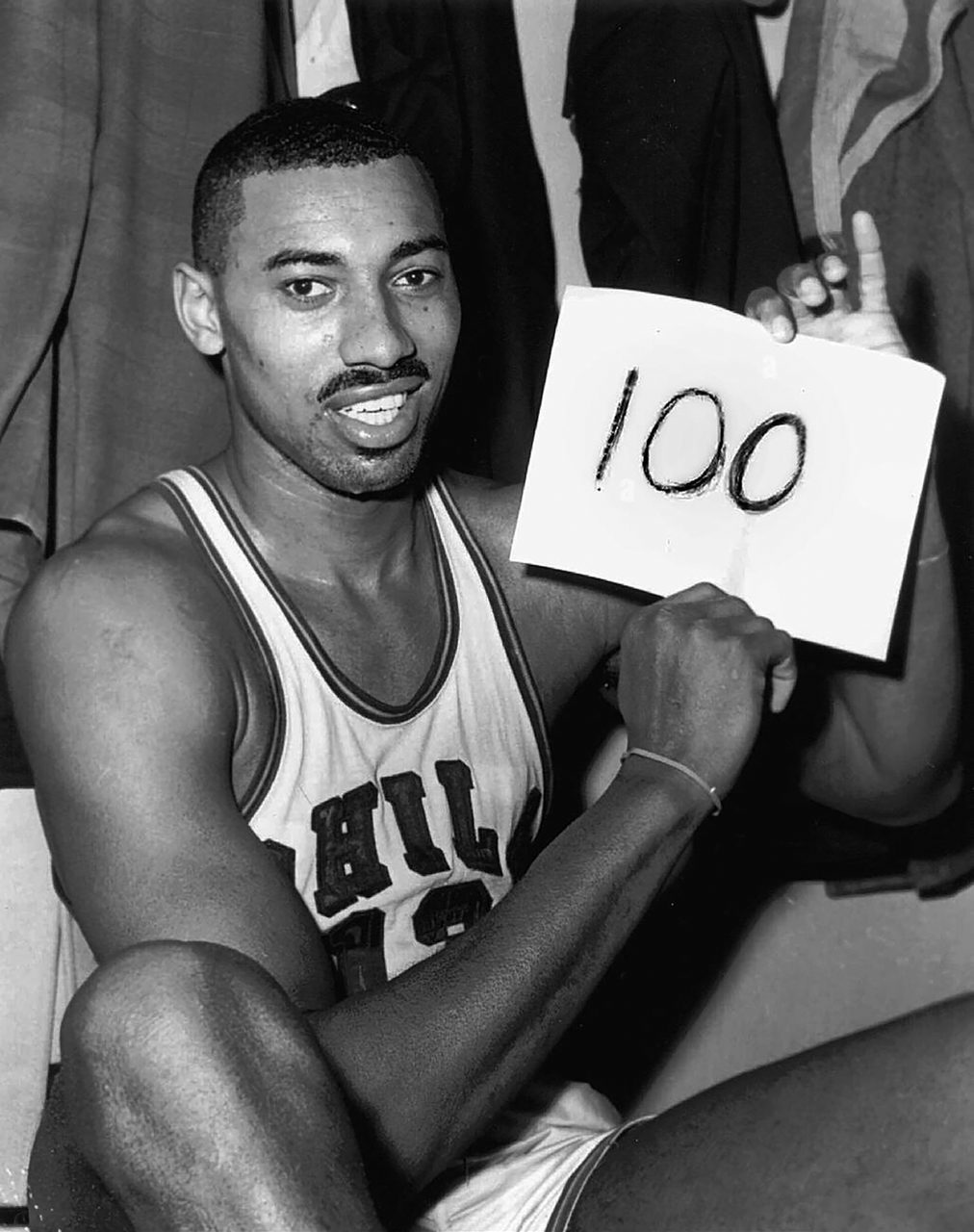
The Wilt Chamberlain argument is the counter-thought-experiment. Nozick asks a reader to accept whatever distribution they consider just, and then to imagine one million fans each paying Wilt Chamberlain twenty-five cents, out of holdings that were just by their own standard, for the pleasure of watching him play. The Stanford Encyclopedia of Philosophy states the case as a million fans each paying twenty-five cents, and quotes Nozick's question at page 161: if people were entitled to dispose of the resources to which they were entitled, did that not include being entitled to give them to, or exchange them with, Wilt Chamberlain. The conclusion Nozick draws is that any patterned principle of distribution must be continuously interfered with to be maintained, because free exchanges keep disturbing the pattern. Our own file says millions of people rather than one million; the case is stated with one million, and no dollar total is given here because Nozick's own arithmetic line was not among the things this article verified.
Nozick's own theory contains a principle of rectification: if past acquisitions or transfers were unjust, current holdings may be illegitimate. Our own file's counter-arguments section states the standard objection to the entitlement theory from that direction, that no existing distribution arose from purely just acquisitions. So the entitlement theory, taken seriously and applied to the actual world, does not obviously deliver a conservative result.
That is the point where the libertarian argument and the reparations argument touch, and it is as far as this article follows it. What corrective justice would require across centuries belongs to The Empire's Ledger, which this wing has planned and not yet built.
The denial has a peer-reviewed literature of its own, and it is two-sided. John Kekes, "On the Supposed Obligation to Relieve Famine," Philosophy, volume 77, issue 4, 2002, pages 503 to 517. It was answered directly by Keith Horton, "Famine and Fanaticism: A Response to Kekes," Philosophy, volume 79, issue 2, 2004, pages 319 to 327. Both records were resolved live against CrossRef for this article and returned exactly those titles, authors, journal, years, volumes, issues and pages. Neither paper was read for this article, so nothing is attributed to either beyond what its own title establishes: that Kekes argues against the supposed obligation, and that Horton replies in Singer's defence. The exchange is here because it is evidence that the dispute was live in the journals thirty years after 1972 rather than settled by acclaim.
06Poverty Is No Pond
The third and fourth families do not attack the conclusion or the premise. One attacks the analogy itself, and the other accepts that something is owed while denying that generosity is the right name for it.
The pond has a chapter-length critic, and the chapter's title states its thesis. Leif Wenar, "Poverty Is No Pond: Challenges for the Affluent," in Giving Well: The Ethics of Philanthropy, edited by Patricia Illingworth, Thomas Pogge and Leif Wenar, Oxford University Press, 2011, pages 104 to 130. The record was resolved live against CrossRef for this article and returned that author, container, publisher, year and page range, and the main title without its subtitle. The chapter was not read for this article, so no specific argument is attributed to it here. What is stated is what the title states and what the record establishes: one of the volume's own co-editors published a chapter-length challenge to the analogy, arguing under that title that a pond is not what poverty is like.
Thomas Pogge, World Poverty and Human Rights, Polity, 2002, with a second edition in 2008, argues that the global institutional order actively harms the global poor rather than merely failing to help them: trade rules, intellectual property regimes, financial systems, and the international borrowing and resource privileges. On this account affluent countries and institutions are not bystanders. They maintain and benefit from global rules that foreseeably and avoidably perpetuate poverty.
Pogge's move changes the kind of duty at stake. Singer's duty is positive: prevent something bad from happening. Pogge's is negative: do not harm. Our own research file states why that matters, and that sentence is the reason this position gets a section of its own here. A negative duty is a much stronger moral claim, because even libertarians accept negative duties. On this reading the question is not what the rich owe out of generosity but what they owe having caused the damage, which makes poverty a matter of justice rather than of charity, and which makes the title question of this article carry two entirely different answers depending on whether the debt is one of aid or one of repair.
Pogge's reform proposal has a published, citable form: Thomas W. Pogge, "Eradicating Systemic Poverty: Brief for a global resources dividend," Journal of Human Development, volume 2, issue 1, 2001, pages 59 to 77. The record was resolved live against CrossRef for this article and returned exactly that title, author, journal, year, volume, issue and pages, with no retraction or update field. Our own research file describes the Global Resource Dividend as a modest tax on resource extraction redistributed to the global poor, alongside fair trade rules and access to essential medicines.
There is a further institutional answer, older than Pogge's, and it is the frame Singer's argument sits inside. John Rawls, A Theory of Justice, Harvard University Press, 1971, revised in 1999, argued that rational agents choosing principles of justice from behind a veil of ignorance, not knowing their own race, gender, wealth, talents or conception of the good, would choose an equal right to the most extensive system of basic liberties compatible with the same for all, together with the difference principle, that social and economic inequalities are permissible only if they benefit the least advantaged, combined with fair equality of opportunity. In Political Liberalism, in 1993, he made explicit that justice as fairness applies to the basic structure of society, its institutions, constitutions and legal systems, rather than to individual acts of charity or personal morality. The machinery of the veil belongs to this wing's companion article, The Veil of Ignorance; the last sentence is what this article needs.
Because that last sentence states plainly why an institutional theorist thinks Singer is asking the wrong unit of moral agency the wrong question. Singer addresses a person with a bank balance. Rawls addresses a constitution. Pogge addresses a trade regime. Three serious positions in this subject disagree not about whether poverty is unjust but about who exactly the question is being put to, and an answer aimed at the wrong addressee can be true and useless at the same time.
07The Wrong Measure
A fifth position says the whole dispute is counting the wrong thing, which makes it neither a defence of Singer nor an objection to him but a claim that the ledger itself is mis-ruled.
Amartya Sen, in Development as Freedom in 1999, and Martha Nussbaum, in Creating Capabilities in 2011, reframe poverty as capability deprivation rather than income deprivation: the lack of real freedoms to achieve valuable functionings such as adequate nutrition, health, education, political participation and bodily integrity. Nussbaum lists ten central capabilities, which our own file gives as life; bodily health; bodily integrity; senses, imagination and thought; emotions; practical reason; affiliation; other species; play; and control over one's environment, and holds that a just society guarantees each citizen a threshold level of each, below which human dignity is violated. Our neighbouring file on charity and philanthropy adds Sen's corollary, that effective development requires institutional reform, democratic participation and empowerment rather than external aid transfers alone.
The point generalises past development economics. Elizabeth Anderson, "What Is the Point of Equality?," Ethics, volume 109, issue 2, 1999, pages 287 to 337. The record was resolved live against CrossRef for this article and returned exactly that title, author, journal, year, volume, issue and pages, with no retraction or update field. Our own file uses it for the point that even radical egalitarians argue for relational equality, meaning equal social standing, rather than for equal holdings. It is also the single identifier in that file's bibliography that resolves to the work it is attached to; section 12 explains what happened to the others.
Which reframes the title of this article. If what the poor lack is standing and capability rather than money, then a transfer of money is at best an instrument and possibly the wrong one, and the question of what the rich owe stops being a question about a quantity. That is a serious position held by serious people, and it is not an answer to Singer either, because a person dying of a treatable disease this year is not helped by a better theory of what deprivation is.
08Does Aid Work
Every version of the argument, Singer's and Pogge's and the capability theorists', has an empirical premise underneath it: that something can actually be done. Neither of our own research files carries the aid-effectiveness exchange, the Millennium Villages episode or the 2019 prize; the one empirical study of an aid intervention that our files do carry appears further down this section. The dispute is real, it is in the journals, and it has not been settled.
Craig Burnside and David Dollar, "Aid, Policies, and Growth," American Economic Review, volume 90, issue 4, 2000, pages 847 to 868. The published abstract, verbatim from the American Economic Association's own article page: "Aid has a positive impact on growth in developing countries with good fiscal, monetary, and trade policies but has little effect in the presence of poor policies." Against it, in the same journal: William Easterly, Ross Levine and David Roodman, "Aid, Policies, and Growth: Comment," American Economic Review, volume 94, issue 3, 2004, pages 774 to 780. Both records were resolved live against CrossRef for this article and returned exactly these titles, authors, journal, years, volumes, issues and pages, neither carrying a retraction or update field. The Comment's working-paper form describes its own method and result as extending the original data by four further years and filling in missing observations for the original period, and finding the earlier result not robust to the additional data. That summary is attributed to the working-paper record rather than to the published Comment's abstract, which was not obtained.
The dispute has also happened in public with names and dates attached. The study: Paul M. Pronyk and colleagues, on an integrated multisector model for achieving the Millennium Development Goals and improving child survival in rural sub-Saharan Africa, The Lancet, volume 379, issue 9832, 2012, pages 2179 to 2188. The challenge: Jesse B. Bump, Michael A. Clemens, Gabriel Demombynes and Lawrence Haddad, "Concerns about the Millennium Villages project report," The Lancet, volume 379, issue 9830, 2012, page 1945. The authors' own correction: Paul Pronyk, "Errors in a paper on the Millennium Villages project," The Lancet, volume 379, issue 9830, 2012, page 1946, whose record explicitly names it a correction to the study. And the later independent assessment: Eran Bendavid, "The fog of development: evaluating the Millennium Villages Project," The Lancet Global Health, volume 6, issue 5, 2018, pages e470 to e471. All four records were resolved live against CrossRef for this article and returned exactly these titles, authors, journals, years, volumes, issues and pages.
The substance is worth stating plainly, with the hedges the published correspondence itself carries. The disputed claim was that child mortality fell about three times faster at the project's sites than in recent national rural trends, about 7.8 percent per year against about 2.6 percent. The critics' point was a comparison-period mismatch: a three-year project window had been compared against a national trend drawn from a much longer period. On the more closely matched data the critics cite, child mortality fell about 5.9 percent per year at the sites against about 6.4 percent per year on average across all areas of the same countries. The paper was corrected rather than retracted, its own monitoring and evaluation director wrote the correction letter, and Jeffrey Sachs publicly accepted that the timing criticism was on point and restructured the project's evaluation, including an independent expert group. Those numbers are attributed to the published correspondence and are not offered as a settled measurement of what the project did.
The methodological turn behind the modern evidence-based case has an institutional marker. The Sveriges Riksbank Prize in Economic Sciences in Memory of Alfred Nobel 2019 was awarded jointly to Abhijit Banerjee, Esther Duflo and Michael Kremer "for their experimental approach to alleviating global poverty", recognising the use of randomised controlled trials to identify what actually works in development. The motivation wording is quoted identically by four independent institutional sources checked for this article; the prize organisation's own page could not be retrieved directly, so the canonical citation remains its 2019 press release in economic sciences.
Our own corpus states the sceptical case as well: poorly designed aid can cause harm through dependency, market distortion, undermining of local institutions and the empowerment of corrupt governments, citing Dambisa Moyo, Dead Aid, 2009, and William Easterly, The White Man's Burden, 2006. Our file files that material under a heading aimed at the claim that charity always helps, but the underlying critique of aid effectiveness is a serious position held by serious economists and not a fringe one. Easterly and Moyo on one side, Sachs and the randomised-trial researchers on the other, and this article crowns neither.
The honest state of it is that the empirical premise is contested at exactly the level where the philosophy needs it settled. Both Singer's version and Pogge's require that intervention can change outcomes. The literature says sometimes, under conditions, with results that depend on what is measured and over what period, and one well-documented episode in the public record ran like this: a headline finding challenged, corrected by its own authors, and reassessed six years later.
09When The Argument Became Money
A philosophical argument that becomes institutions acquires a history, and the history is not the argument. What follows is the record, dated, because our own files stop short of it and because a movement's conduct is evidence about the movement.
GiveWell was founded in 2007 by Holden Karnofsky and Elie Hassenfeld. Giving What We Can was founded in 2009 by Toby Ord. In 2011 Giving What We Can and 80,000 Hours decided to incorporate under an umbrella organisation and held a vote on the new name; the name selected was the Centre for Effective Altruism, and that naming is the origin of the term as a movement label. Peter Singer used the term publicly in a 2013 TED talk titled "The Why and How of Effective Altruism". Our own file states that the movement was launched organizationally by Toby Ord and William MacAskill around 2011, which is consistent with that record. No single confident founding year is printed here for the Centre for Effective Altruism, because reputable summaries disagree between 2011 and 2012; what is dated is the 2011 vote on the name.
What effective altruism claims for itself, as our corpus reports it: that evidence and reason should determine the most effective ways to improve the world; that the most effective charities produce on the order of a hundred times more benefit per dollar than average ones, a figure that appears in William MacAskill's Doing Good Better in 2015; and that giving should be guided by cause prioritisation, meaning problems that are large, neglected and tractable, by counterfactual impact, meaning only the difference a donation makes beyond what would have happened anyway, and by evidence-based evaluation using randomised controlled trials and similar methods. These are the movement's claims about its own method, reported as claims. The hundredfold figure is a claim in a trade book and is not presented here as a measured finding.
One number is unavoidable in any account of what this movement does, and it arrives here with its owner's name, its date and its owner's own caveats attached, because without them it turns into something it is not. GiveWell's own page, dated April 2024, states: "Over the past several years, our models for grants to our Top Charities have typically estimated an average cost between $3,000 and $5,500." The same page attaches its own qualifications, also in its own words: "Note that the same program can vary widely in cost-effectiveness across locations" and "We generally expect the cost to save a life to increase over time." That is an evaluator's published estimate of its own grants, reported as exactly that. It is not a price, it is not a recommendation, and the positions set out earlier under Poverty Is No Pond and The Wrong Measure are in large part arguments that this is the wrong thing to be counting.
The critiques are equally on the record: that the movement is technocratic, that it neglects structural injustice, and that it privileges quantifiable outcomes over systemic reform. Our own files cite Srinivasan and Emile P. Torres among the critics, and an independent survey of the critical literature checked for this article adds Kwame Anthony Appiah, Judith Lichtenberg and Larissa MacFarquhar, on grounds ranging from the neglect of structural and political change to the character of the moral psychology the movement asks for. Srinivasan is named here without a specific piece attached, because our own file's bibliography entry and its in-text citation are two different pieces that the file conflates, and a second critic our file cites with a year was not verified for this article, so the year is not repeated here.
Sam Bankman-Fried, a prominent effective altruism adherent who publicly framed his wealth accumulation as earning to give, built the FTX cryptocurrency exchange. FTX collapsed in November 2022 with billions of dollars of customer funds lost. He was convicted in November 2023 on seven counts of fraud and conspiracy. On March 28, 2024 he was sentenced to 25 years in federal prison, and the court ordered a forfeiture of $11.02 billion. On June 12, 2026 a three-judge panel of the United States Court of Appeals for the Second Circuit rejected his appeal, upholding both the conviction and the sentence. Our own file carries only the collapse and the conviction; every date and figure after that point comes from independent reporting checked for this article, and the 2026 appellate outcome post-dates both of our files entirely.
MacAskill and the effective altruism community publicly distanced themselves from Bankman-Fried, and the episode triggered sustained internal and external critique of longtermism and of the movement's institutional culture. Our own file frames the open questions honestly: whether a focus on maximising impact encouraged ends-justify-means reasoning, and whether the community's earlier embrace of him reflected insufficient attention to how wealth was accumulated rather than to how it would be given away. Separately and adjacently, Rob Reich, in Just Giving in 2018, argues that large-scale private philanthropy raises democratic problems, because foundations receive substantial tax advantages, answer to donor intent rather than public need, and can reshape public goods without democratic accountability, with the standard counter that foundations can take risks governments cannot.
And then the guard, stated in the open rather than left to the reader. A criminal fraud committed by one funder in 2022 is evidence about that funder, and at most evidence about a movement's governance and its vetting of the people who write it cheques. It is not evidence about the soundness of an argument published in 1972 by somebody else. The record is here because a movement this article names leans on its own credibility and because our own file leans on that movement; it is not here as a verdict on the argument, and the opposite error would be just as bad, because softening the record to protect a philosophical claim would be the same trade made in the other direction.
10The Numbers As They Stand In 2026
The empirical backdrop moved in 2025, and it moved in a way that is easy to report dishonestly in either direction.
On June 5, 2025 the World Bank updated its global poverty lines. The international extreme poverty line is now $3.00 per person per day in 2021 purchasing power parities, replacing the previous $2.15 line in 2017 parities. Under the new line about 838 million people were in extreme poverty in 2022, against the previous estimate of 713 million for the same reference year under the old line. The World Bank's own factsheet states both figures. The revision is a change of measuring rod rather than a sudden worsening of the world, and this article says so plainly because the figure is exactly the kind that gets restated bare and read as news. Our own research file states approximately 712 million people living on less than $2.15 a day, citing the World Bank in 2023, and was last updated on March 12, 2026 without catching the change.
| What Is Being Measured | Under The Old Line | Under The Line Since June 5, 2025 |
|---|---|---|
| The international extreme poverty threshold | $2.15 per person per day, in 2017 purchasing power parities | $3.00 per person per day, in 2021 purchasing power parities |
| People in extreme poverty in 2022, the same reference year measured both ways | 713 million, the World Bank's own restatement of the old-line figure | About 838 million |
| What the difference between those two counts is | Not a worsening of the world between one year and the next | One year measured twice, with a different threshold and a different price base |
| What our own research file prints | Approximately 712 million people living on less than $2.15 a day, citing the World Bank in 2023 | Superseded. The file was last updated on March 12, 2026 and had not caught the June 2025 revision |
On the distribution, this article uses a named report with named methods rather than the figures our own file carries. The World Inequality Report 2022, produced by the World Inequality Lab, states in its own executive summary: "The richest 10% of the global population currently takes 52% of global income, whereas the poorest half of the population earns 8.5% of it." On wealth it states that "The richest 10% of the global population own 76% of all wealth" while "The poorest half of the global population barely owns any wealth at all, possessing just 2% of the total." The report also states that since 1995 the share of global wealth held by billionaires has risen from 1 percent to over 3 percent.
Our own file prints, inside quotation marks and attributed to Branko Milanovic, a sentence to the effect that the most important factor determining a person's income is not effort, education or luck but where they were born, and states that citizenship accounts for roughly two thirds of income variation globally. The substance holds: a published academic review of Milanovic's Global Inequality quotes his own claim that he can explain, in a regression sense, more than two thirds of the variability in income across country percentiles using a single variable, the country in which people live, a location effect he calls the citizenship premium and describes as essentially a rent. The quoted sentence itself could not be traced to him, so it is not reproduced here. The citable form of the finding is Branko Milanovic, "Global Inequality of Opportunity: How Much of Our Income Is Determined by Where We Live?," Review of Economics and Statistics, volume 97, issue 2, 2015, pages 452 to 460, whose record resolved live against CrossRef for this article.
Two live proposals sit at the edge of this subject and our own file files both as unsettled. Universal basic income, unconditional cash transfers to all citizens, argued for on grounds of autonomy, a social floor, simplified welfare bureaucracy and collective ownership of natural resources, with pilot programmes in Finland, Kenya and Stockton, California reported as promising but preliminary, and sustainability at national scale still debated. And reparations and historical justice, where if current distributions are the product of slavery, colonialism and dispossession, corrective justice may require more than equal opportunity going forward, and where Nozick's own rectification principle points the same way; our file names Coates and Taiwo as scholarly support, and the practical difficulties of identifying beneficiaries, setting amounts and tracing causal chains across generations are enormous. Reparations belongs to The Empire's Ledger. One piece of hard evidence sits on the anti-paternalism side of the cash-transfer question and is worth naming precisely: Johannes Haushofer and Jeremy Shapiro, "The Short-term Impact of Unconditional Cash Transfers to the Poor: Experimental Evidence from Kenya," The Quarterly Journal of Economics, volume 131, issue 4, 2016, pages 1973 to 2042, whose record resolved live against CrossRef for this article and whose own title says short-term.
One further set of numbers is deliberately absent. Our own file's headline wealth-share figures, taken from a report series that its publisher no longer issues under that name, could not be confirmed against any available source, and available secondary summaries of the same series disagree with the file and with each other. The figures are therefore not printed anywhere in this article, in the body or in the factbox, and the World Inequality Report figures above stand in their place.
11Where It Stands
Four kinds of objection, each attacking a different part of the argument, each with named holders and a published record. The middle two columns are what stop the list from reading as a count.
| The Objection | Who Presses It | What It Attacks | Where It Stands |
|---|---|---|---|
| Too demanding. A morality that requires giving until further giving costs the giver as much as it relieves cannot be right, because it leaves no room for the projects and relationships that make a life a life | Wolf 1982, Williams 1973, Murphy 2000, Scheffler 1982, as our own file names them | The conclusion, not the premise. It grants the argument's shape and denies that morality can ask this much | Live. Singer's own moderate principle, offered in the same 1972 paper, was written to survive exactly this pressure, and it still yields a conclusion far beyond ordinary practice |
| No such duty exists. Holdings acquired justly and transferred voluntarily belong to the holder, and taxing earnings to redistribute them treats the earner as partly owned | Nozick 1974; Kekes 2002 in the journal Philosophy, answered by Horton 2004 in the same journal | The premise. It denies any positive duty to aid, so the pond case does not generalise | Live, and two-sided in the peer-reviewed literature rather than settled. Nozick's own rectification principle complicates his side of it |
| Poverty is no pond. The chapter's title states the thesis: a pond is not what poverty is like | Wenar 2011, a chapter in Giving Well, a volume he co-edited with Illingworth and Pogge | The analogy itself, which is the device the whole argument runs through | Live, and carried here at the level the record supports. The chapter, its venue and its title are cited; no specific argument is attributed to a text this article did not read |
| It is not charity that is owed but repair. The global institutional order actively harms the poor, so the duty is negative rather than positive | Pogge 2002 and 2008, with a published reform proposal in 2001 | The category. It agrees that the affluent owe something and denies that generosity is the right name for it | Live, and it cuts across the other three. A negative duty binds even those who accept no positive duties at all, which makes it a rival account rather than a friendly amendment |
Read the first column alone and the argument looks finished. Read the last column alone and it looks untouched. Both readings are wrong, and the reason is that the objections do not point the same way. The demandingness family says the conclusion asks too much; Pogge's version asks for more, and asks it as a matter of repair. Nozick says there is no duty at all; Pogge's negative duty binds Nozick's own position on Nozick's own terms. Wenar's title says the analogy fails; that leaves the institutional case standing, because it never ran through the pond. An argument attacked from four directions by critics who contradict each other is not a refuted argument. It is a live one, and counting critics is not a method of adjudication.
12What We Corrected In Our Own File
This article rests on one research file from our own library, ZE_4_13, with a second, ZE_5_13, read alongside it for the effective altruism material. Both needed correcting before anything above could be written, and the corrections are collected here rather than buried, because several of them change what a reader would find if they went looking.
The file is not thin. It runs to 197 lines with four populated tier sections, a real counter-arguments section, a sixteen-entry bibliography, a cross-reference index and two logged corrections. As a survey of distributive justice it is solid. It is thin in exactly one place: this article's whole spine, Singer's 1972 argument, gets five bullet points, one of which misstates the 1972 text. The occasion of the essay, the verbatim moderate principle, the distance sentence, the duty-versus-charity conclusion and Singer's own worked comparison against Concorde development costs are all absent from it, and every one of them was recovered by reading the 1972 article itself.
The misquotation first. Both files state that in the 1972 essay the rescuer ruins his expensive shoes. The 1972 text says the rescuer's clothes get muddy, verified against the scanned original in three separate passes. The shoes belong to the later popular restatement, which Singer's own organisation publishes and itself attributes to 1972. That error had already reached a published page: an image caption on this Athenaeum's article The Greatest Good described the 1972 argument in terms of ruined shoes. It was corrected. The corpus half is logged for a hygiene session rather than edited from inside this build.
Then the paraphrase that changes a text. Our file renders the moderate principle as a weak version in which people should give until they sacrifice something morally significant. Singer's actual qualified principle is a conditional, and it also changes bad to very bad, which is one of its two deliberate weakenings. Dropping that change makes the moderate principle look like a softer instruction rather than a different premise, and the difference matters exactly where section 04's objections land.
Then the identifiers, which is where the file goes wrong at scale. Four of the five digital object identifiers in this file's bibliography resolve to works other than the ones they are attached to, every one checked live against CrossRef for this article with the returned title read against the claim. The identifier on Nozick's Anarchy, State, and Utopia resolves to a German handbook chapter about the book, whose registered title is the book's own title and author, so a title-match check passes it; the identifier on Milanovic's Global Inequality resolves to a two-page book review; the identifier on Banerjee and Duflo's Poor Economics resolves to a review of a different Banerjee and Duflo book altogether; and the identifier on Nussbaum's Creating Capabilities resolves to a book review in a philosophy journal. The pattern is identical in all four cases: a review of the work has been captured in place of the work. Only the Anderson entry resolves to what it names. None of the four is reproduced in the sources below. The Nozick identifier is worse than a local typo: it appears in at least three of our corpus documents attached to different labels, and two independent research passes on the same day resolved it separately and got the same handbook chapter, which makes it shared contamination during ingestion rather than three coincidences.
Then three figures. The file's headline wealth shares, attributed to a 2021 report from a publisher that no longer issues the series under that name, could not be confirmed and are not printed here. The file's poverty line and count were superseded by the source institution itself in June 2025, and the file was updated in March 2026 without catching it, which is a stale figure rather than a wrong one and is worth a corpus-wide check because that line is quoted in many places. And a sentence about where a person is born is printed inside quotation marks and attributed to Branko Milanovic; the substance is well supported, the quotation could not be traced to him, and a true claim inside untraceable quotation marks is still a citation defect.
Then the smaller items, recorded rather than fixed. Our two files disagree with each other about the same evaluator's cost estimate, one giving a lower bound of $3,000 for GiveWell's April 2024 figure and the other $3,500, having been last updated on the same day; GiveWell's own page supports the first. A chapter's page range is given in one file as ending eight pages later than its own record says. Several bibliography rows in both files have publisher, edition and place data displaced into the wrong columns, and one World Bank entry gives one year in its year column and a different year in its publisher column for the same publication, while the body text cites a third. And one book identifier carried identically by both files matches no known edition of the book it names, which a sibling article's research pass established independently; the correct number is not reproduced from our files because our files do not have it.
Finally the images, which is where a research file can do real damage to a build. This file carries a build-facing images table whose four rows recommend a photograph from a university archive marked fair use, a book cover marked fair use, a wealth-distribution chart from a commercial report marked fair use, and a diagram described only as a standard philosophical illustration asserted to be public domain, with no file, author or repository named. Fair use is not a licence this estate ships, and an unnamed illustration is not a verifiable asset. None of the four rows was acted on. The same defect was reported independently the same day against the file behind this wing's companion article, which makes it a pattern across the document family rather than one careless table. Nothing was edited in the research corpus for this build; every item above is logged for a hygiene session that owns that work.
One gap is worth naming rather than papering over. No freely licensed photograph of Thomas Pogge could be found, and his position is load-bearing in this article. The institutional-critique section therefore runs without a portrait, which is the right outcome: a generic photograph of a trade summit or a shipping container would assert something about institutions that no verified frame supports. For the same reason there is no diagram of the drowning child anywhere on this page. Drawing a child in danger as an editorial asset raises the same problem as photographing one, and the thought experiment is one sentence long and was built to need no illustration.
Fast Facts
- The Argument
- Peter Singer, Famine, Affluence, and Morality, Philosophy & Public Affairs, volume 1, number 3, Spring 1972, pages 229 to 243. If a passer-by ought to wade into a shallow pond to save a drowning child at the cost of muddy clothes, then distance and anonymity cannot excuse a failure to prevent a death far away, because Singer's own load-bearing sentence says it makes no moral difference whether the person he can help is a neighbour's child ten yards from him or someone whose name he will never know, ten thousand miles away
- Its Occasion
- Written in November 1971 about the East Bengal refugee crisis of the Bangladesh Liberation War. The essay's opening names the emergency and gives Singer's figure for it, at least nine million destitute refugees. Our own research file carries none of this
- The Half Most Readers Miss
- The same paper offers a second, weaker principle: prevent something very bad without sacrificing anything morally significant. Singer says he does not need it and is willing to accept it, because his conclusion about Bengal follows from it anyway. Objections aimed only at the strong version leave the weak one standing
- What Singer Calls The Act
- Not charity. He writes that the traditional distinction between duty and charity cannot be drawn where it is normally drawn, and denies that giving to famine relief is charitable or generous. That move is what makes this a wealth-obligation argument rather than a generosity argument
- The Wording, Corrected
- The 1972 text says the rescuer's clothes get muddy. It does not say expensive shoes. The shoes belong to a later popular restatement published by Singer's own organisation, which itself attributes that version to 1972. Both of our own research files carry the shoes as 1972 wording
- The Standing Objections
- Too demanding (Wolf, Williams, Murphy, Scheffler); no positive duty exists (Nozick, and Kekes in 2002, answered by Horton in 2004); the analogy itself is wrong (Wenar, 2011); and what is owed is repair rather than charity (Pogge). They do not point the same way, and counting them is not a method of adjudication
- The Empirical Question Underneath
- Whether aid works is disputed in the peer-reviewed literature: Burnside and Dollar in 2000, the Easterly, Levine and Roodman comment in 2004, the Millennium Villages study of 2012 with its published challenge and its authors' own correction, an independent assessment in 2018, and the 2019 Sveriges Riksbank Prize for the experimental approach to alleviating global poverty
- The Line Moved
- On June 5, 2025 the World Bank replaced its $2.15 a day extreme poverty line, in 2017 purchasing power parities, with $3.00 a day in 2021 parities. About 838 million people were in extreme poverty in 2022 under the new line, against a previous estimate of 713 million for the same year under the old one. The jump is the measuring rod moving, not the world getting worse
- What Is Not Settled
- Whether a positive duty to aid strangers exists at all. Whether the pond analogy carries. Whether the debt is aid or repair. Whether aid works, and which aid. Whether the right thing to count is income, capability or standing. Fifty years of argument have not closed any of them
What Can Actually Be Stood Behind
What was written, and when, is settled and may be stated flatly. Singer published "Famine, Affluence, and Morality" in Philosophy & Public Affairs, volume 1, number 3, in the spring of 1972, at pages 229 to 243, having written it in November 1971 about the East Bengal refugee crisis. The strong principle, the moderate principle, the marginal-utility stopping point, the distance sentence, the duty-versus-charity conclusion and the Concorde comparison are all in that text in the wordings quoted above. Nozick published Anarchy, State, and Utopia in 1974; the forced-labor phrase sits at page 169 and the Wilt Chamberlain question at page 161, both cited to those pages by the Stanford Encyclopedia of Philosophy. Kekes published in Philosophy in 2002 and Horton answered in the same journal in 2004. Wolf published "Moral Saints" in 1982, Murphy Moral Demands in Nonideal Theory in 2000, Wenar "Poverty Is No Pond" in 2011, Pogge the Global Resource Dividend brief in 2001, Anderson "What Is the Point of Equality?" in 1999, Burnside and Dollar in 2000 and the Easterly, Levine and Roodman comment in 2004. The Millennium Villages study, its published challenge, its authors' own correction and the 2018 independent assessment are all four on the record. The 2019 prize was awarded for an experimental approach to alleviating global poverty. FTX collapsed in November 2022, the adherent who built it was convicted in November 2023, sentenced on March 28, 2024 and denied his appeal on June 12, 2026. The World Bank moved its extreme poverty line on June 5, 2025. Every one of those is a fact about a document or a public record, which is the only level at which this article states them.
The dispute about whether the argument works is real, serious and unresolved, and every side has named holders. The demandingness objection is a live position, and so is the reply that the moderate principle already answers it. Pogge's institutional-harm thesis and the shift from a positive to a negative duty are a live and much-discussed reading, not a settled finding. The capabilities reframing from Sen and Nussbaum is a standing alternative account of what deprivation is, and Anderson's relational equality is a standing account of what equality is for. The aid-effectiveness dispute is live in the economics literature on both sides. Effective altruism's claims about its own method are reported here as its claims, and an evaluator's cost estimate is reported as that evaluator's own published estimate, dated, with its owner's own caveats, and never as a price. The critiques of the movement, that it is technocratic and neglects structural injustice, are equally live and equally unresolved.
No: Singer did not settle it in 1972, and the claim that the affluent are simply obligated to give until marginal utility with only compliance left to argue about is not available here. The argument faces standing, unresolved, peer-reviewed objections. The demandingness family runs from Williams in 1973 and Wolf in 1982 through Scheffler in 1982 to Murphy in 2000. The rights-based denial that any such positive duty exists runs from Nozick in 1974 through Kekes in 2002, answered by Horton in 2004, which is a live exchange in a journal and not a settled question with a few holdouts. And the analogy itself has a chapter-length challenge from Wenar in 2011 whose title is the objection. The debate is in the journals in the 2000s and after. It was not closed in 1972.
No: the demandingness objection did not kill it either, and the argument has not been refuted. Singer offered a moderate principle in the same 1972 paper precisely to survive that pressure, and even the moderate principle delivers a conclusion far beyond ordinary practice. The argument also has an institutional successor that concedes nothing to demandingness at all, because Pogge's negative-duty version binds even those who accept no positive duties, which is exactly the population the demandingness objection speaks for. And it produced institutions that still exist and still argue their case in public. An argument with a fifty-year critical literature and no agreed refutation is a living argument, not a dead one, and a reader who wants it dead will not find the death certificate in this article.
No: the FTX fraud does not prove that effective altruism was a fraud, and it does not touch Singer's 1972 argument at all. That inference is a category error and this article does not make it, imply it, or let a caption, a deck, a teaser or this verdict make it by juxtaposition. A criminal fraud by one funder in 2022 is evidence about that funder and, at most, evidence about a movement's governance and its vetting of donors. It is not evidence about the soundness of a philosophical argument published in 1972 by somebody else. The reverse error is refused just as firmly: the record is not omitted or softened to protect the argument, which is why the dates, the counts, the sentence, the forfeiture and the 2026 appellate outcome are all printed above.
No: nothing in this article is advice, and no sentence in it should be read as recommending, ranking, endorsing or discouraging any gift to anybody. An evaluator's own published estimate of what its grants cost appears here as a reported claim with its owner, its date and its owner's caveats attached, and never as a price list, a bargain or a call to action. This article reports an argument, the arguments against it, and a dated institutional record. The philosophical claim that an obligation exists is reported at full strength as Singer's claim, which is a different act from the article making it, and no reader is told what to conclude about themselves.
No, in the two directions our own research file already refuses, and it is worth keeping both. Poverty is not entirely explained by individual choices, laziness or cultural deficiency: that claim is contradicted by extensive economic and sociological evidence, including Banerjee and Duflo's account of how poverty itself creates decision-making constraints that perpetuate it regardless of individual virtue, and by cross-country variation in poverty rates under similar economic systems, which points at institutional design rather than personal effort. And justice does not require a perfectly equal distribution of resources: strict egalitarianism is held by none of the major participants in this argument. Rawls permits inequality that benefits the worst-off, Sen and Nussbaum argue for threshold capabilities rather than equal outcomes, and Anderson argues for equal social standing rather than equal holdings. One refusal says the poor do not deserve it. The other says justice is not everybody holding the same. Neither side of this argument gets a free pass, and an article that kept only one of these two refusals would be a partisan piece wearing a tier system.
The scale does not balance, and the failure to balance is the finding rather than a gap in the reporting. Singer's argument has not been refuted: the objections contradict one another, the moderate principle in his own paper was built to absorb the strongest of them, and the institutional version binds even the people who deny that any positive duty exists. It has also not been established: the analogy has a chapter-length challenge, the positive duty has a peer-reviewed denial with an answer and a counter-answer on the record, and the empirical premise every version depends on, that the money reaches the person and changes the outcome, is disputed by the people who study it for a living. What survives all of that is smaller than Singer's conclusion and much harder to dismiss than the length of the objection list suggests: a shallow pond, a rescue that costs almost nothing, and a question fifty years of argument has not closed. Whether distance is what makes the difference is the question those fifty years have not closed.
Sources & further reading
This article rests on one research file in our own library, ZE_4_13, read alongside a second, ZE_5_13, together with sources checked directly for this build. The files are where the work was done from; the records below are where the work can be checked. Three things stated in the text carry no link: the 2019 prize citation and the restatement published by Singer's own organisation, both quoted from pages that refuse automated retrieval, and the FTX record, for which the research behind this article recorded outlets rather than addresses, and they are listed for that purpose rather than as a reading list. Twenty-two entries appear here and twenty-one of them are external. Fifteen carry a digital object identifier that was resolved live against CrossRef on August 7, 2026 with the returned title read against the claim it is attached to. Four identifiers carried by our own file's bibliography are deliberately NOT reproduced, because each resolves to a review or a handbook entry about a book rather than to the book itself, and section 12 sets that out. Singer's 1972 article carries no identifier at all, which was checked rather than assumed, so it is cited by volume, issue and pages, with a stable reference record and the scanned original that every quotation from it in this article was verified against. One entry needs saying plainly: the Millennium Villages study below is linked by a published correction notice, which is also listed. That is not a defect in the citation, it is the reason the study is cited at all, because the correction is part of what section 08 reports. Several works named in the text carry no link on purpose. Nozick's Anarchy, State, and Utopia, Pogge's World Poverty and Human Rights, Sen's Development as Freedom, Nussbaum's Creating Capabilities, Milanovic's Global Inequality, Banerjee and Duflo's Poor Economics, Moyo's Dead Aid, Easterly's The White Man's Burden, MacAskill's Doing Good Better, Scheffler's The Rejection of Consequentialism, Smart and Williams's Utilitarianism: For and Against, Rawls's two books, Reich's Just Giving, Van Parijs's Real Freedom for All and Taiwo's Reconsidering Reparations are cited by author, title and year, because no identifier for them was verified for this article and our own file's identifiers for four of them point somewhere else entirely.
Image credits
- Peter Singer at a Chatham House event, 9 June 2016 Chatham House, the Royal Institute of International Affairs, via Flickr and Wikimedia Commons. CC BY 2.0 Source.
- The village pond at Morborne, Cambridgeshire, 14 February 2009 Michael Trolove, via geograph.org.uk and Wikimedia Commons. CC BY-SA 2.0 Source.
- Wilt Chamberlain in the dressing room at Hershey, Pennsylvania, 2 March 1962 Paul Vathis, Associated Press wirephoto, via Wikimedia Commons. Public Domain (a United States work published between 1931 and 1963 whose copyright was not renewed) Source.
- Card crop of the Peter Singer portrait, sixteen by nine Chatham House, the Royal Institute of International Affairs, via Flickr and Wikimedia Commons. CC BY 2.0 Source.
.jpg)

.jpg)