
The Greatest Good: Morality as Arithmetic
Jeremy Bentham thought he could end two thousand years of moral argument with a sum. Right and wrong, he proposed, reduce to a single calculation: whatever produces the greatest happiness for the greatest number is good, and that is all goodness is. It is one of the most powerful ideas in the history of ethics, it quietly runs much of modern public policy, and it leads, by an unbroken line of reasoning, to a runaway trolley and a lever that forces you to choose who dies. This is utilitarianism: its genuine power, its famous thought experiment, and the serious objections that have kept it from ever winning the argument outright.
Most moral traditions tell you what to do by pointing at rules, or at character, or at the will of God. Utilitarianism does something stranger and, at first, thrilling: it tells you to calculate. Add up the happiness an action would produce for everyone affected, subtract the suffering, and the action with the best total is the right one. Nothing else counts, not your intentions, not ancient commandments, not whose happiness it is. It is the moral theory as arithmetic, and its promise is enormous: a single, impartial, this-worldly method for settling any ethical question, from how to run a hospital to whether to go to war. This article follows that idea from the man who built it, through the thought experiment that made it famous, to the objections that have kept it, for two centuries, one great contender among several rather than the winner it once looked like.
01Morality as Arithmetic

Jeremy Bentham set out, in his 'Introduction to the Principles of Morals and Legislation' (1789), to put ethics on an empirical footing rather than resting it on natural law, divine command, or intuition. His premise: 'nature has placed mankind under the governance of two sovereign masters, pleasure and pain,' and his principle followed from it, that 'it is the greatest happiness of the greatest number that is the measure of right and wrong.' To make this workable he proposed a 'felicific calculus,' measuring any pleasure or pain along seven dimensions (intensity, duration, certainty, nearness, fecundity, purity, and extent, the number of people affected). He meant it literally, holding that all pleasures sit on one scale, so that, in his notorious phrase, 'pushpin is as good as poetry' if it yields the same pleasure. And he was no armchair theorist: he followed the arithmetic into real reform, arguing for animal welfare, the decriminalization of homosexuality, prison reform, women's suffrage, and the separation of church and state, positions often centuries ahead of his time.
02Better to Be Socrates Dissatisfied
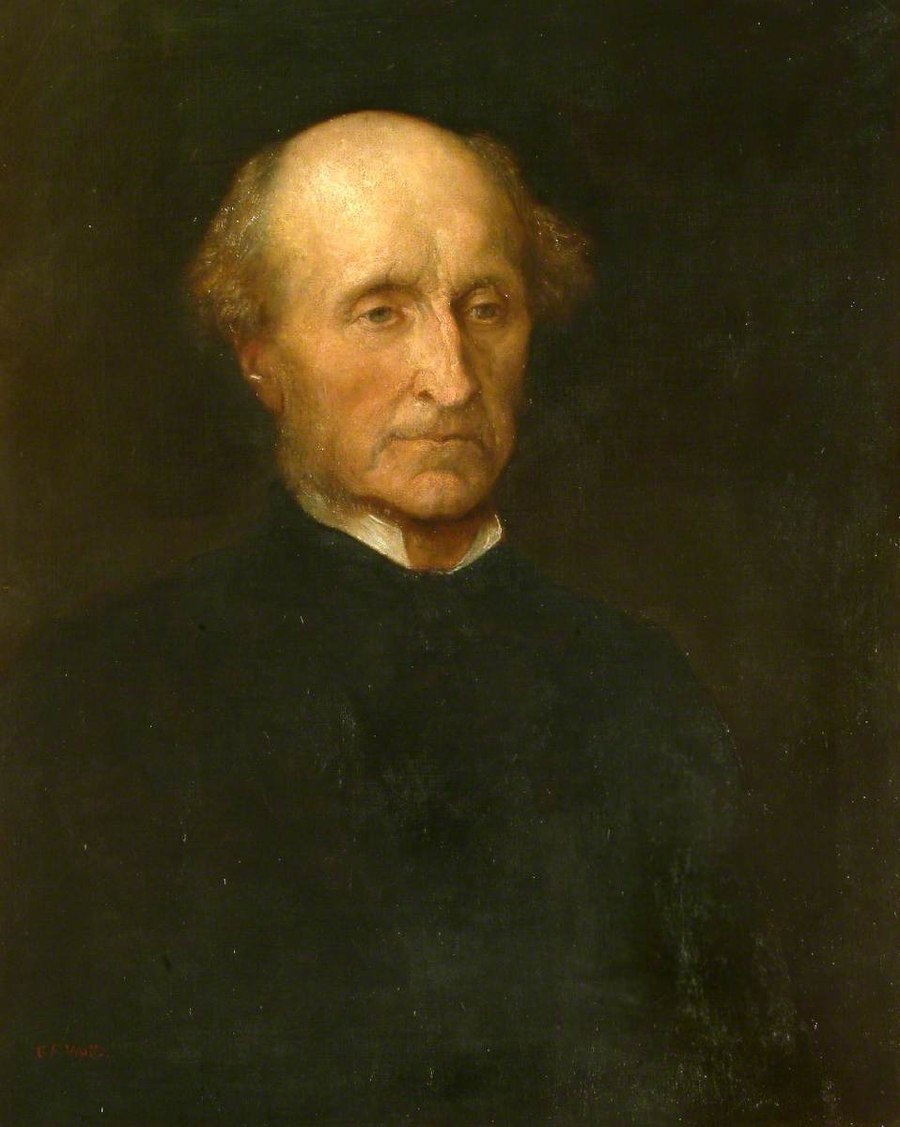
John Stuart Mill, raised from childhood to carry the utilitarian banner, saw the theory's weakest point at once: if all that matters is the quantity of pleasure, then a life of simple sensory contentment beats a life of difficult thought, which almost no one believes. So in 'Utilitarianism' (serialized in 1861, published as a book in 1863) Mill introduced a distinction of quality: intellectual and moral pleasures are inherently higher than bodily ones, and the test of which is higher is the verdict of people who have genuinely experienced both. Hence his famous line: 'it is better to be a human being dissatisfied than a pig satisfied; better to be Socrates dissatisfied than a fool satisfied.' Critics, then and now, note the tension the move creates: if a pleasure can be better rather than merely greater, Mill may have imported a standard of value that pure hedonism cannot supply. Mill also grounded his celebrated 'harm principle,' from 'On Liberty' (1859), that power may rightfully be used against a person only to prevent harm to others, on utilitarian foundations, holding that maximal liberty produces the most happiness over time.
03The Trolley on the Track
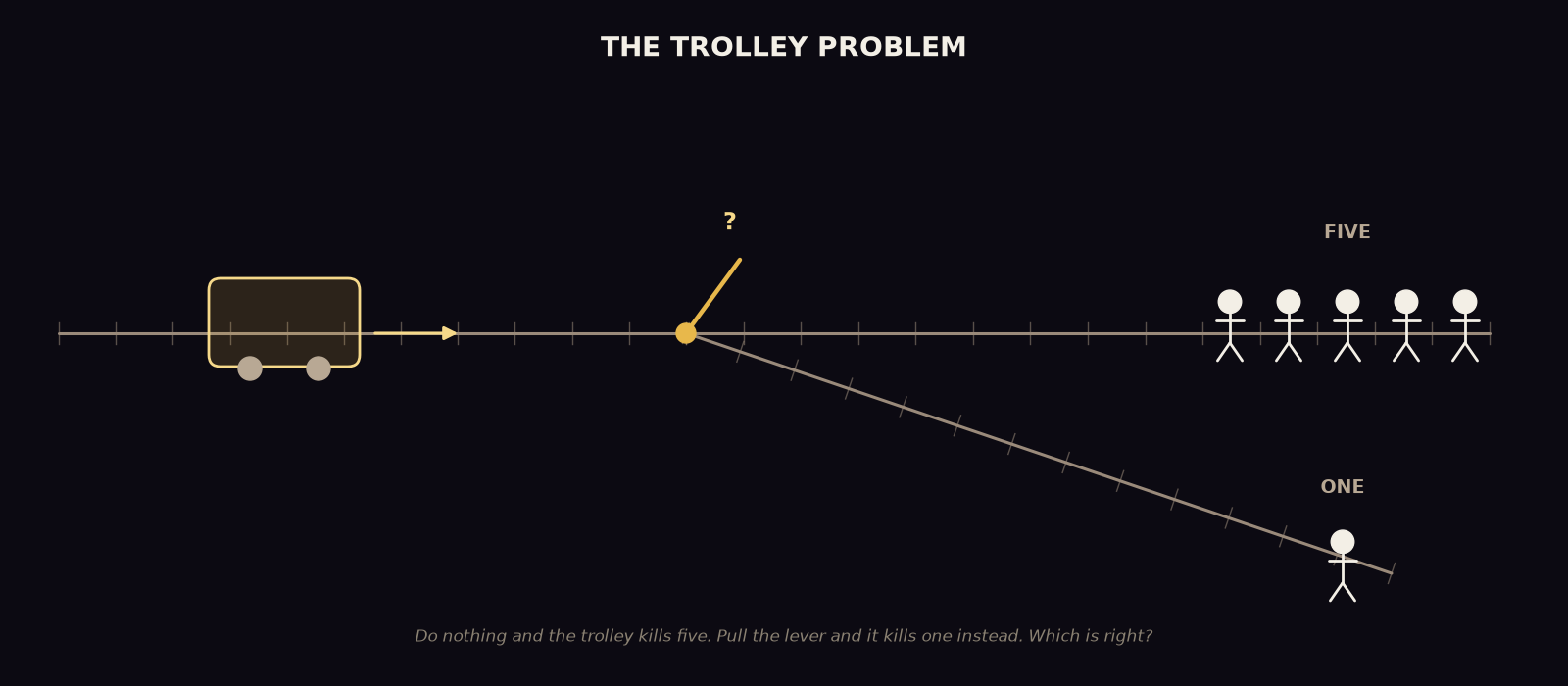
The thought experiment that made utilitarian reasoning vivid, and troubling, to the wider world was not invented as a utilitarian showcase at all. The philosopher Philippa Foot introduced it in 1967, in a paper on abortion and the doctrine of double effect, as a test of moral intuitions: a runaway tram will kill five workers on the track, unless it is steered onto a spur where it will kill one. Pure outcome-counting says divert it, one death beats five, and most people agree. Judith Jarvis Thomson later coined the name 'the trolley problem' and sharpened it, adding in 1976 the version where you are a bystander at a lever rather than the driver, and in 1985 the decisive twist: the 'footbridge' case. Now the only way to stop the trolley and save the five is to push a large stranger off a bridge into its path, killing him. The numbers are identical, one dies so that five may live, yet almost everyone who would pull the lever recoils from the push. That gap is the engine of the entire debate. It suggests our moral intuitions track something beyond the arithmetic, the difference between redirecting a threat and using a person's body as a means, which a pure tally of consequences does not see.
04Act, Rule, and the Ways to Soften It
In response to cases like the footbridge, utilitarians split the theory into forms, and the distinction between two of them is essential to everything that follows. Act utilitarianism (Bentham, and the early Peter Singer) judges each individual act by its consequences, one case at a time; it is maximally flexible but can, in principle, license a single terrible act if the sums happen to favor it, and it demands you calculate constantly. Rule utilitarianism (Brandt, Hooker) instead asks which general rule would produce the most good if everyone followed it, and then tells you to follow that rule even in a particular case where breaking it might score higher, precisely because a world of rule-followers does better than a world of constant case-by-case exceptions. Rule utilitarianism blunts the ugly results, at the cost of a standing objection that it either collapses back into act utilitarianism (why keep a rule you know is counterproductive right now?) or quietly becomes a kind of duty-based ethics in disguise. Further refinements followed: preference utilitarianism (Hare, Singer) counts the satisfaction of preferences rather than raw pleasure, and R.M. Hare's two-level view has us follow reliable rules in daily life and reserve full calculation for hard cases. Henry Sidgwick's 'The Methods of Ethics' (1874), which Rawls called the first truly academic work in moral theory, gave the whole tradition its rigor, and honestly named its own unsolved problem: he could not prove that pure self-interest is irrational, leaving the clash between self and others, he said, 'the profoundest problem of ethics.'
05The Serious Objections
Utilitarianism's objections are not quibbles; they are deep, old, and still live, and any honest account has to give them their full weight. The justice objection: because only the total matters, the theory can in principle justify grave injustice, framing an innocent person to prevent a riot, or harvesting one patient's organs to save five, whenever the sums work out; utilitarians answer that rule-based and institutional versions block such acts, since a society that permitted them would be worse off overall. The demandingness objection: if you must always maximize total happiness, you would have to give away nearly everything and never rest, a standard fit for saints, not people; replies range from two-level thinking to 'satisficing' (good enough is good enough), while Singer bites the bullet and says the demand is real and we are simply failing it. Bernard Williams's integrity objection holds that the theory can require you to betray your own deepest commitments for a marginally better total, alienating you from the projects that make you you. And the measurement problem asks the awkward practical question of how one person's happiness is ever really weighed against another's, when economics itself largely gave up on cardinal utility. Robert Nozick added the 'utility monster,' a being that extracts so much more pleasure from resources than anyone else that strict utilitarianism would feed everyone to it. Derek Parfit spent decades on the 'Repugnant Conclusion,' the theory's implication that a vast population of lives barely worth living can be 'better' than a smaller, flourishing one, because the total is higher, a result widely regarded as devastating for the theory, which Parfit spent decades trying and failing to fully dissolve.
06The Arithmetic Goes to Work

Utilitarianism is not only a seminar puzzle; it is the working logic of much modern practice, and its most visible recent form is effective altruism, the movement that applies evidence and impartial reasoning to doing good. Its seed is Peter Singer's 1972 argument that if geography and anonymity are morally irrelevant, the affluent are obliged to give substantially to prevent distant suffering; its method is cause-prioritization and hard evidence, with evaluators like GiveWell estimating that the best charities save a life for a few thousand dollars while average ones do far less per dollar. (The full debate over what the rich owe the poor, Singer against Nozick against Pogge, belongs to its own article on this wing; here it is the illustration, not the subject.) Effective altruism also carries a genuine, unresolved shadow: the movement's early embrace of the cryptocurrency financier Sam Bankman-Fried, whose FTX exchange collapsed in fraud in November 2022. He was convicted on seven counts in November 2023 and sentenced in March 2024 to 25 years in prison. The episode forced a hard question the movement is still sitting with, whether a relentless focus on maximizing impact can quietly license ends-justify-means thinking about how the money is made, not just how it is given away.
07The Two Overclaims
This wing maps rival moral systems and crowns none, and utilitarianism is exactly the kind of theory that tempts a verdict in both directions. The first overclaim: that utilitarianism is simply the correct, settled theory of morality, and the rest is stubbornness. It is not settled. The justice, integrity, and measurement objections are unanswered, the utility monster and the Repugnant Conclusion remain genuine embarrassments, and the footbridge case shows the arithmetic parting company with almost everyone's considered moral sense. But the mirror overclaim is just as wrong: that utilitarianism has been refuted, a quaint relic of Victorian bookkeeping. Also false. It generated and still generates first-rate philosophy (Sidgwick, Hare, Parfit, Hooker, the continuing work of Singer and de Lazari-Radek), its rule and two-level versions answer several of the classic objections without collapsing, and its cost-benefit logic remains the actual operating framework of public health, economics, and policy worldwide, where a hospital deciding how to spend a fixed budget across many patients is, like it or not, doing utilitarian arithmetic. What is true is narrower and more useful than either slogan: utilitarianism is one of the three great living theories of ethics, alongside duty and virtue, powerful, indispensable, and demonstrably incomplete.
Fast Facts
- The core
- An act is right if it produces the greatest happiness for the greatest number; nothing else counts
- Founders
- Jeremy Bentham (the felicific calculus, 1789) and John Stuart Mill (higher and lower pleasures, 1861 to 1863)
- The trolley problem
- Originated by Philippa Foot (1967); named and sharpened by Judith Jarvis Thomson (1976, and the footbridge case, 1985)
- Act vs rule
- Act utilitarianism judges each act; rule utilitarianism follows the rule that would do most good if generally adopted
- The hardest objections
- Justice (it can license framing the innocent), integrity (Williams), the utility monster (Nozick), and the Repugnant Conclusion (Parfit)
- In practice
- Effective altruism; and the cost-benefit logic behind public health, economics, and policy
- The double refusal
- Utilitarianism is neither the proven correct ethics nor a refuted relic; it is one of three great living theories
What We Can Actually Stand Behind
The history and the tools are solid. Bentham really did propose the greatest-happiness principle and the felicific calculus; Mill really did add the higher/lower distinction and the harm principle; Sidgwick systematized the tradition and named its unsolved self-versus-others problem; and the trolley problem really was originated by Philippa Foot in 1967 and named and extended by Judith Jarvis Thomson in 1976 and 1985. The switch-versus-footbridge contrast is a genuine and robust feature of human moral intuition.
Utilitarianism stands as one of the three major living families of normative ethics, and its central objections are live, serious, and unresolved: demandingness, justice, integrity (Williams), measurement, the utility monster (Nozick), and the Repugnant Conclusion (Parfit). Its rule, preference, and two-level variants are real, still-debated attempts to blunt those objections without abandoning the theory. Its applied arm, effective altruism, is a real movement carrying a real and unresolved reputational shock from the FTX collapse.
The furthest extensions are genuinely contested. Longtermism, the claim that the sheer number of possible future people should dominate our present moral priorities, is defended by Ord and MacAskill and challenged by critics (Srinivasan, Torres) who warn that speculative future value can be used to justify almost anything and to crowd out certain present suffering. Treat it as an open argument, not a settled conclusion.
Here the discipline holds in both directions. No, utilitarianism is not the proven, correct theory of morality; its deepest objections remain unanswered and the footbridge case shows the arithmetic breaking from moral common sense. But equally, no, it has not been refuted; it generates serious philosophy to this day and quietly runs much of real-world policy. We refuse both the triumphal and the dismissive verdict, and leave it where the evidence leaves it: indispensable, powerful, and incomplete, one contender on a scale this wing will not tip.
It is worth sitting with why the trolley will not leave us alone. The pull of utilitarianism is that it is honest about tragedy: when five lives weigh against one, it refuses to hide behind clean hands and insists that numbers matter, that a smaller catastrophe really is better than a larger one, and anyone who has had to allocate a fixed supply of medicine knows the force of that. The recoil from the footbridge is just as honest: it insists that a person is not a resource, not even to save five, and that some lines should not be crossed no matter what the sum says. The deepest thing this two-hundred-year argument may have taught us is not which side is right, but that both intuitions are real and that no single formula has ever fully held them together. Bentham gave us a scale and told us to weigh. He was more right than his critics allow. He was also, as the footbridge shows and as this wing keeps finding, not the whole of the story. The heart still goes on the scale. It has just never been only a number.
Sources & further reading
Everything above is drawn from our research library on Theories of Anything. Open the full file to check the sourcing and go deeper.
Image credits
- The Trolley Problem (original diagram) Original diagram by Theories of Anything. CC BY-SA 4.0 Source.
- Jeremy Bentham's Auto-Icon, University College London Photograph by Michael Reeve, 2003, via Wikimedia Commons. CC BY-SA 3.0 Source.
- John Stuart Mill, portrait by George Frederic Watts (1873), Watts Gallery George Frederic Watts (1817 to 1904), 1873; Watts Gallery, via Wikimedia Commons. Public Domain Source.
- Peter Singer speaking at the Veritas Forum, MIT, 2009 Photograph by Joel Travis Sage, 2009, via Wikimedia Commons. CC BY 3.0 Source.
- Card crop of the original trolley-problem diagram Original diagram by Theories of Anything. Original work

_-_John_Stuart_Mill_(1806%E2%80%931873)_-_COMWG_86_-_Watts_Gallery.jpg)
