
Non-Dualism: The Claim That You and the Universe Are Not Two
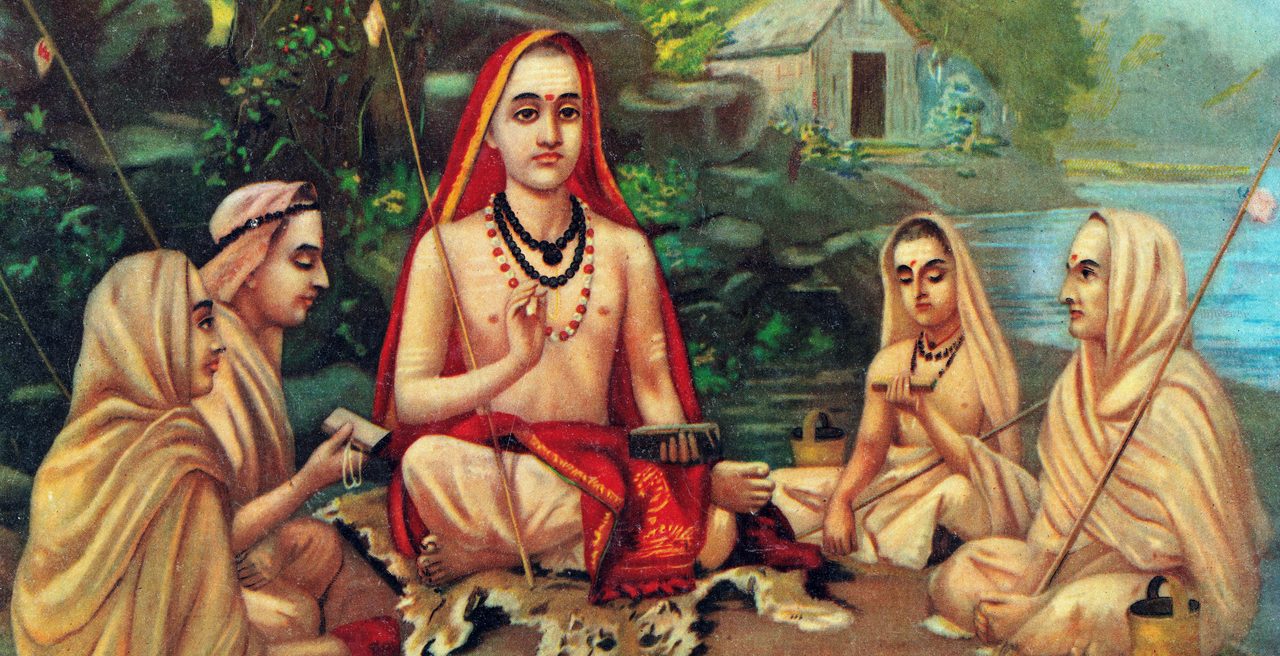
Ask what non-dualism claims and the answer usually comes back as everything is one, which is the one thing it does not say. The name is negative on purpose: not two. Four traditions are set against one another here, with the Western apophatic line beside them, and the four reached four different not-twos. Advaita says what is left standing is consciousness. Madhyamaka Buddhism says nothing is left standing at all and explicitly refuses a Brahman. Daoism refuses the question. Sufism keeps a creator and a creation. The shape of the move is the same in all four and the content is different in every case, which is why this article crowns none of them. The famous sentences are handled one at a time, each with its translator named where one exists, one is refused outright because it could not be traced to any scholarly translation, and the claim that quantum mechanics proves any of this is refused with it.
Ask a room what non-dualism claims and the answer comes back as everything is one. That is the one thing it does not say. The traditions gathered under the name are held together by a refusal rather than by a doctrine, and the refusal is stated negatively on purpose: not two. What is left standing after the refusal turns out to be different in every tradition that makes it, and in one case the tradition insists that nothing is left standing at all.
Our own research file on non-dualism defines the position as the claim that ultimate reality is not divided into fundamentally opposed categories, and it names four such divisions: subject and object, mind and matter, self and other, and good and evil. It also says the position appears independently across the world's deepest intellectual traditions. The first half of that sentence is this article's subject. The second half carries a word this article will not print without a hedge, because nothing in the file argues for independence and nothing checked for this article establishes it.
A note on the quotation marks, because this is a subject where they fail often. The famous sentences here reach English through translators who disagree with one another, and some of the most repeated forms are no translator's wording at all. Every quotation below therefore names whose words it is: a named translator's, a reference work's, or our own file's. Where the research behind this article could not read a passage off a primary text, a published translation or a named reference work, the wording is loosened until it cannot be mistaken for a transcription and no quotation marks appear. Two house conventions apply inside the quotations as well as outside them, and both are stated here rather than left to be noticed. Date ranges are written with the word to, because this house prints no dashes, and no number changes in that substitution. And Sanskrit, Chinese, Arabic and Tibetan words are transliterated plainly, without diacritical marks.
Three refusals belong on the record before anything else. One sentence that our own file prints inside quotation marks, inside its Verified section, attributed to Rumi, appears nowhere below in any form, quoted or paraphrased; section 07 explains what that refusal rests on and what it does not. The wordings our file gives for the opening of the Dao De Jing, for its chapter 42 and for its chapter 2 are not reproduced either, because the file names no translator for any of them and they match no translation that could be located, so James Legge's public domain renderings are used instead and he is named every time. And the slogan our file attaches to John Wheeler is reported rather than quoted, because the form the file prints drops two qualifying words that the reported canonical version carries, and the volume where that version appears was not read for this article.
The tier marks follow our own file where it assigns them, and this article departs from it in seven places. Every one of the seven weakens a claim rather than strengthening one: five are carried a tier lower than our file puts them, one is refused outright, and one is narrowed without a change of tier. Not one is an upgrade, each is disclosed on the claim that carries it, and all seven are gathered into a table at the end. A downgrade is safe for a reader in a way an upgrade is not, which is the whole reason the departures run one way.
Several neighbouring subjects are not this one. Rumi, the Mevlevi order, the whirling ceremony and the concept of fana belong to The Whirling Dervishes, which is live in this library and owns them; section 07 here runs on Ibn Arabi and al-Hallaj instead, and links out rather than re-explaining fana. Are We Living in a Simulation? already states that Hindu maya and Zhuangzi's butterfly are evocative metaphors for the intuition that appearances may deceive rather than evidence for anything, and nothing below contradicts that; what this article adds is what those two ideas are doing inside their own traditions. Two further articles are not built yet and are named here rather than linked: one on Buddhist no-self, which will own anatman and Nagarjuna's emptiness at depth, and one on the perennial philosophy, which will own Aldous Huxley's convergence thesis in full. Buddhism appears below as the counterpunch to Advaita, one movement and no more, and perennialism appears only as the open question of whether these traditions are saying one thing.
01Not-Two Is Not One
Our file's definition is negative and that is the entire point of it: ultimate reality is not divided into fundamentally opposed categories. The four divisions it names are subject and object, mind and matter, self and other, and good and evil. Read that slowly and notice what it does not do. It says nothing about how many things there are. It says that one particular way of cutting reality in two does not survive scrutiny, and it leaves the question of what survives instead completely open. Everything difficult about the subject lives in that gap.
So non-dual is a family name rather than a doctrine, and the members of the family do not agree. Our file supplies the components in more than one place. Advaita's name literally means not-two, and Advaita is a monism: Brahman alone. Buddhist non-dualism explicitly rejects all positions ending in -ism, monism included. Daoist non-dualism is neither monism nor pluralism and transcends the question rather than answering it. One member of this family is a monist and another one refuses to be, which is why the equation of non-dualism with everything is one collapses before it starts. Our file is blunt about what that equation costs: it says the reduction trivialises millennia of sophisticated philosophical analysis.
The word Advaita means not-two, and Vedanta means end of the Vedas, which are the standard glosses and are borne out by the Stanford Encyclopedia of Philosophy's entry on Sankara. That entry calls Advaita Vedanta a philosophical position of radical nondualism derived from the Upanisadic texts, and calls Sankara the most authoritative philosopher of Advaita Vedanta and one of the most widely known and influential Indian philosophers of the classical period. Our own file goes further and calls Advaita the most influential school of Hindu philosophy. That is our file's phrasing and it is not printed here as a bare fact. What this article prints instead is the safe and still substantial version: Advaita is the most influential school of Vedanta, and Vedanta is the tradition that has dominated Hindu philosophical writing since the medieval period.
One more piece of housekeeping before the traditions themselves, because it governs every sentence after it. These bodies of thought arose in different places and different centuries and reached structurally similar refusals. Whether any of them influenced any other is a separate question with a separate and largely unsettled literature, and this article will say so each time the question comes near. The word independently, which our file's summary uses, is doing work that nothing in the file earns.
02Brahman, And The Rope In The Road
We do not know when Sankara lived. Our file gives 788 to 820 CE as the traditional dates and notes that scholars propose 700 to 750 CE. The Stanford Encyclopedia's entry on Sankara agrees with both of those and adds a third position our file omits: Karl Potter proposes the late seventh to the early eighth centuries CE. So the live scholarly window runs from roughly 650 CE to 820 CE rather than the neat fifty-year slot our file's parenthesis implies, and the encyclopedia declines to settle it, summarising only that he flourished during the eighth century CE. The traditional dates are printed here as traditional and nowhere else in this article as a bare figure.
What Sankara actually wrote was commentary rather than treatise. Our file records the key texts as the Upanisads, especially the Brhadaranyaka, the Chandogya and the Mandukya, together with the Brahma Sutras and the Bhagavad Gita, the three called the prasthana-trayi or triple canon, and it records that Sankara wrote commentaries on all three. That is why Advaita reads the way it does. He is not building a system out of nothing. He is arguing that three inherited scriptures, read correctly, all say the same non-dual thing, which is also why the tradition can spend centuries fighting over the construal of a single sentence.
The central Advaita claim is stronger than the popular versions of it. Our file states that Brahman is the sole ultimate reality, infinite, formless, conscious and without qualities, which is nirguna Brahman; that Atman, the true self, is identical with Brahman; and that adhyasa, superimposition, is the error by which properties of the empirical world are attributed to Brahman and the reverse, the standing illustration being a rope in the road seen as a snake. The Stanford Encyclopedia states the identity claim in a more precise form, and these are the encyclopedia's words: "the atman is pure non-intentional consciousness, one without a second, nondual, infinite existence, and numerically identical with brahman". It adds the epistemic half our file leaves implicit, that Sankara identifies avidya, ignorance, as the root cause of all existential suffering through the false superimposition of individual identity. The claim is not that you resemble the universe, or belong to it, or are in harmony with it. It is that the referent of the word you and the referent of the word Brahman are numerically the same thing, and that the appearance of two is a mistake with a diagnosable structure.
Two levels of reality, not three. Our file lists three inside its Verified section and presents them as Sankara's doctrine: paramarthika, the ultimate, Brahman alone; vyavaharika, the empirical, waking experience; and pratibhasika, the apparent, dreams and illusions. The Stanford Encyclopedia's entry describes only two primary levels as Sankara's own, the conventional empirical, vyavaharikasatta, and the ultimate, paramarthikasatta, and does not present the third as part of his systematic framework. This article therefore carries two levels as Sankara's and the third as a later refinement, and marks the claim one tier below our file. The correction is not pedantry. The two-level structure is what does the philosophical work, because it is precisely what lets Advaita say that the world is real enough to live in and not real in the last analysis. A separate tier for dreams is a tidy scheme that later Advaitins found useful.
And maya is not the word Sankara mostly argues with. Our file's own gloss is careful and this article keeps it: maya means the phenomenal world of multiplicity has dependent reality, not that it does not exist. The Stanford Encyclopedia sharpens that in two ways our file misses. Its formulation is that "the universe is an objective but less-than-real appearance", and that "This appearance, akin to a magic trick, is maya", which are the encyclopedia's words and are quoted here with the macron dropped from maya per the note above. More surprisingly, the same entry records that Sankara avoids extensive use of maya terminology, and that the terms he actually works with are avidya, ignorance, and adhyasa, superimposition. Maya is the word the tradition and the popular telling made famous. Avidya and adhyasa are the words the argument runs on, and the claim is carried one tier below our file for that reason.
03The Most Famous Sentence In Indian Philosophy
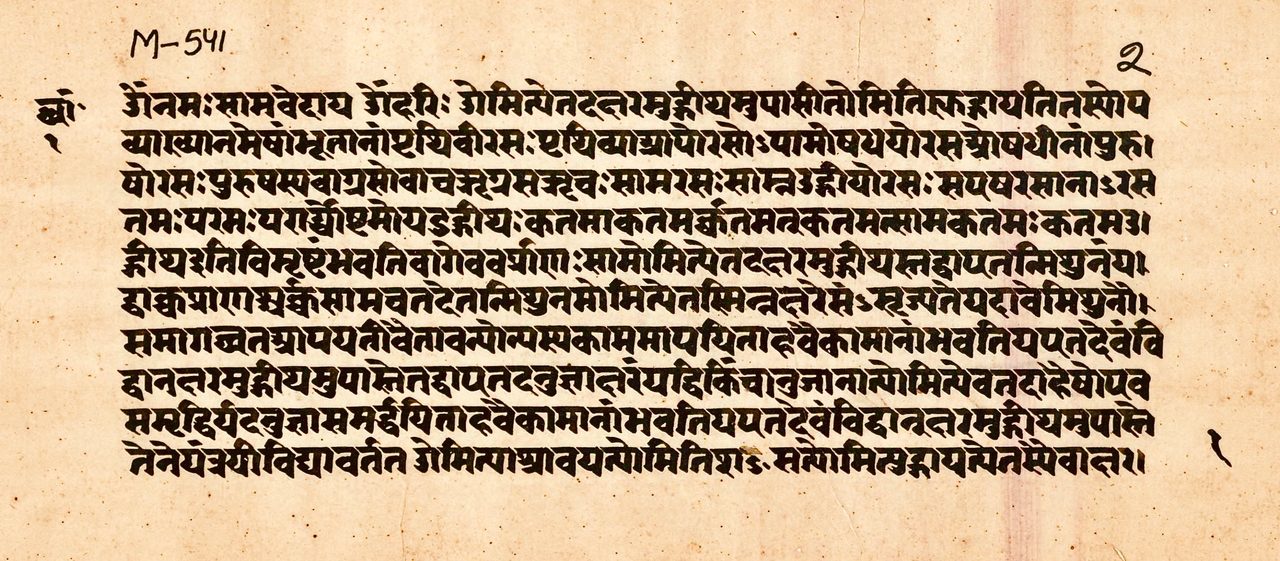
Chandogya Upanisad 6.8.7 contains the words "Tat tvam asi", and our file gives the locus correctly. The traditional Advaitin rendering is that thou art, and it is an identity statement: the thing being pointed at and the person being addressed are the same. Everything Advaita claims can be compressed into those three words, which is why what happens next matters.
What the sentence actually says is disputed, and the dispute is both modern and old. Patrick Olivelle's 1998 Oxford annotated translation, the standard scholarly edition of the early Upanisads, renders the same words as that's how you are, which is not an identity statement at all but a statement about manner. Olivelle follows Joel Brereton's 1986 article in the Zeitschrift der Deutschen Morgenlandischen Gesellschaft, which argues from the grammatical genders of the pronouns and from Vedic syntax that the traditional reading forces an agreement the text does not support. And the quarrel is older than modern philology. Edwin Gerow's 1987 article in the Journal of the American Oriental Society documents the reading of the same sentence by Visnudasacarya, a Dvaitin, that is a dualist Vedantin, who denied the Advaita construal on its own Indian terms centuries earlier. Two limits belong on this claim rather than being left to be discovered. Brereton's article was not read for this article and is reported only at the level of description, and Gerow's argument was not read either, only his title and journal record. What this article says is that the traditional Advaita reading takes the sentence as an identity, that modern philology has challenged that reading, and that Advaita's own Indian opponents challenged it much earlier. What it does not say is that the traditional reading has been refuted.
It is worth being clear about why a translation quarrel is not a footnote here. In a commentarial tradition the sentence is the argument. Sankara's case is that the inherited texts, read correctly, say the non-dual thing; if the sentence can be read another way, the case has to be made again on other ground. The same problem is about to appear in Chinese in a sharper form, and it is the clearest concrete demonstration of a worry that runs under this whole article: a family resemblance between traditions can sometimes be manufactured in the act of translating them.
04The Dao That Cannot Be Trodden
The Dao De Jing opens by refusing its own subject. In James Legge's public domain translation, read at the Chinese Text Project for this article, chapter 1 runs: "The Dao that can be trodden is not the enduring and unchanging Dao. The name that can be named is not the enduring and unchanging name." Its chapter 42 gives a cosmogony: "The Dao produced One; One produced Two; Two produced Three; Three produced All things." Our file quotes both passages in different words and names no translator, and the differences are not cosmetic: it has spoken where Legge has trodden, eternal where Legge has enduring and unchanging, gives birth to where Legge has produced, and the ten thousand things where Legge has All things. The philosophical reading survives all of that, and our file's gloss of it is sound. Chapter 1 says ultimate reality transcends every dualistic category, including the category of being nameable. Chapter 42 runs from unity through duality to multiplicity.
Chapter 2 is where the stakes of a translation become visible. Our file quotes it as being and non-being produce each other, which reads as an ontological claim: two kinds of being generate one another. Legge's rendering interpolates two words in parentheses and turns the same line into a claim about concepts. His words, with his own parentheses kept: "So it is that existence and non-existence give birth the one to (the idea of) the other". Legge's chapter 2 does the same thing five more times in the same sentence, among them difficulty and ease, length and shortness, and height and lowness. Which reading is right is a real question and this article does not have to settle it. What the reader should take away is that a text quoted everywhere as proof of cosmic non-duality can also be read as a remark about how concepts work, and that the difference is invisible unless you set two translations side by side.
The yin-yang reading of the Yijing is a commentary, not the original book. Our file states inside its Verified section that the earliest systematic expression of yin-yang is the Yijing, and that its hexagrams represent all possible combinations of yin and yang lines. The hexagram arithmetic is true. The historical claim is not safe as stated. The received scholarly position, for which Robin R. Wang's Cambridge monograph of 2012 is the standing reference work, is that yinyang cosmology is formulated in the Yizhuan, the Ten Wings commentaries appended to the Zhouyi in the late first millennium BCE, and that the Zhouyi divination core did not originally read its broken and unbroken lines as yin and yang at all; the words yin and yang themselves appear in texts of the Warring States period. So what this article prints is that the Yijing's line symbolism was read as yin and yang by its commentators, and that it is that commentarial layer, rather than the divination manual underneath it, that gives us the systematic cosmology. An honest limit: the research behind this article resolved Wang's monograph and read the consensus position through reference sources, and did not read her chapter text, so no sentence is attributed to her.
Yin and yang are not opposites, and they are not one thing either, which is exactly why this is a different non-dualism. Our file states that the relation is complementarity rather than opposition, each containing the seed of the other, which is what the dots in the taijitu represent, and it gives four relations. They are relative, so what is yin in one context may be yang in another. They are mutually arising, so you cannot have one without the other, and our file's own example is that there is no light without dark and no up without down. They are mutually transforming, so extreme yin becomes yang and the reverse, cyclically. And they are mutually containing, so each holds the germ of the other. Set that against Advaita and the difference is structural rather than decorative. Advaita dissolves the two into one substrate. Yin-yang keeps the two and denies that they are separable. Calling both of those non-dualism is an act of translation, and this article performs it in the open rather than assuming it.
The Dao itself is one of the four not-twos, and it is the one that refuses the question rather than answering it. Our file on Chinese philosophy, the second research file behind this article, states that the Dao is the ultimate reality, the source and pattern of all things; that it cannot be named, defined or conceptualised; that it is, in that file's words, "prior to all distinctions (being/non-being, good/bad, self/other)"; and that it is the formless process from which all forms emerge and to which they return. It supplies two terms the article needs: wu wei, non-action or non-coercive action, which is not passivity but spontaneous action aligned with the Dao, and De, virtue or power or efficacy, the Dao manifest in particular things. Our non-dualism file makes the same point from the other direction in its own Dubious section: the Dao is beyond characterisation, not consciousness, not emptiness, not being.
05The Butterfly, And The Line Everyone Drops
Here is the butterfly dream, in James Legge's public domain translation, read at the Chinese Text Project for this article and given whole: "Formerly, I, Zhuang Zhou, dreamt that I was a butterfly, a butterfly flying about, feeling that it was enjoying itself. I did not know that it was Zhou. Suddenly I awoke, and was myself again, the veritable Zhou. I did not know whether it had formerly been Zhou dreaming that he was a butterfly, or it was now a butterfly dreaming that it was Zhou. But between Zhou and a butterfly there must be a difference. This is a case of what is called the Transformation of Things." Our file gives the dream in one compressed clause and stops before the end of it.
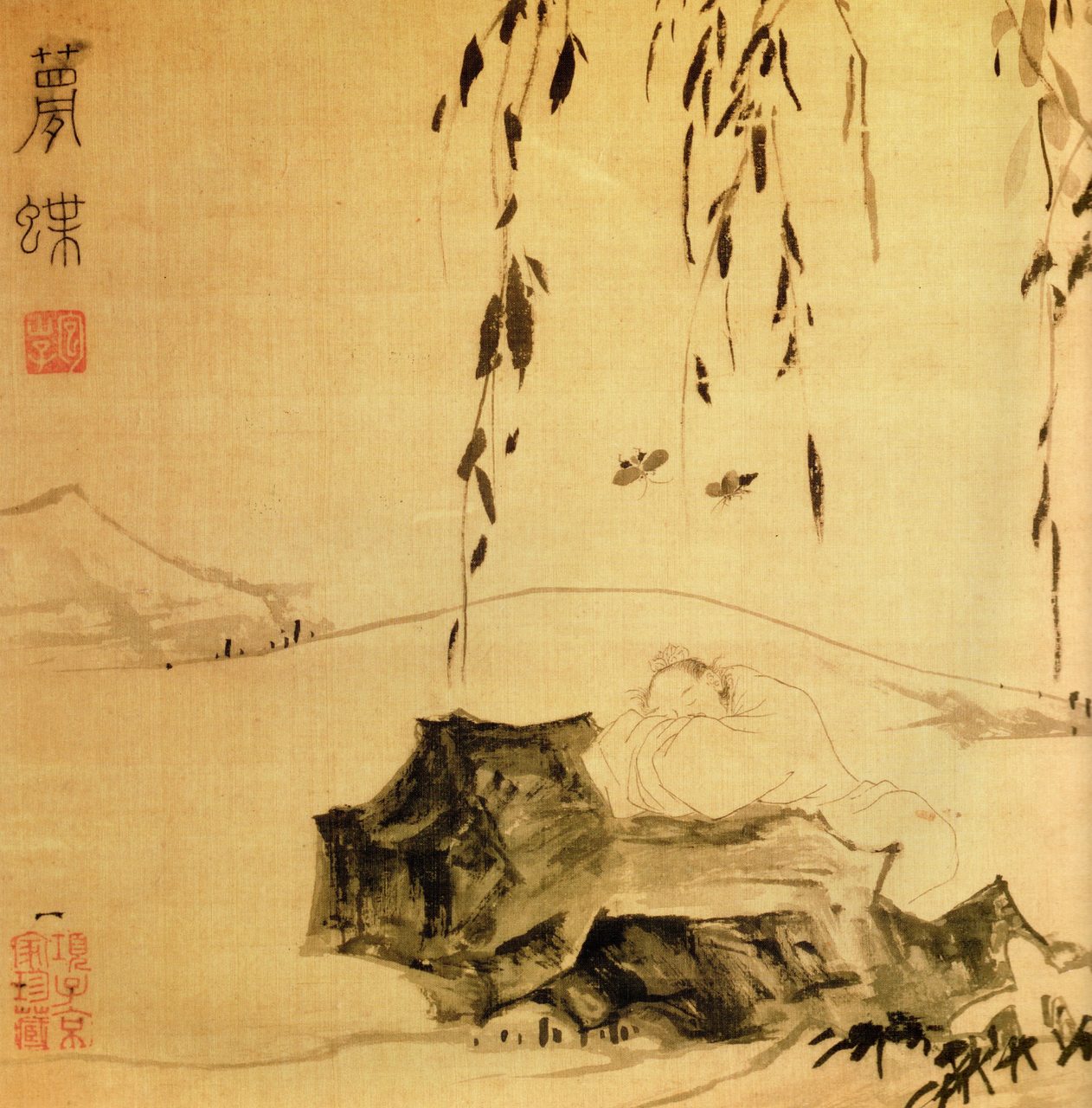
Read the last two sentences again, because almost every popular retelling omits them. Zhuangzi does not say the distinction between the dreamer and the butterfly is unreal. He says there must be one, and then names the process by which one becomes the other. A passage that is quoted as proof that the self dissolves ends by insisting that it does not, and by pointing at change instead. Dropping that ending is exactly how a text gets recruited into a thesis it does not hold, which is a problem this article is partly about.
The doctrine around the dream is a non-dualism about judgement rather than about substance. Our file on Chinese philosophy states that in the Zhuangzi all judgements are relative to standpoints, that what seems right from one perspective seems wrong from another, that this and that mutually produce each other, that the sage does not eliminate perspectives but transcends fixed attachment to any single one, and that the sage dwells in what that file calls the pivot of the Dao, the centre where all perspectives are equalised. Legge's translation of the same chapter carries the point in one line: "If there were not (the views of) another, I should not have mine; if there were not I (with my views), his would be uncalled for". Set beside Legge's chapter 2 of the Dao De Jing, which reads the pairs as concepts rather than as kinds of being, the Chinese material starts to look as though it is doing a different job from the Indian material rather than the same job in another language.
06Known By What It Is Not
The oldest Western move in this territory is a negative method. Our file states that Pseudo-Dionysius the Areopagite, writing in the fifth or sixth century, developed apophatic theology: God is known by what God is not, the via negativa, and every affirmation and every negation is ultimately transcended. That method stands behind both figures below, and it is the closest formal parallel in the Western canon to nirguna Brahman, the Brahman without qualities. Formal parallel is all that is claimed. Nothing checked for this article supports any historical transmission in either direction, and the suggestion that Pseudo-Dionysius learned the move from India is not made here.
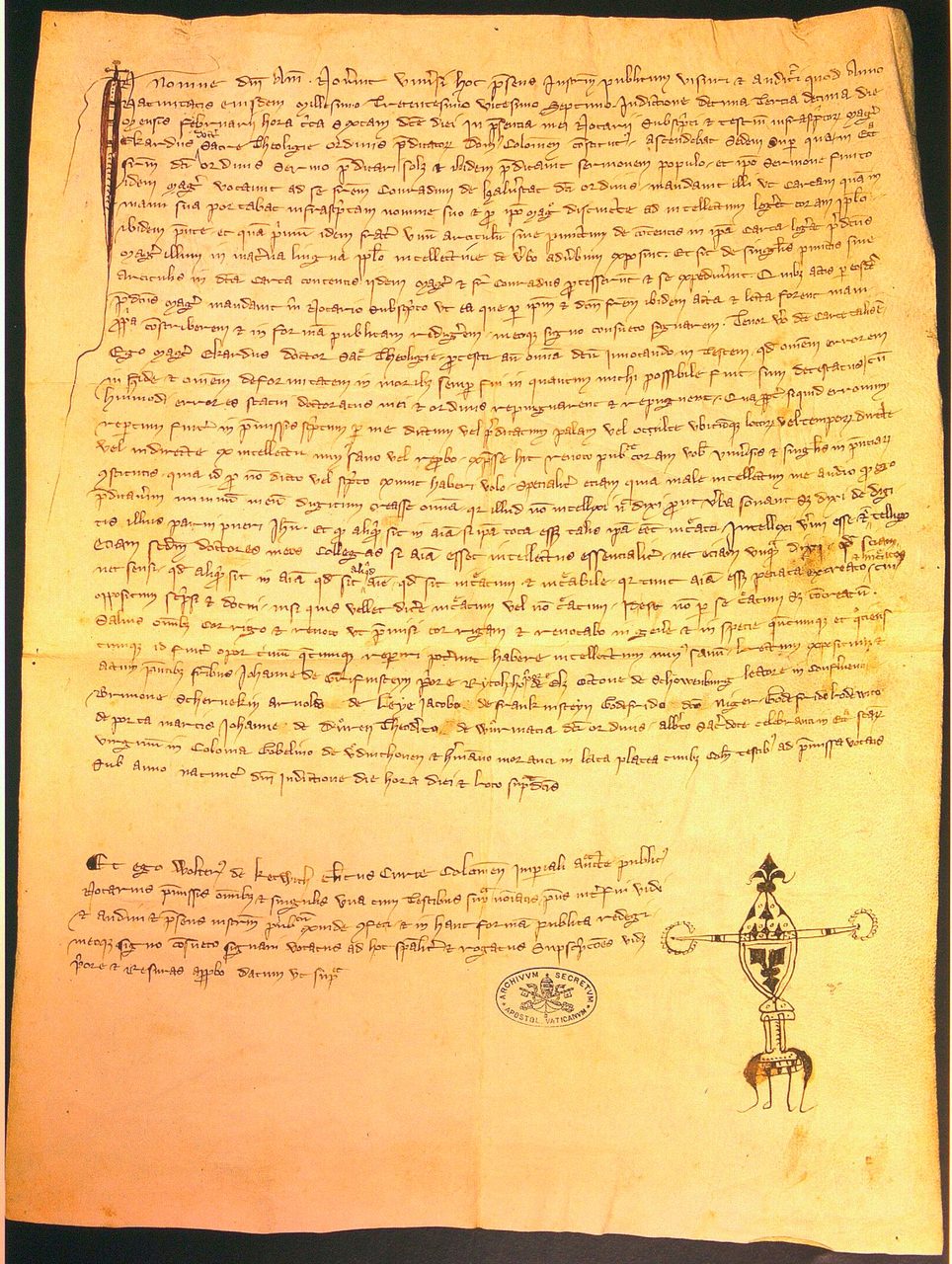
Meister Eckhart's famous line is a claim about a single act of seeing: "The eye with which I see God is the same eye with which God sees me". That wording is the exact title of Duane Williams's 2023 article in Medieval Mystical Theology, a peer-reviewed piece devoted to the passage, and it is attributed to Eckhart on that basis. Our file prints a longer version with a continuation about one eye, one seeing, one knowing and one love, and cites Sermon 12. Neither the continuation nor the sermon number could be confirmed against any edition or translation for this article, and sermon numbering differs between the Quint German critical edition and Walshe's English, so a bare number is ambiguous even when it is right. This article therefore quotes the short clause and prints no locus. The doctrine around it is solid and independently corroborated: our file records that Eckhart distinguished God, as known and worshipped, from the Godhead, Gottheit, the transcendent ground beyond all names and qualities, and the Stanford Encyclopedia's entry on Eckhart describes the wholly naked Godhead as distinct from God considered under the aspect of being or under the aspect of will or love.
Eckhart was condemned after he was dead, which our file does not say. It gives his dates as about 1260 to 1328 and records that he was condemned for heresy by Pope John XXII in 1329 with 28 propositions censured. The Stanford Encyclopedia supplies the dates that make the sequence legible: he "was born around 1260", he "most likely died on January 28, 1328", and "On March 27, 1329, Pope John XXII issued the bull In agro dominico", which condemned "all 28 articles", eleven of them "merely claimed to be likely misunderstood" rather than heretical outright. Those are the encyclopedia's words. It also declines the easy reading that our file reaches for, stating that Eckhart need not be viewed as a pantheist, or even a panentheist. So this article does not say that Eckhart taught non-dual union in the Advaita sense. It says he was read that way, that the reading is old, and that the leading English reference work on him declines it.
Nicholas of Cusa, 1401 to 1464, published De docta ignorantia in 1440 and gave the apophatic tradition its most compact formula: the coincidentia oppositorum, the coincidence of opposites. The Stanford Encyclopedia's entry on Cusanus puts it that "in God both maximum and minimum coincide in the divine infinite Oneness", and at II.12 that "God, who is everywhere and nowhere, is its circumference and center". Our file renders that second formulation as the centre and circumference of the universe being the same point, which converts a claim about God into a claim about geometry. The encyclopedia's version is the one used here, because the difference is not stylistic: one reads as cosmology and the other reads as theology, and Cusanus was doing theology.
Our file also asserts that Cusanus anticipated infinity mathematics and set theory by four centuries. The Stanford Encyclopedia says something weaker and vaguer: that Nicholas anticipated many later ideas in mathematics, cosmology, astronomy and experimental science while constructing his own original version of systematic Neoplatonism. Set theory is not named there. This article prints the weaker claim, attributed to the encyclopedia, and marks it one tier below our file, because a specific anticipation of a specific nineteenth-century discipline is the kind of claim that needs a source naming it and does not have one.
One detail about where this argument actually happens is worth more than a paragraph of summary. Robert Forman, the leading modern defender of the view that mystics across cultures report the same contentless experience, devoted his own contribution to his 1990 Oxford volume to a chapter on Eckhart, gezucken and the ground of the soul. That is the perennialist making his case with a Christian mystic rather than an Indian one, which is testing the thesis where it is hardest instead of where it is easiest. Pair that with Williams's 2023 article on the eye passage and this section rests on two independent peer-reviewed anchors rather than on our own file alone. Neither text was read for this article; both are cited for what their records and titles establish.
07I Am The Truth, And A Label Applied By An Opponent
This section is deliberately short. The Sufi material that most readers arrive with, Rumi and the Mevlevi order and the turning ceremony, belongs to The Whirling Dervishes, which is live in this library and treats fana at length. What is here is the pair of cases that bear directly on the argument of this article: a man executed for a sentence, and a doctrine known by a label its opponent applied to it.
Our file states that fana is the annihilation of the separate self in God, the mystic's ego dissolving into divine unity; that al-Hallaj, who lived from 858 to 922, said "Ana al-Haqq", I am the Truth, or I am God; that he was executed for blasphemy; and that Sufis understood the statement as indicating fana rather than as a personal claim to divinity. The Arabic phrase and its standard English are carried here as reported speech attributed to him by the tradition, not as a transcript. That last clause is the philosophically interesting one, and it is also where care is needed. What the sentence means depends entirely on whether there is anyone left to be saying it, which is precisely the content of fana. That is what makes the case a genuine test of the non-dual claim rather than an anecdote about intolerance. The standing scholarly treatment of al-Hallaj is Louis Massignon's four-volume The Passion of al-Hallaj, Mystic and Martyr of Islam, named here rather than listed below, because its identifier was read inside a bibliographic query for this article rather than resolved on its own.
Ibn Arabi never used the phrase he is famous for, and the man who put it in his mouth was his opponent. Our file states, inside its Verified section, that wahdat al-wujud, the Unity of Being, was developed by Ibn Arabi, who lived from 1165 to 1240, and adds, correctly, that the position was theologically controversial and was opposed by Ibn Taymiyyah and by orthodox authorities. The Stanford Encyclopedia's entry on Ibn Arabi is written by William Chittick, who is also the author of the one Sufi monograph in our own file's bibliography, and it says this: "Ibn Arabi has typically been called the founder of the doctrine of wahdat al-wujud, the Oneness of Being or the Unity of Existence, but this is misleading, for he never uses the expression." It continues that "The first author to say that Ibn Arabi believed in wahdat al-wujud seems to have been the Hanbalite polemicist Ibn Taymiyya (d. 1328)," who "called this notion worse than unbelief", and that "His attack set in motion a long controversy over the term." So the label is not a summary of the doctrine. It is a charge sheet that stuck, and the controversy our file reports in its very next clause is the controversy the accusation started. The doctrine Ibn Arabi does hold is quotable from the same entry: "there is no wujud but God, which is to say that there is no real existence and no real finding but God." Our file's own gloss of that is careful and is kept here: not pantheism, not God equals world, but that the world has no being apart from God.

There is a softer Sufi option, and it keeps the two. Our file states that wahdat ash-shuhud, the Unity of Witnessing, is the alternative associated with Simnani and Sirhindi: the mystic experiences unity, while an ontological duality between God and creation remains. Our file calls that a softer non-dualism. It is also the clearest illustration available of the distinction this whole article turns on, between a claim about experience and a claim about what exists. An Advaitin holds that those are the same claim. A wahdat al-shuhud Sufi holds that they are not, and that running them together is the error. One limit belongs on this claim: no independent identifier could be obtained for the Simnani or Sirhindi attribution, so it is carried on our file's account, no dates are attached to either figure, and it goes no further than two sentences of doctrine.
One sentence has to be refused outright. Our file prints, inside its Verified section and attributed to Rumi, 1207 to 1273, a line about the ocean and a drop. It could not be traced to any scholarly translation of the Masnavi or of the Divan-i Shams for this article. It is everywhere on quotation aggregators and absent from the philological literature, and the English formulation is best described as a modern paraphrase of a genuine Sufi theme. The underlying image, the drop and the ocean as figures for the self and God, is authentically Sufi and can be described, which is what has just been done. The sentence is not printed here in any form. Two things keep this refusal honest. It is an argument from absence, which is weaker than a positive identification of where the English actually comes from, so what is claimed is only that the line is widely attributed to Rumi and not found in scholarly translation. And our file's own bibliography entry for Rumi is Coleman Barks's The Essential Rumi of 1995, which is a book of English versions rather than translations from the Persian; Franklin Lewis's Oneworld monograph is the standard scholarly treatment of Rumi's transmission into English and is where the provenance question should be settled.
08The Tradition That Says There Is Nothing Underneath
Buddhism's non-dualism contradicts Advaita's rather than varying it. Our file attributes to Nagarjuna's Madhyamaka the emptiness of emptiness, meaning that even sunyata is not an absolute, and the collapse of the distinction between samsara and nirvana, citing Mulamadhyamakakarika 25.19. The locus is right and the sentence is right, and the wording our file prints without attribution is Mark Siderits and Shoryu Katsura's, from their 2013 Wisdom Publications translation: "There is not the slightest difference between samsara and nirvana; there is not the slightest difference between nirvana and samsara." Our file prints only the first half, and the doubling is the rhetorical point, so the full verse is given here with the translators named and with Sanskrit diacritics dropped per the note above. Jay Garfield's 1995 Oxford translation of the same verse reads differently, which is worth knowing before anyone builds an argument on a single English wording. The structural point is this article's spine and not a footnote: our file's own closing line in that section says Buddhism's non-dualism differs from Advaita's because Buddhism denies any ultimate substance, whether it is called Brahman, God or Self. Advaita's answer to what is left standing is consciousness. Madhyamaka's answer is that the question is malformed. Those are not two versions of one thesis.
That fight is old, scholarly, and citable, which our file asserts without citing anything. Two resolvable works make it checkable. Richard King's 1998 article in the International Journal of Hindu Studies examines the relationship between early Advaita and Madhyamaka Buddhism through the Gaudapadiyakarika, the text standing immediately behind Sankara and the place where the question of Buddhist influence is sharpest. David Loy's 1982 article in the International Philosophical Quarterly asks directly whether nirvana and moksha are the same thing, which is the whole dispute in one question. The honest limit: both identifiers were resolved and both records read for this article, and neither argument was. So what is claimed is that the relationship between Advaita and Madhyamaka is a live scholarly question with a literature, and no conclusion is attributed to either author.
One further Buddhist position deserves a sentence because it states the deepest problem inside every tradition on this page at once. Our file records that Dzogchen, the Tibetan Great Perfection, holds that reality is primordially pure, ka dag, and spontaneously present, lhun grub, and that no practice can add to what is already complete. Take that seriously and the obvious question follows immediately: if the not-two is already the case, what is any practice for? Advaita has the same problem and answers it with avidya, an ignorance to be removed rather than a state to be attained, which is why its vocabulary runs on error rather than on achievement. David Higgins's 2012 survey in Religion Compass is the peer-reviewed entry point for Dzogchen philosophy of mind; its record was read for this article and its argument was not.
And the best short statement on this page of what non-dual realisation is supposed to change comes from Chan. Our file gives it and marks it as attributed to Qingyuan Weixin rather than sourced, and that word attributed is not optional here, because the saying could not be located in a primary Chan text or a named translation for this article: "Before enlightenment, mountains are mountains. During practice, mountains are no longer mountains. After enlightenment, mountains are again mountains." Nothing happens to the mountains. It is printed once, with its hedge, and no argument is built on it.
09Four Traditions, Four Different Not-Twos
Our own file contains two statements about this that do not sit together, and reproducing the tension silently would be the easiest mistake in the article. Its summary says the four traditions arrive at claims about an underlying unity that closely resemble one another. Its own section on dubious claims says that treating all non-dual traditions as identical is perennialist overstatement, that important differences exist, and that flattening them erases their distinctiveness and their intellectual rigour. This article follows the second and says so.
All non-dual traditions say the same thing is perennialist overstatement. Our file sets out four different claims, and they are different in the place where it matters most, namely what each says is left standing after the refusal. Advaita: ultimate reality is consciousness, which is Brahman. Buddhism: ultimate reality is empty, with no substrate and no Brahman. Daoism: the Dao is beyond characterisation, not consciousness, not emptiness, not being. Sufism: unity of being inside a framework that keeps a creator and a creation. The resolution this article uses, and it is faithful to both halves of our file, is that the shape of the move is similar in all four, a refusal of a basic dichotomy, and the content of what survives the refusal is different in every case. That sentence is the article's thesis, and it crowns nobody.
| The Tradition | What It Refuses | What Is Left Standing | Where It Sits In This Article |
|---|---|---|---|
| Advaita Vedanta | That the self and ultimate reality are two things, and that the empirical world is real in the last analysis | Consciousness, which is Brahman. The identity is numerical rather than a resemblance, and the appearance of two is diagnosed as superimposition on a ground of ignorance | Tier 1 on the doctrine and on what Sankara wrote. Two of its details are carried one tier below our file: the number of levels of reality, and the centrality of the word maya. The rendering of its most famous sentence is contested and is carried as contested |
| Madhyamaka Buddhism | That there is any ultimate substance at all, whether it is called Brahman, God or Self, and finally that emptiness itself is an absolute | Nothing, and that is the position rather than a gap in it. Samsara and nirvana are not different, in a verse whose translators do not agree with one another | Tier 2. Carried as the direct counterpunch to Advaita and not as a variant of it, in one movement; the depth belongs to an article this library has not built |
| Daoism | That the question can be answered in language at all, and that the pairs we think in name two kinds of being rather than two concepts | A process, not a substance. The Dao is prior to the distinctions, and in Legge's reading of chapter 2 the pairs give birth to the idea of one another rather than to one another | Tier 1 on the primary texts in Legge's translation, Tier 2 on the framing carried from our second research file, and one tier below our file on the dating of yin-yang to the Yijing |
| Sufism | That the world has any being of its own apart from God | A creator and a creation, both kept. There is no wujud but God, in the encyclopedia's wording, and the softer alternative keeps an ontological duality while granting the unity of the experience | Tier 1 on al-Hallaj as our file reports him. Tier 2 on the doctrine, because the label it is famous under appears to have been applied first by its opponent. One quotation our file attributes to Rumi is refused outright |
| Christian apophatic theology | That God can be captured by any affirmation, and that the opposites we reason with hold at the limit | A Godhead beyond all names and qualities, and a God in whom maximum and minimum coincide. This is the one case here that our file does not set against the other four; it treats it in the same Verified section and leaves it alongside them | Tier 1 on the texts and the dated record, including a condemnation issued more than a year after Eckhart's death. Tier 2 on a weaker anticipation claim for Cusanus, attributed to the encyclopedia and naming no particular modern discipline. The leading reference work declines to read Eckhart as a pantheist |
10Where The Physics Comes In, And Where It Stops
The most common thing a reader arrives at this subject already believing is some version of the claim that modern physics has confirmed what the mystics said. That claim is refused at the end of this section, and refused again in the verdict. It is worth working through what is actually in the record first, because the true parts are more interesting than the claim they get recruited into.
Bohr's complementarity is not wave-particle complementarity. Our file states the principle as the claim that wave and particle descriptions are complementary, both necessary, neither alone complete, and not simultaneously observable. The Stanford Encyclopedia's entry on the Copenhagen interpretation records that Bohr eventually abandoned that version in favour of kinematic-dynamic complementarity, on the ground that those are the properties depending on mutually exclusive experimental arrangements. The second correction is the one that matters for this article's subject. Our file writes that measurement appears to create the observed property. The encyclopedia records that Bohr rejected the idea that measurement disturbs pre-existing properties, and argued instead that measurement establishes the conditions under which a property can be defined at all. That is not the mystical reading, and it is not the naive realist reading either. What does survive, in the encyclopedia's words, is that "the state of the measuring device and the state of the object cannot be separated from each other during a measurement but they form a dynamical whole", and that "the whole situation in atomic physics deprives of all meaning such inherent attributes as the idealization of classical physics would ascribe to such objects". The inseparability is real. The claim that consciousness is what makes it happen is a different claim, and nothing here supports it.
The coat of arms is real. Bohr was made a knight of the Danish Order of the Elephant in 1947, an honour normally reserved for royalty and heads of state, and having no arms of his own he designed a set around the taijitu with the motto "Contraria sunt complementa", opposites are complementary. Now put two dates side by side. The arms are from 1947. Complementarity dates from 1927. So the arms are evidence of what Bohr thought the symbol expressed twenty years after he formulated the principle, and they are not evidence that Chinese philosophy produced it. That gap is the entire scholarly question, and there is a literature in it: Robert Allinson's 1998 article in the Journal of Chinese Philosophy treats complementarity as a model for East and West integrative philosophy, and archival material including a 1958 Bohr letter about the Daodejing is cited in that debate. The limits here are strict and they are stated rather than smoothed. Allinson's article was not read for this article, the 1958 letter was not seen, and no interview testimony was verified. This article reports that the influence question has a literature and is unsettled. It does not say that Bohr drew complementarity from Daoism, and it does not say that he did not.

John Wheeler's participatory universe is reported here rather than quoted. Our file gives it as the idea that the universe does not exist independently of observation, and prints a slogan to that effect. That wording is not reproduced, because Wheeler's canonical formulation carries two qualifiers, elementary and registered, that the printed version drops, and the volume the formulation is reported to appear in was not read for this article. The reason for the care is specific rather than fussy. This is the class of quotation that gets softened by retelling until it says something the author did not say, and dropping the word elementary turns a claim about quantum registration events into a claim about the moon.
David Bohm, 1917 to 1992, proposed a deeper level of reality in which everything is enfolded into everything else, the implicate order, from which the manifest world, the explicate order, unfolds. Our file draws parallels between that and Advaita's distinction between Brahman and maya, and Daoist cosmogony, and records that Bohm was in extensive dialogue with Krishnamurti and that their conversations explicitly explored non-dual philosophy. It also records the qualification that keeps the claim honest, and this article keeps it too: the interpretation remains a minority view in physics while being mathematically consistent. One checkable detail is worth adding, because it shows what kind of proposal this was. Bohm published an article in the International Philosophical Quarterly in 1982 titled as a response to Schindler's critique of Wholeness and the Implicate Order. A philosopher published a critique in a philosophy journal and the physicist answered it there, which is the cleanest available evidence that the implicate order was treated as a contestable philosophical proposal rather than as a settled physical result. The Krishnamurti dialogues are our file's claim; no independent identifier was obtained for them, so no date or title is attached.
Quantum mechanics does not prove non-dualism. Our file says so in its own dubious section and gives four reasons, all of which survive into this article. The claim is popular in New Age literature. It conflates structural similarity with proof. Quantum mechanics describes subatomic phenomena while non-dual philosophy addresses the nature of consciousness and reality at the phenomenological level. And Bohr and Heisenberg drew philosophical inspiration from Eastern thought without ever claiming that physics validated mysticism. The relationship is resonance, not proof, and the details differ substantially. The corrections earlier in this section make the refusal sharper rather than softer: Bohr abandoned the wave-particle version of complementarity, and he rejected the disturbance picture that most popular versions of the argument silently depend on. No sentence in this article says that physics supports, validates, confirms or proves any mystical claim, and none should be read that way.
11A Brain State, Or A Window
Our file states that the default mode network is the brain network active during self-referential thought and that it constructs the sense of a separate self; that meditation and psychedelic research find suppression of that network correlating with reports of ego dissolution and non-dual experience; and that the hypothesis is that non-dual awareness is a specific, replicable brain state characterised by that deactivation. Then it asks the right question, which this article keeps: does the brain create non-dual awareness, or reveal it? A correlation cannot tell you. Three corrections come from the literature itself, and all three tighten the claim rather than loosening it. First, the paper our file cites, Carhart-Harris and colleagues in the Proceedings of the National Academy of Sciences in 2012, is about the neural correlates of the psilocybin state; it is the standard citation for that finding and it is not itself a study of non-dual awareness. Second, the on-target paper is Zoran Josipovic's in the Annals of the New York Academy of Sciences, titled neural correlates of nondual awareness in meditation, published online in September 2013 and in print in January 2014, and our file does not cite it at all. A bare year for it would be wrong in one direction or the other, which is why both are given. Third, the careful survey of exactly this territory is the 2018 review in Frontiers in Psychology by Raphael Milliere, Carhart-Harris and colleagues, and it is the safest single citation for the state of play. Nothing here is a mechanism. This claim stays at the tier our file gives it.
12A Ladder, And The People Who Object To Ladders
Ken Wilber, born 1949, synthesised non-dual traditions with developmental psychology, systems theory and philosophy of mind. Our file records that his AQAL model, All Quadrants All Levels, maps interior against exterior and individual against collective across multiple levels of development, and that he places non-dual awareness at the apex of consciousness development, framed as post-rational integration rather than as a regression to pre-rational unity. That framing rests on his own term, the pre/trans fallacy, the confusion of pre-rational infantile merger with trans-rational mature non-dual awareness, an error he says appears in mainstream and New Age thinking alike. The primary source for the term is his own 39-page article in the Journal of Humanistic Psychology in 1982, whose title is the term itself, which our file uses without citing.
Our file says Wilber's developmental hierarchy is accused of being Western-centric, teleological and potentially elitist, and asks who decides which traditions represent higher development. It cites nobody for any of that. Three published works make the charge citable. Steven Taylor's 2003 article in the International Journal of Transpersonal Studies is a direct critique of the claim that primal peoples were or are less spiritually and socially developed than modern humans, which is the elitism charge in its sharpest form and its title says so plainly. Burton Daniels's 2004 article in the same journal contests the fallacy framing on its own ground by proposing a trans/trans fallacy. And Jorge Ferrer's 2001 SUNY monograph proposes a participatory alternative to exactly the kind of universal ladder Wilber builds. The limits: Taylor's identifier was resolved individually and his full title read; the Ferrer and Daniels identifiers were read inside bibliographic query responses rather than resolved on their own, so neither is reproduced as a link below. No argument is reported from any of the three beyond what its title states. The interesting part is where the criticism comes from: it is internal to transpersonal psychology rather than external to it.
13The Ethics That Does Not Simply Follow
Our file makes one further argument, and it is the one with practical consequences. It puts it plainly: if the boundary between self and other is ultimately illusory, then harming another is harming oneself, so non-dualism supplies a metaphysical foundation for universal compassion. It records that Arne Naess's deep ecology explicitly drew on Advaita Vedanta and Buddhism, with Self-realization spelled with a capital S to mean identification with all of nature rather than with the ego-self; that Joanna Macy's Work That Reconnects is Buddhist-inflected environmental activism grounded in dependent origination; and that this is a potential foundation for ecological ethics requiring careful engagement rather than superficial appropriation. Two real identifiers stand behind the Naess half: his 1973 paper in Inquiry, the founding six-page statement of deep ecology, and a chapter in his Springer selected works titled for self-realization as an ecological approach to being in the world. Now the joint that does not hold, which belongs in the open. The inference from the self and other boundary not being ultimate to therefore be compassionate is not valid on its own. If there is no separate self, then there is also nobody being harmed, and several of these traditions have had to work hard to avoid exactly that conclusion. Nothing checked for this article licenses the claim that non-dualism entails an ethics.
14What Would Settle It, And Why Nothing Can
The question underneath this whole article has a name and a literature. Our file sets it out accurately. Aldous Huxley's The Perennial Philosophy of 1945 argued that non-dualism is the universal core of all mystical traditions, the phrase he used being "Highest Common Factor", which is carried here as a term of his and with no sentence attached, because the 1945 first edition was not read for this article. Robert Forman's 1990 Oxford volume argued that cross-cultural reports of pure consciousness events, contentless awareness, suggest a common non-dual experience rather than mere cultural construction. Steven Katz argued the reverse. In the Stanford Encyclopedia's words, Katz holds that "the conceptual scheme a mystic possesses completely determines the nature and content of the mystical experience", and it describes pure consciousness events as "mental events ... involving an emptying out by a subject of all phenomenological qualities and content", where that ellipsis is the encyclopedia's own. Our file's verdict is the right one and this article keeps it: the debate remains unresolved and most scholars adopt intermediate positions. No winner is crowned here, in either direction.
Where the argument is actually conducted is worth naming. Forman's own framing essay in his 1990 volume is titled for mysticism, constructivism and forgetting, which names the two camps and his proposed third term in a single line. Donald Rothberg's chapter in the same volume brings contemporary epistemology to bear on the question. And Johannes Bronkhorst's 2001 Brill chapter attacks the perennialist thesis from a specific and damaging angle: it asks what a universal mystical core is supposed to do with the law of karma, a doctrine central to the Indian traditions and with no counterpart in the Christian or Islamic ones. The limit: Bronkhorst's identifier was resolved individually for this article and the two chapter identifiers named here were read in bibliographic query responses rather than resolved on their own, so the volume is cited below and the chapters are named here. No argument is attributed to any of the three beyond what its title states.
So here is what would settle the question, and why nothing can. The perennialist claim is that these traditions found the same thing. Testing it would mean comparing the experiences, and the obstacle is not a shortage of data but the kind of data available: every account arrives already dressed in a vocabulary, and there is no route back behind the account to the experience itself. That is a falsifier problem rather than a research gap, and it does not look like the sort of thing a better instrument fixes. Meanwhile the doctrines, which we can compare, plainly disagree: consciousness against emptiness against the uncharacterisable against a creator. What remains is a family resemblance in the shape of the move, four traditions refusing a basic dichotomy, and one open question about that resemblance. Is it a discovery about reality, or an artefact of how minds like ours run out of road? This article does not know, and it is suspicious of any page that says it does.
One gap in the backing belongs in the open rather than in a footnote. Our research file runs from Sankara in the eighth century straight to Ken Wilber in the twentieth and names nobody in between. The form of Advaita that almost every English-speaking reader has actually met, through Ramana Maharshi, through Vivekananda, through Nisargadatta Maharaj and through the whole twentieth-century transmission into English, is absent from that file entirely. This article does not fill the hole from general knowledge, because filling it that way would put unsourced centuries next to sourced ones and a reader would have no way to tell which was which. The gap is logged for a future research pull. What is above ends at the traditions and the modern neuroscience, which is a complete argument, and it is short one chapter that our own library has not yet written.
| What Our File Says | What The Specialist Source Says | What This Article Prints |
|---|---|---|
| Three levels of reality are Sankara's: paramarthika, vyavaharika and pratibhasika. Tier 1 | The Stanford Encyclopedia's entry on Sankara describes two primary levels as his own and does not present the third as part of his systematic framework | Two levels as Sankara's, the third as a later refinement, at Tier 2. Section 02 |
| Maya is the headline term for the status of the world in Advaita, in the summary and inside the Verified section. Tier 1 | The Stanford Encyclopedia's entry on Sankara records that Sankara avoids extensive use of maya terminology, and that the terms he actually argues with are avidya, ignorance, and adhyasa, superimposition | Our file's own careful gloss of maya kept, with the emphasis corrected to avidya and adhyasa, at Tier 2. Section 02 |
| The earliest systematic expression of yin-yang is the Yijing. Tier 1 | The received sinological position is that yinyang cosmology is formulated in the Yizhuan commentaries appended in the late first millennium BCE, and that the divination core did not read its lines that way | The line symbolism was read as yin and yang by the commentators, and it is that layer that gives the systematic cosmology, at Tier 2. Section 04 |
| Cusanus anticipated infinity mathematics and set theory by four centuries. Tier 1 | The Stanford Encyclopedia's entry on Cusanus says he anticipated many later ideas in mathematics, cosmology, astronomy and experimental science. Set theory is not named | The weaker claim, attributed to the encyclopedia, at Tier 2. Section 06 |
| Wahdat al-wujud was developed by Ibn Arabi. Tier 1 | William Chittick's Stanford Encyclopedia entry says the attribution is misleading because Ibn Arabi never uses the expression, and that the first author to say he believed in it appears to have been his opponent Ibn Taymiyya | The doctrine as his, the label as his opponent's, at Tier 2, with the encyclopedia quoted. Section 07 |
| A sentence about the ocean and a drop, printed in quotation marks and attributed to Rumi. Tier 1 | The line could not be traced to any scholarly translation of the Masnavi or the Divan-i Shams, and is absent from the philological literature while ubiquitous on quotation aggregators | Refused at Tier 4 and not printed in any form. The image itself is described as authentically Sufi. Section 07 |
| Bohr's complementarity is wave and particle, and measurement appears to create the observed property. Tier 2 | The Stanford Encyclopedia's entry on the Copenhagen interpretation records that Bohr abandoned wave-particle complementarity for kinematic-dynamic complementarity, and rejected the disturbance picture | The corrected version, still at Tier 2, with the inseparability of apparatus and object as what survives. Section 10 |
Fast Facts
- The Word
- Advaita means not-two and Vedanta means end of the Vedas. The definition our file gives is negative throughout: ultimate reality is not divided into fundamentally opposed categories, the four named divisions being subject and object, mind and matter, self and other, and good and evil. Not-two is not the same claim as one
- What The Claim Actually Says
- Advaita states it at its most precise, and it is stronger than the popular versions. Not that you resemble ultimate reality or belong to it, but that the referent of the word you and the referent of the word Brahman are numerically the same thing, and that the appearance of two is an error with a diagnosable structure
- When Sankara Lived
- Unsettled. Our file gives Sankara traditional dates of 788 to 820 CE and notes a scholarly proposal of 700 to 750 CE; the Stanford Encyclopedia adds a third position placing him earlier still, and declines to choose. Those traditional dates are printed here as traditional and nowhere as a bare figure
- The Disagreement Inside The Family
- Real, and it is our own file's point, made in its own dubious section. Advaita says what is left standing is consciousness. Madhyamaka Buddhism says nothing is left standing and explicitly refuses a Brahman. Daoism refuses the question. Sufism keeps a creator and a creation. The shape of the move is shared; the content is not
- A Doctrine Labelled By Its Opponent
- Ibn Arabi is famous for a doctrine whose name he never used. In the Stanford Encyclopedia entry written by William Chittick, whose own Sufi monograph is in our file's bibliography, the attribution is called misleading, and the first person recorded as saying Ibn Arabi believed in wahdat al-wujud appears to have been the polemicist Ibn Taymiyya, who called it worse than unbelief
- What The Physics Does Not Do
- Prove any of it. That refusal is our own file's, in its own dubious section, and the reference literature makes it sharper: Bohr abandoned the wave-particle form of complementarity and rejected the picture in which measurement disturbs a property that was already there. What survives is that apparatus and object cannot be separated during a measurement
- What Is Refused Here
- Four things. That quantum mechanics proves non-dualism. That all non-dual traditions say the same thing. That non-dualism is the claim that everything is one, which is the refusal this article is titled for, since one member of the family is a monist, another refuses monism outright and a third refuses the question. And one sentence our own file prints as Rumi's, which could not be traced to any scholarly translation and appears nowhere above in any form
- Why It Cannot Be Closed
- Because the test would have to compare experiences and only accounts of experiences exist. The doctrines can be compared and they disagree. Whether the family resemblance is a discovery or an artefact of translation is the open question this page ends on
What Can Actually Be Stood Behind
What these texts contain, and what was written or done and when, is documented and can be stated flatly. Sankara wrote commentaries on the Upanisads, the Brahma Sutras and the Bhagavad Gita, the triple canon, and argued that all three say the same non-dual thing. Chandogya Upanisad 6.8.7 contains the words tat tvam asi. Advaita's central claim is that Atman is identical with Brahman and that the appearance of separateness is superimposition on a ground of ignorance. The Dao De Jing opens by denying that the Dao can be named, and its chapter 42 runs from unity to multiplicity. The Zhuangzi's butterfly passage ends by insisting that there must be a difference between the dreamer and the butterfly. Pseudo-Dionysius developed the via negativa in the fifth or sixth century. Eckhart distinguished God from the Godhead; he was born around 1260, most likely died on 28 January 1328, and the bull In agro dominico condemning 28 of his propositions was issued on 27 March 1329, more than a year after his death, with eleven of the 28 marked as likely to be misunderstood rather than heretical outright. Nicholas of Cusa published De docta ignorantia in 1440 and holds that in God maximum and minimum coincide. Al-Hallaj, 858 to 922, is reported by the tradition to have said I am the Truth and was executed for blasphemy. Every one of those is a fact about a text or a dated public act, and that is the level at which they are stated above.
The interesting questions are all open and none of them is closed here. What tat tvam asi says is disputed: the traditional Advaita reading takes it as an identity, Patrick Olivelle's standard scholarly translation renders it as a statement about manner, and Advaita's own Dvaitin opponents denied the identity reading centuries before modern philology did. Whether early Advaita and Madhyamaka Buddhism are related, and whether nirvana and moksha are the same thing, are live scholarly questions with a published literature and no verdict is offered on either. Whether the four traditions are saying one thing is exactly the perennialist against constructivist debate, which our own file calls unresolved and which is left unresolved here. Bohr's coat of arms of 1947 is a fact, and what it shows about the origins of a principle he formulated in 1927 is contested; this article neither asserts nor denies a Daoist influence. Wilber's developmental ladder carries published criticism from inside his own field. And this article departs from our own file in seven places, all of them in the weakening direction: five claims carried a tier lower, one refused outright, and one narrowed without a change of tier. Each is disclosed where it stands and all seven are gathered in the table above.
Three lines of argument are labelled speculative in our own file and stay speculative here. That non-dual awareness is a specific replicable brain state characterised by suppression of the default mode network is a hypothesis resting on correlations, and a correlation cannot distinguish a brain that creates the state from a brain that stops obstructing it; the on-target study is Josipovic's, published online in 2013 and in print in 2014, which our file does not cite. That Bohm's implicate order describes the same structure the traditions describe is a parallel drawn by our file, and Bohm's interpretation is a minority view in physics that was argued with in a philosophy journal in 1982 rather than settled in a laboratory. And that non-dualism grounds an ethics of universal compassion does not follow by itself: if there is no separate self, there is also nobody being harmed, and the traditions have had to work to avoid that conclusion.
No, quantum mechanics does not prove non-dualism. It is the single most common thing a reader arrives at this page already believing and it is false. The argument conflates structural similarity with proof; quantum mechanics describes subatomic phenomena while non-dual philosophy addresses consciousness and reality at the phenomenological level; and while Bohr and Heisenberg did draw philosophical inspiration from Eastern thought, neither claimed that physics validated mysticism. The reference literature makes the refusal harder rather than softer, because Bohr abandoned the wave-particle version of complementarity and rejected the disturbance picture that most popular versions of the argument rest on. The relationship is resonance, not proof. Two further refusals stand with it. No, the non-dual traditions do not all say the same thing; that is perennialist overstatement and our own file says so in the same section. And no, non-dualism is not the claim that everything is one; one member of the family is a monist, another explicitly refuses monism, and a third refuses the question, which is why this article is titled for a negation. One quotation is refused with them: a sentence our own file prints inside quotation marks in its Verified section and attributes to Rumi could not be traced to any scholarly translation, and it appears nowhere above in any form.
Sources & further reading
WHERE THIS PAGE WORKED FROM, AND WHERE IT CAN BE CHECKED. It was written from two files in our own research library, P_4_09 on non-dualism and P_4_13 on Chinese philosophy, the second supplying only the Daoist framing in sections 04 and 05. Those files are where the work started. They are our own claims and they cannot corroborate themselves, which is why the twenty-nine external entries below are here: they are where the claims can be checked, and each one names the section it supports rather than standing as a reading list. THIS PAGE DEPARTS FROM ITS OWN SOURCE FILE IN SEVEN PLACES AND EVERY DEPARTURE WEAKENS A CLAIM: five are carried a tier lower, one is refused outright, and one is narrowed without a change of tier. Each is disclosed on the claim itself and all seven are gathered in the table at the end of section 14. TWO IDENTIFIERS FROM THAT FILE'S BIBLIOGRAPHY ARE DELIBERATELY NOT REPRODUCED HERE. One is attached to a translation of Meister Eckhart and resolves instead to a scholarly chapter about Eckhart in an unrelated volume from an unrelated publisher, and no replacement identifier for that translation exists, which is why the Eckhart wording below is anchored to a peer-reviewed article instead. The other resolves perfectly, to a 1977 chapter of Edward Gibbon historiography that has no relationship to this subject, is cited nowhere in the file, carries a publisher in its author field, and is in the bibliography only because its title contains the same Latin phrase as the motto on Niels Bohr's coat of arms. A third identifier there is a genuine ISBN for a 1972 reprint of Aldous Huxley's book of 1945, so section 14 names the 1945 first edition in prose and attaches no ISBN to it. ELEVEN FURTHER EXTERNAL IDENTIFIERS were read inside bibliographic query responses rather than resolved individually for this article, and not one of them is reproduced as a link below; the works are named in the prose where they matter, among them Allinson on complementarity, Ferrer and Daniels on Wilber, Massignon on al-Hallaj, and the three chapters inside Forman's 1990 volume, which is itself listed below under the identifier that was resolved. WHAT THIS PAGE DELIBERATELY DOES NOT PRINT: a sentence our file attributes to Rumi, in any form; our file's own wordings for three passages of the Dao De Jing, since it names no translator for any of them and James Legge's public domain renderings are used and attributed instead; a sermon number for Eckhart's eye passage, because the numbering differs between editions and none could be confirmed; and any version of the slogan our file attaches to John Wheeler. ONE CAVEAT ON THE PRIMARY TEXTS, since three quotations rest on it: the Chinese passages come from James Legge's nineteenth-century translations hosted by a primary-source archive rather than from modern scholarly editions. He is named every time, and a later pass able to check a modern edition should correct the wording if it differs.
Image credits
- Adi Shankara with disciples, by Raja Ravi Varma, about 1904 Raja Ravi Varma; catalogued among the Chitrashala Press lithograph and oleograph prints, source record Google Arts & Culture, via Wikimedia Commons. Public Domain Source.
- A leaf of an 1849 Devanagari manuscript of the Chandogya Upanisad Photograph by Ms Sarah Welch, own work, 2018; the manuscript photographed is dated 1849 CE and is itself in the public domain, via Wikimedia Commons. CC BY-SA 4.0 Source.
- Zhuangzi Dreaming of a Butterfly, attributed to Lu Zhi, mid sixteenth century Lu Zhi, 1496 to 1576; no holding institution is named on the file record, via Wikimedia Commons. Public Domain Source.
- The notarial instrument concerning Meister Eckhart's public recantation, Cologne, 13 February 1327 Instrument drawn by the notary Wolter von Kettwig; photographic reproduction of a two-dimensional public domain original, via Wikimedia Commons. Public Domain Source.
- The grave of Ibn Arabi, Salihiyya, Damascus Omar.Hafez, 2024, via Flickr and Wikimedia Commons. CC0 1.0 Public Domain Dedication Source.
- A modern heraldic rendering of Niels Bohr's coat of arms GJo, 2010, own work built from File:Royal Coat of Arms of Denmark.svg and File:Yin yang.svg, via Wikimedia Commons. CC BY-SA 3.0 Source.
- Card crop of Adi Shankara with disciples, by Raja Ravi Varma, about 1904 Raja Ravi Varma; catalogued among the Chitrashala Press lithograph and oleograph prints, source record Google Arts & Culture, via Wikimedia Commons. Public Domain Source.


