
The Vent At The Beginning: A Battery Made Of Rock
Every living cell on Earth runs on a proton gradient across a membrane. There is a kind of deep-sea vent that makes one for free, out of geology. That is either the best clue we have about where life started, or a coincidence.
Every cell you have ever seen or been made of works the same way at the bottom. It pumps protons across a membrane, builds up a difference in charge and acidity, and lets them flow back through a molecular turbine that makes ATP. Bacteria do it. Archaea do it. Your mitochondria do it, and the chloroplasts in a leaf do it. It is as universal as the genetic code, and nobody designed it.
There is a kind of vent on the seafloor that makes exactly that gradient out of nothing but rock and seawater. The question this article is about is whether that is a clue or a coincidence.
This page is a deep dive on one hypothesis. The Athenaeum's origin of life article gives it level weight alongside four others, which is the right way to survey the field. This one goes into the vents specifically, including the objections a survey has no room for.
01Two Very Different Vents
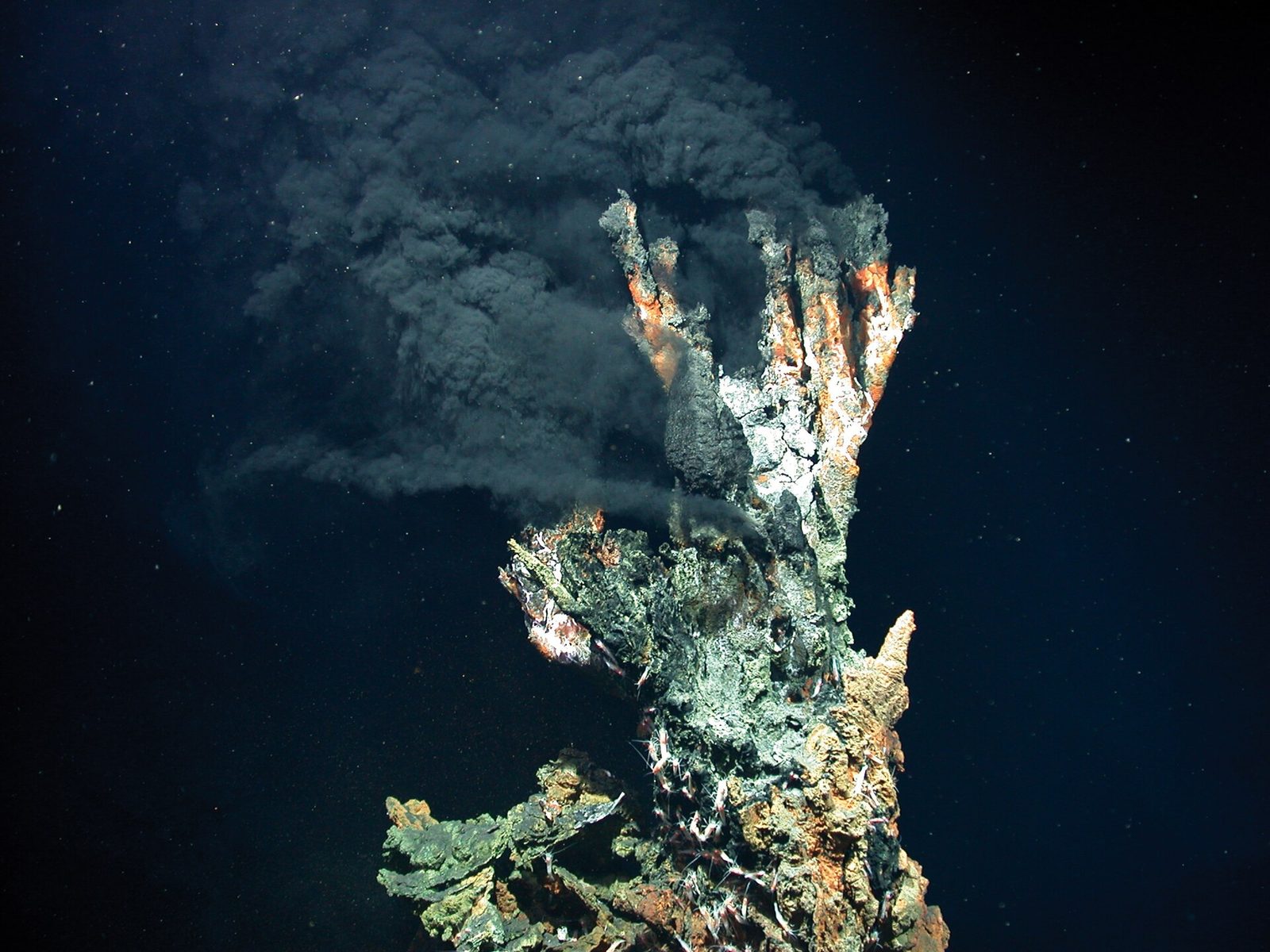
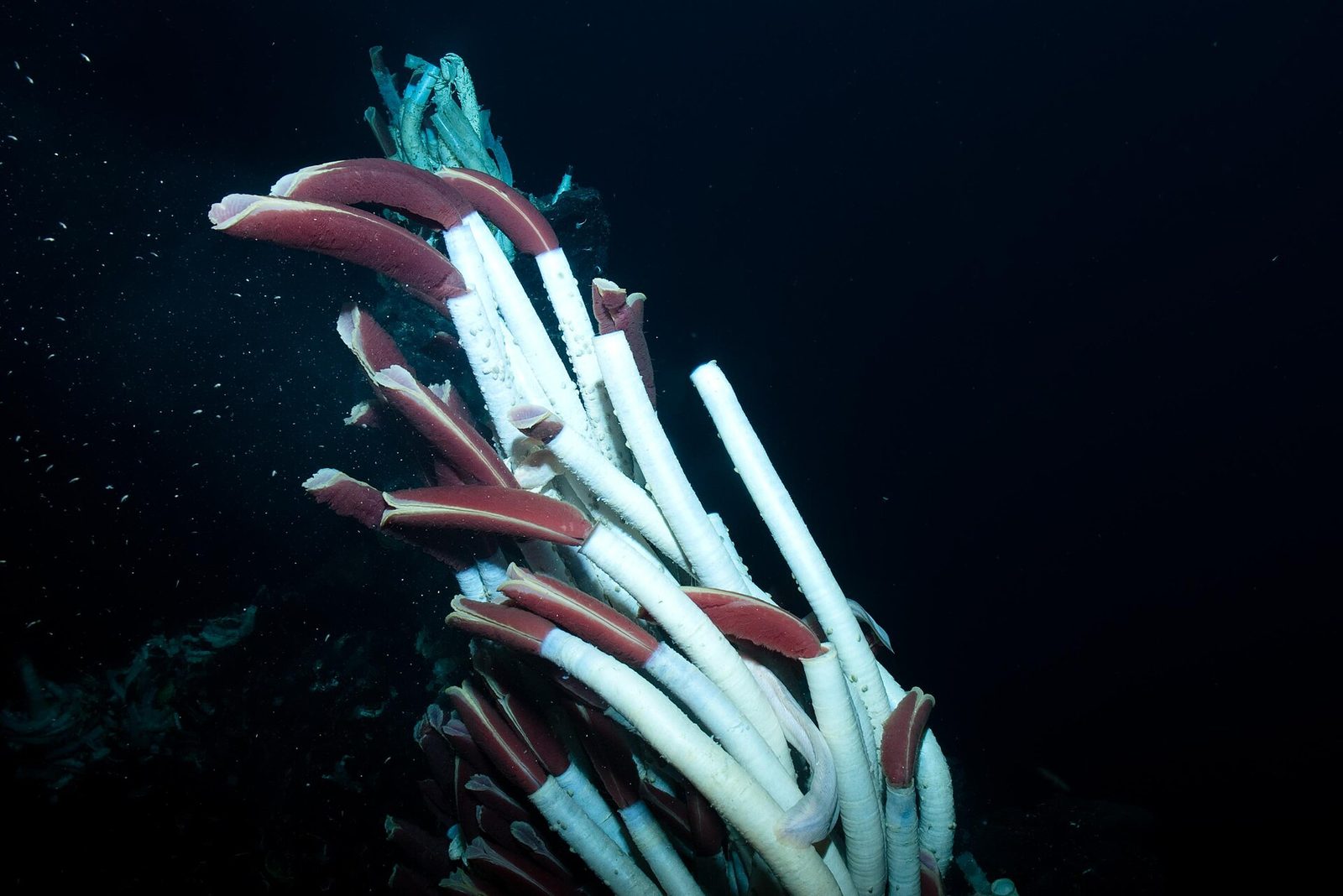
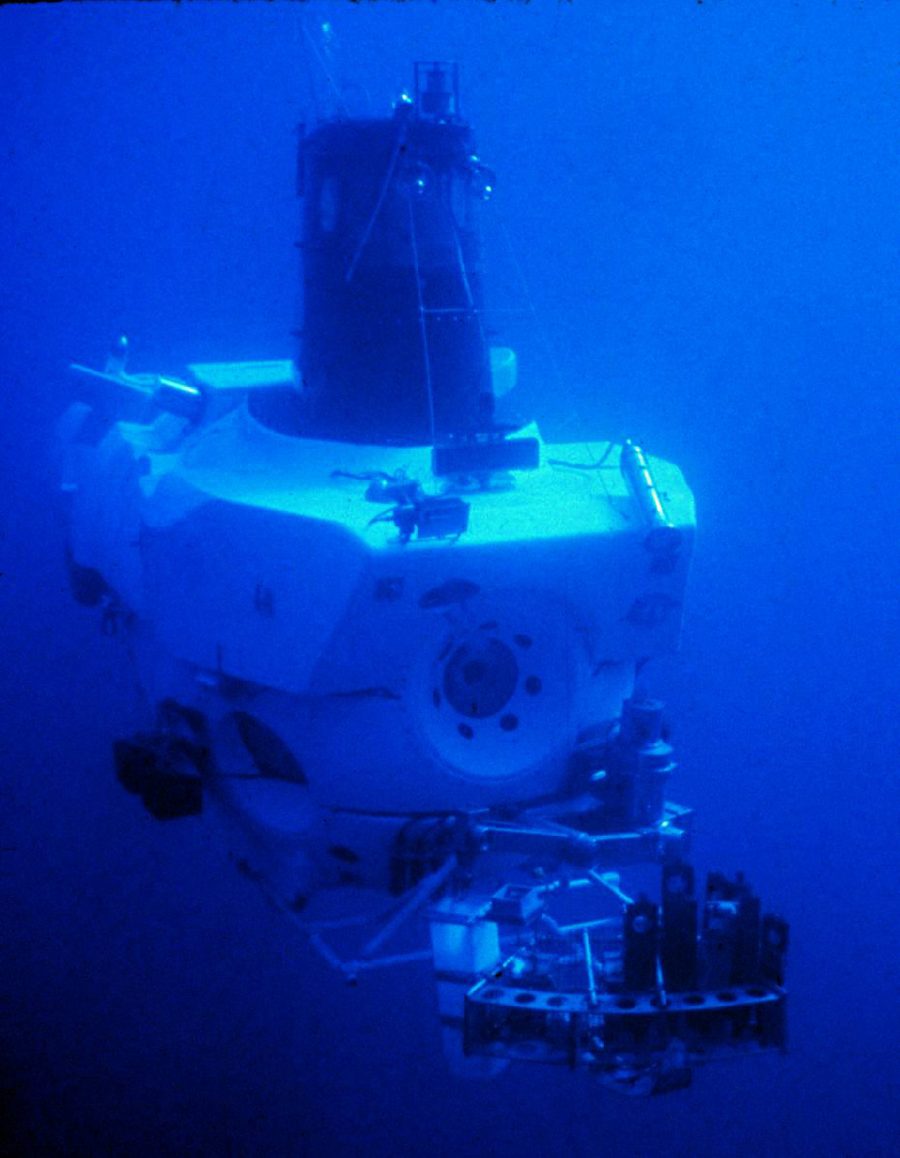
Black smoker hydrothermal vents were found in 1977 on the Galápagos Rift by the Alvin submersible team, including John Corliss and Jack Dymond of Oregon State University, and the first high-temperature black smokers were found at 21 degrees north on the East Pacific Rise in 1979. What made them famous was not the plumbing but the ecosystems: bacteria and archaea oxidising hydrogen sulphide, hydrogen and methane, feeding food webs of giant tube worms, clams, shrimp and crabs. LIFE THAT EATS CHEMISTRY RATHER THAN SUNLIGHT. That is what made vents look like a plausible cradle in the first place.
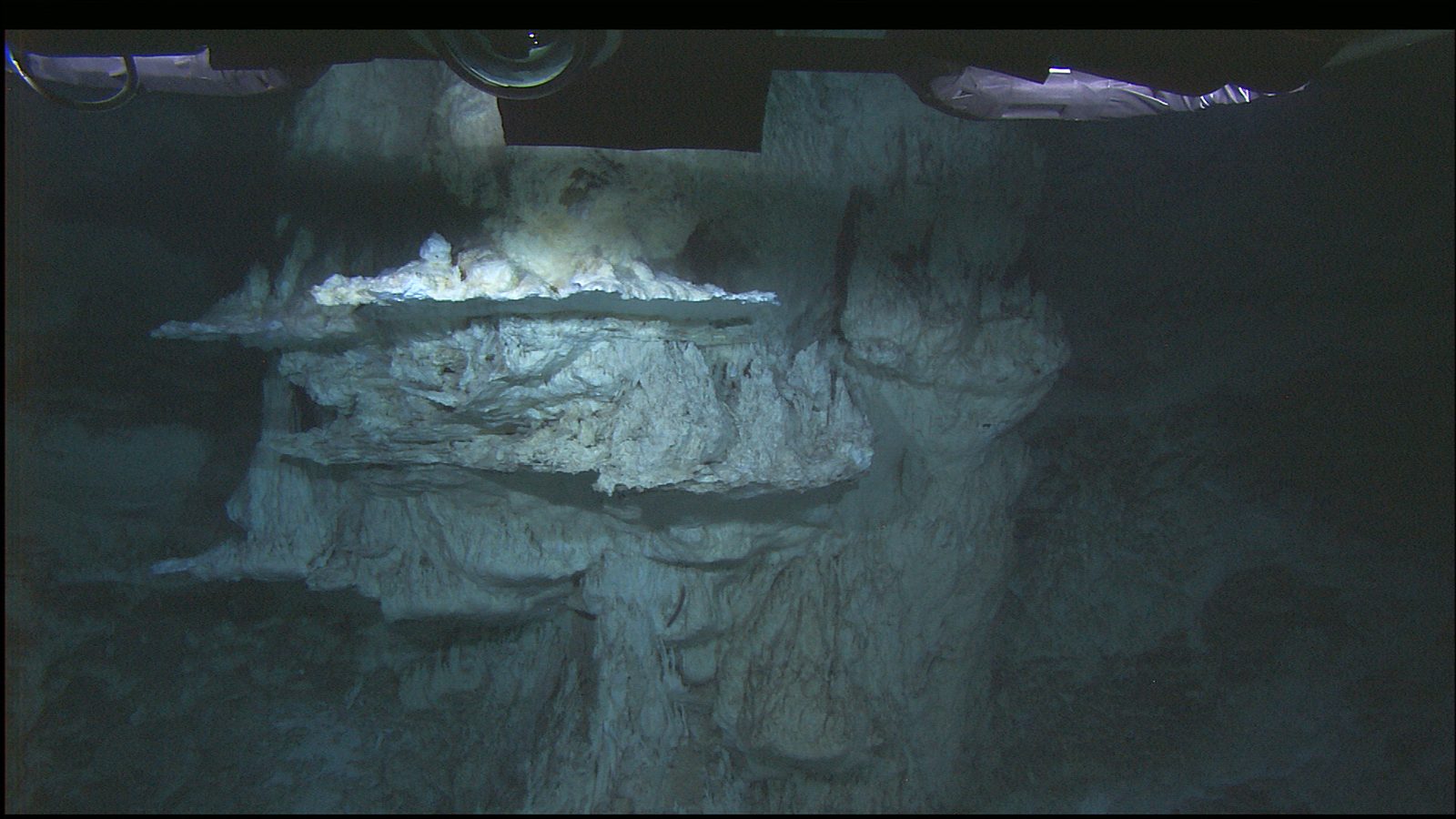
The Lost City Hydrothermal Field was discovered in 2000 at 30 degrees north on the Mid-Atlantic Ridge by Deborah Kelley of the University of Washington, aboard R/V Atlantis, and published in Nature in 2001. It is an off-axis field driven by serpentinization rather than by magma, and it is nothing like a black smoker. Where they run above 350 degrees, acidic and loaded with transition metals, Lost City runs at about 40 to 90 degrees, at pH 9 to 11, rich in hydrogen and methane. OUR FILE'S IDENTIFIER FOR THE KELLEY PAPER RESOLVES EXACTLY, which turns out to be true of every identifier it carries.
02The Battery
Michael Russell, then at Glasgow and later at NASA's Jet Propulsion Laboratory, proposed from 1989 that life began at off-axis alkaline vents like this one. The mechanism is a natural proton gradient: a pH difference of three to five units across thin iron-sulphide mineral walls, separating alkaline hydrogen-rich vent fluid at pH 10 to 11 from the mildly acidic carbon-dioxide-rich Hadean ocean at pH 5 to 6. Porous mineral structures act as natural flow reactors, and the gradient across their walls supplies free energy for organic synthesis.
The force of Russell's argument is not the chemistry, it is an observation about all life. Chemiosmotic energy coupling is universal: bacteria, archaea, and the mitochondria and chloroplasts inside every complex cell all run on a proton gradient across a membrane. His point is that this is best explained if life began somewhere that already had one, and alkaline vents provide exactly that. Nick Lane and William Martin formalised the thermodynamics in Cell in 2012, showing that hydrogen plus carbon dioxide going to organics is favourable under alkaline vent conditions at moderate temperatures.
Günter Wächtershäuser, a Munich patent attorney and origin-of-life chemist, proposed in 1988 that the first metabolic cycles ran on iron-sulphide mineral surfaces, with iron sulphide plus hydrogen sulphide going to pyrite and releasing reducing power. Claudia Huber and Wächtershäuser then demonstrated peptide bond formation on nickel-iron sulphide surfaces at 100 degrees and pH 7 to 10.5, in Science in 1998. The supporting observation is as good as Russell's: iron-sulphur clusters sit in the active sites of ferredoxins, hydrogenases, nitrogenases and carbon monoxide dehydrogenase in virtually all life.
Laura Barge and colleagues at the Jet Propulsion Laboratory made alanine and other amino acids in simulated alkaline vent chimneys, using iron oxyhydroxide minerals, pyruvate and ammonia at 70 degrees, published in PNAS in 2019. Hudson and colleagues showed in 2020 that formaldehyde produced by carbon dioxide reduction can undergo the formose reaction under simulated vent conditions to give sugars including ribose, which is the sugar in RNA. OUR FILE CALLS HER LAURIE BARGE. THE RECORD SAYS LAURA.
A 2016 study identified 355 genes likely present in the Last Universal Common Ancestor and described an anaerobic, hydrogen-dependent organism using the Wood-Ljungdahl carbon fixation pathway, which is what you would expect of something living at an alkaline vent. One detail about the attribution: our file's summary calls this a study by William Martin and colleagues. Martin is the senior author. THE FIRST AUTHOR IS MADELINE WEISS, and our file's own bibliography names her correctly even where its summary does not.
03What Is Actually Wrong With It
The largest hole is the step from a free gradient to a paid one. How life moved from depending on a geological proton gradient to generating its own, with membrane-bound electron transport chains, is unsolved. Lane and Martin propose early protocells with leaky lipid membranes inside vent pores, gradually evolving ion-tight ones. Our file's own word for the detailed mechanism is HYPOTHETICAL, and it puts the whole transition in its speculative section rather than its verified one.
Our file prints them rather than burying them. The RNA World and warm-pond models, favoured by Jack Szostak and John Sutherland, depend on ultraviolet-driven photochemistry and wet-dry cycling to make nucleotides, and NEITHER CONDITION EXISTS AT THE BOTTOM OF THE SEA. Concentration is a real problem: vent fluids are extremely dilute, and the mechanisms for concentrating prebiotic molecules to reactive levels inside vent pores are not fully demonstrated. And Sutherland argues in Angewandte Chemie that the chemistry of life's building blocks points at surface photochemistry rather than deep-sea reduction.
Our file does not refuse the warm pond. It keeps Darwin's warm little pond and Miller-Urey spark chemistry as relevant. What it refuses is the claim that life could ONLY have started at the surface under ultraviolet light, which it says is contradicted by the thermodynamics of vent chemistry and by the phylogenetic evidence for a thermophilic, anaerobic ancestor. THE REFUSAL IS AIMED AT AN EXCLUSIVITY CLAIM AND NOT AT A RIVAL HYPOTHESIS, which is a distinction most files in this library do not manage to make.
04And If It Is Right, It Is Not Only Here
Cassini confirmed molecular hydrogen in the plume of Enceladus in 2017, which is evidence of hydrothermal activity in the moon's subsurface ocean. Europa probably has a global subsurface ocean in contact with a rocky mantle. If life started at alkaline vents here, those are places to look, and our file notes that this reasoning is driving Europa Clipper and the Enceladus Orbilander concept. ONE THING OUR FILE DOES NOT NOTE: an erratum to that Cassini paper exists. It was found while checking the citation and it was not read, so nothing is claimed about what it corrects.
05A Note On Our Own Sources, Which Are The Best Yet
Every article in this series resolves the identifiers in the research file behind it and reports what comes back. The previous four found reviews standing in for books, a citation whose every locator had drifted, a paper that could not be found to exist, and a library filing number written into the middle of a title. This file produced something different.
All five identifiers this file carries resolve exactly, matching author, title, journal, volume, issue, pages and year in every case: Russell 1993, Martin and Russell 2003, Lane and Martin 2012, Kelley 2001 and Wächtershäuser 1988. Nine further entries carried no identifier at all, and EIGHT OF THEM WERE FOUND, every single one an accurate citation missing only its pointer. THIRTEEN OF FOURTEEN ENTRIES VERIFIED CORRECT. The fourteenth is a 2015 trade book with no identifier to find, recorded here as unchecked rather than clean.
Here is the first entry as it actually sits in the file, field by field: "Russell, Michael J., Roy M" then the year, then the title, then the journal, then the page range, THEN "Daniel, and Alan J", then the identifier, THEN "Hall". That is one author list, Russell, Michael J., Roy M. Daniel, and Allan J. Hall, CUT AT THE FULL STOP AFTER EACH MIDDLE INITIAL and scattered across three separate columns, one of them arriving after the DOI. The same break splits William F. Martin in another entry, Michael J. Russell in another, Dennis K. Bird in a fourth, and turns the publisher W. W. Norton into "New York: W" and "W; Norton" in a fifth. FIVE OF FOURTEEN ENTRIES. ONE MECHANISM. NOT ONE WRONG CITATION AMONG THEM.
| Research File | Rated | What The Audit Found |
|---|---|---|
| N_2_04, the Nizari Ismailis | 3 of 5 | 0 of 5 correct. Four reviews standing in for the books they review, and a modern extract standing in for Marco Polo |
| W_1_16, the Hittites | 3 of 5 | 6 of 9. Two review-DOIs, and one citation whose every locator had drifted onto a different paper |
| ZF_2_22, the hadal zone | 4 of 5 | 10 of 13. Three identifiers landing in the right journal and the wrong article |
| F_4_07, Sundaland | 1 of 5, from a source count recorded as ZERO | 4 of 5, on a bibliography of twenty. A library filing number found written into a citation title |
| R_1_19, this file | 4 of 5 | 5 of 5 correct, 8 more recovered, 13 of 14 verified. PERFECT CONTENT. And five of its entries have their author lists shattered across the wrong fields |
Every previous file in this series produced bad content: a pointer aimed at the wrong work, a locator that had drifted, a paper nobody could find. THIS ONE'S CONTENT IS ESSENTIALLY PERFECT AND ITS MACHINERY IS BROKEN. Those are different defects and they need different repairs. A field parser that breaks on a middle initial is an afternoon's work and it would fix five entries at once. A citation pointing at the wrong paper has to be found and re-resolved one at a time. Fifteen articles into this audit, this is the first document where the two come cleanly apart.
The Barge paper's first author is Laura M. Barge, not Laurie, in both the prose and the bibliography. The 1993 Terra Nova paper's third author is Allan J. Hall, not Alan, and the thing that proves it is the correct identifier our file itself supplies. And the Sutherland paper is dated 2016 in the bibliography and 2017 in the counter-arguments section: the record puts it in volume 55, issue 1, of Angewandte Chemie International Edition, which is the January 2016 issue, so THE BIBLIOGRAPHY IS RIGHT AND THE BODY IS WRONG. That is the second time in this series that a file's bibliography has been the more reliable half of the same document.
Fast Facts
- The Universal Thing
- Every cell alive runs on a proton gradient across a membrane. Bacteria, archaea, mitochondria, chloroplasts
- Black Smokers
- Found 1977, Galápagos Rift. Above 350 degrees, acidic, metal-rich
- Lost City
- Found 2000, Mid-Atlantic Ridge at 30 degrees north. About 40 to 90 degrees, pH 9 to 11, hydrogen and methane
- The Gradient
- A pH difference of 3 to 5 units across thin iron-sulphide walls, made by geology, for free
- Whose Idea
- Michael Russell, from 1989. Thermodynamics formalised by Nick Lane and William Martin, 2012
- The Other Half
- Wächtershäuser's iron-sulphur world, 1988. Iron-sulphur clusters sit in the active sites of enzymes in nearly all life
- Made In A Lab
- Amino acids in simulated alkaline vent chimneys, Barge and colleagues, PNAS 2019
- The Ancestor
- A gene set reconstructed for LUCA: anaerobic, hydrogen-dependent, Wood-Ljungdahl pathway
- The Hole
- Nobody knows how a cell went from using a free gradient to making its own. Our file's word is hypothetical
- Our File's Identifiers
- Five carried, five correct. Eight more recovered. Thirteen of fourteen verified, the best result in this series
What We Can Actually Stand Behind
Black smokers were found in 1977 and Lost City in 2000, and they are chemically different in the ways described. Vent ecosystems run on chemolithotrophy rather than sunlight. Alkaline vents genuinely do maintain a natural pH gradient across mineral walls. Chemiosmotic coupling is universal in living things. Iron-sulphur clusters really do sit in the active sites of enzymes across all domains of life. Amino acids have been made in simulated alkaline vent chimneys. And in our own file, five of five identifiers resolve exactly and eight more were recovered.
That life began at alkaline hydrothermal vents. This is our file's own tier for it, and it is the right one: the argument from universal chemiosmosis is strong, the thermodynamics work, the lab results are real, and the reconstruction of LUCA fits. None of that is the same as evidence that it happened.
The transition from a geological gradient to a biological one, which is the load-bearing step and is unsolved. And the astrobiological extension to Enceladus and Europa, which is a reason to go and look rather than a finding.
That life could only have begun at the surface under ultraviolet light. Note what that refusal is and is not: it rejects an exclusivity claim, not the warm pond itself, which our file keeps as a live and relevant model.
What makes this hypothesis interesting is not that it is proven, because it is not. It is the shape of the argument. Somebody noticed that every living thing on the planet runs on the same odd trick, went looking for a place that does that trick without being alive, and found one on the floor of the Atlantic. That is not proof. It is a good question asked in the right direction, which is rarer and more useful than most answers.
Sources & further reading
WHERE THIS WORKED FROM. One file in our own research library, R_1_19, at Source Confidence 4 out of 5, last updated 10 April 2026, plus thirteen external records resolved live on 26 August 2026. THIS IS THE BEST-SOURCED RESEARCH FILE IN THIS AUDIT SERIES and the point deserves stating before anything else. All five identifiers it carries resolve exactly. Nine entries carried none, eight of those were recovered, and every single recovered citation proved accurate. Thirteen of fourteen entries verified correct; the fourteenth is Nick Lane's 2015 trade book, for which no identifier was searched, recorded as unchecked. AND ITS BIBLIOGRAPHY IS STILL BROKEN, in a way that has nothing to do with the citations. A field parser has cut five author lists at the full stop after a middle initial and scattered the fragments into columns meant for other data, in one case placing part of an author's name after the DOI. Five of fourteen entries, one mechanism, no wrong citations. Section 05 shows the first entry field by field so a reader can see it. WHAT THE PAGE ADDS. Eight recovered identifiers: Huber and Wächtershäuser 1998 in Science, Weiss and colleagues 2016 in Nature Microbiology, Barge and colleagues 2019 in PNAS, Waite and colleagues 2017 in Science, Sojo and colleagues 2016 in Astrobiology, Corliss and colleagues 1979 in Science, Sutherland in Angewandte Chemie, and Sleep, Bird and Pope 2011 in Philosophical Transactions B. THREE SMALL CORRECTIONS ARE OWED TO OUR FILE and are set out in section 05: Laura rather than Laurie Barge, Allan rather than Alan Hall, and the Sutherland year, where the bibliography's 2016 is right and the body's 2017 is not. Two errata exist, to the Corliss 1979 and Waite 2017 papers, which our file does not note; they were found while checking the citations and were NOT read, so nothing is claimed here about what they correct. WHAT IS NOT CLAIMED. That the vent hypothesis is established. Our file holds it at Tier 2 and prints the real objections, and this page follows it. Nothing here says Sutherland is wrong, and nothing here is claimed about the Lane book. ON THE OVERLAP. The Athenaeum's origin of life article, built from R_1_01, surveys five cradle hypotheses at level weight. This page is the deep dive on one of them and links to that one rather than repeating it. ON THE IMAGES. Five were fetched and opened and one was dropped for a reason new to this run: a correctly licensed photograph from a Lost City expedition showing a bright yellow branching organism that could not be identified from the frame or the file record. A caption that cannot be supported is worse than no image.
Image credits
- A black smoker hydrothermal vent MARUM, Zentrum für Marine Umweltwissenschaften, Universität Bremen, via Wikimedia Commons (CC BY 4.0). CC BY 4.0 Source.
- Giant tube worms, Riftia pachyptila Ifremer, via Wikimedia Commons (CC BY 4.0). CC BY 4.0 Source.
- A carbonate formation at the Lost City Hydrothermal Field NOAA, via Wikimedia Commons (public domain). Public domain Source.
- The submersible DSV Alvin U.S. Navy, via Wikimedia Commons (public domain). Public domain Source.

_(Ifremer_00568-67973_-_25085).jpg)

