
The Higgs Boson: The Field That Gives Particles Their Mass
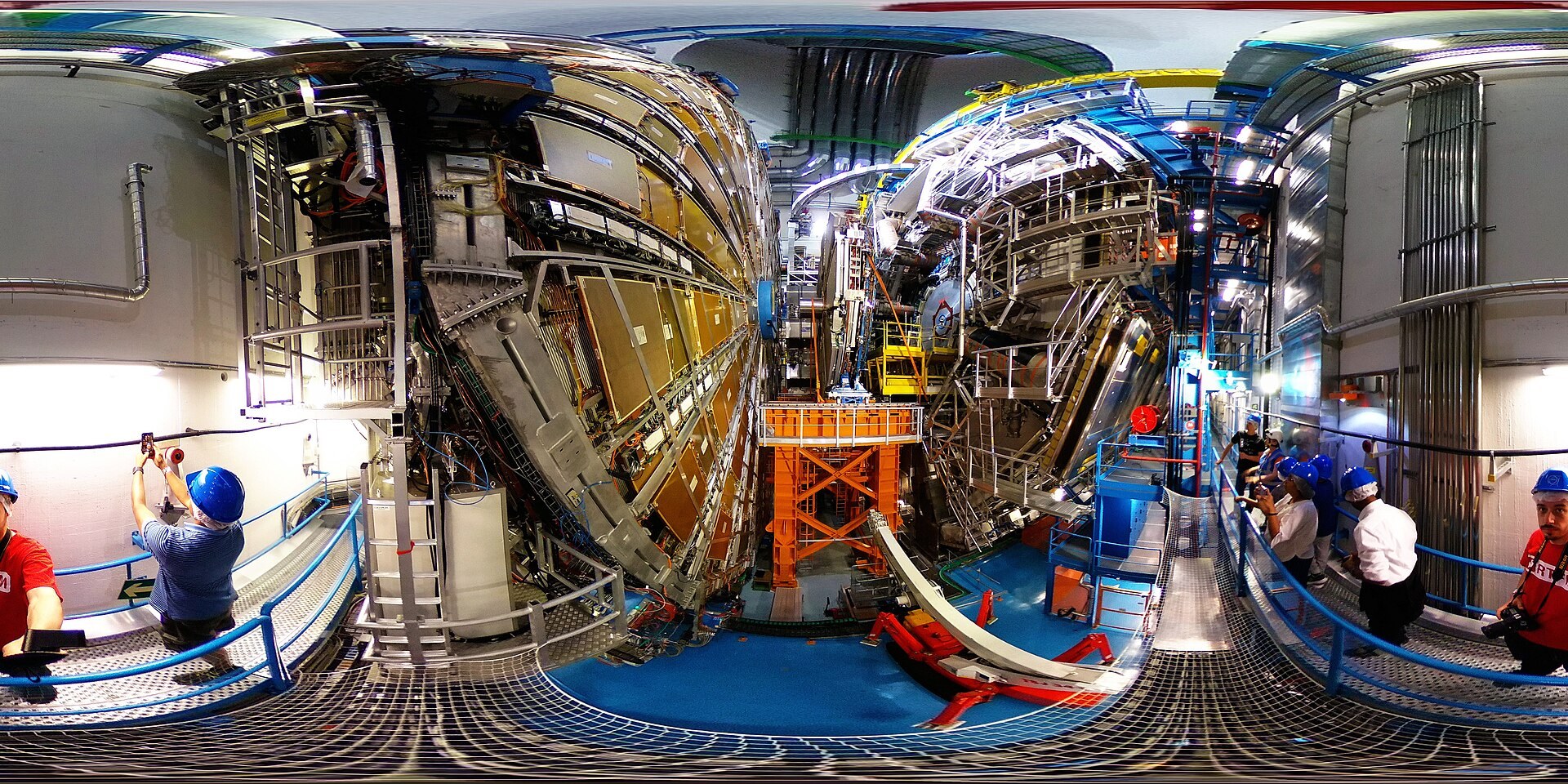
On July 4, 2012, two teams at the world's largest machine announced they had found it: a new particle, forty-eight years after it was predicted, that confirmed how the most fundamental pieces of matter come to have mass at all. The Higgs field fills all of space, and particles that interact with it, the W and Z bosons, the quarks, the electrons, are resisted by it and thereby gain mass. It is one of the great triumphs of modern physics, sealed with a Nobel Prize. But it is also the subject of one of the most common misunderstandings in all of science, because the Higgs is not, in fact, where most of your own weight comes from. This is what the Higgs boson genuinely is, how it was found, and the crucial thing it does not do.
For nearly fifty years, one piece of our deepest theory of matter was a promissory note. The equations said the fundamental particles should have mass, and they said there had to be a reason, an invisible field filling all of space, switched on everywhere, that the particles push against. But the field could not be seen, and the one particle that would prove it existed was so heavy and so rare that finding it would take the largest machine humanity had ever built. On the fourth of July, 2012, it was found. The story of the Higgs boson is a genuine triumph, a prediction from pure mathematics confirmed almost half a century later. It is also one of the most misunderstood ideas in modern science, wrapped in a nickname its own discoverers disliked and a claim about your body's weight that is simply false. Here is what the Higgs really is, how we caught it, and the one crucial thing it does not do.
01The Field That Fills Space
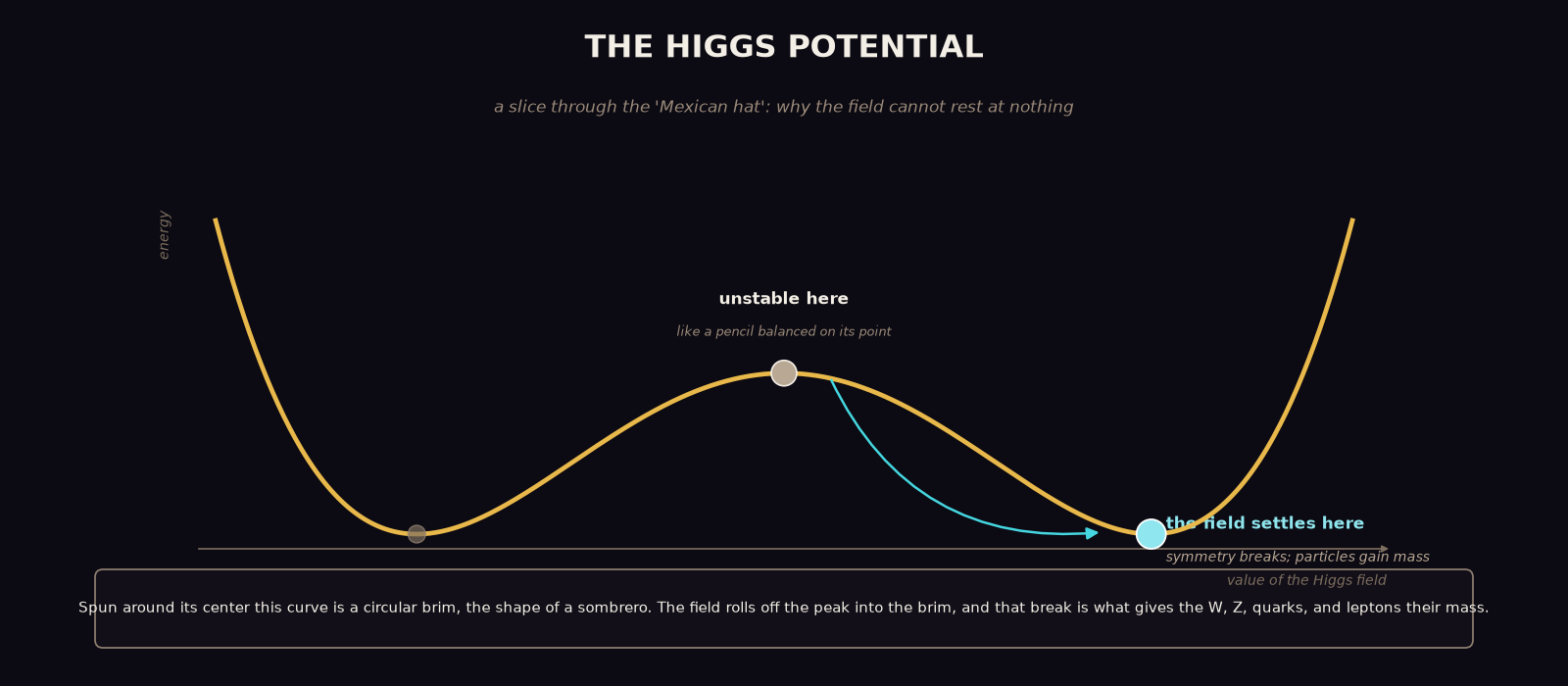
Empty space, it turns out, is not empty. Threaded through all of it is the Higgs field, a kind of invisible medium switched on everywhere since a fraction of a second after the Big Bang. Most fields, like the electromagnetic one, are quietest when set to zero. The Higgs field is different: its lowest-energy state is not zero but a fixed, non-zero value (about 246 giga-electronvolts, in the units physicists use), and understanding why is the whole trick. The energy of the field, drawn as a curve, has the shape of a sombrero, or the punt at the bottom of a wine bottle: a little bump in the middle and a circular trough around it. A field sitting on the central bump is like a pencil balanced on its point, poised but unstable; it inevitably rolls down into the trough and settles there. That settling is called electroweak symmetry breaking, and it is the event that gives the fundamental particles their mass. Particles that interact with the switched-on field are resisted by it, and that resistance is what we measure as mass. The more strongly a particle couples to the field, the more mass it has: the top quark, the heaviest known particle, couples most strongly of all; the electron couples very weakly and is correspondingly light. The W and Z bosons, the carriers of the weak nuclear force, get their considerable mass this way too, while the photon, which does not interact with the field, stays exactly massless and travels at the speed of light. Without the Higgs field switched on, the fundamental particles would all be massless, and atoms, chemistry, and you could not exist.
02Not Your Mass
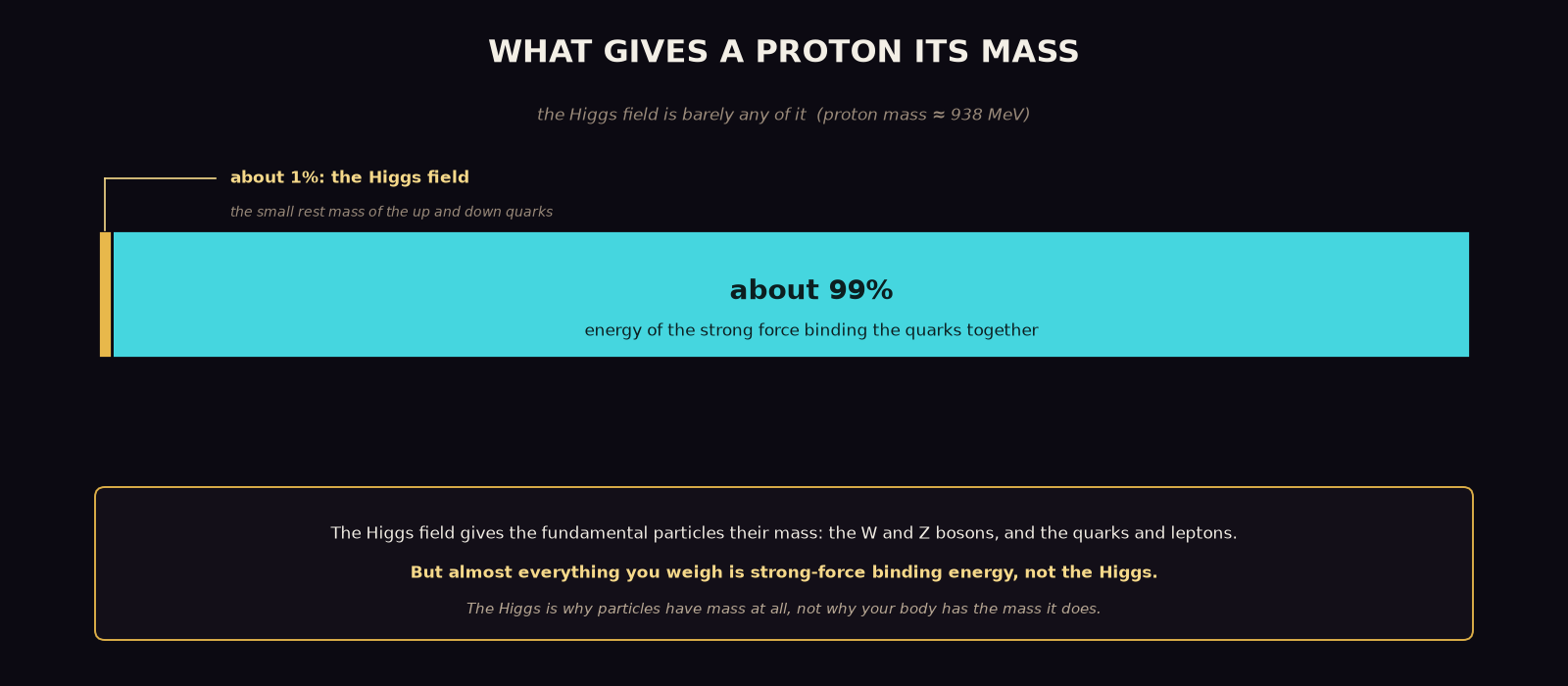
And now the correction that almost every popular account gets wrong, and that is worth stating as plainly as possible. It is often said that the Higgs boson 'gives everything its mass,' or that it is why you weigh what you weigh. That is not true, and the gap is enormous. The Higgs field gives mass to the fundamental particles: the W and Z bosons, and the individual quarks and leptons. But you are not made of bare quarks; you are made of atoms, whose mass lives almost entirely in the protons and neutrons of their nuclei. And a proton's mass is overwhelmingly not the mass of the quarks inside it. A proton weighs about 938 mega-electronvolts; the three quarks it is built from contribute only about 9 of those, barely one percent, from their Higgs-given rest mass. The other ninety-nine percent is pure energy: the ferocious energy of the strong nuclear force binding the quarks together, the kinetic energy of the quarks racing around inside, and the energy of the gluon field that glues them, all of it counting as mass through Einstein's E equals m c squared. So when you step on a scale, almost everything it reads is strong-force binding energy, not the Higgs field at all. The Higgs is why the fundamental particles have mass in the first place, a profound and necessary thing. It is not why your body has the mass it does. Keeping those two statements separate is the single most important step toward understanding what the Higgs boson actually is.
03Forty-Eight Years to Find It
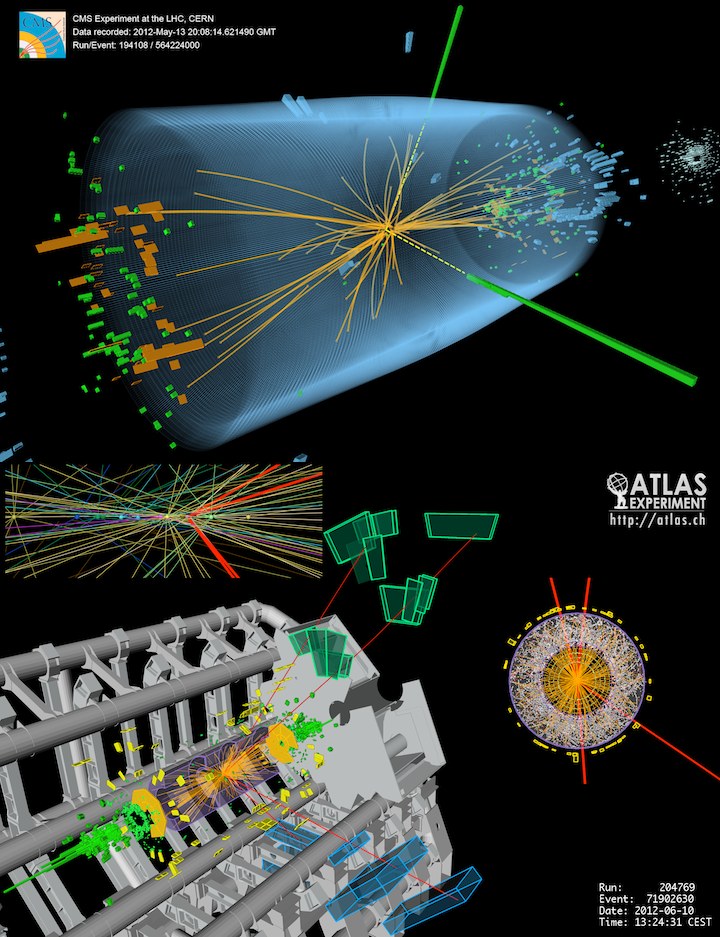
A field that fills all of space and cannot be switched off sounds like something you could never test. The way in is that every field has an associated particle, its smallest possible ripple, and the ripple in the Higgs field is the Higgs boson. Find the boson, and you have proven the field. The mechanism was worked out in 1964 by three independent groups, most famously Peter Higgs, and Francois Englert with Robert Brout, and also Gerald Guralnik, Carl Hagen, and Tom Kibble, who showed how such a field could give the force-carrying particles mass without wrecking the mathematics of the theory. Then came the hard part: the predicted boson is heavy and fantastically rare, and finding it took nearly half a century and the largest machine ever built. The Large Hadron Collider, a 27-kilometre ring straddling the French-Swiss border at CERN, accelerates protons to nearly the speed of light and collides them hundreds of millions of times a second, briefly concentrating enough energy in a tiny volume to conjure a Higgs boson out of it, roughly once in several billion collisions. Two enormous detectors, ATLAS and CMS, built and run by thousands of physicists working independently so they could check each other, watched for the sprays of particles a Higgs leaves as it instantly decays. On July 4, 2012, both announced the same thing: a new particle at a mass of about 125 giga-electronvolts, seen in the two cleanest signatures (a pair of photons, and four leptons), each above the five-sigma level of certainty that particle physicists demand before claiming a discovery. Its mass has since been pinned down to 125.11 giga-electronvolts, to better than a tenth of a percent, and its spin measured as zero, exactly as the theory required. The Standard Model of particle physics, the catalogue of nature's fundamental pieces, had its last missing entry filled in.
04The Prize, and the Third Man
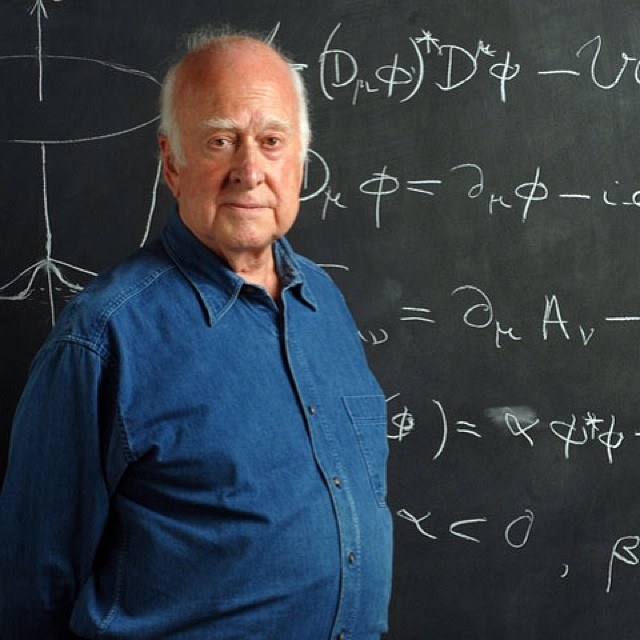
The next year, 2013, the Nobel Prize in Physics went to Peter Higgs and Francois Englert, 'for the theoretical discovery of a mechanism that contributes to our understanding of the origin of mass of subatomic particles.' There is a quiet tragedy folded into that sentence. Robert Brout, Englert's close collaborator and co-author of their 1964 paper, had died in 2011, a year before the boson was found and two before the prize. The Nobel is never awarded posthumously and can be split at most three ways, so Brout could not be named. Peter Higgs himself later said he thought it was right the prize went to only two, because by implication it recognised Brout as the third who could not receive it. Higgs, a modest and private man who shunned the spotlight and famously did not own a television, had spent decades attached to a particle he was uneasy about being named after; the field, the boson, and the mechanism all carry his name, though he always insisted the work belonged to many hands. He lived to see it found, and died in 2024. It is worth remembering that behind the machine and the five-sigma statistics stood a very human story: an idea one man published on a few pages in 1964, doubted for years, and vindicated within his own lifetime.
05The Open Edges
With the boson found, the frontier moved to its finer details, and this is where genuine, unfinished physics begins. The most important open measurement is the Higgs field's interaction with itself, its 'self-coupling,' which encodes the exact shape of that sombrero-shaped energy curve and, with it, clues about the earliest moments of the universe. Measuring it means catching the rare event in which a single collision produces two Higgs bosons at once, which has not yet been observed; the High-Luminosity LHC, an upgrade running through roughly 2040, aims to measure it to perhaps twenty-seven percent precision, still short of what a full test would need. There are deeper puzzles too. The measured masses of the Higgs and the top quark place the universe's vacuum in a curious 'metastable' state, technically not the lowest-energy configuration possible, which could in principle decay to a true one; but the calculated timescale for that is vastly longer than the present age of the universe, so it poses no threat of any kind, and its deeper meaning belongs to a separate discussion. And the Higgs mass itself is oddly, some say suspiciously, light compared to where naive theory expects it, a tension called the hierarchy problem. For decades it was the main reason to expect new particles (supersymmetry, above all) just beyond reach; the LHC's failure to find them has split physicists, with some, like Nima Arkani-Hamed, questioning old assumptions, and others, like Sabine Hossenfelder, arguing that the 'naturalness' expectation was an aesthetic preference mistaken for a law. Whether the Higgs is truly the lone, simple particle the Standard Model describes, or part of a larger family as many theories predict, is still, genuinely, unknown.
06What It Is Not
A few pieces of Higgs mythology should be retired plainly. First, the nickname. The Higgs is often called 'the God Particle,' a phrase that comes not from physics but from the title of a 1993 popular-science book by the physicist Leon Lederman, whose publisher, so the story goes, rejected his preferred title, 'the Goddamn Particle,' a joke about how maddeningly hard the thing was to find. Physicists almost universally dislike the label, because it wildly overstates the boson's cosmic or spiritual significance; it is a marketing phrase, not a description of what the particle is. Second, the fear, aired loudly before the LHC switched on, that its collisions might create a black hole that would swallow the Earth. They will not, and this is not a matter of hope but of arithmetic: cosmic rays have been striking Earth's atmosphere at far higher energies for four and a half billion years without incident, and dense stars survive the same bombardment; a formal safety review found no risk. And third, the one already met above but worth repeating because it is so widespread: the Higgs boson is not what gives ordinary matter, or you, most of its mass. It is a genuinely profound discovery. It does not need, and is only cheapened by, the exaggerations.
Fast Facts
- What it is
- The Higgs boson is the ripple in the Higgs field, an invisible field filling all of space whose non-zero value gives the fundamental particles their mass
- What gets mass from it
- The W and Z bosons and the individual quarks and leptons; the more strongly a particle couples to the field, the heavier it is (top quark most, electron very little)
- What does NOT
- Most of your body's mass. About 99% of a proton's mass is strong-force binding energy, not the Higgs; only about 1% is the quarks' Higgs-given rest mass
- Discovered
- July 4, 2012, by the ATLAS and CMS experiments at CERN's Large Hadron Collider, each above 5-sigma, in the two-photon and four-lepton channels
- Mass and spin
- 125.11 plus or minus 0.11 GeV (ATLAS 2023 legacy combination); spin measured as 0, as the Standard Model requires
- The prize
- The 2013 Nobel Prize went to Peter Higgs and Francois Englert; co-discoverer Robert Brout had died in 2011 and, by the Nobel's rules, could not be included
- Still open
- The Higgs self-coupling (not yet measured; HL-LHC target about 27% by roughly 2040), vacuum metastability (real but not remotely imminent), and whether it is the only Higgs
- Refused
- The 'God Particle' hype; the LHC-doomsday black-hole claim; and the myth that the Higgs gives ordinary matter most of its mass
What We Can Actually Stand Behind
The Higgs field, the Brout-Englert-Higgs mechanism, and the discovery of the Higgs boson are established, textbook, Nobel-winning physics. The mechanism was proposed in 1964; the boson was found on July 4, 2012, by ATLAS and CMS at the LHC, each independently above the 5-sigma threshold, with a mass now measured to 125.11 GeV and spin zero. It gives the fundamental particles, the W and Z bosons and the quarks and leptons, their mass, and it completed the Standard Model.
The finer physics is active and unfinished. The Higgs has been confirmed to couple to the top, bottom, and tau, and at evidence level to the muon, all consistent with the Standard Model. Its self-coupling has not yet been measured, and Higgs-pair production has not yet been observed; the High-Luminosity LHC aims to change that by around 2040. The vacuum-metastability calculation is real and well-motivated, and points to a timescale vastly longer than the age of the universe.
Real open questions remain. Whether the Higgs is the only scalar or part of an extended family, as supersymmetry and other theories predict, is unknown; no additional Higgs bosons have been found, though much parameter space is unexplored. The hierarchy problem, why the Higgs is so light, has no agreed answer, and the long-assumed 'naturalness' argument for new physics is now itself in dispute.
The hype gets a flat no. 'The God Particle' is a book-marketing phrase, not physics. The LHC did not and cannot create an Earth-swallowing black hole. And, most importantly, the Higgs does not give ordinary matter most of its mass: about 99 percent of a proton's mass is strong-force binding energy, not the Higgs field. The real discovery is extraordinary enough without the embellishments.
The Higgs boson closes this wing's tour of the fabric of reality on a fitting note, because it is at once a total triumph and a standing reminder to be precise. It is a triumph: a particle predicted from pure mathematics in 1964, pursued for forty-eight years, and finally caught by a machine and a collaboration of a scale the world had never assembled before, confirming our deepest account of why the elementary pieces of matter have mass at all. And it is a lesson in precision, because the very ease with which it can be oversold, into a 'God Particle' that supposedly gives everything its weight, is exactly the kind of loose thinking that careful physics exists to correct. The honest version is not smaller than the myth; it is larger, because it is true, and because it is exact. The Higgs field is real, it is everywhere, and it is why an electron has any mass at all. It is not why you have yours. Hold both of those in mind and you understand something that eluded the entire human race until well within living memory, and that most people who have heard the words 'God Particle' still do not.
Sources & further reading
Everything above is drawn from our research library on Theories of Anything. Open the full file to check the sourcing and go deeper.
Image credits
- The ATLAS detector at CERN's Large Hadron Collider Photograph by SimonWaldherr, via Wikimedia Commons. CC BY-SA 4.0 Source.
- The Higgs potential (original diagram) Original diagram by Theories of Anything. CC BY-SA 4.0 Source.
- What gives a proton its mass (original diagram) Original diagram by Theories of Anything. CC BY-SA 4.0 Source.
- Candidate Higgs boson events in the ATLAS and CMS detectors (2012) CERN, for the ATLAS and CMS Collaborations, via Wikimedia Commons. CC BY-SA 3.0 Source.
- Peter Higgs at a blackboard (2013) Photograph by Hans G, via Wikimedia Commons. CC BY-SA 2.0 Source.
- Card crop of the ATLAS detector photograph Photograph by SimonWaldherr, via Wikimedia Commons. CC BY-SA 4.0


