
Shannon and the Birth of the Bit
In one 1948 paper, a playful mathematician at Bell Labs named Claude Shannon did something no one had managed before: he turned 'information' into a precise, measurable quantity, as concrete as length or mass, counted in a brand-new unit called the bit. From that single austere idea, that information is the resolution of uncertainty, and nothing to do with meaning, came the mathematics of compression and error-free communication that quietly built the entire digital world. This is what Shannon actually proved, the one deep link between information and physics, and the crucial thing his bit was carefully designed never to measure.
The modern world runs on a single idea that almost no one outside engineering can name, and it was invented, more or less whole, by one man in one paper. Before 1948, 'information' was a vague and human thing, tangled up with meaning, knowledge, and intent, and no one could have told you how much of it a sentence, a photograph, or a telegram contained. After 1948, information was a number, as concrete as a length or a weight, obeying exact laws. The man was Claude Shannon, and the paper was called 'A Mathematical Theory of Communication.' What he did in it was so foundational that we now live entirely inside its consequences, every file, every stream, every phone call, every genome we sequence, is counted in the unit he put on a firm footing: the bit. And yet the single most important thing about Shannon's information is also the most misunderstood: he built it, deliberately, to have nothing to do with meaning at all. This is what he actually proved, the one place his abstract bits touch physical reality, and the crucial thing the bit was designed never to measure.
01The Man and the Paper
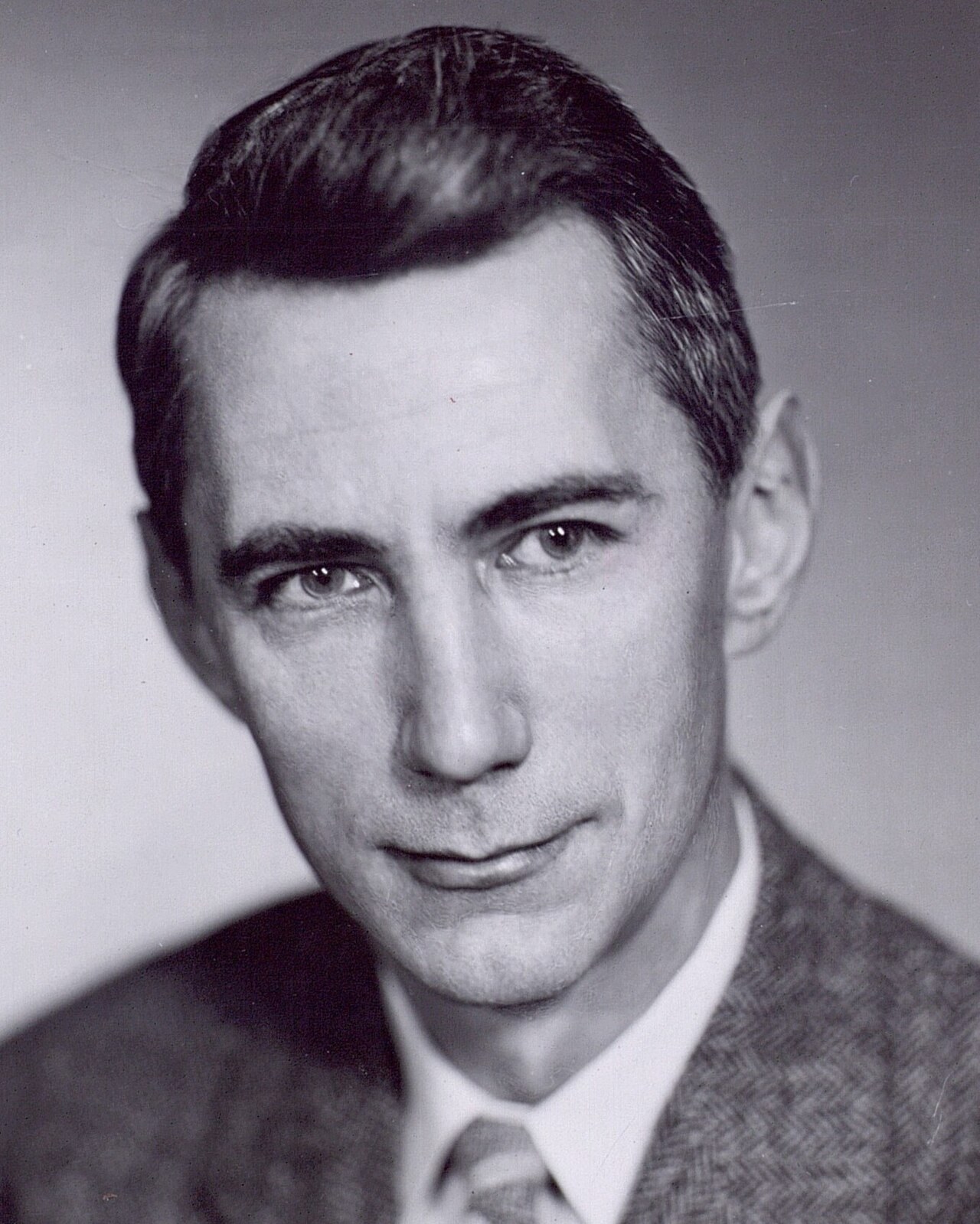
Claude Shannon was a quiet, playful mathematician at Bell Labs when, in 1948, he published the paper that made information measurable. His central move was to strip away meaning and ask a narrower, sharper question: how much uncertainty does a message resolve? A message tells you something only to the extent that you did not already know it; the more it could have been otherwise, the more it carries when it arrives. Shannon measured this in a unit a colleague, the statistician John Tukey, had coined the year before, in a Bell Labs memo dated January 1947: the bit, a contraction of 'binary digit,' the amount of information in a single yes-or-no answer when the two answers are equally likely. Shannon credited Tukey by name in a footnote of the paper itself. It is worth pausing on how strange and bold this was. Information had always seemed inseparable from significance, from what a message was about. Shannon's insight was that the engineering problem of communication, getting a message reliably from here to there, does not care what the message is about at all; it cares only that the message is one selection out of a set of possible messages. From that deliberately austere starting point, everything followed.
02A Number for Surprise
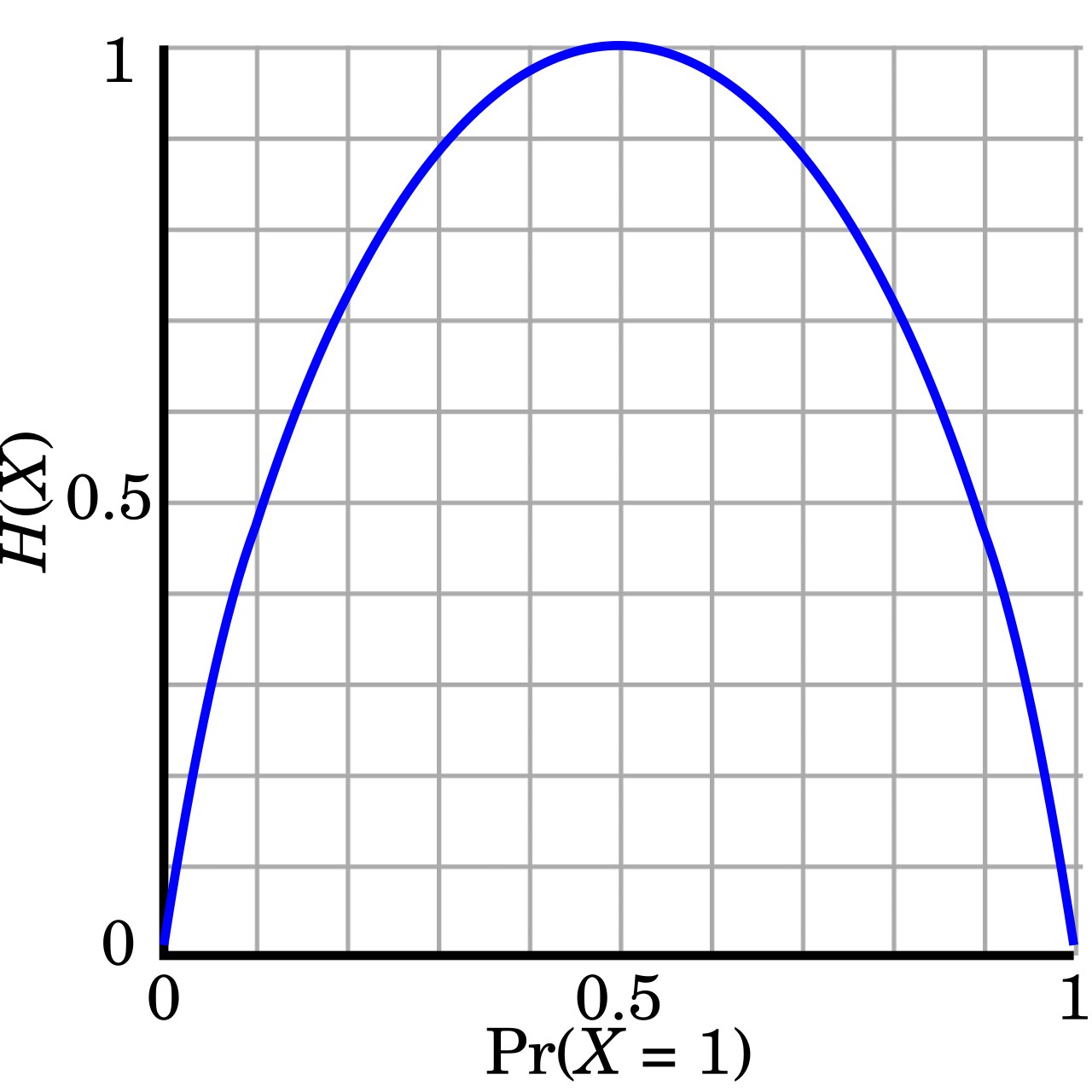
To turn surprise into arithmetic, Shannon borrowed both a formula and a name from physics: entropy. The entropy of a source, written H, is the average number of bits its messages carry, computed as the negative sum, over all possible outcomes, of each outcome's probability multiplied by the logarithm of that probability. The formula looks forbidding and says something simple. Entropy is largest when every outcome is equally likely, when you are maximally unsure what comes next, and it falls to zero when one outcome is certain and there is no surprise left to have. A fair coin flip carries exactly one bit; a two-headed coin carries none, because the answer is already known. The same measure applies to anything with an element of chance: the roll of a die, the next letter in a sentence, the next pixel in a photograph. And here Shannon proved that this number is not merely a description but a hard physical limit. The entropy of a source is the absolute floor on how far its messages can be compressed. You can squeeze out redundancy, which is exactly what a ZIP file does, but you can never get below H bits per symbol without discarding information. Ordinary English, as it happens, is roughly half redundant, which is why u cn stll rd ths sentence with its vowels gone.
03Two Theorems That Built the Modern World
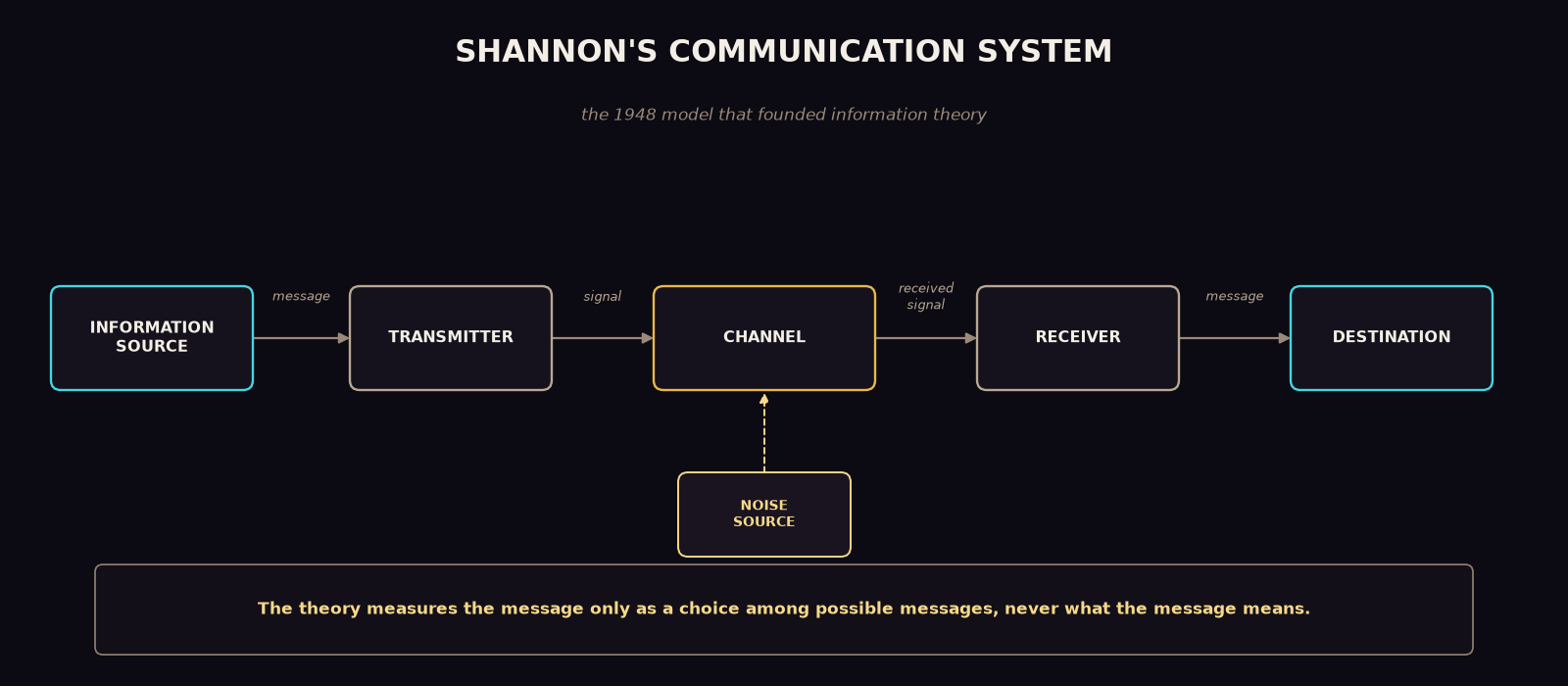
Shannon's 1948 paper contained two theorems that, between them, built the digital age. The first, the source-coding theorem, is the compression result just seen: data can be squeezed down to its entropy, and no further. Every lossless format you use, ZIP, PNG, the FLAC in a music library, is an attempt to reach that Shannon limit; lossy formats like JPEG and MP3 deliberately go below it, discarding detail your eyes and ears are unlikely to miss, a trade-off Shannon also made rigorous in his 1959 theory of rate and distortion. The second theorem is deeper, and at the time genuinely shocking. Shannon's model of communication, drawn at the top of this page, runs from an information source through a transmitter, across a noisy channel, to a receiver and a destination, with noise corrupting the signal on the way. Common sense says noise must always degrade a message: push faster, or accept a noisier line, and you must accept more errors. Shannon proved common sense wrong. Every channel has a capacity, a maximum rate in bits per second (for a simple channel, the bandwidth times the logarithm of one plus the signal-to-noise ratio), and at any rate below that capacity you can communicate with an error rate as close to zero as you wish, provided you encode cleverly enough. He proved that such near-perfect codes exist without showing how to build them; engineers spent the next half-century constructing codes that approach his bound, and today's 5G phones and deep-space probes run within about one decibel of the limit Shannon set in 1948. The error-correcting codes that make it possible, Reed-Solomon and its relatives, are why a scratched CD still plays, a smudged QR code still scans, and the Voyager spacecraft can still whisper data across billions of miles of noise. Shannon returned to communication's other half the next year: in a 1949 companion paper he proved that perfect secrecy is genuinely achievable, a 'one-time pad,' a truly random key as long as the message and never reused, is provably impossible to break.
04What the Bit Is Not
Now the single most important thing to understand about Shannon's information, and the thing most often gotten wrong. Shannon's theory says nothing whatsoever about what a message means. This was not an oversight; it was the founding move of the entire field, and Shannon stated it plainly in the 1948 paper itself: 'Frequently the messages have meaning... These semantic aspects of communication are irrelevant to the engineering problem. The significant aspect is that the actual message is one selected from a set of possible messages.' A bit measures choice, the resolution of uncertainty among possibilities, and nothing else. The sentence 'the meeting is at noon' and a random string of the same length can carry exactly the same number of Shannon bits, even though one means something and the other means nothing at all. This is why it is a mistake, however common, to speak of Shannon information as though it measured meaning, understanding, knowledge, or content. It does not, and it was carefully built not to. The strange power of the theory flows directly from this austerity: by refusing to ask what messages mean, Shannon uncovered laws that govern all of them equally, the profound message and the meaningless one alike. Any claim that the bit captures significance is not an extension of Shannon's theory but a misreading of its very first sentence.
05Information and Heat
There is one place where Shannon's abstract bits touch the physical world in a genuinely deep way, and it is worth stating exactly, because it is so often overstated. Shannon's entropy has the identical mathematical form as the entropy of thermodynamics, the quantity that measures disorder and drives the second law, the reason heat flows from hot to cold and time seems to run one way. For a long while this looked like nothing more than a suggestive coincidence of formulas. Then, in 1961, Rolf Landauer proved a real bridge between them: erasing a single bit of information must release a tiny but definite amount of heat, about 3 x 10^-21 joules at room temperature, no matter how the erasure is performed. This is Landauer's principle, and it was confirmed in the laboratory in 2012. It also resolves a puzzle a century old, Maxwell's 'demon,' an imagined being that seemed able to break the second law by sorting fast and slow molecules; the demon must eventually erase the records it keeps, and paying Landauer's price restores the balance. So information and thermodynamic entropy are genuinely linked, at exactly this one proven point. But that narrow, real bridge is not a license to declare the two 'the same thing.' Shannon entropy counts uncertainty among possible messages; thermodynamic entropy counts the microscopic states available to a physical system. They share a formula and one rigorous connection, and casually equating them beyond that is a popular overreach, not a result. The honest statement is the precise one: analogous mathematics, distinct concepts, and a single proven link between them.
06The Reach, and the Edge
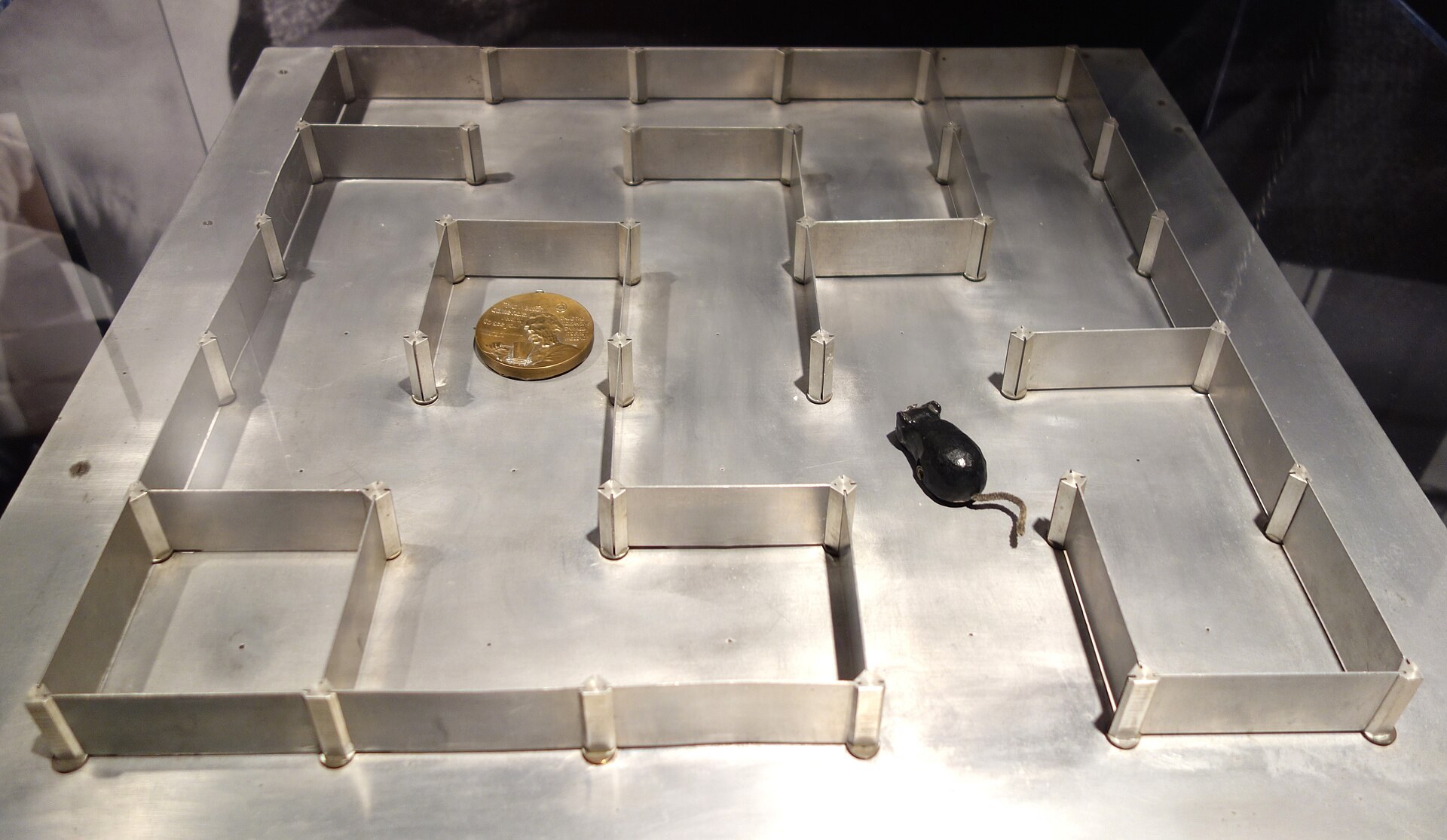
From these foundations, information theory spread into nearly every science. The genetic code is now read as information, roughly two bits per rung of the DNA ladder, complete with its own error-correcting redundancy. Neuroscientists count the bits a nerve carries; statisticians use 'mutual information' to measure what one variable reveals about another; and modern machine learning is threaded through with information-theoretic ideas about compressing away the irrelevant. Shannon himself loved to build as much as to prove: in 1950 he made Theseus, a mechanical mouse that learned its way through a maze by trial and error and then ran it flawlessly, an early, tangible machine that learns. At the field's speculative edge, information reaches toward the deepest questions there are. Quantum information replaces the bit with the 'qubit,' which can be a blend of 0 and 1 at once. The entropy of a black hole turns out to be set by the area of its horizon rather than its volume, hinting that a region's capacity for information is somehow written on its boundary, and the fate of information that falls into a black hole remains one of physics' genuinely unsolved problems. And the physicist John Wheeler distilled a lifetime's wonder into a phrase, 'it from bit,' the radical proposal that physical reality itself might, at bottom, be made of information. It is essential to keep the line clear. Shannon's own theory is proven, exact, and world-building. The leap from 'information is a superb way to describe reality' to 'reality is made of information' is a real and serious idea, but a separate and unproven one, taken up directly in this wing's own article on information as fundamental reality. Here it is enough, and more than enough, that one man, asking a deliberately narrow question in 1948, found a law obeyed by everything that communicates, from a phone call to a strand of DNA to a signal from the edge of the solar system.
Fast Facts
- The paper
- Claude Shannon's 'A Mathematical Theory of Communication' (Bell System Technical Journal, 1948), which created information theory and made information a measurable quantity
- The bit
- The unit of information, the answer to one equally-likely yes-or-no question; the word was coined by John Tukey in a 1947 Bell Labs memo, and Shannon credited him
- Entropy
- H = the negative sum of p log p; the average bits per message, largest when outcomes are equally likely, zero when one is certain. It is the exact limit of lossless compression
- Two theorems
- Source coding (data compress to their entropy, no further, ZIP/PNG/FLAC) and noisy-channel coding (error-free transmission is possible up to a channel's capacity, 5G and Voyager run within ~1 dB of it)
- NOT meaning
- Shannon's bit measures choice among possible messages, never meaning, understanding, or content. He excluded semantics deliberately, and said so in the 1948 paper
- Information and heat
- Landauer's principle (1961, confirmed 2012): erasing one bit releases a minimum of heat (about 3 x 10^-21 joules). This is the ONE proven bridge to thermodynamic entropy, not a license to equate the two
- The frontier (Tier 3)
- Quantum information (qubits), black-hole entropy and the holographic principle, and Wheeler's 'it from bit' are serious but unresolved, deferred to this wing's article on information as reality
- Refused
- That the bit measures meaning; that Shannon entropy just IS thermodynamic entropy; and that information theory alone proves a simulated universe or that consciousness is 'just information'
What We Can Actually Stand Behind
The core is settled, and among the most consequential mathematics of the twentieth century. Shannon's 1948 theory made information a measurable quantity (the bit); his entropy formula gives the exact limit of lossless compression; and his noisy-channel theorem proved that error-free communication is possible at any rate below a channel's capacity. These results underpin every digital device, from ZIP files to 5G to the Voyager probes. And Shannon's deliberate exclusion of meaning from the theory is on his own explicit record.
Information theory's reach into other sciences is real and productive. Landauer's principle, the proven result that erasing a bit costs a minimum of heat, is established and was confirmed experimentally in 2012. Kolmogorov complexity, information measures in genetics and neuroscience, and mutual information and the information-bottleneck view of machine learning are all serious, working tools, credible and active rather than closed.
The frontier is genuinely open. Quantum information, the informational reading of black-hole entropy and the holographic principle, and John Wheeler's 'it from bit' proposal that reality is fundamentally informational are serious but unresolved ideas, and the black-hole information paradox in particular is still an active, unsettled problem in physics. These belong to this wing's dedicated article on information as reality, not to Shannon's proven engineering theory.
Two conflations are refused. First, Shannon's bit does not measure meaning, understanding, or content; Shannon excluded semantics on purpose and said so in 1948. Second, Shannon (information) entropy and thermodynamic entropy are not simply 'the same thing': they share a formula and exactly one proven bridge, Landauer's principle, and equating them further is overreach. And information theory does not, by itself, prove the universe is a simulation or that consciousness is 'just information processing.'
Shannon and the bit open the band of The Gold Thread that treats information as a real, measurable substance, and they anchor it because Shannon's is the one place where the wing's boldest theme, that reality might be, at bottom, informational, rests on something completely solid. The solid part is this: in a single 1948 paper, one man turned the vague old notion of 'information' into a precise quantity with exact laws, and those laws turned out to govern everything that communicates, from a whispered word to a genome to a faint signal from the edge of the solar system. That much is proven, world-shaping, and genuinely beautiful. The tempting further step, that because information describes reality so well, reality must therefore be made of information, is a real and serious question, and a different one, which the thread will follow in its own place. For now it is enough, and more than enough, to sit with the smaller marvel: that surprise itself can be counted, in bits, and that from that one austere idea the whole digital world was built.
Sources & further reading
Everything above is drawn from our research library on Theories of Anything. Open the full file to check the sourcing and go deeper.
Image credits
- Shannon's communication system (original diagram) Original diagram by Theories of Anything. CC BY-SA 4.0 Source.
- Claude Shannon Tekniska museet (Sweden), via Wikimedia Commons. CC BY 2.0 Source.
- The binary entropy function H(p) Brona and Alessio Damato, via Wikimedia Commons. CC BY-SA 3.0 Source.
- Theseus, Claude Shannon's maze-solving mouse (MIT Museum) Daderot, via Wikimedia Commons (CC0). CC0 Source.
- Card crop of Shannon's communication-system diagram Original diagram by Theories of Anything. CC BY-SA 4.0
.jpg)

