
Rise of the Robots: Humanoids and the Automated World
In December 1954 George Devol filed a patent on a machine he called Programmed Article Transfer. It was granted in June 1961, and that same year a hydraulic arm went to work unloading a die-casting press at a General Motors plant in New Jersey. Sixty-five years after that arm, the industry's own trade association counts 4,664,000 industrial robots in operational use on 2024 data, and a 2019 review in Science says that dexterous manipulation remains an open problem. This page is about physical work: what robots actually do, where they actually are, why a machine that welds car bodies all day still cannot reliably pick up an object it has not been shown before, and the difference between a demonstration and a job. It corrects our own research file on six points, refuses the numbers it could not verify at a primary source, and lays the employment evidence out at a spread of a factor of five without picking one.
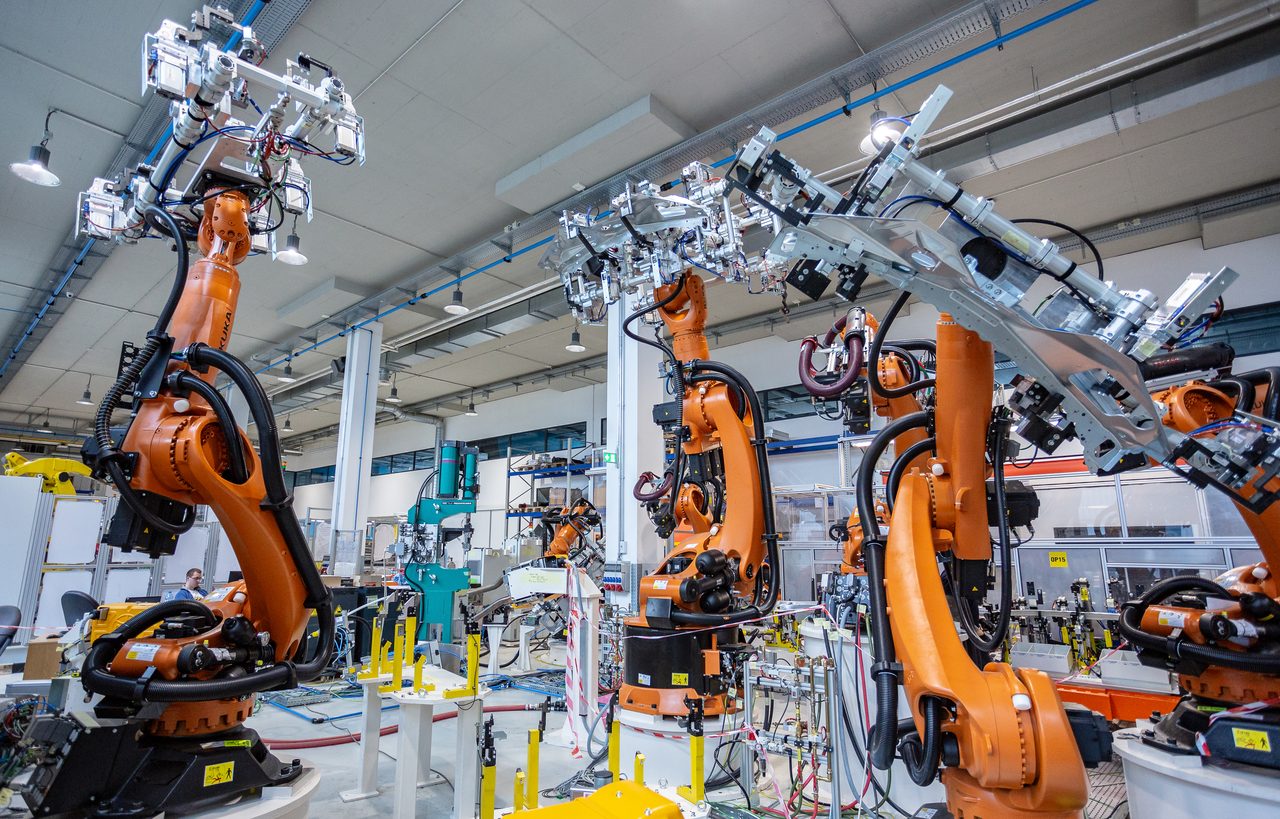
Almost everything written about robots is written about the ones that do not exist yet. This page is about the ones that do. They are mostly arms bolted to a floor, they mostly move metal, and there are millions of them. The interesting thing about them is not that they are getting cleverer. It is that after sixty-five years of continuous industrial deployment, a machine that welds car bodies all day still cannot reliably pick up an object it has not been shown before. That gap, between moving mass along a known path and touching an unknown thing, is where every hard question in this subject lives, and it is the reason the last five years of humanoid footage have produced so few documented jobs.
A note on the badges below, because they mean something narrower here than usual. Our own research file on this subject grades a small number of its claims on the four-tier scale this site uses, and this page carries those grades unchanged, including one it cannot support in full. Most of what follows is not in that file at all. It is external evidence gathered for this page, and it is set in plain text with its provenance in the sentence rather than dressed in a grade our file never gave it. Three of the badges below are a stated exception to that. Our file's graded sections carry only two claims, on productivity and on Moravec's paradox; the first installation, the operational stock and the collaborative-robot date are asserted as established fact in its summary instead, where the file grades nothing, and each of those three says so in its own tag. The file is also corrected here in six places, each disclosed where it happens. The largest is a reversal: our file describes the methodologies of the two most cited studies of automation and employment the wrong way round, which makes the two numbers everyone quotes incomparable as it states them.
01Programmed Article Transfer
The industrial robot arrives in the world under a name that describes a conveyor, and the first one installed goes to work at the hot end of the plant. Both facts are worth more than they look.
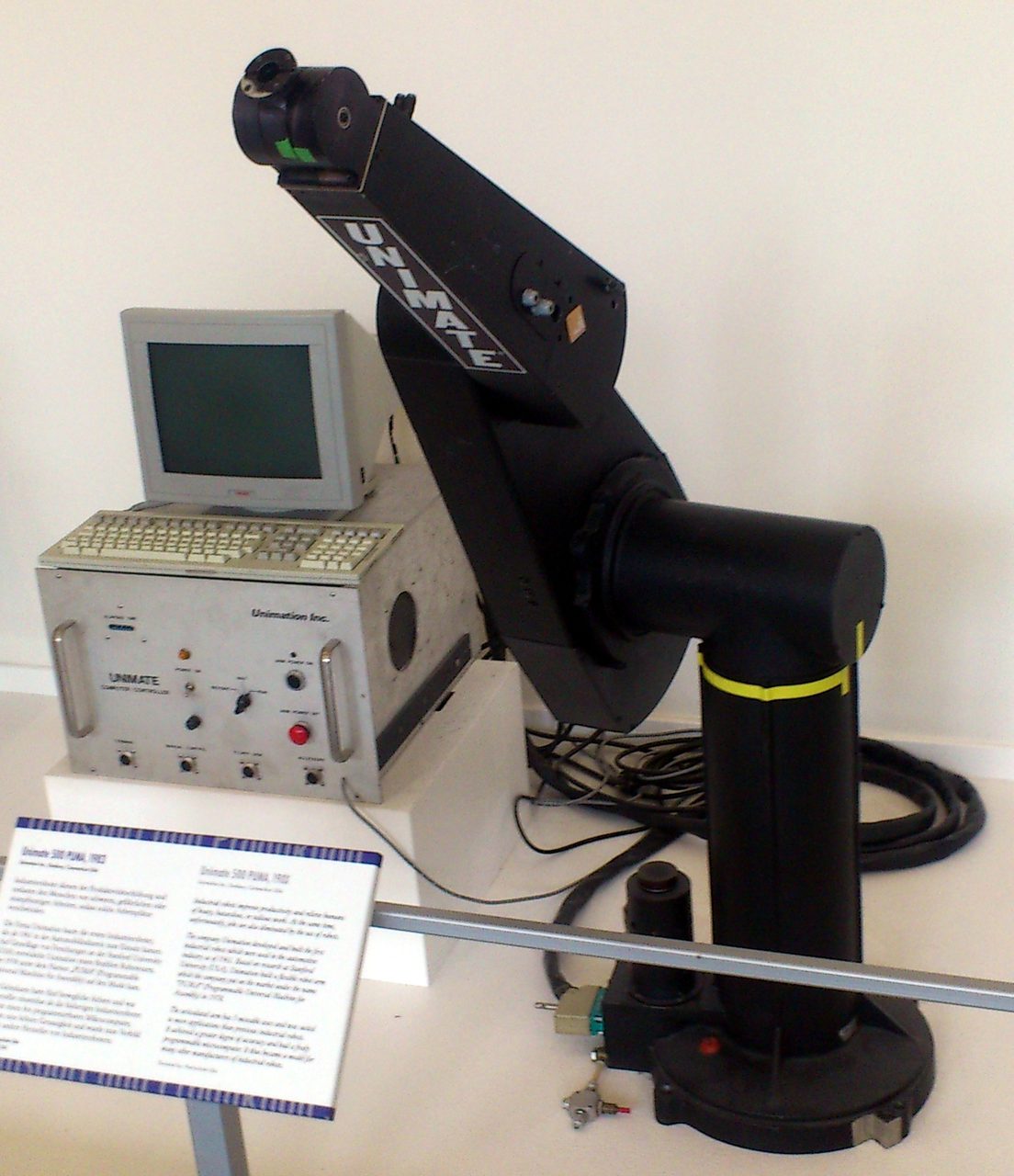
Our research file states that the first industrial robot arm was installed at a General Motors factory for die casting in 1961. The machine survives, and the object record of the institution that holds it, The Henry Ford in Dearborn, Michigan, is more specific: 'Unimate made the first successful industrial robots, and this is the first Unimate robot ever installed on an assembly line. The robot unloaded a die-casting press at the General Motors Ternstedt Division plant in Trenton, New Jersey in 1961. A hydraulically activated arm makes this an electro-hydraulic robot.' The same record names three creators: George C. Devol, who lived from 1912 to 2011 and held the patent; Joseph F. Engelberger, 1925 to 2015, who built the company that sold the machine; and Unimation, Inc. Our file names neither man anywhere. The plant is given elsewhere as the Inland Fisher Guide plant in Ewing Township, which adjoins Trenton; those are the same General Motors operation under different divisional names across the period and not a second fact, and the museum's own wording is used here. Note what the robot did. It unloaded a die-casting press: hot, heavy, repetitive and dangerous. Sixty-five years later that is still the honest centre of gravity of the whole industry.
The patent underneath it is a better document than the story usually allows. George C. Devol Jr filed it on 10 December 1954 and it was granted on 13 June 1961 as US Patent 2,988,237. Its title is Programmed Article Transfer, and the title does not contain the word robot. The specification opens: 'The present invention relates to the automatic operation of machinery, particularly to automatically operable materials handling apparatus, and to automatic control apparatus suitable for such machinery.' Two things follow from that. The filing and the grant are seven years apart, and a great deal of writing on this subject collapses them into a single date. And the founding invention of the field was conceived, described and registered as materials handling. Everything the word robot now carries was attached to it afterwards.
Our file's own opening definition is the one to keep. Robotics, it says, 'integrates mechanical engineering, electrical engineering, and computer science to create machines capable of autonomous or semi-autonomous physical action'. The load-bearing word is physical. A robot has to move mass through a world that will not hold still, on an energy budget, without breaking itself or anyone standing near it, and every difficulty on this page follows from that one sentence. The field's standard reference work, the Springer Handbook of Robotics edited by Bruno Siciliano and Oussama Khatib, is a catalogue of the consequences.
The other thing everyone knows about robots is also slightly wrong. Asimov's Three Laws of Robotics were not first stated in I, Robot, which is the only Asimov entry in our own file's bibliography, in a document that never mentions the Laws at all. The Science Fiction Encyclopedia records that they 'were formally stated by Asimov in his story "Runaround" (March 1942 Astounding).' I, Robot is the 1950 collection that reprinted the story. The same entry records something better: 'Asimov credited John W Campbell Jr with the formulation of all three laws in a December 1940 conversation; Campbell, however, felt that the laws were already implicit in the early Asimov Robot stories beginning with "Strange Playfellow" (September 1940 Super Science Stories; vt "Robbie" in I, Robot, coll 1950).' The rules everyone cites are eight years older than the book they are cited to, and the man who wrote them said he did not invent them while the man he credited thought there had been nothing there to invent.
They are also not engineering, and it is worth saying so plainly rather than leaving it implied. Nothing in the evidence gathered for this page supports the Three Laws as a design principle. They are a plot device that generated stories by failing, and no robot described anywhere on this page implements anything resembling them. What actually keeps a robot from hurting the person next to it is a technical specification with measured limits for the human body. ISO/TS 15066:2016, Robots and robotic devices, Collaborative robots, supplements ISO 10218-1 and ISO 10218-2 and defines four modes of collaborative operation: safety-rated monitored stop, hand guiding, speed and separation monitoring, and power and force limiting. In 2016 it set out biomechanical limits for the human body, which the technical summaries read for this page describe as a first for a robotics standard, and that is what makes a robot without a safety cage both legally and physically possible. A limit belongs here: nothing in this paragraph was read from the standard itself, because the standard's own catalogue page refuses non-browser clients, so the designation, the year, the relationship to ISO 10218 and the four modes all come from technical summaries. ISO 10218 was itself revised in 2025, and that date is the least firmly held thing on this page.
02Where The Robots Actually Are
Numbers in this subject rot fast, and they rot in one direction: yesterday's announcement becomes today's assumed fact. Every figure below carries the year of the data and the year of the report in the same sentence, because that discipline is exactly what our own file did not apply, and its absence is why our file's figures are wrong.
The International Federation of Robotics reports that 'The total number of industrial robots in operational use worldwide was 4,664,000 units in 2024', an increase of 9 percent on the previous year. That figure comes from the association's press release for World Robotics 2025, dated 25 September 2025. Our own research file gives about 3.9 million and presents it as today's number. 3.9 million is the 2022 stock as published in the 2023 edition of the same report, so the file is two report cycles behind and does not say which cycle it is quoting. Who is counting matters here. The IFR is the robotics industry's own trade association, World Robotics is a paid report, and this page read only the free press release. The stock figure is an estimate assembled from member and national-association reporting rather than a census, and the association has a commercial interest in the number being large.
The distribution is more surprising than the total. The IFR gives 542,000 industrial robots installed worldwide in 2024, 'more than double the number 10 years ago', with annual installations above 500,000 for the fourth consecutive year. In a separate sentence the same release states: 'Asia accounted for 74% of new deployments in 2024, compared with 16% in Europe and 9% in the Americas.' China alone installed 295,000 of them; Japan 44,500; the United States 34,200, which is a fall of 9 percent; and all of Europe 85,000, of which Germany took 26,982. The two quoted sentences are not adjacent in the release and are given here as two quotations rather than joined into one.
Our file states what industrial robots are for in its summary rather than in its graded sections, and the task list is accurate and concrete: they 'perform welding, painting, assembly, pick-and-place, and inspection with high precision and speed'. It states the productivity case at the same level, and there is a measurement underneath it. Graetz and Michaels, studying robot adoption within industries across seventeen countries between 1993 and 2007, found that increased robot use 'contributed approximately 0.36 percentage points to annual labor productivity growth, while at the same time raising total factor productivity and lowering output prices'. The second half of our file's claim is a different matter. It says that adoption 'has increased output per worker while reducing workplace injuries in hazardous tasks (welding, painting, heavy lifting)', and it says so flat, with no source anywhere in the document. The evidence on the injury question points in both directions and it is set out in section 08. Our file also carries a per-facility robot count for automotive plants with no source anywhere in the document, and none was found for this page, so this page does not repeat it.
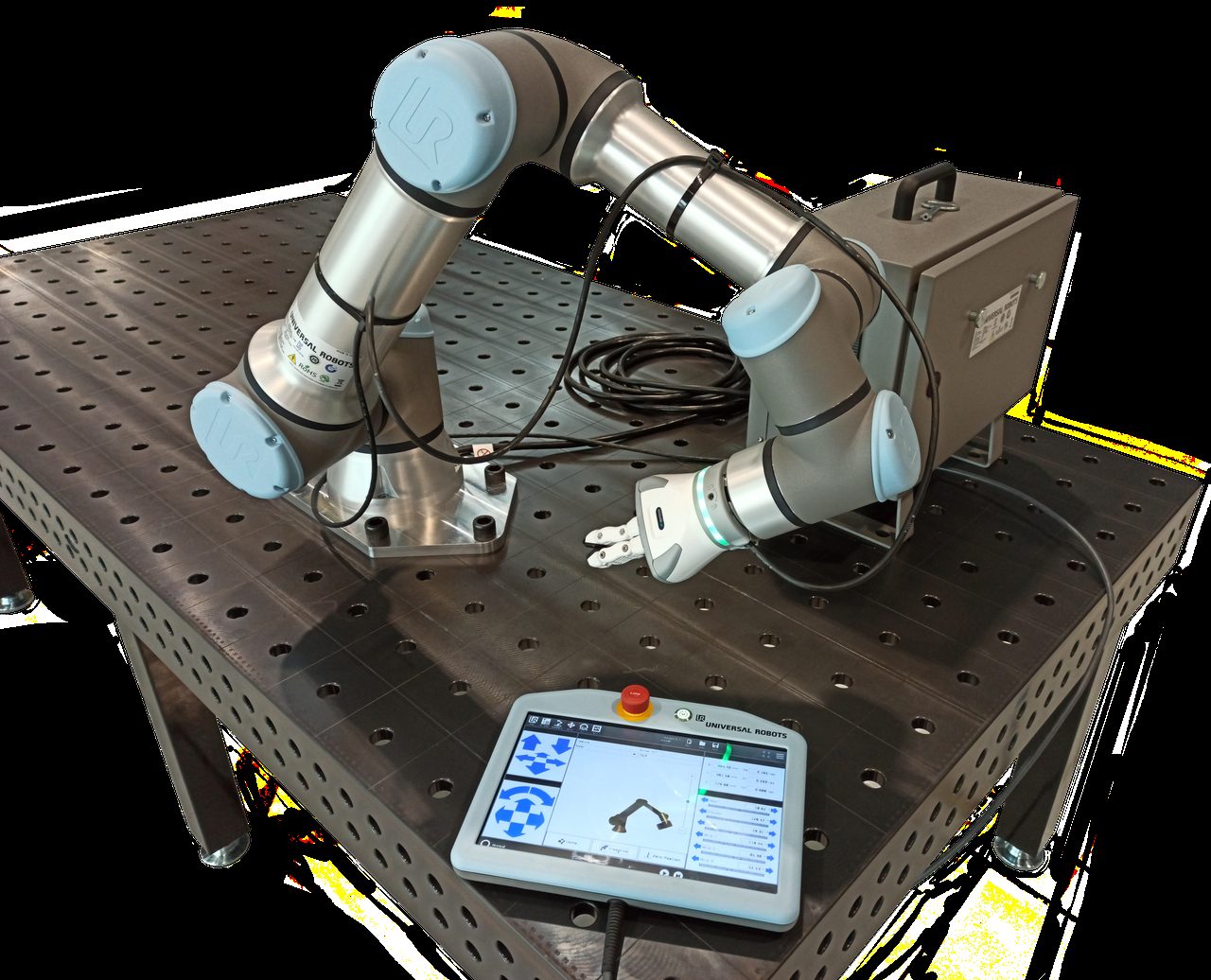
Our file also carries collaborative robots, and the date it gives is right. Universal Robots states on its own history page that the company 'is founded by Esben Ostergaard, Kasper Stoy, and Kristian Kassow, who met at the University of Southern Denmark', that its 'first product, launched in 2008, was the UR5, a six-jointed articulated robot arm', and that the founders 'created the world's first commercially viable collaborative robot (cobot)'. Three notes travel with that. Those are three separate statements on the page and not one sentence. The founders' surnames carry Danish diacritics in the original which this site's typography does not reproduce, and the plain-letter forms are used. And the third statement is a company making a primacy claim about its own product, which is why it appears here inside quotation marks rather than in this page's voice; the word cobot and the research behind it predate the UR5 by more than a decade. What is not in dispute is the consequence, and it is the interesting part. Taking the safety cage away is what opened industrial robotics to firms too small to build a cage, and that only became possible because of the standard in the section above.
Robot density is the measure the industry uses to compare countries: robots per 10,000 manufacturing employees. Our file gives South Korea at about 1,012, Japan at about 399 and Germany at about 397, and there are three separate defects in that one sentence. The figures are blended from two different report years, with Korea's from one edition and Japan's and Germany's from an earlier one built on 2021 data. Singapore is missing, and Singapore has been second in the world throughout. And all of it has been superseded. On 2024 data the IFR gives the Republic of Korea at 1,220, Singapore at 818, Germany at 449 and Japan at 446, and, further down the same ranking, the United States at 307, which the federation places eighth in the world, Chinese Taipei at 302, Switzerland at 294, Canada at 241, China at 166 and Mexico at 62. The regional averages are 267 for Western Europe, 231 for the European Union, 204 for North America and 131 for Asia, against a global average of 132. Korea sits at roughly nine times the global average, and that is the one fact in this paragraph that survives everything in the next one, because Korea's own denominator did not move. On the same report, China's operational stock passed two million units in 2024, the largest of any country, and Japan's rose 3 percent to 450,500, and they are stated as figures rather than quoted.
| Country Or Region | Robots Per 10,000 Manufacturing Employees, IFR On 2023 Data | IFR On 2024 Data |
|---|---|---|
| Republic of Korea | 1,012 | 1,220 |
| Singapore | 770 | 818 |
| Germany | 429 | 449 |
| Japan | 419 | 446 |
| United States | 295 | 307 |
| China | 470 | 166 |
| Asia, average | 182 | 131 |
| World, average | 162 | 132 |
Look at the China row. Its reported robot density was 470 on 2023 data and 166 on 2024 data, a fall of nearly two thirds in a single year, and nothing physical happened: China's operational stock passed two million units over the same period. The association's own release of 8 April 2026 explains it in one line: 'Based on updated labor market data issued by China's National Bureau of Statistics, China ranks 6th in Asia and 22nd worldwide.' The denominator moved. Robot density is a ratio, and a statistics bureau revising the number of people it counts as manufacturing employees changes the answer without a single machine being installed or removed. The global average fell from a reported record 162 to 132 for the same reason, and the average for Asia from 182 to 131. That is worth a paragraph of anyone's attention for two reasons. It is a working demonstration of how to read every other number on this page. And it is why our own file's density sentence went wrong: the file blended figures from two report years, which is exactly the operation a denominator revision punishes.
03The Paradox, And Its Critic
Hans Moravec wrote in Mind Children, published by Harvard University Press in 1988: 'It is comparatively easy to make computers exhibit adult level performance on intelligence tests or playing checkers, and difficult or impossible to give them the skills of a one-year-old when it comes to perception and mobility.' Our file grades that at its highest confidence level and draws the standard consequence: sensorimotor skill is the product of hundreds of millions of years of evolution while abstract reasoning is evolutionarily recent, so the things that feel effortless to a person are the things that are hardest to build. Two disclosures travel with the quotation. The book itself was not read for this page. The sentence is reproduced from an essay that quotes it and attributes it to the 1988 book, a widely circulated variant of it begins with a lower-case letter, and no page number is verified, so none is printed. And the paradox has a serious critic, whom our file does not carry anywhere.
The critic is Arvind Narayanan, who argues that 'Moravec's paradox has never been fact checked'. His case, stated here in this page's words rather than his, has three parts. The apparent inverse relationship between what is easy for people and what is easy for machines is selection bias: researchers only work on problems that are interesting, so tasks that are easy for both, or hard for both, drop out of view and never enter the pattern at all. Computer vision, the canonical example of a hard-for-machines task, broke through around 2012 to 2013. And symbolic reasoning, which Moravec put on the easy side, has turned out to work well only in closed domains and to fail on open-ended tasks that need common sense. Three qualifications belong in the same breath. This is a signed essay on the author's own publication rather than peer-reviewed work. It is one scholar's argument against a phrase almost everyone uses loosely. And it does not claim that manipulation is solved: every measurement in the next two sections says it is not. The honest reading is that the observation still holds and the explanation is contested, and this page carries both rather than choosing.
Driving is the other famous instance of the same difficulty, and our file's own statement of the paradox says as much: it 'explains why autonomous driving and dexterous manipulation have proven far harder than originally predicted'. The modern field starts with the DARPA Grand Challenge of 2004 and 2005, whose winning entry is documented in Thrun and twenty-nine co-authors, Stanley: The robot that won the DARPA Grand Challenge, in the Journal of Field Robotics in 2006. That sentence is the whole of what this page has to say about robot driving. It is a separate subject with a separate dossier queued in this wing, which owns perception, the argument between lidar and vision, and the long tail of driving edge cases. This page turns to the hands.
04The Hard Problem Of Hands
This is the section the article exists for. Everything above is prologue to a single fact: the part of robotics that has not worked is the part that touches things.
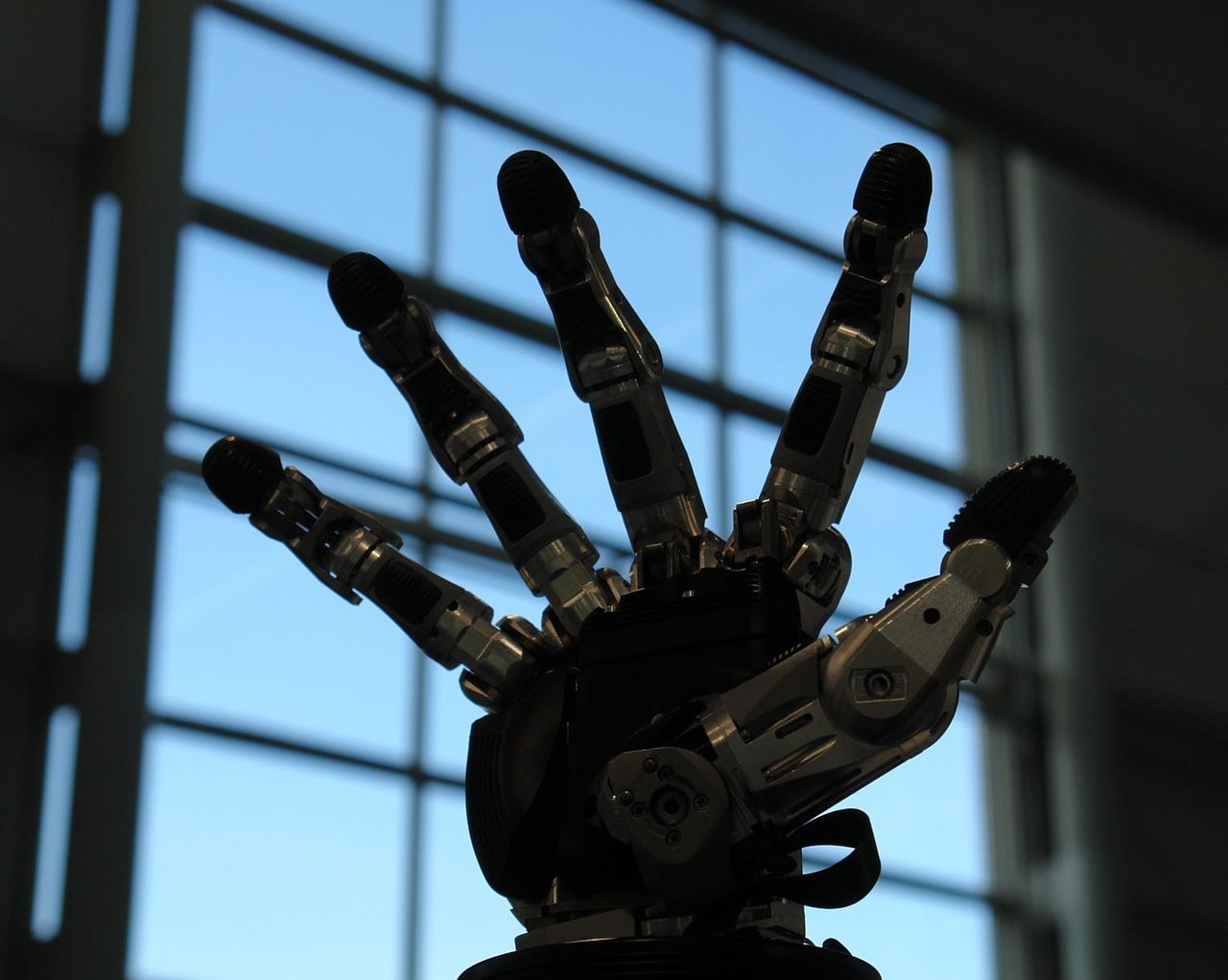
The anchor is a review in Science by Aude Billard of EPFL and Danica Kragic of KTH, published on 21 June 2019, which our own file should have cited and does not. It sets the arc: 'The first robot manipulators date back to the 1960s and are some of the first robotic devices ever constructed. In these early days, robotic manipulation consisted of carefully prescribed movement sequences that a robot would execute with no ability to adapt to a changing environment.' Sixty years on, the same review's summary of the state of the art sits in a different part of the abstract and is blunt: 'Despite many years of software and hardware development, achieving dexterous manipulation capabilities in robots remains an open problem'. That quotation stops there because the original continues after a punctuation mark this site's style does not reproduce; what it goes on to say is that it is an interesting problem. Two spans, two quotations, not joined.
Simulation does not close the gap, and the same review says why. Its own words are that 'grasping and dexterous manipulation require a level of reality that existing simulators are not yet able to deliver', and the quotation is cut there because the original continues after a punctuation mark this site does not carry; the example it gives is the modelling of contacts for soft and deformable objects. A second sentence in the same abstract goes further: 'achieving realistic simulation of friction, material deformation, and other physical properties may not be possible anytime soon, and real experimental evaluation will be unavoidable for learning to manipulate highly deformable objects'. Keep that in view for the next two paragraphs, because what makes them impressive is precisely that a policy got out of a simulator and onto real hardware.
In 2018 OpenAI reported a result that shows plainly what learning can do for a hand. Its abstract, quoted whole: 'We use reinforcement learning (RL) to learn dexterous in-hand manipulation policies which can perform vision-based object reorientation on a physical Shadow Dexterous Hand. The training is performed in a simulated environment in which we randomize many of the physical properties of the system like friction coefficients and an object's appearance. Our policies transfer to the physical robot despite being trained entirely in simulation. Our method does not rely on any human demonstrations, but many behaviors found in human manipulation emerge naturally, including finger gaiting, multi-finger coordination, and the controlled use of gravity.' The last phrase is the one to keep. A policy that was never shown a human hand rediscovered the trick of letting an object fall a little way and catching it.
The follow-up in 2019 is the one that escaped the laboratory, and the paper states its own limits plainly enough that the popular version is wrong in three separate ways at once. On the success rate: 'This corresponds to successfully solving a Rubik's cube that requires 15 face rotations 60% of the time and to solve a Rubik's cube that requires 26 face rotations 20% of the time.' On what the hand was doing: it did not work out the solution, because 'computing a solution sequence can easily be done with existing software libraries like the Kociemba solver.' And on what it could see: in the headline configuration the hand did not sense the cube's state by vision either, since 'the vision model is used to produce the cube position and rotation. For the face angles, we use the previously described customized Giiker cube with built-in sensors.' A vision-only variant exists and is reported separately in the same paper. Those three quotations come from three different sections and are not joined here. The result is real and it is impressive, and what it demonstrates is manipulation rather than solving: one time in five on a hard scramble, with an existing software library doing the thinking and a sensor-equipped cube reporting its own faces.
There is a structural reason the hands lag, and it can be stated as a number. The Open X-Embodiment collaboration reports: 'We assemble a dataset from 22 different robots collected through a collaboration between 21 institutions, demonstrating 527 skills (160266 tasks). We show that a high-capacity model trained on this data, which we call RT-X, exhibits positive transfer and improves the capabilities of multiple robots by leveraging experience from other platforms.' The task figure is printed in the original without a thousands separator; it is 160,266. The paper's framing question is the point, and it is quoted separately because it is not adjacent in the abstract: 'Conventionally, robotic learning methods train a separate model for every application, every robot, and even every environment.' Twenty-one institutions had to pool their data to train one model, and 160,266 tasks is a trivially small corpus beside the ones behind today's text systems. Robot data has to be produced by a robot moving in the real world, one attempt at a time, and that is the binding constraint this whole section has been circling.
What web knowledge buys a robot is worth one paragraph and no more, because the machinery behind it belongs to this wing's separate dossier on large language models. RT-2, posted on 28 July 2023, describes actions as being, in a clause lifted from a longer sentence in its abstract, 'expressed as text tokens and incorporated directly into the training set of the model in the same way as natural language tokens'. Over 6,000 evaluation trials the paper reports 'significantly improved generalization to novel objects, the ability to interpret commands not present in the robot training data (such as placing an object onto a particular number or icon), and the ability to perform rudimentary reasoning in response to user commands (such as picking up the smallest or largest object, or the one closest to another object).' The honest gloss is short. This lets a robot know what a banana is without ever having been shown one in the laboratory. It does not let the robot pick the banana up reliably.
Two positions on where this goes were published within five months of each other in 2025, and they contradict each other. Rodney Brooks, one of the founding figures of the field, argues that the current humanoid programme cannot reach human dexterity because it is training on the wrong data. 'Human dexterity relies on a rich sense of touch. And dexterity for humans involves more than just their hands; it often involves their elbows, the fronts of the bodies, legs, and feet.' And: 'Collecting just visual data is not collecting the right data. There is so much more going into human dexterity that visual data completely leaves out.' The emphasis on right data in that sentence is Brooks' own and is reproduced as he set it. He names the companies in a sentence that is grammatically odd in the original and is not tidied here: 'Both Figure and Tesla are all in on videos of people doing things with their hands are all that is needed to train humanoid robots to do things with their hands.' He also holds that the first profitable deployment of humanoid robots is more than ten years away even with minimal dexterity; that is a prediction, it is stated here in this page's own words rather than quoted, and forecasting belongs to The Singularity rather than to this page. Three qualifications: this is a signed essay rather than peer-reviewed work, it is by someone with a long public record of arguing that robotics timelines are too optimistic and with commercial history of his own in the field, and it is an argument about method rather than a measurement.
Five months earlier the laboratory Physical Intelligence had posted the opposite trajectory. Its model pi-0.5, released on 22 April 2025, reports: 'Our experiments show that this kind of knowledge transfer is essential for effective generalization, and we demonstrate for the first time that an end-to-end learning-enabled robotic system can perform long-horizon and dexterous manipulation skills, such as cleaning a kitchen or bedroom, in entirely new homes.' The method is co-training on heterogeneous data: multiple robots, high-level semantic prediction, web data and other sources. Three things belong in the same breath as that sentence. It is a preprint. The claim to be first is made by the laboratory that built the system, with no independent replication cited. And the abstract carries no success rate at all, which is exactly the quantity the Rubik's cube result shows matters most. Set the two side by side and neither is settled. Brooks says the data is wrong in principle; a laboratory says it has already generalised to homes it has never seen; both were published in 2025; and this page declines to crown either.
05Legs, And Whether The Shape Is Right
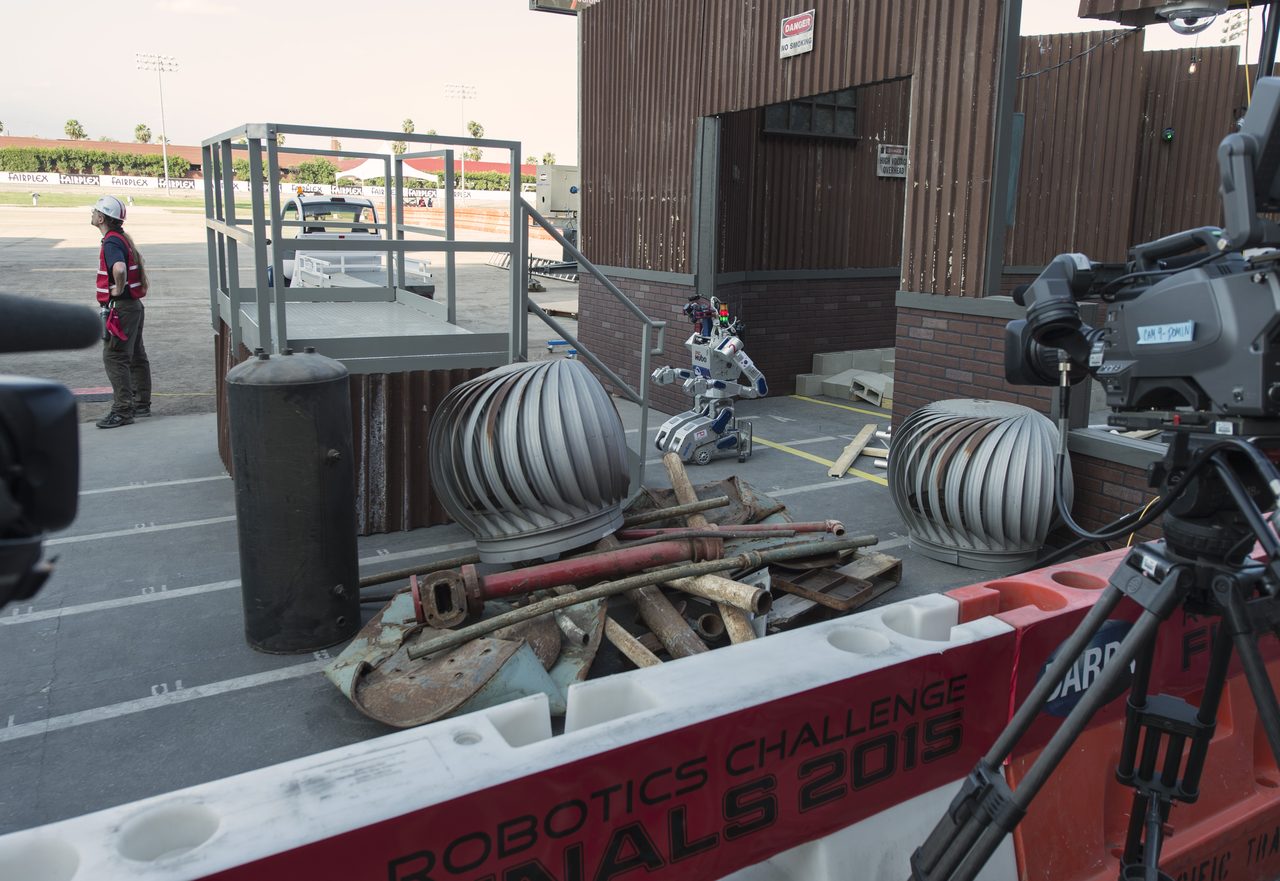
The evidence this page most trusts about what humanoid robots can and cannot do is not a video. It is the peer-reviewed post-mortem of the 2015 DARPA Robotics Challenge Finals, written by the WPI-CMU team with self-reports from many of the competing teams and published as a chapter in a Springer volume in 2018. Its first conclusion is the one worth carrying: in the authors' words, 'Reducing operator errors is the most cost effective way to improve robot performance'. The second large lever they name is 'super-human sensing'. Third, they argue the field needs 'paradigm shifts', including an emphasis on 'consistent real world results' rather than on videos of rare successes; that last clause is this page's paraphrase and only the quoted phrase belongs to the authors. The chapter also records that their own team was the only one in the Finals that attempted all tasks, scored points, required no physical human intervention and did not fall in either of its two missions. A provenance note, because it matters here more than usual: the chapter sits behind an identity provider, its abstract was read through an institutional repository record that interleaves quoted fragments with its own connective prose, and the fragments above are therefore given separately and are never joined into one sentence. The finding reframes the whole humanoid question. The great embarrassment of 2015 was not that the robots were stupid. It was that people made mistakes and the robots fell over.
The one measurement of whole-body humanoid competence available for this page comes from simulation. HumanoidBench, posted in March 2024, is a simulated benchmark of whole-body locomotion and manipulation with a humanoid robot equipped with dexterous hands. It reports that 'Our findings reveal that state-of-the-art reinforcement learning algorithms struggle with most tasks, whereas a hierarchical learning approach achieves superior performance when supported by robust low-level policies, such as walking or reaching.' Its stated motivation is that 'research in humanoid robots is often bottlenecked by the costly and fragile hardware setups.' Three qualifications. A benchmark result measures algorithms on that benchmark and is not a verdict on any commercial machine. It is over two years old in a field that moves. And it is a simulation, which is the friendlier world, so failing in simulation is worse news than failing on hardware rather than better.
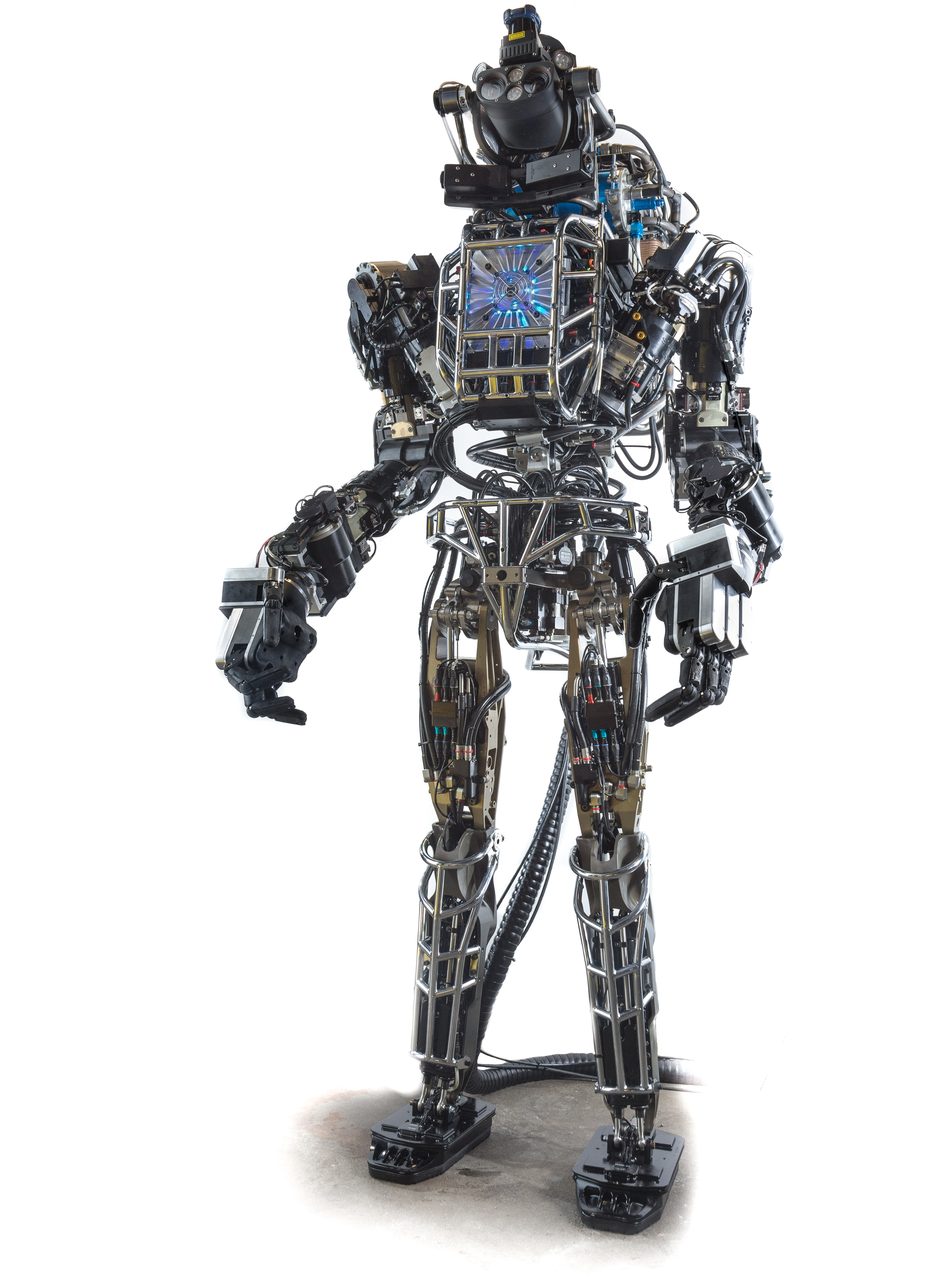
The robot in most people's heads no longer exists. In April 2024 Boston Dynamics announced, in its own words, 'This week we announced the retirement of our hydraulic Atlas and unveiled what comes next'. The rest is paraphrased rather than quoted, because the company's sentences use a punctuation mark this site's style does not reproduce and repunctuating inside quotation marks would be an edit. The successor is a fully electric Atlas which the company frames commercially and describes as designed for real-world applications; that phrase is a marketing claim rather than a demonstrated capability, and nothing on the company's page shows the new machine doing work. The company names Hyundai as its first partner and as a testing ground for new Atlas applications. What is verifiable is the retirement, which is a fact about a machine that no longer runs, and the corporate relationship, which is a fact about a contract. Our own file has Atlas performing parkour in the present tense. The blog post carries no visible date beyond the month, so no day is given here.
Our file puts general-purpose humanoids at its Speculative grade and states the case there: 'The vision of humanoid robots performing arbitrary physical tasks in unstructured environments (household chores, elder care, warehouse work) is the goal of multiple companies (Tesla Optimus, Figure AI, 1X Technologies)', and 'dramatic recent progress in locomotion (Atlas parkour) and manipulation (learning-based grasp planning) makes this more plausible than a decade ago'. The file finishes that same sentence with the caveat, and it belongs in the same breath: 'achieving human-level dexterity, robustness, and common-sense physical reasoning at affordable cost remains a major unsolved challenge'. There are four separate conditions in that clause and one of them is cost. The neutral statement of the case for the human shape comes from the benchmark paper rather than from anyone selling a robot: humanoids 'hold great promise in assisting humans in diverse environments and tasks, due to their flexibility and adaptability leveraging human-like morphology.' Every version of the argument found from a manufacturer for this page was unverifiable marketing, so what is being reported here is a rationale rather than a finding.
Our file argues the other side too, and the sharpest sentence in the whole document is eleven words long. Its counter-arguments make three moves, given here in paraphrase because the file's bullets use a punctuation mark this site does not reproduce and paraphrasing is honest where silently repunctuating inside quotation marks would not be. Robotics progress has consistently been slower than optimistic predictions, and the history of the field is littered with failed timelines, which suggests that physical intelligence is far harder than digital intelligence. The economic case is uncertain, because specialised robots such as arms, drones and autonomous vehicles may be more cost-effective for most applications than general-purpose humanoids, and, in the file's own words, 'the human body plan is not necessarily optimal for industrial tasks'. And the ethical objections run past employment to accountability, dignity and military use. Only that one clause is quoted, because it is the only one that contains no dash, and it happens to be the best thing in the document.
06Shapes That Are Not Ours
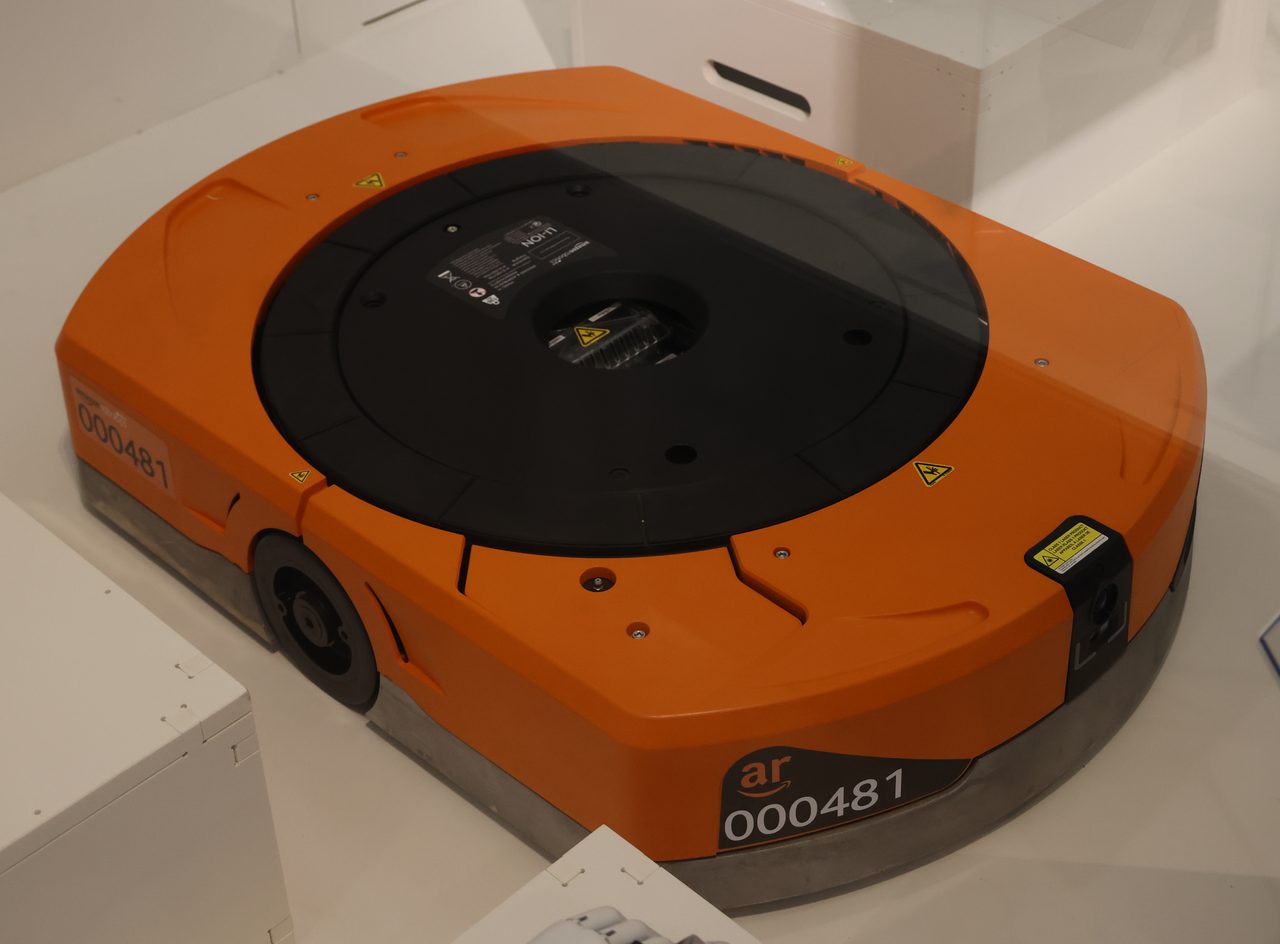
A million working robots, and not one of them shaped like a person. Amazon announced in July 2025: 'Amazon has deployed its one millionth robot in its operations.' It added: 'This milestone robot was recently delivered to a fulfillment center in Japan, joining our global network that now spans more than 300 facilities worldwide.' It also announced a machine-learning system for coordinating the fleet which it says is 'improving the travel time of our robotic fleet by 10%', and stated that 'Over 700,000 employees have been upskilled through training programs that prepare its workforce for the future.' Every one of those figures is the company's own, including the 10 percent and the 700,000, and the upskilling number is a corporate-responsibility metric with no external audit named. The newsroom page carries no visible publication date, which is why the month here is approximate. What is remarkable is not the count. It is the shape. The machines doing the moving are wheeled drive units that carry shelves, and the company built its network out of those rather than out of anything with arms and legs.
The second alternative to the human shape has better credentials than a contrarian argument. It is a review in Nature. Daniela Rus and Michael Tolley set the case out in 2015: 'Conventionally, engineers have employed rigid materials to fabricate precise, predictable robotic systems, which are easily modelled as rigid members connected at discrete joints. Natural systems, however, often match or exceed the performance of robotic systems with deformable bodies. Cephalopods, for example, achieve amazing feats of manipulation and locomotion without a skeleton; even vertebrates such as humans achieve dynamic gaits by storing elastic energy in their compliant bones and soft tissues.' The review's own example is an animal with no skeleton at all, and the point it makes is that the rigid-link body plan robotics inherited is a modelling convenience rather than a law of nature.
The extreme case was built. Wehner and colleagues reported in Nature in 2016 'the untethered operation of a robot composed solely of soft materials'. It has no electronics and no battery: 'The robot is controlled with microfluidic logic that autonomously regulates fluid flow and, hence, catalytic decomposition of an on-board monopropellant fuel supply. Gas generated from the fuel decomposition inflates fluidic networks downstream of the reaction sites, resulting in actuation.' Its body and its logic were made by moulding, soft lithography and multi-material embedded 3D printing, and its features 'span several orders of magnitude from the microscale to the macroscale'. A machine whose computer is a set of valves and whose muscles are inflated by a chemical reaction is an existence proof and not a product. The abstract claims no more than laying the foundation for completely soft, autonomous robots, and a decade later nothing built this way does industrial work.
The third alternative is to give up on the single machine. Michael Rubenstein, Alejandro Cornejo and Radhika Nagpal reported programmable self-assembly in a thousand-robot swarm in Science in 2014. The system forms complex shapes using only local information, with each robot communicating with its nearby neighbours, and it includes algorithms to cope with disruption from collisions and from variation in individual robot performance. Nothing from that paper is quoted here, because the publisher elides its abstract on every record this page could reach. The framing reference for the field is Brambilla, Ferrante, Birattari and Dorigo's 2013 review, which our own file cites with no identifier at all; the identifier exists and is carried below. Swarm robotics is the least commercially realised of the three alternatives in this section, and it belongs here because it is the third answer to the same question. If the human body plan is not the right one, what is on the table is a rigid arm, a soft body, or a thousand cheap things acting together.
07Demonstrated, Deployed, Announced
Every capability claim about a robot is one of three things, and almost nothing written about the subject keeps them apart. It is demonstrated and measured, with a number and a denominator. It is deployed and documented by a customer rather than by a vendor. Or it is announced. This section sorts the humanoid record into those three boxes, and the sorting is most of the value.
The earliest humanoid deployment this page could document from a primary document is a small one. GXO Logistics announced on 27 June 2024 what it and Agility Robotics call 'both the industry's first formal commercial deployment of humanoid robots and first Robots-as-a-Service (RaaS) deployment of humanoid robots'. That is a primacy claim by the two companies making the deal, about the deal they made. What the release describes precisely is the work: 'Digit robots are assisting with repetitive tasks such as moving totes from cobots and placing them onto conveyors', at a SPANX facility, and 'As part of the RaaS agreement, GXO is deploying Digit robots and Agility Arc, Agility's cloud automation platform for deploying and managing Digit fleets.' The release does not say how many robots there are. It does not state the financial terms. It gives no performance metrics. The task is the story and it should be told without a raised eyebrow: the first contracted humanoid work this page could document is lifting a plastic tote off one machine and putting it on another.
The strongest single document this page found is a press release that contradicts itself in public, and the contradiction is not a mistake. BMW's release of 6 August 2024 reports: 'The BMW Group is exploring the use of humanoid robots in production for the first time. During a trial run lasting several weeks at BMW Group Plant Spartanburg, the latest humanoid robot, Figure 02 from California company Figure, successfully inserted sheet metal parts into specific fixtures, which were then assembled as part of the chassis.' The same release states, further down: 'Currently, there are no Figure AI robots at BMW Group Plant Spartanburg, and there is no definite timetable established for bringing Figure robots to the plant.' Those are two separate statements in one document and they are given here in the order the document gives them. A carmaker announced a successful humanoid test and stated, in the same release, that it has none of the robots and no plan for when it might. Almost nobody reproduced the second sentence. The release does not say how many robots were used in the trial.
Two years later the programme was real, and BMW's own description of what became real is worth more than any of the coverage. Its release of 25 June 2026 states: 'The BMW Group already gained important experience with humanoid robotics at Plant Spartanburg in 2025. In collaboration with the technology company Figure AI, the Figure 02 robot supported the production of more than 30,000 BMW X3 vehicles over ten months.' Note the singular: the robot. The successor project is described just as precisely: 'In the new sequencing use case application, delivered components initially arrive in larger containers, unsorted. Figure 03 will pick them up and sort them into a sequencing trolley.' BMW does not say how many Figure 03 robots there are. Two discrepancies belong here rather than in a footnote. BMW says ten months and Figure's own public statements, relayed through trade coverage, say eleven; this page uses the customer's number because it read the customer's document. And the widely circulated figures for runtime, parts handled and shift length come from Figure rather than from BMW, were not verified at any primary source for this page, and are not printed. What BMW documents is one robot, ten months, one insertion task, and now a sorting task. That is a genuine industrial result and it is nothing like the marketing.
On 10 October 2024, at Tesla's We, Robot event, Optimus units walked among the crowd, served drinks, played games and held conversations. They were being remotely operated by people. Reporting in the days that followed established that human operators, some wearing motion-capture suits, were controlling movement and supplying the voices, that Tesla had not disclosed this at the event, and that at least one attendee got a robot to confirm it was being helped by a person. None of that is quoted here: the reporting sits behind paywalls this page could not read, and the accurate form is that it was reported within days by several independent outlets and never denied. The strongest version of Tesla's side is that teleoperation at a launch event is ordinary, that the company claimed no autonomy that night, and that a hardware demonstration is not a capability claim. The criticism is narrower and it survives that defence: the audience was not told, and the video that circulated afterwards was watched by a great many people who had no way to know. The rule this page proposes is a small one. A robot video is evidence of what the hardware can be made to do, and evidence of nothing at all about what the software decided.

The more interesting case is the disclosed one. In late 2025 1X Technologies opened orders for NEO, a home humanoid, with first consumer deliveries stated for 2026. Its product page lists tasks it says NEO does on its own, including opening doors, fetching items, folding laundry and tidying, and it describes a service in which 'owners can schedule a 1X Expert to guide it through unknown tasks'. Contemporaneous coverage established, and the company did not dispute, that the Expert is a remote human operator who sees inside the customer's home, that the operator cannot take control without the owner's approval, and that owners can set no-go zones and have people blurred. The product page itself does not use the word teleoperation and does not mention the privacy controls, and that absence is a fact verified by reading the page. Both framings describe the same arrangement, and this page prints the fact without deciding which framing is dishonest. One shipping answer to the hard problem of hands, in 2026, is a person.
There is a set of numbers this page will not print, and saying so once is more informative than the numbers would be. Unit counts, production targets and fleet sizes for humanoid robots could not be verified at any primary source for this page. Prices are a different refusal: one maker prints one on its own product page, and this page does not repeat an announced price for a machine that has not shipped. Tesla's investor communications sit on servers that refuse non-browser clients, and the figures circulating for Optimus production, for Unitree shipments and for Chinese humanoid market share all trace back to company statements relayed through trade blogs. So do the runtime and parts figures attached to the BMW deployment. The deployment numbers for humanoid robots are, almost in their entirety, company statements about themselves, and this page has chosen not to repeat them. A reader is better served by knowing that than by a number with nothing under it.
| The Deployment | What The Document Says It Did | Whose Document It Is |
|---|---|---|
| Agility Robotics Digit at a GXO Logistics site, announced 27 June 2024 | Moving totes from cobots and placing them onto conveyors, at a SPANX facility. No robot count, no financial terms and no performance metrics are given. | A joint release by GXO and Agility Robotics, which calls it the industry's first formal commercial deployment of humanoid robots. |
| Figure 02 at BMW Group Plant Spartanburg, trial announced 6 August 2024 | Inserting sheet metal parts into fixtures that were then assembled as part of the chassis, over a trial run lasting several weeks. The release does not say how many robots were used. | BMW Group's own press release, which also states that there are currently no Figure AI robots at the plant and no definite timetable for bringing them. |
| Figure 02 at the same plant, reported 25 June 2026 | Supporting the production of more than 30,000 BMW X3 vehicles over ten months, in BMW's own singular phrasing, the Figure 02 robot. | BMW Group's own press release. Figure's separate runtime and parts figures are not carried on this page. |
| Figure 03 at the same plant, announced 25 June 2026 | Picking delivered components out of unsorted containers and sorting them into a sequencing trolley. BMW does not say how many robots. | BMW Group's own press release, describing a project rather than a result. |
| Tesla Optimus at the We, Robot event, 10 October 2024 | Walking among the crowd, serving drinks, playing games and holding conversations, while being remotely operated by people. | Reported within days by several independent outlets and never denied. Tesla did not disclose it at the event. |
| 1X Technologies NEO, orders opened in late 2025 | Advertised as opening doors, fetching items, folding laundry and tidying, with a remote human Expert who can be scheduled to guide it through unknown tasks. | The company's own product page, which does not use the word teleoperation. The operator's role was established by contemporaneous coverage. |
Four independently sourced facts, and then this page will stop making the argument. The robot-hand demonstration that travelled furthest succeeded one time in five on a hard scramble, did not compute the solution, and in its headline configuration did not sense the cube's faces by vision. The peer-reviewed post-mortem of the field's own flagship competition asked for 'consistent real world results' instead of videos of rare successes, and named reducing operator errors the most cost effective way to improve robot performance. A manufacturer's own announcement of a successful humanoid test states in the same document that no such robots are at the plant. And at a launch event watched by a great many people the humanoids were being driven by operators nobody mentioned. The conclusion is not that the field is fraudulent. It is that a demonstration is evidence about hardware under favourable conditions, and that the claims worth weighting are the ones with a denominator under them or a customer's signature.
08Where Robots Already Do The Work
Two industries have had robots at scale for long enough to produce evidence rather than announcements. The evidence in both is more complicated than either side would like, and our own research file mentions neither of them.
Start with the contested one. An investigation by Reveal from The Center for Investigative Reporting, published in 2020, obtained internal Amazon safety records covering more than 150 warehouses from 2016 to 2019. It reported that the rate of serious injuries was more than 50 percent higher at warehouses with robots than at those without, and that in 2019 the robotic facilities recorded a serious injury rate of 7.9 per 100 workers, about 54 percent above the rate at non-robotic sites. The investigation itself was not readable for this page, so its figures are carried unquoted and attributed to it by name and year rather than presented as a finding of ours. Two things must travel with them. Amazon disputes the underlying characterisation of its safety record. And a correlation between robots and injuries inside one company's warehouses is not a finding about robots: the robotic sites are also the newest, the busiest and the most rate-driven, which is precisely the confound the peer-reviewed work below is built to handle.
An interim report by the US Senate Committee on Health, Education, Labor and Pensions, published on 16 December 2024, found that Amazon workplaces recorded 30 percent more injuries in 2023 than the warehousing industry average. It alleged that the company had disregarded its own internal safety research, including studies finding that back-injury risk rose with the number of items a worker picked from robotic storage units during a shift, and whose recommendations to slow the pace of work were rejected. Amazon rejected the report. It told reporters that the report is 'wrong on the facts and weaves together out-of-date documents and unverifiable anecdotes', that there is 'zero truth to the claim that we systemically underreport injuries', and that the investigation interviewed roughly 130 workers out of a US front-line workforce of about 800,000. Both qualifications belong in the same paragraph as the finding. This is an interim report by a committee under a chair with a long public record of criticising this company, and the sample-size objection is a real methodological point about the interviews, though not about the injury statistics, which come from regulatory filings. The report itself was not read for this page: it is served in a document format that could not be parsed here, and its findings and the company's quoted replies were read from the committee chair's own office page reproducing newspaper coverage.
The peer-reviewed answer is not the one either side wants. Gihleb, Giuntella, Stella and Wang, writing in Labour Economics in 2022, report: 'Using establishment-level data on injuries, we find that a one standard deviation increase in our commuting zone-level measure of robot exposure reduces work-related annual injury rates by approximately 1.2 cases per 100 workers.' The next sentence of the same abstract is the one that gets dropped, and dropping it turns a complicated finding into a corporate talking point: 'US commuting zones more exposed to robot penetration experience a significant increase in drug- or alcohol-related deaths and mental health problems.' And in German individual-level panel data the same paper finds that 'a one standard deviation change in robot exposure led to a 4% decline in physical job intensity and a 5% decline in disability, but no evidence of significant effects on mental health and work and life satisfaction.' Those three sentences are consecutive in the original abstract, are quoted here in order, and nothing is dropped between them. That is three findings which do not resolve into one story: robots reduce physical injury, the same places see more deaths of despair, the paper does not claim the second is caused by the first, and the German data finds no mental-health effect at all. A second peer-reviewed paper asks the question in its own title, Robot application and occupational injuries: Are robots necessarily safer?, published in Safety Science in 2022 by Yang, Zhong, Feng, Li, Shao and Liu. Its bibliographic record is confirmed and nothing is said here about what it found, because no abstract for it was reachable. It is named as evidence that the question is live in the peer-reviewed safety literature and not only in journalism.
Now the mature one. A robot that runs on the order of three million operations a year is entirely absent from our own research file, and most people would not call it a robot. Intuitive Surgical reported for full year 2025 that its da Vinci systems were used in more than 3.1 million procedures, up about 18 percent on the previous year, and that its installed base at year end exceeded 11,100 systems, at just over 300 procedures per system per year. Those figures are second-hand and the caveat is on the face of them: the company's filings sit on servers that refuse non-browser clients and its investor-relations page timed out twice, so no primary document was read for this page and the right precision is the round shape of it. On the order of three million operations a year, on the order of eleven thousand machines.
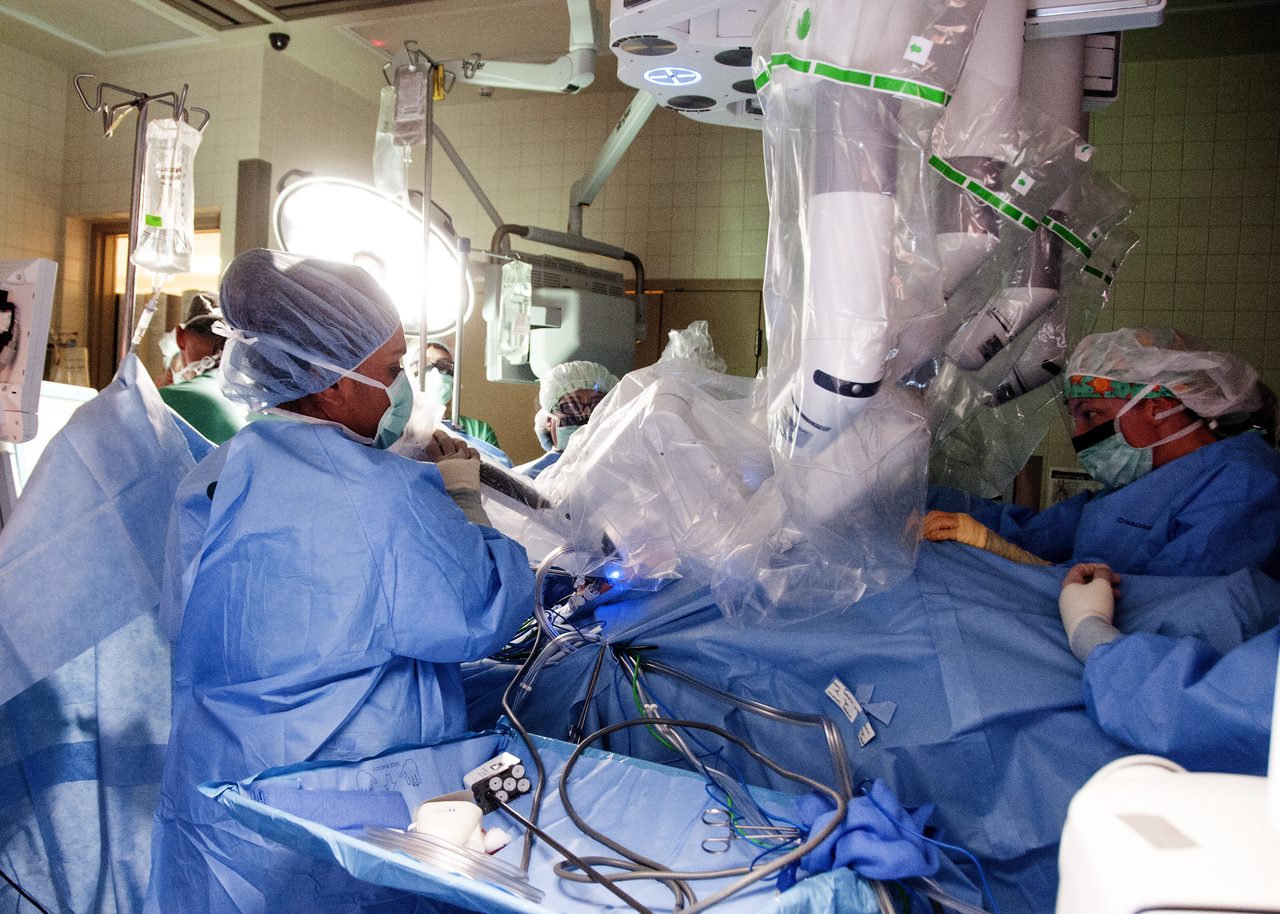
The randomised evidence is better than almost anything else on this page, and the first large trial found nothing. ROLARR randomised 471 patients with rectal adenocarcinoma across 29 sites in 10 countries with 40 surgeons. Its conclusion: 'Among patients with rectal adenocarcinoma suitable for curative resection, robotic-assisted laparoscopic surgery, as compared with conventional laparoscopic surgery, did not significantly reduce the risk of conversion to open laparotomy.' That quotation is the first sentence of a two-sentence conclusion and it is cut there; the second sentence says the findings suggest that robotic-assisted laparoscopic surgery, when performed by surgeons with varying experience of robotic surgery, does not confer an advantage in rectal cancer resection. Conversion was 8.1 percent robotic against 12.2 percent laparoscopic, an adjusted odds ratio of 0.61 with a 95 percent confidence interval of 0.31 to 1.21 and P equal to .16. Positive circumferential margin was 5.1 percent against 6.3 percent, adjusted odds ratio 0.78, P equal to .56. Of eight other prespecified secondary endpoints, including intraoperative complications, postoperative complications, 30-day mortality, bladder dysfunction and sexual dysfunction, 'none showed a statistically significant difference between groups.' The direction of the point estimates favours the robot and the trial simply could not distinguish them from chance, so did not significantly reduce is not the same sentence as was worse, and blurring the two would be exactly what this page accuses the demonstration videos of doing. The funding and disclosure block is worth reading too. ROLARR was funded by the Efficacy and Mechanism Evaluation Programme, a partnership of the UK Medical Research Council and the National Institute for Health Research, and its own conflict statement records that five of the named authors served as proctors for Intuitive Surgical, one was a consultant to the company and one received travel expenses from it. That cuts in the trial's favour rather than against it: a study whose surgeons were trained and paid by the manufacturer found no advantage for the manufacturer's machine.
Eleven trials later the picture is different and still not triumphant. A systematic review and meta-analysis published in BMC Surgery in 2025 pooled 11 randomised controlled trials totalling 3,107 cases. Against laparoscopy, robotic surgery showed 'a significantly lower conversion rate (odds ratio: 0.42; 95% confidence interval: 0.28 to 0.63; P < 0.0001)', a smaller incidence of positive circumferential margin at an odds ratio of 0.59 with a confidence interval of 0.41 to 0.85 and P equal to 0.004, more lymph nodes harvested, and faster return of urination, defecation and flatus. It also showed 'more operating time (mean difference: 23.46; 95% confidence interval: 15.76 to 31.16; P < 0.00001)'. And it reported that 'Overall postoperative complication, short-term postoperative complication, estimate blood loss, hospital stays, Intraoperative complication, postoperative mortality, preventive ostomy rates, readmission did not differ significantly between approaches.' The capitalisation of Intraoperative in the middle of that list is the journal's own and is not corrected inside the quotation marks. Two qualifications. The searches ran to 1 February 2024 and ROLARR is one of the 11 trials pooled, so this is ROLARR plus a decade of smaller trials rather than an independent result. And the outcomes that did not move are the ones patients care most about: complications, mortality and length of stay. The best available evidence says the robot is somewhat better on the surgeon's technical measures, no different on whether you live and how long you stay, and about 23 minutes slower per case. That is what a mature robotic technology actually looks like, and it is the opposite of a demonstration video.
09The Jobs
This is the part of the subject people actually care about, and it is where our own file makes its most consequential error. Two studies are quoted against each other constantly, almost always by people who have read neither, and the comparison only means anything once you know which unit each one counted.
Frey and Osborne's paper, published in Technological Forecasting and Social Change in 2017 from a working paper of 2013, is the source of the number everyone quotes. Its abstract states the method: 'We examine how susceptible jobs are to computerisation. To assess this, we begin by implementing a novel methodology to estimate the probability of computerisation for 702 detailed occupations, using a Gaussian process classifier. Based on these estimates, we examine expected impacts of future computerisation on US labour market outcomes, with the primary objective of analysing the number of jobs at risk and the relationship between an occupations probability of computerisation, wages and educational attainment.' The missing apostrophe in that last phrase is the publisher's and is not corrected inside the quotation marks. Their estimate is that 47 percent of total US employment falls in a high risk category, and the hedge attached to it, which is almost always stripped away, is that the associated occupations are potentially automatable over some unspecified number of years, perhaps a decade or two. That hedge is given here in this page's own words rather than quoted, because the sentence containing it sits in the 2013 working paper, which was not readable for this page, and no page number is printed. The crucial thing is what the number measures. It is an estimate of susceptibility. Nothing in the paper predicts that any particular job will be destroyed, and the figure has been used for a decade as a forecast of unemployment, which it never was.
The OECD reply is where our own file goes wrong, and it is a factual reversal rather than a wording problem. Our file describes Frey and Osborne as having measured task-level automation potential and Arntz, Gregory and Zierahn as having estimated fully automatable jobs. It is the other way round, and the named source says so in its own abstract: 'These studies follow an occupation-based approach proposed by Frey and Osborne (2013), i.e. they assume that whole occupations rather than single job-tasks are automated by technology. As we argue, this might lead to an overestimation of job automatibility, as occupations labelled as high-risk occupations often still contain a substantial share of tasks that are hard to automate.' Their own method is the opposite, and this is a second and separate span from the same abstract: 'we estimate the job automatibility of jobs for 21 OECD countries based on a task-based approach. In contrast to other studies, we take into account the heterogeneity of workers' tasks within occupations. Overall, we find that, on average across the 21 OECD countries, 9 % of jobs are automatable.' The spacing and the spelling of automatibility are the publisher's own and are kept inside the quotation marks. The spread between countries is wide: 6 percent in Korea, 12 percent in Austria. With the methodologies the right way round the comparison finally means something. Whether automation looks catastrophic depends on whether you count jobs or tasks, and that is a choice a researcher makes before any data is collected.
The strongest evidence that robots cost jobs comes from Daron Acemoglu and Pascual Restrepo, who studied the effect of industrial robots on US local labour markets between 1990 and 2007 and published in the Journal of Political Economy in 2020. Their finding: one more robot per thousand workers reduces the employment-to-population ratio by 0.2 percentage points and wages by 0.42 percent. They report that the effect is distinct from Chinese and Mexican import competition, from the decline of routine work, from offshoring, from other information-technology capital and from the total capital stock, and that the most exposed commuting zones show no differential trend before 1990. Two things travel with it. The widely circulated figures are different, because a great deal of secondary writing quotes the 2017 working paper, which reports ranges of 0.18 to 0.34 percentage points and 0.25 to 0.5 percent, without saying that is what it is quoting; the published point estimates are the ones above. And this is a local labour-market design. It measures what happens to a commuting zone relative to other commuting zones, and it is not the same quantity as a national employment effect, which is why the studies that follow can find what they find without contradicting it.
Graetz and Michaels, working within industries across seventeen countries from 1993 to 2007, found something different in the same decade. Their abstract: 'Our findings suggest that increased robot use contributed approximately 0.36 percentage points to annual labor productivity growth, while at the same time raising total factor productivity and lowering output prices. Our estimates also suggest that robots did not significantly reduce total employment, although they did reduce low-skilled workers' employment share.' Both halves of that last sentence are the finding, and quoting only the first is the same error as quoting Acemoglu and Restrepo alone. Dauth, Findeisen, Suedekum and Woessner then asked how German regional labour markets adjusted. Robots displaced manufacturing positions, but in the study's own words 'those are fully offset by new jobs in services'. The adjustment burden fell mainly on young workers entering the labour force, who nonetheless ended in higher-quality employment and shifted their educational choices toward tertiary study. Germany's robot density is among the highest in the world, and its labour-market institutions, including works councils and strong sectoral bargaining, are unlike those of the United States, so a finding that displacement was fully offset in Germany is not a finding that it would be offset anywhere. That is what makes this a real argument rather than a two-sided one: the same technology, measured carefully in two rich countries over overlapping periods, produced different labour outcomes, and the most likely reason is institutions rather than machines.
A decade after the two famous numbers, the OECD went back and checked what had actually happened. Georgieff and Milanez report: 'This study looks at what happened to jobs at risk of automation over the past decade and across 21 countries. There is no support for net job destruction at the broad country level. All countries experienced employment growth over the past decade. Within countries, however, employment growth has been much lower in jobs at high risk of automation (6%) than in jobs at low risk (18%). Low-educated workers were more concentrated in high-risk occupations in 2012 and have become even more concentrated in these occupations since then. In spite of this, the low growth in jobs in high-risk occupations has not led to a drop in the employment rate of low-educated workers relative to that of other education groups. This is largely because the number of low-educated workers has fallen in line with the demand for these workers.' The abstract continues past that point and the quotation is cut before it; what follows notes that the risk is increasingly falling on low-educated workers and that the pandemic may have accelerated automation. This is the only piece of evidence on the page that tests a prediction against an outcome, and it says both halves at once. Neither famous number came true as a headline. No country lost jobs on net, and the jobs flagged as automatable grew three times more slowly than the rest.
| The Study | What It Measured, And On What Unit | What It Found |
|---|---|---|
| Frey and Osborne, Technological Forecasting and Social Change 2017, from a 2013 working paper | The probability of computerisation for 702 detailed US occupations, using a Gaussian process classifier. Whole occupations, not tasks. | 47 percent of total US employment falls in a high risk category, which they describe as potentially automatable over an unspecified period they put at perhaps a decade or two. It is an estimate of susceptibility, not a forecast of job loss. |
| Arntz, Gregory and Zierahn, OECD Working Paper 189, 2016 | The same question on a task-based approach across 21 OECD countries, allowing for the heterogeneity of workers' tasks within occupations. | 9 percent of jobs automatable on average, with 6 percent in Korea and 12 percent in Austria. The smaller number follows from the smaller unit of analysis. |
| Acemoglu and Restrepo, Journal of Political Economy 2020 | US local labour markets from 1990 to 2007, comparing commuting zones by robot exposure. | One more robot per thousand workers reduces the employment-to-population ratio by 0.2 percentage points and wages by 0.42 percent. A local effect measured against other commuting zones, not a national total. |
| Graetz and Michaels, The Review of Economics and Statistics 2018 | Robot adoption within industries across seventeen countries from 1993 to 2007. | About 0.36 percentage points added to annual labour productivity growth, with total factor productivity up and output prices down; no significant reduction in total employment, and a reduced employment share for low-skilled workers. |
| Dauth, Findeisen, Suedekum and Woessner, Journal of the European Economic Association 2021 | German regional labour markets adjusting to industrial robots. | Manufacturing positions displaced, and in the paper's own words those are fully offset by new jobs in services. Germany's robot density and bargaining institutions are both unusual, so the result does not travel by itself. |
| Georgieff and Milanez, OECD Working Paper 255, 2021 | An ex-post check across 21 countries: what actually happened over the following decade. | No support for net job destruction at the broad country level and employment growth in every country, but 6 percent employment growth in jobs at high risk of automation against 18 percent in low-risk jobs. |
The industry has a position on all of this and published it seventeen days before the research for this page was done. The International Federation of Robotics released a position paper on 11 August 2026, The Impact of Robots: Employment, Productivity and Competitiveness, replacing an earlier paper on robotics and employment. Its headline findings include that 'Automation can support employment growth by increasing productivity and stimulating demand', that 'Robots typically substitute tasks rather than entire occupations', that 'Robotics improves working conditions by taking over dirty, dull, dangerous and delicate tasks', and that 'Robotics helps address labor shortages and mitigate the impact of demographic change in aging economies'. This is the robot industry's own trade association making the case for robots, and it is worth showing a reader precisely because it is so ordinary. The second finding is the same conclusion the OECD task-based study reached independently. The third glosses over a dispute this page has just spent a section carrying unresolved. The paper itself sits behind a registration wall and was not read; only the association's own public summary of it was.
Six serious attempts on one question, and the range is the finding rather than any number inside it. The table above lays them out with the design choice named under each, and there is no honest way to average them, because they do not measure the same quantity: they differ in unit, in country, in period and in what counts as an effect. An article that picks one of them is telling you about its author. The labour question also has a research file of its own in our library, on the sociology of work and labour, and it is linked below.
10What This Is Not
Our research file's only claim at its lowest grade is the robot uprising, and it refuses it in terms: fears that robots will achieve sentient self-awareness and turn against humanity have no basis in current robotics, because 'existing robots are narrow tools without consciousness, goals, or self-awareness'. It names what the real risks are instead, and this page states those in its own words because the file's punctuation does not survive extraction cleanly: the risks of autonomous systems are real and they concern misuse by people, in autonomous weapons and in surveillance, and unintended failures, and conflating science fiction with engineering reality distracts from the genuine problems. Everything above is the evidence for the refusal. A hand that solves a hard scramble one time in five. A humanoid whose first documented job is moving a tote onto a conveyor. A simulated benchmark that state-of-the-art learning cannot pass. A competition post-mortem whose largest finding is that the operators made mistakes. Nothing on this page is remotely close to wanting anything. This is not a dismissal of the serious argument that advanced artificial intelligence could pose real risks, which has nothing to do with sentience or with robot bodies, and which belongs to The Alignment Problem, where it is made at full strength.
Three ethical questions outlive the employment argument and this page will not resolve any of them. Accountability: who is responsible when an autonomous system kills someone. Dignity: whether elderly people should be cared for by machines, which our library holds in a separate file on social and care robotics. And military use, which our file hands to its own file on autonomous weapons systems, and which this page names and does not tour. Naming a question and saying who owns it is a different act from opening it. It is worth noting only that the accountability question is not abstract even inside this article: the same literature that measures a fall in physical injury measures a rise in deaths of despair in the same places, and neither outcome has an obvious party responsible for it.
Fast Facts
- The Founding Patent
- Programmed Article Transfer, US Patent 2,988,237, filed by George C. Devol Jr on 10 December 1954 and granted on 13 June 1961. The title does not contain the word robot.
- The First Installed Machine
- A hydraulically activated arm that unloaded a die-casting press at a General Motors plant in New Jersey in 1961, in the words of the object record of The Henry Ford, which holds it. Our research file states the installation as established fact in its summary, which carries no grade.
- The Laws, Correctly Dated
- First stated in Runaround in the March 1942 Astounding, not in the 1950 collection our own file cites. Asimov credited John W Campbell Jr with formulating all three in a December 1940 conversation; Campbell thought they were already implicit in the earlier stories.
- The Operational Stock
- 4,664,000 industrial robots in operational use, on 2024 data published by the International Federation of Robotics in September 2025. The IFR is the industry's own trade association and this page read only its free press release, not the paid report.
- Robot Density, And Its Trap
- On 2024 data the IFR gives the Republic of Korea at 1,220 robots per 10,000 manufacturing employees against a global average of 132. China's reported figure fell from 470 on 2023 data to 166 on 2024 data because China's National Bureau of Statistics revised the employment denominator, not because robots left.
- The Open Problem
- Dexterous manipulation. Billard and Kragic's 2019 review in Science says in its own words that achieving dexterous manipulation capabilities in robots remains an open problem, and its own figure caption records that a human had to place the objects in the robot's hand for the photograph.
- The Documented Humanoid Jobs
- Moving totes from cobots onto conveyors at a GXO Logistics site, announced June 2024, and inserting sheet metal parts into fixtures at BMW Group Plant Spartanburg, announced August 2024. Both are described in the deploying parties' own documents.
- The Sentence At The Bottom Of The Release
- BMW's August 2024 announcement of a successful humanoid test states in the same document that there are currently no Figure AI robots at the plant and no definite timetable for bringing them.
- Safety, Contested
- Our own file asserts injury reduction at its highest confidence level with no source. A peer-reviewed study finds that robot exposure reduces annual injury rates by about 1.2 cases per 100 workers and, in the next sentence of the same abstract, more drug or alcohol related deaths and mental health problems in the same commuting zones.
- The Employment Pair
- 47 percent of US employment in a high risk category on an occupation-based method (Frey and Osborne), against 9 percent of jobs automatable on average across 21 OECD countries on a task-based method (Arntz, Gregory and Zierahn). Our own file states those two methodologies the wrong way round, which makes the comparison incoherent as it stands.
- The Surgical Record
- The ROLARR trial randomised 471 patients and found no statistically significant reduction in conversion to open surgery. A 2025 meta-analysis of 11 trials and 3,107 cases found lower conversion and fewer positive margins, no difference in complications, mortality or length of stay, and about 23 minutes more operating time per case.
- What This Page Refuses To Print
- Humanoid production numbers, fleet sizes and unit counts, none of which could be verified at a primary source, and prices, which are refused for a different reason: a maker printing a price for a machine that has not shipped is an announcement, not a shipment. The runtime and parts figures attached to the BMW deployment, which are Figure's rather than BMW's. Either of the two stories told as the first person killed by an industrial robot, because no primary or scholarly source could be reached for either. Any statement of what the 2022 Safety Science paper found, since only its bibliographic record is known. And a page number for the Moravec sentence or the Frey and Osborne hedge.
What We Can Actually Stand Behind
Robots do an enormous amount of physical work and the record of it is measured rather than argued. The International Federation of Robotics reports 4,664,000 industrial robots in operational use on 2024 data and 542,000 installed in 2024, with 74 percent of new deployments in Asia; the association is the industry's own and this page read its free press release rather than the paid report, and it says so wherever the figures appear. Robot density on 2024 data runs from the Republic of Korea at 1,220 per 10,000 manufacturing employees to a global average of 132, and that measure has to be read with its denominator, because China's figure moved from 470 to 166 in one year on a statistics revision alone. The productivity contribution has been estimated independently: about 0.36 percentage points of annual labour productivity growth across seventeen countries between 1993 and 2007. These are the parts of this page a reader can most easily go and check.
Our file states at its highest confidence level that robot adoption raised output per worker while reducing workplace injuries in hazardous tasks. The first half stands and has a measurement under it. The second half has no source anywhere in the document, and the external evidence does not settle it in either direction. One investigation of internal records at one company reported serious injury rates more than 50 percent higher at robotic warehouses; a Senate committee's interim report found 30 percent more injuries than the industry average and the company rejected it in terms; and the peer-reviewed study this page could read in full finds fewer physical injuries and, in the very next sentence, more drug or alcohol related deaths and mental health problems in the same places, with a German panel showing less physical strain, less disability and no mental-health effect at all. This page carries all of that unresolved, and a compressed line saying robots make factory work safer would be false to the evidence above it.
Our file grades Moravec's paradox at its highest confidence level, and the observation it names is still doing work: the difficult thing to build is not reasoning, it is perception and contact. The peer-reviewed anchor says so in its own words, and the phrase is theirs rather than ours: dexterous manipulation remains an open problem. The measurements agree. A hand that reoriented a block after training entirely in simulation is a real result, and the same laboratory's cube result was one in five on a hard scramble with an external solver and a sensor-equipped cube. Twenty-one institutions had to pool 160,266 tasks to train one model. What is genuinely contested is the explanation rather than the observation: a serious critic argues that the paradox has never been tested and that the pattern is selection bias, our own file carries no dissent at all, and this page carries the dissent without letting it cancel the measurements.
Our file grades the two famous employment studies at its middle confidence level, and it states their methodologies the wrong way round, which this page corrects in the open: Frey and Osborne is the occupation-based study and Arntz, Gregory and Zierahn is the task-based one. Corrected, the pair is genuinely informative rather than contradictory, because 47 percent and 9 percent are answers to differently-posed questions. Four further measurements do not collapse into one story either: a local labour-market design finds 0.2 percentage points of employment-to-population ratio and 0.42 percent of wages per robot per thousand workers; a seventeen-country study finds no significant reduction in total employment and a falling low-skilled share; a German study finds displacement fully offset by service jobs under institutions the United States does not have; and an ex-post check across 21 countries finds no net job destruction anywhere and high-risk jobs growing three times more slowly than low-risk ones. There is no honest average of those. The spread, and the reason for it, is the result.
Our file puts general-purpose humanoids at its Speculative grade, and finishes its own sentence with four conditions still unmet, one of them cost. The documented record is thin and specific rather than absent: the humanoid jobs this page could evidence from a deploying party's own document are moving totes from cobots onto conveyors at a logistics site, inserting sheet metal parts into fixtures on a car line, and a sorting task announced but not yet reported. Against that sit a manufacturer's release stating that no such robots are at the plant, a launch event at which the robots were driven by undisclosed operators, and a home product whose answer to unfamiliar tasks is a scheduled human being. The argument about whether the human shape is the right one is live between serious people, and this page ends it in neither direction: a founding figure of the field argues that video is the wrong training data in principle, and a laboratory five months earlier claims generalisation to unseen homes in a preprint with no success rate in its abstract. What can be said is that the one fleet on this page counted in millions, on its owner's own count, is made of wheeled drive units rather than of humanoids, and that our own file's eleven-word objection, that the human body plan is not necessarily optimal for industrial tasks, has not been answered.
The scenario in which physical robots achieve sentient self-awareness and turn against humanity is refused, and our own file refuses it at its lowest grade: existing robots are narrow tools without consciousness, goals, or self-awareness. Nothing on this page comes near the threshold. The field's own competition post-mortem found that the binding constraints on humanoid performance were operator error and sensing, which is a portrait of a machine nowhere near having purposes of its own. This refusal is narrow and deliberate, and it must not be read as a dismissal of the serious argument that advanced artificial intelligence could pose real risks. That argument does not depend on sentience or on robot bodies, it is made at full strength in the sibling article on the alignment problem, and refusing the cartoon is not the same act as refusing the case.
Sources & further reading
WHERE THIS PAGE WORKED FROM, AND WHERE IT CAN BE CHECKED. It was written from one file in our own research library, S_5_04 on robotics and automation. That file is where the work started, not where the work can be verified: it is our own claim and it cannot corroborate itself, which is why the external entries below are here. Each one names the section it supports, and none is listed as general reading. Three further files of ours appear in the list because this page hands neighbouring subjects to them by name, not because it draws claims from them. THIS PAGE CORRECTS ITS OWN RESEARCH FILE IN SIX PLACES, each disclosed on the claim it belongs to. The largest is a reversal: our file describes Frey and Osborne as having measured task-level automation potential and Arntz, Gregory and Zierahn as having estimated fully automatable jobs, and the OECD paper states the opposite in its own abstract, which makes the 9-against-47 comparison incoherent as our file puts it. The others are that the operational stock our file gives as a present-tense figure is the 2022 stock from the 2023 edition of a report now two cycles further on; that the robot-density sentence blends figures from two different report years and omits Singapore, which has been second in the world throughout; that our file has Atlas performing parkour in the present tense while that machine was retired in April 2024; that the Three Laws are cited to the 1950 collection and were first stated in Runaround in March 1942; and that our file asserts injury reduction at its highest confidence grade with no source anywhere in the document, while the peer-reviewed evidence points in both directions at once. WHAT THIS PAGE DELIBERATELY DOES NOT PRINT: humanoid production numbers, fleet sizes and unit counts, because none could be verified at a primary source, and prices, which are refused instead because an announced price for a machine that has not shipped is not evidence that it ships; the runtime, parts and shift-length figures circulating for the BMW deployment, because they are Figure's rather than BMW's and BMW's own release gives a different duration; either of the two stories routinely told as the first person killed by an industrial robot, because every route to a primary or scholarly source failed and saying nothing is the correct answer; any statement of what the 2022 Safety Science paper found, because only its bibliographic record could be reached; a page number for the Moravec sentence or for the Frey and Osborne hedge; and the leaked internal projections reported in October 2025 about one company's future hiring, because they are projections in a document this page could not read and this page is not in the forecasting business. FOUR SOURCES USED IN THE BODY CARRY NO LINK BELOW, and saying so is better than pointing a reader at something else. Three further findings rest on contemporaneous reporting this page could not read at source and does not cite as a document: the teleoperation at the Tesla event, the role of the 1X Expert, and the discrepancy over how long the BMW deployment ran. The object record of The Henry Ford, from which the Unimate description is quoted, was read through a mirror whose address was not recorded. ISO/TS 15066:2016 was not read at source at all: its catalogue page refuses non-browser clients, and the designation, the year and the four modes come from technical summaries. Intuitive Surgical's reported full-year 2025 figures are second-hand from summaries of filings this page could not open. And the 2020 investigation into one company's warehouse injury records was not readable, so its figures are attributed to it by name and year and are not quoted. ON THE IDENTIFIERS. Seventeen of the digital object identifiers below were resolved live against CrossRef and every one returned the work named here, checked on type, author, container and year before title. Six arXiv identifiers were checked by opening the abstract page and reading the title, the author line and the date against the work the entry names. The patent was opened at its own record, and the Moravec ISBN resolved at a library catalogue. One identifier is UNCHECKED and is named as such in its own entry. One CrossRef record, for the OECD working paper of 2016, carries no author list at all: the three authors are correct and were confirmed from a separate record, and a machine that matches authors will report that identifier unmatchable.
Image credits
- A robotised production line at AIUT Marta Veverica, via Wikimedia Commons (CC BY-SA 4.0). CC BY-SA 4.0 Source.
- A Unimate 500 PUMA of 1983 with its control unit and terminal, Deutsches Museum Theoprakt, via Wikimedia Commons (CC BY-SA 3.0). CC BY-SA 3.0 Source.
- A UR16e collaborative robot from Universal Robots, with controller and teach pendant Auledas, via Wikimedia Commons (CC BY-SA 4.0). CC BY-SA 4.0 Source.
- A Schunk SVH servo-electric five-finger gripping hand at Hannover Messe, 2016 NearEMPTiness, via Wikimedia Commons (CC BY-SA 4.0). CC BY-SA 4.0 Source.
- KAIST's HUBO at the final obstacle, DARPA Robotics Challenge Finals, 5 June 2015 Office of Naval Research from Arlington, United States, via Wikimedia Commons (CC BY 2.0). CC BY 2.0 Source.
- The hydraulic Atlas, front view, June 2013 DARPA, via Wikimedia Commons (public domain). Public domain Source.
- An Amazon warehouse robot, July 2023 Geni, via Wikimedia Commons (CC BY-SA 4.0). CC BY-SA 4.0 Source.
- A Unimate arm pouring coffee, press photograph of 3 October 1967 Frank Q. Brown, Los Angeles Times, via Wikimedia Commons (CC BY 4.0). CC BY 4.0 Source.
- Humanoid robots at the Tesla event of 10 October 2024 Steve Jurvetson, via Wikimedia Commons (CC BY 2.0). CC BY 2.0 Source.
- A da Vinci Xi system during a robotic surgical procedure, 2 May 2016 Marcy Sanchez, US Army, via Wikimedia Commons (public domain). Public domain Source.
- Card crop of a robotised production line at AIUT Marta Veverica, via Wikimedia Commons (CC BY-SA 4.0). CC BY-SA 4.0 Source.


.jpg)


