
Quantum Entanglement: The Spooky Action That Sends No Signal
Einstein called it 'spooky action at a distance' and spent the rest of his life convinced it meant quantum mechanics was incomplete. He was half right, and wrong about the more important half. Entanglement is real: two particles can be prepared so that measuring one instantly fixes what you will find when you measure the other, however far apart they are, and this has been confirmed in experiment after experiment, all the way to the 2022 Nobel Prize. But the same mathematics that makes it real forbids it, absolutely, from ever carrying a message faster than light. This is what entanglement genuinely is, how we came to be sure of it, and the single thing it cannot do, no matter how often that thing is claimed for it.
Of all the strange things quantum mechanics asks us to accept, entanglement is the one that broke Einstein. He could live with particles behaving like waves, and with measurement playing some role in what turns out to be real. What he could not accept was that two particles, once they had interacted, could stay linked so that measuring one seemed to settle the state of the other in the same instant, across any distance at all. He called it 'spooky action at a distance' and took it as proof that quantum theory was missing something underneath. For thirty years this looked like a question philosophy could argue but no experiment could decide. Then one physicist wrote down a way to test it, and the answer came back, again and again, on Einstein's least favorite side. Entanglement is real. It is also, in a way that would have given Einstein small comfort, completely unable to do the one thing most often claimed for it. Here is what it actually is, how we came to be certain, and where the truth ends and the mythology begins.
01Einstein's Objection
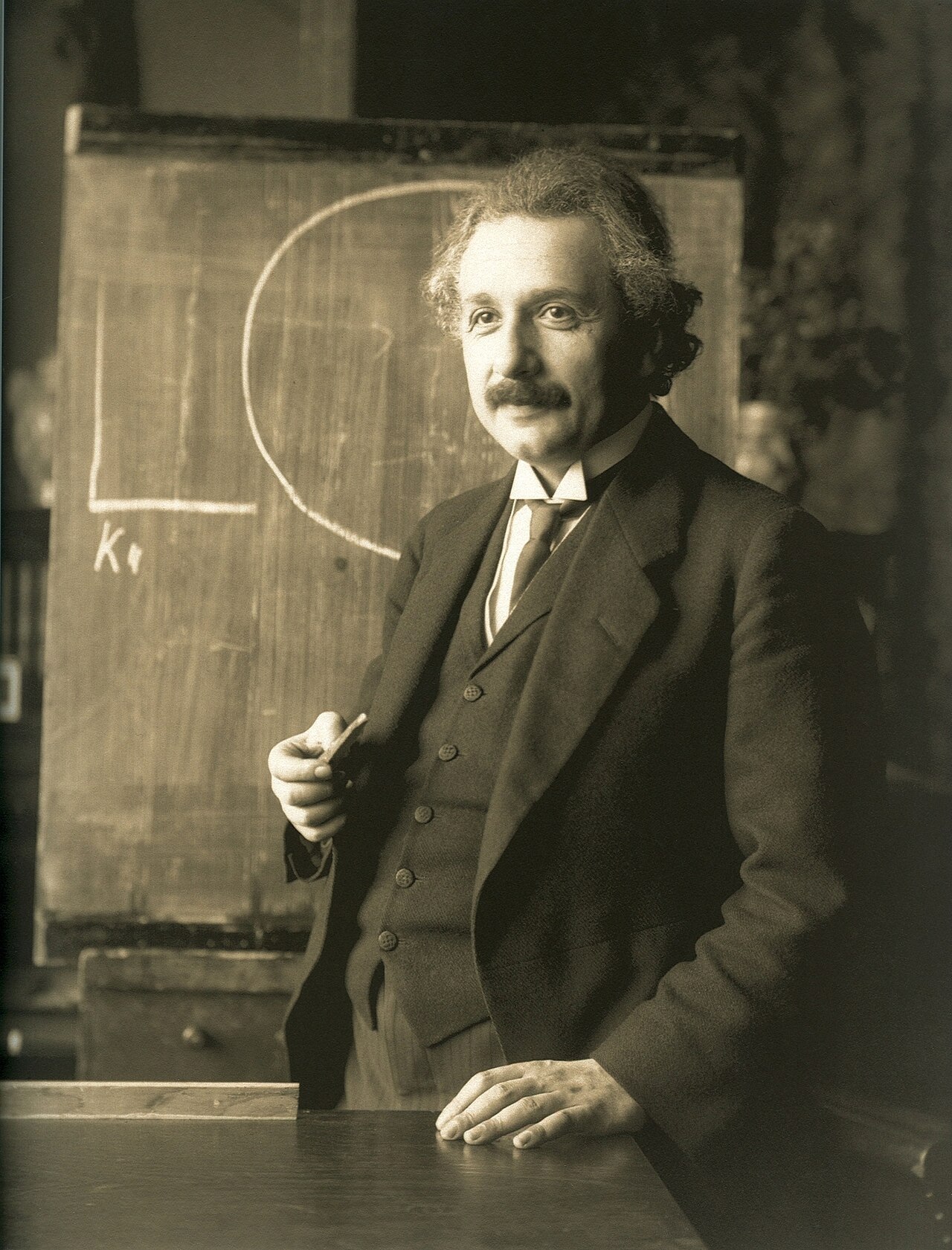
Start with what entanglement actually is. When two particles interact in the right way, quantum mechanics can describe them with a single shared state rather than two separate ones, and that shared state can fix a relationship between them that survives no matter how far apart they later travel. Prepare two photons so their polarizations are perfectly anti-correlated, send one to a laboratory here and the other to one a continent away, and measure them along the same axis: whenever one comes up 'horizontal,' the other comes up 'vertical,' every single time. Neither photon carried a hidden tag saying which it would be, or so quantum mechanics insists; the outcome is genuinely undecided until measured, and yet the two outcomes are locked together. This is what unsettled Einstein. In 1935, with Boris Podolsky and Nathan Rosen, he published a famous argument, now called EPR, that ran like this: either measuring one particle instantly changes the other far away, which he dismissed as a spooky action at a distance, or the outcomes were fixed all along by 'hidden variables' the theory simply failed to mention. Einstein bet on the hidden variables. He was certain the world was local, that nothing here can instantly affect anything there, and that quantum mechanics was therefore an incomplete account of a deeper, more ordinary reality. The phrase everyone quotes, 'spooky action at a distance,' is genuinely his, but it comes not from the 1935 paper; it is from a letter he wrote to Max Born in 1947.
02Bell's Theorem
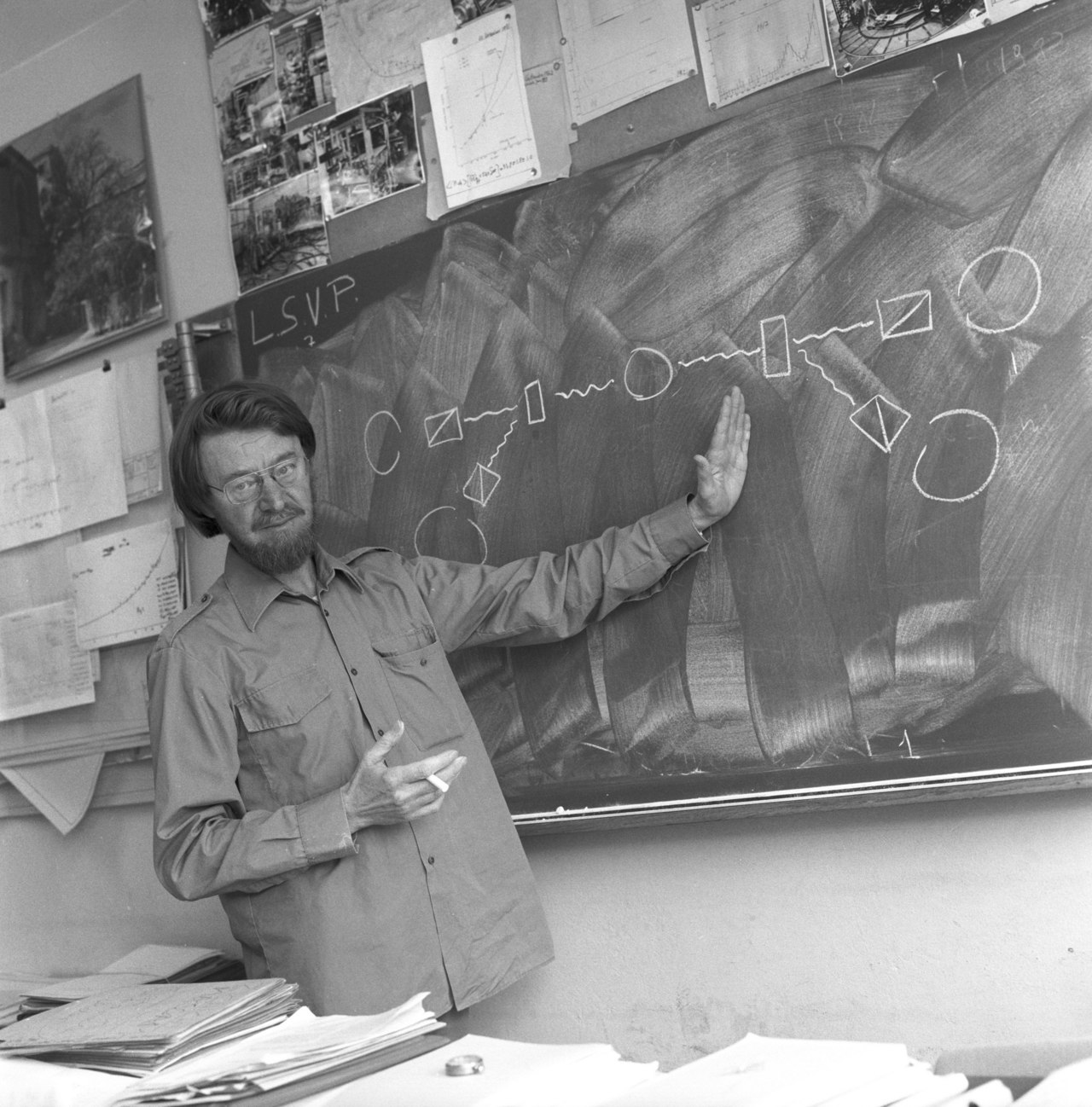
For three decades, EPR looked like a matter of taste: you could believe in Einstein's hidden variables or in quantum mechanics' entangled state, and no experiment could tell them apart. Then, in 1964, the Northern Irish physicist John Stewart Bell found the crack. He proved that the two pictures are not interchangeable after all. Any theory in which the outcomes are fixed in advance by local hidden variables, Einstein's kind of theory, must obey a strict mathematical limit on how strongly the measurements on the two particles can be correlated, taken across many runs and many measurement angles. Quantum mechanics predicts correlations that break that limit. This is Bell's theorem, and its genius is that it converts a philosophical dispute into a quantity you can go out and measure. The specific, testable form used in real experiments, worked out by Clauser, Horne, Shimony, and Holt in 1969, sets a ceiling of 2 for any local-hidden-variable theory; quantum mechanics allows as much as about 2.83. The universe, it turns out, does not respect the ceiling. Whatever is really going on, the comfortable idea that each particle quietly carried its answer with it the whole time is ruled out by measurement. Nature is either not local, or not 'realist' in Einstein's sense, or neither, but it is provably not both in the plain way he wanted it to be.
03The Experiments
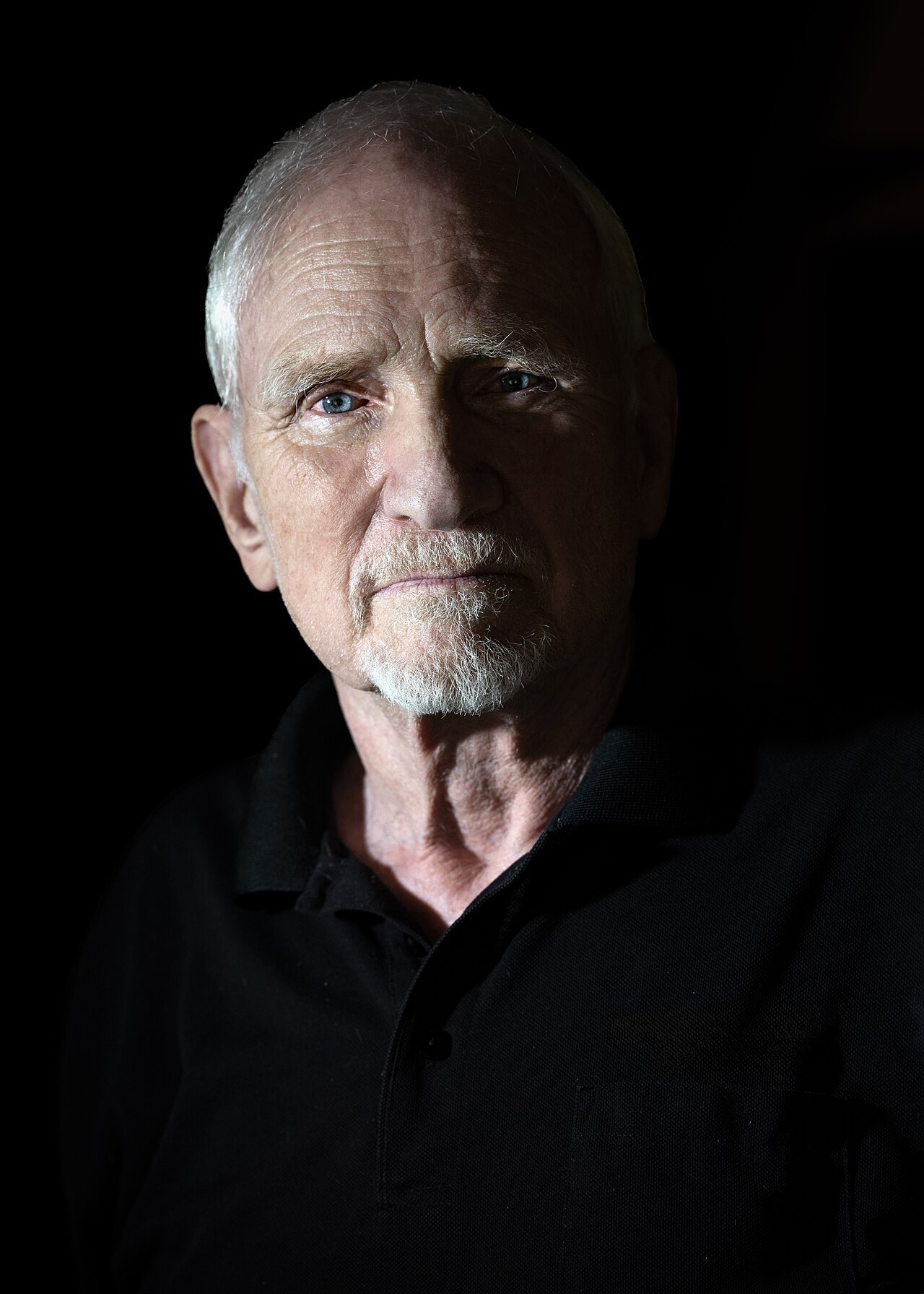
Bell handed physics a test; it took the experimenters a decade to run it. The first real attempt came in 1972, when Stuart Freedman and John Clauser, at Berkeley, measured pairs of photons emitted by calcium atoms and found the correlations breaking Bell's limit, on the side of quantum mechanics. Through the late 1970s and early 1980s Alain Aspect's group near Paris, at Orsay, sharpened the test decisively, most famously by switching the orientation of the detectors while the photons were already in flight, too fast for any signal traveling at light-speed to coordinate the two ends, and still the quantum correlations held. Real experiments, though, left gaps a determined skeptic could point to, called loopholes: perhaps the detectors were too inefficient, or the two stations not quite independent enough. Closing them took another thirty years, until in 2015 several groups, in Delft, at the U.S. National Institute of Standards and Technology, and in Vienna, ran the first genuinely 'loophole-free' Bell tests, sealing the escapes at once. The verdict did not change. In 2022 the Nobel Prize in Physics went to Aspect, Clauser, and Anton Zeilinger 'for experiments with entangled photons, establishing the violation of Bell inequalities and pioneering quantum information science.' Entanglement is not an interpretation or a manner of speaking. It is one of the most stringently tested facts in all of physics.
04What It Cannot Do
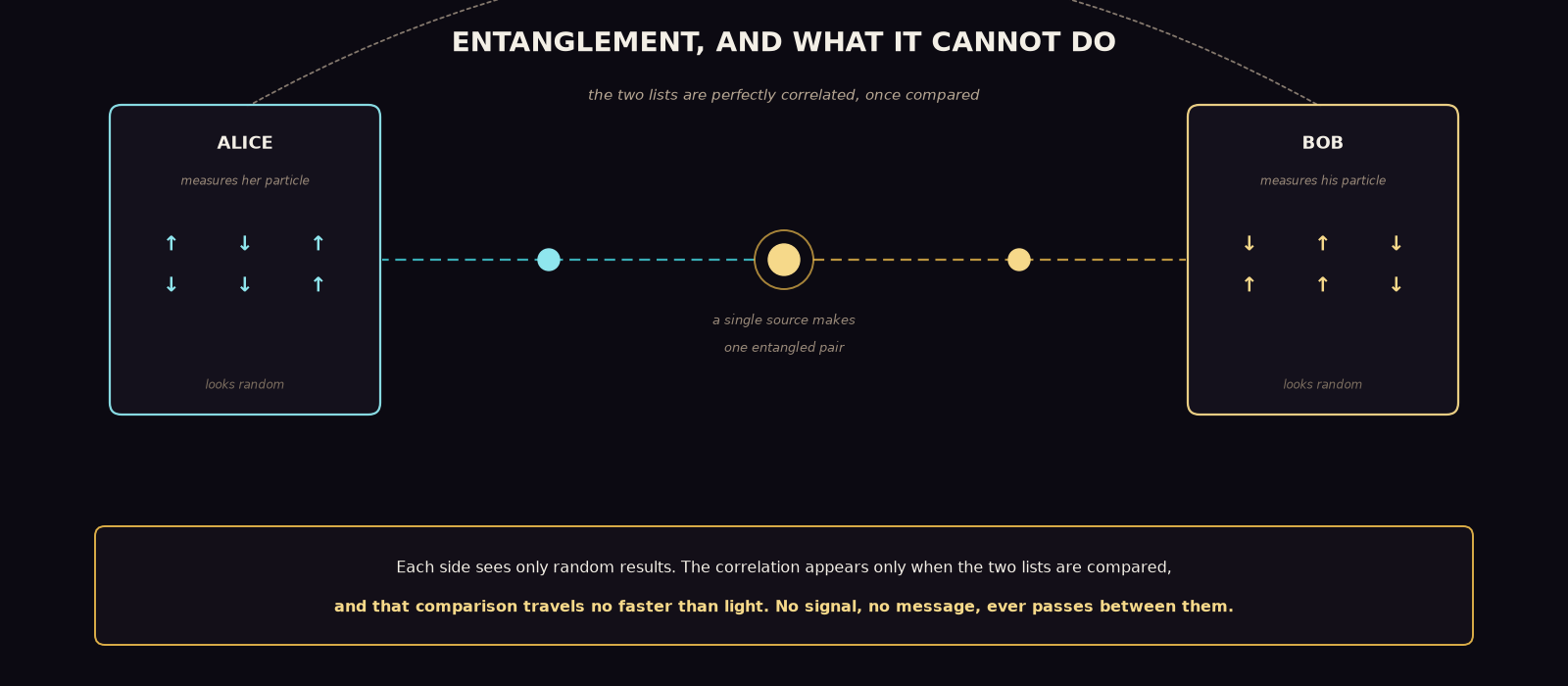
Here is where almost every popular account goes wrong, so it is worth stating with full force. The correlation between entangled particles is instant, in the sense that it does not weaken with distance and does not wait for any signal to travel between them. It is tempting to conclude that you could ride this to send a message faster than light: nudge your particle here, read the effect there. You cannot. It is not merely difficult; it is forbidden, provably, by the very same quantum mechanics that predicts entanglement in the first place, in a result called the no-communication theorem. The reason is the heart of the whole subject. When Alice measures her particle, all she ever sees is a random outcome, up or down, with no pattern she can control, bias, or influence. When Bob measures his, he sees the same: pure randomness. The famous correlation between their results is entirely real, but it is invisible to each of them alone. It shows up only when they later lay their two lists of outcomes side by side and compare them, and that comparison is an ordinary message, a phone call, an email, a radio signal, that travels no faster than light like anything else. Entanglement gives you two perfectly synchronized copies of a random coin flip in two distant places; it never lets you choose what the coin says. No information, no signal, no message of any kind can be pushed through entanglement alone, ever. Every claim that it can, faster-than-light communication, instantaneous remote control, is simply, flatly wrong.
05What It Might Mean
So the experiments are settled, but their meaning is not, and honesty here means admitting how much stays open. Bell's theorem tells us local hidden variables are dead; it does not tell us what to put in their place, and physicists genuinely disagree. In the Copenhagen view, the shared state is all there is to say, and asking what is 'really' happening between measurements is a mistake. In the many-worlds view, both outcomes happen, on separate branches, and the correlation is bookkeeping across them. In the de Broglie-Bohm view, particles do have definite positions all along, guided by a wave, at the price of an explicit nonlocality Einstein would have detested. In QBism, the quantum state is not the world but a measure of an observer's own information about it. These are not fringe positions; they are live options held by serious physicists, and no experiment yet made distinguishes them. What entanglement is 'really' doing therefore remains, in the strict sense, unknown. What is not in doubt is that entanglement is useful. It is the working substance of the emerging quantum technologies: the basis of quantum key distribution, where any eavesdropper unavoidably disturbs the shared state and so gives themselves away; a resource inside quantum computing; and the mechanism behind quantum teleportation, which, despite the name, transfers a quantum state rather than any matter, and, crucially, cannot happen without an accompanying ordinary, slower-than-light message, which is exactly why it too breaks no cosmic speed limit. At the theory's frontier, some physicists take the link between entanglement and the geometry of spacetime seriously enough to conjecture, under the name ER=EPR, that entangled particles are joined by tiny wormholes; it is a fascinating and genuinely speculative idea, not established fact.
06The Metaphors and the Mysticism
Finally, the mythology, which has grown lush around entanglement precisely because the real thing sounds so much like magic. Because measuring one particle 'instantly' relates to another one far away, entanglement gets invoked to license all manner of claims it does not support: that human minds can be 'entangled,' that it explains telepathy or a shared universal consciousness, that it powers 'quantum healing' across a distance. None of this follows, and much of it directly contradicts the no-communication theorem. Entanglement is a fragile relationship between carefully prepared particles that decoheres almost instantly on contact with any warm, noisy environment, which is exactly what a living brain is; it does not link lovers' hearts or synchronize souls, and it cannot carry so much as a single bit of intention from one mind to another. There is a gentler version of the overreach worth naming with respect rather than scorn. Entanglement's picture of a world of deep interconnection genuinely rhymes with older images: the jeweled net of the god Indra in Huayan Buddhism, in which every jewel reflects all the others; the Hermetic 'as above, so below'; the relational cosmos of many Indigenous traditions, such as the Aboriginal Dreamtime. As metaphors, as ways the human imagination has long reached toward wholeness, these are beautiful and worth honoring. But they are metaphors. They are not early physics, not evidence that the ancients secretly knew quantum mechanics, and not confirmation of the science; and the science, in turn, neither proves nor needs them. The honest response keeps the wonder of the real phenomenon and declines to inflate it into something it is not.
Fast Facts
- What it is
- Two particles sharing a single quantum state, so that measuring one is perfectly correlated with the other however far apart they are, though neither outcome is decided until measured
- Einstein's objection
- The 1935 EPR paper argued this 'spooky action at a distance' (his phrase, from a 1947 letter to Max Born) showed quantum mechanics was incomplete, and that hidden variables must fix the outcomes in advance
- Bell's theorem (1964)
- Proved local hidden-variable theories obey a strict limit (the CHSH bound of 2) that quantum mechanics violates (up to ~2.83), turning a philosophical dispute into a measurable number
- The experiments
- Freedman and Clauser ran the first test in 1972; Aspect sharpened it around 1982; loophole-free tests in 2015 sealed it; Aspect, Clauser, and Zeilinger shared the 2022 Nobel Prize
- The hard limit
- Entanglement CANNOT send a signal or message faster than light (the no-communication theorem); each side sees only randomness, and the correlation appears only when results are compared over an ordinary, slower-than-light channel
- Its meaning
- Genuinely unsettled: no experiment yet chooses between Copenhagen, many-worlds, de Broglie-Bohm, and QBism
- Its uses
- Real and growing: quantum key distribution, quantum computing, and quantum teleportation (which transfers a state, not matter, and still needs a classical message)
- Refused
- Faster-than-light communication; mind-to-mind telepathy; 'quantum consciousness' and 'quantum healing'; and the claim that ancient traditions already knew quantum physics
What We Can Actually Stand Behind
Entanglement is real and among the most stringently tested facts in physics. Bell's 1964 theorem made the EPR question experimentally decidable; Freedman and Clauser (1972), Aspect (around 1982), and the loophole-free tests of 2015 all came down on quantum mechanics' side, ruling out Einstein's local hidden variables. Aspect, Clauser, and Zeilinger shared the 2022 Nobel Prize for this work. And the no-communication theorem, that entanglement cannot transmit information faster than light, is every bit as established as the correlations themselves.
The applications are real and advancing, though still maturing. Quantum key distribution has been demonstrated over long distances, including by satellite; quantum computers built on entangled qubits are being made and improved year over year; and quantum teleportation of states has been performed in the laboratory and over both optical fiber and open air. These are engineering realities, not speculation, even as they remain works in progress rather than finished, everyday tools.
What entanglement means is genuinely open. Bell's theorem killed local hidden variables but crowned no successor: Copenhagen, many-worlds, de Broglie-Bohm, and QBism all remain live, and no experiment yet separates them. Whether nature gives up locality, or realism, or something subtler, is unsettled. Frontier ideas tying entanglement to the very structure of spacetime, such as ER=EPR, are serious but frankly speculative.
The overclaims get a flat no. Entanglement cannot send a message or signal faster than light, cannot be controlled to transmit information at all, and cannot connect human minds, enable telepathy, or power 'quantum healing.' It is not evidence that ancient traditions secretly knew quantum mechanics. Indra's Net and kindred images are lovely metaphors, not physics. The reality is astonishing enough without the embroidery.
Quantum entanglement sits in a wing about the fabric of reality because it is, quite literally, about how the threads of that fabric are tied together. Einstein looked at the knot and concluded the theory must be hiding something; two generations of experimenters looked, and found that the knot is real and the hidden something is not there. That is a rare and clean result in science: a question that began as pure philosophy, was sharpened by one man's theorem into a single number, and was then settled, decisively, by careful measurement. What makes entanglement worth telling honestly is that it is strange enough to invite every kind of exaggeration and disciplined enough to refuse them all. It is genuinely nonlocal in its correlations and genuinely silent as a channel; it overturns Einstein's intuition about reality and obeys his cosmic speed limit to the letter. Hold both of those at once and you have the truth of it. Let go of either, toward 'it's just correlation, nothing to see here' on one side or 'everything is instantly connected, so anything is possible' on the other, and you have left the physics behind. The real thing is better than the myth, for the plain reason that it is true.
Sources & further reading
Everything above is drawn from our research library on Theories of Anything. Open the full file to check the sourcing and go deeper.
Image credits
- Entanglement and the no-signalling limit (original diagram) Original diagram by Theories of Anything. CC BY-SA 4.0 Source.
- Albert Einstein, 1921 Ferdinand Schmutzer, 1921 (public domain), via Wikimedia Commons. Public domain Source.
- Physicist John Stewart Bell at CERN, June 1982 CERN, via Wikimedia Commons. CC BY 4.0 Source.
- John Clauser in 2024 Christopher Michel, via Wikimedia Commons. CC BY-SA 4.0 Source.
- Card crop of the entanglement diagram Original diagram by Theories of Anything. CC BY-SA 4.0


