
The Primes and the Million-Dollar Riddle
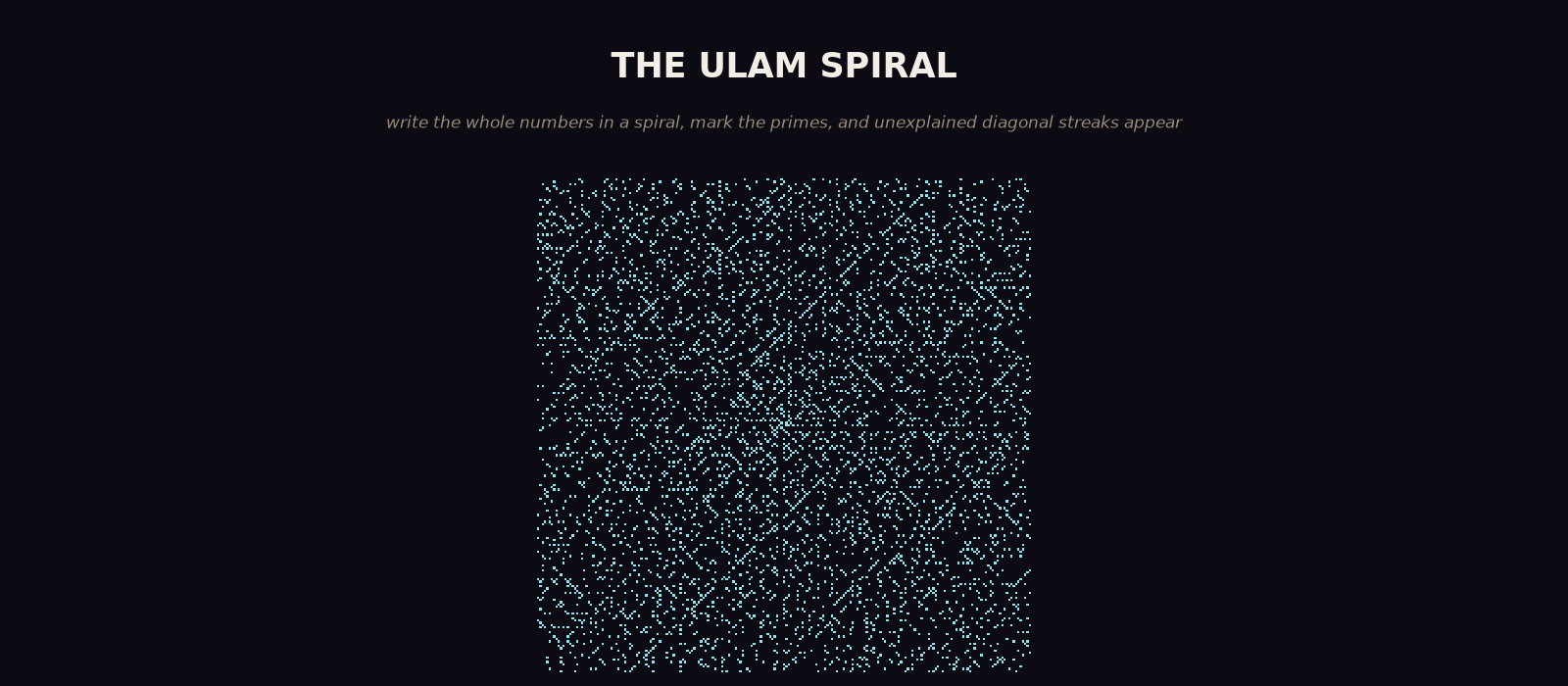
Prime numbers are the simplest objects in mathematics: whole numbers, like 2, 3, 5, and 7, divisible only by 1 and themselves, the indivisible atoms from which every other number is built. They are also the source of its single most famous unsolved problem. The primes look locally random and yet obey a precise law of density; they guard nearly every secure transaction on the internet; and the deepest question about how they are distributed, the Riemann Hypothesis, has resisted the best mathematicians for over a century and a half, with a million-dollar prize waiting for whoever cracks it. This is what is genuinely proven about the primes, what remains gloriously open, and where the real wonder ends and mere mysticism begins.
Some of the hardest questions in all of science are asked in the simplest words. Here is one: the prime numbers, 2, 3, 5, 7, 11, 13, and on forever, are the whole numbers that cannot be split into smaller factors, divisible only by 1 and by themselves. A child can understand what they are. And yet the way they are scattered through the number line hides a pattern so deep that unravelling it is worth a million dollars, has resisted the greatest mathematicians for over a century and a half, and is bound up with the security of nearly every secret you send across the internet. The primes are at once the most elementary objects in mathematics and the doorway to its most famous unsolved problem. This is what we can actually prove about them, what remains genuinely and gloriously open, and, just as important, where the real wonder ends and empty mysticism begins.
01The Atoms of Arithmetic
A prime is a whole number greater than 1 that cannot be divided evenly by anything but 1 and itself. They are the atoms of arithmetic. Just as every molecule is built from chemical elements, every whole number greater than 1 is built, in exactly one way, from primes multiplied together, a fact so fundamental it is called the Fundamental Theorem of Arithmetic. That 12 is 2 times 2 times 3, and nothing else, is why primes matter: they are the indivisible building blocks of the entire number system. And there are infinitely many of them, which the Greek mathematician Euclid proved around 300 BCE in a handful of lines so clean they are still taught unchanged today. But knowing the primes go on forever is very different from knowing where they are. Finding a large one means testing candidates one by one, and even now the largest prime we have ever explicitly written down, a monster of over 41 million digits, discovered in October 2024 by a worldwide volunteer computing project, took an enormous machine to confirm. The primes are trivial to define and maddening to predict, and nowhere is that clearer than in the picture at the top of this page. In 1963 the physicist Stanislaw Ulam, idly doodling through a dull lecture, wrote the whole numbers in a square spiral and shaded in the primes. He expected a random dusting. Instead the primes fell, unmistakably, along diagonal lines, a pattern no one has ever fully explained. That tension, structure precisely where you expect randomness, is the whole story of the primes.
02Order in the Average
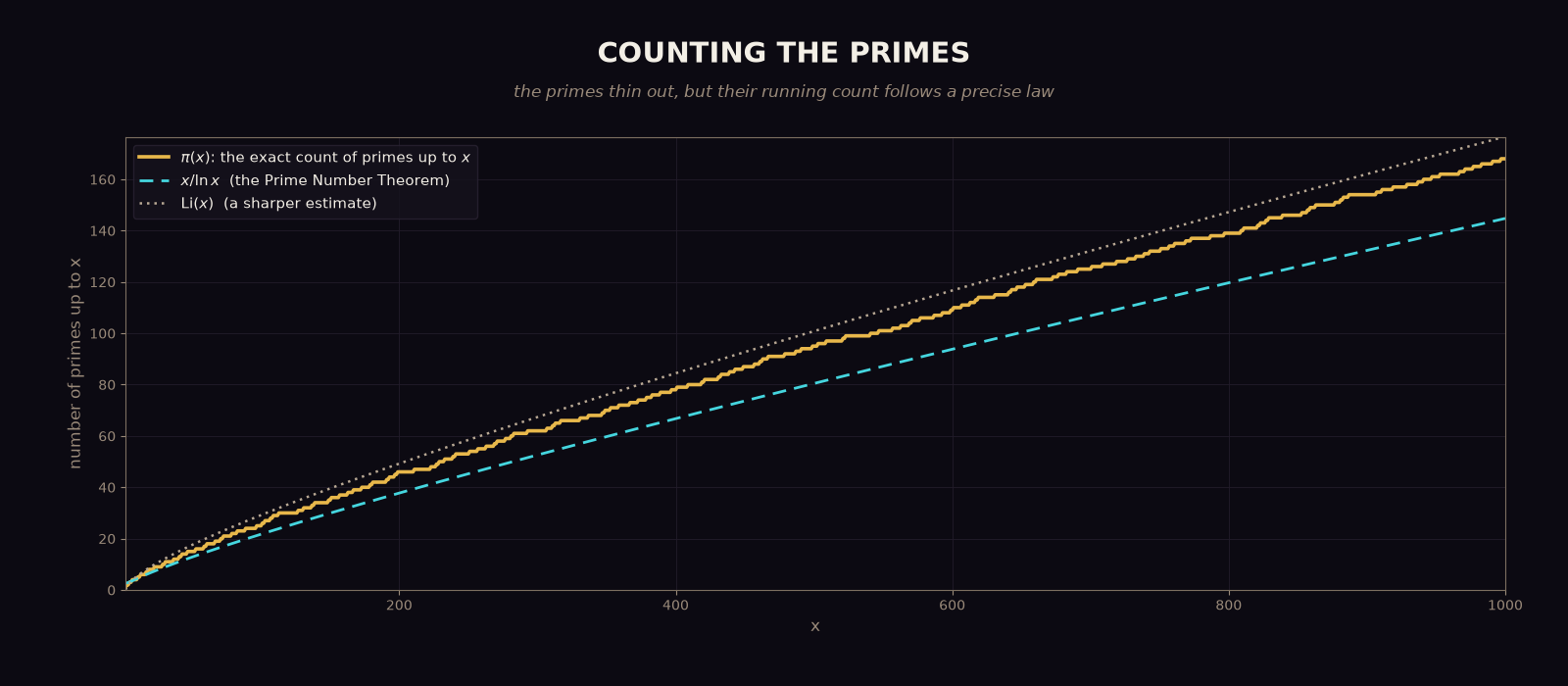
So the primes are not random, but they are not simply patterned either, and the exact way they sit between those two extremes is one of the deep facts of mathematics. Consider their density. Primes thin out as numbers grow, there are 25 of them below 100, but only about 78,000 below a million, yet they thin out in a strikingly regular way. Carl Friedrich Gauss noticed this as a teenager in the 1790s, and Adrien-Marie Legendre saw it independently: the number of primes up to some value x is close to x divided by its natural logarithm. This is the Prime Number Theorem, and it says the primes have a precise average density even though their individual positions look erratic. It stood as a conjecture for a century, until Jacques Hadamard and Charles-Jean de la Vallee-Poussin, working independently, both proved it in 1896 using the machinery of complex analysis. The bridge that made the proof possible is a remarkable object called the Riemann zeta function, and an identity discovered by Leonhard Euler shows that this single function secretly encodes complete information about every prime there is. To study the primes, in other words, you study a function, and the deepest question about that function is the most famous unsolved problem in all of mathematics.
03The Million-Dollar Riddle
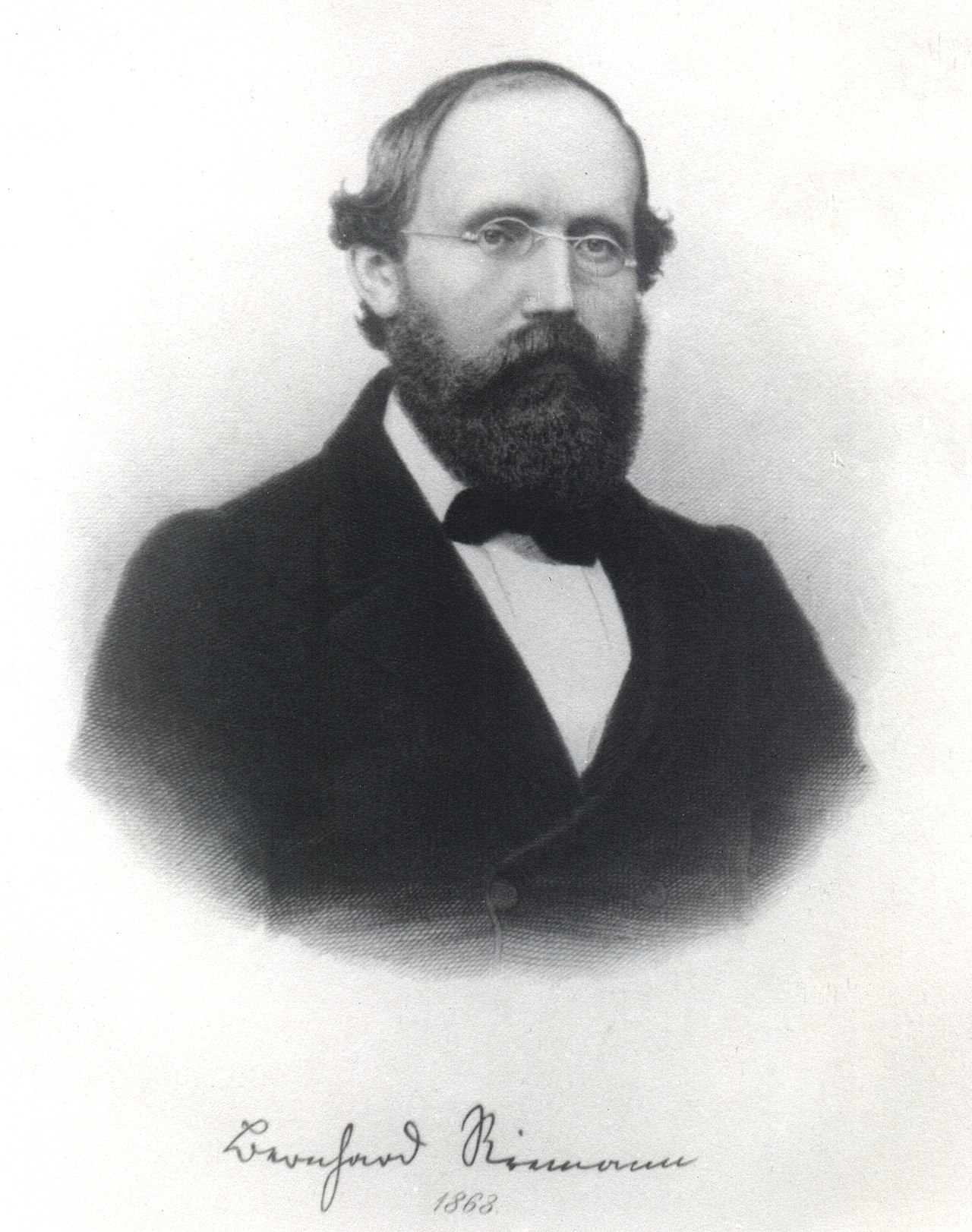
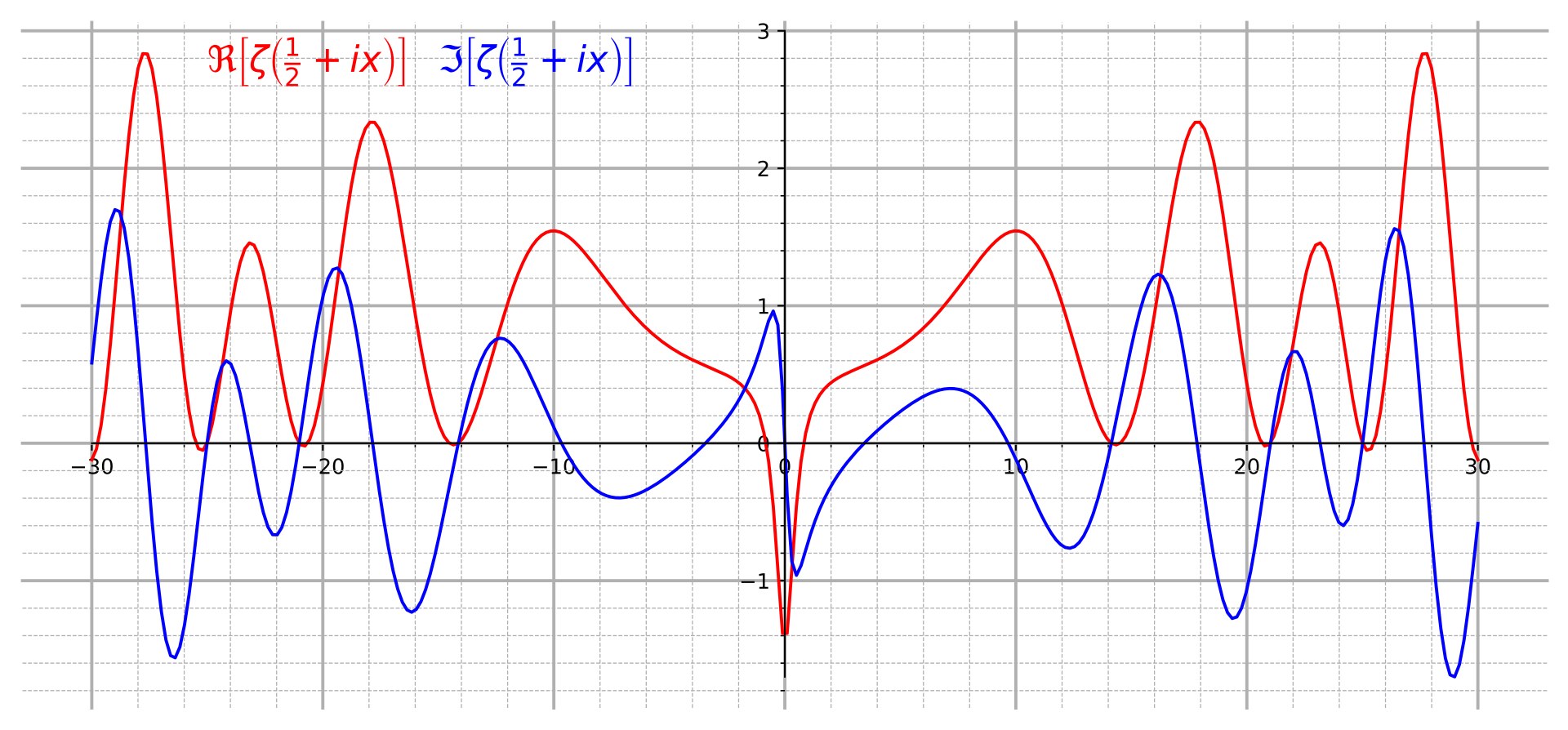
In 1859, in a short and famously dense paper, Bernhard Riemann carried Euler's connection much further and, almost as an aside, made a conjecture. The zeta function has an infinite collection of special inputs, its 'non-trivial zeros,' the places where it equals zero, and Riemann noticed that every one he could compute lay on a single vertical line, where a certain coordinate is exactly one-half, the 'critical line.' He conjectured that all of them, every last one of the infinitely many, lie on that line. This is the Riemann Hypothesis, and it matters enormously, because it is precisely equivalent to the sharpest possible statement about how the primes are distributed; a proof would pin down the primes' deep structure, and a great deal of modern number theory has already been proved on the assumption that it holds. It is now 167 years later, and no one has proved it. This deserves stating carefully, because it is so often blurred. More than ten trillion of those zeros have been computed, and every single one lies exactly on the critical line. That is staggering evidence. It is not a proof. A universal claim about infinitely many things can never be established by checking finitely many of them, however vast the number; there could always be a rogue zero further out than anyone has yet looked. Most mathematicians believe the Hypothesis is true, but belief is not proof, and the history of claimed proofs, announced, celebrated, and then quietly withdrawn, is a long one. The Clay Mathematics Institute has offered a million dollars for a correct resolution; of its seven such 'Millennium Prize' problems, exactly one has ever been solved (the Poincare Conjecture, by Grigori Perelman, who declined the money), and the Riemann Hypothesis is not it. It remains genuinely, completely open.
04The Codes That Guard the World
While the deepest question about the primes stays unanswered, the primes themselves quietly guard almost everything you do online, and they do it through a single, beautiful asymmetry. Multiplying two large prime numbers together is easy. Taking the resulting product and finding the two original primes back out of it is, as far as anyone knows, staggeringly hard, so hard that for large enough primes it would take the fastest computers on Earth longer than the current age of the universe. This one-way difficulty is the foundation of RSA, the public-key cryptography invented in 1977 that underlies secure websites, digital signatures, and online banking. The little padlock in your browser is, at bottom, a bet that nobody can factor a particular very large number. Two clouds sit on this horizon, and both are honest science rather than hype. The first is Shor's algorithm, a proven mathematical result showing that a sufficiently large, reliable quantum computer could factor those numbers quickly and break RSA outright, which is exactly why cryptographers are now racing to design 'post-quantum' schemes that do not depend on factoring. The second is subtler and rarely mentioned: no one has ever actually proved that factoring is hard, only that no one has yet found a fast way to do it. A great deal of the digital world's security rests on a difficulty that is empirically formidable but is not, itself, a theorem.
05Almost, But Not Quite

The primes are littered with questions a child can grasp and no one can answer, and the honest pleasure lies in seeing exactly how far the real proofs have and have not reached. Take twin primes: pairs like 11 and 13, or 29 and 31, that differ by just 2. It is conjectured that there are infinitely many, and this is almost certainly true, but it has never been proved. What has been proved is a spectacular near-miss. In 2013 Yitang Zhang, then an obscure lecturer, showed that there are infinitely many pairs of primes differing by no more than 70 million, the first finite bound anyone had ever established on the gaps between primes. A worldwide collaboration, energized by James Maynard's independent breakthrough, quickly drove that 70 million down to 246. That is a genuine, unconditional theorem and a mountain truly climbed, but it is not the twin prime conjecture, which demands the gap shrink all the way to 2, and the final step from 246 to 2 may be the hardest part of all. The same discipline applies to Goldbach's conjecture, the 1742 guess that every even number greater than 2 is a sum of two primes. It has been checked by computer for every even number up to four billion billion, without a single exception, and it is still unproven. Its weaker cousin, that every odd number above 5 is a sum of three primes, was completely proved by Harald Helfgott in 2013, a real and finished result, but a genuinely different and easier statement. Keeping these apart, 'verified up to an enormous number,' 'proved for a weaker version,' and actually 'proved,' is the entire discipline of the subject, and blurring them is exactly how good mathematics gets misreported.
06Wonder, Not Numerology
Two last threads run out from the primes, one real and one to be refused. The real one is a genuine astonishment. In the spring of 1972, over afternoon tea at Princeton's Institute for Advanced Study, the number theorist Hugh Montgomery described to the physicist Freeman Dyson the statistical pattern in the spacing of Riemann's zeros, and Dyson recognized it instantly: it was the very same pattern that governs the energy levels of heavy atomic nuclei, captured by the mathematics of 'random matrices.' No one knows why the distribution of the zeta zeros, an object born in pure number theory, should mirror the quantum behaviour of nuclei, but the connection is real, deep, and has driven decades of serious research, including a speculative hope that some physical system might one day be found whose energy levels are exactly the zeros, turning a proof of the Riemann Hypothesis into a problem of physics. That is wonder of the legitimate kind, anchored in real, unexplained mathematical fact, and it stands beside gentler open puzzles like why some cicadas evolved life cycles of exactly 13 and 17 years, both primes. It must be kept strictly apart from the other kind of 'wonder.' Because primes are mysterious and important, they attract a great deal of mysticism: claims that prime numbers hold secret spiritual power, that certain prime 'frequencies' can heal or harm the body, or, in a memorable piece of science fiction, that a radio signal counting out the primes could only be a message from aliens. These are numerology and story, not mathematics, and they should be named as such. But refusing the mysticism is not the same as flattening the marvel, and the two must not be confused. The genuine wonder of the primes needs no embellishment whatsoever: that the simplest objects in all of mathematics, the building blocks of counting itself, still conceal a pattern deep enough to be worth a million dollars, and that after more than two thousand years the sharpest minds alive still cannot fully explain the streak of dots a bored physicist noticed while doodling a spiral.
Fast Facts
- What primes are
- Whole numbers above 1 divisible only by 1 and themselves; the multiplicative 'atoms' from which every integer above 1 is uniquely built (the Fundamental Theorem of Arithmetic)
- How many
- Infinitely many, proved by Euclid around 300 BCE. The largest one explicitly known has over 41 million digits (a Mersenne prime found in October 2024)
- Prime Number Theorem
- The count of primes up to x is close to x / ln x; conjectured by Gauss, proved by Hadamard and de la Vallee-Poussin in 1896. Primes thin out, but on a precise law
- The Riemann Hypothesis
- Riemann's 1859 conjecture that all the zeta function's non-trivial zeros lie on one line. UNPROVEN. Over 10 trillion zeros have been checked, all on the line, which is NOT a proof
- The million dollars
- One of the seven Clay Millennium Prize Problems ($1M each); exactly one (the Poincare Conjecture) has ever been solved. The Riemann Hypothesis remains open and unclaimed
- Why they matter
- RSA encryption (which secures the web) relies on the difficulty of factoring a product of two large primes back into them; Shor's algorithm shows a large quantum computer could break it
- Almost-proved
- Twin primes (unproven) vs Zhang's 2013 bounded-gap theorem (proven, later sharpened to gaps of at most 246); strong Goldbach (unproven, checked to 4x10^18) vs weak Goldbach (proven, Helfgott 2013)
- Refused
- That RH is proved or 'basically confirmed'; that primes carry mystical or 'sacred frequency' power; and that a prime signal proves aliens (a premise from the novel Contact). Refusing numerology is not refusing the real wonder
What We Can Actually Stand Behind
The proven mathematics is deep and settled. Primes are the unique building blocks of the integers (the Fundamental Theorem of Arithmetic); there are infinitely many (Euclid); and their average density obeys the Prime Number Theorem (Hadamard and de la Vallee-Poussin, 1896). RSA cryptography rests on the real difficulty of factoring. And two landmark near-misses are fully proven: Zhang's 2013 bounded-gap theorem (later sharpened to gaps of at most 246) and Helfgott's 2013 proof of the weak (ternary) Goldbach conjecture.
Several central claims are strongly believed and strongly evidenced, but genuinely unproven. The Riemann Hypothesis is supported by over ten trillion computed zeros and near-universal expert belief, yet remains a conjecture. The twin prime conjecture and the strong (binary) Goldbach conjecture are both unproven, despite the proven partial results near them. And the Montgomery-Dyson link between the zeta zeros and random-matrix (nuclear) physics is a real, deep, and still-unexplained connection.
Some connections are genuinely speculative. That periodical cicadas evolved prime-numbered 13- and 17-year cycles specifically to dodge predators is a plausible, researched hypothesis, not a settled fact. And the Berry-Keating program, the hope of finding a physical (quantum) system whose energy levels are exactly Riemann's zeros, and so turning the Hypothesis into a physics problem, is a serious but so far unrealized idea.
The overclaims get a firm no. The Riemann Hypothesis has NOT been proved, and ten trillion verified zeros are evidence, not proof; claimed proofs have repeatedly failed peer review. Primes carry no mystical or 'sacred frequency' power, and a signal of prime numbers is not evidence of aliens (that is a premise from Carl Sagan's novel Contact). Refusing this numerology, though, is emphatically not the same as refusing the primes' real and unexplained mystery.
The primes close The Gold Thread's band on the edges of the knowable, and they belong there because they are the plainest possible proof that simplicity and mystery are not opposites. Nothing in mathematics is more elementary than a prime number; almost nothing is harder to understand completely. Here the wing's recurring theme, that a deep pattern runs through the world, is neither oversold nor waved away. The pattern is provably real: the Prime Number Theorem is a theorem. It is provably useful: it guards the internet. And its deepest layer is provably, or rather stubbornly un-provably, still hidden, sealed behind a question worth a million dollars that has defeated the finest minds for a century and a half. That is the honest shape of the thing. The primes are not random, and they are not mystical. They are structured in ways we can prove, unpredictable in ways we can measure, and mysterious in ways we have not yet cracked, and the thread they hang on runs unbroken from Euclid's few lines to a diagonal streak of dots a bored physicist once noticed in a spiral. It is still being followed.
Sources & further reading
Everything above is drawn from our research library on Theories of Anything. Open the full file to check the sourcing and go deeper.
Image credits
- The Ulam spiral (original diagram) Original diagram by Theories of Anything. CC BY-SA 4.0 Source.
- Counting the primes: the Prime Number Theorem (original diagram) Original diagram by Theories of Anything. CC BY-SA 4.0 Source.
- Bernhard Riemann, 1863 Smithsonian Institution Libraries, via Wikimedia Commons (public domain). Public domain Source.
- The Riemann zeta function on the critical line Slonzor and Krishnavedala, via Wikimedia Commons (public domain). Public domain Source.
- Yitang Zhang Voice of America, via Wikimedia Commons (public domain). Public domain Source.
- Card crop of the Ulam spiral Original diagram by Theories of Anything. CC BY-SA 4.0
,_Mathematician_(2551069295).jpg)

