
The Machines That Learned to Talk: Large Language Models
One architecture, posted in June 2017 for a machine translation benchmark, turned next-word prediction into systems that argue, write code and produce confident falsehood. This page takes the machine apart: what a token is, what attention computes, what the scaling laws found and what their own authors wrote against them, what a training run costs in compute, electricity, money and unsettled copyright, what these systems can be measured doing with the date attached, what they reliably fail at, and why an interpretability team tracing the circuits inside a production model reported satisfying insight on about a quarter of their attempts. Our own research files are corrected in more than a dozen places on the way, including one figure they attribute to two sources that do not contain it, a defect this page names in the open and a number it refuses to print. There is no evidence of sentience here. Whether any of it amounts to understanding is a live argument, and this page holds it open.
A large language model is a neural network trained to do one thing: predict the next token in a sequence. Everything it appears to do afterwards, argue, translate, write code, is a consequence of doing that one thing across an enormous body of text. That is not a simplification written for the reader. It is the entire pretraining objective. What follows is an account of the specific machine: where the architecture came from, what its parts compute, what a training run costs, what these systems can be measured doing, what they reliably fail at, and how little anybody can say about why. Every figure and every model name below carries its date where it appears, because this subject moves quickly and an undated number ages into a false one.
01The Machine That Finished The Sentence
The pretraining objective is next-token prediction and nothing else. The model is shown a stretch of text with the continuation hidden, it produces a probability distribution over what comes next, and the gap between its guess and the actual next token is used to adjust its weights. Repeat that across a corpus large enough and the system that emerges can hold an argument, translate a contract, or write a working function, none of which it was separately taught. Our own research file draws the consequence that follows, and it is the hinge of everything below: fluent falsehood 'arises from the fundamental training objective (next-token prediction)', because 'the model optimizes for plausibility, not truth'. A machine built to produce likely continuations will produce a likely continuation whether or not a true one exists. Hold that sentence; sections 07 and 09 are both arguments about how far it reaches.
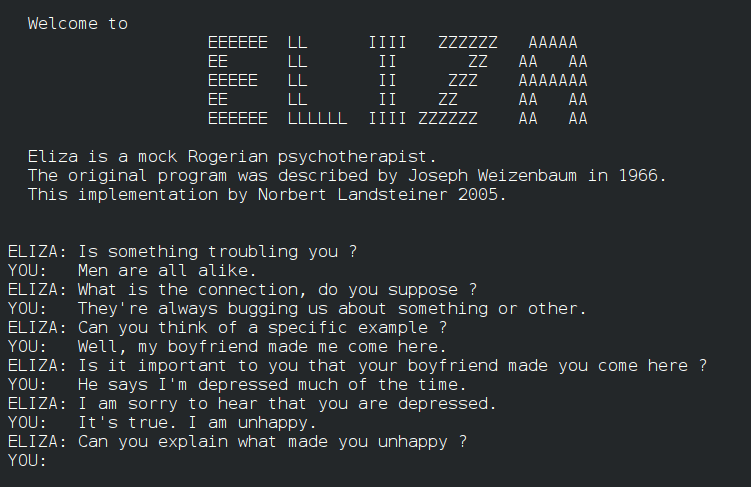
The reflex to read a mind into fluent text is older than any of this. In January 1966 Joseph Weizenbaum, at MIT, published a program called ELIZA in Communications of the ACM. It matched patterns in whatever the user typed and reflected them back as questions. It had no model of language, no memory and no knowledge of anything at all, and people talked to it as though it had all three. None of our four research files carries ELIZA, which is a gap worth naming, because the central psychological fact of this subject was documented in a peer-reviewed journal by the program's own author six decades ago. Nothing since has removed the reflex. The machines simply got better at triggering it, and section 09 returns to what that does and does not license anyone to conclude.
02What A Transformer Actually Is
Start with what the model reads, because it is not words. Text is first cut into sub-word units by a learned merge procedure, byte pair encoding, brought into neural machine translation by Rico Sennrich, Barry Haddow and Alexandra Birch at ACL 2016. Common words survive as single units; rare ones are split into fragments, and the fragments cut across morphology, because the procedure is a compression algorithm repurposed and nothing in the paper claims the resulting units mean anything. That engineering convenience is the reason these systems are mocked for spelling and arithmetic: they are manipulating units that were never designed to line up with letters or digits. The consequence is public and measurable. Anthropic's own model documentation, read on 28 August 2026, states that a one-million-token context window is 'roughly 555k words or 2.5M Unicode characters on the current tokenizer (introduced with Claude Opus 4.7)', and that 'models before it fit about 750k words in 1M tokens'. The same advertised window holds a different quantity of English depending on which tokenizer sits underneath it.
Attention did not arrive in 2017. Dzmitry Bahdanau, Kyunghyun Cho and Yoshua Bengio introduced additive attention for neural machine translation at the Universite de Montreal in 2014, in 'Neural Machine Translation by Jointly Learning to Align and Translate', published at ICLR 2015, letting a decoder focus on the relevant parts of a source sentence instead of forcing the whole of it through one fixed vector. Minh-Thang Luong proposed a simpler multiplicative form at Stanford in 2015. Our own architecture file states the 2017 contribution precisely, and it is subtractive rather than additive: 'The transformer's contribution was eliminating recurrence entirely and building an architecture from attention alone.' A note on sourcing: the identifier our file carries for the Bahdanau paper could not be independently resolved for this page, so that work is named here by title, authors and venue and is not linked below.
The architecture itself was posted on 12 June 2017 as 'Attention Is All You Need', by Ashish Vaswani, Noam Shazeer, Niki Parmar, Jakob Uszkoreit, Llion Jones, Aidan N. Gomez, Lukasz Kaiser and Illia Polosukhin, and published at NIPS 2017. The paper's own footnotes give three affiliations, Google Brain, Google Research and the University of Toronto, where our file gives two. The abstract proposes 'a new simple network architecture, the Transformer, based solely on attention mechanisms, dispensing with recurrence and convolutions entirely.' That sentence is the whole move. Everything the field had built on processing a sentence in order was taken out, and what remained was a stack of layers in which every position can look at every other position at once.
The paper's first author footnote is worth carrying whole, because it is the only place the architecture can be watched being assembled by named people rather than arriving finished, and because of what its first two sentences do. It reads: 'Equal contribution. Listing order is random. Jakob proposed replacing RNNs with self-attention and started the effort to evaluate this idea. Ashish, with Illia, designed and implemented the first Transformer models and has been crucially involved in every aspect of this work. Noam proposed scaled dot-product attention, multi-head attention and the parameter-free position representation and became the other person involved in nearly every detail. Niki designed, implemented, tuned and evaluated countless model variants in our original codebase and tensor2tensor. Llion also experimented with novel model variants, was responsible for our initial codebase, and efficient inference and visualizations. Lukasz and Aidan spent countless long days designing various parts of and implementing tensor2tensor, replacing our earlier codebase, greatly improving results and massively accelerating our research.' The paper that founded the field declined to say who wrote most of it.
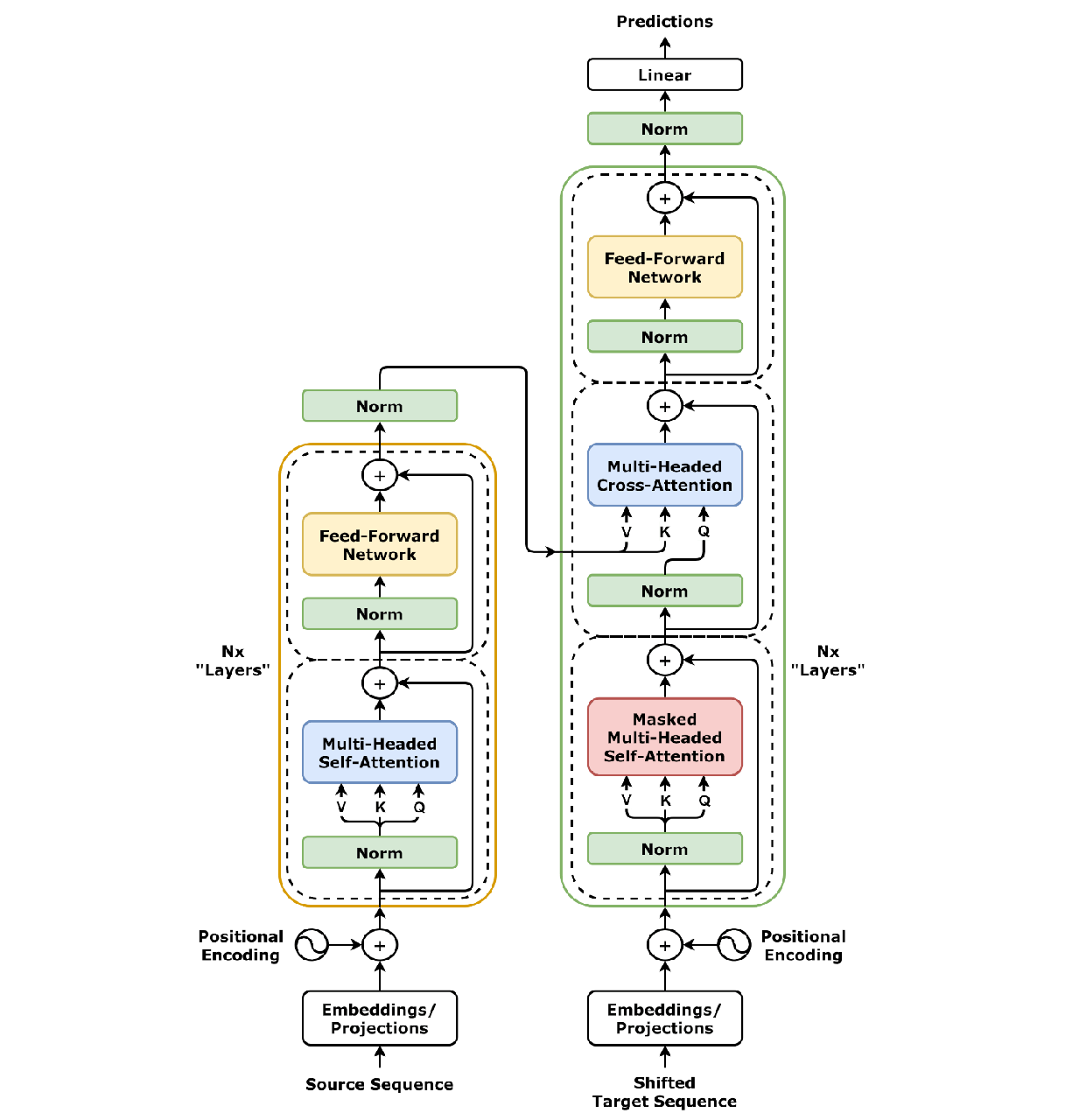
Self-attention is one operation and it is simple enough to say in a sentence. Every position in the sequence produces three vectors by linear projection: a query, a key and a value. Each query is compared against every key to produce a score, the scores are turned into weights that sum to one, and the position's output is the weighted average of all the values. Every token asks every other token how relevant it is, and the answer is an average. Two engineering details matter. The comparison is a dot product divided by the square root of the key dimension, and that divisor exists for a mundane and decisive reason: without it the scores grow large enough to push the weighting function into a region where the gradients vanish and the network stops learning. And the whole thing is a matrix operation, so all positions are computed together rather than in order. Our own primary file states the effect plainly: the mechanism 'allows the model to weigh relationships between all tokens in a sequence simultaneously, replacing the sequential processing of RNNs and LSTMs'.
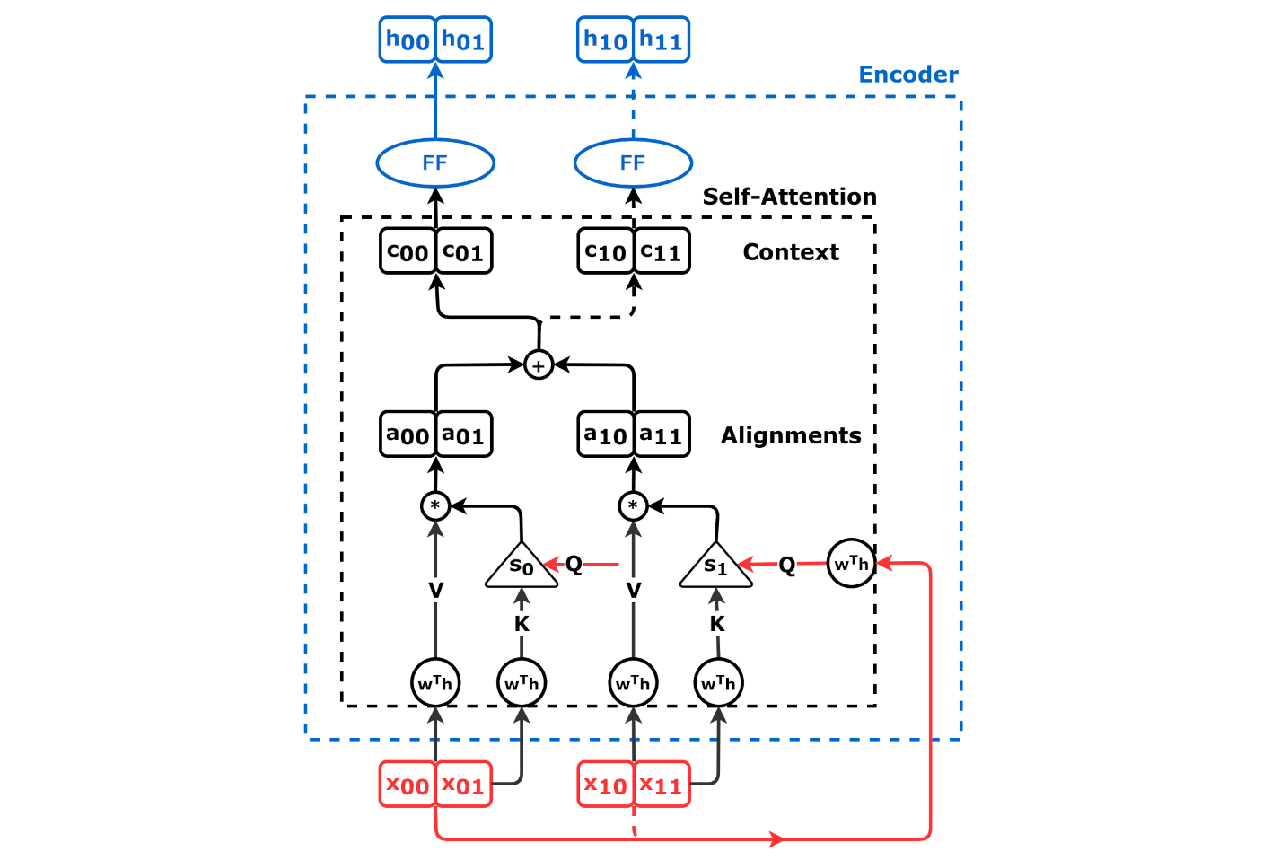
A transformer does not run one attention function but several in parallel, called heads, whose outputs are concatenated and projected back down. The 2017 model used eight of them, each working in 64 dimensions, that being the model dimension divided by the number of heads. The paper's own justification is about representational room rather than division of labour: 'Multi-head attention allows the model to jointly attend to information from different representation subspaces at different positions.' Our own architecture file adds the familiar gloss that one head handles syntax, another semantics, another position. That gloss is an interpretation, not a finding, and it is the first place this article should show its hand: section 08 carries the work showing that where a model attended is not a reliable account of what it used.
Attention has no idea what order anything is in. The operation is permutation invariant: shuffle the tokens and exactly the same set of comparisons is made. Word order, which is a great deal of what a sentence is, has to be added by hand, and the 2017 paper adds it as a set of sinusoidal position signals mixed into the input. Later models replaced those with learned position embeddings, with relative position representations (Shaw, Uszkoreit and Vaswani, 'Self-Attention with Relative Position Representations', NAACL 2018) and with rotary position embeddings (Su and colleagues, 2021). The identifier our file carries for the Shaw paper could not be independently resolved for this page either, so it too is named here and not linked below.
Attention is also not the only thing in a transformer layer, and our own architecture file says so in a refusal box. Each layer carries a two-layer feed-forward network applied at every position independently, typically four times as wide as the model dimension, plus layer normalisation (Ba and colleagues, University of Toronto, 2016) and residual connections (He and colleagues, Microsoft Research, 2015). Our file marks the proposition that attention is a complete theory of neural computation as unsupported, at Tier 4, on the grounds that transformers 'rely heavily on feed-forward layers (which some available evidence suggests store the majority of factual knowledge), normalization, and positional information'. The famous title is a claim about what was removed, not a description of what remains.
Comparing every position against every other position costs time and memory in proportion to the square of the sequence length. Double the input and the work quadruples. Our own architecture file gives the consequence at scale in its own framing: processing a document of a million tokens takes on the order of 10^12 attention computations per layer. Engineering has attacked the constant rather than the exponent, and our file records the outcome: FlashAttention (Dao and colleagues, 2022) cut the memory overhead by reorganising the computation around the memory hierarchy, but 'the asymptotic complexity remains quadratic'. Our file also reads Tay, Dehghani, Bahri and Metzler's 2022 survey of efficient transformer variants as finding that no sub-quadratic method consistently matches full attention quality across tasks. That negative verdict is our file's reading; the survey itself was not opened for this page, and its own stated shape is a taxonomy of variants rather than a head-to-head ranking.
It is worth being exact about what that paper claimed, because it is not what the architecture became. It was a machine translation paper with a table of BLEU scores. Its abstract reports: 'Our model achieves 28.4 BLEU on the WMT 2014 English-to-German translation task, improving over the existing best results, including ensembles by over 2 BLEU. On the WMT 2014 English-to-French translation task, our model establishes a new single-model state-of-the-art BLEU score of 41.8 after training for 3.5 days on eight GPUs, a small fraction of the training costs of the best models from the literature.' Two corrections to our own files sit inside that quotation. The base model in the paper had 65 million parameters, which is the figure our primary file prints as the parameter count, but the result quoted above came from the big model at 213 million. And our architecture file attaches the three and a half days on eight GPUs to the German result; the abstract attaches it to the French one. What the authors were reporting was a two-point improvement on a translation benchmark and a large saving in training time.
| Family | How It Is Pretrained | What It Suits | The Archetype Our File Names |
|---|---|---|---|
| Encoder-only | Masked language modelling: words are removed from a visible whole and predicted from both sides | Classification and question answering | BERT (Devlin, Chang, Lee and Toutanova, Google, posted 11 October 2018) |
| Decoder-only | Causal next-token prediction: each position sees only what came before it | Generation | GPT (Radford and colleagues, OpenAI, June 2018) |
| Encoder-decoder | Every task framed as text in and text out | Translation and task transfer | T5 (Raffel and colleagues, Google, 2020) |
Within about a year the architecture had split into the three families above, and that split is why the abbreviation now names one specific shape of machine. Our file gives the verdict: 'The decoder-only architecture dominates current frontier models due to its simplicity and effectiveness for generative tasks.' Note what that means for section 01. The family that won is the one whose training objective is the single sentence this article opened with, and our file's stated reason for its winning is simplicity and effectiveness for generative tasks, not any argument that predicting the next token is the right thing to be doing.
One further change matters for a reason that arrives in the next section. A mixture-of-experts layer routes each token to a small subset of the network instead of all of it, so a model can hold an enormous number of total parameters while using only a fraction of them on any given token. Shazeer, Mirhoseini, Maziarz, Davis, Le, Hinton and Dean introduced the sparsely-gated version at Google in January 2017, reporting 'greater than 1000x improvements in model capacity with only minor losses in computational efficiency on modern GPU clusters'. In January 2021 Fedus, Zoph and Shazeer simplified the routing in the Switch Transformer and reported that they 'advance the current scale of language models by pre-training up to trillion parameter models on the "Colossal Clean Crawled Corpus"'. The consequence is that a trillion-parameter sparse model and a trillion-parameter dense model are not the same object, so a published parameter count would mean less than a reader expects even in the years when one was published.
The architecture did not stay in language. Our machine learning file states at Tier 1 that the transformer 'underpins all major LLMs (GPT, BERT, T5, LLaMA, Claude, Gemini) and has been adapted for computer vision (Vision Transformer, ViT), protein folding (AlphaFold), weather prediction (GraphCast), and other domains', and that 'its impact across ML subfields is comparable to the invention of the convolutional layer'. Our architecture file grades the same generalisation one step lower, at Tier 2, and this page carries the more conservative of the two. What those systems do is not this article's subject, and our article on the alignment problem tells the protein-folding story at length. That a translation architecture from 2017 ended up in all of them is the point here, and then this article returns to language.
03Making It Bigger
BERT was posted by Jacob Devlin, Ming-Wei Chang, Kenton Lee and Kristina Toutanova at Google on 11 October 2018 and published at NAACL 2019. It came in two sizes and our own file prints only the larger: BERT-BASE at 110 million parameters and BERT-LARGE at 340 million. Its pretraining recipe is worth one concrete sentence because it is checkable: 'we simply mask some percentage of the input tokens at random, and then predict those masked tokens', with a masked token replaced by a placeholder 80 percent of the time, by a random token 10 percent, and left unchanged 10 percent. The paper reports that the model 'obtains new state-of-the-art results on eleven natural language processing tasks, including pushing the GLUE score to 80.5% (7.7% point absolute improvement)'. Those are October 2018 numbers on October 2018 benchmarks, and they are recorded here as history rather than as a current standing.
GPT-2 arrived from OpenAI in February 2019 at 1.5 billion parameters and was initially withheld over misuse concerns. Our own file calls it 'the first major AI "staged release"', keeping the inner quotation marks it puts around the term. OpenAI's own peer-facing account of the decision, Solaiman and colleagues in August 2019, describes 'staged release, which allows time between model releases to conduct risk and benefit analyses as model sizes increased'. The full model was released in November 2019. This page does not quote the announcement that accompanied that release, because openai.com returns an error to non-browser clients and the page could not be read for this article. What can be said is the shape of the episode: an organisation treated its own output as hazardous and then undid that decision itself within nine months.
The GPT-3 paper, 'Language Models are Few-Shot Learners', was posted by Tom B. Brown and thirty co-authors on 28 May 2020, and the API private beta followed in June 2020; our own file gives one date for those two events. The paper reports that 'we train GPT-3, an autoregressive language model with 175 billion parameters, 10x more than any previous non-sparse language model, and test its performance in the few-shot setting', and that all its models 'were trained for a total of 300 billion tokens'. The result that changed the field was procedural rather than numerical: 'For all tasks, GPT-3 is applied without any gradient updates or fine-tuning, with tasks and few-shot demonstrations specified purely via text interaction with the model.' The same abstract names its own failures, and they belong here too: 'we also identify some datasets where GPT-3's few-shot learning still struggles, as well as some datasets where GPT-3 faces methodological issues related to training on large web corpora.' Deeper in, the paper discloses that its own contamination filtering broke: 'a bug in the filtering caused us to ignore some overlaps, and due to the cost of training it was not feasible to retrain the model.' The founding paper of the modern era says in its own pages that it could not afford to fix a flaw in its evaluation, and that admission is almost never quoted. Our own file also carries a launch-day price per thousand tokens for this model. No primary record of it could be obtained, the June 2020 launch was a free private beta, and this page therefore does not print the figure.
PaLM arrived from Google in April 2022 at 540 billion parameters and demonstrated, in our own file's phrasing, 'breakthrough performance on reasoning tasks, including explaining jokes'. The joke result is real and appears in the PaLM paper; that paper was not opened for this page, so it is attributed and not quoted. The checkable reasoning result at that scale comes from a different paper and is carried in section 04, where it belongs to a method rather than to a model.
Meta released LLaMA in February 2023: a family from 7 billion to 65 billion parameters trained only on publicly available data. Our own file gives one training-set size for the whole family. The paper gives two: the 7B and 13B models were trained on 1.0 trillion tokens and the 33B and 65B on 1.4 trillion. The headline is the one that mattered, and it is the strongest single piece of evidence for the compute-optimal argument three claims below: 'LLaMA-13B outperforms GPT-3 (175B) on most benchmarks, and LLaMA-65B is competitive with the best models, Chinchilla-70B and PaLM-540B.' The paper says 'We release all our models to the research community.' The weights then reached the wider public, which is widely reported and was not verified against a primary source for this page; our own file credits the release with catalysing the open-weight ecosystem, and section 05 returns to what that does and does not settle.
GPT-4 was released by OpenAI in March 2023 and accepted image as well as text input. Its size is not public and never has been. The technical report says so in as many words: 'Given both the competitive landscape and the safety implications of large-scale models like GPT-4, this report contains no further details about the architecture (including model size), hardware, training compute, dataset construction, training method, or similar.' Our own file prints an estimate above one trillion parameters, marked unconfirmed, in a claim it grades Tier 1. There is no primary source for it and this page does not print a number. This is the hinge of the article's middle: for five years the history could be told in parameter counts, and then it stopped being tellable that way, not because the numbers got bigger but because they stopped being published. The exam results announced alongside this model are not retold here either. Our article on the alignment problem already carries the bar exam claim together with its peer-reviewed re-evaluation, and our own file's Tier 1 grade for a vendor's own percentile is not one this page would repeat.
| Model And Date | Parameters, As Published At The Time | Training Data, As Published At The Time | What Its Own Paper Reported |
|---|---|---|---|
| Transformer, posted 12 June 2017 | 65 million (base) and 213 million (big) | WMT 2014 translation corpora | 28.4 BLEU English to German; 41.8 BLEU English to French, which the paper attributes to the big model, after 3.5 days on eight GPUs |
| BERT, posted 11 October 2018 | 110 million (BASE) and 340 million (LARGE) | Not restated here | New results on eleven NLP tasks, GLUE pushed to 80.5% |
| GPT-2, February 2019 | 1.5 billion | Not restated here | Withheld at announcement; full model released November 2019 |
| GPT-3, posted 28 May 2020 | 175 billion | 300 billion tokens across all models in the paper | Few-shot performance with no gradient updates; a disclosed contamination-filtering bug |
| LaMDA, posted 20 January 2022 | Up to 137 billion | 1.56 trillion words of public dialogue data and web text | A family of transformer-based dialogue models |
| Chinchilla, posted 29 March 2022 | 70 billion | Not restated here, because it is in the paper body rather than the abstract and was not re-read for this page | Trained on the same compute budget as Gopher (280B), and outperformed Gopher, GPT-3 (175B), Jurassic-1 (178B) and Megatron-Turing NLG (530B) on a large range of downstream tasks |
| PaLM, April 2022 | 540 billion | Not restated here | Reasoning performance including joke explanation, per our own file |
| LLaMA, February 2023 | 7 billion to 65 billion | 1.0 trillion tokens (7B, 13B) and 1.4 trillion (33B, 65B) | LLaMA-13B outperformed GPT-3 (175B) on most benchmarks |
| GPT-4, March 2023 | Not disclosed, then or since | Not disclosed | The report states explicitly that it contains no details of size, compute, data or method |
That blackout is now the industry's normal condition, and it is the durable finding rather than any leaderboard. Read on 28 August 2026, Anthropic's models overview lists Claude Fable 5, Claude Opus 5, Claude Sonnet 5 and Claude Haiku 4.5, with million-token context windows on the first three and 200,000 on the fourth, 128,000 maximum output tokens, list prices published per million tokens, and published training-data cutoffs. OpenAI's models reference on the same day lists a GPT-5.6 family with a 1.05 million token context. Google's Gemini API models page lists a Gemini 3.x family. Every one of those names will be stale within months and is dated here for that reason. Four things on those pages will not be: context windows are now quoted in millions of tokens, prices are quoted per million tokens, training cutoffs are published, and none of the three vendors publishes a parameter count for any model. The one number a reader most wants is the one number nobody prints, and the mixture-of-experts routing described in section 02 means it would be ambiguous even if they did.
The reason anyone kept building bigger ones is a measurement. Jared Kaplan and colleagues at Johns Hopkins and OpenAI posted 'Scaling Laws for Neural Language Models' on 23 January 2020, finding that a model's loss falls as a power law in model size, in dataset size and in compute. The paper gives the exponents: about 0.076 for non-embedding parameters, about 0.095 for training tokens, and about 0.050 for optimally allocated compute. They are worth stating only with their meaning attached, which is that a larger exponent means loss falls faster as you spend more of that particular thing. The abstract says the trends span 'more than seven orders of magnitude', and draws the conclusion the industry acted on: 'Larger models are significantly more sample-efficient, such that optimally compute-efficient training involves training very large models on a relatively modest amount of data and stopping significantly before convergence.' Our article on the alignment problem states this paper in one sentence as a safety backdrop and carries the compute-growth figures; this page carries the result as a machine learning finding and leaves the growth curves there.
The counter-evidence to the most quoted finding in the field is inside the finding's own paper, and it is usually dropped. On the upper end the authors write that 'we observe no signs of deviation from these trends on the upper end, though performance must flatten out eventually before reaching zero loss.' Later in the same paper they identify a contradiction between their own trends at extreme scale and conclude that the laws must break down before the point at which those trends would intersect. That second sentence is a paraphrase of their section 6.3 and is deliberately not presented as a quotation, because the section was not re-opened for this page. The point stands either way: the people who measured the curve wrote down, in the paper that measured it, that it cannot hold.
In March 2022 Jordan Hoffmann and colleagues at DeepMind showed that the models of the GPT-3 generation were undertrained rather than merely large. Training over 400 models from 70 million to more than 16 billion parameters on 5 to 500 billion tokens, they concluded 'that for compute-optimal training, the model size and the number of training tokens should be scaled equally: for every doubling of model size the number of training tokens should also be doubled.' They then built Chinchilla at 70 billion parameters on the same compute budget as the 280-billion-parameter Gopher, and report that 'Chinchilla uniformly and significantly outperforms Gopher (280B), GPT-3 (175B), Jurassic-1 (178B), and Megatron-Turing NLG (530B) on a large range of downstream evaluation tasks.' A smaller model beat a model four times its size on the same budget, which is also what the LLaMA result two claims above is showing.
Our own file grades that as settled Tier 1 and does not mention that somebody tried to redo it. In April 2024 Tamay Besiroglu, Ege Erdil, Matthew Barnett and Josh You attempted to replicate the third of the paper's three estimation procedures and report that the published estimates for it 'are inconsistent with their first two estimation methods, fail at fitting the extracted data, and report implausibly narrow confidence intervals'. State the limit of that finding as carefully as the finding: it challenges one of three procedures, the replicators' own rederivation using the same approach agreed with the other two, and the compute-optimal conclusion everybody actually uses survives intact. This is not a retraction and nothing here implies one. The right shape of the story is that the headline held, one of the three fits did not, and the field found out because someone did the arithmetic again.
The claim that made scaling feel like more than economics is emergence. Jason Wei and fifteen colleagues argued in June 2022, in a paper later published in Transactions on Machine Learning Research, that some abilities are simply absent below a scale threshold and present above it. Their definition is the whole of the claim: 'We consider an ability to be emergent if it is not present in smaller models but is present in larger models. Thus, emergent abilities cannot be predicted simply by extrapolating the performance of smaller models.' The examples our own file names are multi-step arithmetic, chain-of-thought reasoning, and translation for low-resource languages. The abstract's closing sentence is the one that moved money: 'The existence of such emergence implies that additional scaling could further expand the range of capabilities of language models.' Note the conditional verb. It is doing a great deal of work.
In April 2023 Rylan Schaeffer, Brando Miranda and Sanmi Koyejo argued that the cliff is in the scoring rather than in the model. Their claim: 'for a particular task and model family, when analyzing fixed model outputs, emergent abilities appear due to the researcher's choice of metric rather than due to fundamental changes in model behavior with scale. Specifically, nonlinear or discontinuous metrics produce apparent emergent abilities, whereas linear or continuous metrics produce smooth, continuous predictable changes in model performance.' The strongest part is a demonstration our own file omits: they chose metrics that produced 'never-before-seen seemingly emergent abilities in multiple vision tasks across diverse deep networks'. They did not merely argue that the cliff was an artefact; they manufactured cliffs to order. And their conclusion is narrower than the way it is usually cited: 'alleged emergent abilities evaporate with different metrics or with better statistics, and may not be a fundamental property of scaling AI models.' That is a claim about the shape of the acquisition, not a claim that the abilities are absent. A reader who takes it as a debunking has misread it.
Our two files reach the same verdict independently, and this page carries it as written. The primary file states the standoff: 'The debate remains unresolved: whether LLM capabilities represent genuine phase transitions or gradual improvements perceived as sudden due to measurement choices'. The machine learning file puts it more briefly: 'the nature and reliability of emergence is debated'. Neither side has been retired by the other. What can be said is narrower and more useful than either: whether a capability arrives or grows depends on how you agreed to score it before you looked, which is a fact about measurement that would be worth knowing even if the dispute were settled tomorrow.
04Teaching It To Answer
A pretrained language model predicts text. It does not follow instructions, and nothing in the objective asks it to. The bridge is reinforcement learning from human feedback: supervised fine-tuning on human-written examples, then a reward model trained on human rankings of model outputs, then optimisation of the language model against that reward model. Paul Christiano, Jan Leike, Tom B. Brown, Miljan Martic, Shane Legg and Dario Amodei published the method in June 2017, reporting that it works while 'providing feedback on less than one percent of our agent's interactions with the environment' and can teach 'complex novel behaviors with about an hour of human time'. An accident of history worth one clause: that paper is about Atari games and simulated robots, not about language at all. OpenAI applied it at scale to language in InstructGPT, announced in January 2022 and published as a paper on 4 March 2022; our own file gives one date for those two events. What this method does to a model's safety, and where it fails, belongs to our article on the alignment problem. Here it is simply the step that turned a text predictor into something a person could talk to.
That step also produced the sharpest counterweight to the scaling story on this page, and it came from the organisation with the most to gain from that story. In OpenAI's own human evaluations, outputs from a 1.3 billion parameter InstructGPT model were preferred to outputs from the 175 billion parameter GPT-3, a model a hundred times larger. The paper reports that increasing model size alone does not make a model better at following instructions, and that the fine-tuning also improved truthfulness and reduced toxic output while leaving performance on standard benchmarks broadly intact. Nothing on this page is quoted from that abstract, because the fetch of it returned a paraphrase rather than the deposited text, and a paraphrase does not go inside quotation marks here. The finding stands on its own: a hundredfold difference in size, reversed by a training method.
In December 2022 Yuntao Bai and colleagues at Anthropic published a way to cut the human labelling of harmful outputs almost entirely, replacing it with a written list of principles. The abstract states: 'The only human oversight is provided through a list of rules or principles, and so we refer to the method as "Constitutional AI".' The reinforcement stage uses preferences generated by a model rather than by people, and the stated result is 'a harmless but non-evasive AI assistant that engages with harmful queries by explaining its objections to them.' The disclosure: the model that drafted this article was trained with a later version of that method. That is not a reason to leave the paper out, and it is a reason to say so on the page where it appears. Whether any of these methods make a system safe is a different question and belongs to the sibling article named above.
The last piece of the usable-assistant story is not a training stage at all but a way of asking. Prompting a model to write out intermediate steps before its answer measurably improves its performance on multi-step problems. Jason Wei and colleagues at Google reported in January 2022 that 'prompting a 540B-parameter language model with just eight chain of thought exemplars achieves state of the art accuracy on the GSM8K benchmark of math word problems, surpassing even finetuned GPT-3 with a verifier.' Eight examples. The capability was already inside the model and was unlocked by the shape of the question, which is the most economical illustration in this article of how little anyone understood about what had been built. The paper's own framing is that such abilities 'emerge naturally in sufficiently large language models', which is the disputed claim section 03 has just taken apart. And there is a second caution, deferred to section 08: chain of thought improves answers. It is not established that the printed steps are the reasoning.
05What It Costs To Build One
Training GPT-3 took roughly 3,640 petaflop per second days of compute. The figure follows from the paper's own total of approximately 3.14 x 10^23 floating-point operations, and the paper supplies its own scale marker, which is more informative than the headline: 'Although GPT-3 3B is almost 10x larger than RoBERTa-Large (355M params), both models took roughly 50 petaflop/s-days of compute during pre-training.' Ten times the parameters for the same compute, because the compute is a product of size and data and not of size alone. That is a single measurement for a single 2020 model and this page does not put it on a curve; our article on the singularity is where growth curves are argued about.
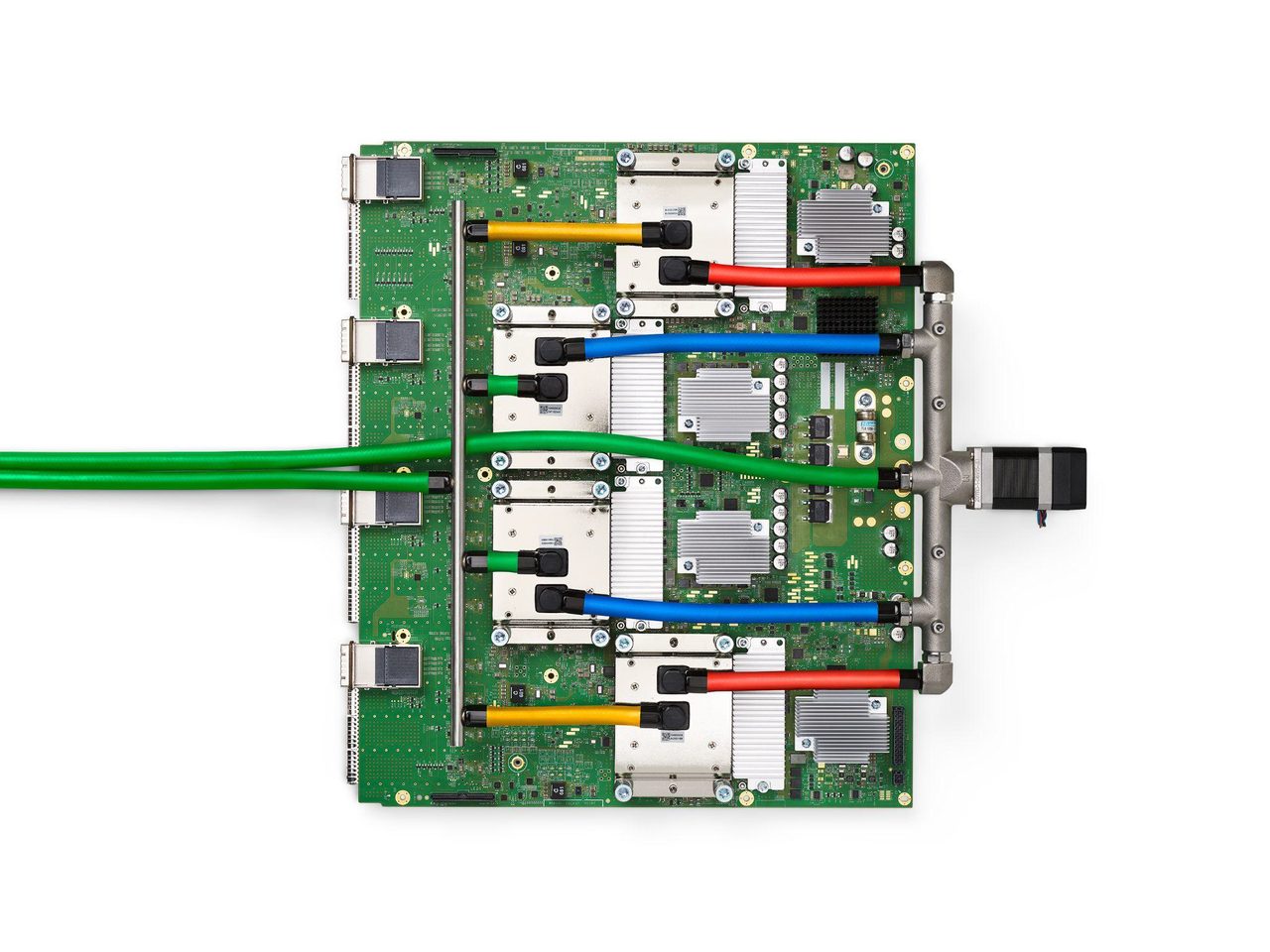
The same run has been costed in electricity. Patterson, Gonzalez, Le, Liang, Munguia, Rothchild, So, Texier and Dean published carbon and energy figures for five large models in April 2021, including GPT-3, and put its training at about 1,287 megawatt hours and about 552 tonnes of carbon dioxide equivalent. Two disclosures travel with those numbers. First, they could not be read out of the paper's own table for this page, because its text layer would not extract, so they are high-confidence and second-hand. Second, and more important, the authors' own abstract undercuts any confident use of them: the choice of model, datacenter and processor 'can reduce the carbon footprint up to ~100-1000X', and 'These large factors also make retroactive estimates of energy cost difficult.' A retroactive estimate of a model the authors did not train is precisely what the GPT-3 figure is. Our own architecture file cites Strubell, Ganesh and McCallum's 2019 ACL paper for the comparison that training one large model can emit as much carbon dioxide as five cars over their lifetimes. The honest version of this paragraph is not a tonnage. It is that a careful estimate exists, its authors warn that estimates like it can be wrong by two or three orders of magnitude, and the organisations who could settle it by publishing their own meter readings do not.
The same run has been costed in money, and our own file's dollar figures carry no citation, so this page replaces them with a sourced measurement. In May 2024 Ben Cottier, Robi Rahman, Loredana Fattorini, Nestor Maslej, Tamay Besiroglu and David Owen built a cost model covering hardware, energy, cloud rental and staff, and report that 'the amortized cost to train the most compute-intensive models has grown precipitously at a rate of 2.4x per year since 2016 (90% CI: 2.0x to 2.9x)'. Their breakdown puts accelerator chips and research staff each in the tens of millions of dollars for models such as GPT-4 and Gemini, server components at 15 to 22 percent of the total, cluster interconnect at 9 to 13 percent, and energy at 2 to 6 percent. Their conclusion is a conditional and is reproduced as one: 'If the trend of growing development costs continues, the largest training runs will cost more than a billion dollars by 2027, meaning that only the most well-funded organizations will be able to finance frontier AI models.' That is an estimate built from hardware prices and headcount, not an invoice, which is why its authors give an interval that wide. This page does not restate their conditional as a prediction and does not extend their trend by a single year.
There is a supply constraint underneath all three costs, and none of our four files carries it. Pablo Villalobos, Anson Ho, Jaime Sevilla, Tamay Besiroglu, Lennart Heim and Marius Hobbhahn compared the total stock of public human-written text against the growth in training-set sizes and concluded that 'if current LLM development trends continue, models will be trained on datasets roughly equal in size to the available stock of public human text data between 2026 and 2032, or slightly earlier if models are overtrained.' The lower bound of that window is the year this page is published, which is worth one sentence and no drama. The hedge that usually gets dropped is the authors' own: they do not predict a wall, they name three ways past one, which are synthetic data, transfer from data-rich domains, and improvements in data efficiency.
The first of those three ways past has a peer-reviewed problem attached to it. Ilia Shumailov, Zakhar Shumaylov, Yiren Zhao, Nicolas Papernot, Ross Anderson and Yarin Gal published 'AI models collapse when trained on recursively generated data' in Nature on 24 July 2024. They report that indiscriminate use of model-generated content in training causes irreversible defects, in which the tails of the original content distribution disappear, and they show the effect in language models, in variational autoencoders and in Gaussian mixture models. Two things about that sentence. Nothing in it is quoted, because the article page sits behind a cookie wall and the wording was read from the registration record rather than from the paper. And the word indiscriminate is load-bearing: the finding is about replacing human data with model output, not about synthetic data as such, and subsequent work arguing that accumulating synthetic data alongside the original avoids the collapse was not reviewed for this page. So: the first proposed route past the data wall is the thing this paper says destroys the model if you do it carelessly, and that tension is real without either half being stretched.
Our own file carries the question of who can afford any of this as a three-move exchange rather than a position, and all three moves are kept here. Against: 'Only a handful of organizations can afford to train frontier models, raising concerns about concentration of AI capabilities.' For: 'the opposing view, argued by open-source advocates, is that model weights release and distillation techniques are democratizing access'. And the rejoinder our file supplies itself: 'critics contend this does not address the underlying compute asymmetry'. Our machine learning file puts the entry price at $100 million to $1 billion or more of investment. The strongest evidence for the open-weight side is not assertion but two dated facts already on this page: an openly released 13-billion-parameter model beat a 175-billion-parameter closed one on most benchmarks in February 2023, and the model discussed at the end of the next section, the one that went through peer review in September 2025, was an open-weight model too. Neither fact settles the compute argument, because that argument is about who can train rather than who can run.
One cost is not measured in any of these units. Our own file states the problem plainly: 'Most LLMs are trained on web-scraped data of uncertain quality, potentially including copyrighted material', and names The New York Times Company v. Microsoft Corporation and OpenAI, filed in the Southern District of New York on 27 December 2023, as the test case. It is still unresolved as of this writing. That status could not be confirmed against the court's own docket for this page, so it is stated loosely and no docket event is named. Our machine learning file adds Getty Images against Stability AI and records that resolution is pending there too. The plain fact is worth stating without a prediction attached: nearly three years after the first case was filed, the legal foundation of the training method described in section 03 has not been settled by any court, and nothing on this page forecasts how it will be.
06What They Can Be Measured Doing
Benchmarks now have to be built on purpose to be hard, and they stay hard for months rather than years, which changes what a score means. GPQA is 448 multiple-choice questions written by domain experts in biology, physics and chemistry. Its paper reports that 'experts who have or are pursuing PhDs in the corresponding domains reach 65% accuracy (74% when discounting clear mistakes the experts identified in retrospect), while highly skilled non-expert validators only reach 34% accuracy, despite spending on average over 30 minutes with unrestricted access to the web (i.e., the questions are "Google-proof")'. Those human numbers are the durable content of the benchmark and they do not move. The model number does: when the benchmark was published in November 2023 the authors' strongest GPT-4 based baseline reached 39 percent, and that figure is printed here only as a November 2023 measurement and is long superseded.
One illustration of what a passed benchmark does and does not mean comes from the person who built one. On 20 December 2024 Francois Chollet reported that OpenAI's o3 scored 75.7 percent on the ARC-AGI semi-private evaluation set at about $26 per task, and 87.5 percent in a high-compute configuration that used 172 times more compute, at about $4,560 per task. In the same report he declined the conclusion everyone else was drawing: 'Passing ARC-AGI does not equate to achieving AGI, and, as a matter of fact, I don't think o3 is AGI yet.' He noted the system still failed on some very easy tasks. Both numbers need their conditions attached or they mean nothing: they are not comparable to a human score, and the higher one was bought at a price per task that nobody would pay for the work being done.
ARC Prize then published a harder version, and the gap reopened. ARC-AGI-2 arrived in 2025 with a human baseline established in a live study of more than 400 members of the public in San Diego. Its technical report states that 'Humans can solve 100% of ARC-AGI-2' and, at the time of writing in May 2025, that 'none of the leading AI models have surpassed a 5% success rate on ARC-AGI-2 tasks', against models routinely scoring between 20 and 50 percent on the first version. The ARC Prize 2025 technical report, published in January 2026, reports that the Kaggle competition on the new dataset 'attracted 1,455 teams and 15,154 entries, with the top score reaching 24% on the ARC-AGI-2 private evaluation set.' Those are the only two dated figures this page has. The current leaderboard could not be verified: the ARC Prize leaderboard renders its table in the browser and returned no figures to a text fetch, and third-party aggregators reporting much higher scores as of August 2026 were found and not accepted, because none of them was checked at the source. The number has moved since May 2025. This page does not know by how much, and would rather say so than print a figure it cannot stand behind.
Capacity has moved faster than any score. The original transformer handled sentences. As of 28 August 2026, Anthropic documents million-token context windows on three of its four current models and OpenAI documents 1.05 million tokens on its GPT-5.6 family. A window is capacity and not competence, and there is peer-reviewed evidence of the difference. Nelson F. Liu, Kevin Lin, John Hewitt, Ashwin Paranjape, Michele Bevilacqua, Fabio Petroni and Percy Liang measured how models use long inputs and found that performance can degrade significantly when the position of the relevant information changes, with models doing best when the needed fact sits at the beginning or the end of the input and worst when it sits in the middle. Nothing there is quoted, because the wording was read from the registration record rather than the article page. Two conditions belong with that finding: our own architecture file attributes the U-shape to an interaction between positional encodings and the attention distribution, which is our file's interpretation rather than the paper's; and the measurement was made on 2023 and 2024 models whose context windows were two orders of magnitude smaller than the ones quoted above. Whether the same curve holds at a million tokens was not established for this page.
A different unit for capability has been proposed, and it is one a reader can feel: time. Thomas Kwa and twenty-four colleagues at METR suggested measuring a model by the length of task a human takes rather than by a benchmark score: the 50 percent time horizon is the human duration of tasks the model completes with 50 percent success. They timed people with relevant expertise on a combination of two existing task suites and 66 new shorter tasks, and report that 'current frontier AI models such as Claude 3.7 Sonnet have a 50% time horizon of around 50 minutes'. Three conditions. That is a March 2025 measurement of a March 2025 model. The tasks are software tasks, so it is not a measure of general capability and is not presented as one. And the paper's own authors flag the limits of their result including its degree of external validity. The paper also derives a rate of change and extrapolates it; that half of it belongs to our article on the singularity, which owns extrapolation, and is deliberately not carried here.
One frontier model in this subject went through referees before it was published. On 17 September 2025 Nature published 'DeepSeek-R1 incentivizes reasoning in LLMs through reinforcement learning' by Daya Guo, Dejian Yang, Haowei Zhang, Junxiao Song and 198 further authors, at Nature 645:633-638. The paper reports that reasoning ability can be developed by reinforcement learning without human-labelled reasoning examples, that behaviours including self-reflection, verification and dynamic strategy adaptation emerged during that training, and that the result surpassed models trained conventionally on human demonstrations. Nothing there is quoted, for the same cookie-wall reason as the Nature paper in section 05. This is described elsewhere as the first frontier model published after independent peer review; that superlative comes from Nature's own news coverage, which could not be read at source for this page, so what this page says is that it is among the first, which loses nothing. Eight years after the architecture was posted, a laboratory sending a frontier model to referees was still news. That this is notable at all is the finding.
07What They Reliably Fail At
Language models produce fluent text that is not true. The standard survey, Ji and nine colleagues in ACM Computing Surveys in March 2023, characterises the failure as 'the generated content that is nonsensical or unfaithful to the provided source content'. Our own file says that survey coined the word in 2023. It did not, and the survey itself is the source that refutes the claim: it records that 'The term "hallucination" first appeared in Computer Vision (CV) in Baker and Kanade 2000', where it described something desirable, and that researchers began applying it to unwanted generation later. Our own file also carries a specific hallucination rate for GPT-4, attributed to two named sources. Neither of them contains it: the GPT-4 technical report carries no such figure and the second attributed paper could not be located at all. This page does not print that number in any form, and says so here rather than quietly omitting it. What can be said with a source is narrower. The GPT-4 technical report puts the model 19 percentage points above GPT-3.5 on OpenAI's own internal, adversarially designed factuality evaluations, which is a vendor's measurement of its own product on its own test, and the same report admits in its own words that the model 'still is not fully reliable (it "hallucinates" facts and makes reasoning errors)'.
The mechanism is less mysterious than the name suggests, and section 01 has already supplied half of it. In September 2025 Adam Tauman Kalai, Ofir Nachum, Santosh S. Vempala and Edwin Zhang argued that the rest is an incentive rather than a defect: 'We argue that language models hallucinate because the training and evaluation procedures reward guessing over acknowledging uncertainty'. Their account has two halves. In pretraining, if incorrect statements cannot be distinguished from facts by the objective, plausible falsehoods arise from ordinary statistical pressure. In evaluation, models are optimised to be good test-takers, and on most benchmarks a guess scores better than an admission of ignorance. Their proposed remedy is to change how existing benchmarks are scored rather than to add more hallucination tests, and a benchmark built on exactly that principle already exists: SimpleQA, from Wei and seven colleagues in November 2024, states its design goal as 'A model with ideal behavior would get as many questions correct as possible while not attempting the questions for which it is not confident it knows the correct answer.' The loop closes back on the first sentence of this article. The machine was trained to produce plausible continuations and then graded on whether it answered, so of course it answers.
The engineering answer is retrieval. Patrick Lewis and eleven colleagues at Facebook AI Research proposed retrieval-augmented generation in May 2020, pairing a pretrained language model with a searchable index, in their case a dense vector index of Wikipedia reached through a neural retriever, so that an answer can be grounded in a retrieved document rather than in the weights alone. Nothing is quoted from that paper here, because the abstract came back paraphrased rather than verbatim. Our own file records the motivation exactly: retrieval 'mitigates hallucination by grounding responses in retrieved documents'. And our file supplies its own closing objection, which survives into this page unchanged: 'Researchers argue hallucination is an inherent feature of generative models and cannot be fully eliminated without external verification systems.' Retrieval moves the failure rather than removing it. A model can still misread a document it correctly retrieved, over-generalise from it, or contradict it in the next sentence.
The useful result about failure is not a list of anecdotes but a measurement of where the training objective shows through. R. Thomas McCoy, Shunyu Yao, Dan Friedman, Mathew D. Hardy and Thomas L. Griffiths tested five models on eleven tasks and found that accuracy depends on how probable the task is, how probable the output is, and how probable the input is, even on tasks that are entirely deterministic. Their sharpest result: GPT-4's accuracy at decoding a cipher fell from 51 percent to 13 percent purely as a function of how probable the correct output text was, on a task where the probability of the answer should be irrelevant to whether it can be computed. Those two figures come from the paper's abstract as recorded by the registration agency rather than from the paper itself, which was not opened for this page, and nothing here is quoted. The authors' conclusion is the frame this whole article has been building: these systems should be understood as shaped by the specific problem they were trained to solve, next-word prediction over internet text, rather than measured against expectations formed by watching humans. The objective from section 01 leaves fingerprints on the finished machine, on tasks where it has no business being visible at all.
Two more measurements sharpen it. Nouha Dziri and fifteen colleagues tested transformers on multi-digit multiplication, logic grid puzzles and a dynamic-programming problem, formulating each as a computation graph so that complexity could be varied and measured. Their finding names the mechanism precisely: 'transformer LLMs solve compositional tasks by reducing multi-step compositional reasoning into linearized subgraph matching, without necessarily developing systematic problem-solving skills.' They add theoretical arguments that autoregressive performance 'can rapidly decay with increased task complexity'. The paper's own opening concedes the other half and it belongs here too: transformers 'have sparked admiration for their exceptional performance on tasks that demand intricate multi-step reasoning'. This is an account of the machinery behind the successes, not a denial that they happened. Our own architecture file dates this work to 2024; it was posted in May 2023 and presented at NeurIPS that year.
The second is arithmetic that looks solved. Iman Mirzadeh, Keivan Alizadeh, Hooman Shahrokhi, Oncel Tuzel, Samy Bengio and Mehrdad Farajtabar built GSM-Symbolic, which regenerates grade-school maths problems from symbolic templates, and report that performance declines when only the numerical values change, and that 'Adding a single clause that seems relevant to the question causes significant performance drops (up to 65%) across all state-of-the-art models, even though the clause doesn't contribute to the reasoning chain needed for the final answer.' Their hypothesis is that the models replicate reasoning steps seen in training rather than performing the reasoning. Put that beside the chain-of-thought result in section 04, which raised scores on the same family of problems, and the pair shows what those scores were partly measuring. Both papers are October 2024 and January 2022 respectively, and the models tested are the models of those dates.
The live version of this argument is unresolved and this page leaves it that way. In June 2025 Parshin Shojaee, Iman Mirzadeh, Keivan Alizadeh, Maxwell Horton, Samy Bengio and Mehrdad Farajtabar tested reasoning models on controllable puzzles and reported that 'LRMs face a complete accuracy collapse beyond certain complexities', alongside a counterintuitive result in which reasoning effort rises with complexity up to a point and then falls away despite an unspent token budget. Three days later A. Lawsen published a comment identifying three experimental artefacts: Tower of Hanoi runs that risked colliding with the models' own output token limits, an automated evaluation that could not tell a reasoning failure from a practical constraint, and River Crossing instances that are mathematically impossible above a certain size because the boat is too small, on which models were scored as failures for not solving unsolvable problems. Controlling for those, by asking for a generating function instead of an exhaustive move list, preliminary experiments recovered high accuracy on instances previously reported as total failures. Neither side is clean: the corrected version of the comment says in its own metadata that it 'corrects mistakes in sections 4 and 6 of the original submission, as well as several typographical errors', and the same field records something no folklore is needed for, that the 'Latest version removes Claude as a co-author, in line with arXiv policies'. A rebuttal about the limits of machine reasoning had a language model on its author line until the archive's rules removed it. This page crowns neither paper.
08Nobody Can See Inside
Nobody can trace how a particular input produces a particular output inside a frontier model. Our explainability file states it flatly at Tier 1: deep networks, ensembles and large language models 'achieve state-of-the-art accuracy but are opaque', and 'with millions to trillions of parameters, no human can trace how a specific input leads to a specific output through internal computations'. Our machine learning file puts the consequence in its counter-arguments: 'we often cannot explain why a model makes a specific prediction, which is problematic for high-stakes applications (medicine, criminal justice, autonomous vehicles); interpretability research is active but far from solving this'. Two files, written separately, both at the highest tier. This is as solid as anything in this article, and it sits underneath everything section 09 argues about.
The obvious way to look inside a transformer is to look at where it attended, and it does not work. Our explainability file states at Tier 1 that 'Jain and Wallace (2019) showed attention weights do not reliably indicate feature importance'. The multi-head gloss from section 02, one head for syntax and another for semantics, is exactly the kind of tidy story this finding complicates: the weights show what the mechanism looked at, not what the computation used. The same file summarises Cynthia Rudin's more general 2019 argument in Nature Machine Intelligence, that post-hoc explanations of black boxes 'explain an approximation of the model, not the model itself', and that high-stakes decisions should use models that are interpretable to begin with. Those words are our file's rendering of Rudin's position and not a quotation from her paper, which was not opened for this page.
The serious alternative is mechanistic interpretability, which tries to reverse-engineer the computations themselves, identifying circuits built out of attention heads and neurons. Our two files agree on where it stands and it is not where its press coverage puts it. Our explainability file places the entire programme at Tier 3, speculative: 'whether complete mechanistic understanding of billion-parameter models is achievable remains open'. Our architecture file adds that 'current interpretability covers only a small fraction of model behavior'. The findings the corpus does record are real and specific: induction heads, which implement learning from the context window, and the result that factual knowledge in GPT-style models sits in particular feed-forward layers and can be edited there surgically. Note that the second of those confirms the Tier 4 refusal in section 02: the facts live in the layers the famous title left out.
In March 2025 a team at Anthropic traced computations inside a production model with attribution graphs, and published the result as 'On the Biology of a Large Language Model'. What they found is genuinely surprising in both directions. There is real internal multi-step reasoning. In one case the model selects candidate rhyming words before composing the line that will lead to them, which is planning rather than continuation. And in one case its account of itself is simply wrong: asked how it had computed 36 plus 59, the model described carrying digits in the ordinary way, while its circuits had used low-precision heuristics and lookup-like structures. That is the article's whole warning about chain of thought in a single example. A system can produce a confident, coherent, and false description of its own method. Two things must travel with this work. It is a laboratory publishing about its own model on its own venue without external peer review, which is a fact about the evidence and not an accusation. And its authors state their own ceiling: 'we've found that our attribution graphs provide us with satisfying insight for about a quarter of the prompts we've tried', with the simplified model they analyse 'incompletely and imperfectly captures the original.'
09Parrot Or Not
The criticism that stuck was published at the ACM Conference on Fairness, Accountability, and Transparency in March 2021, pages 610 to 623, by Emily M. Bender, Timnit Gebru, Angelina McMillan-Major and Shmargaret Shmitchell. Our own file attributes the whole author line to the University of Washington; the conference record does not. Bender and McMillan-Major are recorded there at the University of Washington, Gebru at Black in AI, and the fourth name is a pseudonym, with an affiliation given as The Aether, which our file never mentions. That detail is worth one clause because it says something true about the conditions the paper was written under, without this page having to litigate the employment dispute around it, which is out of scope and was not verified here. The definition the phrase comes from: 'an LM is a system for haphazardly stitching together sequences of linguistic forms it has observed in its vast training data, according to probabilistic information about how they combine, but without any reference to meaning: a stochastic parrot.' A provenance note this page owes the reader: the publisher's page returns an error to non-browser clients, so that sentence was not read from the paper's own text layer. It is reproduced from a sourced secondary reproduction that places it on pages 616 to 617, it matches the wording quoted throughout the literature, and this page does not claim to have read it in the original.
The argument underneath the phrase was made a year earlier and our corpus does not carry it, which matters, because without it the parrot claim reads as a slogan instead of a position with a premise you can attack. At ACL 2020 Emily M. Bender and Alexander Koller wrote that 'we find that these successes sometimes lead to hype in which these models are being described as "understanding" language or capturing "meaning"', and against that, 'we argue that a system trained only on form has a priori no way to learn meaning.' They call for 'a clear understanding of the distinction between form and meaning' to guide 'better science around natural language understanding.' The premise is the interesting part: that meaning requires some relation to something outside the text, and that a system with access only to the text can therefore never acquire it in principle, however good it gets. The paper describes itself as a position paper, which is a hedge worth keeping.
Our own primary file argues the parrot side three separate times and never states the opposing position at strength anywhere, which is the largest single gap in it. So here is that side, from the literature rather than from assertion. Steven T. Piantadosi and Felix Hill argue: 'Contrary to claims that LLMs possess no meaning whatsoever, we argue that they likely capture important aspects of meaning, and moreover work in a way that approximates a compelling account of human cognition in which meaning arises from conceptual role.' Their decisive move is not a claim about capability at all: 'Because conceptual role is defined by the relationships between internal representational states, meaning cannot be determined from a model's architecture, training data, or objective function, but only by examination of how its internal states relate to each other.' Read carefully, that is not the assertion that these systems understand. It is the assertion that the question cannot be settled by looking at how they were built, which is a harder thing to dismiss than the caricature. It is also a preprint arguing a position rather than an experimental result. And it collides directly with section 08: the examination they propose is exactly the thing our own files grade Tier 3 and the best current method reports satisfying results on about a quarter of attempts.
The empirical evidence this page can offer on that side is a game. Kenneth Li, Aspen K. Hopkins, David Bau, Fernanda Viegas, Hanspeter Pfister and Martin Wattenberg trained a GPT variant on nothing but sequences of legal Othello moves, with no knowledge of the game or its rules, and report: 'Although the network has no a priori knowledge of the game or its rules, we uncover evidence of an emergent nonlinear internal representation of the board state.' They could intervene on that representation and change the model's output accordingly, which is the part that makes it evidence rather than correlation. It was an ICLR 2023 oral. The following year Neel Nanda, Andrew Lee and Martin Wattenberg revisited it: 'Prior work suggests that Othello-playing neural network learned nonlinear models of the board state (Li et al., 2023). In this work, we provide evidence of a closely related linear representation of the board.' The difference was how the probe was framed, asking about the board relative to the player to move rather than in fixed colours. Two limits travel with all of it, and our own file states the first: 'Whether this extends to real-world knowledge (physics, causality) is unknown.' The second is that the original finding was refined within a year by a different instrument pointed at the same model, which is a caution about how much weight any probing result can carry. Othello has sixty-four squares and two colours. The world does not.
A prominent technical objection is Yann LeCun's, that the architecture is fundamentally insufficient whatever is done with it. An attribution correction first, because it is exactly the defect class this page exists to catch: our own file puts quotation marks around a sentence attributed to LeCun, and that string could not be located in any primary source for this article, so it is not repeated here. What can be sourced is an essay he co-wrote with Jacob Browning, published in Noema on 23 August 2022, which states the position without hedging: 'A system trained on language alone will never approximate human intelligence, even if trained from now until the heat death of the universe.' Attribute that to Browning and LeCun jointly, in an opinion essay rather than a result. Our own files record the argument behind it, that autoregressive language models lack world models and causal reasoning, and that LeCun proposes a different architecture in their place, the Joint Embedding Predictive Architecture. His technical proposal for it was not consulted for this page.
On the other side sits a preprint that made a much larger claim. Sebastien Bubeck and thirteen colleagues at Microsoft Research published 'Sparks of Artificial General Intelligence: Early experiments with GPT-4' on 22 March 2023, arguing that 'Given the breadth and depth of GPT-4's capabilities, we believe that it could reasonably be viewed as an early (yet still incomplete) version of an artificial general intelligence (AGI) system.' Its own abstract carries three hedges that citing articles routinely drop. It studied 'an early version of GPT-4, when it was still in active development by OpenAI', which the public could not test. It says 'we put special emphasis on discovering its limitations'. And it names 'the possible need for pursuing a new paradigm that moves beyond next-word prediction', which sits oddly beside the way the paper is usually cited. Three further facts are checkable and none of them is an insult: the authors worked at the company that had invested most heavily in the model's developer, the version they tested was not available to anyone outside, and the paper was not peer reviewed. State them and let the reader weigh it.
Now the separation this page will not blur, because our own primary file blurs it. That file puts consciousness and understanding into the same Tier 4 sentence: 'Claims that LLMs possess consciousness, sentience, or understanding are not supported by current evidence', noting that the models 'process tokens through mathematical operations (matrix multiplications, softmax attention) without demonstrated subjective experience'. Our architecture file is more careful about the second half and this page follows it: whether the computation constitutes understanding 'depends on one's definition and remains a philosophical debate, not a settled scientific question', and 'Performance on benchmarks does not demonstrate comprehension in the human sense'. Those are two different claims. Sentience: refused at Tier 4, with no live scientific dispute for this class of system on this evidence, and the general question of machine minds belongs to our article on machine consciousness. Understanding: genuinely contested, argued at strength above by serious people on both sides, and left open here. Collapsing the second into the first would be this page taking a side in a fight it promised to hold.
Our own file records that in June 2022 the Google engineer Blake Lemoine publicly claimed the company's LaMDA chatbot was sentient, and that the claim 'was widely rejected by AI researchers'. Nothing is quoted here from Lemoine or from Google: the primary reporting could not be read for this page, and the transcript that circulated was not checked for provenance, so this page does not reproduce it or characterise the man. The system itself is documented. Romal Thoppilan, Daniel De Freitas, Jamie Hall, Noam Shazeer, Apoorv Kulshreshtha and colleagues describe a family of transformer-based dialogue models of up to 137 billion parameters, pretrained on 1.56 trillion words of public dialogue data and web text. The useful content is the pattern rather than the person, and section 01 named it fifty-six years earlier: a program that produces fluent, responsive text recruits the reader into supplying a mind for it. ELIZA did it with pattern matching and no memory. The reflex did not need the parameters.
10Out In The World
The figure most often quoted about work comes from a bank. In a report dated March 2023, Goldman Sachs estimated that generative AI could expose the equivalent of 300 million full-time jobs worldwide to automation, that around two thirds of current jobs in the United States and Europe are exposed to some degree of AI automation, and that up to a quarter of current work tasks could be done by AI. Two framing corrections, and both matter because both push in the same direction. Our own file writes that the report says these jobs could be affected; the report's own word is exposed, and exposure to some degree of automation is not replacement. And our file omits the report's own offsetting observation, that the jobs historically lost to automation have been offset by new kinds of work that account for the bulk of long-run employment growth; the same report projected a possible 7 percent rise in global GDP over a ten-year period. Nothing here is quoted, because the report itself was not opened and its contents were established from the publisher's own summary. When a number loses its qualifier and its counterweight in the same retelling, that is the signature of a claim that has drifted.
There is a careful measurement of what deployment actually did, and it covers one industry and one company. Erik Brynjolfsson, Danielle Li and Lindsey Raymond studied customer-support agents given access to a generative AI assistant, and the peer-reviewed version published in the Quarterly Journal of Economics in 2025 reports that access to the assistant increased productivity, measured as issues resolved per hour, by 15 percent on average, with substantial variation between workers. Our own file gives 14 percent, which is the figure in the earlier working paper. The variation is the finding our file drops entirely, and it is the more interesting half: the gains concentrated among less experienced and lower-skilled workers, who improved in both speed and quality, while experienced and high-performing workers saw small speed gains and slight declines in quality. Nothing here is quoted; the wording was read from the registration record rather than the article page, which rendered without an abstract. One study, one industry, one company, and it should not be made to stand in for an economy.
Our own file refuses, at Tier 4, the claim that these systems will replace all human cognitive work within five years, and it refuses it with reasons rather than with confidence: 'While LLMs excel at text manipulation, summarization, and pattern matching, they remain unreliable for tasks requiring real-time factual accuracy, physical reasoning, or long-horizon planning without supervision', and 'Current deployment patterns emphasize human-AI collaboration (copilot models) rather than full automation.' The measurement above supports that refusal better than assertion does, and so does everything in section 07. A system whose accuracy on a deterministic cipher moves with the probability of the answer, and which loses ground when an irrelevant clause is added to a school arithmetic problem, is not a system that quietly absorbs cognitive work while nobody checks. Note what this refusal is not. It is not a forecast in the other direction, and this page makes none.
11What We Can Stand Behind
Four numbers a reader might reasonably expect on a page like this are missing, and each is missing for a stated reason. There is no hallucination rate for any model, because the figure our own file carries is attributed to two sources that do not contain it and no verified replacement was found. There is no current ARC-AGI-2 score, because the leaderboard could not be read at its source and the third-party figures that were found were not checked. There is no launch price for GPT-3, because no primary record of one could be obtained and the launch was a free private beta. And there is no parameter count for any model released after GPT-4 in March 2023, because none of the three vendors whose documentation was read on 28 August 2026 publishes one, and because the routing described in section 02 would make it ambiguous if they did. Naming those four gaps is a better demonstration of what this site is for than any of the four numbers would have been.
Fast Facts
- The Objective
- Next-token prediction, and in pretraining nothing else. Everything the finished system appears to do is a consequence of doing that one thing across an enormous body of text.
- The Architecture
- The transformer, posted 12 June 2017 by eight authors at Google Brain, Google Research and the University of Toronto, for machine translation. Self-attention, several attention heads in parallel, position signals added by hand, feed-forward layers, normalisation and residual connections.
- What Attention Computes
- Every position asks every other position how relevant it is, and the answer is a weighted average of values. The cost grows with the square of the input length, which is why long context is expensive rather than merely slow.
- The Three Families
- Encoder-only (BERT, October 2018), decoder-only (GPT, June 2018) and encoder-decoder (T5, 2020). Our own architecture file records decoder-only as dominating current frontier models, which means the family that won is the one whose objective is plain next-token prediction.
- The Scaling Result
- Kaplan and colleagues, January 2020: loss falls as a power law in model size, data and compute across, in the abstract's words, more than seven orders of magnitude. The same paper states that the trends must flatten out before loss reaches zero.
- Chinchilla, And Its Replication
- Hoffmann and colleagues, March 2022: for compute-optimal training, model size and training tokens should be scaled equally. A 2024 replication attempt found one of the paper's three estimation procedures inconsistent with the other two; the compute-optimal conclusion everybody uses survives, and this is not a retraction.
- Emergent Abilities
- Disputed and left disputed. Wei and colleagues in 2022 say some abilities are absent below a scale threshold; Schaeffer and colleagues in 2023 say the cliff is produced by the choice of metric and demonstrate it by manufacturing new cliffs in vision models. Our own two files both record the debate as unresolved.
- Parameter Counts
- Published in the lineage above as late as LLaMA in February 2023, and not after it. GPT-4's technical report in March 2023 published none, and as of 28 August 2026 none of the three vendors whose documentation was read that day gives one for any model. Mixture-of-experts routing would make the number ambiguous even if they did.
- What A Training Run Costs
- GPT-3's pretraining is given in its own paper as roughly 3,640 petaflop per second days, a 2020 figure for a 2020 model. Its electricity and carbon are second-hand estimates by researchers who did not train it, and whose own paper warns that retroactive estimates of that kind can be off by a factor of a hundred to a thousand. No frontier laboratory publishes either quantity.
- The Interior
- Opaque. Both of our relevant files put mechanistic interpretability at Tier 3, speculative. The March 2025 circuit-tracing work reports satisfying insight on about a quarter of the prompts its authors tried, and includes a case in which a model described an arithmetic method it had not used.
- Sentience
- Refused at Tier 4 by two of our own files, on this evidence and for this class of system. Understanding is a separate claim and is the next entry. The general question of machine minds belongs to our article on machine consciousness.
- Understanding
- A different question, and contested. Bender and Koller in 2020 argue that a system trained only on form has no way in principle to learn meaning; Piantadosi and Hill in 2022 argue that the answer cannot be read off the architecture, the data or the objective at all. This page carries both and settles neither.
- What This Page Will Not Print
- A hallucination rate for any model, a current ARC-AGI-2 score, GPT-3's launch price, or a parameter count for any model released after GPT-4. Each refusal is stated in the text with its reason.
What We Can Actually Stand Behind
The mechanism is not in doubt and it is unusually easy to verify. A large language model is trained to predict the next token; the transformer was posted on 12 June 2017 for machine translation and reported 28.4 and 41.8 BLEU on two translation tasks; self-attention projects every position into queries, keys and values and returns a weighted average; the architecture split into three families and the decoder-only one dominates. Every sentence in that list can be checked against a paper linked below, and the dates on all of them are fixed. Two of our own files agree at the highest tier on the architecture and on the opacity of what it builds, and where they disagree, this page has said so and taken the lower grade.
The strongest counter-evidence on this page is inside the primary sources themselves, and it is routinely dropped in the retelling. The scaling-law paper states that its own trends must flatten before loss reaches zero. The GPT-3 paper discloses that a bug in its own contamination filtering went unfixed because retraining was too expensive. The founding transformer paper's footnote says the author order is random. And the numbers stopped being published: GPT-4's technical report says in its own words that it contains no details of size, compute, data or method, and as of 28 August 2026 none of the three vendors whose documentation was read that day publishes one for any model. That last one is a change in what is knowable about this technology, and it is stated here as a fact rather than as an accusation.
Two live disputes are carried here without a winner. Whether capabilities emerge at a threshold or grow smoothly and are scored as though they jumped: Wei and colleagues on one side, Schaeffer and colleagues on the other, and our own two files both recording it as open. And whether the reported collapse of reasoning models beyond a certain complexity is a property of the models or of the experiments: a June 2025 paper and a comment published three days later, where the comment's own corrected version admits errors in two of its sections. Neither dispute is settled by this page, and in both cases what can be said is smaller and more durable than either position: the shape of a capability curve depends on a scoring decision made before anyone looked, and a benchmark result and a capability are not the same object.
Interpretability is where the honest answer is smallest. Our explainability file and our architecture file independently place mechanistic interpretability at Tier 3 and record that it covers only a small fraction of model behaviour. Looking at where a model attended does not explain what it used. A March 2025 attempt to trace the circuits inside a production model reports satisfying insight on about a quarter of the prompts its authors tried, by their own count, on their own model, on their own venue, and without external peer review. In one of its cases a model gave a confident and coherent account of an arithmetic method its circuits had not used. That single result is why nothing on this page treats a model's written reasoning as a window into the machine.
There is no evidence that these systems are sentient, and two of our own files refuse the claim. Nothing measured, published or traced in any source on this page bears on subjective experience, and the one famous public claim of it, in June 2022, was rejected by researchers at the time. The refusal is bounded in two ways that matter. It is about this class of system on this evidence, and the general question of whether any machine could be conscious belongs to our article on machine consciousness. And it is not a refusal of the word understanding, which is a different claim with serious arguments on both sides, carried at strength in section 09 and left open.
The claim that these systems will replace all human cognitive work within five years is refused, at Tier 4, by our own file and by the measurements on this page. The peer-reviewed study of a real deployment carried in section 10 measured an average productivity gain of 15 percent, counted as issues resolved per hour, in one job at one company, concentrated among the least experienced workers, while the most experienced saw small speed gains and slight declines in quality. The exposure figure that circulates is a bank's March 2023 estimate of jobs exposed to some degree of automation, which is not replacement, and the same report notes that automation has historically been offset by new kinds of work. That is a refusal of a forecast, not a forecast of its opposite, and this page makes none.
Whether any of this amounts to understanding is a live argument between serious people and it is not settled here. On one side, a position with a premise you can attack: a system trained only on form has no route in principle to meaning, argued by Bender and Koller in 2020 before the phrase stochastic parrot existed. On the other, an argument that is not the claim it is usually mistaken for: Piantadosi and Hill hold that meaning cannot be read off an architecture, a dataset or an objective, only off the relations between a system's internal states, which is a demand for evidence rather than a verdict. And between them sits the awkward fact that the examination they ask for is the thing nobody can yet do at scale. Nine years after the architecture was published for a translation benchmark, we can measure what these machines do in remarkable detail, and we cannot read their interiors. Which of those two facts turns out to matter more is not something this page knows.
Sources & further reading
WHERE THIS PAGE WORKED FROM, AND WHERE IT CAN BE CHECKED. It was written from four files in our own research library: S_1_16 on large language models, which is the primary file; ZD_2_15 on the transformer architecture, which supplies the attention mathematics, positional encoding, the three architecture families and the efficiency literature; ZD_2_13 on explainable AI, which supplies the black box and the Tier 3 grade on mechanistic interpretability; and S_1_11 on machine learning, used for the black-box counter-arguments and the copyright and centralisation material. Those files are where the work started. They are our own claims and cannot corroborate themselves, which is why every external entry below names the section it supports and none is listed as general reading. THIS PAGE CORRECTS OR NARROWS ITS OWN FILES IN MORE THAN A DOZEN PLACES, EVERY ONE DISCLOSED ON THE CLAIM IT BELONGS TO. The load-bearing ones: our file says the 2023 hallucination survey coined the word, and the survey itself records that the term came from computer vision in 2000; our file prints a hallucination rate for GPT-4 attributed to two sources that do not contain it; 340 million is BERT-LARGE and the paper also gives BERT-BASE at 110 million; 1.4 trillion tokens is the LLaMA 33B and 65B figure and the smaller models were trained on 1.0 trillion; 65 million is the transformer's base model and the headline translation score came from the big model at 213 million; our architecture file attaches the three-and-a-half-day training time to the German result where the abstract attaches it to the French one; one date is given for two separate events in both the GPT-3 and InstructGPT entries; our file prints an unsourced parameter estimate for GPT-4 inside a Tier 1 claim, where the technical report prints a refusal; our file grades Chinchilla settled and does not mention the 2024 replication attempt; the stochastic parrots author line is not all at the University of Washington and its fourth name is a pseudonym; the productivity figure is 15 percent in the peer-reviewed version and not 14, and the peer-reviewed version also reports that top performers got slightly worse; the Goldman Sachs figure is jobs EXPOSED to automation rather than replaced; our file puts quotation marks around a sentence attributed to Yann LeCun that could not be located in any primary source; our architecture file dates Faith and Fate to 2024 and it is 2023; and our file's Tier 1 grade on GPT-4's bar exam percentile is one this page does not repeat, because the peer-reviewed correction is already published on this site. WHAT THIS PAGE DELIBERATELY DOES NOT PRINT, each named in the text with its reason: a hallucination rate for any model; a current ARC-AGI-2 score, because the leaderboard renders client-side and returned nothing to a text fetch, and the third-party figures found were not checked at source; GPT-3's launch price per thousand tokens, because no primary record of it could be obtained; and a parameter count for any frontier model after GPT-4 in March 2023, because none of the three vendors whose documentation was read for this page publishes one. TWO IDENTIFIERS CARRIED IN OUR OWN FILES ARE NOT REPRODUCED BELOW, because neither was independently resolved for this page: Bahdanau, Cho and Bengio's 'Neural Machine Translation by Jointly Learning to Align and Translate', published at ICLR 2015, and Shaw, Uszkoreit and Vaswani's 'Self-Attention with Relative Position Representations', NAACL 2018. Both are named in section 02 by title, authors and venue instead. Several works are likewise named in the prose without a link, because they were not opened for this page: the PaLM paper, Luong 2015, Ba and colleagues 2016, He and colleagues 2015, Su and colleagues 2021, Jain and Wallace 2019, Dao and colleagues 2022, and LeCun's own architecture proposal. FIVE KINDS OF SOURCE WERE NOT READABLE AT THE PUBLISHER AND THE ARTICLE SAYS SO WHERE IT USES THEM: the stochastic parrots PDF, OpenAI's own blog announcements, two Nature article pages behind a cookie wall, the Washington Post's June 2022 report, and the Oxford journal page that rendered without an abstract. Where a quotation could not be read at its source, this page states the finding and does not put quotation marks around it.
Image credits
- The Google data centre at Council Bluffs, Iowa, from the air (2017) Chad Davis, via Wikimedia Commons (CC BY 2.0). CC BY 2.0 Source.
- A conversation with the ELIZA chatbot Unknown author, via Wikimedia Commons (public domain); the implementation shown is Norbert Landsteiner's, 2005. Public domain Source.
- The complete transformer architecture, drawn as labelled blocks Daniel Voigt Godoy (dvgodoy), via Wikimedia Commons (CC BY 4.0). CC BY 4.0 Source.
- Encoder self-attention, detailed diagram Daniel Voigt Godoy (dvgodoy), via Wikimedia Commons (CC BY 4.0). CC BY 4.0 Source.
- A circuit board carrying four liquid-cooled TPU v4 packages Norman P. Jouppi, George Kurian, Sheng Li, Peter Ma, Rahul Nagarajan, Lifeng Nai, Nishant Patil, Suvinay Subramanian, Andy Swing, Brian Towles, Cliff Young, Xiang Zhou, Zongwei Zhou and David Patterson, via Wikimedia Commons (CC BY 4.0). CC BY 4.0 Source.
- Card crop of the Google data centre at Council Bluffs, Iowa Chad Davis, via Wikimedia Commons (CC BY 2.0). CC BY 2.0 Source.
.jpg)


