
The Gateway Process: The Army Report on Leaving the Body
In June 1983 a serving lieutenant colonel in United States Army Intelligence answered a question his commander had put to him about a commercial audio programme that claimed to teach people to leave their bodies. He took it seriously enough to try to explain the whole thing in the language of physics, and produced a document that is still circulating: real, declassified, and unlike anything else written on government letterhead. Every strange sentence in it is genuinely there. That is a fact about a document. It is not evidence that the physics inside it is correct, and our own research file grades that physics between Tier 2 and Tier 4. This is what the report actually says, what our own file gets wrong about it, and what the science of sound-driven brainwaves does and does not support.
Two things are true about the Gateway Process at once, and nearly every version of this story that reaches a reader has folded them into one. The first is that a real declassified United States Army Intelligence document exists, written in 1983 by a serving lieutenant colonel, held today in the CIA's own reading room, arguing at length that leaving your body is physically plausible. The second is that everything in that first sentence is a fact about a document, not a finding about the world. A memorandum can be genuine, dated, signed, stamped and completely wrong about physics. Holding those two apart, sentence by sentence, is the whole job here, and our own research file says so before we do: this is one officer's analytical assessment, not an official CIA position statement. The wing's companion article on remote viewing covers the operational psychic-spy programme that ran out of the same command; this one stays with the document, and with the audio technology it was written about.
01A Memorandum Dated 9 June 1983
Start with the parts that are not in dispute. There are more of them than the internet version of this story suggests, and they are the only foundation the rest of the article can stand on.
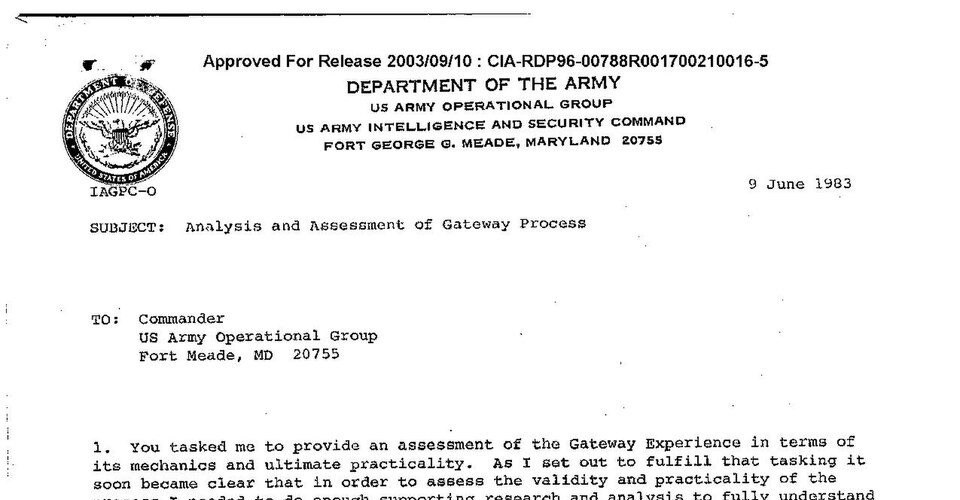
The document is called Analysis and Assessment of Gateway Process. It is a memorandum on Department of the Army letterhead, from the US Army Operational Group of the US Army Intelligence and Security Command at Fort George G. Meade, Maryland 20755, carrying the office symbol IAGPC-O and the date 9 June 1983, addressed to the Commander of that same operational group. Its author signs himself Wayne M. McDonnell, LTC, MI: Lieutenant Colonel, Military Intelligence. It carries the CIA document number CIA-RDP96-00788R001700210016-5, it sits in the CIA's electronic reading room, and it is mirrored on the Internet Archive and on Wikimedia Commons, which is where the pages reproduced in this article come from. One correction before we go any further, because it travels widely and it appears once in our own research file: McDonnell is often called Commander, including once in our own research file. The word does appear on page one, in the addressee block, where the memorandum is sent TO the Commander of that operational group. Commander was his post. Lieutenant Colonel was his rank.
The report opens by explaining itself, and the opening is better than any summary of it. 'You tasked me to provide an assessment of the Gateway Experience in terms of its mechanics and ultimate practicality,' it begins. 'As I set out to fulfill that tasking it soon became clear that in order to assess the validity and practicality of the process I needed to do enough supporting research and analysis to fully understand how and why the process works. Frankly, sir, that proved to be an extremely involved and difficult business.' He then names his method: Itzhak Bentov's biomedical models first, then quantum mechanics 'in order to be able to describe the nature and functioning of human consciousness', and finally physics, to bring the whole phenomenon of out-of-body states 'into the language of physical science to remove the stigma of its occult connotations, and put it in a frame of reference suited to objective assessment'. In his third paragraph he quotes Niels Bohr telling his son 'You are not thinking, you are merely being logical', and warns his reader that parts of the paper will require not only logic but a touch of right-brain intuitive insight. That is the document's own statement of what it is trying to do, and it should be taken at face value: an officer trying to make an occult subject survive a staff reading.
What the released copy carries, and what it does not. Every page bears one stamp: 'Approved For Release 2003/09/10 : CIA-RDP96-00788R001700210016-5'. It bears no classification marking of any kind. That matters, because our own research file's timeline states that the report was classified SECRET/NOFORN and cites a classification stamp on the original as its source. No such marking is visible on the copy the public has, and no independent account we checked names a level. We are not carrying that row. The plain version is the honest one: the report was declassified in 2003, the full text minus a single page went up on the CIA reading room website in 2017, and that is as far as the document itself will take anybody.
Its length is quoted almost everywhere as 29 pages, and that figure quietly describes an incomplete document, because the copy the CIA released omitted the report's own page 25. The Wikimedia Commons copy, which splices that page back in, runs to 30 scanned pages, and the validated transcription indexes the body as two unnumbered front pages followed by pages 1 to 28. Our file adds 'plus annexes', which is also worth dropping: the report's five exhibits are full pages inside that same run, not a separate volume hung off the end.
02The Man Who Made the Tapes
The report is an assessment of somebody else's product, and the product came first. Before there was an Army memorandum there was a radio executive with a recurring problem and a tape recorder.
Robert Allan Monroe (1915 to 1995) was an American radio broadcaster and businessman who began having spontaneous out-of-body episodes in 1958. He wrote three books about them: Journeys Out of the Body (1971), the first systematic account; Far Journeys (1985), which described encounters with non-human intelligences and energy beings; and Ultimate Journey (1994). Those books are the origin of everything downstream, and our own file's assessment of them is blunt and correct. They are single-witness, unverified personal narratives. One man's account of what happened to him is a real thing to have. It is not a result, and this article treats it as the first and not the second.
The Monroe Institute was founded in 1974 in Faber, Virginia. It developed the audio technology called Hemi-Sync, short for hemispheric synchronization, it runs residential Gateway Voyage programmes, it sells audio courses, and it is still operating. Our own file adds that the Institute later moved to Nelson County. Faber is in Nelson County. There is no move to describe.
Monroe holds US Patent 3,884,218, 'Method of Inducing and Maintaining Various Stages of Sleep in the Human Being', filed on 30 September 1970, granted on 20 May 1975, assigned to Monroe Industries of Charlottesville, Virginia. Its abstract, in full, is one sentence: 'A method of inducing sleep in a human being wherein an audio signal is generated comprising a familiar pleasing repetitive sound modulated by an EEG sleep pattern.' This is worth slowing down on, because our own file's timeline calls it the Hemi-Sync patent and it is not one. It describes a pleasant repetitive sound, rain or wind, amplitude-modulated by a recorded sleep EEG. It says nothing about binaural beats and nothing about synchronizing the hemispheres. Monroe's binaural-beat patents exist and came later. They are not this one, and this article does not name them, because we have not checked them.
Three names connect the Institute to the Army. Thomas Campbell, a physicist, took part in early Monroe lab experiments and later wrote My Big TOE. Skip Atwater, an Army intelligence officer, acted as liaison between the Army and the Institute and later became the Institute's research director. And Joseph McMoneagle, the Army remote viewer, went through the Institute. Independent accounts put Atwater's first visit at 1977 and describe classified contracts between the Institute and Army Intelligence and Security Command; they place McMoneagle at the Institute with Atwater in 1983 rather than describing a formal course, so 'connected to' is the right strength of phrase and 'trained by' is not. McMoneagle's own career belongs to the remote-viewing article, and this is the entire overlap this article will claim: the same command, the same post, the same Cold War appetite for capabilities nobody could account for.
Our file's timeline of official interest runs as follows, and two of its rows need a label attached. 1972: SRI International begins remote-viewing research. 1975: Monroe's patent is granted. 1977 to 1978: Army Intelligence and Security Command begins evaluating Monroe Institute programmes. 1978: General Albert Stubblebine III takes an interest in psychic military applications. 1983: this report. 1984: the Army sends selected personnel through Gateway Voyage programmes. 1995: Project Stargate is declassified. 2003: the report is released under FOIA. 2017: the full text goes up on the reading room website. 2021: the missing page surfaces. The two rows cited only to unspecified INSCOM records, with no document number attached, are the 1977 to 1978 evaluation and the 1984 training. Independent sources support the first. The second we could not corroborate at all, so it stays here as our file's claim and not as record, and it matters again at the end of section 07.
03What the Report Actually Argues
The report's argument has three moving parts, and only the first of them is a mechanism anybody could test.
The report defines its two central mechanisms in its own words. Hemi-Sync is 'a state of consciousness defined when the EEG patterns of both hemispheres are simultaneously equal in amplitude and frequency'. The frequency-following response is the claim that 'if a subject hears a sound produced at a frequency which emulates one of those associated with the operation of the human brain, the brain will try to mimmick the same frequency pattern by adjusting its brainwave output'. It credits audio techniques developed by Bob Monroe with inducing and sustaining that state, starting from what it calls the Institute's basic Focus 3 tapes.
The frequency bands it works from are the standard ones: beta at 13 to 30 Hz for alertness, alpha at 8 to 13 Hz for relaxation, theta at 4 to 8 Hz for drowsiness and meditation, delta at 0.5 to 4 Hz for deep sleep. The claimed lever is the binaural beat. Present slightly different frequencies to each ear, and the listener perceives a phantom beat at the difference between them, which the brain is said to follow. Hemi-Sync delivers particular beat patterns to aim at particular bands, and McDonnell treats that mechanism as the foundation of everything Gateway claims to do. This is the testable part of the report, and section 06 is about how it has actually fared.
Then the report leaves anything testable behind, and it is important to be exact about what happens next. That the following sentences are in the document is Tier 1: they are quoted here from its own text. That they are true is not a claim this article makes at any tier. On the universe: 'Energy creates, stores and retrieves meaning in the universe by projecting or expanding at certain frequencies in a three dimensional mode that creates a living pattern called a hologram,' and 'The universe is composed of interacting energy fields, some at rest and some in motion. It is, in and of itself, one gigantic hologram of unbelievable complexity.' On the ground beneath that universe: energy in infinity is completely at rest and can generate no holograms while it stays inactive, and 'Energy in this state of inactive infinity is termed by physicists as energy in its absolute state, or simply the Absolute'. And on the subject the memorandum was commissioned to assess: 'Although human consciousness can, with enough practice, move beyond the dimension of time-space and interface with other energy systems in other dimensions, the entire process is appreciably enhanced if that consciousness can be detached in large measure from the physical body before such interface is attempted.'
One phrase in that passage is doing work it has not earned, and it is the phrase a reader will trust most. No physicist calls it the Absolute. Then the report does something that is either careless or unusually honest, depending on how you read the man: a few lines further on, it names the lineage itself. 'The Absolute at rest in infinity is a concept straight out of Hebrew mystical philosophy.' That sentence is the seam of the whole document, visible from outside and admitted from inside. What is being described is a mystical cosmology wearing the vocabulary of physics, and its author half tells you so on the page.
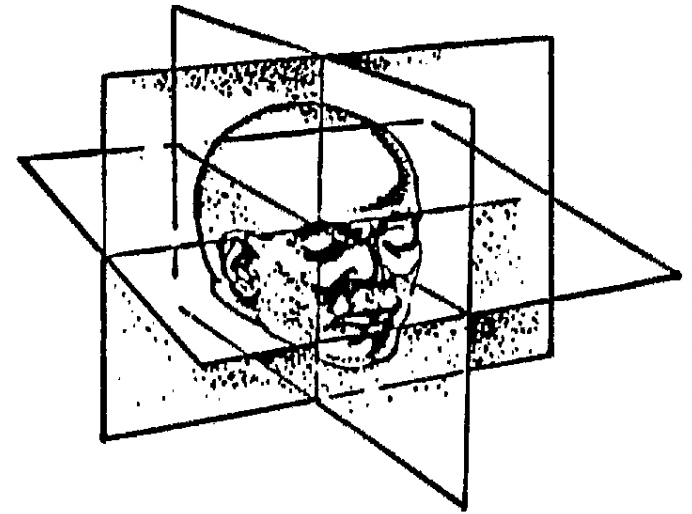
The report has no bibliography and no reference section. It reasons from named people instead, and the tally is revealing. Itzhak Bentov appears roughly twenty to twenty-five times, far more than anyone else, followed by Bob Monroe, Karl Pribram, David Bohm, Dennis Gabor, Marilyn Ferguson, Lyall Watson, John Gliedman, Keith Floyd, Lee Sannella, Elmer and Alyce Green, Stuart Twemlow, Melissa Jager, Ronald Stone, and Alexandra David-Neel with Lama Yongden, plus Bohr and Einstein by quotation. A document that leans this heavily on one popular-science author and formally cites nothing at all is not a scientific paper, whatever is printed at the top of page one. That is not an insult to it. It is a description of its genre, and the report never claimed a different one.
The Focus levels are the part everybody remembers, and our own file rates them Tier 3 in its own words: experiential claims reported by participants, not scientifically verified, not peer-reviewed, not reproducible under controlled conditions. The report claims that a sufficiently focused consciousness can perceive remote locations, reach information about the past and the future, interact with other conscious entities, and approach the Absolute. Two labels usually attached to those levels are not the report's, and this article will not put them in its mouth. 'Mind Awake, Body Asleep', the standard gloss on Focus 10, appears nowhere in the 1983 document. It is Monroe Institute terminology. And Focus 21 is not 'other energy systems' in the report's own description: the report calls it the last and most advanced of all the Focus states associated with the Gateway training programme, and describes it as movement outside the boundaries of time and space, as in Focus 15, 'but with attention to discovering the future rather than the past'. Focus 15, in the same passage, is about reaching the past, including parts of the past the individual had no connection with. Those are the report's descriptions. The familiar glosses are the Institute's, and the difference is not trivial: one of them is a claim about perceiving the future.
04Where the Physics Stops Being Physics
McDonnell built his case on three thinkers. Our own research file grades all three, and it does not grade them kindly.
| The Source | What the Report Takes From It | How Our File Grades It |
|---|---|---|
| David Bohm, named in the report as a physicist at the University of London | The implicate and explicate order: an enfolded deeper level of reality beneath the one that is observed | Tier 2 to 3. A legitimate interpretation of quantum mechanics, and not mainstream physics |
| Karl Pribram, named in the report as a neuroscientist at Stanford University | The holographic brain: memory stored as interference patterns rather than in single locations | Tier 3. Largely superseded by modern neuroscience |
| Itzhak Bentov, from Stalking the Wild Pendulum (1977) | Consciousness as a vibratory system, and most of the report's actual working machinery | Tier 3 to 4. Not peer-reviewed physics |
There is one more thing to separate, and it matters more than the rest, because a reader who has met the word holographic on a science channel will import the wrong meaning into this document and never notice. The holographic principle in modern physics, the one associated with 't Hooft and Susskind, is a claim about information on boundaries. It is not what McDonnell is describing. His hologram is a living pattern of energy that stores meaning and that a consciousness can enter and move through. The two ideas share a word and nothing else, and that word does an enormous amount of unearned persuading in every retelling of this report.
The report also reaches for the heart. It treats the heart as an electromagnetic oscillator that synchronizes with the brain, and proposes that resonance between heart, brain and body creates a coherent field. Heart-brain coherence is a real phenomenon and it is measured: our own file rates the physiology at Tier 2, and the HeartMath Institute and others have studied it.
The meaning attached to that measurement is a different claim, and it carries a different grade. That coherence between heart and brain enables an out-of-body state, or access to non-local information, is not scientifically established, and our file puts the interpretation at Tier 3 in the same breath as it puts the physiology at Tier 2. Same instrument, same subject, two tiers. If you want one worked example of how this article is grading everything else, that is it.
05The Missing Page, and the Older Maps
The public copy of this report had a hole in it from the first release until 2021, and the hole did most of the work of making the document famous.
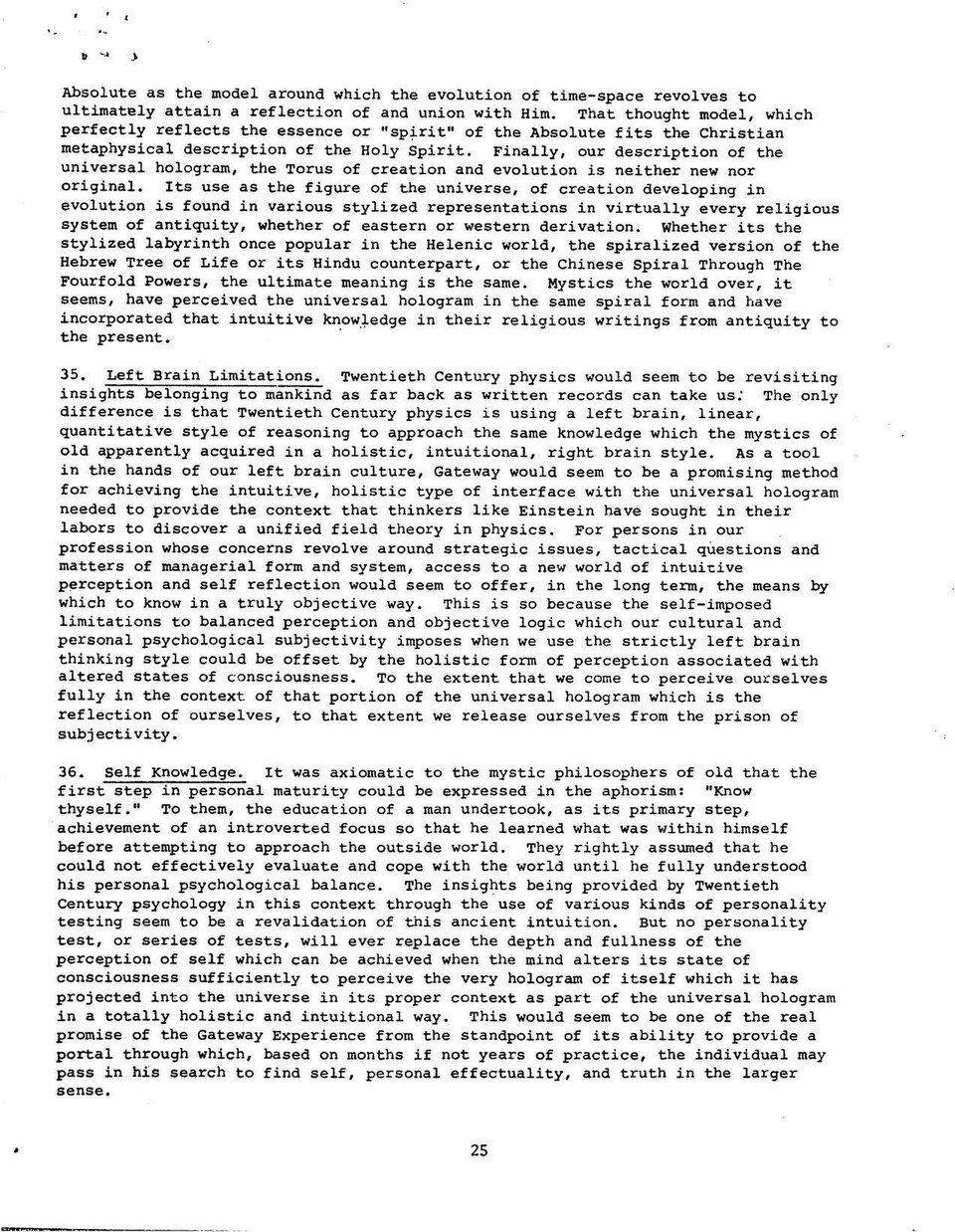
The route the page took into public view is more ordinary than the mystery built around it. The Monroe Institute had held a complete copy for 38 years. Its director of marketing and communications emailed the page to a reporter at VICE, who published it on 8 April 2021, and it spread across social media from there.
What is on it is three paragraphs of typed prose. The first finishes an argument that the torus of creation 'is found in various stylized representations in virtually every religious system of antiquity', naming 'the stylized labyrinth once popular in the Helenic world, the spiralized version of the Hebrew Tree of Life or its Hindu counterpart, or the Chinese Spiral Through The Fourfold Powers', and concluding that 'Mystics the world over, it seems, have perceived the universal hologram in the same spiral form'. The second is headed 'Left Brain Limitations' and argues that Gateway could give a left-brain culture the intuitive interface with the universal hologram 'needed to provide the context that thinkers like Einstein have sought in their labors to discover a unified field theory in physics'. The third, headed 'Self Knowledge', opens on 'Know thyself' and ends on the promise that Gateway is 'a portal through which, based on months if not years of practice, the individual may pass in his search to find self, personal effectuality, and truth in the larger sense'. Our own file's verdict on the page, that it holds no bombshell revelations, is exactly right. The famous missing page turns out to be three paragraphs about the limits of left-brain thinking.
That first paragraph is the report inviting a comparison, and our own file takes the invitation up, at Tier 2 to 3 and no higher. It maps the Gateway levels onto older systems: the Egyptian Book of the Dead's navigation of afterlife regions, Tibetan dream yoga's maintained awareness during sleep, the Hermetic ascent through the planetary spheres, shamanic journeying, Merkabah mysticism's ascent through the hekhalot, yogic samadhi, the Enochian ascent through seven heavens. It notes that shamanic drumming typically runs at 4 to 7 Hz, inside the theta band Hemi-Sync aims at, and that chant traditions from Gregorian chant to Tibetan throat singing to Hindu mantra build harmonic resonance. Then it argues against itself in the same section, and the counterargument has to be carried alongside the parallel or the parallel becomes a lie by omission: a shared frequency range does not demonstrate a shared function, and trance in a shamanic setting may come from expectation, cultural context, physical exhaustion or psychoactive substances rather than from acoustics. What is genuinely interesting here is not that the resemblance exists. It is that a serving intelligence officer drew it himself, in 1983, on Army letterhead.
06The Sound Itself
Everything above is about a document. This section is about whether the mechanism inside it works, which is a separate question with a separate literature, and the answer is neither of the two answers usually on offer.
Start with the floor, because it is solid and it is routinely mistaken for the contested part. Neural oscillations are a fundamental feature of brain function and have been measurable by EEG since Hans Berger's first recordings in 1924. The canonical bands, delta, theta, alpha, beta and gamma from 30 Hz upward, correlate with distinct cognitive states and are generated by synchronized populations of cortical neurons. Alpha is prominent in relaxed wakefulness with the eyes closed, theta in drowsiness and in memory encoding, gamma in attentional binding and conscious perception. György Buzsáki's Rhythms of the Brain (2006) is the standard framework for the field. None of this is fringe, and the Gateway report is not wrong to build on it.
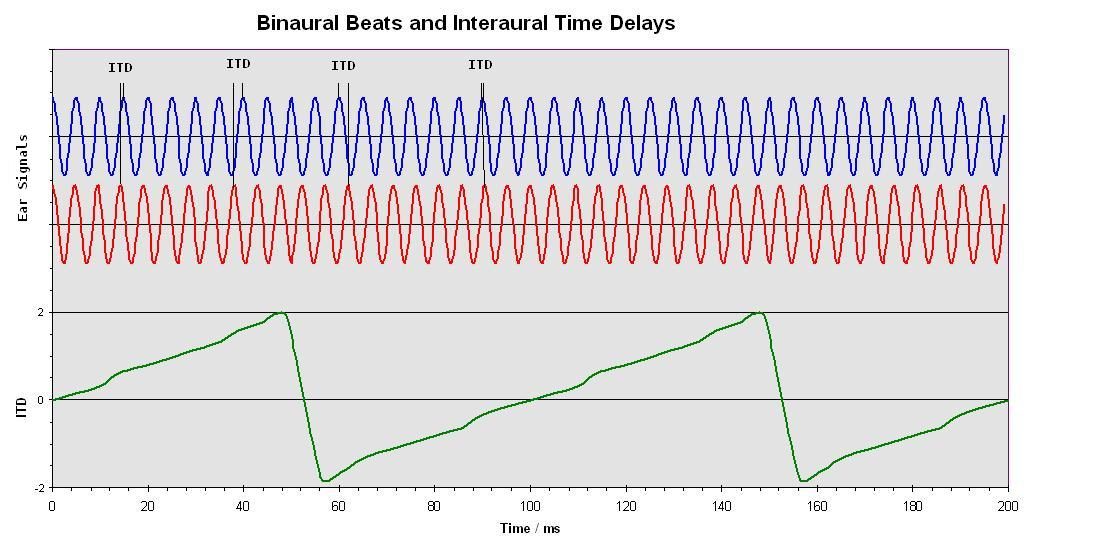
Binaural beats are older than the Institute, older than the report, older than EEG itself. Heinrich Wilhelm Dove described them in 1839. Gerald Oster of the Mount Sinai School of Medicine investigated them in depth in a 1973 Scientific American article that is still the standard citation. Present two tones of slightly different frequency dichotically, one to each ear, and the auditory system generates a perceived amplitude modulation at the difference between them. The percept arises in the superior olivary complex of the brainstem, where inputs from the two ears are first integrated. The effect the 1983 report leans its whole mechanism on is a Victorian discovery about hearing.
The illustrative numbers, as our own file gives them: 400 Hz to the left ear and 410 Hz to the right produce a perceived beat at 10 Hz. Published EEG work shows the brain can synchronize its dominant frequency to that beat, which is the frequency-following response the report names. Two details of the mechanism matter later. The first is that headphones are a requirement rather than a convenience, because without dichotic separation the two tones simply mix in the air and there is no binaural percept at all. The second is that Hemi-Sync is not a bare beat: it layers multiple binaural beats over pink noise, verbal guidance and proprietary audio patterns, which means that when a listener reports an effect, the beat is only one of several things in the room that could have produced it.
Here is the fact that does the most quiet damage to the mechanism story, and it comes from the better-sourced of our two research files, out of its Tier 1 section. Rhythmic light drives brain rhythms better than rhythmic sound does. Photic driving reliably entrains occipital alpha, the intermittent photic stimulation test has been standard in epilepsy diagnosis since the 1940s, and the visual cortex follows external flicker robustly across roughly 1 to 60 Hz. Auditory steady-state responses are real too, well documented and used clinically in audiometry, which confirms that the auditory system can track periodic stimuli across the major EEG bands, though how strongly the cortex follows, as against the brainstem, varies. The reason nobody markets photic entrainment to consumers is not that it fails to work. It is seizure risk in photosensitive people, on the order of 1 in 4,000 among those with epilepsy. The stronger tool exists. It is the more dangerous one.
| The Claim | The Study Behind It | What Has to Be Carried With It |
|---|---|---|
| Anxiety | Garcia-Argibay, Santed and Reales, a meta-analysis of 22 studies, Psychological Research, 2019 | A small but statistically significant effect, strongest for theta-band beats given for 15 minutes or more. The authors themselves flag high heterogeneity, small samples and potential placebo effects, and say clinical significance is uncertain |
| Meditation | Lavallee, Koren and Persinger, 2011 | 7 Hz beats facilitated the meditative process and 15 Hz beats hindered it, across both novice and experienced meditators |
| Chronic pain | Zampi, 2016, in Alternative Therapies in Health and Medicine | A modest reduction, from theta beats applied once daily for two weeks. Our own file places this study in the European Journal of Pain and calls the beats delta. Both are wrong |
| Sleep | Abeln and colleagues, 2014, in the European Journal of Sport Science | Eight weeks of 2 to 8 Hz stimulation during sleep improved subjective sleep and awakening quality and motivational state, with no effect on perceived physical state. It is a pilot study with 15 participants, all of them young elite footballers. Our own file places it in Frontiers in Psychiatry and calls the beats delta. Both are wrong |
| Sleep onset | Jirakittayakorn and Wongsawat, 2017 | 6 Hz beats increased theta power during NREM sleep transitions, though the clinical magnitude of the effect was small |
| Cognition | Mixed. Hommel and colleagues, 2016, among others | Enhanced cognitive flexibility from high-frequency beats in some work, and no effect at all in other work. We did not independently identify the Hommel study, and name it here only as our file names it |
The strongest single result in that table deserves its number. The 2019 meta-analysis by Garcia-Argibay, Santed and Reales pooled 22 studies and found a small but statistically significant effect on anxiety, a Cohen's d of about 0.45. That is a real finding and there is no reason to shrink it. There is also no reason to strip it of what its own authors attached: high heterogeneity between studies, small sample sizes, and potential placebo effects that leave the clinical significance uncertain. Those caveats are part of the result, not a hedge added here afterwards.
Our own file's critical section is labelled Tier 1, which means the negative half of this story is better evidenced than the positive half. Binaural beats do not reliably entrain brainwaves in every subject, and individual variation is high. No controlled study has demonstrated the induction of an out-of-body experience by binaural beats alone. Placebo and expectation are a classic confound here, because people who believe the audio will produce an altered state are more likely to report one. And the active ingredient is genuinely unclear, between the beat itself, the relaxation, the guiding voice and the expectation. The consensus our file states is narrow and should be quoted at exactly that width: modest effects on subjective states such as relaxation and anxiety, and no support from controlled peer-reviewed evidence for out-of-body experience, remote viewing or consciousness expansion. Producing relaxation is not the same as enabling travel outside the body, and the step between the two is precisely the step that has never been evidenced.
Four criticisms set the honest ceiling on the whole field, and they come from inside it. First, the evidence base is weak and probably inflated: most individual studies have fewer than 30 participants, lack active controls such as relaxation music or white noise, and are inadequately blinded, and funnel-plot asymmetry suggests publication bias. Second, the blinding fails, because Chaieb and colleagues noted in 2015 that participants can often tell a binaural beat from a control stimulus. Third, and sharpest, the pathway is contested: Orozco Perez, Dumas and Lehmann showed in eNeuro in 2020 that binaural beats reliably modulate brainstem activity while the evidence for cortical entrainment, particularly of the thalamocortically generated alpha rhythm, remains inconclusive, and Herrmann and colleagues in 2016 distinguish the robust cortical entrainment achievable with transcranial stimulation from the weaker effect available through the ear. That is a sharper claim than the one our primary file makes, and it is the better one. Fourth, expectation confounds nearly everything, because relaxation expectancy alone can raise EEG alpha power by about as much as the beats are credited with. Notice what the third of those does to the argument. The brainstem part is solid. It is the part that would have to reach the cortex and change a state of consciousness that is not.
Our second research file, the one on brainwave entrainment, names Hemi-Sync directly in its speculative section, and its sentence is the fairest summary available anywhere: the system 'has a dedicated practitioner community but lacks controlled research demonstrating specific altered-state induction beyond relaxation and hypnagogic imagery'. Read the end of that carefully, because it is not the dismissal it looks like. Relaxation and hypnagogic imagery, the imagery of the edge of sleep, are real states, and nobody serious is saying that listeners imagine the experience. What is unestablished is that the experience is anything more than those two things, and most studies cannot separate a specific entrainment effect from non-specific relaxation, expectation and demand characteristics.
Two claims in this area sit at Tier 4 in our own files, meaning no credible source or contradicted by evidence, and they should be refused by name. Binaural beats do not replace medication for clinical anxiety, depression, ADHD or chronic pain, and no medical or psychological professional body recommends them as a standalone treatment for any clinical condition. And the frequency marketing, 528 Hz for DNA repair or 432 Hz for universal harmony, is confused at the level of arithmetic: neural entrainment operates at EEG frequencies of roughly 0.5 to 100 Hz, while those are audio pitches from a range running to 20,000 Hz. The beat is the difference between two pitches, which makes the carrier pitch very nearly irrelevant. None of this is McDonnell's fault, and it is worth saying so plainly. He was writing in 1983 about an audio programme, not about a wellness market that did not yet exist.
07What the Report Does Not Say
Our own research file does something here worth crediting, because it did it unprompted and it did it against the grain of its own subject.
The file keeps a list of what the report does not claim, written against the way the report is used online. It does not say the CIA confirmed that astral projection is real. It does not say the universe is a simulation, whatever holographic language it uses. It does not say the Gateway Process creates superpowers. It is one officer's analytical assessment and not an official CIA position statement. And it was one of many reports commissioned during a Cold War in which the American government explored a great deal of unconventional territory. That list belongs near the top of any honest account of this document, which is why it is here rather than in a footnote.
The file is equally direct about the report's own weaknesses, and these are its criticisms and not ours. The report is not peer-reviewed science, having been produced for internal evaluation and never submitted for review. It cherry-picks its physics, invoking Bohm and Pribram while passing over the fact that both were already controversial in 1983 and have been further marginalized since. It conflates quantum mechanics with consciousness, carrying uncertainty and non-locality up to a scale at which no mechanism has been demonstrated. The Focus system makes unfalsifiable claims, because there is no way to confirm whether a person is in Focus 21 or simply relaxed with an active imagination. And the Cold War context cuts against the report rather than for it: the government explored fringe ideas in large part because it feared the Soviets were exploring them, and funding is not validation. That last sentence is our file's own, and it is the one that keeps this article honest.
On the audio technology the file lists four more objections. No double-blind study has demonstrated the induction of an out-of-body experience by binaural beats. Anecdotal reports from Gateway sessions may be lucid dreams, hypnagogic imagery, or imagination under suggestion, and our own article on lucid dreaming covers how substantial the first of those alone can be. The Monroe Institute is a commercial entity selling courses and audio products, so a financial incentive to promote the claims exists, a point worth making once, plainly, and without sneering: the Institute has never hidden what it sells. And Monroe's original accounts remain single-witness, unverified personal narratives.
The other side of the argument is also in our file, and it deserves its full strength rather than a summary. The report's value, on this reading, lies not in proving anything about out-of-body experience but in documenting that a military intelligence organization looked at the Monroe Institute's training closely enough to want further investigation. The participant experience is documented, and whether it is an out-of-body event or a profound meditative state, the subjective reports have been consistent across very large numbers of people. And neuroscience has not explained consciousness, so ruling out every non-materialist model in advance is its own kind of overreach. Two of those three points stand on their own. The first leans partly on the 1984 training row that we could not corroborate, and it should be held exactly that loosely.
08What Is Still Open
Forty-odd years on, the interesting question is no longer what the report claimed. It is what has been done since to find out, and the honest answer is: announced more often than finished.
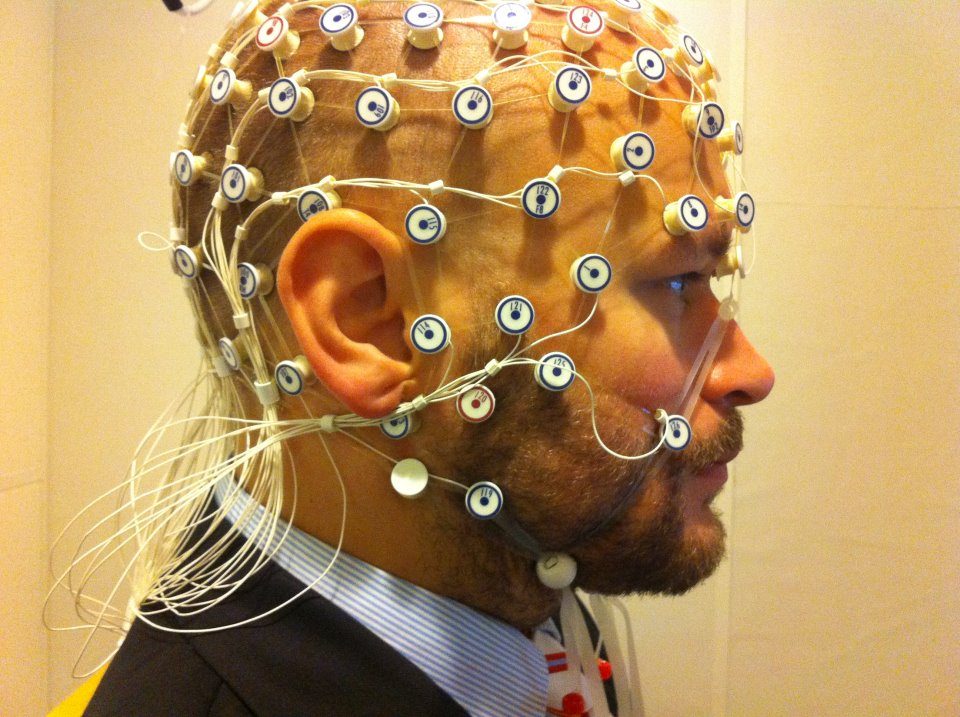
The most recent development is an announcement rather than a result, and that distinction is the whole of its weight. In 2025 the Monroe Institute and a neurotechnology company called Neuphoria announced a remote EEG partnership, described in the announcement as one of the world's largest remote EEG studies: a 30-day protocol with 333 Gateway Voyage alumni, mapping Focus levels 10 to 21 with real-time neurofeedback, stated to be conducted remotely under institutional review board compliance. That is a genuinely interesting design, because it points an instrument at exactly the gap this article keeps naming. It is also a corporate press release and a product page, issued by a company that sells headsets, and no findings have been published. Our own file additionally attributes the wider 2025 resurgence to coverage by outlets including WIRED, and to an academic re-evaluation under a named framework. We could locate neither, so neither is carried here.
Our file's own list of what remains unknown is the honest ending, and one item on it is better than the rest. No peer-reviewed double-blind study has confirmed out-of-body induction by Hemi-Sync. What the Army actually did with Gateway training is unknown, because operational results remain classified. Whether the Gateway protocols and the later remote-viewing work overlapped functionally is unclear, and that question belongs to the remote-viewing article rather than to this one. Whether modern imaging and connectivity analysis could find a unique neural signature for a Gateway state is untested. Whether other militaries run comparable programmes now is unknown. And the best of them is the one the document answers itself: McDonnell did not end his report with a conclusion. He ended it with a request.
Here is what the report actually concludes, in its own words: 'There is a sound, rational basis in terms of physical science parameters for considering Gateway to be plausible in terms of its essential objectives. Intuitional insights of not only personal but of a practical and professional nature would seem to be within bounds of reasonable expectations.' Plausible. Would seem to be. He then sets out a phased experimental programme labelled A through L, beginning 'Begin by using the Gateway Hemi-Sync tapes to achieve enhanced brain focus and to induce hemisphere synchronization', and signs off: 'If these experiments are carried through, it is to be hoped that we will truly find a gateway to Gateway and to the realm of practical application for the whole system of techniques which comprise it.' That is not the language of a man who has been convinced. It is the language of a careful officer who has not been, and who is asking for the work that would settle it. There is no public record that anybody did it.
One piece of housekeeping about our own file rather than about the report, kept in the open because the alternative is to inherit its errors quietly. Six things in research document Y_5_02 did not survive checking against the primary source, and this article carries the corrections instead: McDonnell's rank, which is Lieutenant Colonel; the SECRET/NOFORN classification row, which cites a stamp not visible on any released page; the description of page 25 as a diagram, when it is prose; the patent, which is a sleep-induction patent and not a Hemi-Sync patent; and the Focus 10 and Focus 21 glosses, which are the Institute's language rather than the report's. The sixth is the most serious, and it is the reason the conclusion above is quoted at such length. Our file attributes a conclusion to McDonnell inside quotation marks that is not in his report. We tested it twice against the full document text, once for the whole sentence and once for the phrase it turns on, 'self-awareness', which appears nowhere in either of the two transcriptions we searched, one of them the validated Wikisource text. That sentence is therefore not reproduced here, and the report's real conclusion, quoted above, is both verified and more interesting: hedged, and followed by a request for experiments. Our file also carries a footer stating that no significant counter-arguments exist in the scholarly literature for the claims it presents, which its own section on counterarguments and debunking contradicts at length. Nothing in this article rests on that line either. Both need fixing in the file, and both are worth a reader knowing about a source they may go and check.
Fast Facts
- The Document
- Analysis and Assessment of Gateway Process, a memorandum dated 9 June 1983 from the US Army Operational Group, US Army Intelligence and Security Command, Fort George G. Meade, Maryland
- Who Wrote It
- Wayne M. McDonnell, Lieutenant Colonel, Military Intelligence. Commander was his post, not his rank, and our own file gets this wrong in one place
- Where It Lives
- CIA document CIA-RDP96-00788R001700210016-5, in the CIA's electronic reading room, mirrored on the Internet Archive and Wikimedia Commons
- Its Classification
- The released copy carries no classification marking of any kind, only a stamp approving release in 2003. Our own file's SECRET/NOFORN row is not carried here
- Its Own Conclusion
- That there is a sound, rational basis in physical science terms for considering Gateway plausible in terms of its essential objectives, followed by a phased programme of experiments, A through L
- The Missing Page
- Page 25, omitted from the 2003 release, supplied to a reporter by the Monroe Institute in 2021. It is prose, not a diagram
- The Technology
- Hemi-Sync, binaural-beat audio developed by Robert Monroe and the Monroe Institute, founded 1974 in Faber, Virginia
- The Patent
- US Patent 3,884,218, filed 1970 and granted 1975, is a sleep-induction patent and not a Hemi-Sync patent, whatever our own file's timeline says
- What Binaural Beats Reliably Do
- Produce a perceived beat at the difference between two tones, built in the brainstem, plus modest measured effects on relaxation and anxiety
- What They Have Not Been Shown To Do
- Induce an out-of-body experience. No controlled study has demonstrated it, and our own file states that at Tier 1
- The Experiments He Asked For
- There is no public record that anyone ran them
What We Can Actually Stand Behind
The document is real and it says what this article says it says. Analysis and Assessment of Gateway Process was written on 9 June 1983 by Wayne M. McDonnell, Lieutenant Colonel, Military Intelligence, addressed to the Commander of the US Army Operational Group at Fort George G. Meade; it carries the CIA document number CIA-RDP96-00788R001700210016-5 and a stamp approving its release in 2003; every quotation from the report above was taken from its own text in two independent transcriptions. Its recovered page 25 is prose. And the sceptical half of this is Tier 1 as well, in our own file's own labelling: no controlled study has demonstrated the induction of an out-of-body experience by binaural beats, and the brain-rhythm floor the whole argument stands on, measured since 1924, is ordinary neuroscience.
Binaural beats do something, and it is small. A meta-analysis of the anxiety literature found a statistically significant effect, strongest for theta-band beats given for a quarter of an hour or more, with its own authors flagging high heterogeneity, small samples and possible placebo effects. Individual studies report modest results for meditation, pain, sleep and sleep onset, one of them explicitly a pilot with a very small sample. The physiology of the beat itself is not in doubt. What remains contested is how far up the nervous system the effect travels, whether anything survives an active control, and whether the ingredient doing the work is the beat or the quiet time that comes with it.
Everything the report builds above its mechanism sits here, at the grade our own files give it. The Focus levels and what a focused consciousness is said to reach are experiential claims, not verified, not reproducible under controlled conditions. Bohm's implicate order, graded Tier 2 to 3, is a legitimate interpretation of quantum mechanics and not mainstream physics; Pribram's holographic brain, Tier 3, has been largely superseded; Bentov's vibratory consciousness, Tier 3 to 4, is not peer-reviewed physics at all, and he is the source the report leans on hardest by a wide margin. Heart-brain coherence is measured at Tier 2 and interpreted at Tier 3, in the same breath, by the same file. And the 2025 EEG partnership is an announcement, issued by a company that sells headsets, with no findings published.
Four refusals, stated plainly. No, the CIA did not confirm that astral projection is real. The document is one Army officer's assessment, our own file says so in its own words, and no controlled study has demonstrated out-of-body induction by binaural beats. No, the report's hologram is not the holographic principle of modern physics. That principle is about information on boundaries; McDonnell's is a living energy pattern a consciousness can enter, and the shared word is doing all the persuading. No, binaural beats are not a treatment. They do not replace medication for anxiety, depression, ADHD or chronic pain, and no professional body recommends them as a standalone treatment for any clinical condition. And no, a carrier pitch does not do what the marketing says. Neural entrainment happens in the EEG range of roughly 0.5 to 100 Hz, the pitches the marketing names sit well above it, and the beat is the difference between two tones rather than the tones themselves, which leaves 528 Hz and 432 Hz with nothing to stand on. None of that last point is the 1983 report's fault, and it should not be laid at its door.
So what is actually here? A real memorandum, written by a real lieutenant colonel, in which the United States Army's intelligence command was told that leaving the body was worth a phased programme of experiments. That is remarkable, and no amount of correcting the details around it makes it less so. What is inside the memorandum is a mystical cosmology in the vocabulary of physics, assembled largely from one popular-science author, formally citing nothing, by an officer who wrote in his own first paragraph that he was trying to strip the occult stigma off the subject so that it could be assessed at all. The audio technology underneath it does something small and measurable, and does not do the large thing it is famous for. The gap between those two descriptions is where every viral version of this story lives. The strange part is that McDonnell told us how to close it. He wrote the experiments down, in order, A through L, and then asked for them. There is no public record that anyone ran them, and until somebody does, the most honest sentence available about the Gateway Process is still the one its own author wrote: plausible, in terms of its essential objectives, and nothing further than that.
Sources & further reading
Everything above is drawn from our research library on Theories of Anything, principally file Y_5_02 with its companion file Y_5_22 on brainwave entrainment, together with sources checked directly for this article. The 1983 memorandum itself was read in full in two independent transcriptions, the validated Wikisource text and the Internet Archive's copy of the CIA scan, and every quotation above comes from that text rather than from a summary of it. Corrections to our own files are carried in the open rather than buried. Six concern the document and are described in the article itself. Four more are bibliographic and belong here. First, our file's row for the eNeuro paper attaches the title 'Binaural Auditory Beats Affect Long-Term Memory' and the issue 7(4) to the DOI 10.1523/ENEURO.0232-19.2020; that DOI resolves to 'Binaural Beats through the Auditory Pathway: From Brainstem to Connectivity Patterns' by Orozco Perez, Dumas and Lehmann, in eNeuro 7(2), and the title in that row belongs to a different paper altogether, by Garcia-Argibay, Santed and Reales. The companion file Y_5_22 carries the same DOI correctly, so the two files disagree with each other on one identifier; it is linked below in its verified form. Second, Y_5_22 names the third author of that paper as Shubhi Bhatt. The third author is Alexandre Lehmann, and Bhatt belongs to the bibliography entry directly above it. Third, the Zampi and Abeln studies are placed in the wrong journals and described as using delta-frequency beats when both used theta, as the table in section 06 records. Fourth, the ISBN our files attach to Journeys Out of the Body belongs to the 1972 Souvenir Press edition rather than the 1971 Doubleday first edition they cite, and the DOI attached to Bohm's Wholeness and the Implicate Order resolves to the 2005 electronic edition rather than the 1980 print edition; the Open Library record for the edition actually cited is linked below. Three studies named in the article carry no identifier that we verified. Hommel and colleagues (2016) is named only as our file names it, because we could not independently identify the study. Zampi (2016) and Abeln and colleagues (2014) carry no identifier either, but their journals and frequency bands were corrected against independent bibliographic records, as the table in section 06 records. Open the full file to check the sourcing and go deeper.
Image credits
- The letterhead of page 1 of Analysis and Assessment of Gateway Process (1983) Wayne M. McDonnell, US Army Intelligence and Security Command, via Wikimedia Commons. Public domain (US Government work) Source.
- Exhibit 2 from Analysis and Assessment of Gateway Process (1983) Wayne McDonnell, extracted by Commons user TE(ae)A,ea, via Wikimedia Commons. Public domain (US Government work) Source.
- Page 25 of Analysis and Assessment of Gateway Process (1983), the page recovered in 2021 Wayne M. McDonnell, US Army Intelligence and Security Command, via Wikimedia Commons. Public domain (US Government work) Source.
- Binaural beats and interaural time delays Skyhead E, via Wikimedia Commons. Public domain Source.
- Subject ready for EEG recording at the phonetics lab, Stockholm University Petter Kallioinen, via Wikimedia Commons. CC BY-SA 3.0 Source.
- Card crop of Exhibit 2 from Analysis and Assessment of Gateway Process (1983) Wayne McDonnell, extracted by Commons user TE(ae)A,ea, via Wikimedia Commons. Public domain (US Government work) Source.


