
Lucid Dreaming: Awake Inside the Dream
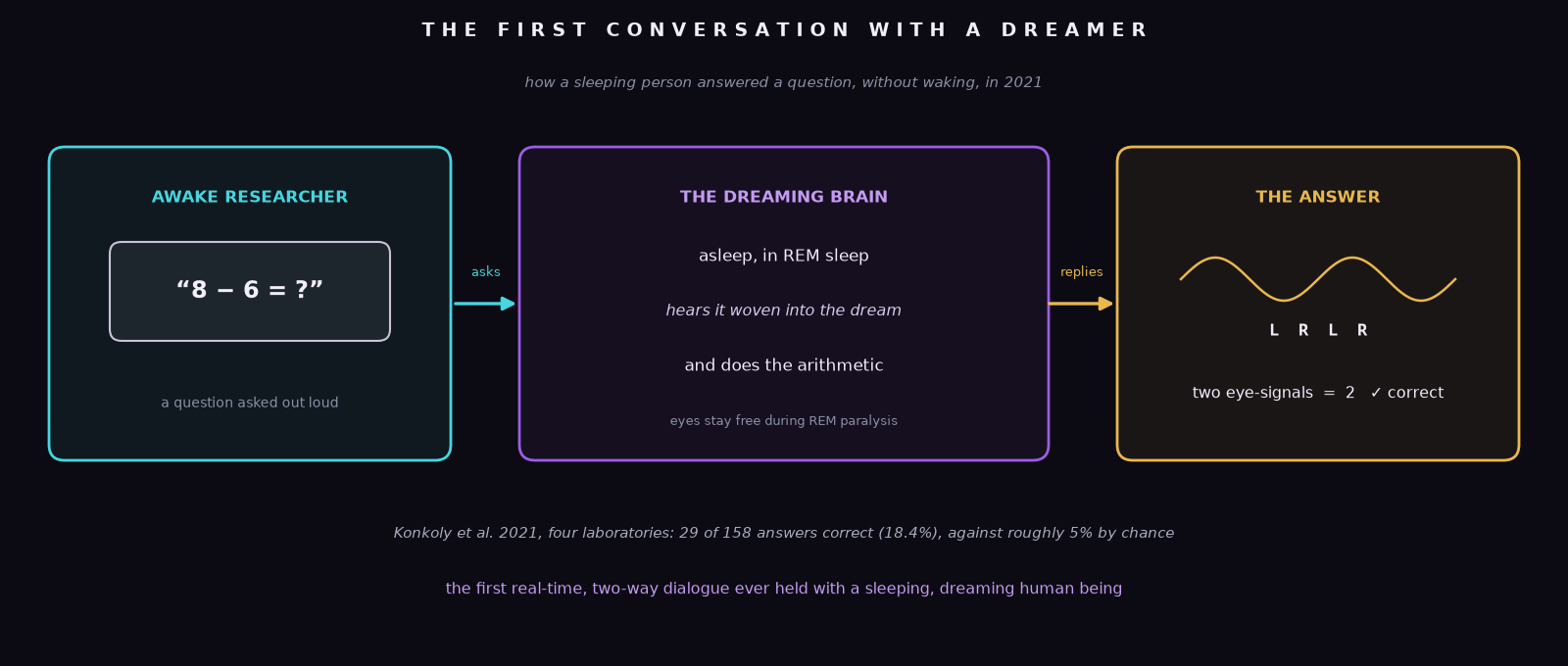
Somewhere in the night, a sleeping person realizes they are dreaming, and instead of waking, they stay. This is lucid dreaming, and unlike almost everything else in this wing, it is not a contested claim: it has been proven in the sleep laboratory, repeatedly, for half a century. Dreamers have signaled to waking researchers with their eyes from inside REM sleep, and in 2021 they held the first real two-way conversation with the outside world without waking up. The state is real and physiologically distinct. What people can reliably do with it, and the grander things they claim it opens onto, is where the honesty has to start.
Most of this wing deals in the genuinely uncertain, states of mind whose reality is argued over. Lucid dreaming is the exception, and it is worth putting that up front, because the topic attracts so much mysticism that its hard, boring, laboratory-proven core often gets lost. A lucid dream is simply this: you are asleep and dreaming, and you become aware that you are dreaming, while it is still going on. Sometimes you can then steer the dream. That this happens is not a matter of belief. It has been demonstrated under controlled conditions, confirmed by the machines that measure sleep, and replicated in labs around the world. So this is one of the rare articles here where we get to start from solid ground and then walk carefully outward toward the parts that are not solid at all.
01Proof From Inside the Dream
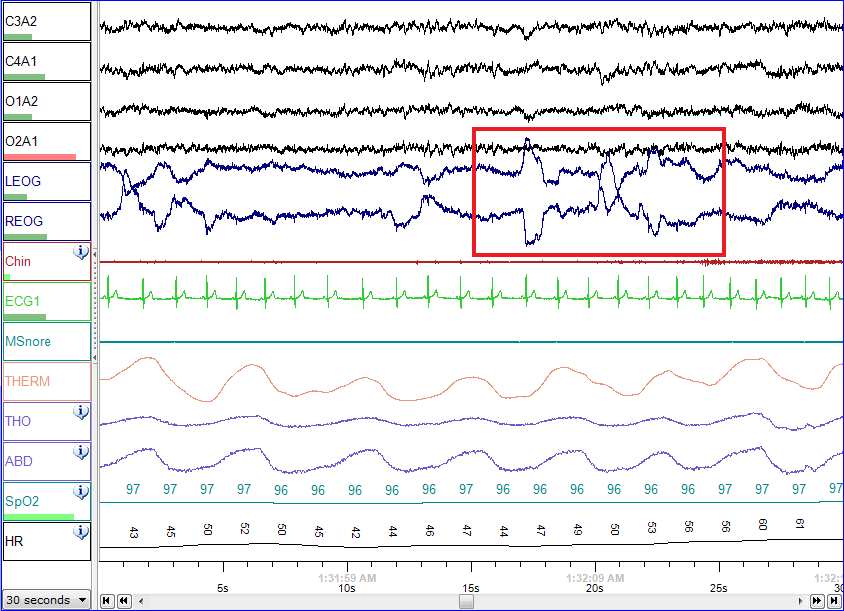
The problem with studying dreams was always that the dreamer cannot talk; the body is paralyzed during REM sleep. The breakthrough was realizing there is one exception. During REM, muscle atonia shuts down almost all voluntary movement, but the eyes still move, and the eyes can be moved on purpose. So the experiment designed itself: teach a would-be lucid dreamer a code, and have them signal with their eyes the moment they realize they are dreaming. Keith Hearne first pulled it off on the 12th of April, 1975, at the University of Hull's sleep laboratory, when his subject Alan Worsley sent a pre-arranged pattern of eye movements from within confirmed REM sleep. At Stanford, Stephen LaBerge independently developed the same method and published the verification that made the field respectable.
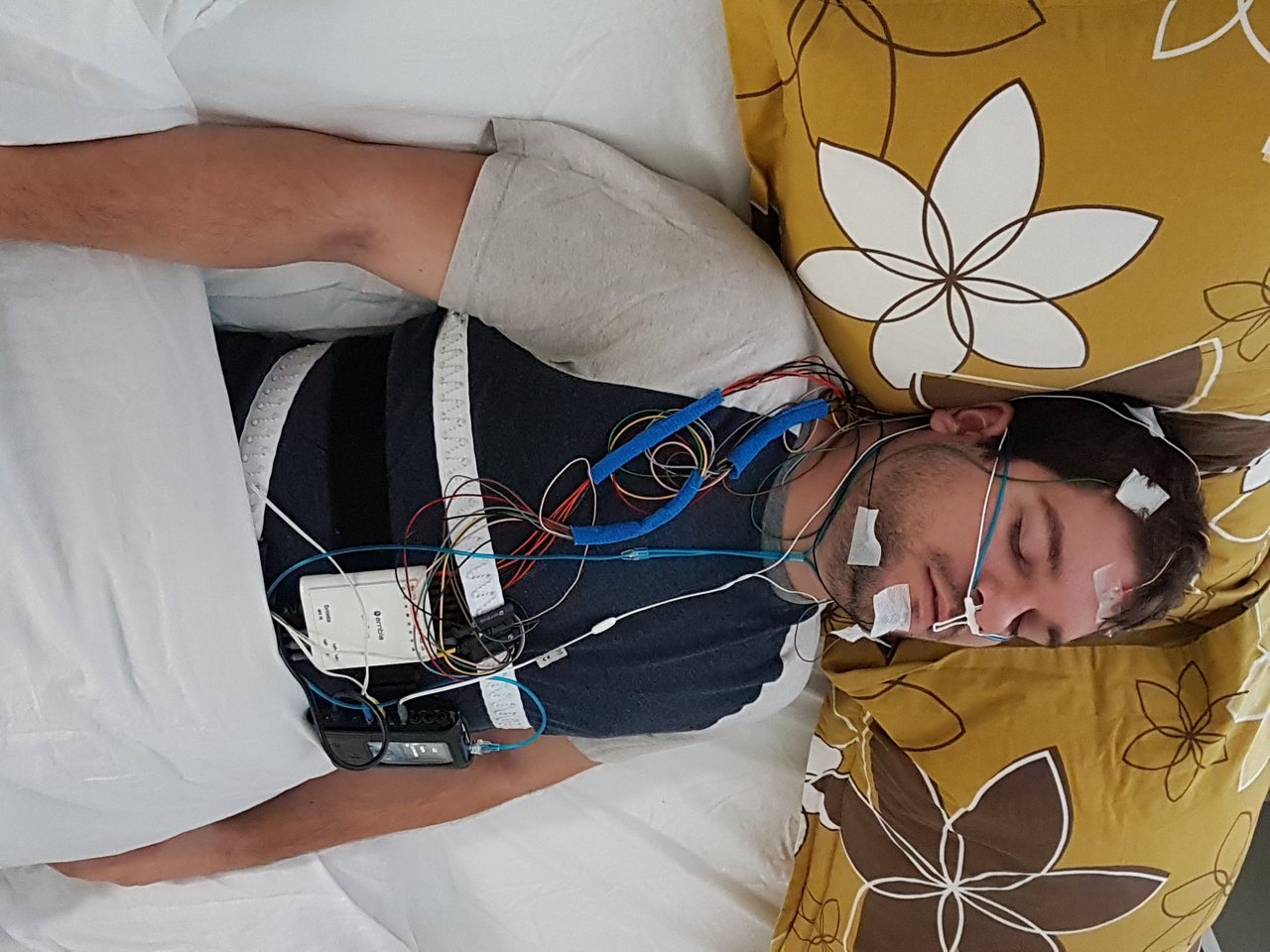
What makes this airtight is that the machines agree. During these episodes the polysomnograph shows unmistakable REM sleep, the EEG shows the right brain-wave patterns, the EMG confirms the muscles are slack and the body is asleep, and the EOG records the eyes making exactly the pre-arranged signal. There is no wiggle room for the subject being secretly awake; every instrument says they are asleep, and yet a deliberate, agreed-upon message is coming out. Dozens of labs have since replicated it. Within sleep science, lucid dreaming stopped being a curiosity decades ago and became what it is now: an established, physiologically distinct state of consciousness.
02The First Conversation
For decades the eye-signal was a one-way message: the dreamer could say 'I am lucid now,' and nothing more. Then, in 2021, a study led by Karen Konkoly and published in Current Biology went the other way. Across four independent laboratories, in the United States, France, Germany, and the Netherlands, researchers spoke to sleeping subjects, asking simple math questions and yes-or-no questions out loud, and the dreamers answered from inside their dreams using pre-agreed eye movements or small facial-muscle twitches. Out of 158 attempts with 36 participants, 29 answers were correct, a rate of 18.4 percent, against a chance baseline of roughly 5 percent. Modest, yes. But it was the first genuine two-way, real-time dialogue ever conducted with a sleeping, dreaming human being.
The detail that makes it uncanny is how the dreamers experienced the questions. They did not hear a disembodied voice announcing a math problem. The external stimulus got woven into the dream: one reported the question coming from a radio in the dream, another saw it written across the sky. The dreaming brain took a real signal from the outside world, folded it seamlessly into the story it was already telling, solved the arithmetic, and sent a deliberate answer back through the one channel still open. That is a brain doing waking-style cognition, on external input, while unambiguously asleep. It is the closest science has come to reaching through the wall of sleep and getting a reply.
03A Third State of the Brain
So what is physically different about a lucid dream? The picture researchers describe is a hybrid, a blend of sleeping and waking that does not normally occur. The machinery of REM keeps running, the vivid imagery, the atonia, the characteristic brain rhythms, but something extra switches back on: the dorsolateral prefrontal cortex, a region that supports self-reflection and executive control and that is normally quieted during ordinary dreaming. Its reactivation is the leading candidate for that sudden click of 'wait, this is a dream.' Studies by Ursula Voss and colleagues (2009) found lucid dreams carry elevated 40-hertz gamma activity in the front of the brain and tighter front-to-back coordination, a signature that sits partway between waking and normal REM. Benjamin Baird and colleagues (2019) later found that people better at lucid dreaming tend to have more prefrontal grey matter and stronger everyday metacognition, the same traits that meditation strengthens.
One tempting shortcut deserves a caution. A 2014 study reported that running a weak 40-hertz electrical current across the frontal scalp of sleeping subjects nudged them toward lucid-dream-like self-awareness, which sounds like a switch you could flip. But the honest footnote, which the research itself carries, is that attempts to replicate it have been mixed. It is a genuinely interesting result and a poor basis for a product. As of now there is no reliable, proven device or current that will simply hand you a lucid dream.
04Can You Learn to Do It?
Lucid dreaming can be trained, but the honest word for how well is 'variably.' The best-supported method is MILD, Mnemonic Induction of Lucid Dreams: as you drift off, you firmly rehearse the intention 'the next time I am dreaming, I will notice that I am dreaming.' The strongest single result comes from a 2017 Australian study by Aspy and colleagues, which found that combining MILD with reality testing and the wake-back-to-bed method produced a lucid dream in 46 percent of participants in a single night. That is a real and encouraging number, but read it precisely: it is one specific technique stack, in one study, in a motivated population, over one night, not a promise that anyone can do it on demand.
The other tools are a mixed bag, honestly rated. Reality testing, habitually checking during the day whether you are dreaming, has moderate support and works by building a habit that carries into sleep. Wake Back To Bed, getting up after five or six hours and returning to sleep, reliably increases REM and lucidity odds and underlies the strong Aspy result. WILD, holding awareness continuously as you fall asleep, is powerful but hard, mostly the province of experienced practitioners. Light-flashing eye-mask devices exist with variable results, and one drug, galantamine, does measurably raise lucidity when paired with MILD, though it carries real safety and ethical questions and is not something to take casually.
05The Old Traditions
None of this is new; it is only newly measured. Several traditions built practices around dream awareness centuries ago, and the structural overlap with modern techniques is striking. Tibetan Buddhism's dream yoga, or milam, part of the Six Yogas of Naropa dating to around the 11th century, trains practitioners to recognize the dream state and hold awareness inside it, using intention-setting and awareness habits that map closely onto MILD and reality testing. Australian Aboriginal traditions describe the Dreaming, or Tjukurpa, as a reality accessed through and alongside sleep. In ancient Greece, patients slept in the temples of Asclepius hoping for a healing dream, after fasts and purifications that functioned much like induction rituals. Islamic istikhara seeks guidance through dreams after specific prayers. The honest framing is that these are structural parallels and a shared human intuition, not scientific proof of any tradition's metaphysical claims.
06What It Can and Cannot Do
The practical uses are real but bounded, and worth stating at their true size rather than the inflated one. The best-evidenced application is treating nightmares: becoming lucid during a recurring nightmare and changing its course has genuine support as a therapy, including for trauma-related nightmares. There is intriguing evidence that rehearsing a physical movement inside a lucid dream activates the same motor circuits as real practice, which points, cautiously, at uses in skill training and rehabilitation. And lucid dreaming is a genuinely unique tool for consciousness research, being the one state in which a person can run deliberate experiments inside a world entirely generated by their own brain. The famous stories of dreamed creative breakthroughs, the benzene ring, parts of a Beatles song, belong here too, but flagged: most are better described as ordinary dream or half-asleep reverie than as verified lucid dreams, and they make lovely anecdotes rather than evidence.
07Where the Claims Outrun the Evidence
Now the outer edge, clearly labeled. Shared dreaming, two people meeting inside the same dream, has plenty of anecdotal reports of people waking with matching dream content, but zero controlled verification, and it should be treated as unproven. It is at least true that the Konkoly method makes a mediated version thinkable, since if a dream can receive an outside signal, one could imagine relaying a message from one lucid dreamer to another, but this has never been attempted, and 'thinkable' is a long way from 'real.' Some traditions and researchers also point to the structural resemblance between a lucid dream and descriptions of the moment of death, the Tibetan bardo, the instruction to stay aware as the body fails. That resemblance is real and interesting, and the most it can honestly offer is a framework for imagining how awareness might persist. It does not prove that it does.
And one claim has to be refused outright, because it is where the whole subject most often goes off the rails: that lucid dreamers visit real other places, astral planes, parallel universes, objective non-physical realms. Everything the neuroscience shows points the other way. The lucid dream, however vivid and however convincingly external it feels, is generated by the dreamer's own brain; it is an internally constructed world, not a doorway to an external one. A lucid dream can feel more real than the room you are reading this in. That feeling is a fact about the brain's power to model reality, not evidence that the dreamed world exists anywhere but inside your own head.
Fast Facts
- What it is
- Becoming aware you are dreaming while the dream continues, sometimes with control
- First proven
- Keith Hearne, 1975 (Hull); Stephen LaBerge published the verification from Stanford
- How it was proven
- A pre-arranged eye-movement signal sent from inside confirmed REM sleep
- The 2021 leap
- Konkoly et al.: the first real-time two-way conversation with a dreaming person
- That study's rate
- 29 correct answers out of 158 attempts (18.4%), across four labs
- The brain state
- A hybrid: REM sleep plus reactivation of the prefrontal cortex and frontal gamma
- Best induction
- MILD plus reality testing plus wake-back-to-bed: 46% in one night in one study
- The hard limit
- It is generated by your own brain; it is not a portal to another reality
What We Can Actually Stand Behind
Lucid dreaming is real and proven, and this is the firmest ground in the whole wing. Dreamers have signaled to researchers with their eyes from inside confirmed REM sleep since 1975, the finding has been replicated across many labs, and in 2021 sleeping subjects held a genuine two-way conversation with waking experimenters. The brain state is measurably distinct, a hybrid of REM sleep and reawakened prefrontal activity. None of this is in dispute.
You can probably learn to do it, but not on command. The best technique stack produced a lucid dream in just under half of one study's motivated participants in a single night, which is genuinely good and still far from a switch you can flip. Therapeutic uses, especially for nightmares, and possible roles in skill rehearsal are real but bounded, and the ancient dream traditions are striking structural cousins of the modern methods rather than proof of anything mystical.
The romantic extensions are not established. Shared dreaming has anecdotes and no controlled evidence. The resemblance between a lucid dream and descriptions of dying is a real and thought-provoking parallel, but a parallel is a framework for a question, not an answer to it; it offers no proof that awareness survives death. Hold these as open and interesting, not as findings.
No, a lucid dream is not a portal to another world. The vividness is real; the destination is not. Everything the science shows indicates the dreamed world is built entirely by the sleeping brain, not visited. Claims of astral travel to objective realms or parallel universes run directly against what the neuroscience actually finds, and this article refuses them plainly, exactly as the research does.
What lucid dreaming really offers is stranger and better than the mysticism draped over it. Here is a state, entered every so often by ordinary people and reliably by trained ones, in which a mind wakes up inside its own creation and can look around, reason, remember, and even answer a question posed from the far side of sleep. It is the one place a person can stand fully inside their own consciousness and examine it while it runs. That the dreamed world is homemade does not cheapen it; it makes it a laboratory of one, the only room in which you are simultaneously the scientist, the subject, and the entire universe under study. You do not need it to be a doorway to somewhere else. It is already the most direct look most people will ever get at the machinery of their own awareness, from the inside, with the lights on.
Sources & further reading
Everything above is drawn from our research library on Theories of Anything. Open the full file to check the sourcing and go deeper.
Image credits
- Original diagram of the Konkoly et al. 2021 two-way dream-communication experiment: a spoken question answered from inside REM sleep via pre-arranged eye movements Original diagram by Theories of Anything. CC BY-SA 4.0 Source.
- A person fitted with the electrode array used in a clinical polysomnography (sleep study) Clinique Somnomed, via Wikimedia Commons. CC BY-SA 4.0 Source.
- A screenshot of a polysomnogram of a person in REM sleep, including an eye-movement channel NascarEd, via Wikimedia Commons. CC BY-SA 3.0 Source.
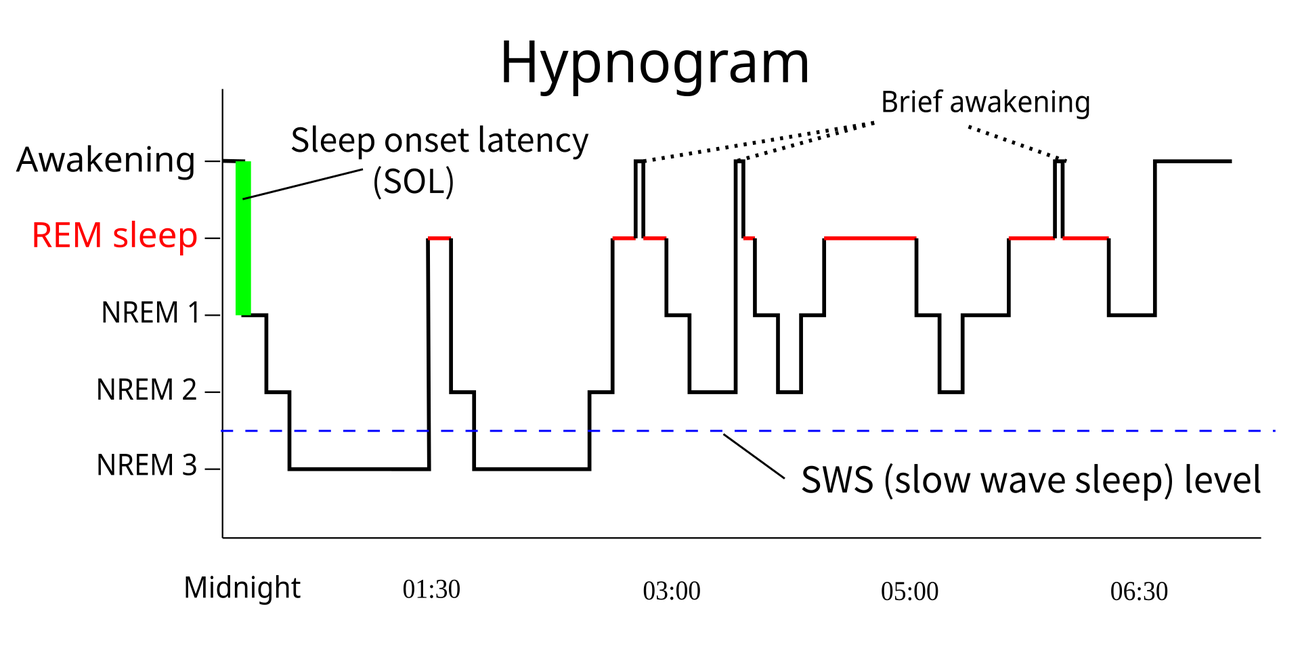
- A hypnogram of sleep-stage progression across one night, with REM periods marked RazerM, via Wikimedia Commons. CC BY-SA 3.0 / GNU Free Documentation License Source.
- Card crop of the original Konkoly 2021 dream-communication diagram Original diagram by Theories of Anything. CC BY-SA 4.0


