
The Dead Sea Scrolls: The Bible Before the Bible
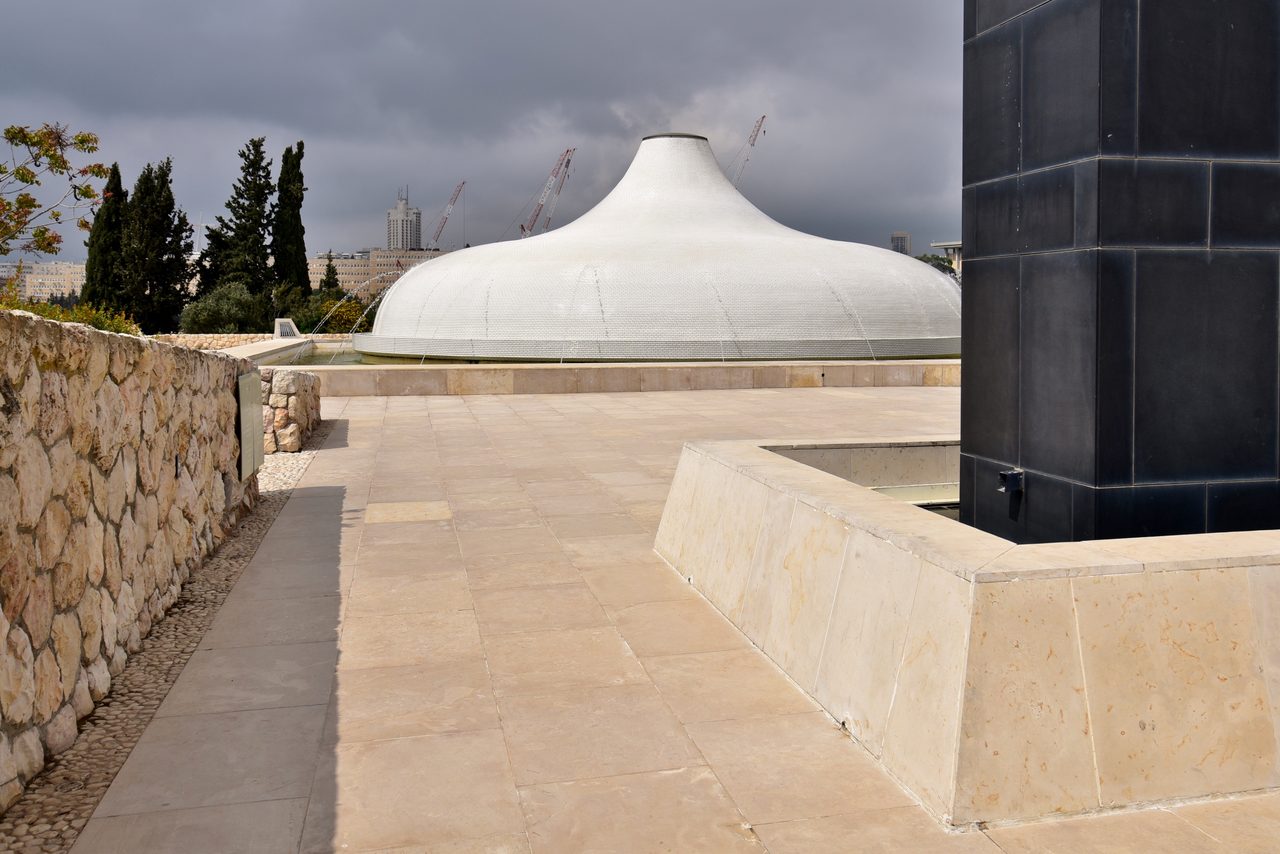
A Bedouin shepherd looking for a stray goat threw a rock into a cave above the northwest shore of the Dead Sea and heard it strike pottery. Inside were tall clay jars, and inside some of the jars were leather scrolls wrapped in linen. Over the following nine years, eleven caves near Khirbet Qumran gave up more than 900 manuscripts in Hebrew, Aramaic and Greek, written between roughly 250 BCE and 68 CE, and among them were copies of every book of the Hebrew Bible except Esther. One of them, the Great Isaiah Scroll, is dated to approximately 125 BCE, which is about a thousand years older than the oldest complete Hebrew biblical manuscripts anybody had before 1947. This article carries the find at tiers set three ways: by our primary research file, by its companion file, and by an independent verification pass run alongside both, and every claim below says which. The discovery and the chain of sale that followed it, the corpus with its languages and dates, the excavation record at Khirbet Qumran, the contents of the named scrolls including the Copper Scroll, the Temple Scroll and the War Scroll, the three classical authors who independently describe the Essenes, the community's own rule book with its three-year initiation and its penal code, and the forty-year publication bottleneck that one California library broke with a single announcement in 1991, all sit at Tier 1. The Melchizedek Scroll's heavenly-judge reading, the explanation that Roman forces looted the Copper Scroll's hiding places, the parallels between Essene practice and early Christianity, and the two live alternatives to identifying the Qumran community as Essene, sit at Tier 2. Whether the Copper Scroll's treasure was ever real, and who the Teacher of Righteousness and the Wicked Priest actually were, sit at Tier 3. That Jesus of Nazareth was an Essene community member, and that the Vatican suppressed the scrolls to protect Christianity, sit at Tier 4 and are stated here as the no they are. Two things this article deliberately does not do. It does not give a single precise manuscript count, because the honest figure depends on how fragments are grouped. And it does not repeat the four corrupted scroll designations that our own primary file carries.
The find began with a sound. Sometime between late 1946 and early 1947, a shepherd in the hills above the northwest shore of the Dead Sea threw a rock into a cave opening and heard it hit pottery rather than rock or animal. What was in the jars had been lying there since before the settlement below was destroyed in 68 CE, which is to say for roughly nineteen centuries. Within a decade, eleven caves in the same cliffs had been located and emptied, and what came out of them was more than 900 manuscripts written between roughly 250 BCE and 68 CE. Two corpus files were read in full for this article. Where the text below says our primary file it means A_2_04, Dead Sea Scrolls Expanded, and nothing else; where it says the companion file it means N_1_09, The Essenes: Qumran Community and Secret Knowledge; where a fact came from independent checking during the research pass instead, it says so. Nothing below is attributed to both files unless both actually carry it.
01A Rock, and the Sound It Made
The discovery narrative was reconstructed by independent checking during this article's research pass and corroborated across multiple sources, including the Biblical Archaeology Society, deadseascrolls.org.il and the Center for Online Judaic Studies. Between late 1946 and early 1947 a Ta'amireh Bedouin shepherd named Muhammed edh-Dhib, together with his cousin Jum'a Muhammed and a third companion, Khalil Musa, was searching for a stray goat in the hills above Qumran. Investigating a cave opening, edh-Dhib threw a rock inside and heard it strike pottery. Inside the cave, now designated Cave 1, they found several tall clay jars, some of which held ancient leather scrolls wrapped in linen. Then comes the part the story usually leaves out. They did not report the find. They kept the cave's location secret and began selling scrolls through intermediaries, most notably a Bethlehem antiquities dealer named Khalil Iskander Shahin, known as Kando. Eleven caves were eventually located and excavated between 1947 and 1956, one of which, Cave 7, yielded only Greek-language fragments.
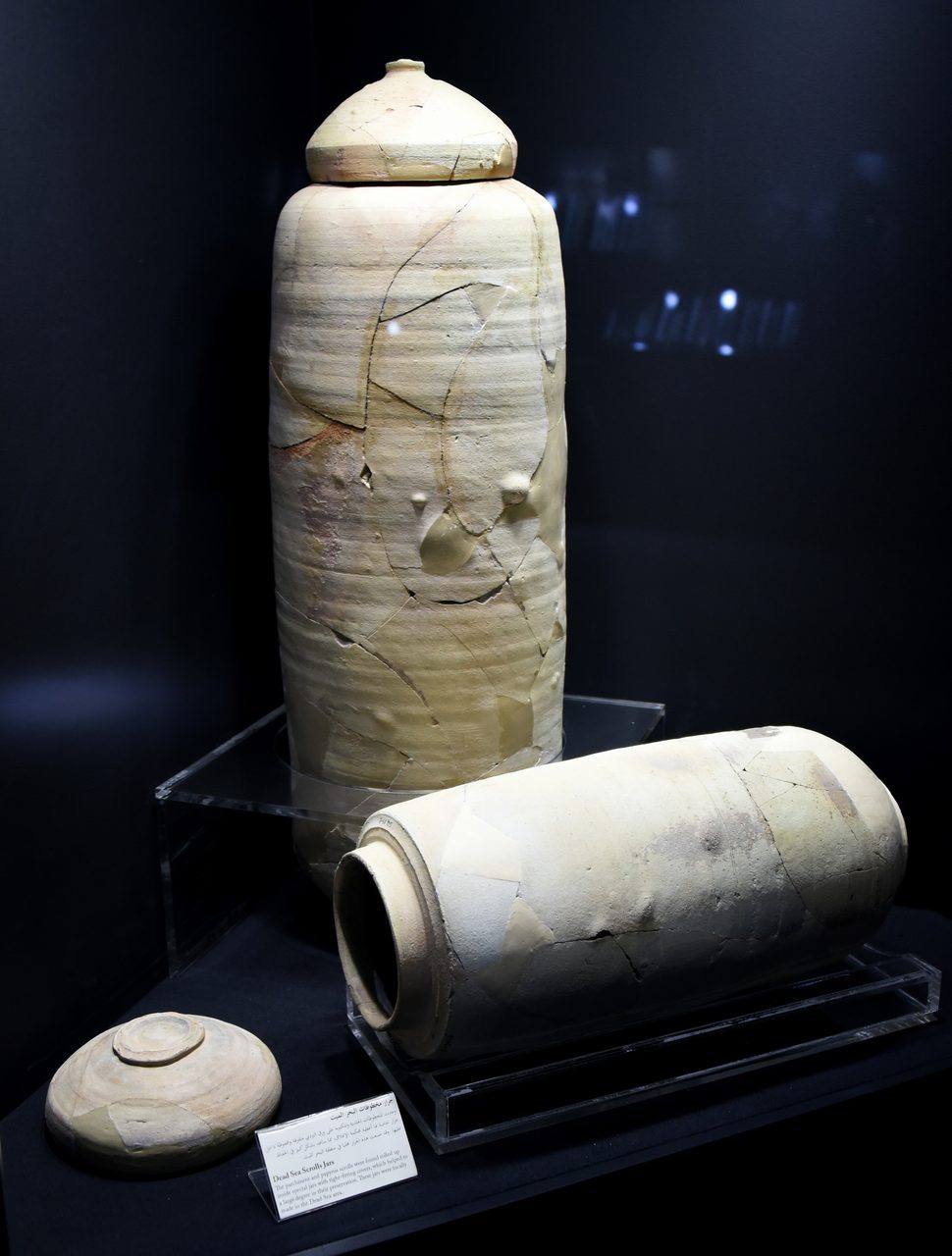
This is the kind of object edh-Dhib's rock actually struck: not a scroll, but the pottery around it. Jars like these are what kept the leather and linen intact for nineteen centuries in a cave that was otherwise open to the air.
The chain of acquisition was independently corroborated during the research pass against the Biblical Archaeology Society's own timeline and against The Jewish Link's account of the initial finds. Eleazar Sukenik, a Hebrew University archaeology professor and the father of the future Israeli general and archaeologist Yigael Yadin, bought three of the original seven scrolls from a Bethlehem dealer, making the dangerous crossing by Arab bus on November 29, 1947, the same day as the United Nations Palestine partition vote. Separately, Kando had sold four scrolls to Mar Athanasius Yeshue Samuel, the Syrian Orthodox archbishop, or Metropolitan, of Jerusalem. In June 1954 Mar Samuel placed a for-sale advertisement headed The Four Dead Sea Scrolls in the Wall Street Journal. Yigael Yadin, then on a lecture tour in the United States, arranged to buy all four through an intermediary on June 1, 1954, specifically so that the seller would not learn the buyer was acting for the State of Israel. All seven of the original Cave 1 scrolls thereby ended up in Israeli hands, and they are held today at the Shrine of the Book. Hold on to the shape of that sequence, because it is unusual for a discovery of this size. The seven most famous manuscripts of the twentieth century entered scholarship through an antiquities market and a newspaper classified advertisement, not through a trench.
02Eleven Caves, More Than Nine Hundred Manuscripts
The Dead Sea Scrolls were discovered between 1947, when Cave 1 was found, and 1956, when Cave 11 was, in eleven caves near Khirbet Qumran on the northwest shore of the Dead Sea in the Judean Desert. The corpus totals more than 900 manuscripts. They are written mostly in Hebrew, approximately 80 percent, with Aramaic at approximately 15 percent and Greek at approximately 5 percent making up the remainder, and they date from roughly 250 BCE to 68 CE. The materials are mostly parchment, meaning animal skin, with some papyrus, and exactly one inscribed on copper. Our primary file names the community responsible as most plausibly the Essenes, a Jewish sect independently described by Josephus, Philo of Alexandria and Pliny the Elder, and that identification is examined on its own terms in section 06 rather than assumed here. The scrolls are held today primarily at the Israel Museum's Shrine of the Book in Jerusalem, with other fragments distributed across institutions including the Jordan Museum in Amman.
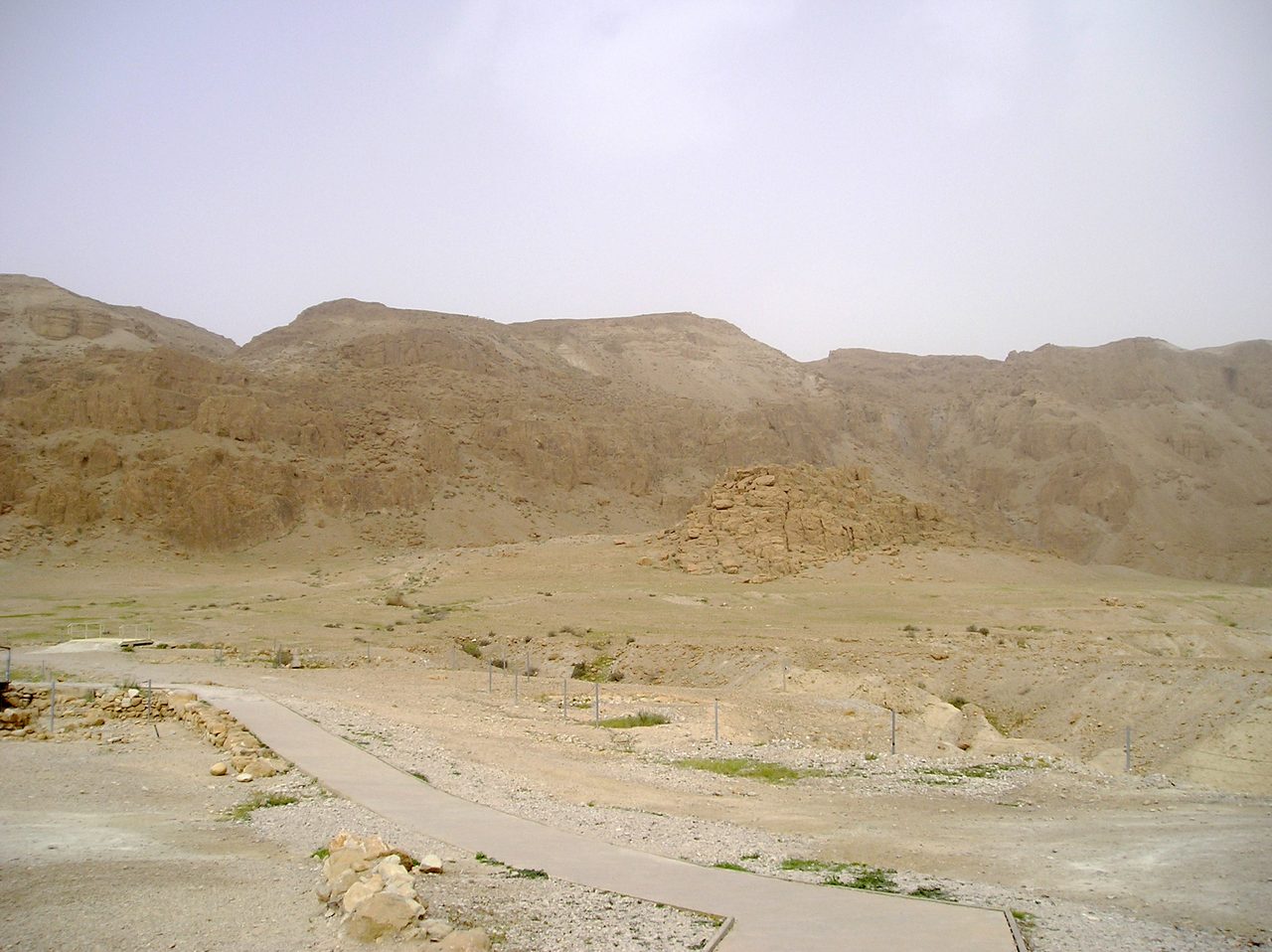
A word about that count, because it is the one number in this article that could easily have been written with a false precision. Our primary file says over 900. Our companion file says approximately 930. Independent sources checked during the research pass give figures running from roughly 900 up to 981, and the difference is not a disagreement about what was found; it is a disagreement about what counts as one manuscript, since a cave that yields thousands of fragments can be tallied as hundreds of distinct works or as rather more, depending on how confidently a scholar groups scraps that may belong together. So this article says more than 900 manuscripts and stops there, because that framing holds under every source found and no single precise number does. The same caution applies to the four category figures in the table below: each is approximate in our primary file's own text, and they do not add to a stated total, which is itself a reason not to treat any one of them as exact.
| The Category | How Many | What Is In It | How This Is Carried Here |
|---|---|---|---|
| Biblical Manuscripts | Approximately 230 | Every book of the Hebrew Bible except Esther | Tier 1, our primary file. This is the category the article's central claim rests on |
| Apocryphal and Pseudepigraphal Works | Approximately 100 or more | 1 Enoch, Jubilees, Tobit, Sirach | Tier 1, our primary file. Books that did not enter the Hebrew Bible but were plainly being read |
| Sectarian Texts | Approximately 100 or more | Community Rule, War Scroll, Temple Scroll, and other documents specific to the Qumran community | Tier 1, our primary file. These are the documents the Essenes-or-not question in section 06 actually turns on |
| Other Texts | Approximately 400 or more | Commentaries, hymns, calendrical documents, and mystical and wisdom material | Tier 1, our primary file. The largest category, and the least discussed |
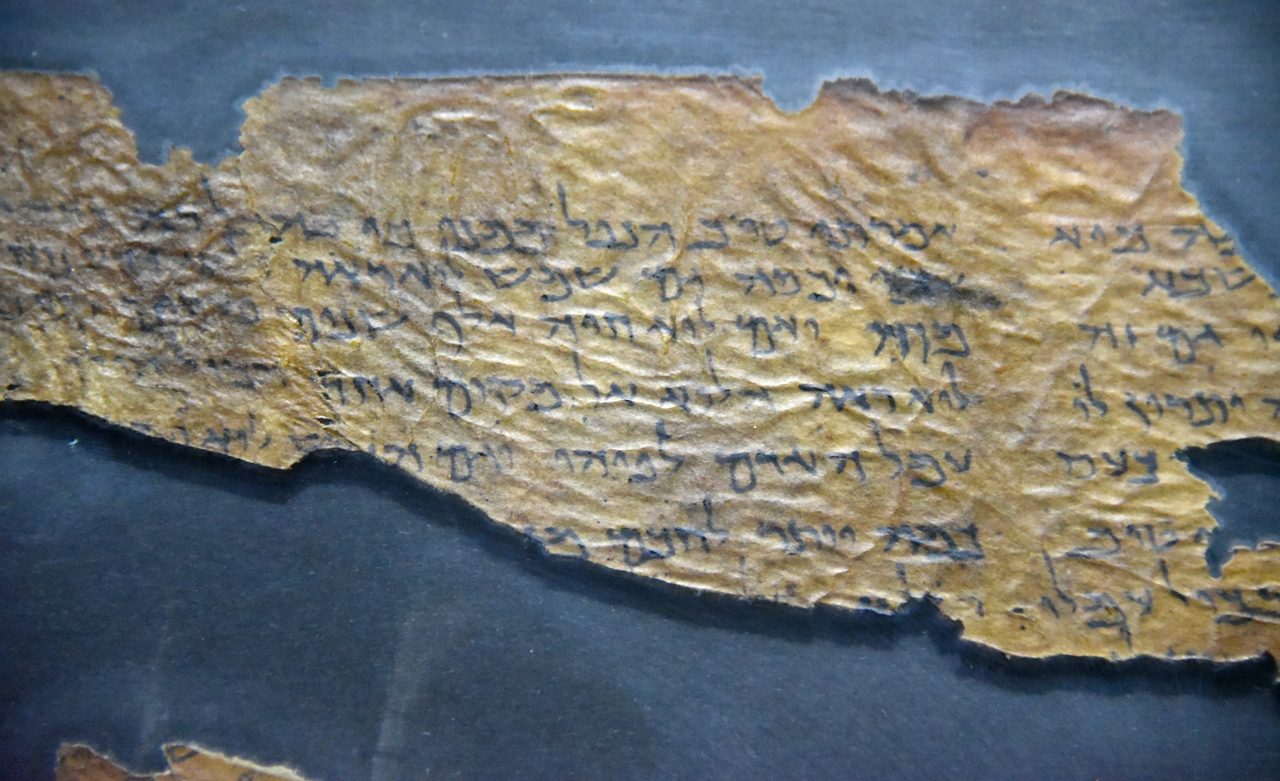
This is what the first row of the table above actually looks like in the hand: a fragment, not a scroll intact end to end. Most of the corpus is reconstructed from pieces like this one.
Excavations at Khirbet Qumran, carried out by Roland de Vaux between 1951 and 1956 and synthesized by Jodi Magness in 2002, revealed a settlement with communal facilities: a refectory, multiple ritual baths, the miqva'ot, a potters' workshop, an upper room containing writing tables and inkwells, and a cemetery of roughly 1,100 graves, predominantly adult males in the main section. Our companion file records the upper room as interpreted by some as a scriptorium, and that hedge stays where the file puts it, because a room with writing tables in it is evidence of writing, not proof of a manuscript workshop. The settlement dates from the late 2nd century BCE to 68 CE, when it was destroyed during the First Jewish Revolt. Paleographic and radiocarbon dating together confirm the scrolls span roughly 250 BCE to 68 CE, which is more than three centuries of text production rather than a single act of deposit. Cave 4 alone yielded fragments of roughly 580 manuscripts, the largest single cache, while Cave 1, the first found, yielded the best-preserved scrolls, including the Great Isaiah Scroll and the Community Rule.
03A Thousand Years Older Than Anything Else
The Great Isaiah Scroll, designated 1QIsa-a, is one of the original seven Cave 1 scrolls, and it is independently dated by radiocarbon analysis and paleography to approximately 125 BCE. That makes it roughly 1,000 years older than the previously known oldest complete Hebrew biblical manuscripts, which belonged to the medieval Masoretic tradition of the 10th century CE. It is also the most complete biblical manuscript recovered from the Judean Desert finds: about 734 cm long, which is roughly 24 feet, between 25.3 and 27 cm high, carrying 54 columns of text, and preserving the entire Book of Isaiah essentially intact apart from a few small damaged portions. Every other claim in this article could be argued about and this one would still stand, because it is a physical object with a laboratory date on it. Before 1947, the oldest complete Hebrew copy of a biblical book anyone could put on a table was medieval. After 1947, one of them was pre-Roman.
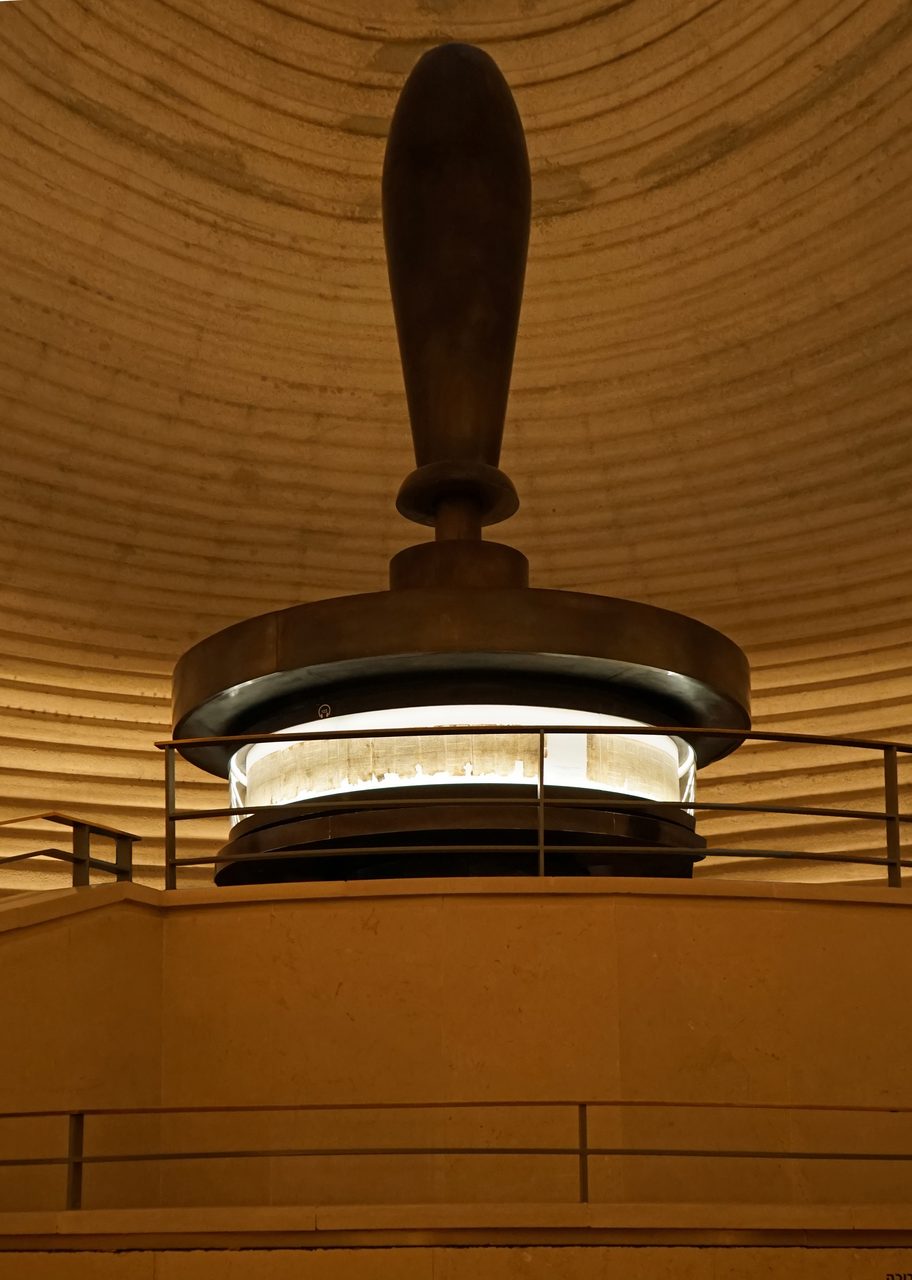
Facsimile or original, the display is built around the same 54-column, 24-foot scroll described above, wound open around the drum at the heart of the dome and lit behind glass. That is a museum's arrangement, not the state the find was in: what came out of the cave was wrapped in linen and packed inside jars.
One restraint belongs here, because the obvious next sentence is one this article will not write. It would be easy to move from a scroll that is a thousand years older to a statement about how closely its text matches the medieval text that followed it, in either direction: that the Hebrew Bible was transmitted unchanged for a millennium, or that the scrolls prove it was not. Our files supply no textual comparison at all, no variant counts, no collation, nothing on which either sentence could rest, so neither sentence appears here. What is established is the age and the completeness of the manuscript, and the age and completeness are already the remarkable part. A community that was destroyed in 68 CE left behind a copy of a book that was still being copied nineteen centuries later, and the physical evidence for the earlier end of that chain sat in a jar the entire time.
04The Library Of a Sect
The Qumran community identified itself in the Damascus Document, designated CD, as the Sons of Zadok, and it held the Jerusalem priesthood to be illegitimate on a specific genealogical ground: that a usurping Hasmonean priesthood had displaced the true Zadokite lineage descended from Aaron. The community also kept a 364-day solar calendar rather than the Temple's lunar calendar, and on that basis regarded Jerusalem's rituals as invalid, since a festival kept on the wrong day is not the festival. A founding figure called the Teacher of Righteousness is described as leading the community into the desert to preserve the true way until the End Times. What sits at Tier 1 here is the primary-text portion, meaning what these documents say about themselves; the interpretive extensions built on top of them sit at Tier 2, and the identity of the Teacher himself is genuinely unresolved and sits at Tier 3, in section 06.
The Community Rule, designated 1QS, at columns III to IV, sets out what is usually called the Two Spirits doctrine. God created two spirits to govern humanity, the Spirit of Truth and the Spirit of Falsehood, and every person is born carrying both of them in tension. The Spirit of Truth is led by the Prince of Light, identified with the archangel Michael; the Spirit of Falsehood is led by Belial, the Angel of Darkness. At the end of days God will destroy the Spirit of Falsehood and purify the world. Note where that doctrine locates the conflict. It is not only between the community and its enemies, which would be the ordinary sectarian move, but inside each member, which makes the community's own penal code in section 06 read less like discipline and more like a front line.
The War Scroll, designated 1QM, from Milhamah, meaning war, runs to 19 columns and is roughly 9 feet long. It lays out a detailed 40-year battle plan between the Sons of Light, meaning the community itself together with all the congregation of Israel and led by the angelic Prince of Light identified with Michael, and the Sons of Darkness, meaning the Kittim, understood as Rome, and other nations, led by the demonic figure Belial. The text specifies troop formations, weapon dimensions, inscribed banners, seven types of trumpet for tactical signals, and an alternating pattern of battle years and sabbatical rest years. Both human armies are backed by opposing supernatural forces, and the outcome, victory for the Sons of Light, is predetermined. The scroll is a military manual whose result is already known, which is a strange object to write and an even stranger one to keep, and it is one of the clearest windows the corpus offers onto what this community actually expected to happen.
The Songs of the Sabbath Sacrifice, designated 4Q400 to 407 with a second designation of 11Q17, and also called the Angelic Liturgy, comprise 13 songs corresponding to 13 Sabbaths, which is one quarter of a year. They offer the most detailed description of heavenly beings in any Dead Sea Scroll: a multi-chambered heavenly Temple, ranked angels performing structured liturgical worship, and, in the final songs, the divine chariot-throne, the Merkabah, matching Ezekiel's vision of a wheeled, multi-faced, living throne. Set that beside the 364-day solar calendar above and the two facts lock together. A community that rejected the Jerusalem Temple's timekeeping wrote a quarter-year cycle of songs about worship in a Temple that could not be desecrated, because it was not on the ground.
The Temple Scroll, correctly designated 11Q19, is the longest of the Dead Sea Scrolls at approximately 8.15 meters. It presents a detailed plan for an ideal Temple, and it is written in the first person as though God is speaking directly to Moses, in the form I, God, tell you. It describes a three-court Temple layout with specific measurements in cubits, extreme purity requirements, additional festivals not found in the canonical Torah, and strict limits on royal power that subordinate the king to priestly authority. That last provision is worth reading twice. Somewhere in the three centuries of text production these caves preserve, somebody wrote a constitution for a Temple that did not exist, and in it they put the king under the priest.
The Melchizedek Scroll, correctly designated 11Q13, presents Melchizedek as a heavenly figure of divine status, called Elohim, who will execute end-times judgment and vindicate the Sons of Light against Belial. Our primary file reads this as building on the brief and genealogy-free reference in Genesis 14, where Melchizedek appears as king of Salem, priest of God Most High, and it notes the later elaboration in Hebrews 7, which describes him as without father, without mother, without genealogy. Keep the tier on this one. That the scroll says what it says is not in doubt; what sits at Tier 2 is the developmental reading, the claim that this text is the hinge between a two-verse figure in Genesis and the fully cosmic Melchizedek of later tradition.
| The Scroll | Designation | What It Is | How This Is Carried Here |
|---|---|---|---|
| The Great Isaiah Scroll | 1QIsa-a | The most complete biblical manuscript from the Judean Desert finds: about 734 cm long, 54 columns, the Book of Isaiah essentially intact | Tier 1, independent checking. Dated by radiocarbon and paleography to approximately 125 BCE |
| The Community Rule | 1QS | The sect's own rule book: initiation, hierarchy, a penal code, and the Two Spirits doctrine at columns III to IV | Tier 1. Our primary file for the Two Spirits doctrine, our companion file for the initiation structure in section 06 |
| The Damascus Document | CD | The text in which the community calls itself the Sons of Zadok and rejects the Jerusalem priesthood as illegitimate | Tier 1 for what the text says about itself. The interpretive extensions built on it sit at Tier 2 |
| The War Scroll | 1QM | A 40-year battle plan between the Sons of Light and the Sons of Darkness, 19 columns and roughly 9 feet long | Tier 1, our primary file |
| The Temple Scroll | 11Q19 | The longest scroll, at approximately 8.15 meters: a plan for an ideal Temple, written as God speaking in the first person | Tier 1, our primary file. The designation here is corrected, see the note below this table |
| The Songs Of the Sabbath Sacrifice | 4Q400 to 407, and 11Q17 | Thirteen songs for thirteen Sabbaths, describing a multi-chambered heavenly Temple and the divine chariot-throne | Tier 1, our primary file. The second designation here is corrected, see the note below this table |
| The Melchizedek Scroll | 11Q13 | Melchizedek as a heavenly figure of divine status who executes end-times judgment against Belial | Tier 2, our primary file. The designation here is corrected, see the note below this table |
| The Copper Scroll | 3Q15 | The only Dead Sea Scroll inscribed on metal: 64 hiding places for gold, silver, vessels and priestly garments | Tier 1 for the object and its list, in section 05. Whether the treasure was real is Tier 3. The designation here is corrected, see the note below this table |
Four of those designations are corrected, and the correction belongs in the body rather than in a footnote, because a reader who opens our own primary file will find different numbers there. In A_2_04's text the Copper Scroll is labeled 3Q_3_03, the Temple Scroll 11Q_1_11, the Melchizedek Scroll 11Q_1_10, and the second designation of the Songs of the Sabbath Sacrifice 11Q_2_04. None of those is a real shelf mark. Every one of them has been reshaped into the pattern of this project's own internal document identifiers, a capital letter followed by underscored digits, which is the same pattern as the A_2_04 in this article's own case chip, and the most plausible explanation is an automated reformatting pass that mistook genuine scroll numbers for our own filing convention. The real designations were independently confirmed during the research pass: the Copper Scroll is 3Q15, the Temple Scroll is 11Q19, the Melchizedek Scroll is 11Q13, and the Songs of the Sabbath Sacrifice carries 11Q17. In every case the surrounding description of the scroll's material, contents and significance is intact and correct, so this is a labeling defect and not a factual one, but a wrong shelf mark is the kind of error that propagates silently, because it is exactly what a reader would copy into a catalogue search. The corrected forms are used throughout this article and the defect is logged for a corpus-hygiene pass.
One aside about the corpus's range, kept short deliberately, because it is the part of this material that most easily runs away with an article. Alongside the biblical and sectarian texts, the caves produced vividly strange apocalyptic and angelic works. The Aramaic Birth of Noah fragments, 4Q534 to 536, describe a child born with unusual physical traits and destined to know the secrets of all living things, and a parallel account in 1 Enoch 106 to 107 and the Genesis Apocryphon, 1QapGen, has Noah's father Lamech fear the child is not his own, an accusation his wife Bitenosh explicitly denies. The Book of Giants, an Aramaic text found across several caves, expands the Watcher and Nephilim narrative of 1 Enoch with named giant offspring, and it borrows Gilgamesh himself into the cast. Mainstream scholarship, per our primary file's own counter-argument section citing Fitzmyer, reads the Noah birth account as a conventional literary marker for a divinely chosen figure rather than a historical claim, and reads the Gilgamesh borrowing as Qumran scribes folding Mesopotamian epic into their own framework. That is as far as this article goes with it. Entity profiles for Watchers, Nephilim and giants are a separate subject with a separate scope, and this article is about a discovery and a library.
Our primary file also carries a table of cross-cultural and cross-corpus parallels, comparing the War Scroll's Belial with the biblical serpent tradition, Gnostic archon cosmology with the two-spirits doctrine, the Watcher tradition with Anunnaki material, Melchizedek's function with that of the Apkallu or Oannes figures, and the Temple Scroll's divine blueprint with the Sumerian concept of the ME. The file labels every one of them explicitly as a speculative interpretive connection, and this article does no more than record that they exist at that tier. The single useful thing they establish is genuine and modest: the Qumran texts sit inside a wider ancient Near Eastern conversation rather than in isolation. Developing any one of those five comparisons would mean writing a different article inside this one, and would borrow authority from a Tier 3 table to do it.
05The Copper Scroll, and Sixty-Four Empty Places
The Copper Scroll, correctly designated 3Q15, is the only Dead Sea Scroll inscribed on metal rather than parchment or papyrus: 99 percent copper and 1 percent tin. It was discovered in Cave 3 in 1952 and dates to roughly 50 to 100 CE. It runs about 2.4 meters, was rolled into two separate scroll sections, and had to be cut into 23 strips before scholars could read it. It is written in a distinctive Mishnaic-style Hebrew with occasional Greek letters used as codes, and it lists 64 hiding places, each described by landmarks and measurements, for enormous quantities of gold and silver, along with precious vessels and priestly garments, and at some locations a scroll. Our primary file's own figures for the totals are roughly 1,280 talents of gold and 3,282 talents of silver. It also offers a modern-currency estimate of over a billion dollars, which independent checking did not re-verify and which this article therefore carries as a rough, source-dependent estimate rather than a figure. Despite decades of searching, almost none of the listed treasure has ever been recovered.
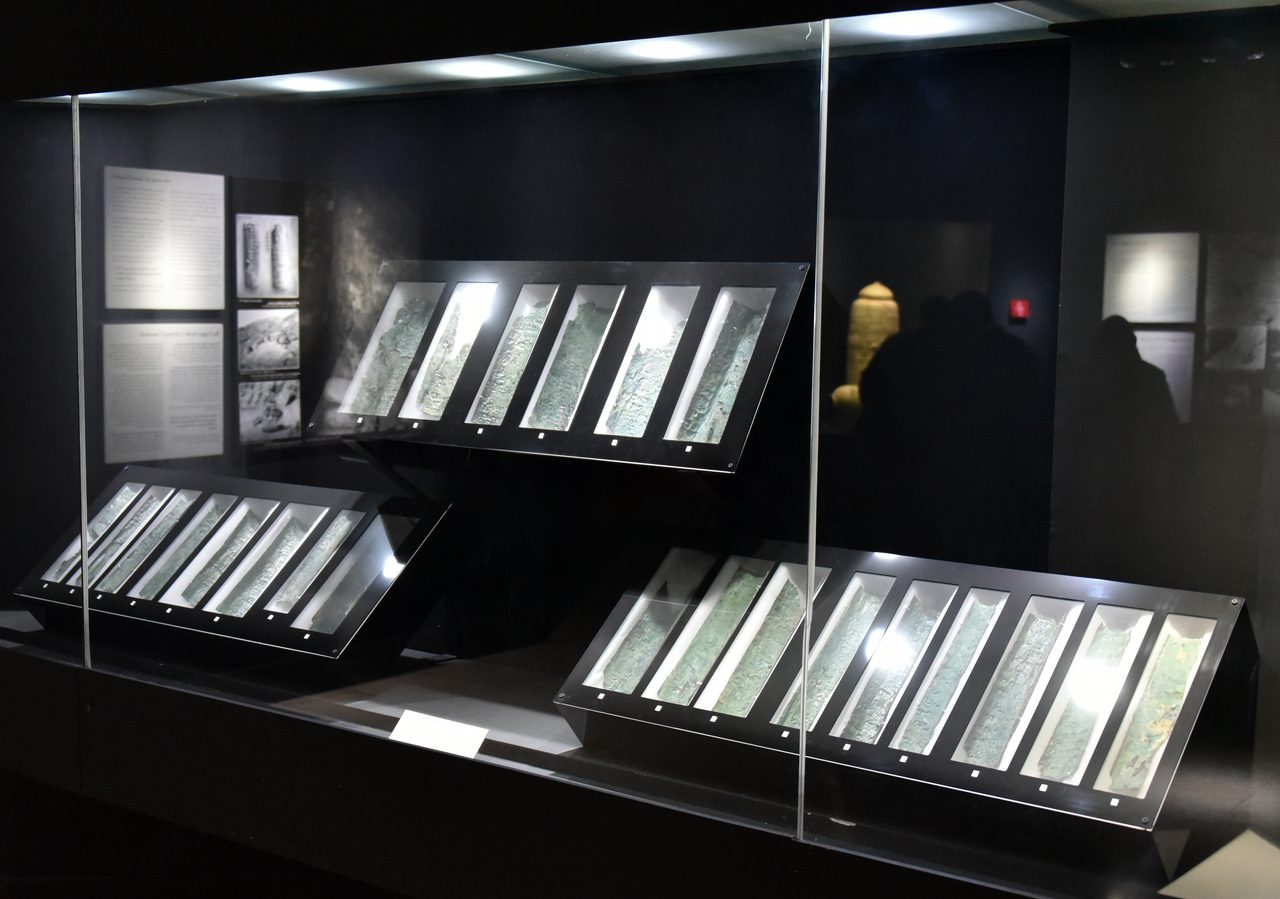
The searching has been real and repeated. Researcher John Allegro led expeditions looking for the Copper Scroll's listed treasure, including at Hyrcania, and found nothing. Researcher Vendyl Jones later claimed to have located associated incense residue near Qumran, but not the gold or the silver. Our primary file's leading explanation is that Roman forces looted the treasure during or shortly after the destruction of Jerusalem in 70 CE, which would account for the consistently empty hiding places despite repeated searches. That explanation carries at Tier 2 because it is a reconstruction rather than a finding, but notice how much it explains at once: a list written by people who expected somebody to come back, and an army that arrived first.
Whether the Copper Scroll's listed treasure was ever real remains unresolved, and physical verification is scarce. So does the further question of whether any of it derives from Solomon's First Temple, hidden before the Babylonian destruction of 586 BCE, as opposed to the Second Temple alone, hidden before 70 CE. A minority scholarly position holds that the scroll is a literary fantasy, a utopian list whose quantities are simply too large to be real. Our primary file flags that as the minority view and records that most scholars accept the scroll as a real, if unrecovered, record of hiding places. This article carries both readings at that weight and crowns neither, because an unexcavated list is compatible with a hoard that was taken and with a hoard that never existed. A defect in the source document sits at this exact spot, and it is described in the sources note below rather than passed along silently.
06Who Lived At Qumran?
The Essenes are not a modern reconstruction. Three independent classical authors describe them. Josephus, in Jewish War 2.119 to 161 and Antiquities 18.18 to 22, gives the most detailed account: roughly 4,000 Essenes living communally across Judea, holding property in common, practicing celibacy with one branch that married, requiring a three-year probation before full membership, performing ritual ablutions, wearing white garments, prohibiting oaths except the membership oath, engaging in prophetic study, and believing in the soul's immortality. Philo of Alexandria describes a similarly sized group, and a related group he calls the Therapeutae, living in villages, rejecting slavery, and practicing communal economics and allegorical scriptural interpretation. Pliny the Elder locates a celibate Essene community on the west side of the Dead Sea, which is a location matching Qumran. That last sentence carries the geography by itself, because Pliny is the only one of the three who ties the ancient descriptions to this particular shoreline. What he does not supply is any match in practice, and that comes from somewhere else entirely, the community's own rule book.
| The Witness | What He Reports | How This Is Carried Here |
|---|---|---|
| Josephus | Roughly 4,000 Essenes across Judea, communal property, celibacy with one marrying branch, a three-year probation, ritual ablutions, white garments, no oaths but the membership oath, prophetic study, and the soul's immortality | Tier 1, our companion file. The most detailed of the three, at Jewish War 2.119 to 161 and Antiquities 18.18 to 22 |
| Philo Of Alexandria | A similarly sized group living in villages, rejecting slavery, practicing communal economics and allegorical interpretation of scripture, plus a related group he calls the Therapeutae | Tier 1, our companion file. Independent of Josephus and broadly agreeing with him |
| Pliny the Elder | A celibate Essene community on the west side of the Dead Sea | Tier 1, our companion file. The only one of the three that puts the sect at a place matching Qumran, and therefore the whole of the identification's geography |
The Community Rule describes a structured initiation and hierarchy in detail. Prospective members were examined by the Guardian, the mebaqqer, and by the general membership, the Many, or rabim. Year one brought instruction with no access to communal meals; year two brought partial access; year three or beyond brought full membership, including the purity of the Many and access to the community's secret doctrine, the mystery of existence, raz nihyeh. Members swore an oath of secrecy binding them to Mosaic Torah and to concealing community teachings from outsiders, with expulsion as the penalty for violation. A council of 12 men and 3 priests governed the community, with an Instructor, the maskil, holding doctrinal authority. A detailed penal code specified graduated penalties, running from 10 days of reduced food rations for falling asleep in assembly up to permanent expulsion for blasphemy or for betraying community secrets. Compare that structure with Josephus's three-year probation in the table above. Pliny supplies the geography and nothing else; this is the other half, the match in practice, and on that side it is the strongest support the identification has. Neither half does the other's work.
Two live alternative theories challenge the Qumran-Essene hypothesis developed by Roland de Vaux, Frank Moore Cross and Geza Vermes, and both are carried here at their own strength rather than as speed bumps. Norman Golb argued in 1995 that the scrolls were a Jerusalem library hidden in the caves during the Roman siege, rather than the output of a resident sect, pointing to the diversity of handwriting across the corpus, which runs to hundreds of distinct scribal hands. Our companion file also states that theory's own difficulty: it does not explain the internally consistent sectarian ideology of documents like the Community Rule. Lawrence Schiffman argued in 1994 that the sectarian legal material reflects Sadducean rather than Essene positions, based on the halakhic disputes in the Miqsat Ma'ase ha-Torah, 4QMMT; most scholars read this as showing overlap between groups rather than as refuting the Essene identification outright. Our companion file's own summary is the one this article carries: the Qumran-Essene hypothesis remains the dominant scholarly position, but not an uncontested one.
| The Reading | Who Argues It | The Core Argument | How This Is Carried Here |
|---|---|---|---|
| The Qumran-Essene Hypothesis | Roland de Vaux, Frank Moore Cross, Geza Vermes | The settlement housed a resident sect and the sectarian scrolls are that sect's own library; Pliny places a celibate Essene community on this shore, and the Community Rule's initiation structure matches Josephus's three-year probation | The dominant scholarly position, carried at Tier 2 as an identification. Our primary file's own wording for the community is most plausibly the Essenes, and the hedge is kept |
| The Jerusalem Library Theory | Norman Golb, 1995 | The scrolls were a Jerusalem library hidden in the caves during the Roman siege rather than the product of a resident sect, since hundreds of distinct scribal hands are hard to explain from one small community | Tier 2, our companion file, with that file's stated difficulty attached: it does not explain the internally consistent sectarian ideology of documents like the Community Rule |
| Sadducean Authorship | Lawrence Schiffman, 1994 | The sectarian legal material reflects Sadducean rather than Essene positions, based on the halakhic disputes in Miqsat Ma'ase ha-Torah, 4QMMT | Tier 2, our companion file. Most scholars read this as showing overlap between groups rather than refuting the Essene identification outright |
The sectarian scrolls name a founding figure, the Teacher of Righteousness, the moreh ha-tsedeq, who was persecuted by a figure the texts call the Wicked Priest. Neither figure's historical identity is conclusively established. Proposed candidates for the Wicked Priest include several Hasmonean high priests, among them Jonathan Maccabee and Alexander Jannaeus, but none of the proposals commands scholarly consensus. This is worth sitting with rather than skipping past. The community that produced this library left a rule book, a battle plan, a hymn cycle, a calendar and a constitution, and it left no usable identification of the man it was founded by.
So how should a reader hold section 06 as a whole? Like this. The excavated settlement, the eleven caves, the ancient descriptions and the sectarian documents all exist and are Tier 1. The join between them, the sentence that says the people described by Pliny are the people who lived in that settlement and wrote those documents, is an inference, and it is a strong one that most of the field accepts and that two serious scholars have argued against on evidence rather than on contrarianism. Our primary file's own phrasing is most plausibly the Essenes, not certainly, and that is the phrasing this article keeps. A dominant hypothesis is not the same object as a settled fact, and the difference is exactly what a tier system exists to record.
07The Christianity Question
The parallels between Essene practice and early Christianity are genuine and specific: communal property, as in Acts 2:44 to 45; ritual purification by water; a communal meal carrying eschatological weight; a dualistic worldview of light against darkness, which invites comparison with the Gospel of John; and a belief in imminent divine judgment. What does not exist is a scholarly consensus on what those parallels mean. Three explanations are live: direct influence, which is the unproven claim that Jesus or John the Baptist were once Essenes; a shared Second Temple Jewish cultural milieu, in which both groups drew on the same available vocabulary; and independent development under similar conditions. Our companion file adds the constraint that decides how much weight any of them can bear. The scrolls themselves never mention Jesus, John the Baptist, or any identifiable early Christian figure.
No. Our companion file's own Tier 4 section states the claim and refuses it, and the refusal rests on two things rather than on distaste for the idea. The first is absence where presence would be expected: the scrolls do not mention Jesus at all, and a library whose keepers wrote down their own penal code in graduated detail is not a library that would have left no trace of him. The second is divergence in practice: Jesus's recorded ministry, with its engagement with sinners and tax collectors and its comparative indifference to ritual purity, runs against the Essene ethos as the three classical authors describe it, and against the graded purity and discipline the Qumran documents themselves set out. Neither ground depends on the identification in section 06 being settled, and that is worth saying plainly: the refusal holds whether or not the people who kept this library were Essenes. Be precise about what is being refused. The parallels in the block above are real and stay at Tier 2. What fails at Tier 4 is the specific biographical claim that a named individual was a member of this community.
08Forty Years, and the Day It Broke
For roughly 40 years after the discoveries, access to unpublished scroll fragments was controlled by a small international editorial team under a restrictive arrangement with the Israeli Department of Antiquities. It was a genuine and widely criticized scholarly bottleneck, described in contemporary press coverage as a Dead Sea Scrolls cartel, and it was a monopoly on access rather than a suppression conspiracy. Then, on September 22, 1991, the Huntington Library in California announced that it would grant unrestricted scholarly access to its own set of roughly 3,000 master photographic negatives of the scrolls, independent of the official editorial team's permission. Those negatives had been financed in 1980 by Elizabeth Hay Bechtel of the Ancient Biblical Manuscript Center and later entrusted to the library. Independent checking during the research pass traced the announcement through UPI's own archive of the day and through contemporary coverage in the Christian Science Monitor. The single announcement broke the forty-year access monopoly essentially overnight and opened the field to the wider scholarly community; full digitization and public online access followed in the decades after.
No. The claim that the Vatican suppressed publication of the scrolls to hide material damaging to Christianity is explicitly unsupported in our companion file's own Tier 4 section, and the reason is that the real causes of the delay are documented and sufficient. There was a small editorial team with an effective monopoly, there was academic politics, and there was the genuine, grinding difficulty of reconstructing thousands of fragments into manuscripts. That bottleneck was ended definitively by the Huntington Library's 1991 decision and by the full digitization that followed, and not by any later lifting of a suppression. Notice which way the evidence actually runs. The conspiracy version needs a hidden hand to explain a delay that is already fully explained by an ordinary and thoroughly recorded academic failure, and the delay ended when an outside institution decided it did not need the editorial team's permission.
Fast Facts
- The Find (Tier 1)
- Between late 1946 and early 1947 a Ta'amireh Bedouin shepherd, Muhammed edh-Dhib, with his cousin Jum'a Muhammed and Khalil Musa, threw a rock into a cave above Qumran and heard it strike pottery. Inside Cave 1 were tall clay jars holding leather scrolls wrapped in linen
- The Caves (Tier 1)
- Eleven caves near Khirbet Qumran, located and excavated between 1947 and 1956. Cave 4 alone yielded fragments of roughly 580 manuscripts, the largest single cache; Cave 1 yielded the best-preserved scrolls; Cave 7 yielded only Greek-language fragments
- The Corpus (Tier 1)
- More than 900 manuscripts, approximately 80 percent Hebrew, 15 percent Aramaic and 5 percent Greek, dating from roughly 250 BCE to 68 CE. Mostly parchment, some papyrus, and exactly one inscribed on copper
- The Count (Editorial Note)
- Our primary file says over 900, our companion file says approximately 930, and independent sources give figures from roughly 900 up to 981, because the difference is about what counts as one manuscript rather than about what was found. This article says more than 900 and gives no single precise number
- The Categories (Tier 1)
- Approximately 230 biblical manuscripts covering every book of the Hebrew Bible except Esther; approximately 100 or more apocryphal and pseudepigraphal works; approximately 100 or more sectarian texts; approximately 400 or more commentaries, hymns, calendrical documents and mystical or wisdom material
- The Oldest Bible (Tier 1)
- The Great Isaiah Scroll, 1QIsa-a, dated by radiocarbon and paleography to approximately 125 BCE, roughly 1,000 years older than the previously known oldest complete Hebrew biblical manuscripts of the 10th century CE Masoretic tradition. About 734 cm long, 25.3 to 27 cm high, 54 columns, the Book of Isaiah essentially intact
- The Settlement (Tier 1)
- Khirbet Qumran, excavated by Roland de Vaux from 1951 to 1956 and synthesized by Jodi Magness in 2002: a refectory, multiple ritual baths, a potters' workshop, an upper room with writing tables and inkwells interpreted by some as a scriptorium, and a cemetery of roughly 1,100 graves. Occupied from the late 2nd century BCE until its destruction in 68 CE during the First Jewish Revolt
- The Rule Book (Tier 1)
- The Community Rule, 1QS: examination by the Guardian, the mebaqqer, and by the Many, the rabim; instruction in year one, partial access in year two, full membership from year three; an oath of secrecy; a council of 12 men and 3 priests with an Instructor, the maskil, holding doctrinal authority; and a penal code running from 10 days of reduced rations for sleeping in assembly to permanent expulsion for betraying community secrets
- The Cosmology (Tier 1)
- The Two Spirits doctrine at 1QS columns III to IV: a Spirit of Truth under the Prince of Light, identified with Michael, and a Spirit of Falsehood under Belial, with both present in every person until God destroys the Spirit of Falsehood at the end of days
- The Calendar (Tier 1)
- A 364-day solar calendar rather than the Temple's lunar one, which is the specific ground on which the community, calling itself the Sons of Zadok in the Damascus Document, treated Jerusalem's rituals as invalid
- The War Plan (Tier 1)
- The War Scroll, 1QM: 19 columns, roughly 9 feet, a 40-year war between the Sons of Light and the Sons of Darkness, with troop formations, weapon dimensions, inscribed banners, seven types of trumpet, alternating battle and sabbatical years, and a predetermined outcome
- The Blueprint (Tier 1)
- The Temple Scroll, 11Q19, the longest at approximately 8.15 meters: an ideal three-court Temple in cubits, written in the first person as God speaking to Moses, with extreme purity requirements, extra festivals outside the canonical Torah, and the king subordinated to priestly authority
- The Angelic Liturgy (Tier 1)
- The Songs of the Sabbath Sacrifice, 4Q400 to 407 and 11Q17: 13 songs for 13 Sabbaths, a multi-chambered heavenly Temple, ranked angels, and the divine chariot-throne, the Merkabah, matching Ezekiel's vision
- The Metal Scroll (Tier 1)
- The Copper Scroll, 3Q15: 99 percent copper and 1 percent tin, found in Cave 3 in 1952, dated roughly 50 to 100 CE, about 2.4 meters, cut into 23 strips to be read, listing 64 hiding places for roughly 1,280 talents of gold and 3,282 talents of silver plus vessels and priestly garments. Almost none of it has ever been recovered
- The Ancient Witnesses (Tier 1)
- Josephus, at Jewish War 2.119 to 161 and Antiquities 18.18 to 22, describes roughly 4,000 Essenes with communal property and a three-year probation; Philo of Alexandria describes a similar group and the related Therapeutae; Pliny the Elder places a celibate Essene community on the west side of the Dead Sea, a location matching Qumran
- The Monopoly (Tier 1)
- About 40 years of restricted access under a small international editorial team, ended when the Huntington Library announced unrestricted scholarly access to its roughly 3,000 master photographic negatives on September 22, 1991. The negatives were financed in 1980 by Elizabeth Hay Bechtel of the Ancient Biblical Manuscript Center
- The Melchizedek Reading (Tier 2)
- 11Q13 presents Melchizedek as a heavenly figure of divine status, called Elohim, executing end-times judgment against Belial, developing the genealogy-free Genesis 14 reference to a king of Salem and priest of God Most High that Hebrews 7 later elaborates
- The Empty Hiding Places (Tier 2)
- John Allegro's expeditions, including at Hyrcania, found nothing; Vendyl Jones later claimed associated incense residue near Qumran but no gold or silver. One leading explanation is Roman looting during or shortly after the destruction of Jerusalem in 70 CE
- The Community Identification (Tier 2)
- The Qumran-Essene hypothesis of de Vaux, Cross and Vermes remains dominant but not uncontested. Norman Golb argued in 1995 for a Jerusalem library hidden during the Roman siege, citing hundreds of distinct scribal hands; Lawrence Schiffman argued in 1994 for Sadducean legal positions on the basis of 4QMMT
- The Treasure Itself (Tier 3)
- Whether the Copper Scroll's treasure was ever real is unresolved and physical verification is scarce, as is whether any of it came from Solomon's First Temple, hidden before 586 BCE, rather than the Second Temple alone. A minority position reads the scroll as a utopian literary list; most scholars accept it as a real record of hiding places
- The Founder (Tier 3)
- The Teacher of Righteousness, the moreh ha-tsedeq, and the Wicked Priest who persecuted him are named in the sectarian scrolls, but neither identity is conclusively established. Candidates for the Wicked Priest include Hasmonean high priests such as Jonathan Maccabee and Alexander Jannaeus, with no consensus
- The Jesus Claim (Tier 4)
- No. That Jesus of Nazareth was an Essene community member is contradicted by the total absence of any mention of Jesus in the scrolls and by the divergence between his recorded ministry and the Essene ethos. The genuine practice parallels with early Christianity remain at Tier 2 and are unaffected
- The Suppression Story (Tier 4)
- No. The Vatican did not suppress the scrolls. The 40-year delay is fully explained by an editorial team's monopoly, academic politics and the real difficulty of reconstructing thousands of fragments, and it ended with the Huntington Library's 1991 access decision and the digitization that followed
- The Designations (Not a Tiered Claim)
- Four scroll shelf marks are corrupted in our own primary file into a pattern resembling this project's internal document identifiers. Independently confirmed and used here: the Copper Scroll is 3Q15, the Temple Scroll is 11Q19, the Melchizedek Scroll is 11Q13, and the Songs of the Sabbath Sacrifice carries 11Q17
- The Bibliography (Not a Tiered Claim)
- Five of our primary file's ten DOI-bearing bibliography entries carry an identifier belonging to something other than the cited work, and all five of our companion file's do, two of them repeating the primary file's errors exactly. The two identifiers on the primary file's source list that check out are linked below; none of the wrong ones was carried into this article
What Is Settled Here, and What Is Not
Eleven caves near Khirbet Qumran, found and excavated between 1947 and 1956, produced more than 900 manuscripts, approximately 80 percent in Hebrew, 15 percent in Aramaic and 5 percent in Greek, dating from roughly 250 BCE to 68 CE, mostly on parchment with some papyrus and exactly one on copper. Cave 4 alone gave up fragments of roughly 580 manuscripts. Below the caves, Roland de Vaux's excavations from 1951 to 1956, synthesized by Jodi Magness in 2002, uncovered a settlement with a refectory, ritual baths, a potters' workshop, an upper room of writing tables and inkwells, and a cemetery of roughly 1,100 graves, occupied from the late 2nd century BCE until its destruction in 68 CE during the First Jewish Revolt. Paleography and radiocarbon dating agree on the span. None of that depends on any interpretation of who wrote what.
The corpus includes approximately 230 biblical manuscripts covering every book of the Hebrew Bible except Esther, and the Great Isaiah Scroll, 1QIsa-a, is dated by radiocarbon analysis and paleography to approximately 125 BCE. That is roughly 1,000 years older than the previously known oldest complete Hebrew biblical manuscripts, which came from the medieval Masoretic tradition of the 10th century CE. The scroll is about 734 cm long, between 25.3 and 27 cm high, carries 54 columns, and preserves the Book of Isaiah essentially intact apart from a few small damaged portions. What this verdict does not say, because our files supply no textual comparison on which to say it, is anything about how closely the Qumran text agrees with the medieval text. The age is established. The collation is not in evidence here.
The sectarian documents say what they say, and that is Tier 1 independently of who is judged to have written them. The Damascus Document has the community calling itself the Sons of Zadok and rejecting the Jerusalem priesthood as an illegitimate Hasmonean displacement of the Zadokite line, keeping a 364-day solar calendar against the Temple's lunar one. The Community Rule sets out the Two Spirits doctrine at columns III to IV, a three-year initiation, a council of 12 men and 3 priests, an oath of secrecy, and a penal code graduated from 10 days of reduced rations to permanent expulsion. The War Scroll lays out a 40-year war down to the trumpet signals. The Temple Scroll, 11Q19, gives an ideal Temple in cubits with the king subordinated to the priesthood. The Songs of the Sabbath Sacrifice, 4Q400 to 407 and 11Q17, give 13 songs for 13 Sabbaths and a heavenly chariot-throne. The Copper Scroll, 3Q15, lists 64 hiding places on hammered metal.
For roughly 40 years, access to unpublished fragments ran through a small international editorial team under a restrictive arrangement with the Israeli Department of Antiquities, criticized at the time in the press as a cartel. On September 22, 1991 the Huntington Library in California announced unrestricted scholarly access to its own roughly 3,000 master photographic negatives, financed in 1980 by Elizabeth Hay Bechtel of the Ancient Biblical Manuscript Center, without the editorial team's permission. The monopoly ended essentially overnight, and full digitization and public online access followed in the decades after. This is the honest version of a story that is usually told with a villain in it, and it is worth stating in exactly this shape: the delay was real, the criticism was fair, the cause was academic rather than clerical, and the fix came from an institution that simply declined to keep honoring the arrangement.
Three independent classical authors describe the Essenes, and one of them, Pliny the Elder, places a celibate Essene community on the west side of the Dead Sea, a location matching Qumran. Josephus's three-year probation matches the Community Rule's own initiation grades, and his report that the sect swore no oaths but the oath of membership matches the rule book's own binding oath of secrecy. Our primary file's phrasing is most plausibly the Essenes, and that hedge is kept here rather than quietly upgraded, because two serious alternatives are live in our companion file. Norman Golb's 1995 Jerusalem-library theory rests on the hundreds of distinct scribal hands across the corpus, which are hard to account for from one small resident community, though it does not explain the internally consistent sectarian ideology of the Community Rule. Lawrence Schiffman's 1994 argument from 4QMMT reads the legal material as Sadducean, which most scholars take as evidence of overlap between groups rather than as a refutation. The dominant hypothesis is dominant. It is not closed.
Communal property as in Acts 2:44 to 45, ritual purification by water, a communal meal with eschatological weight, a light-against-darkness dualism inviting comparison with the Gospel of John, and belief in imminent divine judgment are all genuine points of contact between Essene practice and early Christianity. What is not established is which explanation accounts for them: direct influence, a shared Second Temple Jewish milieu, or independent development under similar conditions. The constraint that keeps this at Tier 2 rather than higher is stated in our companion file itself. The scrolls never mention Jesus, John the Baptist, or any identifiable early Christian figure. Also at this tier: Roman looting after the destruction of Jerusalem in 70 CE as one leading explanation for the Copper Scroll's empty hiding places, and the reading of 11Q13's Melchizedek as the development from a two-verse Genesis figure into a judge of the world.
Two things stay genuinely open. Whether the Copper Scroll's listed treasure was ever real is unresolved, physical verification is scarce, and whether any of it derives from Solomon's First Temple, hidden before the Babylonian destruction of 586 BCE, rather than from the Second Temple alone, is unresolved with it; a minority scholarly position reads the whole list as a utopian literary fantasy whose quantities are too large to be real, while most scholars accept it as a real record of hiding places. And the Teacher of Righteousness, together with the Wicked Priest who persecuted him, has no established historical identity; candidates for the Wicked Priest include Hasmonean high priests such as Jonathan Maccabee and Alexander Jannaeus, and none commands consensus. Our primary file's table of wider ancient Near Eastern parallels sits at this tier too, named in section 04 and deliberately not developed. Speculative here means proposed and unconfirmed, not refuted.
No. The claim is explicitly unsupported in our companion file's own Tier 4 section, on two grounds. The scrolls contain no mention of Jesus at all, and Jesus's recorded ministry, with its engagement with sinners and tax collectors and its comparative indifference to ritual purity, diverges from the Essene ethos as the three classical authors describe it and from the graded purity and discipline the Qumran documents themselves set out. Neither ground needs the Essene identification settled in order to hold. The refusal is narrow and should stay narrow. The practice parallels between Essene life and early Christianity are real, and they remain above at Tier 2 with their cause unsettled. What fails here is the biographical leap from a shared religious vocabulary to a membership roll.
No. The claim that the Vatican suppressed publication to conceal material damaging to Christianity is contradicted by the documented causes of the actual delay: a small editorial team's effective monopoly on access, academic politics, and the real difficulty of reconstructing thousands of fragments into manuscripts. The bottleneck was ended by the Huntington Library's announcement of September 22, 1991 and by the digitization that followed, not by any suppression being lifted. The distinction matters more than it might look. There was a genuine scandal here, and it is the one this article carries at Tier 1: a forty-year restriction on scholarly access that deserved every criticism it got. Replacing a real institutional failure with an invented one is not a stronger accusation. It is a weaker one, and it lets the real one off.
So here is the honest shape of the two files. Eleven caves above a ruined settlement held more than 900 manuscripts that had been in the dark since the First Jewish Revolt, and among them was a copy of Isaiah written around 125 BCE, roughly a thousand years older than anything comparable that survived above ground. The community that left them wrote down its own rules, its own calendar, its own war, its own Temple and its own hymns, and it did not write down the name of the man who founded it. The identification of that community as Essene is the strongest reading available, supported by three ancient authors and by a rule book that matches what one of them describes, and it is still a reading, with two serious alternatives standing beside it. The treasure list on hammered copper remains almost entirely unrecovered. And the scandal in the story is not the one usually told: no church hid these texts, but a small editorial team held them for forty years, until a library in California opened its own set of photographs to anyone who wanted to study them, and the field opened in a day. That last fact is the one worth carrying out of the article, because it is not really about 1991. The scrolls waited nineteen centuries in a jar and then another forty years in a filing system, and only the second of those two was anybody's fault. How much else has already been found, and is simply not yet in the hands of the people who would recognize what it says?
Sources & further reading
Two corpus files were read in full for this article. The primary file is A_2_04, Dead Sea Scrolls Expanded, whose own header rates it Tier 1, well-documented and peer-reviewed, at High confidence, with a source confidence of 4 out of 5, a weighted score of 32, and 16 bibliography entries, which is the figure in the source count above. Its Last Updated field could not be reported, because the field is garbled in the file itself: it reads as two dates fused together with no separator, most plausibly an ISO date that a later edit partially overwrote with a second date format without removing the first, and neither component was independently confirmable during the research pass, so it is flagged here rather than guessed at. The companion file is N_1_09, The Essenes: Qumran Community and Secret Knowledge, with thirteen bibliography entries, and it is the wing blueprint's own listed secondary document for this article. Its four tier sections, its counter-arguments and its bibliography were all read. Where the text above says our primary file it means A_2_04 and nothing else; where it says the companion file it means N_1_09. Beyond the files, an independent verification pass was run against the most load-bearing narrative and dated claims, and its results are marked where they appear above rather than blended in. Checked and confirmed, or added, by that pass: the 1947 discovery story with its named participants, Muhammed edh-Dhib, Jum'a Muhammed and Khalil Musa, and the sale of scrolls through the Bethlehem dealer Khalil Iskander Shahin, known as Kando, corroborated across the Biblical Archaeology Society, deadseascrolls.org.il and the Center for Online Judaic Studies; the 1947 to 1954 chain of acquisition, from Eleazar Sukenik's bus journey on November 29, 1947 through Mar Athanasius Yeshue Samuel's Wall Street Journal advertisement of June 1954 to Yigael Yadin's purchase through an intermediary on June 1, 1954, cross-checked between the Biblical Archaeology Society's own timeline and The Jewish Link; the Great Isaiah Scroll's radiocarbon and paleographic date of approximately 125 BCE and its physical dimensions of about 734 cm and 54 columns, cross-checked across multiple independent secondary sources; and the Huntington Library's announcement of September 22, 1991, traced through UPI's archive of that date and contemporary coverage in the Christian Science Monitor. Now the corpus housekeeping, which belongs here rather than being passed along quietly. Four defects were found in the source documents during the research pass and none of them was carried forward into this article. The first is the one this article corrects in its own body text, because it would otherwise mislead a reader who went looking. Four scroll shelf marks in A_2_04's text have been reshaped into a pattern resembling this project's own internal document identifiers: the Copper Scroll appears as 3Q_3_03, the Temple Scroll as 11Q_1_11, the Melchizedek Scroll as 11Q_1_10, and the second designation of the Songs of the Sabbath Sacrifice as 11Q_2_04. The corrupted Copper Scroll form recurs in the file's own bibliography, in the title of Lefkovits's re-evaluation of that scroll. The real designations, independently confirmed during the research pass, are 3Q15, 11Q19, 11Q13 and 11Q17, and those are the forms used throughout this article. In every case the file's surrounding description of the scroll's material and contents is intact and correct, so this is a labeling defect rather than a factual one, and the most plausible cause is an automated identifier-reformatting pass that mistook real catalogue numbers for our own filing convention. The second defect is the identifier problem this pipeline keeps finding, at an unusually severe rate here. Five of the primary file's ten DOI-bearing bibliography entries carry an identifier that belongs to something other than the cited work, and all five of the companion file's do. In the primary file, five of ten are wrong: Vermes's The Complete Dead Sea Scrolls in English, Penguin, 1997 and revised 2004, carries an identifier that resolves to James VanderKam's 1996 review of that same book in Dead Sea Discoveries; VanderKam's own The Dead Sea Scrolls Today, Eerdmans, 1994 and revised 2010, carries one that resolves to Paul Foster's review in The Expository Times; Wise, Abegg and Cook's The Dead Sea Scrolls: A New Translation, HarperSanFrancisco, 1996, carries one that resolves to F. V. Greifenhagen's multi-book review in Studies in Religion; Fitzmyer's The Genesis Apocryphon of Qumran Cave 1, Pontifical Biblical Institute, 1966 and revised 2004, carries one that resolves to Vinzenz Hamp's 1968 review in Biblische Zeitschrift; and Schiffman's Reclaiming the Dead Sea Scrolls, Jewish Publication Society, 1994, carries one that is worse than a review swap, since it resolves to a different work entirely by the same author, his Dead Sea Scrolls entry in Oxford Bibliographies in Jewish Studies. In the companion file, all five DOI-bearing entries are wrong. Two of them repeat the primary file's errors exactly, on Vermes and on VanderKam. Magness's The Archaeology of Qumran and the Dead Sea Scrolls, Eerdmans, 2002, carries one that resolves to Yizhar Hirschfeld's review in the Journal of Roman Archaeology, and Cross's The Ancient Library of Qumran, Sheffield Academic Press, third edition 1995, carries one that resolves to James R. Davila's review in Biblical Interpretation. The most severe instance sits on de Vaux's Archaeology and the Dead Sea Scrolls, Oxford University Press, 1973, whose identifier resolves to a wholly unrelated work by a different author, Jodi Magness's own encyclopedia entry on the archaeology of Qumran, rather than to de Vaux's book at all. Every one of those works is named here by title, publisher and year, and none of them is linked, because a reader following those identifiers today would land on a short review or on somebody else's article. Two identifiers on the primary file's own source list were checked and found correct, and both are linked below: Garcia Martinez and Tigchelaar's two-volume Study Edition and Newsom's critical edition of the Songs of the Sabbath Sacrifice. Stuckenbruck's The Book of Giants from Qumran, Mohr Siebeck, 1997, carries no DOI, and its ISBN was independently confirmed as correct against title, author, publisher and year. The third defect is formatting rather than fact: three bibliography rows in the primary file have their citation fields shuffled across columns, most visibly in a 1980 review by VanderKam of a volume by J. T. Milik, where the reviewed author's name is scattered in fragments across unrelated columns, and in a review by S. Ausin whose subtitle bleeds across several fields. In each case the underlying citation is genuine and its identifier was confirmed correct; only the presentation is broken. The fourth defect is a text-integrity one, and it sits at exactly the point in the primary file where the Copper Scroll's Tier 3 material ends: a source-confidence bracket tag is cut off mid-token and merged with no line break into the next section's heading, and that heading's own title is duplicated and garbled. The claim carried in section 05 above is otherwise intact and unaffected. A fifth, milder discrepancy is recorded without alarm: the primary file's header cross-reference list and its footer cross-reference table do not match, with one document appearing only in the header and another only in the footer. Both are real files on disk, and the footer's entry is the one the file's own body text actually uses, so this reads as a stale header line rather than a broken link. Two scoping notes explain what this article deliberately does not attempt. The Watchers, the Nephilim, the Book of Giants and the Birth of Noah fragments are genuinely present in the corpus and are described in a single short paragraph in section 04, because the range of what these caves held is a real fact about them; entity profiles for those beings belong to a separate pool with its own scope, and this article is about a discovery and a library, not a bestiary. And the primary file's Tier 3 table of cross-cultural parallels, comparing the Qumran material with Gnostic, Mesopotamian and Sumerian traditions, is named at its own tier in section 04 and left undeveloped, because each of those comparisons is another article's subject and none of them would be strengthened by being borrowed into this one. The files' other named sources, none of them linked here, include Yadin's three-volume The Temple Scroll, Israel Exploration Society, 1983; Allegro's The Treasure of the Copper Scroll, Doubleday, 1960; Josephus's Jewish War in the Williamson translation and Philo's Quod Omnis Probus Liber Sit in the Colson translation; Golb's Who Wrote the Dead Sea Scrolls?; Collins's Beyond the Qumran Community; Stegemann's The Library of Qumran; and Dimant and Rappaport's The Dead Sea Scrolls: Forty Years of Research. Open the full files to check the sourcing and go deeper.
Image credits
- Exterior of the Shrine of the Book, Israel Museum, Jerusalem Bahnfrend, via Wikimedia Commons (CC BY-SA 4.0). CC BY-SA 4.0 Source.
- Dead Sea Scroll storage jars, Jordan Museum, Amman Osama Shukir Muhammed Amin FRCP(Glasg), via Wikimedia Commons (CC BY-SA 4.0). CC BY-SA 4.0 Source.
- Khirbet Qumran cliffs, viewed westward A. Sobkowski, via Wikimedia Commons (CC BY-SA 3.0). CC BY-SA 3.0 Source.
- Fragment of 4Q109, Qohelet (Ecclesiastes), Qumran Cave 4 Osama Shukir Muhammed Amin FRCP(Glasg), via Wikimedia Commons (CC BY-SA 4.0). CC BY-SA 4.0 Source.
- The Great Isaiah Scroll on display, Shrine of the Book Dennis G. Jarvis, via Wikimedia Commons (CC BY-SA 2.0). CC BY-SA 2.0 Source.
- The Copper Scroll's cut strips, Jordan Museum, Amman Osama Shukir Muhammed Amin FRCP(Glasg), via Wikimedia Commons (CC BY-SA 4.0). CC BY-SA 4.0 Source.
.jpg)


