
Dark Matter and Dark Energy: The Missing Ninety-Five Percent
Add up everything we can see, every star, every planet, every glowing cloud of gas, and you have accounted for about five percent of the universe. The other ninety-five percent is dark: it gives off no light, and we know it is there only because we can feel its gravity. Roughly a quarter of the cosmos is dark matter, an unseen substance whose pull holds galaxies together; the remaining two-thirds is dark energy, a stranger thing still, pushing the universe apart faster and faster. Six independent lines of evidence agree, beyond serious doubt, that both are real. And after ninety years of looking, we still do not know what either one actually is. This is what the evidence proves, what the leading ideas are, and exactly how far honesty will let us go.
Look up on a clear night and everything you can see, every star, the glowing band of the Milky Way, the faint smudges of other galaxies, is part of the ordinary matter that makes up you, this planet, and the air you breathe. It is also, as best we can measure, about five percent of what the universe is made of. The other ninety-five percent is dark, in the plain sense that it emits no light of any kind; we know it is there only because we can feel its gravity shaping everything we can see. About a quarter of the cosmos appears to be dark matter, an unseen substance whose gravity holds galaxies together and builds the scaffolding on which they hang. The remaining two-thirds is dark energy, a stranger thing still, a property of empty space that is pushing the universe apart faster and faster. The evidence that both exist is overwhelming and comes from six completely independent directions. The evidence for what either one actually is amounts, after ninety years of searching, to almost nothing. Holding those two facts together, the certainty and the ignorance, is the whole honest story.
01The Six Lines of Evidence

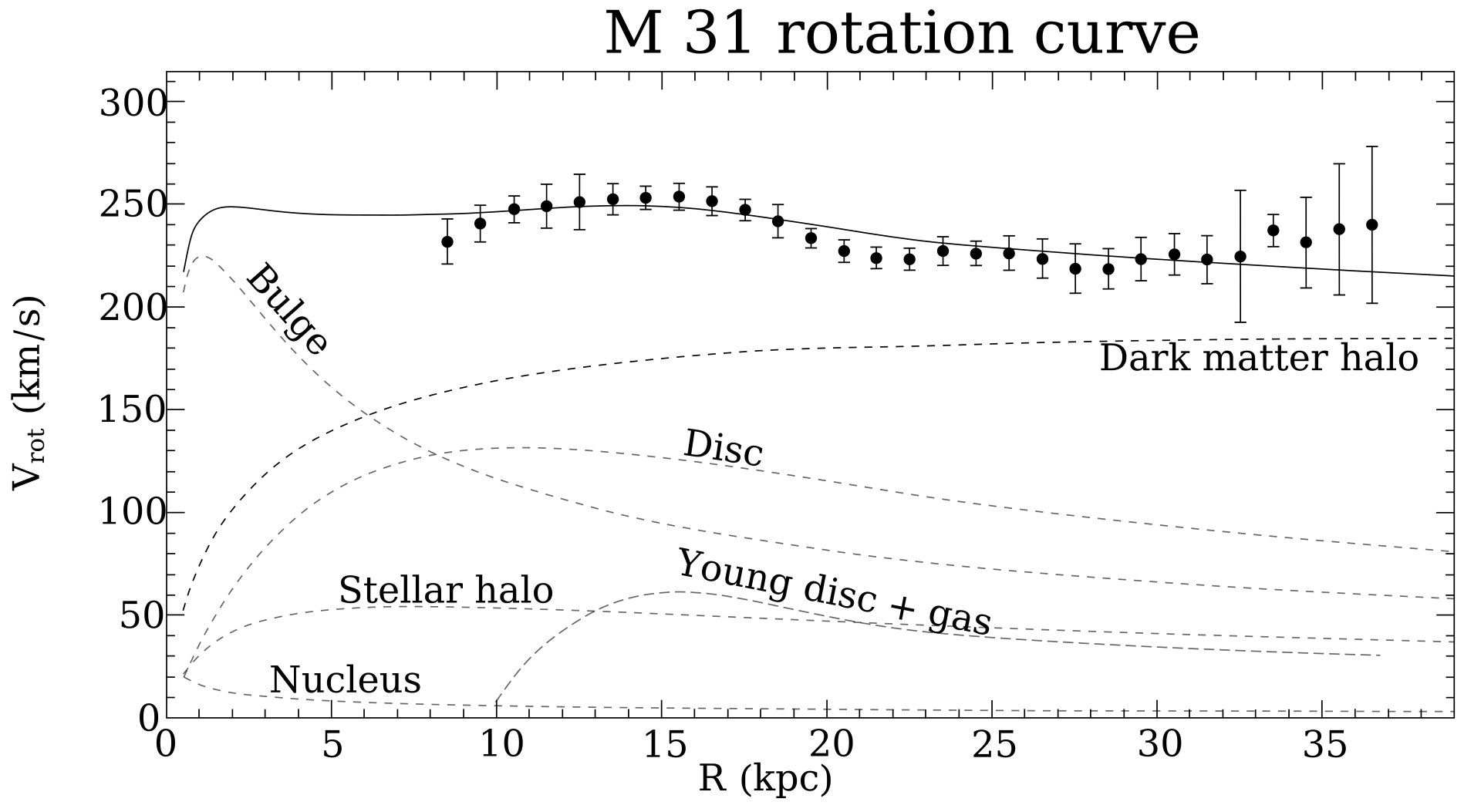
The case for dark matter did not come from one clever observation but from six, each using different physics and different instruments, all arriving at the same answer. The first came in 1933, when the Swiss astronomer Fritz Zwicky measured how fast galaxies were moving inside the Coma Cluster and found them racing far too quickly for the cluster's visible mass to hold them; by his estimate there had to be hundreds of times more unseen mass than seen. He called it 'dunkle Materie,' dark matter, and for decades almost no one followed up. The second line arrived in the 1970s, when Vera Rubin and Kent Ford measured how stars orbit within spiral galaxies, Andromeda among them, and found that stars near the edge move just as fast as those near the center, when the visible matter says they should slow down. That flat 'rotation curve' requires each galaxy to sit inside a vast halo of invisible mass, five to ten times the visible amount. The other four lines are independent again: gravitational lensing, the bending of light by mass, weighs galaxy clusters and keeps finding far more gravity than light; the pattern of ripples in the cosmic microwave background, the afterglow of the Big Bang, fixes the amount of dark matter precisely; the abundances of the lightest chemical elements, forged in the first minutes after the Big Bang, limit ordinary matter to about five percent of the total; and computer simulations of how galaxies gather into the vast 'cosmic web' match the real universe only when dark matter is included. Six methods, six kinds of data, one answer.
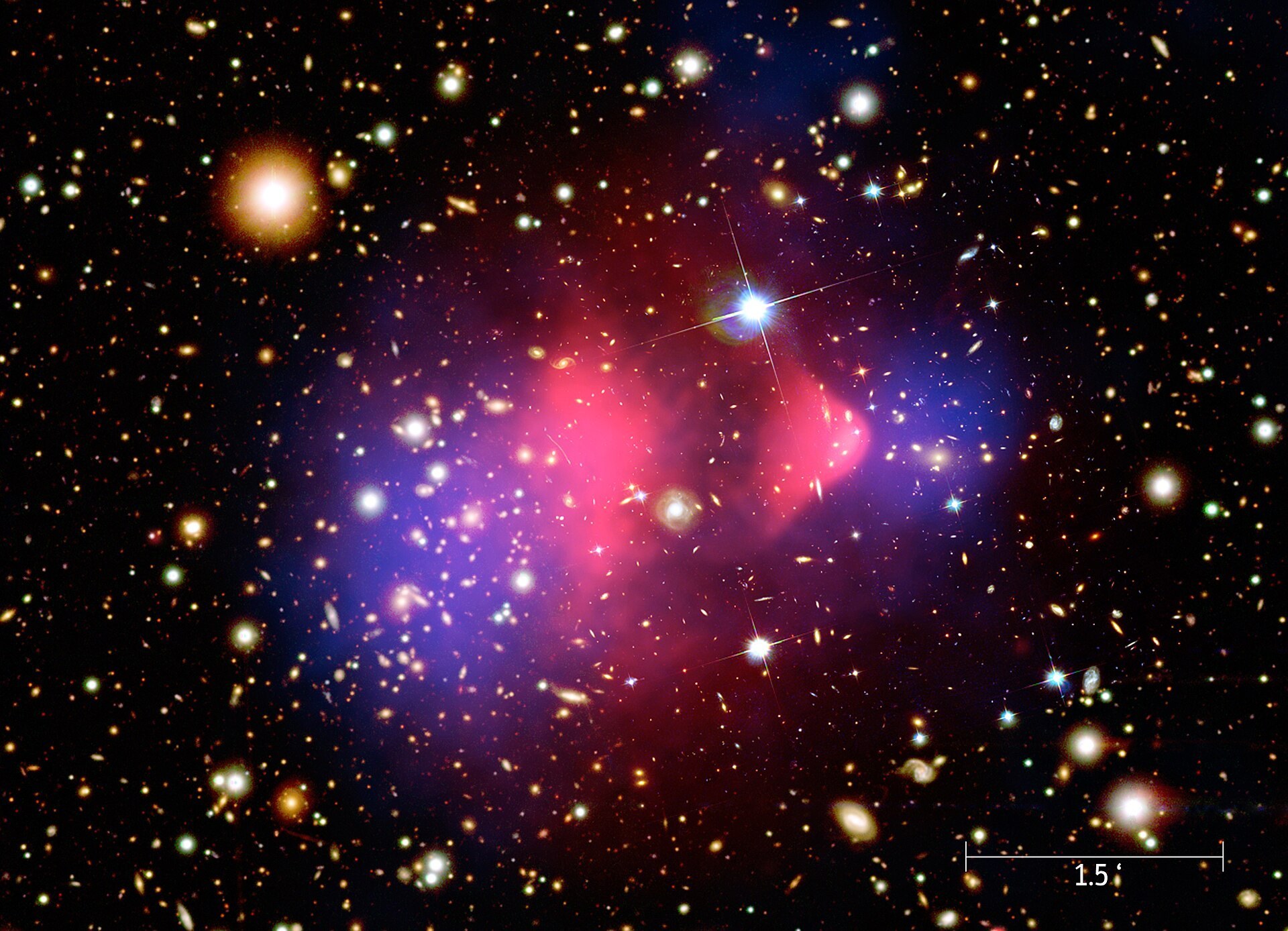
One of those six deserves singling out, because it answers the obvious objection most directly. If galaxies and clusters merely seem to have too little visible mass, perhaps our law of gravity is simply wrong on the largest scales, and there is no dark matter at all. The Bullet Cluster, shown at the top of this page, is the cleanest evidence against that idea. It is the wreckage of two galaxy clusters that smashed through each other. When they collided, their enormous clouds of hot gas, which is where most of the ordinary matter actually is, crashed together and were slowed and stripped out, left glowing in X-rays in the middle of the wreck (shown in pink). But the bulk of the gravity, mapped independently by how the collision bends the light of galaxies far behind it, did not stay with the gas: it passed straight on through, split into two clumps offset from the gas (shown in blue). Most of the mass and most of the visible matter ended up in different places. A mere adjustment to the law of gravity cannot easily produce that separation; a substance that slips through itself and everything else, feeling only gravity, produces it naturally. This is why the Bullet Cluster is so often called the closest thing we have to a direct proof that dark matter is a real, separate thing.
02The Cosmic Census
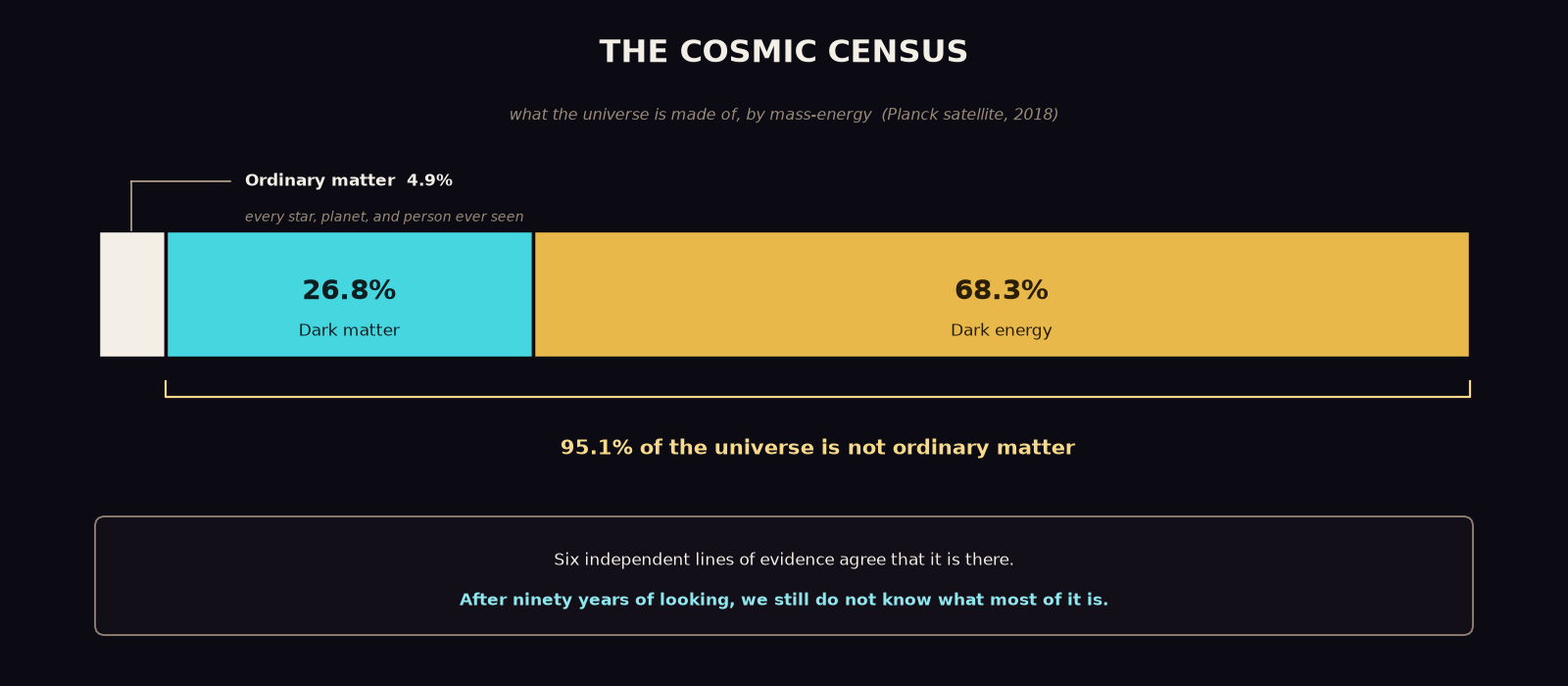
Put all six measurements together and you can take an actual census of the universe. The most precise version comes from the European Space Agency's Planck satellite, which mapped the microwave afterglow of the Big Bang in exquisite detail: about 4.9 percent ordinary matter, about 26.8 percent dark matter, and about 68.3 percent dark energy. Ordinary matter, the whole periodic table, every star and planet and living thing, is the smallest slice by far. The same body of evidence also tells us a great deal about what dark matter is not, even as it leaves what it is wide open. It cannot be ordinary matter hiding as dim stars or cold gas, because the light-element abundances cap ordinary matter at roughly five percent. It must be 'cold,' moving slowly in the early universe, or galaxies would never have clumped the way they did, which rules out familiar fast, light particles such as ordinary neutrinos as the main ingredient. It must be electrically neutral, since it neither emits nor blocks light. It must be effectively collisionless, as the Bullet Cluster shows, passing through itself untouched. And it must be stable, still present 13.8 billion years on. Something specific and abundant satisfies every one of those constraints. We simply have not caught it.
03What Dark Matter Might Be
So what is it? The honest answer is that nobody knows, though there is no shortage of serious candidates. For decades the front-runner was the WIMP, a Weakly Interacting Massive Particle: a heavy, sluggish particle that would feel only gravity and the weak nuclear force. WIMPs were compelling because a particle of roughly the right mass would, through simple early-universe physics, naturally end up in about the observed amount, a coincidence nicknamed the 'WIMP miracle.' Yet three decades of ever more sensitive underground detectors, LUX, XENON, LZ, PandaX, have found nothing, and the Large Hadron Collider has not turned up the particles that would support the idea either. WIMPs are not ruled out, but the mood has cooled enough that physicists now speak of a 'WIMP winter,' and the detailed hunt is a story of its own, told in this wing's article on the dark matter search. Other candidates remain wide open: the axion, a feather-light particle first proposed to fix an unrelated puzzle in the physics of quarks, which happens to fit dark matter's requirements and is now being chased by experiments such as ADMX; and the sterile neutrino, a heavier, more reclusive cousin of the ordinary neutrino. A different school of thought abandons the idea of a new particle entirely. Modified Newtonian Dynamics, or MOND, proposed by Mordehai Milgrom in 1983, suggests that gravity itself behaves differently at the very low accelerations found in a galaxy's outskirts. MOND is genuinely, and awkwardly for the standard picture, good at predicting galaxy rotation curves from the visible matter alone, in some ways better than dark-matter models that must be fitted galaxy by galaxy; a tight empirical pattern called the radial acceleration relation is exactly what MOND predicts, and it remains a real, unexplained puzzle. But MOND has a decisive gap: on its own it cannot account for the Bullet Cluster, the cosmic microwave background, or the growth of large-scale structure without quietly adding some invisible mass back in, which defeats its own purpose. It is a legitimate minority position and a standing challenge, not a replacement, and it too has a fuller reckoning of its own elsewhere in this wing. Further ideas sit at the edges, primordial black holes formed in the universe's first instants (which the evidence allows to be, at most, a fraction of the total) and tweaks to dark matter's own properties to smooth over mismatches at the scale of dwarf galaxies. None is confirmed. All that is certain is the gravity.
04The Deeper Mystery: Dark Energy
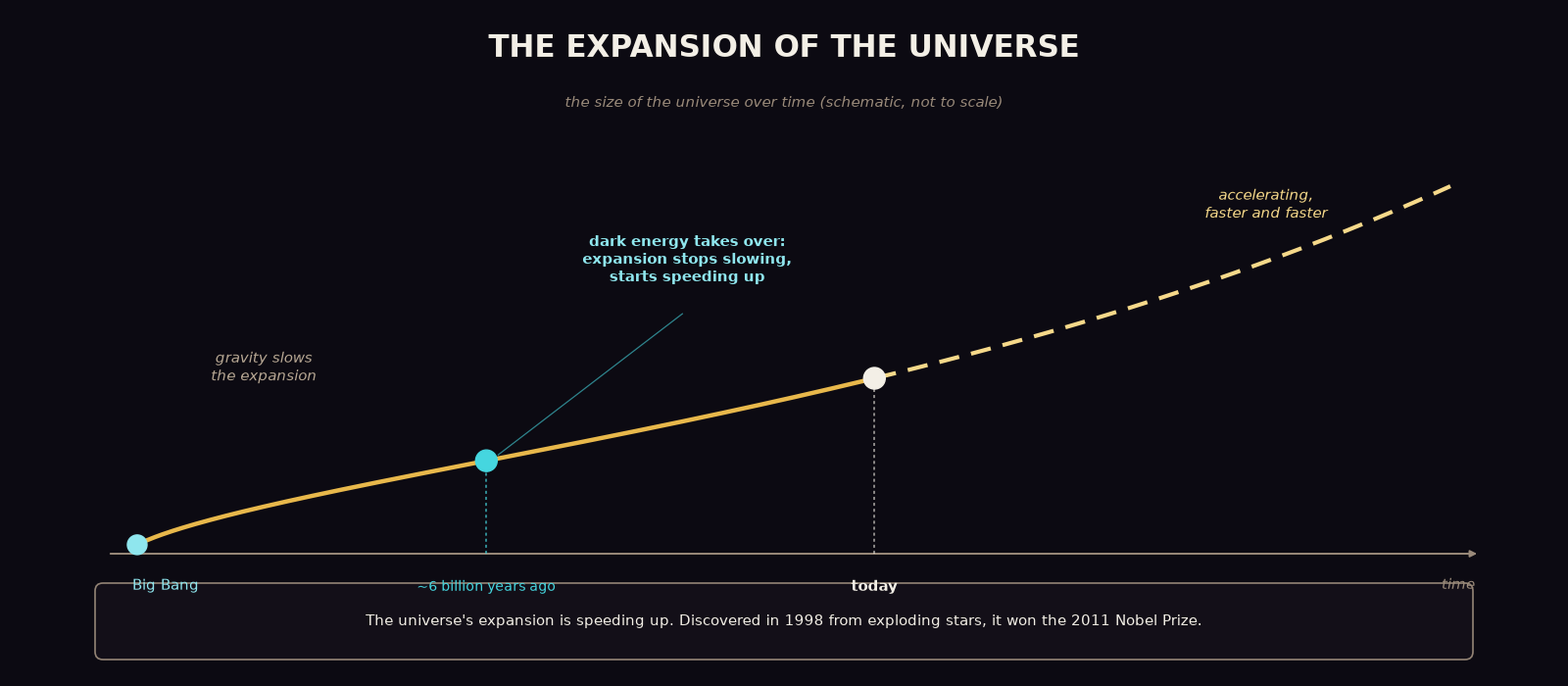
If dark matter is mysterious, dark energy is stranger by an order of magnitude. Its discovery came in 1998, when two rival teams, one led by Saul Perlmutter, the other by Adam Riess and Brian Schmidt, measured the distances to exploding stars called Type Ia supernovae, which serve as 'standard candles' of known intrinsic brightness. They expected to measure how fast the universe's expansion was slowing under gravity. Instead they found the distant supernovae dimmer, and so farther away, than they should be: the expansion is not slowing at all but speeding up. Something is pushing space apart. The three shared the 2011 Nobel Prize, and the result has since been confirmed independently by the cosmic microwave background, by the clustering of galaxies, and by lensing surveys. Whatever this 'dark energy' is, it makes up about sixty-eight percent of the universe and behaves, to within a few percent, like a constant property of empty space itself, exactly the 'cosmological constant' that Einstein once inserted into his equations and then discarded. Here the trouble begins. When quantum physics tries to calculate how much energy empty space should contain, it overshoots the measured value by a factor of ten to the power of one hundred and twenty, a one followed by a hundred and twenty zeros. It is, by an enormous margin, the worst quantitative prediction in the history of physics, and no one knows why the true value is so vanishingly small; that failure has an article of its own in this wing. Whether dark energy is truly a fixed constant, or instead a slowly changing field (an idea called quintessence), determines nothing less than how the universe ends: in a slow, cold fade, or, if dark energy ever strengthened, a violent 'Big Rip' that tears apart galaxies, stars, and eventually atoms.
05Is Dark Energy Changing?
That last question stopped being purely theoretical in 2024. The Dark Energy Spectroscopic Instrument, DESI, has built the largest three-dimensional map of the universe ever made, charting the positions of tens of millions of galaxies to trace how cosmic expansion has changed over billions of years. Its first results hinted at something the standard model does not expect: dark energy may not be perfectly constant after all, but may have been slightly stronger in the distant past and be weakening now. In March 2025 a second, larger DESI data release strengthened the hint; combined with supernova data, the preference for evolving dark energy reached about 4.2 sigma in the strongest combination, roughly 99.995 percent confidence, though DESI's own data alone remained consistent with a plain constant, and the result still fell short of the five-sigma threshold physicists demand before calling something a discovery. In April 2026 DESI announced it had completed its full five-year survey, mapping more than forty-seven million galaxies and quasars, and its scientists were careful to call the evolving-dark-energy result exactly what it is: a strengthening hint under active test, not a confirmed finding, with a fuller answer expected around 2027. It would be a mistake to report this as settled in either direction. But it is a live, genuinely thrilling possibility that one of the deepest assumptions in cosmology, that dark energy is a true constant, may be wrong, and that we may know within a few years.
06What It Is Not
A subject this strange, and this full of the word 'dark,' attracts more than its share of misunderstanding, and a few claims have to be set aside plainly. First, dark matter is not proven to be WIMPs, or axions, or any other specific particle; every candidate remains unconfirmed, and honest writing does not promote a favorite to fact. Second, and in the very same breath, dark matter is not disproven, and it is not 'just gravity behaving oddly.' MOND genuinely explains galaxy rotation curves, but it fails the Bullet Cluster, the microwave background, and cosmic structure, and no direct-detection claim has survived scrutiny; the DAMA/LIBRA experiment's long-reported signal has never been reproduced by more sensitive detectors and is not accepted as a detection. The gravitational evidence is robust; the identity is open; both overclaims, 'it is definitely particle X' and 'it does not exist,' are wrong. Third, dark energy is not a free-energy source waiting to be tapped: its density is so faint that a whole cubic kilometer of empty space holds about the energy of a single AA battery, and no known physics could concentrate or extract it. Fourth, scientists did not 'invent' dark matter to prop up a failing theory; inferring an unseen thing from several independent gravitational fingerprints is exactly how neutrinos, atoms, and black holes were each established, sometimes decades before anyone detected them directly. There is a gentler temptation as well: to read ancient notions of an invisible substrate, the Hindu 'Akasha,' the classical 'aether,' into today's dark sector. They are evocative metaphors and nothing more; dark matter and dark energy are specific, measured quantities inferred from gravity, and the old ideas served entirely different purposes. The genuine mystery is remarkable enough without dressing it up.
Fast Facts
- The census
- Per Planck 2018: about 4.9% ordinary matter, 26.8% dark matter, 68.3% dark energy, so about 95% of the universe is not ordinary matter
- Dark matter, the evidence
- Six independent lines agree it exists: galaxy rotation curves, cluster dynamics (Zwicky 1933), gravitational lensing (the Bullet Cluster), the CMB, light-element abundances, and cosmic structure formation
- What dark matter is NOT
- Non-baryonic, cold, electrically neutral, collisionless, and stable; ordinary neutrinos are ruled out as the main component
- Leading candidates
- WIMPs (undetected after 30 years, a 'WIMP winter'), axions, sterile neutrinos, all unconfirmed. MOND (modified gravity) fits rotation curves but fails clusters, the CMB, and structure
- Dark energy
- Discovered 1998 via Type Ia supernovae (Perlmutter, Riess, Schmidt; 2011 Nobel); about 68% of the universe; behaves like a cosmological constant (w near -1)
- The worst prediction
- Quantum theory overshoots the measured vacuum energy by a factor of about 10^120, the largest mismatch between prediction and measurement in physics
- The DESI hint
- A live, strengthening (about 4.2 sigma, still under the 5-sigma bar) hint that dark energy may be evolving, not constant; DESI's five-year survey finished April 2026, fuller answer expected around 2027
- Refused
- Dark matter proven to be any specific particle; dark matter 'disproven' or 'just modified gravity'; dark energy as harvestable free energy; dark matter 'made up'; a confirmed detection (DAMA/LIBRA is not one)
What We Can Actually Stand Behind
That dark matter and dark energy exist is settled science. Six fully independent lines of evidence, rotation curves, cluster dynamics, gravitational lensing (the Bullet Cluster), the CMB power spectrum, light-element abundances, and structure formation, converge on about 27 percent dark matter and 68 percent dark energy. Cosmic acceleration (discovered 1998, the 2011 Nobel Prize) is confirmed by several independent probes. About 95 percent of the universe is not ordinary matter, and this is not seriously contested.
Several candidate identities are serious, active science but unproven. WIMPs, axions, and sterile neutrinos are all viable dark matter candidates under active search, none yet detected. Dark energy behaves like a cosmological constant to within a few percent. The DESI hint that dark energy may be evolving is a real and strengthening result (about 4.2 sigma in the best combination as of 2025), under active test by a now-completed five-year survey, with fuller results expected around 2027.
The deepest questions are wide open. Dark matter's actual identity is unknown. MOND is a legitimate minority alternative that succeeds with individual galaxies and fails with clusters and the CMB. The cosmological-constant problem, why the vacuum energy is some 10^120 times smaller than quantum theory predicts, has no accepted solution. Whether dark energy is constant or evolving, and so whether the universe ends in a slow fade or a Big Rip, is genuinely undecided. Primordial black holes and unified dark-sector models remain speculative.
The overclaims get a flat no, in both directions. Dark matter is not proven to be WIMPs or any specific particle, and it is not disproven or 'just modified gravity'; the gravity is robust, the identity is open. No dark matter particle has been confirmed (DAMA/LIBRA's signal has never been reproduced). Dark energy is not harvestable free energy. And dark matter was not invented to save a failing theory; it was inferred exactly the way neutrinos and black holes were. Ancient 'invisible substance' ideas are metaphors, not anticipations of the physics.
Dark matter and dark energy belong in a wing about the fabric of reality because they are, quite literally, most of that fabric, and we can see almost none of it. It is a genuinely humbling situation, and one worth sitting with honestly rather than hurrying past in either direction. On one side, it would be wrong to treat the darkness as a failure or a fudge: the evidence that something is there is among the most cross-checked in all of science, six independent instruments and methods telling the same story to the same numbers. On the other, it would be just as wrong to pretend we understand it: the two dominant ingredients of the universe are, as of today, placeholders, names we have given to gravitational effects whose cause we cannot yet identify. What makes this the honest frontier, rather than a scandal, is that the questions are sharp and the tests are already running. Detectors are listening for particles deep in mines; DESI is watching dark energy across ten billion years of cosmic history; a definitive word on whether dark energy is changing may arrive before the decade is out. We are not lost. We are in the rare and exhilarating position of knowing precisely how much we do not know, and of having built the machines to find out.
Sources & further reading
Everything above is drawn from our research library on Theories of Anything. Open the full file to check the sourcing and go deeper.
Image credits
- The Bullet Cluster (1E 0657-56), X-ray / optical / weak-lensing composite X-ray: NASA/CXC; optical and lensing map: NASA/STScI, Magellan/U. Arizona, D. Clowe et al., via Wikimedia Commons. Public domain Source.
- Fritz Zwicky, 1947 ETH-Bibliothek Zurich, Image Archive (photographer unknown), via Wikimedia Commons. Public domain Source.
- M31 (Andromeda) galaxy rotation curve with component decomposition Diagram by Wikimedia Commons user Vallastro, via Wikimedia Commons. CC BY-SA 4.0 Source.
- The cosmic census, Planck 2018 mass-energy breakdown (original diagram) Original diagram by Theories of Anything. CC BY-SA 4.0 Source.
- The expansion history of the universe (original diagram) Original diagram by Theories of Anything. CC BY-SA 4.0 Source.
- Card crop of the Bullet Cluster composite X-ray: NASA/CXC; optical and lensing map: NASA/STScI, Magellan/U. Arizona, D. Clowe et al., via Wikimedia Commons. Public domain

