
Cellular Automata: Is the Universe Running on Rules?
Take a grid of cells, give each one a simple on-or-off state, and write down a single rule for how each cell changes based on its neighbors. Apply it everywhere at once, over and over. That is a cellular automaton, and it is almost the simplest machine imaginable. Yet from rules this trivial pour gliders, self-replicating machines, and patterns of unlimited complexity, and one of the very simplest rules of all, Rule 110, has been proven able to compute anything a computer can. That has led some serious thinkers to ask whether the universe itself might be running on such rules. This is what cellular automata really are, what has genuinely been proven, and how far that last, tempting question can honestly be pushed.
Some of the deepest ideas in science come dressed as toys. A cellular automaton is one of these: a grid of cells, each holding a simple state, all updated together, again and again, by a single unchanging rule. It is about the least a machine can be and still do anything at all, and for exactly that reason it is one of the most illuminating objects in all of mathematics. Because the astonishing thing is that these trivial rules do not produce trivial results. Out of them come structures that crawl across the grid, machines that build copies of themselves, patterns as intricate as anything in nature, and, in one proven case, the full power of a general-purpose computer, hiding inside a rule short enough to memorize. That has led a handful of serious scientists to a genuinely vertiginous thought: if so much can grow from so little, might the whole universe be one of these rule-driven grids, ticking forward step by step? This is what cellular automata actually are, what has genuinely been proven about them, and just how far that last, tempting question can honestly be pushed.
01What a Cellular Automaton Is
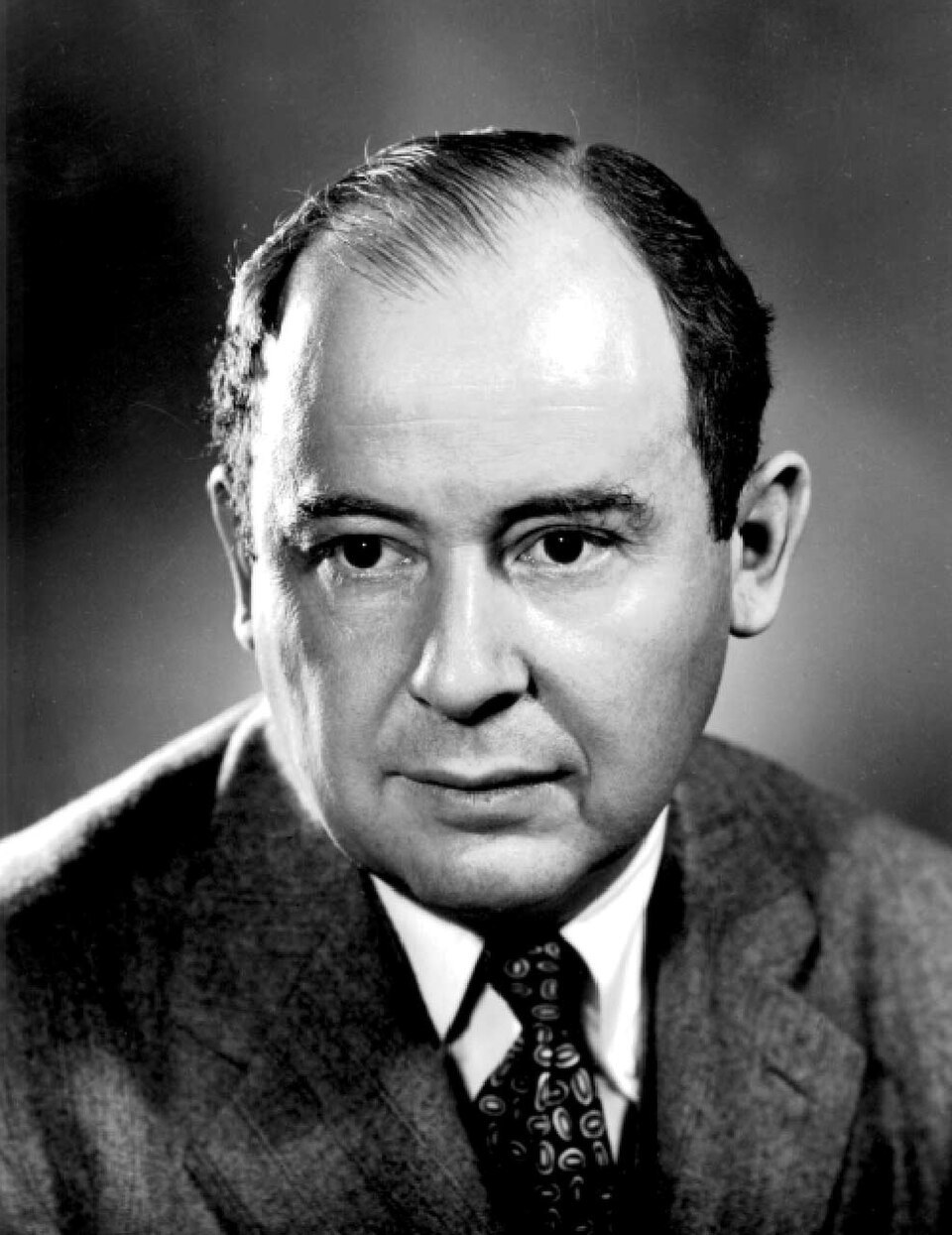
A cellular automaton is about the simplest machine you can imagine that still does something interesting. Take a grid of cells, like graph paper. Give each cell a state, in the simplest case just 'on' or 'off,' black or white. Fix a neighborhood, the handful of nearby cells a given cell can 'see.' Then write down one rule that decides each cell's next state from its neighborhood, and apply that rule to every cell at once, over and over. That is the whole of it: a grid, a set of states, a neighborhood, and a rule, ticking forward in discrete steps with every cell updating in lockstep. Nothing is random; nothing is centrally directed. And yet from rules this plain, structure of remarkable richness can pour out. The idea was born in the late 1940s with John von Neumann, who was chasing a strange and beautiful question: could a machine build a copy of itself, blueprint and all? He proved, on paper, that it could, designing a cellular automaton with twenty-nine states per cell that was capable both of universal computation and of self-reproduction. The work was published after his death, in 1966. The simplest cellular automata of all are one-dimensional: a single row of cells, each 0 or 1, each looking only at itself and its two immediate neighbors. Count the possibilities, and there are exactly 256 such rules, no more; and in the 1980s Stephen Wolfram sat down and studied every single one.
02Four Kinds of Behavior
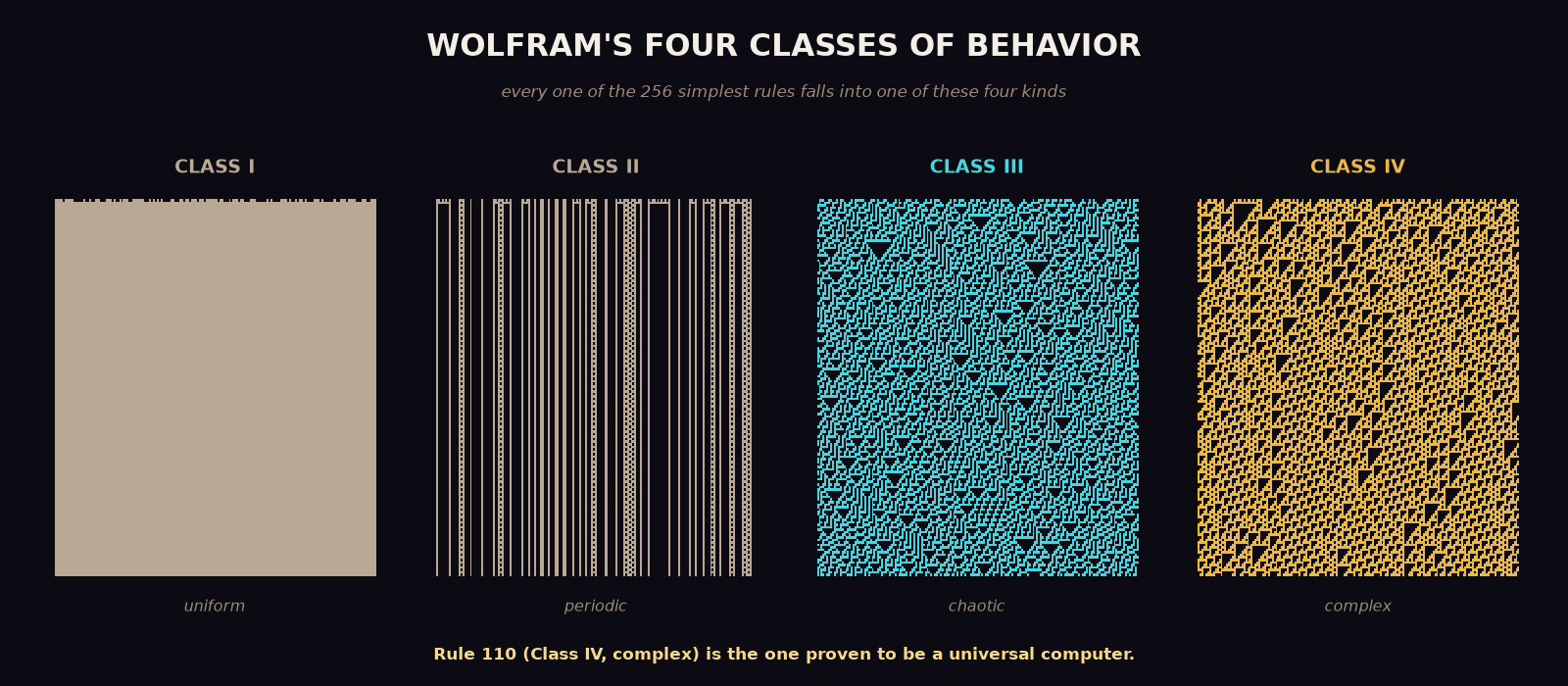
What Wolfram found, and catalogued in 1984, is that the 256 elementary rules, and cellular automata generally, sort into just four broad classes of behavior. Class I rules are dull: whatever you start with, everything quickly settles into a single uniform state. Class II rules settle into simple stable or periodically repeating structures, stripes and blocks that sit still or blink forever. Class III rules do the opposite: they produce chaos, patterns as random-looking as television static, with no lasting structure. And then there is Class IV, the rare and interesting one, poised on the knife-edge between order and chaos. Class IV rules generate localized structures that move, collide, and interact in intricate, unpredictable ways, neither freezing into repetition nor dissolving into noise. This 'edge of chaos,' as it came to be called, is where genuinely complex behavior lives. It is also where the most remarkable result in the whole field is found.
03The Simplest Universal Machine
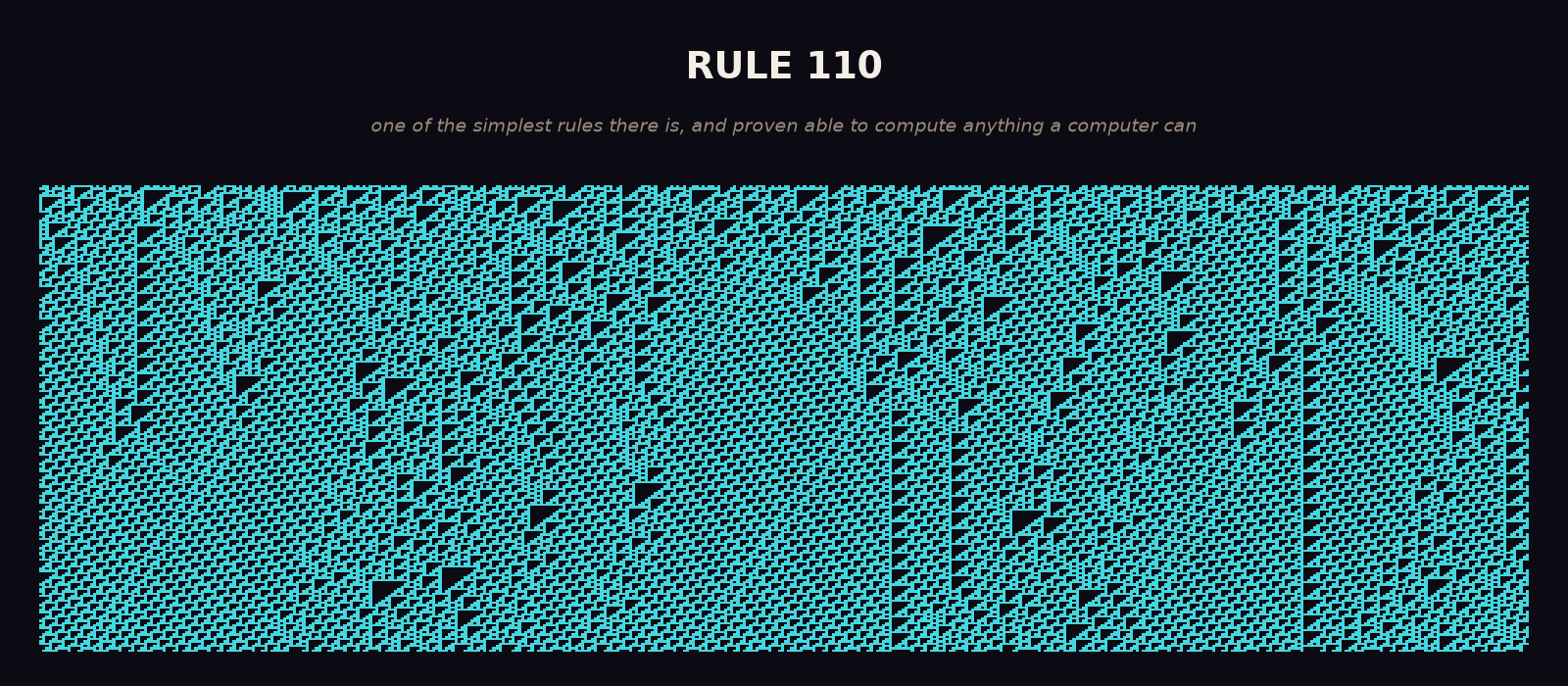
That result concerns a single, unassuming Class IV rule called Rule 110, shown at the top of this page. Its entire definition fits on one line: look at each cell and its two neighbors, and read off the next state from a fixed table of eight cases. Run on a one-dimensional row, it produces gliders, structures that travel across the grid and collide and combine in complicated ways. And in 2004, the mathematician Matthew Cook proved something extraordinary: Rule 110 is Turing complete. That means this one-line rule can, in principle, compute anything any computer can compute, run any program, evaluate any calculable answer, simulate any other machine, given the right starting pattern and enough space and time. This is not a conjecture or an analogy; it is a proven theorem, established by showing that Rule 110 can emulate a system already known to be universal. And its lesson is genuinely deep: the full power of a computer does not require a complicated machine. One of the very simplest rules there is, one of only 256, already suffices. Cook's proof carries a small human drama: he developed it while working for Wolfram's company in the 1990s, presented it at a 1998 conference before Wolfram's own book had appeared, was accused of breaking a non-disclosure agreement, and could not publish the complete proof until 2004, six years later. It settled a conjecture Wolfram himself had made in 1985. And Rule 110 is not even alone, Conway's Game of Life and other minimal systems have been proven universal too. The boundary between 'a simple pattern' and 'a general-purpose computer' sits far lower than anyone had guessed.
04The Game of Life
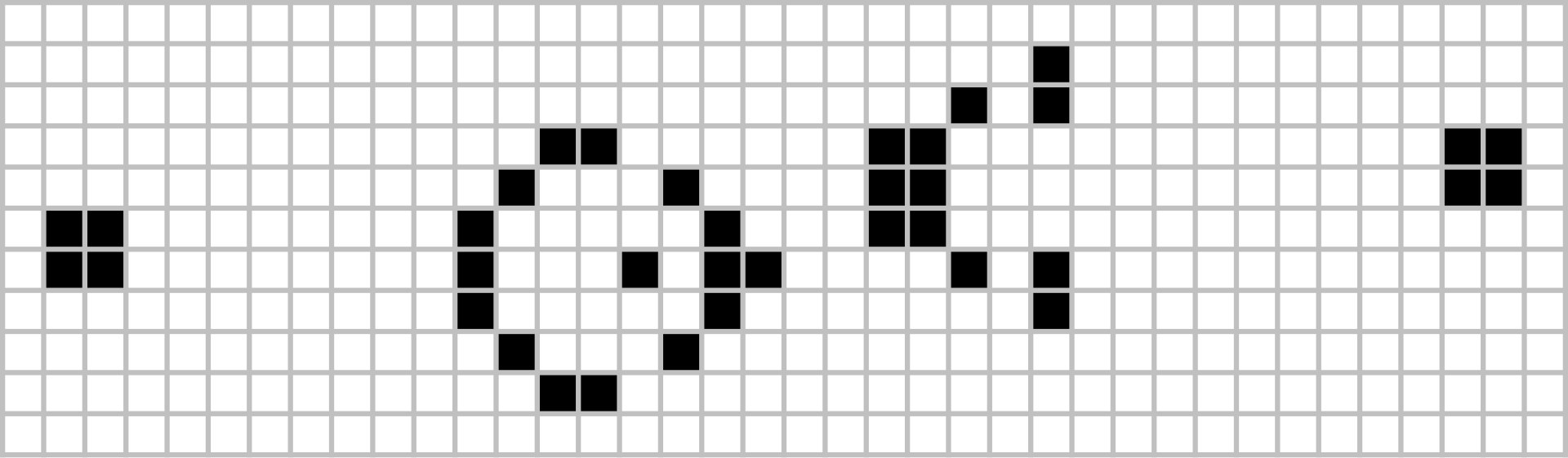
The most beloved cellular automaton of all is two-dimensional, and it made the whole field famous. In 1970 the mathematician John Conway devised the Game of Life, played on an endless grid of square cells, each alive or dead, under just four rules: a live cell with fewer than two live neighbors dies, as if of loneliness; one with two or three neighbors lives on; one with more than three dies, as if of overcrowding; and a dead cell with exactly three live neighbors comes to life. That is the entire game. From those four rules emerges a whole zoo of behavior: 'still lifes' that sit unchanging, 'oscillators' that blink in cycles, and 'spaceships' like the famous glider, a five-cell pattern that crawls diagonally across the grid forever. There are even glider guns, discovered in 1970, that stay in place and fire off an endless stream of gliders. The Game of Life reached the public through Martin Gardner's 'Mathematical Games' column in Scientific American in October 1970, which drew more mail than any of his columns had up to that point, and it captivated a generation of programmers who have since catalogued thousands of intricate patterns. Like Rule 110, the Game of Life is Turing complete: people have assembled working logic gates and memory out of streams of gliders, so that in principle a whole computer can be built inside the game. It has a dossier of its own elsewhere in these halls; here it is enough to see that Conway's four rules, like Rule 110's one, reach all the way up to universal computation.
05Order for Free
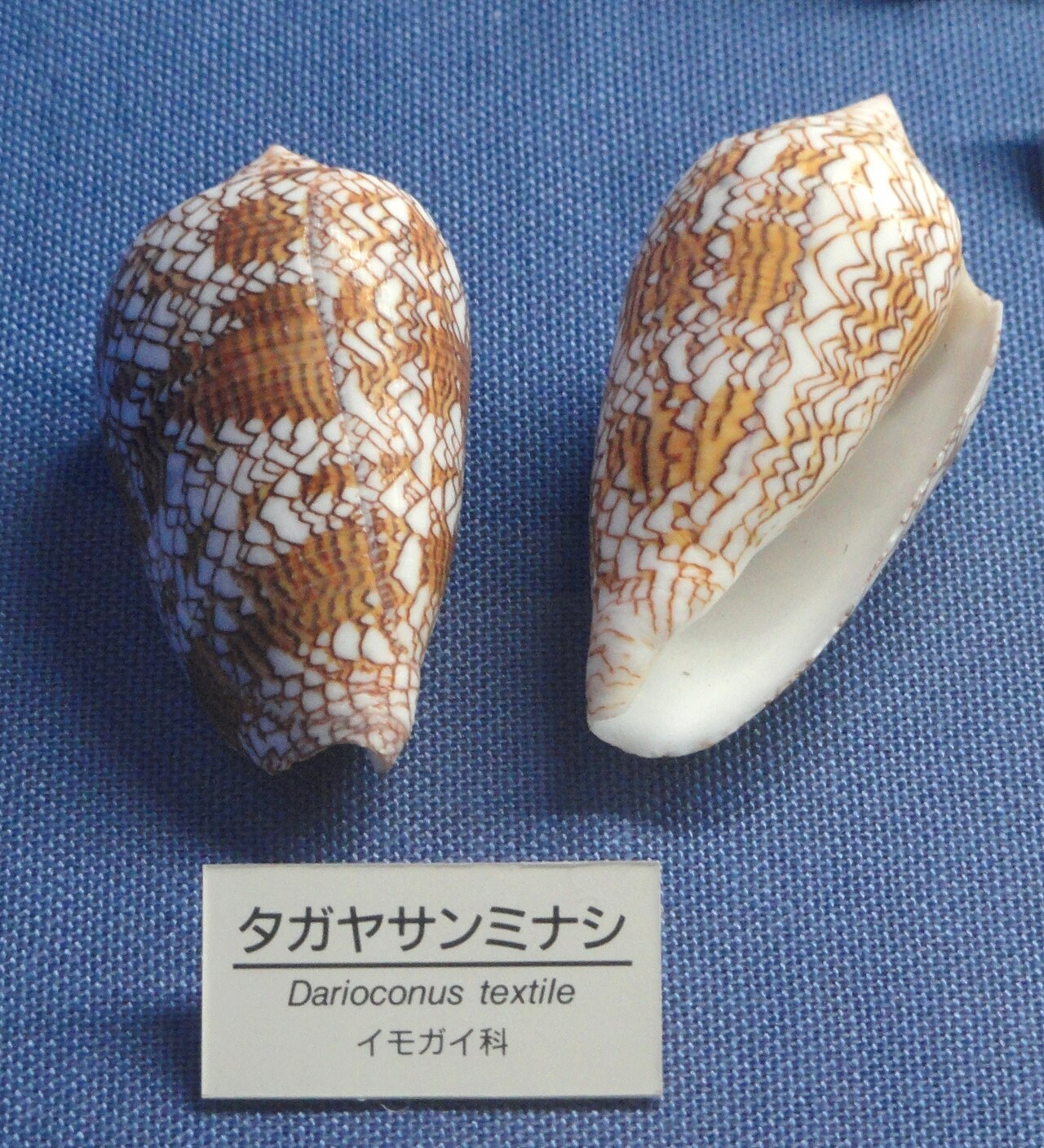
None of this would matter much if cellular automata were only mathematical curiosities, but they turn out to model real corners of nature with surprising fidelity, which is what earns the field its place under the heading 'order for free.' Fluid dynamics can be simulated by 'lattice-gas' automata, in which simple particles hop and collide on a grid and, remarkably, reproduce the Navier-Stokes equations of real fluid flow in the large-scale limit; the descendant of that idea, the Lattice Boltzmann Method, is now a workhorse of engineering. Highway traffic has its own celebrated model, devised by Kai Nagel and Michael Schreckenberg in 1992, in which cars follow trivial rules for speeding up and slowing down, and out of it emerge the maddening 'phantom' traffic jams that appear from nowhere on a busy motorway; the model is used in real traffic planning. And biology is full of cellular-automaton-like pattern formation. The pigment on a seashell, the textile cone snail is the classic case, is laid down by the growing edge of the shell following local rules, exactly like a one-dimensional automaton, and the resemblance to rules like Rule 30 is striking. The same style of modeling reaches into Alan Turing's own 1952 theory of how animal markings form, into forest-fire and epidemic spreading, and into the wider world of 'agent-based models,' where giving the cells richer behavior reproduces everything from urban segregation (Thomas Schelling, 1971) to whole artificial economies. Not every process yields to this approach, and the 'edge of chaos' idea in particular is genuinely debated, a useful notion to some, too vague to others, but that these simple rule-systems reach deep into real science is not in doubt.
06Is the Universe Running on Rules?
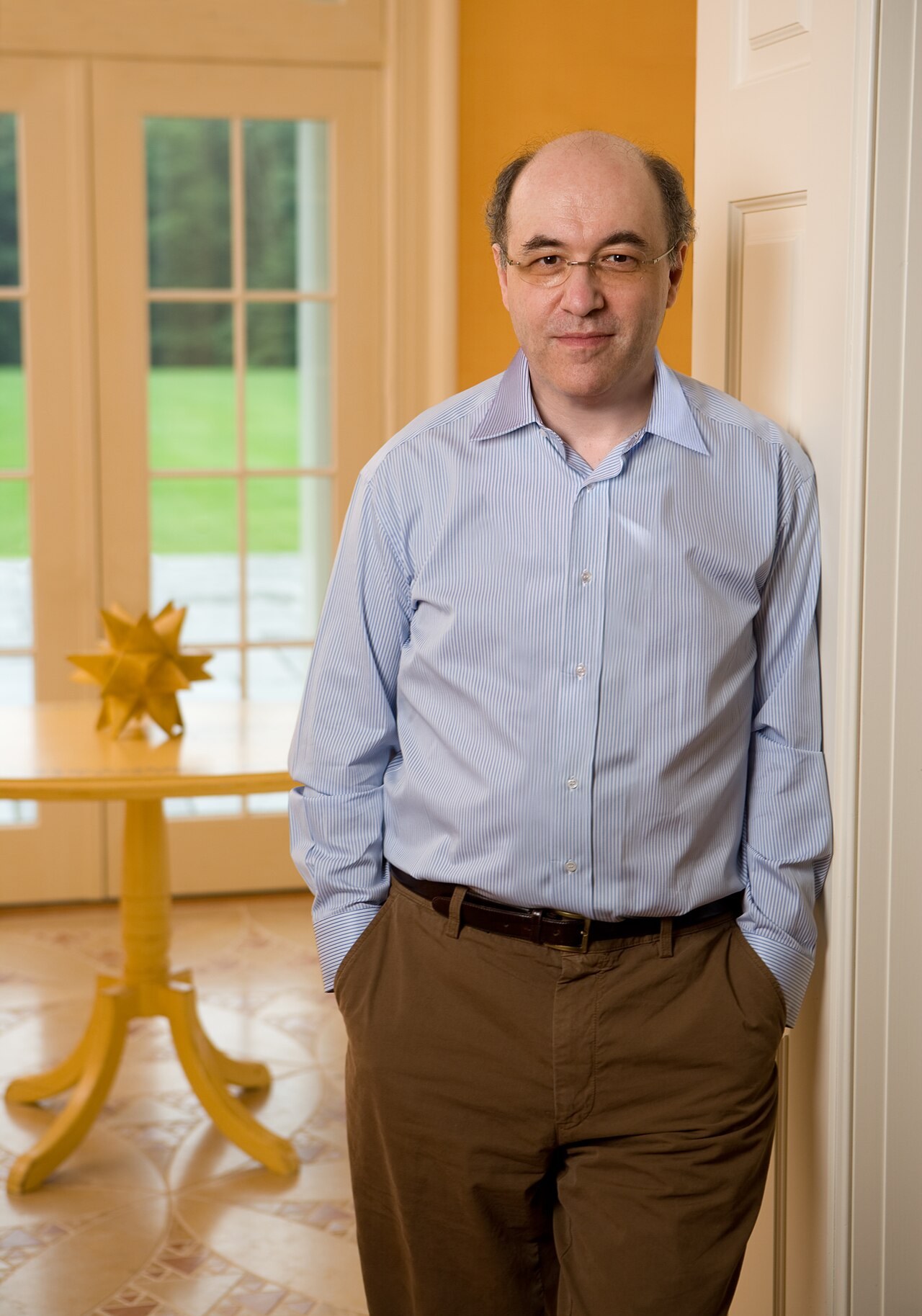
Which brings us, at last, to the question the title asks, and here the honest tier drops sharply. If such simple rules can generate the complexity of fluids, traffic, and living patterns, and if a one-line rule can compute anything at all, it is tempting to wonder whether the universe itself is, at bottom, a cellular automaton: a vast computation grinding forward through simple rules. This idea, 'digital physics,' has a real lineage. Konrad Zuse, a pioneer of the computer, proposed it in a 1969 book, 'Calculating Space.' The Nobel laureate Gerard 't Hooft has developed a 'cellular automaton interpretation of quantum mechanics,' arguing that a deterministic rule-system might underlie the apparent randomness of the quantum world. And most prominently, Stephen Wolfram, in his sprawling 2002 book 'A New Kind of Science' and its successor the Wolfram Physics Project, argues that simple computational rules are the true foundation of physics, and claims to recover hints of relativity and quantum mechanics from evolving networks called hypergraphs. It is essential to be clear about the status of all this. It is a real, serious, genuinely interesting research program, pursued by capable people, one of them a Nobel laureate. It is also a minority position, not peer-reviewed physics in the ordinary sense, with a decidedly mixed reception among physicists, and, decisively, no experiment yet distinguishes a computed universe from a continuous one. Wolfram's boldest general claim, the 'principle of computational equivalence,' that almost every complex system is at heart the same universal computation, is widely regarded as unproven and probably overreaching. So the answer to 'is the universe running on rules?' is neither the confident 'yes' its advocates imply nor the dismissive 'of course not' its critics offer. It is, honestly, unknown: a live and unresolved speculation, not a finding, and not a settled non-finding either.
Fast Facts
- What it is
- A grid of cells, each in a simple state, all updated at once by one local rule, over discrete steps; fully deterministic, yet capable of startling complexity
- Invented by
- John von Neumann in the late 1940s, to study whether a machine could reproduce itself (it can); published posthumously in 1966
- Wolfram's four classes (1984)
- Uniform (I), periodic (II), chaotic (III), and complex / edge-of-chaos (IV); the 256 simplest one-dimensional rules all fall into these four kinds
- Rule 110
- One of the simplest rules there is, and PROVEN Turing complete (Matthew Cook, 2004), able to compute anything a computer can. Universal computation does not require a complicated machine
- The Game of Life
- Conway's 1970 four-rule automaton; its gliders, glider guns, and glider-built logic gates make it Turing complete too; popularized by Martin Gardner in Scientific American, October 1970
- In nature
- Lattice-gas fluid dynamics (recovering Navier-Stokes), the Nagel-Schreckenberg traffic model and its phantom jams, and the pigment patterns of seashells
- The title question (Tier 3)
- Whether the universe is fundamentally a cellular automaton (digital physics: Zuse, 't Hooft, the Wolfram Physics Project) is a real but minority, unconfirmed idea; no experiment yet distinguishes it from continuous physics
- Refused
- That cellular automata are THE model for all of nature, or that the universe is provably one; and, in the other direction, that the digital-physics program is mere crackpottery
What We Can Actually Stand Behind
The core science is settled and beautiful. A cellular automaton is a grid of cells updated by one local rule; von Neumann designed a self-reproducing one on paper in the 1940s; Wolfram's four-class scheme (1984) organizes their behavior; and Matthew Cook proved in 2004 that the elementary Rule 110 is Turing complete, one of the simplest systems capable of universal computation. Conway's Game of Life is likewise universal. Cellular automata genuinely model fluids, traffic, and biological patterns.
Several ideas around the field are active and credible but not fully settled. Wolfram's 'principle of computational equivalence' has been influential but is criticized as overreaching and unproven in generality. The 'edge of chaos' hypothesis (Langton) is suggestive and partly formalized but genuinely debated. Agent-based models extending cellular automata are a real and widely used tool across the sciences.
The title's own question is open. Whether the universe is fundamentally a cellular automaton, the 'digital physics' program of Zuse, 't Hooft, and the Wolfram Physics Project, is a serious but minority research direction. It is not peer-reviewed physics in the usual sense, has a mixed reception, and, decisively, no experiment yet distinguishes a computed universe from a continuous one.
The overclaim gets a no: cellular automata are one powerful modeling paradigm among many, not the proven model for all of nature, and the universe is not established to be a cellular automaton. But the opposite dismissal is refused too: the digital-physics program is not crackpottery. It is unresolved and unproven, which is a different and more honest verdict than 'wrong.'
Cellular automata belong in The Gold Thread because they are the cleanest demonstration of the whole wing's theme: that simple rules, applied without exception, can generate structure of unlimited depth, up to and including a universal computer hiding inside a single line of instructions. That much is proven, and it is one of the more beautiful results in twentieth-century mathematics. The leap from there to 'and therefore the universe is one' is a leap the evidence does not license, and the quiet pleasure of the subject is that it does not need to make that leap to be astonishing. A grid, a rule, and patience are enough to compute anything computable; whether nature took the same shortcut is a question we can now ask sharply and still cannot answer. The thread runs on, from the smallest rules to the largest patterns, and it remains one of the genuinely surprising things we know: that so much can come from so little.
Sources & further reading
Everything above is drawn from our research library on Theories of Anything. Open the full file to check the sourcing and go deeper.
Image credits
- Rule 110 space-time evolution (original diagram) Original diagram by Theories of Anything. CC BY-SA 4.0 Source.
- John von Neumann at Los Alamos Los Alamos National Laboratory, via Wikimedia Commons. Public domain Source.
- Wolfram's four classes of cellular-automaton behavior (original diagram) Original diagram by Theories of Anything. CC BY-SA 4.0 Source.
- Gosper glider gun (Conway's Game of Life) Bryan.burgers, via Wikimedia Commons (public domain). Public domain Source.
- Textile cone snail (Conus textile) shell Daderot, via Wikimedia Commons (CC0). CC0 Source.
- Stephen Wolfram, 2008 Stephen Faust, via Wikimedia Commons. CC BY-SA 3.0 Source.
- Card crop of the Rule 110 diagram Original diagram by Theories of Anything. CC BY-SA 4.0


