
Ancient Ink: The Iceman's Tattoos and the World's Oldest Body Art
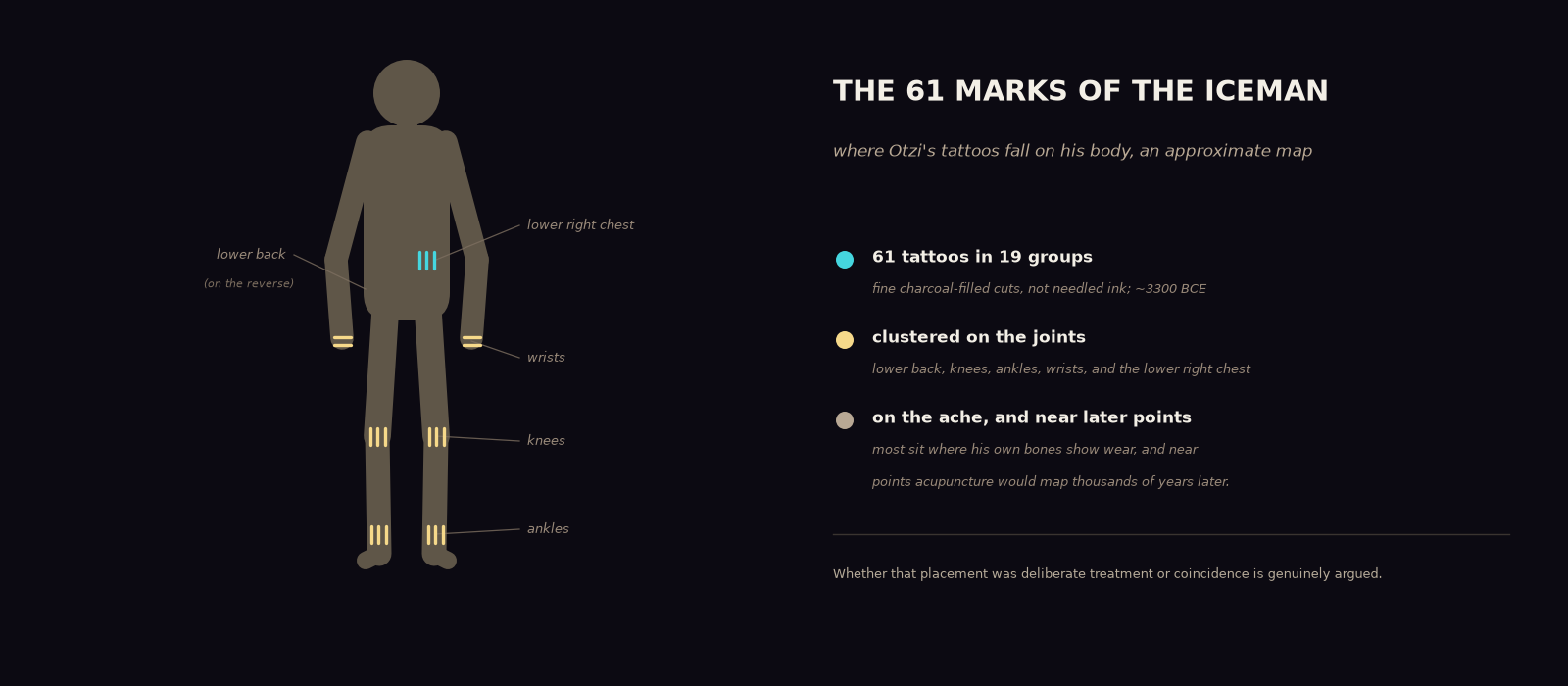
When a frozen body melted out of an Alpine glacier in 1991, it carried the oldest tattoos ever found on human skin: sixty-one small marks, cut into the flesh and rubbed with charcoal more than five thousand years ago. The Iceman is not alone. Egyptian mummies wear the oldest pictures ever inked, Siberian nobles wore whole menageries of beasts, and a living Maori tradition still carves identity into the face. This is the real history of the world's oldest body art, and the honest handling of its most famous claim: that the Iceman's marks sit, uncannily, on the very points a system of medicine would map thousands of years later.
In September 1991, a body melted out of a glacier in the Otztal Alps, and at first the hikers who found it took it for a modern climbing casualty. It was not. The man had died there around 3300 BCE, and the cold had kept him almost perfectly for more than five thousand years, down to the contents of his stomach and the marks on his skin. Those marks are the reason he belongs in a history of human expression: sixty-one small tattoos, the oldest ever found on a human body. They are not the only ancient ink. Egyptian mummies carry the oldest pictures ever tattooed, frozen Siberian nobles wore herds of stylized beasts across their bodies, and on the far side of the world a living tradition still carves a person's whole ancestry into the face. This is the real story of the oldest body art, told through the bodies that kept it, and it includes one of archaeology's most seductive claims, which has to be handled with unusual care: that the Iceman's tattoos are not decoration at all, but medicine.
01The Iceman
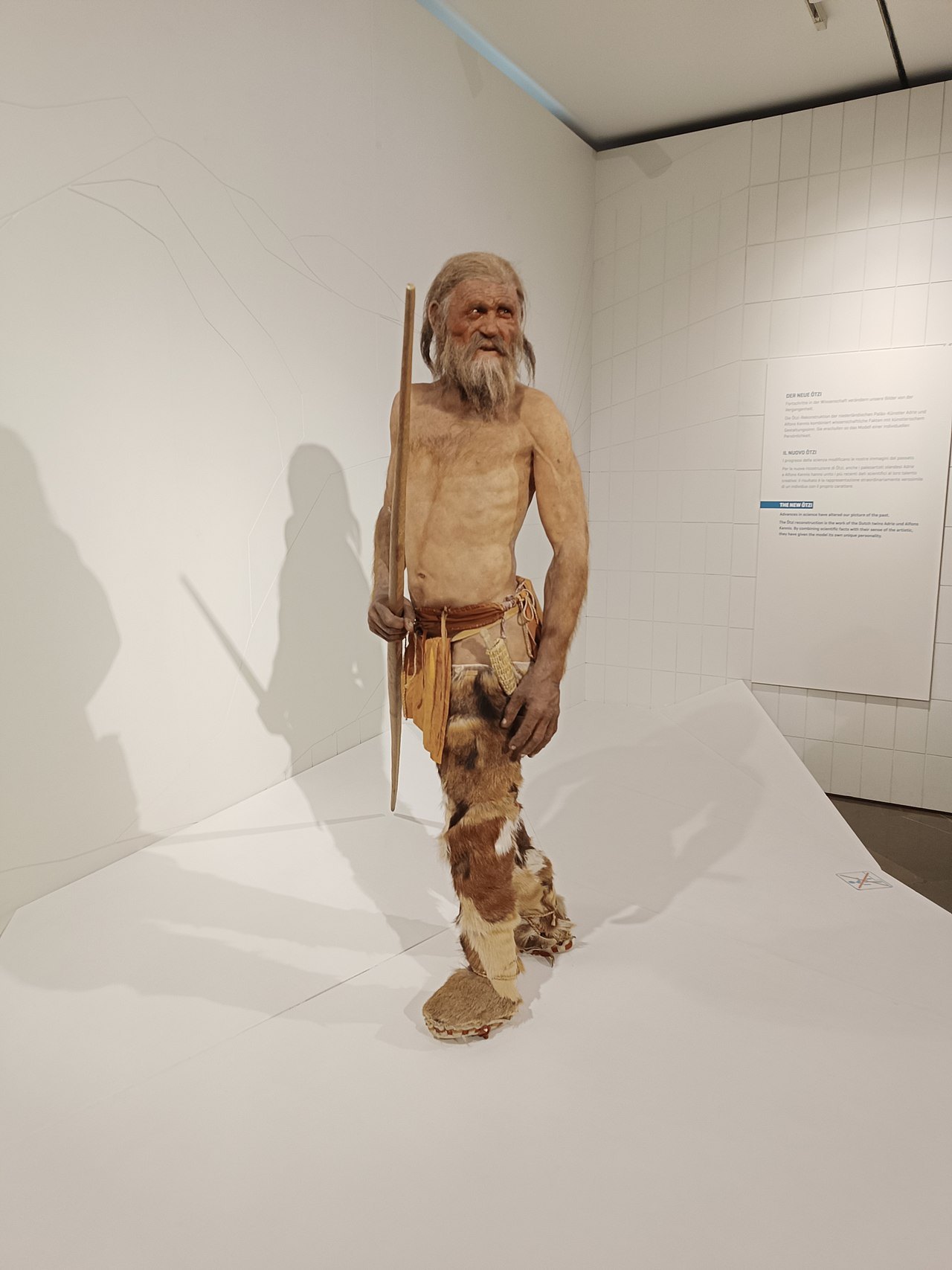
Start with the Iceman himself, whom the world calls Otzi. A 2015 survey using multispectral imaging, able to catch marks the naked eye no longer can, put his final tally at sixty-one tattoos in nineteen groups. They are not pictures but simple geometry: short parallel lines, a few crosses, small clusters of dots, placed on his lower back, his wrists, his knees, his ankles, and one group on his lower right chest. And they were not made the way a modern tattoo is. Otzi's marks were cut, fine incisions into the skin, then rubbed with charcoal, a technique different again from the chisel the Maori would later use. For a while it was not even certain he held the record. A Chinchorro mummy from the coast of Chile, marked with a thin line of dots like a moustache above the lip, was once dated older than Otzi, which would have dethroned him; but a careful re-examination of the radiocarbon data corrected that mummy to somewhere between about 2500 and 2000 BCE, several centuries younger. Otzi, at roughly 3300 BCE, keeps the title of the oldest directly dated tattoos on a human body. The Chinchorro moustache is the second oldest, and the correction settled a real scholarly argument rather than overturning one.
02The Oldest Pictures
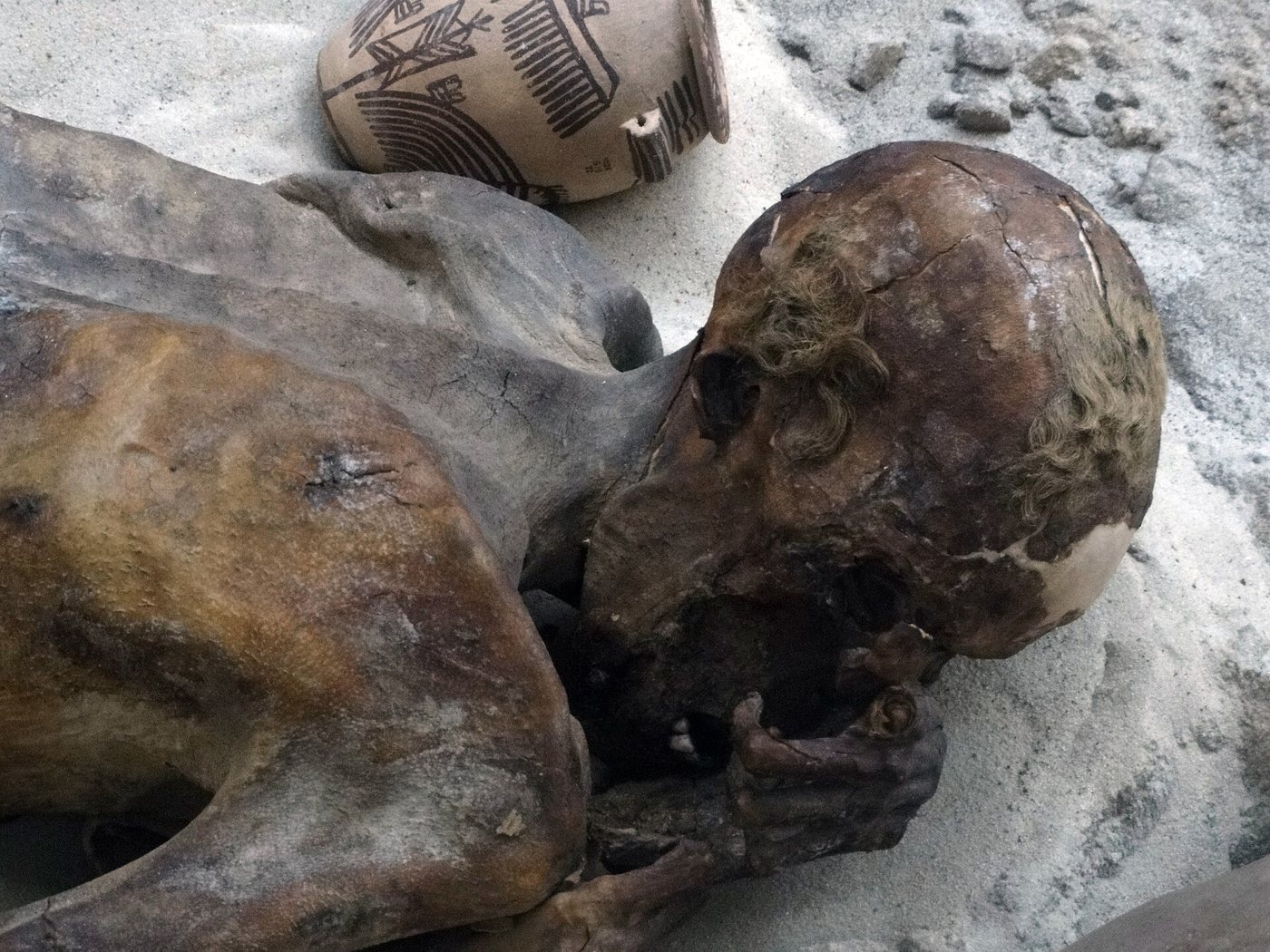
The oldest tattoos that are actually pictures come from Egypt, and no one knew they were there until recently. Two naturally mummified bodies from Gebelein, in Upper Egypt, dating to around 3351 to 3017 BCE and so almost exactly as old as Otzi, had been on display for a century with dark smudges on their skin that everyone took for stains. In 2018, infrared imaging revealed the smudges for what they were: tattoos. On the upper arm of the man, the British Museum specimen catalogued as Gebelein Man, are a wild bull and a Barbary sheep; on the woman, a set of S-shaped and linear motifs across the shoulder. These are the oldest known figurative tattoos in the world, representational images rather than Otzi's abstract lines, and they had survived, invisible, for five thousand years, and another hundred in a glass case, before anyone saw them for what they were.
03The Painted Horsemen
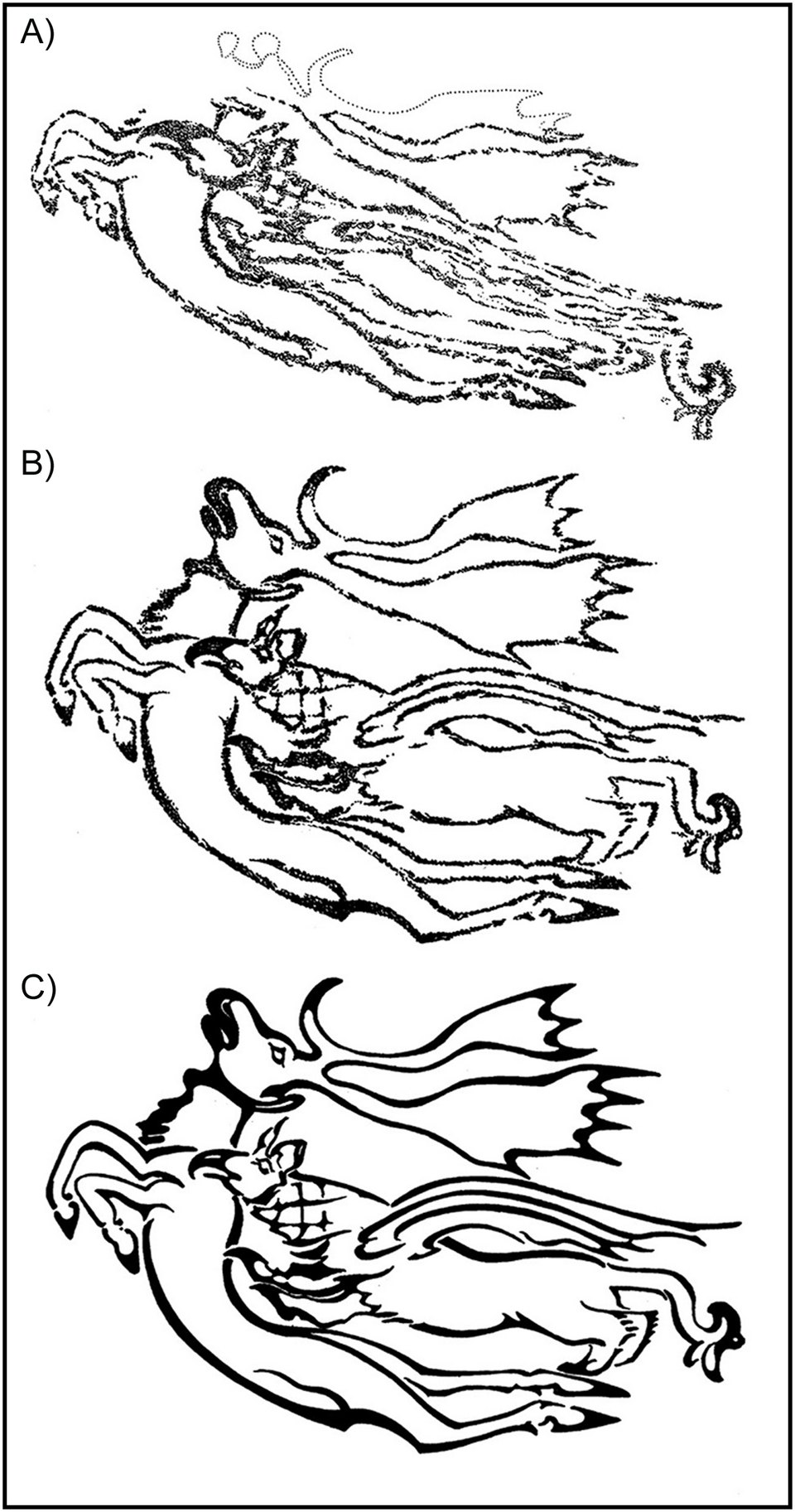
For sheer artistry, nothing in the ancient world matches the Pazyryk. In frozen tombs in the Altai Mountains of southern Siberia, excavated across the mid-twentieth century, lay the bodies of Iron Age nomads whose skin had been kept by the permafrost, and they were covered in tattoos. The chieftain from the second Pazyryk barrow, buried around 300 BCE, wore a full-body menagerie of stylized animals: deer with impossibly elaborate antlers, mountain rams, big cats, and composite mythological beasts including griffins, flowing across his arms, shoulders, and legs. And the tattoos were not for men only. The frozen woman known as the Ice Maiden, from the same culture, wore shoulder and arm designs closely matching the men's, proof that elaborate tattooing crossed the sexes in this society. These are not marks of medicine or of tally but of art and status, worn like a coat of the animals that mattered.
04A Medical Report from the Stone Age?
Now the seductive claim, which is real, published, and taken seriously, and which must still be held with both hands. Otzi's tattoos are strikingly practical in their placement. When radiologists examined his skeleton, they found that many of his tattoo clusters sit directly over areas of real, physical wear: arthritis in his knees and ankles, degeneration in his lower spine, exactly the places a person aches. In 1999, a team led by Leopold Dorfer, with Maria Moser, Frank Bahr, and Konrad Spindler, published a paper in The Lancet with the arresting title 'A medical report from the stone age?' Of the fifteen tattoo groups then known, they reported, twelve, four out of every five, fell directly on or within thirteen millimeters of a classical acupuncture point, and all fifteen lay on or near a recognized meridian, one of the mapped lines of Chinese medicine, a system that would not be written down for another three thousand years. A later study added a cluster on his lower chest, in a region later associated with treating the gut, and Otzi is independently known to have carried an intestinal parasite. The correlation is genuine, peer-reviewed, and not going away. One thing is worth correcting in passing: this finding is often, including in some reference works, misattributed to the researcher Luigi Capasso, whose own 1998 work on Otzi concerned a fungus he carried as a possible remedy. The acupuncture-point paper is Dorfer and his colleagues'.
So did Copper Age Europe practice acupuncture three thousand years before China wrote it down? Here both easy answers are wrong. The first, the exciting one, is yes: that Otzi proves a lost European medicine mapping the same points as Chinese acupuncture. The evidence does not support so large a claim. A correlation in placement is not a system. There is no text, no tool kit, no second practitioner, nothing to show that Otzi's people had organized this into anything resembling the mapped meridian theory of Chinese medicine, and a spatial match to points defined much later is not the same as an equivalent earlier discipline. The second easy answer, the dismissive one, is that the whole idea is fringe nonsense and the tattoos were obviously just decoration. That is wrong too. The correlation is real, it was published in one of the world's leading medical journals, it has been revisited and not overturned by later imaging work, and it is treated as a live hypothesis by the mainstream scientists who study the Iceman, not by cranks. The most likely honest reading sits between the two: people mark where it hurts, and the places that hurt, and that a later medicine learned to treat, may simply be the same places because the body is the same body. That is not acupuncture five thousand years early. But it is not nothing, and it is not decoration. It may be the oldest surviving hint that human beings have always drawn on their own skin to try to mend it.
05A Living Art
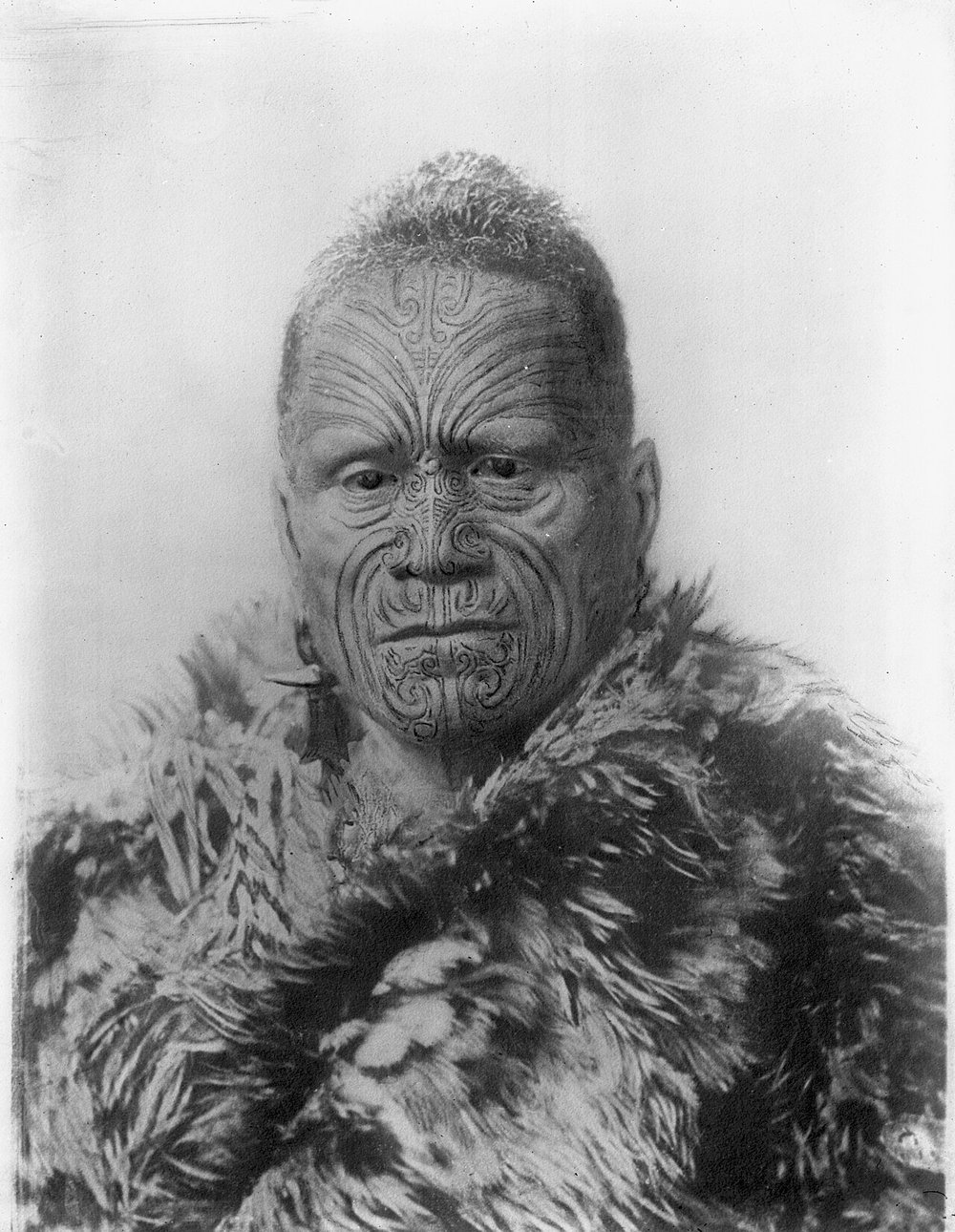
It would be a mistake to leave ancient tattooing in the archaeological past, because in much of the world it never became past at all. The very word we use carries the history: 'tattoo' comes from the Polynesian tatau, brought back to Europe by the crew of Captain Cook's Endeavour in 1769, which is to say that Europeans did not so much discover an old practice as borrow a name for one that had never stopped. In Aotearoa New Zealand, Maori ta moko is a living tradition and a distinct technique: rather than puncturing the skin, the artist uses an uhi, a bone chisel, to carve grooves into it, so that a completed moko is felt as much as seen. A full facial moko is not ornament but a document, recording a person's genealogy, their rank, and their deeds, so bound to individual identity that in the nineteenth century Maori chiefs signed treaties and land deeds by drawing their own moko as their mark. It is worth saying plainly, too, that the history of tattooing has too often been written as a story of European explorers 'finding' the practice among other peoples; the traditions of the Pacific, of the Arctic, of the Americas have their own long, self-directed histories, and deserve to be told on their own terms rather than only from the deck of an arriving ship.
06What It Was Not
Two tidy generalizations deserve refusing. The first is that tattooing spread around the world from a single inventing culture. It did not: it appears independently in Copper Age Europe, predynastic Egypt, Iron Age Siberia, ancient Chile, Polynesia, and beyond, on bodies and in eras with no possible contact, which is the signature of a good idea invented many times over, not one idea carried. The second is that all ancient tattooing was religious or ritual. Some surely was, but the evidence is broader and more human than that: tattoos across the ancient world served to heal, or to try to, to mark beauty, to record a life's achievements, to declare a rank, and, in Mesopotamia and Greece and Rome, to brand the enslaved and the convicted against their will. The needle, or the chisel, or the blade and the ash, has been turned to almost every human purpose there is. It always will be. That is rather the point of it.
Fast Facts
- Oldest
- Otzi the Iceman, ~3300 BCE: 61 tattoos in 19 groups, fine cuts rubbed with charcoal, not needled ink
- Oldest pictures
- Two Gebelein mummies (Egypt, ~3351 to 3017 BCE): a wild bull and a Barbary sheep on the man, revealed by infrared in 2018
- Most elaborate
- The Pazyryk of Iron Age Siberia (~300 BCE): full-body stylized animals and griffins, on both men and women
- Second oldest
- A Chinchorro mummy (Chile), a dotted 'moustache,' ~2500 to 2000 BCE after its dating was corrected
- The famous claim
- 12 of 15 of Otzi's tattoo groups sit on or within 13 mm of a later acupuncture point (Dorfer et al., The Lancet, 1999, NOT Capasso)
- Held honestly
- A real, published correlation, but NOT proof of a Copper Age acupuncture system, and NOT fringe nonsense either
- Living traditions
- Maori ta moko (carved with a bone chisel; records genealogy and rank); 'tattoo' is from the Polynesian tatau
- Refused
- A single origin culture for tattooing; and that all ancient tattoos were ritual
What We Can Actually Stand Behind
The tattooed bodies and their dates are documented. Otzi (~3300 BCE) carries 61 tattoos in 19 groups, made by charcoal-filled incisions. The Gebelein mummies (~3351 to 3017 BCE) bear the oldest known figurative tattoos: a bull and a Barbary sheep on the man, geometric motifs on the woman, revealed by infrared in 2018. The Pazyryk of Iron Age Siberia (~300 BCE) wore elaborate zoomorphic tattoos, on both sexes. A Chinchorro mummy's dating was corrected to ~2500 to 2000 BCE, second-oldest after Otzi. Maori ta moko is carved with a bone chisel and records genealogy and rank; 'tattoo' derives from the Polynesian tatau (Cook's voyage, 1769).
The factual core of the famous claim is solid. Many of Otzi's tattoo clusters really do sit over documented areas of his own joint and spinal degeneration, established by radiological examination of his skeleton. That the marks fall on the places that ache is a real, physically grounded correlation, not a coincidence invented after the fact. This is the well-supported observation on which the more speculative therapeutic interpretation is built, and it should not be conflated with that interpretation.
The interpretation is contested. That Otzi's tattoos were a deliberate therapy, and that their correspondence to later Chinese acupuncture points is meaningful rather than coincidental, is a real, peer-reviewed hypothesis (Dorfer, Moser, Bahr, and Spindler, The Lancet, 1999: 12 of 15 groups on or within 13 mm of a point) that remains unproven. Skeptics note that painful joints are the obvious place for any culture to intervene, so the overlap may reflect shared anatomy rather than a shared or transmitted system. Real correlation; unestablished intent.
Both overclaims fail. No, this does not prove that a system of acupuncture or meridian medicine existed in Copper Age Europe 5,300 years early; a placement correlation is not an organized discipline, and no text, tool, or tradition attests one. But no, the idea is not fringe pseudoscience and the tattoos were not obviously 'just decoration'; the correlation is real and was published in a leading medical journal. Two further tidy stories also fail: tattooing was not spread from a single origin culture (it was invented independently many times), and it was not all ritual (it also healed, adorned, recorded, ranked, and punished).
Of all the surfaces this wing considers, the ones people have written on when plain words were not enough, the body is the first and the most intimate. Before there was a wall to paint or a tablet of clay to press, there was skin, and someone reaching for a blade and a pinch of soot to make a mark on it that would last a lifetime and, as it turned out, a great deal longer. What is moving about the oldest tattoos is not only their age but their range: the same act, the deliberate marking of the flesh, was turned to healing and to beauty, to memory and to rank, to devotion and to cruelty, across peoples who never met and could not have taught one another. The Iceman took his sixty-one marks into the ice; a Maori chief carved his lineage into his face; a Pazyryk rider wore a griffin on his shoulder into a frozen tomb. Each of them made, on the one canvas every human being is issued exactly once, a statement meant to be read. We are still reading them. And we are still, every day, making our own.
Sources & further reading
Everything above is drawn from our research library on Theories of Anything. Open the full file to check the sourcing and go deeper.
Image credits
- Map of Otzi the Iceman's tattoo distribution (original diagram) Original diagram by Theories of Anything. CC BY-SA 4.0 Source.
- Kennis Brothers reconstruction of Otzi the Iceman (South Tyrol Museum) Photograph by Wikimedia Commons user Mannivu (reconstruction by Adrie and Alfons Kennis), via Wikimedia Commons. CC BY-SA 4.0 Source.
- Gebelein Man, predynastic Egyptian mummy (British Museum EA 32751) Photograph by Wikimedia Commons user Fae, via Wikimedia Commons. CC BY-SA 3.0 Source.
- Reconstruction of a Pazyryk griffin tattoo Reconstruction by Daniel Riday, via Wikimedia Commons. CC BY 4.0 Source.
- Tawhiao, second Maori King, with ta moko (c. 1894) Photographer unknown, c. 1894 (National Library of Australia); public domain, via Wikimedia Commons. Public Domain Source.
- Card crop of the Iceman tattoo-map diagram Original diagram by Theories of Anything. CC BY-SA 4.0


