
Two Thousand Years Of Food, Arriving At Once
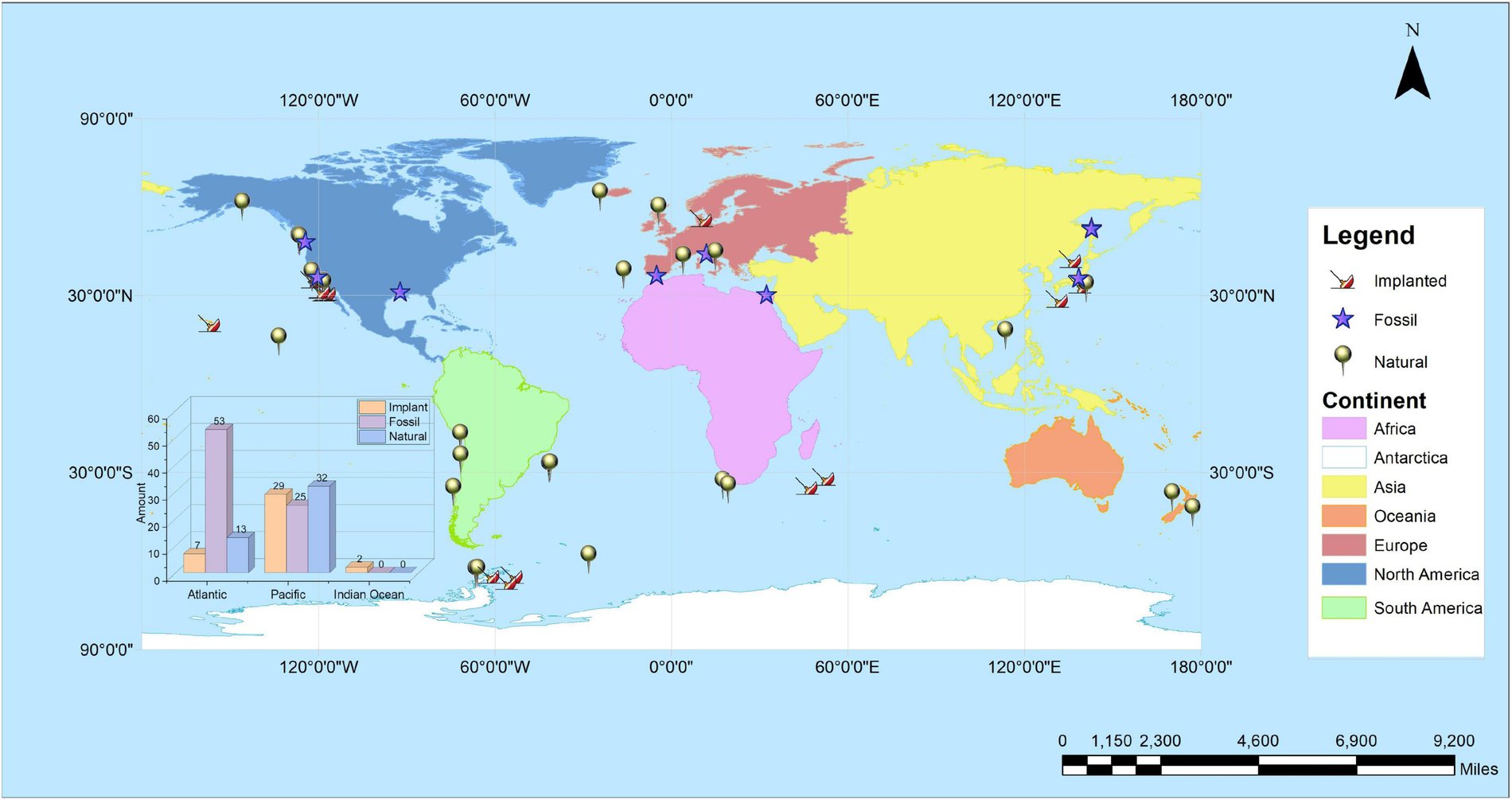
The abyssal plain is a desert fed by a slow drizzle of dead plankton. Then a great whale dies, and roughly two thousand years of that drizzle lands in a single afternoon. What follows runs for fifty years and ends with a worm that has no mouth farming bacteria inside a bone. Here is what happens, in order, and what we found when we checked every citation in our own file about it.
The floor of the deep ocean is a desert. Nothing grows there, because nothing photosynthesises in the dark, and everything that lives there is waiting on a slow drizzle of dead plankton sinking from far above. It is called marine snow, and it is thin. A patch of abyssal seafloor might wait a lifetime for anything worth eating.
Then a great whale dies. It sinks, sometimes four kilometres, and lands. And that patch of desert receives, in a single afternoon, roughly two thousand years' worth of its normal food supply. What happens next is not decomposition in any ordinary sense. It is a whole ecosystem, arriving in stages, running for half a century, and ending with an animal that has no mouth.
01The Arithmetic Of A Carcass
A single adult great whale, 30 to 160 tonnes, delivers 2,000 to 5,000 kilograms of organic carbon to the seafloor. That is equivalent to roughly two thousand years of the normal background carbon flux to the same patch of abyssal sediment. Nothing else that reaches the deep sea is remotely like this. It is not a larger meal than usual. It is a different category of event, and the organisms that exploit it are organisms that have evolved specifically for a windfall that arrives once in a very long while and then has to last.
The bones are the point, not the meat. Large whale bones are up to 60 per cent lipid by dry weight, mostly wax esters and triacylglycerols. The soft tissue is gone within a year or two. The skeleton is a slow-release fuel tank, and it is still feeding an ecosystem fifty years later. A whale is not simply a large body. It is a large body with several hundred kilograms of fat locked inside a mineral structure that only bacteria can open.
02Three Stages, In Order
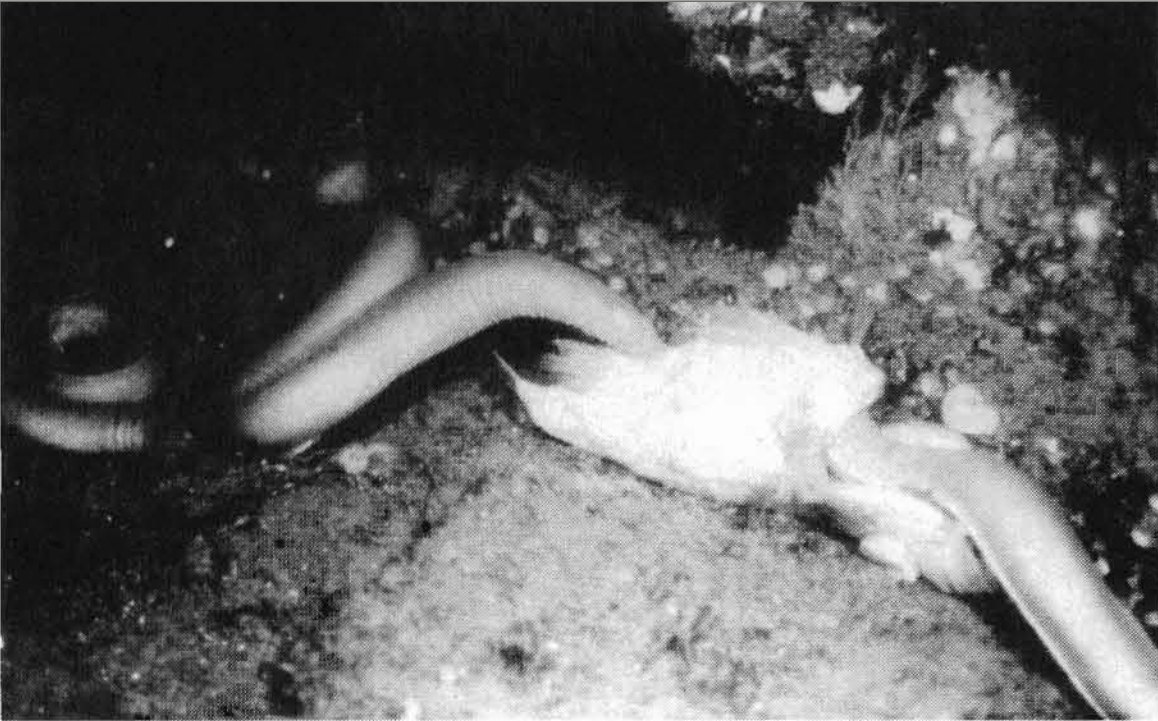
Stage one: the mobile scavengers. The large necrophages arrive first. Sleeper sharks (Somniosus pacificus), hagfish (Eptatretus deani), rattail fish, lysianassid amphipods and lithodid crabs. They strip soft tissue at 40 to 60 kilograms per day. Smith and Baco estimated that a 35 tonne gray whale at 1,240 metres lost more than 90 per cent of its soft tissue within a year and a half. And they do something less obvious than eating: by feeding and then swimming away, the scavengers redistribute the whale's energy across tens to hundreds of metres of surrounding seabed. The windfall starts spreading before it is even finished.
Stage two: the enrichment opportunists. Dense aggregations of polychaete worms, including Vigtorniella flokati and dorvilleids, together with crustaceans, colonise the sediment the scavengers have just enriched. Densities reach more than 20,000 individuals per square metre, orders of magnitude above the background abyssal figure. Our file notes that the same pattern shows up around wood falls, kelp falls and fish-processing waste, which is the first clue that a whale is a spectacular instance of something more general: any large lump of organic matter hitting a starved seafloor.
Stage three: the sulfophilic stage, and this is where a corpse becomes a habitat. Anaerobic microbes break down the remaining bone lipids and generate hydrogen sulfide, which is lethal to most life and is food to sulfur-oxidising chemoautotrophic bacteria. Those bacteria coat the bones and also live inside specialised animals as endosymbionts: Idas and Adipicola mussels, vesicomyid clams whose gill symbionts are genetically related to hydrothermal vent species, and siboglinid polychaetes, the same family as the giant tubeworms of the vents. This stage runs for decades, more than fifty years. It is a chemosynthetic ecosystem of the kind found at hydrothermal vents, except that the energy source is not the Earth's interior. It is whale fat.
One caution about those durations. Our research file gives the stage lengths twice and the two versions do not match. Its summary says the scavenger stage runs months to about two years and the enrichment stage about two to four years. Its body says months to about 1.5 years and about one to five years. Same document, same two stages, four different numbers. We have used the body's figures above, because that is where the supporting detail sits, and we are flagging the discrepancy rather than quietly picking one.
03The Worm With No Mouth
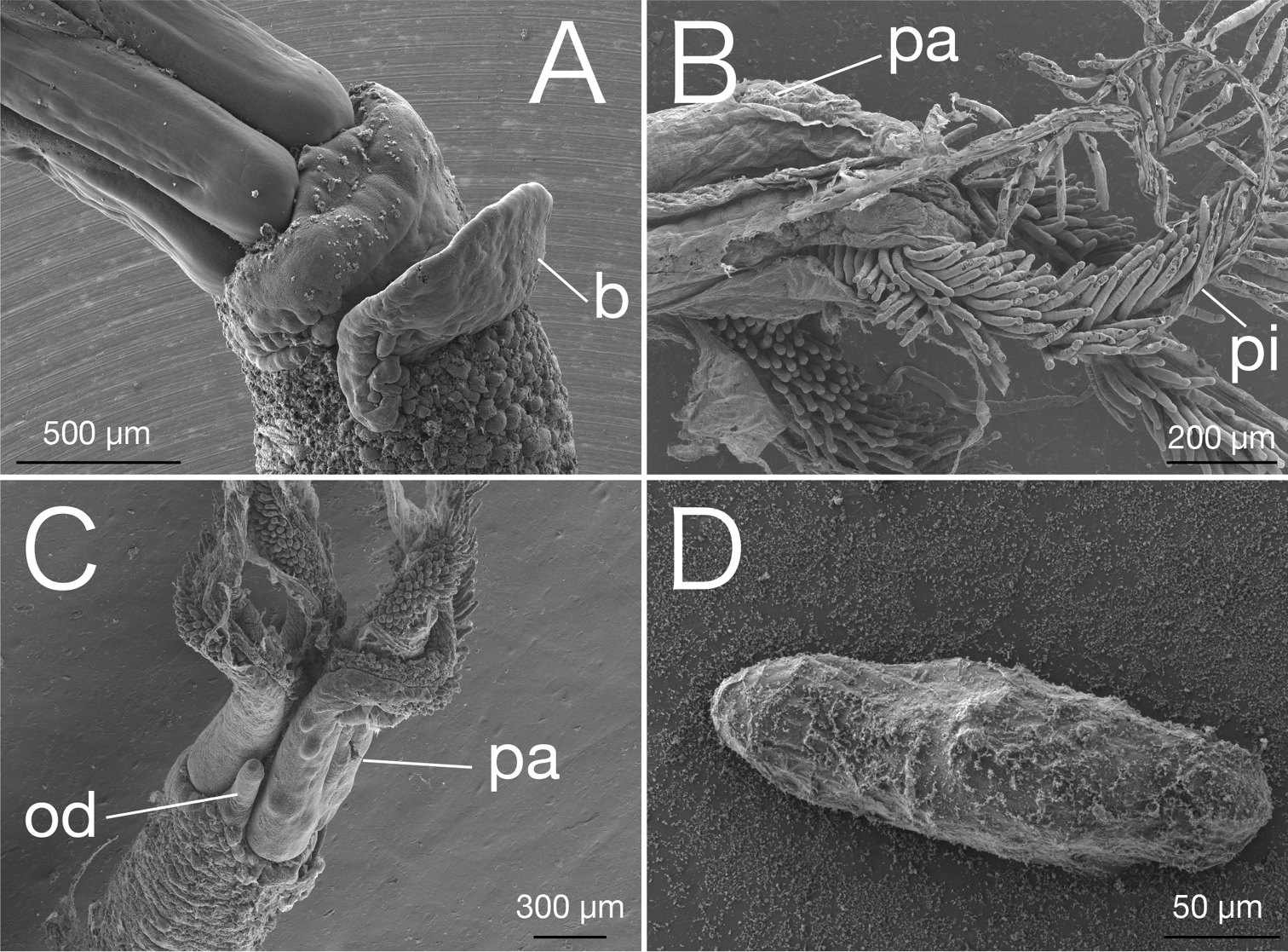
Osedax, Latin for bone eater, was found in 2002 on a gray whale skeleton at 2,893 metres in Monterey Canyon, and described in Science two years later. Females are 2 to 7 centimetres long, with feathery blood-red palps standing off the bone surface into the water. And they have no mouth, no gut and no anus. Instead, root-like structures bore down into the bone carrying endosymbiotic bacteria that break down bone collagen and lipid and pass the products back to the worm. The animal does not eat. It farms.
Male Osedax are one to two millimetres long and live in harems of fifty to a hundred inside the female's mucus tube. Our file calls this one of the most extreme sexual dimorphisms in the animal kingdom, and the arithmetic backs it: a 7 centimetre female against a 1 millimetre male is a length ratio of about seventy to one. More than twenty five species of Osedax have been described since 2004, across multiple ocean basins, from 100 metres down to 4,000.
Osedax will colonise almost any bone. It has been experimentally shown to take bones from cow, pig, fish and bird, not just whales. That matters, because it means the lineage is not dependent on whales at all, and could therefore be far older than they are. The obvious candidate for what it lived on before: the bones of ichthyosaurs, plesiosaurs and mosasaurs, tens of millions of years before the first whale existed.
04Stepping Stones, And What We Removed
Hydrothermal vents and cold seeps are islands. They are scattered, isolated patches of chemosynthetic habitat separated by vast stretches of ordinary seafloor, and their specialised animals somehow get from one to the next. The stepping stone hypothesis proposes that whale falls, along with wood and kelp falls, are the intermediate habitats that make the crossing possible. The supporting evidence is that many whale-fall species are closely related to, or identical with, vent and seep species: bathymodiolin mussels, vesicomyid clams, siboglinid tubeworms. Molecular phylogenies indicate multiple independent colonisations between the three habitat types.
The hypothesis comes with a number attached, which is why it sits at Tier 2 rather than Tier 3. Current estimates put pre-whaling whale-fall density along cetacean migration routes at approximately one fall every 5 to 16 kilometres. Deep-sea invertebrate larvae live for weeks to months and travel on deep currents, so that spacing is within reach for many species. This is not a story that merely sounds plausible. It predicts a spacing, and the spacing can be measured against what larvae can actually cross.
Industrial whaling removed an estimated two million or more great whales in the twentieth century. Pre-whaling baleen whale populations of roughly 750,000 to over a million fell to about 150,000 to 300,000 by the 1970s moratorium. Our file's reading is that this may have cut whale-fall density on the seafloor by 66 to 90 per cent. If the stepping stone hypothesis is right, then industrial whaling did not only reduce a population of whales. It pulled up most of the stepping stones, in an ecosystem nobody was watching, on behalf of animals nobody had yet described.
More than 400 macrofaunal species have been documented at whale falls, and at least 30 appear to be whale-fall specialists, found only or predominantly at whale carcasses. The contribution is to beta diversity, the diversity between habitats rather than within one. A whale fall is a patch of entirely different ecology dropped into an otherwise uniform plain, and the plain is more diverse for having them scattered across it.
And there may have been a Mesozoic version. Before whales evolved around 50 million years ago, large marine reptiles could have created the same habitat. The evidence offered is a report of chemosymbiotic bivalves associated with a Cretaceous plesiosaur skeleton, which would put sulfophilic communities long before whales, and Osedax borings identified on Cretaceous and Oligocene fossil bones. This stays at Tier 3. It is also, as it happens, the one entry in our file's bibliography whose identifier we could not find anywhere.
That whale falls are trivial and temporary is contradicted by fifty-year persistence, 400-plus species and 30-plus obligate specialists. That all deep-sea life comes from whale falls is not what the stepping stone hypothesis claims, and hydrothermal vents and cold seeps are geologically older habitats with independent evolutionary histories stretching back hundreds of millions of years. It is worth noticing that the second of those is exactly the error an enthusiastic article about whale falls would make, and our own source file is the thing that names it.
05What We Found Auditing Our Own Citations
This is the first file in the series with a perfect score on every identifier it carries. Twelve entries, and all twelve are journal articles, which makes it the purest article-dominated bibliography of the twenty seven we have audited. Five carry an identifier and all five resolve exactly on title, journal, volume, pages, year and first author. No reviews. No drift. No dead links.
That result is the pattern this series has been testing, in its purest form. The rule is that a wrong identifier lands on whatever is adjacent in the namespace the identifier itself uses. Journal articles are registered and resolve to themselves. Books mostly are not registered, so whatever fills a book's identifier field points elsewhere, usually at a review. The all-book bibliographies in this series have run at zero per cent. This all-article bibliography ran at a hundred. The prediction was sealed before any lookup, and it was declared weak in advance precisely because nothing here could fail informatively.
Seven of the twelve entries carry no identifier at all, the largest such block we have found. That is not automatically a fault. Yesterday's file had an empty field whose only available target was a review of the book, so the blank was correct and had prevented a defect. But these are modern journal articles, and for those an empty field is a defect. Four were recovered and verified by resolving each new identifier back and comparing the returned volume and pages against our own entry: Smith 2015 in Annual Review of Marine Science, Treude 2009 in Marine Ecology Progress Series, Vrijenhoek 2009 in BMC Biology, and Rocha in Marine Fisheries Review.
We called each of the seven blanks in advance, and got five right. The two misses went in opposite directions, which is more useful than the score. We called Kiel 2010 in Lethaia high confidence recoverable, reasoning that Wiley registers everything. It is not in Crossref, even under a search filtered to that journal. We called Rocha doubtful, reasoning that United States federal serials often go unregistered. It is registered. A heuristic that fails in both directions is not a heuristic. It is a hunch, and the only thing that settled either case was going and resolving them.
One prediction deserves reporting because a score would hide it. Entry one's identifier is meps260109, which encodes volume 260, page 109. From that single example we predicted the missing Marine Ecology Progress Series identifier would take the same form. The real one is meps07972, a running article number. The journal changed its scheme between 2003 and 2009. We generalised a format from one instance, which is the identical mistake we had avoided the day before, when a volume number inside a different identifier looked wrong and turned out to be correct. Right answer, wrong reason, and worth saying so.
We recovered an identifier for the whaling-catch paper, checked it against Crossref, and got back the right title, the right journal, volume 76, pages 37 to 48. Then the link returned a 404. The identifier is correct. The page it points at no longer exists. That is a failure class this series had not met before: not a review standing in for a book, not an archive number drifting to a neighbour, not an empty field, but link rot inside the registry itself. Recovering an identifier is not the end of the job. And the attempt to route around it produced a second finding: one alternative address returned a clean 200 by redirecting to a generic departmental landing page, and our own link checker passed it, because every test it ran was about the server rather than about where a reader ends up. A 200 is a statement about the server, not about whether the reader arrived. The checker has been given a new verdict for that and now treats it as a failure.
| Section Of The Library | Files | Correct | Wrong | Correct |
|---|---|---|---|---|
| Genetics and Origins | 1 | 15 | 0 | 100% |
| Molecular Biology | 2 | 9 | 1 | 90% |
| Oceanography | 2 | 15 | 3 | 83% |
| Biology and Evolution | 2 | 18 | 4 | 82% |
| Ecology and Biology | 2 | 18 | 6 | 75% |
| Lost Connections | 2 | 4 | 4 | 50% |
| World Civilizations | 8 | 21 | 35 | 38% |
| Foundations and Scripture | 4 | 12 | 24 | 33% |
| Secret Societies | 4 | 5 | 19 | 21% |
| The sciences together | 9 | 75 | 14 | 84% |
| The humanities together | 18 | 42 | 82 | 34% |
Two defects in this file that no amount of identifier resolution would ever surface. First, a taxonomic rank error: the file calls the Osedax symbionts bacteria (genus Oceanospirillales). Oceanospirillales is an order, not a genus. The -ales ending is what a bacterial order takes; the name is several ranks above where the file puts it. Second, the summary contradicts the body about the file's own central timeline, as set out earlier. Both are the kind of error that survives every automated check and is caught only by reading.
There is essentially no freely licensed photograph of a whale fall. We searched Wikimedia Commons for whale-fall communities, whale bones on the seafloor, and submersible imagery of carcasses, and found nothing usable. The footage that exists belongs to MBARI, WHOI and JAMSTEC and is not openly licensed. Even Robert Vrijenhoek's own photographs of Osedax, taken by the author of one of our file's own citations, are on Commons at 224 by 181 pixels and smaller, which would need magnifying four to eight times to fill a column here. There were large, well-lit museum whale skeletons available, and we did not use one, because an articulated museum mount is not a carcass on the seafloor and using it would have implied a picture of something this article is telling you nobody outside the field has seen.
Fast Facts
- The carbon pulse
- 2,000 to 5,000 kg of organic carbon from one adult great whale, roughly 2,000 years of normal background flux to that patch of seafloor
- Why it lasts
- Whale bone is up to 60 per cent lipid by dry weight, a slow-release fuel source
- Stage one
- Mobile scavengers. Sleeper sharks, hagfish, rattails, amphipods, crabs. 40 to 60 kg of tissue per day
- How fast
- A 35 tonne gray whale at 1,240 m lost over 90 per cent of its soft tissue within about a year and a half
- Stage two
- Enrichment opportunists. Polychaetes and crustaceans at over 20,000 individuals per square metre
- Stage three
- Sulfophilic. Bone lipids to hydrogen sulfide to chemoautotrophic bacteria. Decades, more than fifty years
- Osedax
- Found 2002 at 2,893 m in Monterey Canyon, described 2004. Females 2 to 7 cm with no mouth, gut or anus. Males 1 to 2 mm, in harems of 50 to 100 inside the female's tube
- Species
- Over 400 documented at whale falls, which is a count of what has been found rather than a total; at least 30 apparently whale-fall specialists, over 25 species of Osedax since 2004
- Stepping stones
- Pre-whaling density estimated at one fall every 5 to 16 km along migration routes
- What whaling removed
- Over 2 million great whales in the 20th century; whale-fall density possibly down 66 to 90 per cent
- Citations in the source file
- 12 entries, all journal articles. 5 carry an identifier and all 5 are exact. 7 carry none; 4 recovered by us
What We Can Actually Stand Behind
A sunken great whale delivers 2,000 to 5,000 kg of organic carbon to the deep seafloor, roughly two thousand years of that patch's normal supply. Whale bone is up to 60 per cent lipid by dry weight, which is why the ecosystem runs for decades rather than months.
The three-stage succession is documented: mobile scavengers, then enrichment opportunists at over 20,000 individuals per square metre, then a sulfophilic stage running more than fifty years on hydrogen sulfide generated from bone lipid. The third stage is a genuine chemosynthetic ecosystem, not a decomposing corpse.
Osedax is real, has no mouth, gut or anus, farms bacteria in root structures inside the bone, and has dwarf males a seventieth the length of the female living in harems inside her tube. It will colonise cow, pig, fish and bird bone, so the lineage need not depend on whales.
The stepping stone hypothesis. The shared and closely related fauna between whale falls, vents and seeps is real, and the pre-whaling spacing estimate of one fall every 5 to 16 km is within larval reach. That whale falls actually served as the dispersal route is inference, and the phylogenies allow several readings.
That industrial whaling cut whale-fall density by 66 to 90 per cent and thereby reduced deep-sea connectivity. The whaling figures are solid. The consequence is a modelled inference about an ecosystem that was never surveyed before the whaling happened, so there is no baseline to compare against.
Mesozoic marine reptile falls as the evolutionary predecessor. One report of chemosymbiotic bivalves at a Cretaceous plesiosaur, plus Osedax borings on Cretaceous and Oligocene bone. Suggestive, thin, and the citation for it is the one identifier in this file we could not locate.
That whale falls are ecologically trivial, and equally that all deep-sea chemosynthetic life originated at them. Vents and seeps are far older habitats with their own independent histories. The second error is the one this article would be likeliest to commit, and our own source file is what names it.
Sources & further reading
The deep-sea ecology above is drawn from our research library on Theories of Anything. Every identifier below was resolved live against Crossref on 26 August 2026. Four are marked RECOVERED because our own file left the field empty, and three are ADDED, including the source of the map at the top of this page and its published correction notice.
Image credits
- Global distribution of known whale falls, separated into implanted, fossil and natural records Li Qihui, Liu Yaping and colleagues, via Wikimedia Commons (CC BY 4.0), from Frontiers in Ecology and Evolution 2022. CC BY 4.0 Source.
- Pacific hagfish feeding on the seabed. Not identified as a whale fall by its record National Oceanic and Atmospheric Administration, via Wikimedia Commons (public domain). Public domain Source.
- Scanning electron micrographs of Osedax braziliensis, from the paper describing the species Fujiwara Y, Jimi N, Sumida PYG, Kawato M, Kitazato H, via Wikimedia Commons (CC BY 4.0), from ZooKeys 814, 2019. CC BY 4.0 Source.


_Figure_4.jpg)