
Viral Fossils: A Virus Gene Builds the Placenta
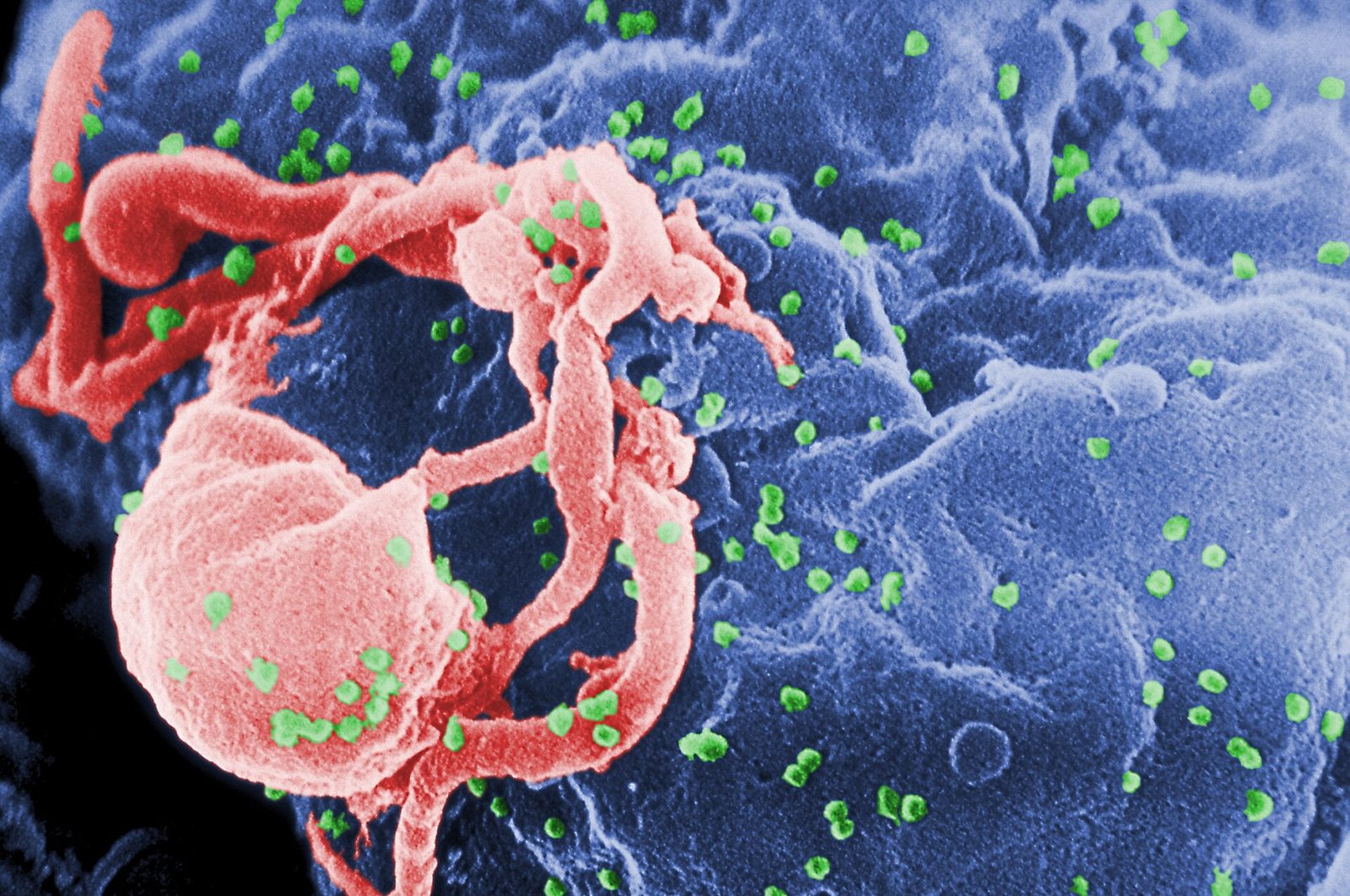
About eight per cent of your genome is the wreckage of ancient retroviruses, five times more than the part that codes for proteins. Most of it is inert. Some of it was repurposed, and one piece of it is what fuses the cells that separate a mother's blood from her child's.
Somewhere in the deep past, a retrovirus infected a sperm or an egg cell in one of our ancestors. It did what retroviruses do: copied itself into the host's DNA. Because it happened in a germ cell rather than a body cell, the insertion was passed to the next generation, and the one after that, and so on down the line to you.
That has happened, on our research file's figures, enough times to leave about a quarter of a million recognisable pieces of retrovirus in the human genome, adding up to roughly eight per cent of it. The part that actually codes for proteins is about one and a half per cent. There is more dead virus in you than there is you.
01What Is Actually In There
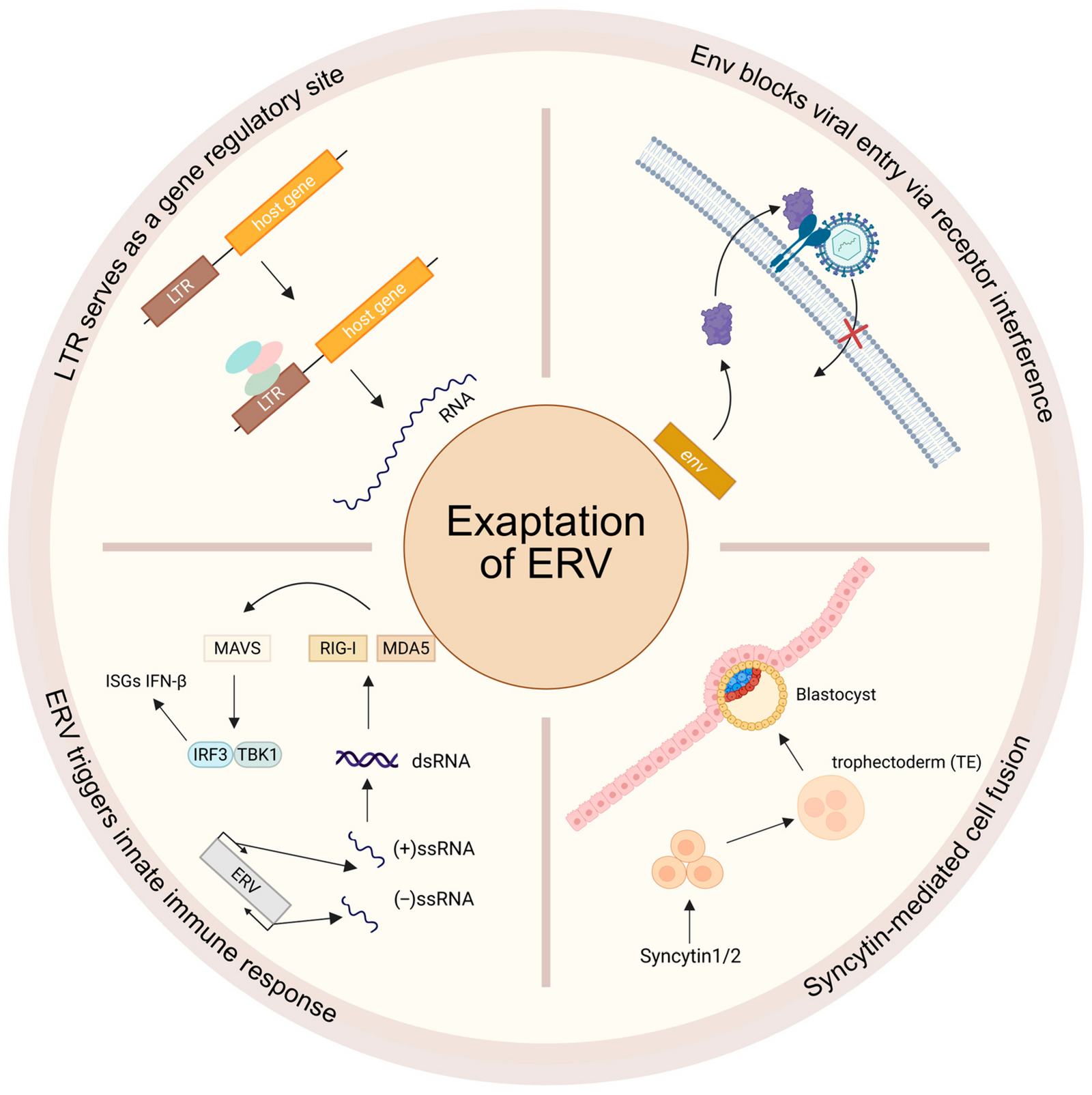
Our research file gives human endogenous retroviruses as roughly 8 per cent of the genome, some 250,000 proviral elements and fragments, against about 1.5 per cent that encodes proteins; counting all transposable-element-derived sequence, the fraction passes 45 per cent. Most HERVs are wrecks: stop codons, frameshifts and deletions have made them unable to replicate. But the long terminal repeats that flanked them survive as working promoters and enhancers, in about 320,000 solo LTR copies scattered through the genome. The virus is dead; its switches are not.
02The Placenta Is Partly Viral
The syncytiotrophoblast is the layer of fused cells that forms the barrier between a mother's blood and her child's tissue. What fuses those cells is a protein called syncytin, and syncytin is a retroviral envelope gene. Syncytin-1 comes from HERV-W, on chromosome 7q21.2; Syncytin-2 comes from HERV-FRD, on 6p24.1. Jean-Luc Blond and colleagues identified the first in the Journal of Virology in 2000; Sandra Blaise, Nathalie de Parseval, Laurence Bénit and Thierry Heidmann identified the second in PNAS in 2003. The gene a virus used to fuse its envelope with a cell it was invading has been repurposed to fuse the cells of the organ that lets mammals gestate.
This is not a curiosity. Anne Dupressoir and colleagues showed in PNAS in 2009 that mice engineered without the syncytin-A orthologue die in the womb, of placental failure. Take the captured virus gene out and the pregnancy does not work. And our file records the capture happening independently at least seven separate times across mammals: different retroviral envelope genes recruited for placentation in primates, mice, rabbits, dogs, cats and ruminants, on Lavialle and colleagues' 2013 account in Philosophical Transactions of the Royal Society B. Evolution reached for the same solution seven times, from seven different viruses.
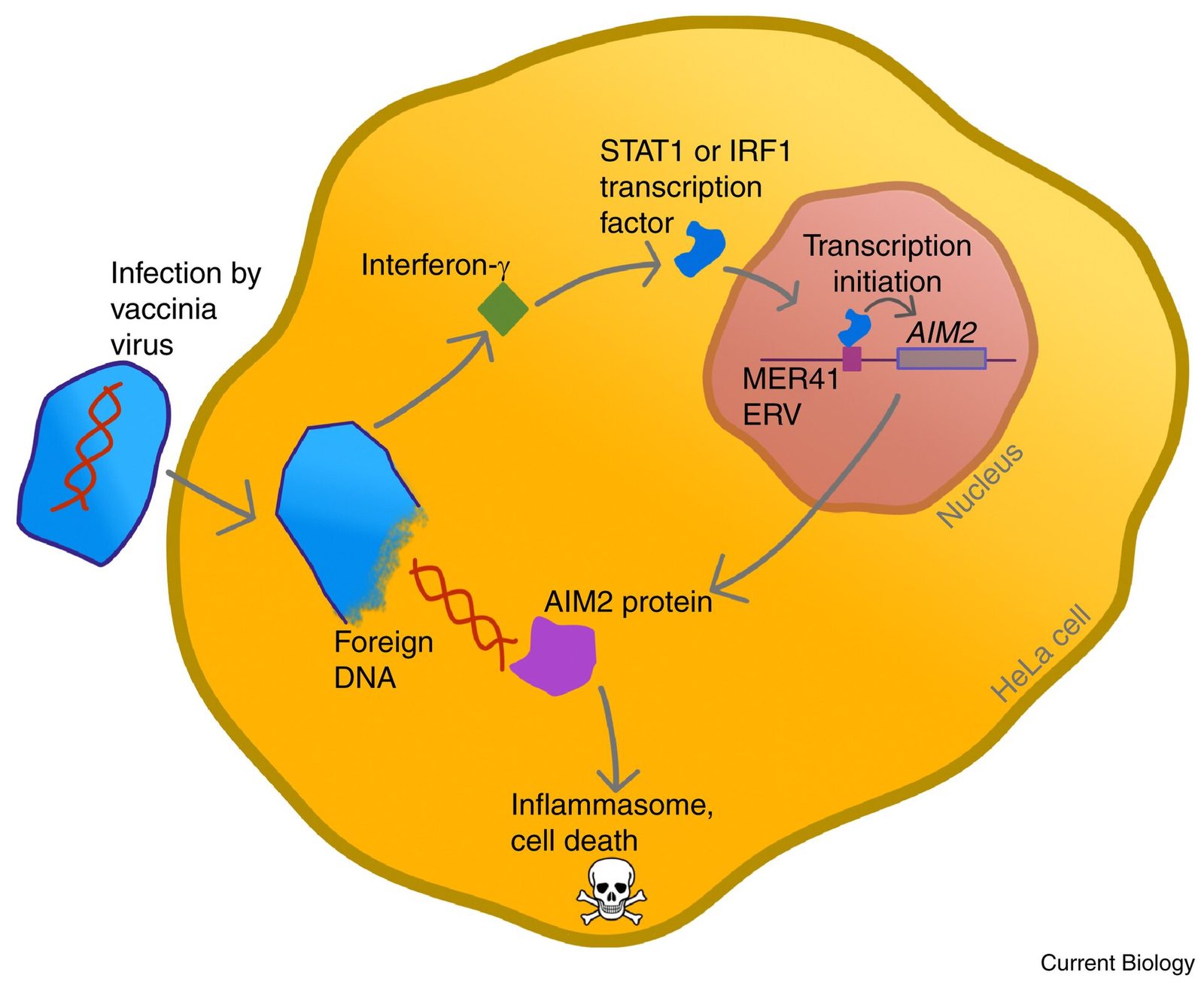
Edward Chuong, Nels Elde and Cédric Feschotte showed in Science in 2016 that enhancers derived from the MER41 family of endogenous retroviruses, which integrated about 45 to 60 million years ago, are bound by the STAT1 transcription factor and switch on interferon-stimulated genes. The demonstration is the convincing part: CRISPR deletion of MER41 elements near AIM2 and APOL1 abolished those genes' response to interferon-gamma in HeLa cells. The innate immune system has, in places, been wired up out of the remains of the things it defends against.
03The Disease Claim, And What Happened When It Was Tested
Our research file puts the connection between HERV-K reactivation and neurodegenerative disease at Tier 3, speculative, and adds that anti-retroviral clinical trials are underway but that causal roles remain unestablished. That tiering is correct. What follows is not a correction of it. It is three papers our file does not cite which show, rather precisely, why that tier is the right one.
In 2019 Jeremy Garson, Louise Usher, Ammar Al-Chalabi, Jim Huggett, Edmund Day and Adele McCormick set out to confirm the central observation independently. Total RNA from the postmortem premotor cortex of 34 ALS patients and 23 controls, RT-qPCR run to MIQE guidelines with gag, pol and env primer sets, normalised against two reference genes. Their finding, in their own words: geometric mean HERV-K RNA expression levels in the premotor cortex of ALS patients were not found to be different from the expression levels in non-ALS controls. The paper's own title contains the phrase fails to confirm.
The trial our file calls underway is the Lighthouse trial, and it published in 2019. Julian Gold, Dominic Rowe, Matthew Kiernan, Steve Vucic, Susan Mathers, Ruben van Eijk and colleagues gave Triumeq, a combination of three antiretrovirals, to 40 ALS patients for 24 weeks; 35 completed. THE PRIMARY OUTCOMES WERE SAFETY AND TOLERABILITY, and on those the news was good: no drug-related serious adverse events, one withdrawal for raised liver enzymes. The efficacy signal, quoted exactly as reported: a favourable response on HERV-K expression levels was observed, accompanied by a decline in ALSFRS-R progression rate of 21.8 per cent, 95 per cent confidence interval minus 4.8 per cent to 48.6 per cent. THAT INTERVAL CROSSES ZERO. A safety trial found a promising number that is statistically consistent with no effect at all, which is exactly what a safety trial is entitled to find.
In 2022 Marta García-Montojo, Elena Rita Simula, Saeed Fathi, Cynthia McMahan, Anubrata Ghosal, James Berry and colleagues measured antibodies against HML-2 envelope in 242 healthy donors, 243 people with ALS and 85 with multiple sclerosis. People with ALS did have more antibodies and higher HML-2 levels than controls, which fits the picture. But inside the ALS group the correlation ran the other way: lower antibody levels went with a definite diagnosis and with lower predicted and observed survival. More immune response against the retrovirus, better outcome. Their title says it carefully: may be protective.
| The Step | What Was Claimed | What Testing Showed |
|---|---|---|
| The observation | Elevated HERV-K expression in ALS brains and spinal neurons (Li and colleagues, 2015) | An independent 2019 replication in 34 ALS brains against 23 controls found no difference from controls. The paper's title says fails to confirm |
| The mechanism | HERV-K envelope protein is neurotoxic in vitro and in transgenic mice | Not contested here. In-vitro and animal neurotoxicity is a different claim from elevated expression in human patients, and the second is the one that failed replication |
| The treatment | Antiretroviral drugs might therefore help, and trials are underway | The Lighthouse trial reported in 2019. Safety and tolerability were the primary outcomes and were satisfactory. The efficacy number had a confidence interval crossing zero |
| The direction | Reactivation contributes to the disease | A 2022 study of 243 ALS patients found lower anti-HML-2 antibody levels associated with WORSE survival, which is what you would expect if the immune response were protective |
| Our file's own hedge | Reactivation may be a consequence rather than a cause of neurodegeneration | Its own counter-arguments section already notes that degenerating neurons show widespread epigenetic derepression, so HERV upregulation may be a symptom of that rather than a driver. That remains the most parsimonious reading |
04What It Is Not
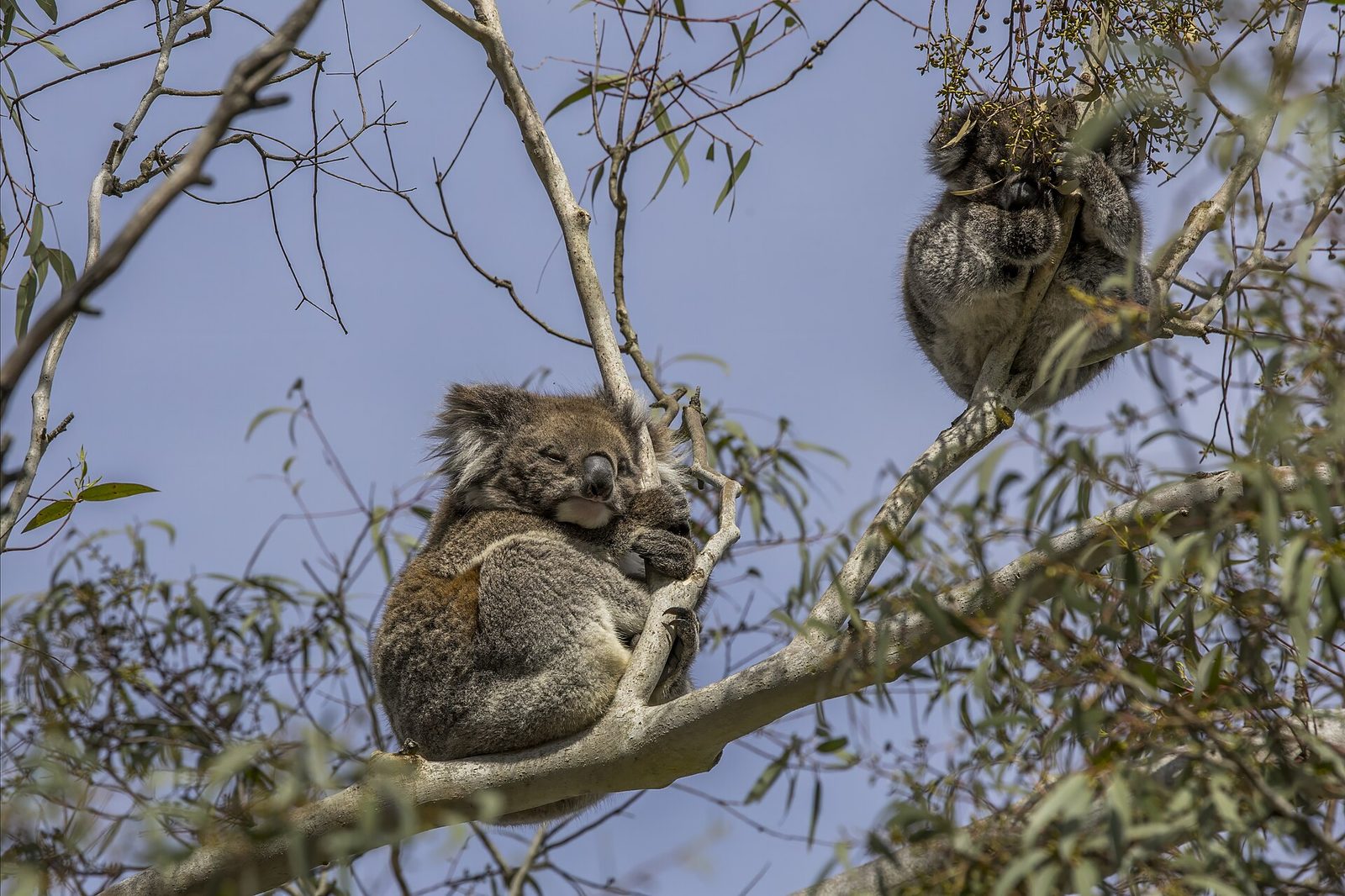
Claims that HERVs are evidence of ancient alien genetic engineering are refused in our own file, and its reason is the strongest kind there is. The mechanism does not need inferring from old sequence: retroviral infection of germ cells, proviral integration and vertical inheritance are observable in real time in other species. Our file names the koala retrovirus, currently undergoing endogenization in koala populations, citing Tarlinton, Meers and Young in Nature in 2006. What happened to our ancestors is happening to koalas.
Our file refuses the opposite error just as firmly, and gets the balance right in a single sentence. The ENCODE project and specific functional studies show that a significant fraction of HERV sequence has been co-opted for host regulation, so the blanket junk designation is outdated, though most HERV sequences remain genuinely non-functional. Its counter-arguments section puts a number on the second half: our file estimates that over 99 per cent of HERV-derived sequence shows no evidence of function, with selection analyses finding most insertions evolving at neutral rates. Both halves of that are true at once, and pages that quote only one of them are common.
05A Note On The File Itself
Every one of the fifteen identifiers in our research file was resolved live against Crossref for this article, and every one of them points at exactly the work it names, with matching authors, journal, year and title. That is the second flawless bibliography found in this programme and the largest. It is worth stating plainly, because the same procedure applied to other files in this library has been returning reviews attached to the books they review, chapters listed as standalone works with the publisher as author, and in two cases identifiers that resolve to nothing at all.
Every identifier resolving is not the same as every sentence being right, and this file proves it twice in one line. Its summary credits Jean-Luc Blond and Thierry Heidmann with identifying Syncytin-1 in 2000. HEIDMANN IS NOT AN AUTHOR OF THAT PAPER. Its nine authors are Blond, Lavillette, Cheynet, Bouton, Oriol, Chapel-Fernandes, Mandrand, Mallet and Cosset, which is what the DOI our file supplies resolves to and what our file's own bibliography row already says. Heidmann is on the 2003 Syncytin-2 paper, and the tidy symmetry of the sentence looks to have pulled him back onto the 2000 one. The same sentence calls the first author of that 2003 paper Sylvie Blaise. Crossref, Europe PMC and OpenAlex all give SANDRA, and the bibliography repeats the error rather than catching it.
This is the second file in this programme with a flawless bibliography and a wrong fact in its prose. The other, on tardigrades, resolved twelve identifiers out of twelve and then gave an age for a fossil that no source supports. CHECKING IDENTIFIERS AND CHECKING FACTS ARE DIFFERENT INSTRUMENTS, and passing the first says nothing about the second. What is encouraging here is where the contradiction was found: not in an outside source, but between one paragraph of the file and another. A document that carries its own bibliography properly can be caught by itself.
That prompted a measurement. Every research file used in this programme carries a Source Confidence rating out of five. Across the documents used so far, those rated 4 or 5 have 31 correct identifiers against 3 bad, 91 per cent. Those rated 2 or 3 have 12 correct against 30 bad, 29 per cent. THE CAVEATS BELONG WITH THE NUMBER: this is eleven documents, all from one run, chosen by roster rank rather than at random, and the rating was never designed to measure citation accuracy. It is not a controlled study. It is a strong enough signal to be worth acting on as triage, which is to say that if this library's bibliographies are going to be repaired in some order, the twos should go first.
Fast Facts
- The Fraction
- About 8 per cent of the human genome is HERV-derived, roughly 250,000 elements and fragments, against about 1.5 per cent that codes for protein. Our file's figures
- The Switches
- About 320,000 solo LTRs survive as promoters and enhancers, long after the viruses themselves stopped working
- Syncytin-1
- From HERV-W env, chromosome 7q21.2. Identified by Blond and colleagues, Journal of Virology, 2000
- Syncytin-2
- From HERV-FRD env, chromosome 6p24.1. Identified by Sandra Blaise and Thierry Heidmann, PNAS, 2003
- Why It Matters
- Mice without the syncytin-A orthologue die in the womb of placental failure. Dupressoir and colleagues, PNAS, 2009
- Seven Times Over
- Retroviral env genes have been independently captured for placentation in at least seven mammal lineages
- The Immune Wiring
- MER41 elements, integrated 45 to 60 million years ago, act as STAT1-bound enhancers. Delete them and interferon-gamma responsiveness goes
- The Youngest Family
- HERV-K(HML-2). About 90 near-full-length proviruses, at least 12 integrated after the split from chimpanzees, some with intact reading frames
- The ALS Claim
- Tier 3. An independent 2019 replication found no difference from controls; the Lighthouse trial's efficacy interval crosses zero; and a 2022 study suggests the antibody response may be protective
- Watch It Happen
- Koala retrovirus is endogenizing in koala populations now
What We Can Actually Stand Behind
HERV-derived sequence makes up roughly 8 per cent of the human genome, several times the protein-coding fraction. Syncytin-1 and Syncytin-2 are retroviral envelope genes that build the syncytiotrophoblast, and mice without the equivalent gene die of placental failure. MER41 elements function as STAT1-bound enhancers and deleting them abolishes interferon-gamma responsiveness in cell lines. The syncytin capture happened independently at least seven times. Koala retrovirus is endogenizing now. All fifteen identifiers in our own research file resolve correctly, and two author names in its summary are nonetheless wrong.
That syncytin capture represents convergent exaptation under strong selection. That HERV-H expression matters to human embryonic stem cell pluripotency, where the expression data are good and the functional experiments in brain are not yet there. And that HERV-K retains some replicative potential: reconstituted constructs make particles in culture, and those particles have never been shown to spread between people.
That HERV-K reactivation contributes causally to ALS or multiple sclerosis. Our own file already holds this at Tier 3 with the right hedge. Three papers it does not cite make that tiering look better rather than worse: a failed independent replication in 2019, a 2019 trial whose efficacy interval crosses zero, and a 2022 finding that more antibody response goes with better survival. A claim that survives testing as a Tier 3 claim is the tier system working.
HERVs are not evidence of engineering by anyone. The process is observable in koalas. And HERV sequence is not all junk, nor is it mostly functional: our file's own estimate is that over 99 per cent shows no evidence of function, and a small fraction is load-bearing enough that removing it is lethal. Both are true and neither on its own is the story.
There is a version of this subject that gets written a lot, in which the viruses in our DNA are secret controllers, or a hidden design signature, or the cause of every disease nobody can explain. The actual finding is stranger than any of those and harder to dramatise. A parasite got into the germ line, broke, and stayed. Most of what it left is inert. A few pieces got picked up and used, because evolution has no standards about where a working part comes from. And one of those pieces is what holds together the layer of tissue that lets a mammal grow another mammal inside itself. Not a message. Just an old accident that turned out to be useful, kept because it worked.
Sources & further reading
WHERE THIS WORKED FROM, AND WHERE IT CAN BE CHECKED. This article worked from one file in our own research library, L_3_17, at Source Confidence 5 out of 5. ALL FIFTEEN OF ITS IDENTIFIERS WERE RESOLVED LIVE AGAINST CROSSREF AND ALL FIFTEEN ARE CORRECT, matching the named authors, journal, year and title in every case. That is the second flawless bibliography found in this programme, after the tardigrades file's twelve of twelve, and the largest. It deserves stating as loudly as the failures found elsewhere. IT ALSO PROMPTED A MEASUREMENT, SET OUT IN SECTION 05. Across the eleven research files used in this programme, those rated 4 or 5 for Source Confidence carry 31 correct identifiers against 3 bad; those rated 2 or 3 carry 12 correct against 30 bad. The rating appears to predict citation accuracy. The caveats are printed with the number on the page: eleven documents, one run, selected by roster rank rather than at random, and a rating never designed for this purpose. AND TWO THINGS IN IT ARE WRONG, WHICH THE IDENTIFIER CHECK DOES NOT CATCH. Its summary credits Thierry Heidmann as an author of the 2000 Syncytin-1 paper; the paper has nine authors and he is not among them, as the file's own bibliography row and the DOI it supplies both show. And it calls the first author of the 2003 Syncytin-2 paper Sylvie Blaise, in the summary and in the bibliography row alike; Crossref, Europe PMC and OpenAlex all give Sandra. Both are reported in section 05 and both are logged against L_3_17 for the corpus hygiene campaign. WHAT THIS PAGE ADDS THAT OUR FILE PREDATES. Our file was last updated on 10 April 2026 and its Tier 3 section says antiretroviral trials are underway. Three papers bear directly on that and are not cited there: Garson and colleagues in Acta Neuropathologica Communications in 2019, an independent replication that failed to confirm elevated HERV-K RNA in ALS brain; Gold and colleagues in Amyotrophic Lateral Sclerosis and Frontotemporal Degeneration in 2019, the Lighthouse trial, which reported safety and tolerability as its primary outcomes and an efficacy interval crossing zero; and Garcia-Montojo and colleagues in Annals of Neurology in 2022, finding that lower anti-HML-2 antibody levels went with worse survival. A fourth, Attig and colleagues in the Journal of Clinical Investigation in 2023, is cited for the cancer picture. NONE OF THESE OVERTURNS OUR FILE. They support its own decision to hold the claim at Tier 3. WHAT IS CARRIED AS OUR FILE'S OWN. The 8 per cent and 250,000 and 320,000 figures, the 45 per cent transposable-element total, the integration dates, the provirus counts, the seven independent syncytin captures, the MER41 integration window and the over-99-per-cent non-functional estimate. Those numbers come from papers our file cites correctly and whose identifiers all resolve, but the numbers themselves were not re-read from the papers for this article. ON THE IMAGES. The hero is an electron micrograph of HIV-1 particles budding from a cell. HIV IS AN EXOGENOUS RETROVIRUS AND NOT A HERV; it is used because it shows the event this whole subject is the fossil record of, and its caption says so. One further image was fetched and dropped for a reason new to this programme: an accurate, correctly licensed schematic of the term placenta labelling the syncytiotrophoblast, which is unreadable at the roughly 358 pixels a side column gives it. Correct at full size, useless at the delivered size.
Image credits
- HIV-1 particles budding from a cultured lymphocyte, colourised scanning electron micrograph C. Goldsmith, CDC, via Wikimedia Commons (public domain). Public domain Source.
- Exaptation of endogenous retroviruses: four host functions built from captured retroviral sequence Jiang R, Zhou J, Liu Y and colleagues, via Wikimedia Commons (CC BY 4.0). CC BY 4.0 Source.
- A MER41 endogenous retroviral element acting as an interferon-inducible enhancer upstream of AIM2 Aris Katzourakis, figure published in Current Biology, via Wikimedia Commons (CC BY 4.0). CC BY 4.0 Source.
- Koalas (Phascolarctos cinereus), Mount Lofty, South Australia Charles J. Sharp, via Wikimedia Commons (CC BY-SA 4.0). CC BY-SA 4.0 Source.


_female_Mount_Lofty_4.jpg)