
The Octopus: An Alien Intelligence Born on Earth
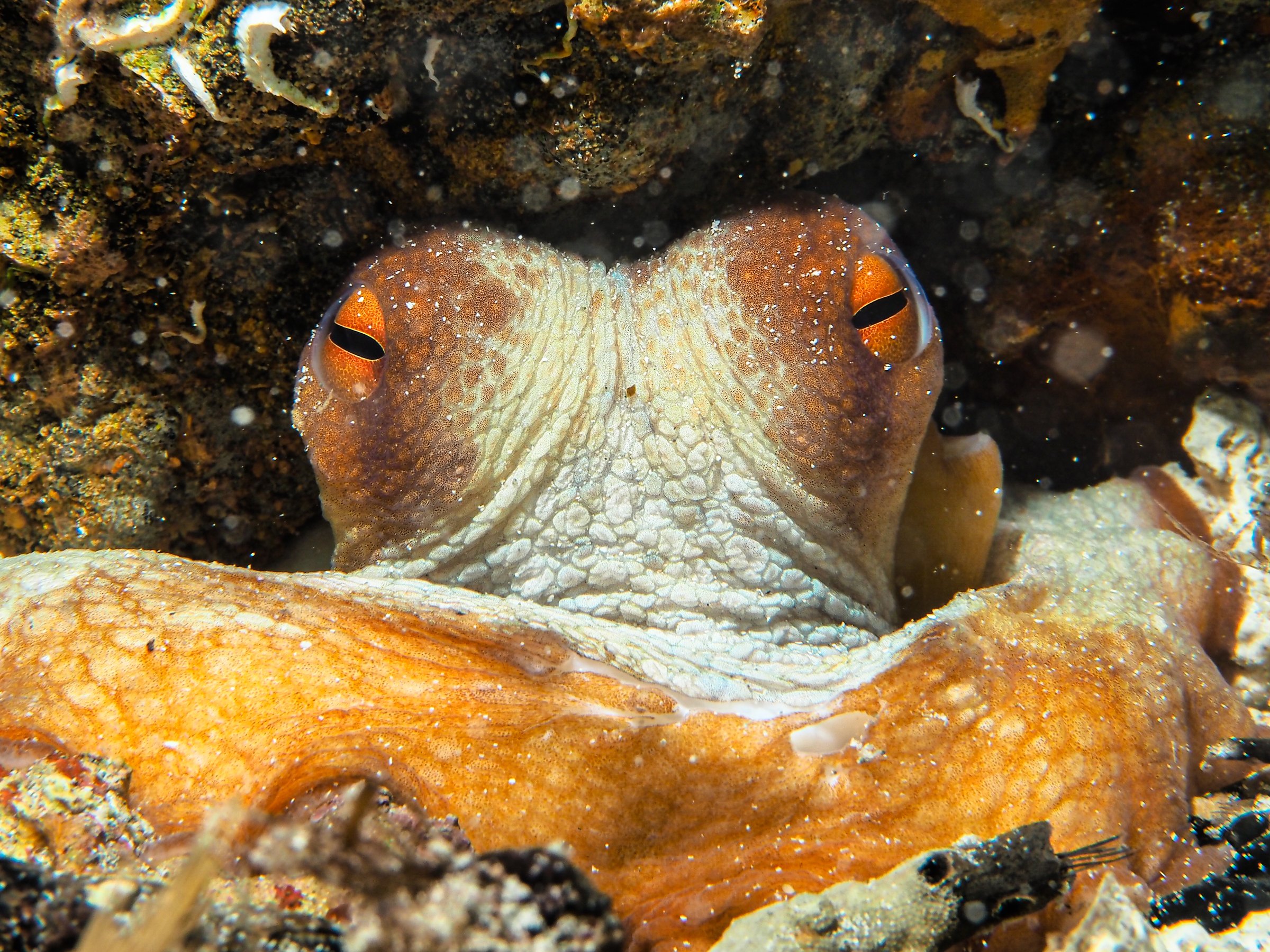
The octopus is the closest thing to an intelligent alien any of us will ever meet, and it evolved here, in our own oceans, on a branch of the animal kingdom that split from ours more than 500 million years ago. It has about 500 million neurons, as many as a dog, but two-thirds of them are in its arms, not its head, so that each arm can taste, feel, and decide almost on its own. It uses tools, solves puzzles, keeps a personality, and rewrites its own nervous system on the fly. This is what is genuinely known about the octopus mind, what remains a real and open mystery, and where the wonder ends and the science fiction begins.
If you want to know what an alien mind might be like, you do not need to leave Earth. You need only look into the eye of an octopus, and let it look back. The octopus is an intelligence that evolved on a completely separate branch of the animal kingdom from our own. The last ancestor we share with it lived more than 500 million years ago, long before anything on this planet had what we would call a brain, and whatever that creature was, it was nothing like an octopus and nothing like us. Which means the octopus mind was not inherited from a common blueprint. It was invented from scratch, a second time, out of entirely different materials. The result is a body that thinks with its skin, arms that make their own decisions, and a set of abilities that keep forcing biologists to ask uncomfortable questions about what a mind even is. This is what we actually know about that intelligence, what remains genuinely mysterious, and where the sober wonder gives way to nonsense.
01A Mind Turned Inside Out
Start with the raw hardware. A common octopus has on the order of 500 million neurons, roughly as many as a dog. That alone is remarkable for a mollusc, a cousin of the clam and the snail. But the truly strange fact is where those neurons are. In a human, and in almost every vertebrate, more than 99 percent of the nervous system sits in the brain and spinal cord. In an octopus, only a minority is in the central brain at all. Roughly two-thirds of its neurons, some 350 million of them, are distributed down the eight arms, split fairly evenly, around 44 million to each arm. The central brain, the doughnut-shaped mass wrapped around the animal's esophagus, is actually the smallest piece of the system, holding only about 45 to 50 million neurons; the two optic lobes behind the eyes, dedicated to vision, hold more than the brain does, something like 120 to 180 million between them. And here is the detail that changes everything: the brain, the optic lobes, and the vast peripheral nervous system of the arms are connected to one another by only about 30,000 nerve fibers. That is a startlingly thin cable for so much processing power, and it means most of what an octopus's arms do, they must be doing largely by themselves. This is not a brain that pilots a body. It is closer to a federation of nervous systems that cooperate.
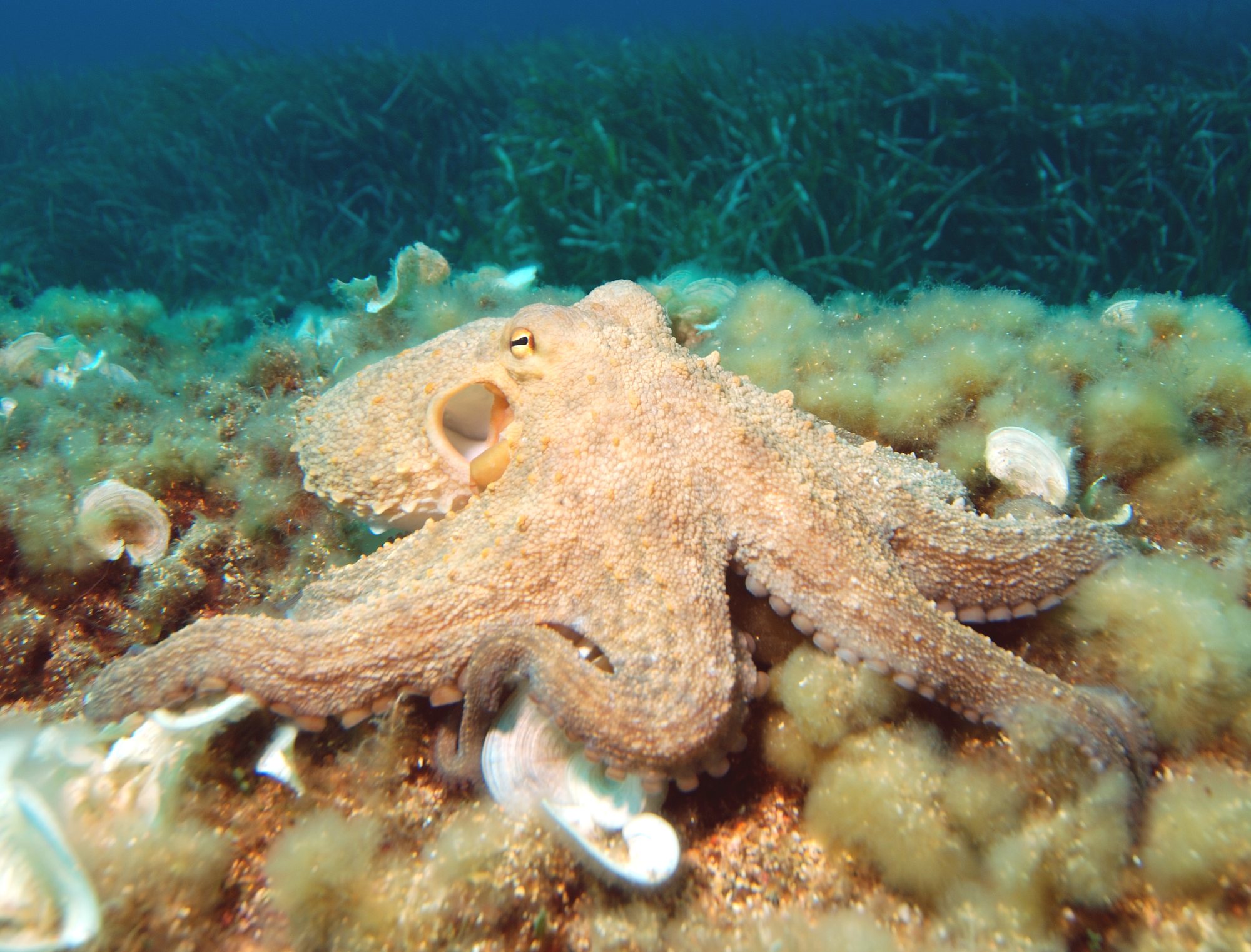
What does that distributed design actually buy the animal? Astonishing autonomy in the arms. In a now-famous 2001 experiment, Binyamin Hochner's group in Jerusalem (Sumbre and colleagues, published in Science) showed that an octopus arm, even one fully severed from the body, still carries enough neural circuitry to run the animal's signature reaching-and-grasping movement on its own, an organized motor program built into the arm itself rather than dictated from the center. In the living animal, each arm can independently taste and touch what it encounters, explore a crevice, grasp an object, and pull back from something noxious, without waiting for orders. The central brain, in this picture, does not micromanage. It sets goals and coordinates, described in our own research library as a conductor leading an orchestra of semi-autonomous musicians. Exactly how much the arms 'decide' versus 'execute,' and how the central brain keeps track of eight semi-independent limbs at once, is still active research; the autonomy is real and measured, but it should not be inflated into the arms 'thinking' with no involvement from the brain. What is certain is that this is a fundamentally different way to build a behaving animal than the one we know from the inside.
02The Problem-Solver
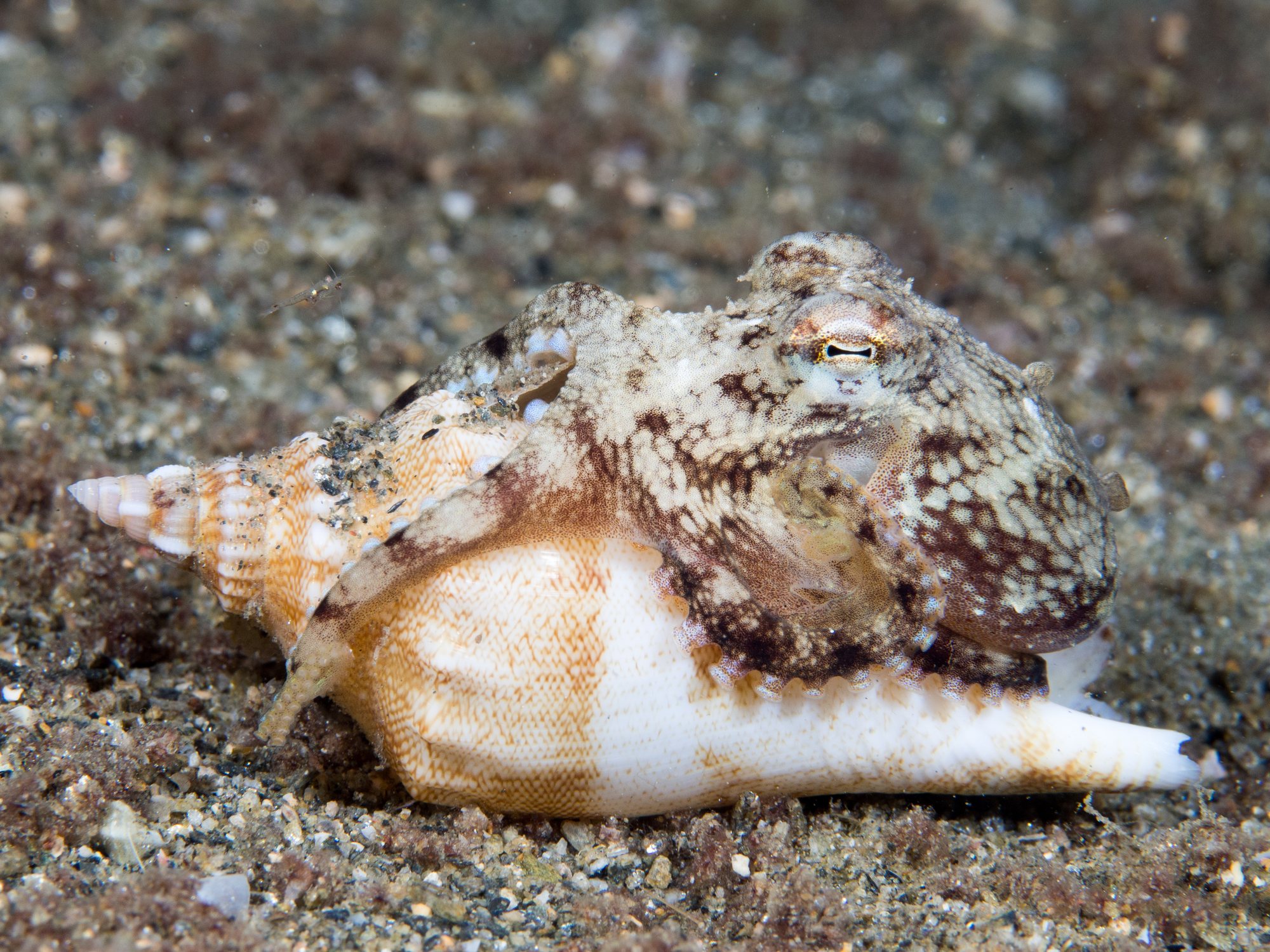
A distributed nervous system would be a mere curiosity if it produced a dull animal. It does the opposite. The single most celebrated demonstration came in 2009, when Julian Finn and colleagues (Finn, Tregenza and Norman, in Current Biology) documented veined octopuses off Indonesia doing something no invertebrate had ever been seen to do: gathering discarded coconut-shell halves from the seafloor, cleaning them out, and carrying them stacked beneath the body while awkwardly 'stilt-walking' on the tips of their arms, only to reassemble them later into a shelter. That last part is the crux. Carrying a shell you are hiding under right now is just using cover. Carrying an object that is currently useless, and in fact cumbersome, because you will need it later, is tool use, complete with what looks like planning for the future. It met every criterion, and it stood as the first case of tool use ever recorded in an invertebrate. It is not an isolated trick, either. Octopuses in the lab routinely unscrew jars from the inside to reach food, thread through mazes, and work through multi-step puzzles that demand actions in the right sequence. And in 1992, Graziano Fiorito and Pietro Scotto (in Science) showed something subtler still: an untrained octopus that simply watched a trained one attack a particular colored ball would then choose that same ball itself. Observational learning, copying another individual, was a capacity long assumed to be the preserve of birds and mammals.
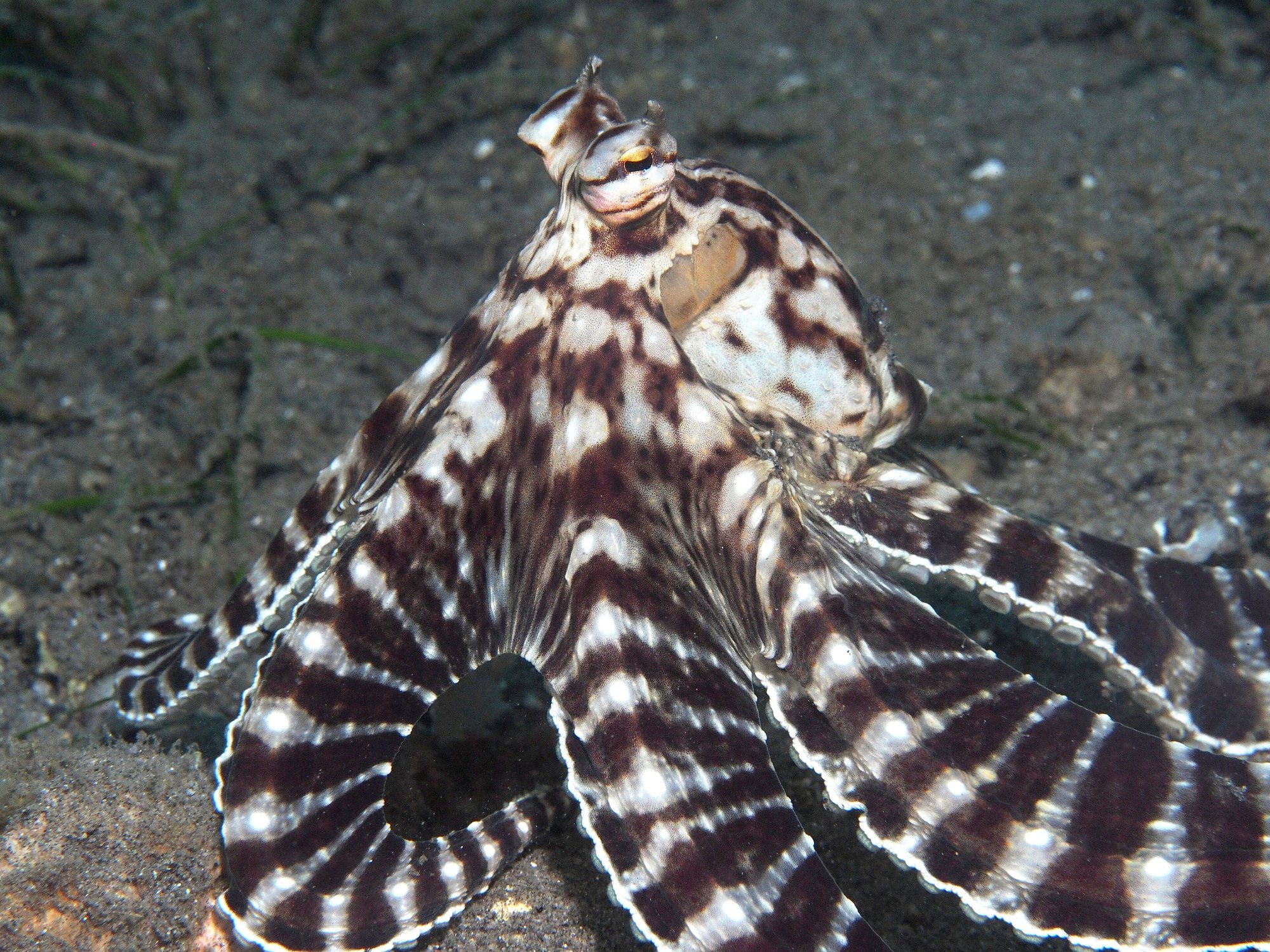
Nowhere is octopus behavioral flexibility more theatrical than in the mimic octopus, Thaumoctopus mimicus, a slender, boldly striped species first noticed off Sulawesi, Indonesia, in 1998 and formally named in 2005 by Mark Norman and F. G. Hochberg. It does not merely camouflage; it impersonates. By flattening, folding, and striping its arms and body, and moving in a borrowed way, it can pass for at least fifteen other marine animals, nearly all of them venomous, toxic, or otherwise a bad meal: a banded sea snake, a lionfish with poisonous spines, a flatfish gliding along the bottom, and more. Most striking of all, it appears to choose which creature to imitate based on the specific threat it faces. Confronted by a territorial damselfish, for example, it has been reported to impersonate a banded sea snake, which happens to be a known predator of damselfish. Whether this reflects genuine on-the-spot assessment or a more automatic set of learned responses is not fully settled, and it deserves the honest hedge. But the raw fact, a soft-bodied animal running a repertoire of impressions and seeming to pick the right one for the audience, is one of the most extraordinary behaviors in the sea.
03The Skin That Lies
The octopus and its cousins carry a second marvel on the outside: a living display screen for skin. It works in three stacked layers. On top are the chromatophores, tiny elastic sacs of red, yellow, and brown pigment, each one ringed by its own muscles and wired directly to the nervous system, so the animal can stretch a sac open or let it snap shut in an instant. Below those sit iridophores, which use microscopic stacked plates to bounce light into structural blues, greens, and silvers, and beneath them leucophores, broadband reflectors that scatter back whatever white light is around. Together these layers let a cuttlefish or octopus repaint itself, and even change the texture of its skin, in a matter of a few hundred milliseconds, faster than you can react to it. It uses this to match a background with uncanny precision, and cuttlefish command a whole grammar of camouflage: a flat uniform tone, a medium-scale mottle, or bold disruptive blotches that shatter the body's outline against a busy reef. It is, in a real sense, thinking made visible on the surface of the body.
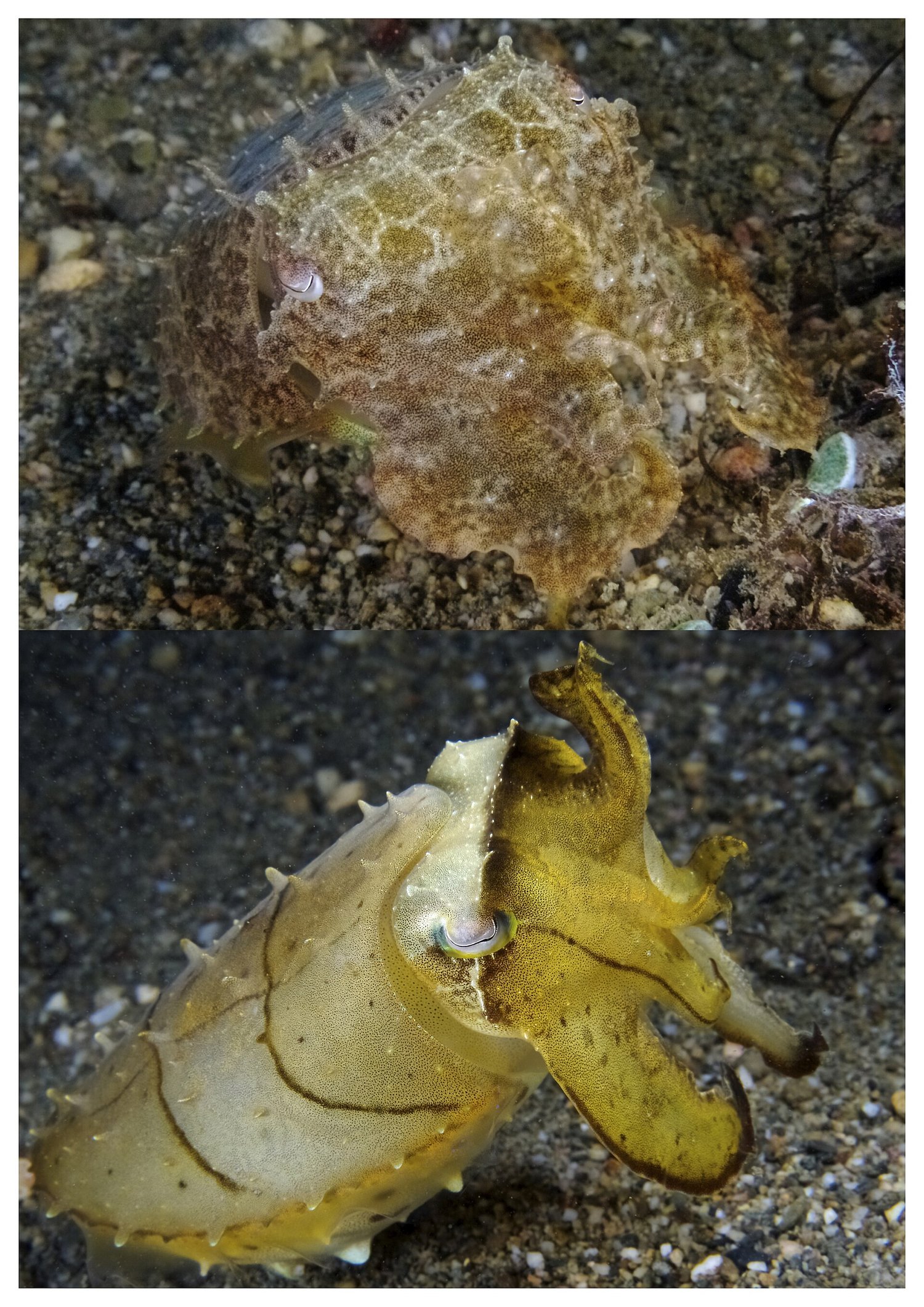
Now for the genuine paradox, one biologists have argued over for years. Almost all cephalopods have only a single type of light-detecting pigment in the retina, which by every ordinary rule should make them colorblind, unable to tell one hue from another. And yet they produce color matches to their surroundings so exact that a human diver cannot spot them. How can an animal that cannot see color reproduce it perfectly? The honest answer is that we do not entirely know, and that this is a live puzzle rather than a solved one. The most intriguing proposal came in 2016 from an unusual father-and-son team, the biologist Alexander Stubbs and the astrophysicist Christopher Stubbs (in the Proceedings of the National Academy of Sciences). They suggested the animals exploit a flaw instead of fixing it: the strange, off-center, U-shaped pupil of a cephalopod spreads different colors of light to slightly different focal distances (an effect called chromatic aberration), so that by subtly refocusing the eye, the animal could in principle read off color from how the blur changes, without ever needing a second pigment. It is a beautiful idea, and it remains a hypothesis under test, not an established fact. One number worth correcting while we are here: an octopus's skin carries something like 200 to 230 chromatophores per square millimeter, which works out to a little over 20,000 per square centimeter, while the whole animal, head to arm-tip, carries on the order of 10 to 20 million of these color organs in total. Those are two different measurements, an areal density and a body-wide count, and they are easy to run together into a single wrong figure.
04Rewriting the Wiring
Cephalopods have shaped neuroscience for almost a century, and the deepest surprise is the most recent. Go back to the 1950s and you find the squid at the very foundation of the field: the squid's giant axon, a nerve fiber up to about a millimeter thick, was so unusually large that Alan Hodgkin and Andrew Huxley could push electrodes inside it and work out, for the first time, the ionic mechanism of the nerve impulse itself, the work that won them a share of the 1963 Nobel Prize and that still underlies every textbook account of how neurons fire. But the modern shock is different in kind. In 2017, Noa Liscovitch-Brauer, Joshua Rosenthal, Eli Eisenberg, and colleagues (in Cell) reported that the coleoid cephalopods, the octopuses, squid, and cuttlefish, but not the primitive nautilus, do something with their genetic information that almost nothing else does to this degree. They routinely recode their own messenger RNA on the way from gene to protein, chemically converting one letter of the code (adenosine) into another (inosine, read as guanosine) at hundreds of thousands of sites, far more heavily than in humans. In us, the great majority of such RNA editing happens in stretches that do not code for protein at all. In these cephalopods, editing rewrites the proteins themselves, and it falls especially on the proteins of the nervous system: ion channels, synaptic machinery, the scaffolding of neurons.
The implication is genuinely mind-bending, and it is where careful tiering matters. The measurement is Tier 1: the editing is real, extensive, and heavily concentrated on neural proteins, with more than half of the relevant transcripts edited in some tissues. The interpretation is where honesty is required. Rosenthal and his colleagues proposed a striking trade-off: to keep this vast editing apparatus working, a cephalopod must hold the DNA around each editing site unusually still, under strong purifying selection, which appears to slow the ordinary evolution of those regions of the genome. In other words, these animals may have partly traded the long, slow adaptation of changing their genes for a faster, more flexible adaptation of changing their RNA from moment to moment, editing rather than mutating. There is even suggestive evidence that some of this editing responds to conditions such as temperature, hinting at real-time tuning of the nervous system. How much of the octopus's behavioral flexibility actually traces to RNA editing, as opposed to being merely correlated with it, is not yet established, and that gap should not be papered over. But the core discovery stands, and it is astonishing: an animal that revises the blueprint of its own mind on the fly.
05A Personality on a Deadline
The evidence that there is a 'someone' inside an octopus is behavioral, and it is surprisingly rich. Individual octopuses have measurable, consistent personalities: as far back as 1993, Jennifer Mather and Roland Anderson documented stable differences between individuals across dimensions of activity, reactivity, and avoidance, the same kind of personality axes studied in vertebrates. They play, in the technical sense of the word: octopuses have been recorded repeatedly using their funnels to blow empty pill bottles around their tanks, back and forth, with no food or survival payoff at all, which is close to a working definition of object play. They show self-control that reads as planning. In 2021, Alexandra Schnell and colleagues (in the Proceedings of the Royal Society B) gave common cuttlefish a version of the marshmallow test made famous with human children: the animals could take an immediately available but less-preferred snack, or hold out for a favorite one, a live grass shrimp. The cuttlefish waited, in some cases for more than two minutes, refusing the sure thing for the better thing. And the individuals with the strongest self-control also learned fastest on a separate task, echoing the link between patience and cognition seen in children. This finding is often misattributed; the lead author is Alexandra Schnell, not, as some summaries state, Piero Amodio, who is a real and separate cephalopod researcher.
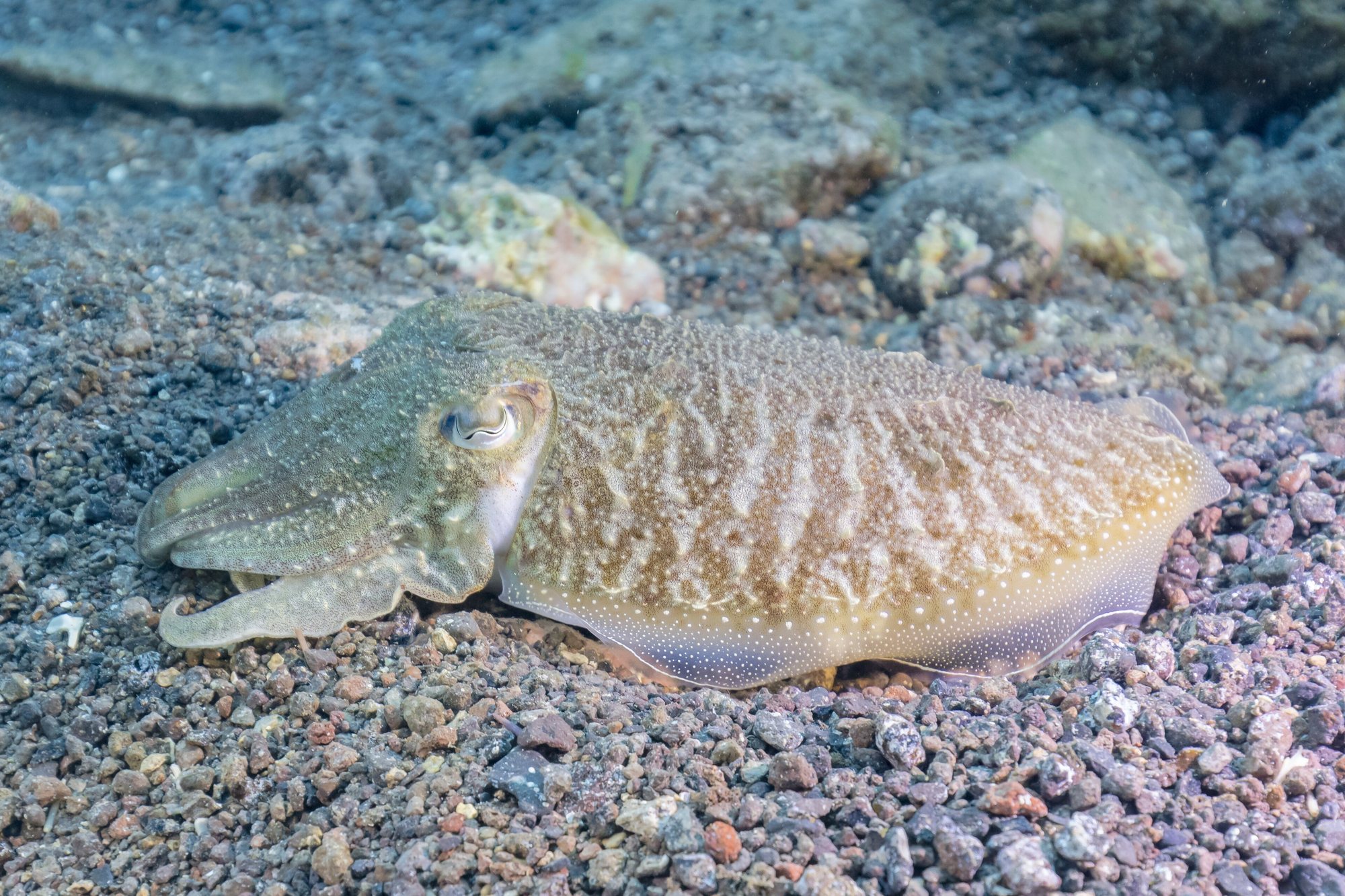
All of this has begun to change how the law treats these animals. In 2021, a review led by Jonathan Birch at the London School of Economics weighed more than 300 studies on pain, distress, and internal states in cephalopod molluscs and decapod crustaceans, and concluded there was strong evidence of sentience. On that basis the United Kingdom formally recognized octopuses, squid, and cuttlefish as sentient beings in the Animal Welfare (Sentience) Act 2022, becoming the first country to extend that kind of legal protection to invertebrates. The behavioral case behind that decision goes beyond simple reflex: octopuses nurse and guard injured arms and avoid places where they have been hurt, which points to an experience of pain rather than mere automatic withdrawal; they treat different human keepers differently, recognizing individuals; and their moods seem to flicker across their skin in shifting color. Which makes the last fact almost unbearably strange. Most octopuses live only one to two years. Even the giant Pacific octopus, the largest of them all, reaches only about four and a half to five. And most females die shortly after their eggs hatch, so there is essentially no passing of knowledge from one generation to the next. Each octopus, in effect, builds its formidable mind alone, from scratch, and uses it for a single brief season. Why evolution would invest in such expensive intelligence for an animal with so little time to spend it, whether the pressure of predators, the demands of a complicated seafloor, or something else, is a genuine and unresolved puzzle.
06Is Anyone Home?
All of which leads to the question the octopus was always going to raise: is it conscious, and if so, what is that consciousness like? Here we are honestly at the edge of what anyone can prove. The philosopher Peter Godfrey-Smith, who has spent years in the water with them, argues that if octopuses have any inner experience at all, it represents an independent origin of subjective experience, meaning that consciousness would have arisen at least twice on Earth, on two different neural architectures. His often-quoted line captures the stakes: 'This is probably the closest we will come to meeting an intelligent alien.' The idea is taken seriously in mainstream science. In 2012 a group of neuroscientists issued the Cambridge Declaration on Consciousness, which stated that non-human animals, cephalopods explicitly among them, possess the neurological substrates that generate consciousness. It is worth being precise about that event, because it is often embellished: the declaration was written and signed by the assembled neuroscientists, and the physicist Stephen Hawking attended the conference as its guest of honor and was present at the signing, but he was not himself one of the scientist-authors. And then there is the deepest and least answerable question of all. Given that each of an octopus's arms carries its own web of neurons capable of acting on its own, some thinkers, Godfrey-Smith among them, have asked whether octopus consciousness, if it exists, is a single unified thing at all, or something stranger and partly distributed, with the arms carrying some flicker of experience of their own. There is no experiment that settles this today. It is a real question that the octopus poses to our very assumption that a mind must be one thing, in one place.
One more open thread is worth naming as open. Because cephalopods can throw patterns across their skin so fast, and because some, like the Caribbean reef squid, run elaborate rippling 'passing cloud' displays in social settings, it has been proposed that this skin-signaling might amount to a kind of visual language. It is a legitimate line of research, recently energized by the same tools being turned on whale and dolphin communication. But it must be reported for exactly what it is: no one has found a syntax, a grammar, or symbolic reference in these displays. The honest statement is that cephalopod skin patterning clearly carries information, and might carry more than we yet realize, and that calling it a 'language' is a hope, not a result.
Finally, two claims that must be named and set firmly aside, because the word 'alien' invites them. The first is literal. In 2018 a paper by Steele and dozens of co-authors floated the notion that octopuses are alien in the strict sense, their eggs supposedly arriving frozen on comets, with an extraterrestrial virus even helping to trigger the Cambrian explosion of animal life. This drew immediate and sustained criticism from biologists as, in the words of one response, frankly ridiculous. The reason is simple: octopus ancestry is not a mystery that needs a cosmic rescue. Cephalopods have a rich fossil record, from shelled nautiloids in the Cambrian more than 500 million years ago to the first modern-style octopods in the age of the dinosaurs, and their genes place them squarely and unambiguously within the molluscs, alongside snails and clams. Nothing about them requires, or even hints at, an origin in space. The octopus is an alien intelligence only in the profound metaphorical sense Godfrey-Smith means, a mind that evolved independently of ours, here on Earth, and that is a far more interesting truth than the fantasy. The second claim is gentler but no truer: Paul the octopus, who 'predicted' World Cup matches in 2010 by picking between two flag-marked feeding boxes, was demonstrating chance and a plausible preference for high-contrast patterns, not precognition. A charming story, and nothing more.
Fast Facts
- Neurons
- About 500 million, comparable to a dog. Roughly two-thirds (around 350 million) are in the eight arms; the central brain is the smallest part (about 45 to 50 million), the optic lobes hold more (about 120 to 180 million combined), all linked by only about 30,000 nerve fibers
- Arm autonomy
- A severed octopus arm can still run the reaching-and-grasping motor program on its own (Sumbre et al., 2001). In life each arm tastes, touches, and acts semi-independently
- Tool use
- The veined octopus carries and stacks discarded coconut-shell halves to build a shelter (Finn, Tregenza and Norman, 2009), the first tool use recorded in any invertebrate
- Camouflage
- A three-layer skin (chromatophores, iridophores, leucophores) repaints color and texture in a few hundred milliseconds, even though the animal has one visual pigment and is effectively colorblind
- RNA editing
- Octopuses, squid and cuttlefish recode most of their neural messenger RNA (A-to-I editing) at hundreds of thousands of sites (Liscovitch-Brauer et al., 2017), apparently trading genomic evolution for on-the-fly flexibility
- Sentience and lifespan
- The UK legally recognized cephalopods as sentient in 2022 (300-plus studies reviewed). Yet most octopuses live only 1 to 2 years, females usually die after the eggs hatch, and each builds its mind essentially from scratch
- Refused
- That octopuses came from space on comets (a 2018 fringe claim; their mollusc ancestry and fossil record are clear), and that 'Paul the octopus' truly predicted football matches (chance and pattern preference, not precognition)
What We Can Actually Stand Behind
The core biology is settled. The octopus has roughly 500 million neurons with about two-thirds of them in the arms, a genuinely distributed nervous system in which a severed arm can still act (Sumbre et al., 2001). It uses tools (Finn, Tregenza and Norman, 2009), learns by observation (Fiorito and Scotto, 1992), and repaints its skin through a real three-layer chromatophore system. And coleoid cephalopods do recode most of their neural RNA through extensive A-to-I editing (Liscovitch-Brauer et al., 2017). These are facts.
Several important claims are real but still being worked out. How much the arms genuinely 'decide' versus execute, and how the central brain coordinates them, is active research. The functional payoff of RNA editing, how much of octopus flexibility it actually explains, is suggestive rather than proven. And the behavioral evidence for personality, play, and cuttlefish self-control (Schnell et al., 2021) is strong and was solid enough to underpin the UK's 2022 legal recognition of cephalopod sentience.
The deepest questions stay open. Whether octopuses are conscious, and if so whether that consciousness is unified or partly distributed across the arms (Godfrey-Smith's question), has no experimental resolution today. And whether the animals' rapid skin patterning amounts to a communication system with any grammar, as opposed to carrying information without a true language, is an active but unsettled line of research. Real questions, honestly unanswered.
The overclaims get a clear no. Octopuses did not arrive from space: the 2018 panspermia paper was widely rejected, and their mollusc ancestry and fossil record are unambiguous. 'Paul the octopus' did not predict football; that was chance and pattern preference. The octopus is an alien intelligence only in the true and stranger sense, a mind that evolved independently of ours right here on Earth, and refusing the science fiction takes nothing away from that.
The octopus opens The Living World's band of evolutionary masterworks because it proves a point the whole wing keeps making: that ordinary chemistry, given enough time and enough pressure, can wake up more than once, and can do it in shapes we would never have imagined. Here is an animal with its mind spread down its arms, a skin that lies faster than the eye can follow, and a nervous system it rewrites as it goes, living out a brilliant existence in the space of a single year and then vanishing, taking everything it learned with it. It asks us, without a word, to loosen our grip on the idea that a mind has to look like ours, or sit in one place, or last a long time. The wonder of it needs no embellishment and no extraterrestrial backstory. That a cousin of the snail, on a branch of life that parted from ours before there were brains at all, should end up looking back at us through a strange horizontal eye and, quite possibly, wondering in its own way what we are, is astonishment enough.
Sources & further reading
Everything above is drawn from our research library on Theories of Anything, with the specific studies below. Open the full file to check the sourcing and go deeper.
Image credits
- Common octopus (Octopus vulgaris) in its den, Cirkewwa, Malta Victor Micallef, via Wikimedia Commons (CC BY-SA 4.0). CC BY-SA 4.0 Source.
- Common octopus (Octopus vulgaris) in the open Albert Kok, via Wikimedia Commons (CC BY-SA 3.0). CC BY-SA 3.0 Source.
- Cuttlefish changing color, same individual seconds apart Nick Hobgood, via Wikimedia Commons (CC BY-SA 3.0). CC BY-SA 3.0 Source.
- Veined (coconut) octopus (Amphioctopus marginatus) with a gastropod shell Rickard Zerpe, via Wikimedia Commons (CC BY 2.0). CC BY 2.0 Source.
- Mimic octopus (Thaumoctopus mimicus) Rickard Zerpe, via Wikimedia Commons (CC BY-SA 2.0). CC BY-SA 2.0 Source.
- Common cuttlefish (Sepia officinalis), Tenerife Diego Delso (poco a poco), via Wikimedia Commons (CC BY-SA 4.0). CC BY-SA 4.0 Source.
- Card crop of the octopus in its den Victor Micallef, via Wikimedia Commons (CC BY-SA 4.0). CC BY-SA 4.0


_(45031078485).jpg)
_(14217664448).jpg)
,_franja_marina_Teno-Rasca,_Tenerife,_Espa%C3%B1a,_2022-01-09,_DD_24.jpg)