
The Glass Panopticon: The Ethics of Being Watched
In 1791 Jeremy Bentham designed a perfect prison: a ring of cells around a single central tower, arranged so that a prisoner could never tell whether he was being watched, and so came to behave as if he always was. It was never built to his plan, and it did not need to be. Two centuries later we have built its logic into the fabric of ordinary life, in the camera on the corner, the data trail behind every click, and the quiet knowledge that someone, somewhere, might be looking. This is the ethics of surveillance: what constant watching does to a person, who it protects and who it controls, and the honest refusal to pretend either that watching is always justified or that it is always tyranny.
The deepest insight in the ethics of surveillance is more than two hundred years old, and it is this: the power of being watched does not come from actually being watched. It comes from not knowing whether you are. A watcher who is present only some of the time, but who might be present at any time, changes your behavior exactly as much as one who never looks away, because you cannot afford to assume you are unobserved. Jeremy Bentham designed a building around that insight, and Michel Foucault turned it into a diagnosis of modern life. Between them they explain why a camera you have stopped noticing still shapes what you do beneath it, and why the central ethical question of the surveillance age is not really about cameras or data at all, but about what it does to a free person to live inside a structure that is always, possibly, looking.
01Bentham's Machine
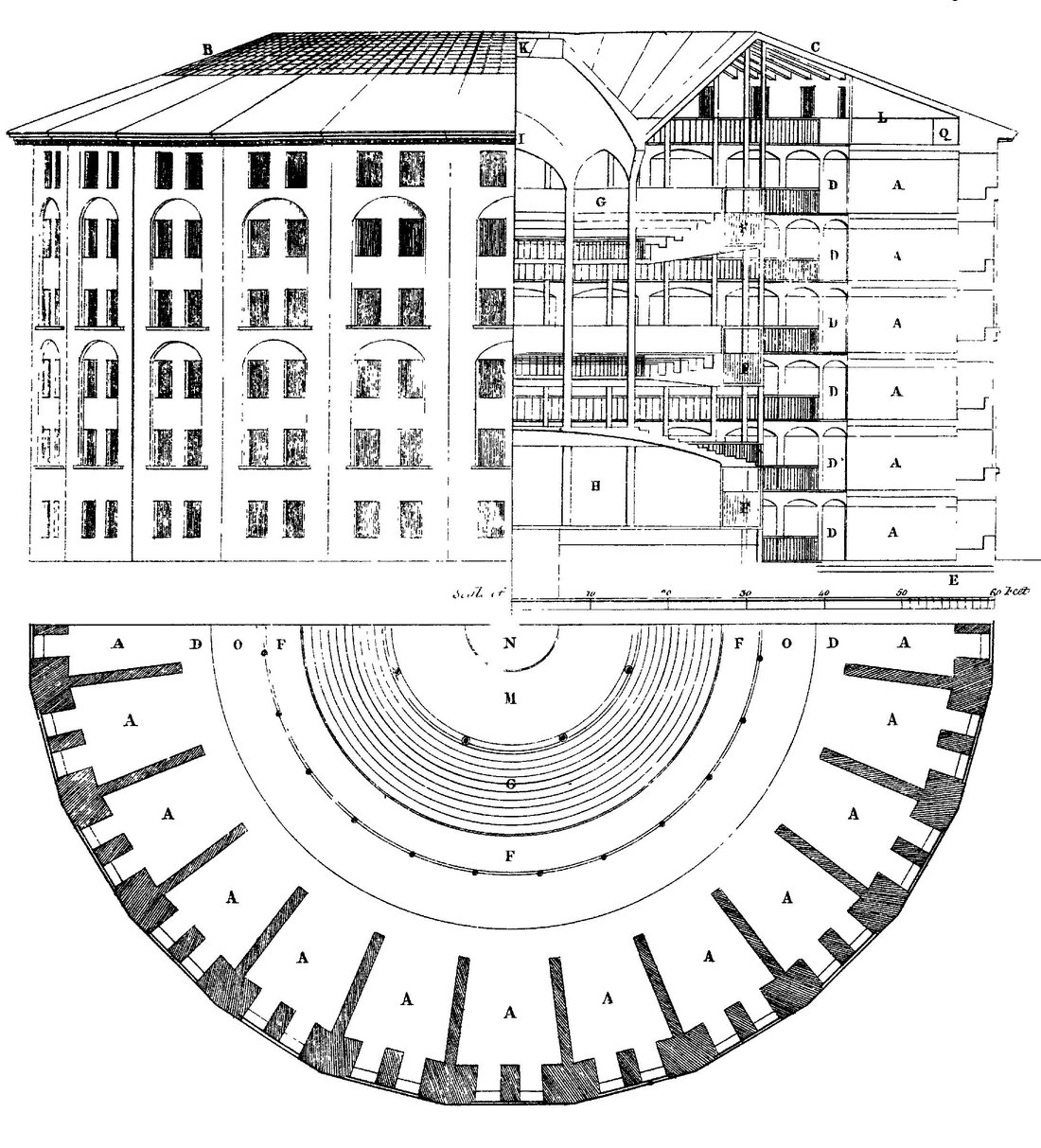
Jeremy Bentham conceived the panopticon around 1786 while visiting his brother in Russia, and set it out in a series of letters published in 1791 as 'Panopticon; or, The Inspection House.' The design is a circle: cells ring the outer wall, each open toward a central inspection tower, from which one unseen watcher can observe any cell at any moment. The genius, and the menace, is that the prisoners cannot see into the tower, so they never know when they are being watched and must assume they always might be, until the watching is done for the guard by the prisoners' own minds. Bentham spent decades trying to get it built as a British national penitentiary and failed; the scheme was abandoned and he was paid 2,000 pounds in compensation in 1813. Nearly two centuries later the French philosopher Michel Foucault, in 'Discipline and Punish' (1975), seized on the panopticon as the emblem of how modern power actually works. Foucault's claim was that discipline in modern societies, in prisons but also in schools, workplaces, and hospitals, operates exactly like the tower: not by force applied from outside, but by the internalized awareness of possibly being watched, which turns each person into their own supervisor. The prisoner, he wrote, becomes 'the principle of his own subjection.'
02The Prison That Got Built
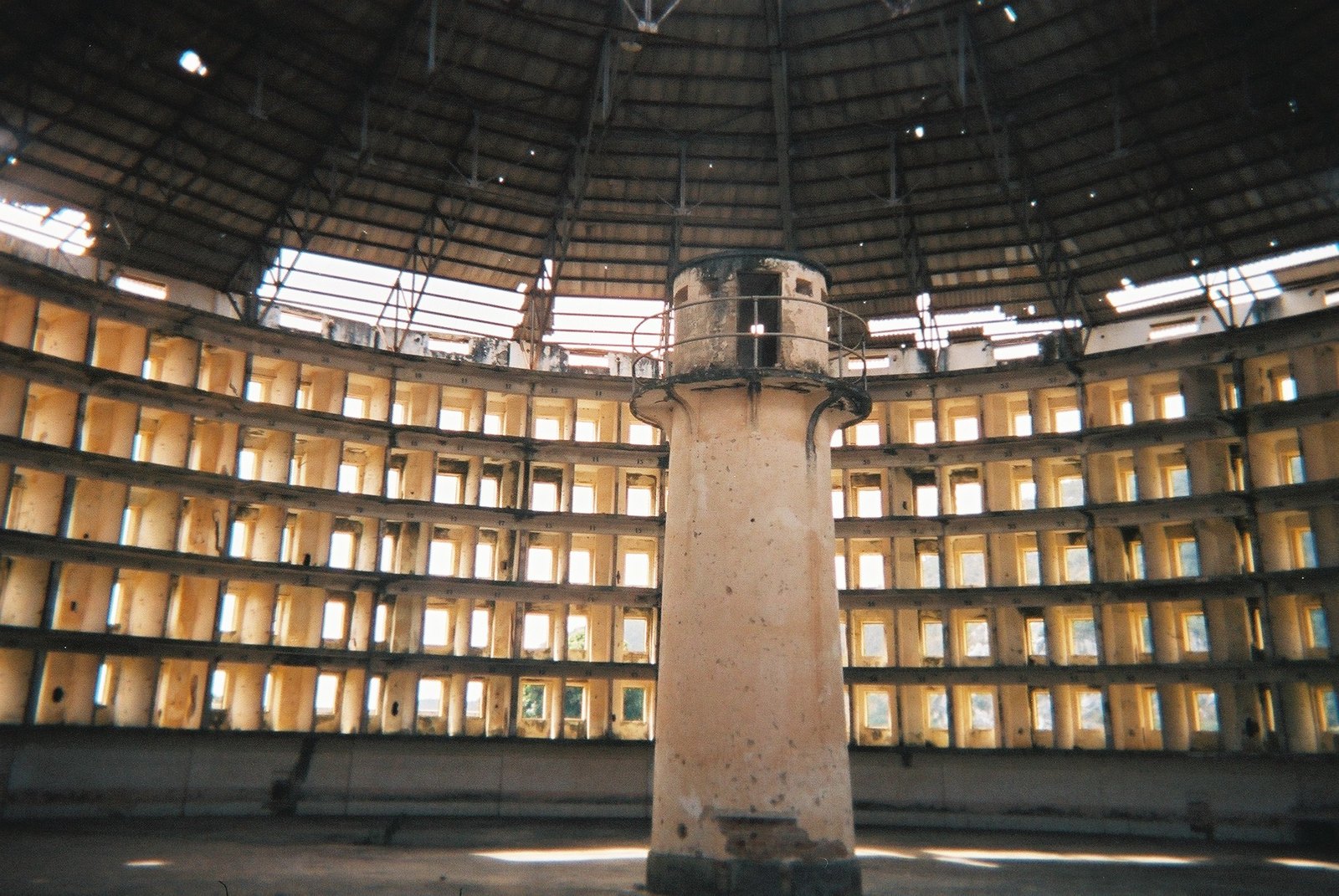
Bentham's design was never realized in his lifetime, but the hero image above shows that it was realized eventually, and faithfully. The Presidio Modelo, on an island off the coast of Cuba, was built between 1926 and 1931 directly on Bentham's panopticon plan: four vast circular cell blocks, each six stories of cells ringing a central watchtower, engineered so that a tiny guard staff could observe thousands of prisoners. Its most famous inmates were Fidel Castro and his fellow rebels, held there from 1953 to 1955 after their failed assault on the Moncada Barracks; after the revolution the new government used it in turn to hold its own political prisoners, several thousand at its peak, until it closed as a prison in 1967. Standing empty now, it is the single most literal picture of Bentham's idea in existence: the geometry of total visibility, poured in concrete. But the reason the panopticon matters today is not that a few prisons were built this way. It is that the same geometry, once it no longer needed walls or a tower, spread everywhere.
03The Panopticon Without Walls
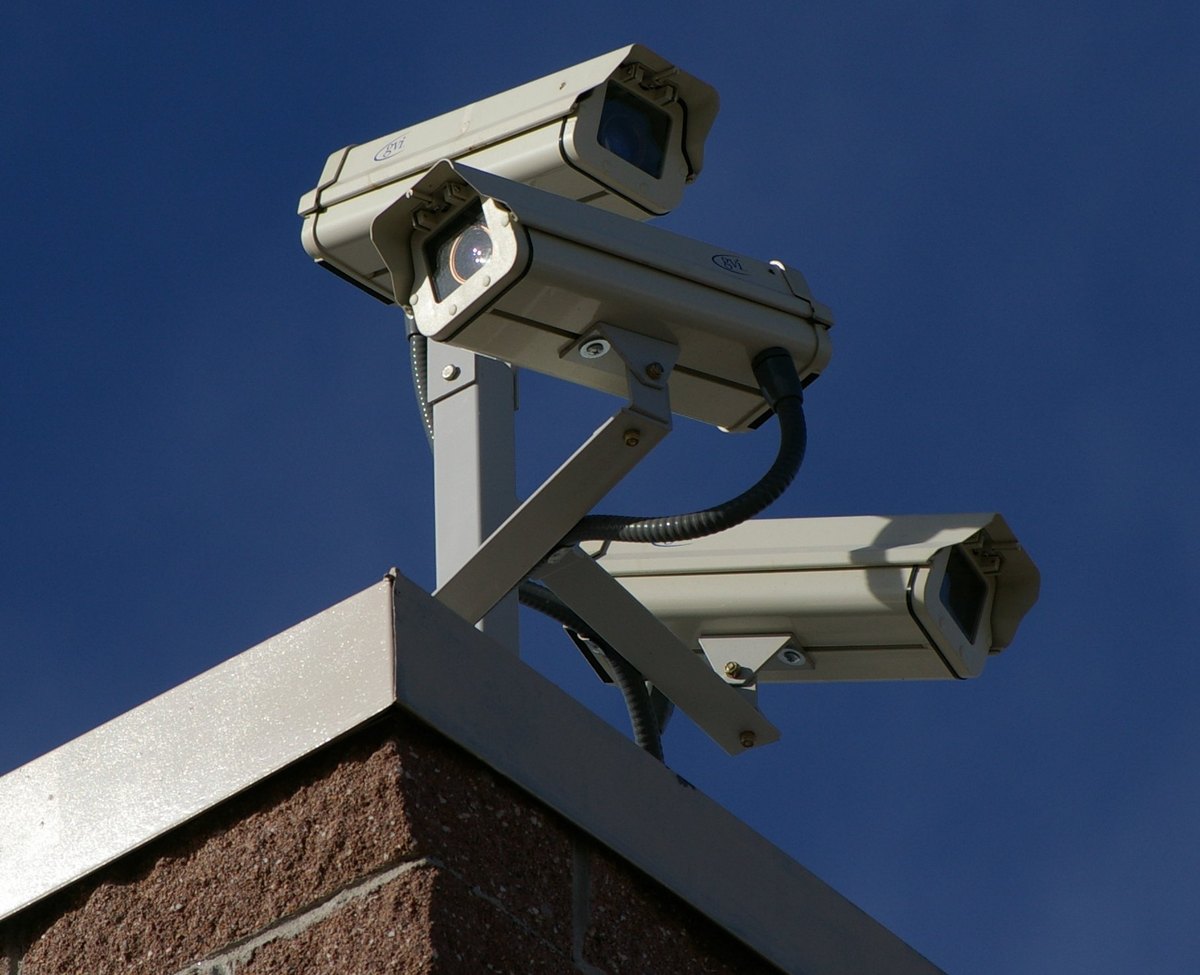
The tower dissolved into the network. The clearest proof of how far arrived in June 2013, when the contractor Edward Snowden leaked classified documents revealing the scale of US mass surveillance. The first stories showed that the National Security Agency was collecting the telephone metadata of millions of ordinary Americans in bulk, under Section 215 of the USA PATRIOT Act, and accessing user data held by major internet companies through a program called PRISM. The disclosures set off a global debate and led, two years later, to the USA FREEDOM Act of 2015, which curtailed the bulk domestic metadata program. (What Snowden revealed is this article's subject; the far harder question of his own choice to reveal it, and what it cost him, belongs to its own story.) Alongside state surveillance runs the commercial and physical kind: networks of cameras on every corner, and facial-recognition systems that, as the researchers Joy Buolamwini and Timnit Gebru showed in 2018, have been far less accurate on darker-skinned faces than lighter ones, a bias with its own serious consequences that a companion article takes up in full. The point here is structural. Bentham's single watchtower has become a distributed mesh of lenses and servers, and it no longer needs a center to produce the same effect.
04What Being Watched Does to You
Bentham's psychological claim is no longer just a theory; it has been measured. The legal scholar Jon Penney found that in the months after Snowden's June 2013 revelations, views of Wikipedia articles on sensitive topics such as terrorism dropped by roughly 20 to 30 percent, evidence of a 'chilling effect' in which people quietly censor even their curiosity once they know they might be watched, not because they have done anything wrong but because they cannot be sure how a record will one day be read. This is why the common retort, 'if you have nothing to hide, you have nothing to fear,' misunderstands the problem. The legal scholar Daniel Solove has argued that privacy harms are not limited to concealing wrongdoing: the aggregation of innocent data points, the loss of control over how you are seen, and the sheer imbalance of power between watcher and watched are harms in themselves. The philosopher Helen Nissenbaum reframes privacy not as secrecy but as 'contextual integrity,' the expectation that information shared in one context, a doctor's office, a friendship, a search bar, flows only by that context's own norms, so that a violation occurs when data leaks across contexts even if no single fact was ever secret. Europe's General Data Protection Regulation, in force since 2018, tries to give these intuitions legal teeth, with rights to access and erase one's data and fines reaching into the tens of millions of euros or a percentage of global turnover, whichever is greater.
05The Score That Isn't

No example is more cited, or more misunderstood, than China's 'social credit system,' and getting it right matters both for fairness and for clear thinking. The popular Western image is of a single, unified number, algorithmically calculated and stamped on every citizen, that rises and falls with their obedience. That picture is substantially wrong. As the corpus documents and China scholars at ChinaFile and the Mercator Institute confirm, the real system, piloted from 2014, is a fragmented patchwork of separate municipal and sectoral programs, many since scaled back, overlapping with a more centrally coordinated set of blacklists aimed mainly at businesses and at people who defy court judgments. Those blacklists are real and serious: by 2019 they had been used to block some 26 million purchases of plane and high-speed-train tickets. But there is no one master score for every person. The accurate account is less cinematic and more useful than the myth, because the myth lets Western readers file the whole problem under 'something authoritarian regimes do,' when the harder truth is that fragmented, purpose-specific scoring by governments and companies alike is spreading, quietly, almost everywhere.
06Surveillance Capitalism, and the Overclaims
The most ambitious critique of all comes from the scholar Shoshana Zuboff, who named the concept 'surveillance capitalism' in a 2015 essay and developed it at book length in 2019. Her argument is that the largest technology companies have built an economic order on the extraction of human behavioral data as free raw material, to be refined into predictions of what we will do and sold to those who want to influence it, an order she considers a genuinely new and autonomy-eroding form of capitalism. It is a powerful and widely cited thesis, and it is also genuinely contested: whether this is a true rupture in economic logic, or the old business of advertising and marketing operating at unprecedented technical scale, is an open scholarly question this article does not pretend to settle. What can be said is that the raw material of the argument, the pervasive commercial harvesting of behavioral data, is real and documented, whatever one concludes about its ultimate nature.
Three confident claims deserve to be refused, and they cut in more than one direction. The first is the paranoid overclaim: that governments already monitor all digital communication in real time, a single all-seeing eye. They do not; mass-collection programs gather enormous volumes of data but face real limits of storage, processing, and analysis, and genuinely targeted surveillance of specific people remains far more common than any true total-population watch. The second is the specific myth just corrected, that China runs one unified score for every citizen; the reality is a fragmented patchwork, and repeating the myth both misdescribes China and lets everyone else off the hook. But the third overclaim runs the opposite way and is just as unearned: that any and all data collection is inherently tyranny, full stop. That treats a genuine, unresolved tradeoff as already decided. Serious people hold that some surveillance, bounded by oversight, proportionality, and purpose limits, genuinely prevents harm, that privacy norms themselves vary across cultures, and that the real work is regulation rather than either total watching or total blindness. The honest position refuses the security hawk's certainty and the abolitionist's alike. What is not in doubt is Bentham's original insight: that a structure which merely might be watching already changes how free people live, which is why this is a question worth getting right.
Fast Facts
- The idea
- Bentham's panopticon (1791): a ring of cells around one unseen watcher, so prisoners self-regulate
- Foucault's reading
- Modern discipline works the same way: the awareness of possibly being watched induces conformity
- Built for real
- The Presidio Modelo, Cuba (1926 to 1931), on Bentham's plan; held Fidel Castro 1953 to 1955
- The modern turn
- Snowden's 2013 disclosures revealed NSA bulk metadata collection and the PRISM program
- The chilling effect
- Wikipedia views of sensitive topics fell roughly 20 to 30 percent after 2013 (Penney)
- China's reality
- Not one unified score; a fragmented patchwork of pilots plus coordinated blacklists (26 million travel bans by 2019)
- The double refusal
- Neither 'surveillance is justified by security' nor 'any data collection is tyranny' is a settled question
What We Can Actually Stand Behind
The history and the facts are solid. Bentham designed the panopticon in 1791; Foucault reinterpreted it in 1975; the Presidio Modelo was built on that plan and held Castro; Snowden's 2013 disclosures revealed real NSA bulk metadata collection and PRISM, and led to the USA FREEDOM Act of 2015; the GDPR took effect in 2018. China's system was piloted from 2014 and its coordinated blacklists had blocked some 26 million ticket purchases by 2019. These are documented events, not interpretations.
The core findings hold up. The chilling effect is measured, not merely asserted (Penney); the 'nothing to hide' reply is answered by real scholarship on privacy harms (Solove) and reframed usefully by contextual integrity (Nissenbaum). And the correction of the China 'unified score' myth rests on the corpus's own careful framing plus independent China scholarship: the real system is a fragmented patchwork, not one number per person, a distinction that is both factually and ethically important.
The largest interpretive claims are genuinely open. Whether Zuboff's 'surveillance capitalism' names a true new economic order or old advertising at new scale is unresolved among scholars, and 'sousveillance,' the idea of turning the cameras back on the powerful, is a real but forward-looking counter-move rather than an established fix. Carry these as live arguments, not conclusions.
Refuse three. No, governments do not already watch everything in real time; the capabilities are real but bounded. No, China does not run one unified score for every citizen; that myth misdescribes the reality. And no, it is not established that all data collection is inherently tyranny; that pretends a real, unresolved security-liberty tradeoff has already been settled. What survives every refusal is Bentham's insight, now two centuries deep: a structure that merely might be watching already reshapes a free person's life. The heart is on the scale, and this time the scale is watching back.
It is worth ending on the strangeness of what Bentham actually discovered, because it is easy to miss inside all the hardware. He did not invent a way to watch people. Watching people is old. He invented a way to make people watch themselves, by engineering uncertainty about when the real watching happens, and he was proud of it, believing a transparent institution would be a just and humane one. The unsettling thing is that he was partly right: visibility does deter cruelty and crime, oversight does depend on someone being able to look. The question the surveillance age forces on us is not whether to abolish the tower or fill it, but who gets to stand in it, who has to live in the cells, and whether the watched ever get to watch back. That is a question about power, which is the oldest subject on this entire wing, wearing the newest possible clothes. Bentham built a machine for turning visibility into obedience. Two centuries later, we are all still deciding whether we are the guards or the prisoners, and most days, quietly, we are being asked to be both.
Sources & further reading
Everything above is drawn from our research library on Theories of Anything. Open the full file to check the sourcing and go deeper.
Image credits
- Interior of a cell block at the Presidio Modelo, Isla de la Juventud, Cuba Photograph by Friman, 2005, via Wikimedia Commons. CC BY-SA 3.0 Source.
- Plan of the Panopticon, by Jeremy Bentham (drawing by Willey Reveley, 1791) Jeremy Bentham / Willey Reveley, 1791 (from The Works of Jeremy Bentham, 1843), via Wikimedia Commons. Public Domain Source.
- Three surveillance cameras on a building corner Photograph by Hustvedt, 2008, via Wikimedia Commons. CC BY-SA 3.0 Source.
- Facial-recognition gate barriers at Changzhou railway station, China, 2019 Photograph by MNXANL, 2019, via Wikimedia Commons. CC BY-SA 4.0 Source.
- Card crop of the Presidio Modelo panopticon interior Photograph by Friman, 2005, via Wikimedia Commons. CC BY-SA 3.0


