
Everything We Know Came From The People Who Burned Them
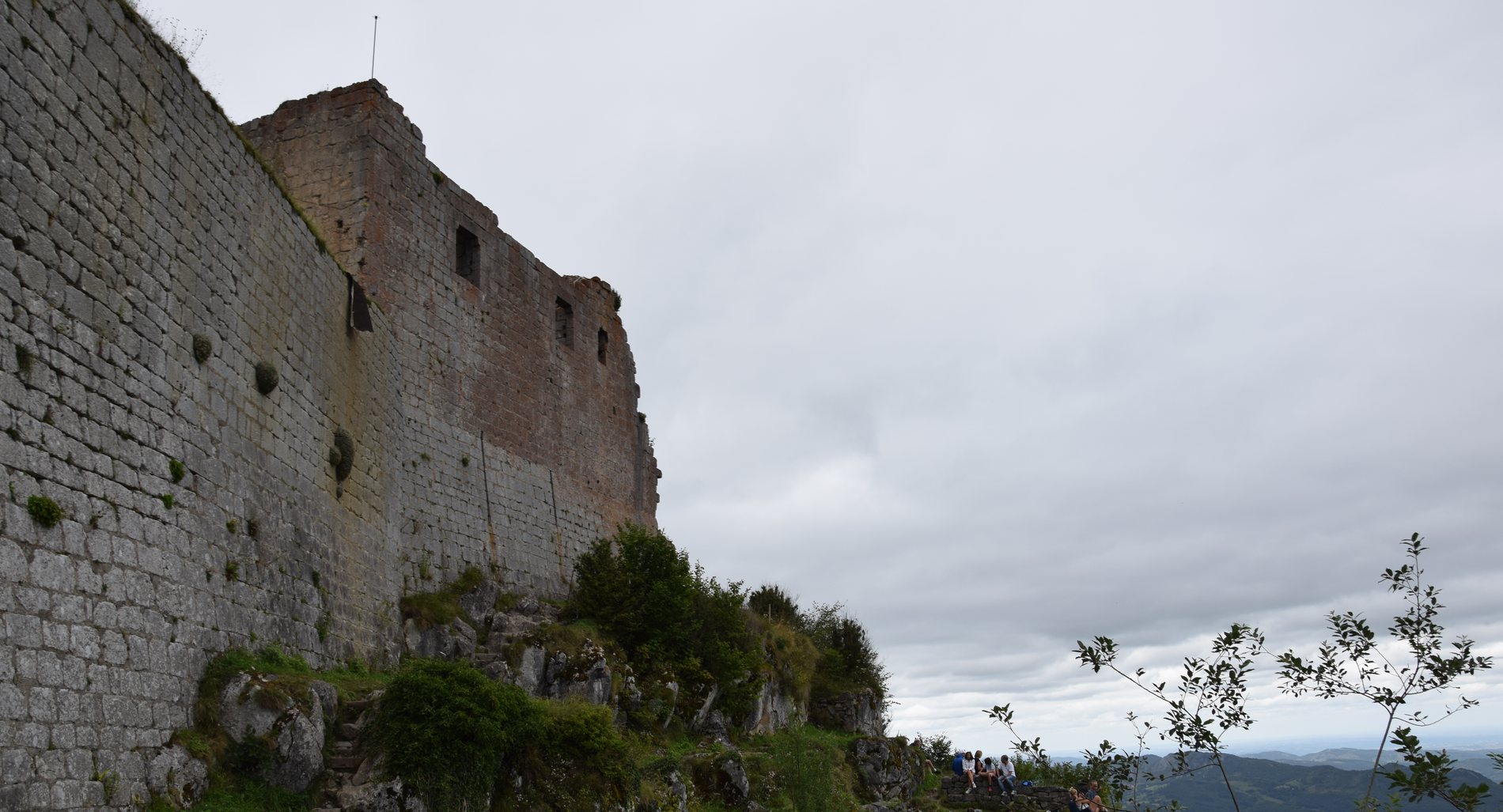
The Cathars left almost nothing. Their scriptures were destroyed, so nearly everything we know about what they believed comes from the interrogation records of the men sent to eradicate them. That is not a footnote about sources. It is the reason a serious argument is now running about whether the Cathars, as a single organised church, existed at all.
Almost every Cathar book was burned. What survives is a handful of texts: two ritual books, a theological treatise, and an apocryphal gospel. Everything else we think we know about what these people believed comes from somewhere else entirely. It comes from the interrogation registers of the Inquisition that was created to destroy them.
Our own research file puts the paradox plainly: those records became the main surviving source for reconstructing a religion, even though their purpose was to condemn it. That is worth sitting with before anything else in this article, because it is the reason a genuinely serious argument is now running in medieval history about whether the Cathars, as a single organised counter-church with a systematic theology, ever existed in the form the record describes.
01What They Believed
Two creators, and the wrong one made you. The Cathars, from the Greek katharoi, pure ones, held that there are two creative principles: a good God who made spirit and souls, and an evil being, called Rex Mundi or the demiurge, who made matter. Bodies, animals, the physical world. The human soul is a trapped angelic spirit imprisoned in flesh by the evil creator. The God of the Old Testament was that evil creator. Jesus was purely spiritual and never truly incarnated or died, which means the Cross was an instrument of evil rather than a symbol of salvation. The world was not to be redeemed. It was to be escaped.
The clergy were the parfaits and parfaites, and the rite that made them replaced three Catholic sacraments at once. The consolamentum was a laying on of hands that transmitted the Holy Spirit and forgave all sins, standing in for baptism, Eucharist and ordination together. After it, a parfait could eat no meat, eggs, cheese or milk, all being products of sexual reproduction, and was bound to no sex, no oaths, and no killing, even of animals. Ordinary believers, credentes, were bound by none of it and commonly took the consolamentum on their deathbed. Women served as parfaites, which made the movement notably egalitarian for its time and place.
Where it came from. Cathar-type dualism is first documented in the Rhineland in the 1140s, recorded by Eberwin of Steinfeld in a letter to Bernard of Clairvaux around 1143. It grew strongest in Languedoc. And the familiar alternative name is a misnomer: Albigensian simply means from Albi, one town in a movement spread far wider than it. The direct theological ancestor is Bogomil dualism from the Balkans, and the link is concrete rather than inferred: the Bogomil bishop Nicetas attended the Cathar council of Saint-Felix-Lauragais in 1167 and reportedly consecrated Cathar bishops there.
02The Crusade
Pope Innocent III launched the Albigensian Crusade after the assassination of his legate Pierre de Castelnau in January 1208. It opened with the sack of Beziers on 22 July 1209, where the entire population, Catholic and Cathar alike, was massacred. Estimates of the dead run from 7,000 to 20,000. The command attributed to the legate Arnaud Amalric, which our file is careful to mark as possibly apocryphal, was Caedite eos. Novit enim Dominus qui sunt eius. Kill them all. God will know his own.
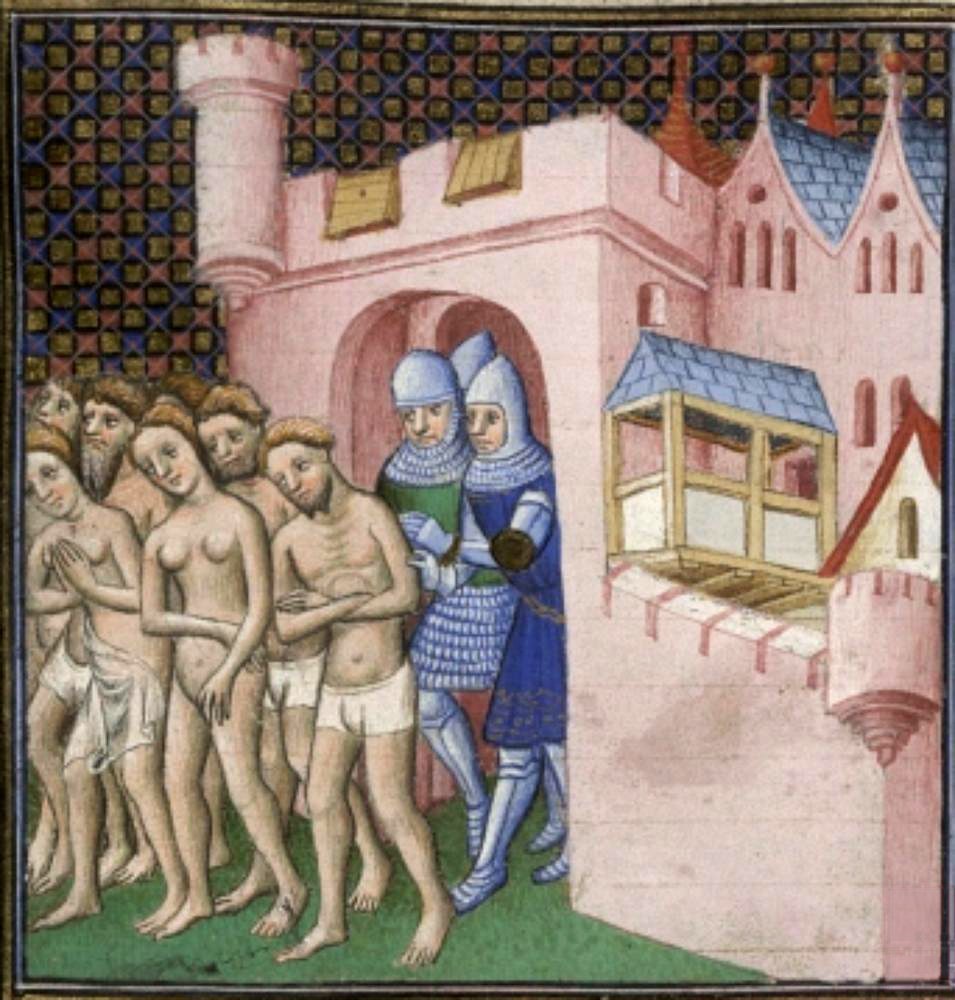
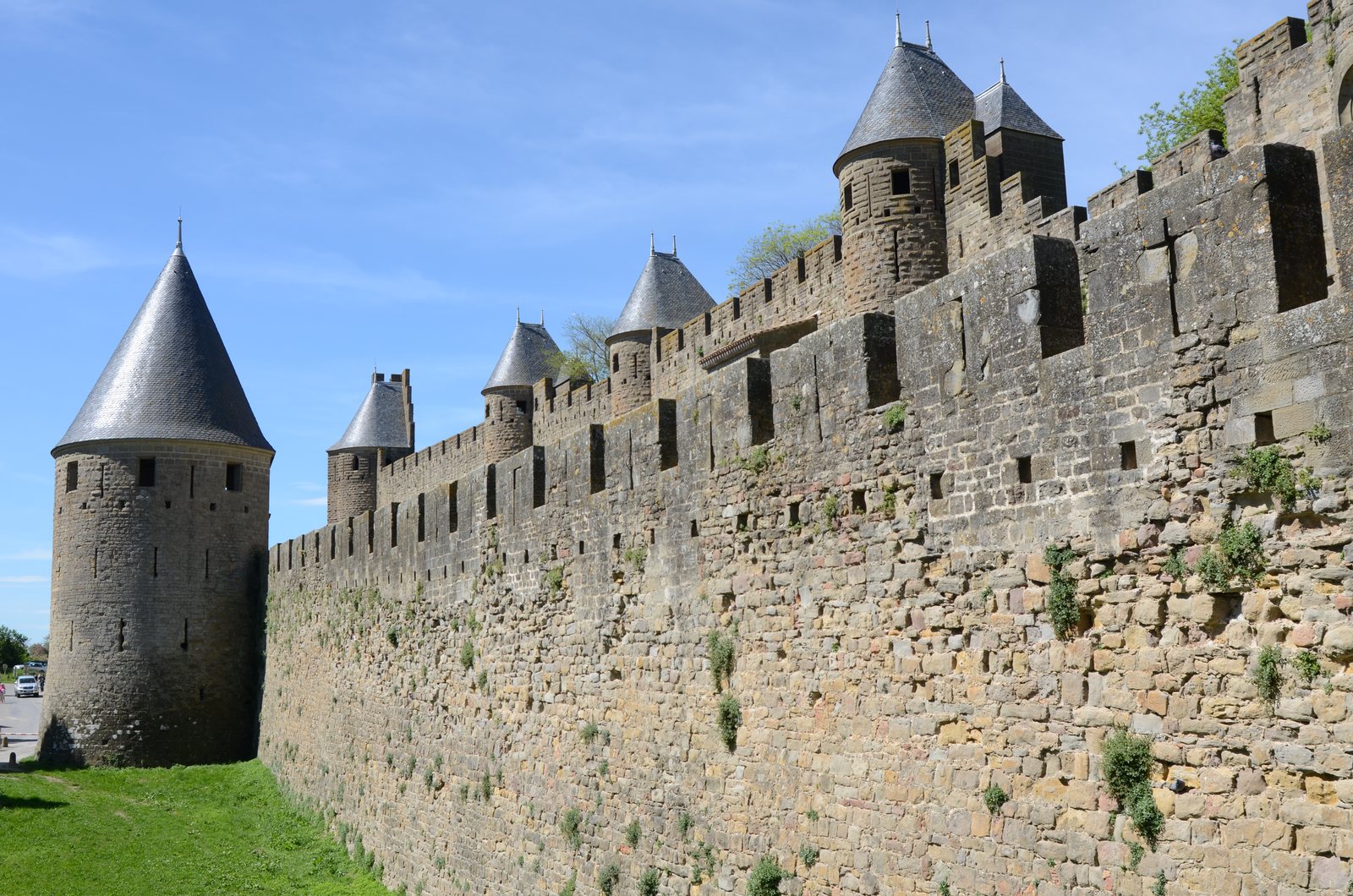
Then twenty years of it. Carcassonne fell in August 1209, within two weeks. At Minerve in July 1210, about 140 parfaits were burned. At Lavaur in May 1211, about 400. The Battle of Muret, 12 September 1213, was the turning point: Peter II of Aragon, who had intervened on behalf of the Occitan lords, was killed, and with him any prospect of Aragonese protection. Simon de Montfort led the campaign that ended the political independence of Languedoc. The Treaty of Paris in 1229 closed the Crusade, stripped the Counts of Toulouse of most of their lands, and mandated an Inquisition specifically to find the Cathars who were left.
03Montsegur
The fortress of Montsegur, on a rock peak in the Pyrenean foothills, was the last major stronghold. After a nine month siege it surrendered on 2 March 1244. A two week truce was granted. On 16 March 1244, over two hundred parfaits and parfaites who refused to recant were burned alive in a mass pyre at the foot of the mountain. The hunt went on for decades afterwards: the last known parfait, Guillaume Belibaste, was burned in 1321 at Villerouge-Termenes, seventy seven years later.
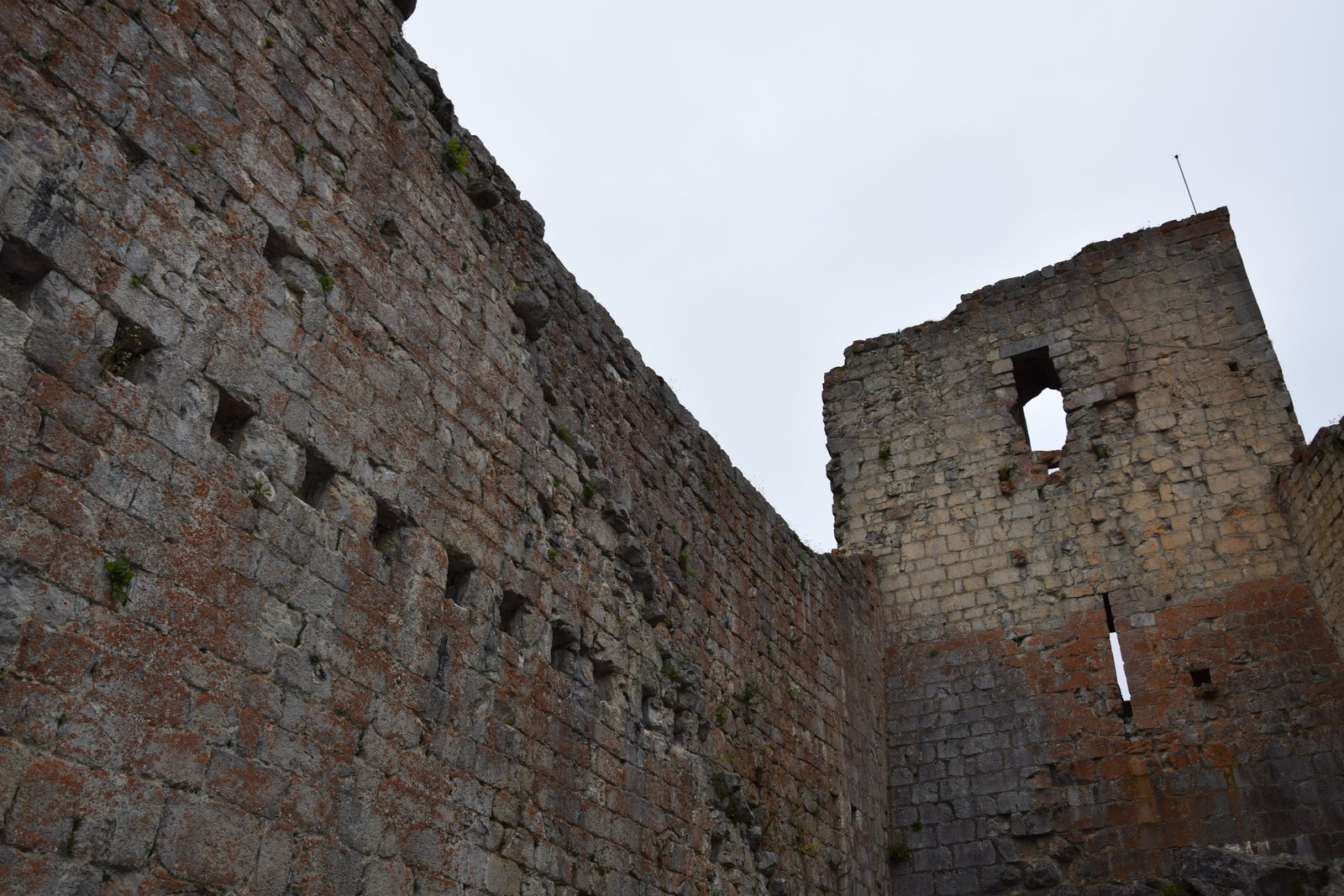
Almost all Cathar scripture was destroyed. What survives is the Liber de Duobus Principiis, the Interrogatio Iohannis, and two ritual books. So the primary source for Cathar belief is the Inquisition's own interrogation registers, above all those of Bernard Gui and Jacques Fournier, who later became Pope Benedict XII. Le Roy Ladurie's Montaillou, built from Fournier's records of 1318 to 1325, reconstructed daily life in the last Cathar village and became a landmark of microhistory. It is an extraordinary document. It is also a transcript of interrogations conducted by a man who became pope, of people who knew what happened to those who answered wrong.
One surviving text carries a detail that outlives the whole story. The Rituel occitan sets out the consolamentum ceremony in Occitan, which makes it one of the earliest liturgical texts in any Romance vernacular. Cathar worship was deliberately conducted in the language of the people rather than in Latin, three hundred years before vernacular liturgy became the thing Europe tore itself apart over.
04The Argument That Is Actually Live
First, the part that is settled. Scholarly consensus holds that Cathar dualism is a medieval revival of Gnostic theology, transmitted along a Paulician to Bogomil to Cathar chain rather than descending directly from ancient Gnostic groups. The parallels with the Nag Hammadi texts are real: the demiurge, imprisoned divine sparks, docetic Christology, the rejection of matter. But unlike the ancient Gnostics, the Cathars built a functioning counter-church with dioceses, bishops and deacons. And our file is careful where care is required: the relationship to third century Manichaeism is debated, because the structural parallels are real and no direct transmission chain has been demonstrated.
They did not all believe the same thing. There was an internal doctrinal split. Absolute dualists, mainly the Italian tradition following John of Lugio, held two co-eternal principles. Mitigated dualists, the majority in Languedoc, held that the evil principle was a fallen angel subordinate to the good God. That is not a quibble. It is the difference between believing in two gods and believing in one. Remember it, because it is the evidence in the argument that follows.
Since the early 2000s a revisionist school has asked whether Catharism was a coherent movement at all, or an artefact of the people writing it down. Mark Gregory Pegg argues that the Good Christians of Languedoc were not a single organised counter-church with a systematic theology, and that their diverse and local views were homogenised by the Inquisition's own interrogation categories. Ask a man a list of yes or no questions drawn up in advance, under threat, and you will get back the shape of your questionnaire. R. I. Moore argues that the great heresy narrative was constructed by the papacy to justify the Inquisition. The traditionalists, Barber, Lambert, Bruschi and Biller, answer that Cathar-authored texts, the councils, and the testimony itself demonstrate a real organised movement with institutions. Our file's own verdict is that the debate is unresolved and is one of the most active areas of medieval heresy scholarship.
05The Treasure, The Nazi, And The Bloodline
On the night before Montsegur surrendered, four parfaits escaped the siege carrying something. That much is in the Inquisition records. What they carried is not. Gold, documents, a relic: the records simply do not say. Everything that has been built on top of that gap, and a great deal has been built, rests on one documented escape with a hole in the middle of it.
Otto Rahn, 1904 to 1939, published Crusade Against the Grail in 1933 and Lucifer's Court in 1937, arguing that Montsegur was Munsalvaesche, the Grail castle of Wolfram von Eschenbach's Parzival. Rahn was recruited into the SS Ahnenerbe, the body that existed to give Nazi racial ideology a pseudohistorical pedigree, and his Cathar-Grail thesis served that agenda by tying German medieval literature to an esoteric Aryan tradition. He died in 1939, officially of exposure on a mountain, probably by suicide. The fact that ends the whole thesis is simple, and our own file states it: Parzival predates the fall of Montsegur by several decades. The castle cannot be modelled on a siege that had not happened yet. Rahn's work fed Holy Blood, Holy Grail in 1982 and The Da Vinci Code in 2003.
Neo-Cathar descent. Twentieth century esoteric movements in southern France claiming to be heirs of the Cathars have no demonstrable historical continuity. Deodat Roche founded the Societe du Souvenir et des Etudes Cathares in 1950 and revived interest, which is not the same as inheriting anything. Egyptian or Indian origins. These bypass the well documented Bogomil and Paulician chain and have no textual support. A secret Cathar bloodline linking Jesus, Mary Magdalene and the Merovingians: no Cathar text and no Inquisition record supports it. And our file closes honestly on the wider claim of underground survival after 1321, which lacks documentary evidence, because the Inquisition was remarkably thorough.
What else died with them. Languedoc was the homeland of troubadour poetry. Denis de Rougemont argued that its themes of spiritual love and hidden meaning encode Cathar theology, and our file marks that direct evidence as thin. What is not thin is the aftermath: the Crusade and the Inquisition ended the troubadour tradition and replaced Occitan literary culture with northern French norms. The Occitan language went from a prestigious literary tongue to a collection of rural dialects. The revival movements, Felibrige in 1854 and the Institut d'Estudis Occitans in 1945, have drawn explicitly on Cathar memory as a symbol of regional identity.
06What We Found Auditing Our Own Citations
Twenty three entries in this file's bibliography, and only five carry an identifier at all. Of those five, two are correct and three are reviews standing in for the books they are supposed to point at. Pegg's A Most Holy War points at a review in Medieval Encounters. Moore's The War on Heresy points at a review in the Journal of Religious History. Given's Inquisition and Medieval Society points at a review in the American Historical Review published in 1999, two years before the edition the entry cites, so it cannot be reviewing the printing named. That last record also renders the title as Inquisition in Medieval Society, so it misnames the book as well.
We wrote down which journal each review would be in before resolving anything, and got all three. An identifier's prefix names its publisher and its suffix often carries the target journal's ISSN, so the strings can be read. Pegg's Oxford book carries a prefix belonging to Brill, so the prediction was a review in a Brill journal around 2010: it is Medieval Encounters, 2010. Moore's Profile Books title carries a Wiley prefix and the ISSN of the Journal of Religious History. Given's Cornell book carries a University of Chicago prefix, the letters ahr, and the string 104.2.624, which is volume 104, issue 2, page 624, and since that volume is 1999, the date paradox was predicted too. Three journals, one page number, and one impossible date, all read off the identifiers.
Barber's The Cathars is the first book in this entire series whose identifier resolves to a genuine book record. Type book, publisher Routledge, author Malcolm Barber. Two of this file's empty fields also filled with real book records when we searched them: Bruschi's Cambridge monograph and Stoyanov's Yale one. So it was never books against articles. It is registered against unregistered. Journal articles are registered almost universally, so they resolve to themselves. Books are registered by some publishers and mostly only recently, so most have no record of their own, and anything filling that field lands on the nearest thing carrying the title, which is a review. Where a book is registered, it behaves exactly like an article. Routledge, Cambridge and JSTOR register. Oxford in 2008, Profile, Cornell and Blackwell in 1998 did not.
The entries that could not be repaired failed in the same way, one level up. Searching for Hamilton's 1978 article in Archivum Fratrum Praedicatorum returns reviews of the periodical itself. Searching for Biller's 1994 chapter returns two reviews of the edited volume it sits inside, not the chapter. When a journal is unregistered you are handed reviews of the journal; when a volume is unregistered you are handed reviews of the volume. The mechanism does not care which level of the hierarchy is missing. It hands back whatever nearby record carries the words.
| Section Of The Library | Files | Correct | Wrong | Correct |
|---|---|---|---|---|
| Genetics and Origins | 1 | 15 | 0 | 100% |
| Molecular Biology | 2 | 9 | 1 | 90% |
| Oceanography | 2 | 15 | 3 | 83% |
| Biology and Evolution | 2 | 18 | 4 | 82% |
| Ecology and Biology | 2 | 18 | 6 | 75% |
| Lost Connections | 2 | 4 | 4 | 50% |
| World Civilizations | 8 | 21 | 35 | 38% |
| Foundations and Scripture | 4 | 12 | 24 | 33% |
| Secret Societies | 5 | 7 | 22 | 24% |
| The sciences together | 9 | 75 | 14 | 84% |
| The humanities together | 19 | 44 | 85 | 34% |
And now the thing this file does that no other file in the series has matched. Its section on the revisionist argument sets the dispute out in detail, names four scholars on one side and two on the other, and concludes that the debate remains unresolved and represents one of the most active areas of medieval heresy scholarship. Four screens later, its counter-arguments section reads, in full, that no significant counter-arguments exist and that the subject has no active scholarly dispute over the fundamental claims presented in this document. The same two words, active and scholarly, used to assert opposite things in one file. And a coincidence that is not one: the two identifiers pointing at reviews instead of books are Pegg 2008 and Moore 2012, which are the two revisionist works. The citations for exactly the side of the argument the file denies is happening are the two that do not reach their targets.
Something goes right here that goes wrong nearly everywhere else, and it is worth more than another fault. This bibliography has no field damage at all. It is a clean list with complete citations: authors, italicised titles, place, publisher, year, edition, translator, volume counts, every part intact. Across the other files in this programme we have found twenty seven author lists shattered at their initials. W. W. Norton became a publisher field reading New York: W. M. Paul Smith was split into three fragments across three columns. An article number and a page range each ended up where a person's name belongs. This file, sitting on the same shelf as several of those, has none of it. So the shattering is a property of the format the other files were generated in, not of the subject, the sources, or the people who compiled them, and that means it is fixable at the pipeline rather than one file at a time.
Fast Facts
- The name
- From Greek katharoi, pure ones. Albigensian just means from Albi, one town in a much wider movement
- The theology
- Two creators. A good God of spirit, an evil demiurge who made matter. The soul is a trapped angel. The Old Testament God is the evil one
- The clergy
- Parfaits and parfaites, made by the consolamentum, which replaced baptism, Eucharist and ordination in one rite. No meat, eggs, cheese or milk, no sex, no oaths, no killing
- Women
- Served as parfaites, giving the movement a notably egalitarian character for medieval Christianity
- First documented
- Rhineland, 1140s, by Eberwin of Steinfeld, around 1143. Council of Saint-Felix, 1167, with the Bogomil bishop Nicetas
- The Crusade
- Launched by Innocent III after his legate was killed in January 1208. Beziers sacked 22 July 1209 with 7,000 to 20,000 dead, Catholic and Cathar alike
- The campaign
- Carcassonne fell within two weeks, August 1209. Minerve, about 140 burned, July 1210. Lavaur, about 400, May 1211. Muret, 12 September 1213. Treaty of Paris, 1229
- Montsegur
- Nine month siege. Surrendered 2 March 1244. Over 200 burned 16 March 1244 after a two week truce
- The last parfait
- Guillaume Belibaste, burned 1321, seventy seven years after Montsegur
- Where the evidence comes from
- Cathar scripture was destroyed. The main surviving source is the Inquisition's own registers, above all those of Bernard Gui and Jacques Fournier, who became Pope Benedict XII
- The live argument
- Whether Catharism was a coherent organised church, or was homogenised into one by the interrogation categories used to record it. Unresolved
- Citations in the source file
- 23 entries, only 5 with an identifier. 2 correct, 3 are reviews standing in for books. 2 further identifiers recovered by us
What We Can Actually Stand Behind
The Albigensian Crusade happened, on the dates and at the places given. Beziers was massacred on 22 July 1209 with the population killed indiscriminately. Montsegur surrendered on 2 March 1244 and over two hundred people who refused to recant were burned on 16 March. The last known parfait was burned in 1321.
Cathar scripture was destroyed and the principal surviving source for Cathar belief is the interrogation record of the institution that destroyed it. This is not a caveat about sourcing. It is the central fact of the subject and it shapes everything downstream of it.
Dualist belief of this kind is real, is documented from the 1140s, and reached Languedoc along a Paulician and Bogomil chain, with the Saint-Felix council of 1167 as a concrete link. The relationship to ancient Manichaeism is a structural parallel with no demonstrated transmission, and our file says so.
Whether the Cathars constituted a single organised counter-church with a systematic theology, or a diverse set of local dissenters homogenised by the questions they were asked. Pegg and Moore against Barber, Lambert, Bruschi and Biller. The internal split between absolute and mitigated dualists is evidence both sides use. This is live and we are not settling it.
Four parfaits escaped Montsegur the night before the surrender carrying something. The escape is in the record. The contents are not, and no amount of retelling has ever added anything to that.
That Montsegur was the Grail castle. Wolfram's Parzival predates the fall of Montsegur by decades, so the castle cannot be modelled on it. That modern neo-Cathar movements descend from the medieval ones: no demonstrable continuity. That Cathar dualism came from Egypt or India: it bypasses a well documented chain. That there is a Cathar bloodline linking Jesus and the Merovingians: no Cathar text and no Inquisition record contains anything of the kind.
Sources & further reading
The history above is drawn from our research library on Theories of Anything. Every identifier in that file's bibliography was resolved live against Crossref on 26 August 2026. Three of its five identifiers turned out to point at reviews rather than at the books; those reviews are listed here as what the entries actually reach, and two replacement identifiers were recovered.
Image credits
- The fortress of Montsegur on its peak, with the valley beyond. Cropped by us from a wider photograph Chatsam, via Wikimedia Commons (CC BY-SA 4.0), cropped by Theories of Anything. CC BY-SA 4.0 Source.
- The expulsion of the inhabitants of Carcassonne in 1209, painted circa 1415 in the Grandes Chroniques de France Workshop of the Master of Boucicaut, Grandes Chroniques de France, British Library Cotton MS Nero E II, via Wikimedia Commons (public domain). Public domain Source.
- The walls of the fortified city of Carcassonne Peulle, via Wikimedia Commons (CC BY-SA 4.0). CC BY-SA 4.0 Source.
- The curtain wall at Montsegur, showing rows of putlog holes left by construction scaffolding Chatsam, via Wikimedia Commons (CC BY-SA 4.0). CC BY-SA 4.0 Source.


