
The Big Bang: The Day Without a Yesterday
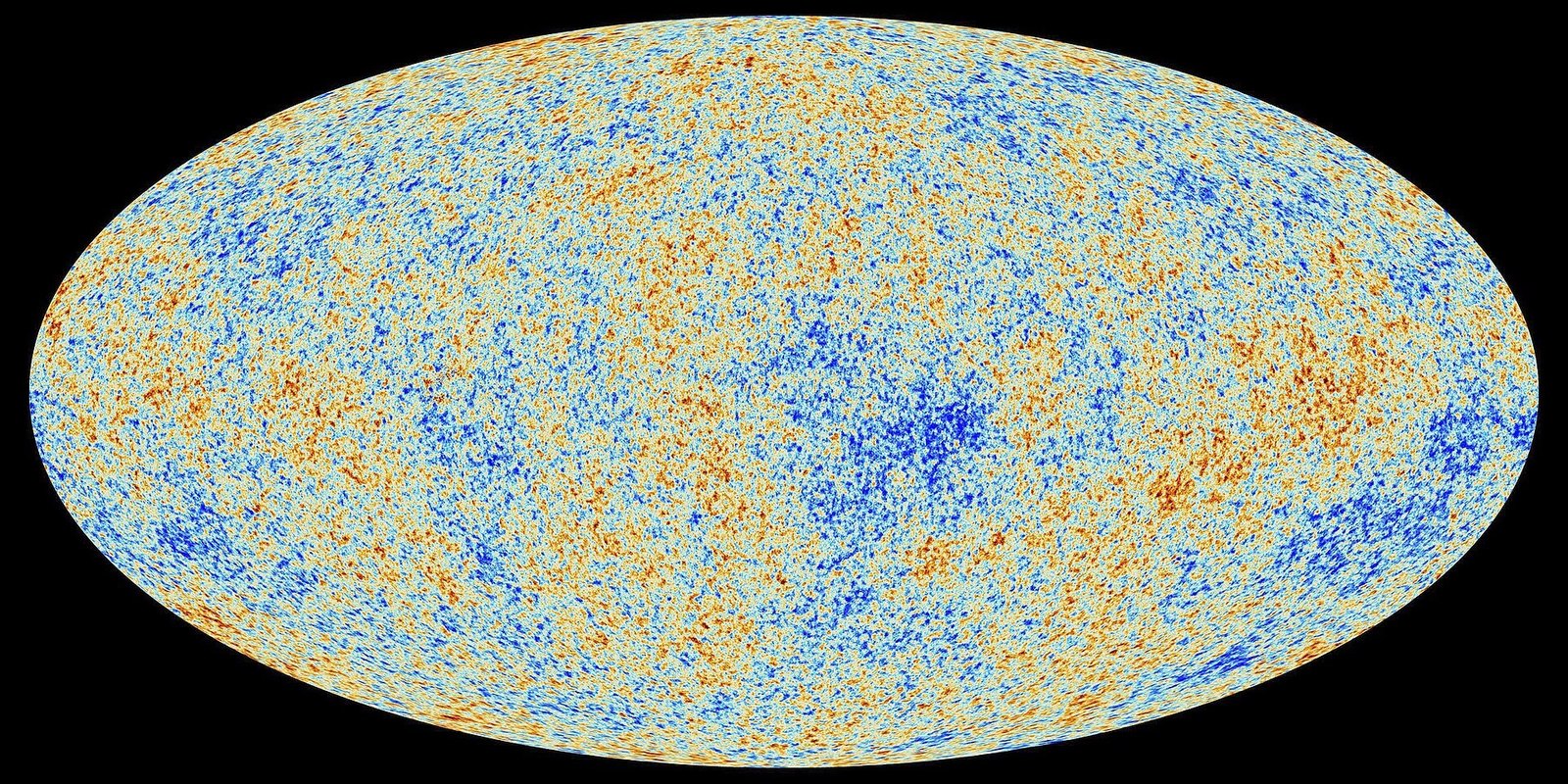
It is the best-tested origin story humanity has, resting on three completely independent pillars of evidence that all point to the same hot, dense beginning about 13.8 billion years ago. It is also badly misnamed: the Big Bang was not an explosion in space but the stretching of space itself, with no center and no outside. And it comes with genuine, unfinished mysteries, ninety-five percent of the universe made of something we cannot identify, two honest measurements of its expansion that refuse to agree, and early galaxies that look older than they should. This is what the evidence really shows, the myth worth correcting, and where the theory's own edges honestly lie.
The physicist and Catholic priest Georges Lemaitre called it 'the day without a yesterday,' and the phrase has held up better than the name that stuck. The Big Bang is the best-tested account we have of how the universe began: not a philosophical guess but a conclusion forced by three completely separate lines of hard evidence, all converging on the same picture of a hot, dense early cosmos that has been expanding and cooling for about 13.8 billion years. It is also, as we will see, badly named, so badly that the name itself is the source of the single most common misunderstanding about it. And it is not finished. The same framework that predicts the light elements and the afterglow of creation to stunning precision also admits, in its own accounting, that it cannot identify ninety-five percent of what the universe is made of, that two good ways of measuring its expansion stubbornly disagree, and that its deepest question, what if anything came before, may lie permanently out of reach. This is the honest state of the Big Bang: overwhelmingly well-evidenced, widely misunderstood, and unfinished at its edges.
01Three Pillars
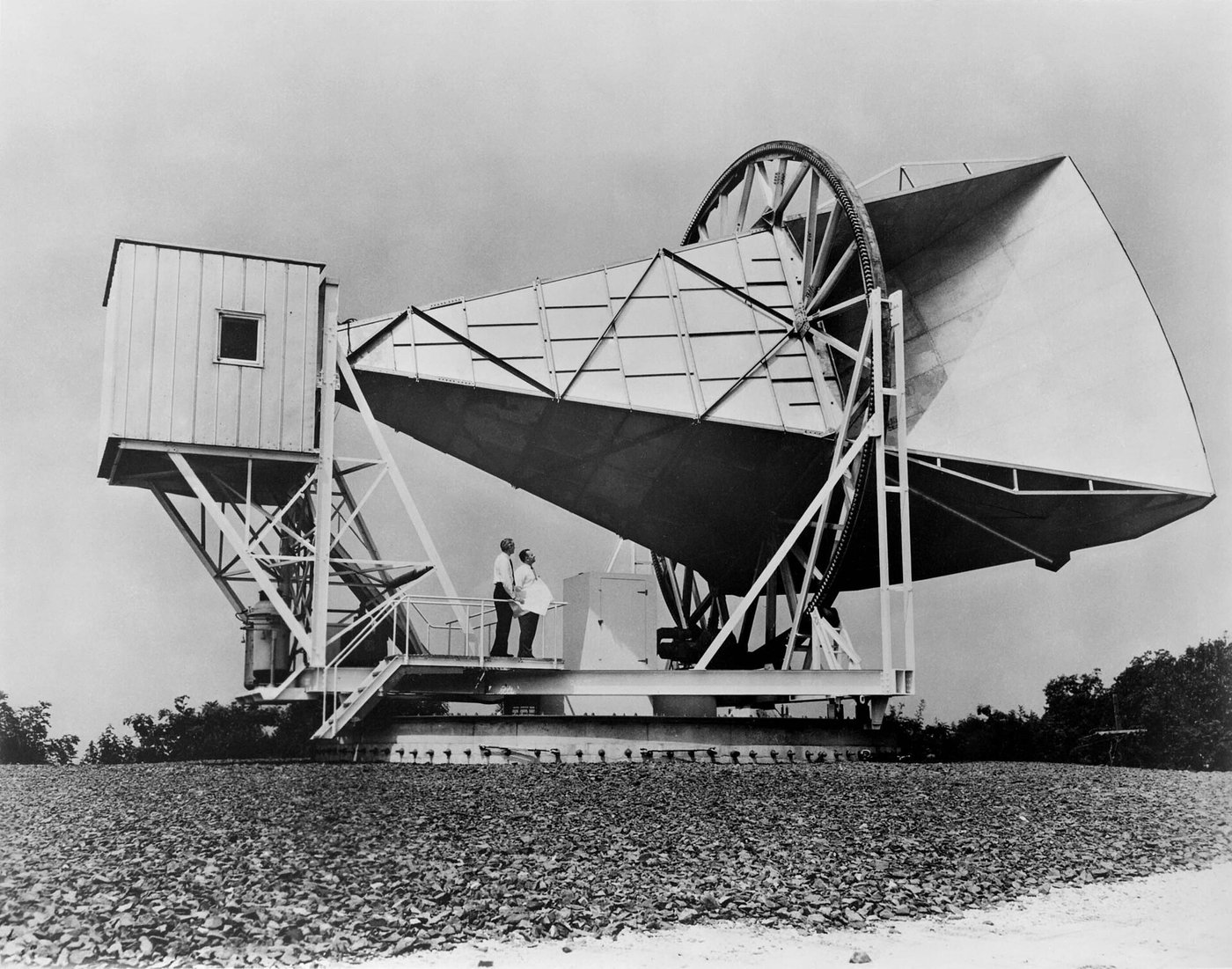
The strength of the Big Bang model is that it does not rest on one clever argument but on three independent ones that did not have to agree, and do. The first is expansion. In 1929 Edwin Hubble showed that distant galaxies are receding, and the farther away, the faster, exactly what you would see if space itself were stretching; run the film backward and everything was once packed together, hot and dense. The second is the afterglow. If the early universe was that hot, it should have left a faint, uniform radiation everywhere, cooled by expansion to just above absolute zero. In 1965 Arno Penzias and Robert Wilson, using a horn antenna in New Jersey, found exactly that: a hiss of microwaves, about 3.5 kelvin, coming evenly from every direction, that they could not explain and at first blamed on pigeon droppings in the instrument. It was the cosmic microwave background, the oldest light there is, released when the universe was about 380,000 years old and first turned transparent. The third is chemistry. The nuclear physics of the first few minutes predicts that the raw universe should have emerged as roughly three-quarters hydrogen and one-quarter helium, with a trace of deuterium and lithium, and that is very nearly what we observe. Three separate windows, expansion, radiation, and the abundances of the light elements, all opening onto the same hot beginning. That convergence is one of the most powerful results in all of science. It is not seamless: the predicted amount of lithium is about three times what we actually find, a real, unresolved discrepancy the model carries honestly.
02The Day Without a Yesterday
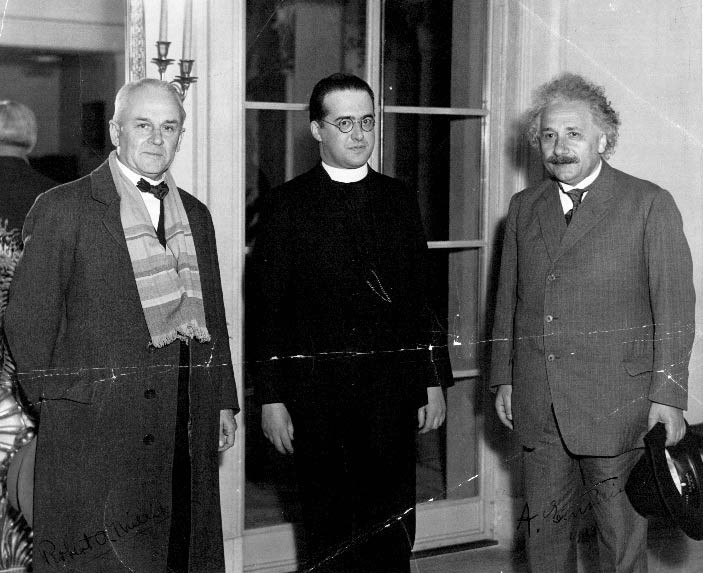
The theory came before most of that evidence, and it came, oddly, from a priest. Georges Lemaitre, a Belgian physicist who was also an ordained Catholic priest, derived an expanding universe from Einstein's own equations in 1927, connected it to the galaxy redshifts, and wrote down the expansion law two years before Hubble published the data that Hubble is more often credited for. In 1931 he proposed that the universe began from a single dense 'primeval atom,' a direct ancestor of the Big Bang idea. And it is worth stressing, because it cuts against a common assumption, that Lemaitre himself insisted his theory proved nothing about God, and explicitly warned against pressing it into service as religious evidence. The name we use was coined by an opponent. Fred Hoyle, who favored a rival 'steady-state' universe with no beginning at all, reached for 'the Big Bang' on BBC radio in 1949 as a dismissive jab at the whole idea of a moment of creation. The jab stuck; the steady-state theory did not. It was a serious competitor until 1965, when the discovery of the microwave background, which the Big Bang had predicted and the steady-state could not explain, effectively ended the contest.
03Not an Explosion
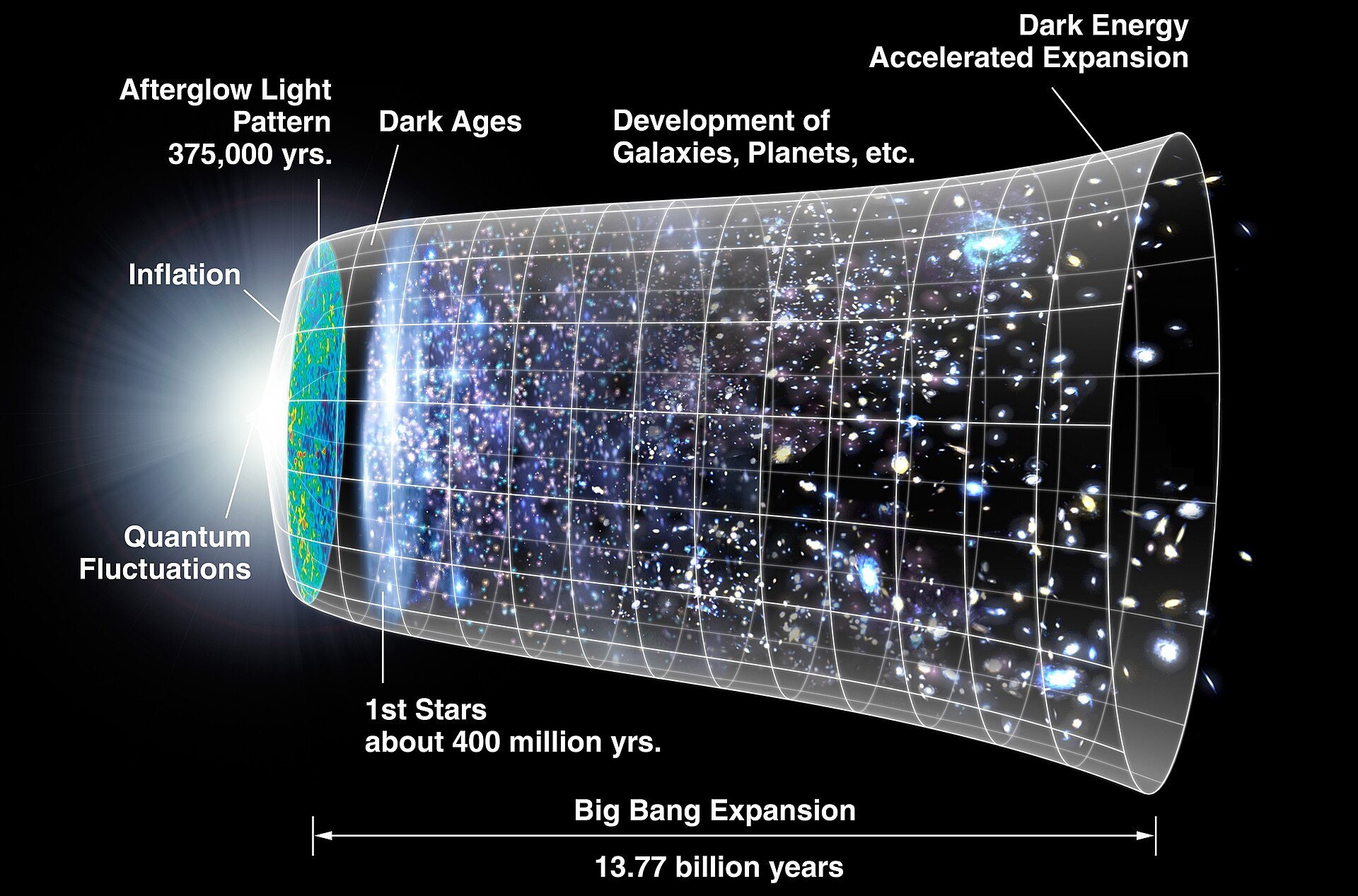
Now the correction the name demands, because almost everyone gets this wrong, including people who accept the theory completely. The Big Bang was not an explosion. There was no bomb going off at a particular spot in a pre-existing emptiness, flinging matter outward into surrounding space. The universe has no center and no edge, and it is not expanding into anything. What is expanding is space itself, everywhere, all at once. The clearest evidence is in the motion we actually see: galaxies are not flying away from some special point in the sky like debris from a blast; they are moving away from one another, in every direction, exactly as raisins in a rising loaf of bread separate from every other raisin without any of them being the center. NASA puts it about as plainly as it can be put: the name suggests a firecracker exploding at a place with a center, but 'the universe doesn't have a center,' and the Big Bang 'happened everywhere at once.' Hold onto that, and half the paradoxes people tie themselves in knots over, what is outside the universe, where exactly did the Big Bang happen, simply dissolve. They are questions the real picture does not contain.
04The Missing 95 Percent
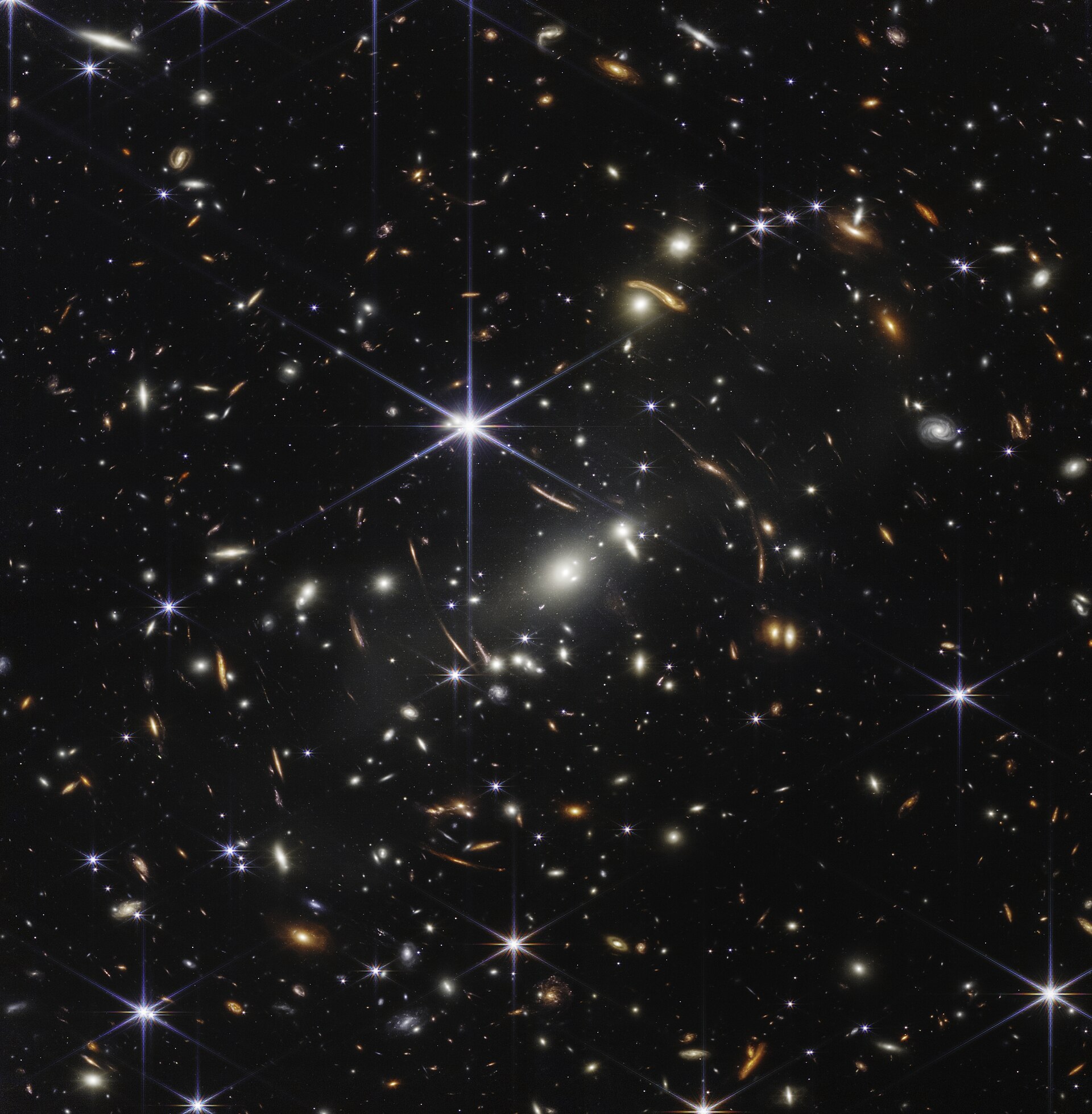
For all it explains, the standard model is honest about an embarrassment at its core: it does not know what most of the universe is. Only about five percent is ordinary matter, the stuff of stars, planets, and people. Roughly twenty-seven percent is dark matter, an unseen substance whose gravity holds galaxies together and bends light, shown to be real and physically separate from ordinary matter by the Bullet Cluster in 2006, but which, after more than forty years of dedicated searching, no experiment has ever directly detected as a particle. The remaining sixty-eight percent is dark energy, discovered in 1998 when distant supernovae revealed that cosmic expansion is not slowing but speeding up, and whose nature is even more obscure; recent galaxy surveys by the DESI instrument have even produced a mounting hint, though still below the threshold physicists count as a discovery, that dark energy may be weakening over cosmic time rather than holding constant. Put together, about ninety-five percent of the universe is made of something we can measure the effects of and cannot name. On top of that sit two live cracks. The first is the Hubble tension: two rigorous, independent ways of measuring how fast the universe is expanding today, one from the ancient microwave background, one from nearby stars and supernovae, give answers that disagree by about five standard deviations, far beyond their stated errors, and recent work, including from the James Webb telescope, has sharpened the disagreement rather than dissolved it. The second is the early galaxies: Webb has found galaxies from the universe's first few hundred million years that look more massive and mature than the models expected. That tension is real but has been shrinking under scrutiny, as astronomers refine the difficult business of converting a smudge of light into a galaxy's true mass; it is a puzzle being worked, not a toppled theory.
05Before the Bang?
So what happened at the very first instant, and what, if anything, came before? Here the honesty has to deepen, because the ground gets softer fast. The leading idea for the first sliver of a second is inflation, Alan Guth's 1981 proposal that the infant universe briefly expanded at a staggering rate, which would neatly explain why the cosmos is so uniform and so nearly flat. Inflation is widely accepted and fits the data well, but it is worth being precise: its signature prediction, a particular imprint of primordial gravitational waves on the microwave background, has never been detected, and a 2014 claim of exactly that turned out to be dust in our own galaxy. So inflation is a strong, well-motivated hypothesis, not a confirmed fact. As for a genuine 'before,' several serious models propose one. Roger Penrose's conformal cyclic cosmology imagines an endless succession of universes; Steinhardt and Turok's cyclic model has universes born from colliding higher-dimensional 'branes'; loop quantum cosmology replaces the singularity with a 'bounce' out of a prior contracting universe. All are mathematically serious and all are, at present, untested. And the boldest claim, that the universe arose 'from nothing' through a quantum fluctuation, has to be read carefully: as the philosopher David Albert pointed out, the 'nothing' in these accounts is really a quantum vacuum, a lawful physical state, not the true philosophical nothing. Why there is something rather than nothing at all is a question physics has not answered, and this article will not pretend it has.
06What It Was Not
A handful of claims can be set aside plainly. The universe is not roughly six thousand years old: radiometric dating, the microwave background, stellar physics, and the light-element abundances are four fully independent clocks, and they all read about 13.8 billion years. The Big Bang neither proves nor disproves the existence of God; it is a physical account of how the early universe evolved, not a verdict on ultimate causes, and the priest who first proposed it said as much himself. The 'Electric Universe' and 'plasma cosmology' fringe, which claims electromagnetic forces rather than gravity shape the cosmos and that the microwave background is scattered starlight, is rejected by essentially all working cosmologists: it cannot explain the background's near-perfect blackbody spectrum, its detailed fluctuations, or the light-element abundances, and it publishes almost entirely outside mainstream astrophysics. And the recurring claim that some ancient text secretly described the Big Bang or an expanding universe does not hold up: a few creation myths carry evocative echoes, a cosmic egg here, a cycle of destruction and rebirth there, but these are metaphors, not measurements, and the precision of modern cosmology has no genuine ancient precedent. The real story needs no such borrowing. It is strange enough, and solid enough, on its own.
Fast Facts
- The evidence
- Three independent pillars, cosmic expansion, the microwave background, and the abundances of the light elements, all point to a hot, dense beginning ~13.8 billion years ago
- The oldest light
- The cosmic microwave background, found by Penzias and Wilson in 1965 (~3.5 K as they measured it; ~2.725 K by later precision), released ~380,000 years after the start
- NOT an explosion
- The Big Bang is the expansion of space itself, everywhere at once; the universe has no center and no 'outside'
- The name
- Coined derisively in 1949 by Fred Hoyle, who backed the rival steady-state theory; the theory itself came from Georges Lemaitre, a Catholic priest
- The missing 95%
- ~27% dark matter (undetected as a particle after 40+ years) + ~68% dark energy (nature unknown) = most of the universe unidentified
- Live cracks
- The Hubble tension (two expansion measurements disagree at ~5 sigma) and JWST's early galaxies (a real but shrinking puzzle)
- Before the Bang
- Inflation is well-motivated but unconfirmed (no primordial gravitational waves detected); cyclic and bounce models are serious but untested
- Refused
- A ~6,000-year-old universe; that the Big Bang proves or disproves God; Electric Universe / plasma cosmology; ancient texts 'predicting' it
What We Can Actually Stand Behind
The hot early universe is established by three independent lines of evidence that converge: cosmic expansion (Hubble, 1929), the cosmic microwave background (Penzias and Wilson, 1965), and the observed abundances of the light elements. The universe is about 13.8 billion years old. Dark matter (~27%) and dark energy (~68%) are real by their gravitational effects, together ~95% of the content. The Hubble tension is a genuine ~5-sigma disagreement, and JWST really did find surprisingly mature early galaxies. Lemaitre proposed the theory (and warned against theological use of it); Hoyle coined the derisive name.
Some strongly-supported points remain unconfirmed. Inflation elegantly explains the universe's uniformity and flatness and fits the data, but its signature primordial-gravitational-wave imprint has never been detected (a 2014 claim was retracted as galactic dust), so it is a leading hypothesis, not established fact. DESI's mounting hint that dark energy may be evolving rather than constant runs at about 2.8 to 4.2 sigma across dataset combinations, below the field's 5-sigma discovery bar. And the JWST early-galaxy tension has shrunk, not vanished, under refined analysis.
The first instant and any 'before' are open. Rival frameworks that replace or precede the Big Bang singularity, Penrose's conformal cyclic cosmology, the Steinhardt-Turok ekpyrotic cycle, loop-quantum-cosmology's 'bounce', are mathematically serious but observationally untested. The 'universe from nothing' proposals rest on a quantum vacuum, which the philosopher David Albert notes is a physical something, not a true nothing. Why there is something rather than nothing remains a genuinely unanswered question, and the lithium abundance mismatch is still unresolved.
Several claims get a flat no. The Big Bang was not an explosion at a point in pre-existing space; it has no center and no outside. The universe is not ~6,000 years old (four independent clocks read ~13.8 billion years). The theory neither proves nor disproves God, as the priest who proposed it insisted. 'Electric Universe' and plasma cosmology are rejected by essentially all cosmologists and cannot explain the microwave background or the light elements. And no ancient text 'predicted' the Big Bang; the parallels are metaphor, not measurement.
The Big Bang belongs at the start of a wing about the fabric of reality for the plainest possible reason: it is the story of where the fabric came from, the first light and the first structure and the stretching of space that has not stopped since. What makes it worth telling carefully, rather than either debunking or mythologizing, is that it is at once one of the great triumphs of human reasoning and a standing confession of how much we still do not know. Three blind windows onto the deep past, opened by different people using different tools, all showed the same sunrise, and that is about as close to certainty as cosmology gets. And yet the same theory shrugs and admits it cannot name most of the universe, cannot make its own expansion rate agree with itself, and cannot see past the first instant. That combination, of hard-won knowledge and frank ignorance held side by side without flinching, is not a weakness of the account. It is the account being honest. The day without a yesterday is the best answer we have to the oldest question there is, and it is still, at its edges, gloriously unfinished.
Sources & further reading
Everything above is drawn from our research library on Theories of Anything. Open the full file to check the sourcing and go deeper.
Image credits
- Planck all-sky map of the cosmic microwave background ESA and the Planck Collaboration, via Wikimedia Commons. CC BY 4.0 Source.
- The Holmdel Horn Antenna, where the CMB was discovered NASA; public domain, via Wikimedia Commons. Public Domain Source.
- Millikan, Lemaitre, and Einstein at Caltech, 1933 Unknown photographer (Caltech), 1933; public domain, via Wikimedia Commons. Public Domain Source.
- NASA/WMAP timeline of the universe's expansion NASA/WMAP Science Team; public domain, via Wikimedia Commons. Public Domain Source.
- JWST First Deep Field (SMACS 0723) NASA, ESA, CSA, and STScI; public domain, via Wikimedia Commons. Public Domain Source.
- Card crop of the Planck CMB map ESA and the Planck Collaboration, via Wikimedia Commons. CC BY 4.0
.jpeg)


