
Tardigrades: The Animal That Turns Itself Off
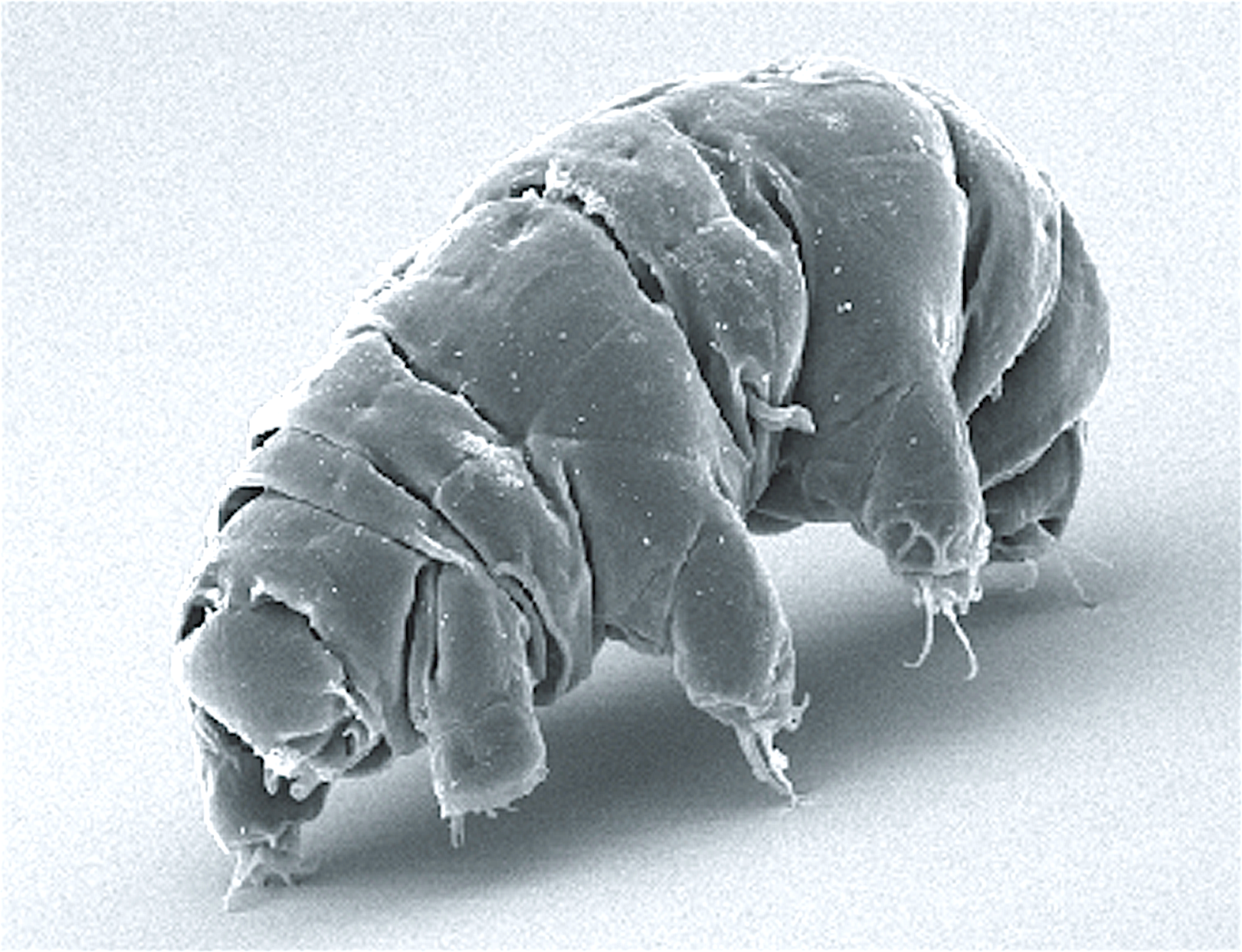
It survives vacuum, five thousand grays and a century of hype. It is not immortal, it is not from space, and a 2026 review still calls the mechanisms proposed. Our own research file gets almost all of this right and then puts its one fossil on the wrong continent, in the wrong period, under the wrong author's name.
A tardigrade is between a tenth of a millimetre and a millimetre and a half long. It has eight legs with claws on the ends, a mouth like a drawstring purse, and a wrinkled cuticle it moults out of. It lives in moss, in lichen, in leaf litter, in the film of water on a roof tile. There are about fourteen hundred described species and you have almost certainly carried some home on your shoes.
It is also the most over-sold animal on Earth, and the interesting thing is that the over-selling is not necessary. What it actually does is remarkable enough, and the honest version has better edges: a 2026 review of the whole phylum says, in its own abstract, that the molecular mechanisms underlying survival during extreme stresses have remained elusive.
01The Tun
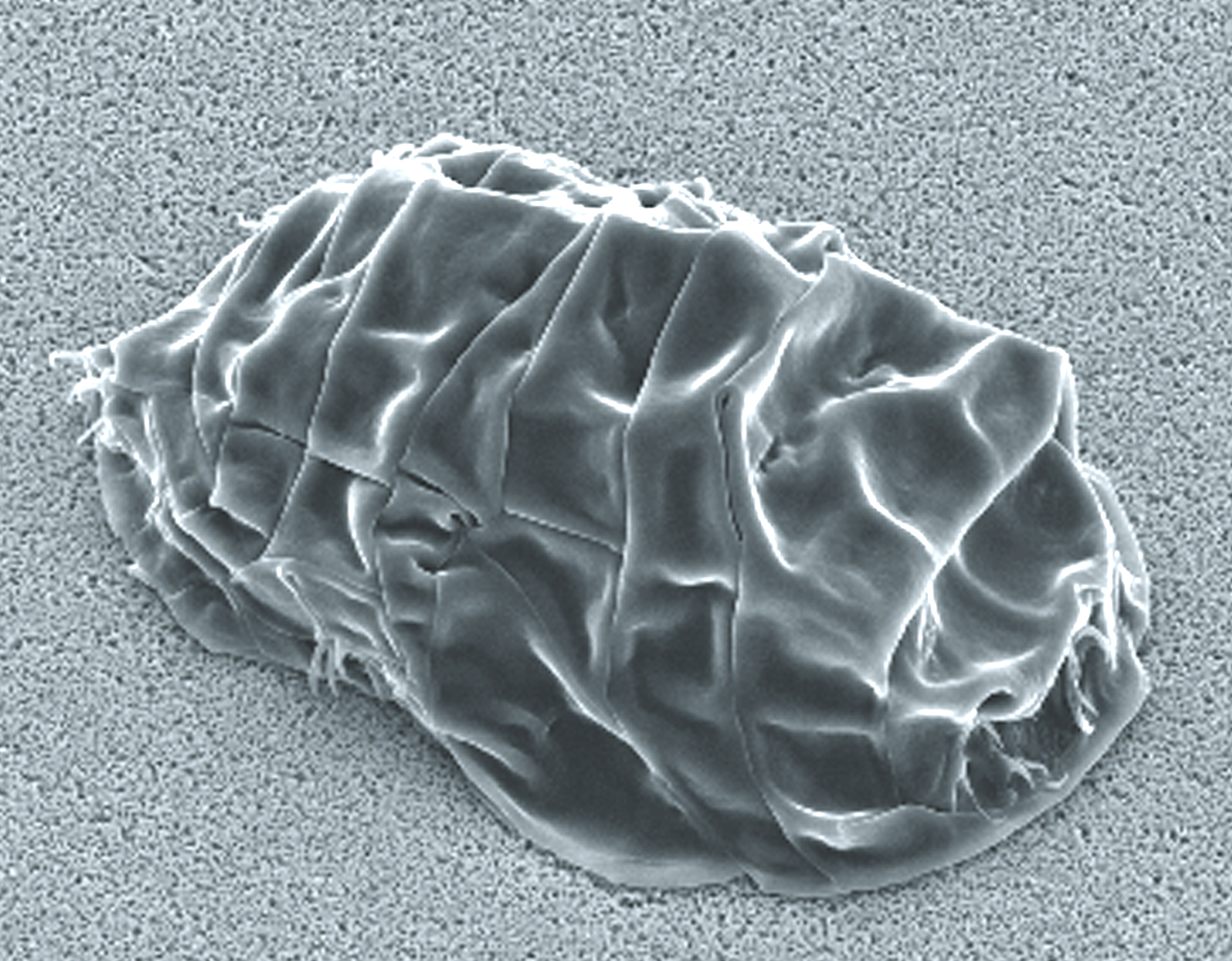
When a tardigrade dries out it contracts into a barrel called a tun, retracting its legs and secreting a waxy coating that slows water loss. In that state metabolic activity becomes undetectable and the animal can remain viable for years to decades; our file records Ingemar Jönsson and Roberto Guidetti documenting revival after more than thirty years in dried moss. And here is the part the popular version leaves out: the process only works slowly. Tardigrades exposed to instantaneous desiccation die. Our file gives the required drying time as roughly one to twenty-four hours, during which the protective molecules are synthesised. Rehydration then restores active metabolism within minutes to hours.
Our file's account, from Thomas Boothby's 2017 work: tardigrades make cytoplasmic and secretory abundant heat-soluble proteins, CAHS and SAHS, which have no stable structure in water but form amorphous biological glasses on drying, physically immobilising the contents of the cell so that nothing can aggregate or tear. In 2025 that picture acquired an actual structure. Malki, Teulon, Mikkola, Maurin and Pellequer published the crystal structure of CAHS-8 fibrils, describing a protein that is disordered in solution and, under stress, assembles into fibres that form a hydrogel, built from a single 101-residue helix forming an unusual 90-amino-acid coiled-coil dimer. Fibres and a gel with a solved structure, rather than simply a glass. Our file's version was the state of the art in 2017 and it named the right proteins.
02The Radiation, And What Dsup Actually Does
In 2016 Takuma Hashimoto and Takekazu Kunieda published the genome of Ramazzottius varieornatus and found a protein with no known relative outside the phylum: Damage Suppressor, or Dsup. It associates with chromatin and protects DNA from the hydroxyl radicals that radiation produces. Expressed in human cultured cells, our file reports, it cut X-ray-induced DNA damage by about 40 per cent and improved survival under radiation. That last detail is the one worth pausing on: a tardigrade gene, put into a human cell line, made the human cells harder to irradiate.
Our file describes Dsup as an intrinsically disordered protein forming a physical shield around DNA. In 2024 Zarubin, Murugova, Ryzhykau, Ivankov and Uversky put instruments on it, using small-angle X-ray scattering, circular dichroism and computational modelling. Their own words: for the first time the intrinsically disordered nature of Dsup, with a highly flexible structure, was experimentally proven and characterised. And they showed that Dsup forms a FUZZY complex with DNA, which is a term of art and a real distinction: not a rigid armour plate clamped over the double helix, but a floppy, constantly rearranging association that has no single fixed geometry.
| The Figure | Our File's Value | What It Does Not Say |
|---|---|---|
| Radiation | About 4,000 to 5,000 Gy for active specimens, against a human lethal dose of about 4 to 5 Gy. Desiccated tuns tolerate more | That any of this is ecologically relevant. Our own file's counter-arguments note that tardigrades evolved in moss and lichen, where the challenge is drying and freezing, not gamma rays |
| Temperature | Minus 272 C to plus 151 C | Duration. These are survival limits under specific exposures, not conditions an animal lives in |
| Pressure | Up to 6,000 atmospheres, roughly six times the deepest ocean trench | Anything about the deep sea. This is a laboratory limit, and tardigrades are not deep-ocean animals |
| Desiccation | Viable for years to decades; documented revival after more than 30 years | Indefinitely. Our file is explicit that a much-repeated 120-year revival claim from 1948 museum moss has never been independently confirmed |
| Space | Above 68 per cent survived vacuum alone in the 2007 TARDIS experiment, and some survived vacuum plus unfiltered solar ultraviolet and then bred | That the combination is survivable in general. Our file records that survival fell significantly once ultraviolet was added |
| Impact | Traspas and Burchell 2021: survival to about 3,000 g, death at about 3,800 g | Panspermia. A meteorite impact runs well past 100,000 g, which our own file uses to close the argument rather than open it |
03Ten Days Outside The Spacecraft
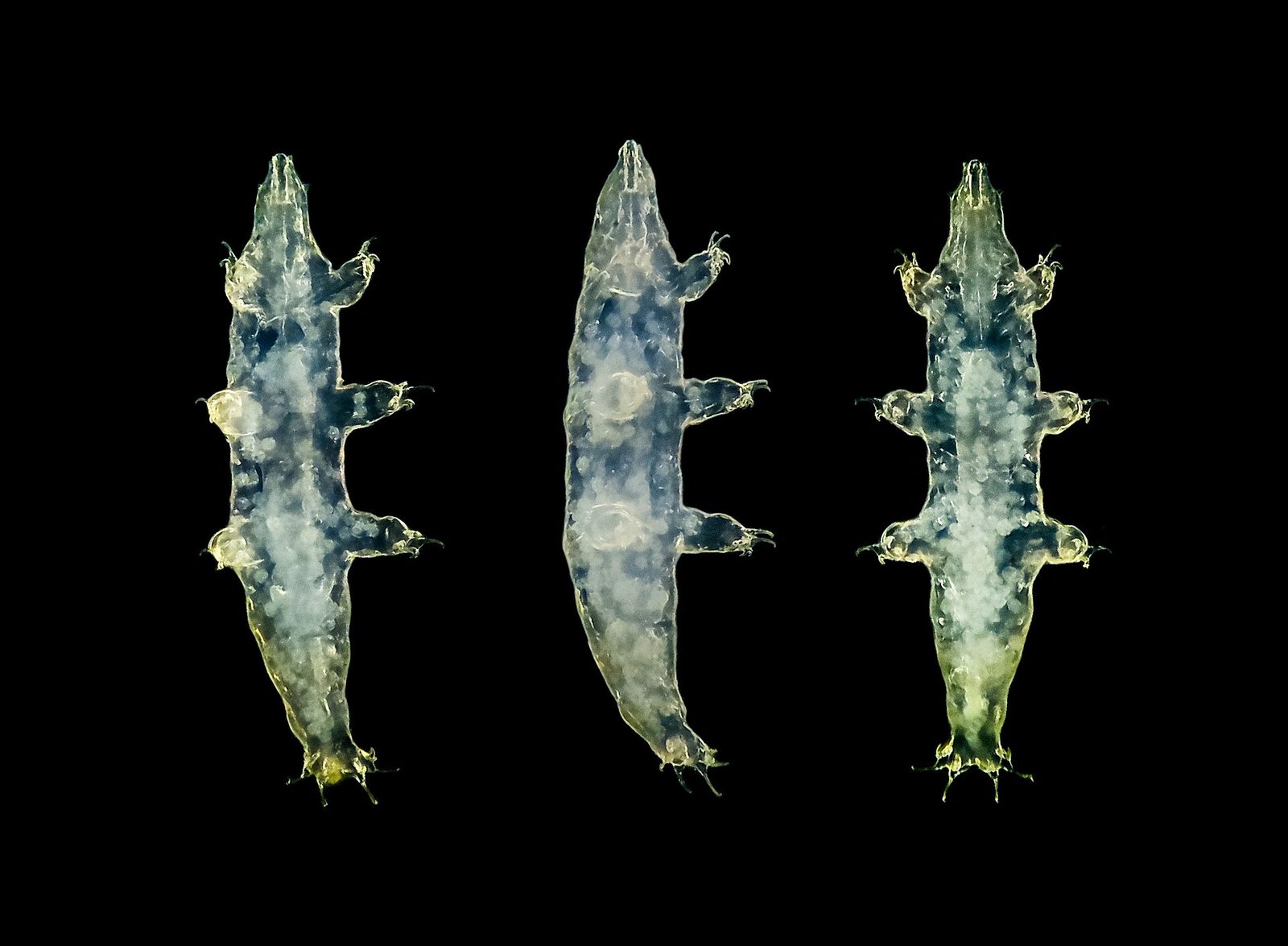
In September 2007, dehydrated tardigrades rode on the OUTSIDE of the FOTON-M3 spacecraft in low Earth orbit for ten days, exposed to vacuum, solar ultraviolet, cosmic radiation and temperature swings. Our file reports survival above 68 per cent among animals exposed to vacuum alone, and that some of those exposed to both vacuum and unfiltered solar ultraviolet not only survived but went on to produce viable offspring, making Milnesium tardigradum the first animal known to have survived full space exposure. The result that gets quoted stops there. The result our file also gives is that survival dropped significantly once ultraviolet was in the mix: they tolerate the stresses one at a time far better than together.
04The Genome That Was Mostly Contamination
In 2015 the first tardigrade genome paper reported that about 17.5 per cent of the animal's DNA had been acquired horizontally from bacteria, plants, fungi and archaea, which would have been an extraordinary proportion and a tidy explanation for where the exotic survival machinery came from. In 2016 a second team resequenced the same species with better decontamination and found that the great majority of those transfers were contamination artefacts, leaving roughly 1.5 per cent, which is unremarkable for an animal. Both papers were in the Proceedings of the National Academy of Sciences, both are cited correctly in our file, and both identifiers resolve. Our file's own assessment names the cost without flinching: the episode damaged the credibility of some tardigrade genomics research and exposed systemic contamination problems in sequencing microscopic organisms.
05The One Thing Our Own File Gets Wrong
Our research file states that the earliest fossil tardigrades date to the Cambrian, about 520 million years ago, giving as its example Beorn leggi, from the Siberian Orsten fauna, described by Maas and Waloszek in 2001. Every element of that is wrong. Beorn leggi is from CANADIAN CRETACEOUS AMBER and was described by Kenneth W. Cooper in 1964, in a paper whose title is Beorn Leggi Cooper, From Cretaceous Amber. Maas and Waloszek 2001 is a real paper about real Orsten material, and our file cites it correctly elsewhere in the same sentence; it simply is not the description of this species. Wrong period, wrong continent, wrong preservation medium, wrong author, wrong year.
In 2024 Marc Mapalo, Joanna Wolfe and Javier Ortega-Hernández revisited the Canadian amber with confocal fluorescence microscopy and formally redescribed Beorn leggi, showing it has Hypsibius-type claws, and named a second species alongside it, Aerobius dactylus. Their opening states the real situation: molecular clocks suggest tardigrades diverged from other panarthropods before the Cambrian, but their fossil record is extremely sparse, and before this work only two fossil tardigrades had resolved taxonomic positions at all. Their phylogenetic analysis places both amber species in the eutardigrade superfamily Hypsibioidea, giving a calibration point, and their molecular clock estimates suggest an early Paleozoic diversification of crown-group Tardigrada. Our file collapsed two separate things: a molecular divergence estimate that does reach back before the Cambrian, and a fossil record that does not.
06What It Is Not
An active tardigrade lives a few months to about two years. A tun survives decades but not indefinitely, and our file states plainly that there is no reliably documented survival beyond about thirty years, and that the frequently repeated 120-year revival from dried museum moss, attributed to 1948, has never been independently confirmed under modern conditions. While hydrated they are killed readily by nematodes and mites that eat them, by fungal infection, and by ordinary environmental toxins. The animal that survives the vacuum of space can be eaten by something living in the same clump of moss.
Claims that tardigrades are extraterrestrial in origin, made on the strength of the very tolerances above, are refused. Their genomes place them clearly inside Ecdysozoa, alongside arthropods and nematodes; their biochemistry runs on the standard terrestrial genetic code and the standard amino acids; and they have a fossil record. Our file's own explanation of where the extremotolerance came from is the ordinary one and is almost certainly right: moss, lichen and leaf litter dry out and rewet constantly, and an animal that lives in that film of water needs to survive losing it.
The best passage in our research file is the one that undercuts the headline. Some biologists argue that the laboratory extremes are irrelevant to what tardigrades actually do: they evolved where the challenge is periodic drying and freezing, not 6,000 atmospheres, and the extremotolerance may be a by-product of desiccation protection rather than a trait selected for on its own. And the tolerance is not even general within the phylum. Survival varies enormously between species. Ramazzottius varieornatus and Milnesium tardigradum are the champions that get tested and quoted; many tardigrade species are only modestly desiccation-tolerant, and laboratory studies use the optimal slow drying that natural conditions may never provide.
Fast Facts
- What
- Phylum Tardigrada. About 1,400 described species, 0.1 to 1.5 mm long. Eutardigrada about 1,000, Heterotardigrada about 400, and Mesotardigrada a single species found once in 1937 and never seen again
- Where They Live
- Moss, lichen and leaf litter, in films of water. Not space, not the deep sea
- The Tun
- Volume down by about half, water from about 85 per cent to below 1 to 3 per cent, metabolism undetectable. Requires SLOW drying over roughly 1 to 24 hours; instant desiccation kills them
- Dsup
- A tardigrade-only protein that binds chromatin. In human cultured cells it cut X-ray DNA damage by about 40 per cent. Shown experimentally in 2024 to be intrinsically disordered and to form a FUZZY complex with DNA
- CAHS Proteins
- Disordered in water, assembling under stress. Tier 2. The 2025 crystal structure of CAHS-8 is reported as fibrils forming a hydrogel, built from a helix of about 101 residues in a coiled-coil dimer
- In Orbit
- TARDIS, September 2007, ten days on the outside of FOTON-M3. Over 68 per cent survived vacuum alone; survival fell significantly with solar ultraviolet added
- The Genome Scandal
- Tier 2. A reported 17.5 per cent horizontal gene transfer in 2015, cut to about 1.5 per cent in 2016 once the contamination was cleaned up
- The Oldest Fossil
- NOT Cambrian. Beorn leggi is Canadian Cretaceous amber, described by Cooper in 1964 and redescribed in 2024. Molecular clocks reach further back than the fossils do
- Lifespan
- Months to about two years while active. Decades in a tun, not centuries
What We Can Actually Stand Behind
Tardigrades enter a tun state in which metabolism is undetectable and survive years to decades dried, given slow drying. Dsup exists, has no known relative outside the phylum, and reduces radiation damage when expressed in human cells; its disorder and its fuzzy DNA complex were demonstrated experimentally in 2024. Tardigrades survived ten days on the exterior of FOTON-M3 in 2007 and some bred afterwards. The 2015 horizontal gene transfer result was retracted in effect by a 2016 resequencing. Beorn leggi is a Cretaceous Canadian amber fossil described by Cooper in 1964 and redescribed by Mapalo, Wolfe and Ortega-Hernández in 2024.
The CAHS vitrification and fibril mechanism, which now has a structure but is one protein of several. The phylogenetic position as sister group to arthropods plus onychophorans, where the branching order is debated. And the whole mechanistic account: a 2026 review of the phylum uses the word proposed throughout and says outright that the molecular mechanisms have remained elusive. A great deal is measured. Rather less is explained.
Panspermia. Days to weeks of exposure is not thousands to millions of years of transit, the impact tolerance runs out around 3,800 g against a meteorite's six figures, and a complex multicellular animal is not what panspermia arguments are about in the first place.
Tardigrades are not immortal, not indestructible, and not extraterrestrial. They are eaten by mites. And the story of an alleged, never independently confirmed 120-year revival from museum moss is exactly the kind of claim this tier exists for. And the Cambrian fossil in our own research file does not exist: that species is Cretaceous, not Cambrian, and it came out of amber in Canada.
The thing that stays with me is the drying time. Everything else about this animal invites the word indestructible, and then it turns out that the whole trick depends on having between one and twenty-four hours of warning. Dry a tardigrade instantly and it dies like anything else. What it has is not toughness in the sense of a substance that resists; it is a procedure, and the procedure takes time to run. The most extreme survival on Earth is a shutdown sequence, and you can kill the animal by not letting it finish.
Sources & further reading
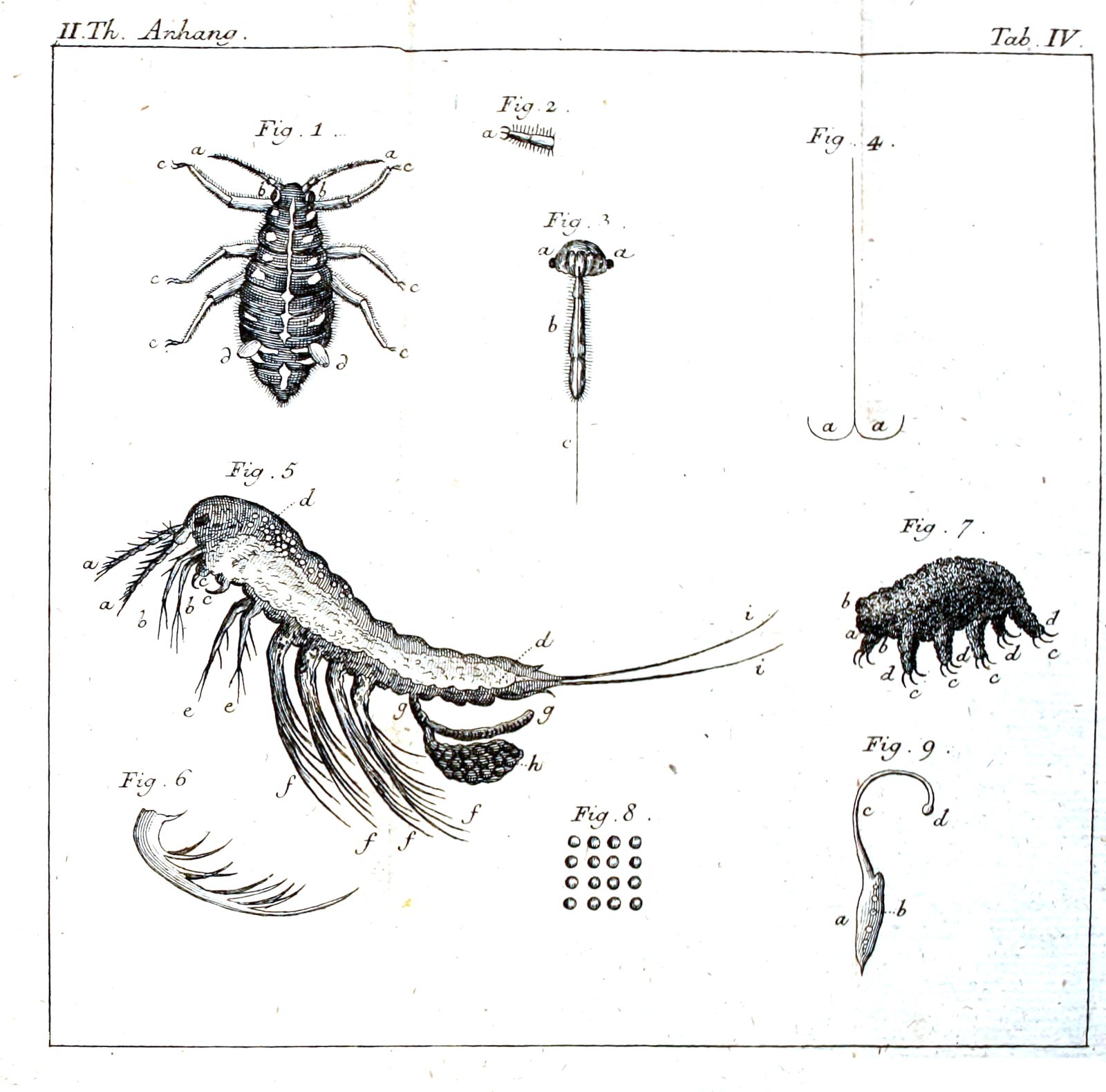
WHERE THIS WORKED FROM, AND WHERE IT CAN BE CHECKED. This article worked from one file in our own research library, ZB_2_16, at Source Confidence 4 out of 5. ALL TWELVE OF ITS IDENTIFIERS WERE RESOLVED LIVE AGAINST CROSSREF FOR THIS ARTICLE AND ALL TWELVE ARE CORRECT, matching the named authors, journal, volume and pages in every case. That is the first perfect bibliography in this programme, after eleven articles in which broken identifiers were the norm, and it deserves stating as loudly as the failures have been. MORE THAN THAT: this file's Corrections block records the hygiene campaign reassembling a truncated Elsevier identifier, one of the kind where a parenthesised year in the DOI was read as a field break and the tail left stranded in a neighbouring column. The reassembled identifier is 10.1016/S0960-9822(02)00959-4 and it resolves correctly to Goldstein and Blaxter's 'Tardigrades' in Current Biology. THE REPAIR WORKED. AND YET. Section 05 sets out a plain factual error in a document whose citations are flawless: our file places the earliest tardigrade fossil in the Cambrian and names Beorn leggi from the Siberian Orsten fauna, described by Maas and Waloszek in 2001. Beorn leggi is Cretaceous, from Canadian amber, and was described by Kenneth W. Cooper in Psyche in 1964. Maas and Waloszek 2001 is cited correctly by our file in the same sentence and is a genuine paper about genuine Orsten material; it is not the description of this species. NOTHING ABOUT VERIFYING TWELVE IDENTIFIERS WOULD HAVE CAUGHT THIS, which is the point worth taking away: a clean bibliography is not a clean document. WHAT THIS PAGE ADDS THAT OUR FILE PREDATES. ZB_2_16 was last updated in June 2025. Since then: the 2024 amber redescription by Mapalo, Wolfe and Ortega-Hernández, which corrects the fossil claim and revises the timeline; the 2024 structural study of Dsup, which proved its disorder experimentally and characterised its DNA association as a fuzzy complex; the 2025 crystal structure of CAHS-8 fibrils, which turns the vitrification account into fibres forming a hydrogel; and the 2026 whole-phylum review in Molecular Ecology, whose own abstract says the molecular mechanisms have remained elusive. WHAT IS CARRIED AS OUR FILE'S OWN. Every tolerance figure, the volume and water-content changes in the tun, the 40 per cent DNA damage reduction, the TARDIS survival percentages, the species counts, the impact thresholds, and the horizontal gene transfer percentages. Those figures come from papers our file cites correctly and whose identifiers resolve, but the numbers themselves were not re-read from the papers for this article. ON THE IMAGES. The two electron micrographs are the same species from the same imaging series, which is why the active and tun frames can be compared directly. The eighteenth-century plate is attributed and dated as its Commons record gives it, and this session did not verify the publication independently; the tardigrade on it is figure 7 and the rest of the plate is other animals.
Image credits
- Milnesium tardigradum in the active state, scanning electron micrograph Schokraie E, Warnken U, Hotz-Wagenblatt A, Grohme MA, Hengherr S, et al., via Wikimedia Commons. CC BY 2.5 Source.
- Milnesium tardigradum in the tun state, scanning electron micrograph Schokraie E, Warnken U, Hotz-Wagenblatt A, Grohme MA, Hengherr S, et al., via Wikimedia Commons. CC BY 2.5 Source.
- Engraved plate of microscopic animals, 1773, with a tardigrade as figure 7 J. A. E. Goeze, via Wikimedia Commons. Public domain Source.
- Three tardigrades of the genus Milnesium, light micrograph Brandon Antonio Segura Torres, via Wikimedia Commons. CC BY-SA 4.0 Source.


