
Every Reign Is A Multiple Of Thirty Six Hundred
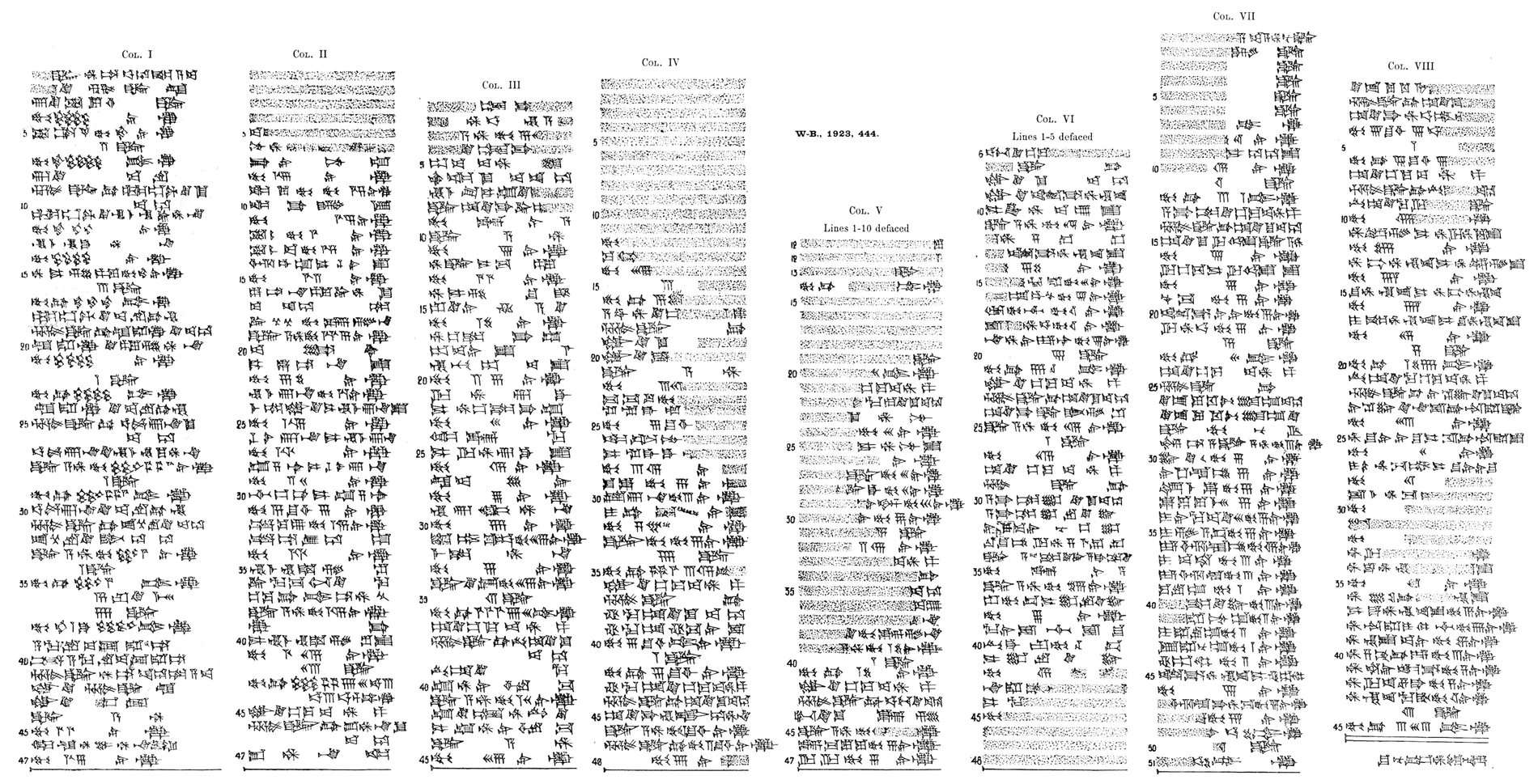
A clay prism in Oxford says the first king of Eridu ruled for 28,800 years, and the second for 36,000. Those look like the wild numbers of a credulous age until you notice what they have in common: every one of them divides exactly by 3,600, the largest round number the Sumerians had. Here is what the list actually says, what part of it turns out to be true, and what we found when we checked every citation in our own file about it.
The first king of Eridu, says the list, ruled for twenty eight thousand eight hundred years. The second ruled for thirty six thousand. Six more kings follow in four more cities, and then a single line: then the flood swept over. After that, kingship starts again at Kish, and the reigns begin, slowly, to come down to human size.
It is easy to file this under credulous antiquity and move on. But look at the two numbers again. 28,800 is 8 times 3,600. 36,000 is 10 times 3,600. The whole antediluvian total, 241,200 years, is 67 times 3,600. And 3,600 is not an arbitrary figure: it is the sar, the largest standard unit in the Sumerian base-sixty system, their equivalent of the biggest round number on the abacus. A list of durations in which every single value is a whole multiple of the largest available round number is not a bad record of how long people lived. It is arithmetic, and it was never pretending otherwise.
01The Object, And What It Admits About Itself
This is a real object with a catalogue number. The Sumerian King List survives in at least eighteen known exemplars, spanning from the Ur III period around 2100 BCE to the Late Babylonian period. The most complete is the Weld-Blundell Prism, catalogued WB-444 and dated to about 1800 BCE, acquired by Herbert Weld for the Ashmolean Museum in Oxford. It is a four-sided clay prism inscribed in Sumerian, and it runs from the descent of kingship down to the Isin dynasty.
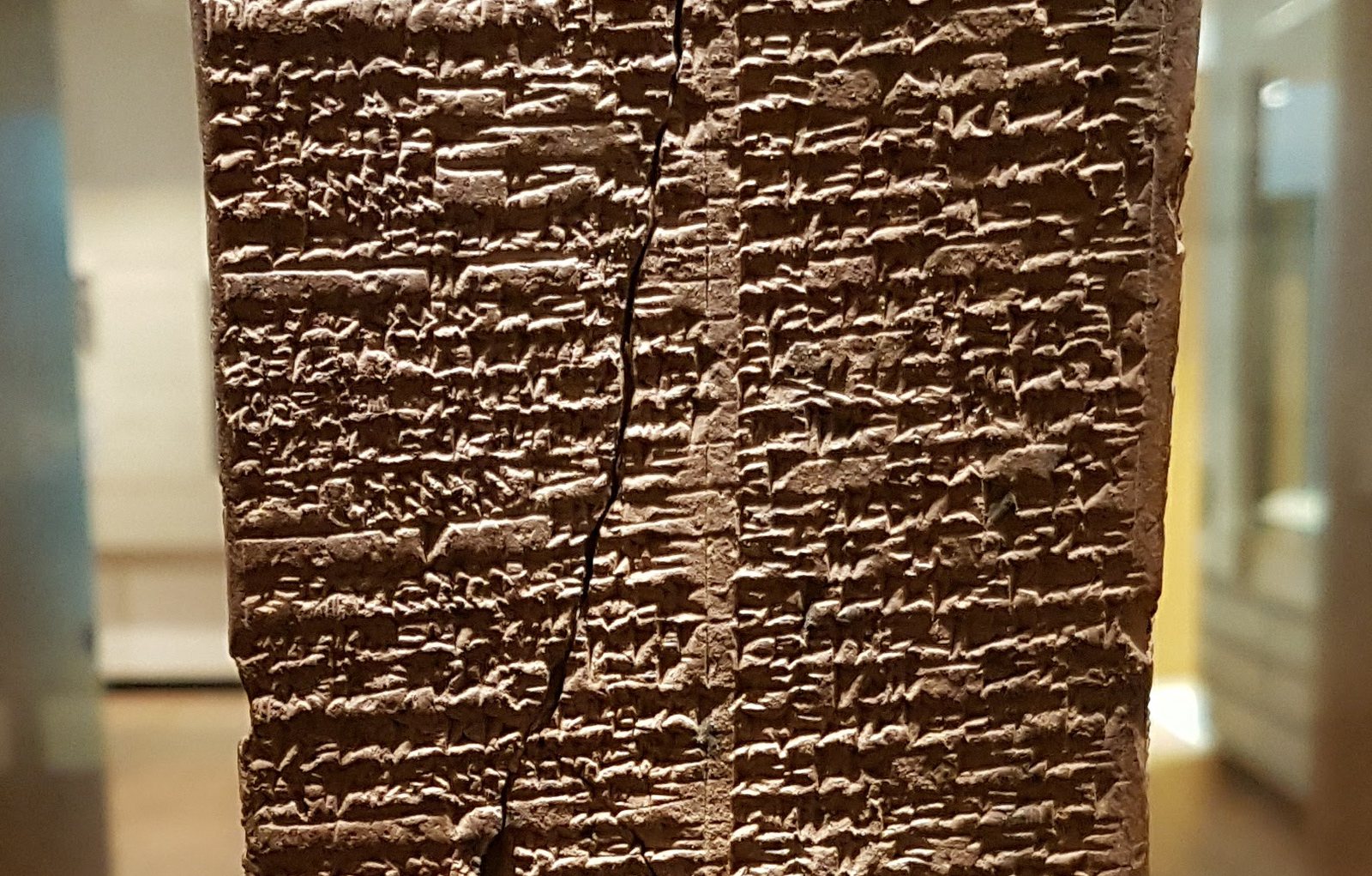
The structure carries the argument. The list has two halves. The antediluvian half names eight kings in five cities, in a fixed order: Eridu, Bad-tibira, Larak, Sippar, Shuruppak. Between the halves stands one line, a-ma-ru ba-ur-ra, then the flood swept over. The postdiluvian half restarts kingship at Kish, with twenty three kings, then hands it on to Uruk, where Gilgamesh appears, then to Ur, then onward.
The opening formula is a constitutional claim, not a historical one. nam-lugal an-ta ed-de-a-ba, when kingship descended from heaven, is among the most analysed phrases in Sumerology, and what it establishes is that royal authority is not made by people. It is granted by gods, and, crucially, it is transferred by them from city to city. That second half is what the document is for. A list organised this way can explain any conquest as a transfer of divine favour, and it can only ever have one holder at a time.
02The Numbers
What the prism says, and what the numbers do. Alulim of Eridu, 28,800 years. Alalgar of Eridu, 36,000. The antediluvian total, 241,200. Those are the figures the text carries. And the arithmetic on them is not an interpretation, it is division: 28,800 is 8 times 3,600. 36,000 is 10 times 3,600. 241,200 is 67 times 3,600. The sar, 3,600, was the largest standard unit in Sumerian sexagesimal counting. Every antediluvian reign in the list is a whole multiple of it, with no remainder anywhere.
What that pattern most likely means. The figures above are what the text says; the reading of them is a separate claim and belongs one tier down. Dwight Young's 1988 paper is the standard treatment, and the conclusion it supports is that a table of durations in which every value is a whole multiple of the largest available round number reflects mathematical and symbolic construction rather than historical record. Put plainly: the compilers were not confused about how long a person lives. They were doing arithmetic on purpose, and expected a reader to see it. What the arithmetic was for is the genuinely open part.
Three of the later kings are archaeologically real. Enmebaragesi of Kish, around 2600 BCE, is confirmed by a votive inscription, which makes him the earliest king in the list attested from outside it. Mesannepada of Ur is confirmed by an inscription on a lapis lazuli bead from the Royal Cemetery of Ur. Gilgamesh of Uruk appears in later literary and administrative texts, and our own file says plainly what most retellings do not: no contemporary inscription of him survives. The document is not fiction with a historical veneer. It is a real dynastic memory with a fictional chronology bolted onto the front.
And the reigns shrink as the list approaches history, which is the tell. The postdiluvian figures come down gradually from thousands of years to lengths a person could actually have lived. A wholly invented document has no reason to taper. A wholly historical one has no reason to start at 28,800. The taper is the seam between the two halves, and it is visible in the numbers themselves without any need to decide in advance what the text is.
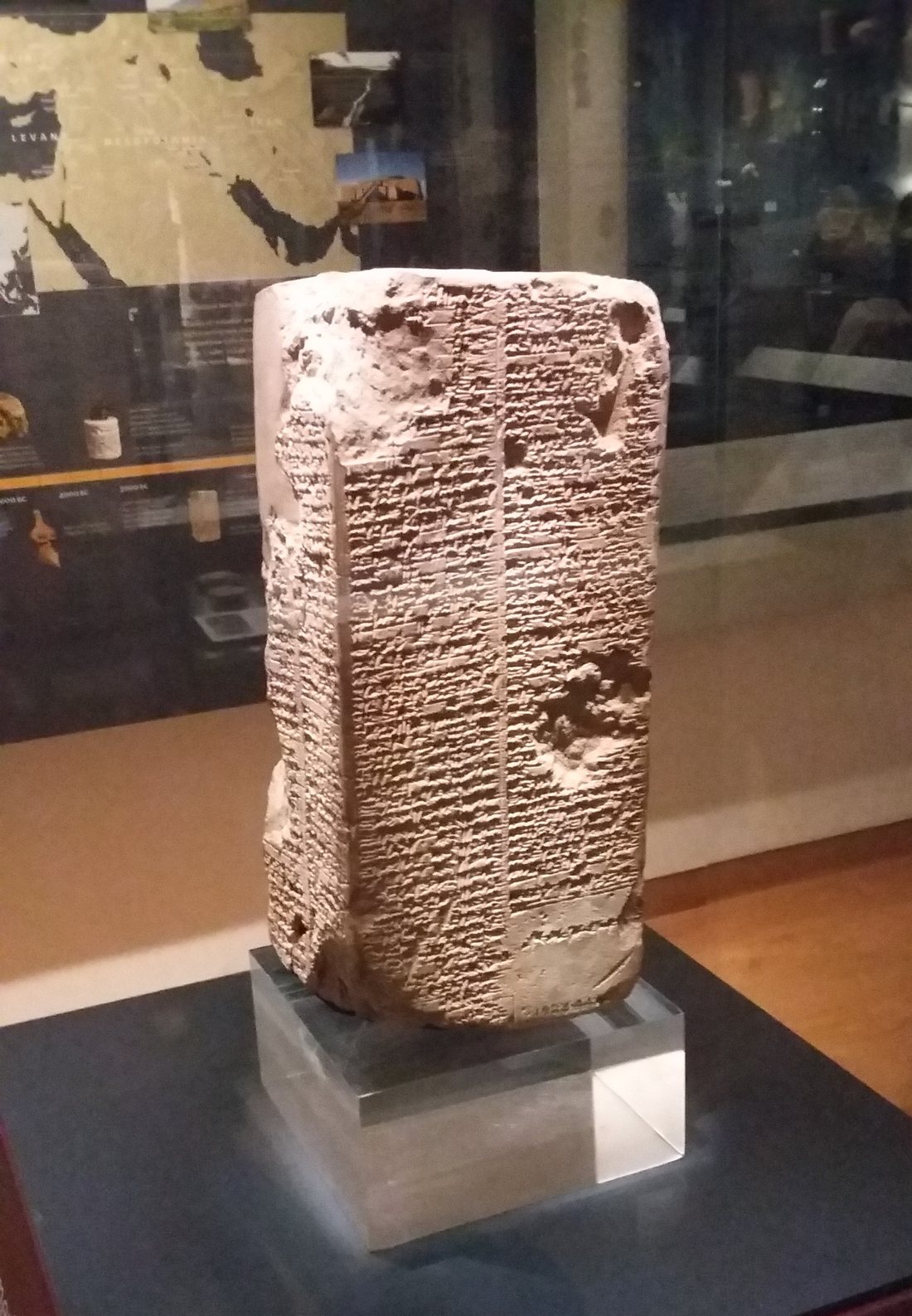
It is worth pausing on how much of this text we do not have. Langdon's transcription in the hero image above marks two columns as defaced at the top and renders long stretches of several others as grey stipple, and the object itself has lost a corner. Any argument about exact totals is an argument about a damaged surface, and the totals are exactly where the popular retellings put all their weight.
Genesis has the same shape. Genesis 5 lists ten patriarchs from Adam to Noah with lifespans of 930, 912 and 969 years, then a flood, after which lifespans fall. The King List has eight antediluvian kings, a flood, then declining reigns. Berossus, a Babylonian priest of the third century BCE, adapted the tradition in his Babyloniaca with ten antediluvian kings totalling 432,000 years. The three counts are not the same and should not be blurred together, but the architecture is: rulers of impossible age, a flood, then history.
03Where The Speculation Starts, And Where Our Own File Slips
The precession reading, with the hedge our file supplies itself. The 241,200-year antediluvian total works out at 9.3 precessional cycles of 25,920 years. Our file's own words are that this is not an exact fit, but close enough to sustain speculation, and that is the correct weight for it. Whether the resemblance reflects transmission, or simply what happens when two traditions both count in round multiples of sixty, our file says remains unresolved. We agree, and we are leaving it unresolved rather than tidying it.
One number in our own document is wrong by a factor of six. It states that Berossus's 432,000-year total is precisely one sixtieth of the Hindu mahayuga of 4,320,000 years. It is one tenth. 4,320,000 divided by 432,000 is 10. One sixtieth of 4,320,000 would be 72,000, a number that appears nowhere in this discussion. The error matters more than an ordinary slip, because the whole rhetorical weight of that sentence rests on the ratio being exact, and the ratio that is exact is a different one. The relationship is real. It is a factor of ten.
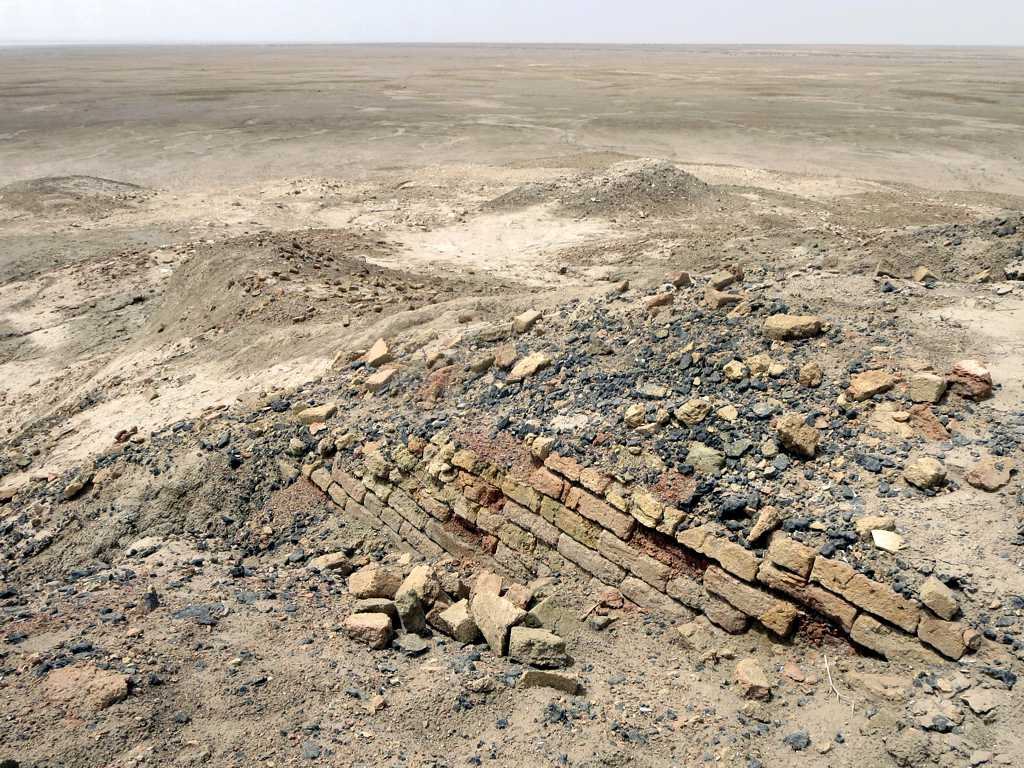
The list puts the first kingship at Eridu, and Eridu really is the oldest. Modern Tell Abu Shahrain is among the oldest settled sites in southern Mesopotamia, with occupation levels reaching back to about 5400 BCE. That is not evidence for Alulim and it is certainly not evidence for a 28,800-year reign. What it is evidence for is that whoever compiled the list knew which city was the oldest, which is a genuine piece of preserved memory sitting inside an invented chronology. That combination is the honest description of the whole document.
04What The Document Is Actually For
It is a political charter, not a chronicle. Older scholarship, Jacobsen in 1939, read the list as preserving genuine Early Dynastic tradition. The consensus led by Piotr Michalowski and Piotr Steinkeller is that it is a fictionalised charter composed in the Ur III period, roughly 2112 to 2004 BCE, to legitimise the reunification of Mesopotamia by projecting a single unbroken chain of city-by-city rule backward in time. And the crucial part is what that projection erases: the Early Dynastic period was politically fragmented, and the unbroken succession the list describes never existed. The document does not exaggerate the past. It replaces it.
And the flood was added later. Claus Wilcke and others have shown that the antediluvian section and the flood line were not part of the original Ur III King List. They were added during the Isin-Larsa period, roughly 1953 to 1700 BCE, merging an independent flood myth into the dynastic list and running the pedigree of kingship back to the beginning of the world. So the most famous feature of the document, the one that gets it quoted, is a later insertion into it.
And the flood layers in the ground do not line up with each other. The deposits found by Max Mallowan at Nineveh and Leonard Woolley at Ur, around 3500 BCE, do not correlate stratigraphically with the flood layer at Shuruppak, around 2900 BCE. Different sites, different centuries, different water. Our file's reading is that these were severe but localised riverine floods, and that there is no single region-wide Mesopotamian deluge available for the King List to be remembering.
The reigns are not literal. Taking 28,800 to 43,200 years per king at face value contradicts everything known about human lifespan, and it is universally rejected. Our file does not hedge this and neither do we. The numbers are symbolic and mathematical, and the arithmetic in section 02 above is what they are made of.
And 'heaven' is not a planet. Following Sitchin, some authors read the superhuman reigns and the phrase kingship descended from heaven as evidence that the antediluvian rulers were extraterrestrial Anunnaki from a planet called Nibiru. No cuneiform evidence identifies Sumerian an, heaven, with any specific planet, and Sitchin's translations have been widely criticised by Assyriologists. The word is doing the same ordinary work it does in every other Mesopotamian royal formula, which is the reason the formula was worth writing on a prism in the first place.
05What We Found Auditing Our Own Citations
Four of this file's identifiers point at the wrong work. Fourteen entries, ten of them carrying an identifier. Six reach the right work. Four do not. Two are reviews standing in for the books they review. Two are JSTOR identifiers that land on a neighbouring article. Four further entries carry no identifier at all. Every wrong pointer has been repaired or established as unrepairable, and three of the six correct ones are reprint printings attached to first-edition dates, including one that is a different publisher entirely.
All four failures were predicted in advance, and two of them by name. The rule this series has been testing is that a wrong identifier lands on whatever is adjacent in the namespace the identifier itself uses. Two entries here are books carrying DOIs whose publisher prefix cannot match their stated publisher, so the sealed prediction named the journal each review would be found in. Jacobsen's 1939 Chicago monograph carries a Cambridge prefix and the ISSN stem of the Journal of the Royal Asiatic Society; it returns a review in the Journal of the Royal Asiatic Society. Glassner's Society of Biblical Literature volume carries an Oxford prefix, the Journal of Semitic Studies code, and a 2008-09 volume marker; it returns a review in the Journal of Semitic Studies, published in 2008. Both journals, and the year, came off the identifier strings before anything was resolved.
The other two failed the other way, and comparing them gives a new rule. JSTOR identifiers are archive accession numbers, assigned in deposit order rather than by publication, which is why a wrong one drifts rather than dying. Michalowski's is out by seven, and it lands on a different article in the same issue of the same journal in the same year. Hallo's is out by two hundred and seventy two, and that one crosses into the next volume and the next year. So: a small offset reads like a typing slip and stays local. A large one silently changes the date as well as the work, and produces a citation that is wrong in a way no reader would think to check.
| Section Of The Library | Files | Correct | Wrong | Correct |
|---|---|---|---|---|
| Genetics and Origins | 1 | 15 | 0 | 100% |
| Molecular Biology | 2 | 9 | 1 | 90% |
| Biology and Evolution | 2 | 18 | 4 | 82% |
| Oceanography | 1 | 10 | 3 | 77% |
| Ecology and Biology | 2 | 18 | 6 | 75% |
| Foundations and Scripture | 4 | 12 | 24 | 33% |
| Lost Connections | 2 | 4 | 4 | 50% |
| World Civilizations | 8 | 21 | 35 | 38% |
| Secret Societies | 4 | 5 | 19 | 21% |
| The sciences together | 8 | 70 | 14 | 83% |
| The humanities together | 18 | 42 | 82 | 34% |
And the mechanism showed itself twice in this one bibliography, without being asked. Jacobsen's monograph has no book record at all and two competing reviews of it, one by C. J. Gadd and one by Albrecht Goetze, published in different journals in the same year. Anything filling that field mechanically has two candidates, no correct answer, and picks one. That is the entire failure, visible in a single entry. Then there is entry nine, an Iraqi state excavation report on Eridu, whose identifier field is empty, and for which the only available candidate is a review of it in Antiquity. That is precisely what would have gone in had anyone filled it. The blank field prevented a defect. An empty identifier is not automatically a gap, and here we can show exactly what the gap was protecting us from.
Entry twelve of this bibliography reads, in the author field, Heiser, Michael S. : 1-15. The page range is sitting where a person's name belongs. Yesterday, auditing a file on the Cambrian explosion in an entirely different part of the library, we found an article number, e1600983, resting among the authors of a paper in Science Advances. Two unrelated documents, two different stray locators, the same destination. A parser that cannot place a value does not leave the field empty. It puts the value somewhere else, and the somewhere else is a person's name.
It has no boilerplate denial, and its disputes section is real. 1,246 of our 3,632 documents carry a verbatim identical sentence stating that no significant counter-arguments exist in the scholarly literature. This file carries none. Instead it has three substantive disputes, each naming scholars and dates: when the list was composed and for what political purpose, that the flood section was a later insertion, and that the archaeological flood layers do not correlate with each other. Its header arithmetic is honest too, fourteen sources counted against fourteen real entries. We wrote the prediction that this file would be healthy before reading that section, so it could not be claimed afterwards. Naming a good document precisely matters as much as naming a bad one, and most of what this series reports is failure.
Fast Facts
- The object
- The Weld-Blundell Prism, WB-444, a four-sided clay prism in Sumerian, about 1800 BCE, Ashmolean Museum, Oxford
- How many copies
- At least eighteen known exemplars, from about 2100 BCE to the Late Babylonian period
- Before the flood
- Eight kings in five cities: Eridu, Bad-tibira, Larak, Sippar, Shuruppak
- The two longest early reigns
- Alulim of Eridu, 28,800 years. Alalgar of Eridu, 36,000 years
- The pattern
- Every antediluvian reign is a whole multiple of 3,600, the sar, the largest standard unit in Sumerian base-sixty counting. The total, 241,200, is 67 of them
- The flood
- One line: a-ma-ru ba-ur-ra, then the flood swept over
- After it
- Kingship restarts at Kish with twenty three kings, then Uruk, then Ur
- Independently attested
- Enmebaragesi of Kish by votive inscription, Mesannepada of Ur by a lapis lazuli bead. Gilgamesh has no contemporary inscription
- What it is for
- An Ur III political charter, roughly 2112 to 2004 BCE, projecting a single unbroken succession backward over a period that was in fact fragmented
- The famous part is an addition
- The antediluvian section and the flood line were inserted in the Isin-Larsa period, roughly 1953 to 1700 BCE
- Citations in the source file
- 14 entries, 10 with an identifier. 6 reach the right work, 4 do not. 4 recovered by us, 1 blank confirmed correct
What We Can Actually Stand Behind
The Weld-Blundell Prism exists, is about 3,800 years old, sits in Oxford, and says what it is reported to say. Eight kings in five cities before a flood, then kingship restarting at Kish. At least eighteen exemplars of the text survive.
Every antediluvian reign length is a whole multiple of 3,600, the largest standard unit in Sumerian sexagesimal counting. The antediluvian total is 67 of them. This is checkable arithmetic and it holds.
The modern reading is that the list is an Ur III political charter that projects an unbroken succession backward over a fragmented period, and that the antediluvian section and the flood were added later, in the Isin-Larsa period. The document's most famous feature is a later insertion.
Three postdiluvian kings are independently attested, and the reign lengths taper toward plausibility as the list approaches history. The text preserves real dynastic memory. Gilgamesh is not among the independently attested, and we say so.
The Genesis 5 genealogy, the King List and Berossus share an architecture: long-lived rulers, a flood, then decline. That is good evidence for a shared Mesopotamian tradition. It is not evidence that any of the three is a record of events.
Whether the round numbers encode astronomical cycles. The 241,200-year total is 9.3 precessional cycles, which our own file correctly calls not an exact fit. Berossus's 432,000 is one tenth of the Hindu mahayuga, not one sixtieth as our file states. The relationship is real and the significance is unproven.
That anybody reigned for 28,800 years. And that kingship descending from heaven refers to a planet: no cuneiform evidence identifies Sumerian an with any specific body, and the Sitchin translations underpinning that reading have been widely criticised by Assyriologists.
Sources & further reading
The Assyriology above is drawn from our research library on Theories of Anything. Every identifier below was resolved live against Crossref or OpenLibrary on 26 August 2026. Four are marked RECOVERED because our own file's entry pointed at the wrong work or carried nothing at all.
Image credits
- Langdon's 1923 transcription of the Weld-Blundell Prism, all eight columns Stephen Herbert Langdon, via Wikimedia Commons (public domain). Public domain Source.
- Two ruled columns of a Sumerian King List prism, close up. Cropped by us from a taller photograph Gts-tg, via Wikimedia Commons (CC BY-SA 4.0), cropped to a landscape band by Theories of Anything. CC BY-SA 4.0 Source.
- The Sumerian King List prism in its display case, Ashmolean Museum, Oxford M.atkinsonross, via Wikimedia Commons (CC BY-SA 4.0). CC BY-SA 4.0 Source.
- Exposed brick courses at Eridu, modern Tell Abu Shahrain, southern Iraq David Stanley, via Wikimedia Commons (CC BY 2.0). CC BY 2.0 Source.
_Published_in_1923.jpg)
.jpg)

.jpg)