
The Split-Brain: Two Minds Inside One Skull?
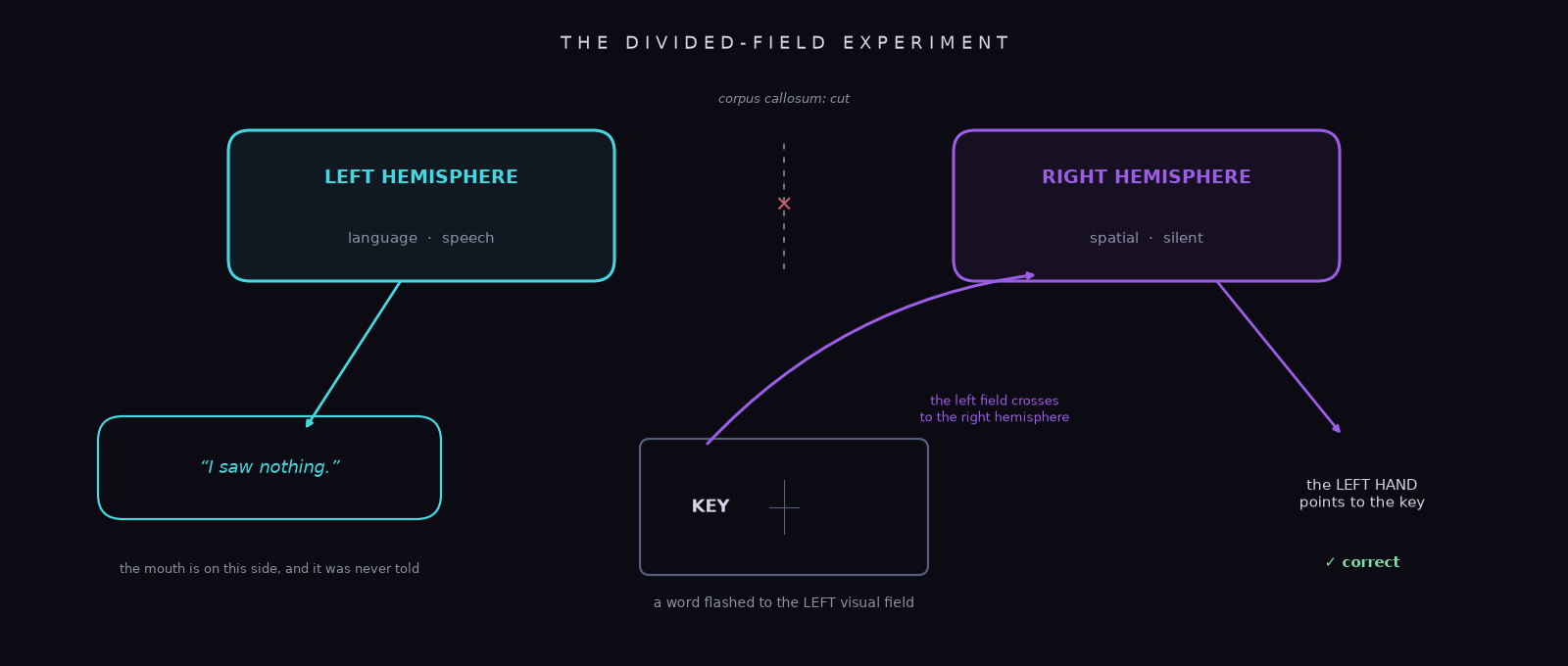
To stop severe epilepsy, surgeons once cut the thick cable of nerve fibers joining the two halves of the brain. The patients walked out seemingly unchanged, and then the laboratory found something strange: the two hemispheres could see different things, want different things, and answer the same question two different ways. For fifty years this was the clearest evidence that a single brain could hold two separate minds. The twist is that even that reading is now genuinely contested. This is the file on the divided brain, opened claim by claim, each one wearing its evidence.
Meet a person who has had the two halves of their brain surgically disconnected, and you will notice nothing wrong. They talk, work, drive, and remember exactly as before. It is only in the laboratory, with a screen and a careful trick of timing, that the seam appears. Show a word to the left half of their vision and their left hand can point to the matching object, while their mouth insists it saw nothing at all. Two halves of one head, disagreeing about what just happened. For half a century this was the strongest evidence in all of science that a single brain can house more than one mind. It is also, as of the last few years, a claim under serious new fire. Let's open the file.
01The Cable Between Two Minds
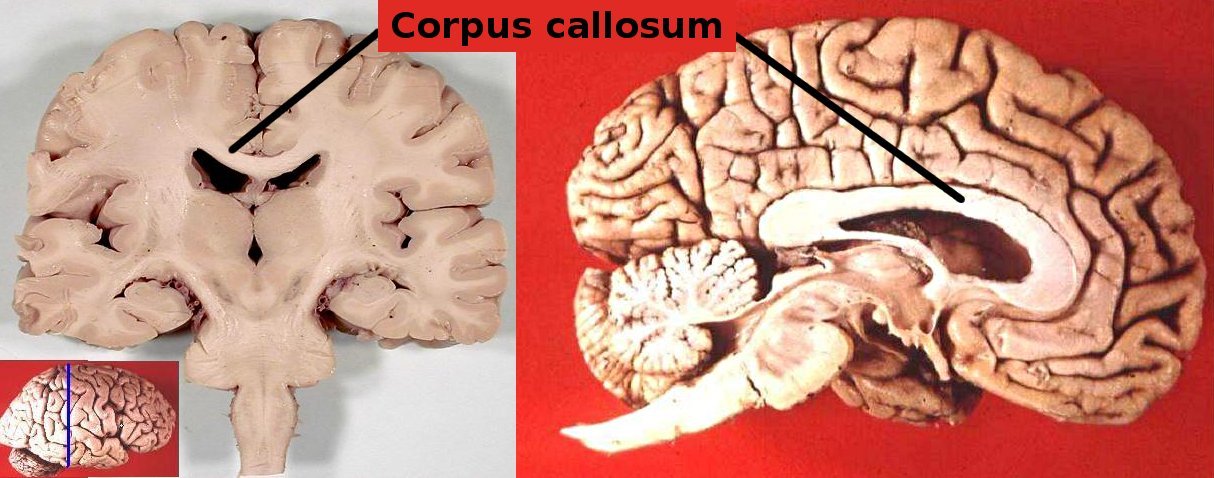
The two hemispheres of a human brain are joined by the corpus callosum, the largest bundle of white matter in the brain, roughly 200 million nerve fibers carrying a constant traffic of signals between the halves. It is the physical bridge that lets the left and right sides work as one. The whole story below is about what happens when that bridge is cut.
Cutting it is a real operation, not a thought experiment. Called a corpus callosotomy, it was first performed by William Van Wagenen in 1940 as a last-resort treatment for severe epilepsy, on the logic that severing the bridge would stop seizures from spreading across the whole brain. Joseph Bogen and Philip Vogel refined the complete version of the procedure in the 1960s. With the callosum cut, and often the smaller anterior commissure with it, direct communication between the hemispheres is essentially gone.
The first surprise is how little seems to change. Split-brain patients behave remarkably normally in ordinary life. They are not visibly two people. The dramatic disconnection only shows up under controlled conditions designed to feed information to one hemisphere without the other finding out. That gap, between the seamless everyday person and the divided laboratory subject, is the puzzle the rest of this article circles.
02Sperry's Divided Field
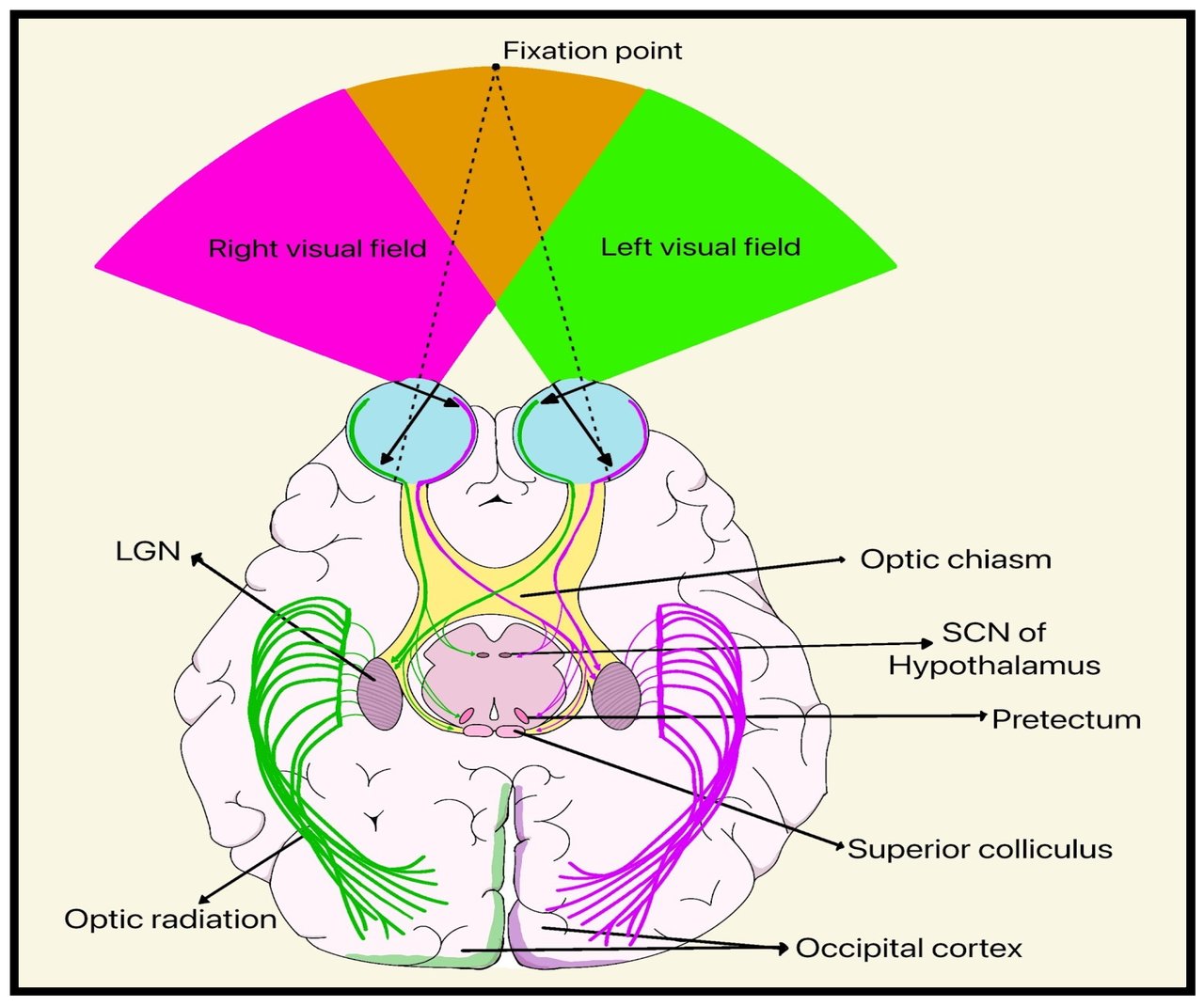
The trick that made the seam visible depends on a fact of anatomy: what you see on your left is handled by the right side of your brain, and vice versa. Flash something to just one side of vision, fast enough that the eyes cannot slide over to share it, and you have delivered a private message to one hemisphere alone.
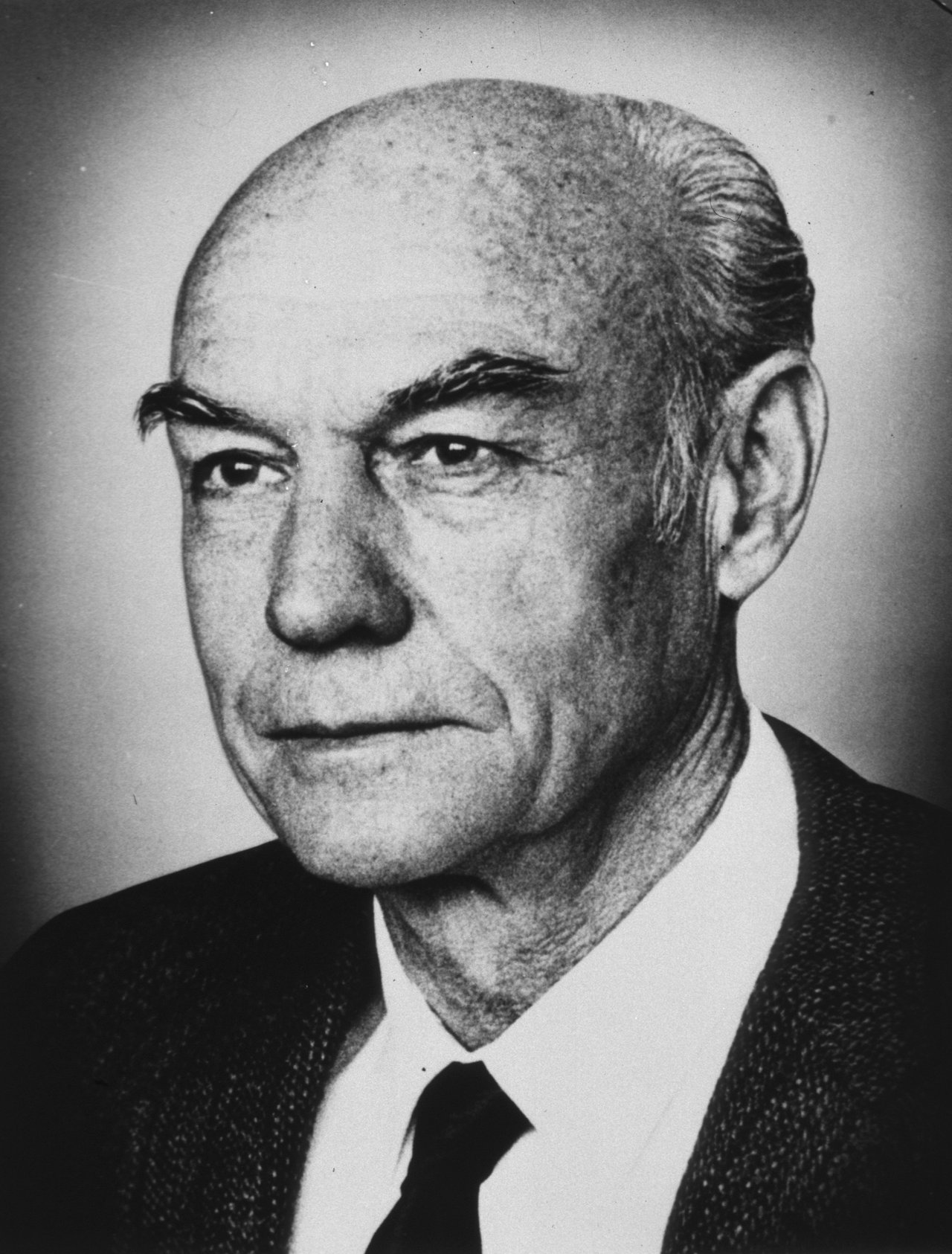
Roger Sperry ran the foundational experiments in the 1960s and 1970s, work that earned him a share of the 1981 Nobel Prize in Physiology or Medicine. Using a tachistoscope to flash images to one visual field only, he showed that each hemisphere of a split-brain patient takes in and acts on its information entirely on its own, with no sign the other half knows.
The experiments also mapped what each side is good at. The left hemisphere handled language, analytical reasoning, and step-by-step sequencing. The right hemisphere handled spatial relationships, face recognition, emotional tone, and seeing patterns whole. Crucially, the right hemisphere could understand simple words and commands but usually could not speak, which is exactly why it can know something the mouth cannot say.
These results did more than reveal a party trick. They overturned the mid-twentieth-century assumption that the right hemisphere was a lesser, silent partner, a kind of spare. It turned out to be a full participant with its own competences, simply a mute one. The right hemisphere was not empty. It just could not talk.
03The Interpreter Who Makes It Up
The most unsettling discovery in this whole field is not that the halves disagree. It is what the talking half does when it is caught out.
Michael Gazzaniga, Sperry's doctoral student, found that the left hemisphere does not simply admit ignorance when it lacks information. It invents. Give a command like the written word walk to the right hemisphere alone, and the patient stands and walks off. Ask them why, and the left hemisphere, which never saw the command and controls the speech, produces an instant, confident, plausible reason: I wanted to get a drink. It has no access to the real cause, so it manufactures one and believes it.
Gazzaniga called this the left-brain interpreter, and his larger claim is the disquieting part: the interpreter is not a quirk of split-brain patients. It runs in every intact brain, all the time. Its job is to spin the disparate, largely unconscious activity of the brain into a single smooth story of a rational self who meant to do what it did. The unified I narrating your life may be, in large part, this interpreter stitching a continuous tale out of processes it cannot actually see.
This is not only inferred from surgical patients. Nisbett and Wilson showed back in 1977 that ordinary people routinely confabulate reasons for choices they cannot really introspect on, confidently explaining preferences that were actually driven by factors they never noticed. The split brain makes visible, in a stark form, something that appears to be true of all of us: the story we tell about why we did something is often a reconstruction after the fact, not a readout of the real cause.
04Two Streams of Consciousness
Now the deep question. If the two halves can perceive, decide, and want independently, how many conscious beings are sitting in the chair? This is where the classic era of split-brain science planted its flag, and where the modern era has come to dig it up.
In experiments, the two hemispheres of a split-brain patient can do genuinely independent things at once: the two hands can draw different shapes, the two halves can react with different emotions to the same picture, and the patient can make conflicting choices on simultaneous tasks. Patient P.S., studied by Gazzaniga and LeDoux in 1978, could have each hemisphere separately answer questions about his own preferences, and they sometimes gave different answers. On the strength of results like these, Sperry argued directly, in 1968 and again in 1984, that each disconnected hemisphere possesses its own stream of consciousness.
Philosophers seized on this at once, because it threatens the most basic assumption we make about ourselves: that each of us is one. Derek Parfit used split-brain cases to argue against the existence of a single unified self. Thomas Nagel suggested the real lesson might be that our very concept of a person breaks down here, unable to return a clean count of one or two. Susan Hurley proposed that unity of consciousness is not all-or-nothing but a matter of degree. Split-brain research remains the most direct empirical pressure ever put on the idea that a person is necessarily one indivisible subject.
05Or Maybe One: The Modern Challenge
Here is the part most popular accounts leave out, and the reason this file cannot be closed. In the last decade the two-minds reading has been directly challenged with new data, and the fight is still live.
In 2017 a team led by Yair Pinto tested two split-brain patients and reported something the classic model does not predict. Across a battery of tasks, the patients could detect, locate, and identify a stimulus anywhere in the visual field, and report it by any means, speaking, left hand, or right hand, even for stimuli in the field that supposedly should have been locked away from the speaking hemisphere. What they could not do was compare a stimulus in one half-field with one in the other. Pinto's conclusion, in the title of the paper, was that the split brain shows divided perception but undivided consciousness: the halves take in the world separately, but a single conscious agent responds.
The response was fast and pointed. In 2018 Volz, Hillyard, Miller, and Gazzaniga published a rebuttal proposing the cross-cueing hypothesis: the apparently unified behavior could be produced by subtle physical signals leaking between the hemispheres through channels the surgery leaves intact, a small shift of the eyes, a movement of the body, a cue one half can pick up from the other, rather than by a genuinely single mind. Pinto's group replied that the rebuttal offered no substantive evidence that cross-cueing was actually doing the work. As of the most recent published exchange, the question is not resolved in either direction.
There is one more twist worth naming carefully, because it is easy to over-read. A 2025 study led by Michael Miller examined a patient with an incomplete cut, only about a centimeter of callosal fiber spared at the back, and found brain-activity synchrony close to that of ordinary brains, hinting that even a small surviving bundle may be enough to keep the whole system unified. That is a materially different case from the fully severed patients of the classic and modern experiments, so it does not settle their debate. It does suggest that unity may be a more robust, more gradual thing than the clean two-halves picture implied.
06Beyond Left-Brain and Right-Brain
Before drawing conclusions, two corrections. The first is that the tidy left-equals-logic, right-equals-creativity story is far too simple even as neuroscience. The second, in the next section, is that its pop-culture version is simply false.
Later work refined the crude verbal-versus-spatial split into something subtler. The left hemisphere leans toward local detail, categories, and approach; the right toward the global whole, detecting what is out of place, sustained vigilance, and withdrawal. Language itself is not purely left: the right hemisphere handles prosody, metaphor, humor, and the pragmatics of what is actually meant. Even music divides, with rhythm leaning left and melody and emotional tone leaning right. And the corpus itself insists on the caveat: normal cognition depends on the two halves integrating constantly. The two-brains model is a simplification of a system built to act as one.
The most ambitious reading of all this is the psychiatrist Iain McGilchrist's. In The Master and His Emissary he casts the right hemisphere as the Master, offering broad, embodied, contextual attention, and the left as its Emissary, focused, analytical, and reductive, and argues that Western culture has drifted steadily toward the Emissary's narrow mode at the cost of the Master's. Critics call the cultural half of the thesis speculative and the hemispheric dichotomy overdrawn. Supporters note the underlying characterization lines up with meta-analytic brain-imaging evidence. It is a serious, contested, big-picture argument, tiered here as credible-but-debated, not settled.
07What It Is Not: The Left-Brain, Right-Brain Myth
The single most famous thing everyone knows about the brain from this research is also flatly wrong.
The idea that some people are logical left-brained types and others are creative right-brained types is a myth. A large 2013 brain-imaging study by Nielsen and colleagues looked for exactly these hemisphere-dominant personality types and found no evidence for them: hemispheric specialization for particular tasks is real, but no individual runs mostly on one side, and essentially every real task recruits both. The myth survives in schools, corporate training, and self-help precisely because it is a tidy story, not because it is true.
Its cousins fail for the same reason. Claims that political leanings map onto hemispheric dominance, or that the right hemisphere is a spiritual antenna picking up psychic or cosmic information, do not hold up. Real hemispheric differences exist and matter; they simply do not license these neat labels. Even mystical experience, studied by Andrew Newberg, involves both hemispheres working together, not one side going online alone.
08The Speculative Edges
At the far end of the map are ideas that are genuinely interesting and genuinely unproven, worth naming as exactly that.
Julian Jaynes famously proposed that ancient humans heard the outputs of the right hemisphere as the external voices of gods, and that consciousness as we know it emerged only when this bicameral arrangement broke down. It is a bold, influential, and highly speculative idea; mainstream cognitive science treats it as too schematic to be a real account, and even McGilchrist, who admires it, thinks it goes too far.
A quieter speculation runs the other way. The neuroscientist Eran Zaidel suggested that even a normal, intact brain may be less a single fused mind than a society of minds, with the corpus callosum acting as a negotiation channel between semi-independent processes rather than a wire that fuses them into one. On this view the split-brain patient does not gain a second mind so much as lose the channel that normally keeps an already-plural system in agreement. It is unproven, but it reframes the whole question in a way worth sitting with.
Fast Facts
- The Structure
- The corpus callosum, about 200 million fibers joining the two hemispheres
- The Operation
- Corpus callosotomy, first done by Van Wagenen in 1940 for severe epilepsy
- The Pioneer
- Roger Sperry, foundational experiments in the 1960s-70s, shared the 1981 Nobel Prize
- The Method
- Tachistoscope: flashing images to one visual field, and so to one hemisphere, alone
- The Interpreter
- Gazzaniga's finding that the left hemisphere confabulates reasons for actions it did not cause
- The Classic Claim
- Sperry (1968, 1984): each disconnected hemisphere has its own stream of consciousness
- The Modern Challenge
- Pinto et al. (2017): divided perception but undivided consciousness; still disputed
- The Myth
- Logical left-brained versus creative right-brained personality types; debunked (Nielsen 2013)
What We Can Actually Stand Behind
The core findings are rock solid. Cutting the corpus callosum really does disconnect the hemispheres, and in the lab each half can then perceive, decide, and act on information the other does not have. The left hemisphere really does confabulate explanations for actions it did not initiate. The right hemisphere is a capable, largely mute partner, not a silent spare. This is Nobel-grade, replicated science.
Whether a split brain contains two conscious minds or one is not settled. Sperry's classic two-streams reading held for decades, but Pinto's 2017 data argue for divided perception under a single undivided consciousness, and the Gazzaniga camp's cross-cueing rebuttal argues the apparent unity is an artifact of leaked signals. As of the latest exchange, neither side has closed it. Anyone who tells you a split brain is definitely two people, or definitely one, is ahead of the evidence.
The bigger interpretations are speculation, honestly labeled. Jaynes's bicameral-mind origin of consciousness and Zaidel's picture of even an ordinary brain as a society of minds are provocative and unestablished. McGilchrist's cultural thesis is a serious argument that remains contested. Take them as ideas worth thinking with, not findings to bank on.
No, you are not left-brained or right-brained. There are no hemisphere-dominant personality types; the large imaging studies find none, and every real task uses both sides. The political-brain and spiritual-antenna versions fail the same way. Real hemispheric specialization is being confused with a tidy label that the evidence does not support.
So the file stays open on the very question that made it famous. We know, past any serious doubt, that cutting one bundle of fibers can make the two halves of a brain behave like separate knowers in a darkened room. What we do not know is whether that means the light of consciousness has actually been split in two, or whether a single subject is simply being fed the world through two disconnected windows. The people who have studied it longest cannot agree, and the newest data have reopened rather than closed the question. It is a strange place to stand: the clearest window we have ever had into the unity of a mind, and it will not tell us for certain whether that unity is one thing or two. When you ask a split-brain patient what they saw and they answer twice, who exactly is it that answered?
Sources & further reading
Everything above is drawn from our research library on Theories of Anything. Open the full file to check the sourcing and go deeper.
Image credits
- Original schematic of the classic split-brain divided-field experiment, showing a left-visual-field word routed to the right hemisphere and the left hand, while the speaking left hemisphere reports seeing nothing Original diagram by Theories of Anything. CC BY-SA 4.0 Source.
- Labeled anatomical diagram of the corpus callosum, the white-matter tract connecting the two cerebral hemispheres, in coronal and sagittal views Composite by Wikimedia Commons user Looie496 from brain-section images by John A. Beal, PhD, via Wikimedia Commons. CC BY-SA 3.0 / GNU Free Documentation License 1.2+ Source.
- Portrait photograph of the neuropsychologist Roger Wolcott Sperry, from the U.S. National Library of Medicine U.S. National Library of Medicine, a work of the U.S. federal government, via Wikimedia Commons. Public Domain Source.
- Scientific diagram of the human visual pathway, showing the optic nerves crossing at the optic chiasm to route each half of the visual field to the opposite hemisphere Firoz et al., Bioengineering 2026, 13, 509 (MDPI), open access, via Wikimedia Commons. CC BY 4.0 Source.
- Card crop of the original divided-field experiment schematic Original diagram by Theories of Anything. CC BY-SA 4.0


