
The Sea Peoples and the Fall of the Bronze Age
Between roughly 1200 and 1150 BCE, an interconnected world went out. The Hittite Empire ceased to exist as a great power. The Mycenaean palaces burned and took Greek literacy with them for about four hundred years. Ugarit was destroyed and never reoccupied. Kassite Babylon fell to Elam. Egypt recorded a total victory over the Sea Peoples in Year 8 of Ramesses III, conventionally dated to about 1177 BCE, and lost its Levantine territories within a generation anyway. Over three hundred years of connected civilization ended inside about fifty, and the destruction layers run from Hattusa to Pylos to Megiddo to Cyprus. That much sits at Tier 1 and is not seriously argued. Why it happened is argued constantly. Our primary file lays out seven competing explanations, each with real evidence and most with a named objection, and its own reliability table rates the causes as a whole Tier 2: no consensus, multiple models. Eric Cline's multi-causal perfect storm is the dominant framing, and that same table calls it widely accepted but not proven. The one explanation carried at Tier 4, ruled out as a sufficient cause on its own, is the popular one: that a single wave of raiders out of the sea did all of it. This article carries the collapse at the tier the evidence earns, holds the causes unresolved rather than crowning one, marks where three files in our own library give three different numbers for the same drought, and names the section of our primary file that declares no counter-arguments exist while its own body presents seven.
A lost world is usually a single place: a city, an island, a valley whose people walked away. This one is a network. Between roughly 1200 and 1150 BCE the palaces, capitals, ports and archives of the eastern Mediterranean and the Near East went out in a rolling sequence that took about fifty years, and over three centuries of connected civilization ended with them. The Hittite Empire stopped existing as a great power. The Mycenaean palace system burned, and Greek literacy went with it for roughly four hundred years. Ugarit was destroyed and never reoccupied. Kassite Babylon fell to Elam. Egypt recorded a total victory over the invaders in two battles and then lost its Levantine territories within a generation anyway. All of that sits at Tier 1 in the files behind this article, and none of it is seriously disputed. What is disputed, still, by named specialists with real evidence on each side, is why. Our primary file sets out seven competing causes and settles on none of them. So this article carries the collapse at the tier the evidence earns, holds the causes unresolved rather than crowning one, marks the place where three files in our own library give three different numbers for the same drought, and names the section of our primary file that declares no counter-arguments exist while its own body presents seven. Let's open it.
01The Globalized Bronze Age
The Late Bronze Age, roughly 1500 to 1200 BCE, in the eastern Mediterranean and Near East was one of the most internationally connected periods in human history before the modern era: a working network of great powers, vassal states and trading partners that the historian Eric H. Cline calls a globalized Bronze Age world (1177 B.C.: The Year Civilization Collapsed, Princeton University Press, 2014, revised 2021). Hold the quotation marks where Cline put them. Globalized is a word carried backward from our own economy, and this article keeps returning to what it implies, which is that a system whose parts depend on one another can fail in ways a set of separate parts cannot.
Egypt's New Kingdom, roughly 1550 to 1070 BCE, held Canaan as vassal territory and exported gold, papyrus, grain and linen, with a religious capital at Thebes and an administrative one at Pi-Ramesses under the 19th and 20th Dynasties. Its peak military moments are dated: Thutmose III at the Battle of Megiddo about 1457 BCE, Ramesses II at the Battle of Kadesh about 1274 BCE. The Hittite Empire, Hatti, roughly 1600 to 1178 BCE, ruled from Hattusa in central Anatolia, modern Bogazkale, controlled most of Anatolia and northern Syria, and was Egypt's major rival. The two fought to a draw at Kadesh and then, about fifteen years later, signed the Egyptian-Hittite Peace Treaty of roughly 1259 BCE, the oldest surviving international peace treaty, preserved in copies in both Egyptian hieroglyphics and Hittite cuneiform. Two empires that could not defeat each other, and wrote the stalemate down in two scripts.
Mycenaean Greece, roughly 1600 to 1100 BCE, was a palace-centered civilization with major centers at Mycenae, Tiryns, Pylos, Thebes, Orchomenos and Iolkos. It kept its accounts in Linear B, an early form of Greek deciphered by Michael Ventris in 1952, behind massive cyclopean walls and beside tholos tombs, and it ran a sophisticated bureaucracy. Mycenaean pottery has been found from Italy to the Levant to Egypt. This is also the civilization that stands as the historical backdrop of the Trojan War tradition in Homer's Iliad and Odyssey, which matters at the end of this article for a reason that has nothing to do with whether the war happened. Eastward, Kassite Babylonia, roughly 1595 to 1155 BCE, ruled Babylon after the Hittite sack of about 1595 BCE and maintained cuneiform, religious practice and astronomical observation as an active diplomatic partner of both Egypt and Hatti. North of it, Middle Assyria, roughly 1363 to 1056 BCE, centered on Ashur and Nineveh, competed with Hatti for northern Syria and Mesopotamia and briefly conquered Babylon under Tukulti-Ninurta I, roughly 1244 to 1208 BCE. Mark Assyria now, because it is one of the few major powers that survives what follows, weakened but standing.
Ugarit, roughly 1450 to 1185 BCE, modern Ras Shamra on the Syrian coast, was a major port city and a vital trading hub between the Hittite and Egyptian spheres. It developed the Ugaritic alphabet, one of the earliest alphabetic writing systems, about thirty cuneiform letters, and its literary texts include the Baal Cycle, mythological narratives central to understanding Canaanite religion. Offshore, Cyprus, called Alashiya in the period's own texts, was the principal source of copper for the entire eastern Mediterranean; the word copper itself derives from Latin cuprum, from Greek Kypros. Alashiya is attested in the Amarna Letters, in Hittite texts and in Ugaritic correspondence, and the copper survives in a distinctive oxhide-shaped ingot recovered from shipwreck sites, notably Uluburun and Cape Gelidonya. Put the powers and the ports on one map and the object under discussion comes into focus. What collapsed was not a country. It was a circuit.
02The Letters, the Cargo, and the Weak Link
The Amarna Letters, catalogued EA 1 to 382, are a corpus of roughly 382 cuneiform tablets discovered in 1887 at Tell el-Amarna in Egypt, the site of Akhenaten's capital Akhetaten. They date primarily from the reigns of Amenhotep III, about 1390 to 1352 BCE, and Akhenaten, about 1352 to 1336 BCE, and they are written in Akkadian, the diplomatic lingua franca of the Late Bronze Age. The correspondents include the kings of Babylonia, Hatti, Mitanni, Assyria and Alashiya, plus vassal rulers across Canaan and Syria. This is the rare case where a claim about ancient international relations does not have to be inferred from architecture. The mail survived.
What the letters contain is a working diplomatic system with all its friction intact: intense diplomatic marriage exchanges, daughters sent to marry foreign rulers with vast dowries; elaborate gift exchanges of gold, chariots, lapis lazuli, textiles, furniture and horses; disputes over the quality of those gifts, with Kadashman-Enlil I of Babylon complaining that the gold Egypt sent was not pure (EA 1 to 5); and requests for physicians, craftsmen and specialists. Our primary file's own summary of what that adds up to is worth keeping: evidence of a sophisticated, if often dysfunctional, system of long-distance communication and imperial control. Sophisticated and dysfunctional at the same time is a fair description of most working systems, which is part of why the ending is hard to explain. This thing did not fail because it was primitive.
Late Bronze Age long-distance trade moved tin from Afghanistan, possibly also from Cornwall and Central Asia; copper from Cyprus, and also Oman and Sinai; gold from Egyptian Nubia; lapis lazuli from Badakhshan in Afghanistan; amber from the Baltic region by overland routes; and ivory, olive oil and textiles across the entire Mediterranean and Near East. Two shipwrecks make that inventory physical. The Uluburun wreck, about 1300 BCE, discovered off the Turkish coast in 1982 and excavated by George Bass and Cemal Pulak between 1984 and 1994, carried roughly 10 tons of copper ingots and 1 ton of tin, Canaanite amphorae holding terebinth resin, African ebony, ostrich eggshells, Baltic amber, Mycenaean pottery, Egyptian scarabs including a gold scarab of Queen Nefertiti, and a Kassite cylinder seal: a single ship's cargo drawn from at least seven cultures. The Cape Gelidonya wreck, about 1200 BCE, discovered in 1960 and excavated by Bass, carried copper and tin ingots and tools, possibly a Canaanite or Cypriot merchant vessel.
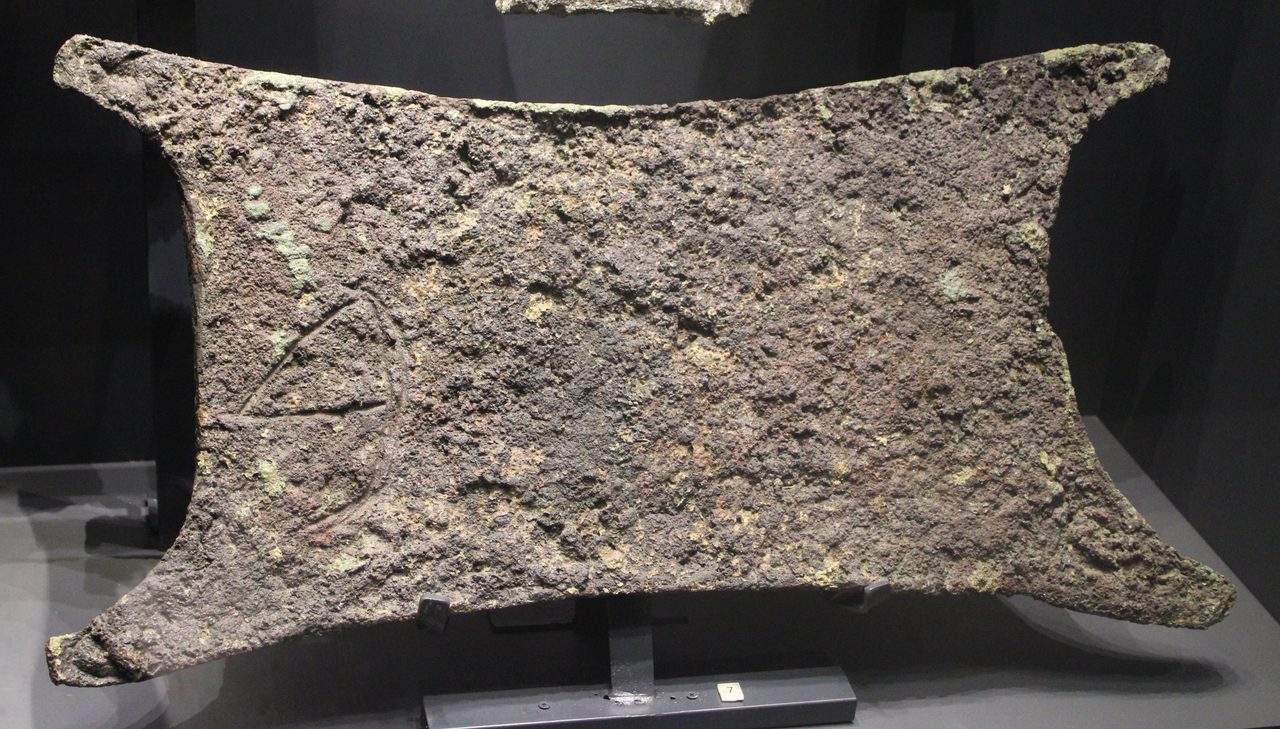
Tin is the weak link, and the reason is arithmetic before it is theory. Bronze requires it, and it had to travel roughly 3,000 kilometers or more from Afghanistan to reach Mediterranean bronze workshops. The distance is the verified part. What our primary file builds on top of that distance is an interpretation, and it is the interpretation this whole article turns on: a supply chain that long, feeding military production in several civilizations at once, is a place where a disruption is not local. Break the link and armories across the map stop producing. Note the tier carefully. The kilometers are Tier 1. The word fragility is a reading of them, and everything after this section is an argument about how much weight that reading can carry.
03Fifty Years
Between approximately 1200 and 1150 BCE, the interconnected world described above collapsed. Over 300 years of civilization ended within roughly 50 years. Both files read in full for this article carry that window, and both are careful about a detail the phrase the collapse tends to erase: the destruction was not simultaneous. It rolled across the eastern Mediterranean in waves. That qualification does more work than it looks like it does, because a wave is the signature of something spreading and a simultaneous event is the signature of something arriving. The evidence says spreading.
One document from inside the collapse deserves quoting at full weight: the last datable tablet from Ugarit. RS 20.238, a letter from the king of Ugarit to the king of Alashiya, about 1207 BCE, reads: "Enemy ships have been spotted at sea... My cities on the coast have been burned... The enemy has done terrible things in our country." The tablet was found in the court oven. It was never sent. A second tablet that does survive, RS 20.18, is a reply from the Hittite viceroy of Carchemish to a different letter Ugarit had sent him: "As for what you have written to me: Enemy ships have been seen at sea! Well now, even if it is true that enemy ships have been seen, be firm." Two documents from the same crisis, not one exchange, and between them the whole tonal range of an empire in its last decades: a vassal reporting his coast on fire, and a superior telling him to hold.
The Hittite capital Hattusa was burned and permanently abandoned, and here our two files differ a little on the date: the primary gives about 1200 BCE, the secondary about 1180. The destruction was catastrophic, with massive fire layers, though some evidence suggests the royal court evacuated before the final destruction, since few valuable objects were found. The Hittite Empire ceased to exist as a great power, described in our files as the most dramatic political collapse of the period. Neo-Hittite successor states, Carchemish, Tabal and Que, survived in southern Anatolia and northern Syria at much reduced scale. An empire that had fought Egypt to a standstill at Kadesh was gone inside a century of doing it.
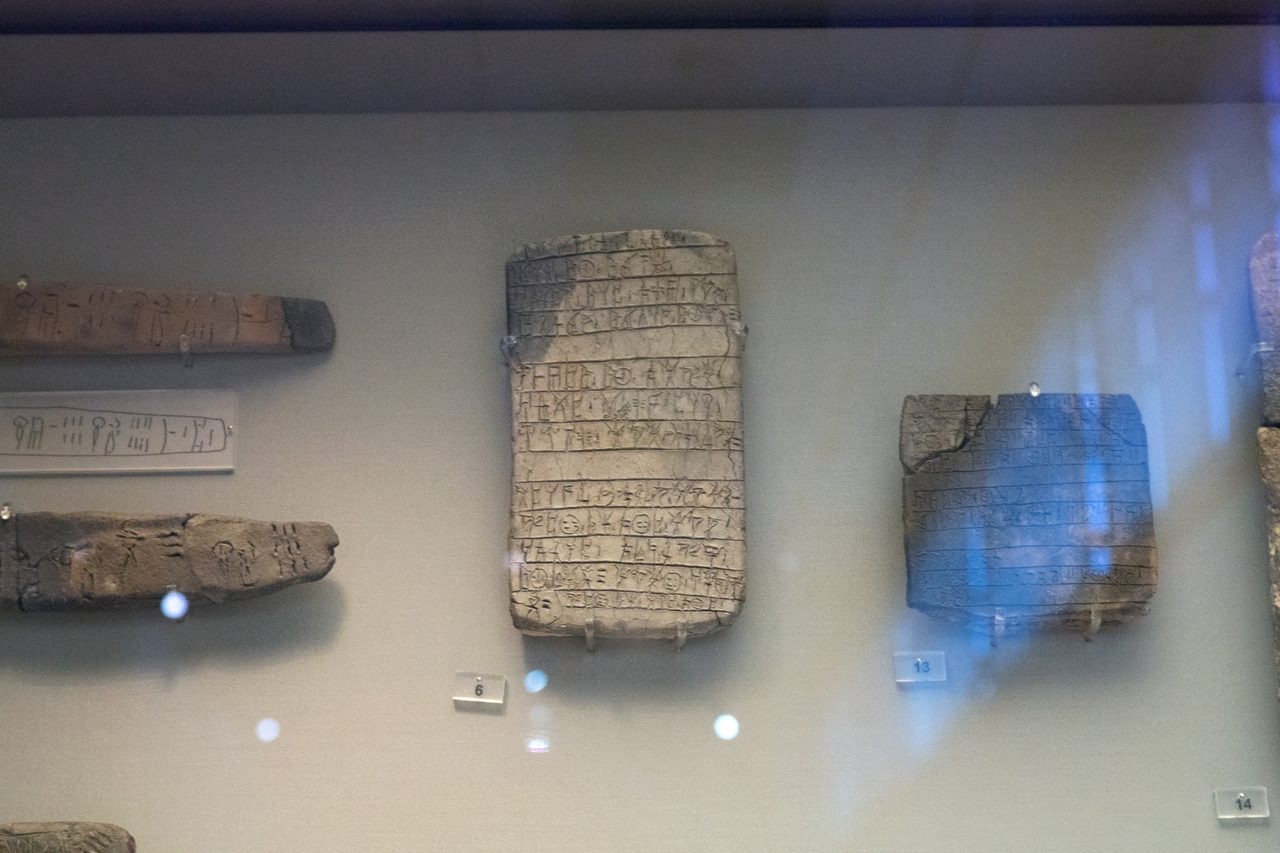
Pylos was destroyed by fire about 1180 BCE, and the fire did something no archivist would have chosen: it baked the palace's Linear B tablets hard enough to preserve them. What those last tablets document is frantic military mobilization. Towers manned. Rowers conscripted. Bronze collected for weapons. Watchers, given in our files as ku-wa-no-wo-ko, deployed along the coast, apparently anticipating a seaborne attack. Our secondary file identifies these as the o-ka tablets and names one of them directly, PY An 657. Tiryns, Midea, Thebes and Orchomenos were destroyed as well; Mycenae was damaged about 1200 BCE, continued at reduced scale, and was eventually abandoned about 1100 BCE. The entire Mycenaean palace system, with its literacy and its centralized bureaucracy, was permanently destroyed. Linear B writing was lost, and Greece entered a period of illiteracy.
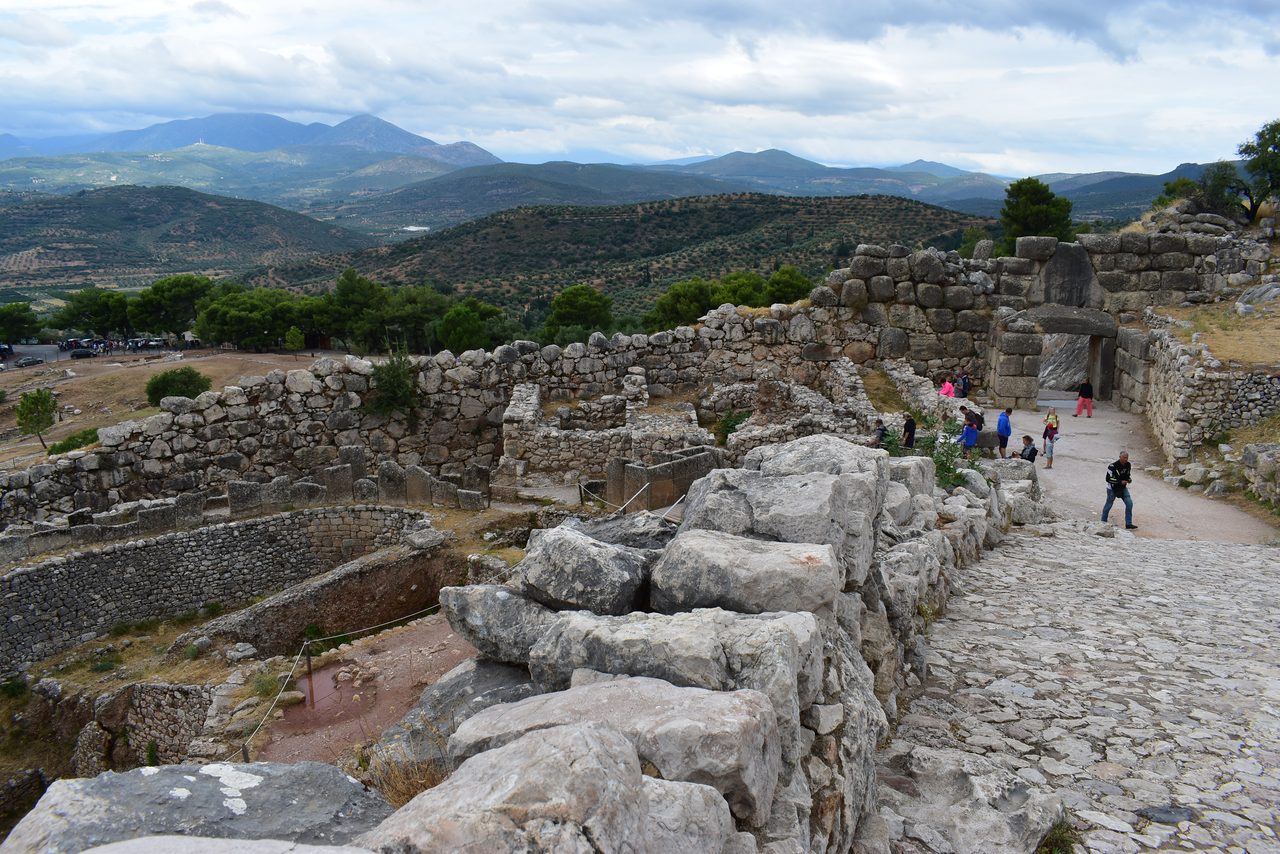
Mycenae itself, damaged around 1200 BCE and abandoned by roughly 1100, is where the palace world's most recognizable gate still stands.
Troy VIIa at Hisarlik shows destruction by fire at the end of the 13th century BCE, widely though not universally identified with the city of the Trojan War tradition. The excavator Carl Blegen supported that identification, and Manfred Korfmann's excavations from 1988 to 2005 supported it too; Frank Kolb has challenged the significance of the site. This article does not need the identification to be settled. It needs the burn layer, which is not the part anyone is arguing about.
Ugarit was destroyed for the final time about 1185 BCE and never reoccupied. The site lay buried until 1928, when a farmer's plow accidentally struck a tomb; the French archaeologist Claude Schaeffer began excavations in 1929 and continued until 1970. Further east the sequence ran later. The Kassite Dynasty in Babylon was overthrown about 1155 BCE when Elam conquered Babylon and carried off the statue of Marduk, Babylon's chief god, a deeply symbolic violation. Set those dates beside Hattusa and Pylos and the rolling character of the thing shows up in the calendar itself: Anatolia and Greece around 1200 to 1180, the Syrian coast about 1185, Babylon about 1155.
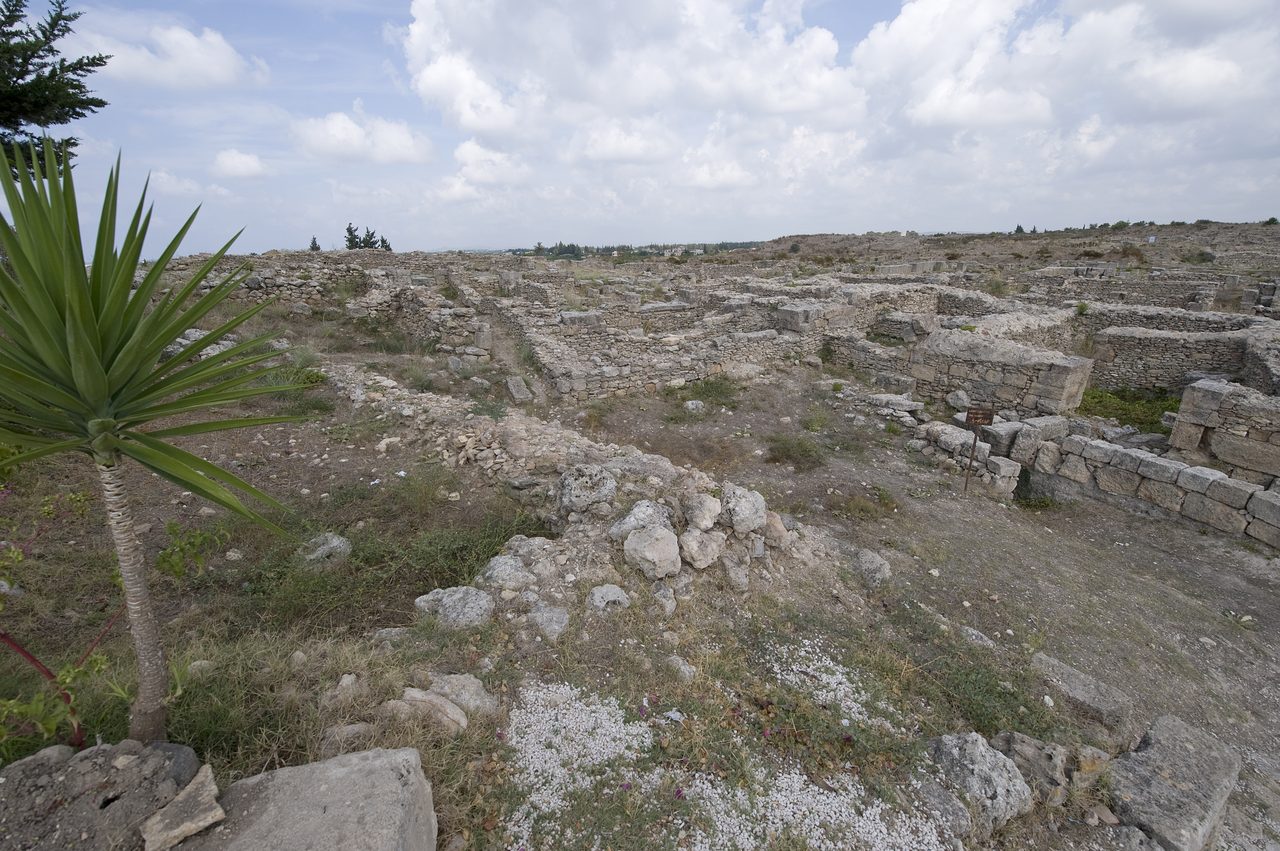
The destruction layers themselves, conflagration, collapsed walls, abandoned buildings, are documented at Hattusa and Alaca Hoyuk in Anatolia; at Alalakh and Aleppo, and at Ugarit, Ras Ibn Hani and Tell Tweini, on the Syrian coast; at Megiddo, Hazor, Lachish, Beth-Shean and Deir 'Alla in Canaan; at Pylos, Tiryns, Mycenae, Midea and Thebes in Greece; and at Enkomi and Kition on Cyprus. Nineteen sites, five regions, one window. Nothing in the rest of this article, none of the seven causes and none of the counter-arguments, disputes that list. The argument starts at the next question, which is what put fire in nineteen places.
| The Power | What It Was | What Became Of It |
|---|---|---|
| Egypt, the New Kingdom | Roughly 1550 to 1070 BCE. Held Canaan as vassal territory; exported gold, papyrus, grain and linen; capitals at Thebes (religious) and Pi-Ramesses (administrative) | Survived the Collapse and entered terminal decline. Ramesses IV through XI show steady deterioration; the New Kingdom ended about 1070 BCE and Egypt fragmented into the Third Intermediate Period, 1070 to 664 BCE |
| Hatti, the Hittite Empire | Roughly 1600 to 1178 BCE. Ruled from Hattusa in central Anatolia; controlled most of Anatolia and northern Syria; fought Egypt to a draw at Kadesh about 1274 BCE | Hattusa burned and permanently abandoned, about 1200 BCE in our primary file and about 1180 in our secondary. Never recovered. Neo-Hittite successor states at Carchemish, Tabal and Que survived at much reduced scale |
| Mycenaean Greece | Roughly 1600 to 1100 BCE. Palace centers at Mycenae, Tiryns, Pylos, Thebes, Orchomenos and Iolkos; Linear B accounting; cyclopean walls and tholos tombs | The palace system permanently destroyed. Pylos burned about 1180 BCE; Mycenae damaged about 1200 and abandoned about 1100. Linear B lost, and palace society replaced by village-level society |
| Ugarit | Roughly 1450 to 1185 BCE. Port city and trading hub between the Hittite and Egyptian spheres; home of the Ugaritic alphabet and the Baal Cycle | Destroyed for the final time about 1185 BCE and never reoccupied. Buried until 1928, when a farmer's plow struck a tomb; excavated by Claude Schaeffer from 1929 to 1970 |
| Kassite Babylonia | Roughly 1595 to 1155 BCE. Ruled Babylon after the Hittite sack of about 1595 BCE; maintained cuneiform, religious practice and astronomical observation | Overthrown about 1155 BCE when Elam conquered Babylon and carried off the statue of Marduk |
| Cyprus, called Alashiya | The principal source of copper for the entire eastern Mediterranean; attested in the Amarna Letters, Hittite texts and Ugaritic correspondence | Destruction layers at Enkomi and Kition |
| Assyria | The Middle Assyrian period, roughly 1363 to 1056 BCE, centered on Ashur and Nineveh; briefly conquered Babylon under Tukulti-Ninurta I, roughly 1244 to 1208 BCE | One of the few major powers to survive, though weakened; later rebuilt as the Neo-Assyrian Empire, 911 to 609 BCE |
| The Phoenician cities | Byblos, Sidon and Tyre, Canaanite cities of the Levantine coast | Survived, and actually thrived in the power vacuum |
| Elam | The power that took Babylon about 1155 BCE | Briefly dominant, until Nebuchadnezzar I of Babylon counterattacked about 1110 BCE |
04Year 8, and the Wall At Medinet Habu
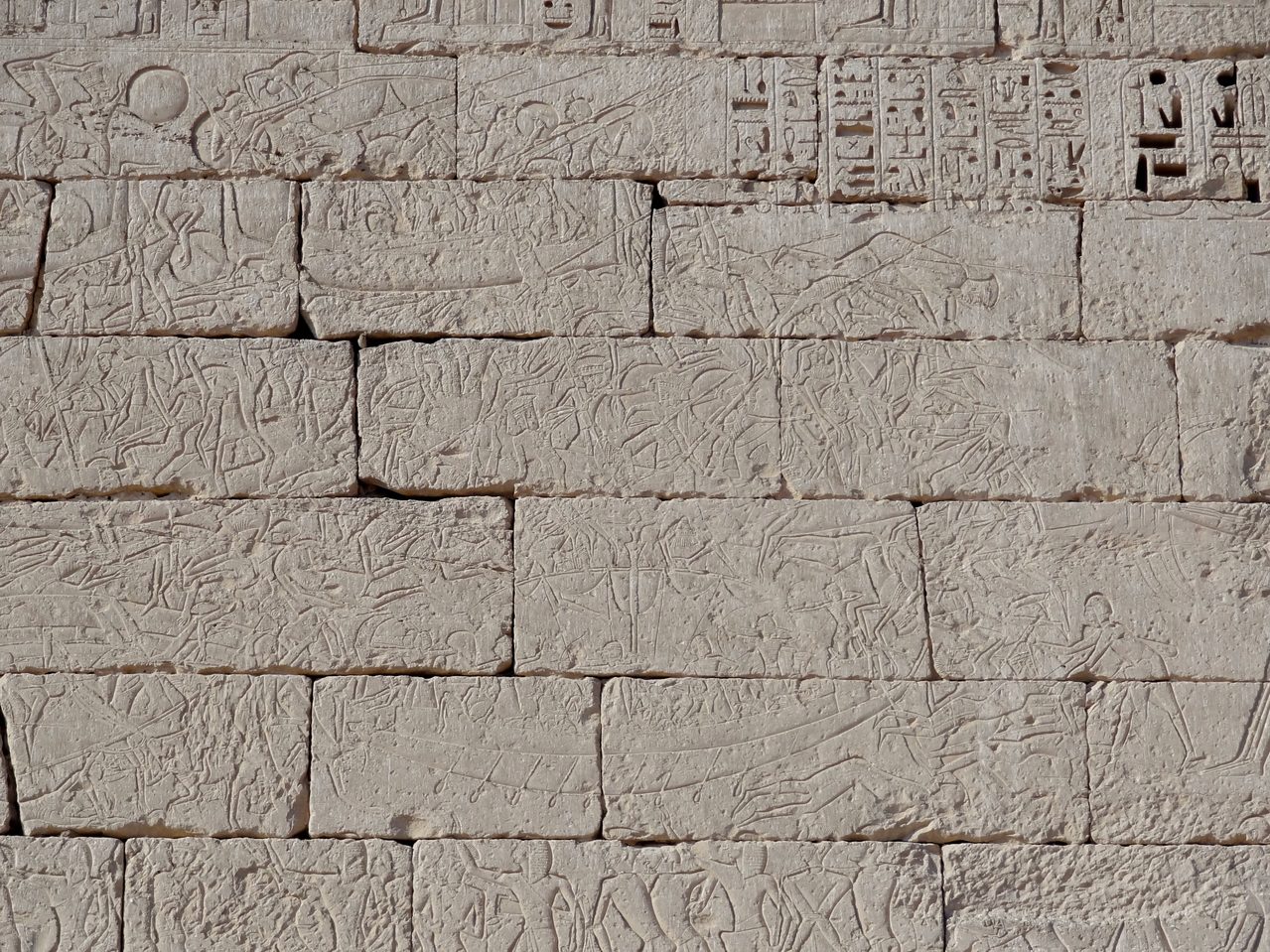
In Year 8 of Ramesses III, conventionally dated to about 1177 BCE, Egypt fought two battles against the Sea Peoples: a land battle in the Levant and a naval battle in the Nile Delta. Both are recorded in extraordinary detail at Ramesses III's mortuary temple at Medinet Habu, in western Thebes. The Egyptian texts claim total victory. Egypt then lost control of its Levantine territories within a generation of that victory, which our primary file reads as a sign that the campaign severely weakened rather than restored Egyptian power. This is one of the few places in the story where the propaganda and the archaeology can be laid side by side and checked, and what they say together is more interesting than either alone: the wall says won, the map says emptied.
Ramesses III's mortuary temple at Medinet Habu contains the most extensive Sea Peoples records: wall reliefs depicting the land and sea battles in vivid detail, with hieroglyphic inscriptions naming the enemy confederation. The Year 8 inscription reads, in part: "The foreign countries made a conspiracy in their islands... Their confederation was the Peleset, Tjeker, Shekelesh, Denyen, and Weshesh." Five names, carved by the winners, and every serious argument about who these people were starts from that sentence.
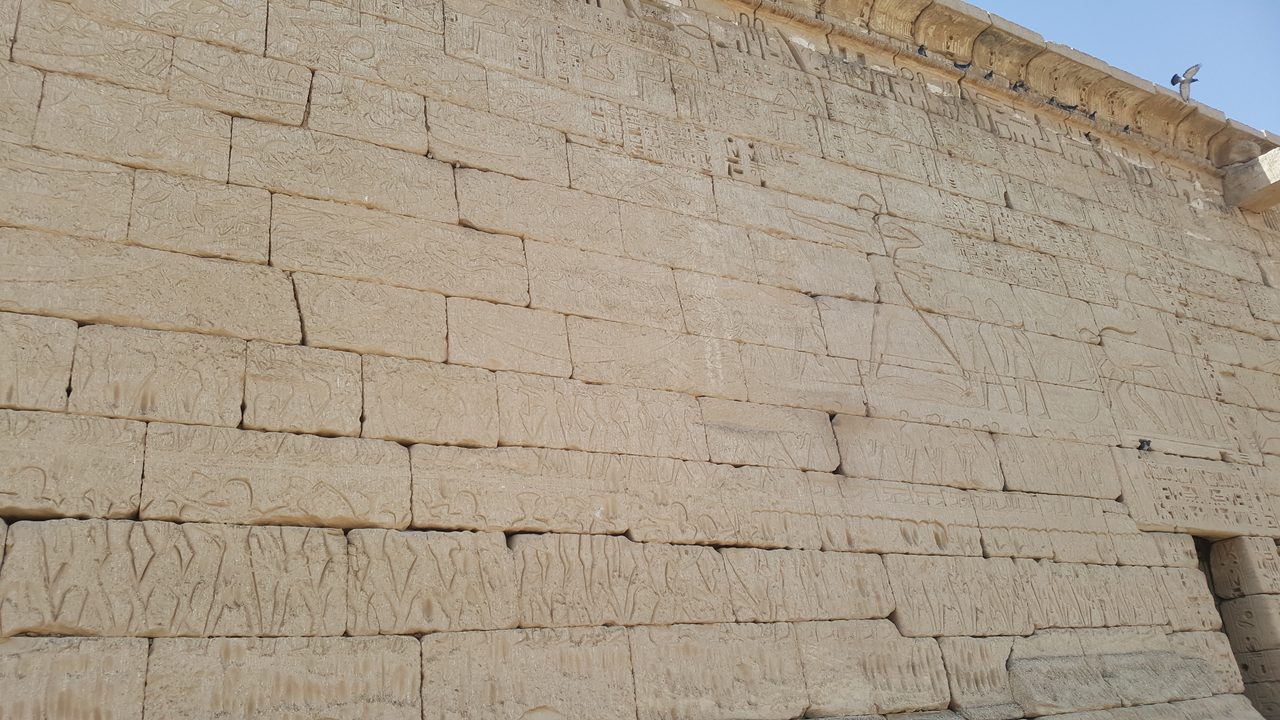
The reliefs show Sea Peoples warriors with feathered or horned headdresses, the feathered type typically identified with the Peleset and the horned possibly with the Sherden, armed with long swords, spears and round shields, in equipment distinct from Egyptian gear. The land-battle scene shows a column of ox-carts carrying women and children, which our primary file reads as evidence that this was a mass migration seeking new homes rather than merely a raiding party. Egyptian defenders fight from chariots while the attackers fight on foot. The naval-battle scene shows Egyptian ships engaging Sea Peoples vessels lacking oars, possibly disabled or surprised, with distinctive bird-headed prows on some of the attacking ships. Carved propaganda is still evidence, provided the reader remembers who commissioned it.
Papyrus Harris I, written under Ramesses IV about 1155 BCE but describing Ramesses III's achievements, confirms the Sea Peoples account: "I slew the Denyen in their islands, while the Tjeker and the Peleset were made ashes. The Sherden and the Weshesh of the sea were made nonexistent." The same document claims Ramesses III settled the defeated peoples as garrison troops, which our primary file notes as possibly the origin of the Philistines in southern Canaan. Made nonexistent is worth pausing over, since the same text then describes settling those same nonexistent people in Egyptian garrisons.
One word about the date, because it is the number this whole subject tends to get filed under. Year 8 of Ramesses III is conventionally placed at about 1177 BCE, and 1177 B.C. is the title of Eric Cline's 2014 book. The collapse those two battles belong to is not a year. Our files date it between roughly 1200 and 1150 BCE and describe the destruction as rolling in waves rather than falling at once. So 1177 is a date inside a process rather than the day the lights went out, and it is worth holding it that way before the next two sections, because the process is the thing that needs explaining.
05Who the Sea Peoples Were, and What They Were Not
Sea Peoples is a modern scholarly designation. Emmanuel de Rouge used it first, in 1855; Gaston Maspero popularized it in 1881. The Egyptians themselves did not use the term. They referred to specific named groups, often collectively as peoples from the islands or northerners from all lands. That is a small point with large consequences, and it is worth fixing in place before the identifications begin: the single collective noun that makes them sound like one army is a 19th-century convenience, not an ancient description.
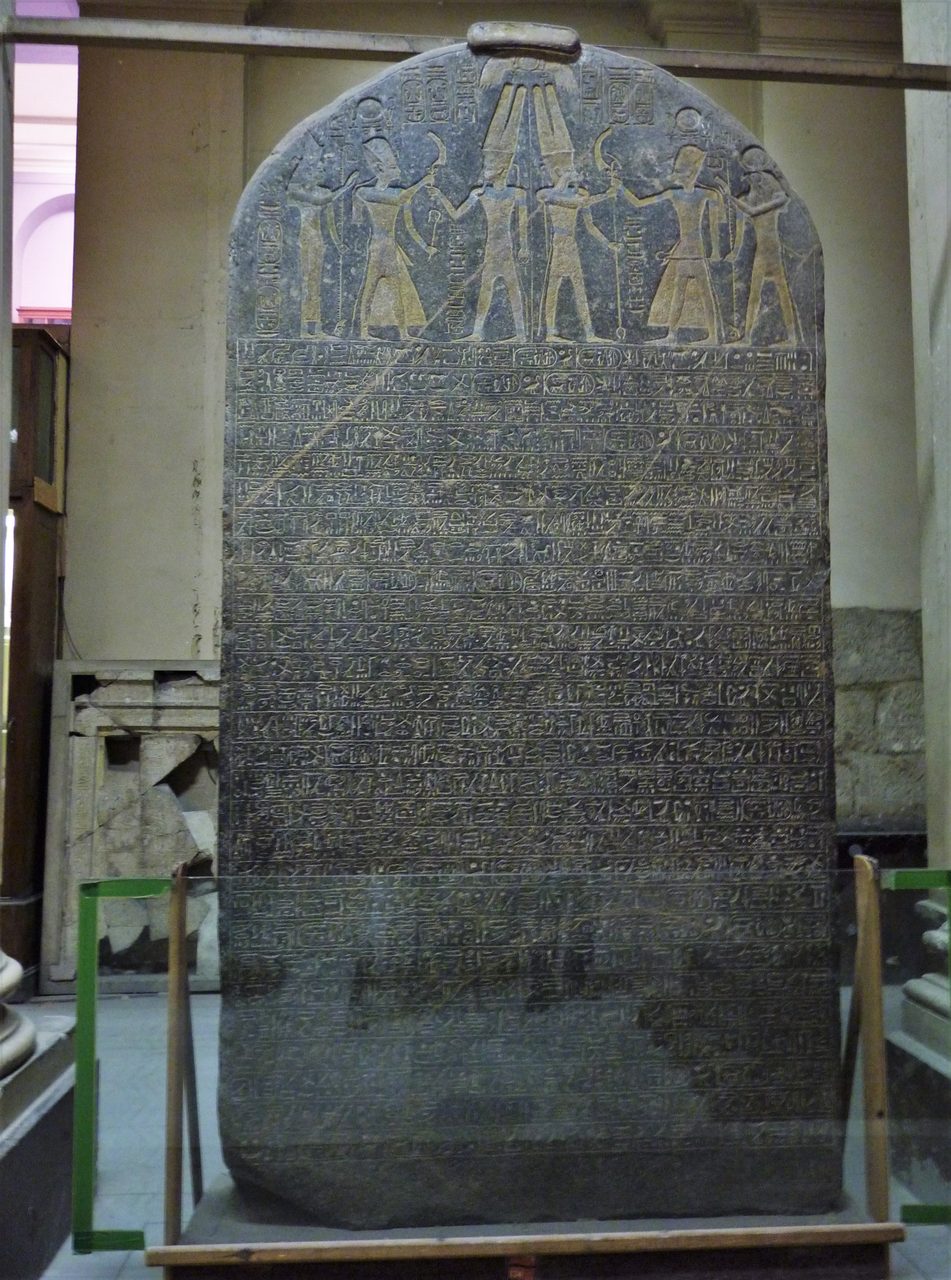
Earlier Karnak Temple inscriptions from the reign of Merneptah, about 1213 to 1203 BCE, record that Merneptah fought a coalition of Libyans and Sea Peoples in his Year 5, about 1208 BCE. The groups named there are the Sherden, Shekelesh, Lukka, Tursha and Ekwesh, the last proposed as Achaeans or Greeks. From that same campaign comes the Merneptah Stele, also called the Israel Stele, now in the Egyptian Museum in Cairo as CG 34025: a black granite victory stele over 3 meters, 10 feet, high, discovered by Flinders Petrie in 1896. It lists defeated entities in Canaan, Ashkelon, Gezer, Yanoam and Israel, and it carries the first extrabiblical mention of Israel: "Israel is laid waste and his seed is not." The grammar carries more than the sentence does. Israel is written with the people determinative rather than the land determinative, indicating a people or tribal group rather than a territorial state at that date, which our primary file records as consistent with Israel Finkelstein's gradual-emergence model in The Bible Unearthed, 2001. The monument that first names Israel is a monument about somebody else's war.
The proposed identifications of the named groups rest primarily on phonetic similarity, which is why our primary file rates the whole exercise Tier 2 and, in its own reliability table, calls it phonetic speculation. The confidence is not uniform across the list, and averaging it would flatter the weak entries at the expense of the strong one. Peleset as Philistines is the strongest case, rated moderate to high and supported by material-culture excavations at Ashkelon, Ekron and Gath. At the other end, Weshesh has no convincing identification at all. The table carries each row at the confidence our file actually assigns it.
| Egyptian Name | Proposed Identification | Confidence, As Our Primary File Rates It |
|---|---|---|
| Peleset | Philistines | Moderate to High. The strongest case, supported by material-culture excavations at Ashkelon, Ekron and Gath |
| Lukka | Lycians | Moderate |
| Sherden, or Shardana | Sardinians | Low to Moderate. The direction of migration is debated: did they go to Sardinia, or come from it? |
| Denyen | Danaans, Homer's Greeks; or Danuna, Adana | Low to Moderate |
| Ekwesh | Achaeans, Mycenaean Greeks, via the Hittite name Ahhiyawa | Low to Moderate |
| Tjeker | Teucrians | Low to Moderate |
| Shekelesh | Sicilians | Low |
| Tursha | Etruscans, Tyrrhenians | Low |
| Weshesh | No convincing identification | Very Low |
The Sea Peoples were not a unified group. They were multiple, distinct populations, possibly moving for different reasons at different times. Some groups, the Sherden and the Lukka among them, had already served as Egyptian mercenaries before the Sea Peoples events, so they were known entities rather than wholly alien invaders. And the Egyptian texts may exaggerate the threat for pharaonic propaganda purposes, which is exactly the job a monumental temple wall exists to do. Hold those three facts together and what survives is not an invasion in the modern sense. It is a period of movement involving peoples Egypt already knew by name.
No. A single massive Sea Peoples invasion did not, on its own, destroy Bronze Age civilization. Our secondary file files that popular narrative at Tier 4 and identifies it as a 19th-century scholarly construction, primarily due to Gaston Maspero in 1895: the same scholar who had popularized the collective name fourteen years earlier. The Egyptian records themselves describe a heterogeneous confederation rather than a unified army, and many of the identified groups had been known to Egypt for centuries as mercenaries and traders. Assaf Yasur-Landau showed in 2010 that Philistine settlement in the southern Levant was a gradual migration process, not a violent conquest. That file's own conclusion is that the Sea Peoples were likely symptoms and participants in the wider collapse rather than its primary, singular cause. Read the tiers on this page carefully, because the whole distinction lives here. The groups are real. The battles are real and Tier 1. The confederation named on the temple wall is real. What fails at Tier 4 is the sentence that turns them into the reason for everything else.
06Seven Causes, and No Consensus
Our primary file's fourth section lays out seven competing explanations for the Collapse and settles on none of them: drought, an earthquake storm, systems collapse, the Sea Peoples themselves, internal rebellion, a military revolution, and disease. Its own reliability table rates the causes of collapse at Tier 2, moderate, with the note: no consensus, multiple models. That is the honest state of the question. This section carries all seven at the tier each one earns, plus one further strand our secondary file adds, and it does not assemble them into a single story at the end, because neither file does.
Eric Cline's widely accepted perfect storm model holds that no single cause explains the Bronze Age Collapse: "The LBA civilizations were so intertwined and interdependent that the failure of one could, and did, lead to the failure of all. The domino effect could have turned what might have been a minor incident into a complete catastrophe" (Cline, 2014, page 170). Our primary file's reliability table rates that model Tier 2 and describes it as widely accepted but not proven. Notice what kind of claim it is, because it is easy to miscount. The perfect storm is not an eighth cause competing with the other seven. It is a claim about how the seven interact, and a claim of that shape can be the best available reading of the evidence while remaining undemonstrated, which is precisely what Tier 2 is for.
Pollen cores from the Sea of Galilee and the Dead Sea region, studied by Dafna Langgut, Israel Finkelstein and Thomas Litt in 2013, documented a severe multi-decadal drought about 1250 to 1100 BCE, described as the worst in the southern Levant in the past 3,500 years. Isotopic analysis of Soreq Cave stalagmites by Miryam Bar-Matthews confirmed aridity in the same period, and tree-ring data from Anatolian junipers shows a specific drought episode about 1198 to 1196 BCE. Beside the proxies sits direct textual evidence of famine, this time from our primary file: the Hittite king requested emergency grain shipments from both Egypt and Ugarit, writing that it was a matter of life and death. That file adds that a famine-driven migration would help explain the mass-migration character of the movement carved at Medinet Habu, the women and children in the ox-carts of section 04. That last step is a connection rather than a measurement. The grain request is not. It is a king asking for food in writing, and it is the point where the climate record and the human record touch each other directly.
Our primary file carries its own climate package at Tier 2. Palynological evidence shows a sharp decrease in tree pollen and an increase in drought-resistant species around 1200 BCE in the eastern Mediterranean. Sediment cores from Lake Van in eastern Turkey show aridification around 1200 BCE. Dead Sea levels show a significant drop about 1200 to 1100 BCE. Speleothem records from Soreq Cave in Israel show drier conditions in the 13th and 12th centuries BCE (Bar-Matthews and colleagues, 1998). On that base, Brandon Drake synthesized the climate proxy data in 2012 and argued for a roughly 300-year drought beginning about 1200 BCE. Our secondary file adds a further peer-reviewed environmental study supporting a climate-stress contribution, Kaniewski and colleagues in PLoS ONE in 2013, which our primary file does not cite. The tier split between this claim and the one above it is real and worth naming rather than smoothing: the secondary file puts its proxy data at Tier 1, the primary file puts its own at Tier 2, and the primary file's reliability table rates climate change as a factor at Tier 1 to 2, moderate to high, noting that the proxy data is improving. This article uses the tier each file assigned. Section 07 is where the underlying numbers stop agreeing with each other.
Amos Nur, a Stanford geophysicist, proposed an earthquake storm: a sequence of catastrophic earthquakes striking the eastern Mediterranean within a roughly 50-year window. Our primary file cites his 2008 book with Dawn Burgess, Apocalypse: Earthquakes, Archaeology, and the Wrath of God; our secondary file names the earlier and distinct source, the 2000 paper Nur wrote with Eric Cline in the Journal of Archaeological Science, which is the original proposal and is linked at the foot of this article. The geology is not the weak part. The Anatolian fault system, the Dead Sea Transform and the Hellenic Arc are all seismically active, which makes correlated earthquake storms geologically plausible, and damage evidence is documented at Mycenae, Tiryns, Midea, Thebes, Troy, Hattusa, Ugarit and Knossos. The counter-argument is stated by our primary file itself: earthquakes alone do not explain the failure to rebuild, since civilizations routinely recover from earthquakes within a generation absent compounding factors. Hold on to that sentence, because it is the template for every objection here. Each single cause can explain a destruction. None of them alone explains a non-recovery.
The systems-collapse view treats the interconnection itself as the mechanism. Our secondary file records a priority note worth carrying: Colin Renfrew was the first to apply complex-systems concepts to this collapse, coining the term systems collapse for the Mycenaean case in 1979, predating Joseph Tainter's more widely cited 1988 book The Collapse of Complex Societies, which both of our files cite. Building on Tainter, the argument runs that complex societies face diminishing marginal returns on investment in complexity, and that the Late Bronze Age trade system was interdependent enough that disruption at any one node, especially the tin supply of section 02, could cascade across the whole network. Our primary file reaches for a modern parallel, global supply-chain disruption during the COVID-19 pandemic, and then does something a weaker file would not: it notes that the Bronze Age system was arguably more fragile than modern economies, with fewer alternative suppliers, slower communication and no institutional safety nets. The parallel is offered and partly withdrawn in the same breath, which is the correct way to use one.
The internal-revolt reading takes the evidence of section 03 and turns it around. The Pylos Linear B tablets show a society under extreme stress: military mobilization, coastal watchers, bronze-collection levies. Some scholars interpret that as preparation against internal revolt rather than external invasion, and the tablets themselves do not say which. Hittite texts mention rebellions in vassal territories, with the Lukka Lands consistently defying Hittite authority. Our secondary file adds Jan Driessen's 2001 proposal that the collapse partly reflected internal revolt against oppressive, rigidly centralized palace administrations, in which a large underclass of laborers, craftsmen and farmers may have been ripe for revolt as the system began to fail. One documented episode of exactly that kind of stress survives from inside a state that did not fall. Egyptian records under Ramesses III document a workers' strike at Deir el-Medina, commonly dated to Year 29 of his reign, about 1158 to 1157 BCE, roughly two decades after the Year 8 battles, and described as the first recorded labor strike in history. Independent checking during this article's research pass filled in detail our files do not carry: the workers, denied their wheat rations after waiting roughly 18 days past payday, laid down their tools and marched in protest, first to Ramesses III's own unfinished mortuary temple at Medinet Habu, then to the temple of Thutmose III, staging both daytime and torchlit nighttime demonstrations over the course of that year. The primary source is the Turin Strike Papyrus. Be precise about what this is. It is evidence of internal social stress inside the Egyptian state during the same window as the wider Collapse. It is not a cause of the Collapse, and our file does not present it as one.
Robert Drews argued in 1993, in The End of the Bronze Age: Changes in Warfare and the Catastrophe ca. 1200 B.C., that the decisive change was military: new infantry tactics and weapons, especially the Naue II cut-and-thrust sword originating in central Europe and Italy, made expensive chariot-based aristocratic armies obsolete and let smaller groups of well-armed foot soldiers defeat palace forces. Our file calls it a democratization of violence that undermined the military basis of palace power. It happens to fit a detail already carved at Medinet Habu, where Egyptian defenders fight from chariots and the attackers fight on foot, which is suggestive and is not, by itself, evidence for the thesis. The critique is our primary file's own, and it is serious: the military revolution may have been a consequence of the Collapse, new tactics arising from necessity, rather than a cause of it. State the tiering plainly. This article carries the thesis at Tier 3, speculative, because that is where the research pass placed it; the same file's reliability table rates Drews's model Tier 2 to 3 and calls it debated. Both readings live in one document, and the lower of the two is the one used here.
Disease is attested; its role in the Collapse is not. The Plague Prayers of the Hittite king Mursili II, about 1321 to 1295 BCE, describe a devastating epidemic that killed his father Suppiluliuma I and his brother, attributed by the Hittites themselves to divine punishment for breaking a treaty. Our file's own hedge is that this is less well-evidenced but plausible, and the chronology is part of why: the attested epidemic falls roughly a century before the collapse window opens. Whether plague contributed to the events around 1200 BCE specifically is uncertain, and direct epidemiological evidence from the Bronze Age is extremely limited.
Our secondary file carries one further strand, and carries its own objections to it in the same breath. The Hekla 3 volcanic eruption, dated to about 1159 BCE by Greenland ice cores, has been proposed as a contributing climate disruptor, and Mike Baillie connected tree-ring anomalies around that date to possible volcanic or cosmic impact events in Exodus to Arthur, 1999. The file's two hedges are decisive ones: the Hekla 3 date itself remains debated, with estimates ranging from about 1200 to 1000 BCE, and the eruption's effects would have been most severe in northern Europe, far from the primary Mediterranean and Near Eastern collapse zone. A proposed cause whose date is uncertain across two centuries, and whose worst effects land in the wrong region, is a good illustration of what Tier 3 means: on the table, not off it, and not close to demonstrated.
| The Proposed Cause | What Is Offered For It | The Stated Objection Or Limit | Tier, As Our Files Assign It |
|---|---|---|---|
| Drought and climate stress | Pollen, Lake Van sediment cores, Dead Sea levels, Soreq Cave speleothems and Anatolian tree rings; Langgut, Finkelstein and Litt (2013) on a severe multi-decadal drought about 1250 to 1100 BCE; Drake (2012) on a roughly 300-year drought from about 1200 BCE; Kaniewski and colleagues (2013) | Three files in our own library give three different windows for the same aridification event, and none of them acknowledges the others (section 07) | Tier 1 in our secondary file, Tier 2 in our primary; the primary's own reliability table says Tier 1 to 2 |
| An earthquake storm | Nur and Cline (2000), and Nur and Burgess (2008); the active Anatolian fault system, Dead Sea Transform and Hellenic Arc; damage evidence at Mycenae, Tiryns, Midea, Thebes, Troy, Hattusa, Ugarit and Knossos | Earthquakes alone do not explain the failure to rebuild, since civilizations routinely recover within a generation absent compounding factors | Tier 2 |
| Systems collapse | Renfrew's 1979 coinage for the Mycenaean case; Tainter (1988) on diminishing returns to complexity; a trade network resting on one very long tin supply line | No named objection to this model appears among the claims assembled for this article; the primary file's reliability table still rates the causes as a whole Tier 2, no consensus | Tier 2 |
| The Sea Peoples themselves | The Medinet Habu reliefs and inscriptions, Merneptah's Karnak inscriptions, Papyrus Harris I, and destruction layers across five regions | The groups were not unified; several had served Egypt as mercenaries; the Egyptian texts may exaggerate for propaganda; Yasur-Landau (2010) found Philistine settlement gradual rather than a conquest | Tier 1 as events. Tier 4 as a sole explanation, per our secondary file |
| Internal rebellion | Pylos tablets readable as preparation against revolt; Hittite vassal rebellions, with the Lukka Lands consistently defying Hittite authority; Driessen (2001) on revolt against rigid palace administrations | The same Pylos evidence reads equally as preparation against a seaborne attack, and the tablets do not say which | Tier 2 |
| A military revolution | Drews (1993); new infantry tactics and the Naue II cut-and-thrust sword making chariot-based palace armies obsolete | The military revolution may have been a consequence of the Collapse rather than a cause of it, which is the primary file's own critique | Tier 3 on our claim card; the primary file's reliability table says Tier 2 to 3 |
| Disease | The Plague Prayers of Mursili II, about 1321 to 1295 BCE, describing an epidemic that killed Suppiluliuma I and his brother | The attested epidemic predates the collapse window by roughly a century, and direct epidemiological evidence from the Bronze Age is extremely limited | Tier 3 |
| Volcanic and cosmic disruption | Hekla 3, dated about 1159 BCE by Greenland ice cores; Baillie (1999) on tree-ring anomalies around that date | The date is debated across about 1200 to 1000 BCE, and the effects would have been most severe in northern Europe, far from the collapse zone | Tier 3. Carried by our secondary file, and not one of the primary file's seven |
07The Drought, and Three Windows That Do Not Match
This is where the article stops reporting and starts auditing, because three documents in our own library describe what all three present as substantially the same aridification event, and give three different durations for it. Our primary file cites Brandon Drake's roughly 300-year drought beginning about 1200 BCE, which implies a window running to roughly 900 BCE. Our secondary file cites Langgut, Finkelstein and Litt's severe multi-decadal drought of about 1250 to 1100 BCE, a window of about 150 years. A third file, consulted during this article's research pass only to spot-check this one number and not read in full, states in its own summary a megadrought lasting about 1200 to 850 BCE, a window of about 350 years. Individually, each of those may be a defensible reading of a different set of proxy studies; they are not the same studies, and different proxies genuinely measure different things in different places. What none of the three documents does is acknowledge that the other two readings exist. So this article does not pick one and does not average them. Each figure stays attached to the named study that produced it, exactly as it appears in section 06, and the spread is logged for a future corpus pass.
One boundary belongs here too, stated openly rather than assumed. How a drought of that scale actually works, what drives it and how each proxy is calibrated, is a mechanism question, and mechanism questions belong to The Cataclysm Files rather than to this wing. What belongs here is narrower and harder to answer. A drought is a stressor. An emptied world is an outcome. Nothing in a pollen core or a stalagmite gets you from the first to the second on its own, and every model in the previous section, including the ones built on the climate data, knows it. That is a large part of why the causes sit at Tier 2 while the proxy measurements sit higher.
08What Survived
The Collapse destroyed the Hittite Empire, which never recovered; Mycenaean palace civilization, replaced by village-level society; Ugarit; Kassite Babylonia; the international trade networks themselves; and multiple writing systems, Linear B, Luwian hieroglyphs partially, and Ugaritic cuneiform. Egypt's New Kingdom survived but entered terminal decline, with Ramesses IV through XI showing steady deterioration until the New Kingdom ended about 1070 BCE. What survived: Assyria, weakened, later rebuilt as the Neo-Assyrian Empire between 911 and 609 BCE; Egypt in reduced form, fragmenting into the Third Intermediate Period from 1070 to 664 BCE; the Phoenician cities of Byblos, Sidon and Tyre; the Neo-Hittite successor states; and Elam, briefly dominant until Nebuchadnezzar I of Babylon counterattacked about 1110 BCE. One entry in that list is not merely survival. Our file says the Phoenician cities actually thrived in the power vacuum, and the next two claims are what came of that.
The Bronze Age ended in the most literal sense available: the metal became unobtainable. Bronze requires tin, sourced from limited, distant supplies, chiefly Afghanistan and Central Asia, and when the Late Bronze Age trade networks collapsed, tin became unavailable. Iron ore, by contrast, is abundant throughout the Mediterranean, the Near East and Europe, and requires no long-distance trade at all. Early iron was inferior in quality to well-made bronze but it was available, and ironworking techniques, carburization moving toward steel, improved over time and eventually surpassed bronze for tools and weapons. Our file adds a detail it marks as contested, and this article marks it the same way: the Hittites may have monopolized early iron production, which is debated, and their collapse may have dispersed that knowledge. On our file's own account, the age did not turn because iron was better. Early iron was worse. It turned because tin stopped arriving.
The Phoenicians, the Canaanite peoples of Byblos, Sidon and Tyre, were among the few Late Bronze Age societies that survived the collapse and flourished afterward. The Proto-Canaanite and Proto-Sinaitic script, roughly 1800 to 1500 BCE, developed into the Phoenician alphabet by about 1050 BCE: a consonantal alphabet, an abjad, of 22 letters. The Greeks adopted and adapted it about 800 BCE, adding vowel letters, which gave rise to the Greek alphabet and then to Latin and the modern Western alphabets. The Arameans adopted it too, giving rise to Aramaic, then Hebrew, Arabic, Syriac, Nabataean, and eventually the Brahmi-derived scripts of South and Central Asia. Our file states the consequence plainly and this article states it the same way: the Phoenician alphabet, born from the ruins of the Bronze Age, is the ancestor of virtually every alphabet in use today. These letters included.
After the Mycenaean palaces were destroyed, Greece entered a roughly 400-year period without literacy, because Linear B went down with the bureaucracy that used it. Population estimates suggest a 75 to 90 percent drop in some regions. Long-distance trade collapsed, and Mycenaean pottery disappears from the archaeological record outside Greece. Settlement patterns shifted from palace-centered urban life to small, dispersed villages with simpler material culture. Note the qualifier on the population figure, because it is the file's own: in some regions. A 75 to 90 percent drop is not offered as a uniform figure for the whole of Greece, and this article does not upgrade it into one.
Around 800 BCE Greece adopted the Phoenician alphabet, ending the literacy gap. The traditional date of the first Olympic Games is 776 BCE, though probably legendary, and our file says so rather than letting the number stand unqualified. Homer, about 750 to 700 BCE, composed the Iliad and the Odyssey, which our file reads as an extraordinary example of oral tradition preserving genuine historical memory of the Bronze Age palace world, chariots, palace warriors, international alliances, bronze weapons, across roughly 400 years of illiteracy; the Catalogue of Ships in Iliad II may preserve genuine Bronze Age political geography. By roughly 600 BCE onward, the Classical Greek world of philosophy, democracy, tragedy and science had emerged. Which produces one of the stranger sequences in this article. The palace world that burned around 1180 BCE was remembered for about four centuries by people who could not write, and then written down in letters that came from Phoenicia, one of the few societies on that coast that came through the collapse and flourished.
09Was It Even a Collapse?
Guy Middleton has questioned whether the collapse was as catastrophic or as sudden as it is typically portrayed, in work our secondary file dates to 2010 and 2017 (Understanding Collapse: Ancient History and Modern Myths). His case rests on significant regional variation: some areas, Assyria and the local Phoenician cities among them, survived or even thrived, and the ensuing dark age preserved more cultural continuity than had previously been assumed. This is not a fringe position and it is not a claim that nothing happened. It is a claim about the resolution of the picture. Averaged across a map, a collapse. Examined region by region, a range of outcomes, several of which look nothing like collapse at all.
Jan Driessen has made a second argument that cuts across all of the above: viewing the collapse only from elite perspectives, the palaces and the diplomatic archives, biases the understanding of it, because ordinary populations may have experienced the period as liberation from oppressive centralized palace systems rather than as unambiguous catastrophe. It is worth sitting with what that does to the sources in this article. Almost everything carried at Tier 1 above, the Amarna Letters, the Linear B mobilization tablets, the Ugarit correspondence, the temple inscriptions, was written by or for a palace. The archives burned with the palaces because the archives were in the palaces. A collapse documented almost exclusively by the people who lost the most in it is a specific kind of evidence, and Driessen's point is that it should be read as one.
Which brings up something our primary file says about itself, and which this article will not pass along quietly. F_4_05 carries a section headed Counter-Arguments and Criticisms, and that section states that no significant counter-arguments exist in the scholarly literature for the core claims presented here, with no active scholarly dispute over the fundamental claims presented in this document. That is not true, and the clearest evidence that it is not true is the same document's own fourth section, which lays out seven competing causal hypotheses and explicitly presents them as an unresolved debate. Our secondary file, on the identical subject, carries three real named counter-arguments in its own equivalent section: Robert Drews's military-revolution critique, Guy Middleton's regional-variation critique, and Jan Driessen's elite-perspective-bias critique. All three appear in this article. The line in F_4_05 reads as an auto-generated placeholder that was never replaced with real content, and it is logged for a corpus pass rather than corrected here. It is named rather than worked around because a research file that announces nobody disagrees with it, inside a document whose own body is a record of people disagreeing, is exactly the kind of small false note that should cost a reader some trust. The fix is not to hide it. The fix is to say it, and then to hand over the counter-arguments the file said did not exist.
Our primary file closes by placing this collapse in a structural pattern with other cascade failures documented elsewhere in our corpus: the 536 CE climate event, with its volcanic winter, crop failure, the Justinianic Plague, the weakening of Rome, Byzantium and the Sasanids, and the Arab conquests; and the 14th century in Europe, with the Black Death, the Little Ice Age and the Hundred Years' War together. The common pattern proposed is that interconnected stressors, climate, disease, warfare and internal instability, interact to produce a collapse greater than any single factor could cause on its own. Our file is explicit that this is interpretive and comparative framing rather than a settled causal claim, and this article carries it exactly that way. A pattern that turns up three times is a reason to look harder. It is not, by itself, a mechanism.
Fast Facts
- The Window
- Roughly 1200 to 1150 BCE. Over 300 years of connected civilization ended within roughly 50, and the destruction rolled in waves rather than falling at once
- The Date In the Title
- Year 8 of Ramesses III, conventionally about 1177 BCE: the year of Egypt's two battles against the Sea Peoples, and the title of Eric Cline's 2014 book. A date inside a process, not the year everything fell
- The World That Fell
- Egypt's New Kingdom, the Hittite Empire, Mycenaean Greece, Kassite Babylonia, Ugarit, Cyprus (Alashiya) and Middle Assyria, connected by diplomacy, gift exchange and long-distance trade
- The Archive
- The Amarna Letters: roughly 382 cuneiform tablets, EA 1 to 382, found in 1887 at Tell el-Amarna, written in Akkadian, the diplomatic lingua franca of the age
- The Cargo
- The Uluburun wreck, about 1300 BCE: roughly 10 tons of copper ingots and 1 ton of tin, plus terebinth resin, African ebony, ostrich eggshells, Baltic amber, Mycenaean pottery, Egyptian scarabs including a gold scarab of Queen Nefertiti, and a Kassite cylinder seal. At least seven cultures in one hull
- The Weak Link
- Tin had to travel roughly 3,000 kilometers or more from Afghanistan to reach Mediterranean bronze workshops. The distance is verified; the fragility read from it is our primary file's interpretation
- The Last Letter
- RS 20.238 from Ugarit, about 1207 BCE: enemy ships spotted at sea, coastal cities burned. Found in the court oven, never sent
- The Capitals
- Hattusa burned and permanently abandoned, about 1200 BCE in our primary file and about 1180 in our secondary. Pylos burned about 1180 BCE. Ugarit destroyed about 1185 BCE and never reoccupied. Babylon taken by Elam about 1155 BCE
- The Destruction Layers
- Documented at Hattusa, Alaca Hoyuk, Alalakh, Aleppo, Ugarit, Ras Ibn Hani, Tell Tweini, Megiddo, Hazor, Lachish, Beth-Shean, Deir 'Alla, Pylos, Tiryns, Mycenae, Midea, Thebes, Enkomi and Kition
- The Name
- Sea Peoples is a modern label, first used by Emmanuel de Rouge in 1855 and popularized by Gaston Maspero in 1881. The Egyptians named specific groups, collectively peoples from the islands or northerners from all lands
- The Confederation
- Named in the Medinet Habu Year 8 inscription: the Peleset, Tjeker, Shekelesh, Denyen and Weshesh. Merneptah's earlier Karnak inscriptions name the Sherden, Shekelesh, Lukka, Tursha and Ekwesh
- The Identifications (Tier 2)
- Rest primarily on phonetic similarity. Peleset as Philistines is the strongest, moderate to high, supported by excavations at Ashkelon, Ekron and Gath. Weshesh has no convincing identification at all
- The Ox-Carts
- The Medinet Habu land-battle relief includes a column of ox-carts carrying women and children, read by our primary file as evidence of mass migration rather than merely a raiding party
- The Israel Stele
- The Merneptah Stele, Cairo CG 34025, black granite over 3 meters high, discovered by Flinders Petrie in 1896. Carries the first extrabiblical mention of Israel, written with the people determinative rather than the land determinative
- Seven Causes (Tier 1 To 3)
- Drought, an earthquake storm, systems collapse, the Sea Peoples themselves, internal rebellion, a military revolution, and disease. Our primary file's own reliability table rates the causes as a whole Tier 2: no consensus, multiple models. The drought proxy data itself runs as high as Tier 1 in our secondary file
- The Dominant Framing (Tier 2)
- Cline's perfect storm: no single cause, with interdependence turning what might have been a minor incident into a complete catastrophe. Our file rates it widely accepted but not proven
- The Drought Data
- Langgut, Finkelstein and Litt (2013) on a severe multi-decadal drought about 1250 to 1100 BCE, described as the worst in the southern Levant in the past 3,500 years; Anatolian juniper tree rings showing an episode about 1198 to 1196 BCE; and Hittite letters requesting emergency grain, a matter of life and death
- The Numbers That Disagree
- Three files in our library give three windows for one aridification event: about 1250 to 1100 BCE (Langgut, Finkelstein and Litt, 2013), roughly 300 years from about 1200 BCE (Drake, 2012), and about 1200 to 850 BCE (a third file, spot-checked only). None acknowledges the others. This article keeps each attached to its own study
- The Strike (Tier 2)
- A workers' strike at Deir el-Medina in Year 29 of Ramesses III, about 1158 to 1157 BCE, described as the first recorded labor strike in history: rations roughly 18 days late, tools down, marches to Medinet Habu and then the temple of Thutmose III. Evidence of internal stress, not a cause of the Collapse
- The Sole-Cause Story (Tier 4)
- No. A single unified Sea Peoples invasion did not destroy the Bronze Age world on its own. Our secondary file traces that narrative to Gaston Maspero in 1895 and cites Yasur-Landau (2010) on Philistine settlement as a gradual migration rather than a conquest
- What Replaced Bronze
- Iron, because tin stopped arriving. Iron ore is abundant and needs no long-distance trade; early iron was inferior to good bronze but available
- What the Ruins Produced
- The Phoenician alphabet, 22 letters, by about 1050 BCE, adopted by the Greeks about 800 BCE with added vowels and by the Arameans; the ancestor of virtually every alphabet in use today
- The Cost In Greece
- A roughly 400-year loss of literacy, a population drop of 75 to 90 percent in some regions, and the disappearance of Mycenaean pottery from the record outside Greece
- The Counter-Arguments
- Guy Middleton on regional variation and continuity, and Jan Driessen on elite-perspective bias. Our primary file's own Counter-Arguments section claims none exist, which its own body contradicts
What Is Settled Here, and What Is Not
The Late Bronze Age, roughly 1500 to 1200 BCE, was one of the most internationally connected periods in human history before the modern era, and the evidence is documentary and physical at once. The Amarna Letters, roughly 382 tablets found in 1887, carry the correspondence of the kings of Babylonia, Hatti, Mitanni, Assyria and Alashiya in Akkadian. The Uluburun wreck of about 1300 BCE carried roughly 10 tons of copper and 1 ton of tin alongside goods from at least seven cultures. Tin itself had to cross roughly 3,000 kilometers or more from Afghanistan to reach Mediterranean workshops. Those are Tier 1 facts. The word fragility, applied to that arrangement, is our primary file's interpretation of them, and this article has kept the two apart.
Between approximately 1200 and 1150 BCE the system collapsed: over 300 years of civilization ending within roughly 50, in rolling waves rather than at once. Hattusa was burned and permanently abandoned, about 1200 BCE in our primary file and about 1180 in our secondary. Pylos burned about 1180 BCE, baking the Linear B tablets that record its last mobilization. Ugarit was destroyed about 1185 BCE and never reoccupied, and its last datable tablet, a letter about enemy ships, was found in the court oven and never sent. Babylon fell to Elam about 1155 BCE. Destruction layers are documented at nineteen named sites across Anatolia, the Syrian coast, Canaan, Greece and Cyprus. Nothing in this article disputes any of that, including the counter-arguments.
In Year 8 of Ramesses III, about 1177 BCE, Egypt fought a land battle in the Levant and a naval battle in the Nile Delta, recorded at Medinet Habu with reliefs and inscriptions naming the confederation as the Peleset, Tjeker, Shekelesh, Denyen and Weshesh. The reliefs show the headdresses, the long swords and round shields, the ox-carts of women and children, and the oarless ships with bird-headed prows. Papyrus Harris I, written under Ramesses IV about 1155 BCE, repeats the claim of annihilation and then describes settling the same peoples as garrison troops. Merneptah's Karnak inscriptions place other named groups in Egypt's wars roughly thirty years earlier, and the Merneptah Stele from that campaign carries the first extrabiblical mention of Israel. Egypt claimed total victory in Year 8 and lost its Levantine territories within a generation.
Bronze needs tin and tin stopped arriving, so iron, abundant everywhere and requiring no long-distance trade, replaced it despite being inferior at first. Greece lost literacy for roughly 400 years along with Linear B, saw population fall by 75 to 90 percent in some regions, and returned to small dispersed villages. And the Phoenicians, among the few societies to survive the collapse and then flourish, carried the Proto-Canaanite script into the 22-letter Phoenician alphabet by about 1050 BCE, which the Greeks adapted about 800 BCE with added vowels and the Arameans took in another direction entirely. Our file's own summary is that this alphabet is the ancestor of virtually every alphabet in use today.
This is the part this article refuses to settle, because our files do not. Seven explanations sit on the table in our primary file's own fourth section, and its reliability table rates the causes of collapse Tier 2, moderate, no consensus, multiple models. Cline's multi-causal perfect storm is the dominant framing and that same table calls it widely accepted but not proven. The drought proxy data is strong, at Tier 1 in our secondary file and Tier 2 in our primary, and it is accompanied by Hittite letters requesting emergency grain as a matter of life and death. The earthquake-storm hypothesis is geologically plausible and answers to a stated objection: earthquakes do not explain a failure to rebuild. Systems collapse, from Renfrew's 1979 coinage through Tainter, blames the network itself. Internal revolt reads the very same Pylos tablets the other way round. And the Sea Peoples group identifications rest on phonetic similarity, running from moderate to high for the Peleset down to no convincing identification at all for the Weshesh. No winner is crowned here, because no winner exists in the evidence.
Guy Middleton questions whether the collapse was as catastrophic or as sudden as usually portrayed, pointing to regional variation, to Assyria and the local Phoenician cities surviving or thriving, and to more cultural continuity through the dark age than had previously been assumed. Jan Driessen argues that reading the period only through palaces and diplomatic archives biases the picture, since ordinary populations may have experienced it as liberation from oppressive centralized systems rather than as unambiguous catastrophe. Both critiques are carried by our secondary file, both stand in the body above at their own tier, and both are why this article's ninth section asks whether the word collapse is doing honest work. Our primary file's own Counter-Arguments section, meanwhile, declares that no counter-arguments exist. That is wrong on its own document's terms, and it is stated in the body rather than smoothed over.
Robert Drews's military revolution, in which the Naue II cut-and-thrust sword and new infantry tactics made chariot-based palace armies obsolete, is carried here at Tier 3, with our primary file's own critique attached: the change may have been a consequence of the collapse rather than a cause of it. That same file's reliability table rates the thesis Tier 2 to 3, and this article uses the lower reading. Disease is attested in the Plague Prayers of Mursili II, about 1321 to 1295 BCE, but that epidemic falls roughly a century before the collapse window and direct Bronze Age epidemiological evidence is extremely limited. And the Hekla 3 eruption, dated about 1159 BCE by Greenland ice cores with Baillie's tree-ring anomalies attached, carries two hedges from the file that raises it: the date is debated across about 1200 to 1000 BCE, and the worst effects would have fallen on northern Europe, far from the collapse zone. Speculative here means proposed and unconfirmed, not refuted.
No. A single unified Sea Peoples invasion did not destroy the Bronze Age world on its own. Our secondary file places that narrative at Tier 4 and identifies it as a 19th-century scholarly construction, primarily due to Gaston Maspero in 1895. The Egyptian records themselves describe a heterogeneous confederation rather than a unified army; many of the named groups had been known to Egypt for centuries as mercenaries and traders; and Yasur-Landau showed in 2010 that Philistine settlement in the southern Levant was a gradual migration process rather than a violent conquest. That file's conclusion is that the Sea Peoples were likely symptoms and participants in the wider collapse rather than its primary, singular cause. Note precisely what is being refused. Not the people, not the battles, not the confederation carved at Medinet Habu, all of which are Tier 1. What fails is the single sentence that makes them the reason.
So here is the honest shape of the file. Something enormous happened between roughly 1200 and 1150 BCE, and the evidence for it is about as good as evidence gets for the ancient world: destruction layers at nineteen named sites, an empire that stops appearing in the record, a script that stops being written, a letter in an oven that was never sent. What is not settled, and what our own primary file's reliability table says is not settled, is why. Seven explanations sit on the table. Each has real evidence. Most carry a named objection, several of them stated by the very files that carry the hypothesis. The dominant synthesis, Cline's perfect storm, is dominant partly because it declines to choose: it says the causes interacted, which is plausible, unrefuted, and not proven. And the one story most people know, in which a wave of raiders came out of the sea and ended a world, is the single explanation our files rule out as a sufficient cause on its own, while confirming that the raiders were entirely real and that Egypt fought them twice. That is an uncomfortable pair of things to hold at once, and holding it is the work. Which leaves the question this article cannot answer and would not trust a confident answer to. If a world that connected could go dark in fifty years, and the specialists who have spent careers in its ruins still cannot agree which of seven pressures did it, what would anyone living inside such a collapse have been able to see at the time?
Sources & further reading
Everything above is drawn from our research library on Theories of Anything, and two files were read in full for it. The primary is F_4_05, the Sea Peoples and Bronze Age Collapse file, whose own header rates it Tier 1 with high confidence and a source confidence of 3 out of 5, and which states plainly that while the Collapse is well evidenced, its specific causes and the Sea Peoples identities remain debated. The secondary is W_1_28 (Bronze Age Collapse: The 1177 BCE Systems Failure and Mediterranean Civilizational Crisis), rated Tier 1 with a source confidence of 4 out of 5. Where this article says our files, it means those two and no others. Between them they carry 29 bibliography entries, 13 and 16, which is the figure in the source count above; that is the sum of two lists rather than a count of 29 distinct works, since the two overlap on at least Drews, Tainter and Drake. Two further documents in our library cover the same ground. E_5_01 (Bronze Age Collapse: A Detailed Systems Analysis) was consulted only far enough to spot-check a single number, its stated drought window, and was not read in full; nothing here is sourced to it except that one disagreement, which section 07 reports as a disagreement rather than resolving. A fourth document, E_2_24, is named in E_5_01's own header and was neither opened nor used. That four documents in one library substantially cover one topic is itself logged for a future consolidation pass. Now the housekeeping, which belongs here rather than being passed along quietly. Identifiers in both files were checked against CrossRef and Open Library during the research pass, and the results split cleanly. Four of the thirteen bibliography entries in F_4_05 attach to a book a DOI that in fact resolves to a published review of that book: Cline's 1177 B.C. carries one resolving to Christoph Bachhuber's review in The Historian; Drews's The End of the Bronze Age carries one resolving to Carol G. Thomas's 1995 review in The American Historical Review; Nur and Burgess's Apocalypse carries one resolving to William S. Arnett's 2010 review in The Historian; and Bryce's The Kingdom of the Hittites (2005) carries one resolving to Ilya Yakubovich's 2010 review in the Journal of Near Eastern Studies. A fifth entry in the same bibliography is a garbled stray: it is filed under an author of Yale University Press with the title of a single chapter, and it resolves to a chapter inside a container also titled The End of the Bronze Age, almost certainly a mis-attributed second citation of the Drews book already listed. Every one of those works is named in this article by title, author and year, and none of them is linked. One further identifier in F_4_05 is wrong in a different way: the ISBN attached to Joseph Tainter's The Collapse of Complex Societies belongs to a French translation rather than to the English Cambridge edition the surrounding text describes, and W_1_28 carries the correct English ISBN for the identical work. And one identifier in W_1_28 is wrong outright: the DOI it gives for Langgut, Finkelstein and Litt's 2013 Tel Aviv paper returns a 404, and the correct one was located by a bibliographic search matching title, journal, volume and pages exactly. It is that corrected DOI, not the file's, that is linked below. Five identifiers were checked and found correct: the ISBNs for Cline's 1177 B.C. and for Moran's edition of The Amarna Letters, and the DOIs for Dickinson's The Aegean from Bronze Age to Iron Age, for Nur and Cline's 2000 earthquake-storm paper, and for Kaniewski and colleagues' 2013 PLoS ONE study. One more was missing rather than wrong: Brandon Drake's 2012 Journal of Archaeological Science paper is cited by both files with the DOI field left blank, and the real one was located and verified during the research pass, so it appears below as an addition to our files rather than a correction of them. Only identifiers independently verified during that pass are linked at the foot of this article. No wrong identifier has been carried forward, and none has been replaced with a guess. Some things here come from independent checking rather than from the files, and are marked where they appear. The Deir el-Medina strike detail in section 06, the roughly eighteen-day wait for rations, the march to Medinet Habu and then to the temple of Thutmose III, and the torchlit night demonstrations, was verified across multiple secondary sources during the research pass; our secondary file carries the fact of the strike, not those details. Two citations, by contrast, are carried on a file's own authority without independent re-verification, and are flagged as such here: Colin Renfrew's 1979 priority for the term systems collapse, which our secondary file asserts but which was not independently re-located, and K. A. Kitchen's Ramesside Inscriptions, whose ISBN was taken from F_4_05 as given. Two contradictions inside our own library are stated in the body rather than smoothed over. The first is the drought spread in section 07: three files, three windows, no cross-acknowledgment. The second is in section 09, and it is the more serious. F_4_05 carries a Counter-Arguments and Criticisms section declaring that no significant counter-arguments exist in the scholarly literature for the core claims presented here, with no active scholarly dispute over the fundamental claims presented in this document. Its own fourth section presents seven competing causal hypotheses as an unresolved debate, and W_1_28, on the identical subject, names three real critiques, all three of which appear above. That line reads as a placeholder that was never replaced with real content, this article names it as one, and it is logged for a corpus pass. Two smaller defects are logged and not corrected here: F_4_05's header carries an invalid last-updated date, two partial dates apparently merged into one string, and the two files give slightly different dates for the burning of Hattusa, about 1200 BCE against about 1180, which section 03 states as a difference rather than resolving. One scoping note, since it explains what this article does not attempt. The same corpus file also backs a separately researched article on our sister site, Alien Life Creations, which takes the group-by-group Sea Peoples identity question directly. This article deliberately treats the identifications at the depth our primary file's own table provides, in section 05, and goes no further. The files' other named sources include Killebrew and Lehmann's edited volume The Philistines and Other Sea Peoples in Text and Archaeology (2013), Middleton's Understanding Collapse (2017), Yasur-Landau's The Philistines and Aegean Migration at the End of the Late Bronze Age (2010), Driessen's Crisis Cults on Minoan Crete? (2001), Moran's The Amarna Letters (1992), Kitchen's Ramesside Inscriptions, and Finkelstein and Silberman's The Bible Unearthed (2001). Open the full files to check the sourcing and go deeper.
Image credits
- Wide view of the northeast wall, Medinet Habu Temple Ovedc, via Wikimedia Commons (CC BY-SA 4.0). CC BY-SA 4.0 Source.
- Battle of the Delta relief, Medinet Habu Olaf Tausch, via Wikimedia Commons (CC BY 3.0). CC BY 3.0 Source.
- Oxhide copper ingot, Uluburun shipwreck Zunkir, via Wikimedia Commons (CC BY-SA 4.0). CC BY-SA 4.0 Source.
- Excavated ruins of Ugarit, Ras Shamra, Syria Dosseman, via Wikimedia Commons (CC BY-SA 4.0). CC BY-SA 4.0 Source.
- Linear B tablet PY An 657, Palace of Nestor, Pylos Zde, via Wikimedia Commons (CC BY-SA 4.0). CC BY-SA 4.0 Source.
- The Lion Gate, Mycenae Annatsach, via Wikimedia Commons (CC BY-SA 4.0). CC BY-SA 4.0 Source.
- The Merneptah Stele, Egyptian Museum, Cairo Alyssa Bivins, via Wikimedia Commons (CC BY-SA 4.0). CC BY-SA 4.0 Source.
- Card crop of Battle of the Delta relief Olaf Tausch, via Wikimedia Commons (CC BY 3.0). CC BY 3.0


