
Sacsayhuaman: Boulders Fitted Tighter Than a Razor Blade
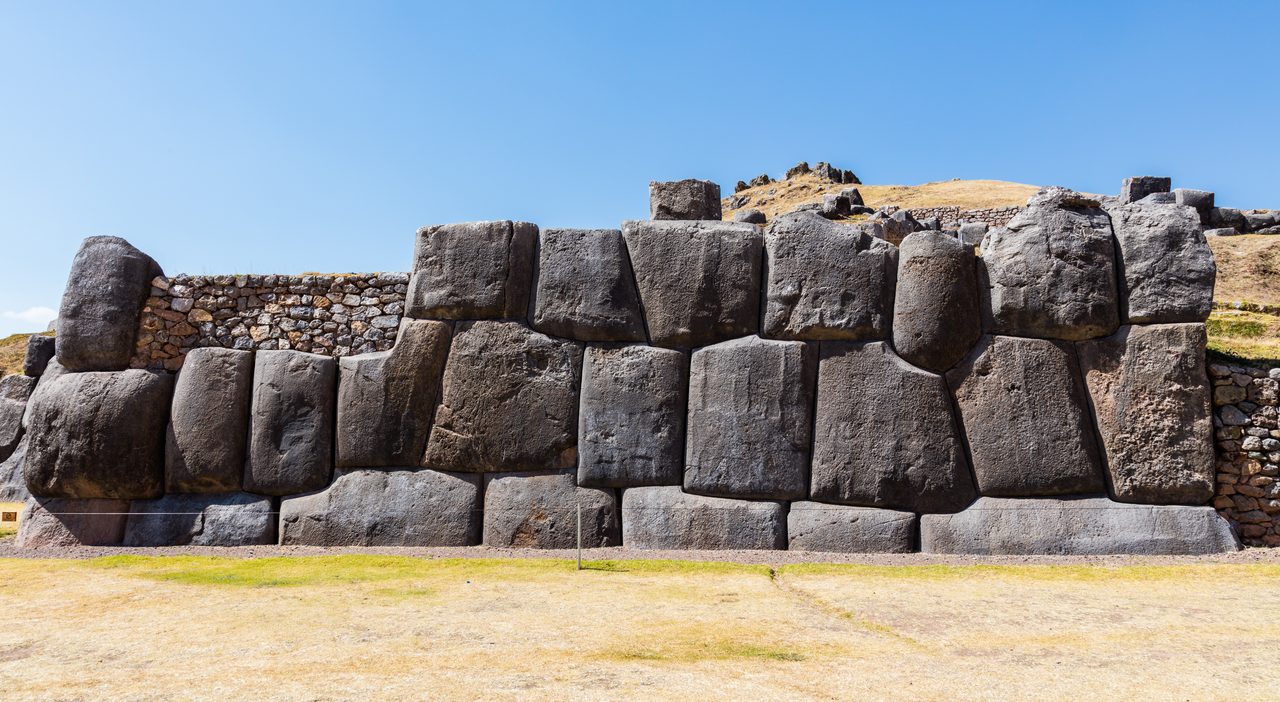
On a hill above Cusco stand three zigzag walls built from boulders that are not rectangles. Each stone carries its own number of sides and its own angles, with the surfaces of the stones beside it ground to match that shape exactly, and the seams between the largest of them are tight enough that a razor blade will not go in. No mortar holds them. The largest block is estimated at 128 tons. The Spanish took the fortress in 1536 and then carried its upper structures away as building stone, leaving the megalithic walls standing only because dismantling them was not worth the labor. Here is the file, opened claim by claim, each one wearing its evidence.
The first thing anyone says about the largest walls above Cusco is that you cannot get a blade into them. That is true, and it is close to the least interesting true thing about them. Look at what is actually being joined. Not bricks, not squared blocks, not anything cut to a standard. Each stone is its own shape, multi-sided, its angles running from blunt to sharp with no repeating pattern, and the stone beside it has been worked until it takes that shape exactly. Nothing binds them. There is no mortar in the seams. The largest of these boulders is estimated at 128 tons, sitting in the same mortar-free puzzle as all the rest, and how a stone that size was fitted rather than merely shaped is a question this file does not consider closed. Let's open the file.
01The Falcon on the Hill
Sacsayhuaman, Saqsaywaman in Quechua, is variously translated as speckled falcon or satisfied falcon. It sits on a steep hill overlooking Cusco, Peru, northwest of the city, at 3,701 meters. That elevation is corroborated independently of our own files, at roughly 3,700 to 3,800 meters.
Three parallel zigzag walls rise in three terraces to a combined height of about 18 meters. Each wall runs approximately 400 meters. That last figure gets a flag rather than a footnote: our primary research file gives about 400 meters, and the comparative file this article also draws on gives about 360 meters for the same walls. It is a real disagreement between two of our own documents on a headline dimension, not a rounding difference. This article states the primary file's 400 meters and says plainly that the number is not settled between them.
Each of the three walls carries roughly 20 to 22 teeth, or angles. The zigzag is not decoration: it creates multiple flanking angles, which are useful in defense. Scholars also read the zigzags as possibly representing the teeth of a puma, since Cusco was reportedly laid out in the shape of a puma with Sacsayhuaman as its head.
Behind the walls lies a platform of about 3,600 square meters. It originally supported structures that are gone entirely now: towers, reservoirs, and galleries. What stands today is the base of a complex whose upper buildings were removed.
02Boulders That Are Not Rectangles
This is the finding everything else here turns on, and it is worth stating flatly: the blocks are not rectangular. They have irregular polygonal shapes, with angles varying from obtuse to acute. The adjoining surfaces are often slightly concave, dished inward, so that the blocks settle more tightly under their own weight. Jean-Pierre Protzen confirmed those concave contact faces by direct measurement.
The walls are built from colossal polygonal limestone and andesite blocks. The largest is estimated at 128 tons, at roughly 8.5 by 5 by 4 meters, a figure that traces to John Hemming's 1970 history of the conquest. Each block was cut, shaped, and fitted to its neighbors without mortar, in a jigsaw pattern.
Multiple modern observers have confirmed that the joints between the largest blocks are so tight that a razor blade cannot be inserted, and Graziano Gasparini and Luise Margolies documented that precision in the detailed photographic surveys published as Inca Architecture in 1980. Razor blade is the specific our files actually carry, and it is the one this article uses.
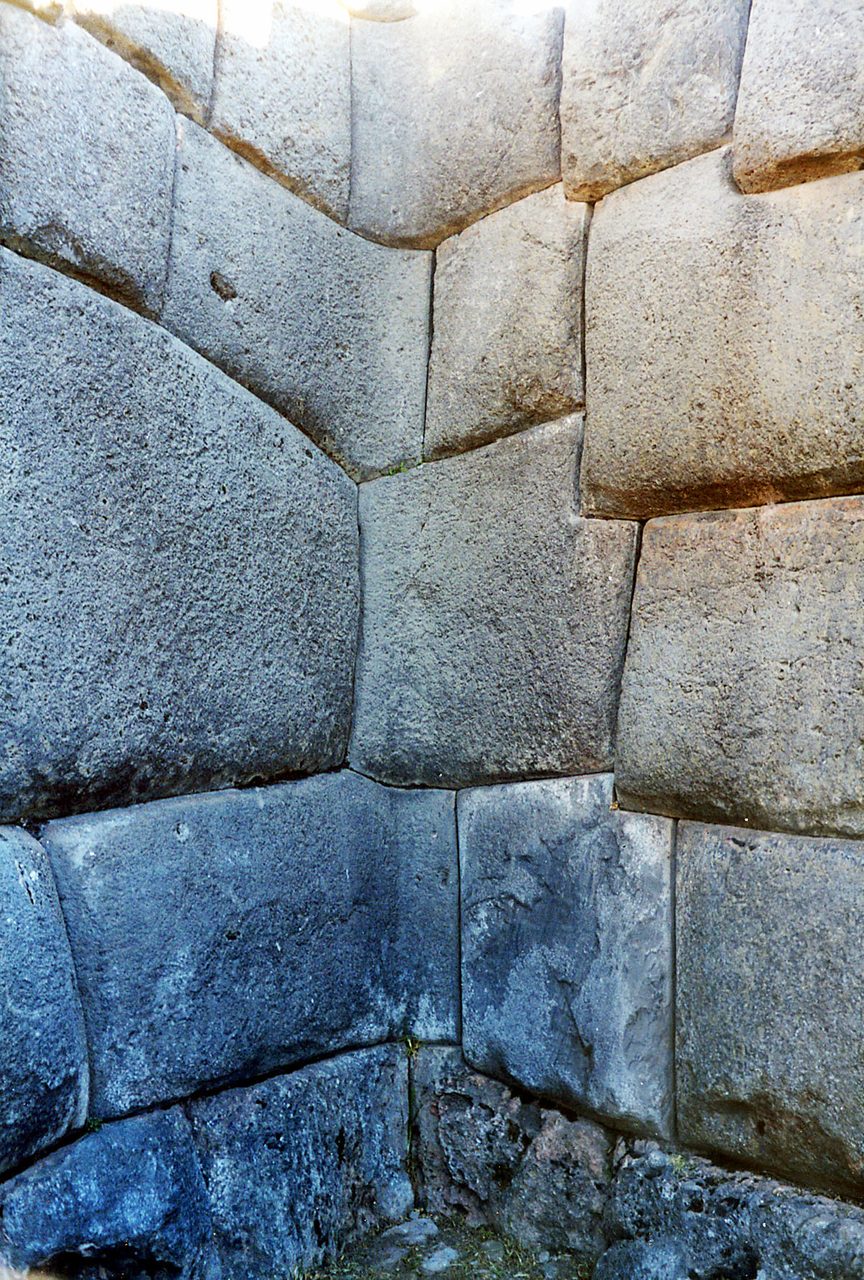
This is the kind of seam the razor-blade claim is about.
One figure that travels with this site is deliberately absent above. Popular tourism and alternative-history sources widely circulate block weights well beyond the documented 128 tons, commonly 200 tons and sometimes hundreds of tons. Those numbers are not tied to a named measurement the way Hemming's figure is, and our own comparative file already flags the range problem. This article states 128 tons throughout and does not offer a larger number as an equally solid alternative.
| Feature | Polygonal | Coursed Ashlar |
|---|---|---|
| Where It Appears | Predominant on the lowest terrace | Upper sections and interior structures |
| Block Shape | Massive multi-sided boulders up to 128 tons, each stone uniquely shaped, with adjacent surfaces ground to match | Rectangular cut-stone blocks laid in regular horizontal courses |
| Where Else It Is Seen | Ollantaytambo and select walls at Cusco are classed with Sacsayhuaman in the same precision-fitted type | The standard Inca imperial style, also seen at the Qoricancha and at Machu Picchu |
The walls show two distinct masonry styles, and telling them apart is the difference between reading this site correctly and reading it as one thing. The polygonal style predominates on the lowest terrace: massive multi-sided boulders up to 128 tons, each stone uniquely shaped, with adjacent surfaces ground to match. The upper sections and the interior structures use coursed ashlar instead, rectangular cut stone in regular horizontal courses. That second style is the standard Inca imperial masonry, the one also seen at the Qoricancha and at Machu Picchu.
03The Stone, the Quarry, and Twenty Thousand Men
The megalithic walls use primarily Yucay limestone, locally available, for the largest blocks. Andesite, a harder volcanic stone quarried from more distant sources including Huaccoto about 35 km away, was used for the finer dressed blocks. Andesite matters here because of what it is: a volcanic rock with a Mohs hardness of about 6 to 7, resistant to shaping and highly durable.
Quarrying exploited the natural fracture planes in the local limestone. Stones were split using wooden wedges inserted into carved channels and then soaked with water, so that the swelling wood did the splitting. Experimental archaeology has confirmed that this expanding-wedge technique is effective.
The largest blocks came from quarries 0.5 to 5 km away, moved on inclined ramps and log rollers by massive organized human labor under the mita corvee system, a method documented in the Spanish chronicles and consistent with known Inca logistical capabilities. Garcilaso de la Vega describes the labor of 20,000 men. Cieza de Leon recorded 20,000 workers rotated in shifts of 6,000. Independent sources outside our files put workforce estimates in the same 20,000 to 25,000-plus range.
Two lines of physical evidence for the production chain come from elsewhere in the Inca world rather than from Sacsayhuaman itself, and that distinction is worth keeping. Protzen identified quarry sites at Kachiqhata, across the Urubamba River from Ollantaytambo, holding partially shaped blocks, abandoned tools, and ramp structures, which is direct evidence of the Inca chain from quarry to finished wall. And boss stones, the protruding knobs left on block faces for rope attachment during transport and lifting and then removed after placement, are visible on unfinished blocks at Ollantaytambo, and at several Greek and Roman sites, which reads as one practical solution independently arrived at across cultures.
04How the Fit Was Actually Made
Start with what the masons did not have. No metal tools were used for shaping the hard stones, andesite and diorite. Bronze tools, tumi knives and chisels, were available and were used, but on softer stone, limestone and sandstone; on andesite they were ineffective. The primary shaping tools were hammerstones of quartzite, sand abrasives for grinding and polishing, and bronze chisels for softer stone and fine detail.
Jean-Pierre Protzen demonstrated experimentally, in work published in 1993, that the observed precision could be achieved with stone hammers, which our primary file describes as river cobbles, together with bronze chisels and abrasive sand. The method is a loop rather than a single cut. Set the stone, test the fit, mark the high spots with pigment, lift it off, hammer and grind the marked areas down, set it again, and repeat until the fit is perfect.
That trial and error process is labor-intensive, and it does not require advanced technology. What it does require is extraordinary organizational capacity and patience, which is a different kind of achievement and not a smaller one.
05The Joint Is the Engineering
A fit this tight could be read as craftsmanship for its own sake. Our files read it as structure. Everything in this section is graded Tier 2, credible rather than verified, and the grading is honest for a specific reason stated at the end of it: the mechanism is well argued and now partly modeled, and the question of whether it was intended is still open.
The concave and convex surface profiles of the fitted faces, each stone slightly convex where it meets a slightly concave neighbor, create strong interlocking joints that resist sliding under earthquake forces.
The polygonal technique is inherently earthquake-resistant. Interlocking, mortar-free joints allow individual stones to shift slightly during a seismic event and then settle back into position, where a rigid mortar-bound wall fractures and collapses instead. The inward batter of each terrace wall, its slight backward lean, adds gravitational stability on top of that.
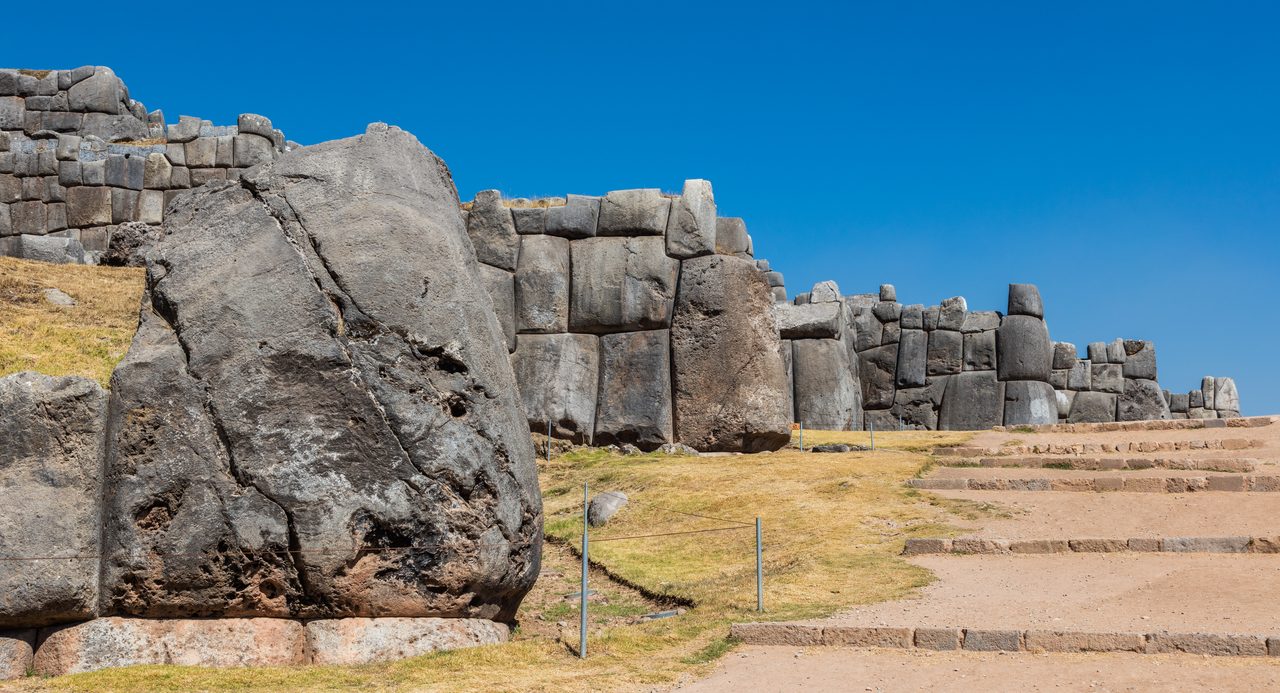
Cusco's own earthquake history is where the claim gets tested outside a laboratory. The severe earthquakes of 1650 and of 1950 destroyed colonial-era buildings while Inca walls survived intact.
The same jointing mechanism has been documented elsewhere in Cusco. Stella Nair of UCLA documented the concave contact-face feature at the Hatunrumiyoc wall, the famous twelve-angled stone, which is a different Cusco site cited here for the same mechanism rather than as evidence about Sacsayhuaman's own stones. Archaeological evidence from post-earthquake inspections shows that polygonal walls often survive earthquakes better than mortared rectangular ashlar does.
A 2012 engineering study by George Simitses and colleagues at the University of Cincinnati took the question to computational modeling of interlocking polygonal masonry, and found that the irregular joint geometry distributes stress more evenly than rectangular joints do, reducing the likelihood of cascading failure. Then the part the modeling does not settle, and the reason this whole section sits at Tier 2: whether the seismic resilience was intentionally engineered, or is a beneficial side effect of a fitting method chosen for other reasons, remains debated.
06The Scale Problem Nobody Has Solved
The fitting method in section 04 rests entirely on Protzen's loop. It is experimental rather than asserted, which is why it carries the weight it does, and there is a hole in it that our own comparative file names in its own counter-arguments section rather than leaving to critics.
Critics note that Protzen's experimental blocks were dramatically smaller than the largest blocks at Sacsayhuaman. The logistics of repeatedly lifting, positioning, removing, adjusting, and repositioning a block of 128 tons using pre-industrial technology remain underexplained. An iterative trial and error process that works on a 500 kg block may be impractically slow at 128 tons. That is a genuinely open scale question rather than a settled one, and this article states it plainly instead of smoothing it over.
Set that beside what our primary research file says about its own contents. That file states that no significant counter-arguments exist in the scholarly literature for the core claims it presents, describing them as established archaeological and historical consensus with no active scholarly dispute over the fundamental claims presented. Both statements hold at once, and they are not in conflict. The consensus covers the fundamentals: who built these walls, when, out of what stone, and by what general method. The open question is narrower and more interesting than that, and it applies at the top of the weight range only.
07Who Built It, and When
The hilltop was occupied before the Inca. The Killke culture held it from approximately 900 to 1200 CE, and Killke-period walls underlie the Inca construction, which demonstrates that the site's strategic importance was recognized well before the Inca period. The roughly 900 CE start is corroborated independently of our files, on surface pottery collections.
Inca construction occurred from about 1440 to 1530 CE, primarily under Pachacuti Inca Yupanqui and his successors. Our comparative file places the building within the reigns of Pachacuti, 1438 to 1471, and Tupac Inca Yupanqui, 1471 to 1493, following the chroniclers Pedro Cieza de Leon, writing in 1553, and Garcilaso de la Vega, writing in 1609. Bernabe Cobo is the third chronicler our primary file names for details of construction methods and scale. Independent sources agree that Pachacuti initiated the major construction and Tupac Inca Yupanqui completed it.
During the siege of 1536, Manco Inca's rebellion against the Spanish, Sacsayhuaman was the site of a desperate battle. Spanish cavalry charged uphill against Inca defenders and eventually took the fortress. The chroniclers describe enormous casualties.
After the conquest, the Spanish systematically dismantled the upper structures, the towers and buildings, for building material for colonial Cusco. The megalithic lower walls survived for an unromantic reason: they were too massive to dismantle economically. What is standing on that hill is what was not worth the labor of taking apart.
| Period | Dates | What the Record Shows |
|---|---|---|
| Killke Occupation | About 900 to 1200 CE | The Killke culture occupied the hilltop, and Killke-period walls underlie the Inca construction. The roughly 900 CE start is independently corroborated on surface pottery collections |
| Inca Construction | About 1440 to 1530 CE | Built primarily under Pachacuti Inca Yupanqui and his successors. Our comparative file places the work in the reigns of Pachacuti (1438 to 1471) and Tupac Inca Yupanqui (1471 to 1493), on the chronicles of Cieza de Leon (1553) and Garcilaso de la Vega (1609) |
| The Siege | 1536 | Manco Inca's rebellion. Spanish cavalry charged uphill against Inca defenders and eventually took the fortress; chroniclers describe enormous casualties |
| After the Conquest | From the Spanish conquest onward | The upper towers and buildings were systematically dismantled for colonial Cusco's building material. The megalithic lower walls survived only because they were too massive to dismantle economically |
08Fortress, or Ceremony
The word fortress has been attached to this place since the conquest, and it is worth asking who attached it. Growing scholarly consensus now favors interpreting Sacsayhuaman as primarily a ceremonial complex rather than a purely military fortress. The case has several parts. One is already stated at Tier 1 in section 01: Cusco was reportedly laid out in the shape of a puma, with this hill as its head. The others are that the site hosted the Inti Raymi, the Festival of the Sun, along with other major state ceremonies, and that the Rodadero, a natural rock outcrop behind the walls carved into smooth slides, thrones, and channels, served ritual purposes. The purely military interpretation was imposed by Spanish conquerors, who experienced the site as a defensive position during the 1536 siege. What sits at Tier 2 here is the conclusion drawn from those parts: that ceremony rather than defense was this site's primary purpose.
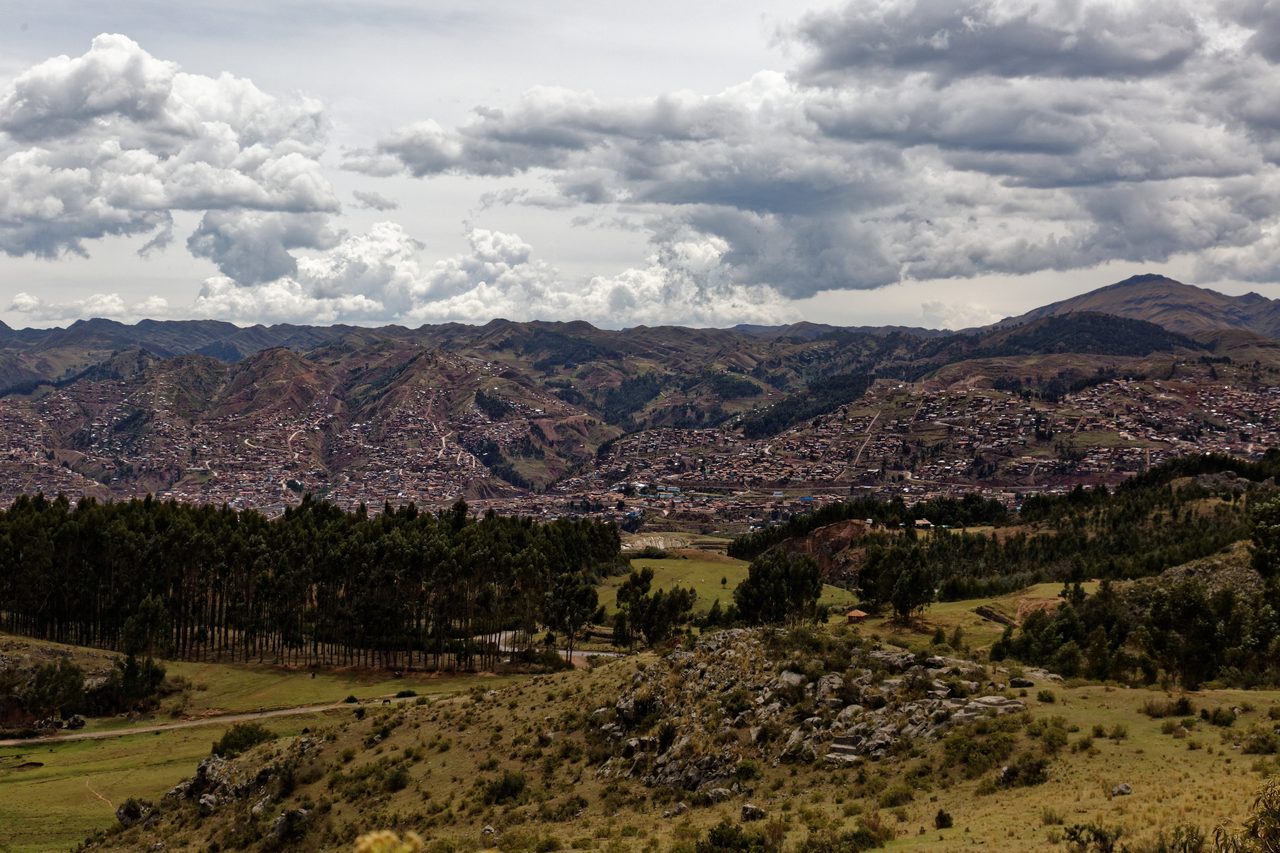
Neither reading gets crowned. The defensive geometry in section 01 is real and sits at Tier 1: the zigzag does create flanking angles useful in defense, and the battle of 1536 was fought on that ground. What has shifted is the reading of the site's primary purpose, and that shift is graded credible rather than verified. Nothing in the record forces a choice between a place built for ceremony and a place defended when it had to be.
One further possibility sits at Tier 3 and stays there. Researchers have noted potential acoustic amplification in the spaces between the zigzag walls. Whether that was intentionally designed for ceremonial sound, drumming and chanting, or is incidental to the architecture, is unknown.
09The Same Idea, Found Many Times Over
Archaeologists classify masonry by coursing and finish into three types. Type I is Rough Cyclopean, the citadel walls of Mycenae at about 1350 to 1250 BCE, with blocks up to roughly 6 tonnes. Type II is Polygonal: the terrace wall at Delphi at about 510 BCE, and the walls of Alatri at about the 4th to 3rd century BCE. Type III is Precision-fitted, blocks with curved, multi-angled faces fitted to sub-millimeter tolerance and typically without mortar, and that is where Sacsayhuaman sits, alongside Ollantaytambo and select walls at Cusco, in the 15th century CE.
| Type | Named Examples | Date |
|---|---|---|
| Type I, Rough Cyclopean | The citadel walls of Mycenae, with blocks up to about 6 tonnes | About 1350 to 1250 BCE |
| Type II, Polygonal | The terrace wall at Delphi; the walls of Alatri, Italy | Delphi about 510 BCE; Alatri about the 4th to 3rd century BCE |
| Type III, Precision-fitted, with curved, multi-angled faces fitted to sub-millimeter tolerance and typically without mortar | Sacsayhuaman; Ollantaytambo; select walls at Cusco | 15th century CE |
Two words in that classification need pinning down before they wander off. Sub-millimeter tolerance there describes the seam: how little space is left where two irregular, multi-angled faces meet. It is not a statement about the flatness of any single surface, and the craft at Sacsayhuaman is a fit between shapes rather than a plane worked true. And cyclopean does double duty across our two files, because the primary file uses polygonal or cyclopean loosely for the massive lowest-terrace style here, while the formal typology above reserves Rough Cyclopean for Type I and files Sacsayhuaman under Type III.
Polygonal masonry appears in civilizations with no known contact with one another: Inca Peru; Mycenaean and Classical Greece, at Mycenae and Delphi; Alatri in Italy; Hittite Anatolia at Hattusa; Rapa Nui; and medieval Japanese castles. Mainstream archaeology favors independent invention, an optimal engineering solution that multiple cultures found on their own, over a diffusion or shared-ancestry explanation; some alternative researchers, most prominently Graham Hancock, have proposed the latter. On the comparison itself, Lukas Nickel and other specialists generally conclude that Inca fitting is significantly tighter than the Mediterranean examples, though those are impressive in their own right.
10Where the Story Runs Off the Map
A wall this strange pulls big stories toward it. One of them is a real question that has simply never produced evidence. The rest fail on the evidence outright, and they are worth walking through plainly, because the honest version is more interesting than the mythology rather than less.
Alternative researchers have proposed that the largest polygonal blocks represent a pre-Inca construction phase by an earlier, unknown civilization, at Sacsayhuaman and at Ollantaytambo. Archaeological investigation finds no stratigraphic or material-culture evidence for a construction phase distinct from the documented Killke and Inca periods, and the largest blocks are stylistically consistent with Inca polygonal masonry. Mainstream consensus attributes all major polygonal masonry in the Cusco region to the Inca imperial period, about 1438 to 1533 CE, supported by radiocarbon dates from associated organic material, ceramic typologies, and historical accounts.
The wrinkle in that deserves stating rather than hiding, because it is the only part of this that is not simply an absence. The radiocarbon dates come from organic material in mound and wall fill rather than from the stone blocks themselves, which leaves a little interpretive room. But no positive evidence for an earlier phase has actually turned up, and interpretive room is not evidence.
The claim that Inca polygonal masonry required lost advanced technology is not supported. The experimental work in section 04, graded Tier 2 there and unchanged here, is one reason: Protzen's experiments in 1986 and 1993 demonstrated that precision fitting of andesite blocks is achievable using only stone hammertools and an iterative trial and error process. The physical record is the other reason. Quarries, tools, abandoned partially shaped blocks, and ramp structures are all present, and all of them are consistent with the documented technique.
Claims that the Inca used a secret plant-based chemical to soften stone blocks for easier shaping have no archaeological, chemical, or botanical support. The same experimental work confirms that stone hammers and abrasive techniques fully explain the observed results, which leaves the softening agent with nothing left to explain.
Claims requiring laser-cutting, anti-gravity, or alien technology misunderstand two things at once: the actual precision achieved, which is impressive but not superhuman, and the known Inca construction methods, which contemporary observers documented in writing at the time.
The extraterrestrial-construction hypothesis, popularized by Erich von Daniken in Chariots of the Gods in 1968, has no supporting evidence. It also carries a cost worth naming out loud: it implicitly denies the engineering capabilities of indigenous peoples.
Fast Facts
- Site
- Sacsayhuaman, Saqsaywaman in Quechua, on a steep hill above Cusco, Peru; the name is translated as speckled falcon or satisfied falcon
- Elevation
- 3,701 meters, independently corroborated at roughly 3,700 to 3,800 meters
- The Walls
- Three parallel zigzag walls in three terraces, combined height about 18 meters. Each wall runs about 400 meters in our primary file and about 360 meters in our comparative file, a disagreement this article states rather than resolves
- The Zigzag
- Roughly 20 to 22 teeth or angles per wall, creating flanking angles useful in defense
- The Platform
- About 3,600 square meters behind the walls, once carrying towers, reservoirs, and galleries that are gone
- Largest Block
- Estimated at 128 tons, roughly 8.5 by 5 by 4 meters (Hemming, 1970)
- The Joint
- No mortar in the polygonal jointing; adjoining faces often slightly concave, so blocks settle tighter under their own weight; seams between the largest blocks too tight for a razor blade
- The Stone
- Yucay limestone for the largest blocks; andesite, Mohs hardness about 6 to 7, from sources including Huaccoto about 35 km away, for the finer dressed blocks
- The Tools
- Hammerstones of quartzite, sand abrasives, and bronze chisels for softer stone and fine detail. No metal tools were used to shape andesite
- The Labor
- Blocks hauled 0.5 to 5 km on inclined ramps and log rollers under the mita corvee system; Cieza de Leon records 20,000 workers rotated in shifts of 6,000
- The Builders
- Killke occupation about 900 to 1200 CE; Inca construction about 1440 to 1530 CE, primarily under Pachacuti Inca Yupanqui and his successors
- The Siege
- 1536, Manco Inca's rebellion; Spanish cavalry took the fortress after a desperate uphill battle
- Why It Survived
- The Spanish dismantled the upper towers and buildings for colonial building stone; the megalithic lower walls were too massive to dismantle economically
- The Open Question
- Protzen's experimental blocks were dramatically smaller than 128 tons, and the logistics of repeatedly lifting, adjusting, and repositioning a block that size with pre-industrial technology remain underexplained
- What Is Not Supported
- That the stone was chemically softened; that laser-cutting, anti-gravity, or alien technology was involved; that lost advanced technology was required
- Unproven, Not Disproven
- That the largest blocks belong to an unknown pre-Inca civilization. No stratigraphic or material-culture evidence has turned up; the one wrinkle is that the radiocarbon dates come from organic fill, not from the blocks themselves
What We Can Actually Stand Behind
Three parallel zigzag walls rise in three terraces to a combined height of about 18 meters on a hill above Cusco at 3,701 meters, with roughly 20 to 22 angles along each wall and a platform of about 3,600 square meters behind them. The blocks are not rectangular. They are irregular polygonal shapes with angles running from obtuse to acute, adjoining faces often slightly concave so the stones settle tighter under their own weight, and they are fitted together without mortar in a jigsaw pattern. The largest is estimated at 128 tons at roughly 8.5 by 5 by 4 meters. The joints between the largest blocks are too tight for a razor blade, documented photographically by Gasparini and Margolies in 1980. One dimension is not settled inside our own library: 400 meters against 360 meters for the length of those walls.
No metal tools were used to shape andesite. Bronze existed and was used on limestone and sandstone, and it was ineffective on the hard stone. The shaping was done with quartzite hammerstones, sand abrasives, and bronze chisels reserved for softer stone and fine detail. Quarrying split limestone along its natural fracture planes with wooden wedges soaked in water, a technique experimental archaeology has confirmed. The blocks travelled 0.5 to 5 km on inclined ramps and log rollers under the mita corvee system, with Cieza de Leon recording 20,000 workers rotated in shifts of 6,000, a figure independent sources place in the same range.
The Killke held the hilltop from about 900 to 1200 CE and their walls underlie the Inca work, so the site's importance predates the empire that made it famous. Inca construction ran from about 1440 to 1530 CE under Pachacuti Inca Yupanqui and his successors, recorded by Cieza de Leon, Garcilaso de la Vega, and Bernabe Cobo. Sacsayhuaman was stormed by Spanish cavalry in 1536 during Manco Inca's rebellion, with enormous casualties, and the Spanish then dismantled its upper towers and buildings for colonial Cusco. The megalithic walls survive because dismantling them would not have paid.
Protzen's experimental reconstruction of the fitting method holds up: set, test, mark the high spots with pigment, lift, grind down, set again, repeat. Labor-intensive, no advanced technology required, and an enormous demand on organization and patience. The concave and convex mating profiles create interlocking joints that resist sliding under earthquake forces; mortar-free joints let stones shift slightly and settle back where a mortared wall fractures; and the inward batter adds gravitational stability. Cusco's severe earthquakes of 1650 and 1950 destroyed colonial-era buildings while Inca walls survived intact, post-earthquake inspections show polygonal walls often outlasting mortared rectangular ashlar, and a 2012 computational study by Simitses and colleagues found that irregular joint geometry distributes stress more evenly than rectangular joints do. Whether that resilience was engineered deliberately or is a side effect of the method remains debated, which is exactly why this is Tier 2 and not Tier 1.
Growing scholarly consensus favors reading Sacsayhuaman as primarily a ceremonial complex rather than a purely military fortress. The case rests on the puma-head correspondence in Cusco's urban plan, on the Inti Raymi and other major state ceremonies hosted there, and on the carved Rodadero outcrop behind the walls; the purely military interpretation was imposed by Spanish conquerors who met the place as a defensive position in 1536. What is graded Tier 2 is the conclusion drawn from those parts. This file does not crown either reading: the flanking angles are real, the battle was real, and what has moved is the reading of the site's primary purpose.
The scale question is not closed and this file will not pretend otherwise. Protzen's experimental blocks were dramatically smaller than Sacsayhuaman's largest. Repeatedly lifting, positioning, removing, adjusting, and repositioning a 128-ton block with pre-industrial technology remains underexplained, and a loop that is merely slow on a 500 kg stone may be impractically slow at 128 tons. Our primary research file states, and this article carries at Tier 1, that no significant counter-arguments exist in the scholarly literature for its core claims; that holds for the fundamentals, meaning who built the walls, when, and from what. This question sits above those fundamentals, at the top of the weight range, and it is raised in our comparative file's own counter-arguments section.
Two ideas are honest to hold and impossible to bank. Potential acoustic amplification has been noted in the spaces between the zigzag walls, and whether it was designed for ceremonial sound or is incidental to the architecture is unknown. And the proposal that the largest polygonal blocks belong to an earlier, unknown civilization has produced no stratigraphic or material-culture evidence, with the largest blocks stylistically consistent with Inca polygonal masonry. Its one genuine wrinkle is that the radiocarbon dates come from organic material in mound and wall fill rather than from the blocks themselves, which leaves interpretive room and nothing more.
No, the stone was not chemically softened. The claim that the Inca used a secret plant-based agent to soften blocks for shaping has no archaeological, chemical, or botanical support, and experimental work shows that stone hammers and abrasive techniques fully explain the observed results. And no, the masonry did not require lost advanced technology: Protzen's 1986 and 1993 experiments achieved precision fitting of andesite with stone hammertools and an iterative process, while the quarries, the tools, the partially shaped abandoned blocks, and the ramp structures are all present and all consistent with that technique.
No, there is no laser-cutting, anti-gravity, or alien technology in this wall. Those claims misunderstand the actual precision achieved, which is impressive but not superhuman, and the known Inca construction methods, which contemporary observers documented in writing. The extraterrestrial version, popularized by Erich von Daniken in Chariots of the Gods in 1968, has no supporting evidence at all, and it implicitly denies the engineering capabilities of indigenous peoples, which is a cost worth stating rather than passing over.
So the honest account leaves the wonder where it was and moves it a few feet sideways. The marvel above Cusco is not that something inhuman cut these stones. It is that people did, with quartzite hammerstones and sand and, on Protzen's reconstruction, pigment to mark whatever was still standing proud, shaping every block to a shape no other block shares and setting it so closely that the joint needed no mortar at all. The file is not closed, either. Two of our own documents disagree on how long the walls are. Whether the seismic behavior was engineered on purpose or inherited from the method is still argued. And the question this file cannot close is the plainest one, the one the fitting loop raises entirely by itself: at 128 tons, how many times can you lift a stone to see whether it fits yet?
Sources & further reading
Everything above is drawn from our research library on Theories of Anything, principally the Sacsayhuaman file D_3_12, with the comparative polygonal-masonry file J_2_19 supplying the global classification, several of the named researchers, and the open scale question in section 06, plus four points of independent web corroboration flagged in the text where they occur (the site's elevation, the Killke occupation's start date, workforce estimates, and the caution against inflated popular block-weight figures). Three housekeeping notes belong here rather than being passed along quietly. Our two files disagree on the length of the zigzag walls, about 400 meters against about 360 meters, which section 01 states rather than resolves. D_3_12 is also internally inconsistent on its own headline detail: its summary says a knife blade cannot be inserted between the blocks while its own body section and J_2_19 both say razor blade, so this article uses razor blade, the wording both files' body sections carry and the wording attached to the Gasparini and Margolies survey. And two entries in those bibliographies carry identifiers that resolve to the wrong work: the DOI attached to Protzen's 1993 Ollantaytambo monograph in fact resolves to Ann Kendall's 1994 review of that monograph in Antiquity, and the DOI attached to the Gasparini and Margolies 1980 book has the shape of a 1980 Science journal article rather than of a book from Indiana University Press, which this research pass could not fully resolve because the publisher returned a 403. Those two works are therefore named in the text by author and date rather than linked. Open the full file to check the sourcing and go deeper.
Image credits
- The great polygonal lowest-terrace wall of Sacsayhuaman Diego Delso, via Wikimedia Commons (CC BY-SA 4.0). CC BY-SA 4.0 Source.
- Close-up of a mortar-free polygonal joint at Sacsayhuaman Hakan Svensson (Xauxa), via Wikimedia Commons (CC BY-SA 3.0). CC BY-SA 3.0 Source.
- Cusco seen from the Sacsayhuaman hilltop KimonBerlin, via Wikimedia Commons (CC BY-SA 2.0). CC BY-SA 2.0 Source.
- A row of fitted stone corners along the zigzag walls of Sacsayhuaman Diego Delso, via Wikimedia Commons (CC BY-SA 4.0). CC BY-SA 4.0 Source.
- Card crop of the polygonal lowest-terrace wall Diego Delso, via Wikimedia Commons (CC BY-SA 4.0). CC BY-SA 4.0


.jpg)
