
Puma Punku: The H-Blocks That Look Machine-Pressed
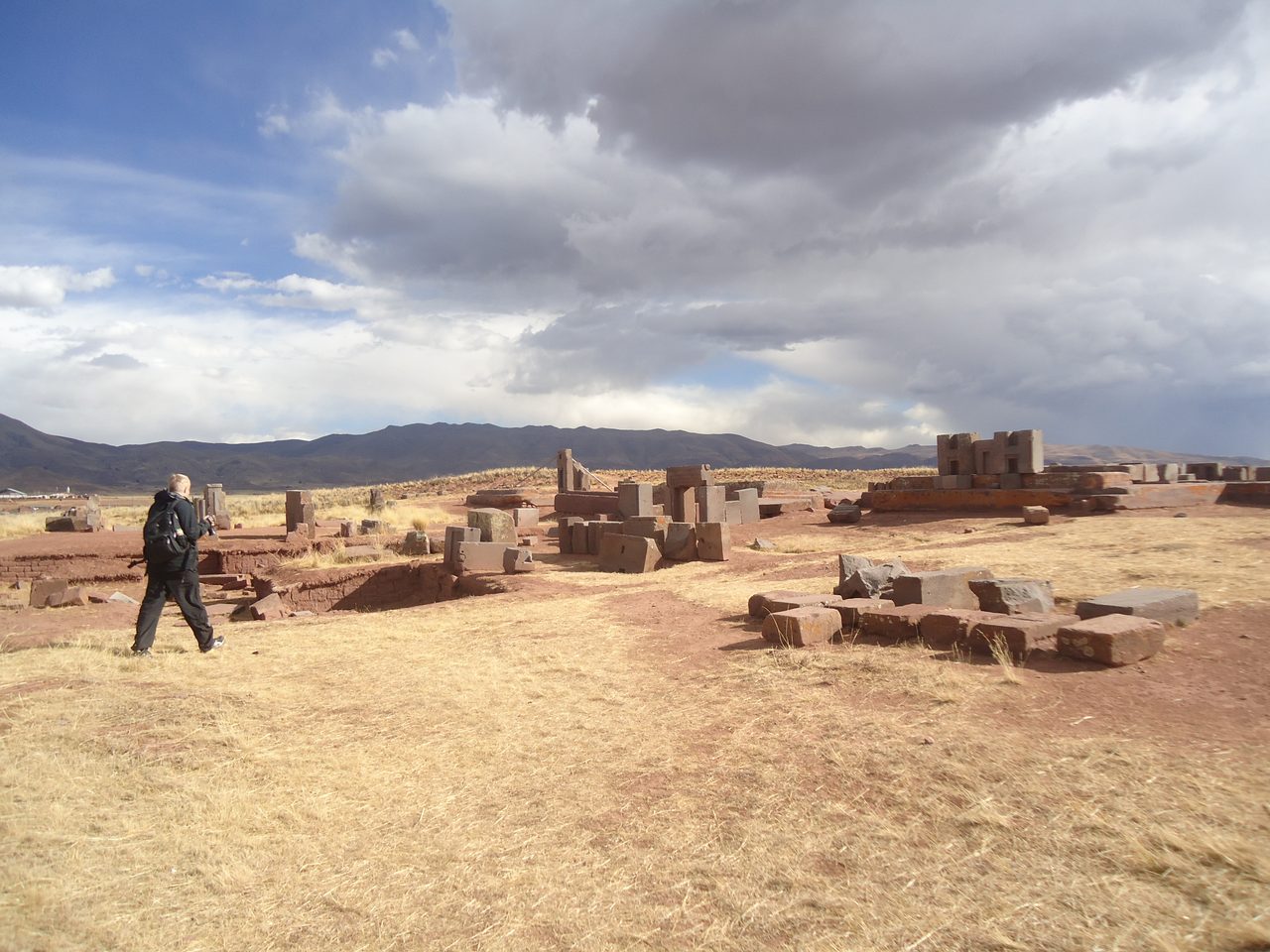
In the thin air of the Bolivian altiplano, nearly 3,850 meters up, lie blocks of stone cut so cleanly that the eye insists a machine made them. The H-blocks of Puma Punku have faces flat to within a millimeter or two and inside corners crisp enough to look milled. They were shaped roughly fourteen hundred years ago by a people who cast bronze, left no metal cutting tools behind, and left no writing we have learned to read. Here is the file, opened claim by claim, each one wearing its evidence.
Look at a well-preserved H-block from Puma Punku and the first instinct is almost always the same: something cut this. The faces are flat, the inside corners are square and crisp, the recesses repeat as if stamped from a single die. It sits on the Bolivian altiplano, nearly 3,850 meters above the sea, and it was shaped by a people whose smiths cast bronze but made no metal cutting tools, and who left behind no writing we can read. That gap, between how the stones look and who we know made them, is exactly why Puma Punku attracts every claim that human hands could not have done it. Let's open the file.
01A Real Place With a Real Address
Puma Punku is not a mystery site floating outside the record. It sits inside the greater Tiwanaku complex on the Bolivian altiplano, roughly 1 km southwest of the Kalasasaya temple and the Semi-Subterranean Court, at about 3,850 meters (12,631 feet) elevation near the southern shore of Lake Titicaca.
Tiwanaku was the capital of a major pre-Columbian civilization that flourished from roughly 300 to 1000 CE, and at its height it may have held territory across parts of modern Bolivia, Peru, Chile, and Argentina. Puma Punku belongs to a later phase of that civilization, not to some unrelated earlier people.
Radiocarbon dates from organic material in the lowest and deepest layers of the mound place the start of construction at about 536 to 600 CE, and the site shows several building phases and modifications over the following centuries. In plain terms, the H-blocks are roughly fourteen hundred years old, not fourteen thousand.
02The H-Blocks
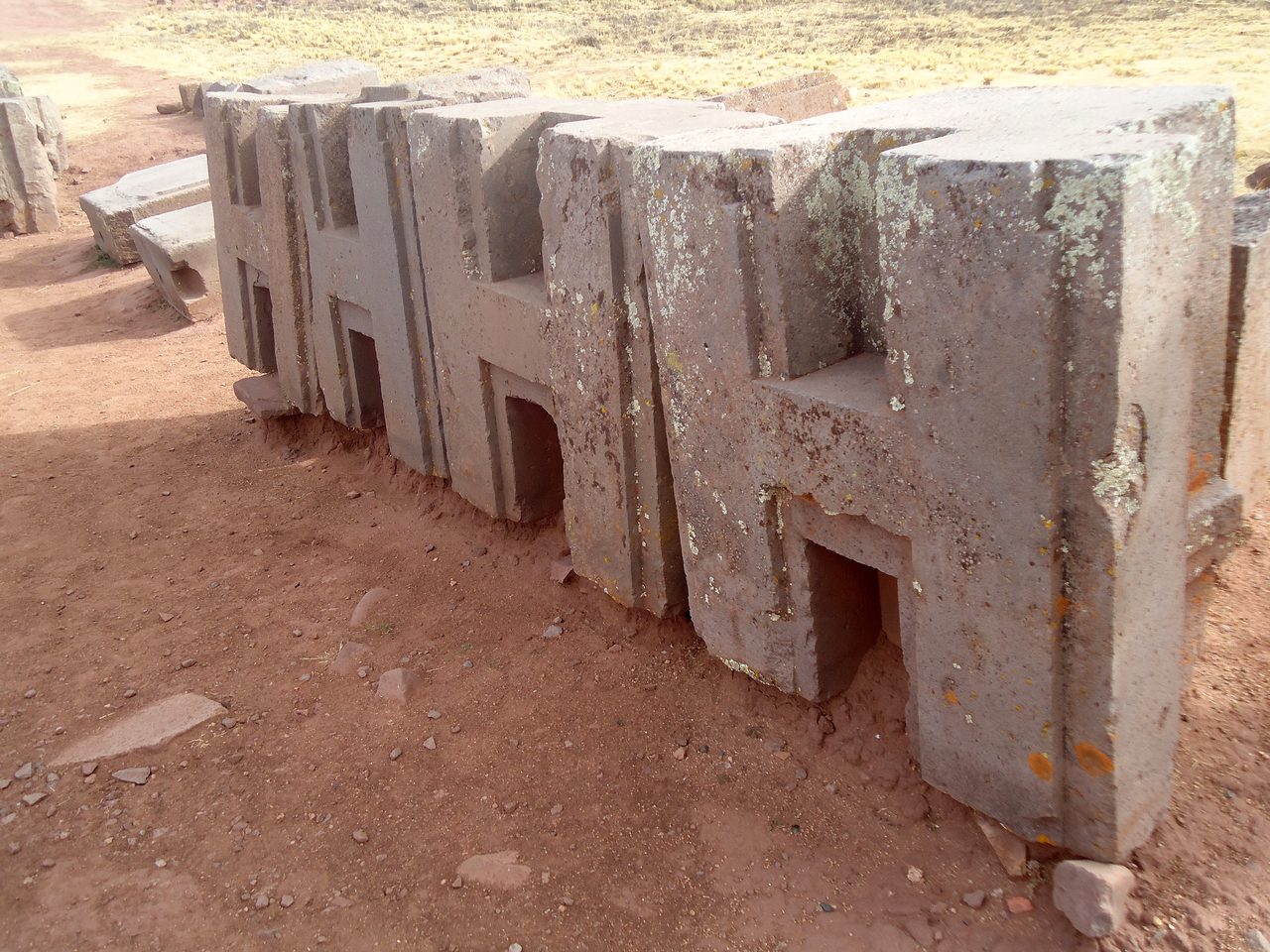
The blocks that made Puma Punku famous are the H-blocks, cut from red sandstone quarried about 10 km away. Each one measures roughly 2.5 by 1.0 by 0.6 meters and carries interlocking features, recessed channels, notches, and surface niches, all cut so that the blocks fit together in a modular, repeatable way.
Over 100 H-block fragments have been cataloged at the site, though many are broken. What we see today is not how the builders left it. After Puma Punku was abandoned around 1000 CE it was quarried for centuries: local communities, Inca builders, and Spanish colonial builders all carried off and reused its stone, leaving the field of scattered, toppled blocks that visitors photograph now.
03The Andesite Giants
| Property | Red Sandstone H-Blocks | Andesite Megaliths |
|---|---|---|
| Stone type | Red sandstone, the softer of the two | Andesite, a hard volcanic rock |
| Quarry distance | About 10 km away | About 90 km away, on the Copacabana Peninsula |
| Typical size and role | Modular H-blocks, about 2.5 by 1.0 by 0.6 m | The largest blocks, up to about 131 tons |
The largest stones here are not sandstone at all but andesite, a hard volcanic rock quarried from the Copacabana Peninsula on Lake Titicaca, about 90 km away. The single largest andesite block is estimated at about 131 metric tons, with some estimates running as high as 144 tons.
Moving stones on that scale across the altiplano, and probably across part of Lake Titicaca itself, took substantial organized labor and real engineering knowledge. That is the first honest measure of Puma Punku: not magic, but coordination.
04Locks Poured From Molten Metal
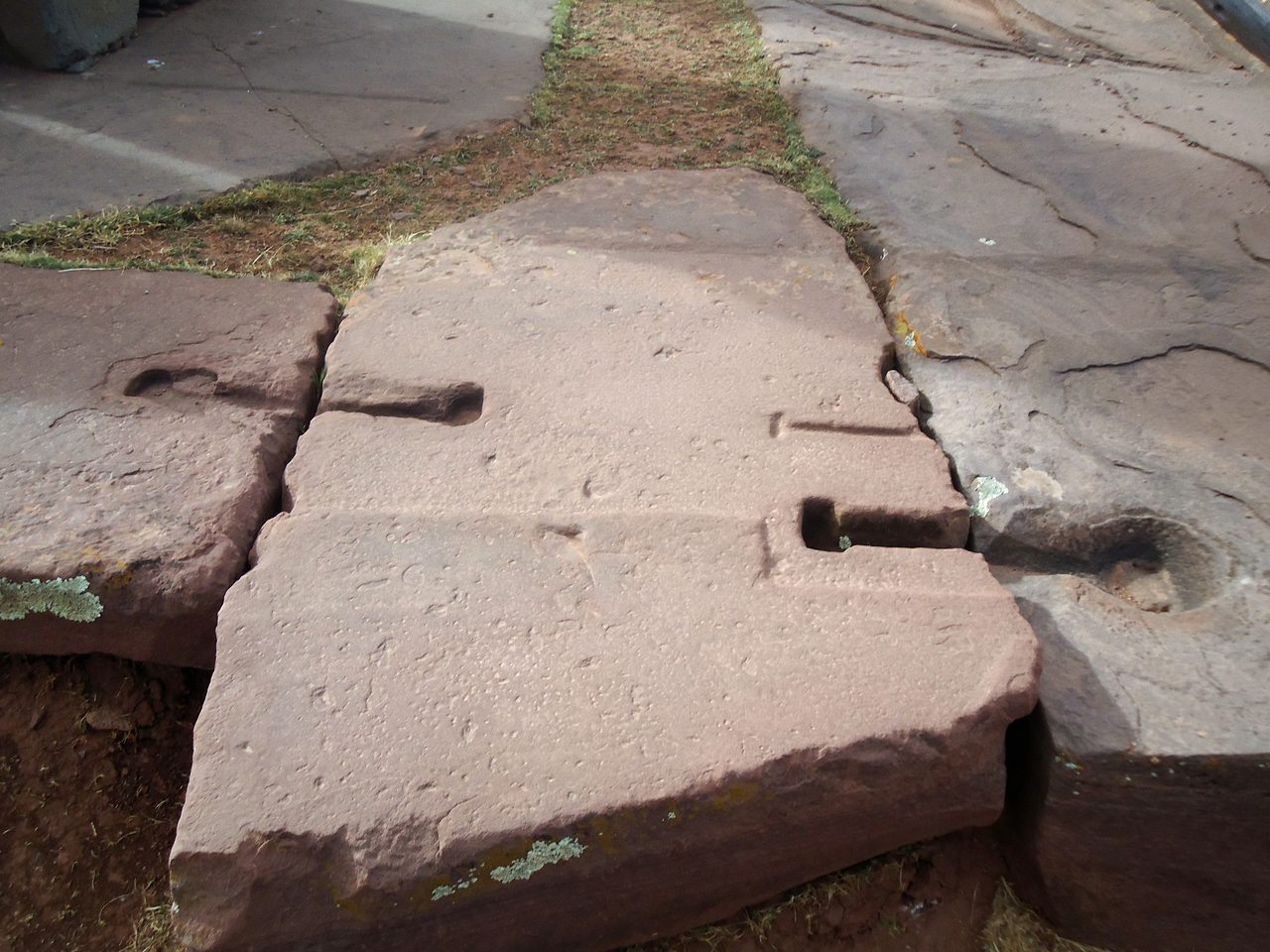
One of the most telling details is how the blocks were fastened. Tiwanaku builders cut I-shaped recesses across the seam between two blocks and poured molten metal into them, so the cooled metal cramp locked the stones together. These clamp indentations are visible on many blocks at both Puma Punku and the nearby Akapana pyramid.
The metal was poured in place. Analysis shows the cramps are a copper-arsenic bronze consistent with known Tiwanaku metallurgy, and the cooled metal conforms exactly to the irregular surfaces of the channels it filled, which only happens if it was cast as a liquid directly into the stone. That means on-site metalworking at nearly 3,850 meters.
The technique is not even unique. Pouring metal cramps in place to tie masonry together shows up independently in ancient Greece, Rome, and India, which reads as different cultures arriving at the same good engineering solution rather than any shared secret source.
05The Precision, Measured
This is the heart of the machine-pressed impression, and it deserves real numbers rather than adjectives. In 1997 the architect Jean-Pierre Protzen and Stella Nair did what few of the site's mythologizers ever have: they measured it.
Protzen and Nair's systematic measurements documented flat surfaces ground to within 1 to 2 mm of true flatness across distances of several meters.
The right angles on the blocks are accurate to within about 1 degree, and matching cut depths on repeating elements such as channels and niches are consistent to within a few millimeters.
The inside corners are cut crisp and sharp, not softened or rounded the way purely abrasive rubbing would tend to leave them. This is the single feature that most fuels the machine-tool impression.
| Feature Measured | Documented Tolerance |
|---|---|
| Flatness of ground faces | Within 1 to 2 mm over distances of several meters |
| Right angles | Accurate to within about 1 degree |
| Repeating cut depths (channels, niches) | Consistent to within a few millimeters |
| Internal corners | Cut crisp and sharp, not rounded |
06How It Was Actually Made
When the surfaces themselves are examined closely, they tell a consistent story. There are pecking marks left by stone hammers used for rough shaping, flat-ground surfaces consistent with grinding and polishing using flat stone tools and abrasive sand, and internal right-angle channels produced by systematic grinding. Crucially, no tool marks have been found that are inconsistent with known pre-Columbian technology.
In 2013 Protzen and Nair went further and showed experimentally that this kind of precision can be reached using flat stone plates as reference surfaces combined with abrasive-sand polishing for the final finish. The method is slow, but it works.
Their broader experimental work reconstructed the full toolkit: hard hammerstones of diorite and quartzite, which are actually found at the site, for percussion; flat stone grinding surfaces to achieve flatness; and sand abrasion for finishing and polish. This is a credible, tested reconstruction rather than a bare assertion.
That said, the debate is not fully closed. Questions remain about whether these techniques alone fully account for every feature, especially the crispest internal corners and the sheer volume of finely cut stone the builders produced. This is an honest open edge, not a hidden one.
07A Three-Dimensional Puzzle
Alexei Vranich's reconstruction studies argue that the H-blocks and their companion elements were part of a modular architectural system: prefabricated components designed to interlock like a three-dimensional puzzle. That implies advance planning, standardized measurements, and possibly a set of templates or measuring standards used across the site.
That is genuinely unusual. Most pre-Columbian architecture fitted stones to one another in place, on site, rather than prefabricating standard parts to a shared specification. The modularity is one of the real puzzles here.
A more recent test reinforced the reading. In 2018 Vranich's team 3D-printed scale models of 140 andesite pieces and 17 sandstone slabs, using measurements gathered over roughly 150 years of scholarship, then physically reassembled the miniatures. The scattered doorways of different sizes turned out to align into a deliberate mirrored arrangement, exactly what a planned, modular design would predict.
It is worth saying plainly that modularity by itself proves nothing exotic. Prefabricated, modular building systems appear independently in several pre-industrial cultures around the world. Impressive planning is not the same as anomalous technology.
08What Puma Punku Was For
What the complex was actually for is still argued. Alan Kolata reads it as a ceremonial platform and gateway complex built for ritual processions. Vranich has argued that part of it may have been a port or dock tied to a now-vanished extension of Lake Titicaca. William Isbell reads it as an elite administrative center. These are competing scholarly readings, not settled fact.
Part of why the question stays open is damage. Centuries of colonial-era stone robbing, earthquakes, and the later conversion of the ground to farmland have scrambled the very evidence a functional interpretation would rest on.
09The Wider Tiwanaku World
The builders of Puma Punku were not isolated geniuses working in a vacuum. They belonged to a civilization that solved hard problems in visible, well-documented ways, and that context is the quiet answer to a great deal of the mystery.
Tiwanaku's engineers pioneered raised-field agriculture, known as suka kollus: elevated planting beds separated by water-filled channels that extended the growing season, improved drainage, and trapped sediment as fertilizer. Experimental reconstructions produced yields 2 to 7 times higher than ordinary dry farming at the same punishing altitude, enough to feed a dense population.
A short walk away, in the Kalasasaya compound rather than at Puma Punku itself, stands the Gateway of the Sun, carved from a single block of andesite about 3 meters tall and 4 meters wide, weighing around 10 tonnes. Across its lintel the central Staff God, often identified with Viracocha, is flanked by 48 smaller winged attendant figures.
Ever since Arthur Posnansky, some scholars have suggested those 48 figures encode a solar calendar. It is a real proposal, but a debated one, and because no one has deciphered a Tiwanaku writing system, the reading cannot be confirmed or ruled out.
Tiwanaku, Puma Punku included, was inscribed as a UNESCO World Heritage Site in 2000, listed as the spiritual and political center of the Tiwanaku culture under criteria three and four. Puma Punku makes up about 7 hectares of the roughly 71.5-hectare protected property.
And the map is still being drawn. In 2025 researchers using satellite and drone imagery identified a large Tiwanaku-style temple complex at Palaspata, roughly 210 km south of the main site, a reminder that the reach of this civilization is still being actively traced. That find is about Tiwanaku's territory, not about Puma Punku's stones, but it underlines how much of this real, human story is still being recovered.
10Where the Story Runs Off the Map
A site this striking and this incompletely understood pulls big stories toward it. Some are worth taking seriously as open questions. Others are not supported by anything in the ground. The honest version is worth walking through plainly, because it is more interesting than the mythology, not less.
Some researchers argue that the crispness and precision of the H-blocks imply stone-cutting techniques not yet fully replicated by experimental archaeology, perhaps metal tools that did not survive or methods no longer practiced. The honest counterweight sits right beside it: no metal cutting tools have ever been recovered at Tiwanaku, and its metallurgy centered on bronze, gold, and silver ornamental work, not heavy industrial cutting tools.
A related idea holds that Puma Punku may have an earlier construction phase predating the accepted radiocarbon dates, possibly reaching back into the first millennium BCE. Current dating does not support it. The one genuine wrinkle is that the radiocarbon dates come from organic material in the mound fill rather than from the stone blocks themselves, which leaves a little interpretive room, but no positive evidence for an earlier phase has actually turned up.
Past that open edge, the claims stop being open questions and start failing on the evidence. Here they are, plainly.
The headline claim, that Puma Punku's stones show machine-tool precision equal to modern CNC milling, is an exaggeration. The precision Protzen and Nair actually measured, on the order of 1 to 2 mm, is genuinely impressive but sits comfortably alongside other pre-industrial stone traditions: Inca polygonal masonry, Egyptian granite work, and the stonework of medieval cathedrals. Impressive is not the same as impossible.
Claims of laser-cut or machine-finished surfaces rest on visual impression, not measurement. Protzen's petrographic analysis of the surfaces shows exactly what stone-on-stone abrasion leaves behind, not what a machine tool would.
A more recent fringe proposal, from Joseph Davidovits of the Geopolymer Institute, holds that the megaliths were not carved at all but cast from a geopolymer, a cement-like artificial stone. It is the same theory shape, and the same researcher, behind the widely rejected claim that the Great Pyramid was cast rather than quarried. It runs directly against the hard evidence here: matched quarry sites 10 and 90 km away, unfinished blocks still lying at those quarries, and abrasion tool marks on the finished surfaces.
Arthur Posnansky's early twentieth-century astronomical dating of Tiwanaku to around 15,000 BCE has been decisively rejected by every modern method. Radiocarbon, ceramic seriation, and stratigraphy consistently place the site in the first millennium CE. The fourteen-thousand-year-old Puma Punku of the documentaries does not exist.
And the biggest claim of all, that Puma Punku required extraterrestrial technology or was built by survivors of Atlantis, has no archaeological evidence behind it. The site fits neatly inside the documented, gradual development of Tiwanaku from early villages to monumental architecture over centuries. The clinching detail is almost mundane: unfinished blocks, still showing work in progress, sit at the quarries alongside the tool marks, the construction ramps, and the cast-metal cramps. Every physical clue points at human hands.
Even the objection that the blocks are simply too heavy to move without modern machinery does not hold. Organized human labor with ramps and sledges is demonstrably capable of moving blocks well over 100 tons, a feat achieved at many ancient sites and well within the reach of Tiwanaku's builders.
Fast Facts
- Site
- Puma Punku, within the Tiwanaku complex on the Bolivian altiplano, about 1 km southwest of Kalasasaya
- Elevation
- About 3,850 meters (12,631 feet), near the southern shore of Lake Titicaca
- Builders
- The Tiwanaku civilization, roughly 300 to 1000 CE
- Construction
- Begun about 536 to 600 CE, over several building phases; roughly 1,400 years old
- The H-Blocks
- Red sandstone quarried about 10 km away, each roughly 2.5 by 1.0 by 0.6 meters
- Largest Stone
- An andesite block estimated at about 131 tons, from a quarry about 90 km away
- Fastening
- I-shaped cramps of copper-arsenic bronze, poured molten into the stone in place
- Measured Precision
- Faces flat to within 1 to 2 mm; right angles within about 1 degree
- Tools Found
- Stone hammers and grinding surfaces; no metal cutting tools recovered
- Status
- UNESCO World Heritage Site, 2000
What We Can Actually Stand Behind
The site is real, its age is well established, and its engineering is genuine. Puma Punku was built by the Tiwanaku beginning around 536 to 600 CE, in red sandstone and andesite, fastened with metal cramps poured in place, and finished to a precision of 1 to 2 mm. All of that is documented and measured.
Several real questions stay open: exactly what the complex was for, how much of the very crispest cutting the tested stone-tool methods fully explain, and how to read the modular design. These are live scholarly debates, not settled facts in either direction.
The idea of a lost or not-yet-replicated cutting technique, and the suggestion of a construction phase older than the radiocarbon dates, are interesting but unproven. No metal cutting tools have been found, and no positive dating evidence supports an earlier phase.
There is no credible evidence for machine-tool or laser precision, and none for the stones being cast as artificial geopolymer rather than carved. The measured tolerances are matched by other pre-industrial cultures, and the surfaces carry ordinary stone-on-stone abrasion marks.
There is no credible evidence for extraterrestrial or Atlantean construction. Unfinished blocks lie at the quarries, the tool marks are human, and the site fits the gradual, documented rise of the Tiwanaku. Posnansky's 15,000 BCE date is rejected by every modern method.
So the honest answer takes nothing away from the wonder. It relocates it. The marvel of Puma Punku is not that something inhuman cut these stones, but that people did, at nearly 3,850 meters, with stone hammers, grinding plates, sand, and poured bronze, working a hard volcanic rock to a tolerance a modern machinist would respect. And the file is not closed. Much of the site was carried away centuries ago, its function is still argued, and its builders left no writing we have learned to read. What did the people who cut these corners so cleanly mean them to hold up?
Sources & further reading
Everything above is drawn from our research library on Theories of Anything. Open the full file to check the sourcing and go deeper.
Image credits
- Wide view across the Puma Punku ruins photograph by Janikorpi, via Wikimedia Commons. CC BY-SA 3.0 Source.
- H-profile blocks in andesite and diorite photograph by Janikorpi, via Wikimedia Commons. CC BY-SA 3.0 Source.
- Red sandstone foundation block with an I-shaped clamp channel photograph by Janikorpi, via Wikimedia Commons. CC BY-SA 3.0 Source.


