
The Olmec: Fifty Tonnes, Eighty Kilometres, By Raft And Rope
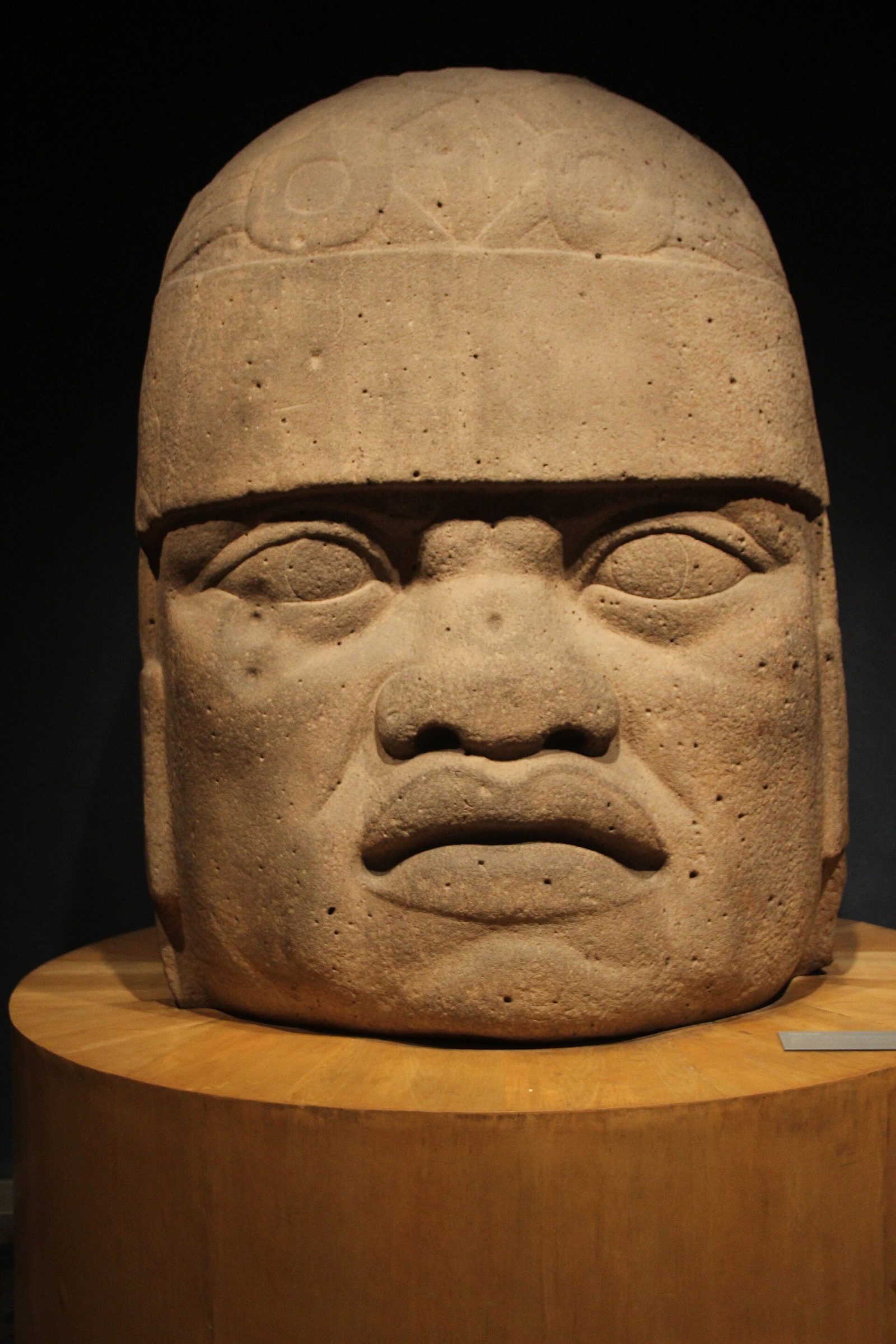
Seventeen colossal basalt heads, the largest weighing up to an estimated fifty tonnes, carved from boulders moved sixty to eighty kilometres by river raft and overland dragging. The sculpture is what people photograph. The haulage is the civilisation.
Our research file describes how the Olmec moved the stone for their colossal heads: organised labour on a large scale, rafting on rivers, and dragging overland. That is the whole method. Sixty to eighty kilometres of it, for a boulder weighing up to an estimated 50 tonnes.
They did this between about 1500 and 400 BCE, on the Gulf Coast of what is now Veracruz and Tabasco, seventeen times over. The sculpture is what people photograph. The haulage is the civilisation.
01The Heads, And What They Cost
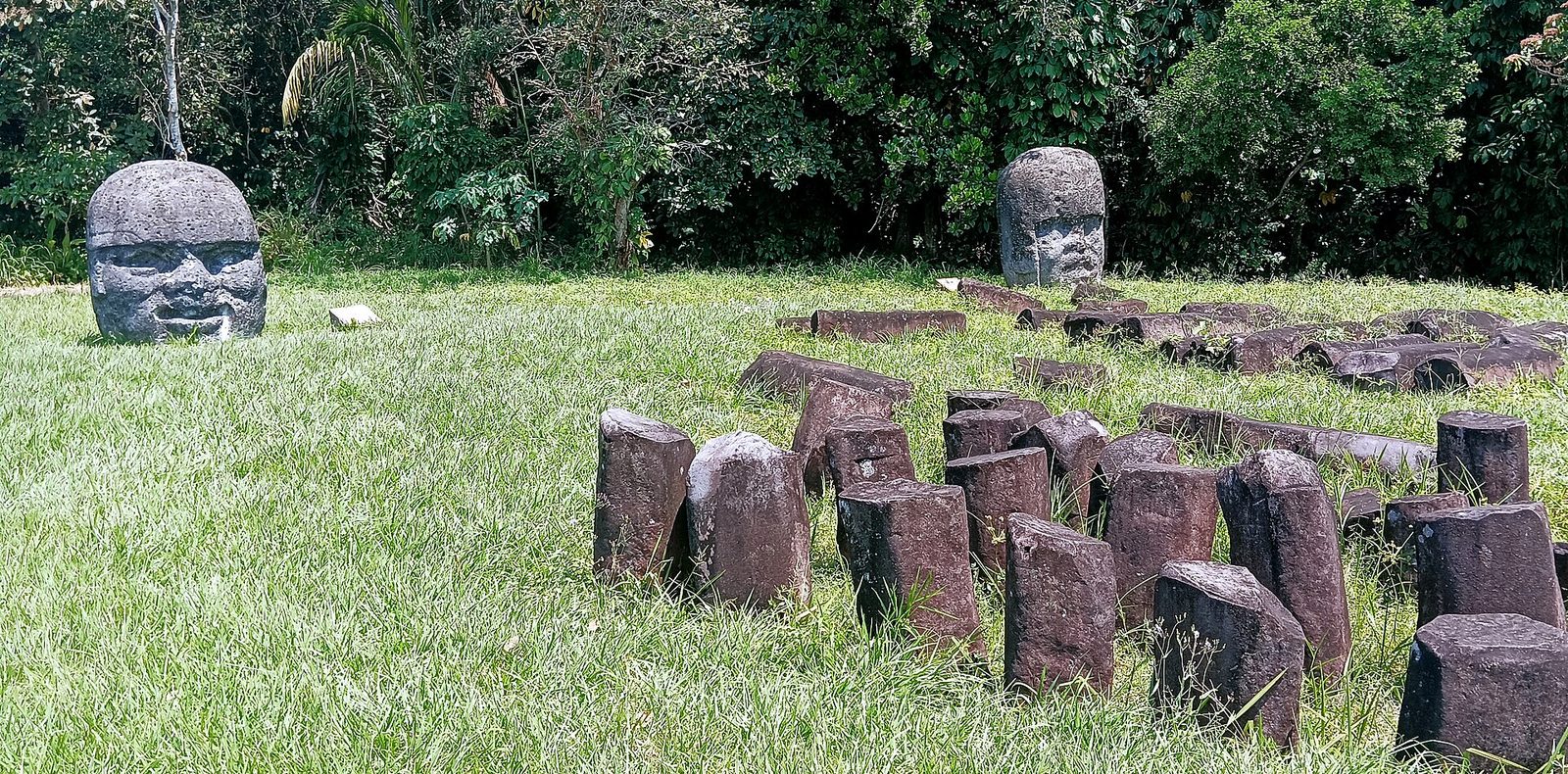
Seventeen colossal stone heads are known, ranging from 1.47 to 3.4 metres tall and weighing up to an estimated 50 tonnes. They are basalt, and the boulders came from the Tuxtla Mountains, 60 to 80 kilometres from where they ended up. Our research file describes what that took: organised labour on a large scale, rafting on rivers, and dragging overland. They are now understood to portray individual rulers, each wearing a distinctive helmeted headdress. Each head is a person, and each one is also a public accounting of how many people would move a rock that far because somebody said so.
San Lorenzo came first, about 1500 to 900 BCE, excavated by Matthew Stirling between 1938 and 1946, then by Michael Coe from 1966 to 1968, then by Ann Cyphers from the 1990s. From about 1200 to 900 BCE it was the largest centre anywhere in Mesoamerica: a massive earthen plateau around 55 metres high and partly artificially shaped, a sophisticated stone drain system, and an estimated population of 5,500 to 13,000. La Venta followed, about 900 to 400 BCE, excavated by Stirling with Philip Drucker and Robert Heizer.
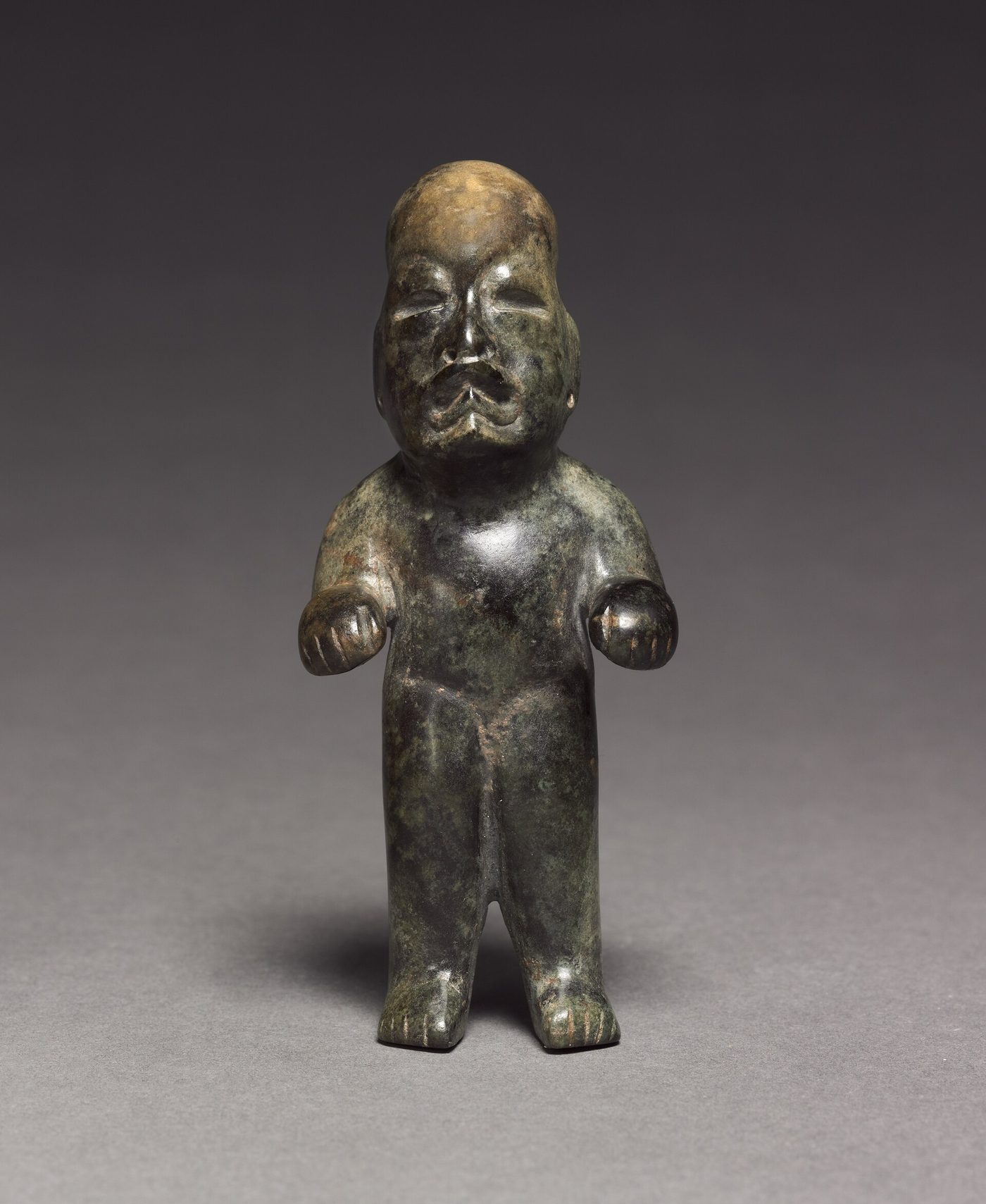
Our file's list of what the Olmec probably originated is long and specific: the ritual ballgame, the Long Count calendar, bar-and-dot numerals, the concept of zero, monumental stone sculpture, large earthen pyramids, elaborate jade and greenstone working, the were-jaguar iconography, and probably the earliest Mesoamerican writing. Every later Mesoamerican civilisation runs on some of that.
02Mother Culture, Or First Among Equals
Michael Coe argued the Olmec were the mother culture of Mesoamerica: the originator of calendrics, writing, urbanism and religious symbolism that everyone else adopted. Kent Flannery and Joyce Marcus argue instead that they were one of several complex societies developing at the same time, including the Zapotec tradition in the Valley of Oaxaca, all influencing each other. OUR FILE'S OWN READING OF WHERE THE ARGUMENT HAS LANDED IS 'FIRST AMONG EQUALS': the earliest fully developed complex society, in mutual interaction with its contemporaries rather than broadcasting at them.
Olmec-style jade, magnetite mirrors and carved pottery turn up at Tlatilco and Tlapacoya in the Valley of Mexico, Chalcatzingo in Morelos, San José Mogote in Oaxaca, Las Bocas in Puebla and Copán in Honduras. Whether that means political control, missionary activity, trade networks, or local elites buying into a prestige style is genuinely disputed. Our file lists the four possibilities and does not choose, which is the correct thing to do with a question the evidence does not settle.
03The Oldest Writing In The Americas, Probably
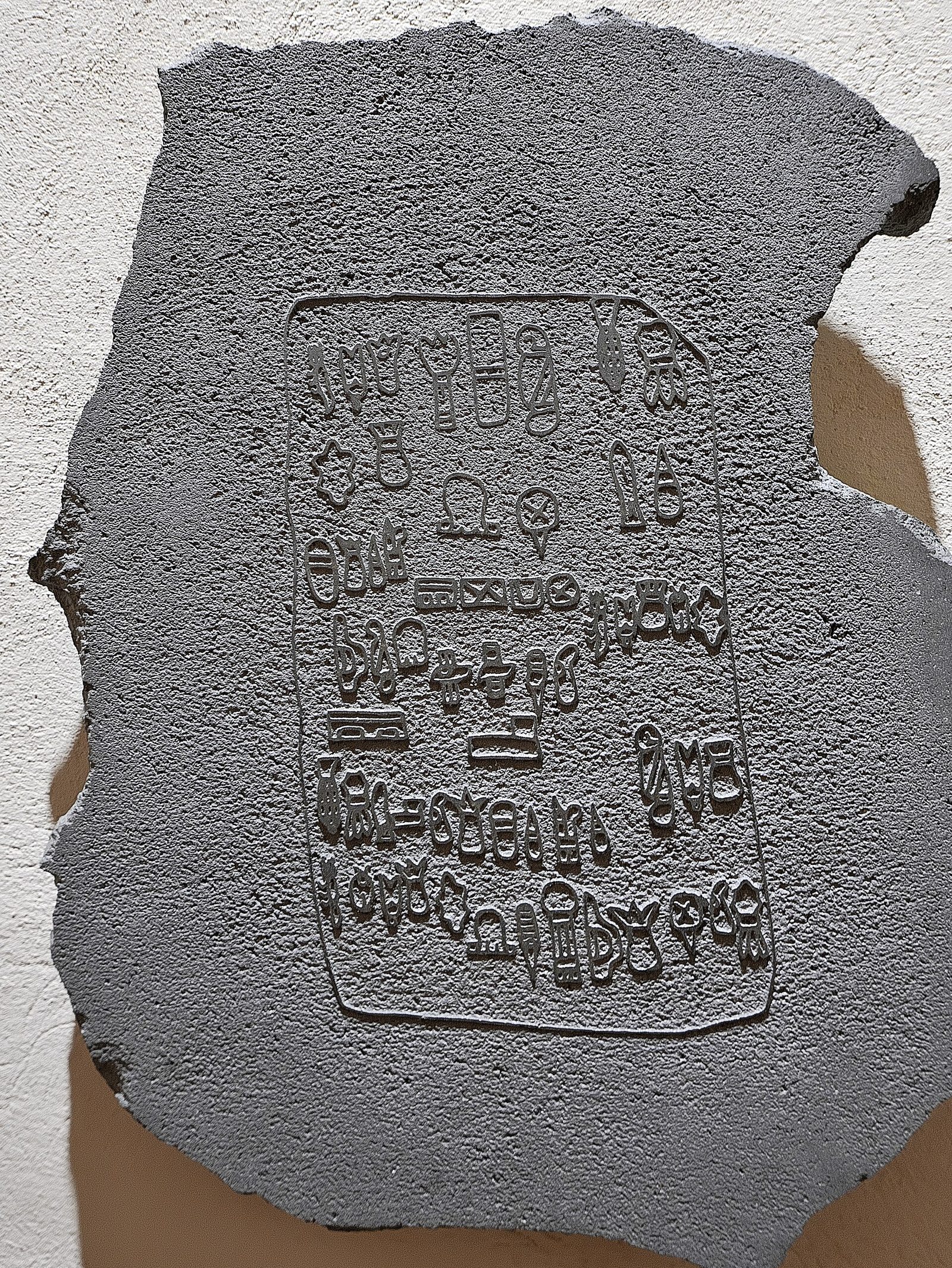
The Cascajal Block was found around 1999 and published in Science in 2006 by María del Carmen Rodríguez Martínez and colleagues, including Michael Coe and Richard Diehl. It carries 62 glyphs in 28 distinct signs, dates to about 900 BCE, and was proposed as the earliest known writing in the Western Hemisphere. OUR FILE DOES NOT LEAVE IT THERE. It records that whether the block is true writing, proto-writing or a one-off system remains debated, and that its authenticity was questioned before being largely accepted. THE IDENTIFIER OUR FILE GIVES FOR THAT SCIENCE PAPER RESOLVES EXACTLY, which is worth saying because most of the others do not.
The ethnic and linguistic identity of the Olmec is unknown. The best available argument is indirect: Lyle Campbell and Terrence Kaufman showed in 1976 that early Mesoamerican words for cacao, the calendar and ritual items derive from Mixe-Zoquean languages, which suggests the Olmec may have spoken one. Our file holds that at Tier 3 and it is right to. It is a loanword argument, not a decipherment, and 62 glyphs on one slab will not settle it.
At San Lorenzo, many monuments were deliberately mutilated and buried. Conquest, internal revolution, ritual decommissioning, or some combination: our file lists them and does not pick. The important part is that the monuments were not abandoned. Somebody went to considerable trouble to break them and put them in the ground, which is a different act from walking away.
The claim that the colossal heads depict African visitors or colonisers, promoted by Ivan Van Sertima in They Came Before Columbus in 1976, is rejected by mainstream archaeology. Our file gives the grounds as physical anthropological studies, DNA analysis and iconographic analysis confirming that the heads represent indigenous Mesoamerican individuals, and then adds the sentence that actually does the work: "The facial features reflect the diversity of Gulf Coast indigenous populations." The claim assumes those features must be foreign. They are not.
Its counter-arguments section raises preservation bias against itself. The Gulf Coast is tropical, humid and acidic, and it has destroyed nearly everything organic: perishable architecture, textiles, and writing media such as bark paper and wood are simply gone. What survives is what stone and jade can carry, and that may badly underrepresent how complex this society was. It also objects to the word "formative", which makes a civilisation whose capital was larger than anything else in Mesoamerica sound like a rough draft.
04A Note On Our Own Sources, Where A Repair Made Things Worse
Every article in this series resolves the identifiers in the research file behind it and reports what comes back. This one found something different, and it is the most consequential finding of the run so far.
A cross-reference in this file carries the label "Maya Civilization" against the identifier W_4_19. IT OPENS MISSISSIPPIAN CULTURE AND CAHOKIA. Another carries the label "Olmec Heads" against D_2_05. IT OPENS TROY (HISARLIK): SCHLIEMANN, STRATIGRAPHY, AND THE BIRTH OF FIELD ARCHAEOLOGY. A third, in the index table, describes "Valdivia, earliest known American pottery tradition" and points at W_5_25, which is SILK ROAD AND ANCIENT TRADE NETWORKS. The Valdivia document is W_5_27, two identifiers away. Every one of those links resolves. Every one of them loads a page.
At the bottom of the document sits the record of the repair. It opens "3 broken cross-reference links repointed", explains that the links "carried folder paths that no longer exist", and then states the method: "Each was repointed using the document ID carried in the link's own filename, resolved against the corpus". It adds, pointedly, "not by guessing which document was meant". THAT METHOD IS EXACTLY RIGHT ABOUT THE TARGET AND COMPLETELY SILENT ABOUT THE LABEL. Where the identifier and the human-readable label disagreed, the repair kept the identifier, fixed the path, and left the label describing something else entirely.
A script was written to check it. For every link in the corpus whose target names a document, it compares the link's visible label against that document's own title. It indexed 3,632 documents, which matches the corpus exactly. Of 18,922 links carrying a label that makes any claim about what it opens, 3,083 share NO significant word with the document they actually open. That is 16.29 per cent. Specimens, all four verified individually: "Temple of Solomon" opens the Sphinx Water Erosion Hypothesis. "Ancient Near Eastern Law" opens Divine Council. "Sumerian Literature" opens the Enuma Elish. "Meaning of Suffering" opens The Hard Problem of Consciousness.
The tool prints this caveat itself, every time it runs. Some authors use the label slot for a thematic note about why a link matters rather than as the document's name, and a thematic note can legitimately share no word with the title. The script cannot tell the two apart. WHAT 16.29 PER CENT GIVES YOU IS THE SET TO LOOK AT, NOT A COUNT OF DEFECTS. The three in this file were read one at a time and are not ambiguous: a link saying Maya that opens Cahokia is wrong under any reading.
Its first run indexed zero documents and REFUSED TO PRINT A RESULT, on the grounds that zero documents indexed is a path fault and not a small corpus. The cause was a regular expression ending in a word boundary: an underscore counts as a word character, so the boundary never matched between the "20" and the "_Olmec" in a filename, and nothing was ever indexed. WITHOUT THAT REFUSAL THE EMPTY RUN WOULD HAVE PRINTED A PERFECTLY CLEAN CORPUS. The guard was written into the script before the bug existed, on a principle this series keeps arriving at: a checker that cannot fail is not a checker.
| Our File's Entry | Identifier | What It Returns |
|---|---|---|
| 3. Pool 2007, Olmec Archaeology and Early Mesoamerica | 10.1017/cbo9781139167147 | Christopher Pool, that book, Cambridge University Press, 2007. CORRECT, and registered as a monograph rather than an article |
| 5. Rodríguez Martínez et al 2006, Oldest Writing in the New World | 10.1126/science.1131492 | That paper, Science 313(5793):1610-1614, 2006. CORRECT on every field |
| 1. Coe and Koontz 2013, Mexico: From the Olmecs to the Aztecs | 10.1086/712273 | Richard Blanton reviewing it in 2021, and reviewing a LATER EDITION: the review's title names the authors as Coe, Javier Urcid and Koontz. Our file omits Urcid entirely |
| 2. Diehl 2004, The Olmecs: America's First Civilization | 10.1017/s1045663500002601 | David Cheetham's review essay, Latin American Antiquity 20(1):260-263, 2009 |
| 6. Clark and Pye 2000, Olmec Art and Archaeology in Mesoamerica | 10.2307/971764 | Ann Cyphers reviewing it, Latin American Antiquity 12(1):107-109, 2001. ANN CYPHERS IS ENTRY 4 OF THE SAME BIBLIOGRAPHY |
The review attached to entry 1 names the book's authors as Michael D. Coe, Javier Urcid and Rex Koontz. Our file credits only Coe and Koontz. The reviewed edition is a later one that added Javier Urcid as a co-author. So an identifier that is wrong about which object it points at is, incidentally, right about a co-author the entry it is attached to leaves out.
Fast Facts
- The Span
- About 1500 to 400 BCE, on the Gulf Coast of Mexico: modern Veracruz and Tabasco
- The Heads
- Seventeen known, 1.47 to 3.4 metres tall, up to an estimated 50 tonnes
- The Haul
- Basalt from the Tuxtla Mountains, 60 to 80 kilometres, by river raft and overland dragging
- San Lorenzo
- About 1500 to 900 BCE. Largest centre in Mesoamerica from about 1200 BCE. Population estimated 5,500 to 13,000
- La Venta
- About 900 to 400 BCE, the successor centre
- The Writing
- The Cascajal Block: 62 glyphs, 28 distinct signs, about 900 BCE, published in Science in 2006
- The Language
- Unknown. Possibly Mixe-Zoquean, on loanword evidence from 1976
- The Debate
- Mother culture, or first among equals. Our file leans to the second
- Our File's Identifiers
- Five DOIs, two correct, three reviews
- Our File's Cross-References
- Three that load perfectly and open a different subject
What We Can Actually Stand Behind
The Olmec existed on the Gulf Coast from about 1500 to 400 BCE. Seventeen colossal heads are known, up to an estimated 50 tonnes, cut from basalt hauled 60 to 80 kilometres. San Lorenzo was the largest centre in Mesoamerica from about 1200 BCE and La Venta succeeded it. The Cascajal Block carries 62 glyphs in 28 signs and was published in Science in 2006. And in our own file, two of five identifiers are correct, three are reviews, and three cross-reference links open documents about entirely different subjects.
That the Olmec were first among equals rather than a sole mother culture, which is our file's own reading. That Olmec-style objects at distant sites reflect some mixture of trade, prestige emulation and contact, without the evidence yet distinguishing which. That preservation bias in a wet acidic tropical environment means what survives understates the society. And that the corpus-wide label mismatch rate is somewhere at or below 16.29 per cent, that figure being an upper bound the measuring tool itself declares.
That the Olmec spoke a Mixe-Zoquean language, which rests on loanwords rather than on any readable text. And what happened at San Lorenzo around 900 BCE, where deliberate mutilation and burial of monuments is a fact and the reason for it is not.
That the colossal heads depict Africans. Our file rejects it on physical anthropology, DNA and iconography, and the sentence that matters is that the faces reflect the diversity of Gulf Coast indigenous populations. The claim only works if you assume those features could not be local, and they are.
The thing worth keeping from this one is not about the Olmec at all. It is that a careful repair, carried out by a stated method, on links that were genuinely broken, produced a document where three references now open the wrong subject and nothing on the page indicates it. The method was right about the half it looked at. Checking a target and not checking a label is not half a check. It is a check that converts a visible failure into an invisible one, and across this library it may have done that thousands of times.
Sources & further reading
WHERE THIS WORKED FROM. One file in our own research library, W_4_20, at Source Confidence 4 out of 5, last updated 10 April 2026, plus five external records resolved live on 26 August 2026. THE SUBSTANCE IS OUR FILE'S AND IT HANDLES A DIFFICULT SUBJECT WELL. The heads and their transport, the two capitals and their excavators, the list of Mesoamerican firsts, the mother-culture debate stated from both sides, the Cascajal Block with its controversy printed rather than buried, the Mixe-Zoquean language argument held at Tier 3, the San Lorenzo destruction left open, the Van Sertima refusal with its grounds given, and a counter-arguments section that raises preservation bias against its own evidence base. THE IDENTIFIER AUDIT IS IN SECTION 04 with a table. Two of five DOIs are correct, including the Science paper on the Cascajal Block and the Cambridge monograph by Pool. Three are reviews, and each is wrong in a different way: one reviews a LATER EDITION and in doing so reveals a co-author, Javier Urcid, whom our file omits; one is a plain review essay; and one is by Ann Cyphers, WHO IS ENTRY 4 OF THE SAME BIBLIOGRAPHY. THE LARGER FINDING IS ABOUT CROSS-REFERENCES, NOT CITATIONS. Three links in this file open documents about entirely different subjects: a link labelled Maya Civilization opens Mississippian Cahokia, a link labelled Olmec Heads opens Troy, and an index row describing Valdivia points at the Silk Road when Valdivia is two identifiers away. The file's own Corrections block records the repair that produced this and states its method: repointing by the document ID carried in the filename, deliberately not guessing which document was meant. That method is right about the target and silent about the label. A CORPUS-WIDE MEASUREMENT WAS THEN MADE. A purpose-built script indexed 3,632 documents, checked 18,922 links carrying a label that makes a claim, and found 3,083, or 16.29 per cent, whose label shares no significant word with the document it opens. THE SCRIPT PRINTS ITS OWN CAVEAT: that number is an upper bound, because some labels are thematic notes rather than document names and the tool cannot separate those. It also refused to report on its first run, when a regular-expression bug left it indexing nothing, rather than printing a clean corpus. WHAT IS NOT CLAIMED. Nine bibliography entries carry no identifier; they were not searched and are recorded as unchecked. The physical figures for the heads, the transport distance and the San Lorenzo population rest on those unchecked sources. ON THE IMAGES. Five were fetched and opened and one was dropped for a reason new to this run: a photograph of the Señor de las Limas taken through museum glass, with reflections across half the frame and soft focus, unusable at the size a column delivers. The Cascajal caption does not claim the object shown is the original stone rather than a cast, because nothing in the photograph's record establishes that.
Image credits
- Olmec colossal head from San Lorenzo, Veracruz, c. 1200-600 BCE Gary Todd, via Wikimedia Commons (CC0). CC0 Source.
- Complex A at La Venta, Tabasco: two colossal heads and a basalt column enclosure Mario E. Fuente Cid, via Wikimedia Commons (CC BY 4.0). CC BY 4.0 Source.
- Olmec standing greenstone figure, c. 1200-300 BCE, Cleveland Museum of Art 1990.219 Cleveland Museum of Art, via Wikimedia Commons (CC0). CC0 Source.
- The Cascajal Block, as displayed Jl FilpoC, via Wikimedia Commons (CC BY-SA 4.0). CC BY-SA 4.0 Source.


