
The Oldest Music: Bone Flutes and the Lyres of Ur
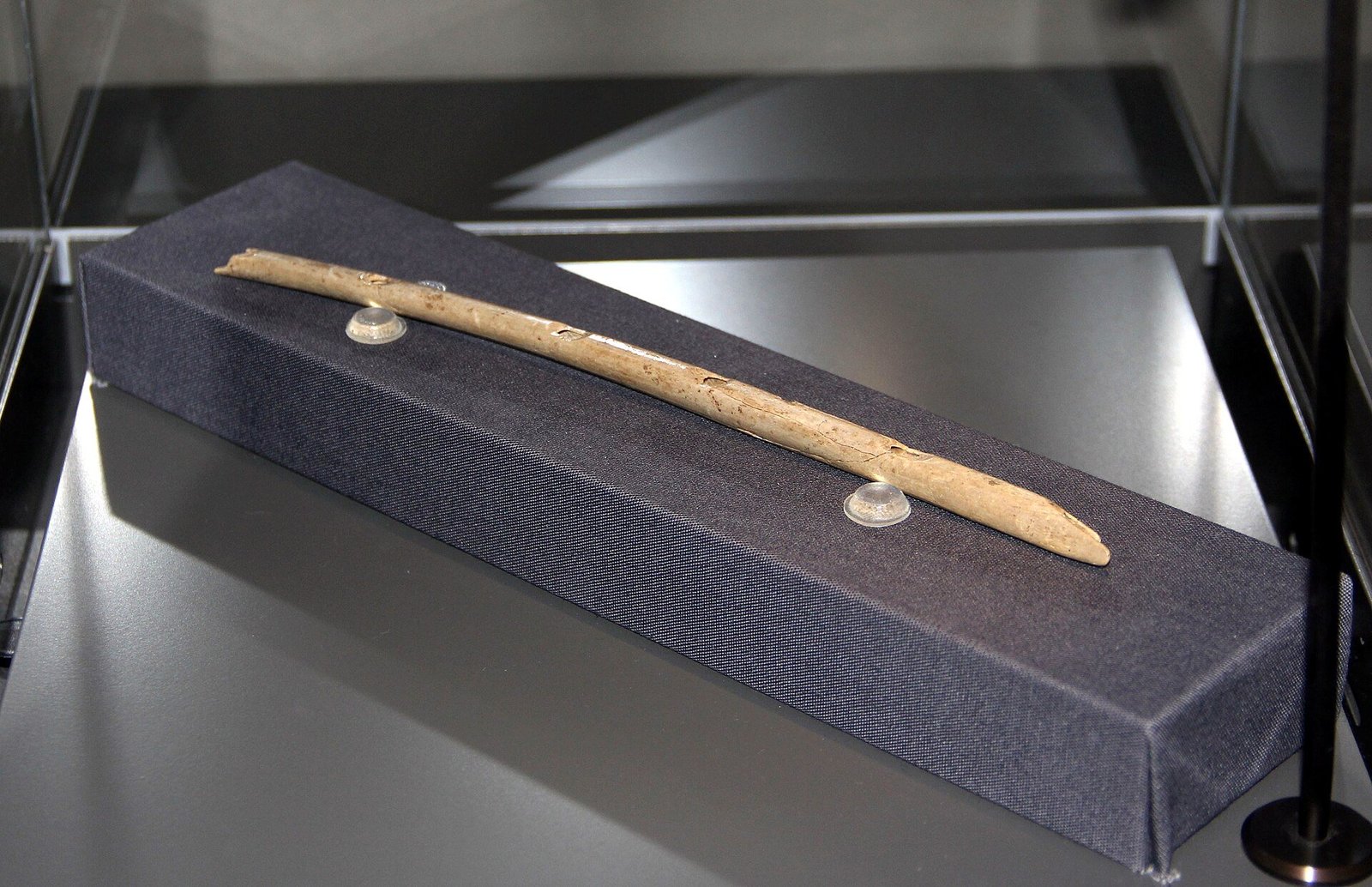
The oldest musical instrument we can hold is a flute carved from the wing bone of a vulture, roughly forty thousand years ago, by people who were painting the first cave walls at the same time. From there the record runs to a Chinese flute still playable after nine thousand years, and to the golden lyres buried with the kings and queens of Ur. We have the instruments, beautifully made and carefully tuned. What we do not have, and can never have, is the music itself: not one melody survives from any of it. This is what the oldest instruments really are, what their makers could do with them, and the honest silence at the center of the story.
The oldest thing a human being ever made that we would still recognize as a musical instrument is a flute, and it is astonishingly old. Around forty thousand years ago, in a cave in what is now southern Germany, someone took the hollow wing bone of a griffon vulture, drilled finger holes along it, and cut a notched mouthpiece into one end, making a flute that a person could pick up and play today. It was made by the same people, at the same time, who were carving the first figurines and painting the first cave walls; music and image and symbol seem to arrive together, as if a single new capacity had switched on. From that flute the trail runs forward through a Chinese grave-flute still playable after nine thousand years to the golden lyres laid beside the kings and queens of Ur. And running underneath the whole story is a strange, permanent silence. We have the instruments, and we can even play faithful copies of them, but not one bar of the actual music survives. We know, in a real sense, exactly what these instruments were, and we will never know what was played on them.
01A Flute From the Ice Age
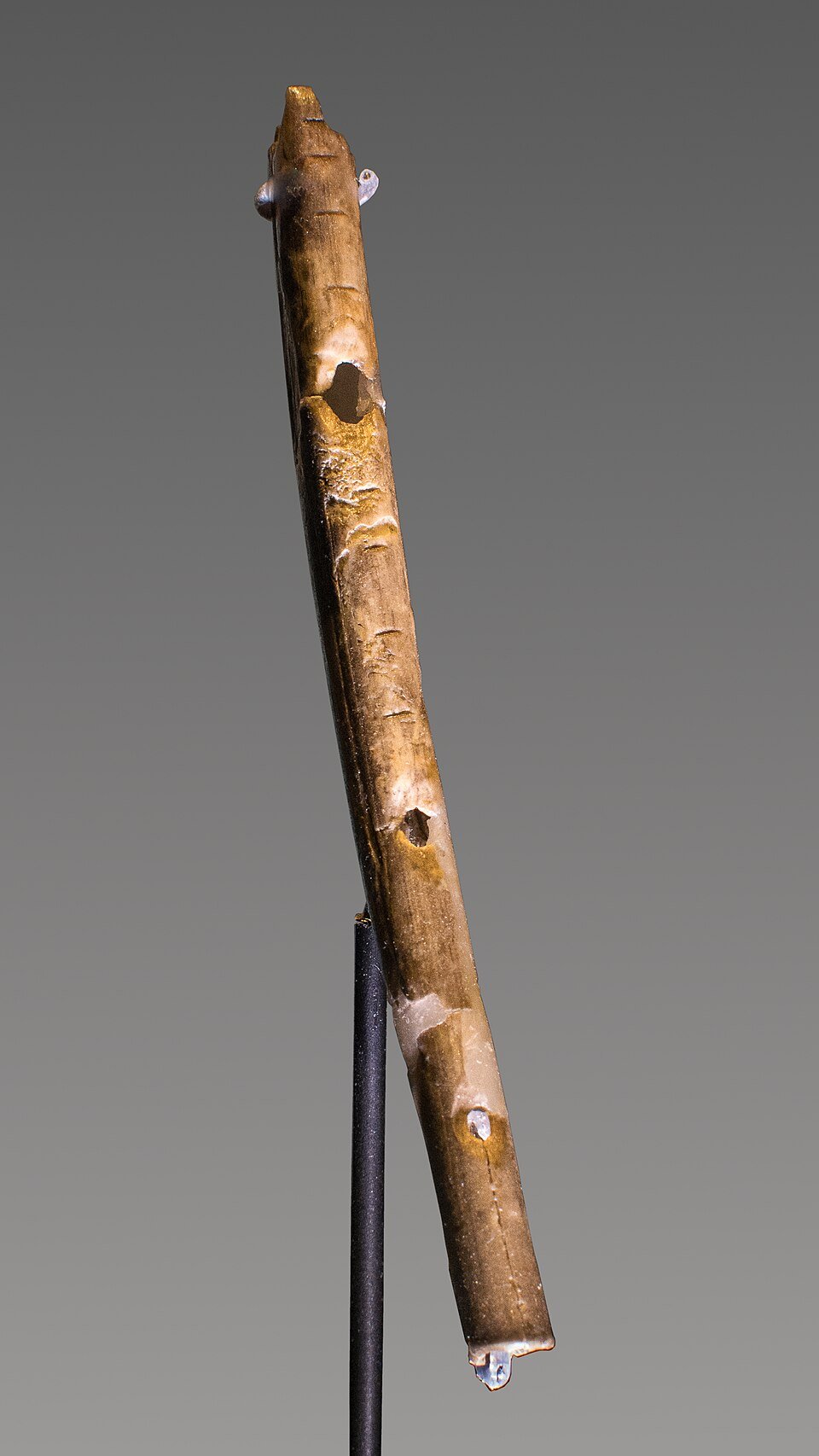
The oldest undisputed instruments come from a cluster of caves in the Swabian Jura of southwestern Germany, made by the Aurignacian people around forty thousand years ago. The most complete is the Hohle Fels flute, cut from the radius bone of a griffon vulture, with five finger holes and a carefully notched blowing end. Its exact age is worth stating honestly rather than as a single tidy number: the radiocarbon dates from its layer run from about 35,000 to 40,000 years, and a later recalibration of the flutes at the neighboring site of Geissenklosterle pushed those to 42,000 or 43,000 years, which would make them, not Hohle Fels, the oldest of all. The two sites are close enough in age, and the dating imprecise enough, that either can hold the record depending on which study you follow. One of the Geissenklosterle flutes is a small marvel of technique in its own right: carved not from a naturally hollow bird bone but from solid mammoth ivory, which meant splitting a curved tusk lengthwise, hollowing out each half, and binding the two halves back together with an airtight seal. What makes these flutes more than a curiosity is their company. They come from the same caves and the same moment as the oldest figurative art known in Europe, the Venus of Hohle Fels and the lion-headed man of Hohlenstein-Stadel. Music did not trail behind art as a later refinement. As far back as we can see the one, we can see the other.
02Still Playable After Nine Thousand Years
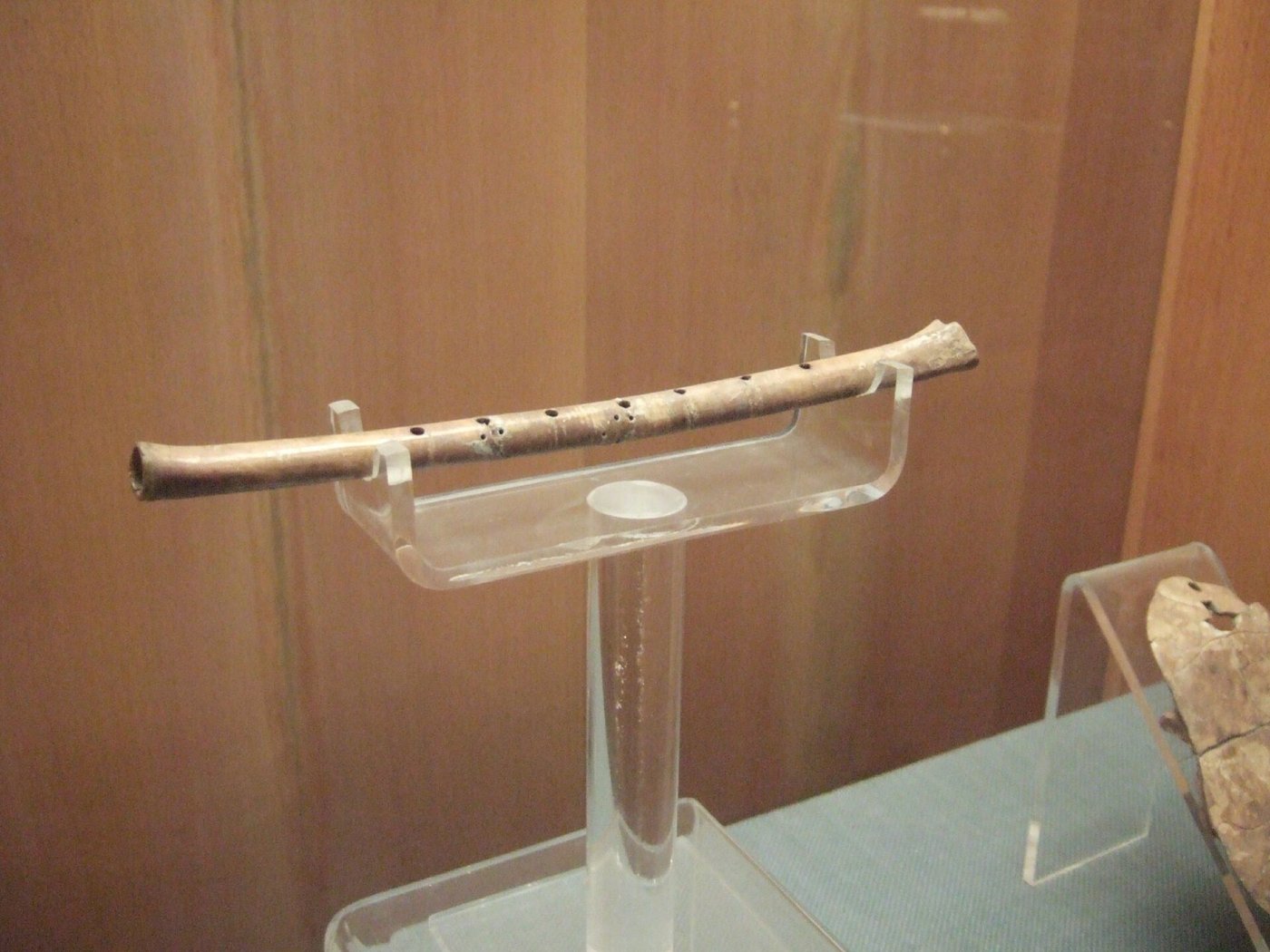
Skip forward some thirty thousand years and halfway around the world, to a Neolithic village at Jiahu, in Henan Province, China, occupied around seven thousand years before the common era. From its graves archaeologists have recovered more than thirty flutes, made from the wing bones of the red-crowned crane, and they are not crude. The best-made have seven finger holes and can play a scale close to the Western major scale, tuned, on spectral analysis, to within one or two percent of equal temperament on several notes. Some show tiny extra holes drilled beside the main ones, the marks of a maker adjusting the pitch by ear until it was right, which is to say deliberate tuning, thousands of years before anyone wrote down a theory of it. And one of them, the flute catalogued as M282:20, can still be played after roughly nine thousand years, one of the oldest functioning instruments on Earth. Here the honest limit sharpens. We can hear the notes this flute produces, because we can pick it up and blow. We still cannot hear the music, because which of those notes were strung into which melodies is nowhere recorded.
03The Lyres of the Dead Kings
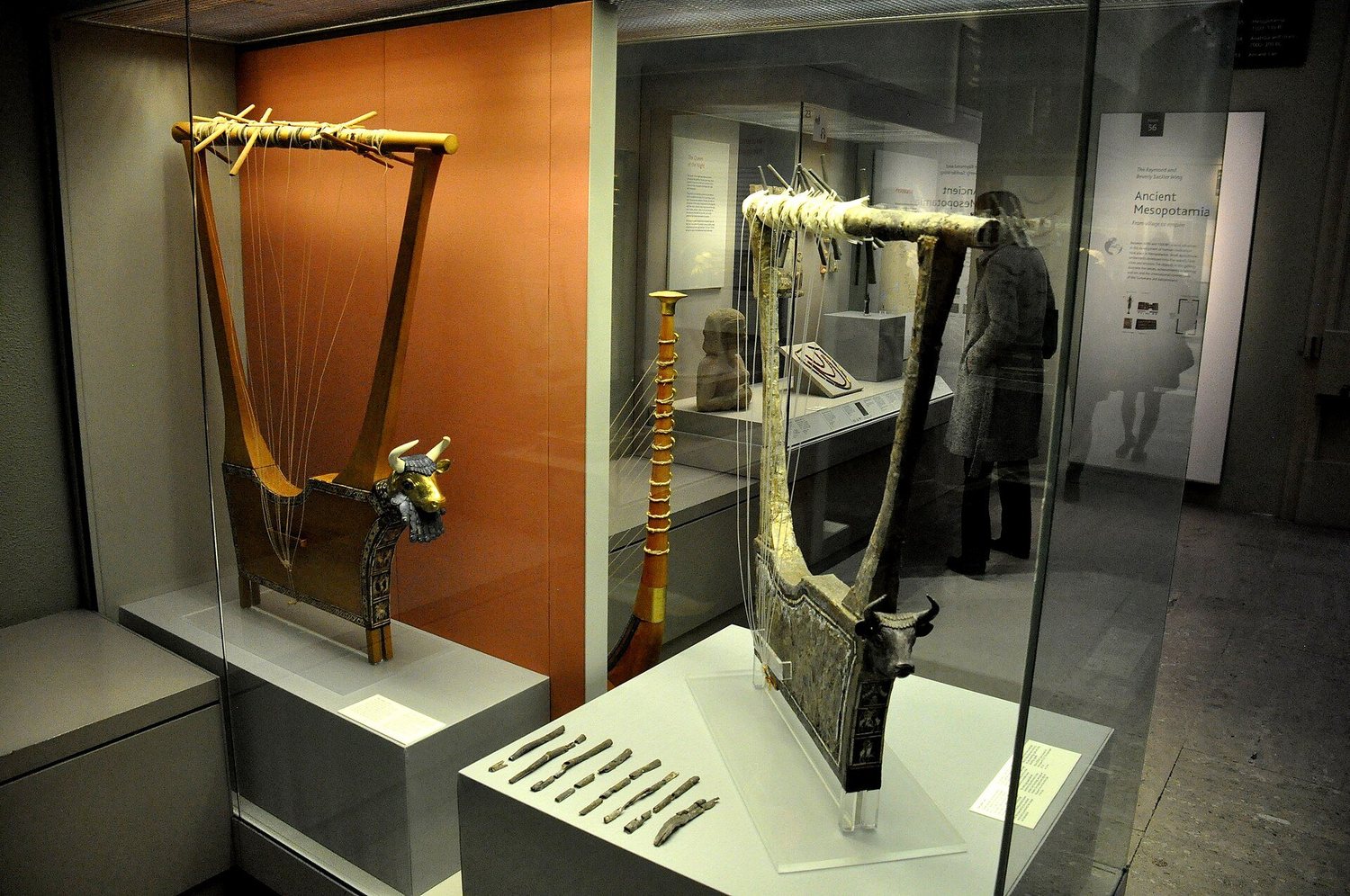
By the middle of the third millennium BCE the instrument that mattered most was the lyre, and the finest examples we have were pulled from the ground with the dead. In the 1920s and 1930s the archaeologist Leonard Woolley, excavating the Royal Cemetery of Ur in southern Iraq for the British Museum and the University of Pennsylvania, uncovered a series of lyres and harps buried in the graves of Sumerian royalty, around 2600 to 2400 BCE. The wooden bodies had long since rotted, but Woolley recovered their shapes by pouring plaster into the voids left in the earth, and the ornament survived: sound boxes fronted with the head of a bull worked in gold and lapis lazuli, panels of inlaid shell showing scenes of feast and myth. The Great Lyre with its golden bull's head is now in Philadelphia; the Queen's Lyre and the Silver Lyre are in London. And these were real instruments, not funeral props: reconstructions built to the originals' dimensions play with a full and resonant tone. By the next millennium the Mesopotamians had gone further and begun to write their music down; cuneiform tablets record a system of seven tuning modes based on the intervals between pairs of strings, along with catalogs of songs, the oldest known music theory in the world.
04The Silence at the Center
It is worth stating plainly what all of this does and does not tell us, because the gap is easy to paper over. What the instruments give us, solidly, is their physical voice: the range of notes a Hohle Fels or a Jiahu flute can sound, confirmed by playing faithful replicas, and the tuning systems the Mesopotamians left in writing. What they do not give us, and what nothing can, is the music. Not a single melody, rhythm, or performance survives from any Paleolithic or Neolithic culture; there is no notation, no recording, no living tradition that reaches back that far. So when a documentary or a museum offers you 'the sound of a 40,000-year-old flute,' what you are hearing is a modern musician improvising on an accurate copy, not an ancient tune recovered from the past. The distinction matters. The replica is real evidence about the instrument; the melody is a modern invention, however lovely. The same caution applies to claims of extreme antiquity for instruments that leave no trace: the Australian didgeridoo is often called the world's oldest wind instrument, with ages of twenty or forty thousand years quoted, but there is no archaeological evidence for that, and the oldest actual depiction of one is only about fifteen hundred years old. It may well be ancient; a hollow branch simply leaves nothing behind to date, so the honest answer is that we cannot know.
05The Bone That Divides the Experts
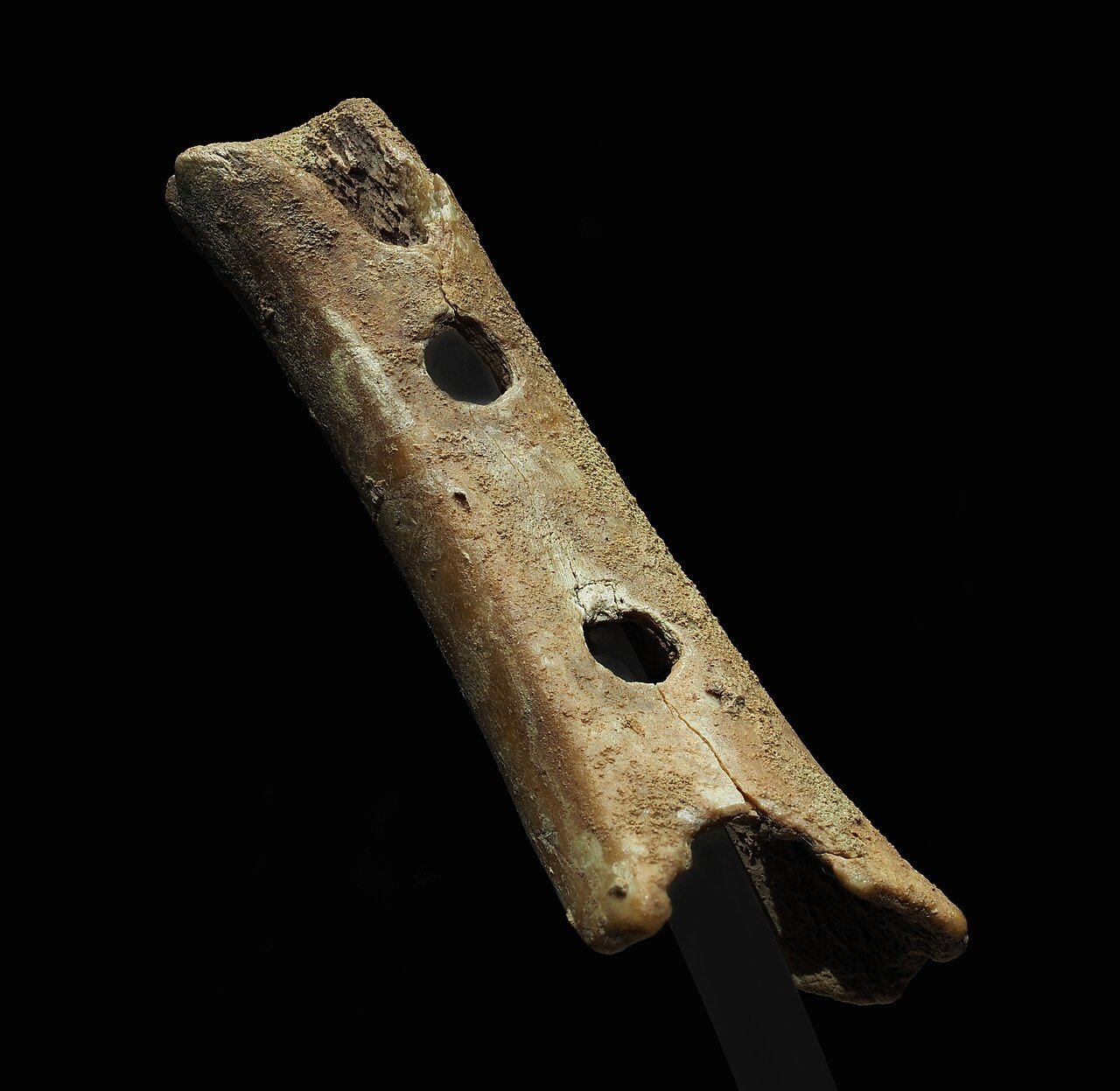
Which leaves the most tantalizing object of all, and the one that has to be handled with the most care. In 1995, in the Divje Babe cave in Slovenia, in a layer around sixty thousand years old, the archaeologist Ivan Turk found a fragment of a young cave bear's thigh bone with holes in it. If the holes were made by a person, this would be a flute far older than Hohle Fels, and, crucially, older than modern humans in the region, which would make it the work of Neanderthals and expand what we think that species could do. Turk argued exactly that: the holes are spaced like finger holes. But others, led by Francesco d'Errico, argued the opposite, that the holes are punctures left by the teeth of a carnivore, a hyena or a wolf gnawing the bone, and that such marks can mimic deliberate holes. Statistical studies of the spacing have come back on both sides, and the plain truth is that the scholarly community remains divided; the Divje Babe bone is neither a confirmed Neanderthal flute nor a confirmed chewed bone, but a genuinely open case. One guard against a tempting leap belongs here. That Neanderthals were capable of symbolic behavior is, separately, well supported, by cave markings, by jewelry of eagle talons, by their anatomy for speech. But none of that proves this particular bone is an instrument. The general capacity and the specific artifact are different claims, and only the first is established.
06What It Was Not
Two fringe claims can be set aside cleanly. The first is that certain instruments, Tibetan singing bowls, the didgeridoo, the trumpets said to have felled the walls of Jericho, produce special 'vibrational frequencies' that alter matter or consciousness in ways beyond ordinary sound. They do not. Rhythmic drumming can genuinely help induce a trance state, but that is a well-understood effect of rhythm on the nervous system, not a paranormal property of a magic frequency. The second is that the sophistication of the Ur lyres and of Sumerian music theory points to some lost or otherworldly source of knowledge. It does not. Sumerian tuning is exactly the kind of system that develops when people spend centuries listening to strings and noticing which lengths sound good together: a human achievement, fully explicable, and all the more impressive for needing no outside help at all.
Fast Facts
- Oldest undisputed
- The Hohle Fels vulture-bone flute, Germany, roughly 40,000 years (published range ~35,000 to 43,000); the nearby Geissenklosterle flutes may be slightly older
- Still playable
- A Jiahu crane-bone flute (China, ~9,000 years old) can still be played; some are tuned close to a major scale, with deliberate correction-holes
- The Lyres of Ur
- Golden bull-headed lyres from Sumerian royal graves, ~2600 to 2400 BCE; reconstructions confirm they were working instruments
- Oldest music theory
- Cuneiform tablets record Mesopotamian tuning systems (7 modes) and song catalogs by the 2nd millennium BCE
- The permanent silence
- No melody or rhythm survives from any prehistoric culture; a 'reconstruction' is a modern performance on an accurate copy, not recovered ancient music
- Divje Babe
- A perforated cave-bear bone, disputed between a deliberate Neanderthal flute and carnivore tooth-punctures; not confirmed either way
- Refused
- 'Magic frequency' powers; any alien or lost-civilization source for Sumerian music theory
What We Can Actually Stand Behind
The instruments and their measured ages are documented, with the dates honestly ranged. The Hohle Fels vulture-bone flute is roughly 40,000 years old (about 35,000 to 43,000 depending on method), and the Geissenklosterle flutes may be slightly older. The Jiahu crane-bone flutes are about 9,000 years old, some tuned close to a major scale with deliberate correction-holes, and one is still playable. The Lyres of Ur date to around 2600 to 2400 BCE and their reconstructions play. Mesopotamian cuneiform tablets record real tuning theory by the 2nd millennium BCE.
Several broader points are strong. The oldest flutes come from the same caves and moment as the oldest European figurative art, so music and visual symbolism appear together in the Aurignacian rather than one following the other. Faithful replicas genuinely confirm the range of notes the flutes could produce. And Neanderthal symbolic and cognitive capacity is well documented on its own, by cave markings, eagle-talon jewelry, speech anatomy, and brain size, independent of any single disputed artifact.
Some questions are genuinely open. The Divje Babe cave-bear bone is neither confirmed as a deliberate Neanderthal flute nor confirmed as a carnivore-chewed bone; the field remains divided. The extreme antiquity claimed for the didgeridoo cannot be verified, since a hollow branch leaves nothing to date and the oldest depiction is only about 1,500 years old. And whether ancient sites like the Hal Saflieni Hypogeum or Stonehenge were acoustically designed on purpose is unresolved.
Two things get a flat no. We cannot recover the actual music: no melody or rhythm survives from any prehistoric culture, and any 'reconstruction' of ancient music is a modern performance on an accurate copy, not a recovered composition, a distinction worth insisting on. And no instrument produces paranormal 'vibrational frequencies' that transcend ordinary acoustics, nor does Sumerian music theory require any lost or alien source. The wonder here is entirely human, and it loses nothing by being true.
There is something clarifying about an art form whose earliest works we can hold in our hands but never hear. A cave painting, at least, still shows us what it showed its makers; the Hohle Fels flute shows us only the shape of a possibility. We can reconstruct the instrument down to the airtight seam in a mammoth-ivory tube, and we can prove it sang, and there the knowledge stops, at the threshold of the sound. What is left is the fact of the effort: that forty thousand years ago someone thought it worth the hours to turn a vulture's bone into a thing that made music, and that the impulse to do so is as old as the impulse to draw. The oldest music belongs in a wing about the marks human beings make because it is the one mark that was never meant to last on the wall at all. It was meant to last in the air, for the length of a breath, and then be gone. That we can still find the flute, and never the tune, is not a failure of the record. It is the truest thing the record has to tell us about what music is.
Sources & further reading
Everything above is drawn from our research library on Theories of Anything. Open the full file to check the sourcing and go deeper.
Image credits
- Hohle Fels vulture-bone flute (Museum of Prehistory, Blaubeuren) Photograph by Wikimedia Commons user Tomatenpflanze, via Wikimedia Commons. CC BY-SA 4.0 Source.
- Geissenklosterle swan-bone flute Photograph by Thilo Parg, via Wikimedia Commons. CC BY-SA 3.0 Source.
- Jiahu Neolithic bone flute (Henan Provincial Museum) Photograph by Flickr/Commons user asgitner, via Wikimedia Commons. CC BY-SA 2.0 Source.
- The Queen's Lyre and the Silver Lyre, Royal Cemetery of Ur (British Museum) Photograph by Osama Shukir Muhammed Amin FRCP(Glasg), via Wikimedia Commons. CC BY-SA 4.0 Source.
- Divje Babe perforated cave-bear bone (National Museum of Slovenia) Photograph by Petar Milosevic, via Wikimedia Commons. CC BY-SA 4.0 Source.
- Card crop of the Hohle Fels flute Photograph by Wikimedia Commons user Tomatenpflanze, via Wikimedia Commons. CC BY-SA 4.0


.jpg)