
The Near-Death Experience: What the Dying Brain Reports
A tunnel, a light, a life flashing past, a floating view of one's own body on the table. Millions of people, across every culture and era, come back from the edge of death describing the same handful of things. That the experience is real, vivid, and often life-changing is not in question. What it proves is. When researchers finally ran the clean test, placing hidden images that only a floating observer could have read, the largest study came back with nothing seen. Yet the same research found the dying brain stays electrically alive far longer than anyone believed. This is the near-death experience with both of those facts held at once, and neither one let off the hook.
First, the honest ground rule, because this subject is wrecked by people who skip it. The question is not whether near-death experiences happen. They do. Somewhere between one in ten and one in five people who survive a cardiac arrest report one, and roughly four to five percent of the general population has had an experience like it at some point in life. These are real memories, often more vivid than ordinary ones, and they frequently change the person for good. None of that is in dispute. The dispute is about one thing only: what the experience is evidence of. Is it a window onto consciousness surviving the death of the body, or is it the most dramatic thing a dying brain does on its way out? Hold that single question steady, and the evidence sorts itself into what it can and cannot support.
01What People Actually Report
The phenomenology is well catalogued and measured. Raymond Moody's 1975 book Life After Life first listed the now-familiar elements from about 150 accounts: a sense of peace, a dark tunnel, an out-of-body view, a being of light, a panoramic life review, a boundary, and a return. That book was popular, not scientific, but it launched the field. The rigor came later. Since 1983, researchers have used the Greyson NDE Scale, a sixteen-item questionnaire scoring cognitive, affective, paranormal, and transcendental features from 0 to 32, with a score of 7 or higher counting as a near-death experience. Its test-retest reliability over a twenty-year gap was 0.92, remarkably stable, and it is used in over ninety-five percent of NDE research worldwide, including every major study below.
The features have measured frequencies, not just vibes. Across Kenneth Ring's standardized data, roughly 60 percent report peace, about 37 percent an out-of-body experience, 23 percent the tunnel, 16 percent an encounter with light, and about 10 percent entering another realm. Notice what that means: the stereotyped tunnel-and-light package is actually the minority experience, and no single feature is universal. That unevenness matters later, because a genuinely objective glimpse of an afterlife ought to look more consistent than a set of features that show up between one and six times out of ten.
02The Test That Could Have Settled It
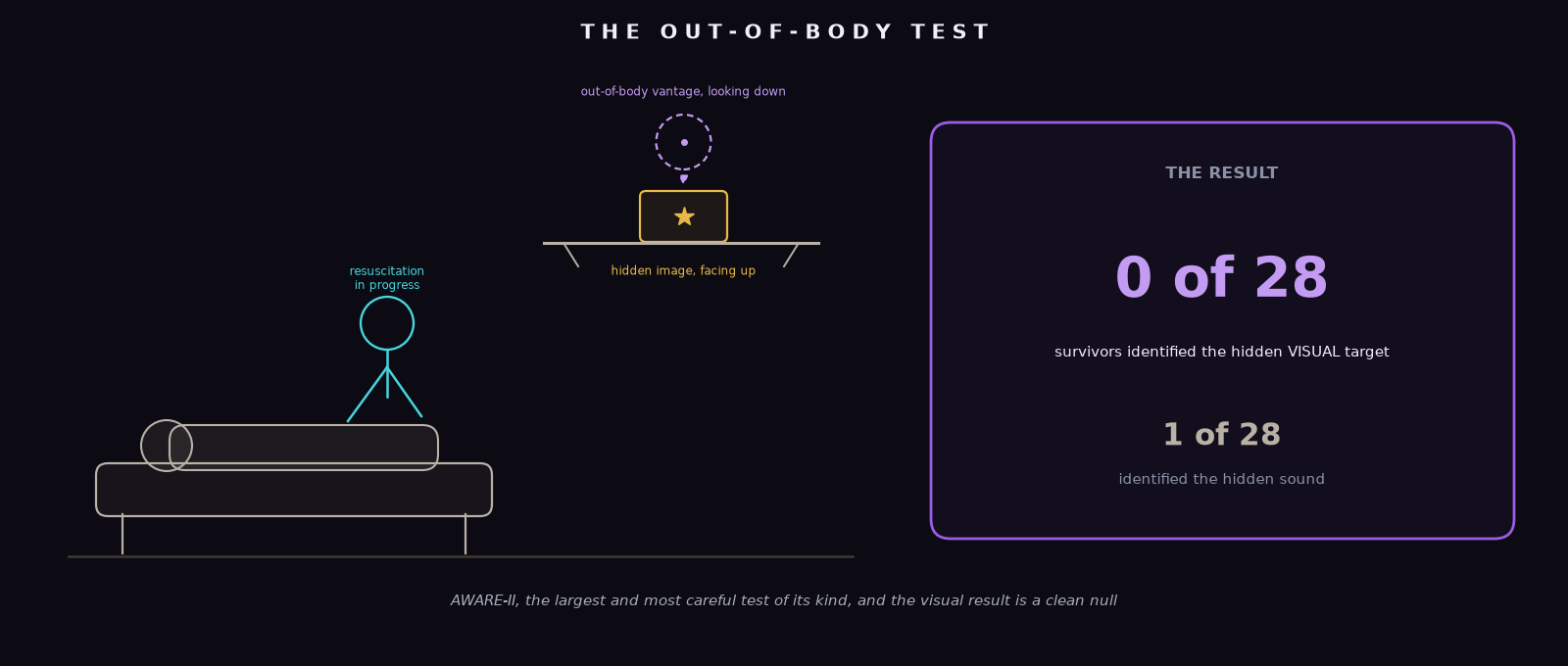
If a person really floats out of their body and looks down during a cardiac arrest, that is testable. Put a picture somewhere only a floating observer could see it, on a high shelf facing the ceiling, and see if anyone reads it. Two large prospective studies did exactly that, and their answer is the load-bearing evidence of this entire article.
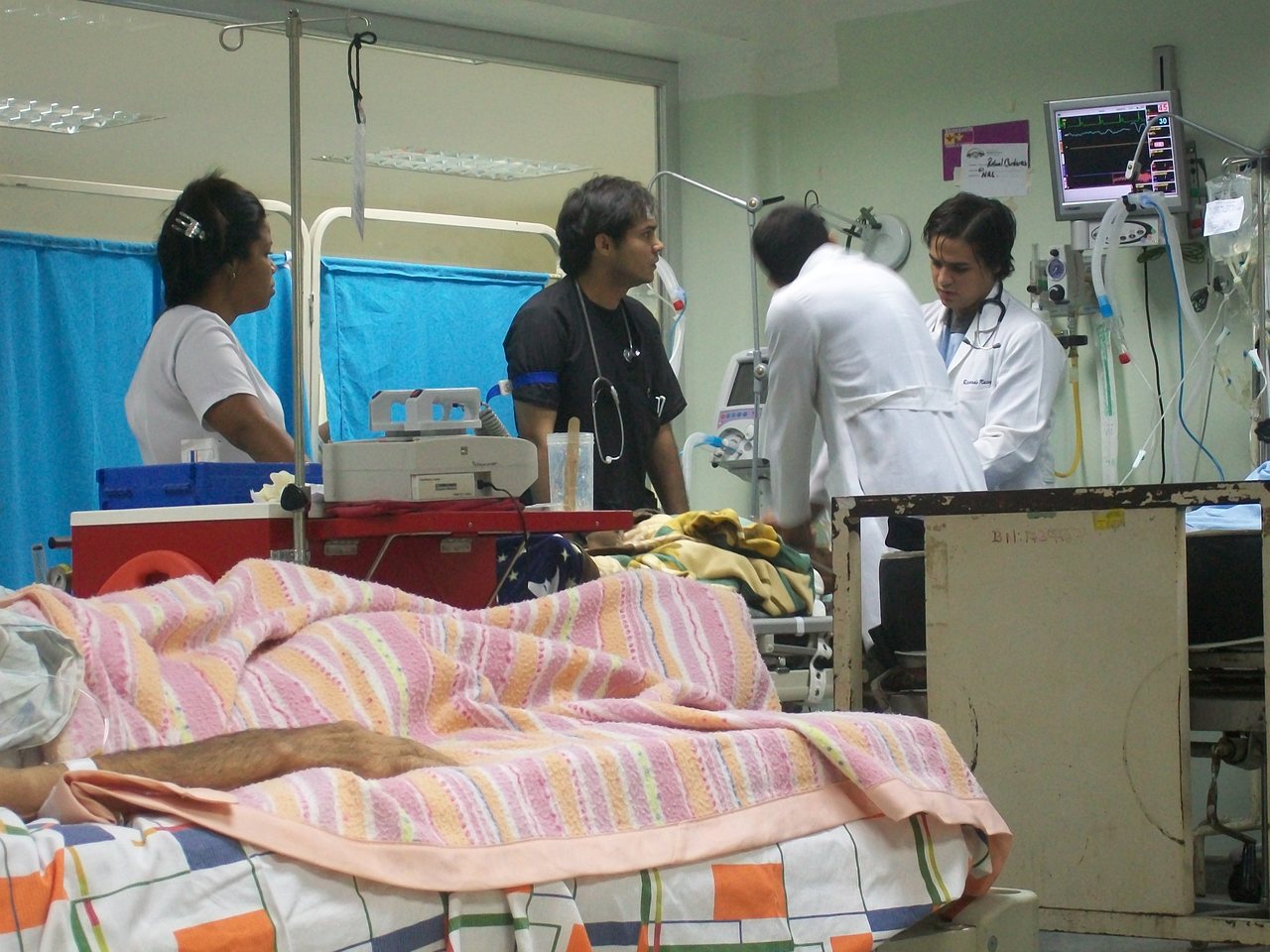
The AWARE study (Parnia et al., Resuscitation, 2014) screened 2,060 cardiac arrests across fifteen hospitals. The funnel is worth seeing in full, because it is where the drama drains out: 2,060 arrests, 330 survivors to discharge, 140 interviewed, 101 completing detailed interviews, and 9 of those 101 (about 9 percent) meeting the Greyson threshold for a classic NDE. One case became famous: a patient who accurately described real events during their own resuscitation while their heart was stopped. But here is the detail the retellings drop, and it is decisive. That patient's bed did not have a hidden target shelf near it. The single celebrated hit was a spontaneous, accurate account of real resuscitation events, not a successful reading of a hidden test image. No patient in AWARE ever identified a hidden visual target.
AWARE-II (Parnia et al., Resuscitation, 2023) was bigger and more rigorous still: 567 in-hospital cardiac arrests across 25 hospitals. Of those, 53 survived, 28 completed interviews, and 11 of the 28 reported memories or perceptions during the arrest, including 6 with a deep, transcendent 'recalled experience of death.' And the hidden-target test, the whole point of the exercise? Of the 28 interviewed survivors, zero identified the hidden visual image. One identified a hidden auditory stimulus. That is the most careful out-of-body test science has run, and the visual result is a clean null. Anyone arguing that NDEs demonstrate real perception from outside the body has to walk straight through that 0 out of 28, and most accounts simply pretend it isn't there.
03But the Brain Is Not as Silent as We Thought
Here the story turns, and turns against the easy dismissal. The old assumption that the brain goes electrically flat within seconds of cardiac arrest, the assumption that made a lucid NDE seem impossible, has itself failed the test.
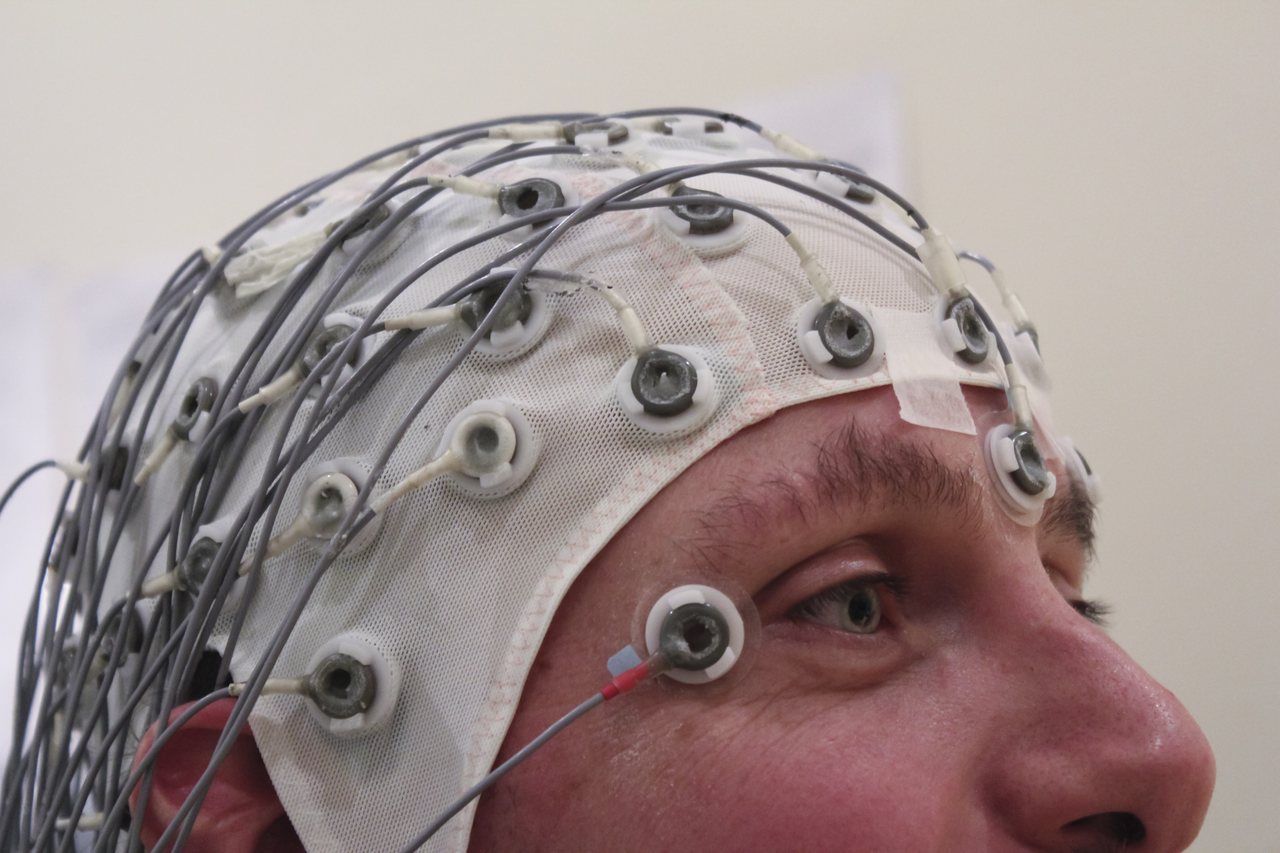
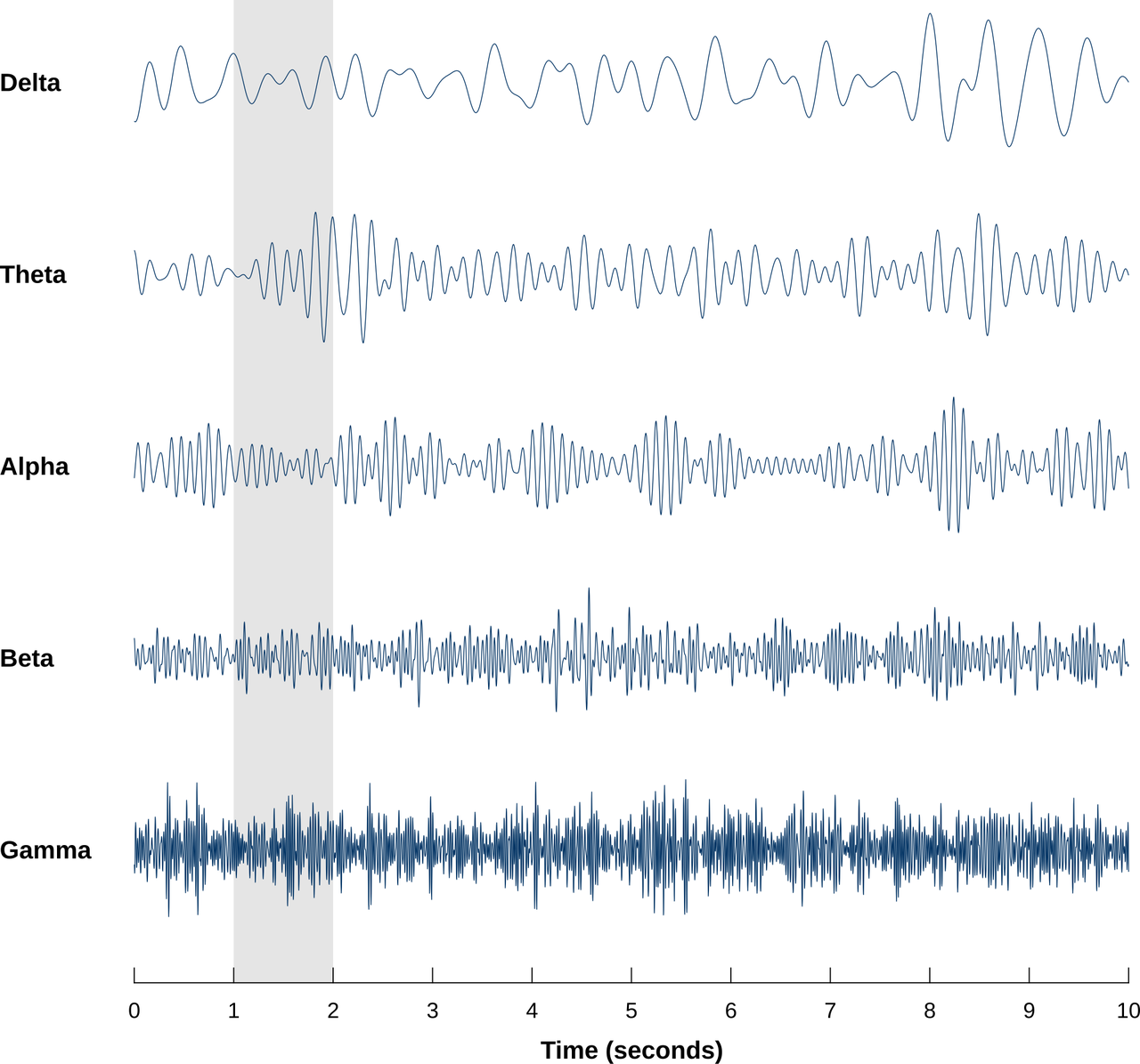
In AWARE-II, a subset of 85 patients had continuous brain monitoring during CPR. In nearly 40 percent of them, organized electrical activity, across the full range of normal rhythms including gamma, persisted or re-emerged at points as far as 35 to 60 minutes into resuscitation. The brain, in other words, is not reliably silent when we thought it was. This does not prove an NDE is happening in that window, but it demolishes the confident claim that the brain is incapable of experience during arrest. The lights are not all the way off.
The dying brain may even surge. Jimo Borjigin's lab found that in rats, cardiac arrest was followed within about 30 seconds by a burst of coherent gamma activity exceeding the waking state (PNAS, 2013). In four dying human patients with intracranial electrodes (Xu, Borjigin et al., PNAS, 2023), two showed gamma surges at the moment of arrest, concentrated in a brain region tied to conscious awareness and out-of-body sensation. This is the sharpest double-edged finding in the field: it is exactly the mechanism a skeptic needs to explain a vivid experience with no soul required, and exactly the neural signature a believer reads as the brink of a real transition. The same data comforts both camps, which is a sign it settles neither.
04The Competing Explanations
No single physiological account explains the whole near-death experience, and honest researchers say so. Each proposed mechanism captures some features and misses others. Laid side by side, the field looks less like a solved case and more like several partial answers, none of them yet complete, sitting across the table from a minority reading that keeps refusing to die.
| Proposed explanation | What it can account for | What it does not account for |
|---|---|---|
| Anoxia / cerebral hypoxia (and the G-LOC parallel in fighter pilots) | Tunnel and light from visual-cortex disinhibition; peace from limbic activation. Pilots under extreme g-force get tunnel-and-light with no brush with death. | The coherence, narrative clarity, and structured sequence of a full NDE, not just isolated features. |
| Dying-brain gamma surge (Borjigin, Xu) | A real, measured burst of consciousness-associated activity at the moment of arrest, in the right brain regions. | Whether that surge produces a vivid unreal experience or is the signature of a real one; the data reads both ways. |
| Endogenous DMT (Strassman) | A candidate psychedelic mechanism for the intensity and strangeness of the experience. | The actual chemistry: DMT has been found in mammalian brain only at picomolar levels, far below what would be psychoactive. Speculative. |
| REM intrusion (Nelson) | NDE reporters show more REM-state intrusion into waking life, linking dream systems to NDE features. | Whether this is the cause or merely a predisposing trait; it may be correlation, not mechanism. |
| Memory reconstruction (Blackmore) | NDE memories may be assembled afterward from fragments of partial awareness during and around the arrest. | The cases of accurate recall of specific real events during the arrest, which are harder to build from nothing. |
| Cultural priming / expectation | The documented cross-cultural variation in NDE content (see below), which argues for real cultural shaping. | The core features that recur across cultures, including in young children and the congenitally blind. |
| Survivalist / non-local consciousness (van Lommel, Fenwick) | Lucid, structured experience reported during a flat or near-flat EEG, which the standard model struggles with. | Any independently testable mechanism; and it must still answer the 0-of-28 hidden-target result. A live minority position, not an established one. |
05The Same Story, Told Differently Everywhere
The content of NDEs varies by culture in a patterned, documented way, and this cuts hard against the simplest 'objective afterlife' reading. Indian NDEs more often feature Yamadoots, messengers of the death-god Yama, and a bureaucratic 'sent back, wrong person' narrative, with tunnels comparatively rare. Thai accounts, shaped by Theravada Buddhism, lean toward Yama and karmic hell-realms. Tibetan delok ('returned from death') journeys move through the bardo as structured moral instruction. Western NDEs supply the tunnels, the being of light, and deceased Christian relatives. The scholar Allan Kellehear frames this as a core-versus-periphery pattern: some features (leaving the body, meeting beings, a boundary, a return) recur across cultures and may reflect shared neurophysiology, while others (the specific tunnel, the cinematic life-review) look culturally supplied. The wrinkle that keeps it interesting: congenitally blind people report visual NDE content, and young children report the core pattern with the least cultural contamination of all.
06The Most Famous Case, Handled Honestly
Pam Reynolds is the case every popular treatment reaches for. In 1991 she underwent a rare 'standstill' brain surgery at the Barrow Neurological Institute, chilled to the point of cardiac arrest with a flat EEG, and afterward reported detailed, apparently accurate perceptions of the operating room and the surgery, said to be confirmed by the surgical team. It is genuinely striking. It is also, honestly, far weaker than it sounds. Critics note that the most verifiable perceptions could have formed during the parts of the procedure when she was under anesthesia but not yet at the deepest hypothermic arrest, reconstructed from sensory cues available before and after the true zero-activity window. It is an anecdote, uncontrolled, decades old, and it is the strongest single case in the popular canon, which tells you how much weight the prospective, hidden-target studies really carry by comparison.
07Where the Science Actually Stands
The frontier is active and unresolved, not closed in either direction. Van Lommel's landmark Dutch study (The Lancet, 2001) followed 344 cardiac-arrest patients and found that NDEs were not explained by how long the arrest lasted, by medications, or by religious belief, and that the NDE group, uniquely, showed lasting increases in empathy and decreases in the fear of death years later. Van Lommel reads his own data as evidence that consciousness is filtered by the brain rather than produced by it, a hypothesis, he is careful to say, not a proof. Recent work (2025 to 2026) has begun relabeling the phenomenon a 'recalled experience of death' to strip away cultural baggage; a 2025 review by Martial and colleagues tried to fold the physiological explanations into one framework, and researchers at the University of Virginia's Division of Perceptual Studies publicly pushed back, arguing the physiological accounts still cannot explain the verified perceptions. That exchange is the live edge of the field, and nobody there is claiming the matter is settled.
Fast Facts
- How common
- About 10 to 20% of cardiac-arrest survivors; roughly 4 to 5% of the general population
- The measure
- The Greyson NDE Scale: 16 items, score 0 to 32, threshold of 7 for an NDE
- The big studies
- AWARE (2,060 screened, 2014) and AWARE-II (567 arrests, 2023)
- The hidden-target test
- AWARE-II: 0 of 28 identified the visual target, 1 of 28 the auditory target
- The brain surprise
- Organized EEG activity up to 35 to 60 minutes into CPR in ~40% of a monitored subset
- The dying-brain surge
- Gamma bursts at the moment of death in rats, and in 2 of 4 human patients
- Cross-cultural
- Core features recur; specific content (tunnels, Yamadoots, bardo) varies by culture
- The status
- Real experience, genuinely unexplained in full, not proven to be evidence of an afterlife
What We Can Actually Stand Behind
The experiences are real and the research is real. Near-death experiences happen at measurable rates, are captured by a validated scale, and have been studied prospectively in thousands of cardiac-arrest patients. AWARE and AWARE-II were run and published; their hidden-target result is 0 of 28 for vision and 1 of 28 for sound; and the finding that organized brain activity can persist far into CPR is solid. These facts are not in dispute.
What the experiences mean is open, and honest researchers sit on both sides. Lucid, structured experiences are reported during states when the brain should be incapable of them, and no physiological account yet explains the whole phenomenon; that is a real puzzle, not a solved one. At the same time, the cleanest out-of-body test came back null, the content varies by culture, and the strongest anecdotes are uncontrolled. Van Lommel's survival reading and the dying-brain reading are both live, and this article does not pretend to choose between them.
The bolder mechanisms are weaker than they sound. The endogenous-DMT hypothesis founders on the actual measured brain concentrations. The survivalist, non-local-consciousness reading is a genuine minority position in the literature, but it offers no independently testable mechanism and still has to answer the hidden-target null. Take these as the speculative edges, not the core.
No, near-death experiences do not prove an afterlife, and no, they are not all the same. Physiological explanations have not been excluded; the hidden-target tests specifically weaken the out-of-body claim; the strong cross-cultural variation points to real cultural construction of the surface phenomenology; and an estimated 1 to 15 percent of NDEs are distressing rather than blissful, so even the 'everyone goes to the light' picture is false. The experience is profound. That is not the same as proof.
So we are left in the most honest and least comfortable place: with a phenomenon that is entirely real as an experience, partly explained as a brain event, and not explained enough to close. The dying brain is more alive than we thought, which makes a vivid final experience less mysterious, not more. The out-of-body claim was put to a fair test and did not pass it. And yet a small, serious group of researchers keeps pointing at the lucidity reported when the brain should be dark, and they have not been refuted so much as left unanswered. The near-death experience is not a proof of heaven, and it is not a hallucination we can fully account for. It is the single most direct look we get at the mind as the body fails, and what it shows us, for now, is our own instruments straining at the edge of what they can measure. The people who came back are telling the truth about what they felt. The rest of us are still arguing about what it was.
Sources & further reading
Everything above is drawn from our research library on Theories of Anything. Open the full files to check the sourcing and go deeper.
Image credits
- Original explanatory diagram of the AWARE / AWARE-II hidden shelf-target out-of-body test and its results (0 of 28 visual, 1 of 28 auditory) Original diagram by Theories of Anything. CC BY-SA 4.0 Source.
- A patient and medical staff in a hospital intrahospital emergency and resuscitation ward Bobjgalindo, via Wikimedia Commons. CC BY-SA 3.0 / GNU Free Documentation License Source.
- A person wearing an EEG cap that holds electrodes in place while recording brain activity Chris Hope, via Wikimedia Commons (originally Flickr). CC BY 2.0 Source.
- A labeled diagram of ten seconds of simulated EEG across the five named frequency bands (delta, theta, alpha, beta, gamma) Laurens R. Krol, via Wikimedia Commons. CC0 1.0 (Public Domain Dedication) Source.
- A bilingual sign marking the entrance to a hospital resuscitation area Ashashyou, via Wikimedia Commons. CC BY-SA 3.0 Source.
- Card crop of the original AWARE shelf-target diagram Original diagram by Theories of Anything. CC BY-SA 4.0


