
Neanderthal DNA: The Ancient Human Inside You
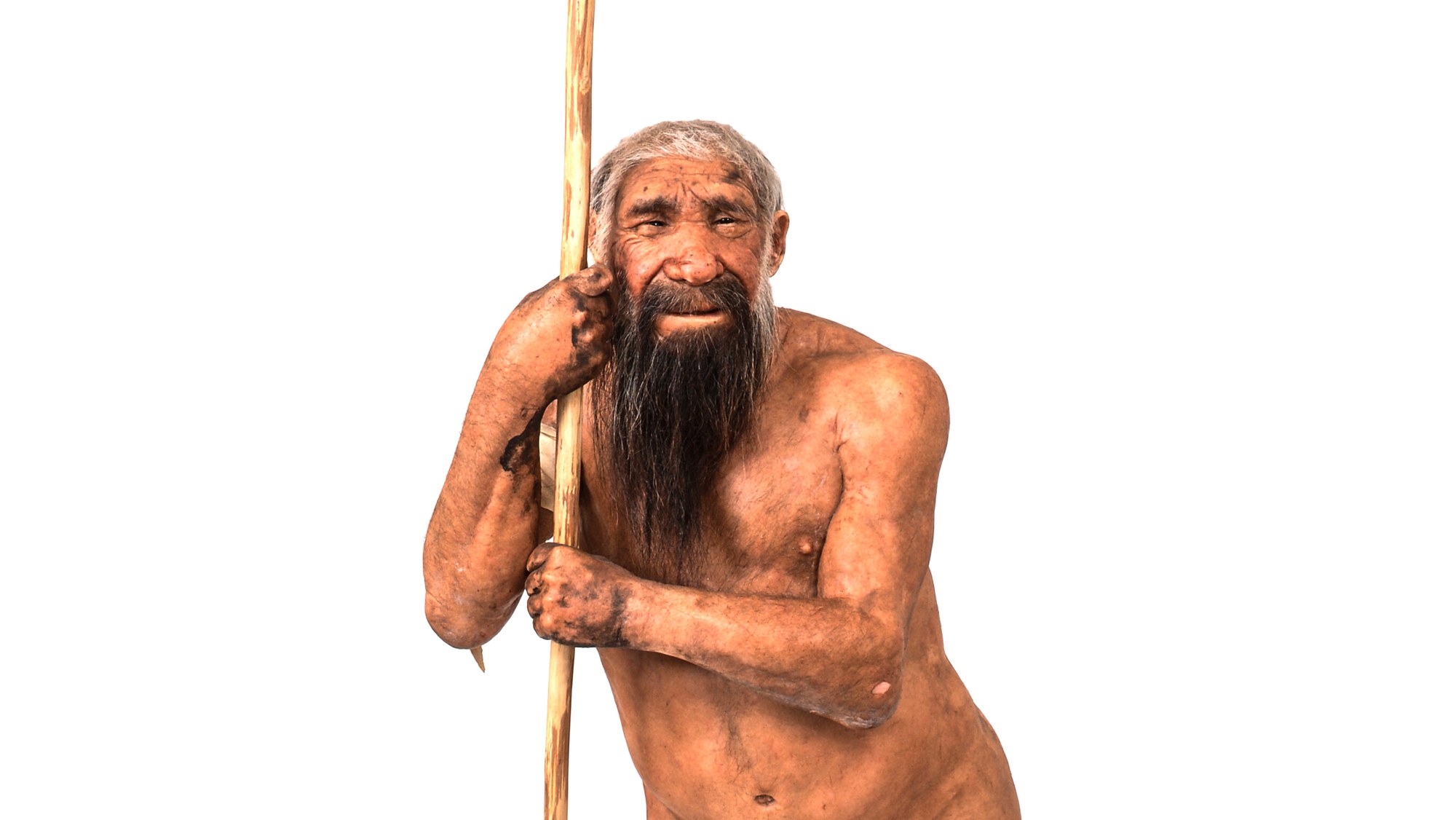
Neanderthals went extinct around 40,000 years ago, and yet, if your ancestry lies anywhere outside Africa, you are carrying a little of them right now: roughly 1.5 to 2.5 percent of your DNA is Neanderthal. It shapes pieces of your immune system, your skin, even your risk from a modern virus. That inheritance is the record of a meeting more than 50,000 years ago, when two kinds of human met and had children together. This is what the genome actually says, how we came to read the DNA of an extinct people, why almost every trace of their maternal line has vanished, and where the honest science ends and the myths, in both directions, begin.
The Neanderthals are gone. The last of them vanished around 40,000 years ago, after more than 300,000 years as a distinct kind of human across Europe and western Asia. And yet they did not disappear completely, because a piece of them is still here, carried in the bodies of billions of living people. If your ancestry traces to anywhere outside Africa, then roughly 1.5 to 2.5 percent of your own DNA was inherited from Neanderthals, woven invisibly through your genome, quietly shaping parts of your immune system, your skin, and even how your body meets a virus that only emerged in this century. That inheritance is the fossil, written in living code, of an encounter tens of thousands of years ago, when our ancestors met another kind of human and had children with them. This is the story of how we learned to read the DNA of an extinct people, what that DNA is actually doing inside us, why one whole half of their heredity has vanished without a trace, and how to tell the real science from the myths that crowd in from both directions.
01Reading a Ghost's Genome
For most of the twentieth century, the idea of recovering the genes of an extinct human seemed like fantasy. DNA breaks down after death, and a fossil tens of thousands of years old should hold only shattered, contaminated scraps. The triumph of paleogenomics was learning to read those scraps anyway. In 2010, a team led by the Swedish geneticist Svante Paabo published the first draft sequence of the Neanderthal genome, pieced together from bones found in Vindija Cave in Croatia. It was a landmark on the scale of the moon landing for human origins, and it delivered an immediate shock: comparing that Neanderthal genome to living people revealed that non-Africans carry Neanderthal DNA. Our ancestors had not merely competed with Neanderthals; they had interbred with them. Higher-quality genomes soon followed, from a Neanderthal toe bone in the Altai mountains, from Vindija, from Chagyrskaya Cave, each sharpening the picture. The work founded an entire scientific field, and in 2022 Paabo was awarded the Nobel Prize in Physiology or Medicine for it. An extinct human being's complete genetic blueprint could now be read from the dust of a cave floor.

The headline number deserves to be stated carefully. Most non-Africans alive today carry roughly 1.5 to 2.5 percent Neanderthal-derived DNA, with East Asian populations tending to hold a little more than Europeans. Present-day Africans carry small amounts too, generally read as the trace of later back-migration from Eurasia rather than interbreeding inside Africa. Two point five percent may sound minor, but it is not trivial: it is tens of millions of letters of an extinct human's code, riding along inside you. And here is a fact that changes how to picture the whole thing. No single living person carries much Neanderthal DNA, but different people carry different pieces of it, because natural selection and chance kept different fragments in different lineages. Add up all the surviving fragments scattered across all living humans, and researchers estimate that something like 40 to 50 percent of the entire Neanderthal genome is still out there, distributed across the human population like a shattered manuscript whose pages are held by millions of different readers. The Neanderthals are extinct as a people, but as a genome they are, in a strange and partial sense, still assembled among us.
02The Meeting
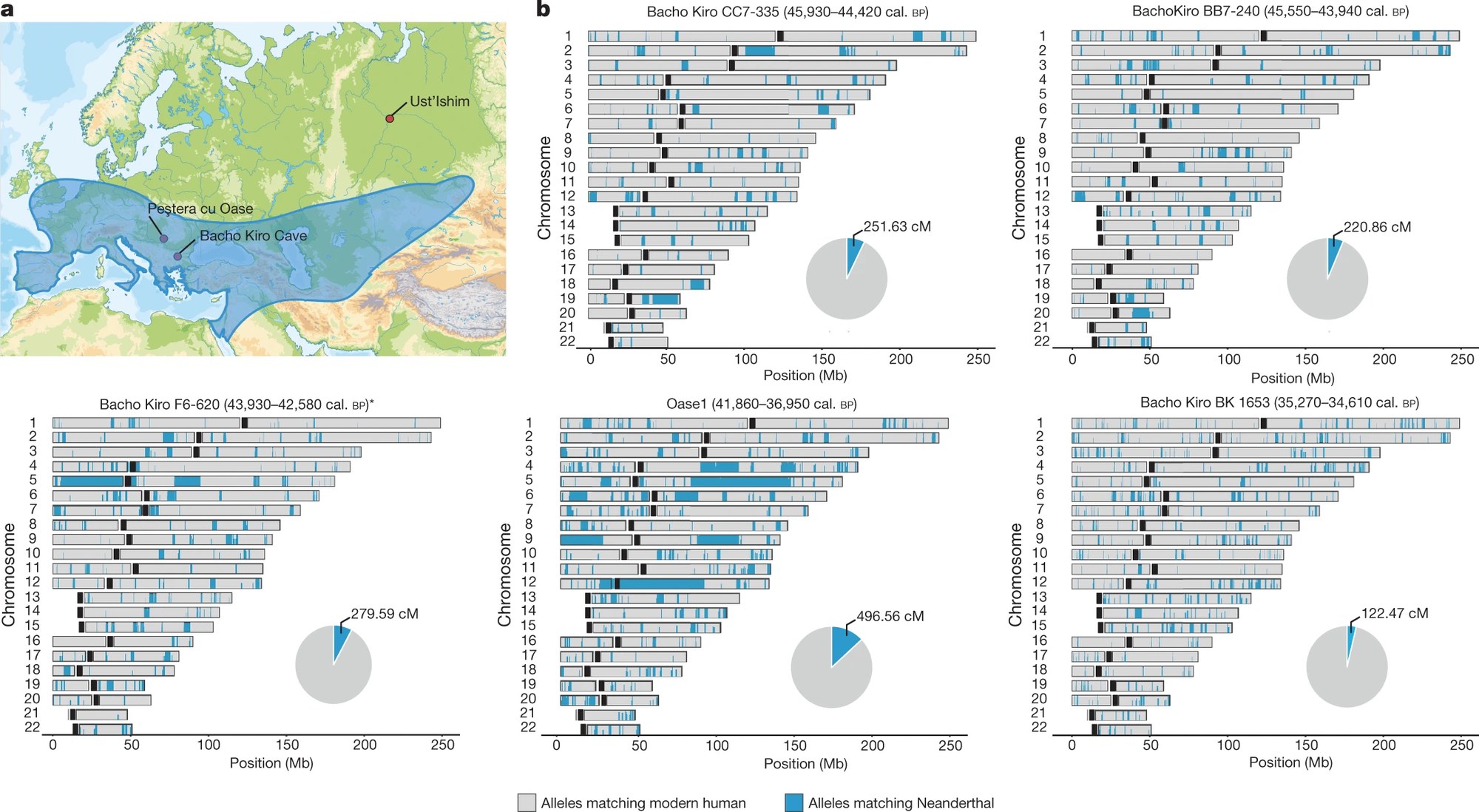
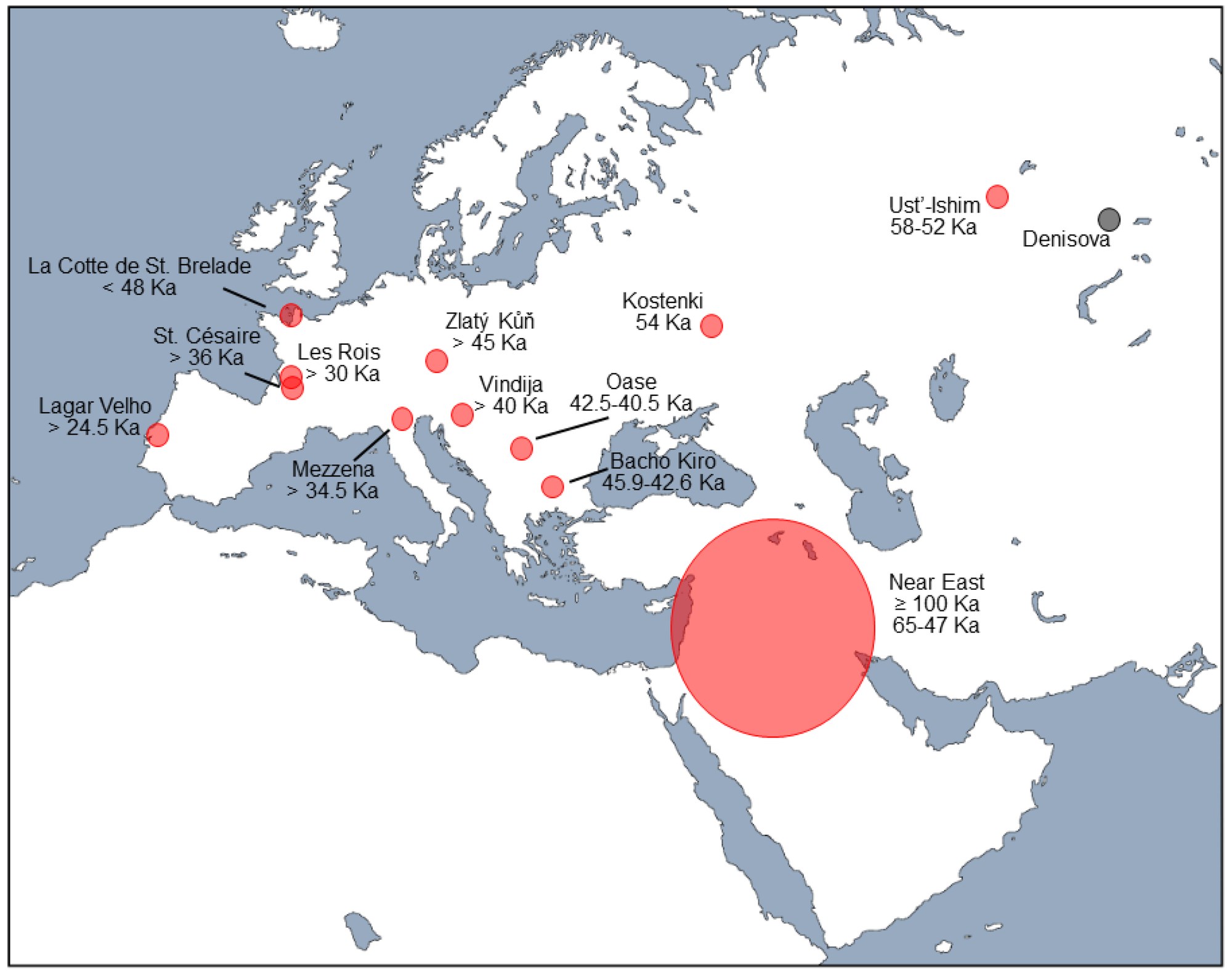
When and where did it happen? The bulk of the Neanderthal DNA in living non-Africans traces to a single broad episode of interbreeding that occurred as modern humans expanded out of Africa and through the Near East, somewhere around 50,000 to 60,000 years ago. That timing is why all non-Africans, from Europe to East Asia to the Americas, share a common baseline of Neanderthal ancestry: their ancestors picked it up in that shared bottleneck before dispersing across the world. A very recent study, published in December 2024 and still settling into the field, used more than 300 ancient and modern genomes to argue the date can be narrowed much further, to a single shared window of roughly 50,500 to 43,500 years ago, a span of only about 7,000 years; a striking refinement, though a recent one that further work may yet adjust. Occasionally the genomes even catch the encounter almost in the act. A roughly 40,000-year-old individual from Pestera cu Oase in Romania carried 6 to 9 percent Neanderthal ancestry in enormous, barely-broken chromosomal blocks, meaning this person had a Neanderthal ancestor just four to six generations back, a great-great-grandparent or thereabouts. That particular family line left no descendants among modern Europeans, but its DNA is a snapshot of interbreeding caught red-handed.
03They Were Not Brutes
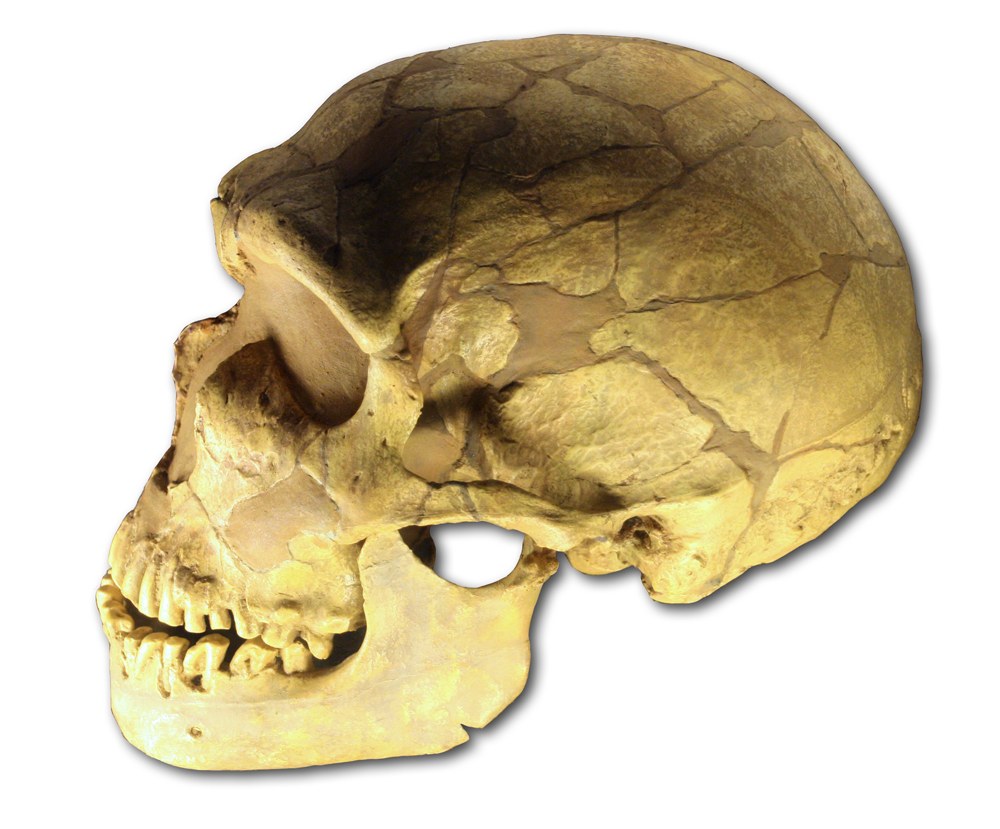
Before going further into what Neanderthal DNA does, it is worth correcting the picture most people still carry of the people it came from. The popular image of the Neanderthal as a shambling, dim-witted caveman is not a finding; it is a mistake, and a traceable one. It stems largely from the French scientist Marcellin Boule, who in 1911 reconstructed an elderly, arthritis-riddled Neanderthal skeleton from La Chapelle-aux-Saints as a stooped, ape-like brute, mistaking one old man's disease for the anatomy of a whole species. The real evidence points the other way. Neanderthals made sophisticated tools using a multi-step technique that demands genuine planning. They buried their dead. They used red ochre and black pigment, and cave paintings in Spain have been dated to more than 65,000 years ago, before modern humans are thought to have even reached Europe, which would make them the work of Neanderthal hands. They cared for their injured and disabled. And their brains were not small: the average Neanderthal braincase, at roughly 1,500 to 1,600 cubic centimeters, was actually larger than the modern human average of about 1,350. Whatever became of them, it was not for lack of a mind.
04What They Left in Us
So what is that 2 percent actually doing? Some of it turns out to be useful, kept and spread by natural selection because it helped, a process called adaptive introgression. The clearest cases involve the immune system: Neanderthal-derived versions of certain innate-immunity genes (the toll-like receptors TLR1, TLR6, and TLR10) are among the best-documented beneficial pieces of archaic DNA in living people, likely tuning how the body first detects pathogens. Other Neanderthal variants sit in genes governing skin and hair, part of a recurring pattern in which the biology of the body's outer surface was one of the domains where archaic DNA mattered most, perhaps helping newly-arrived Africans adapt to unfamiliar northern light and climate. One popular example must be corrected here, though, because it is almost always told wrong: the famous high-altitude adaptation that lets Tibetans thrive in thin mountain air, carried in a gene called EPAS1, is not Neanderthal at all. It came from the Denisovans, a different archaic human cousin with their own separate story. It is a genuinely spectacular case of inherited archaic DNA, but it belongs to a different chapter, not this one.
Not all of the inheritance is benign, and the most topical example is also a perfect illustration of why honesty about this subject matters. A stretch of Neanderthal DNA on chromosome 3 is the single strongest genetic risk factor known for severe COVID-19, raising the odds of serious illness by more than half; it is carried by roughly half of all people of South Asian descent, about 16 percent of Europeans, and only about 4 percent of East Asians. But here is the crucial twist, and the detail that popular accounts routinely garble. A completely separate piece of Neanderthal DNA, on chromosome 12, spanning genes called OAS1, OAS2, and OAS3 that help destroy viral RNA, is protective, lowering the risk of severe COVID-19 by around a fifth. Two different Neanderthal legacies, on two different chromosomes: one can hurt you, the other can help you, and which you carry is a matter of ancestral chance. Beyond COVID, Neanderthal DNA has been statistically linked to small shifts in risk for conditions from mood disorders to skin lesions to blood clotting. But these are population-level correlations with tiny individual effects, not genetic fortunes written for any one person, a distinction that becomes the article's most important refusal further down.
05The Vanishing, and the Open Question
Neanderthal DNA is not scattered randomly through our genomes; it has been actively filtered, and reading that filter tells its own story. Across the genome there are large stretches, called 'deserts of introgression,' that are almost entirely swept clean of Neanderthal ancestry. The X chromosome carries about five times less Neanderthal DNA than the other chromosomes, and Neanderthal ancestry is especially depleted around genes active in the testes and in brain development. The interpretation is sobering and specific: some Neanderthal gene variants reduced the fertility of early male hybrids, and some were mildly incompatible with modern human biology, so natural selection quietly removed them over the generations. Models suggest that the average Neanderthal fraction in modern genomes fell from an initial level of perhaps 10 percent, right after admixture, down to about 2 percent today, a slow purge of the parts that did not work. A likely reason is that the Neanderthal population was small, which had allowed mildly harmful mutations to accumulate in it by chance; once those variants entered the far larger modern human population, selection could see them clearly and weed them out. What survives in us, in other words, is the Neanderthal DNA that was neutral or beneficial. The rest was edited away.
Which brings us to the deepest and most haunting gap of all, and the question buried in this article's own title. We carry Neanderthal DNA scattered across our ordinary chromosomes, but two crucial pieces of them are missing entirely. Not a single living human carries a Neanderthal Y chromosome, passed father to son, or Neanderthal mitochondrial DNA, passed mother to child. Both of these lineages, the pure paternal line and the pure maternal line, have vanished completely from the modern gene pool, even as the rest of the genome kept its Neanderthal fragments. Why? This is genuinely unresolved, and it is the honest open question at the center of the story. There are three leading ideas, and they may all be partly true. Perhaps the interbreeding ran mostly one direction, Neanderthal fathers and modern human mothers, which would leave no Neanderthal mitochondrial line and, combined with other effects, no surviving Neanderthal Y. Perhaps male hybrids with a Neanderthal father were simply less fertile, a common pattern when two long-separated populations mix, which fits the same X-chromosome and testis-gene evidence as the deserts of introgression. Or perhaps it was chance, the random loss of rare lineages from a small population over time. No one yet knows which of these dominated. Fittingly, the tidiest part of the Neanderthal legacy to state, that it is real and it is in us, sits right beside one of its most stubborn mysteries.
Two overclaims must be refused with equal firmness, because this subject attracts both. The first, already met above, is the old 'brute' myth, the idea that Neanderthals were unintelligent sub-humans. The tools, the burials, the pigment, the cave art, and the larger-than-average brain all refute it; it was a stereotype born of one misread skeleton, not a reading of the evidence. The second overclaim runs the opposite way and is subtler and more modern: the notion that carrying Neanderthal DNA 'makes' a person a certain way, that it gives you a particular temperament, intelligence, or character. It does not. The real trait associations, including the disease risks, are small-effect statistical patterns drawn from studying tens of thousands of people at once; they say nothing deterministic about any individual, and they are not a personality horoscope written in archaic genes. And one more, worth stating plainly: Neanderthal ancestry does not track with human 'races.' All non-African populations carry broadly similar amounts, the differences between them are minor, and there is no sense in which Neanderthals are the special ancestors of any one modern group. The genome is more interesting than any of these myths. It records a real meeting between two kinds of human, an inheritance that is partly useful and partly purged, and a maternal line that slipped away for reasons we still cannot fully name.
Fast Facts
- How much you carry
- Most non-Africans carry roughly 1.5 to 2.5 percent Neanderthal DNA (a little more in East Asians). Africans carry small amounts from later back-migration. Across all living people, about 40 to 50 percent of the whole Neanderthal genome still survives in pieces
- How we know
- Svante Paabo's team sequenced the draft Neanderthal genome in 2010 (from Vindija Cave), founding paleogenomics; he won the 2022 Nobel Prize. Comparing it to living people proved interbreeding happened
- The meeting
- Mainly a single episode ~50,000 to 60,000 years ago as modern humans left Africa through the Near East; a 2024 study narrows the main gene flow to ~50,500 to 43,500 years ago. The Oase 1 individual had a Neanderthal ancestor just 4 to 6 generations back
- What it does
- Some is beneficial (immune genes TLR1/6/10, skin and hair). COVID-19 is a case study: a chromosome-3 haplotype RAISES severe-illness risk, while a SEPARATE chromosome-12 (OAS1) haplotype LOWERS it. NOTE: the Tibetan high-altitude gene (EPAS1) is Denisovan, NOT Neanderthal
- The purge
- Neanderthal DNA is depleted on the X chromosome and near testis and brain genes ('deserts of introgression'). Selection cut the average Neanderthal fraction from ~10 percent to ~2 percent, removing variants that reduced hybrid fertility or fitness
- The missing line
- No living human carries a Neanderthal Y chromosome or Neanderthal mitochondrial DNA. Why both vanished is genuinely open: asymmetric mating, reduced hybrid-male fertility, or genetic drift, and possibly all three
- Refused
- That Neanderthals were dim brutes (refuted by tools, burial, art, brain size); that Neanderthal DNA determines anyone's personality (the associations are tiny population statistics); and that Neanderthal ancestry marks any human 'race' (all non-Africans carry similar amounts)
What We Can Actually Stand Behind
The genomics is rock-solid. The draft Neanderthal genome (2010) and Svante Paabo's Nobel-winning paleogenomics proved that modern humans and Neanderthals interbred, and that non-Africans carry roughly 1.5 to 2.5 percent Neanderthal DNA. Neanderthal ancestry is unevenly distributed, with 'deserts' on the X chromosome and near brain and testis genes, and no Neanderthal Y chromosome survives in anyone. And Neanderthals were sophisticated (tools, burial, pigment, cave art, large brains), not brutes. These are established facts.
Much is real but still being refined: the exact reason East Asians carry somewhat more Neanderthal ancestry than Europeans; the precise timing of admixture (a December 2024 study narrows it to about 50,500 to 43,500 years ago); and the disease and trait associations, including the genuine but small-effect COVID-19 risk (chromosome 3) and protective (chromosome 12) haplotypes. Real findings, active debate.
The central mystery is open. Why no Neanderthal Y chromosome or mitochondrial DNA survives in any living human, when the rest of the genome kept its fragments, is genuinely unresolved: asymmetric mating direction, reduced fertility of male hybrids, and simple genetic drift are all candidates, and the honest answer is that no one yet knows which dominated. The deeper cognitive consequences of introgression are likewise unsettled.
Both extremes are refused. Neanderthals were not dim-witted brutes; that stereotype traces to a single misread arthritic skeleton. And carrying Neanderthal DNA does not determine anyone's personality, intelligence, or character: the real associations are tiny statistical patterns across whole populations, not a destiny written in archaic genes. Nor is Neanderthal ancestry a marker of human 'race.' The truthful story is richer than either myth.
Neanderthal DNA belongs to The Living World's band of the living code because it is the most personal possible proof of the wing's recurring lesson: that the deep past is not sealed away but runs, literally, through the present. The Neanderthals were a separate kind of human who lived and thought and buried their dead for a third of a million years, and then faded from the Earth. But they did not leave cleanly. They left a signature inside us, a few percent of an extinct people's code, threaded through the genome of nearly everyone outside Africa, some of it protecting us, some of it we have slowly edited away, and one whole line of it gone for reasons we are still working out. The honest account holds all of that at once: the certainty of the science, the smallness of any single gene's effect, and the real, unsolved mystery of the vanished maternal line. To carry Neanderthal DNA is not to be part-monster or part-genius. It is to be the living end of a story that began when two kinds of human looked at each other, more than 50,000 years ago, and did not turn away.
Sources & further reading
Everything above is drawn from our research library on Theories of Anything, with the specific studies below. Open the full file to check the sourcing and go deeper.
Image credits
- Neanderthal man reconstruction, MUSE Science Museum, Trento Matteo De Stefano / MUSE, via Wikimedia Commons (CC BY-SA 3.0). CC BY-SA 3.0 Source.
- Svante Paabo Duncan Hull, via Wikimedia Commons (CC BY-SA 4.0). CC BY-SA 4.0 Source.
- Genome-wide distribution of Neanderthal DNA in ancient modern human genomes Hajdinjak et al. (2021), Nature, via Wikimedia Commons (CC BY 4.0). CC BY 4.0 Source.
- Map of Neanderthal-modern human hybridization zones and dates Churchill, Keys & Ross (2022), via Wikimedia Commons (CC BY-SA 4.0). CC BY-SA 4.0 Source.
- La Ferrassie 1 Neanderthal skull (museum cast) Wikimedia Commons user '120' (CC BY-SA 3.0). CC BY-SA 3.0 Source.
- Card crop of the Neanderthal reconstruction Matteo De Stefano / MUSE, via Wikimedia Commons (CC BY-SA 3.0). CC BY-SA 3.0

.jpg)

_based_on_fossil_samples_from_indicated_sites.jpg)
