
The Nazca Lines: Art for an Audience in the Sky
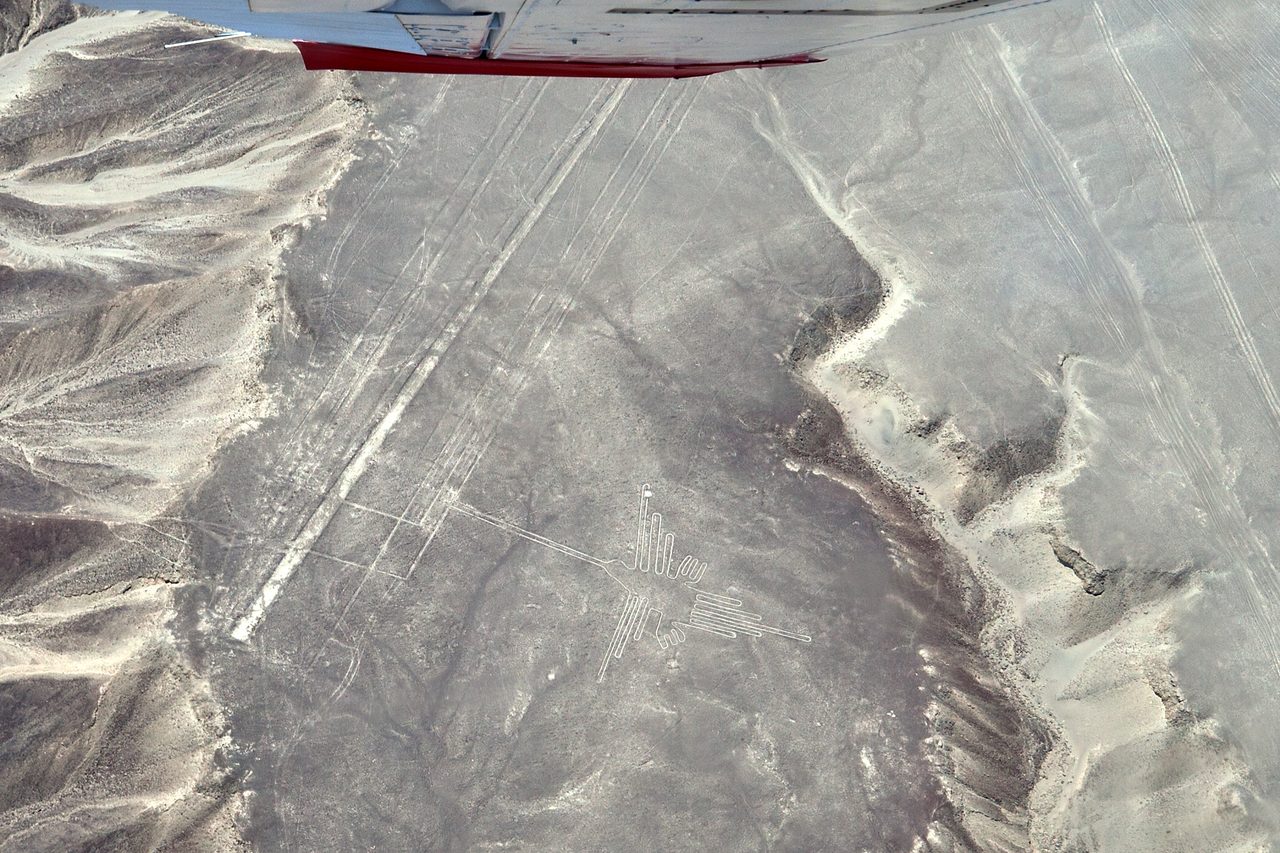
Across one of the driest deserts on Earth, in southern Peru, people scraped away the dark surface stones to draw. A hummingbird nearly a hundred meters long. A monkey with a coiled tail. Straight lines that run for miles. More than 1,500 of these figures cover the Nazca Plateau, made two thousand years ago by people with no aircraft and no iron tools. Here is the file, opened claim by claim, each one wearing its evidence.
Start with what is not in dispute, because everything else about the Nazca Lines grows out of it. On a high desert plateau in southern Peru, people cleared the dark stones off the ground to draw. They drew birds, a monkey, a spider, a whale, and straight lines that run for miles, more than 1,500 figures in all. They did it two thousand years ago, without aircraft to see the results and without iron tools to cut the ground. That gap, between how simple the method was and how vast the result is, is exactly what has drawn every theory from careful archaeology to visitors from space. Let's open the file.
01The Desert Canvas
The Nazca Lines lie on the Pampa de Nazca, a plateau between the towns of Nazca and Palpa in southern Peru, roughly 400 km south of Lima. The ground sits around 500 meters above sea level in one of the driest places on Earth, receiving under 2.5 cm of rain in a year. That aridity is not a footnote. It is the reason the drawings still exist at all.
More than 1,500 geoglyphs have been identified so far, and the count is still climbing as new analysis continues. Together they spread across an area of about 450 square kilometers of desert.
The most numerous figures are not the animals but the geometry: straight lines, triangles, trapezoids, and spirals. Some of the straight lines run for more than 9 kilometers across the pampa.
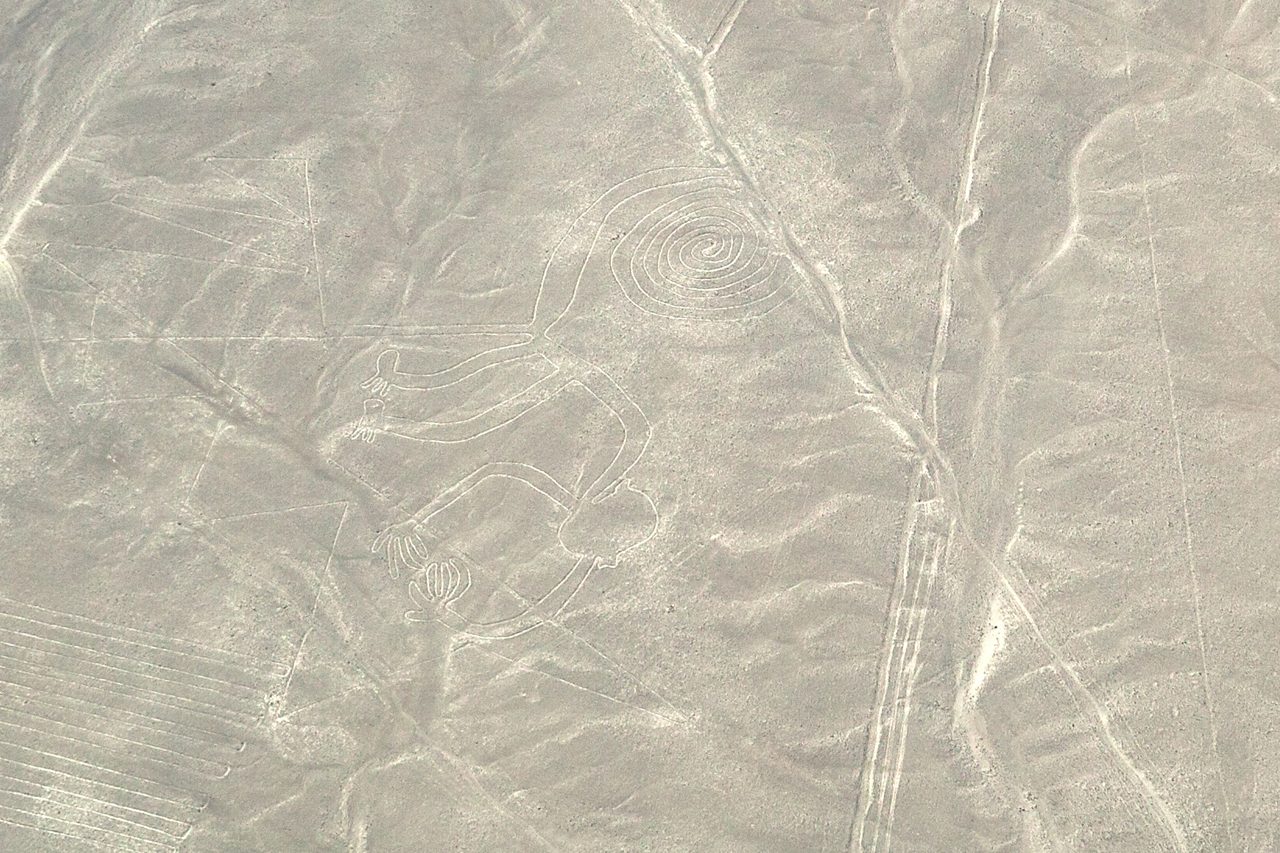
The famous biomorphic figures, the animals and plants, generally run between 50 and 300 meters long. The best known include a hummingbird about 93 meters across, a monkey of the same length, a spider of 46 meters, and a condor stretching 134 meters, alongside a whale, a dog, a pelican, a flower, a tree, and pairs of hands.
| Figure | Size |
|---|---|
| Condor | 134 m long, the largest of the named animals |
| Hummingbird | About 93 m long |
| Monkey | About 93 m long |
| Spider | About 46 m long |
| The "astronaut" or owl man | About 30 m tall, a rare human figure on a Palpa hillside |
The way the lines were made is worth pausing on, because it is the opposite of high technology. The genius here is not complex engineering. It is patience and precision at scale.
The desert surface is a layer of dark pebbles and gravel coated in iron oxide, and beneath it lies a lighter, yellowish grey subsoil. To make a line, the builders simply removed the dark stones to expose the pale ground underneath, a shallow clearance only 10 to 30 centimeters deep. There was no excavation and no carving into bedrock, just the careful sweeping aside of surface stone.
Human figures are rare here. The best known is the roughly 30 meter tall figure on a Palpa hillside popularly called the astronaut or the owl man, and it will matter later that it stands on a slope in the wider geoglyph region rather than out on the flat Nazca pampa.
The Nazca Lines have been a UNESCO World Heritage Site since 1994.
02Who Drew Them, and When
The main body of the lines is the work of the Nazca culture, roughly 200 BCE to 600 CE, in what archaeologists call the Early Intermediate Period. Some of the simpler lines may reach back further, to the late Paracas culture, about 500 to 200 BCE, that immediately preceded Nazca.
That dating does not rest on a single method. It combines radiocarbon dates from pottery fragments and organic material found beside the lines, stylistic matching between the figures and known Nazca ceramic motifs, and optically stimulated luminescence dating of the exposed sub-surface sediments.
The Nazca were no primitive outlier. They were a sophisticated coastal people living in the river valleys that run down from the Andes to the sea, known for elaborate polychrome pottery, fine textiles, the taking of trophy heads, and the great ceremonial center at Cahuachi.
Cahuachi, the major Nazca ceremonial site, sits about 28 kilometers from the lines and was at its peak while the geoglyphs were being made. The two read as parts of a single ritual landscape rather than separate projects.
If the drawings are this old and this shallow, the obvious question is why the wind and rain have not simply erased them. The answer is that they very nearly cannot.
The pampa is one of the most stable ground surfaces anywhere on Earth. Rain is almost nonexistent, the tectonic setting is quiet, and the dark surface pebbles form a natural pavement that resists wind. Those same dark stones absorb the sun and warm the air just above the ground, creating a cushion that calms the wind at surface level. The desert, in effect, protects the drawings that were scratched into it.
Stable is not the same as safe. The lines are threatened by modern vehicles, since the Pan-American Highway cuts straight across the pampa, and by illegal squatting, mining, water runoff from a changing climate, and uncontrolled tourism.
In 2014 Greenpeace activists laid a banner near the hummingbird figure and damaged the fragile desert pavement in the process, a blunt reminder of how easily a surface this delicate can be scarred.
The pressure is still live. In June 2025 Peru's Ministry of Culture proposed shrinking the protected Nazca archaeological reserve by about 42 percent, removing over a thousand hectares from protection, a move critics warned would open the ground to artisanal gold mining. After public backlash, including from the ministry's own staff, the government reversed the decision within days and convened a technical panel to reconsider how the site should be managed.
03The Machines Join the Search
For most of a century, finding new geoglyphs meant flying over the desert and looking. Then a very modern tool was pointed at a very old problem, and the map of Nazca changed.
Beginning around 2019, a research team from Yamagata University in Japan, led by Masato Sakai, turned machine learning loose on the problem. Working with researchers at IBM's Thomas J. Watson Research Center, they trained deep learning models on images of known geoglyphs and set them to scan aerial photographs and satellite data for figures no one had ever catalogued.
It worked. Between 2019 and 2024 the effort identified 303 previously unknown geoglyphs, nearly doubling the known catalog of figurative figures. The team's own published account puts sharper numbers on it: roughly six months of AI-guided field survey raised the documented total of figurative geoglyphs from about 430 to 733, an increase of around 70 percent.
Many of the newly found figures are small, only 5 to 20 meters across, and they cluster along old paths and near where people actually lived rather than out on the open pampa.
That placement hints at a different purpose. The smaller roadside figures may have served individual or community rituals, something more intimate than the monumental figures meant for large gatherings. This is an interpretation of the pattern, not a settled fact, and it sits one tier below the discovery count itself.
The full catalog of AI-identified figures was published by Sakai and colleagues in the Proceedings of the National Academy of Sciences in 2024, at once a Nazca discovery and a demonstration of what machine learning can do for archaeological survey.
04What Were They For?
The physical facts are settled. The purpose is where careful, credible people still disagree, and that disagreement is the honest heart of the Nazca question. No serious reading requires anything beyond what the Nazca themselves could do, believe, and organize. Four hypotheses dominate the credible literature.
| Reading | Core Idea | Where It Stands |
|---|---|---|
| Astronomical calendar | Lines mark solstices, star risings, and other sky events | Partly valid; does not explain most lines |
| Water and fertility | Lines point toward water; figures stand for water beings | Well supported in this hyper-arid desert |
| Ceremonial pathways | Lines were walked in ritual, converging on ray centers | Compatible with the water reading |
| Palpa continuity | An older hillside tradition the pampa lines culminate | Extends the story back over 1,000 years |
The oldest of the four is the astronomical one, and it is also the most tested.
Paul Kosok in the 1940s and, above all, Maria Reiche across the following half century argued that the lines and figures worked as a giant astronomical calendar, with lines aligned to the rising and setting points of the sun at the solstices, to the risings of particular stars, and to other celestial events.
Reiche went further, reading the spider figure as the constellation Orion and treating the line alignments as a tool for tracking solar and lunar events tied to the farming year.
The idea took a serious blow in 1968, and again in 1973, when Gerald Hawkins ran a statistical analysis of the line orientations and found no more astronomical alignments than you would expect from random chance.
It is not fully closed, though. Clive Ruggles noted in 2015 that some alignments, the solstice directions in particular, do exceed what chance would predict, so intentional astronomical encoding remains an open question for specific subsets of the lines.
The fair verdict today is partial. Some lines very likely do reference events in the sky, but astronomy does not account for the majority of the lines or for the figures at all.
05Water in the Driest Place on Earth
Katharina Schreiber and Josue Lancho Rojas proposed, across work in 1995 and 2006, that the lines were bound up with water and fertility ritual. In a desert this dry, water was the one resource that decided whether people lived or died, and a religion built around it makes immediate sense.
The physical evidence fits. Many lines point toward water sources: the underground aqueducts called puquios, the river valleys, and the mountain springs. The Nazca engineered those puquios so well that they still carry water today.
Johan Reinhard argued in 1985 for a related reading, in which the lines and figures mark a sacred landscape centered on mountain worship. The mountains were the source of water, and the lines were ritual pathways linking settlements to sacred water features.
In that light the animals become water symbols: the hummingbird for rain, the spider for water and fertility, the whale for the ocean, the monkey for the rain forest and its abundance. This is an interpretive extension of the water hypothesis rather than an independently proven fact.
There is material to back the ritual reading. Offerings, pottery shards, seashells, and agricultural products, have been found at the intersections and the ends of lines, exactly where you would expect ceremony to leave its traces.
06Lines Meant to Be Walked
Anthony Aveni, in work published in 1990 and 2000, proposed that the lines were not meant so much to be seen as to be walked, laid out as processional routes for ceremonies that moved across the landscape.
The cleared strips are wide enough to walk in procession, and the lines converge on what are called ray centers, elevated points from which many lines radiate outward and which could have served as gathering or ceremonial focal points.
More than 60 of these ray centers have been mapped across the pampa, each one a hub where multiple lines meet.
This walking reading does not compete with the water one; it completes it. Processions may have moved along the lines toward water sources or sacred mountains as part of rites petitioning for rain and good harvests.
07The Longer Story at Palpa
North of Nazca lies a related but distinct set of geoglyphs around Palpa. Unlike the flat pampa figures, many Palpa geoglyphs were made on hillsides, where they are plainly visible from the valley floor below.
The Palpa figures are older than many of the Nazca lines, reaching back into the fuller Paracas sequence of roughly 800 to 200 BCE, of which the 500 to 200 BCE late phase is the part that directly preceded Nazca, and they include anthropomorphic figures of a kind not found at Nazca.
Taken together, Palpa shows a longer, deeper sequence of geoglyph making. The Nazca Lines look less like a sudden invention and more like the culmination of a regional tradition that runs for over a thousand years.
08The Speculative Edge
Beyond the four credible readings sit ideas that are worth naming but rest on thinner evidence. The research file marks them Tier 3: plausible, suggestive, and not established.
Some researchers have noted that the geoglyph motifs, the spider, the monkey, the serpent, resemble the kind of imagery reported in shamanistic and psychoactive experience within Andean traditions.
The link is not baseless. The Nazca did use the San Pedro cactus, Echinopsis pachanoi, and other psychoactive plants, a fact recorded in their ceramic imagery and in archaeological residues.
From there comes the suggestion that the geoglyphs record visionary experience, projected onto the desert as a permanent register of what was seen. It is a genuinely interesting idea, but the evidence tying psychoactive use to the making of the lines is circumstantial, and the research file says so plainly.
A separate proposal reads different line groups as the work of different kin groups, or ayllus, marking territorial boundaries, lineage identity, or water rights. It is plausible, but hard to test without sharper dating and better ethnographic parallels.
09Where the Story Runs Off the Map
A site this large, this old, and this striking was never going to escape the bigger stories. Some are worth taking seriously as open questions. The ones in this section are not, because the ground itself contradicts them, and saying so plainly is more interesting than the myth.
In Chariots of the Gods?, published in 1968, Erich von Daniken proposed that the Nazca Lines were landing strips for extraterrestrial spacecraft. There is no archaeological, geological, or engineering support for it. The cleared surfaces are soft desert soil that could never bear the weight of a landing vehicle, a great many of the lines are curved, wavy, or spiralled rather than straight, and the animal figures serve no conceivable function as runways.
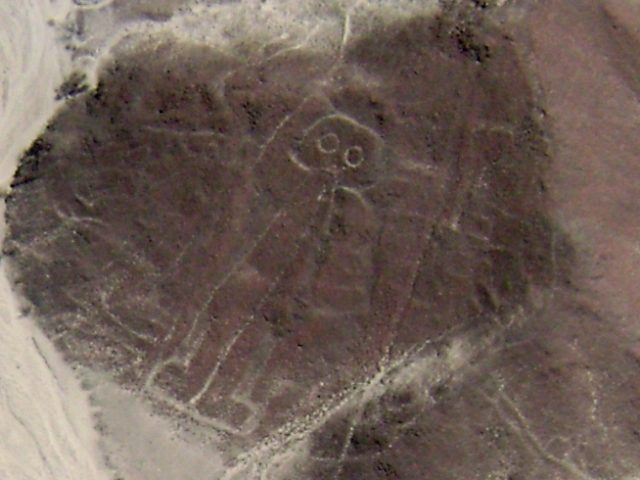
The figure people point to as proof, the so-called astronaut on the Palpa hillside, is on close reading a human figure with a rounded head, entirely consistent with the motifs on Nazca pottery. It is not a helmeted spaceman.
A gentler variant tried to keep the mystery human. In 1977 Jim Woodman suggested the Nazca used hot air balloons to view their own work from above, and even built a reed-basket balloon to argue it was possible. But there is no archaeological evidence for any Nazca aerial technology at all: no balloon materials, no launch infrastructure, and no cultural reference to human flight.
Underneath all of these theories sits one persistent, wrong assumption: that the lines can only be seen from the air, and therefore could not have been designed by people on the ground. That is simply false. The larger geometric lines are visible from the surrounding hills and elevated points. The figures are harder to read from ground level, but they are not invisible, they can be made out from nearby high ground, and the simple surveying techniques that could lay them out are well understood.
Fast Facts
- Site
- The Pampa de Nazca, between Nazca and Palpa in southern Peru, about 400 km south of Lima
- Makers
- The Nazca culture, roughly 200 BCE to 600 CE; some lines may reach back to the late Paracas culture, about 500 to 200 BCE
- Count
- More than 1,500 geoglyphs across about 450 square kilometers, and still climbing
- Biggest Lines
- Some straight lines run for more than 9 kilometers
- Named Figures
- Condor 134 m, hummingbird 93 m, monkey 93 m, spider 46 m
- Technique
- Dark surface stones cleared to expose pale subsoil, only 10 to 30 cm deep
- AI Discovery
- 303 new figures found 2019 to 2024, raising the known figurative total from about 430 to 733
- Status
- UNESCO World Heritage Site, 1994
What We Can Actually Stand Behind
The lines themselves are not in question. Their location, their enormous scale, and the simple surface-clearance technique that made them are Tier 1 facts, verified beyond dispute. They were drawn by the Nazca culture around two thousand years ago, and the desert's own stability is why they survived.
What they were for is a real, live debate among credible archaeologists. The astronomical, water and fertility, processional, and Palpa-continuity readings are all serious, and several of them likely hold true for different parts of the site. None of them requires anything beyond ordinary Nazca capability, belief, and labor.
The psychoactive-visionary reading, and the idea of the lines as territorial markers for different kin groups, are worth considering, but the evidence for them is circumstantial. They belong in the file as suggestions, not conclusions.
The Nazca Lines are not landing strips or markers for extraterrestrial spacecraft. The claim has zero credible support and is contradicted by the physics of the soft soil, the geometry of the many curved lines, and the plainly human iconography of the figures, including the hillside astronaut that is simply a person with a round head.
And the reasoning behind the alien story fails at its root. The lines are not visible only from the air, so no aerial or superhuman vantage was ever needed to design them, and the hot air balloon theory floated to rescue that idea has no archaeological evidence behind it whatsoever.
So the honest answer is not smaller than the myth. It is larger. Ordinary people, with no iron tools and no way to fly, cleared the stones off a desert until it carried more than 1,500 drawings, some of them stretching well over a hundred meters, and they did it so well that two thousand years of weather has not erased them. What they were saying, and to which gods or mountains or stars they were saying it, is still argued over by serious people. And the desert is not done talking. The machines that just found 303 new figures are still scanning, and much of the pampa has not been searched. What else is lying out there in the pale ground, waiting to be read?
Sources & further reading
Everything above is drawn from our research library on Theories of Anything. Open the full file to check the sourcing and go deeper.
Image credits
- The Nazca hummingbird geoglyph, aerial view photograph by Unukorno, via Wikimedia Commons. CC BY 3.0 Source.
- The Nazca monkey geoglyph, aerial view photograph by Unukorno, via Wikimedia Commons. CC BY 3.0 Source.
- The Palpa hillside figure nicknamed the astronaut or owl man, aerial view photograph by Shoestring, via Wikimedia Commons. CC BY-SA 1.0 Source.


