
The Moai of Rapa Nui: The Statues That Walked
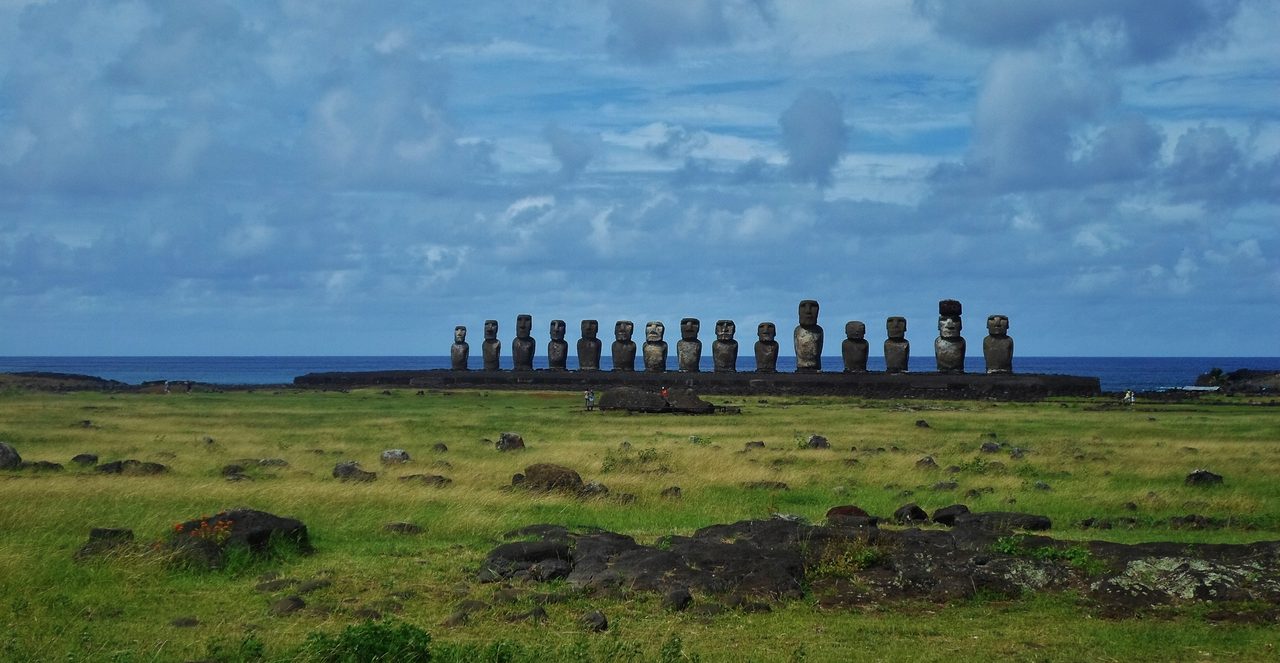
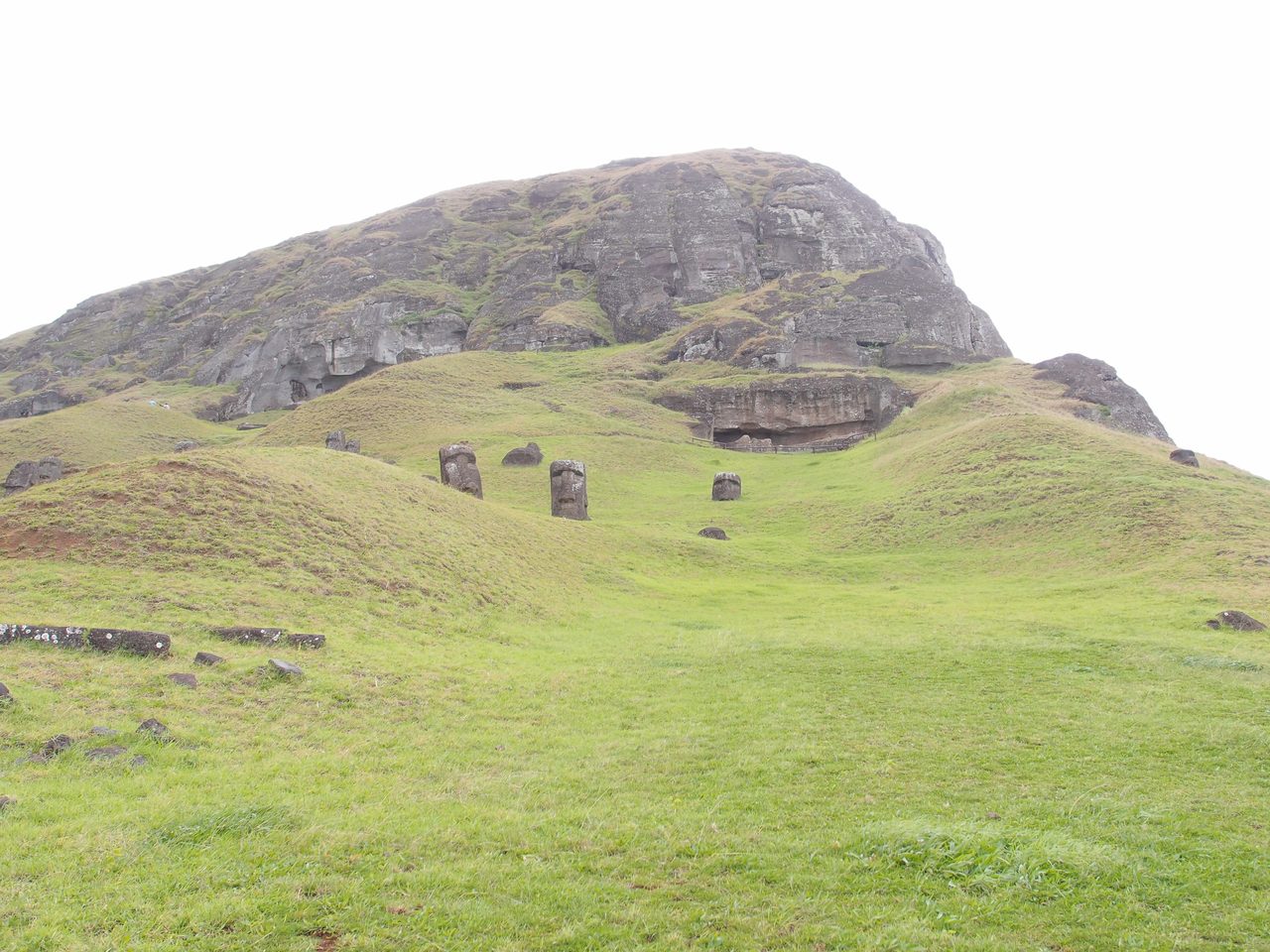
Nearly all of them came from one place. About 95 percent of Rapa Nui's moai were cut from the compressed volcanic tuff of a single crater, Rano Raraku, and then had to get somewhere else: onto stone platforms built along the coast. The average statue is about 4 meters of rock weighing about 12.5 tonnes. The largest one ever raised on a platform is 9.8 meters. The largest one ever started is 21.6 meters, estimated between 145 and 270 tonnes, and it is still lying in the quarry attached to the bedrock, because it never moved at all. In 2012 a team walked a 4.35-tonne concrete replica 100 meters, upright, on ropes, in about 40 minutes. That is a demonstration that the method works. It is not a receipt proving every statue moved that way, and this article keeps those two things apart. Here is the file, opened claim by claim, each one wearing its evidence.
Almost every moai on Rapa Nui was made in the same place. About 95 percent of them were cut from the compressed volcanic tuff of Rano Raraku, one crater on one island, and then they had to get somewhere else entirely: onto stone platforms called ahu, built along the coastline. The average statue is roughly 4 meters of rock weighing about 12.5 tonnes. The tools recovered from the quarry are basalt hand picks, thousands of them. So the question that organizes everything else on this page is a transport question, and unlike most questions of this kind it has an answer that was tested outdoors, on rope, in front of cameras, in 2012. Let's open the file.
01One Crater, 887 Statues
887 moai have been cataloged on Rapa Nui by the Easter Island Statue Project, directed by Jo Anne Van Tilburg and running since 1994. That is the standard figure, and it is a count of monolithic statues recorded with metric data across 55 morphological attributes. Broader inventory work by the same team has examined attributes for as many as 1,040 monolithic sculptural objects once related unfinished and fragmentary pieces are counted, which is where the popular framing of nearly 1,000 statues comes from. It is a rounding of the same body of work, not a second and higher count of moai.
About 95 percent of the moai were carved from lapilli tuff, a compressed volcanic rock, at the Rano Raraku quarry. About 397 of them are still there today, in every stage of the process at once: quarried, partly carved, or abandoned in transit. That is 397 statues against a catalog of 887, so close to half of every moai recorded on the island is still standing, lying, or half-emerged at the place that made it.
Average moai dimensions run to about 4 meters tall and about 12.5 tonnes, and the range around that average is wide. The smallest completed statue is 1.13 meters. The largest ever actually erected on an ahu is 9.8 meters, at Ahu Te Pito Kura.
The carving tools were basalt toki, hand picks, and thousands of them have been recovered from the quarry. Experimental archaeology puts the rough-out of a single moai at 12 to 18 months of work for a team of 15 to 20 carvers.
| Measure | The Figure |
|---|---|
| Cataloged | 887 moai (Easter Island Statue Project, from 1994). The popular framing of nearly 1,000 rounds a broader inventory of as many as 1,040 sculptural objects including unfinished and fragmentary pieces |
| Where They Came From | About 95 percent carved from lapilli tuff at Rano Raraku; about 397 are still there |
| Average | About 4 meters tall, about 12.5 tonnes |
| Smallest Completed | 1.13 meters |
| Largest Erected On An Ahu | 9.8 meters, at Ahu Te Pito Kura |
| Largest Ever Started | El Gigante (Te Tokanga), 21.6 meters, an estimated 145 to 270 tonnes, never separated from the bedrock |
| Carving Effort | 12 to 18 months to rough out one statue, for a team of 15 to 20 carvers, using basalt toki hand picks |
02The One That Never Left
El Gigante, Te Tokanga, is still attached to the bedrock at Rano Raraku. Our file gives it as 21.6 meters long and an estimated 145 to 270 tonnes, never separated from the quarry. Popular archaeology sources commonly cite the same statue as approximately 22 meters and about 182 tonnes. The figures move a little between sources for a simple reason: this statue was never fully separated and never weighed, so every mass figure for it is an estimate. Both sets of numbers describe the same unfinished monolith, and the spread between them is what an unmeasured block still lying in its quarry looks like, not a conflict in the record.
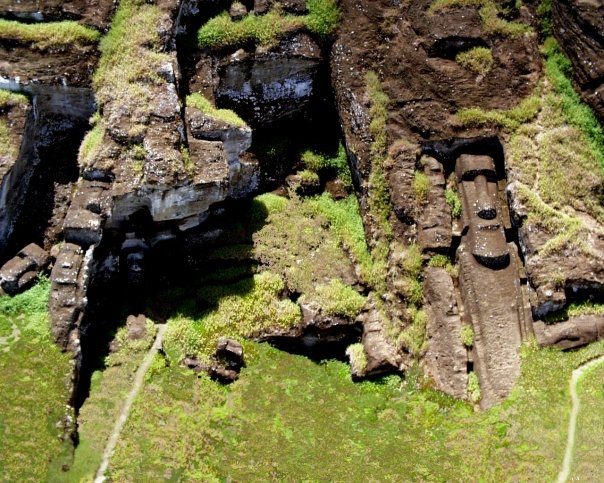
El Gigante was never finished, so nobody knows whether it was abandoned because it was too large to move, because the rock failed, or for some reason that left no trace at all. What it does establish is the ceiling on the ambition: the carvers were willing to start something 21.6 meters long. And it frames the question the rest of this page is about. Somewhere above the 12.5-tonne average there is a limit on what the island's transport method could handle, and section 05 is about where our own file places it.
03Where They Were Going
The ahu are rectangular stone platforms built along the coastline, some of them over 100 meters long, serving both as foundations for moai and as burial sites. About 300 have been identified. About 125 of them originally supported statues, which means most of the island's platforms never carried one.
Ahu construction used fitted basalt and scoria blocks over rubble-fill cores. Some of the joints are remarkably tight, though our own file is careful to say they are not as precise as Inca or Tiwanaku stonework.
The largest is Ahu Tongariki, 220 meters long, supporting 15 moai. The row standing there now is a restoration: a Chilean-led archaeological project with crane assistance donated from Japan, prompted by a 1988 remark from Sergio Rapu, the island's former governor and an archaeologist, wishing aloud for a crane. Our own file dates the work 1992 to 1995. Independent checking during this article's research pass finds the restoration agreement signed in October 1992 and multiple independent site histories placing completion in 1996, so this article carries 1992 to 1996. Everything else in the file's account of Tongariki, the size, the 15 statues, the Chilean-Japanese collaboration, and Rapu's remark, is independently corroborated.
One ahu gets singled out constantly, and it is worth naming here so it can be dealt with properly later. Ahu Vinapu is notable for fitted stonework in a style that has been compared to Inca masonry, and that comparison has been cited as evidence of contact with South America. The masonry is real and the debate about it is real. The attribution is not settled, and section 11 takes it up with the rest of the contact question.
04The Statues Walked
Rapa Nui's own tradition has its own answer to the transport question. It says they walked: te moai e haere. The only question worth asking about a line like that is whether it is a metaphor or a description, and since 2012 there has been a physical answer to it.
Hunt and Lipo proposed in their 2011 book The Statues that Walked that the moai were transported upright, rocked side to side with ropes pulled by teams of workers, in roughly the way a person walks a refrigerator across a kitchen floor.
Then they built one and tested it. Working with National Geographic and NOVA, Hunt and Lipo built a 4.35-tonne concrete replica moai in 2011, made to match an actual road statue's proportions, its forward lean, and its center of mass, and walked it in 2012. Three rope teams worked it, two at the sides and one behind, about 18 people in total. The replica covered 100 meters in about 40 minutes, moving on a forward lean of 5 to 15 degrees off vertical as the side ropes pulled in alternation. Lipo's own description of the experience: "Once you get it moving, it isn't hard at all, people are pulling with one arm. It conserves energy, and it moves really quickly."
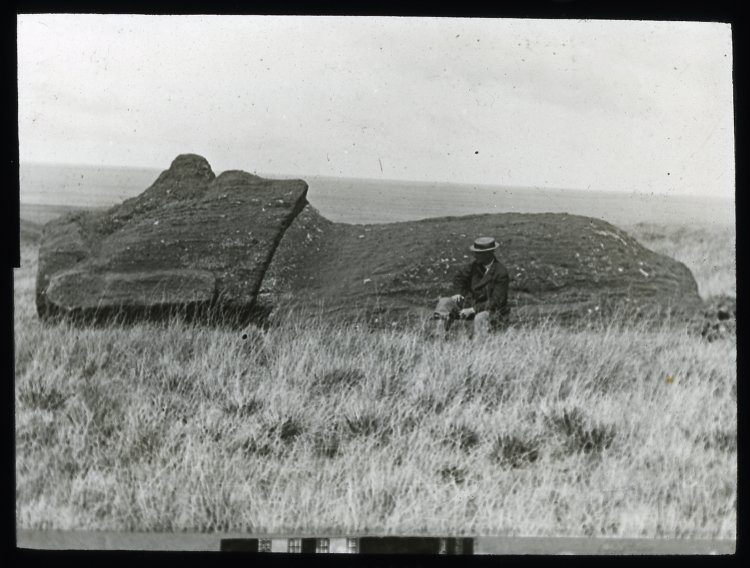
The experiment and the archaeology behind it were published as Lipo, Hunt and Haoa, The walking megalithic statues (moai) of Easter Island, in the Journal of Archaeological Science, volume 40, issue 6, pages 2859 to 2866, in 2013. Our own file leaves the DOI for it blank; it is 10.1016/j.jas.2012.09.029, confirmed through CrossRef during this article's research pass and linked in the sources below. And the paper's most interesting evidence is not the replica at all. It is the ground. The ancient moai transport roads are U-shaped in cross-section rather than flat, which is a poor shape for dragging a statue on a sledge and a good shape for guiding and stabilizing one that is upright and rocking.
Two further pieces of evidence line up with the method. The oral tradition, te moai e haere, describes exactly what the technique looks like from outside. And the moai lying along the ancient roads, the ones that never arrived, include statues found face down, which our file reads as consistent with falling forward during upright transport.
05Where the Walking Stops
The method has a boundary, and our own file states it rather than hiding it. Larger moai, over 20 tonnes, would be much harder to walk this way, and alternative methods, sledges, log rollers, or A-frame cradles, may have been used for the heaviest examples. What the evidence supports is walking as the primary method for the median-sized statue. It is not a demonstration that every moai on the island moved this way, and the largest ones are precisely the cases it does not cover.
There are three different masses in play on this page and it matters that they are not the same mass. The replica that was walked in 2012 weighed 4.35 tonnes. The average moai weighs about 12.5 tonnes. El Gigante, which never moved, is estimated between 145 and 270 tonnes. Our file grades walking as the credible primary method for the median statue and names 20 tonnes as the point above which it gets much harder. What was physically demonstrated on video is the lighter end of that span. Everything above it rests on the shape of the roads, the pattern of the fallen statues, and the physics, which is a real argument and a different kind of evidence from watching a statue cross 100 meters of ground.
06The Hats Came From a Second Crater
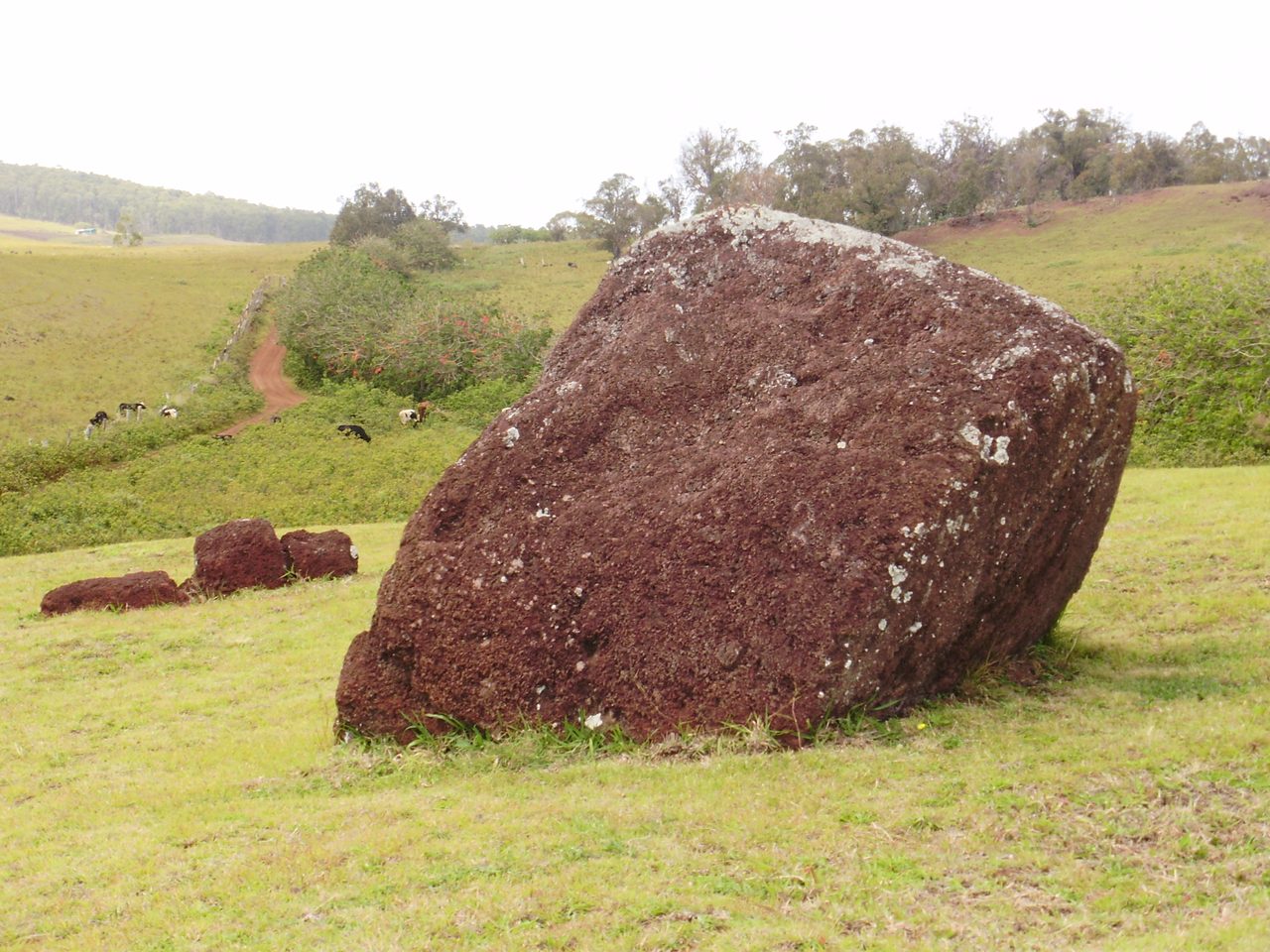
| Element | The Figure |
|---|---|
| Material And Source | Red scoria, quarried at Puna Pau, a separate crater from Rano Raraku |
| Count And Mass | About 100 pukao, cylindrical, from 1.5 to more than 12 tonnes each |
| Emplacement | Rolled to the ahu, then parbuckled up ramps onto already-erected moai, needing no more than about 15 people on ropes (Hixon, Lipo, McMorran and Hunt, 2018) |
The statues were not the only thing that had to be moved. About 100 pukao, the cylindrical topknots or headdresses that sat on moai heads, were carved from red scoria at Puna Pau, a crater entirely separate from the statue quarry. They weigh from 1.5 tonnes to more than 12, and they had to end up on top of a standing statue.
How that was done was worked out recently. Hixon, Lipo, McMorran and Hunt analyzed 3D models of 50 pukao from across the island together with 13 red scoria cylinders still lying at Puna Pau, publishing in the Journal of Archaeological Science in 2018. Their conclusion is that the pukao were rolled to the ahu sites and then parbuckled, levered up incrementally on ramps, onto moai that were already standing. The crew that requires is no more than about 15 people manipulating ropes to roll a cylinder up a ramp onto a forward-leaning statue.
Notice the shape both answers have in common. Neither one is a bigger machine or a lost technology. Both are a small crew, rope, leverage, and the object's own geometry doing part of the work, and both came out of research that rebuilt or modeled the problem instead of standing in front of the monument and calling it impossible.
07The Sequence, In Order
Initial Polynesian colonization of Rapa Nui occurred around 1200 CE. That is a revision, and it moved the date later rather than earlier: previous estimates ran from 400 to 800 CE, and radiocarbon recalibration on the earliest stratigraphic layers at Anakena reset it, published as Hunt and Lipo, Late Colonization of Easter Island, in Science in 2006.
Peak moai construction occurred roughly 1400 to 1600 CE. Construction ceased by roughly 1600 to 1650 CE, and many statues were toppled during later inter-clan conflicts, the huri moai or statue-toppling period. The row of 15 standing at Ahu Tongariki in section 03 is standing because a modern project put it back up.
Set those dates against each other, because the span is shorter than most people assume. Landfall around 1200. Peak statue building from about 1400, two centuries later. Carving stops somewhere around 1600 to 1650. The entire moai era, from the first settlers to the last statue, fits inside roughly 400 to 450 years.
European contact came with Jacob Roggeveen's arrival on Easter Sunday, 1722, which is where the island's European name comes from. Islanders were described as numbering roughly 2,000 to 3,000 at that time. Roggeveen therefore reached an island where the last moai had been carved somewhere between about 70 and 120 years earlier. No European observer ever saw the statue-building period; every written eyewitness account of Rapa Nui postdates it.
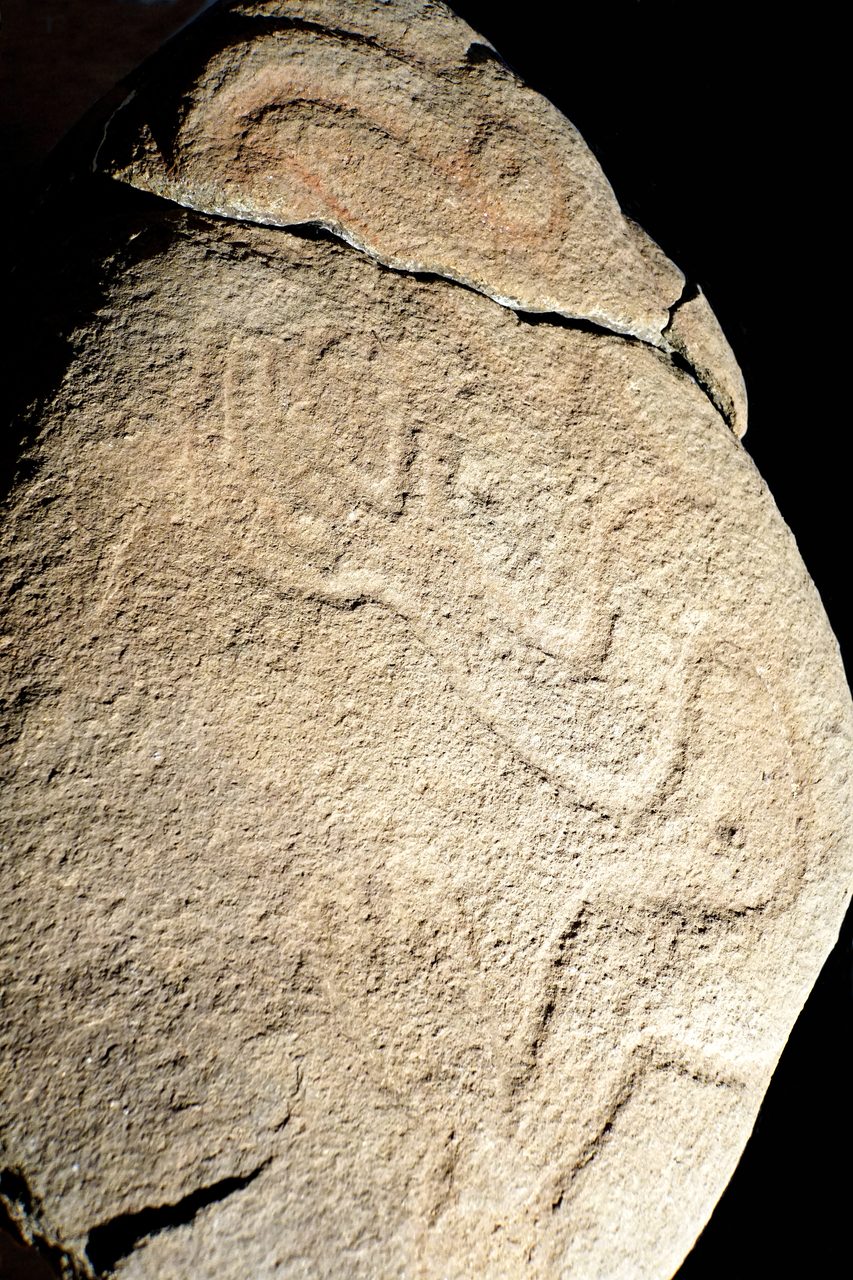
After moai construction ended, the island's ritual focus shifted to the Birdman cult, Tangata Manu, centered at Orongo village on the rim of the Rano Kau crater. In the annual competition, representatives of the island's clans raced to retrieve the first egg of the sooty tern from the offshore islet of Motu Nui; the winner's clan chief became the tangata manu, holding ritual authority for one year. Extensive petroglyphs of Makemake, the creator deity, and of birdman figures survive at Orongo.
| When | What Happened | What the Record Shows |
|---|---|---|
| About 1200 CE | Initial Polynesian colonization | Radiocarbon recalibration on the earliest stratigraphic layers at Anakena (Hunt and Lipo, Science, 2006) moved the date later, from earlier estimates of 400 to 800 CE |
| About 1400 to 1600 CE | Peak moai construction | The main statue-building period, beginning roughly two centuries after landfall |
| About 1600 to 1650 CE | Moai construction ceases | Many statues toppled during later inter-clan conflict, the huri moai or statue-toppling period |
| After construction ended | The Birdman cult at Orongo | Ritual focus shifts to Tangata Manu: clan representatives raced for the first sooty tern egg on Motu Nui, and the winner's clan chief held ritual authority for a year |
| 1722 | European contact | Jacob Roggeveen arrives on Easter Sunday, giving the island its European name; islanders described as numbering roughly 2,000 to 3,000 |
| 1862 onward | Post-contact disruption | Peruvian slave raids in 1862, introduced European disease, and introduced livestock. Section 10 is about where the evidence places the population decline relative to this date |
| 1992 to 1996 | Ahu Tongariki restored | 15 moai re-erected on the island's largest ahu by a Chilean-led project with donated Japanese crane assistance. Our file gives 1992 to 1995; independent checking places completion in 1996 |
08Facing the Village
The moai almost certainly represented deified ancestors, the ariki or chiefs, whose mana, spiritual power, was believed to radiate from the statues onto the land and the communities behind them. The direction they face is the tell. The moai look inland, toward the village, not out to sea. They were never watching the horizon for anything. They had their backs to it, facing the people they were there to protect.
Coral and red scoria eye inlays have been found for moai, and tradition holds that when the eyes were inserted the statue was activated, imbued with mana. That is the tradition as recorded. What tradition does not record is a procedure for switching one off again, which is a separate proposal, one tier down, waiting in section 11.
09The Writing Nobody Has Read
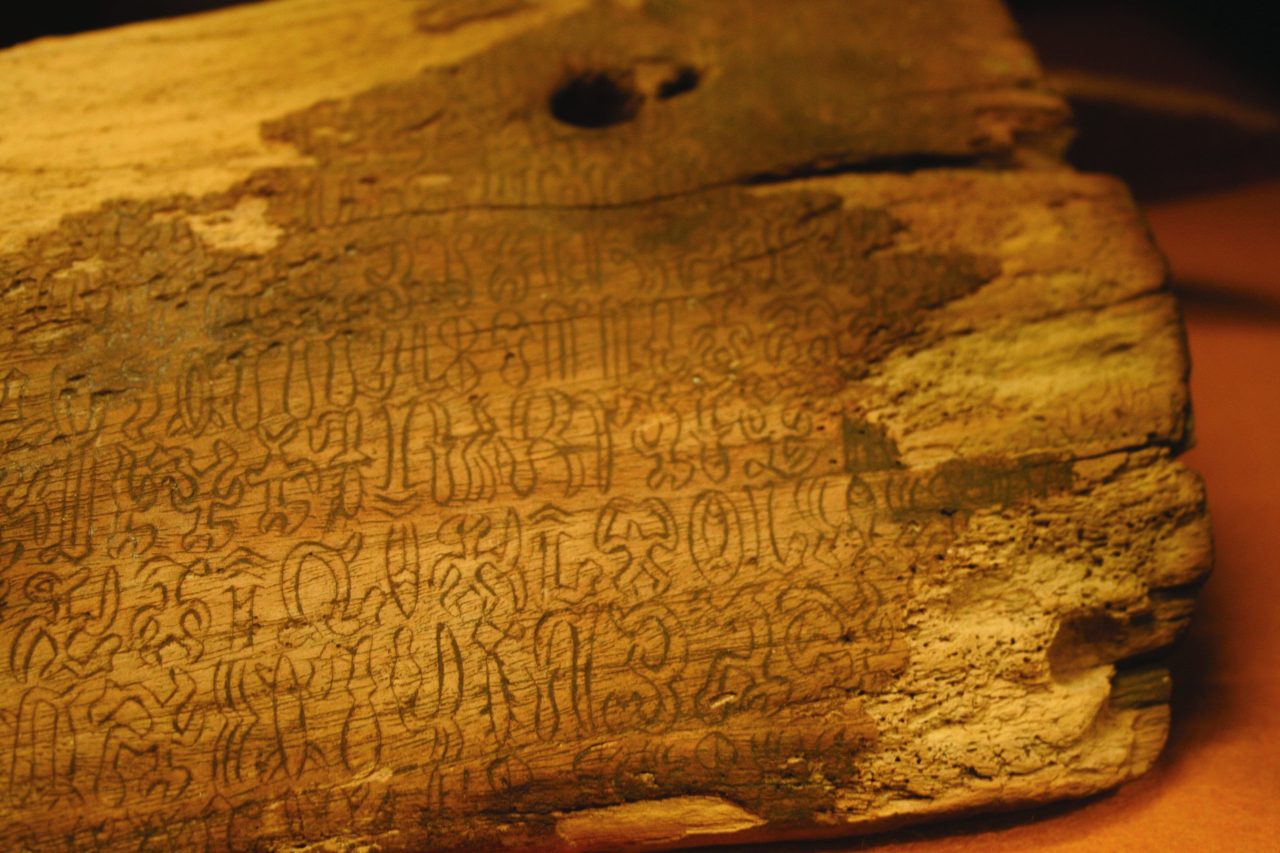
26 surviving artifacts carry rongorongo glyphs: wooden tablets, staffs, and a reimiro ornament, most of them now held in European museums. Decipherment has been attempted repeatedly, by Barthel in 1958, by Fischer in 1997, and by others. None of it is verified. If rongorongo is what it appears to be, it is one of only about four or five independent inventions of writing in human history, alongside Sumerian, Chinese, Mesoamerican, and possibly Indus Valley script.
Whether it is that, though, is exactly what is in dispute. Scholars are divided on whether rongorongo predates European contact or was invented after it, possibly prompted by the sight of Spanish written documents, with radiocarbon dates on the wood part of the argument. Our file states plainly that the question is unresolved, and so does this article. What is not in dispute is the form: rongorongo is written boustrophedon, alternating lines read in opposite directions with the glyphs inverted every other line, which is unique among the world's writing systems.
10The Collapse Argument, and What Has Changed
One more debate belongs on this page, briefly, because it is the one most readers arrive already holding and because our own file carries it. It is not this article's subject. The transport engineering is. But the state of the evidence on the collapse question has moved since our file was last sourced, and moved in a direction anyone can check, so leaving it out would be its own kind of dishonesty.
The ecocide model, argued by Jared Diamond in Collapse in 2005, holds that Rapa Nui's population grew past 15,000, and that unsustainable deforestation, for moai transport logs, for agriculture, and for canoes, caused ecological collapse, food shortage, warfare, cannibalism, and cultural disintegration, all of it before European contact.
The rat-destruction model, argued by Hunt and Lipo in 2006 and 2011, holds that Polynesian rats, Rattus exulans, introduced with the first settlers, ate palm seeds and prevented forest regeneration, making the deforestation primarily rat-driven rather than human-driven. In this model the population was never as high as Diamond claimed, roughly 3,000 to 4,000 at maximum, and the society was relatively stable until European diseases, the 1862 slave raids, and introduced livestock disrupted it.
Our file's own summary of where the field stands, written from source material through Stevenson and colleagues in 2015, is that most scholars accept a combination: human land use and rat predation both contributed to deforestation, while the scale and timing of the population decline remain debated. That is a fair reading of the literature as it stood in 2015. It is no longer the whole of the current evidence.
DiNapoli, Crema, Lipo, Rieth and Hunt applied Approximate Bayesian Computation to radiocarbon summed probability distributions and the paleoenvironmental record, publishing in Nature Communications in June 2021. Their results are consistent with a logistic population pattern, rapid initial growth followed by a plateau, and they found no evidence for a pre-contact demographic collapse. What the data show is resilience and continuity through the period before Europeans arrived. This study appears nowhere in our own file's bibliography.
Moreno-Mayar and colleagues then came at the same question from a completely different direction. Their 2024 paper in Nature reports whole-genome sequencing of 15 ancient Rapanui individuals radiocarbon dated between 1670 and 1950 CE, and finds no evidence of a sudden population crash, corroborating the 2021 demographic result by an independent method. The same study found that about 10 percent of the Rapanui gene pool is of Indigenous American genetic origin, with the timing of that admixture consistent with Polynesian and Native American populations meeting between the 13th and 15th centuries CE, before Roggeveen's arrival in 1722. That second finding belongs to section 11, and it is carefully bounded there.
Two questions have to stay separate here, and running them together is the standard mistake. The first is whether the island's population crashed before Europeans arrived. On that one, the 2021 and 2024 studies are the newest and most direct evidence available, they were produced by unrelated methods, radiocarbon modeling on one side and ancient DNA on the other, and they agree: no pre-contact collapse. This article says that plainly rather than hiding behind a flat both-sides summary, because the newest evidence genuinely does favor the resilience reading. The second question is what stripped the island of its forest, human clearance or rats or some mixture of the two. Neither of those studies is a study of deforestation, so neither one settles it. That question stays exactly where our file leaves it: contested, with real evidence on both sides, and no winner to crown.
11Where the Story Runs Off the Map
An island this strange and this photographed pulls big stories toward it. Some of them are open questions that the work has simply not been done on. Others fail against evidence that is already in hand. Those are two different categories, and this section keeps them apart on purpose, because collapsing them is how an honest uncertainty and a dead claim end up wearing the same clothes.
Start with the part of the South American contact question that is not speculative at all. The sweet potato, kumara, is a South American crop, it was cultivated on Rapa Nui before European contact, and DNA analysis confirms the pre-Columbian transfer occurred. And the 2024 ancient-genome study found about 10 percent Indigenous American ancestry in the Rapanui gene pool, with the admixture timed to a meeting between the 13th and 15th centuries CE. Contact happened, it happened before Europeans arrived, and the genetic evidence for it is materially stronger than the circumstantial case our file was working from.
What remains speculative is the inference built on top of that: that South American contact explains Rapa Nui's stonework or its statues. Ahu Vinapu's fitted masonry has been compared to Inca work, and Thor Heyerdahl's Kon-Tiki expedition in 1947 demonstrated that a Pacific crossing from South America was physically possible, an argument he expanded on Rapa Nui itself in Aku-Aku (1958). Possible is not the same as what happened. Genetic, linguistic, and archaeological evidence overwhelmingly supports West-to-East Polynesian colonization of Rapa Nui, and limited contact with South America, real as it now looks, was not the primary cultural input for the island's settlement or for its monumental building tradition. The 2024 study does not establish which direction anyone sailed, and evidence that two populations met is not evidence about who built the moai. These two claims should not be allowed to borrow each other's support.
A hypothesis holds that moai were ritually activated and deactivated by inserting or removing the eye inlays, functioning as a kind of spiritual power switch. It has real support behind it: ethnographic analogy from elsewhere in Polynesia, and the eye fragments themselves, which were found. What is missing is documentation. No ritual protocol for performing it is recorded. Section 08 carries the activation half at Tier 2 because tradition records that much; the removable-switch reading is the part that sits here.
Researchers have noted that Rano Raraku tuff has acoustic resonance properties. That is genuinely as far as this one goes: a limited study, not confirmed and not replicated in the peer-reviewed literature. It is on this page because our file carries it, at this tier, with that caveat attached to it rather than filed off.
Everything above this line is unproven. Everything below it is a different animal: claims that the evidence already collected contradicts. That distinction is the whole difference between a question nobody has answered yet and an answer that has already failed.
No, the moai were not carved or moved by extraterrestrials. There is no evidence behind the claim, and the quarry contains the entire production line in plain view: quarry marks, unfinished statues at every stage of the work, and thousands of recovered toki. Beyond that, the hardest step in the whole process, moving a finished statue, has been physically replicated at replica scale by a human crew with rope, and the second hardest, getting a multi-tonne pukao onto a standing moai, has a worked-out method behind it built from 3D models of the real cylinders. Every part of this leaves human evidence, and the difficult parts have been done again.
No, Rapa Nui is not the remnant of a lost continent. Claims of Mu or Lemuria have no geological or archaeological basis whatsoever. The island is a volcanic peak that formed about 750,000 years ago, and human occupation of it begins around 1200 CE.
No, the statues did not move themselves. Some fringe writers read te moai e haere literally, as evidence of telekinesis or lost advanced technology. Oral traditions use metaphor and poetic language, and in this specific case the metaphor turns out to describe a real physical technique with unusual precision: a statue rocked forward on ropes does walk, in the ordinary sense of the word. The tradition was not concealing a marvel. It was reporting a method, and the method was tested in 2012.
Fast Facts
- The Island
- Rapa Nui, Easter Island: a volcanic peak formed about 750,000 years ago, with Polynesian colonization from about 1200 CE
- The Statues
- 887 cataloged by the Easter Island Statue Project, directed by Jo Anne Van Tilburg since 1994; about 95 percent carved from lapilli tuff at the Rano Raraku quarry
- Size
- About 4 meters and about 12.5 tonnes on average; 1.13 meters for the smallest completed statue; 9.8 meters for the largest ever erected on an ahu, at Ahu Te Pito Kura
- Still At the Quarry
- About 397 moai remain at Rano Raraku, quarried, partly carved, or abandoned in transit, close to half of the whole catalog
- The One That Never Left
- El Gigante, Te Tokanga: 21.6 meters and an estimated 145 to 270 tonnes, still attached to the bedrock. Popular sources commonly give approximately 22 meters and about 182 tonnes for the same never-weighed monolith
- The Tools
- Basalt toki hand picks, thousands recovered from the quarry; 12 to 18 months to rough out one statue for a team of 15 to 20 carvers
- The Destination
- About 300 ahu identified, some over 100 meters long, built of fitted basalt and scoria over rubble-fill cores; about 125 originally carried moai
- The Largest Platform
- Ahu Tongariki, 220 meters long, carrying 15 moai, re-erected 1992 to 1996 by a Chilean-led project with donated Japanese crane assistance
- The Topknots
- About 100 pukao of red scoria from Puna Pau, 1.5 to more than 12 tonnes, rolled to the ahu and parbuckled up ramps onto standing statues by no more than about 15 people (Hixon, Lipo, McMorran and Hunt, 2018)
- The Walking Test (Tier 2)
- A 4.35-tonne concrete replica, three rope teams, about 18 people, 100 meters in about 40 minutes, rocking on a forward lean of 5 to 15 degrees. Published in the Journal of Archaeological Science in 2013
- The Road Evidence (Tier 2)
- Ancient moai transport roads are U-shaped in cross-section, poor for dragging a sledge and good for stabilizing an upright statue; moai fallen along those roads include statues found face down, which our file reads as consistent with falling forward while upright
- The Named Limit (Tier 2)
- Moai over 20 tonnes would be much harder to walk, and sledges, log rollers, or A-frame cradles may have been used for the heaviest. Walking is supported as the primary method for the median statue, not proven for every statue on the island
- Chronology
- Colonization about 1200 CE; peak construction about 1400 to 1600 CE; carving ceases about 1600 to 1650 CE; Jacob Roggeveen arrives on Easter Sunday 1722, with islanders described as numbering roughly 2,000 to 3,000
- After the Statues
- The Birdman cult, Tangata Manu, at Orongo on the rim of Rano Kau: a race for the first sooty tern egg on Motu Nui, with the winner's clan chief holding ritual authority for a year
- The Script (Tier 2)
- 26 surviving rongorongo artifacts, undeciphered, written boustrophedon with glyphs inverted on alternate lines. Possibly one of only four or five independent inventions of writing, and possibly a post-contact invention, which is unresolved
- Population Collapse (Tier 1, and Newer Than Our File)
- DiNapoli and colleagues (Nature Communications, 2021) find no evidence for a pre-contact demographic collapse; Moreno-Mayar and colleagues (Nature, 2024) sequence 15 ancient genomes and find no sudden crash either
- Deforestation Cause (Tier 2, Still Contested)
- Whether the forest fell to human land clearance, to Polynesian rats eating palm seeds, or to both, is not settled by either of those studies and remains a live debate. It is a different question from the one above it
- Contact With the Americas (Tier 1)
- The pre-Columbian sweet potato transfer is genetically confirmed, and about 10 percent of the Rapanui gene pool is of Indigenous American origin, with admixture timed between the 13th and 15th centuries CE
- Interesting But Unproven (Tier 3)
- South American contact as the cultural or technological source of the moai tradition; the eye inlays as a removable activation switch; acoustic resonance in Rano Raraku tuff. Unproven is not disproven, and these sit in a different category from the row below
- Not Supported (Tier 4)
- That extraterrestrials made or moved the moai; that Rapa Nui is a remnant of Mu or Lemuria; that the statues walked by literal telekinesis. These are contradicted by evidence already in hand, not merely unproven
What We Can Actually Stand Behind
887 moai are cataloged on Rapa Nui by the Easter Island Statue Project, and about 95 percent of them were cut from lapilli tuff at the single Rano Raraku quarry, where about 397 remain in every stage of completion. They average about 4 meters and about 12.5 tonnes, ranging from a 1.13-meter completed statue to the 9.8-meter giant raised at Ahu Te Pito Kura, with El Gigante at 21.6 meters and an estimated 145 to 270 tonnes still attached to the bedrock. The tools were basalt toki, thousands of them recovered, and a team of 15 to 20 carvers needed 12 to 18 months to rough out one statue. They were going to the ahu: about 300 platforms of fitted basalt and scoria on rubble-fill cores, about 125 of which originally carried moai, the largest being Ahu Tongariki at 220 meters with 15 statues, re-erected between 1992 and 1996.
Polynesian colonization dates to around 1200 CE, revised later from earlier estimates of 400 to 800 CE by radiocarbon recalibration at Anakena (Hunt and Lipo, Science, 2006). Peak construction runs roughly 1400 to 1600 CE and carving ceases by roughly 1600 to 1650 CE, with many statues toppled afterward in inter-clan conflict, the huri moai period. Jacob Roggeveen arrived on Easter Sunday 1722, between about 70 and 120 years after the last statue was carved, and described roughly 2,000 to 3,000 islanders. No European observer ever saw the statue-building period. By then the island's ritual life had moved to the Birdman cult at Orongo and a race for the first sooty tern egg on Motu Nui.
The best-supported answer to how the moai crossed the island is that they were walked: rocked side to side upright, on ropes, by teams of workers. Hunt and Lipo proposed it in 2011 and then tested it, walking a 4.35-tonne concrete replica built to a real road statue's proportions, lean, and center of mass 100 meters in about 40 minutes, with three rope teams totaling about 18 people and a working lean of 5 to 15 degrees off vertical. The archaeology published alongside it in the Journal of Archaeological Science in 2013 is arguably the stronger half: the ancient transport roads are U-shaped in cross-section, wrong for dragging a sledge and right for stabilizing an upright rocking statue. The oral tradition says the statues walked, and the moai fallen along those roads include statues found face down, consistent with falling forward while upright. Credible and tested, and still an inference about the past rather than a record of it.
Our own file names the boundary and this article keeps it visible. Moai over 20 tonnes would be much harder to walk this way, and sledges, log rollers, or A-frame cradles may have been used for the heaviest statues. Note the three masses involved: the replica that was physically walked weighed 4.35 tonnes, the average moai is about 12.5 tonnes, and El Gigante is estimated between 145 and 270 tonnes. What the walking hypothesis is well supported as is the primary method for a median-sized statue. It is not proven as the universal method for every moai ever moved, and the largest ones are exactly the cases it does not reach.
Rongorongo does not resolve. 26 artifacts survive carrying its glyphs, no decipherment is verified after attempts from Barthel in 1958 through Fischer in 1997 and others, and scholars are divided on whether the script predates European contact or was invented after it, possibly prompted by seeing Spanish written documents. If it is pre-contact, it is one of only about four or five independent inventions of writing in human history. If it is post-contact, it is not. Nothing currently settles which, and this article does not pretend otherwise.
On the population question specifically, the newest evidence favors resilience and continuity over Diamond's pre-contact ecocide collapse, and this article says so plainly rather than resting on a flat both-sides summary. DiNapoli and colleagues, in Nature Communications in 2021, applied Approximate Bayesian Computation to radiocarbon and paleoenvironmental data and found a logistic growth-then-plateau pattern with no evidence of a pre-contact demographic collapse. Moreno-Mayar and colleagues, in Nature in 2024, sequenced whole genomes from 15 ancient Rapanui individuals dated 1670 to 1950 CE and likewise found no sudden crash, corroborating the earlier result by an entirely different method. Neither study is in our own file's bibliography, which is sourced through 2015. Both are linked below.
What caused the deforestation is a separate matter and it stays contested. Diamond's model attributes it to human land use for transport logs, agriculture, and canoes; Hunt and Lipo's attributes it primarily to Polynesian rats eating palm seeds and preventing forest regeneration, with a maximum population of roughly 3,000 to 4,000 rather than 15,000 and a society disrupted mainly after contact, by disease, the 1862 slave raids, and introduced livestock. Our file's own reading, sourced through Stevenson and colleagues in 2015, is that both contributed. The 2021 and 2024 studies are studies of population, not of forest loss, so they do not settle this one, and nothing here crowns a winner.
Three ideas are honest to hold and impossible to bank, and they are unproven rather than refuted, which puts them in a different category from the line below. First, South American contact as a cultural or technological source for the moai tradition. The contact itself is now Tier 1 evidence, through the confirmed pre-Columbian sweet potato transfer and about 10 percent Indigenous American ancestry in the Rapanui gene pool dated between the 13th and 15th centuries. What stays speculative is the leap from that to Ahu Vinapu's masonry or to the statues themselves, since genetic, linguistic, and archaeological evidence overwhelmingly supports West-to-East Polynesian colonization, and Kon-Tiki proved a crossing possible rather than actual. Second, the eye inlays as a removable activation switch: supported by Polynesian ethnographic analogy and by the recovered fragments, undocumented as a ritual protocol. Third, acoustic resonance in Rano Raraku tuff, which rests on one limited study, unconfirmed and unreplicated.
No, extraterrestrials did not make or move the moai. The quarry holds the whole production line, quarry marks, unfinished statues at every stage, and thousands of recovered toki, and the hardest step of all has been physically replicated at replica scale by a human crew with rope. No, Rapa Nui is not a remnant of Mu or Lemuria; that has no geological or archaeological basis, the island is a volcanic peak about 750,000 years old, and people arrived around 1200 CE. And no, the statues did not walk by telekinesis or lost technology. The tradition that says they walked is using ordinary language for a physical technique, which is why a crew of about 18 with three ropes could reproduce it.
So the honest version takes nothing away from Rapa Nui. It moves the marvel off the stone and onto the people standing around it: three ropes, roughly eighteen pairs of hands, and enough understanding of a statue's center of mass that the researcher who tested it described his crew pulling with one arm. The island's own tradition said the statues walked, and it turns out that was not myth wrapped around a lost secret. It was a technical description, accurate in the ordinary sense of the word, and it was still in the language centuries after the last statue was carved. Two things stay genuinely open, and both are worth carrying out of here. The heaviest moai are not covered by what was demonstrated, so how the largest statues crossed the island remains an argument from roads and physics rather than something anyone has watched happen. And why the whole enterprise stopped is not answered anywhere in this file, which the newest evidence makes harder rather than easier, since it says the population did not collapse before Europeans arrived. Carving ends somewhere around 1600 to 1650, and the ritual life of the island turns to a footrace for the first egg of a sooty tern. What makes a people who spent centuries walking their ancestors across an island put down the ropes and go looking for a bird?
Sources & further reading
Everything above is drawn from our research library on Theories of Anything, principally the Rapa Nui engineering file D_3_03, whose own header rates it Tier 1 to 2 and says outright that transport mechanisms and collapse causation are debated. Four things in this article come from independent checking during its research pass rather than from that file, and each is flagged where it appears. The Ahu Tongariki restoration: our file dates the work 1992 to 1995, while the restoration agreement was signed in October 1992 and multiple independent site histories place completion in 1996, so this article carries 1992 to 1996. The two most decisive recent studies on the population question, DiNapoli and colleagues in Nature Communications in 2021 and Moreno-Mayar and colleagues in Nature in 2024, appear nowhere in our file's bibliography, which is sourced through 2015; both are linked below and both are named in the text as newer than the file. El Gigante's figures vary modestly between sources, our file's 21.6 meters and 145 to 270 tonnes against the commonly cited approximately 22 meters and about 182 tonnes, because the statue was never fully separated from the bedrock and never weighed; both describe the same monolith and section 02 says so. And the statue count is one number, not two: 887 is the cataloged figure, and the popular framing of nearly 1,000 rounds a broader inventory of up to 1,040 sculptural objects including unfinished and fragmentary pieces. Housekeeping belongs here rather than being passed along quietly. Four of our file's bibliography entries left the DOI field empty; the real identifiers were located and verified through CrossRef during this article's research pass, and they are what the links below use. Three other entries carry a DOI that in fact resolves to a review of the book rather than to the book itself, which is why Hunt and Lipo's The Statues that Walked, Diamond's Collapse, and Heyerdahl's Aku-Aku are named in the text above and not linked here. Open the full file to check the sourcing and go deeper.
Image credits
- Fifteen re-erected moai on Ahu Tongariki, Rapa Nui Claire Provost, via Wikimedia Commons (CC BY-SA 3.0). CC BY-SA 3.0 Source.
- Moai partially buried on the slope of the Rano Raraku quarry Dalivor Zapata, via Wikimedia Commons (CC BY-SA 3.0). CC BY-SA 3.0 Source.
- Aerial helicopter view of El Gigante at the Rano Raraku quarry Alejandra Edwards, via Wikimedia Commons (CC BY-SA 3.0). CC BY-SA 3.0 Source.
- A fallen moai on an ancient transport road, Mana Expedition, 1914-1915 Unknown photographer, British Museum (object Oc,G.T.1762), Public Domain Mark. Public Domain Mark 1.0 Source.
- A pukao at the Puna Pau quarry, Rapa Nui Jorge Morales Piderit, via Wikimedia Commons (CC0). CC0 Source.
- Birdman petroglyph at Orongo, Rapa Nui Dennis G. Jarvis, via Wikimedia Commons (CC BY-SA 2.0). CC BY-SA 2.0 Source.
- Original rongorongo tablet, Bishop Museum, Honolulu christopherhu, via Wikimedia Commons (CC BY 2.0). CC BY 2.0 Source.
- Card crop of the Ahu Tongariki moai Claire Provost, via Wikimedia Commons (CC BY-SA 3.0). CC BY-SA 3.0


,_with_a_White_man_wearing_a_hat_and_a_moustache,_sitting_in_front_of_it,_for_scale;_Oc,G.T.1762,_Mana_Expedition_to_Easter_Island,_British_Museum.jpg)

.jpg)
.jpg)