
The Minoans: Europe's First Civilization, Lost to a Volcano
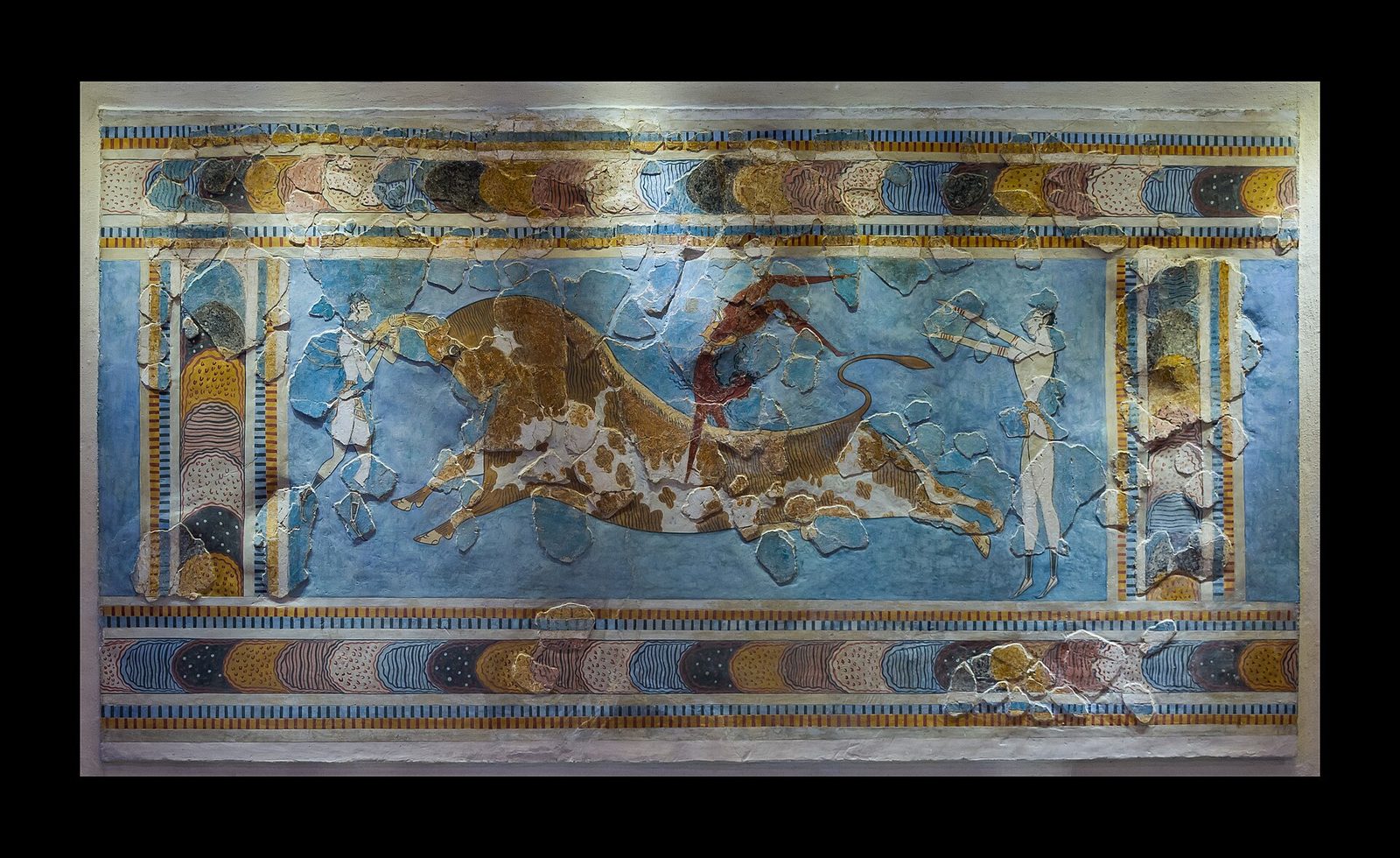
We do not know what they called themselves. The name is an archaeologist's, taken from Greek myth in 1900, and their writing has never been read. The volcano is real and the date of it has been the most famous argument in Bronze Age archaeology for thirty years. It has just moved, and not in the direction most people expect.
Begin with what we do not have. We do not know what these people called themselves, or what they called their island, or what language they spoke. Their administrative tablets survive in the thousands and nobody can read them. The word Minoan was coined by Arthur Evans in 1900, out of Greek mythology, for a civilization that had been gone for centuries before the Greeks who told those myths were born. Every sentence written about them, including this one, is written in somebody else's vocabulary.
What we do have is very good: palace complexes, a Mediterranean trade network traceable in pottery, a town buried under volcanic ash with its furniture in place, and a volcano whose eruption our own file measures at sixty cubic kilometres of ejected tephra. And a date for that eruption which has been argued over for thirty years, and which has just moved, from a direction that surprises people who have followed the argument.
01What Evans Found, And What He Built
Arthur Evans excavated Knossos from 1900 to 1935 and established the chronological framework still used in outline: Prepalatial from 2700 to 1900 BCE, Old Palace from 1900 to 1700, New Palace from 1700 to 1450, and Final Palace from 1450 to 1380. Our research file gives Knossos as covering roughly 20,000 square metres with over 1,300 rooms in its final phase, and describes the palaces as economic redistribution centres rather than royal residences in the Near Eastern sense: extensive magazines of pithoi for oil, wine and grain, with workshops for metal, pottery and textiles attached. Those figures are our file's and were not externally verified for this article.
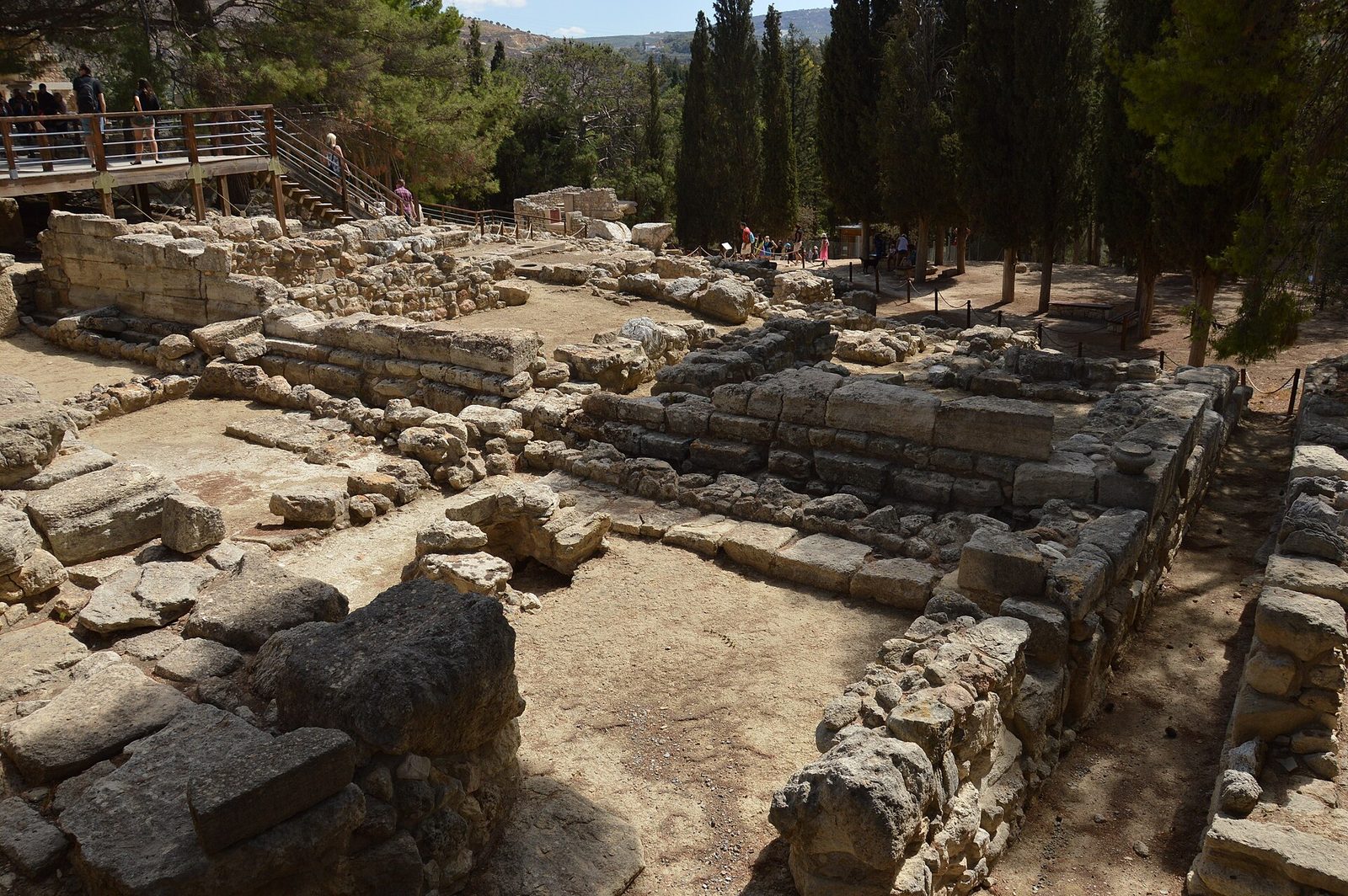
Evans did not only excavate Knossos, he rebuilt a great deal of it. Our own file records Nicoletta Momigliano and others criticising that reconstruction: concrete reinforcement, frescoes repainted from fragmentary evidence, and room names assigned out of Greek mythology. This is not a footnote about conservation ethics. Because Linear A cannot be read, Minoan civilization is understood almost entirely through material culture and iconography, and a substantial part of what a reader pictures when they picture Minoan Crete is an early twentieth-century reconstruction of a fragment. The hero image at the top of this page is one of them, and you can see the joins.
02A Script That Stays Shut
The Minoans used two writing systems, Cretan Hieroglyphic and Linear A. Linear A tablets, which our file numbers at roughly 1,500 known documents dating from about 1800 to 1450 BCE, record administrative transactions and remain undeciphered despite computational analysis. Linear B, which succeeded it at Knossos, was deciphered and turned out to record Greek, and our own file reads those tablets as attesting a Mycenaean warrior elite in control of the palace from around 1450 BCE. Linear A is the earlier system, in the earlier language, and it has not yielded. The structural problem is familiar from other unread scripts: a small corpus, no bilingual text, and a language with no known relatives.
03The Town With No Bodies
The eruption buried the Minoan settlement of Akrotiri on Thera under tephra and preserved it. Spyridon Marinatos began excavating in 1967 and recovered elaborate frescoes, three-storey buildings and indoor plumbing. The comparison everyone reaches for is Pompeii, and the comparison breaks in the most important place. Akrotiri has produced no human remains and no precious objects. Our file reads that as evidence of advance warning and organised evacuation, which is the natural reading and which should be held as a reading rather than a certainty: an absence is evidence, but it is the kind of evidence that can have more than one cause. What can be said is that the excavated town is empty of both people and valuables, and that a town abandoned in a hurry usually is not.
04The Most Famous Date Argument In Bronze Age Archaeology
For about thirty years this was the shape of it. Radiocarbon, working on organic material buried by the eruption, pointed to the seventeenth century BCE. Archaeology, working on Egyptian and Near Eastern chronological synchronisms, pointed to the sixteenth. The gap was roughly a century, which does not sound like much until you notice that it displaces the entire Bronze Age chronology of the eastern Mediterranean relative to Egypt's, and therefore who was trading with whom, and when.
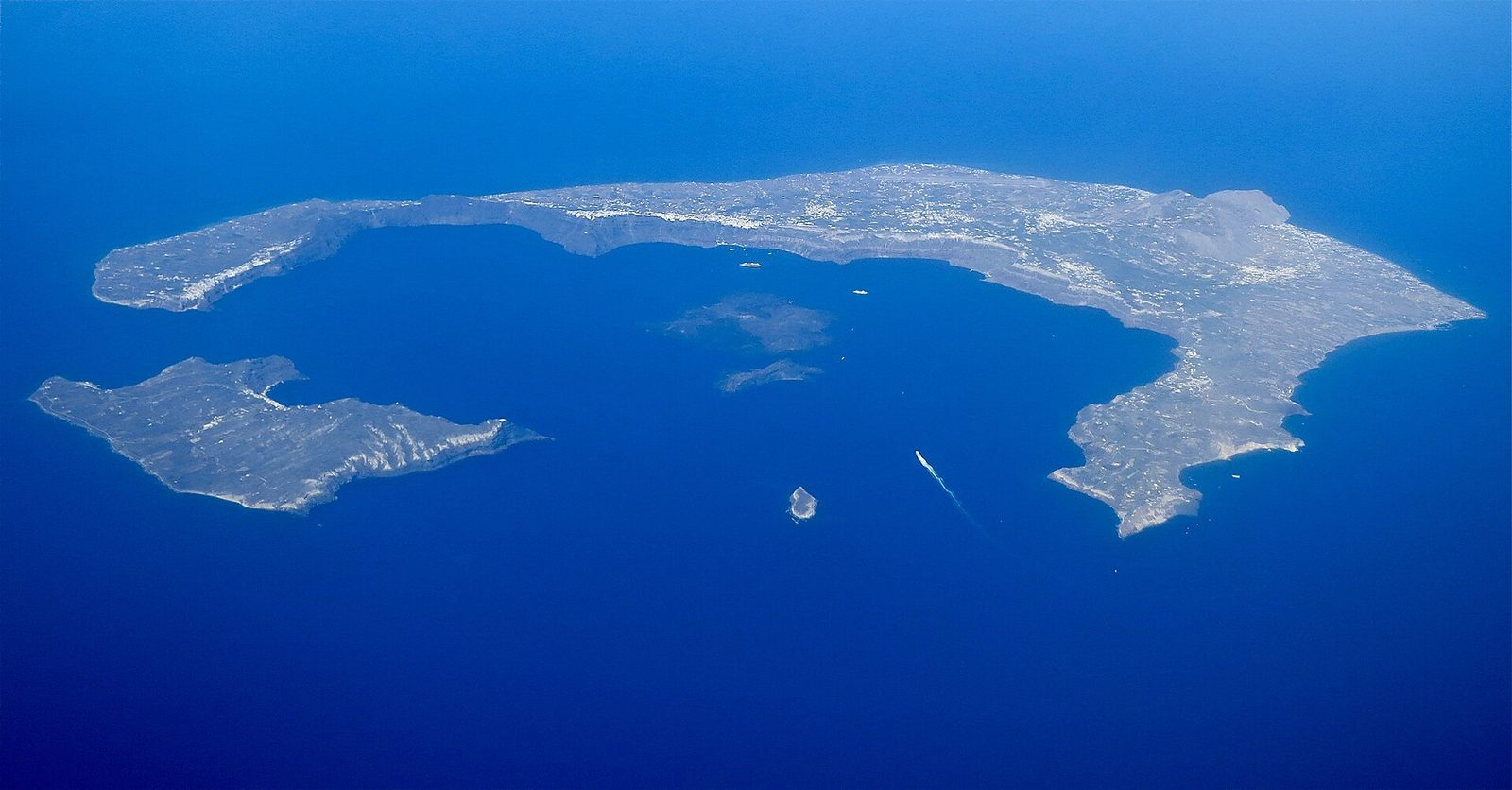
The seventeenth-century position has a specific source. Walter Friedrich and colleagues published Santorini Eruption Radiocarbon Dated to 1627 to 1600 BC in Science in 2006, working from an olive branch buried alive by the eruption. That is the result our own research file reports, and it held the field for more than a decade. Nothing below debunks it. It is being superseded by later work with better calibration, which is a different and much more ordinary thing than being wrong.
The radiocarbon date has moved toward the sixteenth century, and it moved from inside radiocarbon science. Charlotte Pearson and colleagues published Annual radiocarbon record indicates 16th century BCE date for the Thera eruption in Science Advances in 2018; their own summary is that new annual radiocarbon calibration data offer a resolution to the controversial dating. Sturt Manning and colleagues published Mediterranean radiocarbon offsets and calendar dates for prehistory in Science Advances in 2020, reporting that intra-annual offsets in Northern Hemisphere atmospheric radiocarbon levels challenge and complicate Old World radiocarbon dating, which is the mechanism. And in 2023 Pearson, with Sbonias, Tzachili and Heaton, published new radiocarbon evidence from an olive shrub carbonised by the same eruption deposits on neighbouring Therasia, supporting a mid-sixteenth-century date.
| Position | Evidence | What It Means For The Argument |
|---|---|---|
| The archaeological date, sixteenth century BCE | Egyptian and Near Eastern chronological synchronisms, as our own file describes them | Held by archaeologists throughout the dispute. Never moved, and has now been approached from the other side |
| The radiocarbon date, seventeenth century BCE | Friedrich and colleagues, Science 2006: an olive branch buried by the eruption, dated 1627 to 1600 BC | The high date our own file reports. Serious, published, and held the field for over a decade |
| Annual-resolution recalibration | Pearson and colleagues, Science Advances 2018: an annual radiocarbon record indicating a sixteenth-century date | The radiocarbon side moves. Not archaeology defeating science, but a finer instrument inside the same science |
| The mechanism | Manning and colleagues, Science Advances 2020: intra-annual Mediterranean radiocarbon offsets | Explains WHY the older dates ran high. Regional and seasonal variation in atmospheric radiocarbon that a single calibration curve does not capture |
| New material | Pearson, Sbonias, Tzachili and Heaton, Scientific Reports 2023: an olive shrub on Therasia carbonised by the same deposits | Independent plant, neighbouring island, same eruption, mid-sixteenth-century date |
| Still open | Raj and colleagues, Radiocarbon 2023, calibrating multiple tree-ring blocks against this debate | People are still publishing on it. Converging is not the same as concluded, and this page does not print a single date as settled |
05And The Eruption Is Not The Collapse
The title of this article says lost to a volcano, and that is the story everybody knows, and the dates do not support it in the simple form. Our own file puts the Minoan collapse at around 1450 BCE and notes that Knossos itself survived until about 1370. Even on the new sixteenth-century date, the eruption precedes the collapse by roughly a century; on the old seventeenth-century date, by nearly two. A century is longer than most civilizations' entire recorded histories. Our file's own reading is the more careful one: the eruption likely devastated maritime infrastructure and triggered cascading ecological and economic failure, rather than ending anything directly. The volcano is real, the damage is real, and the welding of eruption to collapse into a single event is a narrative convenience.
McCoy and Heiken published Tsunami Generated by the Late Bronze Age Eruption of Thera in Pure and Applied Geophysics in 2000. Our file renders their estimated run-up on northern Crete as 35 to 150 metres, and that range should be read as the range it is: the low and high ends differ by a factor of more than four, which tells you how much modelling sits between a caldera collapse and a number for how high the water went at a particular shore.
06Three Places Our Own File Argues With Itself
This is worth doing explicitly, because on this subject our research file states a popular position and then supplies the objection to it, and the objection is consistently the better-calibrated half. A reader who takes only the first sentence of each pair gets the version that circulates. A reader who takes both gets the state of the field.
| The Subject | What The File States | What The Same File Then Says |
|---|---|---|
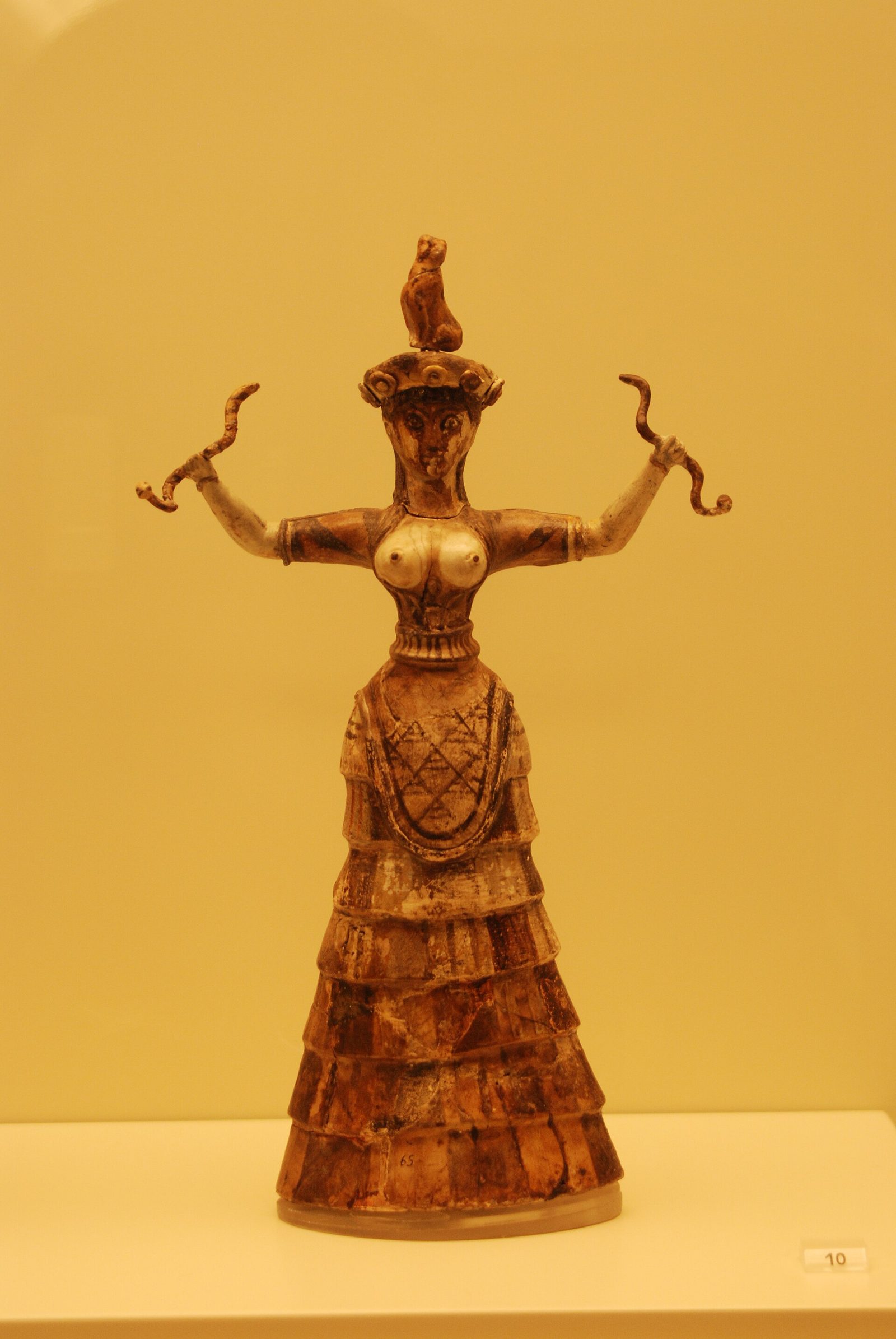
| Religion | Minoan religion centred on a goddess or goddesses, evidenced by the Snake Goddess figurines, peak sanctuaries, sacred caves and tree-cult scenes, with male deities subordinate. Argued by Nanno Marinatos and Lucy Goodison | Peter Warren and others caution that a Mother Goddess lens imports modern frameworks onto ambiguous evidence, that the Snake Goddess may be a votary rather than a deity, and that Evans's restorations bias the interpretation |
| The missing fortifications | Minoan palaces and towns had no walls or gates, and Minoan art has no battle scenes. Read as the Pax Minoica: naval supremacy making land defence unnecessary, with Thucydides attributing the first thalassocracy to Minos | A Minoan army existed, with military frescoes at Akrotiri's West House and weapons in tombs, and the absence of walls may reflect periodic destruction preventing wall construction rather than peace |
| Atlantis | Plato's Atlantis may preserve garbled Egyptian memory of Thera and the Minoan collapse: an island maritime civilization, bull cult, sudden destruction, Egyptian contact. Proposed by K.T. Frost in 1913, developed by Marinatos and Luce | Plato places Atlantis in the Atlantic beyond the Pillars of Heracles, his date is off by an order of magnitude, and most classicists including Christopher Gill read the story as philosophical allegory. This library treats Atlantis in its own article in this wing |
| Matriarchy | The prominence of female figures and the absence of monumental royal male portraiture led Marija Gimbutas and others to describe the society as matriarchal or markedly gender-egalitarian | Direct documentary evidence is unavailable because Linear A is undeciphered, and the Mycenaean takeover around 1450 BCE may have erased evidence of earlier structures. An argument from iconography and from absence, about a society whose own writing cannot be read |
07What They Traded, And How Far
Minoan seafaring is attested by where their pots ended up. Kamares ware, from about 1900 to 1700 BCE, and Marine Style pottery from about 1500, are found in Egypt at Tell el-Dab'a, in the Levant at Ugarit and Byblos, in Cyprus, across the Cyclades and on mainland Greece. Egyptian tomb paintings at Thebes depict the keftiu, people from beyond, as tribute bearers in Minoan dress. Our file also cites the Uluburun shipwreck, excavated by George Bass and Cemal Pulak, as containing Minoan-style cargo, and there the file's own date does some work: Uluburun is given as around 1300 BCE, which is well after the Minoan palatial period, so it evidences the reach of Aegean maritime trade rather than Minoan shipping directly.
08What It Is Not
Claims that Minoans reached the Americas, based on alleged similarities between Minoan and Mesoamerican iconography or on purported ancient DNA matches, are refused, and our own file marks them debunked. No Minoan artefact has been found in the New World, and Minoan vessels were built for the Mediterranean. The iconographic argument is the weak part and it is worth naming why, because the same move gets made about many unconnected cultures: bulls and spirals are generic. Two societies that both carve spirals have told you that spirals are easy to carve, not that they met.
Fast Facts
- The Name
- Coined by Arthur Evans in 1900 from the mythological King Minos. We do not know what these people called themselves, because Linear A is undeciphered
- When
- Crete and the Aegean islands, roughly 2700 to 1450 BCE, with Knossos surviving to about 1370. Our file's dates
- The Excavation
- Evans at Knossos, 1900 to 1935, who also rebuilt much of it in concrete and repainted frescoes from fragments
- The Writing
- Two systems. Cretan Hieroglyphic and Linear A, roughly 1,500 known Linear A documents, none of it read. Linear B, its successor, records Greek and is deciphered
- Akrotiri
- A Minoan town on Thera buried by the eruption and excavated from 1967. Frescoes, three-storey buildings, indoor plumbing, and NO human remains and no precious objects
- The Eruption's Size
- Our file gives sixty cubic kilometres of ejected tephra, and a modelled tsunami run-up on northern Crete of 35 to 150 metres. Both are our file's figures and were not externally verified for this article
- The Old Date
- Friedrich and colleagues, Science 2006: an olive branch buried by the eruption, radiocarbon dated 1627 to 1600 BC
- The New Date
- Pearson and colleagues, Science Advances 2018, annual radiocarbon calibration indicating the sixteenth century; Pearson and colleagues, Scientific Reports 2023, an olive shrub on Therasia supporting the mid-sixteenth century
- Why It Moved
- Manning and colleagues, Science Advances 2020: intra-annual Mediterranean radiocarbon offsets complicate Old World dating. The correction came from inside radiocarbon science
- The Gap Nobody Mentions
- Even on the new date the eruption precedes the collapse by roughly a century, and on the old date by nearly two
What We Can Actually Stand Behind
Evans excavated Knossos from 1900 to 1935 and named the civilization. Linear A exists in quantity and is undeciphered. Akrotiri was buried by the eruption, excavated from 1967, and has produced no human remains and no precious objects. The Thera eruption happened, and our own file gives it as sixty cubic kilometres of ejected tephra. Friedrich and colleagues dated it to 1627 to 1600 BC in Science in 2006. Pearson and colleagues published a sixteenth-century radiocarbon date in Science Advances in 2018 and a mid-sixteenth-century date from a Therasia olive shrub in Scientific Reports in 2023. Manning and colleagues published Mediterranean radiocarbon offsets in Science Advances in 2020. Minoan pottery is distributed across the eastern Mediterranean.
That Minoan religion was centred on a goddess, which our own file states and then qualifies through Peter Warren. That the absence of fortifications indicates a Pax Minoica, which our own file states and then qualifies with military frescoes and weapons in tombs. That the eruption caused the collapse, which our own file states in its summary and then undercuts by noting that Knossos survived more than a century longer. And the reading of Akrotiri's empty rooms as organised evacuation, which is the natural inference from an absence rather than a demonstrated fact.
Atlantis as garbled memory of Thera, proposed by Frost in 1913 and developed by Marinatos and Luce, against Plato's own Atlantic location, his order-of-magnitude date and the mainstream classicist reading of the story as allegory. Minoan society as matriarchal or markedly gender-egalitarian, an argument from iconography and absence about a society whose writing cannot be read. And the exact date of the eruption, which is converging on the sixteenth century and is still being published on.
The Minoans did not reach the Americas. No Minoan artefact has been found there, their vessels were Mediterranean craft, and shared bull and spiral motifs are what you get from any two cultures with cattle and a chisel. And this page does not assert that the Thera eruption destroyed Minoan civilization, because on either date the two events are separated by a century or more and our own file says as much once it gets past its summary.
What I find hardest to hold about the Minoans is how much of the picture is ours rather than theirs. The name is Evans's. The room names are Evans's, out of myths written centuries later. The frescoes on every book cover are partly Evans's restorers'. The goddess may be a votary. The peaceful sea-empire may be an argument from missing walls. And underneath all of it sit fifteen hundred tablets, written by the people themselves, in their own words, about their own affairs, which nobody can read. Everything on this page is what you can work out about a civilization while it stays silent.
Sources & further reading
WHERE THIS WORKED FROM, AND WHERE IT CAN BE CHECKED. This article was written from one file in our own research library, W_1_27, which is where it worked from rather than where it can be checked. That file has been through our corpus hygiene campaign, which repaired or removed six ISBNs and repointed two cross-reference links, and it is in visibly better shape than others used in this run: the three ISBNs spot-checked for this article all resolve, and both of its substantive DOIs are correct. TWO IDENTIFIER PROBLEMS REMAIN AND NEITHER IS SHIPPED. The DOI our file attaches to Arthur Evans's own four-volume Palace of Minos resolves instead to a 2012 book chapter titled The bronze age palace: Sir Arthur Evans' interpretation, which is a modern commentary about Evans's work rather than the work. And the DOI given for Knappett and Nikolakopoulou 2008 did not resolve at Crossref on two attempts, so that paper is not cited here; unresolvable is not the same as wrong, but it is not verifiable either. WHERE THIS PAGE DEPARTS FROM OUR OWN FILE, AND IT IS THE ARTICLE'S MAIN BUSINESS. Our file presents the Thera date as a standoff between radiocarbon at about 1628 BCE and archaeological synchronisms at about 1530 to 1500. That was the shape of the dispute for thirty years and it has moved. Pearson and colleagues reported an annual radiocarbon record indicating a sixteenth-century date in 2018; Manning and colleagues published the mechanism, intra-annual Mediterranean radiocarbon offsets, in 2020; and Pearson with Sbonias, Tzachili and Heaton reported new evidence from an olive shrub on Therasia supporting a mid-sixteenth-century date in 2023, explicitly addressing the olive branch our own file relies on. The correction came from inside radiocarbon science rather than from archaeology defeating it, and this page does not declare the question closed, because Raj and colleagues were still publishing on it in Radiocarbon in 2023. WHAT IS CARRIED AS OUR FILE'S OWN. Knossos at roughly 20,000 square metres and over 1,300 rooms; the palace phase date ranges; roughly 1,500 Linear A documents; the tephra volume; the 35 to 150 metre tsunami run-up range; and the c. 1450 BCE collapse with Knossos surviving to c. 1370. No external source was resolved for these during this article's research. ON THE PICTURES. Our file records the criticism of Evans's reconstructions, and that criticism applies to the images on this page: the Bull-Leaping fresco is one of those reconstructions and its caption says so.
Image credits
- The Bull-Leaping fresco from Knossos, as reconstructed, Heraklion Archaeological Museum Jebulon, via Wikimedia Commons. CC0 Source.
- Excavated remains of the palace complex at Knossos, Crete Annatsach, via Wikimedia Commons. CC BY-SA 4.0 Source.
- The Santorini caldera from the air Steve Jurvetson from Menlo Park, USA, via Wikimedia Commons. CC BY 2.0 Source.
- Faience figurine holding a snake in each hand, Heraklion Archaeological Museum George Groutas, via Wikimedia Commons. CC BY 2.0 Source.


