
The Laschamp Excursion: When the Magnetic Poles Nearly Flipped
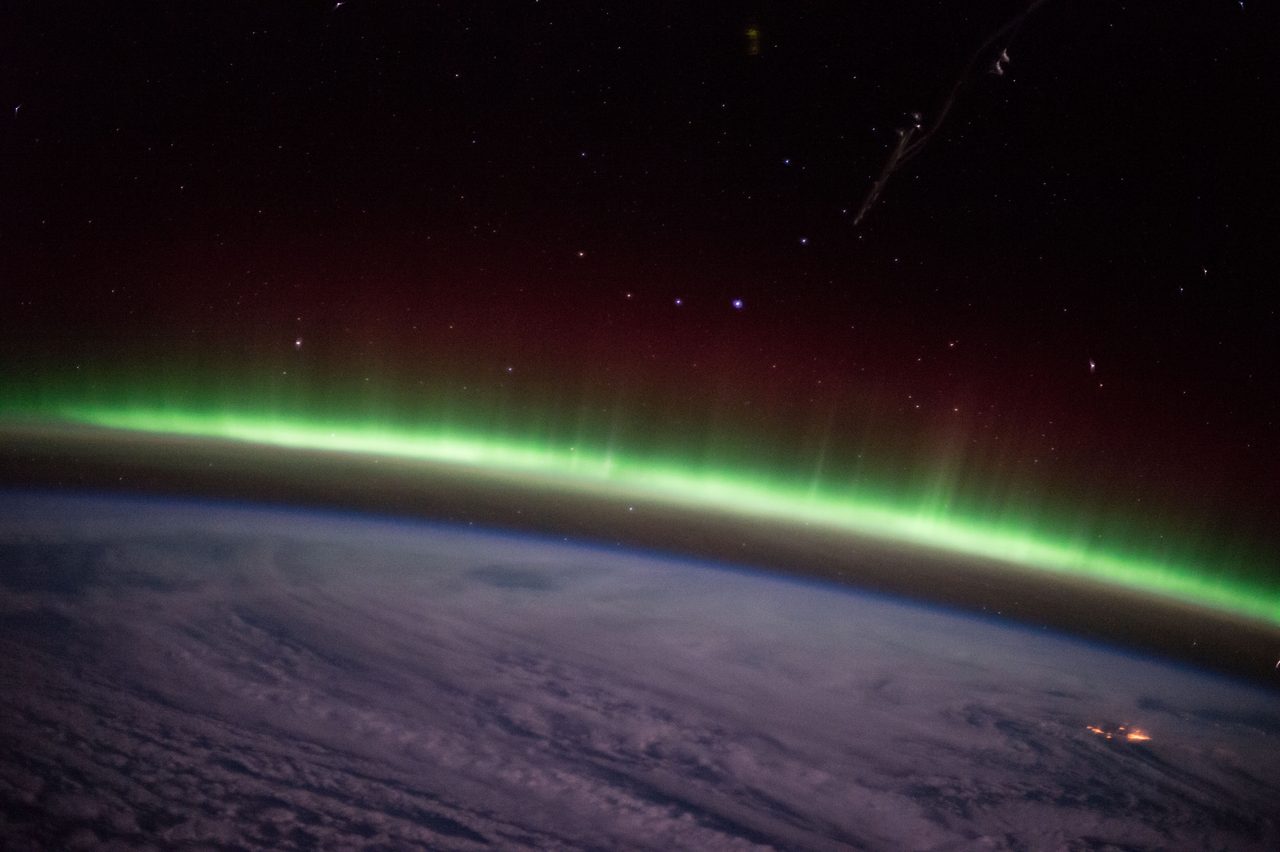
About 42,000 years ago Earth's magnetic field came close to failing. The dipole that organises it collapsed, the strength fell to roughly 5 to 6 percent of its present value at the deepest point, and the magnetic pole wandered into southern latitudes before returning to where it started. That much is measured: the lava carries the direction and the date, and the ice carries the two cosmogenic isotopes that record how thin the shield became. What it did to the living world is a different matter. A 2021 paper argued the event reshaped Neanderthals, megafauna and the origin of cave art, and drew two formal published rebuttals inside a year. This is the file on the Laschamp excursion, opened claim by claim, each one wearing its evidence.
About 42,000 years ago, the thing that makes a compass work came apart. Not all at once, and not permanently, but far enough that for several centuries there was no single north to point at. Earth's magnetic field fell to a small fraction of its present strength, the neat two-pole geometry that normally organises it broke into a scatter of competing poles, and the shield that turns aside most of the cosmic radiation arriving from space thinned badly. Lava in France recorded it. Ice in Greenland and Antarctica recorded it. Almost none of that is disputed. What is argued about, sometimes sharply, is what the event did to the living world above it. Let's open the file.
01The Word For What This Was
The title of this article says the poles nearly flipped, and the word nearly is doing real work. There is a technical distinction underneath it, and everything that follows depends on getting it right at the start rather than letting a headline blur it.
A geomagnetic reversal is a complete swap: magnetic north and magnetic south change places, the dipole field turning through 180 degrees. These are not rare in deep time. 183 of them are recorded in the last 83 million years, in the sequence geologists call the geomagnetic polarity timescale. Over the last 5 million years the average interval between reversals runs to roughly 200,000 to 300,000 years, but the average conceals how irregular the process is, with gaps ranging from about 10,000 years to millions of years. The transition itself typically takes 1,000 to 10,000 years. The last completed reversal, the Brunhes-Matuyama, was approximately 780,000 years ago. The evidence comes from three independent directions: thermoremanent magnetization locked into cooling volcanic rock, the symmetric magnetic stripes on the ocean floor, and continuous sedimentary records.
An excursion is not a reversal, and our research file's own table is explicit about the two things that separate them: an excursion is shorter, and the field returns to its original polarity instead of completing the swap. What happens during one is still dramatic. The dipole collapses, and the non-dipole or multipolar components of the field take over, which produces multiple simultaneous magnetic poles and a complex, disorganised field geometry. Strength during an excursion typically runs at 10 to 25 percent of normal, and sometimes as low as 5 to 6 percent. Laschamp is catalogued in that same table as an excursion. It is not a reversal, and this article will not call it one.
What earns the word nearly is a specific measured fact. During the excursion the Virtual Geomagnetic Pole, the position the pole would occupy if the field were behaving as a clean dipole, briefly reached southern latitudes. The pole went most of the way over, and then it came back. That is a partial polarity swap rather than a completed one, and it is the whole of what nearly means here.
02The Numbers, And Their Error Bars
Two figures do most of the work in every retelling of this event: 42,000 years ago, and 6 percent. Both are close to right. Neither is a single measurement, and the honest version of each is a range.
The event is dated by uranium-thorium measurements on the Laschamp lava flows in the Massif Central in France, which give approximately 41,400 years before present with a stated uncertainty of 2,000 years. The main excursion lasted approximately 800 years, sitting inside a transitional period of instability of approximately 1,500 years. In round terms this is an event a few centuries long, inside an unsettled window of about a millennium and a half.
Independent framings of the same event set the boundaries slightly differently, and the difference is instructive rather than troubling. A synthesis of the primary paleomagnetic literature runs the fully reversed interval from approximately 42,200 to 41,500 years ago, with the reversed state persisting roughly 440 years and transitions of roughly 250 years on either side of it. Separately, the relative synchronization of the Greenland and Antarctic ice-core records around the 41,000 year beryllium-10 peak, published by Raisbeck and colleagues in 2017, achieves a precision of about 20 years. That last figure is easy to misuse and worth pinning down: it is the precision with which two ice cores can be lined up against each other, not the absolute age uncertainty of the event, and it does not replace the lava dating's plus or minus 2,000 years. Different methods here are measuring different things with different uncertainty structures, and naming both is more honest than picking one.
The field-strength figure behaves the same way. Our research file's headline number is approximately 6 percent of the present value, consistent with its general excursion band of 10 to 25 percent dropping sometimes to 5 or 6. An independent framing gives a minimum of about 5 percent during the transition itself, recovering to about 25 percent during the brief reversed phase before the field returned fully to normal polarity. Those are not contradictory pictures. They describe a very deep minimum during the transition and a partial recovery while the field was briefly reversed. So the defensible statement is roughly 5 to 6 percent at the deepest point, not 6 percent presented as a single measurement with no error bar.
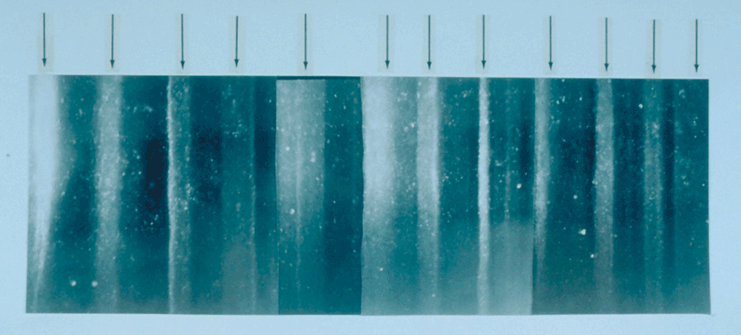
The strength estimate does not come from the lava. It comes from what a weakened field lets through. When the shield thins, more cosmic radiation reaches the atmosphere and produces more cosmogenic isotopes, and two of them spike together in ice cores at approximately 42,000 years before present: beryllium-10 and chlorine-36. The production rate of radiocarbon spiked at the same time, which has a practical consequence worth naming. Standard radiocarbon dating of material from this exact window is complicated by the event itself.
| Measure | What The Evidence Gives |
|---|---|
| Classification | An excursion, not a reversal: the field returned to its original polarity |
| When | Approximately 41,400 years before present, uncertainty 2,000 years, by uranium-thorium dating of the Laschamp lava flows |
| An Independent Framing | The fully reversed interval running from approximately 42,200 to 41,500 years ago |
| Duration | Approximately 800 years for the main excursion, inside an unstable transition of approximately 1,500 years |
| Field Strength | Roughly 5 to 6 percent of the present value at the deepest point, recovering to about 25 percent during the brief reversed phase |
| Pole Position | The Virtual Geomagnetic Pole briefly reached southern latitudes, a partial swap |
| Isotope Record | Beryllium-10 and chlorine-36 spikes in ice cores at approximately 42,000 years before present; radiocarbon production spiked as well |
| Where It Was First Seen | Reversely magnetized lava flows at Laschamp and Olby, Massif Central, France |
| Discovery | Bonhommet and Babkine, 1967 |
03How Any Of This Came To Be Known
The Laschamp excursion was found late, and it could only be found at all because a much older argument had already been won.
Bernard Brunhes recognised reversed magnetization in Pliocene lava flows near Clermont-Ferrand in France in 1906, and was met with scepticism. Motonori Matuyama demonstrated in 1929 that reversed magnetization in Japanese and Korean basalts correlated systematically with geological age, which turned an oddity into a pattern. The decisive step came in 1963, when the Vine-Matthews-Morley hypothesis explained the symmetric magnetic stripes flanking mid-ocean ridges as a seafloor-spreading record of polarity reversals. That single explanation confirmed two things at once: plate tectonics, and the reality of geomagnetic reversal.
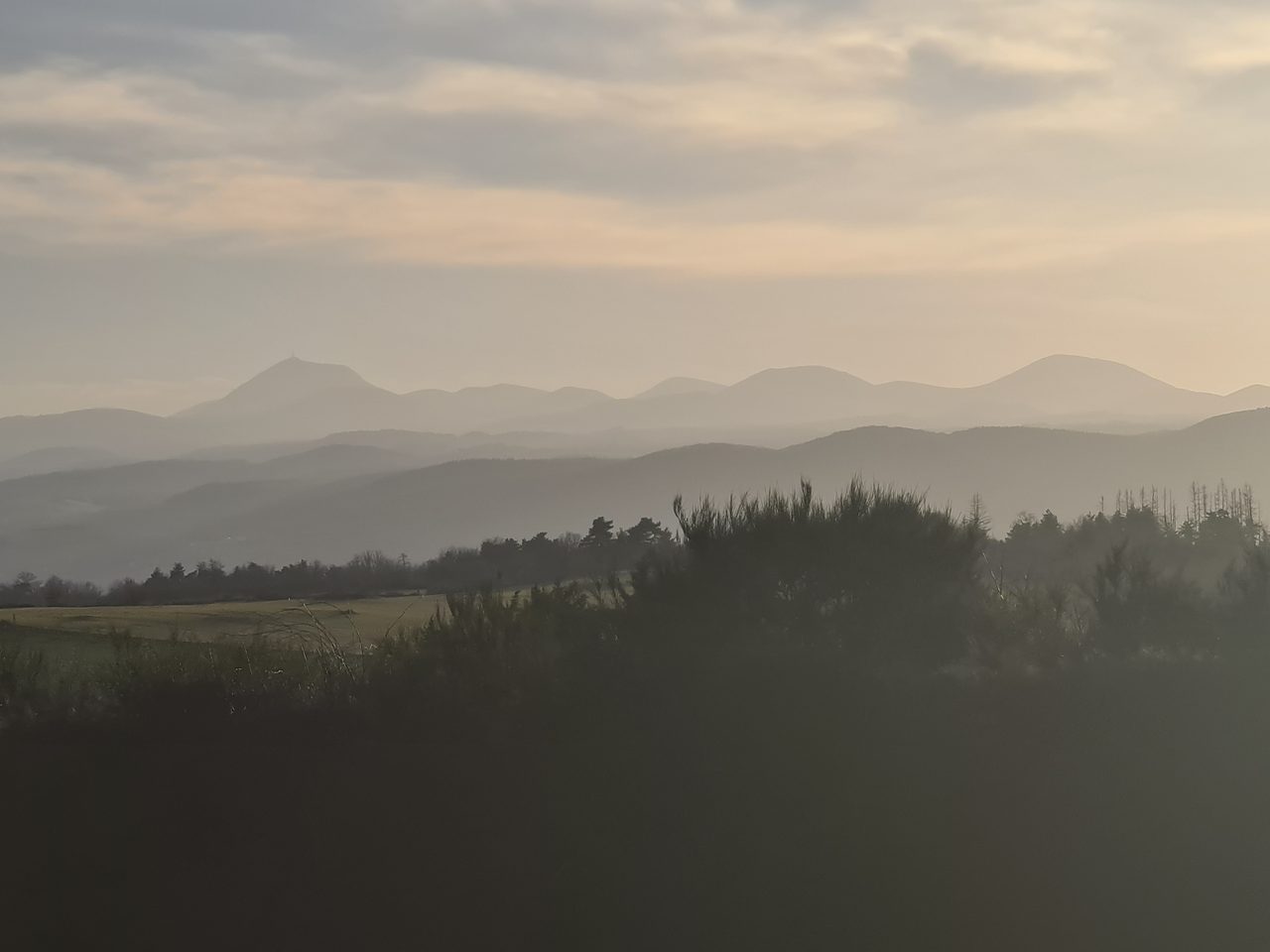
Laschamp itself was identified in 1967, when Bonhommet and Babkine found reversely magnetized lava flows at Laschamp and Olby in France. Those two place names are the excursion's whole provenance: a set of rocks in the Massif Central that had cooled while the field was pointing somewhere it should not have been.
The field they were reading is produced by the geodynamo, the convective motion of liquid iron in Earth's outer core. Reversals are not driven by anything external, and they are not periodic. They are a statistical consequence of the core's own chaotic dynamics. The strongest support for that is computational: numerical geodynamo simulations, notably Glatzmaier and Roberts in 1995 and Kuang and Bloxham in 1997, generate self-sustaining magnetic fields that spontaneously reverse polarity with no trigger applied at all. Earth's solid inner core, radius approximately 1,220 kilometres, grows by about 1 millimetre a year, and the latent heat and compositional buoyancy released by that growth help keep the whole system running.
Laschamp is the best documented excursion, but it is not the only one. Our research file's own table lists four others, and one of them may not be separate from Laschamp at all.
| Excursion | Approximate Date | Approximate Duration | Note |
|---|---|---|---|
| Gothenburg | 13,000 years before present | 1,000 years | Debated: it may not be a genuine excursion at all |
| Mono Lake | 34,000 years before present | 2,000 years | Some researchers consider it part of the same instability episode as Laschamp |
| Norwegian-Greenland Sea | 65,000 years before present | 2,000 years | Recorded in marine sediments |
| Blake | 120,000 years before present | 5,000 years | Recorded in North Atlantic sediments |
04The Adams Event
Everything above is the geophysics, and the geophysics is not where the argument is. The argument starts the moment the excursion is asked to explain something.
In February 2021, Alan Cooper and 31 co-authors published a paper in Science proposing that the Laschamp excursion drove a cascade of environmental and biological consequences around 42,000 years ago. They named it the Adams Event, after Douglas Adams and the number 42. The proposed cascade is expansive: Neanderthal extinction, by way of ultraviolet-driven habitat stress and a resulting competitive disadvantage against Homo sapiens; decline of the Australian megafauna, through vegetation stress from ultraviolet exposure and climate change; an explosion of cave art in Europe and Southeast Asia, on the reasoning that increased ultraviolet drove people into caves and the art followed as a cultural adaptation; an increase in ochre pigment use, proposed as ultraviolet-protective body paint; stratospheric ozone depletion; and broader disruption of climate and wind patterns.
This is not a thin paper, and nothing that follows should be read as saying it is. Its backbone is a high-resolution radiocarbon record built from preserved New Zealand kauri trees, Agathis australis, that grew across the excursion, and its atmospheric-chemistry modelling argues that the critical factor was not the weakened magnetic field on its own but its combination with a concurrent Grand Solar Minimum. That is a real mechanism, proposed with real data behind it. What follows is what happened to it.
05What Happened To It
Within nine months the paper had drawn two formal published Comments in the same journal, from two independent groups, and our own research file carries a careful list of criticisms besides. This is where the article stops being geophysics and becomes an open dispute. It is carried here unresolved, because that is what it is.
Our research file's criticism section lists five problems, and it is worth noting that it presents them at the same tier as the claim itself. First, correlation is not causation: a number of events cluster around 42,000 years before present without any established causal mechanism connecting them. Second, Neanderthal population decline was already underway from roughly 50,000 years before present, with multiple contributing factors, climate, competition with Homo sapiens, and genetic bottlenecks, all predating Laschamp. Third, the ultraviolet and ozone-depletion modelling depends heavily on assumptions about solar activity, and some atmospheric models suggest any real effect would be regional rather than global. Fourth, cave-art dating is itself contentious, and the apparent explosion may partly reflect which dating methods happened to be available rather than a genuine behavioural spike. Fifth, several confounding events sit in the same window regardless of geomagnetism: Heinrich Event 4 in the North Atlantic, and the Campanian Ignimbrite eruption around 39,000 years before present. The file's own summary judgment is that the hypothesis has been influential but not universally accepted.
On 19 November 2021, Science published a Comment by John Hawks of the Department of Anthropology at the University of Wisconsin-Madison. His argument is about the handling of sources rather than about geophysics: that Cooper and colleagues misrepresent both the underlying data and the published interpretations of the extinction and cultural-change literature they cite, which leaves several of their specific claims about Neanderthal extinction and megafaunal decline unsupported as stated.
The same issue carried a second, independent Comment from a notably senior list of Paleolithic archaeologists and paleoanthropologists: Picin, Benazzi, Blasco, Hajdinjak, Helgen, Hublin, Rosell, Skoglund, Stringer and Talamo. Their objections are specific. More recent dating work shows Australian megafauna survived well beyond the extinction window Cooper and colleagues proposed. Neanderthals had already weathered harsher climate shifts earlier in their history, and more plausibly succumbed to competitive pressure from expanding Homo sapiens populations than to a geomagnetic or ultraviolet mechanism. And figurative cave art appears in multiple regions well before the Laschamp excursion, which undermines a causal explosion narrative tied specifically to 42,000 years before present. Their stated conclusion is that Cooper and colleagues "failed to provide convincing explanatory mechanisms," and that the claimed chronological coincidence is "highly questionable."
Cooper and colleagues published a formal Response in the same issue of Science, defending their original interpretation. Nothing was withdrawn, nothing was conceded, and the exchange did not resolve into consensus. As for how the wider field received it, this article can only report rather than measure: most archaeologists and paleogeneticists working on the Late Pleistocene are reported to treat the strongest Adams Event claims about Neanderthal and megafaunal extinction as not established. That is a secondary characterisation of the reception rather than a citation study, and it is offered here as reported reception, not as a measured fact.
One independent study since then bears directly on the Neanderthal strand. Djakovic, Key and Soressi published a paper in Scientific Reports in 2022 applying optimal linear estimation to the regional dating record for France and northern Spain, and modelled 1,400 to 2,900 years of overlap between Homo sapiens and Neanderthals before the latter disappeared. A window of that length fits a gradual, demographically driven disappearance considerably better than it fits a single abrupt replacement triggered at 42,000 years before present.
| Paper | Position |
|---|---|
| Cooper and 31 co-authors, Science, February 2021 | The Laschamp excursion, combined with a concurrent Grand Solar Minimum, drove a global environmental crisis: Neanderthal extinction, megafaunal decline, a cave art explosion, increased ochre use |
| Hawks, Science, November 2021 | Cooper and colleagues misrepresent the data and the published interpretations they cite; several specific extinction claims are unsupported as stated |
| Picin, Benazzi, Blasco, Hajdinjak, Helgen, Hublin, Rosell, Skoglund, Stringer and Talamo, Science, November 2021 | Megafauna survived past the proposed window, Neanderthals had survived harsher climate shifts before, and cave art predates the excursion in several regions |
| Cooper and co-authors, Response, Science, November 2021 | The original interpretation is defended; the exchange closed without consensus |
| Djakovic, Key and Soressi, Scientific Reports, 2022 | 1,400 to 2,900 modelled years of overlap between the two species in France and northern Spain, favouring a gradual disappearance |
06The Objection Already In Our Own Library
There is one more piece of counter-evidence, and it does not come from the published exchange at all. It comes from another file on our own shelves, one that our Laschamp file names as a supporting cross-reference without appearing to have read it.
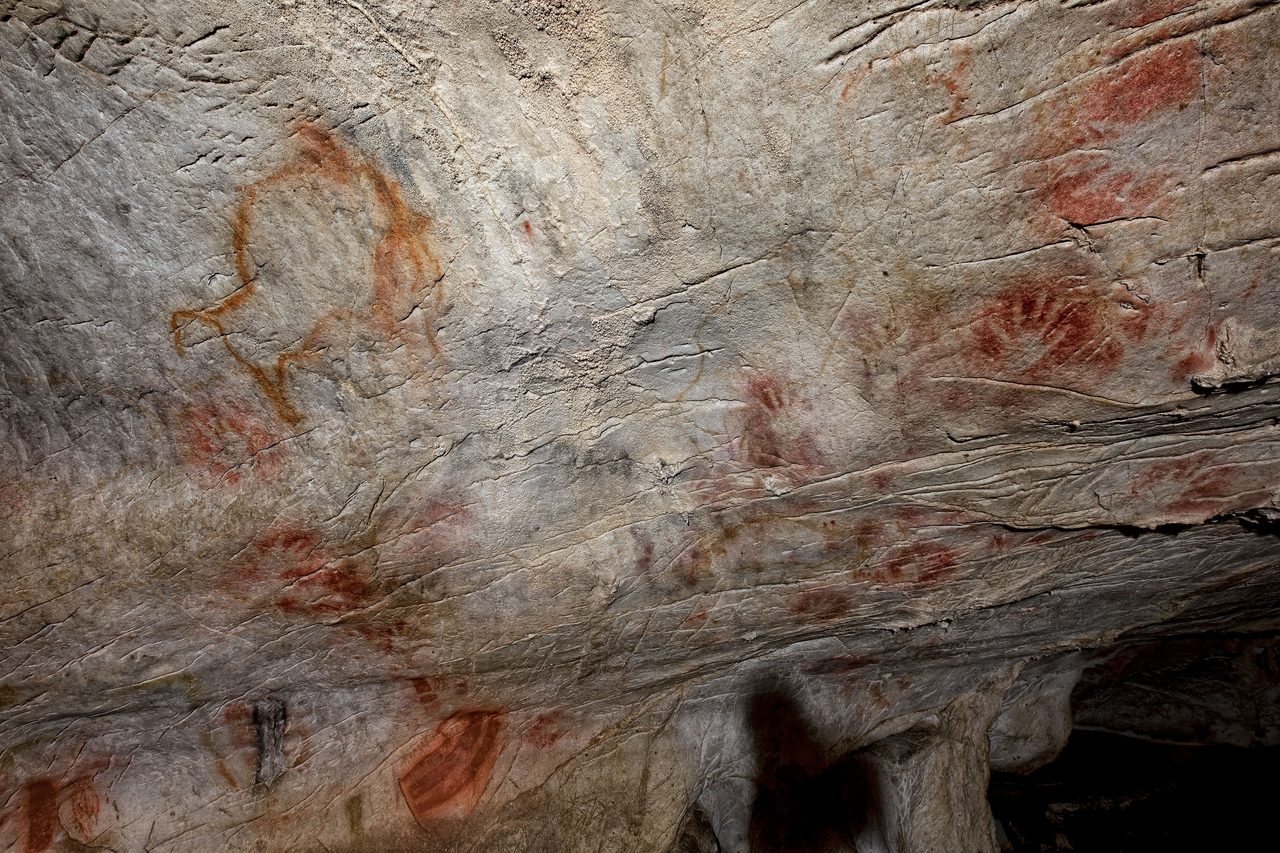
Our research file on Neanderthal cognition carries, at its own top tier, dates that are hard to reconcile with cave art and ochre use as new behaviours triggered by an ultraviolet crisis at 42,000 years before present. Hoffmann and colleagues used uranium-thorium dating on the carbonate crusts overlying cave art at three Spanish sites and published the result in Science in 2018: a red linear motif at La Pasiega dated to more than 64,800 years, a hand stencil at Maltravieso to more than 66,700 years, and red ochre applications at Ardales to more than 65,500 years. Modern humans did not reach Iberia until approximately 42,000 to 45,000 years before present, which makes the artists Neanderthals. Separately, Zilhão and colleagues dated painted, perforated marine-shell ornaments carrying deliberate red and yellow ochre pigment to approximately 115,000 to 120,000 years ago, and Radovčić and colleagues dated deliberately modified eagle-talon jewellery at Krapina in Croatia to approximately 130,000 years ago. All Neanderthal. All tens of thousands of years before Laschamp.
That evidence deserves the same discipline this article applies to Cooper and colleagues, because it is disputed too. White and Pettitt, named in our own cognition file, question whether the uranium-thorium-dated carbonate crusts are in direct stratigraphic association with the paint layers beneath them. The Hoffmann dates were separately challenged in a formal published Comment in Science, from Slimak and colleagues, which drew a Response in turn. What that Comment argues in detail is not summarised here: this article has verified that the exchange exists, not read it. What the exchange does establish is that the Iberian dates are contested on methodological grounds, by named researchers, in the journal that published them. That dispute is live and unresolved. What survives it is the shape of the problem: if symbolic pigment use and wall marking were already in the Neanderthal repertoire long before the excursion, then a 42,000 year trigger is being asked to explain the appearance of something that was already there. That is the same objection Picin and colleagues raised independently, from the archaeological literature.
Two bookkeeping notes about our own file, since a file that grades other people's evidence should be willing to be graded. Its cross-reference index lists the Neanderthal cognition document as support for the Laschamp and Neanderthal extinction correlation, but that document contains no mention of Laschamp, the Adams Event, or geomagnetism anywhere in it, and what it does contain works against a different strand of the same hypothesis. And its counter-arguments section states that no significant counter-arguments exist in the scholarly literature and that there is no active scholarly dispute over the claims it presents. That is not true of the Adams Event material. It is contradicted by the file's own criticism section one page earlier, to say nothing of two formal Comments in Science. This article follows the file's better section and disregards the boilerplate.
07Reversals, Excursions, And The Fossil Record
Step back from the Adams Event and ask the general question instead. Across the whole of the geological record, what have magnetic reversals actually done to life? The answer runs close to the opposite of what the popular framing expects.
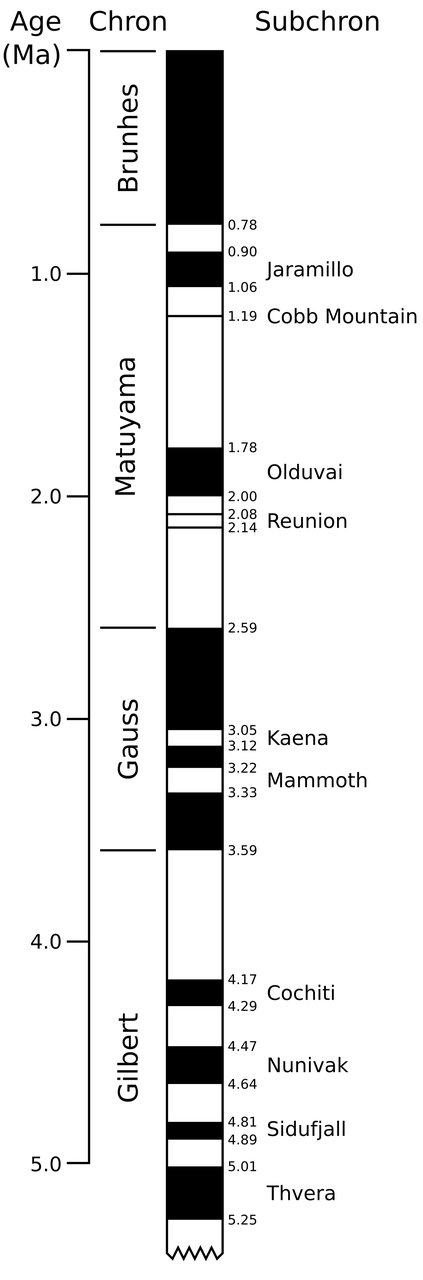
No clear mass extinction correlates with any known magnetic reversal anywhere in the Phanerozoic geological record. Our research file states that at its top tier, alongside its own table of plausible mechanisms: increased cosmic radiation at the surface, ozone depletion, elevated radiocarbon production, and aurora visible at low latitudes. The mechanisms are real. The consequence those mechanisms are usually assumed to produce is not in the record. Whatever biological effects reversals and excursions have, they appear to be subtle rather than catastrophic.
Studies have gone looking for a statistical link between reversal frequency and mass extinction anyway. Some weak correlations have been reported, and none of them are statistically robust. The sharpest argument against the link is a natural experiment: the Cretaceous Normal Superchron, approximately 84 to 124 million years ago, is a span of roughly 40 million years with essentially no reversals at all, and it did not produce notably lower extinction rates. The consensus our file reports is that magnetic reversals alone are not sufficient to cause mass extinctions, though they may act as amplifying stressors in combination with other factors.
08The Field We Have Now
The reason any of this is more than paleomagnetic housekeeping is that the present field is weakening, and there is a large weak patch in it that people watch.
The South Atlantic Anomaly is centred around 28 degrees south, 45 degrees west, and the field there is approximately 30 percent weaker than it should be for that latitude. It is growing, and drifting westward at approximately 0.3 to 0.5 degrees per year. It already has practical consequences: satellites and International Space Station crew take measurably more radiation passing through it. The global dipole moment has decreased by approximately 9 percent since 1840, when the first reliable measurements were made, and at that rate the dipole would reach zero in roughly 1,500 to 2,000 years. Our file rates all of this speculative for good reasons. The decline may be oscillatory rather than the beginning of anything. Prediction is explicitly not possible, because the geodynamo is chaotic and no method reliably forecasts the timing of the next reversal. And the intuition gets pulled the other way too: the current normal-polarity interval, the Brunhes, has run 780,000 years and counting against an average interval of 200,000 to 300,000 years, so by that comparison the present interval is already unusually long, which in a chaotic system forecasts nothing at all.
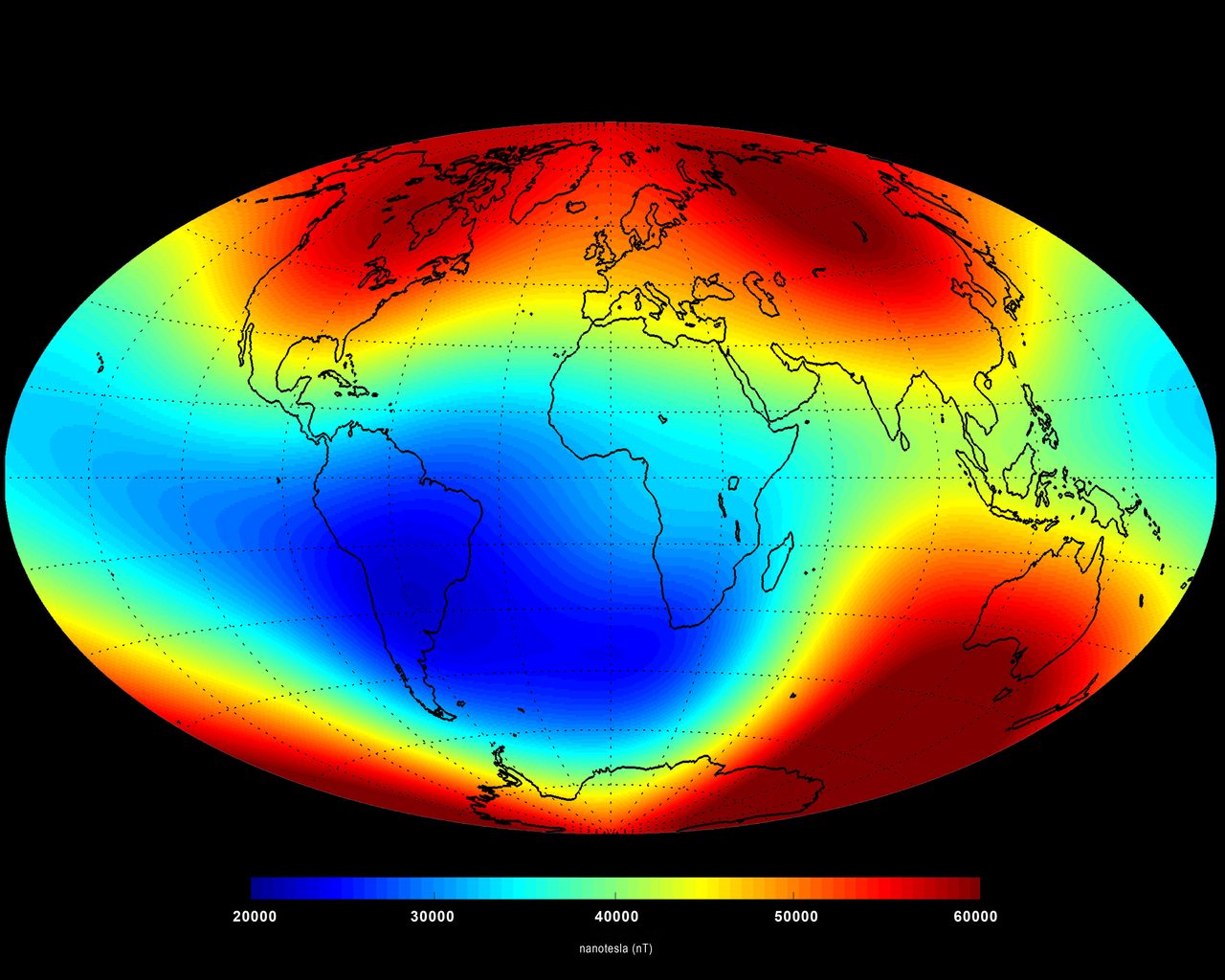
What a genuine excursion or reversal would cost a technology-dependent civilisation is speculative in the same way, and our file is explicit that it is. Increased energetic-particle flux would accelerate degradation of satellite solar panels and electronics and raise the rate of single-event upsets. A weakened background field would let ordinary geomagnetic storms produce stronger ground-level effects on power grids, the reference cases being the 1989 Quebec blackout and the 1859 Carrington Event. Aircrew and passengers on polar routes would take more cosmic radiation. High-frequency radio and the ionosphere would be disrupted. Magnetic compasses would become unreliable during an actual reversal, though GPS would not be affected. Organisms that navigate magnetically, birds, sea turtles and cetaceans among them, might be affected if ozone depletion raised surface ultraviolet. Two things keep this short of a disaster scenario. A transition takes 1,000 to 10,000 years, which is less an event than a condition, and there is time to adapt inside it. And the current weakening already produces measurable satellite and radiation effects today, without anything having gone wrong.
09Where The Claims Run Past The Evidence
A real event with a genuinely dramatic shape attracts claims that are not real at all, and our file's own bottom tier names three of them.
No, a pole shift is not about to destroy civilisation. Popular imminent pole shift material predicts earthquakes, tsunamis and collapse within years, and it works by conflating two entirely different things: the real, gradual magnetic reversal process, which takes 1,000 to 10,000 years, and a rapid shift of the geographic poles, which is physically impossible on human timescales because Earth's rotational axis is extremely stable. Charles Hapgood's Earth crust displacement theory, which Einstein endorsed, is often recruited here, but it was written before plate tectonics was understood, it describes crustal movement rather than magnetic reversal, and it is not supported by modern geophysics.
No, nobody engineered this. Claims that ancient or extraterrestrial civilisations could deliberately control Earth's magnetic field have no supporting evidence whatsoever. The energy required to meaningfully influence the geodynamo is on the order of the entire rotational kinetic energy of Earth's core. This is not a weak claim that might firm up later. It is a claim with no basis in physics.
No, and 2012 was not it either. The Mayan apocalypse phenomenon was sometimes linked to a claimed imminent magnetic reversal. No reversal occurred, none was imminent, and the end-date of the Maya Long Count calendar had no geophysical significance of any kind.
Fast Facts
- The Event
- The Laschamp excursion: a geomagnetic excursion, not a reversal
- When
- Approximately 41,400 years before present, uncertainty 2,000 years, by uranium-thorium dating; an independent framing runs the reversed interval from 42,200 to 41,500 years ago
- Duration
- Approximately 800 years for the main excursion, inside an unstable window of approximately 1,500 years
- Field Strength
- Roughly 5 to 6 percent of present strength at the deepest point
- What The Pole Did
- The Virtual Geomagnetic Pole briefly reached southern latitudes, then the field returned to its original polarity
- How It Is Measured
- Uranium-thorium dating of lava at Laschamp and Olby in France, plus beryllium-10 and chlorine-36 spikes in ice cores
- Discovered
- Bonhommet and Babkine, 1967
- The Contested Part
- The Adams Event: Cooper and 31 co-authors, Science, 2021, proposing Neanderthal extinction, megafaunal decline, a cave art explosion and increased ochre use as consequences (Tier 2, contested)
- Formal Rebuttals
- Two independent Comments in Science, November 2021, from Hawks and from Picin and nine co-authors, plus a Response from Cooper and colleagues; unresolved (Tier 2)
- Reversals And Extinction
- No clear mass extinction correlates with any known magnetic reversal in the Phanerozoic record (Tier 1)
- The Field Today
- The South Atlantic Anomaly, about 30 percent weaker than expected for its latitude and growing; the dipole down about 9 percent since 1840 (Tier 3, and not a prediction)
What We Can Actually Stand Behind
The excursion is real, dated and measured. Approximately 41,400 years before present, give or take 2,000, the geomagnetic field collapsed to roughly 5 to 6 percent of its present strength at the deepest point, the dipole broke down into a multipolar field with multiple simultaneous poles, and the Virtual Geomagnetic Pole travelled into southern latitudes before the field recovered its original polarity. The main excursion ran about 800 years inside an unstable window of about 1,500. Two independent materials carry it, the lava and the ice. The reversely magnetized flows at Laschamp and Olby give the direction, and uranium-thorium dating of those same flows gives the age; the ice cores are the separate line, with beryllium-10 and chlorine-36 spiking together at approximately 42,000 years before present. This part of the story is ordinary, well-behaved geophysics, and it is the spine of the article.
And the general case is settled in the direction most people would not guess. No clear mass extinction correlates with any known magnetic reversal anywhere in the Phanerozoic record. The mechanisms a weak field permits are real, but whatever biological effect reversals and excursions have has been subtle rather than catastrophic.
Whether Laschamp caused a global environmental crisis is genuinely open, and this article does not close it. Cooper and his co-authors made a serious case in Science in 2021, built on a New Zealand kauri radiocarbon record and atmospheric modelling in which the excursion combined with a concurrent Grand Solar Minimum. It drew two independent formal Comments in the same journal inside nine months, arguing that Australian megafauna survived past the proposed window, that Neanderthal decline was already underway from roughly 50,000 years before present and better explained by competition with Homo sapiens, and that cave art predates the excursion in several regions. Cooper and colleagues published a Response and defended the paper. Nothing was withdrawn and nothing was conceded. Our own file's criticism section adds confounders in the same window, Heinrich Event 4 and the Campanian Ignimbrite eruption, that have nothing to do with geomagnetism. No reader should leave this page thinking the Neanderthal, megafauna, cave art and ochre cascade is established, and none of it inherits the Tier 1 confidence of the geophysics above it.
The South Atlantic Anomaly, the roughly 9 percent decline in the dipole since 1840, and what a reversal would do to satellites, power grids and polar flight routes all sit at the speculative tier and belong there. The decline may be oscillatory. The geodynamo is chaotic and no method reliably predicts the next reversal. The same tier holds the search for a statistical link between reversal frequency and extinction, where the reported correlations are weak and the Cretaceous Normal Superchron argues against the link outright.
No, Laschamp was not a reversal. The field returned to the polarity it started with, and that return is the defining property separating an excursion from a reversal. This article's title says the poles nearly flipped, and nearly is load-bearing: the pole reached southern latitudes and came back.
No, an imminent pole shift is not going to end civilisation. That claim conflates a gradual magnetic reversal, which takes 1,000 to 10,000 years, with a rapid shift of the geographic poles, which is physically impossible on human timescales. Hapgood's crust displacement theory describes something else entirely and is not supported by modern geophysics.
No, no civilisation ancient or otherwise engineered any of this, and 2012 was not a magnetic reversal. The energy needed to meaningfully influence the geodynamo is on the order of the entire rotational kinetic energy of Earth's core, and the end of the Maya Long Count had no geophysical significance whatsoever.
What is left when the argument is set aside is still remarkable. For a few centuries about 42,000 years ago, the planet's magnetic shield very nearly failed, a compass would have had no single answer, and the cosmic radiation reaching the atmosphere rose enough to leave a double isotope spike in ice thousands of kilometres away. That is measured, and it is not in dispute. What it did to the people and animals living underneath it is a different question, and the honest answer is that we do not know. The strongest attempt to say otherwise drew two formal rebuttals inside a year, and the strongest counter-evidence, that Neanderthals were already painting and using pigment tens of thousands of years earlier, is itself contested on dating grounds. Which leaves the question the whole file circles without closing. If a field collapse this severe left no legible signature in the fossil record, and no clear extinction anywhere in the Phanerozoic follows a reversal, what would a geomagnetic event actually have to do to the biosphere before we could read it in the rock at all?
Sources & further reading
Everything above is drawn from our research library on Theories of Anything. Three things about the sourcing are worth stating in the open. Our file's citation for Bonhommet and Babkine's 1967 discovery paper, the paper that found the excursion in the first place, carries a DOI that resolves to an entirely unrelated 1991 archaeology paper about Roman military presence in Tunisia, in a different journal; the 1967 paper predates DOIs, so it is cited here by name and not linked. Our file's citation for Raisbeck and colleagues carried a DOI pointing at a referee report on the manuscript rather than at the published article, and the corrected identifier for the published paper is used below. And the paper this whole argument turns on, Cooper and colleagues 2021, is listed in our file with no DOI at all; the verified one is supplied below. None of those are content errors, but a file that grades evidence should itself be checkable. Open the full file to check the sourcing and go deeper.
Image credits
- Aurora borealis over the North Atlantic from the ISS, 9 December 2014 NASA / Samantha Cristoforetti, Expedition 42, via Wikimedia Commons. Public domain Source.
- Panorama of the Chaine des Puys, Massif Central Anthony Baratier, via Wikimedia Commons. CC BY-SA 4.0 Source.
- GISP2 ice core section from 1,855 metres, annual layers marked National Oceanic and Atmospheric Administration, via Wikimedia Commons. Public domain Source.
- Hand-stencil panel, El Castillo Cave, Cantabria Gabinete de Prensa del Gobierno de Cantabria, via Wikimedia Commons. CC BY 3.0 ES Source.
- Earth's magnetic field strength from Swarm, June 2014 ESA / DTU Space, via Wikimedia Commons. Public domain Source.
- Geomagnetic polarity timescale, late Cenozoic U.S. Geological Survey, Open-File Report 03-187, vectorized by Commons user Intgr. Public domain Source.
- Card crop of Aurora borealis over the North Atlantic from the ISS, 9 December 2014 NASA / Samantha Cristoforetti, Expedition 42, via Wikimedia Commons. Public domain Source.


